Accounting Principle 6th Edition Weygandt Test Bank
Accounting Principle 6th Edition Weygandt Test Bank
Accounting Principle 6th Edition Weygandt Test Bank
Accounting Principle 6th Edition Weygandt Test Bank
Accounting Principle 6th Edition Weygandt Test Bank
1.
Download the fullversion and explore a variety of test banks
or solution manuals at https://testbankfan.com
Accounting Principle 6th Edition Weygandt Test
Bank
_____ Tap the link below to start your download _____
https://testbankfan.com/product/accounting-principle-6th-
edition-weygandt-test-bank/
Find test banks or solution manuals at testbankfan.com today!
2.
We believe theseproducts will be a great fit for you. Click
the link to download now, or visit testbankfan.com
to discover even more!
Financial Accounting 6th Edition Weygandt Test Bank
https://testbankfan.com/product/financial-accounting-6th-edition-
weygandt-test-bank/
Financial Accounting 6th Edition Weygandt Solutions Manual
https://testbankfan.com/product/financial-accounting-6th-edition-
weygandt-solutions-manual/
Managerial Accounting Tools for Business Decision Making
6th Edition Weygandt Test Bank
https://testbankfan.com/product/managerial-accounting-tools-for-
business-decision-making-6th-edition-weygandt-test-bank/
Principles of Economics 8th Edition Marshall Test Bank
https://testbankfan.com/product/principles-of-economics-8th-edition-
marshall-test-bank/
3.
Media Essentials 4thEdition Campbell Test Bank
https://testbankfan.com/product/media-essentials-4th-edition-campbell-
test-bank/
Hands-On Ethical Hacking and Network Defense 1st Edition
Simpson Test Bank
https://testbankfan.com/product/hands-on-ethical-hacking-and-network-
defense-1st-edition-simpson-test-bank/
Managerial Economics Foundations of Business Analysis and
Strategy 11th Edition Thomas Test Bank
https://testbankfan.com/product/managerial-economics-foundations-of-
business-analysis-and-strategy-11th-edition-thomas-test-bank/
Marine Biology 10th Edition Castro Solutions Manual
https://testbankfan.com/product/marine-biology-10th-edition-castro-
solutions-manual/
Intermediate Statistics Using SPSS 1st Edition Knapp
Solutions Manual
https://testbankfan.com/product/intermediate-statistics-using-
spss-1st-edition-knapp-solutions-manual/
CHAPTER 10
CURRENT LIABILITIESAND PAYROLL
SUMMARY OF QUESTIONS BY STUDY OBJECTIVES AND BLOOM’S
TAXONOMY
Item SO BT Item SO BT Item SO BT Item SO BT Item SO BT
Exercises
1. 1 AP 6. 1 AP 11. 2 AP 16. 3 AN 21. 5 AN
2. 1 AP 7. 1,3,4 AN 12. 2 AP 17. 4 AP 22. 5 AN
3. 1 AP 8. 2 AP 13. 2,3,4 AN 18. 4 AP *23. 6 AP
4. 1 AP 9. 2 AP 14. 2,5 AP 19. 4 AP *24. 6 AP
5. 1 AP 10. 2 AP 15. 3 E 20. 5 AN *25. 6 AP
Note: AN = Analysis AP = Application E = Evaluation
6.
SUMMARY OF QUESTIONSBY LEVEL OF DIFFICULTY (LOD)
Item SO LOD Item SO LOD Item SO LOD Item SO LOD Item SO LOD
Exercises
1. 1 M 6. 1 M 11. 2 M 16. 3 M 21. 5 E
2. 1 E 7. 1,3,4 E 12. 2 H 17. 4 E 22. 5 E
3. 1 E 8. 2 E 13. 2,3,4 M 18. 4 E *23. 6 H
4. 1 M 9. 2 M 14. 2,5 H 19. 4 M *24. 6 M
5. 1 E 10. 2 M 15. 3 M 20. 5 M *25. 6 M
Note: E = Easy M = Medium H=Hard
7.
CHAPTER STUDY OBJECTIVES
1.Account for determinable or certain current liabilities. Liabilities are present
obligations arising from past events, to make future payments of assets or services.
Determinable liabilities have certainty about their existence, amount, and timing—in
other words, they have a known amount, payee, and due date. Examples of
determinable current liabilities include operating lines of credit, notes payable, accounts
payable, sales taxes, unearned revenue, current maturities of long-term debt, and
accrued liabilities such as property taxes, payroll, and interest.
2. Account for estimated liabilities. Estimated liabilities exist, but their amount or timing
is uncertain. As long as it is likely the company will have to settle the obligation, and the
company can reasonably estimate the amount, the liability is recognized. Product
warranties, customer loyalty programs, and gift cards result in liabilities that must be
estimated. They are recorded either as an expense (or as a decrease in revenue) or a
liability in the period when the sales occur. These liabilities are reduced when repairs
under warranty or redemptions occur. Gift cards are a type of unearned revenue as they
result in a liability until the gift card is redeemed. As some cards are never redeemed, it
is necessary to estimate the liability and make adjustments.
3. Account for contingencies. A contingency is an existing condition or situation that is
uncertain, where it cannot be known if a loss (and a related liability) will result until a
future event happens, or does not happen. Under ASPE, a liability for a contingent loss
is recorded if it is it likely a loss will occur and the amount of the contingency can be
reasonably estimated. Under IFRS, the threshold for recording the loss is lower. It is
recorded if a loss is probable. Under ASPE, these liabilities are called contingent
liabilities, and under IFRS, these liabilities are called provisions. If it is not possible to
estimate the amount, these liabilities are only disclosed. They are not disclosed if they
are unlikely.
4. Determine payroll costs and record payroll transactions. Payroll costs consist of
employee and employer payroll costs. In recording employee costs, Salaries Expense is
debited for the gross pay, individual liability accounts are credited for net pay. In
recording employer payroll costs, Employee Benefits Expense is debited for the
employer’s share of CPP, EI, workers’ compensation, vacation pay, and any other
deductions or benefits provided. Each benefit is credited to its specific current liability
account.
5. Prepare the current liabilities section of the balance sheet. The nature and amount
of each current liability and contingency should be reported in the balance sheet or in the
notes accompanying the financial statements. Traditionally, current liabilities are
reported first and in order of liquidity. International companies sometimes report current
liabilities on the lower section of the balance sheet and in reverse order of liquidity.
8.
6. Calculate mandatorypayroll deductions (Appendix 10A). Mandatory payroll
deductions include CPP, EI, and income taxes. CPP is calculated by multiplying
pensionable earnings (gross pay minus the pay period exemption) by the CPP
contribution rate. EI is calculated by multiplying insurable earnings by the EI contribution
rate. Federal and provincial income taxes are calculated using a progressive tax scheme
and are based on taxable earnings and personal tax credits. The calculations are very
complex and it is best to use one of the CRA income tax calculation tools such as payroll
deduction tables.
9.
EXERCISES
Exercise 1
Leung PropertiesCo. paid $5,600 for property taxes in the 2013 calendar year. In 2014, Leung
receives its property tax bill on May 1 for $6,200 which is payable on June 30, 2014.
Instructions
Calculate the prepaid or property taxes payable that Leung will report on its balance sheet if
Leung’s year end is
a. February 28, 2014
b. May 31, 2014
c. September 30, 2014
d. December 31, 2014.
Solution Exercise 1 (10 min.)
a. Property taxes payable ($5,600 x 2÷12)........................................ $ 933
b. Property taxes payable ($6,200 x 5÷12)........................................ $ 2,583
c. Prepaid property taxes ($6,200 x 3÷12) ........................................ $ 1,550
d. Both Prepaid property taxes and property taxes payable are ........ $ 0
Exercise 2
Chu Company billed its customers a total of $2,655,500 for the month of November. The total
includes 13% HST (Harmonized Sales Tax).
Instructions
a. Determine the proper amount of revenue to report for the month.
b. Prepare the general journal entry to record the revenue and related liabilities for the month.
Solution Exercise 2 (5 min.)
a. $2,655,500 ÷ 1.13 = $2,350,000 is the total sales revenue.
b. $2,350,000 × .13 = $305,500 is the HST (Harmonized Sales Tax) liability.
Journal Entry:
Accounts Receivable..................................................................... 2,655,500
Sales Revenue....................................................................... 2,350,000
HST Payable.......................................................................... 305,500
Exercise 3
On April 1, Hoadley Company borrows $90,000 from Northwest Provincial Bank by signing a 6-
month, 6%, interest-bearing note. Hoadley’s year end is August 31.
Instructions
Prepare the following entries associated with the note payable on the books of Hoadley
Company:
10.
a. The entryon April 1 when the note was issued.
b. Any adjusting entries necessary on May 31 in order to prepare the quarterly financial
statements. Assume no other interest accrual entries have been made.
c. The adjusting entry at August 31 to accrue interest.
d. The entry to record payment of the note at maturity.
Solution Exercise 3 (10 min.)
a. Apr 1 Cash ............................................................................. 90,000
Notes Payable........................................................ 90,000
b. May 31 Interest Expense ........................................................... 900
Interest Payable ..................................................... 900
($90,000 × 6% × 2÷12)
c. Aug 31 Interest Expense ........................................................... 1,350
Interest Payable ..................................................... 1,350
($90,000 × 6% × 3÷12)
d. Oct 1 Notes Payable............................................................... 90,000
Interest Payable ($900+$1,350) .................................... 2,250
Interest Expense ($90,000 x 6% x 1÷12)....................... 450
Cash....................................................................... 92,700
Exercise 4
Walters Accounting Company receives its annual property tax bill for the calendar year on
May1, 2015. The bill is for $32,000 and payable on June 30, 2015. Walters paid the bill on June
30, 2015. The company prepares quarterly financial statements and had initially estimated that
its 2015 property taxes would be $30,000.
Instructions
Prepare all the required journal entries for 2015 related to the property taxes.
Solution Exercise 4 (15 min.)
Mar 31 Property Tax Expense ($30,000 × 3÷12) ........................... 7,500
Property Tax Payable.................................................. 7,500
Jun 30 Property Tax Expense ($32,000 × 6÷12 - $7,500).............. 8,500
Property Tax Payable ........................................................ 7,500
Prepaid Property Tax ($32,000 x 6÷12) ............................. 16,000
Cash .......................................................................... 32,000
Sep 30 Property Tax Expense ($32,000 × 3÷12) ........................... 8,000
Prepaid Property Tax ................................................. 8,000
Dec 31 Property Tax Expense ($32,000 × 3÷12) ........................... 8,000
Prepaid Property Tax .................................................. 8,000
Exercise 5
11.
Elliott Company hadthe following transactions during March:
Mar 1 Purchased computer equipment by issuing a $15,000, 6-month, 8% note payable.
Interest is due at maturity.
Mar 5 Provided services to customers for $9,800 plus 5% GST; customers paid cash.
Mar 15 Purchased supplies on account from Grand and Toy for $3,500. Supplier terms are
2/10, n/30.
Mar 31 Paid the Grand and Toy account in full.
Instructions
a. Record the transactions.
b. Record any adjusting entries required at March 31 related to these liabilities.
Solution Exercise 5 (5 min.)
a.
Mar 1 Computer Equipment......................................................... 15,000
Note Payable (6 month) .............................................. 15,000
Mar 5 Cash………….................................................................... 10,290
GST Payable ($9,800 x 5%)........................................ 490
Service Revenue......................................................... 9,800
Mar 15 Supplies………. ................................................................. 3,500
Accounts Payable ....................................................... 3,500
Mar 31 Accounts Payable .............................................................. 3,500
Cash…......................................................................... 3,500
b.
Mar 31 Interest Expense ($15,000 x 8% x 1÷12) ........................... 100
Interest Payable.......................................................... 100
Exercise 6
During April 2014, DMZ Company incurred the following transactions. This is DMZ’s first period
of operations, and they plan to use the periodic method of accounting for inventory.
Apr 1 Purchased a new automobile for $36,500; the automobile was paid for with a 2-year
5% note payable. Interest is due monthly on the 1st day of each month and the
principal due as follows: 50% due in 1 year, the remainder due in 2 years.
Apr 5 Sold merchandise to Customer A on account for $72,000 plus 5% GST; terms n/30.
Apr 6 Customer A returns one-half of the merchandise purchased on Apr 5 and receives a
credit on account.
Apr 13 Customer A paid their account balance in full.
Apr 25 Sold merchandise to Customer B for $102,900 including 5% GST; terms n/30.
Apr 28 Received $22,000 from Customer C for services to be provided in May.
Apr 30 Recorded any adjusting entries required related to April transactions.
In addition to liabilities arising from the above transactions, DMZ’s Accounts Payable balance at
April 30, 2014 is $65,000.
12.
Instructions
a. Record theabove transactions.
b. Prepare the current liabilities portion of DMZ’s balance sheet at April 30, 2014.
Solution Exercise 6 (25 min.)
a.
Apr 1 Automobile…….................................................................. 36,500
Note Payable .............................................................. 36,500
Apr 5 Accounts Receivable – Customer A................................... 75,600
GST Payable (72,000 x 5%)........................................ 3,600
Sales Revenue............................................................ 72,000
Apr 6 Sales Returns and Allowances ($72,000 x ½).................... 36,000
GST Payable ($3,600 x ½)................................................. 1,800
Accounts Receivable – Customer A............................ 37,800
Apr 13 Cash ($75,600-37,800)...................................................... 37,800
Accounts Receivable – Customer A............................ 37,800
Apr 25 Accounts Receivable – Customer B................................... 102,900
GST Payable (102,900 x 5÷105)................................. 4,900
Sales Revenue............................................................ 98,000
Apr 28 Cash………….................................................................... 22,000
Unearned Revenue..................................................... 22,000
Apr 30 Interest Expense ($36,500 x 5% x 1÷12) ........................... 152
Interest Payable.......................................................... 152
b.
DMZ Company
Balance Sheet (partial)
April 30, 2014
Liabilities
Current liabilities
Accounts payable.......................................................................... 65,000
GST Payable ($3,600 – 1,800 + 4,900)......................................... 6,700
Interest payable............................................................................. 152
Unearned revenue ........................................................................ 22,000
Current portion of long term debt ($36,500 x ½)............................ 18,250
Total current liabilities ................................................................... $112,102
Exercise 7
Fiddler Music Company, which prepares annual financial statements, is preparing adjusting
entries on December 31. Analysis indicates the following:
1. The company is the defendant in an employee discrimination lawsuit involving $50,000 of
13.
damages. Legal counselbelieves it is unlikely that the company will have to pay any
damages.
2. December 31st is a Friday. The employees of the company have been paid on Monday,
December 27th for the previous week which ended on Friday, December 24th. The
company employs 30 people who earn $80 per day and 15 people who earn $120 per day.
All employees work 5-day weeks.
3. Employees are entitled to one day's vacation for each month worked. All employees
described above in 2. worked the month of December.
4. The company is a defendant in a $750,000 product liability lawsuit. Legal counsel believes
the company probably will have to pay the amount requested.
5. On November 1, Fiddler signed a $10,000, 6-month, 8% note payable. No interest has
been accrued to date.
Instructions
Prepare any adjusting entries necessary at the end of the year.
Solution Exercise 7 (12 min.)
1. No entry—loss is not likely.
2. Wages Expense............................................................................ 21,000
Wages Payable ...................................................................... 21,000
30 × $80 × 5 = $12,000
15 × $120 × 5 = 9,000
$21,000
3. Vacation Benefits Expense ........................................................... 4,200
Vacation Benefits Payable [(30 × $80) + (15 × $120)] ............ 4,200
4. Loss from Lawsuit ......................................................................... 750,000
Estimated Liability from Lawsuit ............................................. 750,000
5. Interest Expense ($10,000 × 8% × 2 ÷ 12) .................................... 133
Interest Payable ..................................................................... 133
Exercise 8
During the month of July, Toys to Go started a new promotion. The company offered to reward
their customers for all sales made on Barbie dolls or Toy Trucks during the month of July. For
each sale made, the customer will receive a 1% reward of the sales price which can be
redeemed on future purchases until December of the current year. During the month of July,
$250,000 of Barbie dolls and Toy Trucks were sold. There was $755 worth of redemptions in
August.
Instructions
a. Prepare the journal entries to record all transactions related to the reward promotion.
b. Identify any liabilities that would be reported on the August 31, 2014 balance sheet.
Solution Exercise 8 (10 min.)
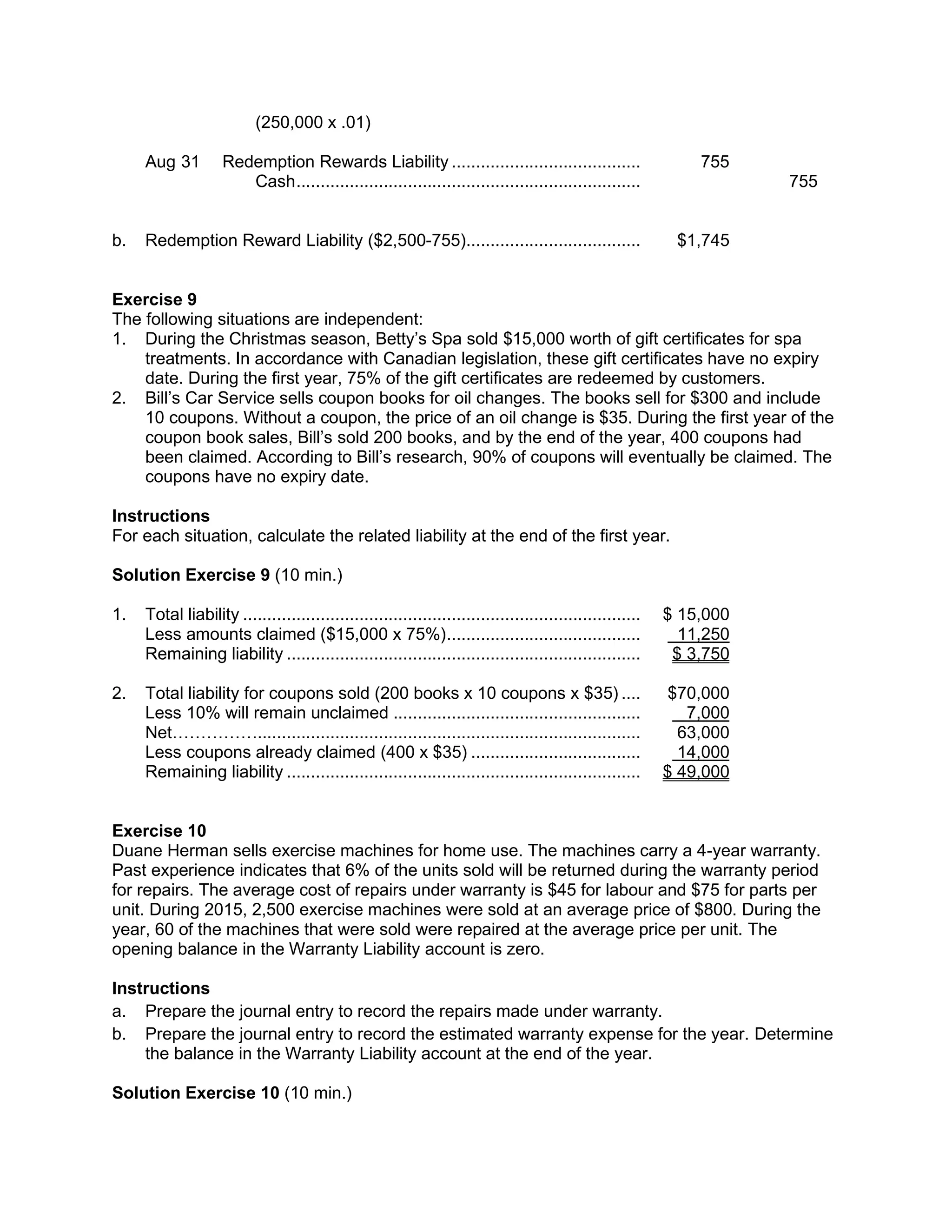
a. July 31 Sales Discounts for Redemption Rewards Issued ......... 2,500
Redemption Rewards Liability ................................ 2,500
14.
(250,000 x .01)
Aug31 Redemption Rewards Liability ....................................... 755
Cash....................................................................... 755
b. Redemption Reward Liability ($2,500-755).................................... $1,745
Exercise 9
The following situations are independent:
1. During the Christmas season, Betty’s Spa sold $15,000 worth of gift certificates for spa
treatments. In accordance with Canadian legislation, these gift certificates have no expiry
date. During the first year, 75% of the gift certificates are redeemed by customers.
2. Bill’s Car Service sells coupon books for oil changes. The books sell for $300 and include
10 coupons. Without a coupon, the price of an oil change is $35. During the first year of the
coupon book sales, Bill’s sold 200 books, and by the end of the year, 400 coupons had
been claimed. According to Bill’s research, 90% of coupons will eventually be claimed. The
coupons have no expiry date.
Instructions
For each situation, calculate the related liability at the end of the first year.
Solution Exercise 9 (10 min.)
1. Total liability .................................................................................. $ 15,000
Less amounts claimed ($15,000 x 75%)........................................ 11,250
Remaining liability ......................................................................... $ 3,750
2. Total liability for coupons sold (200 books x 10 coupons x $35) .... $70,000
Less 10% will remain unclaimed ................................................... 7,000
Net……………............................................................................... 63,000
Less coupons already claimed (400 x $35) ................................... 14,000
Remaining liability ......................................................................... $ 49,000
Exercise 10
Duane Herman sells exercise machines for home use. The machines carry a 4-year warranty.
Past experience indicates that 6% of the units sold will be returned during the warranty period
for repairs. The average cost of repairs under warranty is $45 for labour and $75 for parts per
unit. During 2015, 2,500 exercise machines were sold at an average price of $800. During the
year, 60 of the machines that were sold were repaired at the average price per unit. The
opening balance in the Warranty Liability account is zero.
Instructions
a. Prepare the journal entry to record the repairs made under warranty.
b. Prepare the journal entry to record the estimated warranty expense for the year. Determine
the balance in the Warranty Liability account at the end of the year.
Solution Exercise 10 (10 min.)
15.
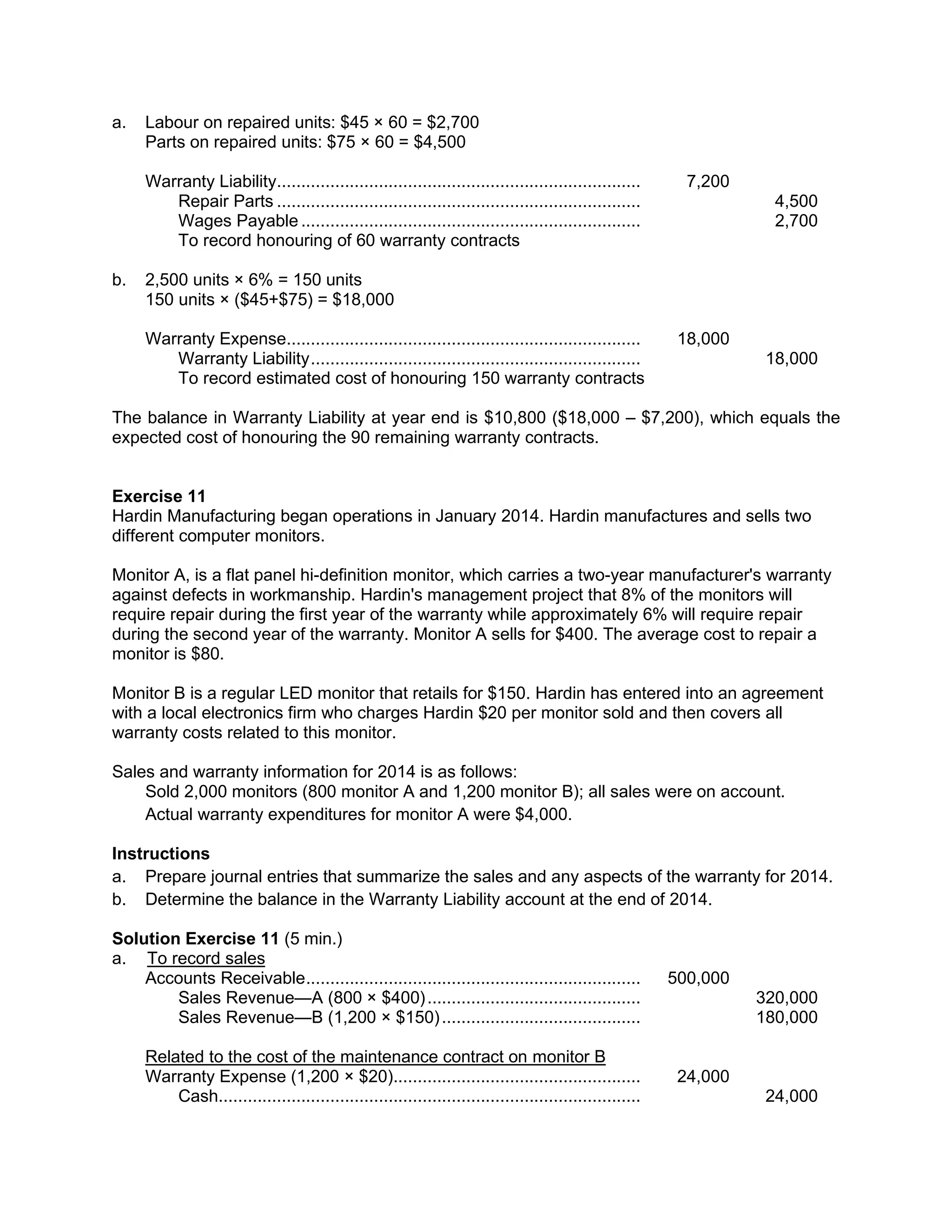
a. Labour onrepaired units: $45 × 60 = $2,700
Parts on repaired units: $75 × 60 = $4,500
Warranty Liability........................................................................... 7,200
Repair Parts ........................................................................... 4,500
Wages Payable ...................................................................... 2,700
To record honouring of 60 warranty contracts
b. 2,500 units × 6% = 150 units
150 units × ($45+$75) = $18,000
Warranty Expense......................................................................... 18,000
Warranty Liability.................................................................... 18,000
To record estimated cost of honouring 150 warranty contracts
The balance in Warranty Liability at year end is $10,800 ($18,000 – $7,200), which equals the
expected cost of honouring the 90 remaining warranty contracts.
Exercise 11
Hardin Manufacturing began operations in January 2014. Hardin manufactures and sells two
different computer monitors.
Monitor A, is a flat panel hi-definition monitor, which carries a two-year manufacturer's warranty
against defects in workmanship. Hardin's management project that 8% of the monitors will
require repair during the first year of the warranty while approximately 6% will require repair
during the second year of the warranty. Monitor A sells for $400. The average cost to repair a
monitor is $80.
Monitor B is a regular LED monitor that retails for $150. Hardin has entered into an agreement
with a local electronics firm who charges Hardin $20 per monitor sold and then covers all
warranty costs related to this monitor.
Sales and warranty information for 2014 is as follows:
Sold 2,000 monitors (800 monitor A and 1,200 monitor B); all sales were on account.
Actual warranty expenditures for monitor A were $4,000.
Instructions
a. Prepare journal entries that summarize the sales and any aspects of the warranty for 2014.
b. Determine the balance in the Warranty Liability account at the end of 2014.
Solution Exercise 11 (5 min.)
a. To record sales
Accounts Receivable..................................................................... 500,000
Sales Revenue—A (800 × $400)............................................ 320,000
Sales Revenue—B (1,200 × $150)......................................... 180,000
Related to the cost of the maintenance contract on monitor B
Warranty Expense (1,200 × $20)................................................... 24,000
Cash....................................................................................... 24,000
16.
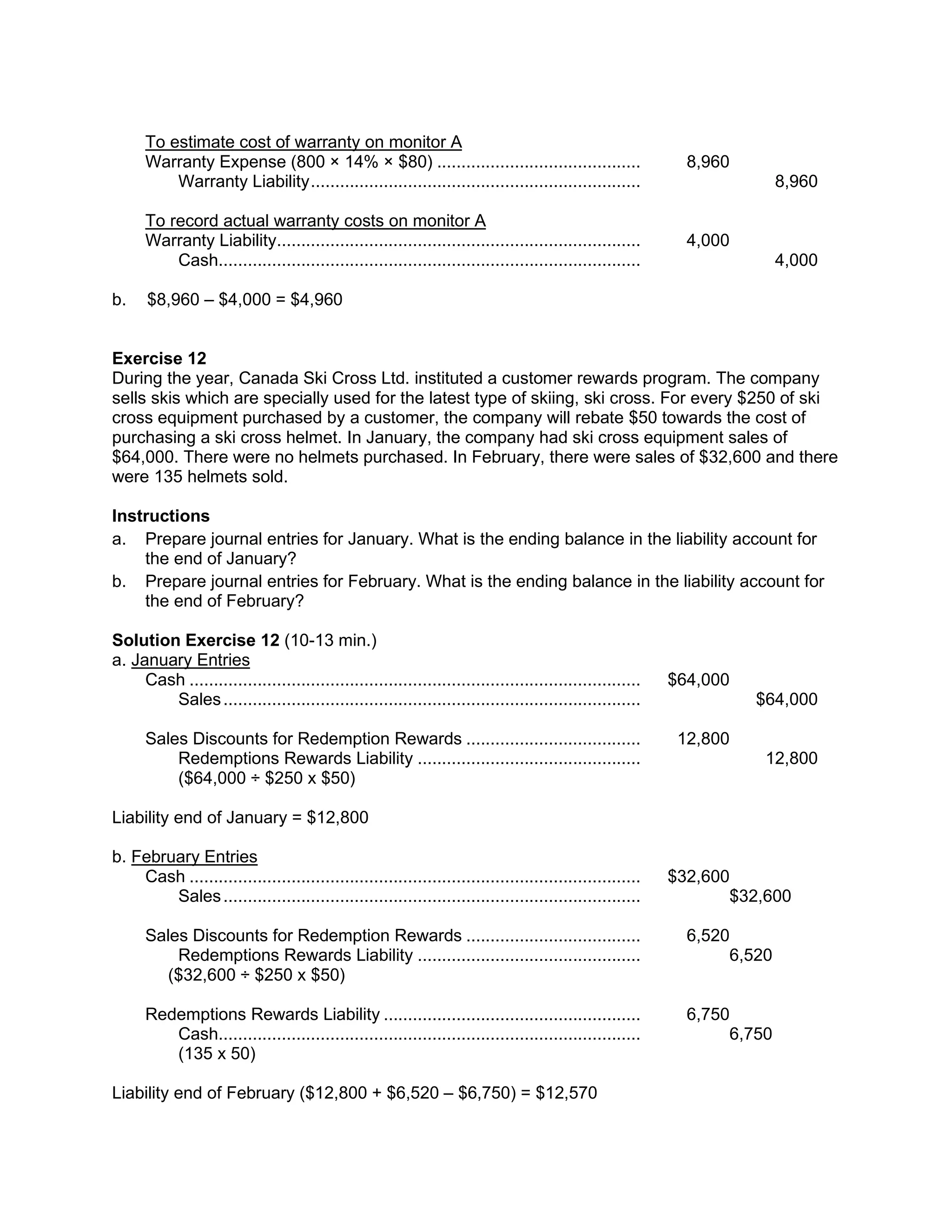
To estimate costof warranty on monitor A
Warranty Expense (800 × 14% × $80) .......................................... 8,960
Warranty Liability.................................................................... 8,960
To record actual warranty costs on monitor A
Warranty Liability........................................................................... 4,000
Cash....................................................................................... 4,000
b. $8,960 – $4,000 = $4,960
Exercise 12
During the year, Canada Ski Cross Ltd. instituted a customer rewards program. The company
sells skis which are specially used for the latest type of skiing, ski cross. For every $250 of ski
cross equipment purchased by a customer, the company will rebate $50 towards the cost of
purchasing a ski cross helmet. In January, the company had ski cross equipment sales of
$64,000. There were no helmets purchased. In February, there were sales of $32,600 and there
were 135 helmets sold.
Instructions
a. Prepare journal entries for January. What is the ending balance in the liability account for
the end of January?
b. Prepare journal entries for February. What is the ending balance in the liability account for
the end of February?
Solution Exercise 12 (10-13 min.)
a. January Entries
Cash ............................................................................................. $64,000
Sales...................................................................................... $64,000
Sales Discounts for Redemption Rewards .................................... 12,800
Redemptions Rewards Liability .............................................. 12,800
($64,000 ÷ $250 x $50)
Liability end of January = $12,800
b. February Entries
Cash ............................................................................................. $32,600
Sales...................................................................................... $32,600
Sales Discounts for Redemption Rewards .................................... 6,520
Redemptions Rewards Liability .............................................. 6,520
($32,600 ÷ $250 x $50)
Redemptions Rewards Liability ..................................................... 6,750
Cash....................................................................................... 6,750
(135 x 50)
Liability end of February ($12,800 + $6,520 – $6,750) = $12,570
17.
Exercise 13
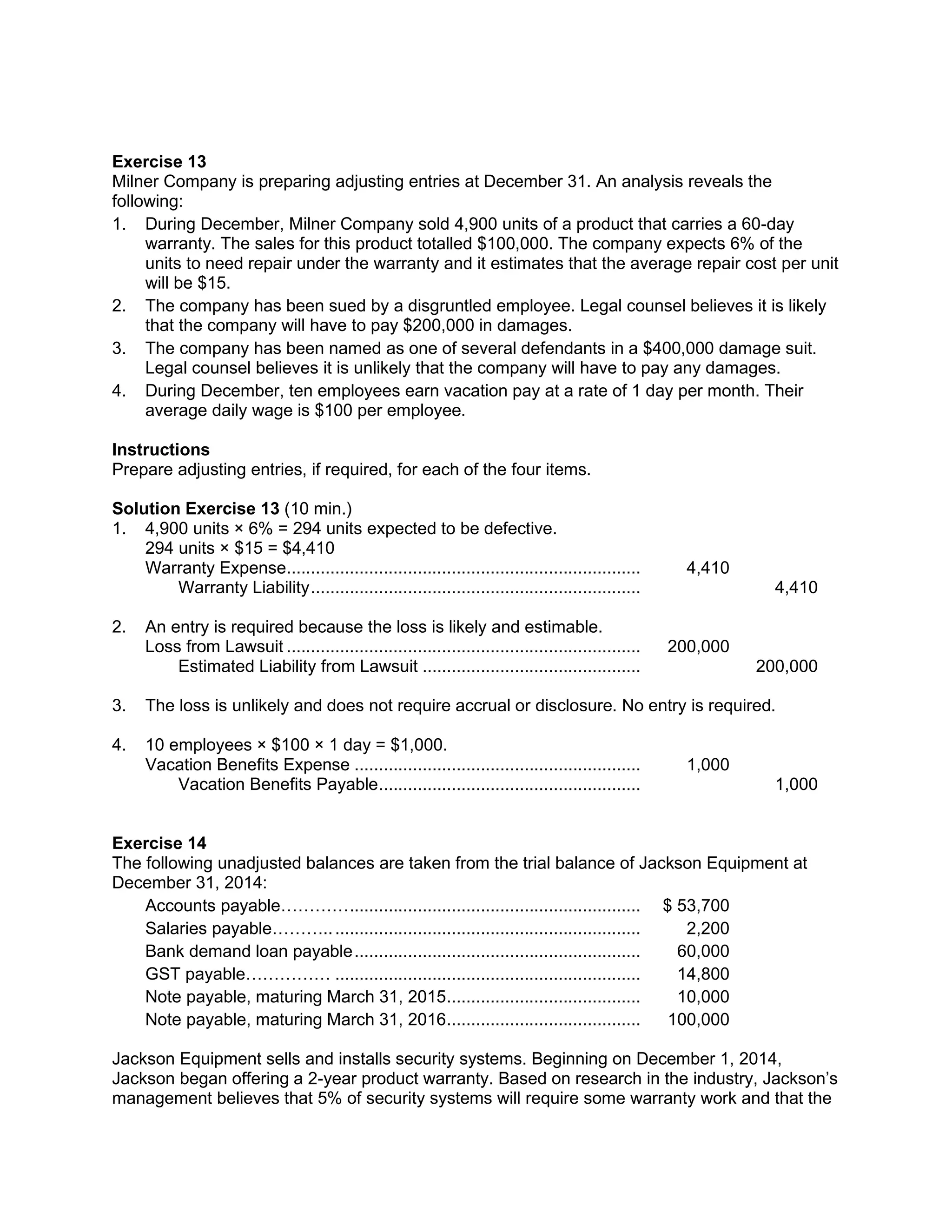
Milner Companyis preparing adjusting entries at December 31. An analysis reveals the
following:
1. During December, Milner Company sold 4,900 units of a product that carries a 60-day
warranty. The sales for this product totalled $100,000. The company expects 6% of the
units to need repair under the warranty and it estimates that the average repair cost per unit
will be $15.
2. The company has been sued by a disgruntled employee. Legal counsel believes it is likely
that the company will have to pay $200,000 in damages.
3. The company has been named as one of several defendants in a $400,000 damage suit.
Legal counsel believes it is unlikely that the company will have to pay any damages.
4. During December, ten employees earn vacation pay at a rate of 1 day per month. Their
average daily wage is $100 per employee.
Instructions
Prepare adjusting entries, if required, for each of the four items.
Solution Exercise 13 (10 min.)
1. 4,900 units × 6% = 294 units expected to be defective.
294 units × $15 = $4,410
Warranty Expense......................................................................... 4,410
Warranty Liability.................................................................... 4,410
2. An entry is required because the loss is likely and estimable.
Loss from Lawsuit ......................................................................... 200,000
Estimated Liability from Lawsuit ............................................. 200,000
3. The loss is unlikely and does not require accrual or disclosure. No entry is required.
4. 10 employees × $100 × 1 day = $1,000.
Vacation Benefits Expense ........................................................... 1,000
Vacation Benefits Payable...................................................... 1,000
Exercise 14
The following unadjusted balances are taken from the trial balance of Jackson Equipment at
December 31, 2014:
Accounts payable…………............................................................ $ 53,700
Salaries payable………................................................................. 2,200
Bank demand loan payable........................................................... 60,000
GST payable…………… ............................................................... 14,800
Note payable, maturing March 31, 2015........................................ 10,000
Note payable, maturing March 31, 2016........................................ 100,000
Jackson Equipment sells and installs security systems. Beginning on December 1, 2014,
Jackson began offering a 2-year product warranty. Based on research in the industry, Jackson’s
management believes that 5% of security systems will require some warranty work and that the
18.
typical costs forsystems requiring warranty work will be $875 during the first year and $325
during the second year. In December, Jackson supplied and installed 80 systems.
Instructions
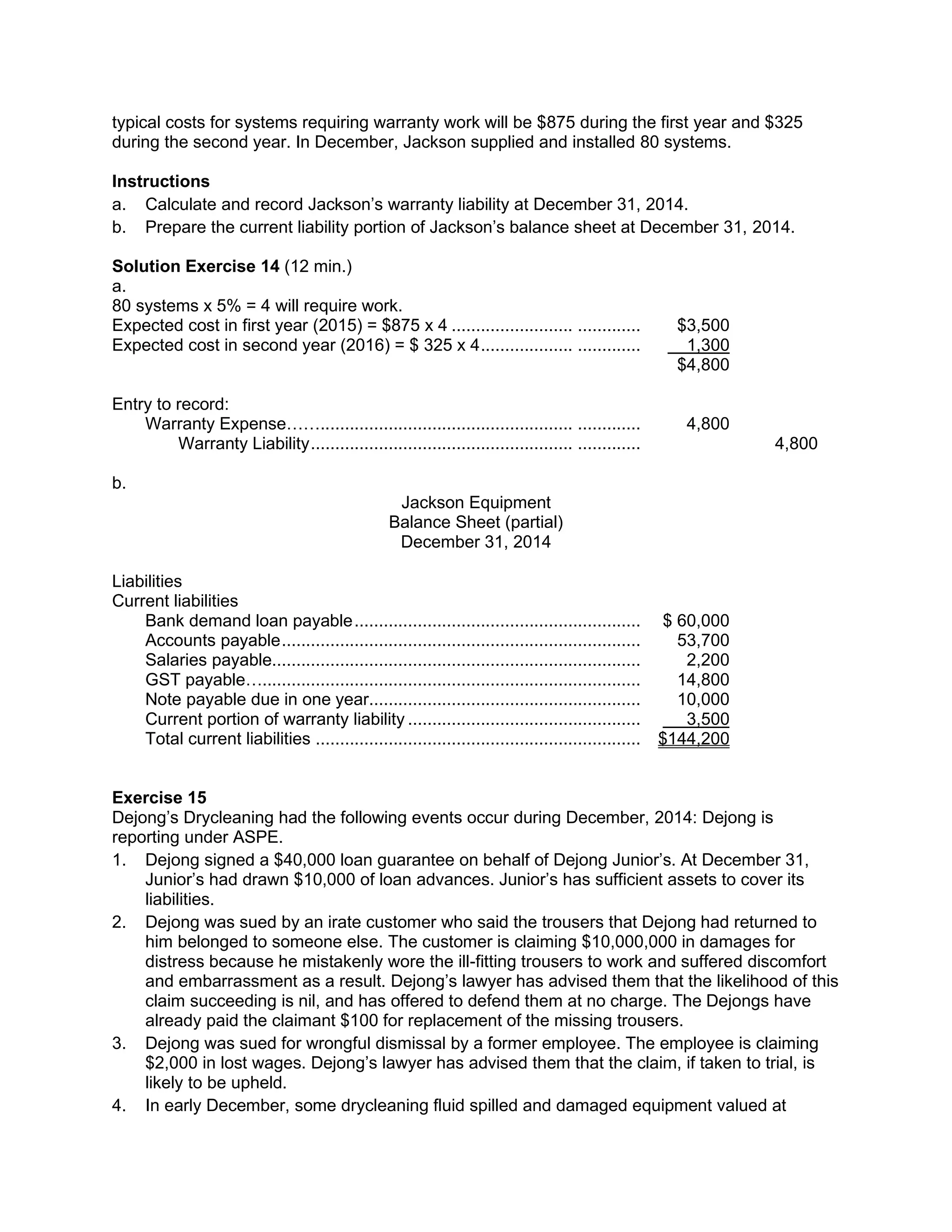
a. Calculate and record Jackson’s warranty liability at December 31, 2014.
b. Prepare the current liability portion of Jackson’s balance sheet at December 31, 2014.
Solution Exercise 14 (12 min.)
a.
80 systems x 5% = 4 will require work.
Expected cost in first year (2015) = $875 x 4 ......................... ............. $3,500
Expected cost in second year (2016) = $ 325 x 4................... ............. 1,300
$4,800
Entry to record:
Warranty Expense…….................................................... ............. 4,800
Warranty Liability...................................................... ............. 4,800
b.
Jackson Equipment
Balance Sheet (partial)
December 31, 2014
Liabilities
Current liabilities
Bank demand loan payable........................................................... $ 60,000
Accounts payable.......................................................................... 53,700
Salaries payable............................................................................ 2,200
GST payable….............................................................................. 14,800
Note payable due in one year........................................................ 10,000
Current portion of warranty liability ................................................ 3,500
Total current liabilities ................................................................... $144,200
Exercise 15
Dejong’s Drycleaning had the following events occur during December, 2014: Dejong is
reporting under ASPE.
1. Dejong signed a $40,000 loan guarantee on behalf of Dejong Junior’s. At December 31,
Junior’s had drawn $10,000 of loan advances. Junior’s has sufficient assets to cover its
liabilities.
2. Dejong was sued by an irate customer who said the trousers that Dejong had returned to
him belonged to someone else. The customer is claiming $10,000,000 in damages for
distress because he mistakenly wore the ill-fitting trousers to work and suffered discomfort
and embarrassment as a result. Dejong’s lawyer has advised them that the likelihood of this
claim succeeding is nil, and has offered to defend them at no charge. The Dejongs have
already paid the claimant $100 for replacement of the missing trousers.
3. Dejong was sued for wrongful dismissal by a former employee. The employee is claiming
$2,000 in lost wages. Dejong’s lawyer has advised them that the claim, if taken to trial, is
likely to be upheld.
4. In early December, some drycleaning fluid spilled and damaged equipment valued at
19.
$5,600. Dejong replacedthe equipment, which is insured, and expects their insurance
policy will reimburse at least $5,000 of the cost and possibly the entire amount. However
the exact amount covered by insurance has not yet been determined.
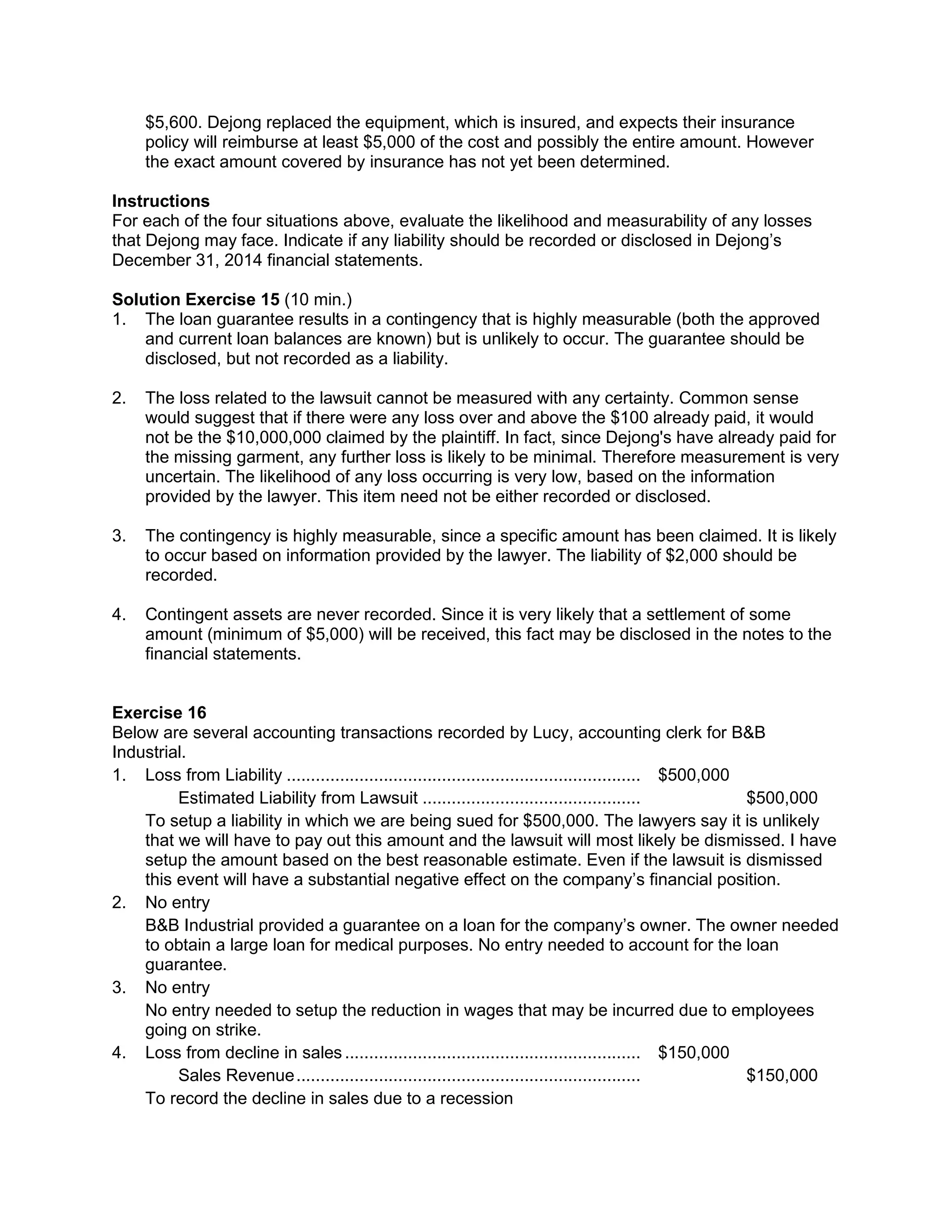
Instructions
For each of the four situations above, evaluate the likelihood and measurability of any losses
that Dejong may face. Indicate if any liability should be recorded or disclosed in Dejong’s
December 31, 2014 financial statements.
Solution Exercise 15 (10 min.)
1. The loan guarantee results in a contingency that is highly measurable (both the approved
and current loan balances are known) but is unlikely to occur. The guarantee should be
disclosed, but not recorded as a liability.
2. The loss related to the lawsuit cannot be measured with any certainty. Common sense
would suggest that if there were any loss over and above the $100 already paid, it would
not be the $10,000,000 claimed by the plaintiff. In fact, since Dejong's have already paid for
the missing garment, any further loss is likely to be minimal. Therefore measurement is very
uncertain. The likelihood of any loss occurring is very low, based on the information
provided by the lawyer. This item need not be either recorded or disclosed.
3. The contingency is highly measurable, since a specific amount has been claimed. It is likely
to occur based on information provided by the lawyer. The liability of $2,000 should be
recorded.
4. Contingent assets are never recorded. Since it is very likely that a settlement of some
amount (minimum of $5,000) will be received, this fact may be disclosed in the notes to the
financial statements.
Exercise 16
Below are several accounting transactions recorded by Lucy, accounting clerk for B&B
Industrial.
1. Loss from Liability ......................................................................... $500,000
Estimated Liability from Lawsuit ............................................. $500,000
To setup a liability in which we are being sued for $500,000. The lawyers say it is unlikely
that we will have to pay out this amount and the lawsuit will most likely be dismissed. I have
setup the amount based on the best reasonable estimate. Even if the lawsuit is dismissed
this event will have a substantial negative effect on the company’s financial position.
2. No entry
B&B Industrial provided a guarantee on a loan for the company’s owner. The owner needed
to obtain a large loan for medical purposes. No entry needed to account for the loan
guarantee.
3. No entry
No entry needed to setup the reduction in wages that may be incurred due to employees
going on strike.
4. Loss from decline in sales............................................................. $150,000
Sales Revenue....................................................................... $150,000
To record the decline in sales due to a recession
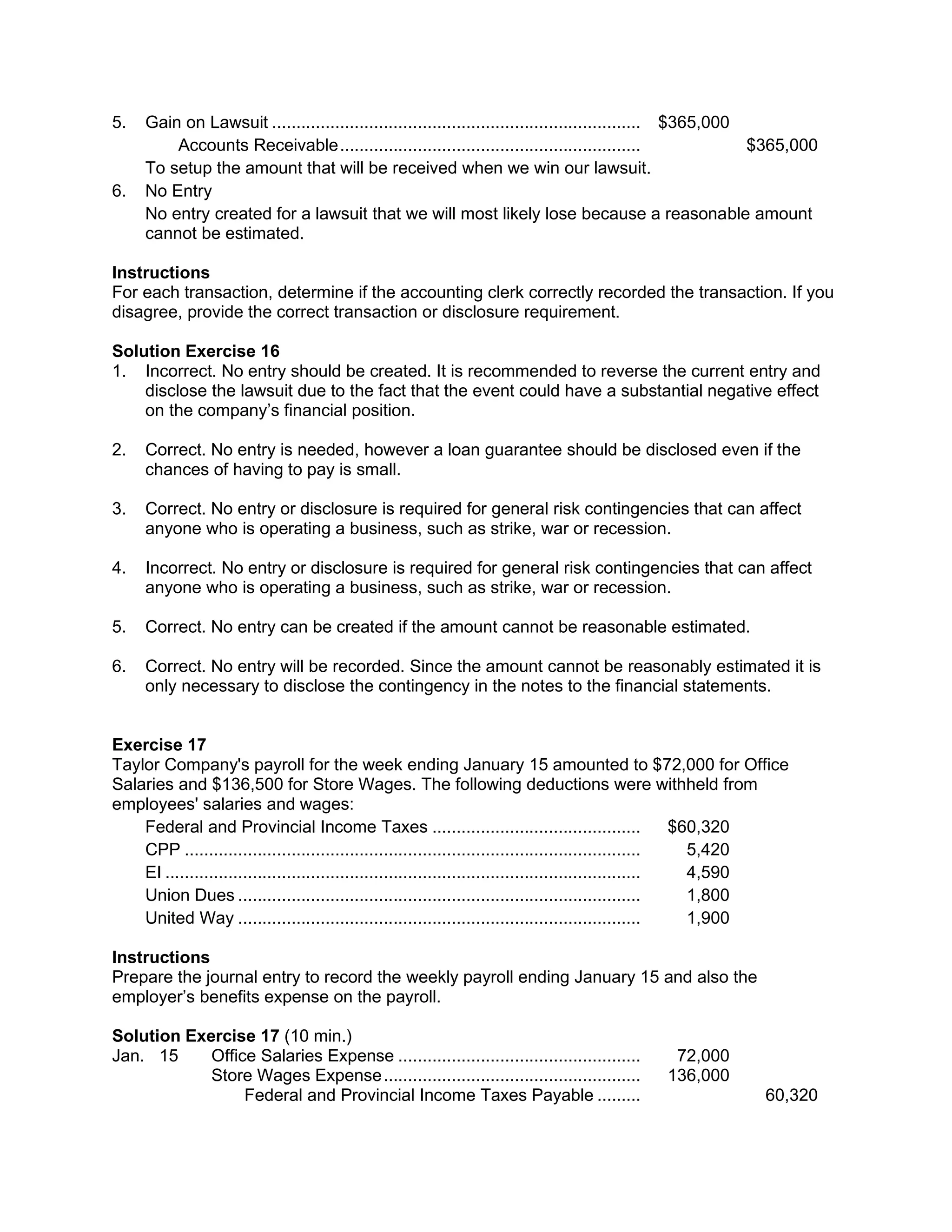
20.
5. Gain onLawsuit ............................................................................ $365,000
Accounts Receivable.............................................................. $365,000
To setup the amount that will be received when we win our lawsuit.
6. No Entry
No entry created for a lawsuit that we will most likely lose because a reasonable amount
cannot be estimated.
Instructions
For each transaction, determine if the accounting clerk correctly recorded the transaction. If you
disagree, provide the correct transaction or disclosure requirement.
Solution Exercise 16
1. Incorrect. No entry should be created. It is recommended to reverse the current entry and
disclose the lawsuit due to the fact that the event could have a substantial negative effect
on the company’s financial position.
2. Correct. No entry is needed, however a loan guarantee should be disclosed even if the
chances of having to pay is small.
3. Correct. No entry or disclosure is required for general risk contingencies that can affect
anyone who is operating a business, such as strike, war or recession.
4. Incorrect. No entry or disclosure is required for general risk contingencies that can affect
anyone who is operating a business, such as strike, war or recession.
5. Correct. No entry can be created if the amount cannot be reasonable estimated.
6. Correct. No entry will be recorded. Since the amount cannot be reasonably estimated it is
only necessary to disclose the contingency in the notes to the financial statements.
Exercise 17
Taylor Company's payroll for the week ending January 15 amounted to $72,000 for Office
Salaries and $136,500 for Store Wages. The following deductions were withheld from
employees' salaries and wages:
Federal and Provincial Income Taxes ........................................... $60,320
CPP .............................................................................................. 5,420
EI .................................................................................................. 4,590
Union Dues ................................................................................... 1,800
United Way ................................................................................... 1,900
Instructions
Prepare the journal entry to record the weekly payroll ending January 15 and also the
employer’s benefits expense on the payroll.
Solution Exercise 17 (10 min.)
Jan. 15 Office Salaries Expense .................................................. 72,000
Store Wages Expense..................................................... 136,000
Federal and Provincial Income Taxes Payable ......... 60,320
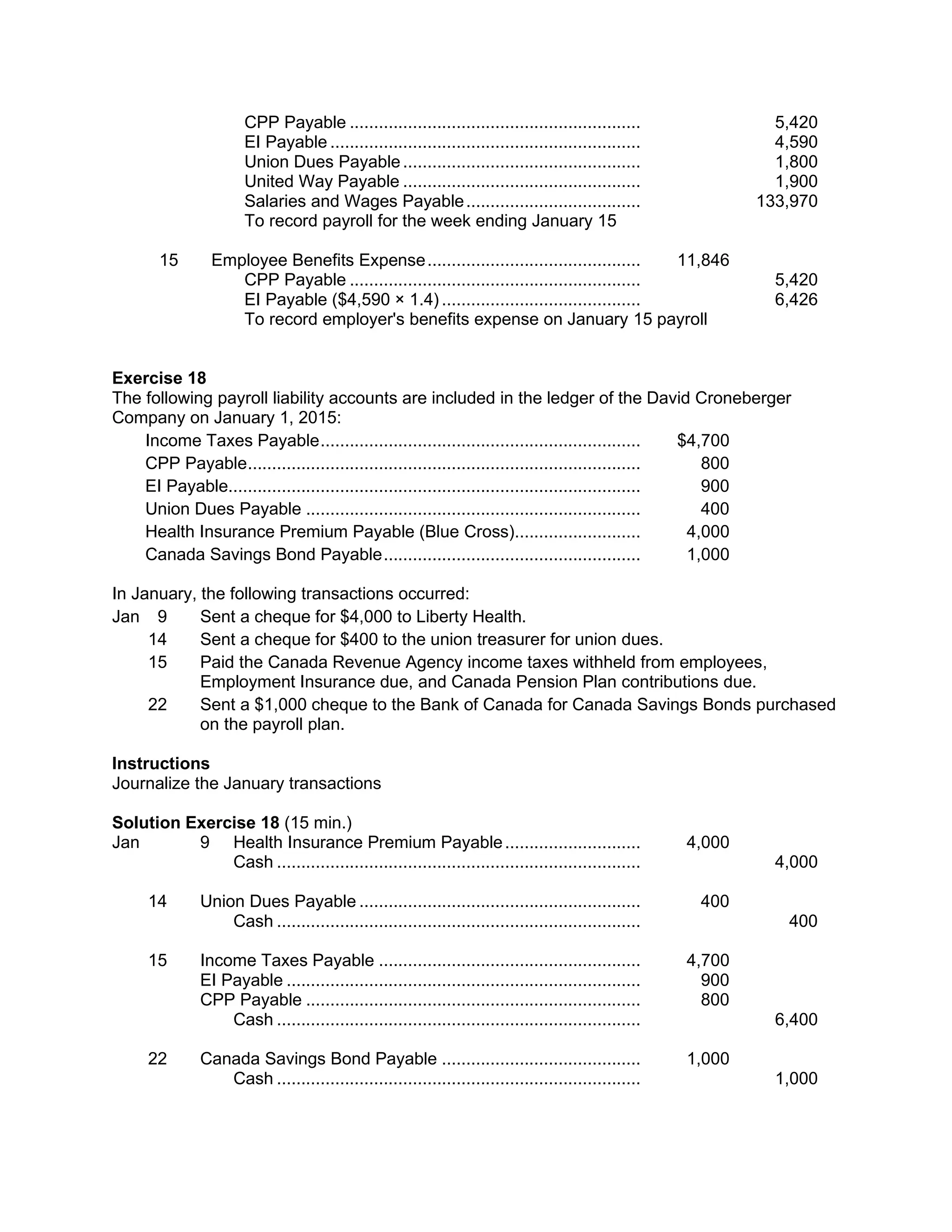
21.
CPP Payable ............................................................5,420
EI Payable ................................................................ 4,590
Union Dues Payable................................................. 1,800
United Way Payable ................................................. 1,900
Salaries and Wages Payable.................................... 133,970
To record payroll for the week ending January 15
15 Employee Benefits Expense............................................ 11,846
CPP Payable ............................................................ 5,420
EI Payable ($4,590 × 1.4) ......................................... 6,426
To record employer's benefits expense on January 15 payroll
Exercise 18
The following payroll liability accounts are included in the ledger of the David Croneberger
Company on January 1, 2015:
Income Taxes Payable.................................................................. $4,700
CPP Payable................................................................................. 800
EI Payable..................................................................................... 900
Union Dues Payable ..................................................................... 400
Health Insurance Premium Payable (Blue Cross).......................... 4,000
Canada Savings Bond Payable..................................................... 1,000
In January, the following transactions occurred:
Jan 9 Sent a cheque for $4,000 to Liberty Health.
14 Sent a cheque for $400 to the union treasurer for union dues.
15 Paid the Canada Revenue Agency income taxes withheld from employees,
Employment Insurance due, and Canada Pension Plan contributions due.
22 Sent a $1,000 cheque to the Bank of Canada for Canada Savings Bonds purchased
on the payroll plan.
Instructions
Journalize the January transactions
Solution Exercise 18 (15 min.)
Jan 9 Health Insurance Premium Payable............................ 4,000
Cash ........................................................................... 4,000
14 Union Dues Payable .......................................................... 400
Cash ........................................................................... 400
15 Income Taxes Payable ...................................................... 4,700
EI Payable ......................................................................... 900
CPP Payable ..................................................................... 800
Cash ........................................................................... 6,400
22 Canada Savings Bond Payable ......................................... 1,000
Cash ........................................................................... 1,000
22.
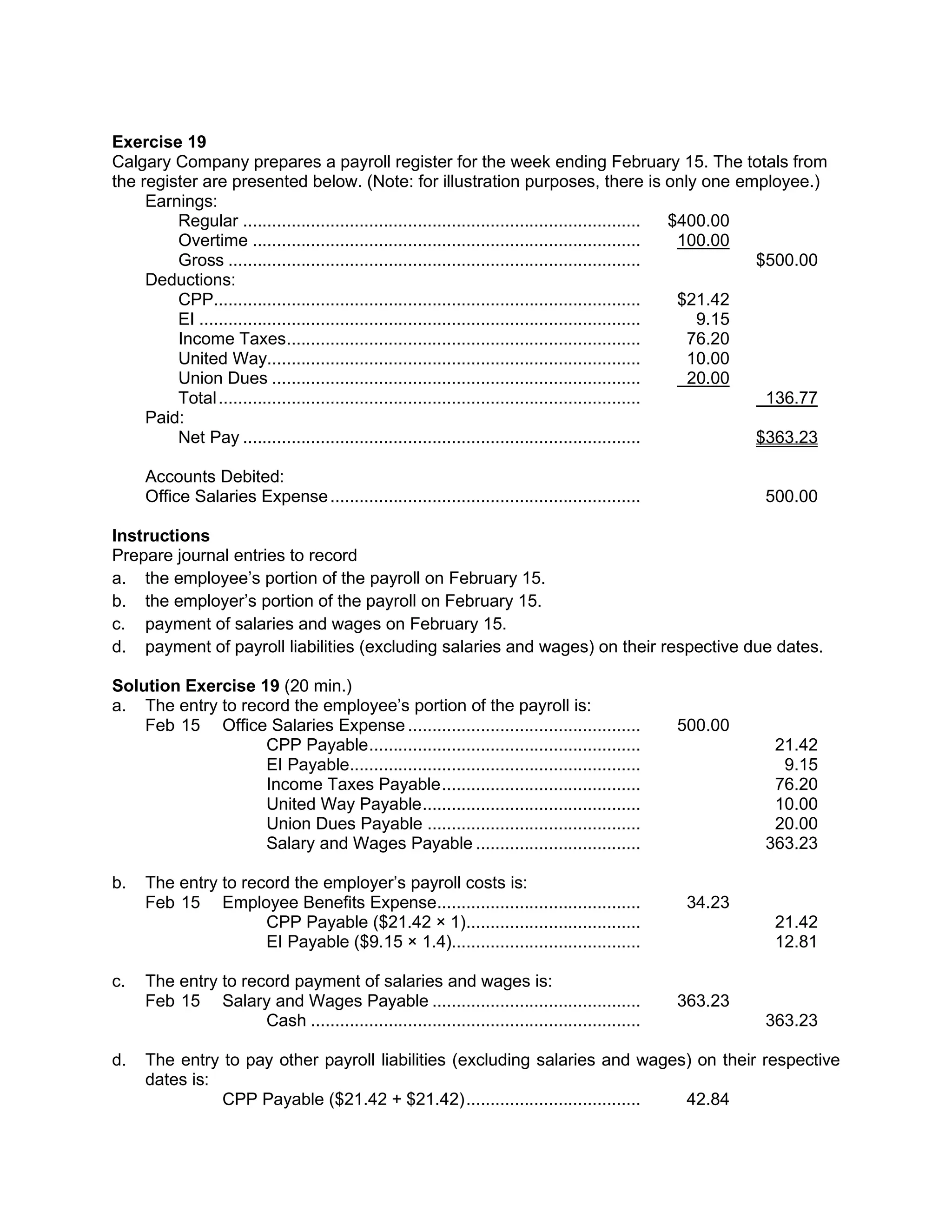
Exercise 19
Calgary Companyprepares a payroll register for the week ending February 15. The totals from
the register are presented below. (Note: for illustration purposes, there is only one employee.)
Earnings:
Regular .................................................................................. $400.00
Overtime ................................................................................ 100.00
Gross ..................................................................................... $500.00
Deductions:
CPP........................................................................................ $21.42
EI ........................................................................................... 9.15
Income Taxes......................................................................... 76.20
United Way............................................................................. 10.00
Union Dues ............................................................................ 20.00
Total....................................................................................... 136.77
Paid:
Net Pay .................................................................................. $363.23
Accounts Debited:
Office Salaries Expense................................................................ 500.00
Instructions
Prepare journal entries to record
a. the employee’s portion of the payroll on February 15.
b. the employer’s portion of the payroll on February 15.
c. payment of salaries and wages on February 15.
d. payment of payroll liabilities (excluding salaries and wages) on their respective due dates.
Solution Exercise 19 (20 min.)
a. The entry to record the employee’s portion of the payroll is:
Feb 15 Office Salaries Expense ................................................ 500.00
CPP Payable........................................................ 21.42
EI Payable............................................................ 9.15
Income Taxes Payable......................................... 76.20
United Way Payable............................................. 10.00
Union Dues Payable ............................................ 20.00
Salary and Wages Payable .................................. 363.23
b. The entry to record the employer’s payroll costs is:
Feb 15 Employee Benefits Expense.......................................... 34.23
CPP Payable ($21.42 × 1).................................... 21.42
EI Payable ($9.15 × 1.4)....................................... 12.81
c. The entry to record payment of salaries and wages is:
Feb 15 Salary and Wages Payable ........................................... 363.23
Cash .................................................................... 363.23
d. The entry to pay other payroll liabilities (excluding salaries and wages) on their respective
dates is:
CPP Payable ($21.42 + $21.42).................................... 42.84
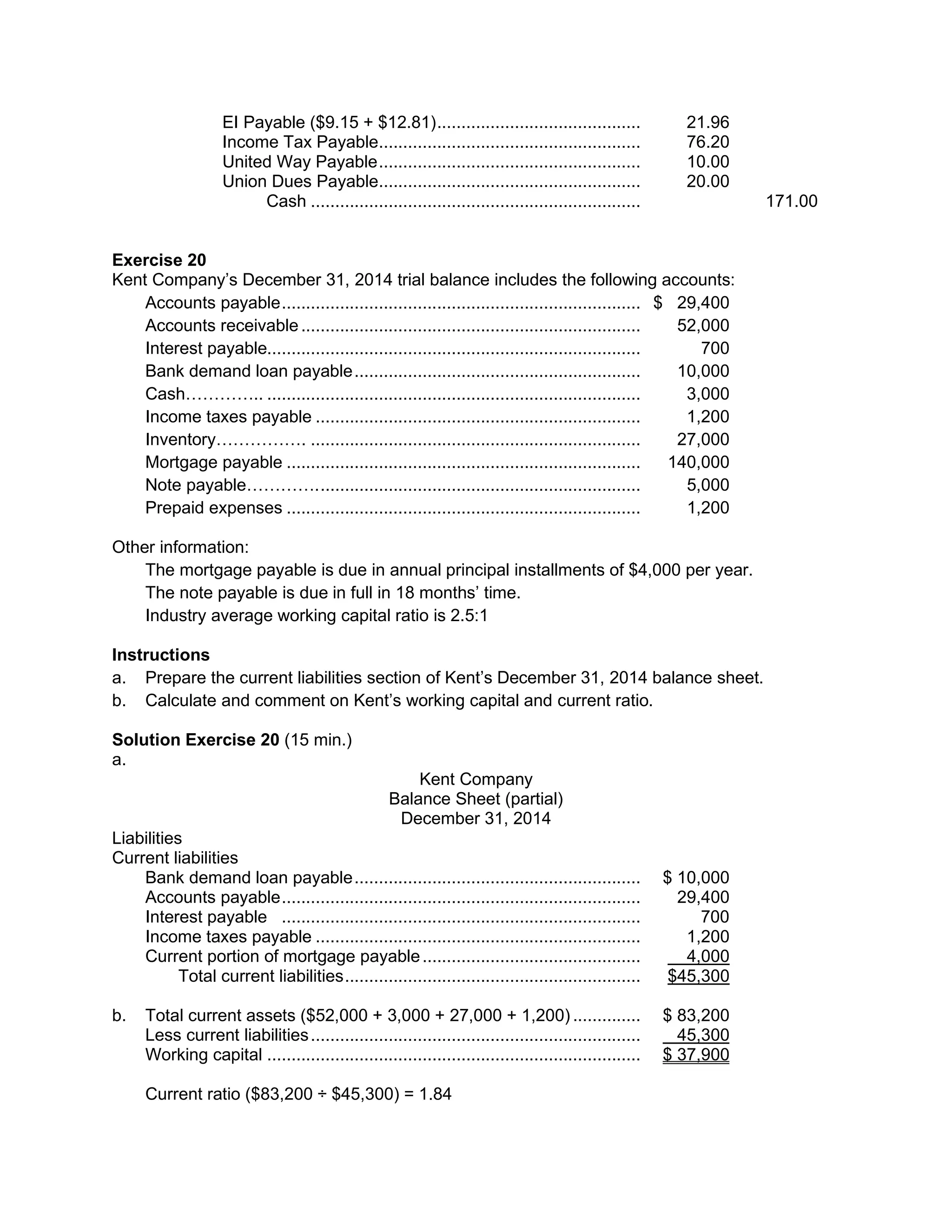
23.
EI Payable ($9.15+ $12.81).......................................... 21.96
Income Tax Payable...................................................... 76.20
United Way Payable...................................................... 10.00
Union Dues Payable...................................................... 20.00
Cash .................................................................... 171.00
Exercise 20
Kent Company’s December 31, 2014 trial balance includes the following accounts:
Accounts payable.......................................................................... $ 29,400
Accounts receivable...................................................................... 52,000
Interest payable............................................................................. 700
Bank demand loan payable........................................................... 10,000
Cash………….. ............................................................................. 3,000
Income taxes payable ................................................................... 1,200
Inventory……………. .................................................................... 27,000
Mortgage payable ......................................................................... 140,000
Note payable…………................................................................... 5,000
Prepaid expenses ......................................................................... 1,200
Other information:
The mortgage payable is due in annual principal installments of $4,000 per year.
The note payable is due in full in 18 months’ time.
Industry average working capital ratio is 2.5:1
Instructions
a. Prepare the current liabilities section of Kent’s December 31, 2014 balance sheet.
b. Calculate and comment on Kent’s working capital and current ratio.
Solution Exercise 20 (15 min.)
a.
Kent Company
Balance Sheet (partial)
December 31, 2014
Liabilities
Current liabilities
Bank demand loan payable........................................................... $ 10,000
Accounts payable.......................................................................... 29,400
Interest payable .......................................................................... 700
Income taxes payable ................................................................... 1,200
Current portion of mortgage payable............................................. 4,000
Total current liabilities............................................................. $45,300
b. Total current assets ($52,000 + 3,000 + 27,000 + 1,200) .............. $ 83,200
Less current liabilities.................................................................... 45,300
Working capital ............................................................................. $ 37,900
Current ratio ($83,200 ÷ $45,300) = 1.84
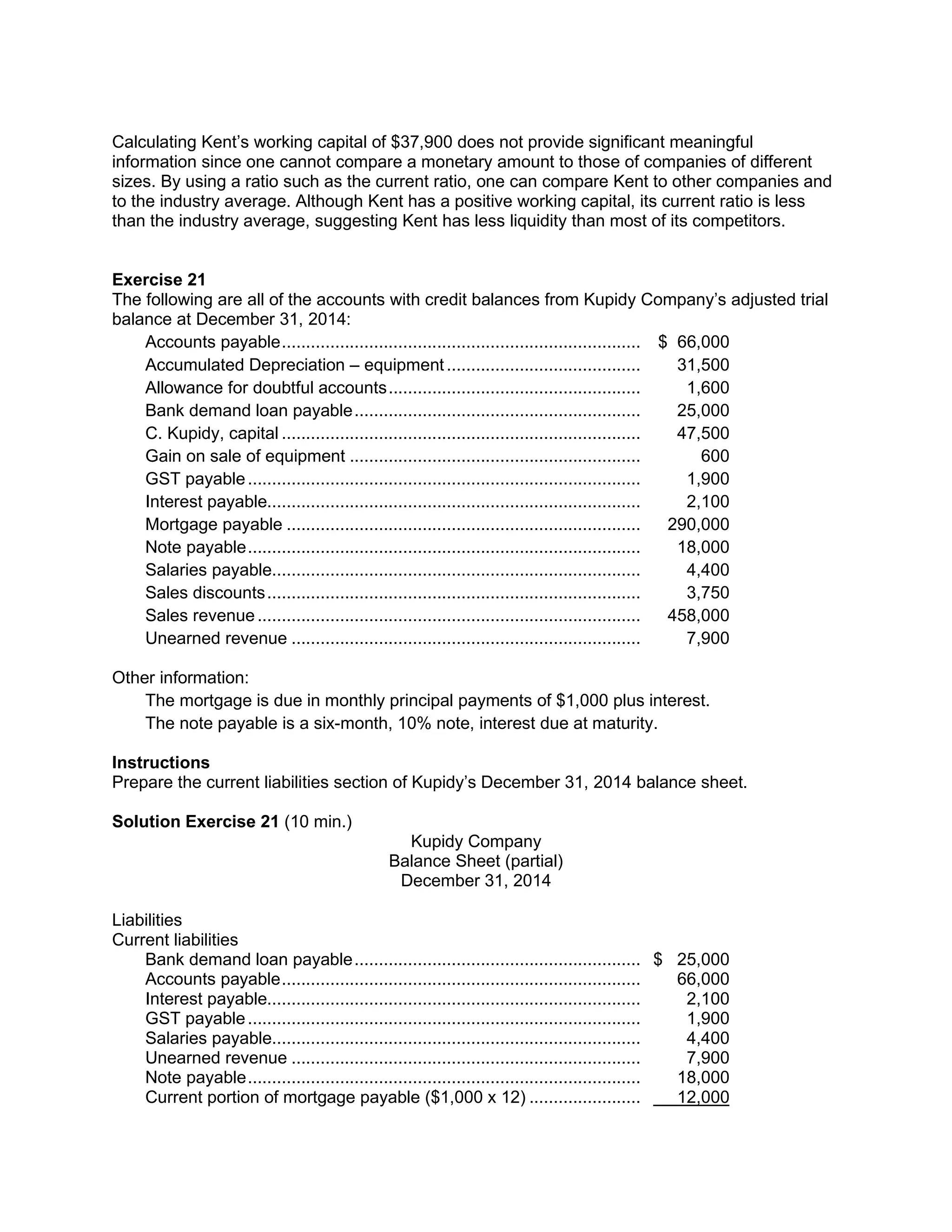
24.
Calculating Kent’s workingcapital of $37,900 does not provide significant meaningful
information since one cannot compare a monetary amount to those of companies of different
sizes. By using a ratio such as the current ratio, one can compare Kent to other companies and
to the industry average. Although Kent has a positive working capital, its current ratio is less
than the industry average, suggesting Kent has less liquidity than most of its competitors.
Exercise 21
The following are all of the accounts with credit balances from Kupidy Company’s adjusted trial
balance at December 31, 2014:
Accounts payable.......................................................................... $ 66,000
Accumulated Depreciation – equipment........................................ 31,500
Allowance for doubtful accounts.................................................... 1,600
Bank demand loan payable........................................................... 25,000
C. Kupidy, capital .......................................................................... 47,500
Gain on sale of equipment ............................................................ 600
GST payable................................................................................. 1,900
Interest payable............................................................................. 2,100
Mortgage payable ......................................................................... 290,000
Note payable................................................................................. 18,000
Salaries payable............................................................................ 4,400
Sales discounts............................................................................. 3,750
Sales revenue............................................................................... 458,000
Unearned revenue ........................................................................ 7,900
Other information:
The mortgage is due in monthly principal payments of $1,000 plus interest.
The note payable is a six-month, 10% note, interest due at maturity.
Instructions
Prepare the current liabilities section of Kupidy’s December 31, 2014 balance sheet.
Solution Exercise 21 (10 min.)
Kupidy Company
Balance Sheet (partial)
December 31, 2014
Liabilities
Current liabilities
Bank demand loan payable........................................................... $ 25,000
Accounts payable.......................................................................... 66,000
Interest payable............................................................................. 2,100
GST payable................................................................................. 1,900
Salaries payable............................................................................ 4,400
Unearned revenue ........................................................................ 7,900
Note payable................................................................................. 18,000
Current portion of mortgage payable ($1,000 x 12) ....................... 12,000
you and me.They think that I am part owner. I let them think so,
but you and I know better, Jack." He nodded his head looking
mighty cunning.
"She cannot be too wealthy or too prosperous, captain. I knew full
well that her prosperity only increases the gulf between us, but I
had long ago understood that such an heiress was not for a mate on
board a merchantman."
"She is not, Jack," the captain replied, gravely. "Already she is the
richest heiress in all Norfolk—perhaps in the whole country. Who is
to marry her? There, I confess, I am at a loss. I must find a husband
for her. There's the rub. She may marry any in the land: there is
none so high but he would desire a wife so rich and so virtuous.
Where shall I look for a husband fit for her? There are admirals, but
mostly too old for her: she ought to have a noble lord, yet, if all
tales be true, they are not fit, most of them to marry a virtuous
woman. Shall I give Molly to a man who gambles and drinks and
rakes and riots? No, Jack, no. Not for twenty coronets. I would
rather marry her to an honest sailor like yourself. Jack, my lad, find
me a noble lord, as like yourself as one pea is like another, and he
shall have her. He must be as proper a man; as strong a man; a
clean liver; moderate in his cups … find him for me, Jack, and he
shall have her."
"Well, but, captain, there are the gentlemen of Norfolk."
"Ay…. There are—as you say—the gentlemen. I have considered
them, Jack. Molly is not a gentlewoman by birth, I know that very
well: but her fortune entitles her to marry in a higher rank. Ay …
there are the gentlemen. They are good fox hunters: they are good
at horse racing, but they are hard drinkers, Jack: they are fuddled
most evenings: my little maid must not have a husband who is put
to bed drunk every night."
"You must take her to London, captain, and let her be seen."
27.
"Ay—ay … ifI only knew where to go and how to begin."
"She is young; there is no need for hurry: you can wait awhile,
captain."
"Ay … we can wait a while. I shall be loth to let her go, God knows
—— Come to-morrow, Jack. She was always fond of you: she talks
about you: 'tis a loving little maid: you played with her and ran
about with her. She never forgets. The next command that falls in—
but I talk too fast. Well—when there is a ship in her fleet without a
captain—— But come, my lad."
He led the way, still talking of his ward and her perfections, through
the narrow street they call Stath Lane into the great market place,
where stands the Crown Inn.
The room appropriated to the "Society of Lynn," which met every
evening all the year round, was that on the ground floor looking
upon the market place. The "society," or club, which is never
dissolved, consists of the notables or better sort of the town: the
vicar of St. Margaret's; the curate of St. Nicholas; the master of the
school—my own father: Captain Crowle and other retired captains;
the doctor; some of the more substantial merchants; with the mayor,
some of the aldermen, the town clerk, and a justice of the peace or
two. This evening most of these gentlemen were already present.
Captain Crowle saluted the company and took his seat at the head
of the table. "Gentlemen," he said, "I wish you all a pleasant
evening. I have brought with me my young friend Jack Pentecrosse
—you all know Jack—the worthy son of his worthy father. He will
take a glass with us. Sit down beside me, Jack."
"With the permission of the society," I said.
Most of the gentlemen had already before them their pipes and their
tobacco. Some had ordered their drink—a pint of port for one: a
Brown George full of old ale for another; a flask of Canary for a
28.
third: and soon. But the captain, looking round the room, beckoned
to the girl who waited. "Jenny," he said, "nobody calls for anything
to-night except myself. Gentlemen, it must be a bowl—or a half
dozen bowls. Tell your mistress, Jenny, a bowl of the biggest and the
strongest and the sweetest. Gentlemen, you will drink with me to
the next voyage of The Lady of Lynn."
But then a thing happened—news came—which drove all thoughts
of The Lady of Lynn out of everybody's mind. That toast was
forgotten.
The news was brought by the doctor, who was the last to arrive.
It was an indication of the importance of our town that a physician
lived among us. He was the only physician in this part of the
country: he practised among the better sort, among the noble
gentlemen of the country round about Lynn and even further afield
in the northern parts of the shire, and among the substantial
merchants of the town. For the rest there were the apothecary, the
barber and blood-letter, the bone-setter, the herbalist and the wise
woman. Many there were even among the better sort who would
rather consult the woman, who knew the powers of every herb that
grows, than the physician who would write you out the prescription
of Mithridates or some other outlandish name composed of sixty or
seventy ingredients. However, there is no doubt that learning is a
fine thing and that Galen knew more than the ancient dames who sit
in a bower of dried herbs and brew them into nauseous drinks which
pretend to cure all the diseases to which mankind is liable.
Doctor Worship was a person who habitually carried himself with
dignity. His black dress, his white silk stockings, his gold shoe
buckles, the whiteness of his lace and linen, his huge wig, his gold-
headed cane with its pomander, proclaimed his calling, while the
shortness of his stature with the roundness of his figure, his double
chin, his thick lips and his fat nose all assisted him in the
maintenance of his dignity. His voice was full and deep, like the voice
29.
of an organand he spoke slowly. It has, I believe, been remarked
that dignity is more easily attained by a short fat man than by one of
a greater stature and thinner person.
At the very first appearance of the doctor this evening it was
understood that something had happened. For he had assumed an
increased importance that was phenomenal: he had swollen, so to
speak: he had become rounder and fuller in front. Everybody
observed the change: yes—he was certainly broader in the
shoulders: he carried himself with more than professional dignity: his
wig had risen two inches in the foretop and had descended four
inches behind his back: his coat was not the plain cloth which he
wore habitually in the town and at the tavern, but the black velvet
which was reserved for those occasions when he was summoned by
a person of quality or one of the county gentry, and he carried the
gold-headed cane with the pomander box which also belonged to
those rare occasions.
"Gentlemen," he said, looking around the room slowly and with
emphasis, so that, taking his change of manner and of stature—for
men so seldom grow after fifty—and the emphasis with which he
spoke and looked, gathering together all eyes, caused the company
to understand, without any possibility of mistake, that something
had happened of great importance. In the old town of Lynn Regis it
is not often that anything happens. Ships, it is true, come and go;
their departures and their arrivals form the staple of the
conversation: but an event, apart from the ships, a surprise, is rare.
Once, ten years before this evening, a rumour of the kind which, as
the journals say, awaits confirmation, reached the town, that the
French had landed in force and were marching upon London. The
town showed its loyalty by a resolution to die in the last ditch: the
resolution was passed by the mayor over a bowl of punch; and
though the report proved without foundation the event remained
historical: the loyalty and devotion of the borough—the king's own
borough—had passed through the fire of peril. The thing was
30.
remembered. Since thatevent, nothing had happened worthy of
note. And now something more was about to happen: the doctor's
face was full of importance: he clearly brought great news.
Great news, indeed; and news forerunning a time unheard of in the
chronicles of the town.
"Gentlemen," the doctor laid his hat upon the table and his cane
beside it. Then he took his chair, adjusted his wig, put on his
spectacles, and then, laying his hand upon the arms of the chair he
once more looked round the room, and all this in the most
important, dignified, provoking, interesting manner possible.
"Gentlemen, I have news for you."
As a rule this was a grave and a serious company: there was no
singing: there was no laughing: there was no merriment. They were
the seniors of the town: responsible persons; in authority and office:
substantial, as regards their wealth: full of dignity and of
responsibility. I have observed that the possession of wealth, much
more than years, is apt to invest a man with serious views. There
was little discourse because the opinions of every one were perfectly
well-known: the wind: the weather: the crops: the ships: the health
or the ailments of the company, formed the chief subjects of
conversation. The placid evenings quietly and imperceptibly rolled
away with some sense of festivity—in a tavern every man naturally
assumes some show of cheerfulness and at nine o'clock the
assembly dispersed.
Captain Crowle made answer, speaking in the name of the society,
"Sir, we await your pleasure."
"My news, gentlemen, is of a startling character. I will epitomise or
abbreviate it. In a word, therefore, we are all about to become rich."
Everybody sat upright. Rich? all to become rich? My father, who was
the master of the Grammar school, and the curate of St. Nicholas,
31.
shook their headslike Thomas the Doubter.
"All you who have houses or property in this town: all who are
concerned in the trade of the town: all who direct the industries of
the people—or take care of the health of the residents—will become,
I say, rich." My father and the curate who were not included within
these limits, again shook their heads expressively but kept silence.
Nobody, of course, expects the master of the Grammar school, or a
curate, to become rich.
"We await your pleasure, sir," the captain repeated.
"Rich! you said that we were all to become rich," murmured the
mayor, who was supposed to be in doubtful circumstances. "If that
were true——"
"I proceed to my narrative." The doctor pulled out a pocketbook
from which he extracted a letter. "I have received," he went on, "a
letter from a townsman—the young man named Samuel Semple—
Samuel Semple," he repeated with emphasis, because a look of
disappointment fell upon every face.
"Sam Semple," growled the captain; "once I broke my stick across
his back." He did not, however, explain why he had done so. "I wish
I had broken two. What has Sam Semple to do with the prosperity of
the town?"
"You shall hear," said the doctor.
"He would bring a book of profane verse to church instead of the
Common Prayer," said the vicar.
"An idle rogue," said the mayor; "I sent him packing out of my
countinghouse."
"A fellow afraid of the sea," said another. "He might have become a
supercargo by this time."
32.
"Yet not withoutsome tincture of Greek," said the schoolmaster; "to
do him justice, he loved books."
"He made us subscribe a guinea each for his poems," said the vicar.
"Trash, gentlemen, trash! My copy is uncut."
"Yet," observed the curate of St. Nicholas, "in some sort perhaps, a
child of Parnassus. One of those, so to speak, born out of wedlock,
and, I fear me, of uncertain parentage among the Muses and
unacknowledged by any. There are many such as Sam Semple on
that inhospitable hill. Is the young man starving, doctor? Doth he
solicit more subscriptions for another volume? It is the way of the
distressed poet."
The doctor looked from one to the other with patience and even
resignation. They would be sorry immediately that they had offered
so many interruptions. When it seemed as if every one had said
what he wished to say, the doctor held up his hand and so
commanded silence.
33.
CHAPTER IV
THE GRANDDISCOVERY
"Mr. Sam Semple," the doctor continued, with emphasis on the prefix
to which, indeed, the poet was not entitled in his native town, "doth
not ask for help: he is not starving: he is prosperous: he has gained
the friendship, or the patronage, of certain persons of quality. This is
the reward of genius. Let us forget that he was the son of a
customhouse servant, and let us admit that he proved unequal to
the duties—for which he was unfitted—of a clerk. He has now risen
—we will welcome one whose name will in the future add lustre to
our town."
The vicar shook his head. "Trash," he murmured, "trash."
"Well, gentlemen, I will proceed to read the letter."
He unfolded it and began with a sonorous hum.
"'Honoured Sir,'" he repeated the words. "'Honoured Sir,'—the letter,
gentlemen, is addressed to myself—ahem! to myself. 'I have recently
heard of a discovery which will probably affect in a manner so vital,
the interests of my beloved native town, that I feel it my duty to
communicate the fact to you without delay. I do so to you rather
than to my esteemed patron, the worshipful the mayor, once my
master, or to Captain Crowle, or to any of those who subscribed for
my volume of Miscellany Poems, because the matter especially and
peculiarly concerns yourself as a physician, and as the fortunate
owner of the spring or well which is the subject of the discovery'—
the subject of the discovery, gentlemen. My well—mine." He went
on. "'You are aware, as a master in the science of medicine, that the
curative properties of various spas or springs in the country—the
names of Bath, Tunbridge Wells, and Epsom are familiar to you, so
34.
doubtless are thoseof Hampstead and St. Chad's, nearer London. It
now appears that a certain learned physician having reason to
believe that similar waters exist, as yet unsuspected, at King's Lynn,
has procured a jar of the water from your own well—that in your
garden'—my well, gentlemen, in my own garden!—'and, having
subjected it to a rigorous examination, has discovered that it
contains, to a much higher degree than any other well hitherto
known to exist in this country, qualities, or ingredients, held in
solution, which make this water sovereign for the cure of
rheumatism, asthma, gout, and all disorders due to ill humours or
vapours—concerning which I am not competent so much as to speak
to one of your learning and skill.'"
"He has," said the schoolmaster, "the pen of a ready writer. He
balances his periods. I taught him. So far, he was an apt pupil."
The doctor resumed.
"'This discovery hath already been announced in the public journals.
I send you an extract containing the news.' I read this extract,
gentlemen."
It was a slip of printed paper, cut from one of the diurnals of
London.
"'It has been discovered that at King's Lynn in the county of Norfolk,
there exists a deep well of clear water whose properties, hitherto
undiscovered, form a sovereign specific for rheumatism and many
similar disorders. Our physicians have already begun to recommend
the place as a spa and it is understood that some have already
resolved upon betaking themselves to this newly discovered cure.
The distance from London is no greater than that of Bath. The
roads, it is true, are not so good, but at Cambridge, it is possible for
those who do not travel in their own carriages to proceed by way of
barge or tilt boat down the Cam and the Ouse, a distance of only
forty miles which in the summer should prove a pleasant journey.'
35.
"So far"—the doctorinformed us, "for the printed intelligence. I now
proceed to finish the letter. 'Among others, my patron, the Right
Honourable the Earl of Fylingdale, has been recommended by his
physician to try the newly discovered waters of Lynn as a preventive
of gout. He is a gentleman of the highest rank, fashion, and wealth,
who honours me with his confidence. It is possible that he may even
allow me to accompany him on his journey. Should he do so I shall
look forward to the honour of paying my respects to my former
patrons. He tells me that other persons of distinction are also going
to the same place, with the same objects, during the coming
summer.'
"You hear, gentlemen," said the doctor, looking round, "what did I
say? Wealth for all—for all. So. Let me continue. 'Sir, I would with
the greatest submission venture to point out the importance of this
event to the town. The nobility and gentry of the neighbourhood
should be immediately made acquainted with this great discovery;
the clergy of Ely, Norwich, and Lincoln; the members of the
University of Cambridge: the gentlemen of Boston, Spalding, and
Wisbech should all be informed. It may be expected that there will
be such a concourse flocking to Lynn as will bring an accession of
wealth as well as fame to the borough of which I am a humble
native. I would also submit that the visitors should find Lynn
provided with the amusements necessary for a spa. I mean music;
the assembly; a pump room; a garden; the ball and the masquerade
and the card room; clean lodgings; good wine; and fish, flesh and
fowl in abundance. I humbly ask forgiveness for these suggestions
and I have the honour to remain, honoured sir, your most obedient
humble servant, with my grateful service to all the gentlemen who
subscribed to my verses, and thereby provided me with a ladder up
which to rise, Samuel Semple.'"
At this moment the bowl of punch was brought in and placed before
the captain with a tray of glasses. The doctor folded his letter,
replaced it in his pocketbook and took off his spectacles.
36.
"Gentlemen, you haveheard my news. Captain Crowle, may I
request that you permit the society to drink with me to the
prosperity of the spa—the prosperity of the spa—the spa of Lynn."
"Let us drink it," said the captain, "to the newly discovered spa. But
this Samuel—the name sticks."
The toast was received with the greatest satisfaction, and then,
when the punch was buzzed about, there arose a conversation so
lively and so loud that heads looked out of windows in the square
wondering what in the world had happened with the society. Not a
quarrel, surely. Nay, there was no uplifting of voices: there was no
anger in the voices: nor was it the sound of mirth: there was no
note of merriment: nor was it a drunken loosening of the tongue:
such a thing with this company was impossible. It was simply a
conversation in which all spoke at the same time over an event
which interested and excited all alike. Everybody contributed
something.
"We must have a committee to prepare for the accommodation of
the visitors."
"We must put up a pump room."
"We must engage a dipper."
"We must make walks across the fields."
"There must be an assembly with music and dancing."
"There must be a card room."
"There must be a long room for those who wish to walk about and
to converse—with an orchestra."
"There must be public breakfasts and suppers."
"We shall want horns to play in the evening."
37.
"We must haveglass lamps of variegated colours to hang among the
trees."
"I will put up the pump room," said the doctor, "in my garden, over
the well."
"We must look to our lodgings. The beds in our inns are for the most
part rough hewn boards on trestles with a flock bed full of knobs
and sheets that look like leather. The company will look for
bedsteads and feather beds."
"The ladies will ask for curtains. We must give them what they are
accustomed to enjoy."
"We must learn the fashionable dance."
"We must talk like beaux and dress like the gentlefolk of
Westminster."
The captain looked on, meanwhile, whispering in my ear, from time
to time. "Samuel is a liar," he said. "I know him to be a liar. Yet why
should he lie about a thing of so much importance? If he tells the
truth, Jack—I know not—I misdoubt the fellow—yet—again—he may
tell the truth——And why should he lie, I say? Then—one knows not
—among the company we may even find a husband for the girl. As
for taking her to London—but we shall see."
So he shook his head, not wholly carried away like the rest, but with
a certain amount of hope. And then, waiting for a moment when the
talk flagged a bit, he spoke.
"Gentlemen, if this news is true—and surely Samuel would not
invent it, then the old town is to have another great slice of luck. We
have our shipping and our trade: these have made many of us rich
and have given an honest livelihood to many more. The spa should
bring in, as the doctor has told us, wealth by another channel. I
undertake to assure you that we shall rise to the occasion. The town
38.
shall show itselffit to receive and to entertain the highest company.
We tarpaulins are too old to learn the manners of fashion. But we
have men of substance among us who will lay out money with such
an object: we have gentlemen of family in the country round: we
have young fellows of spirit," he clapped me on the shoulder, "who
will keep up the gaieties: and, gentlemen, we have maidens among
us—as blooming as any in the great world. We shall not be ashamed
of ourselves—or of our girls."
These words created a profound sigh of satisfaction. The men of
substance would rise to the occasion.
Before the bowl was out a committee was appointed, consisting of
Captain Crowle, the vicar of St. Margaret's, the curate of St. Nicholas
—the two clergymen being appointed as having imbibed at the
University of Cambridge some tincture of the fashionable world—and
the doctor. This important body was empowered to make
arrangements for the reception and for the accommodation and
entertainment of the illustrious company expected and promised. It
was also empowered to circulate in the country round about news of
the extraordinary discovery and to invite all the rheumatic and the
gouty: the asthmatic and everybody afflicted with any kind of
disease to repair immediately to Lynn Regis, there to drink the
sovereign waters of the spa.
"It only remains, gentlemen," said the doctor in conclusion, "that I
myself should submit the water of my well to an examination." He
did not think it necessary to inform the company that he had
received from Samuel Semple an analysis of the water stating the
ingredients and their proportions as made by the anonymous
physician of London. "Should it prove—of which I have little doubt—
that the water is such as has been described by my learned brother
in medicine, I shall inform you of the fact."
It was a curious coincidence, though the committee of reception
were not informed of the fact, that the doctor's analysis exactly
39.
agreed with thatsent to him.
It was a memorable evening. For my own part,—I know not why—
during the reading of the letter my heart sank lower and lower. It
was the foreboding of evil. Perhaps it was caused by my knowledge
of Samuel of whom I will speak presently. Perhaps it was the
thought of seeing the girl whom I loved, while yet I had no hope of
winning her, carried off by some sprig of quality who would teach
her to despise her homely friends, the master mariners young and
old. I know not the reason. But it was a foreboding of evil and it was
with a heavy heart that I repaired to the quay and rowed myself
back to the ship in the moonlight.
They were going to drink to the next voyage of The Lady of Lynn.
Why, the lady herself, not her ship, was about to embark on a
voyage more perilous—more disastrous—than that which awaited
any of her ships. Cruel as is the ocean I would rather trust myself—
and her—to the mercies of the Bay of Biscay at its wildest—than to
the tenderness of the crew who were to take charge of that innocent
and ignorant lady.
40.
CHAPTER V
THE PORTOF LYNN
This was the beginning of the famous year. I say famous because, to
me and to certain others, it was certainly a year eventful, while to
the people of the town and the county round it was the year of the
spa which began, ran a brief course, and terminated, all in one
summer.
Let me therefore speak for a little about the place where these
things happened. It is not a mushroom or upstart town of yesterday
but on the other hand a town of venerable antiquity with many
traditions which may be read in books by the curious. It is important
on account of its trade though it is said that in former days its
importance was much greater.
I have sailed over many seas: I have put in at many ports: I have
taken in cargoes of many countries—the ways of sailors I have found
much the same everywhere. And as for the food and the drink and
the buildings I say that Lynn is behind none. Certainly the port of
London whether at Wapping or at Limehouse or Shadwell cannot
show anything so fine as the market place of Lynn or St. Margaret's
church or our customhouse. Nor have I found anywhere, people
more civil of speech and more obliging and well disposed, than in
my own town; in which, apart from the sailors and their quarters,
the merchants and shipowners are substantial: trade is always brisk:
the port is always lively: continually there is a coming and a going:
sometimes, week after week, one ship arrives and another ship puts
out: the yards are always busy: the hammer and the anvil resound
all day long: carpenters, rope makers, boat builders, block makers,
sail makers, all the people wanted to fit out a ship—they say that a
ship is like a woman, in always wanting something—are at work
41.
without intermission allthe year round from five in the morning till
eight in the evening. They stand at good wages: they live well: they
dress warm: they drink of the best. It is a city of great plenty. Wine
there is of the most generous, to be had at reasonable price—have I
not myself brought home cargoes from Lisbon of Spanish and
Portuguese—strong and heady—rich and sweet; and from Bordeaux
of right claret? All the things that come from abroad are here in
abundance, brought hither by our ships and distributed by our
barges up the river and its tributaries through eight countries at
least, serving the towns of Peterborough, Ely, Stamford, Bedford, St.
Ives, Huntingdon, St. Neots, Northampton, Cambridge, Bury St.
Edmund's, and Thetford. We send them not only wine but also coals
(which come to us, sea-borne, from Newcastle), deal and timber
from Norway and the Baltic, iron and implements; sugar, lemons,
spices, tea (but there is little of that infusion taken in the county),
turpentine, and I know not what: and we receive for export wheat,
barley, oats and grain of all kinds.
In other places you may hear lamentations that certain imported
luxuries have given out: the lemons will fail so that the punch is
spoiled: or the nutmegs give out—which is a misfortune for the
pudding: or the foreign wine has been all consumed. Our cellars and
our warehouses, however, are always full, there is always wine of
every kind: there are always stores of everything that the cook can
want for his most splendid banquet.
Nor are we less fortunate in our food. There is excellent mutton
fattened in the Marshland: the bacon of Norfolk is famous: there are
no geese like the geese of the fens—they are kept in farmhouses,
each in its own hutch, and all driven out to feed in the fens and the
ditches of the fens. Every day you may see the boy they call the
gozzard driving them out in the morning and bringing them home in
the evening. Then, since all the country on the west side is lowland
reclaimed from the sea, it is, like all such land, full of ponds and
haunted by starlings and ducks, widgeon, teal and other wild birds
42.
innumerable, which areshot, decoyed, and caught in great numbers.
Add to this that the reclaimed land is most fertile and yields
abundantly of wheat and barley, fruit and vegetables: and that fish
are found in plenty in the Wash and outside and you will own that
the town is a kind of promised land, where everything that the heart
of man can desire is plentiful and cheap and where the better sort
are rich and comfortable and the baser sort are in good case and
contented.
Another circumstance, which certain scholars consider fortunate for
Lynn, is that the modern town abounds with ancient buildings, walls,
towers, arches, churches, gateways, fragments which proclaim its
antiquity and speak of its former importance. You think, perhaps,
that a plain and simple sea captain has no business to know
anything about matters which concern scholars. That is a reasonable
objection. The Lord forbid that I should speak as if I knew anything
of my own reading. I am but a plain sailor: I have spent most of my
life navigating a merchantman. This is an honourable condition. Had
I to choose another life upon the world I would desire of Providence
no higher station and no happier lot. A sea captain is king: his vessel
is an island over which he rules: he is a servant yet not in a state of
servitude: he is a dependent yet is independent: he has no cares
about money for he is well paid: he keeps what hours he pleases:
dresses as he likes: eats and drinks as he likes: if he carries
passengers he has society. No. Let me not even seem to be
pretending to the learning of a scholar. I do but repeat the things
which my father was wont to repeat in my hearing. He was for forty
years master of the Grammar school; a master of arts of Christ's
college, Cambridge: a learned scholar in Latin, Greek, Hebrew and
Chaldee: and, like many of his calling, an antiquary and one who
was most happy when he was poring over old manuscripts in the
Archives of the Guildhall, and amassing materials which he did not
live to put together for the history of Lynn Regis, sometime Lynn
Episcopi. The collections made by him still lie among the chests
43.
where the corporationkeep their papers. They will doubtless be
found there at some future time and will serve for some other hand
engaged upon the same work.
It is not to be expected that among a trading and a shipping
community there should be much curiosity on such matters as the
past history of their borough: the charter which it obtained from
kings; the creation of a mayor: the destruction of the monasteries
when the glorious Reformation restored the sunlight of the gospel
and of freedom to this happy land. For the most part my father
worked without encouragement save from the vicar of St.
Margaret's, the Reverend Mark Gentle, S.T.P., to whose scholarly
mind the antiquities and charters and leases of the thirteenth and
fourteenth centuries, were of small account indeed compared with a
newly found coin of an obscure Roman usurper, or an inscription on
a Roman milestone, or the discovery of a Roman urn. Yet my father
would willingly discourse upon the subject and, indeed, I think that
little by little he communicated to me the whole of his knowledge, so
that I became that rare creature, a sailor versed in antiquity and
history: one to whom the streets and old buildings of Lynn spoke in
a language unknown by the people, even unheard by them.
It pleases me to recall the tall form of my father: his bent shoulders:
his wig for the most part awry: his round spectacles; his thin face. In
school he was a figure of fear, always terrible, wielding the rod of
office with justice Rhadamanthine, and demanding, with that
unrelenting alternative, things impossible in grammar. In school
hours he was a very Jupiter, a thundering Jupiter: our school was an
ancient hall with an open timber roof in which his voice rolled and
echoed backwards and forwards. Nor did he spare his only son. In
consequence of some natural inability to cope with the niceties of
syntax I was often compelled to become a warning and an
admonition to the rest. I have sometimes, since those days, in
considering things during the night-watch, asked myself why men of
tender hearts force their children to undergo this fierce discipline of
44.
grammar—a thing instantlyforgotten when a boy goes to sea: and I
have thought that perhaps it was invented and encouraged by
divines in order that boys might learn something of the terrors of the
law divine. Out of school, however, no child ever had a parent more
indulgent or more affectionate. The post of schoolmaster is
honourable and one that should be desired, yet I have sometimes
wished, when the disagreeable moments of swishing were upon me,
that the hand of the executioner had belonged to some other boy's
father—say, the father of Sam Semple.
I will tell you how he used to talk. I remember one day—it might be
yesterday—he was standing on the Lady's Mount and looking down
upon the gardens and fields which now lie between the ancient walls
and the modern town. "Look, boy," he said, "you see fields and
gardens: on those fields stood formerly monasteries and convents:
these gardens were once enclosed—you may still discern some of
the stone walls which surrounded them, for monk and friar. All the
friars were here, so great was the wealth of the town. On that green
field behind the church of St. Nicholas was the house of the Austin
Friars: some fragments of these buildings have I discovered built
into the houses on the west side of the field: I should like to pull
down the modern houses in order to display those fragments:
almost at our feet lay the house of the Black Friars, yonder to the
south, between the road to the gate and the river Var, was the friary
of the White Friars or Carmelites: there is the tower of the Grey
Friars, who were Franciscans. On the south side of St. Margaret's
there are walls and windows, with carved mullions and arches—they
belong to a college of priests or perhaps a Benedictine House—there
must have been Benedictines in the town; or perhaps they belonged
to a nunnery: many nunneries stood beside parish churches.
"This is part of the wall of the town. 'Tis a pity that it should fall into
decay, but when walls are no longer wanted for defence they are
neglected. First the weather loosens the stones of the battlements;
or perhaps they fall into the moat: or the people take them away for
45.
building. I wonderhow much of the wall of Lynn is built into the
churches and the houses and the garden walls; then the whole face
of the wall disappears; then if it is a Roman wall there is left a core
of concrete as in London wall which I have seen here and there
where the houses are not built against it. And here is a point which I
cannot get over. The wall of Lynn is two miles long: that of London is
three miles long, as I am credibly informed by Stow and others. Was
then, the town of Lynn at any time able to raise and to defend a wall
two miles in length? It seems incredible. Yet why build a wall longer
than could be defended? Were these fields and gardens once streets
between the religious houses? Certain it is that Lynn Episcopi, as it
was then called, was formerly a very busy place yet, I apprehend,
more busy than at present in proportion only to the increased wealth
and population of the country."
So he would talk to me, I suppose, because he could never find
anybody else who would listen to him. Those who read this page will
very likely resemble the company to whom my father ventured upon
such discourse of ancient things. They would incline their heads;
they would take a drink: they would sigh: they would say, "Why, sir,
since you say so, doubtless it is so. No one is likely to dispute the
point, but if you think upon it the time is long ago and … I think,
neighbours, the wind has shifted a point to the nor'east."
The town preserves, in spite of neglect and oblivion, more of the
appearance of the age than most towns. The Guildhall, where they
show the sword and the silver cup of King John, is an ancient and
noteworthy building: there are the old churches: there are
almshouse and hospitals: there is a customhouse which the
Hollanders enviously declare must have been brought over from
their country and set up here, so much does it resemble their own
buildings. Our streets are full of remains: here a carving in marble:
here a window of ancient shape, cut in stone: here a piece of carved
work from some ancient chantry chapel: here a deserted and
mouldering court: here a house overhanging, gabled, with carved
46.
front: here acourtyard with an ancient house built round it; and with
the narrow streets such as one finds only in the most ancient parts
of our ancient cities. We have still our winding lanes with their
irregularities: houses planted sideways as well as fronting the street:
an irregular alignment: gables instead of a flat coping: casement
windows not yet transformed by the modern sash: our old taverns;
our old walls; our old market places; and the ancient bridges which
span the four streams running through the midst of our town. By the
riverside you may find the sailors and the craftsmen who belong to a
seaport: at the customhouse you may meet the merchants and the
shippers: in the market places you may find the countrymen and
countrywomen—they talk an uncouth language and their manners
are rough, but they are honest: and if you go to the church of St.
Margaret's or St. Nicholas any day for morning prayers but especially
on Sunday you may find among the congregation maidens and
matrons in rich attire, the former as beautiful as in any town or
country may be met; the latter stately and dignified and gracious
withal.
47.
CHAPTER VI
THE MAIDOF LYNN
My earliest recollection as a child shows me Captain Crowle, full-
wigged, with a white silk cravat round his neck, the lace ends
hanging down before, a crimson silk sash to his sword, long lace
ruffles, his brown coat with silver buttons, his worsted hose, and his
shoes with silver clocks. In my memory he is always carrying his hat
under his arm; a stout stick always dangled from his wrist, in
readiness; and he always presents the same honest face, weather-
beaten, ruddy, lined, with his keen eyes under thick eyebrows and
his nose long and broad and somewhat arched—such a nose as
lends authority to a man. In other words, I never saw any change in
the captain, though, when I first remember him he must have been
fifty-five, and when he ceased to be seen in his old haunts he was
close upon eighty.
I have seen, however, and I remember, many changes in the
captain's ward. She is a little thing of two or three at first; then she
is a merry child of six; next she is a schoolgirl of ten or eleven; she
grows into a maiden of sixteen, neither girl nor woman; she
becomes a woman of eighteen. I remember her in every stage.
Strange to say I do not remember her between those stages.
Molly had the misfortune to lose her father in infancy. He was carried
off, I believe, by smallpox. He was a ship owner, and general
merchant of the town, and was generally reputed to be a man of
considerable means. At his death he bequeathed the care of his
widow and his child to his old servant, Captain John Crowle, who
had been in the service of the house since he was apprenticed as a
boy. He directed, further, that Captain Crowle should conduct the
business for the child, who by his will was to inherit the whole of his
48.
fortune whatever thatmight prove to be, on coming of age, after
subtracting certain settlements for his widow.
It was most fortunate for the child that her guardian was the most
honest person in the world. He was a bachelor; he was bound by
ties of gratitude to the house which he had served; he had nothing
to do and nothing to think about except the welfare of the child.
I would have no secrets with my reader. Let it be known, therefore,
that on looking into the position of affairs, the executor found that
there was a much greater fortune for his ward than any one, even
the widow, ever guessed. There were houses in the town; there
were farms in Marshland; there were monies placed out on
mortgage; there were three or four tall ships, chiefly in the Lisbon
trade; and there were boxes full of jewels, gold chains, and trinkets,
the accumulation of three or four generations of substantial trade.
He kept this knowledge to himself: then, as the expenses of the
household were small and there was always a large balance after the
year in favour of the house, he went on adding ship to ship, house
to house, and farm to farm, besides putting out monies on the
security of mortgage, so that the child, no one suspecting, grew
richer and richer, until by the time she was eighteen, if the captain
only knew it, she became the richest heiress not only in the town of
Lynn, but also in the whole county of Norfolk and even, I verily
believe, in the whole country.
I think that the captain must have been what is called a good man
of business by nature. A simple sailor, one taught to navigate; to
take observations; to keep a log and to understand a chart, is not
supposed to be thereby trained for trade. But it must have been a
far-seeing man who boldly launched out into new branches, and
sent whalers to the Arctic seas; ships to trade in the Baltic; and
ships into the Mediterranean, as well as ships in the old trade for
which Lynn was always famous, that with Lisbon for wine. He it was
who enlarged the quay and rebuilt the Common Stath Yard: his
49.
countinghouse—it was calledhis and he was supposed to be at least
a partner—was filled with clerks, and it was counted good fortune by
the young men of the place to enter his service whether as prentices
on board his ships, or as bookkeepers in his countinghouse, or as
supercargoes or pursers in his fleet. For my own part it was always
understood between us that I too was to enter his service, but as a
sailor, not as a clerk. This I told him as a little boy, with the
impudence of childhood: he laughed; but he remembered and
reminded me from time to time. "Jack is to be a sailor—Jack will
have none of your quill driving—Jack means to walk his own quarter-
deck. I shall live to give Jack his sword and his telescope" … and so
on, lest perchance I should forget and fall off and even accept the
vicar's offer to get me a scholarship at some college of Cambridge,
so that I might take a degree, and become my father's usher and
presently succeed him as master of the Grammar school. "Learning,"
said the captain, "is a fine thing, but the command of a ship is a
finer. Likewise it is doubtless a great honour to be a master of arts,
such as your father, but, my lad, a rope's end is, to my mind, a
better weapon than a birch." And so on. For while he knew how to
respect the learning of a scholar, as he respected the piety of the
vicar, he considered the calling of the sailor more delightful than that
of the schoolmaster, even though not so highly esteemed by the
world.
There were plenty of children in the town of Lynn to play with: but it
came about in some way or other, perhaps because I was always a
favourite with the captain, and was encouraged to go often to the
house, that Molly became my special playfellow. She was two years
younger than myself, but being forward in growth and strength the
difference was not a hindrance, while there was no game or
amusement pleasing to me which did not please her. For instance,
every boy of Lynn, as soon as he can handle a scull, can manage a
dingy; and as soon as he can haul a rope, can sail a boat. For my
own part I can never remember the time when I was not in my
50.
spare time outon the river. I would sail up the river, along the low
banks of the sluggish stream up and down which go the barges
which carry the cargoes of our ships to the inland towns and return
for more. There are also tilt boats coming down the river which are
like the waggons on the road, full of passengers, sailors, servants,
soldiers, craftsmen, apprentices and the like. Or I would row down
the river with the current and the tide as far as the mouth where the
river flows into the Wash. Then I would sail up again watching the
ships tacking across the stream in their slow upward progress to the
port. Or I would go fishing and bring home a basket full of fresh fish
for the house: or I would paddle about in a dingy among the ships,
watching them take in and discharge cargo: or receive from the
barges alongside the casks of pork and beef; of rum and beer and
water, for the next voyage: happy indeed, if I could get permission
to tie up the painter to the rope ladder hanging over the side and so
climb up and ramble over every part of the ship. And I knew every
ship that belonged to the port: every Dutchman which put in with
cheese and tallow, hardware and soft goods; every Norwegian that
brought deal: I knew them all and when they were due and their
tonnage and the name of the captain.
More than this, Molly knew as much as I did. She was as handy with
her sculls; she knew every puff of wind and where to expect it at the
bend of the river; she was as handy with the sails. While her mother
made her a notable housewife and taught her to make bread, cakes,
puddings and pies; to keep the still-room; to sew and make and
mend; to brew the ale, both the strong and the small; and the
punch for the captain's friends at Christmas and other festivals—
while, I say, this part of Molly's education was not neglected, it was I
who made her a sailor, so that there was nowhere in the place any
one, man or boy or girl, who was handier with a boat or more
certain with a sail than Molly. And I know not which of these two
accomplishments pleased her guardian the more. That she should
become a good housewife was necessary: that she should be a
51.
handy sailor wasan accomplishment which, because it was rare in a
girl, and belonged to the work of the other sex, seemed to him a
proper and laudable object of pride.
The captain, as you have already learned, nourished a secret
ambition. When I was still little more than a boy, he entrusted his
secret to me. Molly's mother, the good homely body who was so
notable a housekeeper, and knew nothing, as she desired to know
nothing concerning the manners and customs of gentlefolk, was not
consulted. Nor did the good woman even know how great an heiress
her daughter had become. Now, the captain's ambition was to make
his ward, by means of her fortune, a great lady. He knew little—poor
man!—of what was meant by a great lady, but he wanted the
heiress of such great wealth to marry some man who would lift her
out of the rank and condition to which she was born. It was a fatal
ambition, as you shall learn. Now, being wise after the event and
quite able to lock the door after the horse has been stolen I can
understand that with such an ambition the captain's only plan was to
have taken the girl away; perhaps to Norwich, perhaps to London
itself; to have placed her under the care of some respectable
gentlewoman; to have had her taught all the fashionable fal-lals,
with the graces and the sprawls and the antics of the fashionable
world; to let it be buzzed abroad that she was an heiress, and then,
after taking care to protect her against adventurers, to find a man
after his own mind, of station high enough to make the girl's fortune
equal to his own; not to overshadow it: and not to dazzle him with
possibilities of spending. However, it is easy to understand what
might have been done.
What was done, you understand. At nineteen, Molly was a fine tall
girl, as strong as any man, her arms stout and muscular like mine;
her face rosy and ruddy with the bloom of health; her eyes blue and
neither too large nor too small but fearless; her head and face large;
her hair fair and blowing about her head with loose curls; her figure
full; her neck as white as snow; her hands large rather than small,
52.
by reason ofthe rowing and the handling of the ropes, and by no
means white; her features were regular and straight; her mouth not
too small but to my eyes the most beautiful mouth in the world, the
lips full, and always ready for a smile, the teeth white and regular. In
a word, to look at as fine a woman, not of the delicate and dainty
kind, but strong, tall, and full of figure, as one may wish for. As to
her disposition she was the most tender, affectionate, sweet soul
that could be imagined; she was always thinking of something to
please those who loved her; she spared her mother and worked for
her guardian; she was always working at something; she was always
happy; she was always singing. And never, until the captain told her,
did she have the least suspicion that she was richer than all her
friends and neighbours—nay—than the whole town of Lynn with its
merchants and shippers and traders, all together.
You think that I speak as a lover. It is true that I have always loved
Molly: there has never been any other woman in the world for whom
I have ever felt the least inclination or affection. She possessed my
whole soul as a child; she has it still—my soul—my heart—my whole
desire—my all. I will say no more in her praise, lest I be thought to
exaggerate.
Let me return for a moment to our childhood. We ran about
together: we first played in the garden: we then played in the fields
below the wall: we climbed over what is left of the wall: from the top
of the Grey Friars' Tower; from the chapel on the Lady's Mount; we
would look out upon the broad expanse of meadows which were
once covered over at every high tide: there were stories which were
told by old people of broken dams and of floods and inundations:
children's imagination is so strong that they can picture anything. I
would pretend that the flood was out again; that my companion was
carried away in a hencoop and that I was swimming to her
assistance. Oh! we had plays and pretences enough. If we went up
the river there was beyond—what we could never reach—a castle
with a giant who carried off girls and devoured them; he carried off
53.
my companion. Heavens!How I rushed to the rescue and with
nothing but the boathook encountered and slaughtered him. Or if we
went down the river as far as the mouth where it falls into the Ouse,
we would remember the pirates and how they seized on girls and
took them off to their caves to work for them. How many pirates did
I slay in defence and rescue of one girl whom they dared to carry
off!
Or we rambled about the town, lingering on the quays, watching the
ships and the sailors and the workmen, and sometimes in summer
evenings when from some tavern with its red curtain across the
window came the scraping of a fiddle, and the voices of those who
sang, and the stamping of those who danced, we would look in at
the open door and watch the sailors within who looked so happy.
Nobody can ever be so happy as sailors ashore appear to be: it is
only the joy of a moment, but when one remembers it, one imagines
that it was the joy of a life-time. You think that it was a bad thing for
children to look on at sailors and to listen to their conversation if one
may use the word of such talk as goes on among the class. You are
wrong. These things do not hurt children, because they do not
understand. Half the dangers in the world, I take it, come from
knowledge: only the other half from ignorance. Everybody knows the
ways and the life of Jack ashore. Children, however, see only the
outside of things. The fiddler in the corner puts his elbow into the
tune; the men get up and dance the hornpipe; the girls dance to the
men, setting and jetting and turning round and round and all with so
much mirth and good nature and so much kindness and so much
singing and laughing, that there can be no more delightful
entertainment for children than to look on at a sailors' merrymaking
behind the red curtain of the tavern window.
I recall one day. It was in the month of December, in the afternoon
and close upon sunset. The little maid was about eight and I was
ten. We were together as usual; we had been on the river, but it was
cold and so we came ashore and were walking hand in hand along
54.
Welcome to ourwebsite – the perfect destination for book lovers and
knowledge seekers. We believe that every book holds a new world,
offering opportunities for learning, discovery, and personal growth.
That’s why we are dedicated to bringing you a diverse collection of
books, ranging from classic literature and specialized publications to
self-development guides and children's books.
More than just a book-buying platform, we strive to be a bridge
connecting you with timeless cultural and intellectual values. With an
elegant, user-friendly interface and a smart search system, you can
quickly find the books that best suit your interests. Additionally,
our special promotions and home delivery services help you save time
and fully enjoy the joy of reading.
Join us on a journey of knowledge exploration, passion nurturing, and
personal growth every day!
testbankfan.com




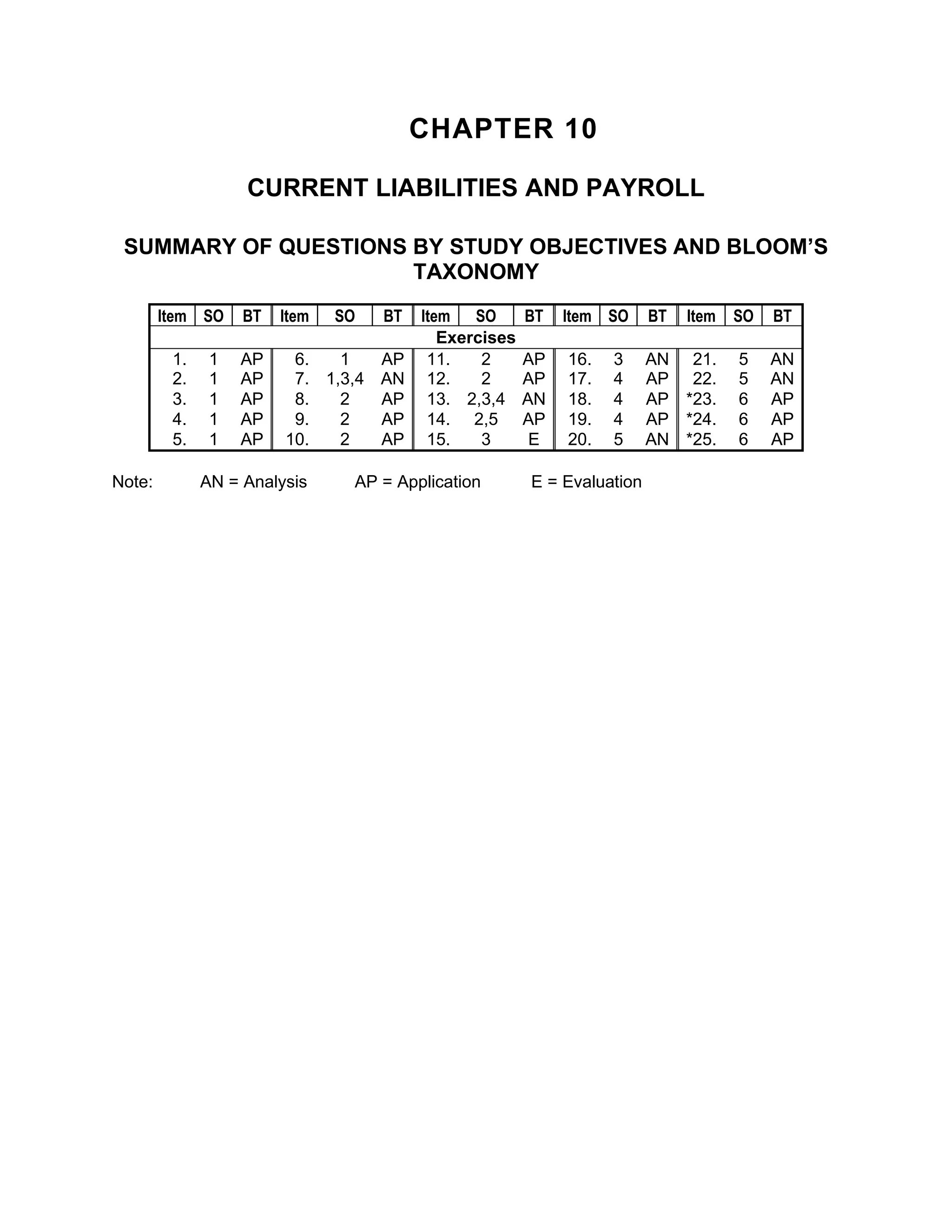
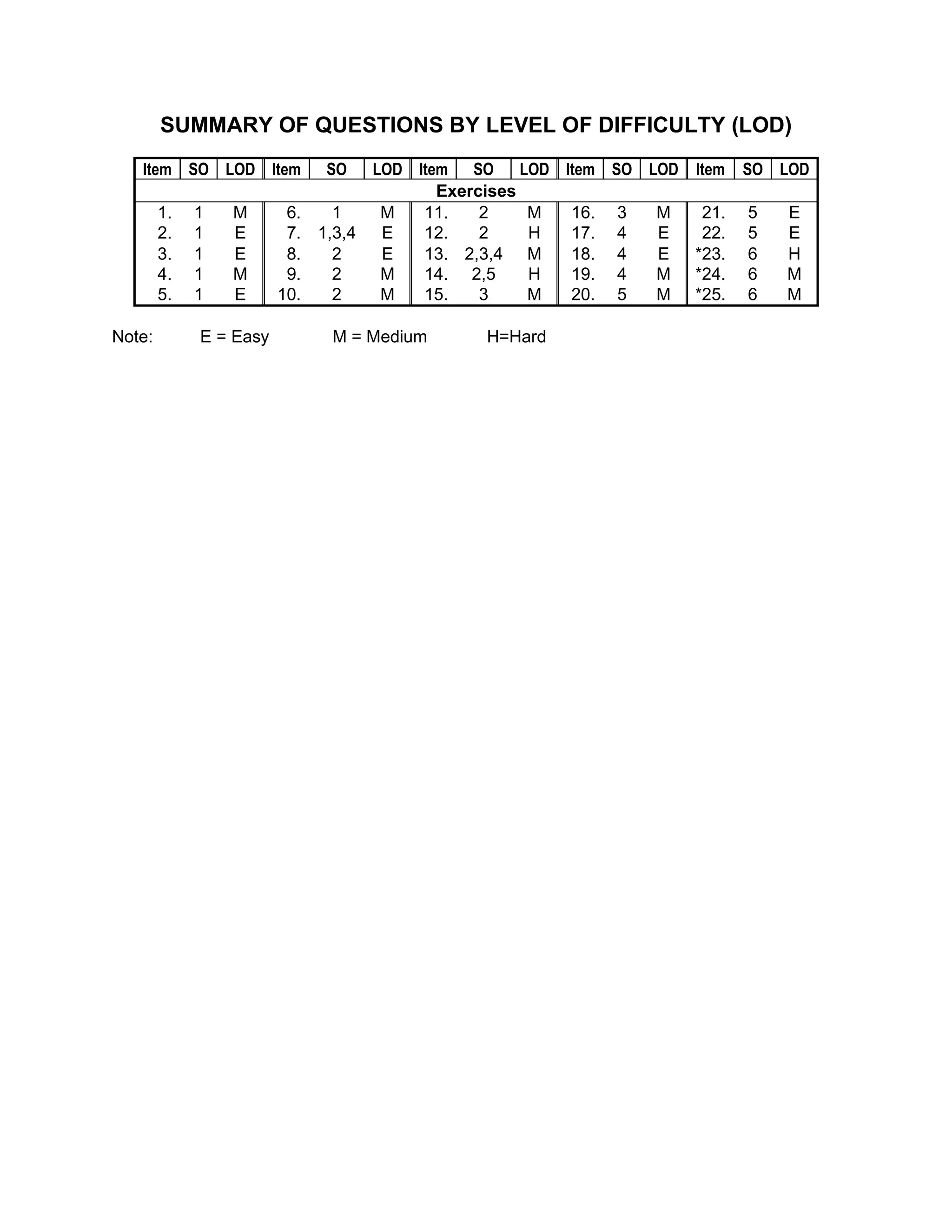
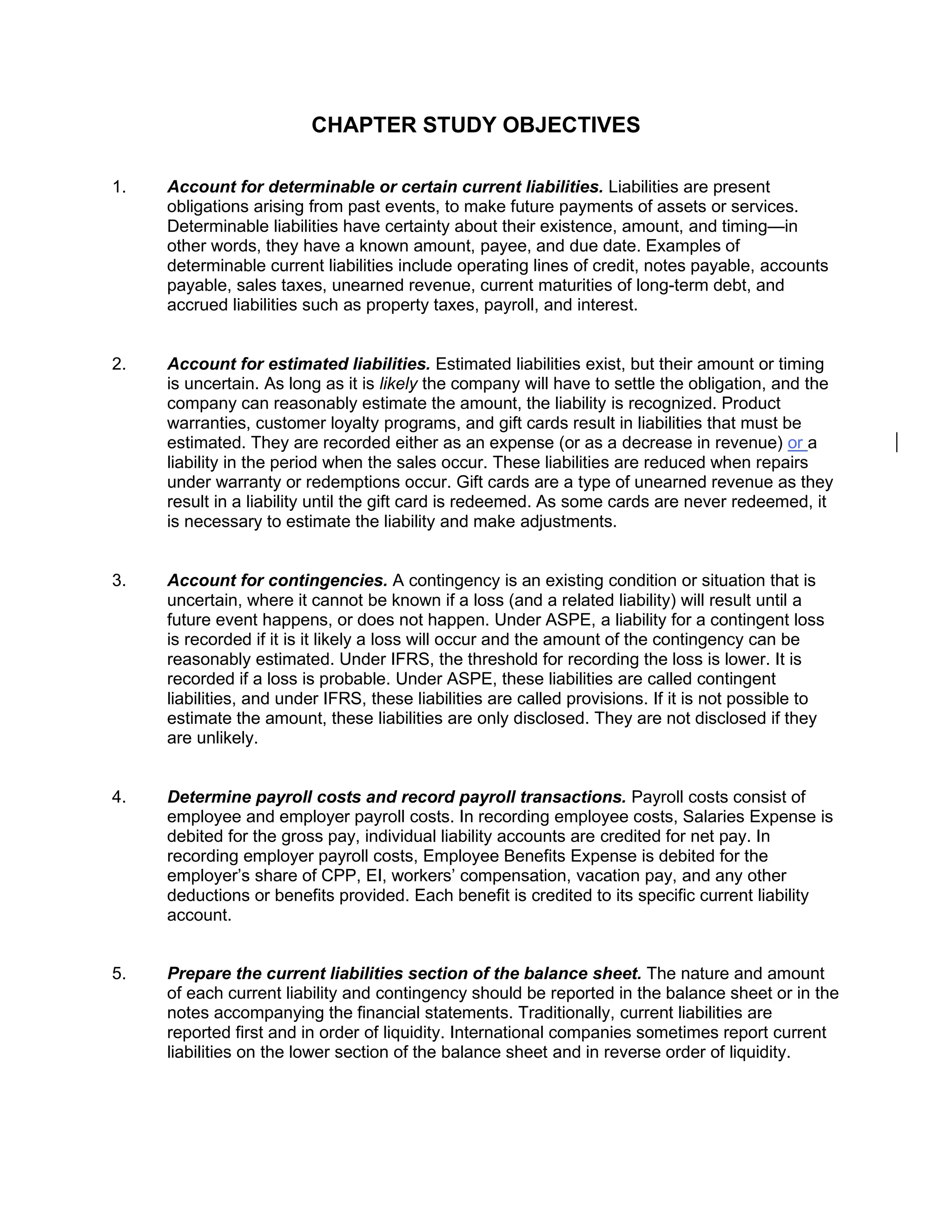

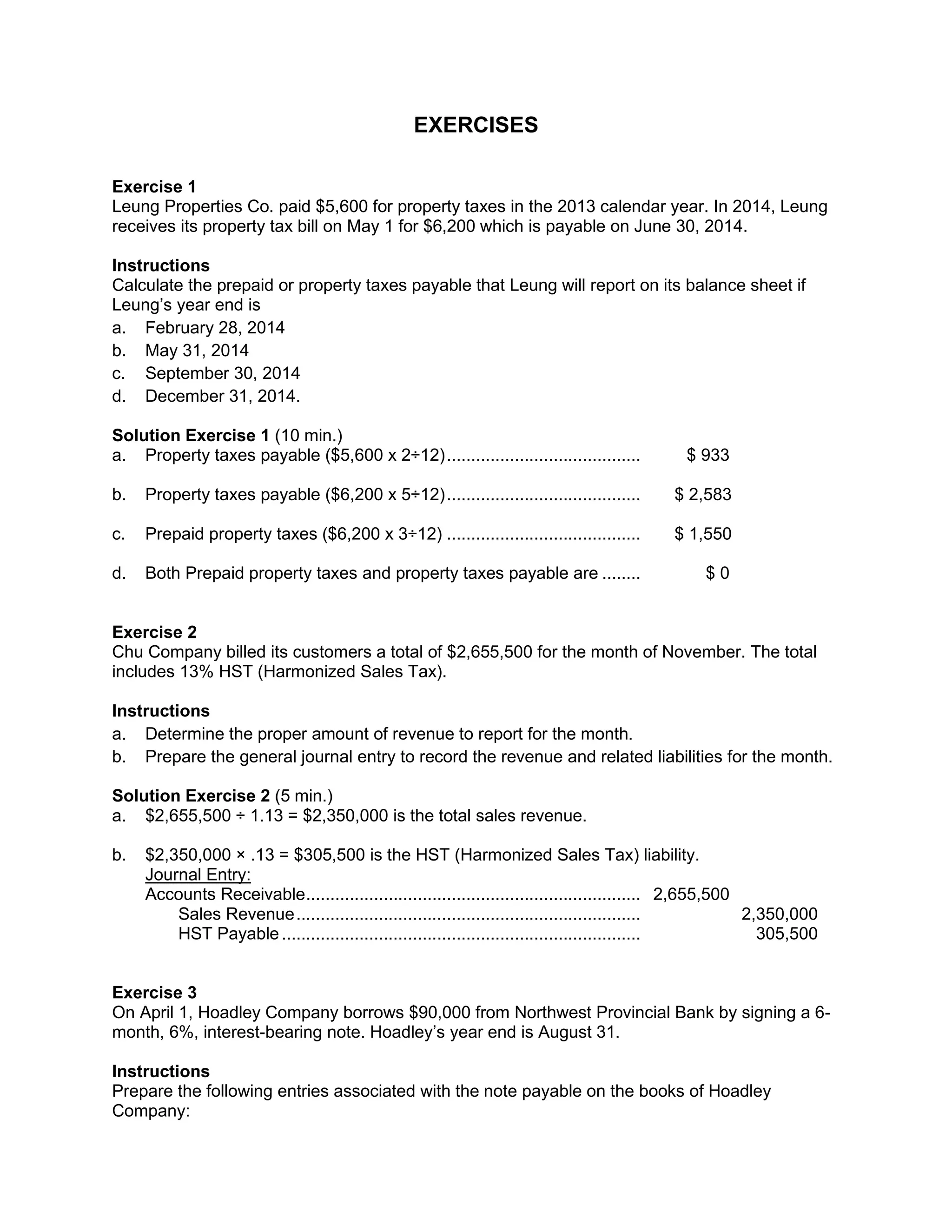
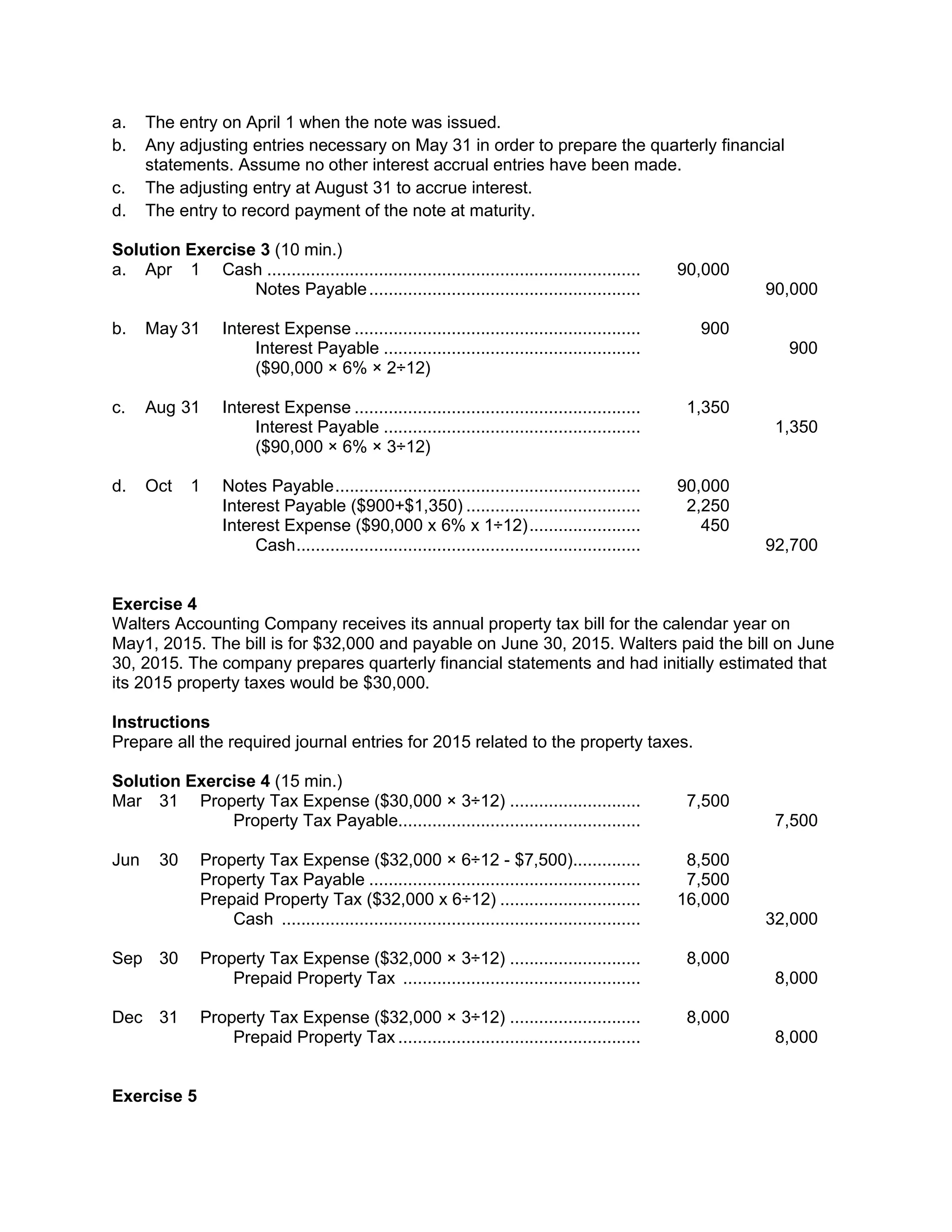
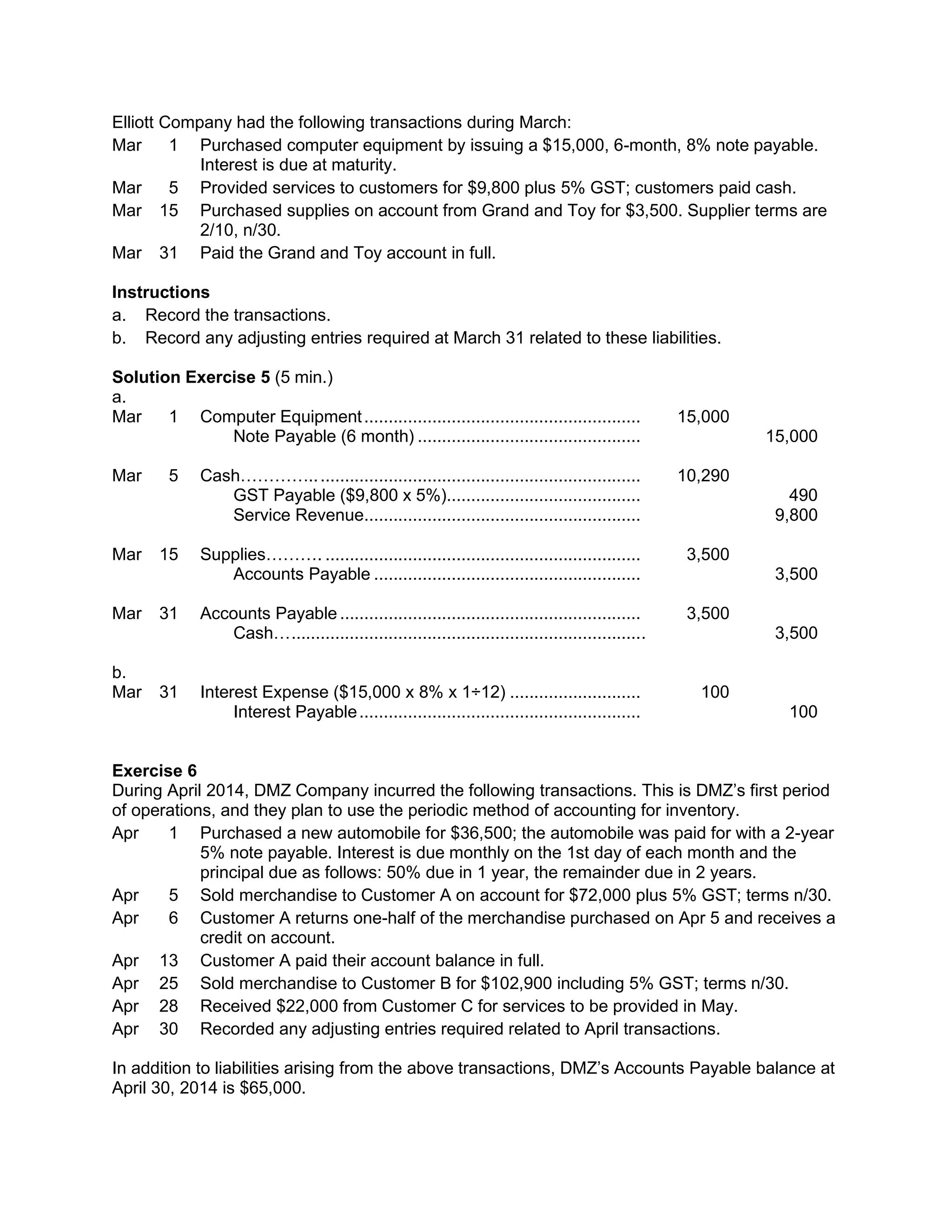
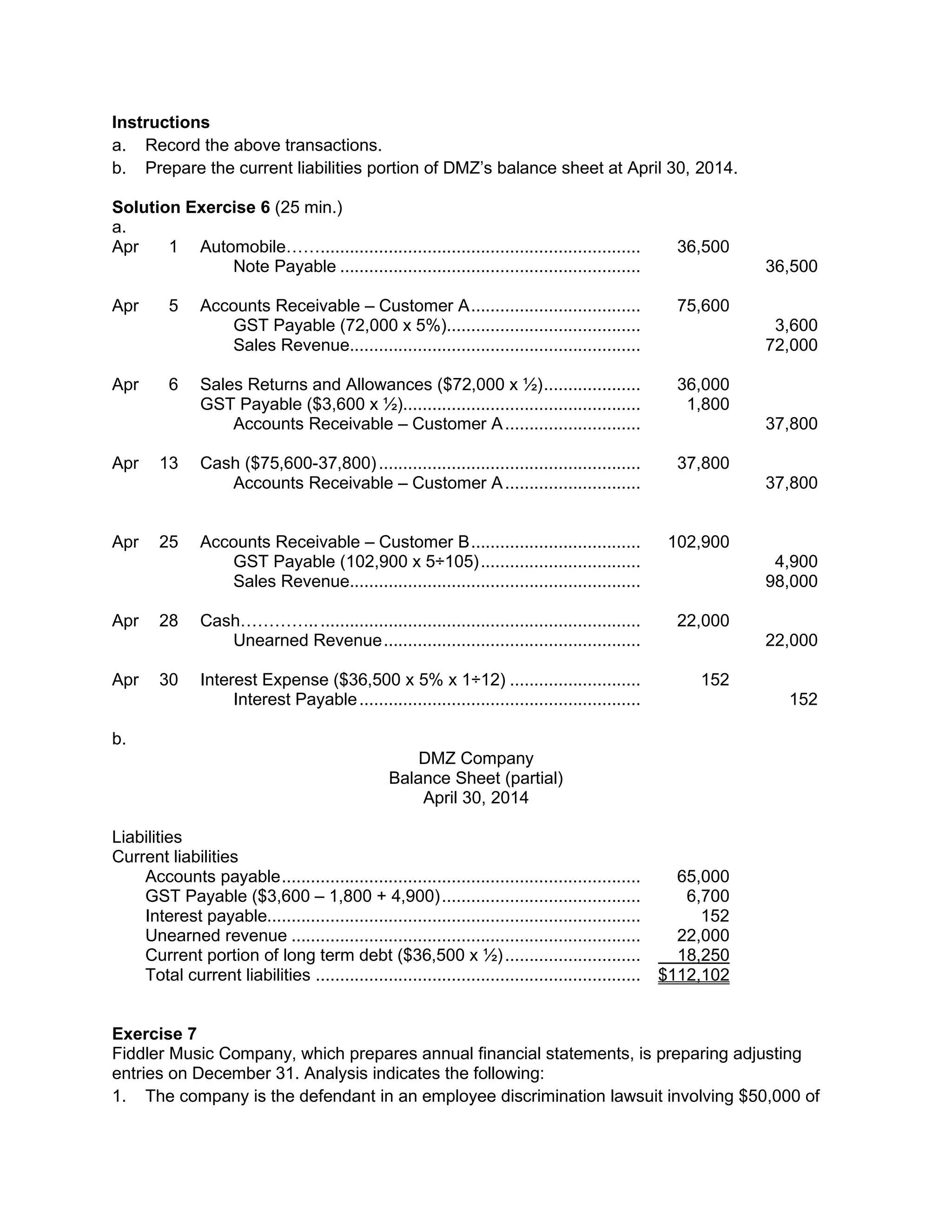
![damages. Legal counsel believes it is unlikely that the company will have to pay any
damages.
2. December 31st is a Friday. The employees of the company have been paid on Monday,
December 27th for the previous week which ended on Friday, December 24th. The
company employs 30 people who earn $80 per day and 15 people who earn $120 per day.
All employees work 5-day weeks.
3. Employees are entitled to one day's vacation for each month worked. All employees
described above in 2. worked the month of December.
4. The company is a defendant in a $750,000 product liability lawsuit. Legal counsel believes
the company probably will have to pay the amount requested.
5. On November 1, Fiddler signed a $10,000, 6-month, 8% note payable. No interest has
been accrued to date.
Instructions
Prepare any adjusting entries necessary at the end of the year.
Solution Exercise 7 (12 min.)
1. No entry—loss is not likely.
2. Wages Expense............................................................................ 21,000
Wages Payable ...................................................................... 21,000
30 × $80 × 5 = $12,000
15 × $120 × 5 = 9,000
$21,000
3. Vacation Benefits Expense ........................................................... 4,200
Vacation Benefits Payable [(30 × $80) + (15 × $120)] ............ 4,200
4. Loss from Lawsuit ......................................................................... 750,000
Estimated Liability from Lawsuit ............................................. 750,000
5. Interest Expense ($10,000 × 8% × 2 ÷ 12) .................................... 133
Interest Payable ..................................................................... 133
Exercise 8
During the month of July, Toys to Go started a new promotion. The company offered to reward
their customers for all sales made on Barbie dolls or Toy Trucks during the month of July. For
each sale made, the customer will receive a 1% reward of the sales price which can be
redeemed on future purchases until December of the current year. During the month of July,
$250,000 of Barbie dolls and Toy Trucks were sold. There was $755 worth of redemptions in
August.
Instructions
a. Prepare the journal entries to record all transactions related to the reward promotion.
b. Identify any liabilities that would be reported on the August 31, 2014 balance sheet.
Solution Exercise 8 (10 min.)
a. July 31 Sales Discounts for Redemption Rewards Issued ......... 2,500
Redemption Rewards Liability ................................ 2,500](https://image.slidesharecdn.com/6776-250324022407-66bf7334/75/Accounting-Principle-6th-Edition-Weygandt-Test-Bank-13-2048.jpg)