Solution Manual for Exploring Microsoft Office
Excel 2019 Comprehensive, 1st edition, Mary Anne
Poatsy (Copy) download pdf
https://testbankmall.com/product/solution-manual-for-exploring-
microsoft-office-excel-2019-comprehensive-1st-edition-mary-anne-poatsy-
copy/
Visit testbankmall.com to explore and download the complete
collection of test banks or solution manuals!
We believe these products will be a great fit for you. Click
the link to download now, or visit testbankmall.com
to discover even more!
Test Bank for Exploring Microsoft Office Excel 2019
Comprehensive, 1st edition, Mary Anne Poatsy
https://testbankmall.com/product/test-bank-for-exploring-microsoft-
office-excel-2019-comprehensive-1st-edition-mary-anne-poatsy/
Solution Manual for Exploring Microsoft Office Excel 2016
Comprehensive 1st Edition
https://testbankmall.com/product/solution-manual-for-exploring-
microsoft-office-excel-2016-comprehensive-1st-edition/
Test Bank for Exploring Microsoft Office Excel 2016
Comprehensive 1st Edition
https://testbankmall.com/product/test-bank-for-exploring-microsoft-
office-excel-2016-comprehensive-1st-edition/
Test Bank for Wardlaw’s Perspectives in Nutrition: A
Functional Approach, 2nd Edition, Carol Byrd-Bredbenner,
Gaile Moe Jacqueline Berning Danita Kelley
https://testbankmall.com/product/test-bank-for-wardlaws-perspectives-
in-nutrition-a-functional-approach-2nd-edition-carol-byrd-bredbenner-
gaile-moe-jacqueline-berning-danita-kelley/
Test Bank for Strategic Management, 10th Edition : Hill
https://testbankmall.com/product/test-bank-for-strategic-
management-10th-edition-hill/
Test Bank for Calculus for Business, Economics, Social
& Life Sciences, 11th Edition: Laurence D. Hoffmann
https://testbankmall.com/product/test-bank-for-calculus-for-business-
economics-social-life-sciences-11th-edition-laurence-d-hoffmann/
Test Bank for Accounting, 25th Edition
https://testbankmall.com/product/test-bank-for-accounting-25th-
edition/
Test Bank for Federal Tax Research, 9th Edition by Raabe
https://testbankmall.com/product/test-bank-for-federal-tax-
research-9th-edition-by-raabe/
Test Bank for Human Development, 11th Edition : Papalia
https://testbankmall.com/product/test-bank-for-human-development-11th-
edition-papalia/
Test Bank for Statistics Informed Decisions Using Data,
4th Edition : Sullivan
https://testbankmall.com/product/test-bank-for-statistics-informed-
decisions-using-data-4th-edition-sullivan/
Copyright © 2020 Pearson
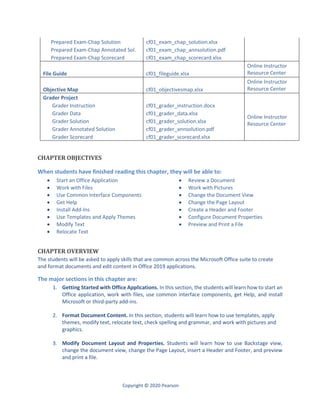
Prepared Exam-Chap Solution cf01_exam_chap_solution.xlsx
Prepared Exam-Chap Annotated Sol. cf01_exam_chap_annsolution.pdf
Prepared Exam-Chap Scorecard cf01_exam_chap_scorecard.xlsx
File Guide cf01_fileguide.xlsx
Online Instructor
Resource Center
Objective Map cf01_objectivesmap.xlsx
Online Instructor
Resource Center
Grader Project
Online Instructor
Resource Center
Grader Instruction cf01_grader_instruction.docx
Grader Data cf01_grader_data.xlsx
Grader Solution cf01_grader_solution.xlsx
Grader Annotated Solution cf01_grader_annsolution.pdf
Grader Scorecard cf01_grader_scorecard.xlsx
CHAPTER OBJECTIVES
When students have finished reading this chapter, they will be able to:
 Start an Office Application
 Work with Files
 Use Common Interface Components
 Get Help
 Install Add-Ins
 Use Templates and Apply Themes
 Modify Text
 Relocate Text
 Review a Document
 Work with Pictures
 Change the Document View
 Change the Page Layout
 Create a Header and Footer
 Configure Document Properties
 Preview and Print a File
CHAPTER OVERVIEW
The students will be asked to apply skills that are common across the Microsoft Office suite to create
and format documents and edit content in Office 2019 applications.
The major sections in this chapter are:
1. Getting Started with Office Applications. In this section, the students will learn how to start an
Office application, work with files, use common interface components, get Help, and install
Microsoft or third-party add-ins.
2. Format Document Content. In this section, students will learn how to use templates, apply
themes, modify text, relocate text, check spelling and grammar, and work with pictures and
graphics.
3. Modify Document Layout and Properties. Students will learn how to use Backstage view,
change the document view, change the Page Layout, insert a Header and Footer, and preview
and print a file.
Copyright © 2020 Pearson
CLASS RUN-DOWN
1. Have students turn in homework assignments.
2. Talk about the chapter using the discussion questions listed below.
3. Use a PowerPoint presentation to help students understand the chapter content.
4. Demonstrate common features in Office 2019 applications.
5. Run through the Scripted Lecture for the chapter. Give special attention to areas in which
students might be challenged.
6. Have students complete the Capstone Exercise.
7. Use MyITLab for in-class work or to go over homework.
8. Give students the homework handout for the next class period.
LEARNING OBJECTIVES
At the end of this lesson students should be able to:
 Use Your Microsoft Account
 Use OneDrive
 Create a New File
 Save a File
 Open a Saved File
 Use the ribbon
 Use a Dialog Box and Gallery
 Customize the ribbon
 Use the Quick Access Toolbar
 Customize the Quick Access Toolbar
 Use a Shortcut Menu
 Use Keyboard Shortcuts
 Use the Tell me Box
 Use the Help tab
 Use Enhanced Screen Tips
 Use an Add-in from the Store
 Open a Template
 Apply a Theme
 Select Text
 Format Text
 Use the Mini Toolbar
 Cut, Copy and Paste Text
 Use the Office Clipboard
 Check Spelling and Grammar
 Insert Pictures
 Modify Pictures
 Change the Document View using the ribbon
 Change the Document View using the Status Bar
 Change Margins
 Change Page Orientation
 Use the Page Setup Dialog Box
 Insert a Footer
 Insert a Header
Copyright © 2020 Pearson
 View and Edit Document Properties
 Preview a File
 Change Print Settings
 Print a File
KEY TERMS
Add-in–A custom program or additional command that extends the functionality of a Microsoft
Office program.
Backstage view–A component of Office 2019 that provides a concise collection of commands
related to an open file.
Cloud storage–A technology used to store files and to work with programs that are stored in a
central location on the Internet.
Command–A button or area within a group that you click to perform tasks.
Contextual tab–A tab that contains a groups of commands related to the selected object.
Copy–A command used to duplicate a selection from the original location and place a copy in the
Office Clipboard.
Cut–A command used to remove a selection from the original location and place it in the Office
Clipboard.
Dialog box–A box that provides access to more precise, but less frequently used, commands.
Dialog Box Launcher–A button that when clicked opens a corresponding dialog box.
Enhanced ScreenTip–A small message box that displays when you place the pointer over a
command button. The purpose of the command, short descriptive text, or a keyboard shortcut if
applicable will display in the box.
Footer–Information that displays at the bottom of a document page.
Format Painter–A feature that enables you to quickly and easily copy all formatting from one area
to another in Word, PowerPoint, and Excel.
Gallery–An area in Word which provides additional text styles. In Excel, the gallery provides a
choice of chart styles, and in Power Point, the gallery provides transitions.
Group–A subset of a tab that organizes similar tasks together.
Header–An area with one or more lines of information at the top of each page.
Keyboard Shortcut–A combination of two or more keys pressed together to initiate a software
command.
Copyright © 2020 Pearson
Landscape orientation–A document layout when a page is wider than it is tall.
Live Preview–An Office feature that provides a preview of the results of a selection when you point
to an option in a list or gallery. Using Live Preview, you can experiment with settings before making
a final choice.
Margin–The area of blank space that displays to the left, right, top, and bottom of a document or
worksheet.
Microsoft Access–A relational database management system in which you can record and link data,
query databases, and create forms and reports.
Microsoft Excel–An application that makes it easy to organize records, financial transactions, and
business information in the form of worksheets.
Microsoft Office–A productivity software suite including a set of software applications, each one
specializing in a particular type of output.
Microsoft PowerPoint–An application that enables you to create dynamic presentations to inform
groups and persuade audiences.
Microsoft Word–An application that can produce all sorts of documents, including memos,
newsletters, forms, tables, and brochures.
Mini toolbar–A toolbar that provides access to the most common formatting selections, such as
adding bold or italic, or changing font type or color. Unlike the Quick Access Toolbar, the Mini
toolbar is not customizable.
Office Clipboard–An area of memory reserved to temporarily hold selections that have been cut or
copied and allows you to paste the selections.
OneDrive–Microsoft’s cloud storage system. Saving file to OneDrive enables them to sync across all
Windows devices and to be accessible from any Internet-connected device.
Paste–A command used to place a cut or copied selection into another location.
Picture–A graphic file that is retrieved from storage media or the Internet and placed in an Office
project.
Portrait orientation–A document layout when a page is taller than it is wide.
Quick Access Toolbar–A toolbar located at the top-left corner of any Office application window,
that provides fast access to commonly executed tasks such as saving a file and undoing recent
actions.
ribbon–The command center of Office applications. It is the long bar located just beneath the title
bar, containing tabs, groups, and commands.
Copyright © 2020 Pearson
Shortcut menu–A menu that provides choices related to the selection or area at which you right-
click.
Smart Lookup–A feature that provides information about tasks or commands in Office, and can also
be used to search for general information on a topic such as President George Washington.
Status bar–A bar located at the bottom of the program window that contains information relative to
the open file. It also includes tools for changing the view of the file and for changing the zoom size of
onscreen file contents.
Tab–Located on the ribbon, each tab is designed to appear much like a tab on a file folder, with the
active tab highlighted.
Tag–A data element or metadata that is added as a document property. Tags help in indexing and
searching.
Tell me box–Located to the right of the last tab, this box enables you to search for help and
information about a command or task you want to perform and also presents you with a shortcut
directly to that command.
Template–A predesigned file that incorporates formatting elements, such as a theme and layouts,
and may include content that can be modified.
Theme–A collection of design choices that includes colors, fonts, and special effects used to give a
consistent look to a document, workbook, presentation, or database form or report.
Title bar–The long bar at the top of each window that displays the name of the folder, file, or
program displayed in the open window and the application in which you are working.
Toggle commands–A button that acts somewhat like light switches that you can turn on and off. You
select the command to turn it on, then select it again to turn it off.
View–The various ways a file can appear on the screen.
Zoom slider–A feature that displays at the far right side of the status bar. It is used to increase or
decrease the magnification of the file.
DISCUSSION QUESTIONS
 What are the benefits of having common features in the Office 2019 applications?
 What is the purpose of the Quick Access Toolbar and when might you want to customize it?
 What are three reasons you would use the Tell me box?
 What is the benefit of using a template and when would you want to start from a blank
document?
 What considerations should you be aware of when incorporating pictures into a document?
Copyright © 2020 Pearson
 Why is it useful to add tags to a document?
WHEN USING SCRIPTED LECTURE IN CLASS, DEMONSTRATE HOW TO:
 Open and Save a File
 Open a Saved File and Use the Ribbon
 Use a Dialog Box and Gallery
 Use and Customize the Quick Access Toolbar
 Use a Shortcut Menu
 Use the Tell Me Box
 Open a Template
 Apply a Theme
 Select and Format Text
 Cut, Copy, and Paste Text
 Check Spelling and Grammar
 Insert a Picture
 Modify a Picture
 Change the Document View
 Change the Page Layout
 Insert a Header and a Footer
 Enter Document Properties
 Preview a File and Change Print Settings
CONNECTIONS: PRACTICAL PROJECTS AND APPLICATIONS
 Collaborate on projects with other classmates or colleagues by saving your file to OneDrive and
sharing with others. Changes by multiple authors can be viewed in real-time. This eliminates
passing files around via email and everyone always has access to the latest changes.
 Use the Tell me box when you can’t remember where a command or feature is located on the
ribbon to be automatically directed to that command. You can also use Tell me box to execute
simple tasks automatically.
 Before you start a project from scratch, search through the available templates for each
application. Beginning with a template could save you a lot of time or give you ideas on how to
arrange or format content for a more professional look.
 If you are creating a project that eventually will combine content from multiple applications
(such as a report in Word that uses charts from Excel, or a PowerPoint presentation that
includes an Excel chart and a Word table) then format the individual files with the same theme
for a more professional look.
 Use Format Painter whenever you need to copy formatting. It can be used with text, images,
and objects. Format Painter is a lot simpler than trying to recreate multiple formats.
 Customize the Quick Access Toolbar with the Editor or Spell command. Doing so will make it
easy to quickly check your file for spelling errors before you save.
Copyright © 2020 Pearson
 Consider formatting any image you place in a Word document or PowerPoint presentation with
a simple frame, border, or modest shadowing to make the image stand out and give your
document a more professional look.
 To facilitate document searches, get in the habit of including at least one document tag for each
file.
 Always preview a document before printing to ensure the document fits nicely on each page,
that the margins and orientation settings are appropriate, and that there are no unnecessary
blank pages at the end of the document.
TEACHING NOTES
Getting Started with Office Applications
In this section, the student will learn how to start an Office application, work with files, use common
interface components, get help, and install add-ins.
A. Starting an Office Application
 Microsoft Office is a productivity software suite that includes a set of software
applications, each one specializing in a particular type of output. Word (word-processing
software), Excel (spreadsheet software), PowerPoint (presentation graphics software),
and Access (relational database software) are the most used applications in the suite.
 Log in using a Microsoft account to sign in to any Windows computer and access the
saved settings associated with your Microsoft account. This also provides additional
benefits such as being connected to all of Microsoft’s resources on the Internet, such as
cloud storage with OneDrive.
 Click the Start button and then click the app tile for the Office application in which you
want to work. If the application tile is not on the Start menu, you can open the program
from All apps.
 Alternatively, you can click in the search box on the task bar, type the name of the
program, and press Enter. The program will open automatically.
 Teaching Tip: Demonstrate the commonality of Word, Excel, PowerPoint, and Access.
 Teaching Tip: Explain the process of choosing which Office application to use and how it
really depends on what type of output you want to produce. Sometimes you may need
to use two or more Office applications to produce the intended output.
 Teaching Tip: It saves time to have an app tile for each of the Office 2019 applications
you frequently use on the desktop or even pinned to the task bar.
 Teaching Tip: You can switch between Microsoft accounts in an application using the
profile name at the top-right of the open application. Click the profile name, select
Switch account, and then select an account from the list.
 Teaching Tip: Explain the difference between Office 365 and Office 2019. Students
might have Office 365 installed on their home devices and might be using Office 2019 at
school or work. Explain that Office 365 is updated regularly while Office 2019 is not,
Copyright © 2020 Pearson
therefore there may be differences in user interface or features between the two
products (and what is showing in the text).
 Teaching Tip: Discuss the value of using OneDrive. OneDrive facilitates collaboration and
file sharing in addition to providing access to files on any device that has an Internet
connection.
B. Working with Files
 You can begin working with an Office application by opening an existing file that has
already been saved to a storage medium or you can begin work on a new file by
selecting a blank document or a ready to use template.
 Saving a file enables you to open it later for additional updates or references. Files are
saved to a storage medium such as a hard drive, CD, flash drive, or to the cloud on
OneDrive.
 Teaching Tip: Stress the importance of determining where you will be storing your files
once they are created and saved.
 Teaching Tip: Show students how to open an existing file using the Open dialog box and
explain the various components of that box.
 Teaching Tip: Demonstrate how the Recent documents list simplifies the task of
reopening the most recently opened files in an application. If you do not see your file
listed, you can click the link to Open Other Documents (or Workbooks, Presentations,
etc.).
o To keep a particular file in the list, click the icon to pin the file to the list.
o The “pushpin” of the file will change directions so that it appears to be inserted.
o If later you want to remove the file from the list, click the inserted pushpin,
changing its direction and allowing the file to be bumped off the list.
 Teaching Tip: Demonstrate to students the difference between using the command
“Save” and the command “Save As”.
C. Using Common Interface Components
 Word, PowerPoint, Excel, and Access all share a similar ribbon structure. Although the
specific tabs, groups, and commands vary among the Office programs, the way in which
you use the ribbon and the descriptive nature of tab titles are the same regardless of
which program you are using.
 Another way you can accomplish tasks in Office is to use the Shortcut menu. Shortcut
menus display when you right-click and are context sensitive, providing choices related
to the object, selection, or area of the document at which you did a right-click.
 Keyboard shortcuts can also be used to streamline executing commands without having
your fingers leave the keyboard. Keyboard shortcuts are executed by pressing
combinations of keyboard keys. Universal keyboard shortcuts in Office include Ctrl+C
(Copy), Ctrl+X (Cut), Ctrl+V (Paste), and Ctrl+Z (Undo); there are others.
Copyright © 2020 Pearson
 You can personalize the ribbon by adding, renaming, and removing ribbon tabs, as well
as creating customized tabs. The custom tabs are unique to the Office program in which
they are created.
 The Quick Access Toolbar (QAT), located at the top-left corner of any Office application
window, provides one-click access to commonly executed tasks. You can customize the
QAT by adding additional commands such as Editor (Spell check) or Quick Print.
 Discuss that the most commonly used features in each application are available on the
ribbon by task, but that additional commands can be found in Dialog boxes. Dialog
boxes are displayed by clicking the Dialog box launcher that is found at the bottom right
corner of a ribbon group. Not every ribbon group has a Dialog Box Launcher.
 Discuss that clicking More reveals additional gallery options.
 Teaching Tip: Demonstrate the ability to maximize your workspace by temporarily
hiding the ribbon and then unhide it.
 Teaching Tip: Discuss how the ribbon tabs group related tasks together and that tasks
are further organized by named groups. Also mention that contextual tabs display for
certain tasks such as working with pictures, objects, or tables.
 Teaching Tip: Reveal commands that are visible when a Dialog Box Launcher is
activated, such as a gallery of Excel chart styles and PowerPoint transitions.
 Teaching Tip: Demonstrate how to customize the ribbon and the Quick Access Toolbar.
The Quick Access Toolbar can be customized directly through the QAT or by right-
clicking a command on the ribbon and selecting “Add to Quick Access Toolbar”. Click File
and Options to customize the ribbon or the Quick Access Toolbar.
D. Getting Help
 As you work with any Office application, you can access help online as well as within the current
software installations.
 The Tell me box, located to the right of the last tab on the ribbon enables you to search for help
and information about a command or task you want to perform. It will also present you with a
shortcut directly to that command and in some instances will complete the action for you.
 Smart Lookup, on the References tab, provides information about tasks or commands in Office,
and can also be used to search for general information on a topic.
 The Help tab offers direct access to Customer support, training videos and other helpful
tutorials.
 Enhanced Screen Tips display when you point to a command, and include a brief description of
the command along with a keyboard shortcut, if available.
 Teaching Tip: Demonstrate the Help button that appears with a dialog box; it is
displayed as a question mark in the top right corner of the dialog box.
 Teaching Tip: Show students the ease of locating a command on the ribbon using the
Tell me box. A list of commands related to the skill will display.
 Teaching Tip: Demonstrate the Smart Lookup which is available on the shortcut menu
when you right-click text, on the References tab, or through the Tell me box.
Copyright © 2020 Pearson
 Teaching Tip: Demonstrate how to display an Enhanced ScreenTip which describes the
command button that the mouse pointer is hovering over.
E. Installing Add-ins
 A Microsoft or third-party add-in is a custom program or additional command that
extends the functionality of an Office program. As an example, in Excel, add-ins provide
additional functionality that can help with statistics and data mining.
 Teaching Tip: Demonstrate the steps used to search for and install an add-in from the
Microsoft Store. Note that some add-ins require fees to use.
Format Document Content
In this section, the student will explore themes and templates, explore tools to make formatting
changes, check grammar and spelling, and format pictures.
A. Using Templates and Applying Themes
 A template is a predesigned file that incorporates formatting elements such as a theme
and layout, and may include content that can be modified.
 A theme is a collection of design choices that include colors, fonts, and special effects
used to give a consistent look to a document, workbook, or presentation.
 When using multiple Office applications in one project, formatting each output with the
same theme provides consistency across all applications.
 Teaching Tip: Demonstrate how to view the Templates list when creating a new
document and how to locate other templates that are available online.
 Teaching Tip: Demonstrate how applying a theme enables you to visually coordinate
various page elements.
B. Modifying Text
 In all Office applications, the Home tab provides tools for editing selected text. You can
also use the Mini toolbar to make changes conveniently to selected text.
 Before making any changes to existing text or numbers, you must first select the
characters. Once you have selected the desired text, besides applying formatting, you
can delete or simply type over text to replace it.
 There are shortcuts to selecting text, such as clicking and dragging, using double-click,
and using the Ctrl and Shift keys with other keys on the keyboard.
 You can find the most common formatting commands in the Font group on the Home
tab.
 The Font determines the way characters display onscreen or print in documents,
including qualities such as size, spacing, and shape.
 Teaching Tip: Demonstrate editing text using various shortcuts to select the text.
 Teaching Tip: Show students how to apply a different font to a section of a project by
selecting the font from within the Font group on the Home tab or selecting it from the
Mini toolbar.
Copyright © 2020 Pearson
 Teaching Tip: Expand the Font dialog box and discuss additional font features that are
not on the ribbon.
C. Relocating Text
 The Office Clipboard is an area of memory reserved to temporarily hold selections that
have been cut or copied and allows you to paste the selections. It is important to finalize
the paste procedure during the current session before the computer is shut down or
loses power, for the contents of the Clipboard are then erased.
 Teaching Tip: Show students how to relocate text using the cut, copy, and paste
commands.
 Teaching Tip: Demonstrate using the Office Clipboard by cutting or copying several
sections of text and then pasting all or some of the cut/copied text to a new location.
D. Checking Spelling and Grammar
 Spelling and grammar are automatically checked as you enter text in Word and
PowerPoint. You run the spelling checker in Excel to check spelling. Spell check in Access
is available only in Forms and Reports.
 When the Check Document (Word), Spelling (Excel and PowerPoint) command is
activated, the Editor pane opens. Use the Editor pane to work through suggested
replacements for identified errors.
 Misspellings are identified with a red wavy underline. Grammatical problems are
underlined in green, and word usage errors (such as using bear instead of bare) have a
blue underline.
 Some correctly spelled words are identified as being incorrect because the word does
not exist in the application’s dictionary. You can add the word to the dictionary to avoid
future error notations or choose to Ignore all or each instance of the word.
 AutoCorrect automatically applies corrections to common typing errors and
misspellings. You modify AutoCorrect settings to add or delete words and replacement
text.
 Teaching Tip: Show students how to make corrections or bypass all occurrences of a
flagged error in the current document.
 Teaching Tip: Demonstrate how to add a word, phrase, or often-used names to the
application dictionary, so an error is not flagged in the future.
 Teaching Tip: Demonstrate how to access and modify AutoCorrect.
E. Working with Pictures
 Pictures and other graphic elements can be included in a project to add energy, interest,
and additional description.
 You can insert pictures from your own library of digital photos you have saved on your
hard drive, OneDrive, or another storage medium.
Copyright © 2020 Pearson
 You can initiate a Bing Image Search for online pictures directly inside the Office
program being used.
 When a picture is selected, the Picture Tools Format tab includes options for modifying
a picture. You can apply a picture style or effect, and add a picture border from
selections in the picture Styles group.
 Teaching Tip: Demonstrate how to insert a picture from a file stored on your computer.
 Teaching Tip: Show students how to use the sizing handles of a picture to resize it and
how to use the cropping tool, which adjusts the amount of a picture that displays.
 Teaching Tip: Demonstrate how to create a document using a template and then
replace the picture placeholder with one of your own.
Modify Document Layout and Properties
In this section, the students will learn about views and how to change a document view to suit their
needs. Additionally, they will learn how to modify the page layout, including page orientation and
margins, as well as how to add headers and footers. Finally, the students will explore Print Preview
and the various printing options available.
A. Changing Document Views
 A document view is the way a file appears onscreen. The view buttons on the status bar
of each application enable you to change the view of the open file.
 Additional views are available on the View tab.
Teaching Tip: Demonstrate using the Zoom slider, which is a horizontal bar on the bottom right side of
the status bar, to increase and decrease the size of the document onscreen. Beware that the changing
size of text onscreen does not change the font size when the file is printed or saved.
B. Changing the Page Layout
 The Layout tab in Word and Page Layout tab in Excel provides access to a full range of
options, such as margin settings and page orientation. PowerPoint and Access do not
have Layout tabs.
 The Page Setup group contains the most commonly used page options in the particular
Office application. Other less common settings are available in the Page Setup dialog
box.
 Teaching Tip: Demonstrate how changing page orientation can be executed using an
option in the Print area of Backstage view, from the Page Layout tab, or the Page Setup
dialog box.
C. Creating a Header and a Footer
 A header and footer in a document better identify the document and give it a
professional appearance.
 A header consists of one or more lines at the top of each page. A footer displays at the
bottom of each page, often to include a page number or one or more lines of text.
Copyright © 2020 Pearson
 PowerPoint offers only footers for slides and headers and footers for handouts.
 One advantage of using headers and footers is that you specify the content only once,
after which it displays automatically on all pages.
 Teaching Tip: Demonstrate how text in a header or footer can be formatted like any
other text in any font or font size.
 Teaching Tip: Discuss and demonstrate how to set headers and footers so they do not
appear on the first page.
D. Configuring Document Properties
 Backstage view, in addition to open, save, and print a file, is used to view settings
related to protection, permissions, versions, and properties of a file. The Info tab houses
document properties.
 Document properties include author name, file size, permissions, and date modified
information.
 Teaching Tip: Demonstrate where documents properties are found on the Info tab in
Backstage view.
E. Previewing and Printing a File
 The Print Preview feature of Office enables you to take a look at how your document or
worksheet will appear before you print it.
 In the Print Preview page, you will see all items, including any headers, footers, graphics,
and special formatting.
 There are various print options to select when you want to print an Office file, including
the number of copies and the specific pages to print.
 Teaching Tip: Demonstrate the options available in the Backstage Print view and how
they vary depending on the application in which you are working.
OBJECTIVE TESTS IN MYITLAB
To find an objective test to help your students practice for tests, have them sign in to MyITLab:
www.myitlab.com
ADDITIONAL WEB RESOURCES
1. What’s new in Office 365: https://support.office.com/en-us/article/What-s-new-in-Office-
365-95c8d81d-08ba-42c1-914f-bca4603e1426#Platform=Windows_Desktop
2. Office 2019 Quick Start Guides: https://support.office.com/en-us/article/office-quick-starts-
25f909da-3e76-443d-94f4-6cdf7dedc51e?ui=en-US&rs=en-US&ad=US
3. Office 365 basics – video training: https://support.office.com/en-us/article/office-365-
basics-video-training-396b8d9e-e118-42d0-8a0d-87d1f2f055fb?wt.mc_id=otc_home
4. Office tips and tricks: https://support.office.com/office-training-center/featured-
tips?wt.mc_id=OTC_HOME
Copyright © 2020 Pearson
5. Office cheat sheets: https://support.office.com/en-us/article/office-cheat-sheets-61abfe7b-
1c43-483c-b82b-3806d80e027e
6. Create a local user account in Windows 10: http://windows.microsoft.com/en-us/windows-
10/create-a-local-user-account-in-windows-10
7. Keyboard shortcuts in Windows: http://windows.microsoft.com/en-us/windows-
10/keyboard-shortcuts
8. Office 365 subscription: https://products.office.com/EN-
US/buy?Wt.mc_id=OAN_mscom_prog_officepostholidayattach_buyoffice365
9. Getting started with OneDrive: http://windows.microsoft.com/en-us/windows-8/getting-
started-onedrive-tutorial
10. How to customize the ribbon: https://support.office.com/en-us/article/Customize-the-
ribbon-3C610B47-6F0F-4179-83D3-68A254A80EA6
PROJECTS AND EXERCISES
Data File Student Solution File
Hands-On Exercise 1 cf01h1Letter.docx cf01h1Letter_LastFirst.docx
Hands-On Exercise 2 cf01h2Flyer.docx
cf01h2Art.jpg
cf01h2Flyer_LastFirst.docx
Hands-On Exercise 3 Blank Document cf01h3Letter_LastFirst.docx
Practice Exercise 1
cf01p1Design.pptx
cf01p1Website.jpg
cf01p1Design_LastFirst.pptx
Practice Exercise 2
cf01p2Business.docx
cf01p2Cupcake.jpg
cf01p2Business_LastFirst.docx
Mid-Level Exercise 1
cf01m1RefLetter.docx
cf01m1College.jpg
cf01m1RefLetter_LastFirst.docx
Mid-Level Exercise 2
cf01m2Tracker.xlsx
cf01m2BloodPressure.jpg
cf01m2Tracker_LastFirst.xlsx
Running Case cf01r1NCCTSRates.xlsx cf01r1NCCTSRates_LastFirst.xlsx
Disaster Recovery cf01d1Resume.docx cf01d1Resume_LastFirst.docx
Capstone
cf01c1SocialMedia.pptx
cf01c1Sharing.jpg
cf01c1SocialMedia_LastFirst.pptx
Copyright © 2020 Pearson
CHAPTER REVIEW/ANSWERS TO END OF CHAPTER MATERIAL
Key Terms Matching Answer Key
1. A productivity software suite including a set of software applications, each one
specializing in a particular type of output.
J. Microsoft Office
2. The long bar located just beneath the title bar containing tabs, groups, and commands.
O. Ribbon
3. Custom program or additional command that extends the functionality of a Microsoft
Office program.
A. Add-in
4. A collection of design choices that includes colors, fonts, and special effects used to give
a consistent look to a document, workbook, or presentation.
T. Theme
5. A data element or metadata that is added as a document property.
Q. Tag
6. A component of Office that provides a concise collection of commands related to an
open file and includes save and print options.
B. Backstage view
7. A tool that displays near selected text that contains formatting commands.
K. Mini Toolbar
8. Relational database software used to store data and convert it into information.
I. Microsoft Access
9. A feature in a document that consists of one or more lines at the bottom of each page.
D. Footer
10. A predesigned file that incorporates formatting elements, such as a theme and layouts,
and may include content that can be modified.
S. Template
Copyright © 2020 Pearson
11. A feature that enables you to search for help and information about a command or task
you want to perform and will also present you with a shortcut directly to that command.
R. Tell me box
12. A tool that copies all formatting from one area to another.
E. Format Painter
13. Stores up to 24 cut or copied selections for use later on in your computing session.
L. Office Clipboard
14. A task-oriented section of a ribbon tab that contains related commands.
F. Group
15. An online app used to store, access, and share files and folders.
M. OneDrive
16. Provides handy access to commonly executed tasks such as saving a file and undoing
recent actions.
N. Quick Access Toolbar
17. The long bar at the bottom of the screen that houses the Zoom slider and various View
buttons.
P. Status bar
18. The area of blank space that displays to the left, right, top, and bottom of a document or
worksheet.
H. Margin
19. A technology used to store files and to work with programs that are stored in a central
location on the Internet.
C. Cloud storage
20. A feature in a document that consists of one or more lines at the top of each page.
G. Header
Copyright © 2020 Pearson
Multiple Choice Answer Key
1. In Word or PowerPoint, a quick way to select an entire paragraph is to:
b. Triple-click inside the paragraph.
2. When you want to copy the format of a selection but not the content, you should:
d. Click Format Painter in the Clipboard group.
3. Which of the following is not a benefit of using OneDrive?
c. Hold video conferences with others.
4. What does a red wavy underline in a document or presentation mean?
a. A word is misspelled or not recognized by the Office dictionary.
5. Which of the following is true about headers and footers?
c. Headers appear at the top of every page in a document.
6. You can get help when working with an Office application in which one of the following areas?
a. The Tell me box
7. To access commands that are not on the ribbon, you need to open which of the following?
b. Dialog Box
8. To create a document without knowing much about the software, you should use which of the
following?
c. Template
9. Which is the preferred method for resizing a picture so that it keeps its proportions?
b. Use a corner sizing handle
10. Which is not a description of a tag in a Word document?
d. Document title
Quick Concept Check Answer Key
1. Explain what the benefits are of logging in with your Microsoft account.
When you log in with your Microsoft account, you will be able to access the saved settings that
are associated with your Microsoft account. Additionally, signing in with your Microsoft account
allows access to OneDrive, allowing you to save, retrieve, and edit files from the Internet.
Copyright © 2020 Pearson
2. Describe when you would use Save and when you would use Save As when saving a
document.
Save As is used when saving a new document or when changing the name of an existing file or
where an existing file is stored. Save is used when saving changes to an existing file, without
making changes to file name or storage location.
3. Explain how the ribbon is organized.
The ribbon is the command center of any Microsoft Office application. The ribbon is organized
by tabs, which sort skills into groups by task.
4. Describe the Office application features that are available to assist you in getting help with a
task.
When a task is typed into the Tell Me box, a menu of possible commands will appear from which
you can select either further assistance on the task, or the task will be completed automatically.
The Smart Lookup feature provides information on general and Office related tasks through a
Bing search. Enhanced ScreenTips are available by simply hovering the mouse pointer over a
command on the ribbon, prompting a text box of information about the command to appear.
Lastly, the Help tab on any Office application provides links to training documents and videos.
5. Discuss the differences between themes and templates.
You can enhance your file by using a template or applying a theme. A template is a predesigned
file that incorporates formatting elements, such as a theme and layout, and may include content
that can be modified. A theme is a collection of design choices that includes colors, fonts, and
special effects used to give a consistent look to a document, workbook, or presentation.
Microsoft provides high quality templates and themes, designed by professional designers to
make it faster and easier to create high-quality documents. Even if you use a theme to apply
colors, fonts and special effects, they can later be changed individually or to a completely
different theme.
6. Discuss several ways text can be modified.
Text can be modified by using the font commands accessed on the ribbon, using a short-cut
menu, or through the Mini Toolbar. Font styles, sizes, colors, and effects such as bold, italics,
and underline are available. Other formatting options not found on the ribbon (or through
shortcut menus or the Mini Toolbar) can be accessed by using the Font Dialog Box Launcher to
display the Font Dialog Box.
7. Explain how the Office Clipboard is used when relocating text.
When you cut or copy selections, they are placed in the Office Clipboard. Instead of cutting or
copying and pasting items individually, you can cut or copy all the items to the Office Clipboard,
then paste each or all Office Clipboard items to the new location.
8. Explain how to review a document for spelling and grammar.
Copyright © 2020 Pearson
Word and PowerPoint automatically check your spelling and grammar as you type. If a word is
unrecognized, it is flagged as misspelled or grammatically incorrect. Misspellings are identified
with a red wavy underline, and grammatical or word usage errors (such as using bear instead of
bare) have a blue double underline. To review for spelling and grammar errors throughout a
document, use the Spelling & Grammar command. When it is selected, the Editor pane will open
on the right. For each error, you are offered one or more suggestions as a correction. You can
select a suggestion and click Change, or if it is an error that is made more than one time
throughout the document, you can select Change All.
9. Explain why it is important to use the corner sizing handles of a picture when resizing.
To adjust the size while maintaining the proportions, use the corner sizing handles. If one of the
center edge sizing handles is used, the picture will stretch or shrink out of proportion.
10. Discuss why would you need to change the view of a document.
As you prepare a file, you may find that you want to change the way you view it. A section of
your document may be easier to view when you can see it magnified, for example. Alternatively,
some applications have different views to make working on your project easier.
11. Discuss the various ways you can change a page layout.
Most commonly the layout of a page or worksheet can be modified by changing margins and
page orientation. In Excel, you can also center the worksheet vertically or horizontally on a page.
In Word, contents can also be aligned in columns. Other less common page setup options can be
found in the Page Setup dialog box.
12. What functions and features are included in Backstage View?
The Backstage view is a component of Office 2019 that provides a concise collection of
commands related to an open file. You access the Backstage view by clicking the File tab. Using
the Backstage view, you can find out information such as protection, permissions, versions, and
properties. A file’s properties include the author, file size, permissions, and date modified. You
can create a new document or open, save, print, share, export, or close.
13. Explain what document properties are and why they are helpful.
Document properties are data elements about a file that include the author, file size,
permissions, and when the file was modified. Additionally, tags can be added to help with future
searches and indexing.
Copyright © 2020 Pearson
List of Solution Files/Folders:
Random documents with unrelated
content Scribd suggests to you:
called evangelical ministers of our day—presbyterians, anabaptists,
wesleyans, independents, all maintain and practise it now, though
sometimes under other names—“consultation,” “history of
conversion,” “detailing of experiences.” Richard Baxter’s
characteristic words, exhibiting the true spirit of Church teaching,
and showing how nonconformists cling to it in this case, are specially
worthy of full recital.
“I know,” he writes, “some will say, that it is near to Popish
auricular confession, which I here persuade Christians to; and it
is to bring Christians under the tyranny of the priests, and make
them acquainted with all men’s secrets, and masters of their
consciences. To the last, I say—to the railing devil of this age—
no more, but the Lord rebuke thee. If any minister have wicked
ends, let the God of heaven convert him, or root him out of His
Church, and cast him among the weeds and briers. But is it not
the known yoke of sensuality to cast reproaches upon the way
and ordinances of God? Who knoweth not, that it is the very
office of the ministry, to be teachers and guides to men in
matters of salvation, and overseers over them. . . . I am
confident, many a thousand souls do long strive against anger,
lust, blasphemy, worldliness, and trouble of conscience, to little
purpose, who, if they would but have taken God’s way, and
sought out for help, and opened all their case to their minister,
they might have been delivered in a good measure long ago.
And for Popish confession, I detest it: we would not persuade
men that there is a necessity of confessing every sin to a
minister before it can be pardoned. Nor do we it in a perplexed
formality only at one time of the year, nor in order to Popish
pardons or satisfactions; but we would have men go for physic
to their souls, as they do for their bodies, when they feel they
have need. And let me advise all Christian congregations to
practise this excellent duty more. See that you knock oftener at
your pastor’s door, and ask his advice in all your pressing
necessities. Do not let him sit quiet in his study for you: make
him know by experience, that the tenth part of a minister’s
labour is not in the pulpit.”
One more quotation: it will be heard with respect when I tell you it is
from the Bishop of Lincoln’s sermons on repentance: “As ministers
should be, by their profession, usually the best advisers in cases of
conscience, and are, or ought to be, every penitent’s ready and
sympathising friends, so to them the stricken or perplexed soul will
often have recourse. And thus, there is a sense in which those
dreaded words, ‘confession to the priest,’ (in one sense, justly
dreaded, for the iniquity of ages is upon them) may express an
edifying practice, and even at times a duty.” [80]
Thus, my brethren, have I endeavoured to set before you, the true
merits of the question, “Ought man to confess to man?” to remind
you what is required, what is allowed and recommended, what is
forbidden by Scripture, and the Witness and Keeper of Scripture, the
Church. Endeavour, all of you, to learn from the subject, charity and
wisdom. If you feel that you need not this use of confession, thank
God for your easy circumstances; but, blame not, and, above all,
dare not to ridicule, those who have need. If you want it, by all
means seek it; we may not refuse it. To all of you, I would say, at
all times regard your clergyman as indeed an appointed spiritual
friend and adviser, and so make use of him; but, especially in
sickness, when you call him to your bedside, so far, at least, admit
him to your confidence, and enlighten him with respect to your
spiritual state, that his instruction may be pointed, and his prayers
appropriate; and so his visits blessed. Oh! look not upon us as mere
Sunday lecturers, or mechanical readers of prayers, in whom you
have no week-day interest, and from whom no benefit is to be
derived, but what may be had in church. Degrade not our office,
nor ignore our authority, nor slight our willingness to use both for
your temporal and eternal good. Nor, on the other hand, exalt us to
the false position of spiritual despots—lords of men’s consciences;
idols occupying the place of God. Ministers we are; servants of
Christ; and your servants for His sake. Make use of our ministry as a
ministry, and doubt not but God will then make it profitable to you,
and accomplish by it, all the ends for which He appointed it.
SERMON VII.
FORGIVENESS.
Psalm cxxx., 4.
“There is forgiveness with Thee.”
We all know what forgiveness of sin means, namely, remission of the
punishment due to it by Divine sentence, and restoration of the
offender to the position and privileges of the righteous. We all
know, too, our individual need, our ever fresh recurring need of this
forgiveness; and we also know, all of us, that forgiveness is granted
only for the sake and merits of the Lord Jesus Christ, and on fixed
conditions.
Alas! my brethren, how little do we feel what we know. With what
vain speculations, what idle dreams, what perverse errors do we too
often darken knowledge!
Forgiveness, ransom from eternal death, deliverance from the
terrible inflictions of Almighty wrath, gracious reception into God’s
own family, and full participation of His inexhaustible love and
benediction, how can sinners consent not to value this when given
or offered, not to desire and seek it when needed? Yet so it is.
There is many an one of our poorest possessions which we cherish
more fondly; there is many an unobtained bauble which we would
make more real effort to obtain.
Ask yourselves, seriously, and answer to yourselves, honestly, my
fellow-sinners, whether it is not so. All of you believe that you have
been forgiven some thing, nay, many things. You do not suppose
that you are carrying about, each one of you, the unmitigated
condemnation of original sin; the full burthen of every transgression
and omission of your whole lives, from the first exercise of your self-
will in childhood, to that in which you offended but an hour since.
You know, indeed, that much remains written against you; but you
believe that much more has been blotted out; that God has been
propitiated and reconciled to fallen man by the sacrifice and
intercession of His Son; that wrath has been displaced by love; that
the way of return is open; that the ears of mercy are unclosed; that
the arms of grace are stretched out to unfold all those, who by birth
inherited banishment, and were kept in exile by the fiery sword
which turned every way and allowed none to pass to the paradise of
bliss and the tree of life. What Adam lost, that and much more has
Christ won. In Him you already have regained much; through Him
you may have all and abound.
This you know. How much of it do you feel? Where is your joy of
deliverance? where your heart-leapings of praise? where your
homage of gratitude for what has been forgiven? And where are
your yearnings, your wrestling prayers, your strenuous efforts after
the forgiveness yet needed? the cries and struggles of drowning
men, grasping in your fresh peril the again stretched out rope of
deliverance; imploring to be taken up once more into the ark of
salvation; to be landed yet again on the shore of hope? Alas!
where? Is not forgiveness obtained, unheeded; forgiveness not
obtained, unsought? Not altogether, God be praised! There are
some who never forget their deliverance; who have learnt from it
gratitude for the past, and hope and direction for the future. There
are some who are wont to gaze upon the book of the Divine account
of them (that is, so much of it as is revealed), and as they gaze, to
keep moist with the tears of humble penitence and love, the red
stain of Christ’s blood, which hides, nay, has obliterated so many of
the black items against them; and who, seeing how much is
cancelled, cannot bear that aught should remain uncancelled, and
therefore rest not, nor cease from pleading and entreating, while
one single black figure is uncovered by the crimson mark of
remission.
Some of you, my brethren, surely there are, who, looking back,
perhaps upon a youth of wild and wicked folly, or a manhood of
worldliness, or much of an old age of dull, spiritual indifference, from
the thraldom of which, by God’s grace, you have been delivered,
whose fearful guilt, you have reason to believe, has been remitted;
some of you, I say, surely there are, who so appreciate the obtained
mercy as to think nothing comparable to it, no gratitude enough for
it; and who, therefore, when need of more forgiveness arises (as, of
course, it constantly does), betake yourselves early, with the first
fruits of your desires, and the quick steps of urgent, craving want, to
the fountain that ever floweth, by whose waters alone you can be
cleansed and refreshed. Yes, there are such; a few of them; and
they do value, they do seek forgiveness.
But, do the many? Judge for yourselves, brethren. Trace back, all
of you, as far as you can, the course of your respective lives; review
your old habits, your former careers of transgression or omission; or
pick out some single sin, if you will of recent date; some one of
those many offences against which God’s wrath is pronounced, and
on account of which it must descend, unless forgiveness is secured.
Is it a lie, a filthy jest, a profane speech, a word of slander? Is it a
thought of malice, an encouraged lust, a meditated misdeed? Is it
an act of fraud? Did you use false balances, or adulterate your
wares, or drive an unfair bargain, exacting more, or giving less than
was right? Did you pilfer from your employer, or rob him of your
bought service, or betray his interest? Is it direct ungodliness? Did
you act in defiance of God’s known commandment? Did you profane
His holy day? Did you disregard His fear? Did you withhold aught
that He claims of service, of prayer, of praise, of money, time,
talents, influence, of example?
Brethren, most of you follow, or have followed, some bad habit; at
least, each of you has committed, and can now bring to quick
remembrance, some one evident, wilful sin. Now God forbade that
sin, and warned you of condemnation if you did it. God witnessed its
commission. His displeasure arose; He registered it in heaven; He
wrote down death, eternal death, against it; and angels, beholding
what He did, prepared themselves to fly with the lightning’s speed
and execute that sentence, at the first motion of His commanding
will. The sentence is not executed. The sin has, or has not, brought
you inconvenience, perplexity, contempt, pain, sickness, loss. But,
at any rate, it has not brought you death. Brethren, why not? Do
you know? do you imagine? do you care? Is the sentence still
impending, or has it been reversed? Are you forgiven? or have you
yet to seek forgiveness? Do you concern yourselves at all about the
matter? If you have forgiveness, do you really value it? If you have
it not, do you really seek it? Oh! judge yourselves, brethren, that ye
be not judged of the Lord.
I can imagine the comparatively religious ready to urge, “Thus
saying, you reproach us also; you bring all in guilty; you do not allow
that any are in the right.” Even so, brethren, for there is none clear
in this matter. The standard of right is so high, that all come short
of it. Infirmity checks the accomplishment of our best purposes. Sin
defiles even our holy things. The flesh ever resists the spirit, and
too often blinds and deadens it. And so our warmest desires are
often all but cold; our greatest industry is but little removed from
sloth. We cannot do the things, nor think the thoughts that we
would, in perfection. Let us gather consolation from the fact, that
this is a law even of our regenerate being, when we fall short of
what we desire and aim at; but let us not thereby justify ourselves in
spiritual indifference, nor suppose that a general culpability
exonerates the individual. Much will always be amiss, through the
opposition of the flesh, and through the difficulty of discerning
spiritual things; and much allowance we may hope will be made for
us: but, much that is amiss, might be corrected, and ought to be;
nay, unless it is, we shall be without excuse. It is so, be assured, in
this matter of forgiveness. At the best, we shall never, in this world,
appreciate it fully, when bestowed; nor seek it with sufficient
earnestness, when needed. But, if we concern ourselves to think
right thoughts about it; if we ascertain more clearly what it is, and
how obtained, we shall speedily become more grateful for it, more
eager to obtain it, more sure partakers of it. Let me throw out a few
suggestions, which, by God’s blessing, may help to bring us nearer to
this better state.
First, consider what Divine forgiveness is. It is not capricious
reversal of the sentence, “The soul that sinneth it shall die.” Divine
justice does not give up its claim. Divine truth does not belie itself;
Divine resoluteness become fickle. God is not a man, that He should
repent, or that He should say and not do, or that He should come to
love what once He hated. God might have been freely reconciled to
the transgressor, if He had not made transgression sin. He might,
even then, have left the sinner alone, imposing no other punishment
than exile from His presence, if He had not solemnly declared, “In
the day that thou eatest thereof, thou shalt surely die.” But now, His
holiness, His justice, and His truth are irrevocably pledged to banish
and destroy transgressors. It can never be otherwise. Holiness
cannot tolerate near unholiness: like Satan from heaven, like Adam
and Eve from paradise, it must be cast out. Justice cannot acquit
the guilty. Truth can never say, “Thou shalt not die,” to him to whom
it has already said, “Thou shalt die.” There is no such forgiveness.
If you transgress, you are a sinner; if you sin, you are condemned; if
you are condemned, you must die. God has said it, and there is no
variableness, or shadow of turning, in Him.
We are wont to think otherwise. We fancy that sin, though wrong, is
not destructive: we wrap ourselves in false security, and flatter and
mislead others, by a perverse assurance that God will not be
extreme to mark what is done amiss. Yea, we think we have
Scripture warrant for so doing. We read of Divine promises which
were never realised, and Divine threats which were never executed;
and we gather from them that, like our poor fickle selves, God easily
goes back from His resolution of favour or wrath.
But let us look again at those promises and threats, and we shall see
that, if they were not fulfilled, it was not because God changed, but
because the objects changed on whom He had resolved to operate,
for good or evil. Jerusalem (bound to God by a covenant of
allegiance) was promised perpetual preservation. Jerusalem forsook
the allegiance, and therefore was destroyed. Nineveh’s cry of
wickedness provoked the Lord to threaten it with destruction within
forty days; but when those forty days were expired there was no cry
of wickedness to be answered; but a cry of repentance, a pledge of
amendment, a nation’s voice and posture of worship. God did not
change, but Nineveh did. The judgment was ready to fall; but there
was no object for it to fall upon, and so it fell not. If the righteous
ceases to be righteous, the promises made to his righteousness
cannot be fulfilled; if the sinner becomes sinless, the sentence of sin
cannot be executed upon him. “At what instant,” says God, by
Jeremiah, “I shall speak concerning a nation, and concerning a
kingdom, to pluck up, to pull down, and to destroy it; If that nation,
against whom I have pronounced, turn from their evil, I will repent
of the evil that I thought to do unto them. And at what instant I
shall speak concerning a nation, and concerning a kingdom, to build
and to plant it; If it do evil in my sight, that it obey not my voice,
then I will repent of the good, wherewith I said I would benefit
them.” [90]
And the like is elsewhere declared of individuals.
Thus only does God change His word; thus only is there forgiveness
with Him. The sinner must change his sin, for sinlessness; and then
for wrath he shall have favour. But this change he cannot make. He
cannot wipe out or undo the past; he cannot bring a clean thing out
of an unclean; he cannot repair the breaches in his soul; he cannot
strengthen the things that are ready to perish. Vain, then, is his idle
trust in the non-fulfilment of a published threat; and vain are all his
efforts to avert that threat. While he is a sinner, God will not forgive
him; and a sinner he can never cease to be.
But, what man cannot do himself, Christ has done for him. Having
in His own person satisfied the Divine law, and stood sinless and
accepted before the Father, He has made Himself the human source
of faculties and graces, by which other men, joined to Him, may
partake of the infinite merits of His atonement, His tasting of death
for every man; and may also be cleansed, and restored, and
strengthened, and become again sinless; escaping the guilt, and
putting away the corruption of sin. There is such forgiveness. Mark,
it is not an indulgent Father’s concession to the mere request of His
loved Son. It is not, again, such a substitution of the innocent for
the guilty, that no more account of sinners is taken; nor is it a
compromise by which one death is accepted instead of many. It is a
merited power, vested in the God-Man, to be the source of absolution
and sanctification. It is a purchased right to apply that power to all
who will observe prescribed conditions. Christ holds and exercises
that power. It is in Him to save whom He will; it is in Him to desire
to save all.
But still, He has not handed over the forgiveness to all. Nay, let it be
said with all reverence, He cannot so hand it over. Men must come
to Him for it; they must be joined to Him to derive it; they must
become like Him to be saved by Him. On conditions He received the
power of salvation, and on conditions He imparts it. Those who do
not observe these conditions, so far from escaping condemnation
through what He has done, and what He has attained unto, do
thereby become subject to surer and worse condemnation. The
same work, the same authority, which made Him the Saviour of all
men, made Him also the Judge of all; and imposed the inflexible law,
that every one that would not be saved by Him must be destroyed
by Him.
Now, in this day of grace, He is labouring to save: and He will save
to the uttermost all who seek His salvation. But, by and by, He must
come to judge; and then, whosoever has not been already saved,
must be utterly destroyed. Are you forgiven? Christ has forgiven
you. Are you seeking forgiveness? If you seek it aright, Christ will
bestow it. Are you not forgiven? Will you not seek forgiveness?
Then, rely upon it, you must be condemned; and that not only or
chiefly by the law, but by the Gospel, the dispensation on the one
hand of unspeakable goodness, on the other of unpardonable
severity. If Christ is not made your Saviour, He will be your
destroyer. There is forgiveness with Him. There is no forgiveness
elsewhere.
Let me press this upon you, dear brethren, even though in so doing
I repeat what I have already said. There is no forgiveness with God,
the Father, apart from Christ, the Saviour. There is no forgiveness,
for the Saviour’s sake, to those who do not belong to the Saviour.
You must not go to the Father and plead, while you continue in your
sin, that, since One has died for sins, there is no longer any such
thing as sin. You must not suppose that holiness, and justice, and
truth are set at nought in all other cases, because they have been
maintained in one. You must not expect that He who once refused
forgiveness, now freely grants it to the same persons in the same
state; that He is changed, and, therefore, you need not be. No! to
find any comfort in the assurance, “There is forgiveness with Thee,”
and to verify it in your own case, you must have observed, and be
still observing, the prescribed conditions. You must have become
Christ’s, and Christ have become yours. You must have obtained the
pardon from Him, and you must hold it through Him; and He must
testify thereof, and plead for you, ere the Father will pronounce His
absolution: “The Lord hath put away thy sins: thou shalt not die.”
But how is all this to be done? Not by idly assenting to the truth,
that it ought to be done. Not by mere thinking and talking of
Christ. Not by working upon your feelings, and warming your
affections, by the contemplation of Him as a historical character; not
even by making mention of Him in your prayers, and pleading His
merits, and asking to be wrapped in His imputed righteousness; but
by intelligently, and heartily, and actively observing the conditions
and using the means of salvation, which Christ has proposed to you,
and put within your reach.
As soon as Christ had accomplished His work on earth, and had
been exalted to be the new head of the human race, the source of
pardon and grace, calling in the powers of His Godhead, He
established supernatural means whereby other men might be
actually joined, and kept joined, to Him, and might derive from Him
the properties and privileges of a renewed and perfected nature.
The Holy Spirit, the third Person of the blessed Trinity, became the
wonderful agent to effect and maintain this union and
communication, providing mysteriously for the gradual subjugation
and destruction of the old nature, with its guilt and proneness to sin,
and for the development and establishment of spiritual excellence in
all those who become objects of His operations. To become such
objects, it is necessary that men should be prequalified (and He
gives them the power, if they ask it), by realising the misery and
condemnation of their natural state, by sorrowing over and
renouncing their sins, by desiring pardon and grace, and by believing
that Christ had them to bestow; and, then, after becoming thus
prequalified, it is further necessary, that they should make appointed
use of certain outward ordinances, in the due observance of which
He pledges Himself to meet them, and to apply to them the merits
and the graces, in the possession of which they shall be accounted
dead with Christ unto sin, and alive with Him unto righteousness.
On none but those thus qualified will the Spirit operate; and on
these only, when they come to Him and invite His operation in
appointed ways. Such, my brethren, is the doctrine of forgiveness;
such is the law of its bestowal. There is forgiveness with God of this
kind, and on these terms; but there is no other forgiveness.
It is because we are not fully persuaded of this truth, that we are so
indifferent, so apathetic, so unthankful, so unrighteous. We do not
appreciate forgiveness, through not understanding it; we do not duly
seek it, through not considering how only it is to be obtained.
Dear brethren, let us strive to be wiser and better. First, let us
qualify ourselves for the application to us of forgiveness, by realising
the guilt and condemnation of sin; by convincing ourselves that we
are sinners, and by ascertaining in what we sin; by sorrowing for sin,
loathing it, and desiring to get free of it; by giving up its work,
forsaking its haunts, and restoring, as far as may be, its plunder
(i.e., by labouring to undo what we have done amiss). Then let us
meditate on pardon, and holiness; on the happy freedom and
glorious privileges of those who are forgiven and sanctified in Christ,
till our reason and affections unite in demanding that our lips and
lives should seek forgiveness and sanctification. We have already
learned where and how to seek. Let us hasten to use our
knowledge. Let us seek the Spirit where He is to be found; let us
submit ourselves to Him, and ask His blessing in the prescribed
ways; the ways revealed to us in the Bible, and made accessible to
us through the Church of Christ: baptism once, for death and burial
with Christ unto sin, and new birth unto righteousness; holy
communion frequently, for the sustenance of the new life, the meat
and drink of the Spirit; and the ministry of reconciliation ever, as the
constant salve for the soul’s constant wounds.
Commending to your full and serious consideration the great
importance of all the Gospel-ordinances, and bidding you remember
(and profit by the remembrance) the sin and danger of neglecting
any one of them, let me now confine your attention, for a few
minutes, to the application of forgiveness by the authorised
ministers of reconciliation, in what is called ministerial absolution.
Whenever you draw near to God in the sanctuary, and make a public
confession of your sins, whether in the ordinary daily service, or in
the office for the holy communion, immediately after such
confession, the priest is directed to stand up and pronounce what is
called an absolution; in the one case declaring, that “God pardoneth
and absolveth,” in the other, praying that He may do so. Whenever
private scruples and peculiar spiritual difficulties keep you from the
holy communion, you are exhorted to go to some discreet and
learned minister, that you may receive the benefit of absolution; and
whenever you are laid on a bed of sickness, and the clergyman is
summoned to your side, he is directed to move you to a special
confession, if you feel your conscience troubled by any weighty
matter, and if you humbly and heartily desire it, to absolve you from
all your sins, in the name of the Father, and of the Son, and of the
Holy Ghost. All of you know that such things are to be found in the
Prayer-Book. Some of you treat them with perfect indifference,
caring not that they are there, neither assenting to them or opposing
them. Others accept the poor explanation, that they are mere kind,
comfortable delusions for weak minds. Others kick against them,
and denounce them as relics of Popery and instruments of
priestcraft, indignantly repelling the notion, that there is any such
forgiveness promised or allowed by the Word of God.
Hear me dispassionately, dear brethren, while in few words (and,
God knows, without any party bias) I endeavour to vindicate the
Church’s teaching; and to guard it against both superstitious misuse
and profane contempt. You know, of course, that Christ, in His life-
time on earth, before His passion, commissioned certain disciples to
go before Him into every city whither He Himself would come, and
when they entered into any house, to pronounce peace upon its
tenants, with the assurance that His peace should, in such case,
always rest upon them, if they were worthy. You know, too, that
just before His ascension, He invested the apostles with the power
of remitting and retaining sins; and that they both exercised that
power themselves, by absolving and excommunicating, and also
handed it on to others—so that St. Paul tells the Corinthian
presbyters, that to whomsoever they forgive anything, He forgives
also, and that his forgiveness is the forgiveness of Christ. And you
likewise know (if you are conversant with Church history) that the
doctrine of ministerial absolution, and the practice of administering
it, have been steadily maintained in all parts of the Church, from the
apostolic age to the present.
In one place, or time, the doctrine has been distorted; in another,
the practice has been abused: but everywhere, and at all times, by
Greeks and Romanists, by high-Churchmen, and by not a few low-
Churchmen, it has been, and is asserted, that Christ gave by
commission, and continues by His promise to be always present with
His Church, power and command to use ministerial absolution. The
Church of England claims that delegated power, and obeys that
positive command. She does not blasphemously exalt her clergy,
and plant them on the throne of God, to usurp His prerogative—to
be judges between good and evil, and awarders of favour or wrath;
nor, on the other hand, does she degrade them to mere voluntary
reporters, such as any of yourselves might be, of statements
contained in a published revelation: she sends them forth to
minister, as in other respects, so in this, the grace which Christ
would communicate through them for the good of the fold, whereof
they are under-shepherds. It is nothing of their own that they
minister; they can claim no honour, nor thanks, for ministering it,
and woe to them if they withhold it when rightly sought; but to them
it is intrusted to minister, and through their ministry it is to be
sought. God, the Father, the primary Giver of every good thing, is
nowhere directly approachable. Christ, the second Adam, to Whom
all that pertains to man’s salvation is committed, sits at the right
hand of God, the Father, and operates upon man only through the
agency of the Holy Spirit. God, the Holy Spirit, does not convey
Himself spontaneously and independently of means into every heart,
but connects the gifts of His presence and working power, with
certain outward ordinances, administered by appointed agents, and
promised to be efficacious in all faithful recipients. We sprinkle with
water in baptism, and, if there be no unworthiness in the person we
sprinkle, the Holy Spirit then and there regenerates. We administer
blessed bread and wine, and, on like conditions, God’s Spirit conveys
into the recipient’s heart the spiritual food of Christ’s body and
blood. We say to those who have confessed their sins, “He
pardoneth and absolveth;” or, “Almighty God pardon and deliver you
from all your sins;” or, “By virtue of His authority, I absolve thee
from all thy sins:” and in the case of every real penitent, there is
then, there, and thereby forgiveness from God. We do not bid you
look to us for pardon; we tell you plainly that we cannot pardon you;
but we distinctly maintain, that if you want pardon, you must seek it
in appointed ways; that this is an appointed way; that none have
due recourse to it, and fail of spiritual blessing; that those who
despise it despise not men, but God.
Brethren, thus soberly and scripturally regard the Church’s ordinance
of absolution. On the one hand, do not superstitiously look upon it
as an inherent power, which any priest can give to whom he will,
and withhold from whom he will; or as an indemnity, to be bestowed
without conditions, to operate as a charm in absolving those who
have not desired, nor prepared themselves for forgiveness; and, on
the other hand, do not make light of its true exercise, and forego
opportunities of having it applied to yourselves, according to Christ’s
appointment, and your several needs. Prepare yourselves duly for it,
and heartily accept the ministry of it, and give God the glory. Yes!
be sure you give God the glory. Use the means, and reverence
them, because God has instituted them; but let the gift be more
thought of, and let the Giver be adored. When, with penitent hearts
and humble lips, you have made your open confession, and the
herald’s consequent proclamation of pardon is ringing in your ears,
bethink you that it is God’s forgiveness which is being offered to your
acceptance. Bless Him for the ordinance; but look through it to the
Spirit who is present in it, to the Saviour who sent the Spirit, to the
Father who provided the Saviour, and let the vision both convince
you of the sinfulness and condemnation of sin (which could only be
put away by such a wonderful contrivance, and such continued
operation of the Blessed Trinity), and also prompt you to value the
forgiveness which God has so much at heart, and so labours to
bestow. “There is forgiveness with thee.” Take to yourselves the
unspeakable comfort of so sweet an assurance when it is offered;
but be sure that you always respond to it, out of grateful and
resolute hearts: “Therefore, O God, shalt Thou be feared, and
served, and loved.”
SERMON VIII.
THE PRINCIPLE OF OFFERINGS TO
GOD.
II. Samuel, xxiv., 24.
“Neither will I offer . . . unto the Lord my God of that which doth
cost me nothing.”
It was a thrice enforced precept of the law that none should appear
before God empty; that when men drew near to Him to celebrate His
past mercies and deliverances, to ask for blessings, to deprecate
wrath, to render thanks, to acknowledge dependence on His
providence, they should at the same time present unto Him some
offering of their substance. And this, be it observed, was not a mere
temporary ordinance. It was not, like the sacrifices of bulls and
goats, a ceremonious shadowing forth and pleading of the one
sacrifice by which alone God could be approached and propitiated.
It was a free-will offering, an acknowledgment that all things come
of God, and that all things, though intrusted to them, belonged still
to God. It was a confession of His Lordship, an act of homage, an
exhibition of gratitude, a pledge of readiness to yield all that He
might require. As such, it was to be offered whenever man
perceived God to be operating upon, or for him, or whenever he
would have God to be thus operating; it was to be presented at
prescribed places, and under prescribed circumstances, which
rendered pains and exertion necessary in the offerer; and it was to
be of a kind and in a measure which should make it a real sacrifice—
the giving up of something valuable and valued. “Every man shall
give as he is able,” says Moses. “I will not offer unto the Lord my
God,” exclaims David, “of that which doth cost me nothing.”
Under the Gospel, this duty is not only continued, but, like all the
other moral sanctions of the law, enlarged and spiritualised. We
Christians are to present ourselves, our souls and bodies, continually,
as a reasonable sacrifice unto God. We are to give up our wills, our
powers, our affections, our time, our substance, our lives to Him.
Our prayer is to be instant; our praise continual; our sacrifice
perpetual; our offering all that we are and have. He who withholds
anything from God, gives Him nothing. He who does not deny
himself, denies God; he who loves any one or anything more than
God, hates God; he who bestows more thought and pains, and
spends more of his substance on any other object than on religion,
takes no thought, bestows no pains, spends none of his substance
on God. Lip-service, stinted service, careless or partial service is no
service; easy religion, cheap religion, intermittent religion is no
religion. Religion, to be worthy of the name, must cost something;
yea, and much—much thought, much feeling, much affection, much
labour, much self-denial, much submission, much renunciation, much
cheerful sacrifice of self and substance. The only limit to our
offering is to be our capability; the only time when we may forbear
to offer it, is when God gives us no opportunity. Hence it was, that
the young man who would not sell all that he had, and give to the
poor, and follow Christ whithersoever He went, could not be His
disciple. Hence it is, that selfishness, and worldliness, and pride,
and self-glorying, and covetousness, are such grievous sins. Hence
it is, that life must not be counted dear, when to be faithful to
religion would endanger it. Hence it is, that not only directly
spiritual acts are to be frequent, and spiritual offerings to be many
and large, but that everything we have is to be held for religion, and
everything we do, to be done for religion; our daily tasks, our rest
and labour, our very eating and drinking. Christ has purchased us
entirely soul and body, talents and possessions, to glorify Him by
perpetually offering to Him the sacrifice of love; and there is no love
in that offering which is formal, indolent, unwilling, self-saving;
which is restrained from thought, and effort, and hazard, and
bountifulness, by the consideration, how much it will cost. “I will not
offer unto the Lord my God,” and the Lord my God will not accept “of
that which doth cost me nothing.’”
This is the principle and measure of Christian offering to God. Would
we offer affection? it must be all affection. “My Son, give me Thy
heart.” Submission? Deny Thyself in all things. Time? Let it be all
time—instant, continual, day and night. Substance? Be ready to
part with all that thou hast. Work? It must be all work; every
labour, and every occupation. Whatsoever thou doest, do all to the
glory of God, that God in all things may be glorified through Jesus
Christ. We, and all that we are and have, are claimed as whole
sacrifices to God. The duration of the offering is to be the length of
our life. The altars upon which we are to be offered, are all the
places and all the circumstances in which God puts us, or we put
ourselves; and we are to be continually laying ourselves upon these
altars, without fear or grudging of the cost, yea, rather with cheerful
incurring of it.
It is a great and difficult service. The very best of our fallen race,
the Abrahams and the Pauls, who have most realised this service,
and loved it, and laid themselves out to render it, have yet fallen
short, very far short of the perfect offering. Many a time have they
reluctantly laid the costly sacrifice on the altar; many a time, alas!
have they substituted the lame, the halt, the lean, the blemished, for
the firstling of the flock; many a due sacred journey has not been
undertaken; many a holy service has been unperformed, or
performed amiss; many an altar has been bare, without an offering.
Yes, the most godly, the saints that excel, have fallen far short of
God’s standard, and have withheld or offered amiss what God
required. But yet through infirmity, not through wilfulness or
selfishness, have they done it, and speedily and deeply have they
repented of it, and then have they straightway laid upon the nearest
altar the sacrifice of a broken and a contrite heart, in whose
fragrance the ill savour of the other has been lost, with whose
costliness God has been well pleased. Such a sacrifice He never
despises. Those who offer it shall be forgiven all that is past. They
shall be dealt with by the after, not the former life. But, my
brethren, if such as these fall short of God’s standard, what of us,
who, alas! can lay no claim to attempted perfection, or to grief and
contrition for shortcomings? What of our service of God? What do
we offer Him? What does religion cost us?
It should cost us much thought—more thought than anything else.
Does it? Is it the most frequent and most encouraged employment
of our minds to meditate on God, our Creator and Preserver, our
Redeemer, our Sanctifier, our Lord and Judge, on heaven, on
holiness, on trial and reward, duties and hopes? We all of us have
some favourite subject of thought and meditation, something which
we ponder chiefly, and lay most plans about, and zealously occupy
our mental faculties upon. Is it religion? Does that cost us more
thought than anything else? or does business or pleasure, or politics
or philosophy, or worldly prospects or cares? If so—no matter how
innocent the object, how laudable in some respects its concern—in
making it a chief consideration, we leave nought to offer God but
that which costs us nothing, and which is therefore nothing
accounted of, yea, rather is rejected by Him.
Again, religion should cost us much affection. Our affections should
be chiefly set on it, and only on other things when they can be
lawfully considered the adjuncts of religion. Is it so? Do we love
God more than anything else? Do we desire heaven’s treasures
more than earth’s; eternal glories more than temporal? Do we
delight above all things in spiritual pursuits? If any other person,
any other thing presents itself as a candidate for our best affections,
is it rejected because the place is already filled? Is it disliked, if
opposed to religion? Is it but moderately esteemed and distantly
entertained, when though not opposed to it, is not religion itself? If
otherwise, then religion costs us not our best affections, and so of
our hearts we offer unto God of that which doth cost us nothing.
Again, religion should cost us much labour, much self-denial, much
zeal and patience, more than anything else. Does it? Is there
nothing for which we toil more, and endure more, and encounter
more; nothing which we pursue more constantly and zealously? Do
we take more pains to please God than man? Do we make more
strenuous endeavours to become good Christians than to become
apt scholars, profound philosophers, able and respected politicians,
successful tradesmen, accomplished members of society? Would
we, and do we rather rise early, and late take rest, go without our
usual meals, undertake fatiguing journeys, contend with difficulties,
suffer reproaches for religion than for anything else? Do we bear
the inconvenience of a warm church more cheerfully than that of a
close shop, a crowded hall of business or pleasure? Do we venture
forth on religious errands, in cold, and wet, and forbidding weather,
more readily than we do for anything else? In what do we wear out
our strength and energies, run our greatest risks, and consume our
time? Is it, directly or indirectly, in religion; or is it in business or in
pleasure? For what do we renounce all needless occupations, for
what do we get through as speedily as may be our necessary work?
Is it to have time and strength for religion, or for what? The answer,
my brethren, which your consciences honestly give to these
questions, and many like them that might be asked, will help to
determine what religion costs you in this respect, and whether or no,
you offer unto God only of that which doth cost you nothing.
Again, religion should cost much of our substance. In one sense, it
should cost us all our substance, i.e. we should never spend one
mite on a sinful or doubtful pleasure or business, or in contributing
to an unhallowed end. Much, indeed, we must lay out in the
sustenance of our natural life, in the prosecution of our worldly
calling, in the support and advancement of our families, in the
maintenance of our social position. Something, too, we are allowed
to spend on our innocent recreations and those of others. But that
which is to cost us most, on which we are to spend all that we can,
and to yearn to be able to spend more, is on God; directly, by
spreading the knowledge of His name, by promoting His service, by
building fit temples for His worship, and adorning them suitably to
our devotion and His glory; indirectly, by ministering to His
representatives, the poor, and afflicted, and helpless, and ignorant.
What, my brethren, let me ask in all plainness, for I speak for God,
and God’s representatives—the poor—what does religion cost you in
this respect? Are you sure that you have left no Lazaruses to perish
of hunger? no pining sick to die for want of the nutriment or
attention which you could have afforded? no children to grow up in
ignorance and blasphemy whom you could have maintained at
school, and helped to make enlightened, serious, holy men and
women? Have you looked to these things, yourselves? or have you
ungrudgingly, liberally supported those who do? Have you
ascertained that the sick and visiting funds of your parish are able to
meet the many demands upon them? that there is no difficulty in
maintaining the necessary staff of the poor’s best guardians, the
clergy? that the alms-boxes will hold no more, or that there is no
demand on their contents? Have you done all this before you have
laden your tables with rich viands and costly wines, and bought
expensive toys and ornaments, and gone on unnecessary
excursions, and paid much for amusements? Or have you consulted
self first, and fed, and decked, and petted, and amused self, and
then been ready (not, perhaps, even then, forward, but waiting to
be asked) to give up something of what self could conveniently
spare, for crying, grievous necessities—sparing God your leavings,
that which you did not want, or, at least, could easily do without?
Remember, brethren, I lay no charge against any one of you. I only,
in faithfulness, put to you plain questions, which it is your duty to
consider; and bid you speedily discover, from their consideration,
what your religion costs you; whether, in your succour, temporal and
spiritual, of those worse off than yourselves, you deny and
inconvenience yourselves, giving what you cannot part with without
feeling its loss and curtailing from other things on account of it (as
you all ought to do); or whether you offer unto God, in this way, of
that which doth cost you nothing.
Once more, religion should cost you much in the direct service of
God; in providing amply for His wide and becoming worship. I pass
by now, as duties which there are other opportunities of enforcing,
the maintenance of missions, at home and abroad; the building and
endowing of schools and churches, and many like things, that I may
dwell for a few moments upon the costliness of the materials of our
churches, and their furniture, and, let me add, their ornaments; for
all which, if I understand the Bible, we Christians are bound to
provide. In the descriptions given us in the Bible, of heaven and
heavenly things, there is frequent mention and great display, as it
were, of gold, and precious stones, and musical instruments, and
beautiful robes, and the like. There are some who understand these
descriptions literally, and who suppose that, being raised in material,
though glorified bodies, the redeemed will inhabit a material heaven
—either this earth transformed, or some other planet—and will be
surrounded with glorious material objects, the most beautiful and
precious of nature’s productions, fashioned like to art’s best
accomplishments. If this is to be so, then it is urged, earth’s
tabernacles, as the type of heaven, should be as nearly assimilated
to heaven as possible; we should improve and furnish our plainer
and barer churches as much as we can; we should build our new
churches in the best, the handsomest style of art; and decorate and
furnish them in the most substantially costly manner.
Without subscribing to this view (though there is really much to be
said for it), I would humbly suggest that, since God, when He
designed an earthly tabernacle, prescribed that it, and all in it,
should be costly and ornamental; and that when He speaks of
heaven He does so under the image of all that is accounted splendid
and costly on earth, He either must have meant to require that we
should erect and adorn our churches after this description, or He
must have taken for granted that we should best understand
spiritual beauties and excellencies by their comparison with what we
account earthly beauties and excellencies, and that we should
naturally honour and worship Him with the best of these within our
reach. It seems, then, to be our duty, nay, to be natural to us, if we
are in earnest, whichever view we take, to make our churches and
their contents beauteous and costly, either as images of the future
church in heaven, or as the nearest representations to it which we
can furnish, and the best copies of God’s own pattern.
To this it has been objected, firstly, that the primitive Christians
afford us no such example; and, secondly, that it seems unfitting,
trifling, unseemly, to decorate the spiritual palace as we would an
earthly mansion. The first objection falls to the ground, when we
remember, that the early Christians were very poor, and, moreover,
were obliged to hide themselves, and, therefore, to refrain from all
that would attract attention; and that, as soon as they had the
means and liberty, they made their churches very splendid, and
furnished them very gorgeously. And the second objection is as
soon disposed of. What is unfitting, trifling, unseemly, for the
Master, is surely as much, and more so, for the disciple. If God is to
dwell in tents, we ought not to dwell in ceiled houses; if gold, and
precious stones, and beautiful arts are unfit for Him, then they are
pre-eminently unfit for us. If we may not furnish His house with rich
furniture, and put into it, for instance, the best musical instrument,
we must not do so in our own houses. It is enough for us, that we
should be as our Lord. We must not be above Him, or different from
Him. We must not glory in what is unfit for Him. Be then our own
abodes rude; let everything in them be homely, unadorned, inferior;
banish from them all traces of the artist’s skill; or give all, and use
all, more exceedingly upon and in the house of God.
One more argument for adorning and furnishing to the utmost, the
house of God:—We must not offer unto God of that which doth cost
us nothing of our substance. Now, all that we offer indirectly, no
matter how much, how frequently, may yet cost us nothing—that is,
it may be only the laying out of that for which we get an immediate
equivalent. When you relieve the sick, rescue the tempted, raise the
fallen, by the contribution of your substance, if you have not the
reward of their gratitude, there is at least the felt human satisfaction
of the act; and that would and has remunerated many an infidel.
The sacrifice, therefore, in this case, ceases to be a sacrifice; it is a
laying out for those who pay you again. But when you expend your
substance largely on the direct service of God, hoping for nothing
again, perhaps getting nothing, then you offer of that which costs
you something; something for which you do not expect an
equivalent. The exercise is a good one, and the duty is imperative.
If you got your money’s worth, and your human satisfaction, for its
outlay, then you would be offering to God of that which doth cost
you nothing.
Let this consideration urge you, then, first, indeed to provide what is
necessary for the service of God by yourselves; afterwards, what
may help others in like manner to serve Him; and then, not by
mulcting them, but by denying yourselves, to give some true gift,
some free-will offering, which is costly in itself, and promises no
present equivalent. Thus shall you overcome selfish and mere
human feelings, and render dutiful, and grateful, and costly sacrifice
unto the Lord your God.
My brethren, depart not with the notion that you have heard nothing
of Christ this morning. It is a deep-rooted error that, under the law
men were commanded to do, but under the Gospel they are
forbidden; that then salvation was a work, but now it is only a
contemplation. The contrary is the truth. Men might contemplate
and wait idly and dreamily before their Redeemer came; they must
be up and doing now that He has laid His hand upon them, and
given them a lifelong, arduous, self-sacrificing work to do.
It is because Christ has purchased you wholly, body, and soul, and
spirit, thoughts, words, and deeds, talents and substance, to be an
entire and constant sacrifice unto Him; it is because He is watching
over you, and working for and in you, to make you that sacrifice; it
is because presently He will judge and deal with you, according as
you have been, or have not been what He required, that I have
enforced on you the pre-eminently Christian lesson of taking solemn,
anxious heed, that you offer not unto the Lord your God of that
which doth cost you nothing.
SERMON IX.
SPIRITUAL PROGRESS.
Philippians, iii., 13, 14.
“Brethren, I count not myself to have apprehended: but this one
thing I do, forgetting those things which are behind, and
reaching forth unto those things which are before, I press
toward the mark for the prize of the high calling of God in Christ
Jesus.”
To have apprehended; to have attained unto the perfection of the
knowledge of Christ; to have gone through the Christian’s appointed
course of discipline and duties; to have acquired the acceptable and
approved character; to have laid such a hold on salvation as could
not be shaken off—this even Paul did not claim to have done.
Divinely enlightened as he was, greatly zealous, blamelessly
righteous, the chosen vessel of the Lord, he could not be satisfied
with the past, he could not rest in the present, he could not
calculate on the future. “If by any means I might attain unto the
resurrection of the dead”—be made one of those who shall be raised
in Christ to glory—“not as though I had already attained, either were
already perfect. . . . I count not myself to have apprehended.”
Brethren, if Paul, with all his light, all his labours, all his holiness, all
his love, felt that heaven, was, after all, not his sure inheritance,
how can any among us count themselves to have secured it, to have
become perfect? And yet, not a few do! I am not alluding now to
those who are called Calvinists, to those who believe that salvation
will infallibly be conferred on a few, chosen without regard to their
former, or care for their after life; and that they who believe this
doctrine are certainly of the chosen few (every Calvinist, according
to his own creed, is sure of salvation)—to those who fancy that a
peculiar flutter of strange feelings in the breast which they felt at a
certain moment of some day or night, perhaps long past, was the
impression of God’s seal upon them; a seal which cannot be broken,
which has marked them God’s for ever; and that all they have to do
in anticipation, in preparation for glory, is to talk and think about
man’s depravity, and God’s electing grace. No! I am alluding to such
as are most of you, brethren; who have probably never concerned
yourselves about supposed absolute decrees, and irresistible grace,
and final perseverance; who do not claim to be objects of any signal
conversion; who have felt, and feel no ecstacy and rapture which
betoken sure acceptance; and of you, I say, that many of you count
yourselves to have apprehended, to know as much, to have done as
much, to feel as much, to be as perfect, as you need, and to have a
sure hope of salvation. None of you have a definite theory of this
kind; none of you, if I took you apart and said, “Are you sure of
heaven?” would dare to answer, “yes,” or to feel that you might
answer, “yes;” but many of you, nevertheless, do persuade
yourselves, that it is even so; many of you so spend your lives as
though you had already apprehended, as though there were nothing
which you had yet to attain.
Listen! You believe that there is another life after this. You believe
that it may be one of glory, or one of shame and destruction. You
believe that there are necessary qualifications for glory, without
which it will not be conferred. You hope and expect to partake of
the glory. You all know that the change from this life to the next
may come at any moment, to any one of you. Still, the greater part
of you make no effort to prepare farther for that change; but go on,
day after day, year after year, doing the same deeds, thinking the
same thoughts, feeling the same feelings, in the same way and
measure as heretofore. Is it not so? And if it is, do you not justify
yourselves—do you not at least compose yourselves in your present
state—by asserting, or at any rate by not actively denying, that you
have attained as much faith, and holiness and love, as you need to
fit you for heaven. You have apprehended: at least you think so.
Otherwise, how could you be contented? Believing in your heart of
hearts that there is a heaven, how could you be satisfied if you did
not think you would go to it; if you conceived it possible that the
want of something which you have not yet, might shut you out from
glory? As I speak to you thus, you feel disposed to protest against
my words. You know you are not perfect. You frequently sigh over
your lamentable imperfections. You feel that it is only unspeakable
mercy which can make any allowance for you. You are not fit for
heaven. You are not satisfied with yourselves. You have not
attained. You have much to do. You intend to do much. Yes! this is
your protest, and it is an honest one; you mean it, you feel it. But,
brethren, I am not talking of what you mean and feel now; of the
momentary stir of right feeling which takes place occasionally, in
church when the minister of Christ rouses you; or at home or
abroad, when God calls loudly to you by some unusual act of
Providence; or on a sick bed, when physicians speak doubtfully, and
friends wear ominously troubled looks; or at the grave-side, when
one of your own age and circumstances of life, and like constitution,
is being hidden out of sight. No! I am speaking of your usual
feelings, and your every-day life; and I say, on their clear testimony,
that many of you count yourselves to have apprehended.
You are at ease about heaven; you do not strive, you do not press
forward as though it were yet to gain; you do not imagine that any
striving, any pressing forward, is needed. What are the religious
exercises of the many? A few words of private prayer, morning and
evening; an attendance once on the Lord’s day at church; and now
and then, perhaps, a participation of the holy communion. These
are the chief, often the only, efforts for grace to attain and
apprehend. No perpetual upraising of the soul in prayer; no delight
in public worship; no frequent yearning for the communication of
Christ through His appointed ordinances; no eager searching of His
Word for light, and guidance, and comfort, and encouragement!
What, again, are the strivings of the many to attain a heavenly
character; to do the work which God has given them to do; to put
aside the old man, with his affections and lusts; to walk in holy
obedience? Alas! they are merely negative; forbearing to offend
against the letter of the great commandments. No literal idolatry, no
profane swearing, no Sabbath-breaking, no stealing, no deed of lust,
no deliberate slander. This is their righteousness; and if, besides,
they occasionally sigh, or utter a self-condemnation, on account of
the frequently reiterated, uncurbed outbreaks and indulgences of
what they call “infirmities,” they seem to themselves to have
attained to exemplary excellence. No matter that all their usual
feelings are earth-born, and earth-directed; that their affections are
set on worldly things; that they continue, year after year, every whit
as spiritually indolent, impatient, bad-tempered, sensual in thought,
jealous, faithless, unloving, unholy. They might, indeed, be better in
these respects; perhaps they ought to be; but it is not actually
necessary. They have already attained what is absolutely needed.
If not quite perfect (no man is) they are perfect enough; better than
many others; as good as God will require.
Oh, if men do not think this, do they not act it and testify it in their
lives? Does not their religion seem to be a mere occasional pastime?
something to be taken up only in the intervals of life’s earnest work;
a matter of no real moment; which does not demand more than
ceremonious observance, leaving the thoughts, the affections, the
energy free; offering nothing (worth the while) to be pursued with
zeal, and industry, and self-denial; to progress and grow perfect in;
having no claims upon us which are not sufficiently discharged in the
way of mere routine?
I should wrong many of you, dear brethren, if I meant this charge to
be universal. Of not a few of you, “we are persuaded better things,
and things that accompany salvation, though we thus speak.” But,
in a degree, even you answer to this description, or part of it;
coming nearer, now and then, to contentment about your spiritual
state than you should; forbearing, frequently, to press forward
enough for what is not yet attained.
Well, then, we are all reproved by the apostle’s lowly estimation of
his own past and present: “I count not myself to have
apprehended.” Let us now seek to be instructed by his proposals for
the future: “Forgetting the things that are behind, I reach forth.”
First, then, we are to forget the things that are behind. In the figure
which the apostle uses, that of a runner in a race, to forget what is
behind is, not to pride ourselves upon, not to think of the progress
we have already made. Paradox though it seem, the Christian
religion often bids us both remember and forget the same thing; and
it does so in this case. We are to remember the success which has
attended us hitherto in the attempt to serve God, both to prompt our
gratitude for the past, and to encourage us to persevere, as having
hope that we may prevail. We are to forget it, so as not to presume
on our goodness; not to rest satisfied with aught we have done, or
to count ourselves as having in any measure attained to what God
requires of us. There is much temptation to such self-satisfaction,
and there is much danger in it. Few, if any of us, who have been
earnestly endeavouring to work out our salvation, can fail to observe
that we have accomplished something. We have come to feel an
interest in spiritual things. Prayer, instead of being altogether a
wearisome task, or a mere matter of routine, has begun to be an
enjoyable exercise. The pursuit of godliness, instead of being
altogether a hard task, requiring us to forego all that is pleasant, to
encounter much that is trying, to do that for which we have no
taste, has begun to bestow on us its reward, in fulfilling its promise
of making glad the life that now is, in elevating us, though, perhaps,
but little, towards the hope of the life which is to come. We like now
(that is, we dislike less) the exercises of devotion. We more readily
give up what once we clung to as the chiefest good. We begin to
realise, that there is something worth striving for beyond; and we
make efforts, though they may be feeble, to reach it, and lay hold
on it. But, perceiving this change, this improvement in ourselves,
we run the risk of coming to think, that we are not like other men;
Welcome to our website – the perfect destination for book lovers and
knowledge seekers. We believe that every book holds a new world,
offering opportunities for learning, discovery, and personal growth.
That’s why we are dedicated to bringing you a diverse collection of
books, ranging from classic literature and specialized publications to
self-development guides and children's books.
More than just a book-buying platform, we strive to be a bridge
connecting you with timeless cultural and intellectual values. With an
elegant, user-friendly interface and a smart search system, you can
quickly find the books that best suit your interests. Additionally,
our special promotions and home delivery services help you save time
and fully enjoy the joy of reading.
Join us on a journey of knowledge exploration, passion nurturing, and
personal growth every day!
testbankmall.com

Solution Manual for Exploring Microsoft Office Excel 2019 Comprehensive, 1st edition, Mary Anne Poatsy (Copy)
  • 1.
    Solution Manual forExploring Microsoft Office Excel 2019 Comprehensive, 1st edition, Mary Anne Poatsy (Copy) download pdf https://testbankmall.com/product/solution-manual-for-exploring- microsoft-office-excel-2019-comprehensive-1st-edition-mary-anne-poatsy- copy/ Visit testbankmall.com to explore and download the complete collection of test banks or solution manuals!
  • 2.
    We believe theseproducts will be a great fit for you. Click the link to download now, or visit testbankmall.com to discover even more! Test Bank for Exploring Microsoft Office Excel 2019 Comprehensive, 1st edition, Mary Anne Poatsy https://testbankmall.com/product/test-bank-for-exploring-microsoft- office-excel-2019-comprehensive-1st-edition-mary-anne-poatsy/ Solution Manual for Exploring Microsoft Office Excel 2016 Comprehensive 1st Edition https://testbankmall.com/product/solution-manual-for-exploring- microsoft-office-excel-2016-comprehensive-1st-edition/ Test Bank for Exploring Microsoft Office Excel 2016 Comprehensive 1st Edition https://testbankmall.com/product/test-bank-for-exploring-microsoft- office-excel-2016-comprehensive-1st-edition/ Test Bank for Wardlaw’s Perspectives in Nutrition: A Functional Approach, 2nd Edition, Carol Byrd-Bredbenner, Gaile Moe Jacqueline Berning Danita Kelley https://testbankmall.com/product/test-bank-for-wardlaws-perspectives- in-nutrition-a-functional-approach-2nd-edition-carol-byrd-bredbenner- gaile-moe-jacqueline-berning-danita-kelley/
  • 3.
    Test Bank forStrategic Management, 10th Edition : Hill https://testbankmall.com/product/test-bank-for-strategic- management-10th-edition-hill/ Test Bank for Calculus for Business, Economics, Social & Life Sciences, 11th Edition: Laurence D. Hoffmann https://testbankmall.com/product/test-bank-for-calculus-for-business- economics-social-life-sciences-11th-edition-laurence-d-hoffmann/ Test Bank for Accounting, 25th Edition https://testbankmall.com/product/test-bank-for-accounting-25th- edition/ Test Bank for Federal Tax Research, 9th Edition by Raabe https://testbankmall.com/product/test-bank-for-federal-tax- research-9th-edition-by-raabe/ Test Bank for Human Development, 11th Edition : Papalia https://testbankmall.com/product/test-bank-for-human-development-11th- edition-papalia/
  • 4.
    Test Bank forStatistics Informed Decisions Using Data, 4th Edition : Sullivan https://testbankmall.com/product/test-bank-for-statistics-informed- decisions-using-data-4th-edition-sullivan/
  • 5.
    Copyright © 2020Pearson Prepared Exam-Chap Solution cf01_exam_chap_solution.xlsx Prepared Exam-Chap Annotated Sol. cf01_exam_chap_annsolution.pdf Prepared Exam-Chap Scorecard cf01_exam_chap_scorecard.xlsx File Guide cf01_fileguide.xlsx Online Instructor Resource Center Objective Map cf01_objectivesmap.xlsx Online Instructor Resource Center Grader Project Online Instructor Resource Center Grader Instruction cf01_grader_instruction.docx Grader Data cf01_grader_data.xlsx Grader Solution cf01_grader_solution.xlsx Grader Annotated Solution cf01_grader_annsolution.pdf Grader Scorecard cf01_grader_scorecard.xlsx CHAPTER OBJECTIVES When students have finished reading this chapter, they will be able to:  Start an Office Application  Work with Files  Use Common Interface Components  Get Help  Install Add-Ins  Use Templates and Apply Themes  Modify Text  Relocate Text  Review a Document  Work with Pictures  Change the Document View  Change the Page Layout  Create a Header and Footer  Configure Document Properties  Preview and Print a File CHAPTER OVERVIEW The students will be asked to apply skills that are common across the Microsoft Office suite to create and format documents and edit content in Office 2019 applications. The major sections in this chapter are: 1. Getting Started with Office Applications. In this section, the students will learn how to start an Office application, work with files, use common interface components, get Help, and install Microsoft or third-party add-ins. 2. Format Document Content. In this section, students will learn how to use templates, apply themes, modify text, relocate text, check spelling and grammar, and work with pictures and graphics. 3. Modify Document Layout and Properties. Students will learn how to use Backstage view, change the document view, change the Page Layout, insert a Header and Footer, and preview and print a file.
  • 6.
    Copyright © 2020Pearson CLASS RUN-DOWN 1. Have students turn in homework assignments. 2. Talk about the chapter using the discussion questions listed below. 3. Use a PowerPoint presentation to help students understand the chapter content. 4. Demonstrate common features in Office 2019 applications. 5. Run through the Scripted Lecture for the chapter. Give special attention to areas in which students might be challenged. 6. Have students complete the Capstone Exercise. 7. Use MyITLab for in-class work or to go over homework. 8. Give students the homework handout for the next class period. LEARNING OBJECTIVES At the end of this lesson students should be able to:  Use Your Microsoft Account  Use OneDrive  Create a New File  Save a File  Open a Saved File  Use the ribbon  Use a Dialog Box and Gallery  Customize the ribbon  Use the Quick Access Toolbar  Customize the Quick Access Toolbar  Use a Shortcut Menu  Use Keyboard Shortcuts  Use the Tell me Box  Use the Help tab  Use Enhanced Screen Tips  Use an Add-in from the Store  Open a Template  Apply a Theme  Select Text  Format Text  Use the Mini Toolbar  Cut, Copy and Paste Text  Use the Office Clipboard  Check Spelling and Grammar  Insert Pictures  Modify Pictures  Change the Document View using the ribbon  Change the Document View using the Status Bar  Change Margins  Change Page Orientation  Use the Page Setup Dialog Box  Insert a Footer  Insert a Header
  • 7.
    Copyright © 2020Pearson  View and Edit Document Properties  Preview a File  Change Print Settings  Print a File KEY TERMS Add-in–A custom program or additional command that extends the functionality of a Microsoft Office program. Backstage view–A component of Office 2019 that provides a concise collection of commands related to an open file. Cloud storage–A technology used to store files and to work with programs that are stored in a central location on the Internet. Command–A button or area within a group that you click to perform tasks. Contextual tab–A tab that contains a groups of commands related to the selected object. Copy–A command used to duplicate a selection from the original location and place a copy in the Office Clipboard. Cut–A command used to remove a selection from the original location and place it in the Office Clipboard. Dialog box–A box that provides access to more precise, but less frequently used, commands. Dialog Box Launcher–A button that when clicked opens a corresponding dialog box. Enhanced ScreenTip–A small message box that displays when you place the pointer over a command button. The purpose of the command, short descriptive text, or a keyboard shortcut if applicable will display in the box. Footer–Information that displays at the bottom of a document page. Format Painter–A feature that enables you to quickly and easily copy all formatting from one area to another in Word, PowerPoint, and Excel. Gallery–An area in Word which provides additional text styles. In Excel, the gallery provides a choice of chart styles, and in Power Point, the gallery provides transitions. Group–A subset of a tab that organizes similar tasks together. Header–An area with one or more lines of information at the top of each page. Keyboard Shortcut–A combination of two or more keys pressed together to initiate a software command.
  • 8.
    Copyright © 2020Pearson Landscape orientation–A document layout when a page is wider than it is tall. Live Preview–An Office feature that provides a preview of the results of a selection when you point to an option in a list or gallery. Using Live Preview, you can experiment with settings before making a final choice. Margin–The area of blank space that displays to the left, right, top, and bottom of a document or worksheet. Microsoft Access–A relational database management system in which you can record and link data, query databases, and create forms and reports. Microsoft Excel–An application that makes it easy to organize records, financial transactions, and business information in the form of worksheets. Microsoft Office–A productivity software suite including a set of software applications, each one specializing in a particular type of output. Microsoft PowerPoint–An application that enables you to create dynamic presentations to inform groups and persuade audiences. Microsoft Word–An application that can produce all sorts of documents, including memos, newsletters, forms, tables, and brochures. Mini toolbar–A toolbar that provides access to the most common formatting selections, such as adding bold or italic, or changing font type or color. Unlike the Quick Access Toolbar, the Mini toolbar is not customizable. Office Clipboard–An area of memory reserved to temporarily hold selections that have been cut or copied and allows you to paste the selections. OneDrive–Microsoft’s cloud storage system. Saving file to OneDrive enables them to sync across all Windows devices and to be accessible from any Internet-connected device. Paste–A command used to place a cut or copied selection into another location. Picture–A graphic file that is retrieved from storage media or the Internet and placed in an Office project. Portrait orientation–A document layout when a page is taller than it is wide. Quick Access Toolbar–A toolbar located at the top-left corner of any Office application window, that provides fast access to commonly executed tasks such as saving a file and undoing recent actions. ribbon–The command center of Office applications. It is the long bar located just beneath the title bar, containing tabs, groups, and commands.
  • 9.
    Copyright © 2020Pearson Shortcut menu–A menu that provides choices related to the selection or area at which you right- click. Smart Lookup–A feature that provides information about tasks or commands in Office, and can also be used to search for general information on a topic such as President George Washington. Status bar–A bar located at the bottom of the program window that contains information relative to the open file. It also includes tools for changing the view of the file and for changing the zoom size of onscreen file contents. Tab–Located on the ribbon, each tab is designed to appear much like a tab on a file folder, with the active tab highlighted. Tag–A data element or metadata that is added as a document property. Tags help in indexing and searching. Tell me box–Located to the right of the last tab, this box enables you to search for help and information about a command or task you want to perform and also presents you with a shortcut directly to that command. Template–A predesigned file that incorporates formatting elements, such as a theme and layouts, and may include content that can be modified. Theme–A collection of design choices that includes colors, fonts, and special effects used to give a consistent look to a document, workbook, presentation, or database form or report. Title bar–The long bar at the top of each window that displays the name of the folder, file, or program displayed in the open window and the application in which you are working. Toggle commands–A button that acts somewhat like light switches that you can turn on and off. You select the command to turn it on, then select it again to turn it off. View–The various ways a file can appear on the screen. Zoom slider–A feature that displays at the far right side of the status bar. It is used to increase or decrease the magnification of the file. DISCUSSION QUESTIONS  What are the benefits of having common features in the Office 2019 applications?  What is the purpose of the Quick Access Toolbar and when might you want to customize it?  What are three reasons you would use the Tell me box?  What is the benefit of using a template and when would you want to start from a blank document?  What considerations should you be aware of when incorporating pictures into a document?
  • 10.
    Copyright © 2020Pearson  Why is it useful to add tags to a document? WHEN USING SCRIPTED LECTURE IN CLASS, DEMONSTRATE HOW TO:  Open and Save a File  Open a Saved File and Use the Ribbon  Use a Dialog Box and Gallery  Use and Customize the Quick Access Toolbar  Use a Shortcut Menu  Use the Tell Me Box  Open a Template  Apply a Theme  Select and Format Text  Cut, Copy, and Paste Text  Check Spelling and Grammar  Insert a Picture  Modify a Picture  Change the Document View  Change the Page Layout  Insert a Header and a Footer  Enter Document Properties  Preview a File and Change Print Settings CONNECTIONS: PRACTICAL PROJECTS AND APPLICATIONS  Collaborate on projects with other classmates or colleagues by saving your file to OneDrive and sharing with others. Changes by multiple authors can be viewed in real-time. This eliminates passing files around via email and everyone always has access to the latest changes.  Use the Tell me box when you can’t remember where a command or feature is located on the ribbon to be automatically directed to that command. You can also use Tell me box to execute simple tasks automatically.  Before you start a project from scratch, search through the available templates for each application. Beginning with a template could save you a lot of time or give you ideas on how to arrange or format content for a more professional look.  If you are creating a project that eventually will combine content from multiple applications (such as a report in Word that uses charts from Excel, or a PowerPoint presentation that includes an Excel chart and a Word table) then format the individual files with the same theme for a more professional look.  Use Format Painter whenever you need to copy formatting. It can be used with text, images, and objects. Format Painter is a lot simpler than trying to recreate multiple formats.  Customize the Quick Access Toolbar with the Editor or Spell command. Doing so will make it easy to quickly check your file for spelling errors before you save.
  • 11.
    Copyright © 2020Pearson  Consider formatting any image you place in a Word document or PowerPoint presentation with a simple frame, border, or modest shadowing to make the image stand out and give your document a more professional look.  To facilitate document searches, get in the habit of including at least one document tag for each file.  Always preview a document before printing to ensure the document fits nicely on each page, that the margins and orientation settings are appropriate, and that there are no unnecessary blank pages at the end of the document. TEACHING NOTES Getting Started with Office Applications In this section, the student will learn how to start an Office application, work with files, use common interface components, get help, and install add-ins. A. Starting an Office Application  Microsoft Office is a productivity software suite that includes a set of software applications, each one specializing in a particular type of output. Word (word-processing software), Excel (spreadsheet software), PowerPoint (presentation graphics software), and Access (relational database software) are the most used applications in the suite.  Log in using a Microsoft account to sign in to any Windows computer and access the saved settings associated with your Microsoft account. This also provides additional benefits such as being connected to all of Microsoft’s resources on the Internet, such as cloud storage with OneDrive.  Click the Start button and then click the app tile for the Office application in which you want to work. If the application tile is not on the Start menu, you can open the program from All apps.  Alternatively, you can click in the search box on the task bar, type the name of the program, and press Enter. The program will open automatically.  Teaching Tip: Demonstrate the commonality of Word, Excel, PowerPoint, and Access.  Teaching Tip: Explain the process of choosing which Office application to use and how it really depends on what type of output you want to produce. Sometimes you may need to use two or more Office applications to produce the intended output.  Teaching Tip: It saves time to have an app tile for each of the Office 2019 applications you frequently use on the desktop or even pinned to the task bar.  Teaching Tip: You can switch between Microsoft accounts in an application using the profile name at the top-right of the open application. Click the profile name, select Switch account, and then select an account from the list.  Teaching Tip: Explain the difference between Office 365 and Office 2019. Students might have Office 365 installed on their home devices and might be using Office 2019 at school or work. Explain that Office 365 is updated regularly while Office 2019 is not,
  • 12.
    Copyright © 2020Pearson therefore there may be differences in user interface or features between the two products (and what is showing in the text).  Teaching Tip: Discuss the value of using OneDrive. OneDrive facilitates collaboration and file sharing in addition to providing access to files on any device that has an Internet connection. B. Working with Files  You can begin working with an Office application by opening an existing file that has already been saved to a storage medium or you can begin work on a new file by selecting a blank document or a ready to use template.  Saving a file enables you to open it later for additional updates or references. Files are saved to a storage medium such as a hard drive, CD, flash drive, or to the cloud on OneDrive.  Teaching Tip: Stress the importance of determining where you will be storing your files once they are created and saved.  Teaching Tip: Show students how to open an existing file using the Open dialog box and explain the various components of that box.  Teaching Tip: Demonstrate how the Recent documents list simplifies the task of reopening the most recently opened files in an application. If you do not see your file listed, you can click the link to Open Other Documents (or Workbooks, Presentations, etc.). o To keep a particular file in the list, click the icon to pin the file to the list. o The “pushpin” of the file will change directions so that it appears to be inserted. o If later you want to remove the file from the list, click the inserted pushpin, changing its direction and allowing the file to be bumped off the list.  Teaching Tip: Demonstrate to students the difference between using the command “Save” and the command “Save As”. C. Using Common Interface Components  Word, PowerPoint, Excel, and Access all share a similar ribbon structure. Although the specific tabs, groups, and commands vary among the Office programs, the way in which you use the ribbon and the descriptive nature of tab titles are the same regardless of which program you are using.  Another way you can accomplish tasks in Office is to use the Shortcut menu. Shortcut menus display when you right-click and are context sensitive, providing choices related to the object, selection, or area of the document at which you did a right-click.  Keyboard shortcuts can also be used to streamline executing commands without having your fingers leave the keyboard. Keyboard shortcuts are executed by pressing combinations of keyboard keys. Universal keyboard shortcuts in Office include Ctrl+C (Copy), Ctrl+X (Cut), Ctrl+V (Paste), and Ctrl+Z (Undo); there are others.
  • 13.
    Copyright © 2020Pearson  You can personalize the ribbon by adding, renaming, and removing ribbon tabs, as well as creating customized tabs. The custom tabs are unique to the Office program in which they are created.  The Quick Access Toolbar (QAT), located at the top-left corner of any Office application window, provides one-click access to commonly executed tasks. You can customize the QAT by adding additional commands such as Editor (Spell check) or Quick Print.  Discuss that the most commonly used features in each application are available on the ribbon by task, but that additional commands can be found in Dialog boxes. Dialog boxes are displayed by clicking the Dialog box launcher that is found at the bottom right corner of a ribbon group. Not every ribbon group has a Dialog Box Launcher.  Discuss that clicking More reveals additional gallery options.  Teaching Tip: Demonstrate the ability to maximize your workspace by temporarily hiding the ribbon and then unhide it.  Teaching Tip: Discuss how the ribbon tabs group related tasks together and that tasks are further organized by named groups. Also mention that contextual tabs display for certain tasks such as working with pictures, objects, or tables.  Teaching Tip: Reveal commands that are visible when a Dialog Box Launcher is activated, such as a gallery of Excel chart styles and PowerPoint transitions.  Teaching Tip: Demonstrate how to customize the ribbon and the Quick Access Toolbar. The Quick Access Toolbar can be customized directly through the QAT or by right- clicking a command on the ribbon and selecting “Add to Quick Access Toolbar”. Click File and Options to customize the ribbon or the Quick Access Toolbar. D. Getting Help  As you work with any Office application, you can access help online as well as within the current software installations.  The Tell me box, located to the right of the last tab on the ribbon enables you to search for help and information about a command or task you want to perform. It will also present you with a shortcut directly to that command and in some instances will complete the action for you.  Smart Lookup, on the References tab, provides information about tasks or commands in Office, and can also be used to search for general information on a topic.  The Help tab offers direct access to Customer support, training videos and other helpful tutorials.  Enhanced Screen Tips display when you point to a command, and include a brief description of the command along with a keyboard shortcut, if available.  Teaching Tip: Demonstrate the Help button that appears with a dialog box; it is displayed as a question mark in the top right corner of the dialog box.  Teaching Tip: Show students the ease of locating a command on the ribbon using the Tell me box. A list of commands related to the skill will display.  Teaching Tip: Demonstrate the Smart Lookup which is available on the shortcut menu when you right-click text, on the References tab, or through the Tell me box.
  • 14.
    Copyright © 2020Pearson  Teaching Tip: Demonstrate how to display an Enhanced ScreenTip which describes the command button that the mouse pointer is hovering over. E. Installing Add-ins  A Microsoft or third-party add-in is a custom program or additional command that extends the functionality of an Office program. As an example, in Excel, add-ins provide additional functionality that can help with statistics and data mining.  Teaching Tip: Demonstrate the steps used to search for and install an add-in from the Microsoft Store. Note that some add-ins require fees to use. Format Document Content In this section, the student will explore themes and templates, explore tools to make formatting changes, check grammar and spelling, and format pictures. A. Using Templates and Applying Themes  A template is a predesigned file that incorporates formatting elements such as a theme and layout, and may include content that can be modified.  A theme is a collection of design choices that include colors, fonts, and special effects used to give a consistent look to a document, workbook, or presentation.  When using multiple Office applications in one project, formatting each output with the same theme provides consistency across all applications.  Teaching Tip: Demonstrate how to view the Templates list when creating a new document and how to locate other templates that are available online.  Teaching Tip: Demonstrate how applying a theme enables you to visually coordinate various page elements. B. Modifying Text  In all Office applications, the Home tab provides tools for editing selected text. You can also use the Mini toolbar to make changes conveniently to selected text.  Before making any changes to existing text or numbers, you must first select the characters. Once you have selected the desired text, besides applying formatting, you can delete or simply type over text to replace it.  There are shortcuts to selecting text, such as clicking and dragging, using double-click, and using the Ctrl and Shift keys with other keys on the keyboard.  You can find the most common formatting commands in the Font group on the Home tab.  The Font determines the way characters display onscreen or print in documents, including qualities such as size, spacing, and shape.  Teaching Tip: Demonstrate editing text using various shortcuts to select the text.  Teaching Tip: Show students how to apply a different font to a section of a project by selecting the font from within the Font group on the Home tab or selecting it from the Mini toolbar.
  • 15.
    Copyright © 2020Pearson  Teaching Tip: Expand the Font dialog box and discuss additional font features that are not on the ribbon. C. Relocating Text  The Office Clipboard is an area of memory reserved to temporarily hold selections that have been cut or copied and allows you to paste the selections. It is important to finalize the paste procedure during the current session before the computer is shut down or loses power, for the contents of the Clipboard are then erased.  Teaching Tip: Show students how to relocate text using the cut, copy, and paste commands.  Teaching Tip: Demonstrate using the Office Clipboard by cutting or copying several sections of text and then pasting all or some of the cut/copied text to a new location. D. Checking Spelling and Grammar  Spelling and grammar are automatically checked as you enter text in Word and PowerPoint. You run the spelling checker in Excel to check spelling. Spell check in Access is available only in Forms and Reports.  When the Check Document (Word), Spelling (Excel and PowerPoint) command is activated, the Editor pane opens. Use the Editor pane to work through suggested replacements for identified errors.  Misspellings are identified with a red wavy underline. Grammatical problems are underlined in green, and word usage errors (such as using bear instead of bare) have a blue underline.  Some correctly spelled words are identified as being incorrect because the word does not exist in the application’s dictionary. You can add the word to the dictionary to avoid future error notations or choose to Ignore all or each instance of the word.  AutoCorrect automatically applies corrections to common typing errors and misspellings. You modify AutoCorrect settings to add or delete words and replacement text.  Teaching Tip: Show students how to make corrections or bypass all occurrences of a flagged error in the current document.  Teaching Tip: Demonstrate how to add a word, phrase, or often-used names to the application dictionary, so an error is not flagged in the future.  Teaching Tip: Demonstrate how to access and modify AutoCorrect. E. Working with Pictures  Pictures and other graphic elements can be included in a project to add energy, interest, and additional description.  You can insert pictures from your own library of digital photos you have saved on your hard drive, OneDrive, or another storage medium.
  • 16.
    Copyright © 2020Pearson  You can initiate a Bing Image Search for online pictures directly inside the Office program being used.  When a picture is selected, the Picture Tools Format tab includes options for modifying a picture. You can apply a picture style or effect, and add a picture border from selections in the picture Styles group.  Teaching Tip: Demonstrate how to insert a picture from a file stored on your computer.  Teaching Tip: Show students how to use the sizing handles of a picture to resize it and how to use the cropping tool, which adjusts the amount of a picture that displays.  Teaching Tip: Demonstrate how to create a document using a template and then replace the picture placeholder with one of your own. Modify Document Layout and Properties In this section, the students will learn about views and how to change a document view to suit their needs. Additionally, they will learn how to modify the page layout, including page orientation and margins, as well as how to add headers and footers. Finally, the students will explore Print Preview and the various printing options available. A. Changing Document Views  A document view is the way a file appears onscreen. The view buttons on the status bar of each application enable you to change the view of the open file.  Additional views are available on the View tab. Teaching Tip: Demonstrate using the Zoom slider, which is a horizontal bar on the bottom right side of the status bar, to increase and decrease the size of the document onscreen. Beware that the changing size of text onscreen does not change the font size when the file is printed or saved. B. Changing the Page Layout  The Layout tab in Word and Page Layout tab in Excel provides access to a full range of options, such as margin settings and page orientation. PowerPoint and Access do not have Layout tabs.  The Page Setup group contains the most commonly used page options in the particular Office application. Other less common settings are available in the Page Setup dialog box.  Teaching Tip: Demonstrate how changing page orientation can be executed using an option in the Print area of Backstage view, from the Page Layout tab, or the Page Setup dialog box. C. Creating a Header and a Footer  A header and footer in a document better identify the document and give it a professional appearance.  A header consists of one or more lines at the top of each page. A footer displays at the bottom of each page, often to include a page number or one or more lines of text.
  • 17.
    Copyright © 2020Pearson  PowerPoint offers only footers for slides and headers and footers for handouts.  One advantage of using headers and footers is that you specify the content only once, after which it displays automatically on all pages.  Teaching Tip: Demonstrate how text in a header or footer can be formatted like any other text in any font or font size.  Teaching Tip: Discuss and demonstrate how to set headers and footers so they do not appear on the first page. D. Configuring Document Properties  Backstage view, in addition to open, save, and print a file, is used to view settings related to protection, permissions, versions, and properties of a file. The Info tab houses document properties.  Document properties include author name, file size, permissions, and date modified information.  Teaching Tip: Demonstrate where documents properties are found on the Info tab in Backstage view. E. Previewing and Printing a File  The Print Preview feature of Office enables you to take a look at how your document or worksheet will appear before you print it.  In the Print Preview page, you will see all items, including any headers, footers, graphics, and special formatting.  There are various print options to select when you want to print an Office file, including the number of copies and the specific pages to print.  Teaching Tip: Demonstrate the options available in the Backstage Print view and how they vary depending on the application in which you are working. OBJECTIVE TESTS IN MYITLAB To find an objective test to help your students practice for tests, have them sign in to MyITLab: www.myitlab.com ADDITIONAL WEB RESOURCES 1. What’s new in Office 365: https://support.office.com/en-us/article/What-s-new-in-Office- 365-95c8d81d-08ba-42c1-914f-bca4603e1426#Platform=Windows_Desktop 2. Office 2019 Quick Start Guides: https://support.office.com/en-us/article/office-quick-starts- 25f909da-3e76-443d-94f4-6cdf7dedc51e?ui=en-US&rs=en-US&ad=US 3. Office 365 basics – video training: https://support.office.com/en-us/article/office-365- basics-video-training-396b8d9e-e118-42d0-8a0d-87d1f2f055fb?wt.mc_id=otc_home 4. Office tips and tricks: https://support.office.com/office-training-center/featured- tips?wt.mc_id=OTC_HOME
  • 18.
    Copyright © 2020Pearson 5. Office cheat sheets: https://support.office.com/en-us/article/office-cheat-sheets-61abfe7b- 1c43-483c-b82b-3806d80e027e 6. Create a local user account in Windows 10: http://windows.microsoft.com/en-us/windows- 10/create-a-local-user-account-in-windows-10 7. Keyboard shortcuts in Windows: http://windows.microsoft.com/en-us/windows- 10/keyboard-shortcuts 8. Office 365 subscription: https://products.office.com/EN- US/buy?Wt.mc_id=OAN_mscom_prog_officepostholidayattach_buyoffice365 9. Getting started with OneDrive: http://windows.microsoft.com/en-us/windows-8/getting- started-onedrive-tutorial 10. How to customize the ribbon: https://support.office.com/en-us/article/Customize-the- ribbon-3C610B47-6F0F-4179-83D3-68A254A80EA6 PROJECTS AND EXERCISES Data File Student Solution File Hands-On Exercise 1 cf01h1Letter.docx cf01h1Letter_LastFirst.docx Hands-On Exercise 2 cf01h2Flyer.docx cf01h2Art.jpg cf01h2Flyer_LastFirst.docx Hands-On Exercise 3 Blank Document cf01h3Letter_LastFirst.docx Practice Exercise 1 cf01p1Design.pptx cf01p1Website.jpg cf01p1Design_LastFirst.pptx Practice Exercise 2 cf01p2Business.docx cf01p2Cupcake.jpg cf01p2Business_LastFirst.docx Mid-Level Exercise 1 cf01m1RefLetter.docx cf01m1College.jpg cf01m1RefLetter_LastFirst.docx Mid-Level Exercise 2 cf01m2Tracker.xlsx cf01m2BloodPressure.jpg cf01m2Tracker_LastFirst.xlsx Running Case cf01r1NCCTSRates.xlsx cf01r1NCCTSRates_LastFirst.xlsx Disaster Recovery cf01d1Resume.docx cf01d1Resume_LastFirst.docx Capstone cf01c1SocialMedia.pptx cf01c1Sharing.jpg cf01c1SocialMedia_LastFirst.pptx
  • 19.
    Copyright © 2020Pearson CHAPTER REVIEW/ANSWERS TO END OF CHAPTER MATERIAL Key Terms Matching Answer Key 1. A productivity software suite including a set of software applications, each one specializing in a particular type of output. J. Microsoft Office 2. The long bar located just beneath the title bar containing tabs, groups, and commands. O. Ribbon 3. Custom program or additional command that extends the functionality of a Microsoft Office program. A. Add-in 4. A collection of design choices that includes colors, fonts, and special effects used to give a consistent look to a document, workbook, or presentation. T. Theme 5. A data element or metadata that is added as a document property. Q. Tag 6. A component of Office that provides a concise collection of commands related to an open file and includes save and print options. B. Backstage view 7. A tool that displays near selected text that contains formatting commands. K. Mini Toolbar 8. Relational database software used to store data and convert it into information. I. Microsoft Access 9. A feature in a document that consists of one or more lines at the bottom of each page. D. Footer 10. A predesigned file that incorporates formatting elements, such as a theme and layouts, and may include content that can be modified. S. Template
  • 20.
    Copyright © 2020Pearson 11. A feature that enables you to search for help and information about a command or task you want to perform and will also present you with a shortcut directly to that command. R. Tell me box 12. A tool that copies all formatting from one area to another. E. Format Painter 13. Stores up to 24 cut or copied selections for use later on in your computing session. L. Office Clipboard 14. A task-oriented section of a ribbon tab that contains related commands. F. Group 15. An online app used to store, access, and share files and folders. M. OneDrive 16. Provides handy access to commonly executed tasks such as saving a file and undoing recent actions. N. Quick Access Toolbar 17. The long bar at the bottom of the screen that houses the Zoom slider and various View buttons. P. Status bar 18. The area of blank space that displays to the left, right, top, and bottom of a document or worksheet. H. Margin 19. A technology used to store files and to work with programs that are stored in a central location on the Internet. C. Cloud storage 20. A feature in a document that consists of one or more lines at the top of each page. G. Header
  • 21.
    Copyright © 2020Pearson Multiple Choice Answer Key 1. In Word or PowerPoint, a quick way to select an entire paragraph is to: b. Triple-click inside the paragraph. 2. When you want to copy the format of a selection but not the content, you should: d. Click Format Painter in the Clipboard group. 3. Which of the following is not a benefit of using OneDrive? c. Hold video conferences with others. 4. What does a red wavy underline in a document or presentation mean? a. A word is misspelled or not recognized by the Office dictionary. 5. Which of the following is true about headers and footers? c. Headers appear at the top of every page in a document. 6. You can get help when working with an Office application in which one of the following areas? a. The Tell me box 7. To access commands that are not on the ribbon, you need to open which of the following? b. Dialog Box 8. To create a document without knowing much about the software, you should use which of the following? c. Template 9. Which is the preferred method for resizing a picture so that it keeps its proportions? b. Use a corner sizing handle 10. Which is not a description of a tag in a Word document? d. Document title Quick Concept Check Answer Key 1. Explain what the benefits are of logging in with your Microsoft account. When you log in with your Microsoft account, you will be able to access the saved settings that are associated with your Microsoft account. Additionally, signing in with your Microsoft account allows access to OneDrive, allowing you to save, retrieve, and edit files from the Internet.
  • 22.
    Copyright © 2020Pearson 2. Describe when you would use Save and when you would use Save As when saving a document. Save As is used when saving a new document or when changing the name of an existing file or where an existing file is stored. Save is used when saving changes to an existing file, without making changes to file name or storage location. 3. Explain how the ribbon is organized. The ribbon is the command center of any Microsoft Office application. The ribbon is organized by tabs, which sort skills into groups by task. 4. Describe the Office application features that are available to assist you in getting help with a task. When a task is typed into the Tell Me box, a menu of possible commands will appear from which you can select either further assistance on the task, or the task will be completed automatically. The Smart Lookup feature provides information on general and Office related tasks through a Bing search. Enhanced ScreenTips are available by simply hovering the mouse pointer over a command on the ribbon, prompting a text box of information about the command to appear. Lastly, the Help tab on any Office application provides links to training documents and videos. 5. Discuss the differences between themes and templates. You can enhance your file by using a template or applying a theme. A template is a predesigned file that incorporates formatting elements, such as a theme and layout, and may include content that can be modified. A theme is a collection of design choices that includes colors, fonts, and special effects used to give a consistent look to a document, workbook, or presentation. Microsoft provides high quality templates and themes, designed by professional designers to make it faster and easier to create high-quality documents. Even if you use a theme to apply colors, fonts and special effects, they can later be changed individually or to a completely different theme. 6. Discuss several ways text can be modified. Text can be modified by using the font commands accessed on the ribbon, using a short-cut menu, or through the Mini Toolbar. Font styles, sizes, colors, and effects such as bold, italics, and underline are available. Other formatting options not found on the ribbon (or through shortcut menus or the Mini Toolbar) can be accessed by using the Font Dialog Box Launcher to display the Font Dialog Box. 7. Explain how the Office Clipboard is used when relocating text. When you cut or copy selections, they are placed in the Office Clipboard. Instead of cutting or copying and pasting items individually, you can cut or copy all the items to the Office Clipboard, then paste each or all Office Clipboard items to the new location. 8. Explain how to review a document for spelling and grammar.
  • 23.
    Copyright © 2020Pearson Word and PowerPoint automatically check your spelling and grammar as you type. If a word is unrecognized, it is flagged as misspelled or grammatically incorrect. Misspellings are identified with a red wavy underline, and grammatical or word usage errors (such as using bear instead of bare) have a blue double underline. To review for spelling and grammar errors throughout a document, use the Spelling & Grammar command. When it is selected, the Editor pane will open on the right. For each error, you are offered one or more suggestions as a correction. You can select a suggestion and click Change, or if it is an error that is made more than one time throughout the document, you can select Change All. 9. Explain why it is important to use the corner sizing handles of a picture when resizing. To adjust the size while maintaining the proportions, use the corner sizing handles. If one of the center edge sizing handles is used, the picture will stretch or shrink out of proportion. 10. Discuss why would you need to change the view of a document. As you prepare a file, you may find that you want to change the way you view it. A section of your document may be easier to view when you can see it magnified, for example. Alternatively, some applications have different views to make working on your project easier. 11. Discuss the various ways you can change a page layout. Most commonly the layout of a page or worksheet can be modified by changing margins and page orientation. In Excel, you can also center the worksheet vertically or horizontally on a page. In Word, contents can also be aligned in columns. Other less common page setup options can be found in the Page Setup dialog box. 12. What functions and features are included in Backstage View? The Backstage view is a component of Office 2019 that provides a concise collection of commands related to an open file. You access the Backstage view by clicking the File tab. Using the Backstage view, you can find out information such as protection, permissions, versions, and properties. A file’s properties include the author, file size, permissions, and date modified. You can create a new document or open, save, print, share, export, or close. 13. Explain what document properties are and why they are helpful. Document properties are data elements about a file that include the author, file size, permissions, and when the file was modified. Additionally, tags can be added to help with future searches and indexing.
  • 24.
    Copyright © 2020Pearson List of Solution Files/Folders:
  • 25.
    Random documents withunrelated content Scribd suggests to you:
  • 26.
    called evangelical ministersof our day—presbyterians, anabaptists, wesleyans, independents, all maintain and practise it now, though sometimes under other names—“consultation,” “history of conversion,” “detailing of experiences.” Richard Baxter’s characteristic words, exhibiting the true spirit of Church teaching, and showing how nonconformists cling to it in this case, are specially worthy of full recital. “I know,” he writes, “some will say, that it is near to Popish auricular confession, which I here persuade Christians to; and it is to bring Christians under the tyranny of the priests, and make them acquainted with all men’s secrets, and masters of their consciences. To the last, I say—to the railing devil of this age— no more, but the Lord rebuke thee. If any minister have wicked ends, let the God of heaven convert him, or root him out of His Church, and cast him among the weeds and briers. But is it not the known yoke of sensuality to cast reproaches upon the way and ordinances of God? Who knoweth not, that it is the very office of the ministry, to be teachers and guides to men in matters of salvation, and overseers over them. . . . I am confident, many a thousand souls do long strive against anger, lust, blasphemy, worldliness, and trouble of conscience, to little purpose, who, if they would but have taken God’s way, and sought out for help, and opened all their case to their minister, they might have been delivered in a good measure long ago. And for Popish confession, I detest it: we would not persuade men that there is a necessity of confessing every sin to a minister before it can be pardoned. Nor do we it in a perplexed formality only at one time of the year, nor in order to Popish pardons or satisfactions; but we would have men go for physic to their souls, as they do for their bodies, when they feel they have need. And let me advise all Christian congregations to practise this excellent duty more. See that you knock oftener at your pastor’s door, and ask his advice in all your pressing necessities. Do not let him sit quiet in his study for you: make
  • 27.
    him know byexperience, that the tenth part of a minister’s labour is not in the pulpit.” One more quotation: it will be heard with respect when I tell you it is from the Bishop of Lincoln’s sermons on repentance: “As ministers should be, by their profession, usually the best advisers in cases of conscience, and are, or ought to be, every penitent’s ready and sympathising friends, so to them the stricken or perplexed soul will often have recourse. And thus, there is a sense in which those dreaded words, ‘confession to the priest,’ (in one sense, justly dreaded, for the iniquity of ages is upon them) may express an edifying practice, and even at times a duty.” [80] Thus, my brethren, have I endeavoured to set before you, the true merits of the question, “Ought man to confess to man?” to remind you what is required, what is allowed and recommended, what is forbidden by Scripture, and the Witness and Keeper of Scripture, the Church. Endeavour, all of you, to learn from the subject, charity and wisdom. If you feel that you need not this use of confession, thank God for your easy circumstances; but, blame not, and, above all, dare not to ridicule, those who have need. If you want it, by all means seek it; we may not refuse it. To all of you, I would say, at all times regard your clergyman as indeed an appointed spiritual friend and adviser, and so make use of him; but, especially in sickness, when you call him to your bedside, so far, at least, admit him to your confidence, and enlighten him with respect to your spiritual state, that his instruction may be pointed, and his prayers appropriate; and so his visits blessed. Oh! look not upon us as mere Sunday lecturers, or mechanical readers of prayers, in whom you have no week-day interest, and from whom no benefit is to be derived, but what may be had in church. Degrade not our office, nor ignore our authority, nor slight our willingness to use both for your temporal and eternal good. Nor, on the other hand, exalt us to the false position of spiritual despots—lords of men’s consciences; idols occupying the place of God. Ministers we are; servants of Christ; and your servants for His sake. Make use of our ministry as a
  • 28.
    ministry, and doubtnot but God will then make it profitable to you, and accomplish by it, all the ends for which He appointed it.
  • 29.
    SERMON VII. FORGIVENESS. Psalm cxxx.,4. “There is forgiveness with Thee.” We all know what forgiveness of sin means, namely, remission of the punishment due to it by Divine sentence, and restoration of the offender to the position and privileges of the righteous. We all know, too, our individual need, our ever fresh recurring need of this forgiveness; and we also know, all of us, that forgiveness is granted only for the sake and merits of the Lord Jesus Christ, and on fixed conditions. Alas! my brethren, how little do we feel what we know. With what vain speculations, what idle dreams, what perverse errors do we too often darken knowledge! Forgiveness, ransom from eternal death, deliverance from the terrible inflictions of Almighty wrath, gracious reception into God’s own family, and full participation of His inexhaustible love and benediction, how can sinners consent not to value this when given or offered, not to desire and seek it when needed? Yet so it is. There is many an one of our poorest possessions which we cherish more fondly; there is many an unobtained bauble which we would make more real effort to obtain. Ask yourselves, seriously, and answer to yourselves, honestly, my fellow-sinners, whether it is not so. All of you believe that you have
  • 30.
    been forgiven something, nay, many things. You do not suppose that you are carrying about, each one of you, the unmitigated condemnation of original sin; the full burthen of every transgression and omission of your whole lives, from the first exercise of your self- will in childhood, to that in which you offended but an hour since. You know, indeed, that much remains written against you; but you believe that much more has been blotted out; that God has been propitiated and reconciled to fallen man by the sacrifice and intercession of His Son; that wrath has been displaced by love; that the way of return is open; that the ears of mercy are unclosed; that the arms of grace are stretched out to unfold all those, who by birth inherited banishment, and were kept in exile by the fiery sword which turned every way and allowed none to pass to the paradise of bliss and the tree of life. What Adam lost, that and much more has Christ won. In Him you already have regained much; through Him you may have all and abound. This you know. How much of it do you feel? Where is your joy of deliverance? where your heart-leapings of praise? where your homage of gratitude for what has been forgiven? And where are your yearnings, your wrestling prayers, your strenuous efforts after the forgiveness yet needed? the cries and struggles of drowning men, grasping in your fresh peril the again stretched out rope of deliverance; imploring to be taken up once more into the ark of salvation; to be landed yet again on the shore of hope? Alas! where? Is not forgiveness obtained, unheeded; forgiveness not obtained, unsought? Not altogether, God be praised! There are some who never forget their deliverance; who have learnt from it gratitude for the past, and hope and direction for the future. There are some who are wont to gaze upon the book of the Divine account of them (that is, so much of it as is revealed), and as they gaze, to keep moist with the tears of humble penitence and love, the red stain of Christ’s blood, which hides, nay, has obliterated so many of the black items against them; and who, seeing how much is cancelled, cannot bear that aught should remain uncancelled, and therefore rest not, nor cease from pleading and entreating, while
  • 31.
    one single blackfigure is uncovered by the crimson mark of remission. Some of you, my brethren, surely there are, who, looking back, perhaps upon a youth of wild and wicked folly, or a manhood of worldliness, or much of an old age of dull, spiritual indifference, from the thraldom of which, by God’s grace, you have been delivered, whose fearful guilt, you have reason to believe, has been remitted; some of you, I say, surely there are, who so appreciate the obtained mercy as to think nothing comparable to it, no gratitude enough for it; and who, therefore, when need of more forgiveness arises (as, of course, it constantly does), betake yourselves early, with the first fruits of your desires, and the quick steps of urgent, craving want, to the fountain that ever floweth, by whose waters alone you can be cleansed and refreshed. Yes, there are such; a few of them; and they do value, they do seek forgiveness. But, do the many? Judge for yourselves, brethren. Trace back, all of you, as far as you can, the course of your respective lives; review your old habits, your former careers of transgression or omission; or pick out some single sin, if you will of recent date; some one of those many offences against which God’s wrath is pronounced, and on account of which it must descend, unless forgiveness is secured. Is it a lie, a filthy jest, a profane speech, a word of slander? Is it a thought of malice, an encouraged lust, a meditated misdeed? Is it an act of fraud? Did you use false balances, or adulterate your wares, or drive an unfair bargain, exacting more, or giving less than was right? Did you pilfer from your employer, or rob him of your bought service, or betray his interest? Is it direct ungodliness? Did you act in defiance of God’s known commandment? Did you profane His holy day? Did you disregard His fear? Did you withhold aught that He claims of service, of prayer, of praise, of money, time, talents, influence, of example? Brethren, most of you follow, or have followed, some bad habit; at least, each of you has committed, and can now bring to quick remembrance, some one evident, wilful sin. Now God forbade that
  • 32.
    sin, and warnedyou of condemnation if you did it. God witnessed its commission. His displeasure arose; He registered it in heaven; He wrote down death, eternal death, against it; and angels, beholding what He did, prepared themselves to fly with the lightning’s speed and execute that sentence, at the first motion of His commanding will. The sentence is not executed. The sin has, or has not, brought you inconvenience, perplexity, contempt, pain, sickness, loss. But, at any rate, it has not brought you death. Brethren, why not? Do you know? do you imagine? do you care? Is the sentence still impending, or has it been reversed? Are you forgiven? or have you yet to seek forgiveness? Do you concern yourselves at all about the matter? If you have forgiveness, do you really value it? If you have it not, do you really seek it? Oh! judge yourselves, brethren, that ye be not judged of the Lord. I can imagine the comparatively religious ready to urge, “Thus saying, you reproach us also; you bring all in guilty; you do not allow that any are in the right.” Even so, brethren, for there is none clear in this matter. The standard of right is so high, that all come short of it. Infirmity checks the accomplishment of our best purposes. Sin defiles even our holy things. The flesh ever resists the spirit, and too often blinds and deadens it. And so our warmest desires are often all but cold; our greatest industry is but little removed from sloth. We cannot do the things, nor think the thoughts that we would, in perfection. Let us gather consolation from the fact, that this is a law even of our regenerate being, when we fall short of what we desire and aim at; but let us not thereby justify ourselves in spiritual indifference, nor suppose that a general culpability exonerates the individual. Much will always be amiss, through the opposition of the flesh, and through the difficulty of discerning spiritual things; and much allowance we may hope will be made for us: but, much that is amiss, might be corrected, and ought to be; nay, unless it is, we shall be without excuse. It is so, be assured, in this matter of forgiveness. At the best, we shall never, in this world, appreciate it fully, when bestowed; nor seek it with sufficient earnestness, when needed. But, if we concern ourselves to think
  • 33.
    right thoughts aboutit; if we ascertain more clearly what it is, and how obtained, we shall speedily become more grateful for it, more eager to obtain it, more sure partakers of it. Let me throw out a few suggestions, which, by God’s blessing, may help to bring us nearer to this better state. First, consider what Divine forgiveness is. It is not capricious reversal of the sentence, “The soul that sinneth it shall die.” Divine justice does not give up its claim. Divine truth does not belie itself; Divine resoluteness become fickle. God is not a man, that He should repent, or that He should say and not do, or that He should come to love what once He hated. God might have been freely reconciled to the transgressor, if He had not made transgression sin. He might, even then, have left the sinner alone, imposing no other punishment than exile from His presence, if He had not solemnly declared, “In the day that thou eatest thereof, thou shalt surely die.” But now, His holiness, His justice, and His truth are irrevocably pledged to banish and destroy transgressors. It can never be otherwise. Holiness cannot tolerate near unholiness: like Satan from heaven, like Adam and Eve from paradise, it must be cast out. Justice cannot acquit the guilty. Truth can never say, “Thou shalt not die,” to him to whom it has already said, “Thou shalt die.” There is no such forgiveness. If you transgress, you are a sinner; if you sin, you are condemned; if you are condemned, you must die. God has said it, and there is no variableness, or shadow of turning, in Him. We are wont to think otherwise. We fancy that sin, though wrong, is not destructive: we wrap ourselves in false security, and flatter and mislead others, by a perverse assurance that God will not be extreme to mark what is done amiss. Yea, we think we have Scripture warrant for so doing. We read of Divine promises which were never realised, and Divine threats which were never executed; and we gather from them that, like our poor fickle selves, God easily goes back from His resolution of favour or wrath. But let us look again at those promises and threats, and we shall see that, if they were not fulfilled, it was not because God changed, but
  • 34.
    because the objectschanged on whom He had resolved to operate, for good or evil. Jerusalem (bound to God by a covenant of allegiance) was promised perpetual preservation. Jerusalem forsook the allegiance, and therefore was destroyed. Nineveh’s cry of wickedness provoked the Lord to threaten it with destruction within forty days; but when those forty days were expired there was no cry of wickedness to be answered; but a cry of repentance, a pledge of amendment, a nation’s voice and posture of worship. God did not change, but Nineveh did. The judgment was ready to fall; but there was no object for it to fall upon, and so it fell not. If the righteous ceases to be righteous, the promises made to his righteousness cannot be fulfilled; if the sinner becomes sinless, the sentence of sin cannot be executed upon him. “At what instant,” says God, by Jeremiah, “I shall speak concerning a nation, and concerning a kingdom, to pluck up, to pull down, and to destroy it; If that nation, against whom I have pronounced, turn from their evil, I will repent of the evil that I thought to do unto them. And at what instant I shall speak concerning a nation, and concerning a kingdom, to build and to plant it; If it do evil in my sight, that it obey not my voice, then I will repent of the good, wherewith I said I would benefit them.” [90] And the like is elsewhere declared of individuals. Thus only does God change His word; thus only is there forgiveness with Him. The sinner must change his sin, for sinlessness; and then for wrath he shall have favour. But this change he cannot make. He cannot wipe out or undo the past; he cannot bring a clean thing out of an unclean; he cannot repair the breaches in his soul; he cannot strengthen the things that are ready to perish. Vain, then, is his idle trust in the non-fulfilment of a published threat; and vain are all his efforts to avert that threat. While he is a sinner, God will not forgive him; and a sinner he can never cease to be. But, what man cannot do himself, Christ has done for him. Having in His own person satisfied the Divine law, and stood sinless and accepted before the Father, He has made Himself the human source of faculties and graces, by which other men, joined to Him, may
  • 35.
    partake of theinfinite merits of His atonement, His tasting of death for every man; and may also be cleansed, and restored, and strengthened, and become again sinless; escaping the guilt, and putting away the corruption of sin. There is such forgiveness. Mark, it is not an indulgent Father’s concession to the mere request of His loved Son. It is not, again, such a substitution of the innocent for the guilty, that no more account of sinners is taken; nor is it a compromise by which one death is accepted instead of many. It is a merited power, vested in the God-Man, to be the source of absolution and sanctification. It is a purchased right to apply that power to all who will observe prescribed conditions. Christ holds and exercises that power. It is in Him to save whom He will; it is in Him to desire to save all. But still, He has not handed over the forgiveness to all. Nay, let it be said with all reverence, He cannot so hand it over. Men must come to Him for it; they must be joined to Him to derive it; they must become like Him to be saved by Him. On conditions He received the power of salvation, and on conditions He imparts it. Those who do not observe these conditions, so far from escaping condemnation through what He has done, and what He has attained unto, do thereby become subject to surer and worse condemnation. The same work, the same authority, which made Him the Saviour of all men, made Him also the Judge of all; and imposed the inflexible law, that every one that would not be saved by Him must be destroyed by Him. Now, in this day of grace, He is labouring to save: and He will save to the uttermost all who seek His salvation. But, by and by, He must come to judge; and then, whosoever has not been already saved, must be utterly destroyed. Are you forgiven? Christ has forgiven you. Are you seeking forgiveness? If you seek it aright, Christ will bestow it. Are you not forgiven? Will you not seek forgiveness? Then, rely upon it, you must be condemned; and that not only or chiefly by the law, but by the Gospel, the dispensation on the one hand of unspeakable goodness, on the other of unpardonable
  • 36.
    severity. If Christis not made your Saviour, He will be your destroyer. There is forgiveness with Him. There is no forgiveness elsewhere. Let me press this upon you, dear brethren, even though in so doing I repeat what I have already said. There is no forgiveness with God, the Father, apart from Christ, the Saviour. There is no forgiveness, for the Saviour’s sake, to those who do not belong to the Saviour. You must not go to the Father and plead, while you continue in your sin, that, since One has died for sins, there is no longer any such thing as sin. You must not suppose that holiness, and justice, and truth are set at nought in all other cases, because they have been maintained in one. You must not expect that He who once refused forgiveness, now freely grants it to the same persons in the same state; that He is changed, and, therefore, you need not be. No! to find any comfort in the assurance, “There is forgiveness with Thee,” and to verify it in your own case, you must have observed, and be still observing, the prescribed conditions. You must have become Christ’s, and Christ have become yours. You must have obtained the pardon from Him, and you must hold it through Him; and He must testify thereof, and plead for you, ere the Father will pronounce His absolution: “The Lord hath put away thy sins: thou shalt not die.” But how is all this to be done? Not by idly assenting to the truth, that it ought to be done. Not by mere thinking and talking of Christ. Not by working upon your feelings, and warming your affections, by the contemplation of Him as a historical character; not even by making mention of Him in your prayers, and pleading His merits, and asking to be wrapped in His imputed righteousness; but by intelligently, and heartily, and actively observing the conditions and using the means of salvation, which Christ has proposed to you, and put within your reach. As soon as Christ had accomplished His work on earth, and had been exalted to be the new head of the human race, the source of pardon and grace, calling in the powers of His Godhead, He established supernatural means whereby other men might be
  • 37.
    actually joined, andkept joined, to Him, and might derive from Him the properties and privileges of a renewed and perfected nature. The Holy Spirit, the third Person of the blessed Trinity, became the wonderful agent to effect and maintain this union and communication, providing mysteriously for the gradual subjugation and destruction of the old nature, with its guilt and proneness to sin, and for the development and establishment of spiritual excellence in all those who become objects of His operations. To become such objects, it is necessary that men should be prequalified (and He gives them the power, if they ask it), by realising the misery and condemnation of their natural state, by sorrowing over and renouncing their sins, by desiring pardon and grace, and by believing that Christ had them to bestow; and, then, after becoming thus prequalified, it is further necessary, that they should make appointed use of certain outward ordinances, in the due observance of which He pledges Himself to meet them, and to apply to them the merits and the graces, in the possession of which they shall be accounted dead with Christ unto sin, and alive with Him unto righteousness. On none but those thus qualified will the Spirit operate; and on these only, when they come to Him and invite His operation in appointed ways. Such, my brethren, is the doctrine of forgiveness; such is the law of its bestowal. There is forgiveness with God of this kind, and on these terms; but there is no other forgiveness. It is because we are not fully persuaded of this truth, that we are so indifferent, so apathetic, so unthankful, so unrighteous. We do not appreciate forgiveness, through not understanding it; we do not duly seek it, through not considering how only it is to be obtained. Dear brethren, let us strive to be wiser and better. First, let us qualify ourselves for the application to us of forgiveness, by realising the guilt and condemnation of sin; by convincing ourselves that we are sinners, and by ascertaining in what we sin; by sorrowing for sin, loathing it, and desiring to get free of it; by giving up its work, forsaking its haunts, and restoring, as far as may be, its plunder (i.e., by labouring to undo what we have done amiss). Then let us
  • 38.
    meditate on pardon,and holiness; on the happy freedom and glorious privileges of those who are forgiven and sanctified in Christ, till our reason and affections unite in demanding that our lips and lives should seek forgiveness and sanctification. We have already learned where and how to seek. Let us hasten to use our knowledge. Let us seek the Spirit where He is to be found; let us submit ourselves to Him, and ask His blessing in the prescribed ways; the ways revealed to us in the Bible, and made accessible to us through the Church of Christ: baptism once, for death and burial with Christ unto sin, and new birth unto righteousness; holy communion frequently, for the sustenance of the new life, the meat and drink of the Spirit; and the ministry of reconciliation ever, as the constant salve for the soul’s constant wounds. Commending to your full and serious consideration the great importance of all the Gospel-ordinances, and bidding you remember (and profit by the remembrance) the sin and danger of neglecting any one of them, let me now confine your attention, for a few minutes, to the application of forgiveness by the authorised ministers of reconciliation, in what is called ministerial absolution. Whenever you draw near to God in the sanctuary, and make a public confession of your sins, whether in the ordinary daily service, or in the office for the holy communion, immediately after such confession, the priest is directed to stand up and pronounce what is called an absolution; in the one case declaring, that “God pardoneth and absolveth,” in the other, praying that He may do so. Whenever private scruples and peculiar spiritual difficulties keep you from the holy communion, you are exhorted to go to some discreet and learned minister, that you may receive the benefit of absolution; and whenever you are laid on a bed of sickness, and the clergyman is summoned to your side, he is directed to move you to a special confession, if you feel your conscience troubled by any weighty matter, and if you humbly and heartily desire it, to absolve you from all your sins, in the name of the Father, and of the Son, and of the Holy Ghost. All of you know that such things are to be found in the Prayer-Book. Some of you treat them with perfect indifference,
  • 39.
    caring not thatthey are there, neither assenting to them or opposing them. Others accept the poor explanation, that they are mere kind, comfortable delusions for weak minds. Others kick against them, and denounce them as relics of Popery and instruments of priestcraft, indignantly repelling the notion, that there is any such forgiveness promised or allowed by the Word of God. Hear me dispassionately, dear brethren, while in few words (and, God knows, without any party bias) I endeavour to vindicate the Church’s teaching; and to guard it against both superstitious misuse and profane contempt. You know, of course, that Christ, in His life- time on earth, before His passion, commissioned certain disciples to go before Him into every city whither He Himself would come, and when they entered into any house, to pronounce peace upon its tenants, with the assurance that His peace should, in such case, always rest upon them, if they were worthy. You know, too, that just before His ascension, He invested the apostles with the power of remitting and retaining sins; and that they both exercised that power themselves, by absolving and excommunicating, and also handed it on to others—so that St. Paul tells the Corinthian presbyters, that to whomsoever they forgive anything, He forgives also, and that his forgiveness is the forgiveness of Christ. And you likewise know (if you are conversant with Church history) that the doctrine of ministerial absolution, and the practice of administering it, have been steadily maintained in all parts of the Church, from the apostolic age to the present. In one place, or time, the doctrine has been distorted; in another, the practice has been abused: but everywhere, and at all times, by Greeks and Romanists, by high-Churchmen, and by not a few low- Churchmen, it has been, and is asserted, that Christ gave by commission, and continues by His promise to be always present with His Church, power and command to use ministerial absolution. The Church of England claims that delegated power, and obeys that positive command. She does not blasphemously exalt her clergy, and plant them on the throne of God, to usurp His prerogative—to
  • 40.
    be judges betweengood and evil, and awarders of favour or wrath; nor, on the other hand, does she degrade them to mere voluntary reporters, such as any of yourselves might be, of statements contained in a published revelation: she sends them forth to minister, as in other respects, so in this, the grace which Christ would communicate through them for the good of the fold, whereof they are under-shepherds. It is nothing of their own that they minister; they can claim no honour, nor thanks, for ministering it, and woe to them if they withhold it when rightly sought; but to them it is intrusted to minister, and through their ministry it is to be sought. God, the Father, the primary Giver of every good thing, is nowhere directly approachable. Christ, the second Adam, to Whom all that pertains to man’s salvation is committed, sits at the right hand of God, the Father, and operates upon man only through the agency of the Holy Spirit. God, the Holy Spirit, does not convey Himself spontaneously and independently of means into every heart, but connects the gifts of His presence and working power, with certain outward ordinances, administered by appointed agents, and promised to be efficacious in all faithful recipients. We sprinkle with water in baptism, and, if there be no unworthiness in the person we sprinkle, the Holy Spirit then and there regenerates. We administer blessed bread and wine, and, on like conditions, God’s Spirit conveys into the recipient’s heart the spiritual food of Christ’s body and blood. We say to those who have confessed their sins, “He pardoneth and absolveth;” or, “Almighty God pardon and deliver you from all your sins;” or, “By virtue of His authority, I absolve thee from all thy sins:” and in the case of every real penitent, there is then, there, and thereby forgiveness from God. We do not bid you look to us for pardon; we tell you plainly that we cannot pardon you; but we distinctly maintain, that if you want pardon, you must seek it in appointed ways; that this is an appointed way; that none have due recourse to it, and fail of spiritual blessing; that those who despise it despise not men, but God. Brethren, thus soberly and scripturally regard the Church’s ordinance of absolution. On the one hand, do not superstitiously look upon it
  • 41.
    as an inherentpower, which any priest can give to whom he will, and withhold from whom he will; or as an indemnity, to be bestowed without conditions, to operate as a charm in absolving those who have not desired, nor prepared themselves for forgiveness; and, on the other hand, do not make light of its true exercise, and forego opportunities of having it applied to yourselves, according to Christ’s appointment, and your several needs. Prepare yourselves duly for it, and heartily accept the ministry of it, and give God the glory. Yes! be sure you give God the glory. Use the means, and reverence them, because God has instituted them; but let the gift be more thought of, and let the Giver be adored. When, with penitent hearts and humble lips, you have made your open confession, and the herald’s consequent proclamation of pardon is ringing in your ears, bethink you that it is God’s forgiveness which is being offered to your acceptance. Bless Him for the ordinance; but look through it to the Spirit who is present in it, to the Saviour who sent the Spirit, to the Father who provided the Saviour, and let the vision both convince you of the sinfulness and condemnation of sin (which could only be put away by such a wonderful contrivance, and such continued operation of the Blessed Trinity), and also prompt you to value the forgiveness which God has so much at heart, and so labours to bestow. “There is forgiveness with thee.” Take to yourselves the unspeakable comfort of so sweet an assurance when it is offered; but be sure that you always respond to it, out of grateful and resolute hearts: “Therefore, O God, shalt Thou be feared, and served, and loved.”
  • 42.
    SERMON VIII. THE PRINCIPLEOF OFFERINGS TO GOD. II. Samuel, xxiv., 24. “Neither will I offer . . . unto the Lord my God of that which doth cost me nothing.” It was a thrice enforced precept of the law that none should appear before God empty; that when men drew near to Him to celebrate His past mercies and deliverances, to ask for blessings, to deprecate wrath, to render thanks, to acknowledge dependence on His providence, they should at the same time present unto Him some offering of their substance. And this, be it observed, was not a mere temporary ordinance. It was not, like the sacrifices of bulls and goats, a ceremonious shadowing forth and pleading of the one sacrifice by which alone God could be approached and propitiated. It was a free-will offering, an acknowledgment that all things come of God, and that all things, though intrusted to them, belonged still to God. It was a confession of His Lordship, an act of homage, an exhibition of gratitude, a pledge of readiness to yield all that He might require. As such, it was to be offered whenever man perceived God to be operating upon, or for him, or whenever he would have God to be thus operating; it was to be presented at prescribed places, and under prescribed circumstances, which rendered pains and exertion necessary in the offerer; and it was to be of a kind and in a measure which should make it a real sacrifice—
  • 43.
    the giving upof something valuable and valued. “Every man shall give as he is able,” says Moses. “I will not offer unto the Lord my God,” exclaims David, “of that which doth cost me nothing.” Under the Gospel, this duty is not only continued, but, like all the other moral sanctions of the law, enlarged and spiritualised. We Christians are to present ourselves, our souls and bodies, continually, as a reasonable sacrifice unto God. We are to give up our wills, our powers, our affections, our time, our substance, our lives to Him. Our prayer is to be instant; our praise continual; our sacrifice perpetual; our offering all that we are and have. He who withholds anything from God, gives Him nothing. He who does not deny himself, denies God; he who loves any one or anything more than God, hates God; he who bestows more thought and pains, and spends more of his substance on any other object than on religion, takes no thought, bestows no pains, spends none of his substance on God. Lip-service, stinted service, careless or partial service is no service; easy religion, cheap religion, intermittent religion is no religion. Religion, to be worthy of the name, must cost something; yea, and much—much thought, much feeling, much affection, much labour, much self-denial, much submission, much renunciation, much cheerful sacrifice of self and substance. The only limit to our offering is to be our capability; the only time when we may forbear to offer it, is when God gives us no opportunity. Hence it was, that the young man who would not sell all that he had, and give to the poor, and follow Christ whithersoever He went, could not be His disciple. Hence it is, that selfishness, and worldliness, and pride, and self-glorying, and covetousness, are such grievous sins. Hence it is, that life must not be counted dear, when to be faithful to religion would endanger it. Hence it is, that not only directly spiritual acts are to be frequent, and spiritual offerings to be many and large, but that everything we have is to be held for religion, and everything we do, to be done for religion; our daily tasks, our rest and labour, our very eating and drinking. Christ has purchased us entirely soul and body, talents and possessions, to glorify Him by perpetually offering to Him the sacrifice of love; and there is no love
  • 44.
    in that offeringwhich is formal, indolent, unwilling, self-saving; which is restrained from thought, and effort, and hazard, and bountifulness, by the consideration, how much it will cost. “I will not offer unto the Lord my God,” and the Lord my God will not accept “of that which doth cost me nothing.’” This is the principle and measure of Christian offering to God. Would we offer affection? it must be all affection. “My Son, give me Thy heart.” Submission? Deny Thyself in all things. Time? Let it be all time—instant, continual, day and night. Substance? Be ready to part with all that thou hast. Work? It must be all work; every labour, and every occupation. Whatsoever thou doest, do all to the glory of God, that God in all things may be glorified through Jesus Christ. We, and all that we are and have, are claimed as whole sacrifices to God. The duration of the offering is to be the length of our life. The altars upon which we are to be offered, are all the places and all the circumstances in which God puts us, or we put ourselves; and we are to be continually laying ourselves upon these altars, without fear or grudging of the cost, yea, rather with cheerful incurring of it. It is a great and difficult service. The very best of our fallen race, the Abrahams and the Pauls, who have most realised this service, and loved it, and laid themselves out to render it, have yet fallen short, very far short of the perfect offering. Many a time have they reluctantly laid the costly sacrifice on the altar; many a time, alas! have they substituted the lame, the halt, the lean, the blemished, for the firstling of the flock; many a due sacred journey has not been undertaken; many a holy service has been unperformed, or performed amiss; many an altar has been bare, without an offering. Yes, the most godly, the saints that excel, have fallen far short of God’s standard, and have withheld or offered amiss what God required. But yet through infirmity, not through wilfulness or selfishness, have they done it, and speedily and deeply have they repented of it, and then have they straightway laid upon the nearest altar the sacrifice of a broken and a contrite heart, in whose
  • 45.
    fragrance the illsavour of the other has been lost, with whose costliness God has been well pleased. Such a sacrifice He never despises. Those who offer it shall be forgiven all that is past. They shall be dealt with by the after, not the former life. But, my brethren, if such as these fall short of God’s standard, what of us, who, alas! can lay no claim to attempted perfection, or to grief and contrition for shortcomings? What of our service of God? What do we offer Him? What does religion cost us? It should cost us much thought—more thought than anything else. Does it? Is it the most frequent and most encouraged employment of our minds to meditate on God, our Creator and Preserver, our Redeemer, our Sanctifier, our Lord and Judge, on heaven, on holiness, on trial and reward, duties and hopes? We all of us have some favourite subject of thought and meditation, something which we ponder chiefly, and lay most plans about, and zealously occupy our mental faculties upon. Is it religion? Does that cost us more thought than anything else? or does business or pleasure, or politics or philosophy, or worldly prospects or cares? If so—no matter how innocent the object, how laudable in some respects its concern—in making it a chief consideration, we leave nought to offer God but that which costs us nothing, and which is therefore nothing accounted of, yea, rather is rejected by Him. Again, religion should cost us much affection. Our affections should be chiefly set on it, and only on other things when they can be lawfully considered the adjuncts of religion. Is it so? Do we love God more than anything else? Do we desire heaven’s treasures more than earth’s; eternal glories more than temporal? Do we delight above all things in spiritual pursuits? If any other person, any other thing presents itself as a candidate for our best affections, is it rejected because the place is already filled? Is it disliked, if opposed to religion? Is it but moderately esteemed and distantly entertained, when though not opposed to it, is not religion itself? If otherwise, then religion costs us not our best affections, and so of our hearts we offer unto God of that which doth cost us nothing.
  • 46.
    Again, religion shouldcost us much labour, much self-denial, much zeal and patience, more than anything else. Does it? Is there nothing for which we toil more, and endure more, and encounter more; nothing which we pursue more constantly and zealously? Do we take more pains to please God than man? Do we make more strenuous endeavours to become good Christians than to become apt scholars, profound philosophers, able and respected politicians, successful tradesmen, accomplished members of society? Would we, and do we rather rise early, and late take rest, go without our usual meals, undertake fatiguing journeys, contend with difficulties, suffer reproaches for religion than for anything else? Do we bear the inconvenience of a warm church more cheerfully than that of a close shop, a crowded hall of business or pleasure? Do we venture forth on religious errands, in cold, and wet, and forbidding weather, more readily than we do for anything else? In what do we wear out our strength and energies, run our greatest risks, and consume our time? Is it, directly or indirectly, in religion; or is it in business or in pleasure? For what do we renounce all needless occupations, for what do we get through as speedily as may be our necessary work? Is it to have time and strength for religion, or for what? The answer, my brethren, which your consciences honestly give to these questions, and many like them that might be asked, will help to determine what religion costs you in this respect, and whether or no, you offer unto God only of that which doth cost you nothing. Again, religion should cost much of our substance. In one sense, it should cost us all our substance, i.e. we should never spend one mite on a sinful or doubtful pleasure or business, or in contributing to an unhallowed end. Much, indeed, we must lay out in the sustenance of our natural life, in the prosecution of our worldly calling, in the support and advancement of our families, in the maintenance of our social position. Something, too, we are allowed to spend on our innocent recreations and those of others. But that which is to cost us most, on which we are to spend all that we can, and to yearn to be able to spend more, is on God; directly, by spreading the knowledge of His name, by promoting His service, by
  • 47.
    building fit templesfor His worship, and adorning them suitably to our devotion and His glory; indirectly, by ministering to His representatives, the poor, and afflicted, and helpless, and ignorant. What, my brethren, let me ask in all plainness, for I speak for God, and God’s representatives—the poor—what does religion cost you in this respect? Are you sure that you have left no Lazaruses to perish of hunger? no pining sick to die for want of the nutriment or attention which you could have afforded? no children to grow up in ignorance and blasphemy whom you could have maintained at school, and helped to make enlightened, serious, holy men and women? Have you looked to these things, yourselves? or have you ungrudgingly, liberally supported those who do? Have you ascertained that the sick and visiting funds of your parish are able to meet the many demands upon them? that there is no difficulty in maintaining the necessary staff of the poor’s best guardians, the clergy? that the alms-boxes will hold no more, or that there is no demand on their contents? Have you done all this before you have laden your tables with rich viands and costly wines, and bought expensive toys and ornaments, and gone on unnecessary excursions, and paid much for amusements? Or have you consulted self first, and fed, and decked, and petted, and amused self, and then been ready (not, perhaps, even then, forward, but waiting to be asked) to give up something of what self could conveniently spare, for crying, grievous necessities—sparing God your leavings, that which you did not want, or, at least, could easily do without? Remember, brethren, I lay no charge against any one of you. I only, in faithfulness, put to you plain questions, which it is your duty to consider; and bid you speedily discover, from their consideration, what your religion costs you; whether, in your succour, temporal and spiritual, of those worse off than yourselves, you deny and inconvenience yourselves, giving what you cannot part with without feeling its loss and curtailing from other things on account of it (as you all ought to do); or whether you offer unto God, in this way, of that which doth cost you nothing.
  • 48.
    Once more, religionshould cost you much in the direct service of God; in providing amply for His wide and becoming worship. I pass by now, as duties which there are other opportunities of enforcing, the maintenance of missions, at home and abroad; the building and endowing of schools and churches, and many like things, that I may dwell for a few moments upon the costliness of the materials of our churches, and their furniture, and, let me add, their ornaments; for all which, if I understand the Bible, we Christians are bound to provide. In the descriptions given us in the Bible, of heaven and heavenly things, there is frequent mention and great display, as it were, of gold, and precious stones, and musical instruments, and beautiful robes, and the like. There are some who understand these descriptions literally, and who suppose that, being raised in material, though glorified bodies, the redeemed will inhabit a material heaven —either this earth transformed, or some other planet—and will be surrounded with glorious material objects, the most beautiful and precious of nature’s productions, fashioned like to art’s best accomplishments. If this is to be so, then it is urged, earth’s tabernacles, as the type of heaven, should be as nearly assimilated to heaven as possible; we should improve and furnish our plainer and barer churches as much as we can; we should build our new churches in the best, the handsomest style of art; and decorate and furnish them in the most substantially costly manner. Without subscribing to this view (though there is really much to be said for it), I would humbly suggest that, since God, when He designed an earthly tabernacle, prescribed that it, and all in it, should be costly and ornamental; and that when He speaks of heaven He does so under the image of all that is accounted splendid and costly on earth, He either must have meant to require that we should erect and adorn our churches after this description, or He must have taken for granted that we should best understand spiritual beauties and excellencies by their comparison with what we account earthly beauties and excellencies, and that we should naturally honour and worship Him with the best of these within our reach. It seems, then, to be our duty, nay, to be natural to us, if we
  • 49.
    are in earnest,whichever view we take, to make our churches and their contents beauteous and costly, either as images of the future church in heaven, or as the nearest representations to it which we can furnish, and the best copies of God’s own pattern. To this it has been objected, firstly, that the primitive Christians afford us no such example; and, secondly, that it seems unfitting, trifling, unseemly, to decorate the spiritual palace as we would an earthly mansion. The first objection falls to the ground, when we remember, that the early Christians were very poor, and, moreover, were obliged to hide themselves, and, therefore, to refrain from all that would attract attention; and that, as soon as they had the means and liberty, they made their churches very splendid, and furnished them very gorgeously. And the second objection is as soon disposed of. What is unfitting, trifling, unseemly, for the Master, is surely as much, and more so, for the disciple. If God is to dwell in tents, we ought not to dwell in ceiled houses; if gold, and precious stones, and beautiful arts are unfit for Him, then they are pre-eminently unfit for us. If we may not furnish His house with rich furniture, and put into it, for instance, the best musical instrument, we must not do so in our own houses. It is enough for us, that we should be as our Lord. We must not be above Him, or different from Him. We must not glory in what is unfit for Him. Be then our own abodes rude; let everything in them be homely, unadorned, inferior; banish from them all traces of the artist’s skill; or give all, and use all, more exceedingly upon and in the house of God. One more argument for adorning and furnishing to the utmost, the house of God:—We must not offer unto God of that which doth cost us nothing of our substance. Now, all that we offer indirectly, no matter how much, how frequently, may yet cost us nothing—that is, it may be only the laying out of that for which we get an immediate equivalent. When you relieve the sick, rescue the tempted, raise the fallen, by the contribution of your substance, if you have not the reward of their gratitude, there is at least the felt human satisfaction of the act; and that would and has remunerated many an infidel.
  • 50.
    The sacrifice, therefore,in this case, ceases to be a sacrifice; it is a laying out for those who pay you again. But when you expend your substance largely on the direct service of God, hoping for nothing again, perhaps getting nothing, then you offer of that which costs you something; something for which you do not expect an equivalent. The exercise is a good one, and the duty is imperative. If you got your money’s worth, and your human satisfaction, for its outlay, then you would be offering to God of that which doth cost you nothing. Let this consideration urge you, then, first, indeed to provide what is necessary for the service of God by yourselves; afterwards, what may help others in like manner to serve Him; and then, not by mulcting them, but by denying yourselves, to give some true gift, some free-will offering, which is costly in itself, and promises no present equivalent. Thus shall you overcome selfish and mere human feelings, and render dutiful, and grateful, and costly sacrifice unto the Lord your God. My brethren, depart not with the notion that you have heard nothing of Christ this morning. It is a deep-rooted error that, under the law men were commanded to do, but under the Gospel they are forbidden; that then salvation was a work, but now it is only a contemplation. The contrary is the truth. Men might contemplate and wait idly and dreamily before their Redeemer came; they must be up and doing now that He has laid His hand upon them, and given them a lifelong, arduous, self-sacrificing work to do. It is because Christ has purchased you wholly, body, and soul, and spirit, thoughts, words, and deeds, talents and substance, to be an entire and constant sacrifice unto Him; it is because He is watching over you, and working for and in you, to make you that sacrifice; it is because presently He will judge and deal with you, according as you have been, or have not been what He required, that I have enforced on you the pre-eminently Christian lesson of taking solemn, anxious heed, that you offer not unto the Lord your God of that which doth cost you nothing.
  • 51.
    SERMON IX. SPIRITUAL PROGRESS. Philippians,iii., 13, 14. “Brethren, I count not myself to have apprehended: but this one thing I do, forgetting those things which are behind, and reaching forth unto those things which are before, I press toward the mark for the prize of the high calling of God in Christ Jesus.” To have apprehended; to have attained unto the perfection of the knowledge of Christ; to have gone through the Christian’s appointed course of discipline and duties; to have acquired the acceptable and approved character; to have laid such a hold on salvation as could not be shaken off—this even Paul did not claim to have done. Divinely enlightened as he was, greatly zealous, blamelessly righteous, the chosen vessel of the Lord, he could not be satisfied with the past, he could not rest in the present, he could not calculate on the future. “If by any means I might attain unto the resurrection of the dead”—be made one of those who shall be raised in Christ to glory—“not as though I had already attained, either were already perfect. . . . I count not myself to have apprehended.” Brethren, if Paul, with all his light, all his labours, all his holiness, all his love, felt that heaven, was, after all, not his sure inheritance, how can any among us count themselves to have secured it, to have become perfect? And yet, not a few do! I am not alluding now to those who are called Calvinists, to those who believe that salvation
  • 52.
    will infallibly beconferred on a few, chosen without regard to their former, or care for their after life; and that they who believe this doctrine are certainly of the chosen few (every Calvinist, according to his own creed, is sure of salvation)—to those who fancy that a peculiar flutter of strange feelings in the breast which they felt at a certain moment of some day or night, perhaps long past, was the impression of God’s seal upon them; a seal which cannot be broken, which has marked them God’s for ever; and that all they have to do in anticipation, in preparation for glory, is to talk and think about man’s depravity, and God’s electing grace. No! I am alluding to such as are most of you, brethren; who have probably never concerned yourselves about supposed absolute decrees, and irresistible grace, and final perseverance; who do not claim to be objects of any signal conversion; who have felt, and feel no ecstacy and rapture which betoken sure acceptance; and of you, I say, that many of you count yourselves to have apprehended, to know as much, to have done as much, to feel as much, to be as perfect, as you need, and to have a sure hope of salvation. None of you have a definite theory of this kind; none of you, if I took you apart and said, “Are you sure of heaven?” would dare to answer, “yes,” or to feel that you might answer, “yes;” but many of you, nevertheless, do persuade yourselves, that it is even so; many of you so spend your lives as though you had already apprehended, as though there were nothing which you had yet to attain. Listen! You believe that there is another life after this. You believe that it may be one of glory, or one of shame and destruction. You believe that there are necessary qualifications for glory, without which it will not be conferred. You hope and expect to partake of the glory. You all know that the change from this life to the next may come at any moment, to any one of you. Still, the greater part of you make no effort to prepare farther for that change; but go on, day after day, year after year, doing the same deeds, thinking the same thoughts, feeling the same feelings, in the same way and measure as heretofore. Is it not so? And if it is, do you not justify yourselves—do you not at least compose yourselves in your present
  • 53.
    state—by asserting, orat any rate by not actively denying, that you have attained as much faith, and holiness and love, as you need to fit you for heaven. You have apprehended: at least you think so. Otherwise, how could you be contented? Believing in your heart of hearts that there is a heaven, how could you be satisfied if you did not think you would go to it; if you conceived it possible that the want of something which you have not yet, might shut you out from glory? As I speak to you thus, you feel disposed to protest against my words. You know you are not perfect. You frequently sigh over your lamentable imperfections. You feel that it is only unspeakable mercy which can make any allowance for you. You are not fit for heaven. You are not satisfied with yourselves. You have not attained. You have much to do. You intend to do much. Yes! this is your protest, and it is an honest one; you mean it, you feel it. But, brethren, I am not talking of what you mean and feel now; of the momentary stir of right feeling which takes place occasionally, in church when the minister of Christ rouses you; or at home or abroad, when God calls loudly to you by some unusual act of Providence; or on a sick bed, when physicians speak doubtfully, and friends wear ominously troubled looks; or at the grave-side, when one of your own age and circumstances of life, and like constitution, is being hidden out of sight. No! I am speaking of your usual feelings, and your every-day life; and I say, on their clear testimony, that many of you count yourselves to have apprehended. You are at ease about heaven; you do not strive, you do not press forward as though it were yet to gain; you do not imagine that any striving, any pressing forward, is needed. What are the religious exercises of the many? A few words of private prayer, morning and evening; an attendance once on the Lord’s day at church; and now and then, perhaps, a participation of the holy communion. These are the chief, often the only, efforts for grace to attain and apprehend. No perpetual upraising of the soul in prayer; no delight in public worship; no frequent yearning for the communication of Christ through His appointed ordinances; no eager searching of His Word for light, and guidance, and comfort, and encouragement!
  • 54.
    What, again, arethe strivings of the many to attain a heavenly character; to do the work which God has given them to do; to put aside the old man, with his affections and lusts; to walk in holy obedience? Alas! they are merely negative; forbearing to offend against the letter of the great commandments. No literal idolatry, no profane swearing, no Sabbath-breaking, no stealing, no deed of lust, no deliberate slander. This is their righteousness; and if, besides, they occasionally sigh, or utter a self-condemnation, on account of the frequently reiterated, uncurbed outbreaks and indulgences of what they call “infirmities,” they seem to themselves to have attained to exemplary excellence. No matter that all their usual feelings are earth-born, and earth-directed; that their affections are set on worldly things; that they continue, year after year, every whit as spiritually indolent, impatient, bad-tempered, sensual in thought, jealous, faithless, unloving, unholy. They might, indeed, be better in these respects; perhaps they ought to be; but it is not actually necessary. They have already attained what is absolutely needed. If not quite perfect (no man is) they are perfect enough; better than many others; as good as God will require. Oh, if men do not think this, do they not act it and testify it in their lives? Does not their religion seem to be a mere occasional pastime? something to be taken up only in the intervals of life’s earnest work; a matter of no real moment; which does not demand more than ceremonious observance, leaving the thoughts, the affections, the energy free; offering nothing (worth the while) to be pursued with zeal, and industry, and self-denial; to progress and grow perfect in; having no claims upon us which are not sufficiently discharged in the way of mere routine? I should wrong many of you, dear brethren, if I meant this charge to be universal. Of not a few of you, “we are persuaded better things, and things that accompany salvation, though we thus speak.” But, in a degree, even you answer to this description, or part of it; coming nearer, now and then, to contentment about your spiritual
  • 55.
    state than youshould; forbearing, frequently, to press forward enough for what is not yet attained. Well, then, we are all reproved by the apostle’s lowly estimation of his own past and present: “I count not myself to have apprehended.” Let us now seek to be instructed by his proposals for the future: “Forgetting the things that are behind, I reach forth.” First, then, we are to forget the things that are behind. In the figure which the apostle uses, that of a runner in a race, to forget what is behind is, not to pride ourselves upon, not to think of the progress we have already made. Paradox though it seem, the Christian religion often bids us both remember and forget the same thing; and it does so in this case. We are to remember the success which has attended us hitherto in the attempt to serve God, both to prompt our gratitude for the past, and to encourage us to persevere, as having hope that we may prevail. We are to forget it, so as not to presume on our goodness; not to rest satisfied with aught we have done, or to count ourselves as having in any measure attained to what God requires of us. There is much temptation to such self-satisfaction, and there is much danger in it. Few, if any of us, who have been earnestly endeavouring to work out our salvation, can fail to observe that we have accomplished something. We have come to feel an interest in spiritual things. Prayer, instead of being altogether a wearisome task, or a mere matter of routine, has begun to be an enjoyable exercise. The pursuit of godliness, instead of being altogether a hard task, requiring us to forego all that is pleasant, to encounter much that is trying, to do that for which we have no taste, has begun to bestow on us its reward, in fulfilling its promise of making glad the life that now is, in elevating us, though, perhaps, but little, towards the hope of the life which is to come. We like now (that is, we dislike less) the exercises of devotion. We more readily give up what once we clung to as the chiefest good. We begin to realise, that there is something worth striving for beyond; and we make efforts, though they may be feeble, to reach it, and lay hold on it. But, perceiving this change, this improvement in ourselves, we run the risk of coming to think, that we are not like other men;
  • 56.
    Welcome to ourwebsite – the perfect destination for book lovers and knowledge seekers. We believe that every book holds a new world, offering opportunities for learning, discovery, and personal growth. That’s why we are dedicated to bringing you a diverse collection of books, ranging from classic literature and specialized publications to self-development guides and children's books. More than just a book-buying platform, we strive to be a bridge connecting you with timeless cultural and intellectual values. With an elegant, user-friendly interface and a smart search system, you can quickly find the books that best suit your interests. Additionally, our special promotions and home delivery services help you save time and fully enjoy the joy of reading. Join us on a journey of knowledge exploration, passion nurturing, and personal growth every day! testbankmall.com