E Commerce 2017 13th Edition Laudon Solutions
Manual download
https://testbankdeal.com/product/e-commerce-2017-13th-edition-
laudon-solutions-manual/
Visit testbankdeal.com today to download the complete set of
test bank or solution manual
We believe these products will be a great fit for you. Click
the link to download now, or visit testbankdeal.com
to discover even more!
E Commerce 2017 13th Edition Laudon Test Bank
https://testbankdeal.com/product/e-commerce-2017-13th-edition-laudon-
test-bank/
E Commerce 2017 14th Edition Laudon Test Bank
https://testbankdeal.com/product/e-commerce-2017-14th-edition-laudon-
test-bank/
E-Commerce Essentials 1st Edition Laudon Solutions Manual
https://testbankdeal.com/product/e-commerce-essentials-1st-edition-
laudon-solutions-manual/
Principles of Chemistry A Molecular Approach 2nd Edition
Tro Test Bank
https://testbankdeal.com/product/principles-of-chemistry-a-molecular-
approach-2nd-edition-tro-test-bank/
Kozier and Erbs Fundamentals of Nursing 9th Edition
Process Test Bank
https://testbankdeal.com/product/kozier-and-erbs-fundamentals-of-
nursing-9th-edition-process-test-bank/
Purchasing and Supply Management 16th Edition Johnson Test
Bank
https://testbankdeal.com/product/purchasing-and-supply-
management-16th-edition-johnson-test-bank/
Horngrens Accounting The Financial Chapters 10th Edition
Nobles Solutions Manual
https://testbankdeal.com/product/horngrens-accounting-the-financial-
chapters-10th-edition-nobles-solutions-manual/
Fundamentals of Nursing Active Learning for Collaborative
Practice 1st Edition Yoost Test Bank
https://testbankdeal.com/product/fundamentals-of-nursing-active-
learning-for-collaborative-practice-1st-edition-yoost-test-bank/
Absolute C++ 5th Edition Savitch Test Bank
https://testbankdeal.com/product/absolute-c-5th-edition-savitch-test-
bank/
Communications Law Liberties Restraints and the Modern
Media 6th Edition Zelezny Test Bank
https://testbankdeal.com/product/communications-law-liberties-
restraints-and-the-modern-media-6th-edition-zelezny-test-bank/
1
Copyright © 2018 Pearson Education, Inc.
Instructor’s Manual: Chapter 7
Social, Mobile, and Local Marketing
Learning Objectives
● Understand the difference between traditional online marketing and the new social-
mobile-local marketing platforms and the relationships between social, mobile, and local
marketing.
● Understand the social marketing process from fan acquisition to sales and the marketing
capabilities of social marketing platforms such as Facebook, Twitter, and Pinterest.
● Identify the key elements of a mobile marketing campaign.
● Understand the capabilities of location-based local marketing.
Key Terms
dark social, p. 430
fan acquisition, p. 431
engagement, p. 431
amplification, p. 432
community, p. 432
social density, p. 434
Reactions button, p. 434
Facebook Exchange (FBX), p. 437
location-based marketing, p. 473
location-based services, p. 473
geo-aware, p. 476
proximity marketing, p. 476
Brief Chapter Outline
Facebook: Putting Social Marketing to Work
7.1 Introduction to Social, Mobile, and Local Marketing
From Eyeballs to Conversations
From the Desktop to the Smartphone and Tablet
The Social, Mobile, Local Nexus
7.2 Social Marketing
Social Marketing Players
The Social Marketing Process
Facebook Marketing
Insight on Technology: Optimizing Social Marketing with Simply Measured
Twitter Marketing
Pinterest Marketing
Marketing on Other Social Networks
The Downside of Social Marketing
2
Copyright © 2018 Pearson Education, Inc.
Insight on Society: Marketing to Children of the Web in the Age of Social
Networks
7.3 Mobile Marketing
Overview: M-commerce Today
Basic Mobile Marketing Features
Mobile Marketing Tools: Ad Formats
Starting a Mobile Marketing Campaign
Insight on Business: Mobile Marketing: Ford Goes 3-D
Measuring Mobile Marketing Results
7.4 Local and Location-Based Mobile Marketing
The Growth of Local Marketing
The Growth of Location-Based (Local) Mobile Marketing
Location-Based Marketing Platforms
Location-Based Mobile Marketing: The Technologies
Why is Local Mobile Attractive to Marketers?
Location-Based Marketing Tools
Starting a Location-Based Marketing Campaign
Measuring Location-Based Marketing Results
7.5 Case Study: ExchangeHunterJumper.com: Building a Brand with Social Marketing
7.6 Review
Key Concepts
Questions
Projects
References
Figures
Figure 7.1 The Rapidly Changing Trajectory of Online Ad Spending, p. 427
Figure 7.2 Social, Mobile, and Local Marketing 2015–2018, p. 428
Figure 7.3 Online Marketing Platforms, p. 429
Figure 7.4 Engagement at Top Social Networks, p. 430
Figure 7.5 The Social Marketing Process, p. 431
Figure 7.6 The Growth of M-commerce, p. 460
Figure 7.7 How People Use Their Mobile Devices to Shop, p. 461
Figure 7.8 Retail M-commerce Sales: Smartphones versus Tablets, p. 462
Figure 7.9 Mobile versus Desktop Marketing Expenditures, p. 465
Figure 7.10 The Top U.S. Mobile Marketing Firms by U.S. Revenue, p. 466
Figure 7.11 U.S. Mobile Ad Spending by Format, p. 467
Figure 7.12 Measuring the Effectiveness of a Mobile Branding Campaign, p. 472
Figure 7.13 Local, Mobile, and Location-Based Mobile Marketing, p. 474
Figure 7.14 Location-Based Mobile Ad Format Spending, p. 475
3
Copyright © 2018 Pearson Education, Inc.
Tables
Table 7.l Basic Facebook Features, p. 433
Table 7.2 Basic Facebook Marketing Tools, p. 437
Table 7.3 Selected Facebook Marketing Campaigns, p. 438
Table 7.4 Measuring Facebook Marketing, p. 439
Table 7.5 Twitter Features, p. 444
Table 7.6 Twitter Marketing Tools, p. 446
Table 7.7 Selected Twitter Marketing Campaigns, p. 447
Table 7.8 Measuring Twitter Marketing Results, p. 448
Table 7.9 Pinterest Features, p. 450
Table 7.10 Pinterest Marketing Tools, p. 451
Table 7.11 Selected Pinterest Marketing Campaigns, p. 452
Table 7.12 Measuring Pinterest Marketing Results, p. 455
Table 7.13 Features of Mobile Devices, p. 467
Table 7.14 Selected Mobile Marketing Campaigns, p. 468
Table 7.15 Major Locating Technologies, p. 477
Table 7.16 Location-Based Marketing Tools and Campaigns, p. 479
Table 7.17 Mobile Location-Based Marketing Effectiveness, p. 482
Teaching Suggestions
Chapter 7 focuses on the “new” online marketing platforms: social, mobile, and local. There is a
major shift in thinking involved in these new marketing platforms. The traditional web
marketing emphasis on “eyeballs” and spraying large populations with messages has changed to
place a greater emphasis on engaging the customer in conversations. In addition, the technology
platform is shifting from the desktop to mobile devices. This is more than just a technology
change. It’s also a behavioral change because customers are much “closer” to their mobile
devices than desktops, and hence offer marketers many more opportunities to send messages,
and to, in a sense, surround the consumer with the same message on multiple platforms. Social,
mobile, and local marketing platforms are connected and self-reinforcing. The mobile audience
is a major user of social sites like Facebook, and local marketing often involves social geo-
targeting. Mobile devices are also a major channel for local advertisers who can touch
customers as they pass their stores.
A good way to introduce the discussion of social, mobile, and local marketing is to review the
opening case in Chapter 7, Facebook: Putting Social Marketing to Work. Facebook’s effort to
morph itself into a marketing and advertising platform is an example of how new Internet
technologies and practices can disrupt and challenge existing industries, in this case, the
marketing and advertising industries. Class discussion questions might include the following:
● Have you ever made a purchase based on something you have read or seen on
Facebook? What was the product and what made you interested?
● Are there other ways for Facebook to make a profit from marketers and advertisers?
● How does Facebook engage its users differently than “traditional” online marketing?
4
Copyright © 2018 Pearson Education, Inc.
Key Points
Social, Mobile, and Local Marketing. Today, social, mobile, and local marketing are the fastest
growing forms of online marketing. In 2016, the amount spent on mobile marketing both
exceeded online advertising spending on desktop/laptops (Figure 7.1) as well as the amount
spent on social and local online marketing. Some key points to make in this section are:
● By 2019, marketers are expected to be spending three times as much on mobile
marketing as they do on social marketing to the desktop.
● Social, mobile, and local are connected: over 80% of Facebook’s ad revenue is
generated by its mobile audience, and local marketing and mobile are also highly
related.
Social Marketing. This section focuses on social marketing and social marketing platforms like
Facebook, Twitter, and Pinterest. While Facebook is the dominant social network in terms of
visitors and engagement (Figure 7.4), there is significant competition in this market, and
differentiation. Figure 7.5 illustrates the social marketing process as a series of five steps or
stages: fan acquisition, engagement, amplification, community, and finally brand strength or
sales. This is a very important concept for understanding the chapter, so take a few minutes to
walk students through this diagram and the underlying concepts.
Before you delve into Facebook marketing in depth, take 5 minutes to review the basic features
of Facebook with students. They probably know all these features already, but be sure to
illustrate how Facebook develops features to maximize the amount of social interaction on its
site by connecting users to one another whether they want to be connected or not. Explain the
concept of “social density” and relate this concept to the marketing opportunities on Facebook.
Review the list of marketing tools currently being used by Facebook (Table 7.2) with students.
Further questions for class discussion might include the following:
● Which Facebook marketing tools do students find are the most effective in their personal
lives?
● Do students pay attention to Facebook ads?
● Are students interested in what their friends buy?
● Do students trust their friends to recommend products?
● What kinds of products would their friends’ choices impact?
Table 7.4 describes some of the metrics used to measure Facebook marketing campaigns. Ask
students how these might be different from a traditional online marketing campaign using
display ads.
When you turn to marketing using Twitter, once again take five minutes to review the basic
features of Twitter with students. As with Facebook, most will probably already be familiar
with many of these features, but be sure to illustrate how Twitter takes these features and
develops them into marketing tools. Twitter offers 140-character messages, and it may seem
difficult at first for students to understand how marketers can influence consumers in such a
small “space.” The Timeline is similar to Facebook’s Newsfeed and in an ideal location to
5
Copyright © 2018 Pearson Education, Inc.
expose users to ads. To make the conversation more concrete, review Table 7.7, which
describes some Twitter marketing campaigns.
Questions for class discussion might include the following:
● Which Twitter marketing tools do students find are the most effective in their personal
lives?
● Do students tweet during television programs?
● Do students pay attention to Promoted Tweets?
● Do students pay attention to Promoted Trends posted by marketers?
● Do students trust their friends to recommend products?
Table 7.8 describes some of the metrics used to measure Twitter marketing campaigns. Ask
students how these might be different from a traditional online marketing campaign using
display ads.
Pinterest is the third major social marketing platform that the text covers. Although students are
likely to be very familiar with Facebook and Twitter, they may be less familiar with Pinterest,
so review the basic features of Pinterest in Table 7.9 with them, as well as the list of Pinterest
marketing tools in Table 7.10. To make the conversation more concrete, you can also review
Table 7.11, which describes some Pinterest marketing campaigns.
Walk students through the process of developing a Pinterest marketing campaign. Pinterest
campaigns depend on the graphical nature of the product, demographics of the audience,
competitors, and the strengths of a firm. The simplest place to start is to create a brand page and
start pinning photos. Walk students through the steps outlined in the text. Ask students to think
about how they would measure the success of a Pinterest campaign. The text highlights key
dimensions like fan (follower) acquisition, engagement, amplification, community, and sales.
Table 7.12 describes some basic ways to measure the results of a Pinterest marketing campaign.
Questions for class discussion might include the following:
● Which Pinterest marketing tools do students think are most effective?
● Have students used Pinterest to shop? Did shopping lead to a purchase?
● Have students visited brand pages? Which were effective?
A good way to pull all these themes of social marketing and platforms together is to review the
Insight on Technology, Optimizing Social Marketing with Simply Measured case. This case
provides interesting real-world examples of different firms’ use of social media, and the
challenges and rewards of developing an integrated social media campaign that crosses many ad
platforms, from Facebook to Twitter to Pinterest. Questions for class discussion might include:
● How do social media analytics help companies identify and attract customers?
● What are the challenges in measuring the effectiveness of social marketing campaigns?
● What advantages did the Seattle Seahawks find in using Simply Measured’s analytics
and tools?
6
Copyright © 2018 Pearson Education, Inc.
Instagram, LinkedIn, and Snapchat are also briefly covered. Again, students are likely to be
familiar with these services, but may not be familiar with the ways these social networks make
money. Instagram allows advertisers to maintain profiles and market directly to users by
sending posts to their individual Instagram feeds. LinkedIn charges corporations for brand
pages and access to its user database, and charges users for premium subscriptions. Snapchat, a
mobile messaging app/social network, has recently introduced a number of features that provide
advertising opportunities, such as Snapchat Stories, Live Stories, and Discover.
Finally, ask students to discuss some of the downsides of social marketing. Obviously, firms do
not have total control over the marketing messages if users of their products are able to freely
opine on the quality of their products. So there is a risk for firms that their shortcomings will be
widely broadcast. Because young people (ages 12 to 18) are very involved in social networks,
and often reveal details of their identity that they quickly lose control over on sites like
Facebook that freely distribute personal information, marketers need to take care how they
exploit personal information in their social marketing campaigns.
A good way to introduce these issues is to review the Insight on Society Case, Marketing to
Children of the Web in the Age of Social Networks. This case offers a discussion of the social
implications of marketing to children and the special care that managers must exercise in this
situation. You might ask students with children or younger siblings what kinds of online and
offline ads they find objectionable for their loved ones. Other questions for class discussion
might include the following:
● Why is online marketing to children a controversial practice?
● What is the Children’s Online Privacy Protection Act (COPPA) and how does it protect
the privacy of children?
● How do companies verify the age of online users?
● Should companies be allowed to target marketing efforts to children under the age of
13?
Mobile Marketing. This section introduces and reviews mobile marketing—the use of mobile
devices to deliver consumer marketing messages. Ask students if they have a smartphone or
tablet mobile device and how often they use it. Have they ever shopped using their smartphone?
Purchased something? If so, they’ve participated in mobile commerce, along with others who
have seen advertising on their phones. Mobile commerce is growing rapidly, and mobile
marketing even faster. Review Figure 7.6, which illustrates the growth in mobile commerce.
Also note that while mobile commerce is growing fast, people will still be using their desktops
to make purchases over the next 5 years, although they will increasingly use their mobile
devices to shop. Make sure students understand the difference between shopping and
purchasing. Because people carry their mobile devices with them everywhere, they make for an
ideal marketing tool because marketers can contact consumers just about anytime and anyplace.
Review Figure 7.7 with students and elicit from them how they use their smartphones. It might
be surprising to students that entertainment tops the list of mobile activities. You might start a
tally on the blackboard or whiteboard and ask for a show of hands for each category of use in
7
Copyright © 2018 Pearson Education, Inc.
Figure 7.7. Just about all smartphone owners use apps. Ask students why in-app ads might be
more effective than mobile display ads.
Mobile devices have created a multi-screen world for consumers: people watch TV, use their
desktop at work (often to shop), and use their tablets and smartphones to watch movies or text
with friends. Ask students how many of these screens they use. What are the implications for
marketers? The answer: marketers need coordinated campaigns to be on all these platforms.
Figure 7.9 illustrates how fast mobile marketing is growing. In 2015, mobile marketing
expenditures surpassed desktop marketing expenditures, and in 2016, constituted almost two-
thirds of all online marketing expenditures. This is a result of all you have discussed to this
point in the class, namely, mobile devices are almost always on (unlike a TV or desktop
computer), and they can deliver very relevant ads often tied to local deals. The big players in
mobile ads are familiar (Figure 7.10): Google dominates, followed by Facebook, Twitter,
Yahoo, and Pandora. YP, the online yellow pages, is also a big player. Ask students why
Google is so dominant. Emphasize that people use their mobile devices to search, especially
local search, and often use maps. Google is the leader in both search and maps.
Mobile marketing formats mimic closely desktop formats—display, search, video, and text.
Table 7.14 provides a list of familiar firms and how they are using mobile ad campaigns.
Starting a mobile campaign involves considering how your product fits into a mobile marketing
platform, the demographics you are looking for, and an analysis of what your competitors are
doing. Mobile campaigns should start out simple—translate your web page to a mobile website,
develop brand pages on Facebook, Twitter, and Pinterest, and use Google or Apple mobile ad
services because they have excellent analytics tools for tracking results.
The Insight on Business case, Mobile Marketing: Ford Goes 3-D, illustrates some of the ways
mobile marketing is different from “traditional” online marketing. Questions for class
discussion might include the following:
● Why do mobile devices represent such a promising opportunity for marketers?
● What are the benefits and the appeal of 3-D mobile advertising?
● Have you ever engaged with 3-D mobile ads?
● What types of products are best suited for 3-D mobile ads?
Walk students through Figure 7.12 to illustrate how the effectiveness of a mobile branding
campaign can be evaluated. As you can see, there are many parts of a mobile branding
campaign to pay attention to.
Local and Location-Based Marketing. This section describes local and location-based
marketing. It’s important for students to understand the difference between the various types of
local marketing. Most local marketing involves traditional newspaper and television ads, but
online local marketing is rapidly catching up to traditional channels. Location-based marketing
targets messages to consumers based on their actual physical location. This is inherently a
mobile device situation because mobile phones and tablets can be located by latitude and
8
Copyright © 2018 Pearson Education, Inc.
longitude fairly precisely. The same is not true of a desktop computer. Go over the list of
location-based services so students get a clear sense of the matter. Review Figure 7.13 with
students to put location-based mobile marketing into the overall context of web marketing.
Location-based marketing is dominated by Google, which also dominates the mobile marketing
field. Point out to students the importance of Google Maps: it’s not just to help people find their
way. Google Maps is an important advertising tool for local businesses. Ask students why they
think location-based ads might be more effective than other ads on mobile devices. Answer:
when people search for something locally (a pizza, shoes, clothing, etc.) they are close to a
purchasing decision. Local search is very immediate.
Be sure to briefly review the technologies that make location-based marketing possible. Most
students will know about GPS, but that alone is not enough to precisely locate people. Other
techniques involve Wi-Fi, geo-search, cell tower, and sign in/registration. There are two kinds
of location-based marketing capabilities based on these technologies: geo-aware and geo-
fencing techniques. Geo-aware techniques identify the location of a user’s device and then
targets marketing to the device, recommending actions near that location, which also requires
the marketer to know where relevant things like stores are located. For instance, a marketer may
target smartphones within several square city blocks to alert them to available offers from
participating merchants. Proximity marketing techniques identify a perimeter around a physical
location, and then target ads to users within that perimeter, recommending actions possible
within the fenced-in area. Proximity marketing can permit marketing to consumers as they walk
by the store, or walk through a store. Apple’s iBeacon technology enables stores to
automatically contact customers with special offers on their iPhones as they walk into a store,
using purchase histories to generate offers that are most relevant to each customer.
Table 7.16 describes some of the unique location-based marketing tools. Go over each type in
class to ensure students understand all the technical possibilities for marketing based on user
location. In general, location-based ads use the same ad formats as desktop advertising—search,
display, and video are the top three.
Starting a location-based campaign begins with an assessment of whether your products or
services have a local component. Are there local stores or entertainment sites where users can
purchase the service? Location-based ads will be most successful with younger, more affluent,
and more educated consumers. You should also be aware of how your competitors are using
location-based marketing, if at all. Measurements of the results of location-based marketing
follow a familiar path of measuring fan acquisition, engagement, amplification, community, and
brand strength (sales).
The concluding case, ExchangeHunterJumper.com: Building a Brand with Social Marketing,
provides an interesting example of how a small business in an arcane area of commerce built a
brand name for itself on the Internet.
Case Study Questions
9
Copyright © 2018 Pearson Education, Inc.
1. Find a site on the Web that offers classified ads for horses. Compare this site to
ExchangeHunterJumper.com in terms of the services offered (the customer value
proposition). What does the Exchange offer that other sites do not?
Bigeq.com is one popular site that also offers classified ads for horses, and is probably
ExchangeHunterJumper.com’s strongest competitor. One service that the Exchange offers
that this site does not is that the Exchange professionally screens horses that are listed, while
Bigeq.com allows anyone to post sales ads. Therefore, the horses on the Exchange are more
likely to be appropriately described and have a better track record than those on Bigeq.com.
However, this does mean that Bigeq.com typically has more horses listed than the Exchange
does. Another service that the Exchange provides is that all of the horses listed have high-
quality videos and photos embedded within the site that the customer can view, while not all
of the horses on Bigeq.com have videos or photos, and those that do are linked to YouTube,
some of which are not very good quality. The Exchange continually updates information on
the horses available, while the ads on Bigeq.com are static once they have been submitted
by the seller.
2. In what ways were social media effective in promoting The Exchange brand? Which media
led to the most increase in sales and inquiries? Why?
ExchangeHunterJumper.com uses the following social media: Facebook, Twitter, YouTube,
RSS Feeds, and an iPhone app. The biggest increase seems to have come from Facebook
although the YouTube videos also appear to have had an impact. Facebook probably worked
so well because of its viral recommending features (the Like button) and the ease with
which word can be spread on Facebook.
3. Make a list of all the ways the Exchange attempts to personalize its services to both sellers
and buyers.
● Works with individual sellers and trainers on the sell side to create effective ads,
including photos and videos.
● Develops a personal strategy for each horse (horses have personalities too!).
● Buyers fill out forms and expected budgets.
● Personal e-mail responses to buyer queries.
● Searching for suitable horses
● Making recommendations.
End-of-Chapter Questions
1. Describe the two factors which make social, local, and mobile marketing different from
traditional online marketing.
One change is the change from unique visitors and ad impressions towards an emphasis on
consumer conversations and consumer engagement. A second change is the rapid growth of
10
Copyright © 2018 Pearson Education, Inc.
mobile devices, which provides many more new opportunities to send marketing messages
than what is true of the desktop platform.
2. Why are social, mobile, and local marketing efforts interconnected?
Visits to social sites increasingly originate from mobile devices. As mobile devices become
more popular, they can increasingly be used as a platform for location-based and location
marketing.
3 Why is the connection between social, mobile, and local marketing important to marketers?
When marketers design a social marketing campaign, they must also consider that their
customers will be accessing the campaign using mobile devices, and often they will also be
looking for local content. Social-mobile-local must be seen in an integrated management
framework.
4. What are the objectives of social marketing?
In social marketing, the objective is to encourage your potential customers to become fans
of your company’s products and services, to engage with your business by entering into a
conversation with it, to encourage your business’s fans to share their enthusiasm with their
friends, and create a community of fans online. The end objective is to strengthen the brand
and drive sales, and to do this by increasing your “share of online conversation.”
5. What are the major social network sites?
The major social network sites in 2016 are Facebook, Instagram, Twitter, LinkedIn,
Pinterest, Snapchat, and Tumblr.
6. What are the five elements of the social marketing process?
The five elements of the social marketing process are fan acquisition, engagement,
amplification, community, and building brand strength and ultimately sales.
7. What the three most important features of Facebook for marketers to consider?
The three most important features of Facebook for marketers to consider are News Feed,
Timeline (and Profile), and Search.
8. List and briefly describe the basic Facebook marketing tools.
Basic Facebook marketing tools are as follows:
11
Copyright © 2018 Pearson Education, Inc.
● Reactions buttons: a Facebook plug-in that websites and Facebook pages use to enable
user feedback and support.
● Brand pages: a central web page for a company that is hosted by Facebook.
● News Feed Page Post Ads: marketing messages inserted into user News Feed.
● Right-hand Column Sidebar Ads: display ads in the right column.
● Facebook Live: video streaming service within Facebook.
● Video ads: autoplay in silent mode on both desktop and mobile News Feeds.
● Mobile ads: ads placed on the Facebook mobile app and Facebook mobile pages,
including app install ads and in-app ads.
● Sponsored messages: messages to customers who have previously engaged with the
advertiser via Messenger chatbot.
● Facebook Exchange (FBX): a real-time bidding system that enables real-time bidding
and sales of Facebook ads.
9. How can you measure the results of a Facebook marketing campaign?
You can measure the results of a Facebook marketing campaign using the social process
marketing model: fan acquisition, engagement, amplification, community, and building
brand strength and ultimately sales.
10. List and briefly describe Twitter marketing tools.
The basic Twitter marketing tools are as follows:
● Promoted Tweets: advertisers pay to have their tweets appear in users’ search results.
● Promoted Trends: advertisers pay to move their hashtags to the top of Twitter’s Trends
list.
● Promoted Accounts: advertisers pay to have their branded account suggested to users on
the “Who to follow” list.
● Enhanced Profile Pages: companies pay to display their brand logo or banner at the top
of the company’s timeline.
● Amplify: a Twitter dashboard that allows marketers to send messages to users who
followed a show or brand.
● Promoted Video: marketers can distribute videos on the Twitter platform and use
Promoted Videos to link directly to app installations.
● Television Ad Retargeting: marketers can target ads to users who are watching a TV
show.
● Lead Generation Cards: marketers can embed a “card” into business tweeters’ standard
Twitter messages.
● Mobile Ads: marketers can use all of the above formats on mobile devices, as well as
mobile app install and app engagement ads.
11. How can you measure the results of a Twitter marketing campaign?
You can measure the results of a Twitter marketing campaign by looking at the following:
12
Copyright © 2018 Pearson Education, Inc.
● Fan acquisition: impressions generated by your Promoted Tweets; the number of
followers and monthly growth.
● Engagement: the number of comments, responses, and re-tweets of your tweets, and
time that followers stay on your page.
● Amplification: the rate at which fans re-tweet or share your tweets.
● Community: monthly interaction rate (a total of comments, responses, and re-tweets).
Average on-site time for all followers. The ratio of positive to negative tweets.
● Building brand strength and ultimately sales: leads generated; percent of revenue
generated by Twitter campaigns; the percentage of online conversation for your brand
when compared to all other brands in your market.
12. In what way are Pinterest postings similar to display ads?
Like display ads, commercial Pinterest pins direct users to a corporate website where
purchases can be made.
13. List and briefly describe some of Pinterest’s marketing tools.
Pinterest marketing tools include the following:
● Rich Pins: enable advertisers to include extra information directly on a pin itself
● Promoted Pins: used to promote pins to a targeted audience and encourage users to click
through to your website
● Cinematic Pins: made-for-mobile ad format that displays a short animation when the
user scrolls down through the ad; only plays a full-length version when the user clicks
on the ad
● Buyable Pins/Shop Our Picks: allows users to buy items without leaving Pinterest and
offers curated lists of items to choose from, respectively
● Promoted Video: new native video player that allows markets to run video ads
● Pin it or follow button on websites: allows visitors to pin photos from your website and
to be notified when you post new photos to your site
● Pin as a display ad: a pinned photo acts as a display ad by directing users back to your
website
● Theme-based boards: business boards that are lifestyle-oriented rather than strictly sales-
oriented
● Brand pages: allows companies to create a corporate brand page
● URL link to stores: enables consumers to click through to buy items, allowing retailers
to better understand how their pinned photos are driving sales
● Integration with other social sites: integrates marketing efforts with those on Facebook
and Twitter
● Network with users, followers and visitors: allows marketers to participate by
commenting, mentioning and communicating with users, followers, and visitors
14. Why is mobile marketing different from desktop marketing?
Discovering Diverse Content Through
Random Scribd Documents
We remained two days at Santa Rita and its vicinity, and on the
third, set out on our return, taking the same route by which we
came. In some parts we observed numerous flocks of birds,
particularly parrots, and a few fine wild hens of the wood, and these
were the only objects that engaged our attention. We reached Canta
Gallo without having met with any monstrous serpents, or any other
uncommon sights which travellers often see or fancy in a strange
country.
After a few days’ rest, I set out, accompanied by a guide, to the
supposed silver-mine, notice having previously been sent to the men
to prepare them for my coming. We travelled for about two miles
through a deep valley, and arrived at a rapid stream called Macáco,
which runs between two almost perpendicular mountains of very
inconsiderable height, along one of which the road leads for about a
mile and a half. Having passed this gloomy and dangerous ravine,
we proceeded half a league farther, and halted at a neat farm-house
called Machado, with a portion of good and well-cultivated land
around it, which looked like a garden in the wilderness. The owner, a
native of the Azores, received us very politely, and introduced us to
his lady, who, with her blooming family of daughters, was engaged
in needle-work on materials of their own spinning. The neatness of
their dress, and the general air of propriety and comfort in the
apartment where they sat, strongly reminded me of my country; and
when they regaled us with liquor made from the fruits of their own
farm, the image of our domestic scenes in rural life was complete: I
could almost have fancied myself transported from the rugged wilds
of Brazil to the smiling vales of England.
We left this peaceful abode; and, advancing for six miles through
thickets and forests, and over some plain land, we reached a farm
called St. Antonio, belonging to a widow named Dona Anna, who is
noted throughout the country for making excellent butter and
cheese. The dwelling is of two stories, and neat, but very
inconvenient. The good lady gave me a hearty repast of milk, and
we entered into some conversation respecting her dairy, in which I
learned that she knew no other mode of making butter than that of
agitating the cream in a jar or bottle; and her notions of cheese-
making were equally defective, In looking about the grounds for an
hour, while our mules rested, I noticed an excellent fence, formed by
planting a strong thorny shrub, that seemed of very rapid and
luxuriant growth. The few cows that were grazing in the inclosures
appeared to be of a superior breed, but were not managed with
either method or foresight. The principal produce of the farm is
Indian corn, and a little cheese; the latter is only made occasionally,
when there happens to be a sufficient supply of milk for the
purpose.
We were here shewn various samples of earthy matter, wrapped
very carefully in paper, and preserved with great secrecy, under the
names of platina, silver, &c. They proved to be merely small crystals
of shining iron ore, and pyrites.
Proceeding a league over a fine country, we reached the Rio
Grande, a stream as large as the Derwent at Derby, which we
crossed in a canoe, our mules swimming after us as usual. We
passed several groupes of Aborigines, and occasionally saw many of
their huts and places of abode. The road now led along the bases of
some huge bold mountains of granite, from whose summits rushed
fine cascades of water. The low ground was interspersed with
fragments of the same rock, lying in heaps in every direction. In
many places the grass was so tall that it reached above the skirts of
my saddle, and, the weather being wet, rendered me very
uncomfortable. After a laborious, and latterly a slow progress, we
arrived by sun-set at the house of Father Thomas de Nossa Senhora
da Conceição, who kindly accommodated us for the night.
The house was new, and neatly built, containing only four rooms,
with boarded floors; a convenience very rarely to be met with in
these parts. It is absolutely encircled with fine streams, abounding
with water-falls, which render the roads to it at all times indifferent,
and in wet weather almost impassable. The father, an intelligent and
industrious man, informed me that he took up that land about four
years since, that he had only one negro, and had no funds
wherewith to carry on his undertaking, except seven or eight pounds
per annum, which he gained by his profession as a clergyman; this
he expended in hiring those who chose to work. He shewed me his
garden, which was full of fine coffee-trees, and was kept in the
neatest order; his fields were covered with Indian corn; his live-stock
consisted of a good milch cow, a number of pigs, and one mule. On
asking him how he disposed of his produce, he told me that dealers
came and purchased it on the spot. The whole of the sesmaria, or
plantation, with the stock upon it, he valued at four hundred pounds
sterling, and said that he had no doubt he could obtain that price for
it. These were clear data for calculating the profits of farming, when
managed with prudence and industry. Here is a man who, having
begun with little or nothing, finds himself, at the end of four years,
worth four hundred pounds; a snug independency in these parts,
and not more than his exertions and perseverance deserved. Father
Thomas lived more comfortably than any person I had hitherto met
with in this district: he was economical, but not parsimonious; liberal
in his sentiments, frank and communicative in his conversation, and
polite in his manners.
Here I was met by the discoverers of the reputed silver-mine,
who came to conduct me to it. We set out on foot, and, after
walking about six miles over mountains impassable for mules,
fording rivulets, and passing thickets that left me scarcely a single
article of dress untorn, we arrived at the miserable hut of these poor
men; a perfect contrast to the neat dwelling of Father Thomas.
Never in my life was I so exhausted by fatigue; I sat down, unable
to go any farther, and rested about an hour, when, being somewhat
recovered, I accompanied the men, along the edge of a beautiful
stream, to the foot of the mountain, where they shewed me a hole
which they had dug, about two feet deep, and informed me that the
sand it contained at the bottom abounded with grains of silver.
Having ordered a quantity to be taken out, I proceeded to examine
the base of the mountain, which I found to be of granite-like gneiss,
with garnets, and small crystals of pyrites. Near this place the
margin of the rivulet contained rounded stones and sand, but no
where was there to be found any metallic substance, except the one
before mentioned. Indeed, the very idea of silver appearing here in
dust or grains, as gold does, would be preposterous, and
contradictory to every principle of nature, as, in such a state, it
would probably have been attacked by the sulphur in the pyrites, so
as to have assumed the form of a sulphuret.
I returned extremely wearied and much exhausted to Father
Thomas’s, where, after some needful repose, I proceeded to
examine the sand and stones I had collected at the supposed silver-
mine, but no particle of metal was to be found. I then ordered the
men to produce their samples, which I examined both by the blow-
pipe and by acids, but no silver appeared. After equivocating very
much, they acknowledged that they had rubbed and beaten
substances to powder, and when they found specular iron ore they
thought it was silver. In one of the samples there certainly was silver,
but it appeared to have been filed probably from an old buckle or
spoon, or rubbed on a stone and mixed with a pulverized substance.
The farce could no longer be carried on: I charged them, in a most
determined manner, with imposture, which, after some hesitation,
they confessed: an officer who was with me would have secured
them, but I restrained him; for, having obtained a confession, I was
unwilling to bring them to punishment, or to render them more
miserable than they already were, by having them sent to the army.
Perhaps that would have been doing them a greater service than
setting them at liberty; for they were too lazy to work, and would,
no doubt, return to their old habits of prowling about, and subsisting
on the credulity of the public by spreading fallacious reports about
mines, precious stones, &c. Such impositions are not uncommon in
South America: I have known instances in which copper-filings,
mixed with earth, and afterwards washed, have been produced as
samples, in order to enhance the value of land, or serve some other
sinister purpose. A passion for mining is fatally prevalent among
some of the lower orders of the people: by deluding them with
prospects of becoming speedily rich, it creates in them a disgust for
labor, and entails want and wretchedness upon them. Even among
the few families of this district, I observed some examples of its
effects; those who devoted themselves wholly to mining were in
general badly clothed and worse fed, while those who attended to
agriculture alone were well provided with every necessary of life.
Having concluded the affair, I took leave of Father Thomas, and
returned to Canta Gallo, where I prepared my papers for a report
respecting it, as the Conde de Linhares, had desired me. During the
remainder of my stay I collected specimens of the different species
of wood, which the neighbourhood produces. The following is a list
of them:
Tapinhoam Canella—Hard, and excellent for sheathing ships.
Venatico—excellent timber.
Cedar—good and durable.
Socupira, also called pao ferro—hard and good.
Olio—very solid, and of a peculiar fragrance.
Cubiuna.
Jaracandá—cabinet-wood, variegated, black and yellow—This is called rose-
wood in England: but the best sorts, as it appears to me, have not
hitherto been imported.
Jaracatangá.
Ubatanga.
Palms—many varieties, among which is the iriri, before described. Its wood,
though small, is unrivalled for strength and elasticity.
Garfauna—the bark of which, as I was informed, affords a yellow dye.
Embé—a creeping plant. The stems are used instead of cords, and often
made into bridles.
Many species of thorny trees.
Most of the above-named species of woods are of large growth,
and well calculated for ship-building. It is remarkable that this
district produces none of the dye-wood called Brazil wood.
Here are innumerable fruit-trees and shrubs which I have omitted
to particularize. Tobacco is cultivated in some parts, and is always
manufactured into roll by uniting the leaves with each other, and
twisting them with a winch. By this operation the juice is expressed,
and after a short exposure to the atmosphere, the color of the
tobacco changes from green to black.
Of wild animals, ounces are the most common; they are met with
of various colors, some black and brown-red. Tapirs or antas are not
unfrequent, but I saw only the footsteps of some of them. Wild hogs
breed here in great numbers, and also long-bearded monkeys; the
latter, when asleep, snore so loud as to astonish the traveller. The
most formidable reptiles are the corral snake, the surocucu, the
surocucu-tinga, and the jararaca, all said to be mortally venomous,
none of which I ever saw on the journey, except a small one of the
former species.
The prevailing method of clearing and cultivating the land here,
is precisely similar to that practised in the neighbourhood of S.
Paulo. After the timber and underwood have been cut down and
burnt (often very imperfectly), the negresses dibble the seed; in
about six weeks a slight weeding is performed, and then the ground
is let alone till harvest. The seed-time begins in October and lasts
until November; the maize is ripe in four or five months. The next
year they commonly sow beans on the corn land, which they then
let lie, and proceed to clear new ground. It is not common to molest
the land from which they have had two crops in succession, before
eight or ten years have elapsed.
The sugar-cane and mandioca require from fourteen to eighteen
months. Coffee, planted by shoots, bears fruit in two years, and is in
perfection in five or six years. Cottons and palma Christi, raised from
seed, bear the first year.
Transplanting is only practised with tobacco; engrafting is little
known and rarely attempted.
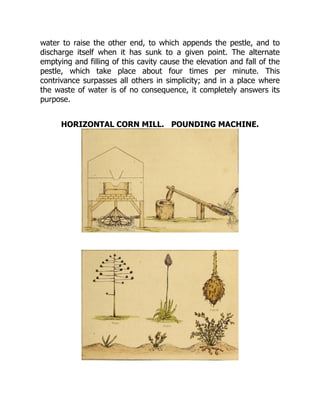
The Indian corn is ground by a horizontal water-wheel, which
acquires great velocity from the rush of water upon it. On the upper
end is fixed the mill-stone, which makes from fifty to sixty
revolutions in a minute. They have likewise a mode of pounding the
corn into flour, by a machine called a Sloth. Near a current of water
a large wooden mortar is placed, the pestle of which is mortised into
the end of a lever twenty-five or thirty feet long, resting upon a
fulcrum at five-eights of its length. The extremity of the shorter arm
of this beam is scooped out, so as to receive a sufficient weight of
water to raise the other end, to which appends the pestle, and to
discharge itself when it has sunk to a given point. The alternate
emptying and filling of this cavity cause the elevation and fall of the
pestle, which take place about four times per minute. This
contrivance surpasses all others in simplicity; and in a place where
the waste of water is of no consequence, it completely answers its
purpose.
HORIZONTAL CORN MILL. POUNDING MACHINE.
Mandioca first
set cuttings.
Commencing to
grow & form Root.
Nearly full grown &
appearance of the
Root.
Having finished my affairs at Canta Gallo, I set out on my return
to the capital, accompanied for about a league of the road by the
worthy governor, the captain, the treasurer, and almost all the
inhabitants. During a residence of about fifteen days among these
excellent men, my table had been sumptuously supplied without
cost, and I had been treated with a degree of respect far exceeding
my expectations or merits. I took leave of them with regret, wishing
most sincerely that it might be in my power to be of service to them
at court, by making representations in their favor.
I arrived at Morro Queimado at night, after a journey of thirty-
four miles[32], and on the next day, in good time, reached the house
of my worthy friend Captain Ferreira. Being now less pressed for
time, I took a more leisurely survey of his establishment, particularly
of his sugarwork and distillery, both which are very ill conducted.
When I saw the furnaces for heating the coppers in the latter, I
freely told the Captain, that they could not have been constructed on
a worse plan, but I received for answer, that no better was known. It
would, indeed, be extremely difficult to introduce improvements into
this or any other parts of the distillery, for every thing is left to the
management of the negroes. When I asked any question concerning
the process, the owner professed his ignorance of it, and sent for
one of the African foremen to answer me. With this man I reasoned
respecting the excessive quantity of fuel consumed to no purpose,
and proposed a method for saving it, as well as for correcting the
disagreeable taste of the rum, caused by the empyreuma; which
was, to redistil it with an equal quantity of water, taking care
previously to clean out the still; but he only laughed at me, and
signified that his certainly must be the best method, for he had
learned it of an old sugar-maker. Thus it is, that from the
indifference of the owners to their own interest, things are suffered
to go on in the same routine, being left to the direction of men who
shrink from a temporary increase of labor, even when it promises
them a lasting advantage. This aversion to improvement I have
often observed among the inhabitants of Brazil: when, for instance, I
have questioned a brick-maker, a sugar-maker, a soap-boiler, or even
a miner, as to his reasons for conducting his concerns in such an
imperfect manner, I have been almost invariably referred to a negro
for answers to my interrogatories.
Some parts of this estate are said to contain gold, and at the
time of my visit, Captain Ferreira was negociating for permission
from Government to work them. I presented to him a drawing of a
plan for washing the cascalho in a manner superior to that
commonly practised, and explained to him the use of grinding or
stamping those concrete masses frequently found in it, which
generally contain particles of gold, but being too hard to be crushed
by the hand, are thrown aside among the debris.
In this fazenda, as in most others, the conveniences for storing
the produce, are so very poor and imperfect, that the weevil soon
gets into the corn, and the cotton, coffee, and other produce are
liable to be deteriorated in a thousand ways. The stabling, too, is
bad, and the cattle are deplorably neglected; indeed, the only part of
the live-stock that seems to be tolerably well attended to, is the
swine. In the dwelling-house I observed a total inattention to
domestic comfort; its general appearance confirmed a remark which
I had often heard made, that the owners of estates here, dislike to
live upon them, and considering their residence as only temporary,
make shift with poor accommodations.
The tract of land belonging to the farm is full two miles square,
and though still susceptible of great improvement, has not been
wholly neglected; the parts already cleared have produced many
valuable crops, and the rest will no doubt, in a few years, be brought
to an equally promising state of cultivation.
Having staid two days with Captain Ferreira, I set out on the
morning of the third for Porto das Caixas, where I arrived at two
o’clock, after a journey of thirty miles, and was delayed some time,
as the river was crowded with vessels, laden with ship-timber, for
the capital. As soon as the navigation became sufficiently open, I
embarked in a large boat, of about ten tons burthen, and rowing all
night to the mouth of the river, sailed with a land wind, and arrived
at Rio de Janeiro about noon. My first care was to inform His
Excellency the minister of my return, after which I employed a few
days in drawing up my journal for his inspection. He received it in
the handsomest manner, and laid it before his Royal Highness, who
was pleased to signify, that my description of the country, through
which I had travelled, merited his approbation.
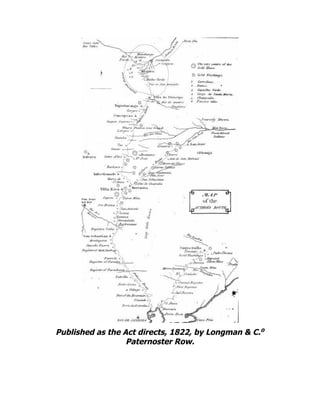
Published as the Act directs, 1822, by Longman & C.o
Paternoster Row.
CHAP. X.
Permission obtained to visit the Diamond Mines.—Account of a pretended Diamond
presented to the Prince Regent.—Journey to Villa Rica.
AFTER I had thoroughly recovered from the fatigues of my late
journey, I solicited his Royal Highness for permission to go and
explore the diamond mines of Cerro do Frio. This favor had never as
yet been granted to a foreigner, nor had any Portuguese been
permitted to visit the vicinity where the works are situated, except
on business relative to them, and even then under restrictions,
which rendered it impossible to acquire the means of giving an
adequate description of them to the public. Through the kind
friendship of the Conde de Linhares, the permission was granted,
and my passports and letters of recommendation were speedily
made out. Lord Strangford was much pleased at my being so highly
favored, and willingly offered his service, and represented me
favorably at court. I obtained admission to the archives, for the
purpose of examining all the manuscript maps, and of copying from
any of them whatever might be necessary to guide me in my route.
It may here be proper to observe, that the most eligible mode of
travelling in the interior of Brazil, especially on such an excursion as
I had undertaken, is to procure orders from the government, and an
escort of soldiers, who have a right, under such orders, to require
proper relays of mules from all persons who reside on or near the
road. The Conde de Linhares intimated to me, that I might select
any two soldiers I thought proper, and while I was deliberating on
the choice, a singular occurrence took place, which was the means
of furnishing me with two men of the corps of miners, who were
appointed to attend me, under an injunction on the part of His
Excellency, that their future promotion would depend entirely on the
report which I should give of their conduct after my return. I am
happy to say that their services merited every commendation.
The occurrence to which I allude was this:—A free negro of Villa
do Principe, about nine hundred miles distant, had the assurance to
write a letter to the Prince Regent, announcing that he possessed an
amazingly large diamond which he had received from a deceased
friend some years ago, and which he begged he might have the
honor to present to His Royal Highness in person. As the magnitude
which this poor fellow ascribed to his diamond was such as to raise
imagination to its highest pitch, an order was immediately
dispatched to the commander of Villa do Principe, to send him
forthwith to Rio de Janeiro; he was accommodated with a
conveyance, and escorted by two soldiers. As he passed along the
road, all who had heard the report hailed him as already honored
with a cross of the order of S. Bento, and as sure of being rewarded
with the pay of a general of brigade. The soldiers also anticipated
great promotion; and all persons envied the fortunate negro. At
length, after a journey which occupied about twenty-eight days, he
arrived at the capital, and was straightway conveyed to the palace.
His happiness was now about to be consummated, in a few
moments the hopes which he had for so many years indulged, would
be realized, and he should be exalted from a low and obscure
condition, to a state of affluence and distinction:—such, no doubt,
were the thoughts which agitated him during the moments of
suspence. At length he was admitted into the presence; he threw
himself at the Prince’s feet, and delivered his wonderful gem. His
Highness was astonished at its magnitude; a pause ensued; the
attendants waited to hear the Prince’s opinion, and what he said
they seconded. A round diamond, nearly a pound in weight, filled
them all with wonder; some ready calculators reckoned the millions
it was worth; others found it difficult to numerate the sum at which
it would be valued, but the general opinion of His Highness’s
servants was, that the treasury was many millions of crowns the
richer. The noise which this occurrence created among the higher
circles, may be easily conceived; the general topic of remark and
wonder, was the negro’s offering. It was shewn to the ministers,
among whom an apprehension, and even a doubt, was expressed,
that a substance so large and round might not prove a real
diamond; they, however, sent it to the treasury under a guard, and it
was lodged in the deposit of the jewel-room.
On the next day, the Conde de Linhares sent for me, and related
all the circumstances which had come to his knowledge respecting
this famous jewel, adding, in a low tone of voice, that he had his
doubts about its proving a genuine diamond. His Excellency directed
me to attend at his office in a few hours, when letters from himself
and the other ministers to the Treasury should be given me[33], for
permission to see this invaluable gem, in order to determine what it
really was. Readily accepting a charge of so interesting a nature, I
prepared myself, and attended at the hour appointed, when I
received the letters, which I presented at the treasury to an officer
in waiting, I was led through several apartments, in which much
business seemed to be transacting, to the grand chamber, where
presided the treasurer, attended by his secretaries. Having my letters
in his hand, he entered into some conversation with me relative to
the subject; I was then shewn through other grand apartments hung
with scarlet and gold, and ornamented with figures as large as life,
representing justice holding the balance. In the inner room, to which
we were conducted, there were several strong chests with three
locks each, the keys of which were kept by three different officers,
who were all required to be present at the opening. One of these
chests being unlocked, an elegant little cabinet was taken out, from
which the treasurer took the gem, and in great form presented it to
me. Its value sunk at the first sight, for before I touched it, I was
convinced that it was a rounded piece of crystal. It was above two
inches in diameter. On examining it, I told the governor it was not a
diamond; and to convince him I took a diamond of five or six carats,
and with it cut a very deep nick in the stone. This was proof
positive; a certificate was accordingly made out, stating, that it was
an inferior substance of little or no value, which I signed.
Other boxes were now unlocked, from one of which they showed
me two large slabs of diamond, each a full inch on the superficies,
and about the eighth of an inch in thickness, of a very bad brown
color. When found, they formed one entire piece, which, being
amorphous, was not known to be a diamond, until the administrator
or chief of the working party, after keeping it by him many days, had
recourse to the old experiment of placing it on a hard stone and
striking it with a hammer. The result of this experiment is, that if the
substance resist the blow, or, separate in laminæ, it must be a
diamond; the latter was the case in the present instance, and the
man having thus made two diamonds from one, transmitted them to
the intendant.
The river Abaité, from whence these pieces came, has produced
one of an octahedral form, which weighs seven-eights of an ounce
Troy, and is perhaps the largest diamond in the world. It was found
about twelve years ago by three men who were under sentence of
banishment for high crimes; but on presenting this valuable gem to
the then Viceroy, they were pardoned and rewarded. It is now in the
private possession of the Prince Regent.
I was afterwards favored with a sight of the remaining diamonds
in the Treasury; they appeared to be in quantity about four or five
thousand carats. The largest did not generally exceed eight carats,
except one of a fine octahedral form, full seventeen. Among the few
colored diamonds, one of the smallest was of a beautiful pink, one of
a fine blue, and several were of a green tinge; the yellow were the
most common and least esteemed.
Having now finished my business, I took my leave of the
treasurer, with thanks for his polite attention, and on my return
home wrote a letter to the Conde de Linhares, stating the result of
my visit. It was no agreeable task to a stranger to have to announce
that a substance which had been considered as an inestimable
addition to the treasures of the state, was in reality, though singular
in its appearance, of very trifling value, and this too in a letter which
was to be laid before the Prince. His Highness, however, was
prepared for the intelligence, and was too noble-minded to manifest
any chagrin at the disappointment. The poor negro who had
presented it was of course deeply afflicted by this unwelcome news;
instead of being accompanied home by an escort, he had to find his
way thither as he could, and would, no doubt, have to encounter the
ridicule and contempt of those who had of late congratulated him on
his good fortune.
When I had nearly completed my preparations for the journey,
Mr. Goodall, a most respectable merchant, expressed a desire to
accompany me to Villa Rica, which I readily acceded to, as he was a
most agreeable companion. Lord Strangford having procured him
passports from the ministers, he was enabled to join me without
delay. On the 17th of August, 1809, we set out on a journey which
no Englishman had ever before undertaken, nor had any ever yet
been permitted to pass the barrier of alpine mountains that stretch
along the coast.
Having embarked in a large market-boat with our retinue, which
consisted of the two soldiers before mentioned, and my servant, a
most trusty negro-boy, we made sail at mid-day with a sea-breeze,
and ran down the bay about six leagues. We then passed the island
of Governador and various others, one of which was the beautiful
Cocoa-nut island. Proceeding along the strait, formed by it and
another of similar extent, we crossed a fine open bay, and arrived at
the mouth of the Moremim, a picturesque river which presents in its
serpentine course a great variety of beautiful scenery. It was now
sun-set; the weather was mild and serene, and we paused awhile to
enjoy one of the finest rural prospects which we had ever seen in
Brazil—a fine romantic fore-ground, enriched by the vivid foliage of
the woods on the banks of the stream, and contrasted by the bold
outline of the mountains in the distance, among which we noticed
that singular chain of perpendicular rocks, called the Organpipe
mountains, from their resemblance in form and position to the front
of the instrument alluded to. Having advanced two leagues up the
river, we arrived at a village on its margin, called Porto da Estrella, a
place of great stir and bustle, on account of the hourly arrival of
numerous droves of mules laden with produce from the interior.
Here are some poor dwellings, and a number of large storehouses
for the reception of the produce. The muleteers, being provided with
bedding and cooking utensils, never leave their cattle, so that good
inns are to them unnecessary. We were shewn into the best in the
place, which was as dirty and inconvenient as can possibly be
imagined. I shall forbear to detail the discomforts of the night, and
merely observe that they were such as to make us early stirrers in
the morning. Our soldiers procured us mules, but owing to the great
bustle of loading and unloading, we were not in travelling order until
ten o’clock. We now proceeded about three leagues along the low
land, having the range of mountains on our left, and passing the
village of Piedade entered on a beautiful plain at their base. We
stopped at a house at which the Prince Regent had remained three
nights for the benefit of the air; but not being able to procure
refreshment there, we passed on and began our ascent along an
excellent paved road, extending five miles on a very steep elevation
along the sides and over the ridges of the mountains. Having rested
awhile at the half-way-house, which we had been near an hour in
gaining, we toiled on, relieving ourselves at times by turning to take
a view of Rio de Janeiro, and the bay, which from this lofty eminence
appeared to great advantage. With some difficulty we reached the
summit, which, as I suppose, is four thousand feet above the level
of the sea; the atmosphere was at least ten degrees colder than on
the plain.
Our next halting place was a small village called Corgo Seco,
situated in a most rugged and uneven district, with not half an acre
of level ground in any part of its vicinity. Having taken some
refreshment here, we proceeded to Belmonte, a beautiful spot,
situated by the edge of a rapid stream, which washes the base of an
immense mountain of granite on the left. We journeyed along this
stream until we reached a station called Padre Correa, from the
name of its owner. It consists of a house and chapel, with a
handsome area in front. The Father maintains a large establishment
of negroes, many of whom are employed in beating out mules’
shoes from the cool Swedish iron, after they have been forged into
form. For these articles there is a considerable demand, as the
unwrought material pays no duty on this side the river Paraiba, while
on the other it is taxed full 100 per cent. which is also the case with
salt. The great consumption of these necessary articles has probably
induced Government to lay these heavy duties upon them, but
certainly every principle of good policy furnishes an argument
against the measure. Padre Correa received us very hospitably,
afforded us an asylum for the night, and assisted us in regulating
our baggage by supplying a pair of cane panniers for one of the
mules, which proved very serviceable. Before sun-rise we were
awakened by the clatter of hammers in the forges; the weather was
dewy, and so cold that my thermometer was down at 46 degrees.
We passed some time in viewing the garden, which was in tolerable
order, and contained some fine peach trees in blossom. Our host
informed us, that he had a good plantation a few miles distant, but
his chief concern was the selling of corn and shoes for the use of the
mules.
Leaving this station we skirted the Piabunha, a river abounding in
falls, which flows into the Paraiba. Among the hills and dales which
we traversed, we at times observed farm-houses and plantations;
but the road, farther on, was quite confined by continual wood-
scenery. After proceeding about twenty miles we reached Cebolla, a
tolerable establishment, consisting of a house of two stories, a small
chapel, and a sugar-engine, in an unfinished state, situated in the
bottom of a valley. The owner, Captain Jose Antonio Barbosa, was a
Portuguese of the old school; he seemed much vexed that His Royal
Highness had permitted strangers to travel the country, and treated
us with a constrained civility, which shewed us that he thought we
were come about no good. His conversation ran continually against
the operations of Government in laying taxes upon rum and other
commodities; and though he tasted the sweets of office, being part-
renter of the lucrative ferry of Paraiba, which post he obtained
through the interest of a very worthy gentleman in Rio de Janeiro,
yet he had all the acerbity of a disappointed place-hunter. His self-
interested and narrow-minded views were but too plainly directed to
one object, monopoly; the mere mention of the Prince Regent’s
liberality in permitting strangers to reside in Brazil appeared to
torture him, and in short, so much of the snarler did he display while
discussing this topic, that no character could have more forcibly
reminded us of the dog in the manger. It is, however, but fair to add,
that while indulging in severe reflections on strangers, he did not
forget the duties of hospitality; before we went to rest, he invited us
to partake of a family supper, consisting of a boiled duck smothered
in rice, and a stewed pullet, to which sat down eight people,
including ourselves. Having thanked our host for his kindness, we
retired to the apartments allotted to us. My bed was so uneasy that I
was obliged to sit up during most of the night, having no alternative,
for as the clay floor was neither boarded nor paved, I could not
venture to throw the bed clothes upon it, and sleep there. Never did
mortal hail day-break with greater satisfaction; but my agreeable
feelings were soon damped by one of those little vexatious accidents
which in some states of mind are more hard to bear than real
misfortunes. I had placed my thermometer in a wind-door or air-hole
(for the aperture was not glazed); a stupid fellow, in fastening the
bridle of a mule to one of the bars, threw down the instrument and
broke it. Luckily I had another, therefore the loss was not so
grievous.
Our soldiers having, with their wonted alacrity, provided mules,
we set out at an early hour, and entered upon a much more level
road than that of the preceding day. We passed along several
valleys, the surface of which presented clay and decomposed
granite, in some places more ferruginous than in others. There are
numerous sheds all the way for the refreshment of travellers and
their cattle. This day’s journey being only sixteen miles, we soon
completed it, arriving about noon at the ferry of Paraibuna. This
river, though as wide as the Thames at Westminster, is unnavigable,
by reason of the large rocks which impede its course. The ferry-boat
arriving, we went into it with all our mules, and were conveyed with
oars and setting poles to the other side, where we found a Register
for the examination of passengers, their passports, and property.
The place is guarded by a few old soldiers, under the command of a
lieutenant, who, though in ill health, shewed us every attention. Our
soldiers got us a dinner cooked at a venda[34], kept by a young man
originally from Oporto; we took tea and supped with the
commandant, who assigned to us an apartment in the Register. He
was very civil, and seemed highly pleased to see us, frequently
exclaiming, “Os Inglezes são grande gente,” (the English are a great
nation). We were gratified by this and other national compliments
which he paid us, and not less so by the respect which every one
who came to visit us testified for our country, as being in alliance
with a Prince to whom they were enthusiastically devoted.
The Register is a substantial edifice of wood, built on posts to
preserve it from the overflows of the river, which frequently inundate
the sandy flat on which it stands. It contains a few rooms, which
serve as barracks for the guards, and has a handsome gallery
fronting the ferry. The station is low, and in summer is said to be
very hot and unhealthy; a circumstance which, joined to the
indolence and poverty of the inhabitants, may sufficiently account
for the general appearance of debility observable among them. The
little employment they have arises chiefly from the passengers who
frequent this great thoroughfare, and from the numerous troops of
mules which are continually arriving on their way to, as well as from,
the interior. The barges of the ferry are as fine vessels as any I ever
saw used for the purpose; and indeed they ought to be, for a
considerable toll is paid, not only for every mule, or other beast of
burden, but for every person crossing the river. The annual amount
collected yields, no doubt, a handsome profit to the renters; but it
might be considerably augmented if a regular road were opened to
Canta Gallo, which is only eighteen leagues distant.
Being informed that our next day’s journey would be an arduous
one, on account of the hilly district through which we should have to
pass, we retired to rest betimes, and were stirring at an early hour.
We mounted fresh mules, and proceeded along a good road through
a rugged and thinly peopled district; in the course of five leagues,
we passed over seven very high granite mountains, and eight
smaller ones, and at length reached the ferry of the Paraiba, a river
considerably larger than the Paraibuna. At the Register belonging to
it, which is more extensive and better guarded than the former, all
goods are examined and weighed, paying duty according to their
weight, whatever be their kind, quality, or value. This regulation
bears very unequally upon different articles; salt, for instance, pays
nearly cent. per cent. iron and lead about the same; while woollens,
cottons, and other light goods do not, on an average, exceed eight
or ten per cent.
The commandant of the Register offered us every assistance,
and was kind enough to provide us a fresh mule for our baggage.
The short time we staid here did not allow much leisure for
observation; and, indeed, there was little of novelty to observe. The
situation of the Register is pleasant; the country around is well
wooded and fertile, though mountainous. The river is almost
destitute of fish.
We proceeded about a league and a half farther, through thick
woods, and arrived at a place named Rosina de Negra, where we
halted for the night. Our next day’s journey presented the same
varieties of hill and ravine as those we had already passed. In one
part of the road we observed a kind of barracks, consisting of an
estalagem and some ranchos or huts, where an officer and about
twenty horse-soldiers are stationed; they patrole the road, and are
authorised to stop travellers, and make the strictest search of those
whom they suspect of having gold-dust or diamonds concealed.
Proceeding two leagues, we arrived at the Register of Mathias
Barboza, situated in the midst of an almost impervious wood. It was
built about sixty or seventy years ago, by the gentleman whose
name it bears, and who was an ancestor of the noble family of
Sousa.
This Register is a large oblong building, with two great doors at
each end, through which all travellers, with their mules, are required
to pass. On entering, they stop, and deliver their passports to a
soldier for examination by the commander, who, if he judges that a
correct account is given of the property, suffers them to proceed:
but if any grounds of suspicion occur, the mules are unloaded, and
all the contents of their cargoes are examined with the strictest
scrutiny. In these examinations it not unfrequently happens that a
negro has been suspected of swallowing a diamond; in which case,
he is shut up in a bare room until such time as the truth can be
proved. The command of this station is entrusted to a major. The
inner part of the building consists of apartments for the officers,
ranchos for the soldiers, cells for the confinement of suspected
persons, and stabling for the mules. In the yard there are numerous
posts, to which the cattle are tied while loading or unloading. There
is also a venda for the accommodation of travellers.
Leaving this place, we proceeded through an extensive tract of
wood, in which we occasionally observed a few deer, but no birds,
except now and then a green parrot or a wood-pecker. The road, as
far as the eye could reach, was bounded on each hand by close
continuous thickets, and rarely enlivened by traces of habitation.
Those persons who live by the way-side are commonly of the lowest
order, who settle there with the view of selling refreshments to
travellers, and corn for the mules; they are in general an idle,
gossipping race: the more respectable classes reside at a distance
from the public road.
We arrived about four in the evening at a farm-house called
Madeiras, belonging to Captain José Pinto de Sousa. The situation is
cold and salubrious, the vicinity well-watered, and abounding in fine
tracts of arable and pasture land, but deplorably neglected. The
owner seemed to prefer ease, with inconvenience, to labor, with
comfort; and, satisfied with the spontaneous bounty of nature, cared
little about improving it by industry. The house itself was miserably
out of repair: its walls, which consisted of lattice-work plastered with
clay, were full of holes and crevices, and its roof was in a very crazy
and shattered condition. We fared but poorly, and passed a very
indifferent night; often reflecting on the apathy and listless indolence
of the people: who, thought we, in a cold climate would live in a
dwelling full of cracks and air-holes, when a few dashes of mud
might render it comparatively comfortable!
From this place, which is an hundred miles from Porto da
Estrella, we continued our route next day over a chain of mountains,
among which we encountered other falls of the Paraiba nearer its
source, and, traversing a tract of close woodland, arrived at a station
called the Fazenda do Juiz de Fora. Here we procured fresh mules,
and proceeded for a considerable distance on the ascent, when we
met with two planters from Minas Novas, who were going to Rio de
Janeiro with forty-six mules loaded with cotton, packed in raw hides,
each beast carrying two packages. They had been nearly three
months on the road. We availed ourselves of their kind offers to
carry intelligence to our friends in the capital, and gave them letters
for that purpose.
The remainder of our day’s journey afforded few incidents worth
notice. We observed several pines of a singular species, which
yielded abundance of resin. In one part of the road I shot a most
beautiful bird, the name of which I could not learn, but was
informed that it flew about much in the night. In another part, we
noticed a beast of prey, which was crossing the road before us, and
fled at our approach. I killed a small water-snake with two fins near
its vent.
We arrived towards evening at the fazenda of Antonio Ferreira,
formerly a good house, but now almost in ruins. The owner was not
at home; but his old negro-servants provided as handsomely for us
as we could have expected them to do if he had been present. We
made a tolerable supper of stewed fowls, with the addition of a fine
wild turkey, which I had killed in the vicinity. I may here observe,
that a traveller in this country should neglect no opportunity of
providing for himself with his gun, as he is never certain of palatable
fare at the places where he alights.
The surface of the country is in general good strong clay; all the
rocks are of gneiss and granite, in the composition of which
hornblende predominates. We this day passed the site of the first
gold-washing, which is very small, and has been many years
abandoned. The rivulets have a great deal of oxide of iron in small
grains mixed with the sand in their eddies. In some places the
granite is in a decomposing state, and there are large nodules of
what the Germans call grünstein, which appear not unlike basalt.
The air in these elevated districts is fresh and cool, except from two
to four o’clock in the afternoon, when I found it rather hot. In the
evening, while amusing ourselves with shooting, we observed a man
in a friar’s habit, with a box bearing a picture of the Virgin, fastened
to his waist by a belt. His face was overgrown with hair, and his
whole appearance exceedingly wild and uncouth. On inquiry, we
were informed that this extraordinary figure was a hermit; and that
he had embraced this austere life by way of doing penance for some
great crime.
Having pursued our diversion while day-light lasted, we returned
to the house, where, for the first time since our departure from Rio,
we partook of a comfortable meal, and regaled ourselves with a
bottle of excellent Madeira, which my worthy companion by good
fortune had brought with him.
We set out next day by sun-rise, and proceeded some miles
along a tolerable road. The vallies as we advanced were wider, and
more easy of cultivation, but the mountains were excessively steep.
On even ground our general pace was three or four miles an hour,
but on the acclivities we proceeded slowly, and were obliged to
observe every step of our mules, and to balance ourselves
accordingly. This action of the body produces no perceptible
consequences for the first few days, but afterwards it begins to
torture the loins with a species of lumbago.
After a journey of twenty-eight miles, which occupied nine hours,
we found ourselves at six in the evening at a small farm-house
called Fazenda de Dôna Clara e Dôna Maria. These two good ladies
honored us with a more polite reception than we had hitherto
experienced on the journey. It being the festival of St. Bartholomew,
a great holiday among the Brazilians, they had prepared a more
sumptuous dinner than usual, of which they kindly invited us to
partake. We were the more sensible of this act of hospitality,
because it evidently proceeded from sincere good-will; and, like the
widow’s mite, derived additional merit from the smallness of the
Welcome to our website – the perfect destination for book lovers and
knowledge seekers. We believe that every book holds a new world,
offering opportunities for learning, discovery, and personal growth.
That’s why we are dedicated to bringing you a diverse collection of
books, ranging from classic literature and specialized publications to
self-development guides and children's books.
More than just a book-buying platform, we strive to be a bridge
connecting you with timeless cultural and intellectual values. With an
elegant, user-friendly interface and a smart search system, you can
quickly find the books that best suit your interests. Additionally,
our special promotions and home delivery services help you save time
and fully enjoy the joy of reading.
Join us on a journey of knowledge exploration, passion nurturing, and
personal growth every day!
testbankdeal.com


E Commerce 2017 13th Edition Laudon Solutions Manual

  • 1.
    E Commerce 201713th Edition Laudon Solutions Manual download https://testbankdeal.com/product/e-commerce-2017-13th-edition- laudon-solutions-manual/ Visit testbankdeal.com today to download the complete set of test bank or solution manual
  • 2.
    We believe theseproducts will be a great fit for you. Click the link to download now, or visit testbankdeal.com to discover even more! E Commerce 2017 13th Edition Laudon Test Bank https://testbankdeal.com/product/e-commerce-2017-13th-edition-laudon- test-bank/ E Commerce 2017 14th Edition Laudon Test Bank https://testbankdeal.com/product/e-commerce-2017-14th-edition-laudon- test-bank/ E-Commerce Essentials 1st Edition Laudon Solutions Manual https://testbankdeal.com/product/e-commerce-essentials-1st-edition- laudon-solutions-manual/ Principles of Chemistry A Molecular Approach 2nd Edition Tro Test Bank https://testbankdeal.com/product/principles-of-chemistry-a-molecular- approach-2nd-edition-tro-test-bank/
  • 3.
    Kozier and ErbsFundamentals of Nursing 9th Edition Process Test Bank https://testbankdeal.com/product/kozier-and-erbs-fundamentals-of- nursing-9th-edition-process-test-bank/ Purchasing and Supply Management 16th Edition Johnson Test Bank https://testbankdeal.com/product/purchasing-and-supply- management-16th-edition-johnson-test-bank/ Horngrens Accounting The Financial Chapters 10th Edition Nobles Solutions Manual https://testbankdeal.com/product/horngrens-accounting-the-financial- chapters-10th-edition-nobles-solutions-manual/ Fundamentals of Nursing Active Learning for Collaborative Practice 1st Edition Yoost Test Bank https://testbankdeal.com/product/fundamentals-of-nursing-active- learning-for-collaborative-practice-1st-edition-yoost-test-bank/ Absolute C++ 5th Edition Savitch Test Bank https://testbankdeal.com/product/absolute-c-5th-edition-savitch-test- bank/
  • 4.
    Communications Law LibertiesRestraints and the Modern Media 6th Edition Zelezny Test Bank https://testbankdeal.com/product/communications-law-liberties- restraints-and-the-modern-media-6th-edition-zelezny-test-bank/
  • 5.
    1 Copyright © 2018Pearson Education, Inc. Instructor’s Manual: Chapter 7 Social, Mobile, and Local Marketing Learning Objectives ● Understand the difference between traditional online marketing and the new social- mobile-local marketing platforms and the relationships between social, mobile, and local marketing. ● Understand the social marketing process from fan acquisition to sales and the marketing capabilities of social marketing platforms such as Facebook, Twitter, and Pinterest. ● Identify the key elements of a mobile marketing campaign. ● Understand the capabilities of location-based local marketing. Key Terms dark social, p. 430 fan acquisition, p. 431 engagement, p. 431 amplification, p. 432 community, p. 432 social density, p. 434 Reactions button, p. 434 Facebook Exchange (FBX), p. 437 location-based marketing, p. 473 location-based services, p. 473 geo-aware, p. 476 proximity marketing, p. 476 Brief Chapter Outline Facebook: Putting Social Marketing to Work 7.1 Introduction to Social, Mobile, and Local Marketing From Eyeballs to Conversations From the Desktop to the Smartphone and Tablet The Social, Mobile, Local Nexus 7.2 Social Marketing Social Marketing Players The Social Marketing Process Facebook Marketing Insight on Technology: Optimizing Social Marketing with Simply Measured Twitter Marketing Pinterest Marketing Marketing on Other Social Networks The Downside of Social Marketing
  • 6.
    2 Copyright © 2018Pearson Education, Inc. Insight on Society: Marketing to Children of the Web in the Age of Social Networks 7.3 Mobile Marketing Overview: M-commerce Today Basic Mobile Marketing Features Mobile Marketing Tools: Ad Formats Starting a Mobile Marketing Campaign Insight on Business: Mobile Marketing: Ford Goes 3-D Measuring Mobile Marketing Results 7.4 Local and Location-Based Mobile Marketing The Growth of Local Marketing The Growth of Location-Based (Local) Mobile Marketing Location-Based Marketing Platforms Location-Based Mobile Marketing: The Technologies Why is Local Mobile Attractive to Marketers? Location-Based Marketing Tools Starting a Location-Based Marketing Campaign Measuring Location-Based Marketing Results 7.5 Case Study: ExchangeHunterJumper.com: Building a Brand with Social Marketing 7.6 Review Key Concepts Questions Projects References Figures Figure 7.1 The Rapidly Changing Trajectory of Online Ad Spending, p. 427 Figure 7.2 Social, Mobile, and Local Marketing 2015–2018, p. 428 Figure 7.3 Online Marketing Platforms, p. 429 Figure 7.4 Engagement at Top Social Networks, p. 430 Figure 7.5 The Social Marketing Process, p. 431 Figure 7.6 The Growth of M-commerce, p. 460 Figure 7.7 How People Use Their Mobile Devices to Shop, p. 461 Figure 7.8 Retail M-commerce Sales: Smartphones versus Tablets, p. 462 Figure 7.9 Mobile versus Desktop Marketing Expenditures, p. 465 Figure 7.10 The Top U.S. Mobile Marketing Firms by U.S. Revenue, p. 466 Figure 7.11 U.S. Mobile Ad Spending by Format, p. 467 Figure 7.12 Measuring the Effectiveness of a Mobile Branding Campaign, p. 472 Figure 7.13 Local, Mobile, and Location-Based Mobile Marketing, p. 474 Figure 7.14 Location-Based Mobile Ad Format Spending, p. 475
  • 7.
    3 Copyright © 2018Pearson Education, Inc. Tables Table 7.l Basic Facebook Features, p. 433 Table 7.2 Basic Facebook Marketing Tools, p. 437 Table 7.3 Selected Facebook Marketing Campaigns, p. 438 Table 7.4 Measuring Facebook Marketing, p. 439 Table 7.5 Twitter Features, p. 444 Table 7.6 Twitter Marketing Tools, p. 446 Table 7.7 Selected Twitter Marketing Campaigns, p. 447 Table 7.8 Measuring Twitter Marketing Results, p. 448 Table 7.9 Pinterest Features, p. 450 Table 7.10 Pinterest Marketing Tools, p. 451 Table 7.11 Selected Pinterest Marketing Campaigns, p. 452 Table 7.12 Measuring Pinterest Marketing Results, p. 455 Table 7.13 Features of Mobile Devices, p. 467 Table 7.14 Selected Mobile Marketing Campaigns, p. 468 Table 7.15 Major Locating Technologies, p. 477 Table 7.16 Location-Based Marketing Tools and Campaigns, p. 479 Table 7.17 Mobile Location-Based Marketing Effectiveness, p. 482 Teaching Suggestions Chapter 7 focuses on the “new” online marketing platforms: social, mobile, and local. There is a major shift in thinking involved in these new marketing platforms. The traditional web marketing emphasis on “eyeballs” and spraying large populations with messages has changed to place a greater emphasis on engaging the customer in conversations. In addition, the technology platform is shifting from the desktop to mobile devices. This is more than just a technology change. It’s also a behavioral change because customers are much “closer” to their mobile devices than desktops, and hence offer marketers many more opportunities to send messages, and to, in a sense, surround the consumer with the same message on multiple platforms. Social, mobile, and local marketing platforms are connected and self-reinforcing. The mobile audience is a major user of social sites like Facebook, and local marketing often involves social geo- targeting. Mobile devices are also a major channel for local advertisers who can touch customers as they pass their stores. A good way to introduce the discussion of social, mobile, and local marketing is to review the opening case in Chapter 7, Facebook: Putting Social Marketing to Work. Facebook’s effort to morph itself into a marketing and advertising platform is an example of how new Internet technologies and practices can disrupt and challenge existing industries, in this case, the marketing and advertising industries. Class discussion questions might include the following: ● Have you ever made a purchase based on something you have read or seen on Facebook? What was the product and what made you interested? ● Are there other ways for Facebook to make a profit from marketers and advertisers? ● How does Facebook engage its users differently than “traditional” online marketing?
  • 8.
    4 Copyright © 2018Pearson Education, Inc. Key Points Social, Mobile, and Local Marketing. Today, social, mobile, and local marketing are the fastest growing forms of online marketing. In 2016, the amount spent on mobile marketing both exceeded online advertising spending on desktop/laptops (Figure 7.1) as well as the amount spent on social and local online marketing. Some key points to make in this section are: ● By 2019, marketers are expected to be spending three times as much on mobile marketing as they do on social marketing to the desktop. ● Social, mobile, and local are connected: over 80% of Facebook’s ad revenue is generated by its mobile audience, and local marketing and mobile are also highly related. Social Marketing. This section focuses on social marketing and social marketing platforms like Facebook, Twitter, and Pinterest. While Facebook is the dominant social network in terms of visitors and engagement (Figure 7.4), there is significant competition in this market, and differentiation. Figure 7.5 illustrates the social marketing process as a series of five steps or stages: fan acquisition, engagement, amplification, community, and finally brand strength or sales. This is a very important concept for understanding the chapter, so take a few minutes to walk students through this diagram and the underlying concepts. Before you delve into Facebook marketing in depth, take 5 minutes to review the basic features of Facebook with students. They probably know all these features already, but be sure to illustrate how Facebook develops features to maximize the amount of social interaction on its site by connecting users to one another whether they want to be connected or not. Explain the concept of “social density” and relate this concept to the marketing opportunities on Facebook. Review the list of marketing tools currently being used by Facebook (Table 7.2) with students. Further questions for class discussion might include the following: ● Which Facebook marketing tools do students find are the most effective in their personal lives? ● Do students pay attention to Facebook ads? ● Are students interested in what their friends buy? ● Do students trust their friends to recommend products? ● What kinds of products would their friends’ choices impact? Table 7.4 describes some of the metrics used to measure Facebook marketing campaigns. Ask students how these might be different from a traditional online marketing campaign using display ads. When you turn to marketing using Twitter, once again take five minutes to review the basic features of Twitter with students. As with Facebook, most will probably already be familiar with many of these features, but be sure to illustrate how Twitter takes these features and develops them into marketing tools. Twitter offers 140-character messages, and it may seem difficult at first for students to understand how marketers can influence consumers in such a small “space.” The Timeline is similar to Facebook’s Newsfeed and in an ideal location to
  • 9.
    5 Copyright © 2018Pearson Education, Inc. expose users to ads. To make the conversation more concrete, review Table 7.7, which describes some Twitter marketing campaigns. Questions for class discussion might include the following: ● Which Twitter marketing tools do students find are the most effective in their personal lives? ● Do students tweet during television programs? ● Do students pay attention to Promoted Tweets? ● Do students pay attention to Promoted Trends posted by marketers? ● Do students trust their friends to recommend products? Table 7.8 describes some of the metrics used to measure Twitter marketing campaigns. Ask students how these might be different from a traditional online marketing campaign using display ads. Pinterest is the third major social marketing platform that the text covers. Although students are likely to be very familiar with Facebook and Twitter, they may be less familiar with Pinterest, so review the basic features of Pinterest in Table 7.9 with them, as well as the list of Pinterest marketing tools in Table 7.10. To make the conversation more concrete, you can also review Table 7.11, which describes some Pinterest marketing campaigns. Walk students through the process of developing a Pinterest marketing campaign. Pinterest campaigns depend on the graphical nature of the product, demographics of the audience, competitors, and the strengths of a firm. The simplest place to start is to create a brand page and start pinning photos. Walk students through the steps outlined in the text. Ask students to think about how they would measure the success of a Pinterest campaign. The text highlights key dimensions like fan (follower) acquisition, engagement, amplification, community, and sales. Table 7.12 describes some basic ways to measure the results of a Pinterest marketing campaign. Questions for class discussion might include the following: ● Which Pinterest marketing tools do students think are most effective? ● Have students used Pinterest to shop? Did shopping lead to a purchase? ● Have students visited brand pages? Which were effective? A good way to pull all these themes of social marketing and platforms together is to review the Insight on Technology, Optimizing Social Marketing with Simply Measured case. This case provides interesting real-world examples of different firms’ use of social media, and the challenges and rewards of developing an integrated social media campaign that crosses many ad platforms, from Facebook to Twitter to Pinterest. Questions for class discussion might include: ● How do social media analytics help companies identify and attract customers? ● What are the challenges in measuring the effectiveness of social marketing campaigns? ● What advantages did the Seattle Seahawks find in using Simply Measured’s analytics and tools?
  • 10.
    6 Copyright © 2018Pearson Education, Inc. Instagram, LinkedIn, and Snapchat are also briefly covered. Again, students are likely to be familiar with these services, but may not be familiar with the ways these social networks make money. Instagram allows advertisers to maintain profiles and market directly to users by sending posts to their individual Instagram feeds. LinkedIn charges corporations for brand pages and access to its user database, and charges users for premium subscriptions. Snapchat, a mobile messaging app/social network, has recently introduced a number of features that provide advertising opportunities, such as Snapchat Stories, Live Stories, and Discover. Finally, ask students to discuss some of the downsides of social marketing. Obviously, firms do not have total control over the marketing messages if users of their products are able to freely opine on the quality of their products. So there is a risk for firms that their shortcomings will be widely broadcast. Because young people (ages 12 to 18) are very involved in social networks, and often reveal details of their identity that they quickly lose control over on sites like Facebook that freely distribute personal information, marketers need to take care how they exploit personal information in their social marketing campaigns. A good way to introduce these issues is to review the Insight on Society Case, Marketing to Children of the Web in the Age of Social Networks. This case offers a discussion of the social implications of marketing to children and the special care that managers must exercise in this situation. You might ask students with children or younger siblings what kinds of online and offline ads they find objectionable for their loved ones. Other questions for class discussion might include the following: ● Why is online marketing to children a controversial practice? ● What is the Children’s Online Privacy Protection Act (COPPA) and how does it protect the privacy of children? ● How do companies verify the age of online users? ● Should companies be allowed to target marketing efforts to children under the age of 13? Mobile Marketing. This section introduces and reviews mobile marketing—the use of mobile devices to deliver consumer marketing messages. Ask students if they have a smartphone or tablet mobile device and how often they use it. Have they ever shopped using their smartphone? Purchased something? If so, they’ve participated in mobile commerce, along with others who have seen advertising on their phones. Mobile commerce is growing rapidly, and mobile marketing even faster. Review Figure 7.6, which illustrates the growth in mobile commerce. Also note that while mobile commerce is growing fast, people will still be using their desktops to make purchases over the next 5 years, although they will increasingly use their mobile devices to shop. Make sure students understand the difference between shopping and purchasing. Because people carry their mobile devices with them everywhere, they make for an ideal marketing tool because marketers can contact consumers just about anytime and anyplace. Review Figure 7.7 with students and elicit from them how they use their smartphones. It might be surprising to students that entertainment tops the list of mobile activities. You might start a tally on the blackboard or whiteboard and ask for a show of hands for each category of use in
  • 11.
    7 Copyright © 2018Pearson Education, Inc. Figure 7.7. Just about all smartphone owners use apps. Ask students why in-app ads might be more effective than mobile display ads. Mobile devices have created a multi-screen world for consumers: people watch TV, use their desktop at work (often to shop), and use their tablets and smartphones to watch movies or text with friends. Ask students how many of these screens they use. What are the implications for marketers? The answer: marketers need coordinated campaigns to be on all these platforms. Figure 7.9 illustrates how fast mobile marketing is growing. In 2015, mobile marketing expenditures surpassed desktop marketing expenditures, and in 2016, constituted almost two- thirds of all online marketing expenditures. This is a result of all you have discussed to this point in the class, namely, mobile devices are almost always on (unlike a TV or desktop computer), and they can deliver very relevant ads often tied to local deals. The big players in mobile ads are familiar (Figure 7.10): Google dominates, followed by Facebook, Twitter, Yahoo, and Pandora. YP, the online yellow pages, is also a big player. Ask students why Google is so dominant. Emphasize that people use their mobile devices to search, especially local search, and often use maps. Google is the leader in both search and maps. Mobile marketing formats mimic closely desktop formats—display, search, video, and text. Table 7.14 provides a list of familiar firms and how they are using mobile ad campaigns. Starting a mobile campaign involves considering how your product fits into a mobile marketing platform, the demographics you are looking for, and an analysis of what your competitors are doing. Mobile campaigns should start out simple—translate your web page to a mobile website, develop brand pages on Facebook, Twitter, and Pinterest, and use Google or Apple mobile ad services because they have excellent analytics tools for tracking results. The Insight on Business case, Mobile Marketing: Ford Goes 3-D, illustrates some of the ways mobile marketing is different from “traditional” online marketing. Questions for class discussion might include the following: ● Why do mobile devices represent such a promising opportunity for marketers? ● What are the benefits and the appeal of 3-D mobile advertising? ● Have you ever engaged with 3-D mobile ads? ● What types of products are best suited for 3-D mobile ads? Walk students through Figure 7.12 to illustrate how the effectiveness of a mobile branding campaign can be evaluated. As you can see, there are many parts of a mobile branding campaign to pay attention to. Local and Location-Based Marketing. This section describes local and location-based marketing. It’s important for students to understand the difference between the various types of local marketing. Most local marketing involves traditional newspaper and television ads, but online local marketing is rapidly catching up to traditional channels. Location-based marketing targets messages to consumers based on their actual physical location. This is inherently a mobile device situation because mobile phones and tablets can be located by latitude and
  • 12.
    8 Copyright © 2018Pearson Education, Inc. longitude fairly precisely. The same is not true of a desktop computer. Go over the list of location-based services so students get a clear sense of the matter. Review Figure 7.13 with students to put location-based mobile marketing into the overall context of web marketing. Location-based marketing is dominated by Google, which also dominates the mobile marketing field. Point out to students the importance of Google Maps: it’s not just to help people find their way. Google Maps is an important advertising tool for local businesses. Ask students why they think location-based ads might be more effective than other ads on mobile devices. Answer: when people search for something locally (a pizza, shoes, clothing, etc.) they are close to a purchasing decision. Local search is very immediate. Be sure to briefly review the technologies that make location-based marketing possible. Most students will know about GPS, but that alone is not enough to precisely locate people. Other techniques involve Wi-Fi, geo-search, cell tower, and sign in/registration. There are two kinds of location-based marketing capabilities based on these technologies: geo-aware and geo- fencing techniques. Geo-aware techniques identify the location of a user’s device and then targets marketing to the device, recommending actions near that location, which also requires the marketer to know where relevant things like stores are located. For instance, a marketer may target smartphones within several square city blocks to alert them to available offers from participating merchants. Proximity marketing techniques identify a perimeter around a physical location, and then target ads to users within that perimeter, recommending actions possible within the fenced-in area. Proximity marketing can permit marketing to consumers as they walk by the store, or walk through a store. Apple’s iBeacon technology enables stores to automatically contact customers with special offers on their iPhones as they walk into a store, using purchase histories to generate offers that are most relevant to each customer. Table 7.16 describes some of the unique location-based marketing tools. Go over each type in class to ensure students understand all the technical possibilities for marketing based on user location. In general, location-based ads use the same ad formats as desktop advertising—search, display, and video are the top three. Starting a location-based campaign begins with an assessment of whether your products or services have a local component. Are there local stores or entertainment sites where users can purchase the service? Location-based ads will be most successful with younger, more affluent, and more educated consumers. You should also be aware of how your competitors are using location-based marketing, if at all. Measurements of the results of location-based marketing follow a familiar path of measuring fan acquisition, engagement, amplification, community, and brand strength (sales). The concluding case, ExchangeHunterJumper.com: Building a Brand with Social Marketing, provides an interesting example of how a small business in an arcane area of commerce built a brand name for itself on the Internet. Case Study Questions
  • 13.
    9 Copyright © 2018Pearson Education, Inc. 1. Find a site on the Web that offers classified ads for horses. Compare this site to ExchangeHunterJumper.com in terms of the services offered (the customer value proposition). What does the Exchange offer that other sites do not? Bigeq.com is one popular site that also offers classified ads for horses, and is probably ExchangeHunterJumper.com’s strongest competitor. One service that the Exchange offers that this site does not is that the Exchange professionally screens horses that are listed, while Bigeq.com allows anyone to post sales ads. Therefore, the horses on the Exchange are more likely to be appropriately described and have a better track record than those on Bigeq.com. However, this does mean that Bigeq.com typically has more horses listed than the Exchange does. Another service that the Exchange provides is that all of the horses listed have high- quality videos and photos embedded within the site that the customer can view, while not all of the horses on Bigeq.com have videos or photos, and those that do are linked to YouTube, some of which are not very good quality. The Exchange continually updates information on the horses available, while the ads on Bigeq.com are static once they have been submitted by the seller. 2. In what ways were social media effective in promoting The Exchange brand? Which media led to the most increase in sales and inquiries? Why? ExchangeHunterJumper.com uses the following social media: Facebook, Twitter, YouTube, RSS Feeds, and an iPhone app. The biggest increase seems to have come from Facebook although the YouTube videos also appear to have had an impact. Facebook probably worked so well because of its viral recommending features (the Like button) and the ease with which word can be spread on Facebook. 3. Make a list of all the ways the Exchange attempts to personalize its services to both sellers and buyers. ● Works with individual sellers and trainers on the sell side to create effective ads, including photos and videos. ● Develops a personal strategy for each horse (horses have personalities too!). ● Buyers fill out forms and expected budgets. ● Personal e-mail responses to buyer queries. ● Searching for suitable horses ● Making recommendations. End-of-Chapter Questions 1. Describe the two factors which make social, local, and mobile marketing different from traditional online marketing. One change is the change from unique visitors and ad impressions towards an emphasis on consumer conversations and consumer engagement. A second change is the rapid growth of
  • 14.
    10 Copyright © 2018Pearson Education, Inc. mobile devices, which provides many more new opportunities to send marketing messages than what is true of the desktop platform. 2. Why are social, mobile, and local marketing efforts interconnected? Visits to social sites increasingly originate from mobile devices. As mobile devices become more popular, they can increasingly be used as a platform for location-based and location marketing. 3 Why is the connection between social, mobile, and local marketing important to marketers? When marketers design a social marketing campaign, they must also consider that their customers will be accessing the campaign using mobile devices, and often they will also be looking for local content. Social-mobile-local must be seen in an integrated management framework. 4. What are the objectives of social marketing? In social marketing, the objective is to encourage your potential customers to become fans of your company’s products and services, to engage with your business by entering into a conversation with it, to encourage your business’s fans to share their enthusiasm with their friends, and create a community of fans online. The end objective is to strengthen the brand and drive sales, and to do this by increasing your “share of online conversation.” 5. What are the major social network sites? The major social network sites in 2016 are Facebook, Instagram, Twitter, LinkedIn, Pinterest, Snapchat, and Tumblr. 6. What are the five elements of the social marketing process? The five elements of the social marketing process are fan acquisition, engagement, amplification, community, and building brand strength and ultimately sales. 7. What the three most important features of Facebook for marketers to consider? The three most important features of Facebook for marketers to consider are News Feed, Timeline (and Profile), and Search. 8. List and briefly describe the basic Facebook marketing tools. Basic Facebook marketing tools are as follows:
  • 15.
    11 Copyright © 2018Pearson Education, Inc. ● Reactions buttons: a Facebook plug-in that websites and Facebook pages use to enable user feedback and support. ● Brand pages: a central web page for a company that is hosted by Facebook. ● News Feed Page Post Ads: marketing messages inserted into user News Feed. ● Right-hand Column Sidebar Ads: display ads in the right column. ● Facebook Live: video streaming service within Facebook. ● Video ads: autoplay in silent mode on both desktop and mobile News Feeds. ● Mobile ads: ads placed on the Facebook mobile app and Facebook mobile pages, including app install ads and in-app ads. ● Sponsored messages: messages to customers who have previously engaged with the advertiser via Messenger chatbot. ● Facebook Exchange (FBX): a real-time bidding system that enables real-time bidding and sales of Facebook ads. 9. How can you measure the results of a Facebook marketing campaign? You can measure the results of a Facebook marketing campaign using the social process marketing model: fan acquisition, engagement, amplification, community, and building brand strength and ultimately sales. 10. List and briefly describe Twitter marketing tools. The basic Twitter marketing tools are as follows: ● Promoted Tweets: advertisers pay to have their tweets appear in users’ search results. ● Promoted Trends: advertisers pay to move their hashtags to the top of Twitter’s Trends list. ● Promoted Accounts: advertisers pay to have their branded account suggested to users on the “Who to follow” list. ● Enhanced Profile Pages: companies pay to display their brand logo or banner at the top of the company’s timeline. ● Amplify: a Twitter dashboard that allows marketers to send messages to users who followed a show or brand. ● Promoted Video: marketers can distribute videos on the Twitter platform and use Promoted Videos to link directly to app installations. ● Television Ad Retargeting: marketers can target ads to users who are watching a TV show. ● Lead Generation Cards: marketers can embed a “card” into business tweeters’ standard Twitter messages. ● Mobile Ads: marketers can use all of the above formats on mobile devices, as well as mobile app install and app engagement ads. 11. How can you measure the results of a Twitter marketing campaign? You can measure the results of a Twitter marketing campaign by looking at the following:
  • 16.
    12 Copyright © 2018Pearson Education, Inc. ● Fan acquisition: impressions generated by your Promoted Tweets; the number of followers and monthly growth. ● Engagement: the number of comments, responses, and re-tweets of your tweets, and time that followers stay on your page. ● Amplification: the rate at which fans re-tweet or share your tweets. ● Community: monthly interaction rate (a total of comments, responses, and re-tweets). Average on-site time for all followers. The ratio of positive to negative tweets. ● Building brand strength and ultimately sales: leads generated; percent of revenue generated by Twitter campaigns; the percentage of online conversation for your brand when compared to all other brands in your market. 12. In what way are Pinterest postings similar to display ads? Like display ads, commercial Pinterest pins direct users to a corporate website where purchases can be made. 13. List and briefly describe some of Pinterest’s marketing tools. Pinterest marketing tools include the following: ● Rich Pins: enable advertisers to include extra information directly on a pin itself ● Promoted Pins: used to promote pins to a targeted audience and encourage users to click through to your website ● Cinematic Pins: made-for-mobile ad format that displays a short animation when the user scrolls down through the ad; only plays a full-length version when the user clicks on the ad ● Buyable Pins/Shop Our Picks: allows users to buy items without leaving Pinterest and offers curated lists of items to choose from, respectively ● Promoted Video: new native video player that allows markets to run video ads ● Pin it or follow button on websites: allows visitors to pin photos from your website and to be notified when you post new photos to your site ● Pin as a display ad: a pinned photo acts as a display ad by directing users back to your website ● Theme-based boards: business boards that are lifestyle-oriented rather than strictly sales- oriented ● Brand pages: allows companies to create a corporate brand page ● URL link to stores: enables consumers to click through to buy items, allowing retailers to better understand how their pinned photos are driving sales ● Integration with other social sites: integrates marketing efforts with those on Facebook and Twitter ● Network with users, followers and visitors: allows marketers to participate by commenting, mentioning and communicating with users, followers, and visitors 14. Why is mobile marketing different from desktop marketing?
  • 17.
    Discovering Diverse ContentThrough Random Scribd Documents
  • 18.
    We remained twodays at Santa Rita and its vicinity, and on the third, set out on our return, taking the same route by which we came. In some parts we observed numerous flocks of birds, particularly parrots, and a few fine wild hens of the wood, and these were the only objects that engaged our attention. We reached Canta Gallo without having met with any monstrous serpents, or any other uncommon sights which travellers often see or fancy in a strange country. After a few days’ rest, I set out, accompanied by a guide, to the supposed silver-mine, notice having previously been sent to the men to prepare them for my coming. We travelled for about two miles through a deep valley, and arrived at a rapid stream called Macáco, which runs between two almost perpendicular mountains of very inconsiderable height, along one of which the road leads for about a mile and a half. Having passed this gloomy and dangerous ravine, we proceeded half a league farther, and halted at a neat farm-house called Machado, with a portion of good and well-cultivated land around it, which looked like a garden in the wilderness. The owner, a native of the Azores, received us very politely, and introduced us to his lady, who, with her blooming family of daughters, was engaged in needle-work on materials of their own spinning. The neatness of their dress, and the general air of propriety and comfort in the apartment where they sat, strongly reminded me of my country; and when they regaled us with liquor made from the fruits of their own farm, the image of our domestic scenes in rural life was complete: I could almost have fancied myself transported from the rugged wilds of Brazil to the smiling vales of England. We left this peaceful abode; and, advancing for six miles through thickets and forests, and over some plain land, we reached a farm called St. Antonio, belonging to a widow named Dona Anna, who is noted throughout the country for making excellent butter and cheese. The dwelling is of two stories, and neat, but very inconvenient. The good lady gave me a hearty repast of milk, and we entered into some conversation respecting her dairy, in which I learned that she knew no other mode of making butter than that of
  • 19.
    agitating the creamin a jar or bottle; and her notions of cheese- making were equally defective, In looking about the grounds for an hour, while our mules rested, I noticed an excellent fence, formed by planting a strong thorny shrub, that seemed of very rapid and luxuriant growth. The few cows that were grazing in the inclosures appeared to be of a superior breed, but were not managed with either method or foresight. The principal produce of the farm is Indian corn, and a little cheese; the latter is only made occasionally, when there happens to be a sufficient supply of milk for the purpose. We were here shewn various samples of earthy matter, wrapped very carefully in paper, and preserved with great secrecy, under the names of platina, silver, &c. They proved to be merely small crystals of shining iron ore, and pyrites. Proceeding a league over a fine country, we reached the Rio Grande, a stream as large as the Derwent at Derby, which we crossed in a canoe, our mules swimming after us as usual. We passed several groupes of Aborigines, and occasionally saw many of their huts and places of abode. The road now led along the bases of some huge bold mountains of granite, from whose summits rushed fine cascades of water. The low ground was interspersed with fragments of the same rock, lying in heaps in every direction. In many places the grass was so tall that it reached above the skirts of my saddle, and, the weather being wet, rendered me very uncomfortable. After a laborious, and latterly a slow progress, we arrived by sun-set at the house of Father Thomas de Nossa Senhora da Conceição, who kindly accommodated us for the night. The house was new, and neatly built, containing only four rooms, with boarded floors; a convenience very rarely to be met with in these parts. It is absolutely encircled with fine streams, abounding with water-falls, which render the roads to it at all times indifferent, and in wet weather almost impassable. The father, an intelligent and industrious man, informed me that he took up that land about four years since, that he had only one negro, and had no funds wherewith to carry on his undertaking, except seven or eight pounds
  • 20.
    per annum, whichhe gained by his profession as a clergyman; this he expended in hiring those who chose to work. He shewed me his garden, which was full of fine coffee-trees, and was kept in the neatest order; his fields were covered with Indian corn; his live-stock consisted of a good milch cow, a number of pigs, and one mule. On asking him how he disposed of his produce, he told me that dealers came and purchased it on the spot. The whole of the sesmaria, or plantation, with the stock upon it, he valued at four hundred pounds sterling, and said that he had no doubt he could obtain that price for it. These were clear data for calculating the profits of farming, when managed with prudence and industry. Here is a man who, having begun with little or nothing, finds himself, at the end of four years, worth four hundred pounds; a snug independency in these parts, and not more than his exertions and perseverance deserved. Father Thomas lived more comfortably than any person I had hitherto met with in this district: he was economical, but not parsimonious; liberal in his sentiments, frank and communicative in his conversation, and polite in his manners. Here I was met by the discoverers of the reputed silver-mine, who came to conduct me to it. We set out on foot, and, after walking about six miles over mountains impassable for mules, fording rivulets, and passing thickets that left me scarcely a single article of dress untorn, we arrived at the miserable hut of these poor men; a perfect contrast to the neat dwelling of Father Thomas. Never in my life was I so exhausted by fatigue; I sat down, unable to go any farther, and rested about an hour, when, being somewhat recovered, I accompanied the men, along the edge of a beautiful stream, to the foot of the mountain, where they shewed me a hole which they had dug, about two feet deep, and informed me that the sand it contained at the bottom abounded with grains of silver. Having ordered a quantity to be taken out, I proceeded to examine the base of the mountain, which I found to be of granite-like gneiss, with garnets, and small crystals of pyrites. Near this place the margin of the rivulet contained rounded stones and sand, but no where was there to be found any metallic substance, except the one
  • 21.
    before mentioned. Indeed,the very idea of silver appearing here in dust or grains, as gold does, would be preposterous, and contradictory to every principle of nature, as, in such a state, it would probably have been attacked by the sulphur in the pyrites, so as to have assumed the form of a sulphuret. I returned extremely wearied and much exhausted to Father Thomas’s, where, after some needful repose, I proceeded to examine the sand and stones I had collected at the supposed silver- mine, but no particle of metal was to be found. I then ordered the men to produce their samples, which I examined both by the blow- pipe and by acids, but no silver appeared. After equivocating very much, they acknowledged that they had rubbed and beaten substances to powder, and when they found specular iron ore they thought it was silver. In one of the samples there certainly was silver, but it appeared to have been filed probably from an old buckle or spoon, or rubbed on a stone and mixed with a pulverized substance. The farce could no longer be carried on: I charged them, in a most determined manner, with imposture, which, after some hesitation, they confessed: an officer who was with me would have secured them, but I restrained him; for, having obtained a confession, I was unwilling to bring them to punishment, or to render them more miserable than they already were, by having them sent to the army. Perhaps that would have been doing them a greater service than setting them at liberty; for they were too lazy to work, and would, no doubt, return to their old habits of prowling about, and subsisting on the credulity of the public by spreading fallacious reports about mines, precious stones, &c. Such impositions are not uncommon in South America: I have known instances in which copper-filings, mixed with earth, and afterwards washed, have been produced as samples, in order to enhance the value of land, or serve some other sinister purpose. A passion for mining is fatally prevalent among some of the lower orders of the people: by deluding them with prospects of becoming speedily rich, it creates in them a disgust for labor, and entails want and wretchedness upon them. Even among the few families of this district, I observed some examples of its
  • 22.
    effects; those whodevoted themselves wholly to mining were in general badly clothed and worse fed, while those who attended to agriculture alone were well provided with every necessary of life. Having concluded the affair, I took leave of Father Thomas, and returned to Canta Gallo, where I prepared my papers for a report respecting it, as the Conde de Linhares, had desired me. During the remainder of my stay I collected specimens of the different species of wood, which the neighbourhood produces. The following is a list of them: Tapinhoam Canella—Hard, and excellent for sheathing ships. Venatico—excellent timber. Cedar—good and durable. Socupira, also called pao ferro—hard and good. Olio—very solid, and of a peculiar fragrance. Cubiuna. Jaracandá—cabinet-wood, variegated, black and yellow—This is called rose- wood in England: but the best sorts, as it appears to me, have not hitherto been imported. Jaracatangá. Ubatanga. Palms—many varieties, among which is the iriri, before described. Its wood, though small, is unrivalled for strength and elasticity. Garfauna—the bark of which, as I was informed, affords a yellow dye. Embé—a creeping plant. The stems are used instead of cords, and often made into bridles. Many species of thorny trees. Most of the above-named species of woods are of large growth, and well calculated for ship-building. It is remarkable that this district produces none of the dye-wood called Brazil wood. Here are innumerable fruit-trees and shrubs which I have omitted to particularize. Tobacco is cultivated in some parts, and is always manufactured into roll by uniting the leaves with each other, and twisting them with a winch. By this operation the juice is expressed, and after a short exposure to the atmosphere, the color of the tobacco changes from green to black.
  • 23.
    Of wild animals,ounces are the most common; they are met with of various colors, some black and brown-red. Tapirs or antas are not unfrequent, but I saw only the footsteps of some of them. Wild hogs breed here in great numbers, and also long-bearded monkeys; the latter, when asleep, snore so loud as to astonish the traveller. The most formidable reptiles are the corral snake, the surocucu, the surocucu-tinga, and the jararaca, all said to be mortally venomous, none of which I ever saw on the journey, except a small one of the former species. The prevailing method of clearing and cultivating the land here, is precisely similar to that practised in the neighbourhood of S. Paulo. After the timber and underwood have been cut down and burnt (often very imperfectly), the negresses dibble the seed; in about six weeks a slight weeding is performed, and then the ground is let alone till harvest. The seed-time begins in October and lasts until November; the maize is ripe in four or five months. The next year they commonly sow beans on the corn land, which they then let lie, and proceed to clear new ground. It is not common to molest the land from which they have had two crops in succession, before eight or ten years have elapsed. The sugar-cane and mandioca require from fourteen to eighteen months. Coffee, planted by shoots, bears fruit in two years, and is in perfection in five or six years. Cottons and palma Christi, raised from seed, bear the first year. Transplanting is only practised with tobacco; engrafting is little known and rarely attempted. The Indian corn is ground by a horizontal water-wheel, which acquires great velocity from the rush of water upon it. On the upper end is fixed the mill-stone, which makes from fifty to sixty revolutions in a minute. They have likewise a mode of pounding the corn into flour, by a machine called a Sloth. Near a current of water a large wooden mortar is placed, the pestle of which is mortised into the end of a lever twenty-five or thirty feet long, resting upon a fulcrum at five-eights of its length. The extremity of the shorter arm of this beam is scooped out, so as to receive a sufficient weight of
  • 24.
    water to raisethe other end, to which appends the pestle, and to discharge itself when it has sunk to a given point. The alternate emptying and filling of this cavity cause the elevation and fall of the pestle, which take place about four times per minute. This contrivance surpasses all others in simplicity; and in a place where the waste of water is of no consequence, it completely answers its purpose. HORIZONTAL CORN MILL. POUNDING MACHINE.
  • 25.
    Mandioca first set cuttings. Commencingto grow & form Root. Nearly full grown & appearance of the Root. Having finished my affairs at Canta Gallo, I set out on my return to the capital, accompanied for about a league of the road by the worthy governor, the captain, the treasurer, and almost all the inhabitants. During a residence of about fifteen days among these excellent men, my table had been sumptuously supplied without cost, and I had been treated with a degree of respect far exceeding my expectations or merits. I took leave of them with regret, wishing most sincerely that it might be in my power to be of service to them at court, by making representations in their favor. I arrived at Morro Queimado at night, after a journey of thirty- four miles[32], and on the next day, in good time, reached the house of my worthy friend Captain Ferreira. Being now less pressed for time, I took a more leisurely survey of his establishment, particularly of his sugarwork and distillery, both which are very ill conducted. When I saw the furnaces for heating the coppers in the latter, I freely told the Captain, that they could not have been constructed on a worse plan, but I received for answer, that no better was known. It would, indeed, be extremely difficult to introduce improvements into this or any other parts of the distillery, for every thing is left to the management of the negroes. When I asked any question concerning the process, the owner professed his ignorance of it, and sent for one of the African foremen to answer me. With this man I reasoned respecting the excessive quantity of fuel consumed to no purpose, and proposed a method for saving it, as well as for correcting the disagreeable taste of the rum, caused by the empyreuma; which was, to redistil it with an equal quantity of water, taking care previously to clean out the still; but he only laughed at me, and signified that his certainly must be the best method, for he had learned it of an old sugar-maker. Thus it is, that from the indifference of the owners to their own interest, things are suffered to go on in the same routine, being left to the direction of men who
  • 26.
    shrink from atemporary increase of labor, even when it promises them a lasting advantage. This aversion to improvement I have often observed among the inhabitants of Brazil: when, for instance, I have questioned a brick-maker, a sugar-maker, a soap-boiler, or even a miner, as to his reasons for conducting his concerns in such an imperfect manner, I have been almost invariably referred to a negro for answers to my interrogatories. Some parts of this estate are said to contain gold, and at the time of my visit, Captain Ferreira was negociating for permission from Government to work them. I presented to him a drawing of a plan for washing the cascalho in a manner superior to that commonly practised, and explained to him the use of grinding or stamping those concrete masses frequently found in it, which generally contain particles of gold, but being too hard to be crushed by the hand, are thrown aside among the debris. In this fazenda, as in most others, the conveniences for storing the produce, are so very poor and imperfect, that the weevil soon gets into the corn, and the cotton, coffee, and other produce are liable to be deteriorated in a thousand ways. The stabling, too, is bad, and the cattle are deplorably neglected; indeed, the only part of the live-stock that seems to be tolerably well attended to, is the swine. In the dwelling-house I observed a total inattention to domestic comfort; its general appearance confirmed a remark which I had often heard made, that the owners of estates here, dislike to live upon them, and considering their residence as only temporary, make shift with poor accommodations. The tract of land belonging to the farm is full two miles square, and though still susceptible of great improvement, has not been wholly neglected; the parts already cleared have produced many valuable crops, and the rest will no doubt, in a few years, be brought to an equally promising state of cultivation. Having staid two days with Captain Ferreira, I set out on the morning of the third for Porto das Caixas, where I arrived at two o’clock, after a journey of thirty miles, and was delayed some time, as the river was crowded with vessels, laden with ship-timber, for
  • 27.
    the capital. Assoon as the navigation became sufficiently open, I embarked in a large boat, of about ten tons burthen, and rowing all night to the mouth of the river, sailed with a land wind, and arrived at Rio de Janeiro about noon. My first care was to inform His Excellency the minister of my return, after which I employed a few days in drawing up my journal for his inspection. He received it in the handsomest manner, and laid it before his Royal Highness, who was pleased to signify, that my description of the country, through which I had travelled, merited his approbation.
  • 28.
    Published as theAct directs, 1822, by Longman & C.o Paternoster Row.
  • 29.
    CHAP. X. Permission obtainedto visit the Diamond Mines.—Account of a pretended Diamond presented to the Prince Regent.—Journey to Villa Rica. AFTER I had thoroughly recovered from the fatigues of my late journey, I solicited his Royal Highness for permission to go and explore the diamond mines of Cerro do Frio. This favor had never as yet been granted to a foreigner, nor had any Portuguese been permitted to visit the vicinity where the works are situated, except on business relative to them, and even then under restrictions, which rendered it impossible to acquire the means of giving an adequate description of them to the public. Through the kind friendship of the Conde de Linhares, the permission was granted, and my passports and letters of recommendation were speedily made out. Lord Strangford was much pleased at my being so highly favored, and willingly offered his service, and represented me favorably at court. I obtained admission to the archives, for the purpose of examining all the manuscript maps, and of copying from any of them whatever might be necessary to guide me in my route. It may here be proper to observe, that the most eligible mode of travelling in the interior of Brazil, especially on such an excursion as I had undertaken, is to procure orders from the government, and an escort of soldiers, who have a right, under such orders, to require proper relays of mules from all persons who reside on or near the road. The Conde de Linhares intimated to me, that I might select any two soldiers I thought proper, and while I was deliberating on the choice, a singular occurrence took place, which was the means of furnishing me with two men of the corps of miners, who were appointed to attend me, under an injunction on the part of His Excellency, that their future promotion would depend entirely on the
  • 30.
    report which Ishould give of their conduct after my return. I am happy to say that their services merited every commendation. The occurrence to which I allude was this:—A free negro of Villa do Principe, about nine hundred miles distant, had the assurance to write a letter to the Prince Regent, announcing that he possessed an amazingly large diamond which he had received from a deceased friend some years ago, and which he begged he might have the honor to present to His Royal Highness in person. As the magnitude which this poor fellow ascribed to his diamond was such as to raise imagination to its highest pitch, an order was immediately dispatched to the commander of Villa do Principe, to send him forthwith to Rio de Janeiro; he was accommodated with a conveyance, and escorted by two soldiers. As he passed along the road, all who had heard the report hailed him as already honored with a cross of the order of S. Bento, and as sure of being rewarded with the pay of a general of brigade. The soldiers also anticipated great promotion; and all persons envied the fortunate negro. At length, after a journey which occupied about twenty-eight days, he arrived at the capital, and was straightway conveyed to the palace. His happiness was now about to be consummated, in a few moments the hopes which he had for so many years indulged, would be realized, and he should be exalted from a low and obscure condition, to a state of affluence and distinction:—such, no doubt, were the thoughts which agitated him during the moments of suspence. At length he was admitted into the presence; he threw himself at the Prince’s feet, and delivered his wonderful gem. His Highness was astonished at its magnitude; a pause ensued; the attendants waited to hear the Prince’s opinion, and what he said they seconded. A round diamond, nearly a pound in weight, filled them all with wonder; some ready calculators reckoned the millions it was worth; others found it difficult to numerate the sum at which it would be valued, but the general opinion of His Highness’s servants was, that the treasury was many millions of crowns the richer. The noise which this occurrence created among the higher circles, may be easily conceived; the general topic of remark and
  • 31.
    wonder, was thenegro’s offering. It was shewn to the ministers, among whom an apprehension, and even a doubt, was expressed, that a substance so large and round might not prove a real diamond; they, however, sent it to the treasury under a guard, and it was lodged in the deposit of the jewel-room. On the next day, the Conde de Linhares sent for me, and related all the circumstances which had come to his knowledge respecting this famous jewel, adding, in a low tone of voice, that he had his doubts about its proving a genuine diamond. His Excellency directed me to attend at his office in a few hours, when letters from himself and the other ministers to the Treasury should be given me[33], for permission to see this invaluable gem, in order to determine what it really was. Readily accepting a charge of so interesting a nature, I prepared myself, and attended at the hour appointed, when I received the letters, which I presented at the treasury to an officer in waiting, I was led through several apartments, in which much business seemed to be transacting, to the grand chamber, where presided the treasurer, attended by his secretaries. Having my letters in his hand, he entered into some conversation with me relative to the subject; I was then shewn through other grand apartments hung with scarlet and gold, and ornamented with figures as large as life, representing justice holding the balance. In the inner room, to which we were conducted, there were several strong chests with three locks each, the keys of which were kept by three different officers, who were all required to be present at the opening. One of these chests being unlocked, an elegant little cabinet was taken out, from which the treasurer took the gem, and in great form presented it to me. Its value sunk at the first sight, for before I touched it, I was convinced that it was a rounded piece of crystal. It was above two inches in diameter. On examining it, I told the governor it was not a diamond; and to convince him I took a diamond of five or six carats, and with it cut a very deep nick in the stone. This was proof positive; a certificate was accordingly made out, stating, that it was an inferior substance of little or no value, which I signed.
  • 32.
    Other boxes werenow unlocked, from one of which they showed me two large slabs of diamond, each a full inch on the superficies, and about the eighth of an inch in thickness, of a very bad brown color. When found, they formed one entire piece, which, being amorphous, was not known to be a diamond, until the administrator or chief of the working party, after keeping it by him many days, had recourse to the old experiment of placing it on a hard stone and striking it with a hammer. The result of this experiment is, that if the substance resist the blow, or, separate in laminæ, it must be a diamond; the latter was the case in the present instance, and the man having thus made two diamonds from one, transmitted them to the intendant. The river Abaité, from whence these pieces came, has produced one of an octahedral form, which weighs seven-eights of an ounce Troy, and is perhaps the largest diamond in the world. It was found about twelve years ago by three men who were under sentence of banishment for high crimes; but on presenting this valuable gem to the then Viceroy, they were pardoned and rewarded. It is now in the private possession of the Prince Regent. I was afterwards favored with a sight of the remaining diamonds in the Treasury; they appeared to be in quantity about four or five thousand carats. The largest did not generally exceed eight carats, except one of a fine octahedral form, full seventeen. Among the few colored diamonds, one of the smallest was of a beautiful pink, one of a fine blue, and several were of a green tinge; the yellow were the most common and least esteemed. Having now finished my business, I took my leave of the treasurer, with thanks for his polite attention, and on my return home wrote a letter to the Conde de Linhares, stating the result of my visit. It was no agreeable task to a stranger to have to announce that a substance which had been considered as an inestimable addition to the treasures of the state, was in reality, though singular in its appearance, of very trifling value, and this too in a letter which was to be laid before the Prince. His Highness, however, was prepared for the intelligence, and was too noble-minded to manifest
  • 33.
    any chagrin atthe disappointment. The poor negro who had presented it was of course deeply afflicted by this unwelcome news; instead of being accompanied home by an escort, he had to find his way thither as he could, and would, no doubt, have to encounter the ridicule and contempt of those who had of late congratulated him on his good fortune. When I had nearly completed my preparations for the journey, Mr. Goodall, a most respectable merchant, expressed a desire to accompany me to Villa Rica, which I readily acceded to, as he was a most agreeable companion. Lord Strangford having procured him passports from the ministers, he was enabled to join me without delay. On the 17th of August, 1809, we set out on a journey which no Englishman had ever before undertaken, nor had any ever yet been permitted to pass the barrier of alpine mountains that stretch along the coast. Having embarked in a large market-boat with our retinue, which consisted of the two soldiers before mentioned, and my servant, a most trusty negro-boy, we made sail at mid-day with a sea-breeze, and ran down the bay about six leagues. We then passed the island of Governador and various others, one of which was the beautiful Cocoa-nut island. Proceeding along the strait, formed by it and another of similar extent, we crossed a fine open bay, and arrived at the mouth of the Moremim, a picturesque river which presents in its serpentine course a great variety of beautiful scenery. It was now sun-set; the weather was mild and serene, and we paused awhile to enjoy one of the finest rural prospects which we had ever seen in Brazil—a fine romantic fore-ground, enriched by the vivid foliage of the woods on the banks of the stream, and contrasted by the bold outline of the mountains in the distance, among which we noticed that singular chain of perpendicular rocks, called the Organpipe mountains, from their resemblance in form and position to the front of the instrument alluded to. Having advanced two leagues up the river, we arrived at a village on its margin, called Porto da Estrella, a place of great stir and bustle, on account of the hourly arrival of numerous droves of mules laden with produce from the interior.
  • 34.
    Here are somepoor dwellings, and a number of large storehouses for the reception of the produce. The muleteers, being provided with bedding and cooking utensils, never leave their cattle, so that good inns are to them unnecessary. We were shewn into the best in the place, which was as dirty and inconvenient as can possibly be imagined. I shall forbear to detail the discomforts of the night, and merely observe that they were such as to make us early stirrers in the morning. Our soldiers procured us mules, but owing to the great bustle of loading and unloading, we were not in travelling order until ten o’clock. We now proceeded about three leagues along the low land, having the range of mountains on our left, and passing the village of Piedade entered on a beautiful plain at their base. We stopped at a house at which the Prince Regent had remained three nights for the benefit of the air; but not being able to procure refreshment there, we passed on and began our ascent along an excellent paved road, extending five miles on a very steep elevation along the sides and over the ridges of the mountains. Having rested awhile at the half-way-house, which we had been near an hour in gaining, we toiled on, relieving ourselves at times by turning to take a view of Rio de Janeiro, and the bay, which from this lofty eminence appeared to great advantage. With some difficulty we reached the summit, which, as I suppose, is four thousand feet above the level of the sea; the atmosphere was at least ten degrees colder than on the plain. Our next halting place was a small village called Corgo Seco, situated in a most rugged and uneven district, with not half an acre of level ground in any part of its vicinity. Having taken some refreshment here, we proceeded to Belmonte, a beautiful spot, situated by the edge of a rapid stream, which washes the base of an immense mountain of granite on the left. We journeyed along this stream until we reached a station called Padre Correa, from the name of its owner. It consists of a house and chapel, with a handsome area in front. The Father maintains a large establishment of negroes, many of whom are employed in beating out mules’ shoes from the cool Swedish iron, after they have been forged into
  • 35.
    form. For thesearticles there is a considerable demand, as the unwrought material pays no duty on this side the river Paraiba, while on the other it is taxed full 100 per cent. which is also the case with salt. The great consumption of these necessary articles has probably induced Government to lay these heavy duties upon them, but certainly every principle of good policy furnishes an argument against the measure. Padre Correa received us very hospitably, afforded us an asylum for the night, and assisted us in regulating our baggage by supplying a pair of cane panniers for one of the mules, which proved very serviceable. Before sun-rise we were awakened by the clatter of hammers in the forges; the weather was dewy, and so cold that my thermometer was down at 46 degrees. We passed some time in viewing the garden, which was in tolerable order, and contained some fine peach trees in blossom. Our host informed us, that he had a good plantation a few miles distant, but his chief concern was the selling of corn and shoes for the use of the mules. Leaving this station we skirted the Piabunha, a river abounding in falls, which flows into the Paraiba. Among the hills and dales which we traversed, we at times observed farm-houses and plantations; but the road, farther on, was quite confined by continual wood- scenery. After proceeding about twenty miles we reached Cebolla, a tolerable establishment, consisting of a house of two stories, a small chapel, and a sugar-engine, in an unfinished state, situated in the bottom of a valley. The owner, Captain Jose Antonio Barbosa, was a Portuguese of the old school; he seemed much vexed that His Royal Highness had permitted strangers to travel the country, and treated us with a constrained civility, which shewed us that he thought we were come about no good. His conversation ran continually against the operations of Government in laying taxes upon rum and other commodities; and though he tasted the sweets of office, being part- renter of the lucrative ferry of Paraiba, which post he obtained through the interest of a very worthy gentleman in Rio de Janeiro, yet he had all the acerbity of a disappointed place-hunter. His self- interested and narrow-minded views were but too plainly directed to
  • 36.
    one object, monopoly;the mere mention of the Prince Regent’s liberality in permitting strangers to reside in Brazil appeared to torture him, and in short, so much of the snarler did he display while discussing this topic, that no character could have more forcibly reminded us of the dog in the manger. It is, however, but fair to add, that while indulging in severe reflections on strangers, he did not forget the duties of hospitality; before we went to rest, he invited us to partake of a family supper, consisting of a boiled duck smothered in rice, and a stewed pullet, to which sat down eight people, including ourselves. Having thanked our host for his kindness, we retired to the apartments allotted to us. My bed was so uneasy that I was obliged to sit up during most of the night, having no alternative, for as the clay floor was neither boarded nor paved, I could not venture to throw the bed clothes upon it, and sleep there. Never did mortal hail day-break with greater satisfaction; but my agreeable feelings were soon damped by one of those little vexatious accidents which in some states of mind are more hard to bear than real misfortunes. I had placed my thermometer in a wind-door or air-hole (for the aperture was not glazed); a stupid fellow, in fastening the bridle of a mule to one of the bars, threw down the instrument and broke it. Luckily I had another, therefore the loss was not so grievous. Our soldiers having, with their wonted alacrity, provided mules, we set out at an early hour, and entered upon a much more level road than that of the preceding day. We passed along several valleys, the surface of which presented clay and decomposed granite, in some places more ferruginous than in others. There are numerous sheds all the way for the refreshment of travellers and their cattle. This day’s journey being only sixteen miles, we soon completed it, arriving about noon at the ferry of Paraibuna. This river, though as wide as the Thames at Westminster, is unnavigable, by reason of the large rocks which impede its course. The ferry-boat arriving, we went into it with all our mules, and were conveyed with oars and setting poles to the other side, where we found a Register for the examination of passengers, their passports, and property.
  • 37.
    The place isguarded by a few old soldiers, under the command of a lieutenant, who, though in ill health, shewed us every attention. Our soldiers got us a dinner cooked at a venda[34], kept by a young man originally from Oporto; we took tea and supped with the commandant, who assigned to us an apartment in the Register. He was very civil, and seemed highly pleased to see us, frequently exclaiming, “Os Inglezes são grande gente,” (the English are a great nation). We were gratified by this and other national compliments which he paid us, and not less so by the respect which every one who came to visit us testified for our country, as being in alliance with a Prince to whom they were enthusiastically devoted. The Register is a substantial edifice of wood, built on posts to preserve it from the overflows of the river, which frequently inundate the sandy flat on which it stands. It contains a few rooms, which serve as barracks for the guards, and has a handsome gallery fronting the ferry. The station is low, and in summer is said to be very hot and unhealthy; a circumstance which, joined to the indolence and poverty of the inhabitants, may sufficiently account for the general appearance of debility observable among them. The little employment they have arises chiefly from the passengers who frequent this great thoroughfare, and from the numerous troops of mules which are continually arriving on their way to, as well as from, the interior. The barges of the ferry are as fine vessels as any I ever saw used for the purpose; and indeed they ought to be, for a considerable toll is paid, not only for every mule, or other beast of burden, but for every person crossing the river. The annual amount collected yields, no doubt, a handsome profit to the renters; but it might be considerably augmented if a regular road were opened to Canta Gallo, which is only eighteen leagues distant. Being informed that our next day’s journey would be an arduous one, on account of the hilly district through which we should have to pass, we retired to rest betimes, and were stirring at an early hour. We mounted fresh mules, and proceeded along a good road through a rugged and thinly peopled district; in the course of five leagues, we passed over seven very high granite mountains, and eight
  • 38.
    smaller ones, andat length reached the ferry of the Paraiba, a river considerably larger than the Paraibuna. At the Register belonging to it, which is more extensive and better guarded than the former, all goods are examined and weighed, paying duty according to their weight, whatever be their kind, quality, or value. This regulation bears very unequally upon different articles; salt, for instance, pays nearly cent. per cent. iron and lead about the same; while woollens, cottons, and other light goods do not, on an average, exceed eight or ten per cent. The commandant of the Register offered us every assistance, and was kind enough to provide us a fresh mule for our baggage. The short time we staid here did not allow much leisure for observation; and, indeed, there was little of novelty to observe. The situation of the Register is pleasant; the country around is well wooded and fertile, though mountainous. The river is almost destitute of fish. We proceeded about a league and a half farther, through thick woods, and arrived at a place named Rosina de Negra, where we halted for the night. Our next day’s journey presented the same varieties of hill and ravine as those we had already passed. In one part of the road we observed a kind of barracks, consisting of an estalagem and some ranchos or huts, where an officer and about twenty horse-soldiers are stationed; they patrole the road, and are authorised to stop travellers, and make the strictest search of those whom they suspect of having gold-dust or diamonds concealed. Proceeding two leagues, we arrived at the Register of Mathias Barboza, situated in the midst of an almost impervious wood. It was built about sixty or seventy years ago, by the gentleman whose name it bears, and who was an ancestor of the noble family of Sousa. This Register is a large oblong building, with two great doors at each end, through which all travellers, with their mules, are required to pass. On entering, they stop, and deliver their passports to a soldier for examination by the commander, who, if he judges that a correct account is given of the property, suffers them to proceed:
  • 39.
    but if anygrounds of suspicion occur, the mules are unloaded, and all the contents of their cargoes are examined with the strictest scrutiny. In these examinations it not unfrequently happens that a negro has been suspected of swallowing a diamond; in which case, he is shut up in a bare room until such time as the truth can be proved. The command of this station is entrusted to a major. The inner part of the building consists of apartments for the officers, ranchos for the soldiers, cells for the confinement of suspected persons, and stabling for the mules. In the yard there are numerous posts, to which the cattle are tied while loading or unloading. There is also a venda for the accommodation of travellers. Leaving this place, we proceeded through an extensive tract of wood, in which we occasionally observed a few deer, but no birds, except now and then a green parrot or a wood-pecker. The road, as far as the eye could reach, was bounded on each hand by close continuous thickets, and rarely enlivened by traces of habitation. Those persons who live by the way-side are commonly of the lowest order, who settle there with the view of selling refreshments to travellers, and corn for the mules; they are in general an idle, gossipping race: the more respectable classes reside at a distance from the public road. We arrived about four in the evening at a farm-house called Madeiras, belonging to Captain José Pinto de Sousa. The situation is cold and salubrious, the vicinity well-watered, and abounding in fine tracts of arable and pasture land, but deplorably neglected. The owner seemed to prefer ease, with inconvenience, to labor, with comfort; and, satisfied with the spontaneous bounty of nature, cared little about improving it by industry. The house itself was miserably out of repair: its walls, which consisted of lattice-work plastered with clay, were full of holes and crevices, and its roof was in a very crazy and shattered condition. We fared but poorly, and passed a very indifferent night; often reflecting on the apathy and listless indolence of the people: who, thought we, in a cold climate would live in a dwelling full of cracks and air-holes, when a few dashes of mud might render it comparatively comfortable!
  • 40.
    From this place,which is an hundred miles from Porto da Estrella, we continued our route next day over a chain of mountains, among which we encountered other falls of the Paraiba nearer its source, and, traversing a tract of close woodland, arrived at a station called the Fazenda do Juiz de Fora. Here we procured fresh mules, and proceeded for a considerable distance on the ascent, when we met with two planters from Minas Novas, who were going to Rio de Janeiro with forty-six mules loaded with cotton, packed in raw hides, each beast carrying two packages. They had been nearly three months on the road. We availed ourselves of their kind offers to carry intelligence to our friends in the capital, and gave them letters for that purpose. The remainder of our day’s journey afforded few incidents worth notice. We observed several pines of a singular species, which yielded abundance of resin. In one part of the road I shot a most beautiful bird, the name of which I could not learn, but was informed that it flew about much in the night. In another part, we noticed a beast of prey, which was crossing the road before us, and fled at our approach. I killed a small water-snake with two fins near its vent. We arrived towards evening at the fazenda of Antonio Ferreira, formerly a good house, but now almost in ruins. The owner was not at home; but his old negro-servants provided as handsomely for us as we could have expected them to do if he had been present. We made a tolerable supper of stewed fowls, with the addition of a fine wild turkey, which I had killed in the vicinity. I may here observe, that a traveller in this country should neglect no opportunity of providing for himself with his gun, as he is never certain of palatable fare at the places where he alights. The surface of the country is in general good strong clay; all the rocks are of gneiss and granite, in the composition of which hornblende predominates. We this day passed the site of the first gold-washing, which is very small, and has been many years abandoned. The rivulets have a great deal of oxide of iron in small grains mixed with the sand in their eddies. In some places the
  • 41.
    granite is ina decomposing state, and there are large nodules of what the Germans call grünstein, which appear not unlike basalt. The air in these elevated districts is fresh and cool, except from two to four o’clock in the afternoon, when I found it rather hot. In the evening, while amusing ourselves with shooting, we observed a man in a friar’s habit, with a box bearing a picture of the Virgin, fastened to his waist by a belt. His face was overgrown with hair, and his whole appearance exceedingly wild and uncouth. On inquiry, we were informed that this extraordinary figure was a hermit; and that he had embraced this austere life by way of doing penance for some great crime. Having pursued our diversion while day-light lasted, we returned to the house, where, for the first time since our departure from Rio, we partook of a comfortable meal, and regaled ourselves with a bottle of excellent Madeira, which my worthy companion by good fortune had brought with him. We set out next day by sun-rise, and proceeded some miles along a tolerable road. The vallies as we advanced were wider, and more easy of cultivation, but the mountains were excessively steep. On even ground our general pace was three or four miles an hour, but on the acclivities we proceeded slowly, and were obliged to observe every step of our mules, and to balance ourselves accordingly. This action of the body produces no perceptible consequences for the first few days, but afterwards it begins to torture the loins with a species of lumbago. After a journey of twenty-eight miles, which occupied nine hours, we found ourselves at six in the evening at a small farm-house called Fazenda de Dôna Clara e Dôna Maria. These two good ladies honored us with a more polite reception than we had hitherto experienced on the journey. It being the festival of St. Bartholomew, a great holiday among the Brazilians, they had prepared a more sumptuous dinner than usual, of which they kindly invited us to partake. We were the more sensible of this act of hospitality, because it evidently proceeded from sincere good-will; and, like the widow’s mite, derived additional merit from the smallness of the
  • 42.
    Welcome to ourwebsite – the perfect destination for book lovers and knowledge seekers. We believe that every book holds a new world, offering opportunities for learning, discovery, and personal growth. That’s why we are dedicated to bringing you a diverse collection of books, ranging from classic literature and specialized publications to self-development guides and children's books. More than just a book-buying platform, we strive to be a bridge connecting you with timeless cultural and intellectual values. With an elegant, user-friendly interface and a smart search system, you can quickly find the books that best suit your interests. Additionally, our special promotions and home delivery services help you save time and fully enjoy the joy of reading. Join us on a journey of knowledge exploration, passion nurturing, and personal growth every day! testbankdeal.com