Solution Architecture Review
Review Template
Project Description
The purpose of this project is to develop an e-commerce web application for The Funny Hat Shop. The project includes building a
solution architecture according to the IT architecture vision and business requirements.
The business outcome is to drive additional sales by implementing an e-commerce web site to sell its products online
The web site should be easy to use, but fast and friendly to use on any channel, such as mobile phones, tablets and personal
computers.
The Funny Hat Shop made an agreement with an external Vendor for deliveries of the products to the customers. The solution needs
to integrate with the delivery companies API’s.
In Scope
The following architecture building blocks are in scope of this project:
● Create an e-commerce web application hosting on the AWS platform
● Integration with the stock management and invoicing systems
● Stand up a e-mail service to communicate to customer
● Work with a new Delivery Vendor to pick up and deliver products sold on
the web site
● Integrate with the Delivery Vendor API to automate status updates and
delivery requests
● Add images to the stock management system for each product
Out of Scope
Upgrading the stock management system is not in scope
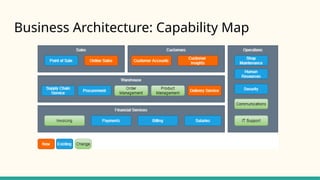
Business Architecture: Capability Map
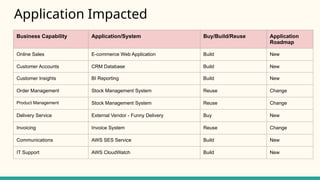
Application Impacted
Business Capability Application/System Buy/Build/Reuse Application
Roadmap
Online Sales E-commerce Web Application Build New
Customer Accounts CRM Database Build New
Customer Insights BI Reporting Build New
Order Management Stock Management System Reuse Change
Product Management Stock Management System Reuse Change
Delivery Service External Vendor - Funny Delivery Buy New
Invoicing Invoice System Reuse Change
Communications AWS SES Service Build New
IT Support AWS CloudWatch Build New
AS-IS Context Diagram
No As-Is architecture exist
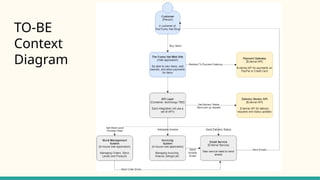
TO-BE
Context
Diagram
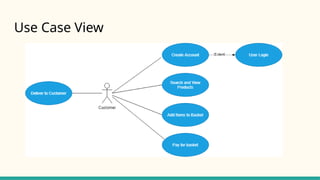
Use Case View
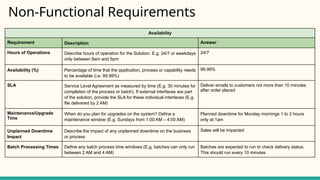
Availability
Requirement Description Answer
Hours of Operations Describe hours of operation for the Solution. E.g. 24/7 or weekdays
only between 8am and 5pm
24/7
Availability (%) Percentage of time that the application, process or capability needs
to be available (i.e. 99.99%)
99.99%
SLA Service Level Agreement as measured by time (E.g. 30 minutes for
completion of the process or batch). If external interfaces are part
of the solution, provide the SLA for these individual interfaces (E.g.
file delivered by 2 AM)
Deliver emails to customers not more than 10 minutes
after order placed
Maintenance/Upgrade
Time
When do you plan for upgrades on the system? Define a
maintenance window (E.g. Sundays from 1:00 AM – 4:00 AM)
Planned downtime for Monday mornings 1 to 2 hours
only at 1am
Unplanned Downtime
Impact
Describe the impact of any unplanned downtime on the business
or process
Sales will be impacted
Batch Processing Times Define any batch process time windows (E.g. batches can only run
between 2 AM and 4 AM)
Batches are expected to run to check delivery status.
This should run every 10 minutes
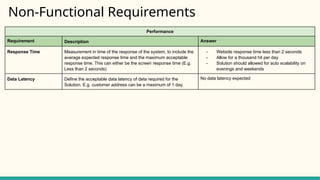
Non-Functional Requirements
Performance
Requirement Description Answer
Response Time Measurement in time of the response of the system, to include the
average expected response time and the maximum acceptable
response time. This can either be the screen response time (E.g.
Less than 2 seconds)
- Website response time less than 2 seconds
- Allow for a thousand hit per day
- Solution should allowed for auto scalability on
evenings and weekends
Data Latency Define the acceptable data latency of data required for the
Solution. E.g. customer address can be a maximum of 1 day.
No data latency expected
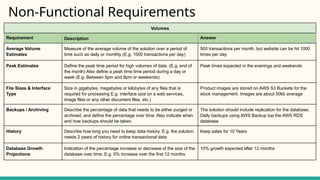
Non-Functional Requirements
Volumes
Requirement Description Answer
Average Volume
Estimates
Measure of the average volume of the solution over a period of
time such as daily or monthly (E.g. 1000 transactions per day)
500 transactions per month, but website can be hit 1000
times per day
Peak Estimates Define the peak time period for high volumes of data. (E.g. end of
the month) Also define a peak time time period during a day or
week (E.g. Between 5pm and 8pm or weekends)
Peak times expected in the evenings and weekends
File Sizes & Interface
Type
Size in gigabytes, megabytes or kilobytes of any files that is
required for processing E.g. interface size on a web services,
image files or any other document files, etc.)
Product images are stored on AWS S3 Buckets for the
stock management. Images are about 50kb average
Backups / Archiving Describe the percentage of data that needs to be either purged or
archived, and define the percentage over time. Also indicate when
and how backups should be taken.
The solution should include replication for the database.
Daily backups using AWS Backup top the AWS RDS
database
History Describe how long you need to keep data history. E.g. the solution
needs 2 years of history for online transactional data
Keep sales for 10 Years
Database Growth
Projections
Indication of the percentage increase or decrease of the size of the
database over time. E.g. 5% increase over the first 12 months
10% growth expected after 12 months
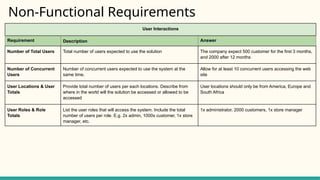
Non-Functional Requirements
User Interactions
Requirement Description Answer
Number of Total Users Total number of users expected to use the solution The company expect 500 customer for the first 3 months,
and 2000 after 12 months
Number of Concurrent
Users
Number of concurrent users expected to use the system at the
same time.
Allow for at least 10 concurrent users accessing the web
site
User Locations & User
Totals
Provide total number of users per each locations. Describe from
where in the world will the solution be accessed or allowed to be
accessed
User locations should only be from America, Europe and
South Africa
User Roles & Role
Totals
List the user roles that will access the system. Include the total
number of users per role. E.g. 2x admin, 1000x customer, 1x store
manager, etc.
1x administrator, 2000 customers, 1x store manager
Non-Functional Requirements
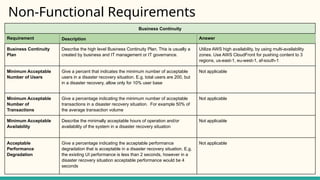
Business Continuity
Requirement Description Answer
Business Continuity
Plan
Describe the high level Business Continuity Plan. This is usually a
created by business and IT management or IT governance.
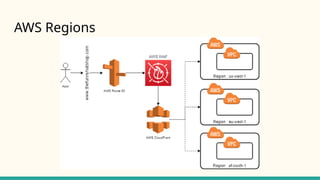
Utilize AWS high availability, by using multi-availability
zones. Use AWS CloudFront for pushing content to 3
regions, us-east-1, eu-west-1, af-south-1
Minimum Acceptable
Number of Users
Give a percent that indicates the minimum number of acceptable
users in a disaster recovery situation. E.g. total users are 200, but
in a disaster recovery, allow only for 10% user base
Not applicable
Minimum Acceptable
Number of
Transactions
Give a percentage indicating the minimum number of acceptable
transactions in a disaster recovery situation. For example 50% of
the average transaction volume
Not applicable
Minimum Acceptable
Availability
Describe the minimally acceptable hours of operation and/or
availability of the system in a disaster recovery situation
Not applicable
Acceptable
Performance
Degradation
Give a percentage indicating the acceptable performance
degradation that is acceptable in a disaster recovery situation. E.g.
the existing UI performance is less than 2 seconds, however in a
disaster recovery situation acceptable performance would be 4
seconds
Not applicable
Non-Functional Requirements
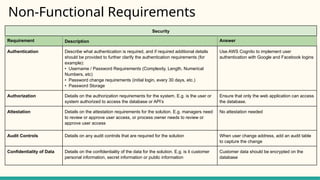
Security
Requirement Description Answer
Authentication Describe what authentication is required, and if required additional details
should be provided to further clarify the authentication requirements (for
example):
• Username / Password Requirements (Complexity, Length, Numerical
Numbers, etc)
• Password change requirements (initial login, every 30 days, etc.)
• Password Storage
Use AWS Cognito to implement user
authentication with Google and Facebook logins
Authorization Details on the authorization requirements for the system. E.g. is the user or
system authorized to access the database or API’s
Ensure that only the web application can access
the database.
Attestation Details on the attestation requirements for the solution. E.g. managers need
to review or approve user access, or process owner needs to review or
approve user access
No attestation needed
Audit Controls Details on any audit controls that are required for the solution When user change address, add an audit table
to capture the change
Confidentiality of Data Details on the confidentiality of the data for the solution. E.g. is it customer
personal information, secret information or public information
Customer data should be encrypted on the
database
Non-Functional Requirements
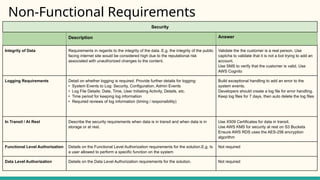
Security
Description Answer
Integrity of Data Requirements in regards to the integrity of the data. E.g. the integrity of the public
facing internet site would be considered high due to the reputational risk
associated with unauthorized changes to the content.
Validate the the customer is a real person. Use
captcha to validate that it is not a bot trying to add an
account.
Use SMS to verify that the customer is valid. Use
AWS Cognito
Logging Requirements Detail on whether logging is required. Provide further details for logging:
• System Events to Log: Security, Configuration, Admin Events
• Log File Details: Date, Time, User Initiating Activity, Details, etc.
• Time period for keeping log information
• Required reviews of log information (timing / responsibility)
Build exceptional handling to add an error to the
system events.
Developers should create a log file for error handling.
Keep log files for 7 days, then auto delete the log files
In Transit / At Rest Describe the security requirements when data is in transit and when data is in
storage or at rest.
Use X509 Certificates for data in transit.
Use AWS KMS for security at rest on S3 Buckets
Ensure AWS RDS uses the AES-256 encryption
algorithm
Functional Level Authorization Details on the Functional Level Authorization requirements for the solution.E.g. Is
a user allowed to perform a specific function on the system
Not required
Data Level Authorization Details on the Data Level Authorization requirements for the solution. Not required
Non-Functional Requirements
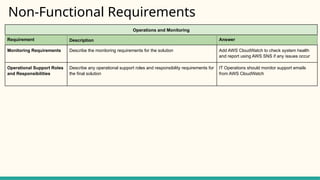
Operations and Monitoring
Requirement Description Answer
Monitoring Requirements Describe the monitoring requirements for the solution Add AWS CloudWatch to check system health
and report using AWS SNS if any issues occur
Operational Support Roles
and Responsibilities
Describe any operational support roles and responsibility requirements for
the final solution
IT Operations should monitor support emails
from AWS CloudWatch
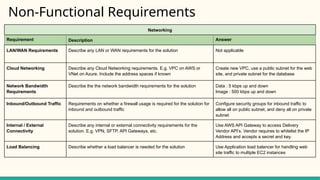
Networking
Requirement Description Answer
LAN/WAN Requirements Describe any LAN or WAN requirements for the solution Not applicable
Cloud Networking Describe any Cloud Networking requirements. E.g. VPC on AWS or
VNet on Azure. Include the address spaces if known
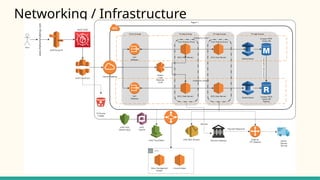
Create new VPC, use a public subnet for the web
site, and private subnet for the database
Network Bandwidth
Requirements
Describe the the network bandwidth requirements for the solution Data : 5 kbps up and down
Image : 500 kbps up and down
Inbound/Outbound Traffic Requirements on whether a firewall usage is required for the solution for
inbound and outbound traffic
Configure security groups for inbound traffic to
allow all on public subnet, and deny all on private
subnet
Internal / External
Connectivity
Describe any internal or external connectivity requirements for the
solution. E.g. VPN, SFTP, API Gateways, etc.
Use AWS API Gateway to access Delivery
Vendor API’s. Vendor requires to whitelist the IP
Address and accepts a secret and key.
Load Balancing Describe whether a load balancer is needed for the solution Use Application load balancer for handling web
site traffic to multiple EC2 instances
Non-Functional Requirements
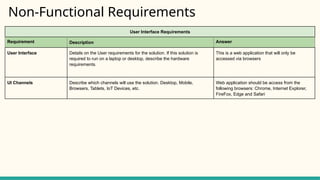
User Interface Requirements
Requirement Description Answer
User Interface Details on the User requirements for the solution. If this solution is
required to run on a laptop or desktop, describe the hardware
requirements.
This is a web application that will only be
accessed via browsers
UI Channels Describe which channels will use the solution. Desktop, Mobile,
Browsers, Tablets, IoT Devices, etc.
Web application should be access from the
following browsers: Chrome, Internet Explorer,
FireFox, Edge and Safari
Non-Functional Requirements
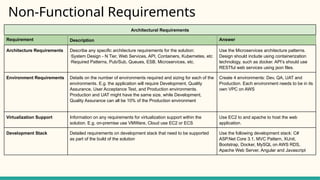
Architectural Requirements
Requirement Description Answer
Architecture Requirements Describe any specific architecture requirements for the solution:
·System Design - N Tier, Web Services, API, Containers, Kubernetes, etc
·Required Patterns, Pub/Sub, Queues, ESB, Microservices, etc.
Use the Microservices architecture patterns.
Design should include using containerization
technology, such as docker. API’s should use
RESTful web services using json files.
Environment Requirements Details on the number of environments required and sizing for each of the
environments. E.g. the application will require Development, Quality
Assurance, User Acceptance Test, and Production environments.
Production and UAT might have the same size, while Development,
Quality Assurance can all be 10% of the Production environment
Create 4 environments: Dev, QA, UAT and
Production. Each environment needs to be in its
own VPC on AWS
Virtualization Support Information on any requirements for virtualization support within the
solution. E.g. on-premise use VMWare, Cloud use EC2 or ECS
Use EC2 to and apache to host the web
application.
Development Stack Detailed requirements on development stack that need to be supported
as part of the build of the solution
Use the following development stack: C#
ASP.Net Core 3.1, MVC Pattern, XUnit,
Bootstrap, Docker, MySQL on AWS RDS,
Apache Web Server, Angular and Javascript
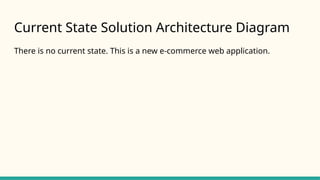
Current State Solution Architecture Diagram
There is no current state. This is a new e-commerce web application.
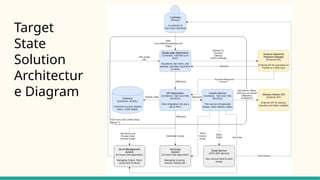
Target
State
Solution
Architectur
e Diagram
Architecture Objectives
● Create a secure private network on AWS using VPC’s for all environments
● Create a responsive single-page web application using bootstrap
● Use AWS Platform services for the solution, such as EC2, Elasticache for
Redis, Amazon RDS on MySQL, ALB load balancer, Route 53 Hosted Zones
and CloudWatch for monitoring
● Ensure auto scaling is enabled on the load balancer
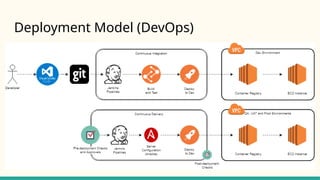
● Deployments should use a DevOps pipeline for continuous integration and
continuous deployments
● Adhere to security standards for both data in transit and data at rest by using
X509 Certificates, AWS KMS encryption on S3 Buckets
Architecture Constraints
● The business only have a limited budget of $200,000 set out for development.
The solution should consider as a constraint.
● The company relies on this solution to keep the business open and would like
this solution in 3 months
● The company standard is to only use the Amazon AWS Cloud services
Architectural Risks
Risk Mitigation Owner
Project Not Delivered in time Business are willing to get contractors to speed up
development
Business User (Sarah)
IT Operational Cost Might be high Solution Architecture will include auto scaling capability Solution Architect
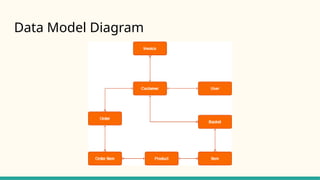
Data Model Diagram
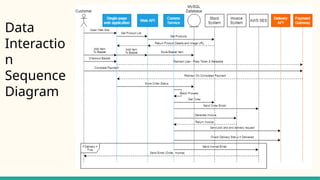
Data
Interactio
n
Sequence
Diagram
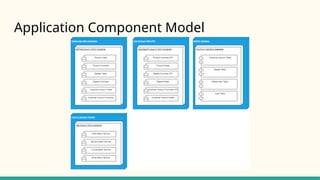
Application Component Model
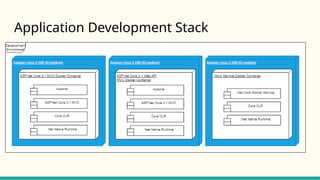
Application Development Stack
Deployment Model (DevOps)
Networking / Infrastructure
AWS Regions
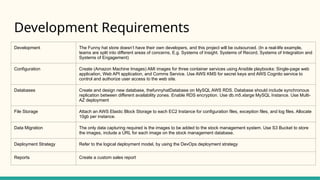
Development Requirements
Development The Funny hat store doesn’t have their own developers, and this project will be outsourced. (In a real-life example,
teams are split into different areas of concerns, E.g. Systems of Insight. Systems of Record, Systems of Integration and
Systems of Engagement)
Configuration Create (Amazon Machine Images) AMI images for three container services using Ansible playbooks: Single-page web
application, Web API application, and Comms Service. Use AWS KMS for secret keys and AWS Cognito service to
control and authorize user access to the web site.
Databases Create and design new database, thefunnyhatDatabase on MySQL AWS RDS. Database should include synchronous
replication between different availability zones. Enable RDS encryption. Use db.m5.xlarge MySQL Instance. Use Multi-
AZ deployment
File Storage Attach an AWS Elastic Block Storage to each EC2 Instance for configuration files, exception files, and log files. Allocate
10gb per instance.
Data Migration The only data capturing required is the images to be added to the stock management system. Use S3 Bucket to store
the images, include a URL for each image on the stock management database.
Deployment Strategy Refer to the logical deployment model, by using the DevOps deployment strategy
Reports Create a custom sales report
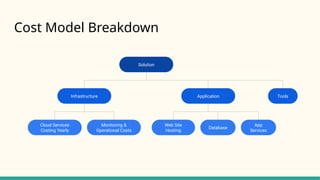
Cost Model Breakdown
Solution
Application
Infrastructure
Cloud Services
Costing Yearly
Monitoring &
Operational Costs
Web Site
Hosting
Database
Tools
App
Services
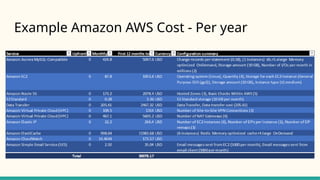
Example Amazon AWS Cost - Per year
Additional Diagram
Examples
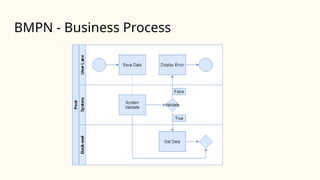
BMPN - Business Process
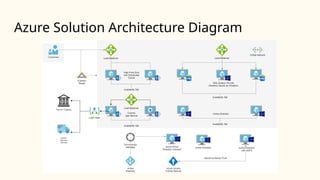
Azure Solution Architecture Diagram
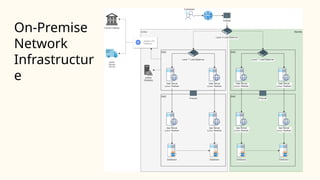
On-Premise
Network
Infrastructur
e
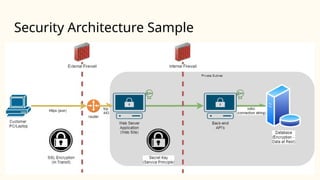
Security Architecture Sample

Solution+Architecture+Review+-+Sample.pptx

  • 1.
  • 2.
    Project Description The purposeof this project is to develop an e-commerce web application for The Funny Hat Shop. The project includes building a solution architecture according to the IT architecture vision and business requirements. The business outcome is to drive additional sales by implementing an e-commerce web site to sell its products online The web site should be easy to use, but fast and friendly to use on any channel, such as mobile phones, tablets and personal computers. The Funny Hat Shop made an agreement with an external Vendor for deliveries of the products to the customers. The solution needs to integrate with the delivery companies API’s.
  • 3.
    In Scope The followingarchitecture building blocks are in scope of this project: ● Create an e-commerce web application hosting on the AWS platform ● Integration with the stock management and invoicing systems ● Stand up a e-mail service to communicate to customer ● Work with a new Delivery Vendor to pick up and deliver products sold on the web site ● Integrate with the Delivery Vendor API to automate status updates and delivery requests ● Add images to the stock management system for each product
  • 4.
    Out of Scope Upgradingthe stock management system is not in scope
  • 5.
  • 6.
    Application Impacted Business CapabilityApplication/System Buy/Build/Reuse Application Roadmap Online Sales E-commerce Web Application Build New Customer Accounts CRM Database Build New Customer Insights BI Reporting Build New Order Management Stock Management System Reuse Change Product Management Stock Management System Reuse Change Delivery Service External Vendor - Funny Delivery Buy New Invoicing Invoice System Reuse Change Communications AWS SES Service Build New IT Support AWS CloudWatch Build New
  • 7.
    AS-IS Context Diagram NoAs-Is architecture exist
  • 8.
  • 9.
  • 10.
    Availability Requirement Description Answer Hoursof Operations Describe hours of operation for the Solution. E.g. 24/7 or weekdays only between 8am and 5pm 24/7 Availability (%) Percentage of time that the application, process or capability needs to be available (i.e. 99.99%) 99.99% SLA Service Level Agreement as measured by time (E.g. 30 minutes for completion of the process or batch). If external interfaces are part of the solution, provide the SLA for these individual interfaces (E.g. file delivered by 2 AM) Deliver emails to customers not more than 10 minutes after order placed Maintenance/Upgrade Time When do you plan for upgrades on the system? Define a maintenance window (E.g. Sundays from 1:00 AM – 4:00 AM) Planned downtime for Monday mornings 1 to 2 hours only at 1am Unplanned Downtime Impact Describe the impact of any unplanned downtime on the business or process Sales will be impacted Batch Processing Times Define any batch process time windows (E.g. batches can only run between 2 AM and 4 AM) Batches are expected to run to check delivery status. This should run every 10 minutes Non-Functional Requirements
  • 11.
    Non-Functional Requirements Performance Requirement DescriptionAnswer Response Time Measurement in time of the response of the system, to include the average expected response time and the maximum acceptable response time. This can either be the screen response time (E.g. Less than 2 seconds) - Website response time less than 2 seconds - Allow for a thousand hit per day - Solution should allowed for auto scalability on evenings and weekends Data Latency Define the acceptable data latency of data required for the Solution. E.g. customer address can be a maximum of 1 day. No data latency expected
  • 12.
    Non-Functional Requirements Volumes Requirement DescriptionAnswer Average Volume Estimates Measure of the average volume of the solution over a period of time such as daily or monthly (E.g. 1000 transactions per day) 500 transactions per month, but website can be hit 1000 times per day Peak Estimates Define the peak time period for high volumes of data. (E.g. end of the month) Also define a peak time time period during a day or week (E.g. Between 5pm and 8pm or weekends) Peak times expected in the evenings and weekends File Sizes & Interface Type Size in gigabytes, megabytes or kilobytes of any files that is required for processing E.g. interface size on a web services, image files or any other document files, etc.) Product images are stored on AWS S3 Buckets for the stock management. Images are about 50kb average Backups / Archiving Describe the percentage of data that needs to be either purged or archived, and define the percentage over time. Also indicate when and how backups should be taken. The solution should include replication for the database. Daily backups using AWS Backup top the AWS RDS database History Describe how long you need to keep data history. E.g. the solution needs 2 years of history for online transactional data Keep sales for 10 Years Database Growth Projections Indication of the percentage increase or decrease of the size of the database over time. E.g. 5% increase over the first 12 months 10% growth expected after 12 months
  • 13.
    Non-Functional Requirements User Interactions RequirementDescription Answer Number of Total Users Total number of users expected to use the solution The company expect 500 customer for the first 3 months, and 2000 after 12 months Number of Concurrent Users Number of concurrent users expected to use the system at the same time. Allow for at least 10 concurrent users accessing the web site User Locations & User Totals Provide total number of users per each locations. Describe from where in the world will the solution be accessed or allowed to be accessed User locations should only be from America, Europe and South Africa User Roles & Role Totals List the user roles that will access the system. Include the total number of users per role. E.g. 2x admin, 1000x customer, 1x store manager, etc. 1x administrator, 2000 customers, 1x store manager
  • 14.
    Non-Functional Requirements Business Continuity RequirementDescription Answer Business Continuity Plan Describe the high level Business Continuity Plan. This is usually a created by business and IT management or IT governance. Utilize AWS high availability, by using multi-availability zones. Use AWS CloudFront for pushing content to 3 regions, us-east-1, eu-west-1, af-south-1 Minimum Acceptable Number of Users Give a percent that indicates the minimum number of acceptable users in a disaster recovery situation. E.g. total users are 200, but in a disaster recovery, allow only for 10% user base Not applicable Minimum Acceptable Number of Transactions Give a percentage indicating the minimum number of acceptable transactions in a disaster recovery situation. For example 50% of the average transaction volume Not applicable Minimum Acceptable Availability Describe the minimally acceptable hours of operation and/or availability of the system in a disaster recovery situation Not applicable Acceptable Performance Degradation Give a percentage indicating the acceptable performance degradation that is acceptable in a disaster recovery situation. E.g. the existing UI performance is less than 2 seconds, however in a disaster recovery situation acceptable performance would be 4 seconds Not applicable
  • 15.
    Non-Functional Requirements Security Requirement DescriptionAnswer Authentication Describe what authentication is required, and if required additional details should be provided to further clarify the authentication requirements (for example): • Username / Password Requirements (Complexity, Length, Numerical Numbers, etc) • Password change requirements (initial login, every 30 days, etc.) • Password Storage Use AWS Cognito to implement user authentication with Google and Facebook logins Authorization Details on the authorization requirements for the system. E.g. is the user or system authorized to access the database or API’s Ensure that only the web application can access the database. Attestation Details on the attestation requirements for the solution. E.g. managers need to review or approve user access, or process owner needs to review or approve user access No attestation needed Audit Controls Details on any audit controls that are required for the solution When user change address, add an audit table to capture the change Confidentiality of Data Details on the confidentiality of the data for the solution. E.g. is it customer personal information, secret information or public information Customer data should be encrypted on the database
  • 16.
    Non-Functional Requirements Security Description Answer Integrityof Data Requirements in regards to the integrity of the data. E.g. the integrity of the public facing internet site would be considered high due to the reputational risk associated with unauthorized changes to the content. Validate the the customer is a real person. Use captcha to validate that it is not a bot trying to add an account. Use SMS to verify that the customer is valid. Use AWS Cognito Logging Requirements Detail on whether logging is required. Provide further details for logging: • System Events to Log: Security, Configuration, Admin Events • Log File Details: Date, Time, User Initiating Activity, Details, etc. • Time period for keeping log information • Required reviews of log information (timing / responsibility) Build exceptional handling to add an error to the system events. Developers should create a log file for error handling. Keep log files for 7 days, then auto delete the log files In Transit / At Rest Describe the security requirements when data is in transit and when data is in storage or at rest. Use X509 Certificates for data in transit. Use AWS KMS for security at rest on S3 Buckets Ensure AWS RDS uses the AES-256 encryption algorithm Functional Level Authorization Details on the Functional Level Authorization requirements for the solution.E.g. Is a user allowed to perform a specific function on the system Not required Data Level Authorization Details on the Data Level Authorization requirements for the solution. Not required
  • 17.
    Non-Functional Requirements Operations andMonitoring Requirement Description Answer Monitoring Requirements Describe the monitoring requirements for the solution Add AWS CloudWatch to check system health and report using AWS SNS if any issues occur Operational Support Roles and Responsibilities Describe any operational support roles and responsibility requirements for the final solution IT Operations should monitor support emails from AWS CloudWatch
  • 18.
    Networking Requirement Description Answer LAN/WANRequirements Describe any LAN or WAN requirements for the solution Not applicable Cloud Networking Describe any Cloud Networking requirements. E.g. VPC on AWS or VNet on Azure. Include the address spaces if known Create new VPC, use a public subnet for the web site, and private subnet for the database Network Bandwidth Requirements Describe the the network bandwidth requirements for the solution Data : 5 kbps up and down Image : 500 kbps up and down Inbound/Outbound Traffic Requirements on whether a firewall usage is required for the solution for inbound and outbound traffic Configure security groups for inbound traffic to allow all on public subnet, and deny all on private subnet Internal / External Connectivity Describe any internal or external connectivity requirements for the solution. E.g. VPN, SFTP, API Gateways, etc. Use AWS API Gateway to access Delivery Vendor API’s. Vendor requires to whitelist the IP Address and accepts a secret and key. Load Balancing Describe whether a load balancer is needed for the solution Use Application load balancer for handling web site traffic to multiple EC2 instances Non-Functional Requirements
  • 19.
    User Interface Requirements RequirementDescription Answer User Interface Details on the User requirements for the solution. If this solution is required to run on a laptop or desktop, describe the hardware requirements. This is a web application that will only be accessed via browsers UI Channels Describe which channels will use the solution. Desktop, Mobile, Browsers, Tablets, IoT Devices, etc. Web application should be access from the following browsers: Chrome, Internet Explorer, FireFox, Edge and Safari Non-Functional Requirements
  • 20.
    Non-Functional Requirements Architectural Requirements RequirementDescription Answer Architecture Requirements Describe any specific architecture requirements for the solution: ·System Design - N Tier, Web Services, API, Containers, Kubernetes, etc ·Required Patterns, Pub/Sub, Queues, ESB, Microservices, etc. Use the Microservices architecture patterns. Design should include using containerization technology, such as docker. API’s should use RESTful web services using json files. Environment Requirements Details on the number of environments required and sizing for each of the environments. E.g. the application will require Development, Quality Assurance, User Acceptance Test, and Production environments. Production and UAT might have the same size, while Development, Quality Assurance can all be 10% of the Production environment Create 4 environments: Dev, QA, UAT and Production. Each environment needs to be in its own VPC on AWS Virtualization Support Information on any requirements for virtualization support within the solution. E.g. on-premise use VMWare, Cloud use EC2 or ECS Use EC2 to and apache to host the web application. Development Stack Detailed requirements on development stack that need to be supported as part of the build of the solution Use the following development stack: C# ASP.Net Core 3.1, MVC Pattern, XUnit, Bootstrap, Docker, MySQL on AWS RDS, Apache Web Server, Angular and Javascript
  • 21.
    Current State SolutionArchitecture Diagram There is no current state. This is a new e-commerce web application.
  • 22.
  • 23.
    Architecture Objectives ● Createa secure private network on AWS using VPC’s for all environments ● Create a responsive single-page web application using bootstrap ● Use AWS Platform services for the solution, such as EC2, Elasticache for Redis, Amazon RDS on MySQL, ALB load balancer, Route 53 Hosted Zones and CloudWatch for monitoring ● Ensure auto scaling is enabled on the load balancer ● Deployments should use a DevOps pipeline for continuous integration and continuous deployments ● Adhere to security standards for both data in transit and data at rest by using X509 Certificates, AWS KMS encryption on S3 Buckets
  • 24.
    Architecture Constraints ● Thebusiness only have a limited budget of $200,000 set out for development. The solution should consider as a constraint. ● The company relies on this solution to keep the business open and would like this solution in 3 months ● The company standard is to only use the Amazon AWS Cloud services
  • 25.
    Architectural Risks Risk MitigationOwner Project Not Delivered in time Business are willing to get contractors to speed up development Business User (Sarah) IT Operational Cost Might be high Solution Architecture will include auto scaling capability Solution Architect
  • 26.
  • 27.
  • 28.
  • 29.
  • 30.
  • 31.
  • 32.
  • 33.
    Development Requirements Development TheFunny hat store doesn’t have their own developers, and this project will be outsourced. (In a real-life example, teams are split into different areas of concerns, E.g. Systems of Insight. Systems of Record, Systems of Integration and Systems of Engagement) Configuration Create (Amazon Machine Images) AMI images for three container services using Ansible playbooks: Single-page web application, Web API application, and Comms Service. Use AWS KMS for secret keys and AWS Cognito service to control and authorize user access to the web site. Databases Create and design new database, thefunnyhatDatabase on MySQL AWS RDS. Database should include synchronous replication between different availability zones. Enable RDS encryption. Use db.m5.xlarge MySQL Instance. Use Multi- AZ deployment File Storage Attach an AWS Elastic Block Storage to each EC2 Instance for configuration files, exception files, and log files. Allocate 10gb per instance. Data Migration The only data capturing required is the images to be added to the stock management system. Use S3 Bucket to store the images, include a URL for each image on the stock management database. Deployment Strategy Refer to the logical deployment model, by using the DevOps deployment strategy Reports Create a custom sales report
  • 34.
    Cost Model Breakdown Solution Application Infrastructure CloudServices Costing Yearly Monitoring & Operational Costs Web Site Hosting Database Tools App Services
  • 35.
    Example Amazon AWSCost - Per year
  • 36.
  • 37.
  • 38.
  • 39.
  • 40.