Mercury
Temperatures vary drastically on Mercury, On the side that
faces the sun, temperatures can reach up to 320° while on
the other side, temperatures can drop down to -116°.
It Is the closest planet to the sun, 150million
kilometres.
Mercury has the most extreme temperature
variations in the solar system.
The longest day, approximately 1407.5 hours (58.65 Earth days),
The shortest year at only 87.97 Earth days.
Speed: 15 thousand km/h.
800 miles in diameter, 5% of Earth.
Venus
Venus has a hellish atmosphere as well, consisting mainly of
carbon dioxide with clouds of sulfuric acid.
It Is the hottest. 449º
It is the brightest
It takes Venus 243 Earth days to rotate on its axis
The Venusian year is about 225 Earth days long
Speed: 37 thousand km/h.
Similar size to Earth (88%).
Distance from the Sun: 107 thousand kilometres.
Earth
The Earth has an atmosphere made of oxygen, nitrogen,
CO2 and other fumes.
It is our planet.
75% water
Rotation cause a 24h day.
Translation causes 365 day years.
Speed: 68 million km/h
Distance from Sun: 150 million kilometres
Mars
Atmosphere: CO2 in 95% and only 0.2 of oxygen.
It Is the red planet.
Temperature: -25º
The rotation is similar to Earth. Day of 24h 37’
The Martian year is about 687 Earth days long.
Speed: 18 thousand km/h.
Size: 15% of Earth
Distance from the Sun: 229 million kilometres
Jupiter
It Is the biggest.
It takes Jupiter 9h and 57min in Earth time to rotate
on its axis
The Jupiter year is about 12 Earth years long.
Speed: 214 thousand km/h.
Distance from the Sun: 777 million kilometres
Atmosphere: Mostly hydrogen and helio
Size: 1,318 x Earth
Temperature: -153º
Saturn
It has famous rings.
It takes Saturn almost 11 h in Earth time to rotate on
its axis
The Saturnian year is about 29 Earth years long.
Speed: 127 thousand kilometres.
Size: 95 x Earth
Distance from the Sun: 1,429 million kilometres
Temperature: -184º
Atmosphere: Mostly hydrogen and helio
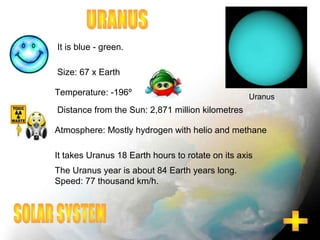
Uranus
It takes Uranus 18 Earth hours to rotate on its axis
The Uranus year is about 84 Earth years long.
Speed: 77 thousand km/h.
Size: 67 x Earth
Temperature: -196º
Distance from the Sun: 2,871 million kilometres
Atmosphere: Mostly hydrogen with helio and methane
It is blue - green.
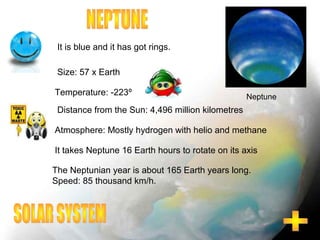
Neptune
It takes Neptune 16 Earth hours to rotate on its axis
The Neptunian year is about 165 Earth years long.
Speed: 85 thousand km/h.
Size: 57 x Earth
Temperature: -223º
Distance from the Sun: 4,496 million kilometres
Atmosphere: Mostly hydrogen with helio and methane
It is blue and it has got rings.

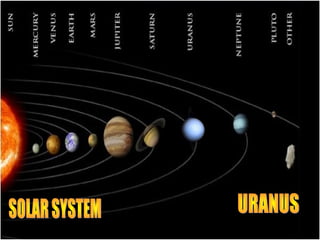
Solar system

  • 3.
    Mercury Temperatures vary drasticallyon Mercury, On the side that faces the sun, temperatures can reach up to 320° while on the other side, temperatures can drop down to -116°. It Is the closest planet to the sun, 150million kilometres. Mercury has the most extreme temperature variations in the solar system. The longest day, approximately 1407.5 hours (58.65 Earth days), The shortest year at only 87.97 Earth days. Speed: 15 thousand km/h. 800 miles in diameter, 5% of Earth.
  • 5.
    Venus Venus has ahellish atmosphere as well, consisting mainly of carbon dioxide with clouds of sulfuric acid. It Is the hottest. 449º It is the brightest It takes Venus 243 Earth days to rotate on its axis The Venusian year is about 225 Earth days long Speed: 37 thousand km/h. Similar size to Earth (88%). Distance from the Sun: 107 thousand kilometres.
  • 7.
    Earth The Earth hasan atmosphere made of oxygen, nitrogen, CO2 and other fumes. It is our planet. 75% water Rotation cause a 24h day. Translation causes 365 day years. Speed: 68 million km/h Distance from Sun: 150 million kilometres
  • 9.
    Mars Atmosphere: CO2 in95% and only 0.2 of oxygen. It Is the red planet. Temperature: -25º The rotation is similar to Earth. Day of 24h 37’ The Martian year is about 687 Earth days long. Speed: 18 thousand km/h. Size: 15% of Earth Distance from the Sun: 229 million kilometres
  • 11.
    Jupiter It Is thebiggest. It takes Jupiter 9h and 57min in Earth time to rotate on its axis The Jupiter year is about 12 Earth years long. Speed: 214 thousand km/h. Distance from the Sun: 777 million kilometres Atmosphere: Mostly hydrogen and helio Size: 1,318 x Earth Temperature: -153º
  • 13.
    Saturn It has famousrings. It takes Saturn almost 11 h in Earth time to rotate on its axis The Saturnian year is about 29 Earth years long. Speed: 127 thousand kilometres. Size: 95 x Earth Distance from the Sun: 1,429 million kilometres Temperature: -184º Atmosphere: Mostly hydrogen and helio
  • 15.
    Uranus It takes Uranus18 Earth hours to rotate on its axis The Uranus year is about 84 Earth years long. Speed: 77 thousand km/h. Size: 67 x Earth Temperature: -196º Distance from the Sun: 2,871 million kilometres Atmosphere: Mostly hydrogen with helio and methane It is blue - green.
  • 17.
    Neptune It takes Neptune16 Earth hours to rotate on its axis The Neptunian year is about 165 Earth years long. Speed: 85 thousand km/h. Size: 57 x Earth Temperature: -223º Distance from the Sun: 4,496 million kilometres Atmosphere: Mostly hydrogen with helio and methane It is blue and it has got rings.