Solar production prediction based on
non linear meteo source adaptation
Mariam Barque, IMIS 07-2015, Blumenau
Content
 Interest of the study
 Aim of the study
 Test bed
 Methodology
 Main results
 Conclusion
 Interest of the study
 Goal of the study
 Test bed
 Methodology
 Main results
 Conclusion
Content
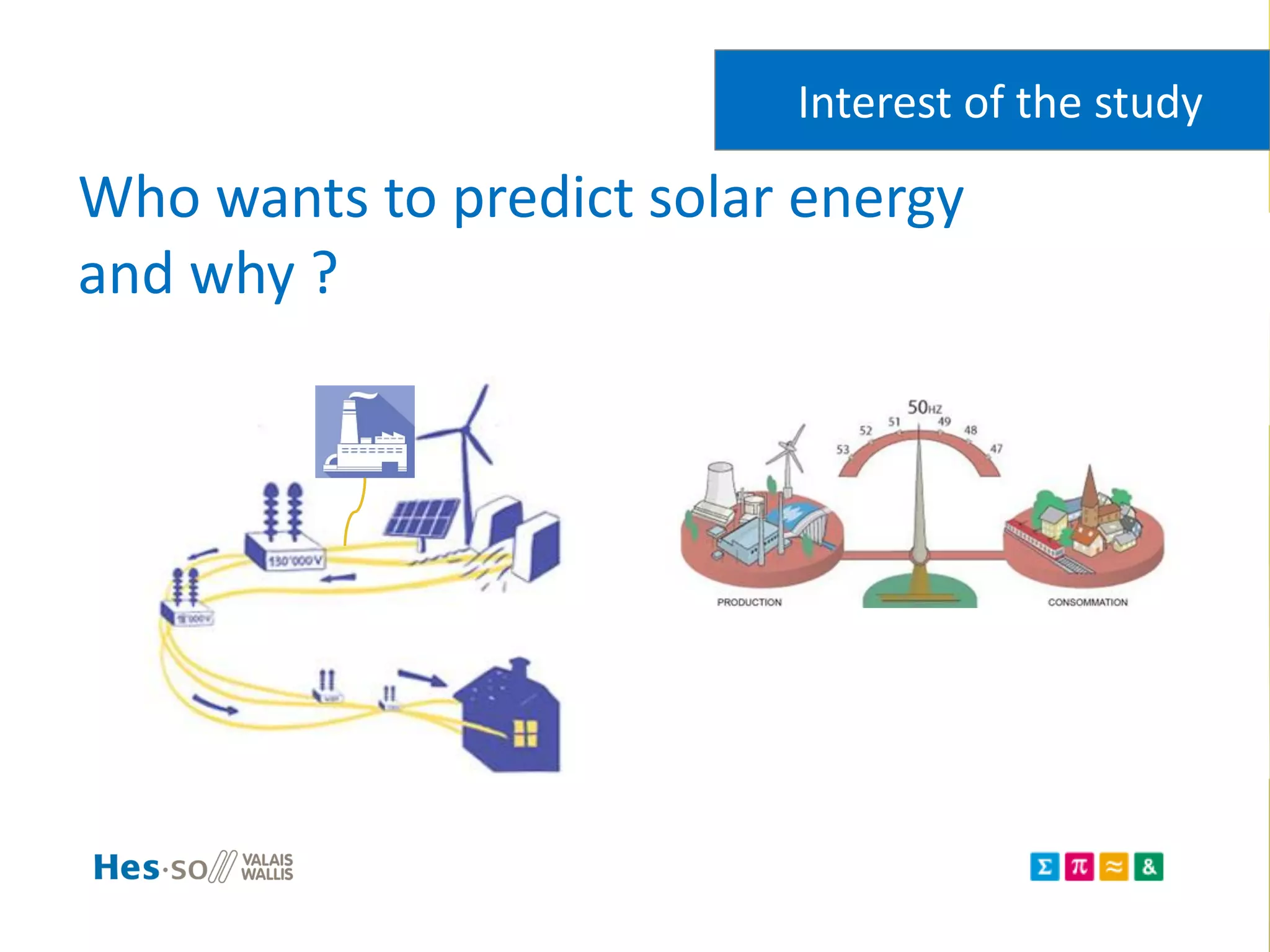
Who wants to predict solar energy
and why ?
Interest of the study
Content
 Interest of the study
 Aim of the study
 Test bed
 Methodology
 Main results
 Conclusion
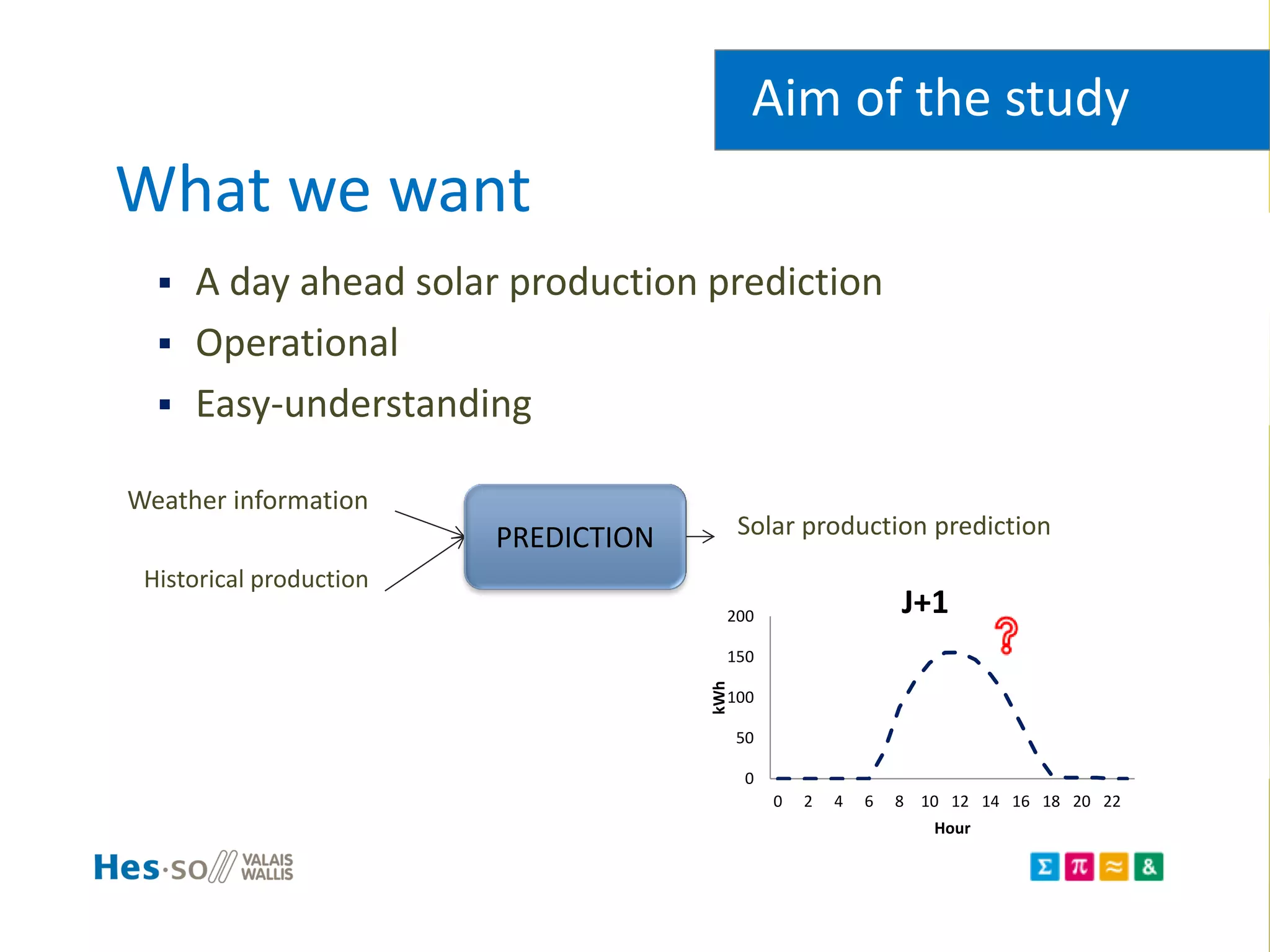
What we want
 A day ahead solar production prediction
 Operational
 Easy-understanding
Aim of the study
Weather information
Historical production
Solar production predictionPREDICTION
0
50
100
150
200
0 2 4 6 8 10 12 14 16 18 20 22
kWh
Hour
J+1
Content
 Interest of the study
 Aim of the study
 Test bed
 Methodology
 Main results
 Conclusion
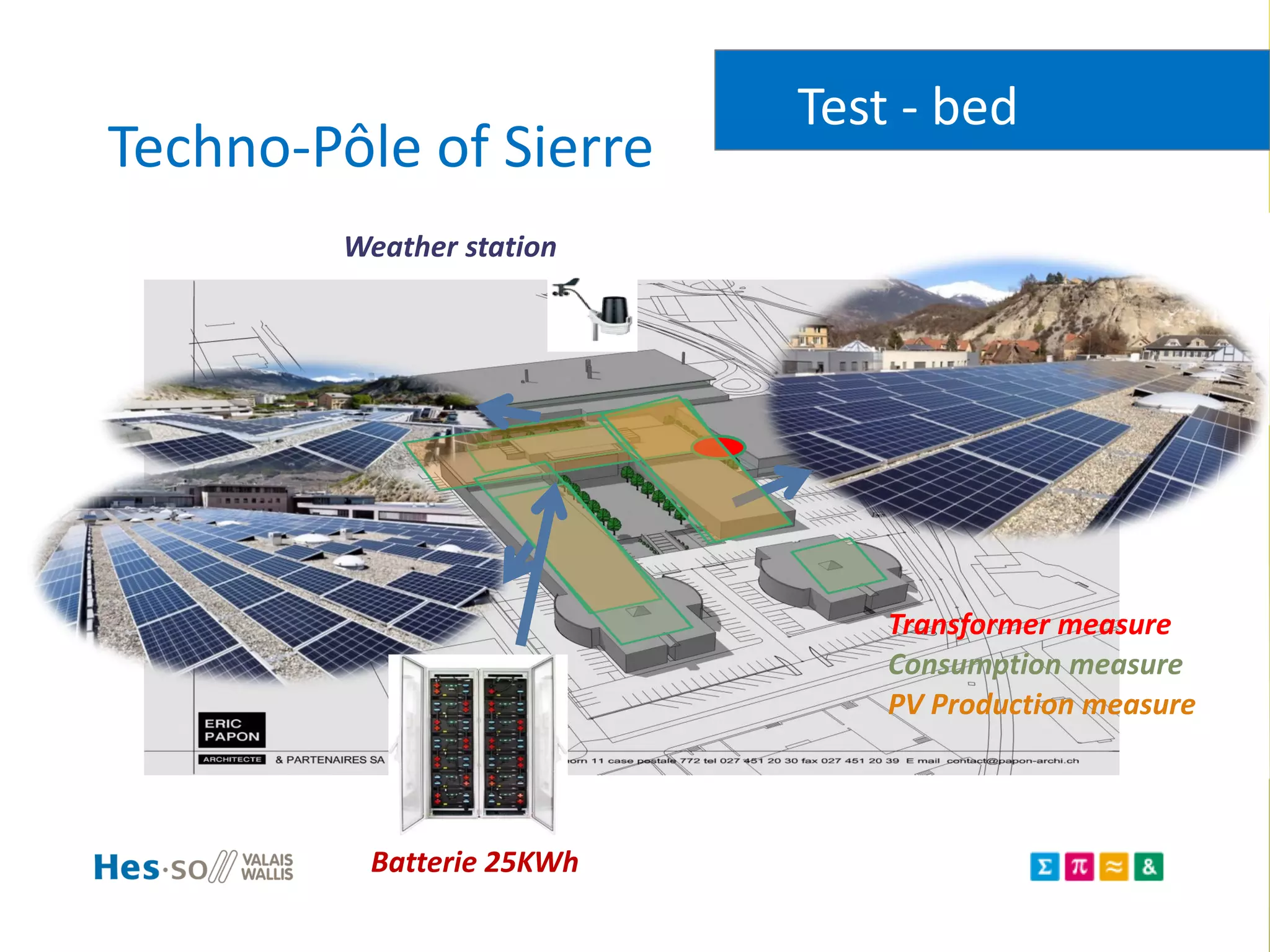
Techno-Pôle of Sierre
Test - bed
Transformer measure
Consumption measure
PV Production measure
Batterie 25KWh
Weather station
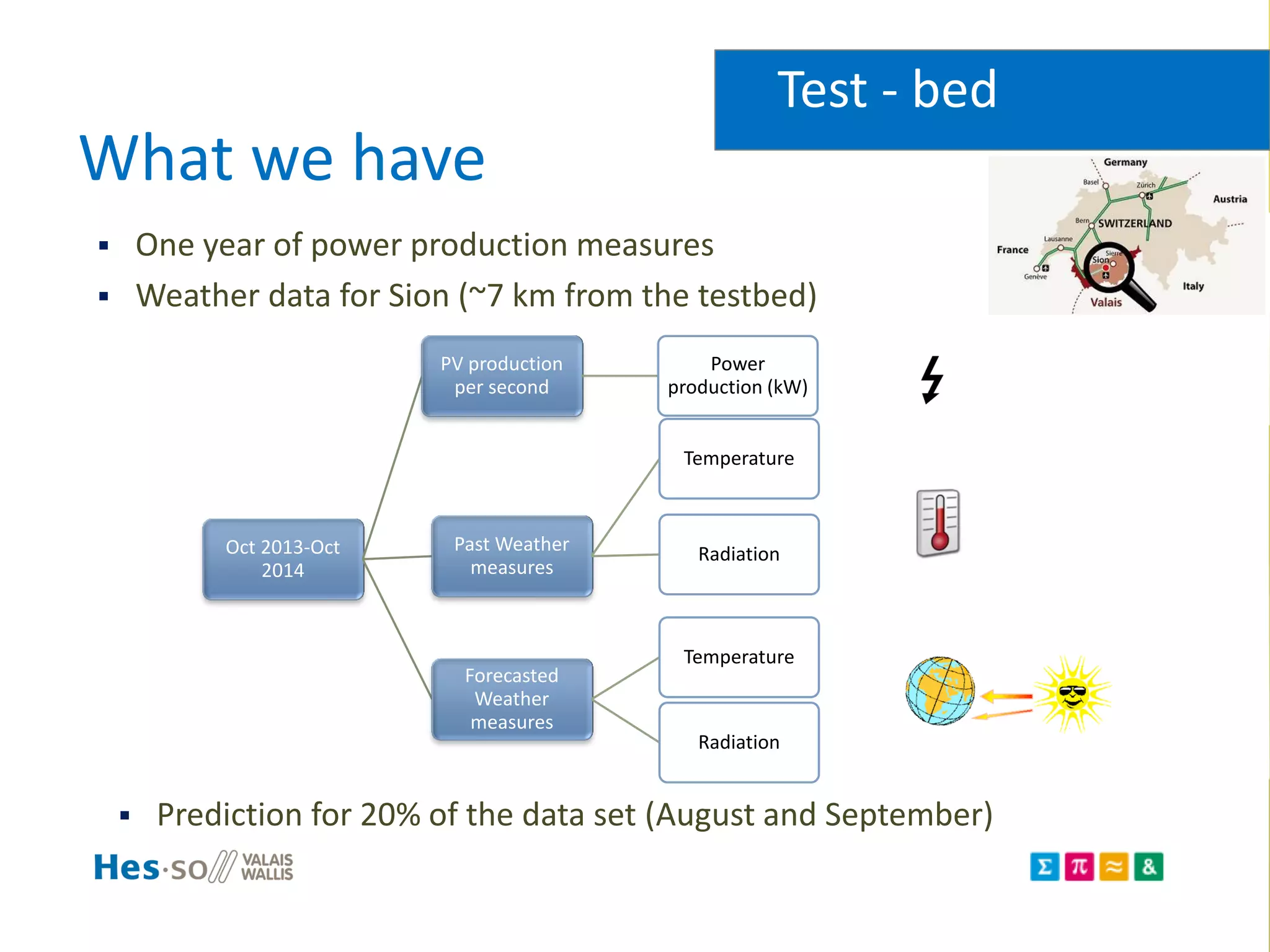
What we have
Oct 2013-Oct
2014
Past Weather
measures
Temperature
Radiation
PV production
per second
Power
production (kW)
Forecasted
Weather
measures
Temperature
Radiation
Test - bed
 One year of power production measures
 Weather data for Sion (~7 km from the testbed)
 Prediction for 20% of the data set (August and September)
Content
 Interest of the study
 Aim of the study
 Test bed
 Methodology
 Main results
 Conclusion
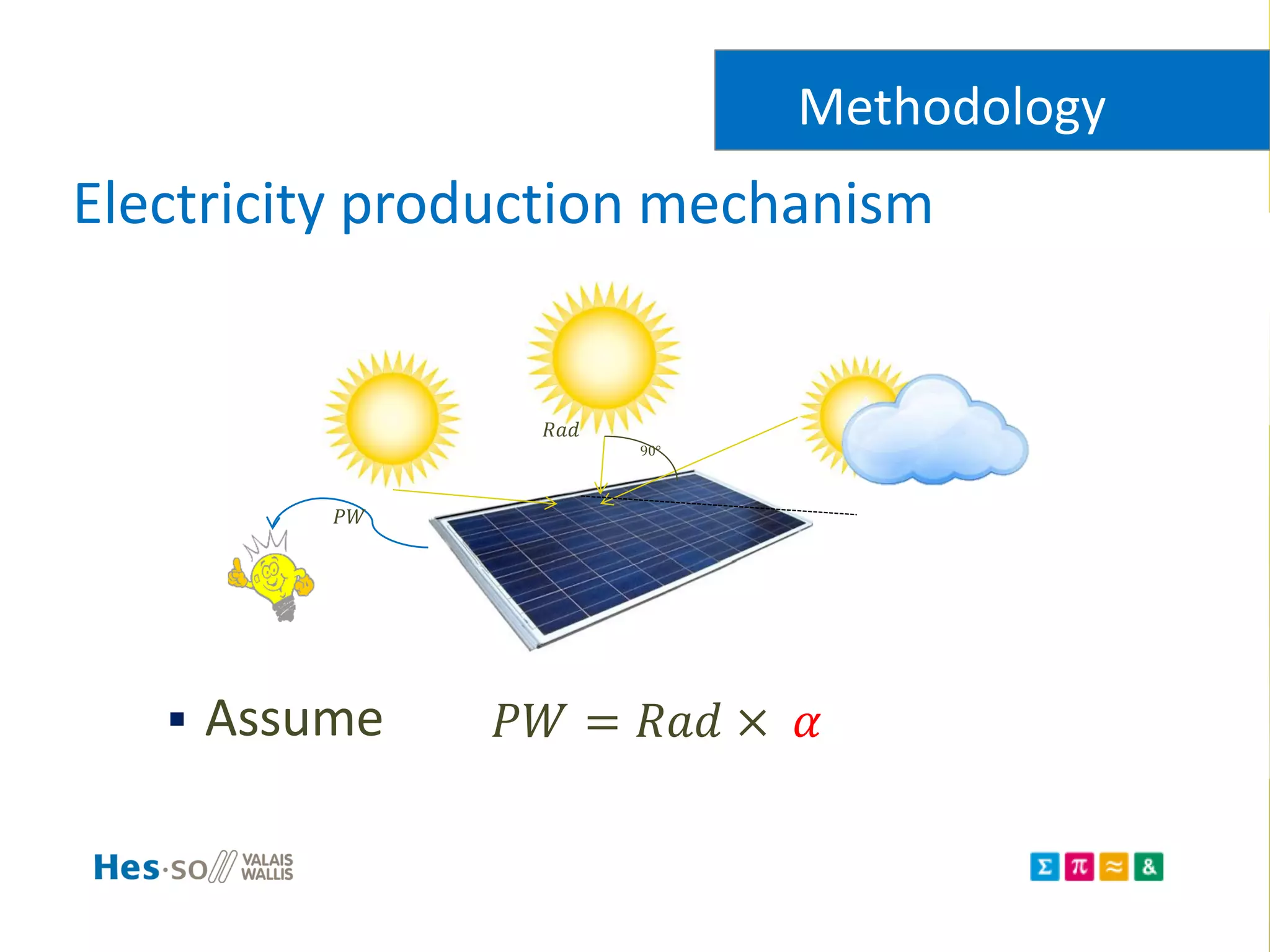
Electricity production mechanism
 Assume
Methodology
𝑃𝑊 = 𝑅𝑎𝑑 × 𝛼
𝑃𝑊
𝑅𝑎𝑑
90°
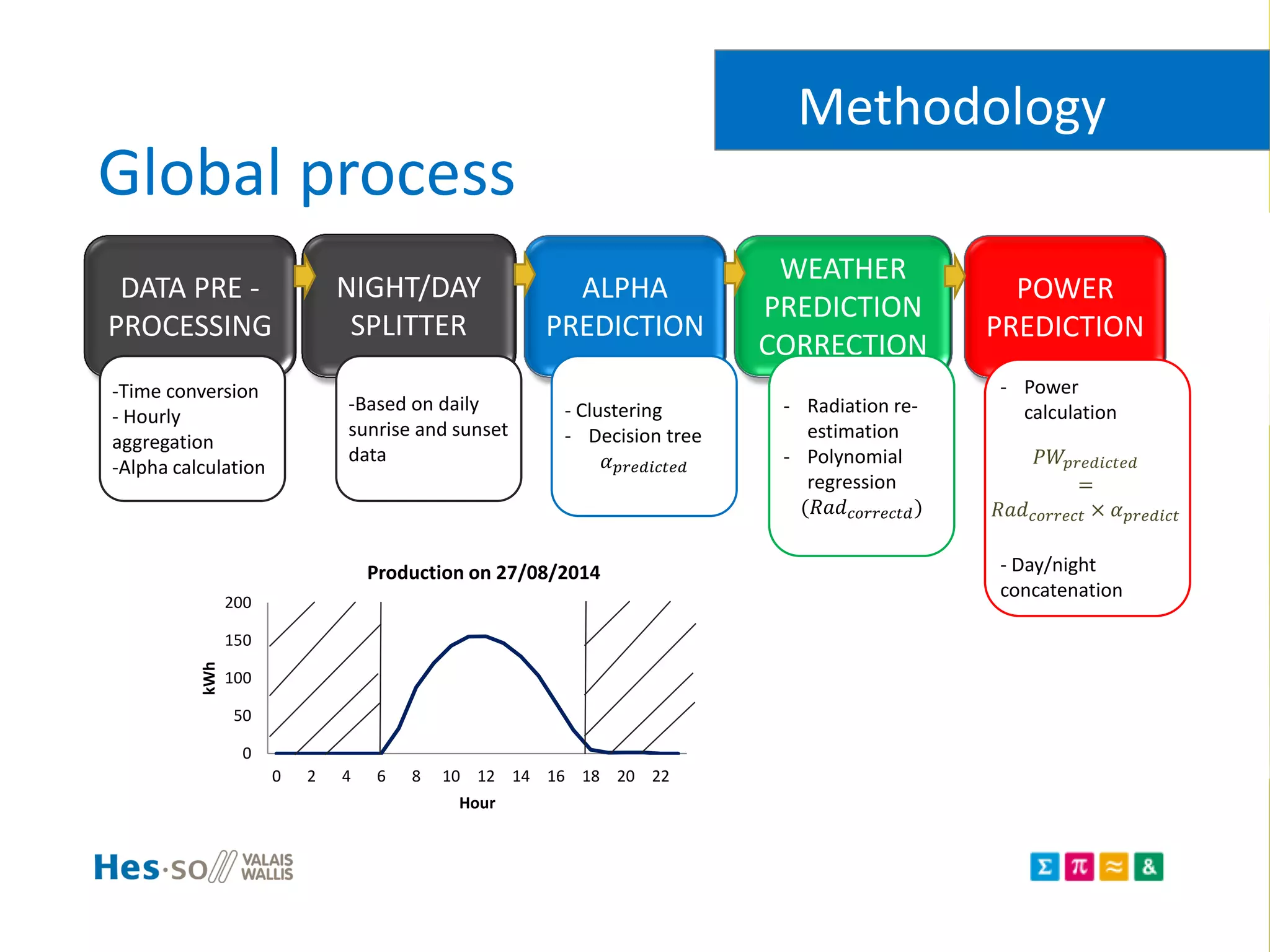
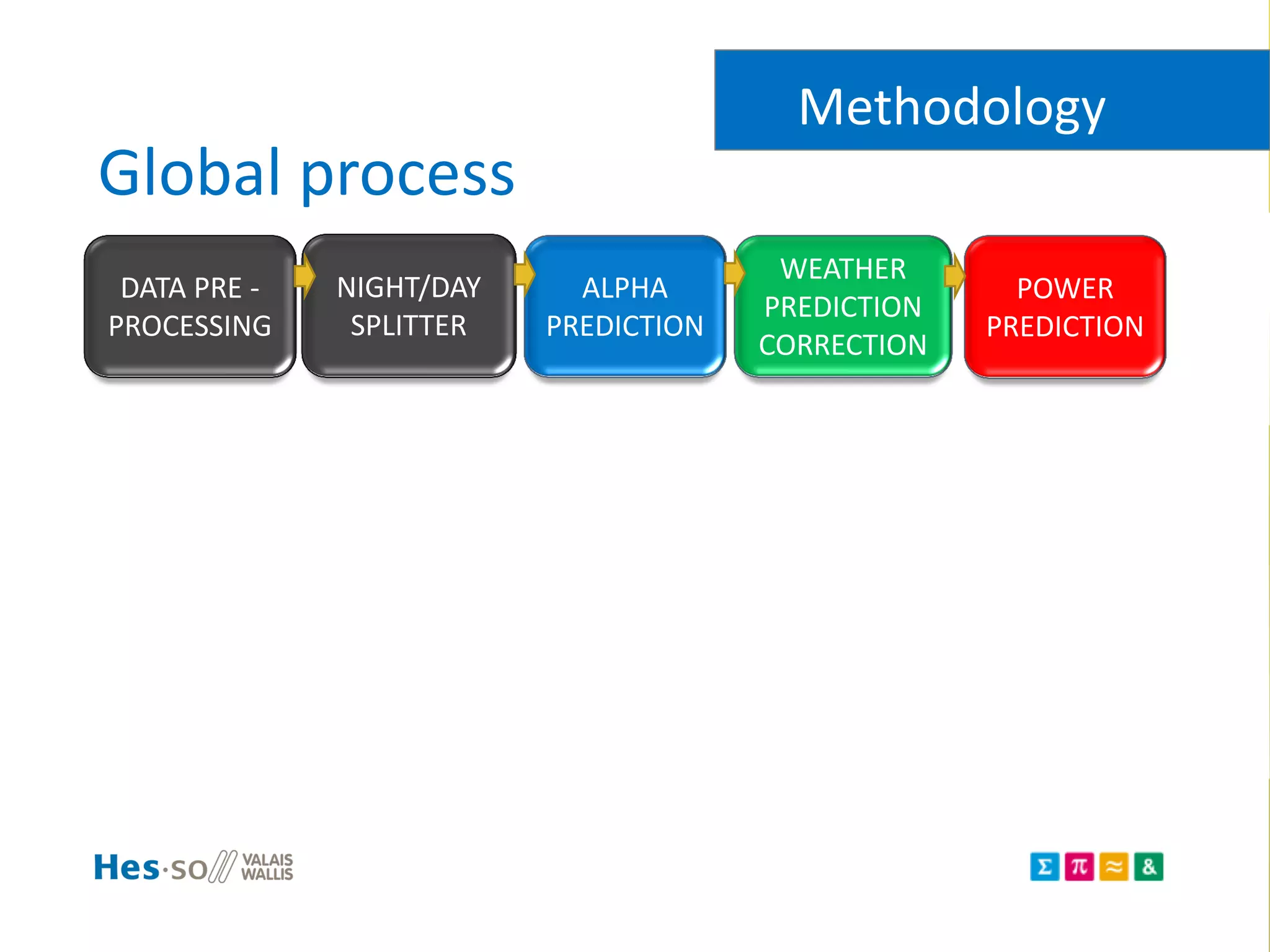
Global process
Methodology
DATA PRE -
PROCESSING
NIGHT/DAY
SPLITTER
ALPHA
PREDICTION
WEATHER
PREDICTION
CORRECTION
POWER
PREDICTION
-Time conversion
- Hourly
aggregation
-Alpha calculation
-Based on daily
sunrise and sunset
data
- Clustering
- Decision tree
𝛼 𝑝𝑟𝑒𝑑𝑖𝑐𝑡𝑒𝑑
- Radiation re-
estimation
- Polynomial
regression
(𝑅𝑎𝑑 𝑐𝑜𝑟𝑟𝑒𝑐𝑡𝑑)
- Power
calculation
- Day/night
concatenation
𝑃𝑊𝑝𝑟𝑒𝑑𝑖𝑐𝑡𝑒𝑑
=
𝑅𝑎𝑑 𝑐𝑜𝑟𝑟𝑒𝑐𝑡 × 𝛼 𝑝𝑟𝑒𝑑𝑖𝑐𝑡
0
50
100
150
200
0 2 4 6 8 10 12 14 16 18 20 22
kWh
Hour
Production on 27/08/2014
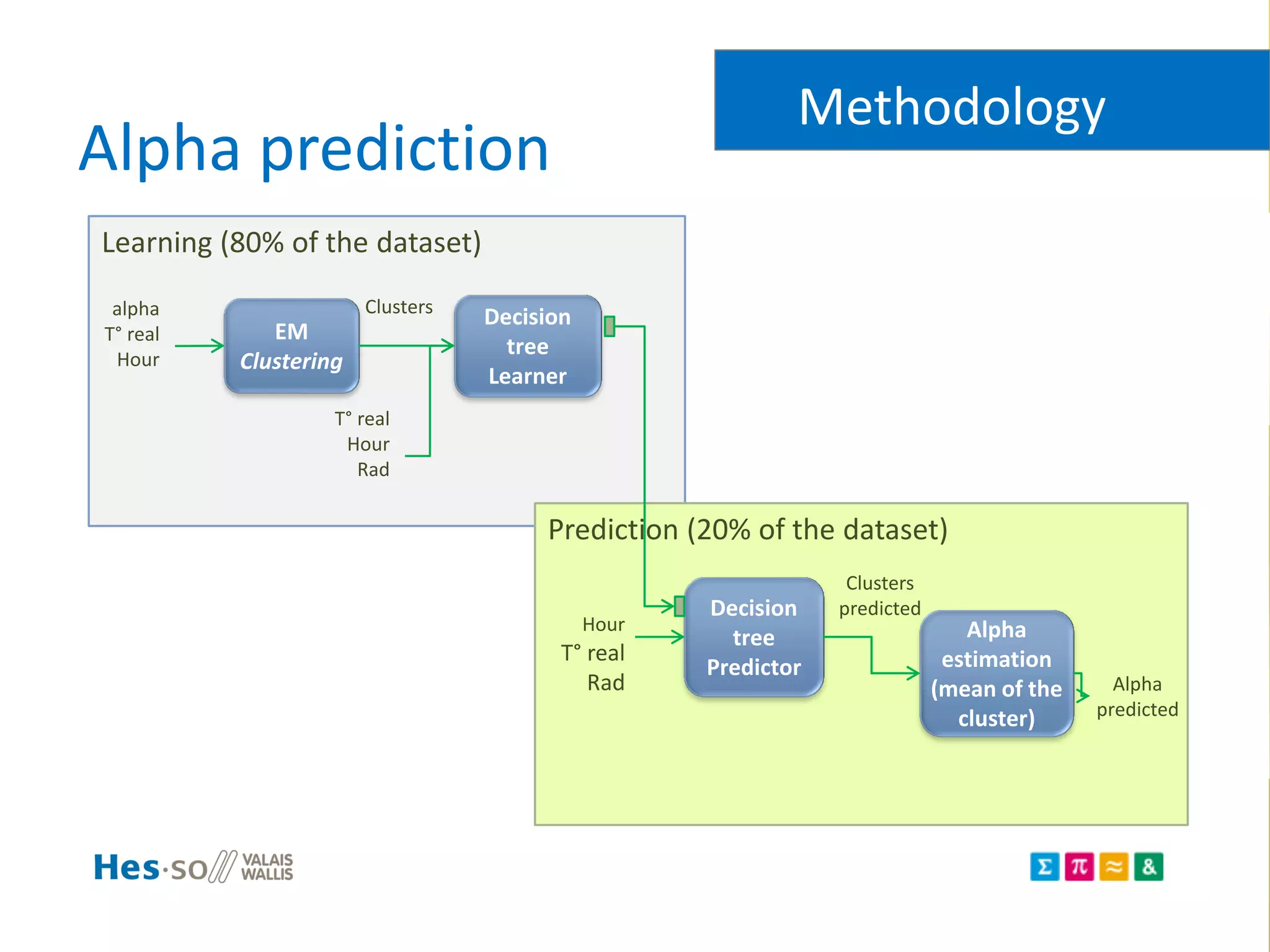
Alpha prediction
Methodology
Learning (80% of the dataset)
EM
Clustering
Decision
tree
Learner
Clusters
T° real
Hour
Rad
alpha
T° real
Hour
Prediction (20% of the dataset)
Decision
tree
Predictor
Clusters
predicted
Alpha
estimation
(mean of the
cluster)
Alpha
predicted
Hour
T° real
Rad
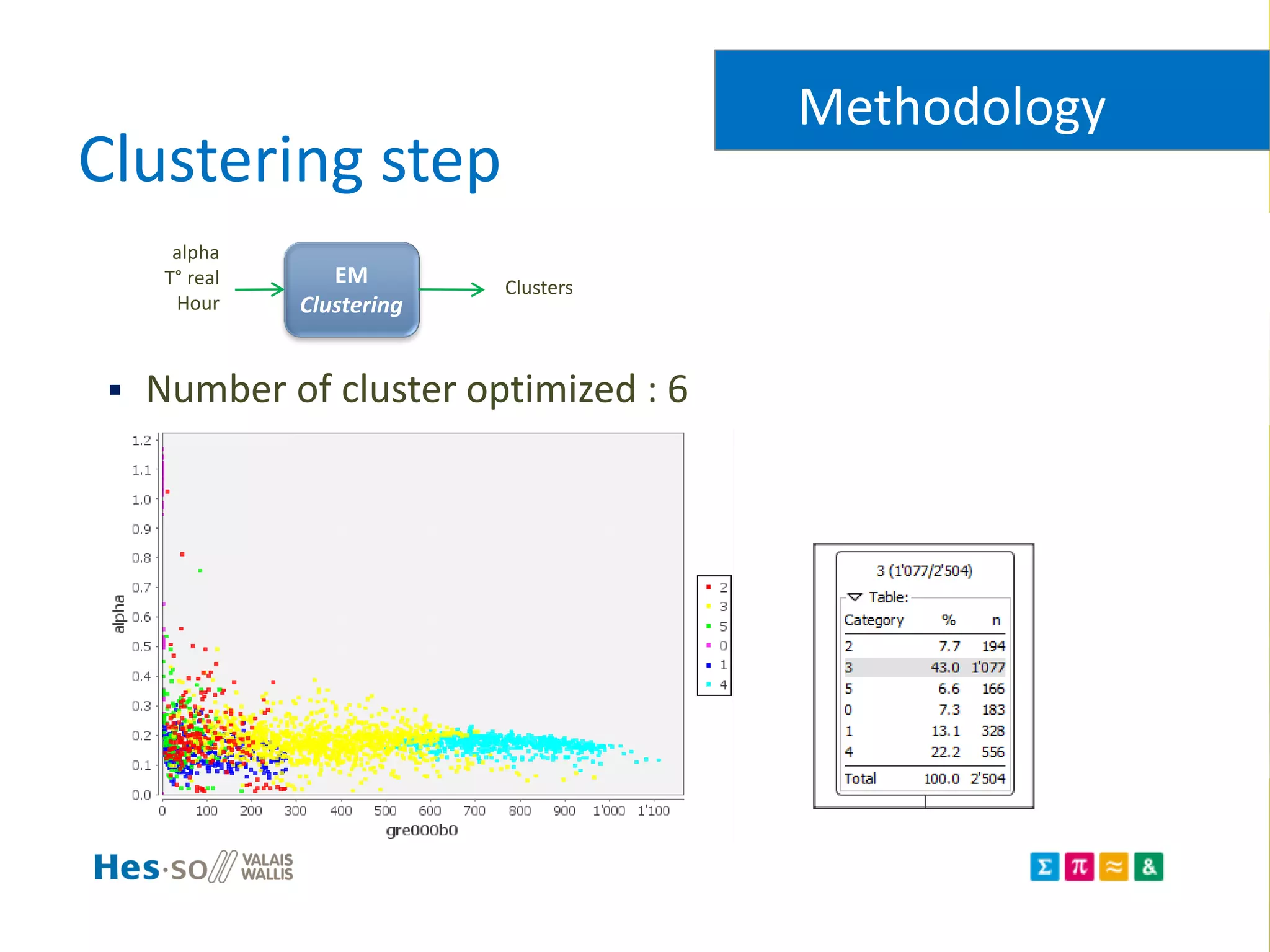
Clustering step
 Number of cluster optimized : 6
Methodology
EM
Clustering
Clusters
alpha
T° real
Hour
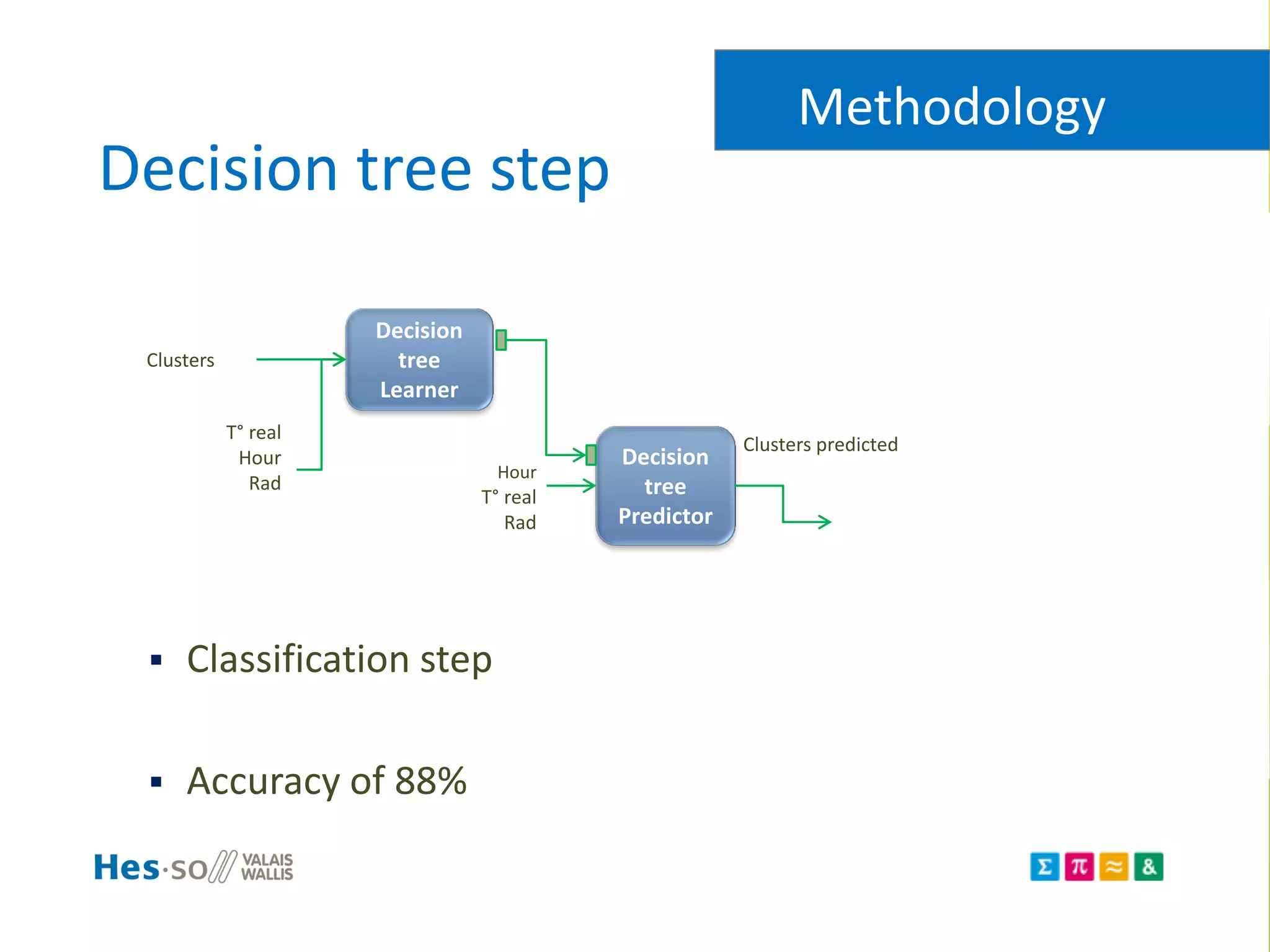
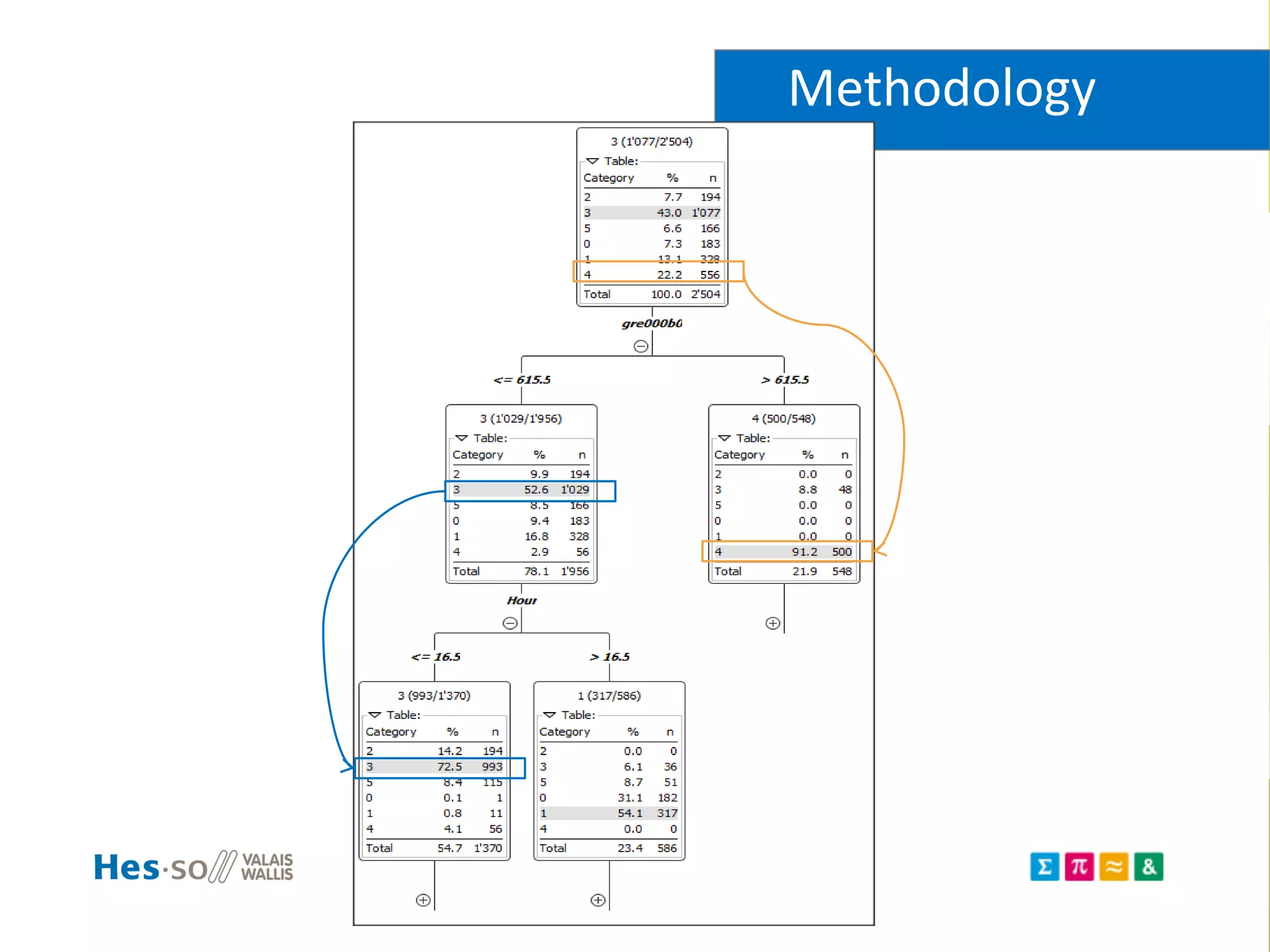
Decision tree step
 Classification step
 Accuracy of 88%
Methodology
Decision
tree
Learner
T° real
Hour
Rad
Decision
tree
Predictor
Clusters predicted
Hour
T° real
Rad
Clusters
Methodology
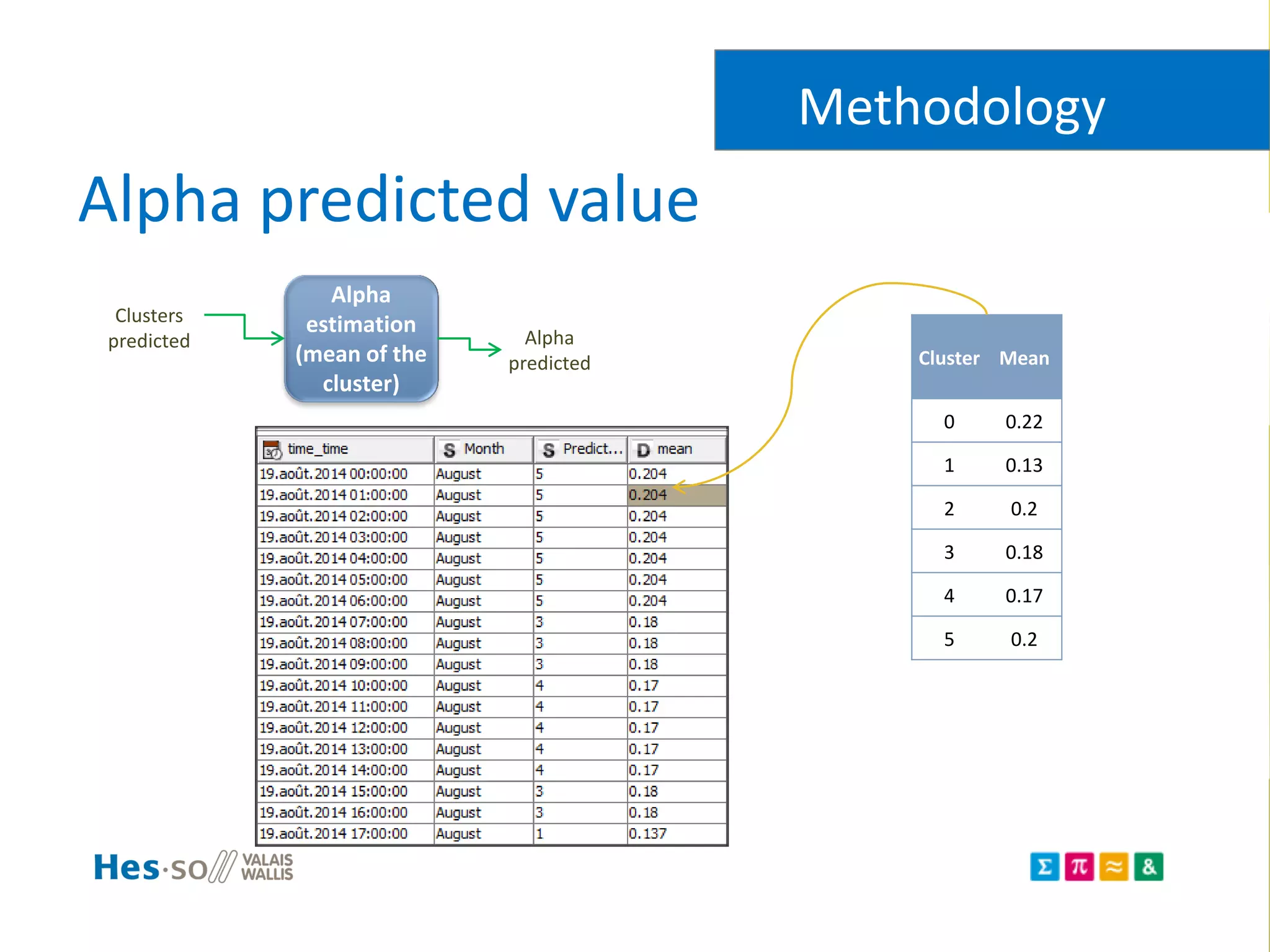
Alpha predicted value
Cluster Mean
0 0.22
1 0.13
2 0.2
3 0.18
4 0.17
5 0.2
Methodology
Clusters
predicted
Alpha
estimation
(mean of the
cluster)
Alpha
predicted
Global process
Methodology
DATA PRE -
PROCESSING
NIGHT/DAY
SPLITTER
ALPHA
PREDICTION
WEATHER
PREDICTION
CORRECTION
POWER
PREDICTION
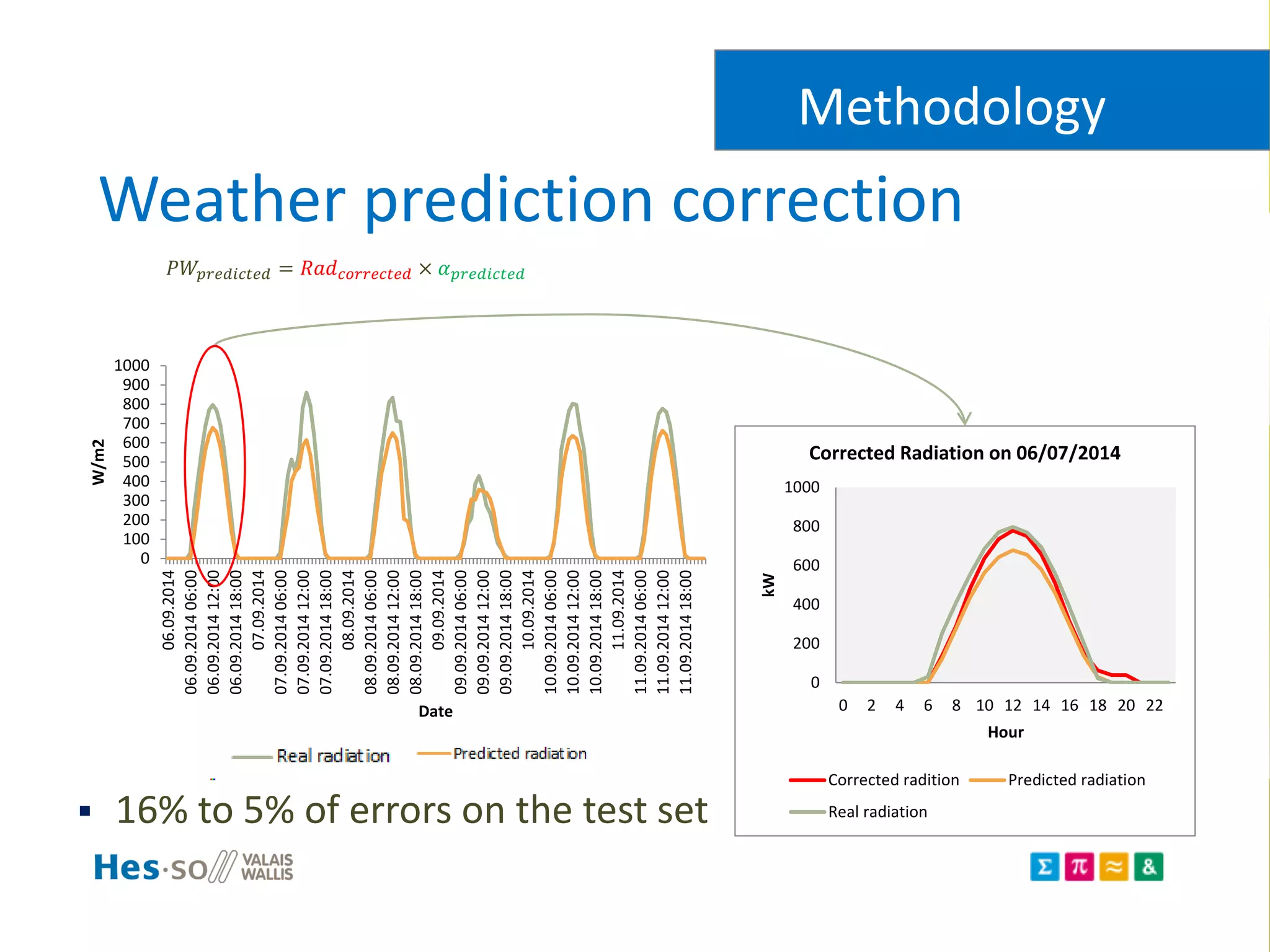
Weather prediction correction
0
200
400
600
800
1000
0 2 4 6 8 10 12 14 16 18 20 22
kW
Hour
Corrected Radiation on 06/07/2014
Corrected radition Predicted radiation
Real radiation
Methodology
𝑃𝑊𝑝𝑟𝑒𝑑𝑖𝑐𝑡𝑒𝑑 = 𝑅𝑎𝑑 𝑐𝑜𝑟𝑟𝑒𝑐𝑡𝑒𝑑 × 𝛼 𝑝𝑟𝑒𝑑𝑖𝑐𝑡𝑒𝑑
0
100
200
300
400
500
600
700
800
900
1000
06.09.2014
06.09.201406:00
06.09.201412:00
06.09.201418:00
07.09.2014
07.09.201406:00
07.09.201412:00
07.09.201418:00
08.09.2014
08.09.201406:00
08.09.201412:00
08.09.201418:00
09.09.2014
09.09.201406:00
09.09.201412:00
09.09.201418:00
10.09.2014
10.09.201406:00
10.09.201412:00
10.09.201418:00
11.09.2014
11.09.201406:00
11.09.201412:00
11.09.201418:00
W/m2
Date
Sum of gre000b0 Sum of GLOB
 16% to 5% of errors on the test set
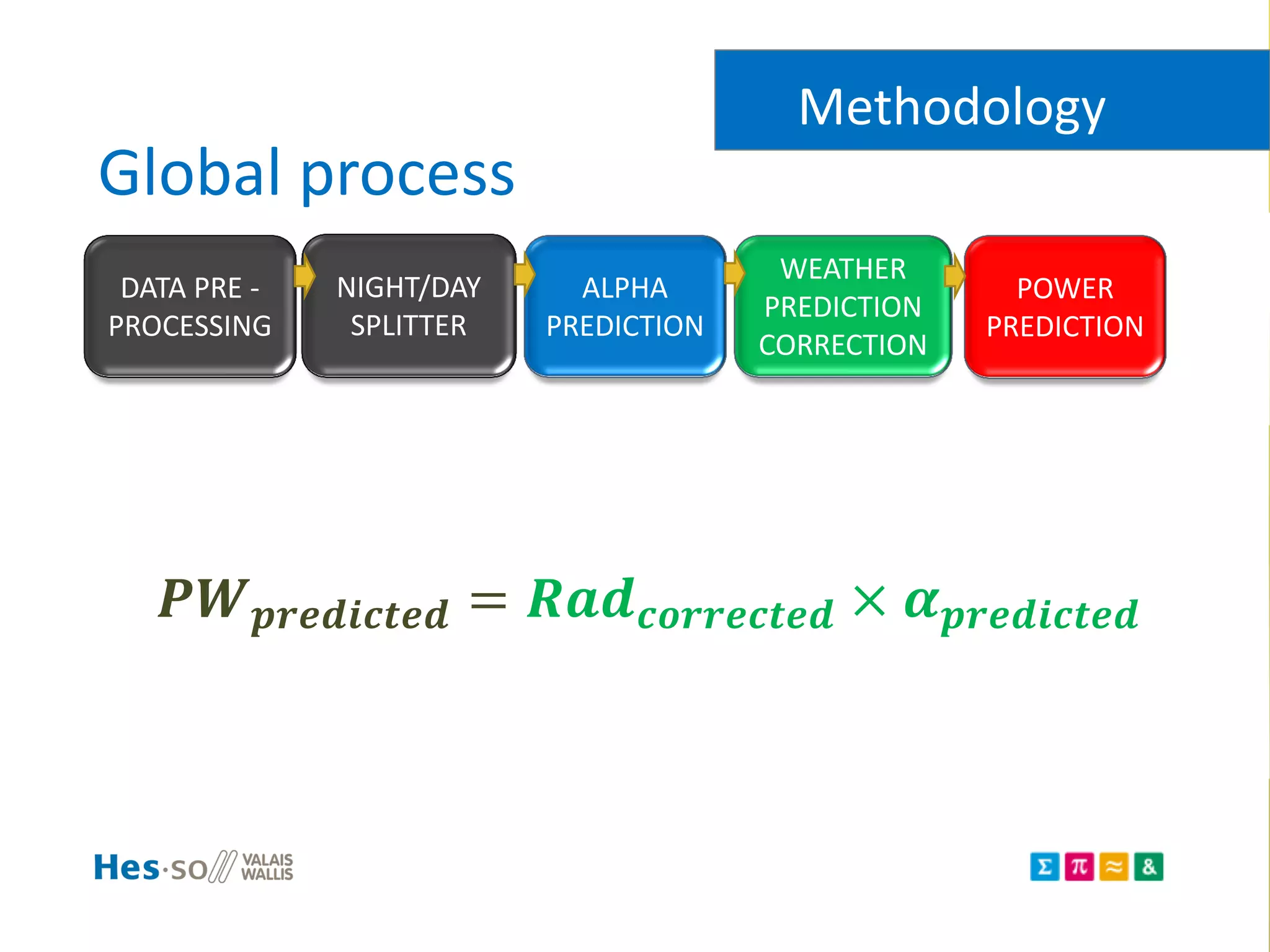
Global process
Methodology
DATA PRE -
PROCESSING
NIGHT/DAY
SPLITTER
ALPHA
PREDICTION
WEATHER
PREDICTION
CORRECTION
POWER
PREDICTION
𝑷𝑾 𝒑𝒓𝒆𝒅𝒊𝒄𝒕𝒆𝒅 = 𝑹𝒂𝒅 𝒄𝒐𝒓𝒓𝒆𝒄𝒕𝒆𝒅 × 𝜶 𝒑𝒓𝒆𝒅𝒊𝒄𝒕𝒆𝒅
Content
 Interest of the study
 Aim of the study
 Test bed
 Methodology
 Main results
 Conclusion
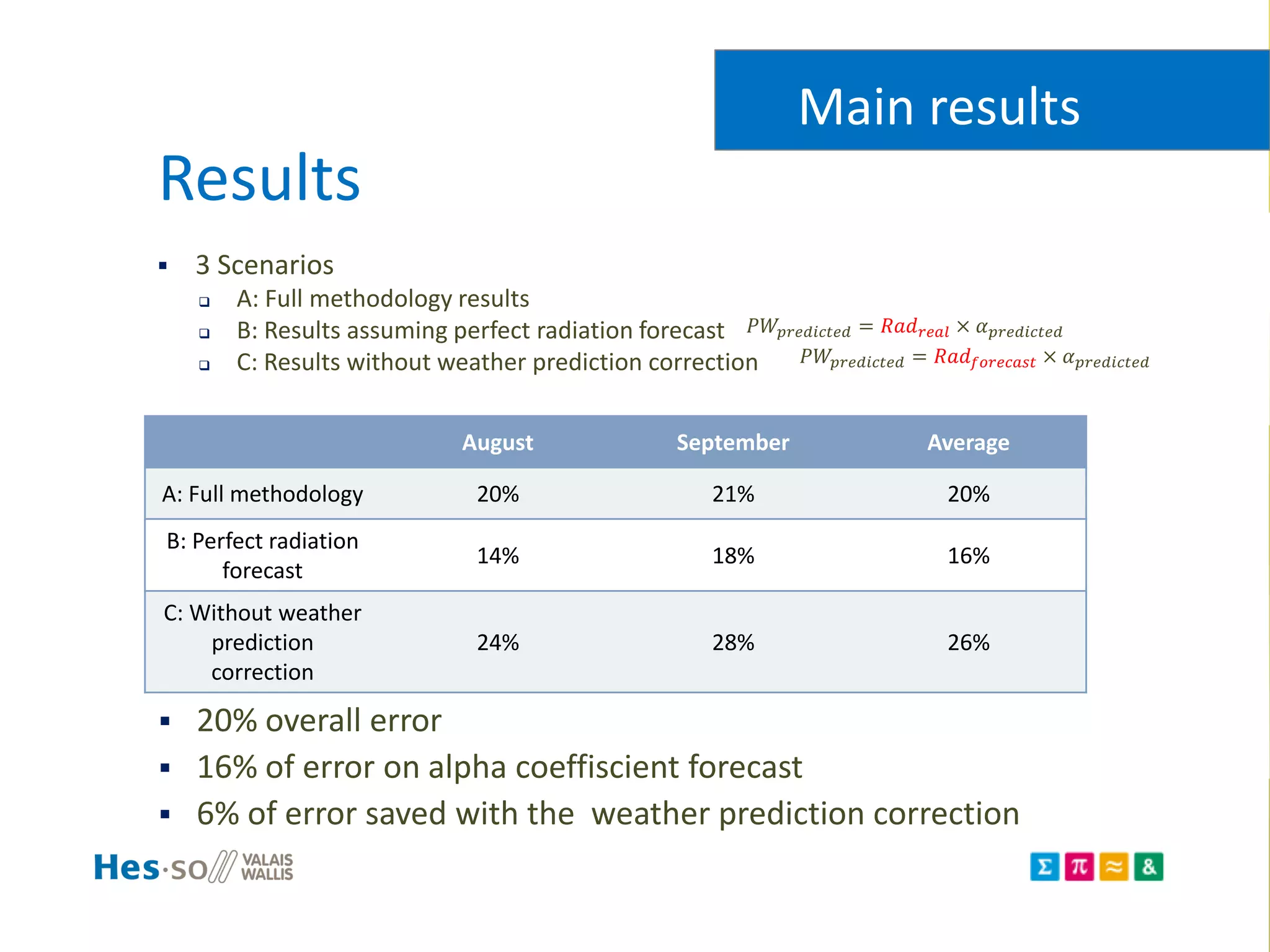
Results
August September Average
A: Full methodology 20% 21% 20%
B: Perfect radiation
forecast
14% 18% 16%
C: Without weather
prediction
correction
24% 28% 26%
Main results
 3 Scenarios
 A: Full methodology results
 B: Results assuming perfect radiation forecast
 C: Results without weather prediction correction
𝑃𝑊𝑝𝑟𝑒𝑑𝑖𝑐𝑡𝑒𝑑 = 𝑅𝑎𝑑 𝑟𝑒𝑎𝑙 × 𝛼 𝑝𝑟𝑒𝑑𝑖𝑐𝑡𝑒𝑑
𝑃𝑊𝑝𝑟𝑒𝑑𝑖𝑐𝑡𝑒𝑑 = 𝑅𝑎𝑑 𝑓𝑜𝑟𝑒𝑐𝑎𝑠𝑡 × 𝛼 𝑝𝑟𝑒𝑑𝑖𝑐𝑡𝑒𝑑
 20% overall error
 16% of error on alpha coeffiscient forecast
 6% of error saved with the weather prediction correction
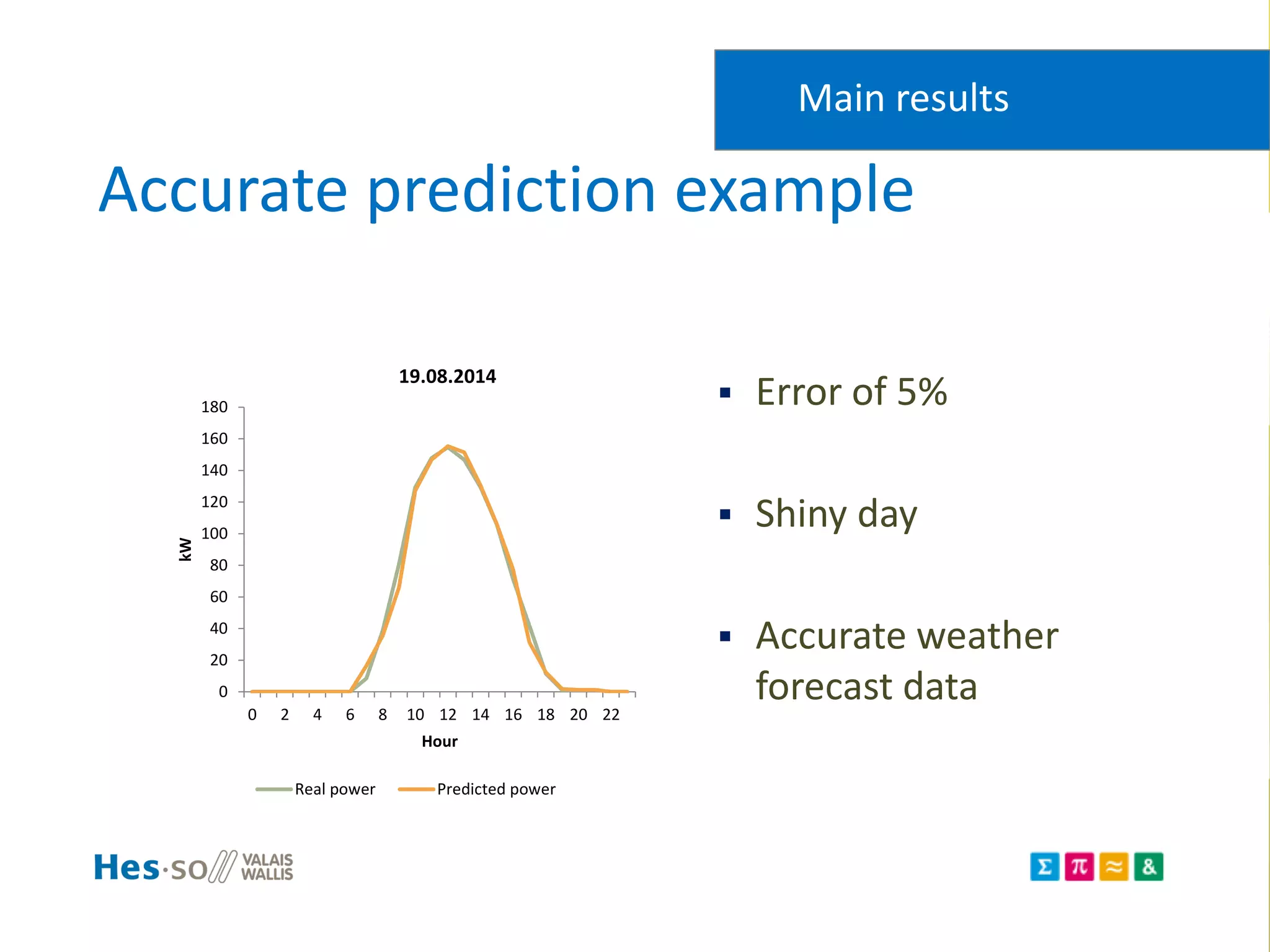
Accurate prediction example
Main results
 Error of 5%
 Shiny day
 Accurate weather
forecast data0
20
40
60
80
100
120
140
160
180
0 2 4 6 8 10 12 14 16 18 20 22
kW
Hour
19.08.2014
Real power Predicted power
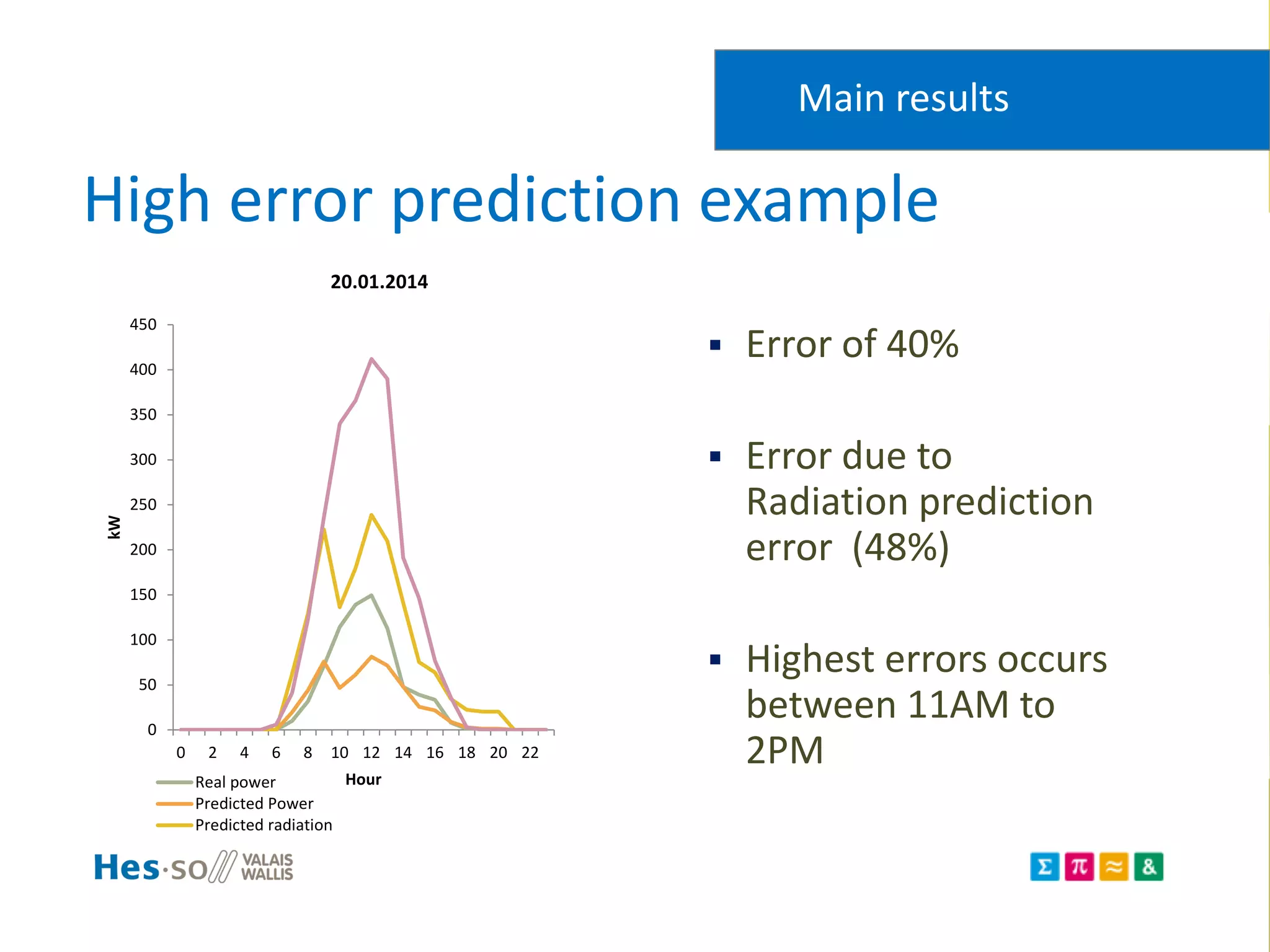
High error prediction example
Main results
 Error of 40%
 Error due to
Radiation prediction
error (48%)
 Highest errors occurs
between 11AM to
2PM
0
50
100
150
200
250
300
350
400
450
0 2 4 6 8 10 12 14 16 18 20 22
kW
Hour
20.01.2014
Real power
Predicted Power
Predicted radiation
Content
 Interest of the study
 Aim of the study
 Test bed
 Methodology
 Main results
 Conclusion
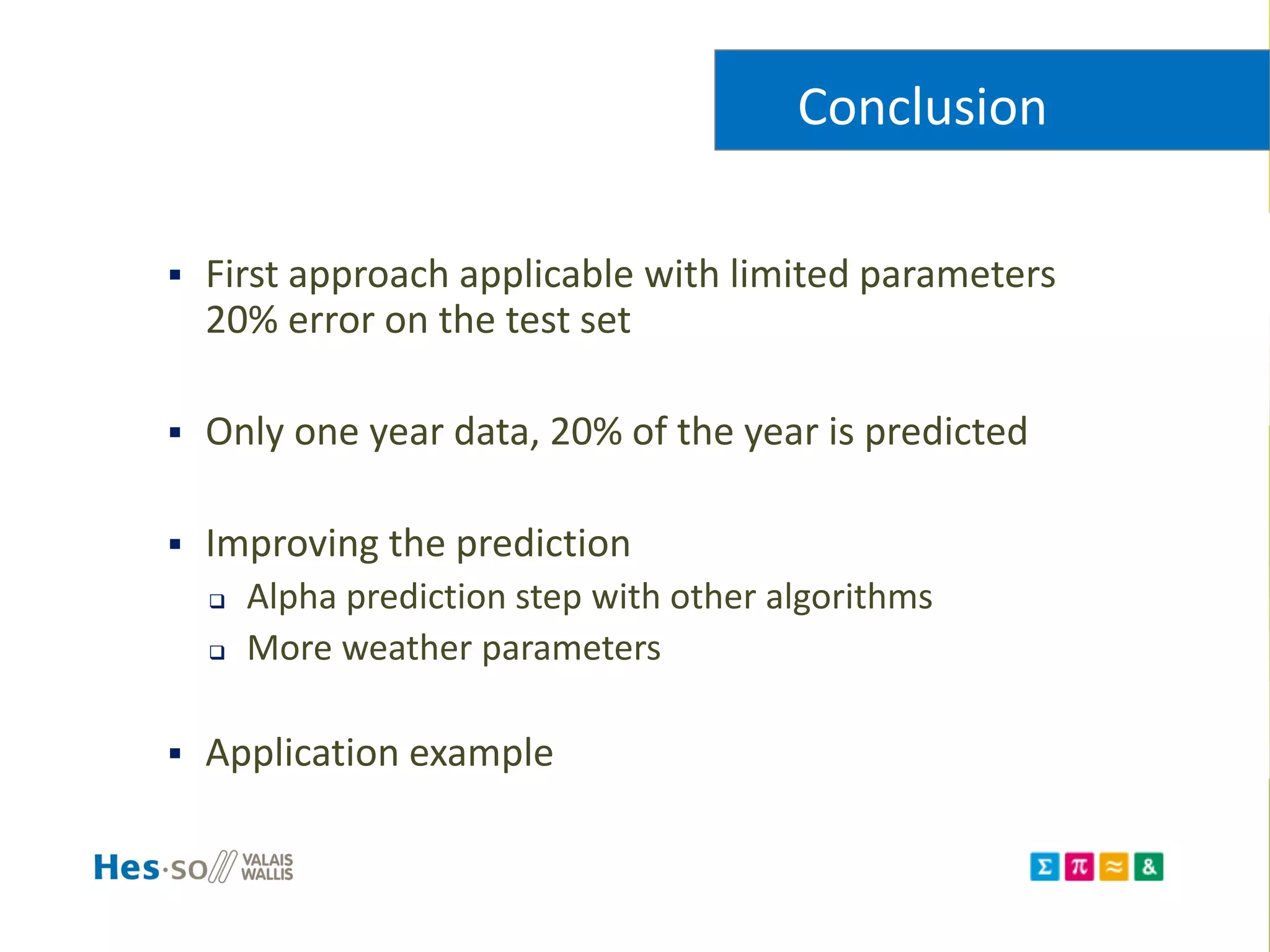
 First approach applicable with limited parameters
20% error on the test set
 Only one year data, 20% of the year is predicted
 Improving the prediction
 Alpha prediction step with other algorithms
 More weather parameters
 Application example
Conclusion
Thank you for your attention,
QUESTIONS ? ..
Authors: Mariam Barque, Luc Dufour, Dominique Genoud, Bruno Ladevie, Jean- Jacques
Bezian, Arnaud Zufferey

Solar production prediction based on non linear meteo source adaptation

  • 1.
    Solar production predictionbased on non linear meteo source adaptation Mariam Barque, IMIS 07-2015, Blumenau
  • 2.
    Content  Interest ofthe study  Aim of the study  Test bed  Methodology  Main results  Conclusion
  • 3.
     Interest ofthe study  Goal of the study  Test bed  Methodology  Main results  Conclusion Content
  • 4.
    Who wants topredict solar energy and why ? Interest of the study
  • 5.
    Content  Interest ofthe study  Aim of the study  Test bed  Methodology  Main results  Conclusion
  • 6.
    What we want A day ahead solar production prediction  Operational  Easy-understanding Aim of the study Weather information Historical production Solar production predictionPREDICTION 0 50 100 150 200 0 2 4 6 8 10 12 14 16 18 20 22 kWh Hour J+1
  • 7.
    Content  Interest ofthe study  Aim of the study  Test bed  Methodology  Main results  Conclusion
  • 8.
    Techno-Pôle of Sierre Test- bed Transformer measure Consumption measure PV Production measure Batterie 25KWh Weather station
  • 9.
    What we have Oct2013-Oct 2014 Past Weather measures Temperature Radiation PV production per second Power production (kW) Forecasted Weather measures Temperature Radiation Test - bed  One year of power production measures  Weather data for Sion (~7 km from the testbed)  Prediction for 20% of the data set (August and September)
  • 10.
    Content  Interest ofthe study  Aim of the study  Test bed  Methodology  Main results  Conclusion
  • 11.
    Electricity production mechanism Assume Methodology 𝑃𝑊 = 𝑅𝑎𝑑 × 𝛼 𝑃𝑊 𝑅𝑎𝑑 90°
  • 12.
    Global process Methodology DATA PRE- PROCESSING NIGHT/DAY SPLITTER ALPHA PREDICTION WEATHER PREDICTION CORRECTION POWER PREDICTION -Time conversion - Hourly aggregation -Alpha calculation -Based on daily sunrise and sunset data - Clustering - Decision tree 𝛼 𝑝𝑟𝑒𝑑𝑖𝑐𝑡𝑒𝑑 - Radiation re- estimation - Polynomial regression (𝑅𝑎𝑑 𝑐𝑜𝑟𝑟𝑒𝑐𝑡𝑑) - Power calculation - Day/night concatenation 𝑃𝑊𝑝𝑟𝑒𝑑𝑖𝑐𝑡𝑒𝑑 = 𝑅𝑎𝑑 𝑐𝑜𝑟𝑟𝑒𝑐𝑡 × 𝛼 𝑝𝑟𝑒𝑑𝑖𝑐𝑡 0 50 100 150 200 0 2 4 6 8 10 12 14 16 18 20 22 kWh Hour Production on 27/08/2014
  • 13.
    Alpha prediction Methodology Learning (80%of the dataset) EM Clustering Decision tree Learner Clusters T° real Hour Rad alpha T° real Hour Prediction (20% of the dataset) Decision tree Predictor Clusters predicted Alpha estimation (mean of the cluster) Alpha predicted Hour T° real Rad
  • 14.
    Clustering step  Numberof cluster optimized : 6 Methodology EM Clustering Clusters alpha T° real Hour
  • 15.
    Decision tree step Classification step  Accuracy of 88% Methodology Decision tree Learner T° real Hour Rad Decision tree Predictor Clusters predicted Hour T° real Rad Clusters
  • 16.
  • 17.
    Alpha predicted value ClusterMean 0 0.22 1 0.13 2 0.2 3 0.18 4 0.17 5 0.2 Methodology Clusters predicted Alpha estimation (mean of the cluster) Alpha predicted
  • 18.
    Global process Methodology DATA PRE- PROCESSING NIGHT/DAY SPLITTER ALPHA PREDICTION WEATHER PREDICTION CORRECTION POWER PREDICTION
  • 19.
    Weather prediction correction 0 200 400 600 800 1000 02 4 6 8 10 12 14 16 18 20 22 kW Hour Corrected Radiation on 06/07/2014 Corrected radition Predicted radiation Real radiation Methodology 𝑃𝑊𝑝𝑟𝑒𝑑𝑖𝑐𝑡𝑒𝑑 = 𝑅𝑎𝑑 𝑐𝑜𝑟𝑟𝑒𝑐𝑡𝑒𝑑 × 𝛼 𝑝𝑟𝑒𝑑𝑖𝑐𝑡𝑒𝑑 0 100 200 300 400 500 600 700 800 900 1000 06.09.2014 06.09.201406:00 06.09.201412:00 06.09.201418:00 07.09.2014 07.09.201406:00 07.09.201412:00 07.09.201418:00 08.09.2014 08.09.201406:00 08.09.201412:00 08.09.201418:00 09.09.2014 09.09.201406:00 09.09.201412:00 09.09.201418:00 10.09.2014 10.09.201406:00 10.09.201412:00 10.09.201418:00 11.09.2014 11.09.201406:00 11.09.201412:00 11.09.201418:00 W/m2 Date Sum of gre000b0 Sum of GLOB  16% to 5% of errors on the test set
  • 20.
    Global process Methodology DATA PRE- PROCESSING NIGHT/DAY SPLITTER ALPHA PREDICTION WEATHER PREDICTION CORRECTION POWER PREDICTION 𝑷𝑾 𝒑𝒓𝒆𝒅𝒊𝒄𝒕𝒆𝒅 = 𝑹𝒂𝒅 𝒄𝒐𝒓𝒓𝒆𝒄𝒕𝒆𝒅 × 𝜶 𝒑𝒓𝒆𝒅𝒊𝒄𝒕𝒆𝒅
  • 21.
    Content  Interest ofthe study  Aim of the study  Test bed  Methodology  Main results  Conclusion
  • 22.
    Results August September Average A:Full methodology 20% 21% 20% B: Perfect radiation forecast 14% 18% 16% C: Without weather prediction correction 24% 28% 26% Main results  3 Scenarios  A: Full methodology results  B: Results assuming perfect radiation forecast  C: Results without weather prediction correction 𝑃𝑊𝑝𝑟𝑒𝑑𝑖𝑐𝑡𝑒𝑑 = 𝑅𝑎𝑑 𝑟𝑒𝑎𝑙 × 𝛼 𝑝𝑟𝑒𝑑𝑖𝑐𝑡𝑒𝑑 𝑃𝑊𝑝𝑟𝑒𝑑𝑖𝑐𝑡𝑒𝑑 = 𝑅𝑎𝑑 𝑓𝑜𝑟𝑒𝑐𝑎𝑠𝑡 × 𝛼 𝑝𝑟𝑒𝑑𝑖𝑐𝑡𝑒𝑑  20% overall error  16% of error on alpha coeffiscient forecast  6% of error saved with the weather prediction correction
  • 23.
    Accurate prediction example Mainresults  Error of 5%  Shiny day  Accurate weather forecast data0 20 40 60 80 100 120 140 160 180 0 2 4 6 8 10 12 14 16 18 20 22 kW Hour 19.08.2014 Real power Predicted power
  • 24.
    High error predictionexample Main results  Error of 40%  Error due to Radiation prediction error (48%)  Highest errors occurs between 11AM to 2PM 0 50 100 150 200 250 300 350 400 450 0 2 4 6 8 10 12 14 16 18 20 22 kW Hour 20.01.2014 Real power Predicted Power Predicted radiation
  • 25.
    Content  Interest ofthe study  Aim of the study  Test bed  Methodology  Main results  Conclusion
  • 26.
     First approachapplicable with limited parameters 20% error on the test set  Only one year data, 20% of the year is predicted  Improving the prediction  Alpha prediction step with other algorithms  More weather parameters  Application example Conclusion
  • 27.
    Thank you foryour attention, QUESTIONS ? .. Authors: Mariam Barque, Luc Dufour, Dominique Genoud, Bruno Ladevie, Jean- Jacques Bezian, Arnaud Zufferey