Two Day’s NationalLevel Virtual
Conference on Recent Advances
in Technology & Engineering
(CRATE-2025)
Department of EEE
Vemu Institute of Technology
D.Balaji
Dept. of EEE
Sri Venkateshwara College of
engineering
Tirupati.
dakshirajubalaji9@gmail.com
2.
Outline of theResearch
Objective
Introduction
Methodology
System Architecture
System Implementation
Results and Discussion
Conclusion
Reference
3.
To analyse theimpact of environmental factors on solar power generation.
. Investigate how variables such as solar irradiance, temperature, humidity, wind speed, and cloud cover
influence solar energy production.
To apply machine learning techniques, specifically the Random Forest algorithm, for solar power prediction
Assess the effectiveness of the Random Forest model in capturing complex, non-linear relationships
between weather parameters and solar power output.
To pre-process and optimize historical data for accurate forecasting
. Implement data cleaning, feature engineering, and hyperparameter tuning to improve model
performance.
To evaluate the model’s performance using key statistical metrics
. Measure prediction accuracy using Mean Absolute Error (MAE), Root Mean Squared Error (RMSE), and R²
score.
To deploy the trained model for real-time solar power prediction
. Develop a scalable and automated system that integrates real-time weather data for continuous
forecasting.
1. To contribute to the advancement of renewable energy forecasting
. Provide a data-driven approach to improving solar power integration into the energy grid, enhancing
efficiency and grid stability.
Objectives
4.
Introduction
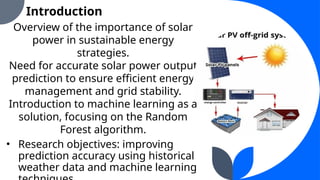
Overview of theimportance of solar
power in sustainable energy
strategies.
Need for accurate solar power output
prediction to ensure efficient energy
management and grid stability.
Introduction to machine learning as a
solution, focusing on the Random
Forest algorithm.
• Research objectives: improving
prediction accuracy using historical
weather data and machine learning
5.
Methodology
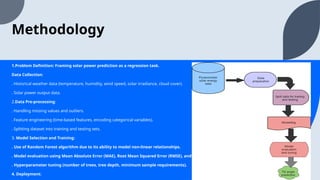
1.Problem Definition: Framingsolar power prediction as a regression task.
Data Collection:
. Historical weather data (temperature, humidity, wind speed, solar irradiance, cloud cover).
. Solar power output data.
2.Data Pre-processing:
. Handling missing values and outliers.
. Feature engineering (time-based features, encoding categorical variables).
. Splitting dataset into training and testing sets.
3. Model Selection and Training:
. Use of Random Forest algorithm due to its ability to model non-linear relationships.
. Model evaluation using Mean Absolute Error (MAE), Root Mean Squared Error (RMSE), and R² score.
. Hyperparameter tuning (number of trees, tree depth, minimum sample requirements).
4. Deployment:
6.
System Architecture
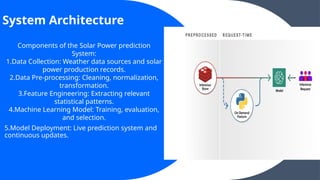
Components ofthe Solar Power prediction
System:
1.Data Collection: Weather data sources and solar
power production records.
2.Data Pre-processing: Cleaning, normalization,
transformation.
3.Feature Engineering: Extracting relevant
statistical patterns.
4.Machine Learning Model: Training, evaluation,
and selection.
5.Model Deployment: Live prediction system and
continuous updates.
7.
System implementation
Technical Overview:
.Centralized database for data storage.
. ETL (Extract, Transform, Load) pipeline for automated data
processing.
. Model development in Python with hyperparameter tuning.
. Deployment through RESTful API for real-time prediction.
Containerization and Cloud Deployment:
. Use of Docker for system consistency.
. Hosting on cloud platforms like AWS or Google Cloud.
Monitoring and Continuous Learning:
. Real-time tracking of model performance.
. Automated retraining pipeline for model updates.
User Interface:
. Dashboard for visualization and analytics.
. Reports for stakeholders.
8.
Results and Distribution
PerformanceEvaluation:
. Statistical metrics (MAE, RMSE, R² score).
. Comparison with other models like Linear Regression.
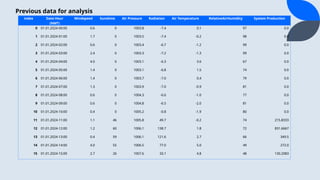
Data Analysis:
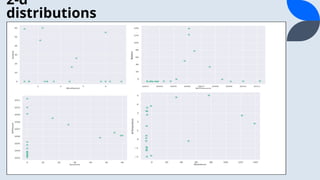
. Weather parameters vs. solar power production correlation.
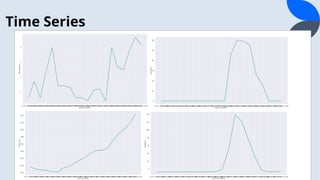
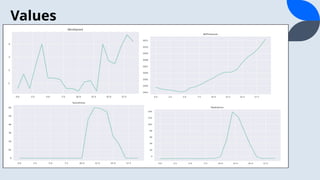
. Time-series analysis and 2D distributions.
Findings:
. Effectiveness of Random Forest in improving prediction accuracy.
. Limitations and potential improvements.
Conclusion
The implementation ofa system to predict solar power
output using the Random Forest algorithm demonstrates
a comprehensive and sophisticated approach to
harnessing machine learning for renewable energy
forecasting. This process begins with meticulous data
collection and pre-processing, where weather data is
transformed into a format suitable for model training,
ensuring that the model captures the nuanced
relationships between weather conditions and solar
power generation. By leveraging the Random Forest
algorithm, known for its ability to model complex, non-
linear relationships, the system achieves high accuracy in
predicting solar power output, which is further enhanced
through hyperparameter tuning and the continuous
retraining of the model with new data.
15.
Reference
Elsaraiti, M., &Merabet, A. (2022). Solar power forecasting using deep learning techniques. IEEE access.
Kim, S. G., Jung, J. Y., & Sim, M. K. (2019). A two-step approach to solar power generation prediction based on
weather data using machine learning. Sustainability.
Lee, C. H., Yang, H. C., & Ye, G. B. (2021). Predicting the performance of solar power generation using deep
learning methods. Applied Sciences.
Sedai, A., Dhakal, R., Gautam, S., Dhamala, A., Bilbao, A., Wang, Q., … & Pol, S. (2023). Performance analysis of
statistical, machine learning and deep learning models in long-term forecasting of solar power production.
Forecasting.
Chang, R., Bai, L., & Hsu, C. H. (2021). Solar power generation prediction based on deep learning. Sustainable
energy technologies and assessments.
AlKandari, M., & Ahmad, I. (2024). Solar power generation forecasting using ensemble approach based on
deep learning and statistical methods. Applied Computing and Informatics.
Anuradha, K., Erlapally, D., Karuna, G., Srilakshmi, V., & Adilakshmi, K. (2021). Analysis of solar power
generation forecasting using machine learning techniques.
Phan, Q. T., Wu, Y. K., Phan, Q. D., & Lo, H. Y. (2022). A novel forecasting model for solar power generation by a
deep learning framework with data preprocessing and postprocessing. IEEE Transactions on Industry