SOIL PROPERTIES
OBJECTIVES
 Describe soil by physical, chemical, and
biological properties of the soil.
 Distinguish among physical, chemical,
and biological properties of the soil.
 Distinguish between homogenous and
heterogeneous mixtures in soil.
Objective 1: TERMS TO KNOW:
 Clay- The smallest soil particle
 Sand - The largest soil particle
 Silt - An intermediate sized soil particle
 Structure - The way individual soil
particles are grouped together
 Texture - A physical property of the soil
referring to the relative percentages of
sand, silt, and clay
Objective 1: TERMS TO KNOW: (Cont’d)
 Topsoil - The upper part of the soil profile that is
normally cultivated
 Subsoil - the area in the soil profile below the
topsoil which accumulates clay
 Subsoiling - A method of breaking up the compacted
layers of the soil that restrict air and water movement
and root growth using farm machinery
 Tillage pan - areas of compacted soil in the plant root
zone created by repeated plowing of heavy soils
especially when wet; also called a plow pan
 Mottling - Spots of color in the soil that indicates
internal drainage and aeration
Texture
 physical property of soil considered rather
permanent
 refers to the relative percentages of the
three types of soil particles
 Sand
 Silt
 Clay
Determining Soil Texture
 Sensing the feel
 It is the varying amount of each soil particle
type that gives soil its texture or feel.
 Mechanical analysis
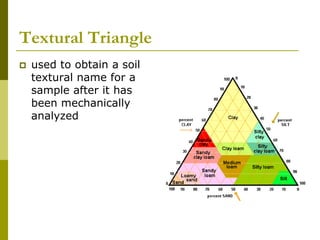
Textural Triangle
 used to obtain a soil
textural name for a
sample after it has
been mechanically
analyzed
Light Soils vs Heavy Soils
 Light Soils - sandy or coarse texture
 Heavy Soils - clay or fine texture
 Loamy Soils - medium textured
 more desirable characteristics usually
associated with highly productive soils that are
easier to manage
Light Soils vs Heavy Soils
When comparing light soils to heavy soils,
the light soil will:
 require less energy to cultivate
 heat and cool faster
 usually lighter in color
 wet and dry faster
 usually subject to greater erosion
 usually lower in fertility
Four Main Types of Soil Structure
 Platy - thin horizontal sheets overlapping
each other
 Prismatic - long vertical columns without
rounded tops
 Block-like - irregular shaped cubes
 Spheroidal - rounded and often referred
to as granular or crumb; usually found in
the topsoil
Two Types of Structureless Soils
 Single grained soils like sand
 Solid massive condition with no noticeable
peds
Internal Soil Drainage
 important for proper plant growth
 Permeability can be determined by the color of
the subsoil.
 Grey with some red or yellow streaks -
poorly drained soils
 Yellowish-brown or reddish brown with
some grey mottling - as internal drainage
improves
 Uniform bright color with few or no grey
streaks or mottling – good internal drainage
and aeration
Objective 2: TERMS TO KNOW:
 Infiltration - The movement of water
into the soil
 Percolation - The movement of water
through the soil
 No-till planting - The planting of a crop
into the previous crop stubble or a
cover crop, disturbing only the
immediate seed zone
Objective 2: TERMS TO KNOW: (Cont’d)
 Reduced-tillage - The elimination of one
or more operational procedures from a
conventional system of working the
soil
 Permeability - the characteristics of a
soil which permits variations in the
speed of air and water movement
Soil Types Influence Crop Selection
 Light textured soil
 Oats
 peanuts
 beets
 Loamy textured soil
 majority of Louisiana crops grow best in a loamy
textured soil.
 Heavy textured soil
 Flooded rice
 requires a heavy fine textured soil to prevent loss of
surface water
 Sugarcane
Determination of Soil Structure
 determined by the way the particles of
sand, silt, and clay are grouped together
in aggregates
 Peds - naturally formed groups of soil
particles
 Clods - are artificially formed groups of
soil particles
Structured Soil
more desirable because it:
 is easier to cultivate
 allows more water intake
 does not restrict root growth
 encourages better drainage within pore
spaces
 allows entry of oxygen into the pore
spaces after the water has drained
 facilitates organic matter decomposition
and the release of plant nutrients
Destruction of Soil Structure
Soil structure can be destroyed by:
 working the soil when it is wet
 repeated movement of equipment or livestock
 repeated use of equipment at the same depth in
the soil
 continual flooding of the soil
Improving Soil Structure
 Leaving it alone, in time it will repair itself
 Planting a green manure crop
 Incorporating plant residue into the soil
Infiltration and Percolation Rates
 Rapid - spheroidal structure and single
grained structure less soils
 Moderate - blocky and prismatic
structure
 Slow - platy structure or massive
structure less soil
Tillage Pans and Traffic Pans
 Tillage pans - areas of compacted soil in
the plant root zone caused by repeated
plowing at the same depth.
 Tillage and traffic pans are serious
problems in many parts of the country
because the area of root restriction is
generally in the topsoil.
 reduces the movement of air, water, and roots
and therefore limits crop yields.
Fragipans
 Fragipans (silt pans) and clay pans can
occur naturally in or near the subsoil. A
fragipan is the result of too much silt in or
near the B horizon, and is not the result of
mans actions.
Alleviating Traffic or Tillage Pans
 Subsoiling breaks up or shatters
compacted layers using deep plowing
equipment.
 Reduced or minimum tillage means less
movement over the soil which results in
less compaction of the soil. Deep
Subsoiling should precede reduced or
minimum till operations.
 No till reduces the formation of traffic
pans because planting is done directly in
the stubble of the previous crop.
Biological Properties of Soil
 refers to the living organisms found in
the soil
 includes both the micro and macro plants
and animals.
Plants
 Micro
 Bacteria
 Fungi
 Actinomycetes
 Macro – roots of higher plants
Biological Properties of Soil
Animals
 Micro
 Nematodes
 Protozoa
 Macro
 Earthworms
 Rodents (prairie dogs, moles, gophers, etc.)
 Arthropods (mites, insects, spiders, etc.)
 Gastropods (slugs, snails, etc.)
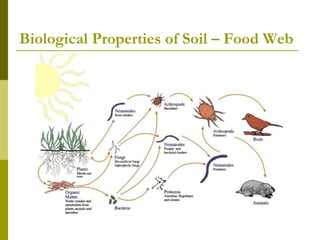
Biological Properties of Soil – Food Web
Chemical Properties of Soil
The ability of soil to provide the essential
elements needed for plant growth
includes:
 the availability of these elements
 other chemical properties
 clay minerals present
 humus content
 cation exchange
 soil reaction (pH).
Objective 3: TERMS TO KNOW:
 Homogenous mixtures – soil mixtures that
contain the same type of soil particles
 Heterogeneous mixtures – soil mixtures that
contain different types of soil particles
 Aerobic – occurring only in the presence of free
oxygen
 Algae – soil plant microorganisms capable of
photosynthesis
 Anaerobic – growing or occurring in the
absence of free oxygen
Objective 3: TERMS TO KNOW: (cont’d)
 Bacteria – single-celled soil plant
microorganisms, some of which are responsible
for organic matter decomposition, while others
are responsible for nitrogen fixation
 Fungi – soil plant microorganisms responsible for
organic matter decomposition, especially the
cellulose, lignin and gum
 Microorganisms – life forms too small to be
seen with the unaided eye or barely visible
 Nematodes - soil animal microorganisms that
are responsible for the decomposition of organic
mater, consumption of other animal
microorganisms and parasitism on the roots of
certain higher plants
Objective 3: TERMS TO KNOW: (cont’d)
 Nitrogen cycle – the biochemical changes undergone by
this atmospheric gas from its use by living organisms to
decomposition and conversion back to the atmosphere
 Organic matter – soil materials including plant and animal
residues at various stages of decomposition
 Rodents – small gnawing animals such as rats and mice
 Acid soil – one having a pH below 7.0 on a scale from 0 to
14
 Alkaline soil – one having a pH below 7.0 on a scale from
0 to 14
 Ion – charged atoms or groups of charged atoms
 pH – a numerical measure of the degree of acidity or
alkalinity of the soil solution
Homogenous Soil Mixtures
 Sand
 Silt
 Clay
Heterogeneous Soil Mixtures
 Any combination and proportion of
sand, silt, or clay

SoilProperties.ppt

  • 1.
  • 2.
    OBJECTIVES  Describe soilby physical, chemical, and biological properties of the soil.  Distinguish among physical, chemical, and biological properties of the soil.  Distinguish between homogenous and heterogeneous mixtures in soil.
  • 3.
    Objective 1: TERMSTO KNOW:  Clay- The smallest soil particle  Sand - The largest soil particle  Silt - An intermediate sized soil particle  Structure - The way individual soil particles are grouped together  Texture - A physical property of the soil referring to the relative percentages of sand, silt, and clay
  • 4.
    Objective 1: TERMSTO KNOW: (Cont’d)  Topsoil - The upper part of the soil profile that is normally cultivated  Subsoil - the area in the soil profile below the topsoil which accumulates clay  Subsoiling - A method of breaking up the compacted layers of the soil that restrict air and water movement and root growth using farm machinery  Tillage pan - areas of compacted soil in the plant root zone created by repeated plowing of heavy soils especially when wet; also called a plow pan  Mottling - Spots of color in the soil that indicates internal drainage and aeration
  • 5.
    Texture  physical propertyof soil considered rather permanent  refers to the relative percentages of the three types of soil particles  Sand  Silt  Clay
  • 6.
    Determining Soil Texture Sensing the feel  It is the varying amount of each soil particle type that gives soil its texture or feel.  Mechanical analysis
  • 7.
    Textural Triangle  usedto obtain a soil textural name for a sample after it has been mechanically analyzed
  • 8.
    Light Soils vsHeavy Soils  Light Soils - sandy or coarse texture  Heavy Soils - clay or fine texture  Loamy Soils - medium textured  more desirable characteristics usually associated with highly productive soils that are easier to manage
  • 9.
    Light Soils vsHeavy Soils When comparing light soils to heavy soils, the light soil will:  require less energy to cultivate  heat and cool faster  usually lighter in color  wet and dry faster  usually subject to greater erosion  usually lower in fertility
  • 10.
    Four Main Typesof Soil Structure  Platy - thin horizontal sheets overlapping each other  Prismatic - long vertical columns without rounded tops  Block-like - irregular shaped cubes  Spheroidal - rounded and often referred to as granular or crumb; usually found in the topsoil
  • 11.
    Two Types ofStructureless Soils  Single grained soils like sand  Solid massive condition with no noticeable peds
  • 12.
    Internal Soil Drainage important for proper plant growth  Permeability can be determined by the color of the subsoil.  Grey with some red or yellow streaks - poorly drained soils  Yellowish-brown or reddish brown with some grey mottling - as internal drainage improves  Uniform bright color with few or no grey streaks or mottling – good internal drainage and aeration
  • 13.
    Objective 2: TERMSTO KNOW:  Infiltration - The movement of water into the soil  Percolation - The movement of water through the soil  No-till planting - The planting of a crop into the previous crop stubble or a cover crop, disturbing only the immediate seed zone
  • 14.
    Objective 2: TERMSTO KNOW: (Cont’d)  Reduced-tillage - The elimination of one or more operational procedures from a conventional system of working the soil  Permeability - the characteristics of a soil which permits variations in the speed of air and water movement
  • 15.
    Soil Types InfluenceCrop Selection  Light textured soil  Oats  peanuts  beets  Loamy textured soil  majority of Louisiana crops grow best in a loamy textured soil.  Heavy textured soil  Flooded rice  requires a heavy fine textured soil to prevent loss of surface water  Sugarcane
  • 16.
    Determination of SoilStructure  determined by the way the particles of sand, silt, and clay are grouped together in aggregates  Peds - naturally formed groups of soil particles  Clods - are artificially formed groups of soil particles
  • 17.
    Structured Soil more desirablebecause it:  is easier to cultivate  allows more water intake  does not restrict root growth  encourages better drainage within pore spaces  allows entry of oxygen into the pore spaces after the water has drained  facilitates organic matter decomposition and the release of plant nutrients
  • 18.
    Destruction of SoilStructure Soil structure can be destroyed by:  working the soil when it is wet  repeated movement of equipment or livestock  repeated use of equipment at the same depth in the soil  continual flooding of the soil
  • 19.
    Improving Soil Structure Leaving it alone, in time it will repair itself  Planting a green manure crop  Incorporating plant residue into the soil
  • 20.
    Infiltration and PercolationRates  Rapid - spheroidal structure and single grained structure less soils  Moderate - blocky and prismatic structure  Slow - platy structure or massive structure less soil
  • 21.
    Tillage Pans andTraffic Pans  Tillage pans - areas of compacted soil in the plant root zone caused by repeated plowing at the same depth.  Tillage and traffic pans are serious problems in many parts of the country because the area of root restriction is generally in the topsoil.  reduces the movement of air, water, and roots and therefore limits crop yields.
  • 22.
    Fragipans  Fragipans (siltpans) and clay pans can occur naturally in or near the subsoil. A fragipan is the result of too much silt in or near the B horizon, and is not the result of mans actions.
  • 23.
    Alleviating Traffic orTillage Pans  Subsoiling breaks up or shatters compacted layers using deep plowing equipment.  Reduced or minimum tillage means less movement over the soil which results in less compaction of the soil. Deep Subsoiling should precede reduced or minimum till operations.  No till reduces the formation of traffic pans because planting is done directly in the stubble of the previous crop.
  • 24.
    Biological Properties ofSoil  refers to the living organisms found in the soil  includes both the micro and macro plants and animals. Plants  Micro  Bacteria  Fungi  Actinomycetes  Macro – roots of higher plants
  • 25.
    Biological Properties ofSoil Animals  Micro  Nematodes  Protozoa  Macro  Earthworms  Rodents (prairie dogs, moles, gophers, etc.)  Arthropods (mites, insects, spiders, etc.)  Gastropods (slugs, snails, etc.)
  • 26.
    Biological Properties ofSoil – Food Web
  • 27.
    Chemical Properties ofSoil The ability of soil to provide the essential elements needed for plant growth includes:  the availability of these elements  other chemical properties  clay minerals present  humus content  cation exchange  soil reaction (pH).
  • 28.
    Objective 3: TERMSTO KNOW:  Homogenous mixtures – soil mixtures that contain the same type of soil particles  Heterogeneous mixtures – soil mixtures that contain different types of soil particles  Aerobic – occurring only in the presence of free oxygen  Algae – soil plant microorganisms capable of photosynthesis  Anaerobic – growing or occurring in the absence of free oxygen
  • 29.
    Objective 3: TERMSTO KNOW: (cont’d)  Bacteria – single-celled soil plant microorganisms, some of which are responsible for organic matter decomposition, while others are responsible for nitrogen fixation  Fungi – soil plant microorganisms responsible for organic matter decomposition, especially the cellulose, lignin and gum  Microorganisms – life forms too small to be seen with the unaided eye or barely visible  Nematodes - soil animal microorganisms that are responsible for the decomposition of organic mater, consumption of other animal microorganisms and parasitism on the roots of certain higher plants
  • 30.
    Objective 3: TERMSTO KNOW: (cont’d)  Nitrogen cycle – the biochemical changes undergone by this atmospheric gas from its use by living organisms to decomposition and conversion back to the atmosphere  Organic matter – soil materials including plant and animal residues at various stages of decomposition  Rodents – small gnawing animals such as rats and mice  Acid soil – one having a pH below 7.0 on a scale from 0 to 14  Alkaline soil – one having a pH below 7.0 on a scale from 0 to 14  Ion – charged atoms or groups of charged atoms  pH – a numerical measure of the degree of acidity or alkalinity of the soil solution
  • 31.
    Homogenous Soil Mixtures Sand  Silt  Clay
  • 32.
    Heterogeneous Soil Mixtures Any combination and proportion of sand, silt, or clay