Chinese
Food
By : Ahmed shrshr
The 8 Great Cuisines of China
Shandong Cuisine: fresh and salty with a lot of seafood dishes.
Sichuan and Hunan cuisines: hot spice.
Guangdong (Cantonese), Zhejiang, Jiangsu cuisines: great seafood, and generally sweet
and light flavors.
Anhui and Fujian cuisines: inclusion of wild foods from their mountains.
1. Guangdong/Cantonese Cuisine
Chinese: 粤菜 Yuècài
Sweeter, favoring braising and stewing, adding various
mild sauces
Cantonese food is the most popular style
internationally. Guangdong Province and Hong Kong
are noted for fine seafood dishes and rice dishes.
They eat a very wide variety of foods. The dishes they
serve don't have strong flavors since it is lightly
seasoned, and they often tend to be a little sweet.
Chinese: 川菜 Chuāncài
Spicy and bold, often mouth-numbing, using lots of chili, garlic, ginger, and
peanuts
Sichuan Province produced the most widely served cuisine in China. Their
dishes are famous for their hot-spicy taste and the numbing flavor of
Sichuan peppercorn that is rare in other regional cuisines. It is the food of
Chengdu and Chongqing (which used to be part of Sichuan).
2. sichuan cuisine
3. Jiangsu Cuisine
Chinese: 苏菜 Sūcài
Fresh, moderately salty and sweet, precise cooking techniques,
favoring seafood, soups and artistic, colorful presentation
Jiangsu Province and China's biggest city, Shanghai, have a very
refined gourmet cuisine that is often served at government banquets.
What makes it special is the exquisite cooking techniques that
produce richly aromatic and visually artistic dishes. Their chefs also
focus on serving meals that promote health.
4. Zhejiang Cuisine
Chinese: 浙菜 Zhècài
Mellow, using fresh seafood, freshwater fish, and bamboo shoots, and a
wide variety of cooking methods.
Zhejiang Province is the province south of Jiangsu, and it borders on
Shanghai too, so their style is similar to theirs, but it is less elaborately
prepared. They focus more on serving fresh food.
The food is often served raw or almost raw and is fresh and crispy and
seasonal. It is more like Japanese food. Ningbo cuisine is very salty
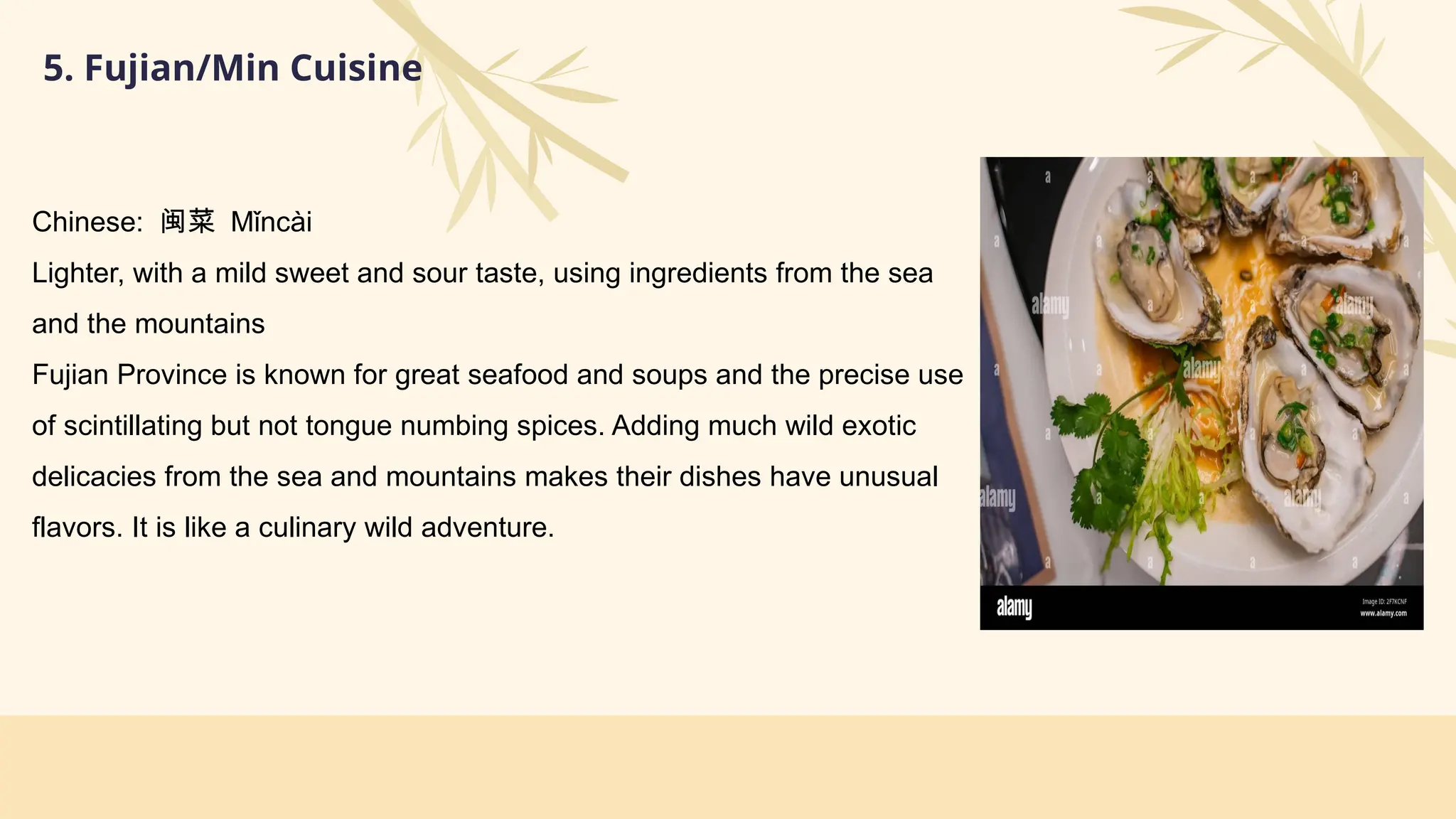
5. Fujian/Min Cuisine
Chinese: 闽菜 Mǐncài
Lighter, with a mild sweet and sour taste, using ingredients from the sea
and the mountains
Fujian Province is known for great seafood and soups and the precise use
of scintillating but not tongue numbing spices. Adding much wild exotic
delicacies from the sea and mountains makes their dishes have unusual
flavors. It is like a culinary wild adventure.
6. Hunan Cuisine
Chinese: 湘菜 Xiāngcài
Quite spicy, with a hot and sour taste, favoring sautéing, stir-frying,
steaming and smoking
If you like Sichuan food, you'll probably like Hunan food too since it
is even hotter. It is tastier and more delicious because they don't use
peppercorn that numbs the mouth.
It is a rich agricultural area that produces a broad range of
vegetables and herbs, and these are served up.
7. Anhui Cuisine
Chinese: 徽菜 Huīcài
Uses many wild plants and animals as ingredients,
favoring stewing and more oil
Anhui cuisine is even wilder than Fujian cuisine. It is
inland, and big mountains such as the Yellow Mountains
are the source of lots of different wild foods and herbs. It
is basically a hearty mountain peasant food. Some of the
best dishes incorporate wild food for an unusual taste.
Some dishes are sweet from added sugar.
8. Shandong Cuisine
Chinese: 鲁菜 L cài
ǔ
Salty and crispy, favoring braising and seafood
Shandong was one of the first civilized areas, and it set the pattern for northern styles of
cooking. With a long coast, seafood is its forte.
They preserve the original taste of the seafood by using simple ingredients and braising,
and they like vinegar and salt. Unlike southern cuisines, they serve much more wheat
food, including their noodles.
中国菜很好吃 😋
Thanks !

chinese food.................... ppt.pptx

  • 1.
  • 2.
    The 8 GreatCuisines of China Shandong Cuisine: fresh and salty with a lot of seafood dishes. Sichuan and Hunan cuisines: hot spice. Guangdong (Cantonese), Zhejiang, Jiangsu cuisines: great seafood, and generally sweet and light flavors. Anhui and Fujian cuisines: inclusion of wild foods from their mountains.
  • 3.
    1. Guangdong/Cantonese Cuisine Chinese:粤菜 Yuècài Sweeter, favoring braising and stewing, adding various mild sauces Cantonese food is the most popular style internationally. Guangdong Province and Hong Kong are noted for fine seafood dishes and rice dishes. They eat a very wide variety of foods. The dishes they serve don't have strong flavors since it is lightly seasoned, and they often tend to be a little sweet.
  • 4.
    Chinese: 川菜 Chuāncài Spicyand bold, often mouth-numbing, using lots of chili, garlic, ginger, and peanuts Sichuan Province produced the most widely served cuisine in China. Their dishes are famous for their hot-spicy taste and the numbing flavor of Sichuan peppercorn that is rare in other regional cuisines. It is the food of Chengdu and Chongqing (which used to be part of Sichuan). 2. sichuan cuisine
  • 5.
    3. Jiangsu Cuisine Chinese:苏菜 Sūcài Fresh, moderately salty and sweet, precise cooking techniques, favoring seafood, soups and artistic, colorful presentation Jiangsu Province and China's biggest city, Shanghai, have a very refined gourmet cuisine that is often served at government banquets. What makes it special is the exquisite cooking techniques that produce richly aromatic and visually artistic dishes. Their chefs also focus on serving meals that promote health.
  • 6.
    4. Zhejiang Cuisine Chinese:浙菜 Zhècài Mellow, using fresh seafood, freshwater fish, and bamboo shoots, and a wide variety of cooking methods. Zhejiang Province is the province south of Jiangsu, and it borders on Shanghai too, so their style is similar to theirs, but it is less elaborately prepared. They focus more on serving fresh food. The food is often served raw or almost raw and is fresh and crispy and seasonal. It is more like Japanese food. Ningbo cuisine is very salty
  • 7.
    5. Fujian/Min Cuisine Chinese:闽菜 Mǐncài Lighter, with a mild sweet and sour taste, using ingredients from the sea and the mountains Fujian Province is known for great seafood and soups and the precise use of scintillating but not tongue numbing spices. Adding much wild exotic delicacies from the sea and mountains makes their dishes have unusual flavors. It is like a culinary wild adventure.
  • 8.
    6. Hunan Cuisine Chinese:湘菜 Xiāngcài Quite spicy, with a hot and sour taste, favoring sautéing, stir-frying, steaming and smoking If you like Sichuan food, you'll probably like Hunan food too since it is even hotter. It is tastier and more delicious because they don't use peppercorn that numbs the mouth. It is a rich agricultural area that produces a broad range of vegetables and herbs, and these are served up.
  • 9.
    7. Anhui Cuisine Chinese:徽菜 Huīcài Uses many wild plants and animals as ingredients, favoring stewing and more oil Anhui cuisine is even wilder than Fujian cuisine. It is inland, and big mountains such as the Yellow Mountains are the source of lots of different wild foods and herbs. It is basically a hearty mountain peasant food. Some of the best dishes incorporate wild food for an unusual taste. Some dishes are sweet from added sugar.
  • 10.
    8. Shandong Cuisine Chinese:鲁菜 L cài ǔ Salty and crispy, favoring braising and seafood Shandong was one of the first civilized areas, and it set the pattern for northern styles of cooking. With a long coast, seafood is its forte. They preserve the original taste of the seafood by using simple ingredients and braising, and they like vinegar and salt. Unlike southern cuisines, they serve much more wheat food, including their noodles.
  • 11.
  • 12.