SOFTWARE TECHNICAL
REVIEWS
AWAIS KHAN 19011598-008
MUHAMMAD HAMMAD 19011598-026
AN INDUSTRIAL-STRENGTH INSPECTION
PROCESS
AN INDUSTRIAL-STRENGTH INSPECTION
PROCESS
• Describes a process for technical reviews that gradually evolved
over a period of 12 years in a research and development
• The developing organization had to produce nearly fault free
systems as a matter of economic necessity
• Necessity is the mother of invention
AN INDUSTRIAL-STRENGTH INSPECTION
PROCESS
AN INDUSTRIAL-STRENGTH INSPECTION
PROCESS
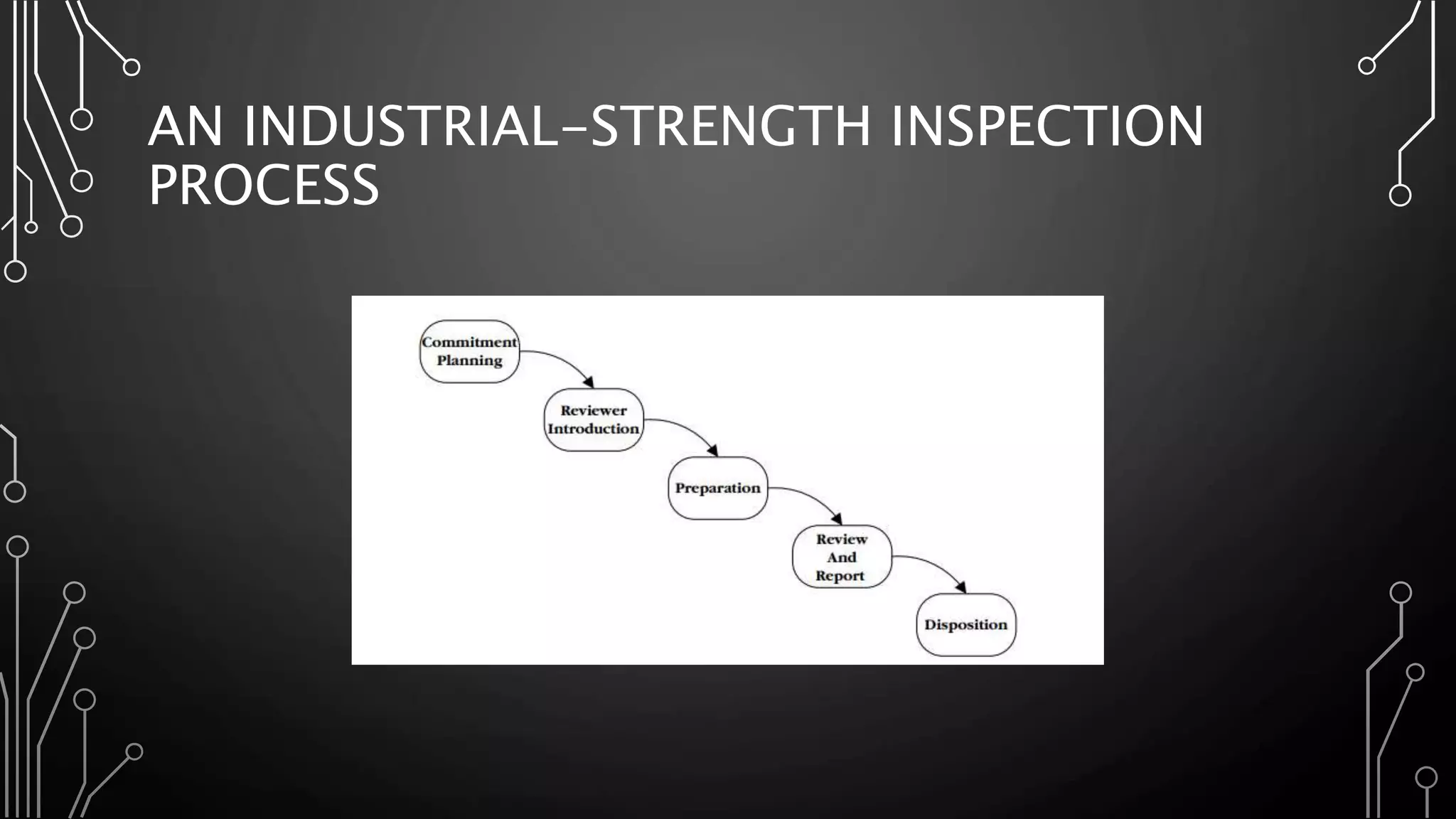
• It happens to resemble common depictions of the Waterfall
lifecycle mode, but there are several important differences.
• The sequence of stages is important, and deviations from the
sequence simply do not work.
COMMITMENT PLANNING
• The technical inspection process begins with a meeting between the producer of the
work product and his/her supervisor.
• The producer may wish to “stack the deck” with close friends
• Once the review team is identified, the supervisor completes any necessary
administrative approval.
• The supervisor should have a commitment meeting, with other supervisors if
necessary, to obtain commitments for all review team members.
• Any task approvals are communicated at this meeting.
• The results are given to the review leader.
REVIEWER INTRODUCTION
• The review leader assembles the team for a brief meeting.
• The producer prepares the full review packet and freezes the work
product to be examined.
• The review leader delivers the review packet and gives a brief
overview of the work product.
• The team should decide whether or not the review packet is
complete.
• The meeting ends with all team members either committing to the
process or possibly disqualifying themselves.
PREPARATION
• The review team members have approved preparation time
• The preparation interval for a review of normal duration (60 to 90
minutes) should be five full working days, in which up to eight hours
of preparation time can be used by each review team member.
• Reviewers examine the work product with respect to the review
checklist and their own expertise.
• Reviewers should describe the issue, provide a short explanation or
description, and then make a severity assessment.
REVIEW MEETING
• The actual review meeting should be conducted as an effective
business meeting.
• Some steps in the review process
 The review team was carefully selected, so the right people will be in
the meeting.
 The agenda is based on the prioritized list of issues, so there should
not be a sense that the meeting is a waste of time.
 The process calls for budgeted preparation time in which issues are
identified before the meeting.
REPORT PREPARATION
• The review leader is primarily responsible for writing the review
report
• The report is a technical recommendation to management, and
it ends the technical responsibility.
• The review report and all other materials should be open to the
entire organization, as this enhances accountability
DISPOSITION
• Once the producer’s supervisor receives the report, it becomes
the basis of a management decision.
• Assuming the recommendation is to accept the work product, it
becomes subject to the configuration management function,
and the work product is no longer a Design Object, it is a
Configuration Item
• Once all action items are resolved, the supervisor either closes
the review or starts a re-review process.
EFFECTIVE REVIEW CULTURE
• Reviews can be quite stressful, and this also requires social
considerations.
• Reviews are a group activity, so group size becomes a question.
• Reviews must be seen as valuable activities by both management and
technical people.
• Part of an effective corporate culture is that reviews must be seen as
valuable activities by both management and technical people.
• Most review meetings should be in the 60 to 90 minute range.
• The best time to have a review meeting?
ETIQUETTE
• To reduce the stress that can accompany a review, the
following points of review etiquette should be observed.
1. Be prepared. Otherwise, the review effectiveness will be
diminished. In a sense an unprepared team member is
disrespecting the rest of the review team.
2. Be respectful. Review the product, not the producer.
3. Avoid discussions of style.
4. Provide minor comments to the producer at the end of the
meeting.
ETIQUETTE
5. Be constructive. Reviews are not the place for personal
criticism, nor for praise.
6. Remain focused. Identify issues, do not try to resolve them.
7. Participate, but do not dominate the discussion.
8. Be open. All review information should be widely available to
the full organization
MANAGEMENT PARTICIPATION IN REVIEW
MEETINGS
• Many organizations struggle with the question of management
participation in reviews.
• Management presence in a review easily creates additional stress on
all team members, but in particular, on the producer.
• If management participation is common, the whole process can easily
degenerate into unspoken agreements among the technical staff
• To be fair, there are managers who are technically competent, and
they can be disciplined enough to respect the process
A TALE OF TWO REVIEWS
• A Pointy-Haired Supervisor Review
• An Ideal Review
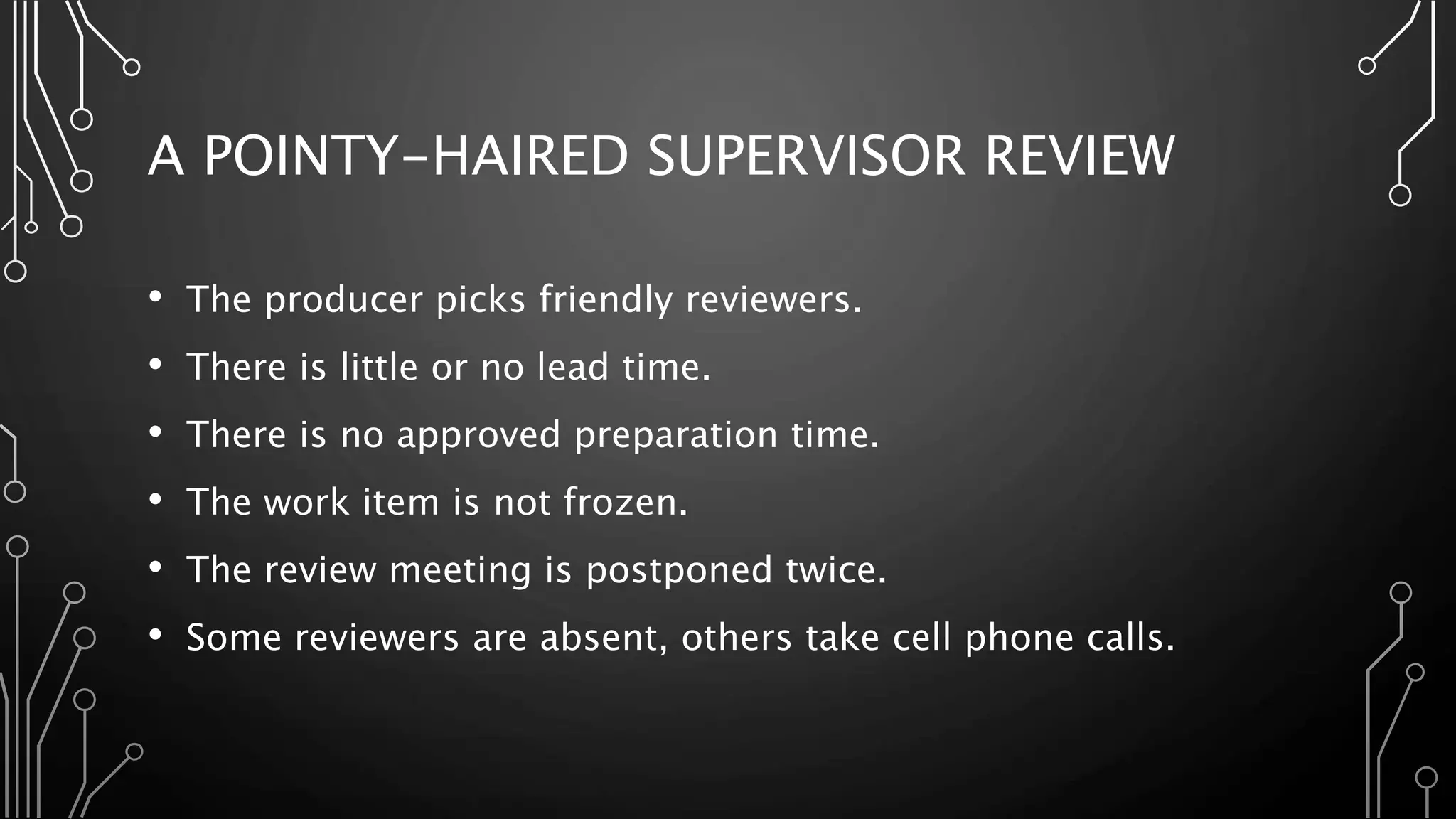
A POINTY-HAIRED SUPERVISOR REVIEW
• The producer picks friendly reviewers.
• There is little or no lead time.
• There is no approved preparation time.
• The work item is not frozen.
• The review meeting is postponed twice.
• Some reviewers are absent, others take cell phone calls.
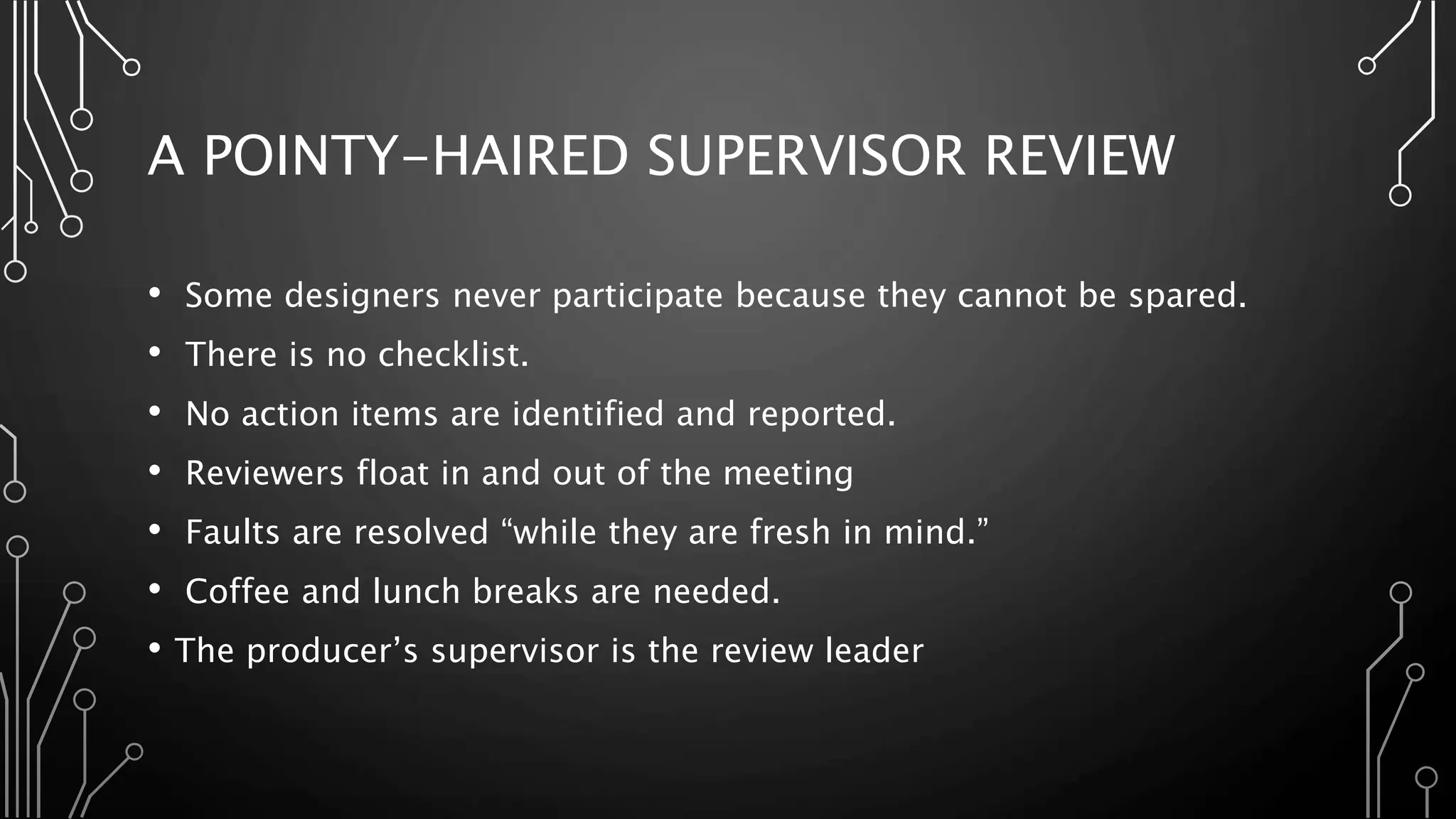
A POINTY-HAIRED SUPERVISOR REVIEW
• Some designers never participate because they cannot be spared.
• There is no checklist.
• No action items are identified and reported.
• Reviewers float in and out of the meeting
• Faults are resolved “while they are fresh in mind.”
• Coffee and lunch breaks are needed.
• The producer’s supervisor is the review leader
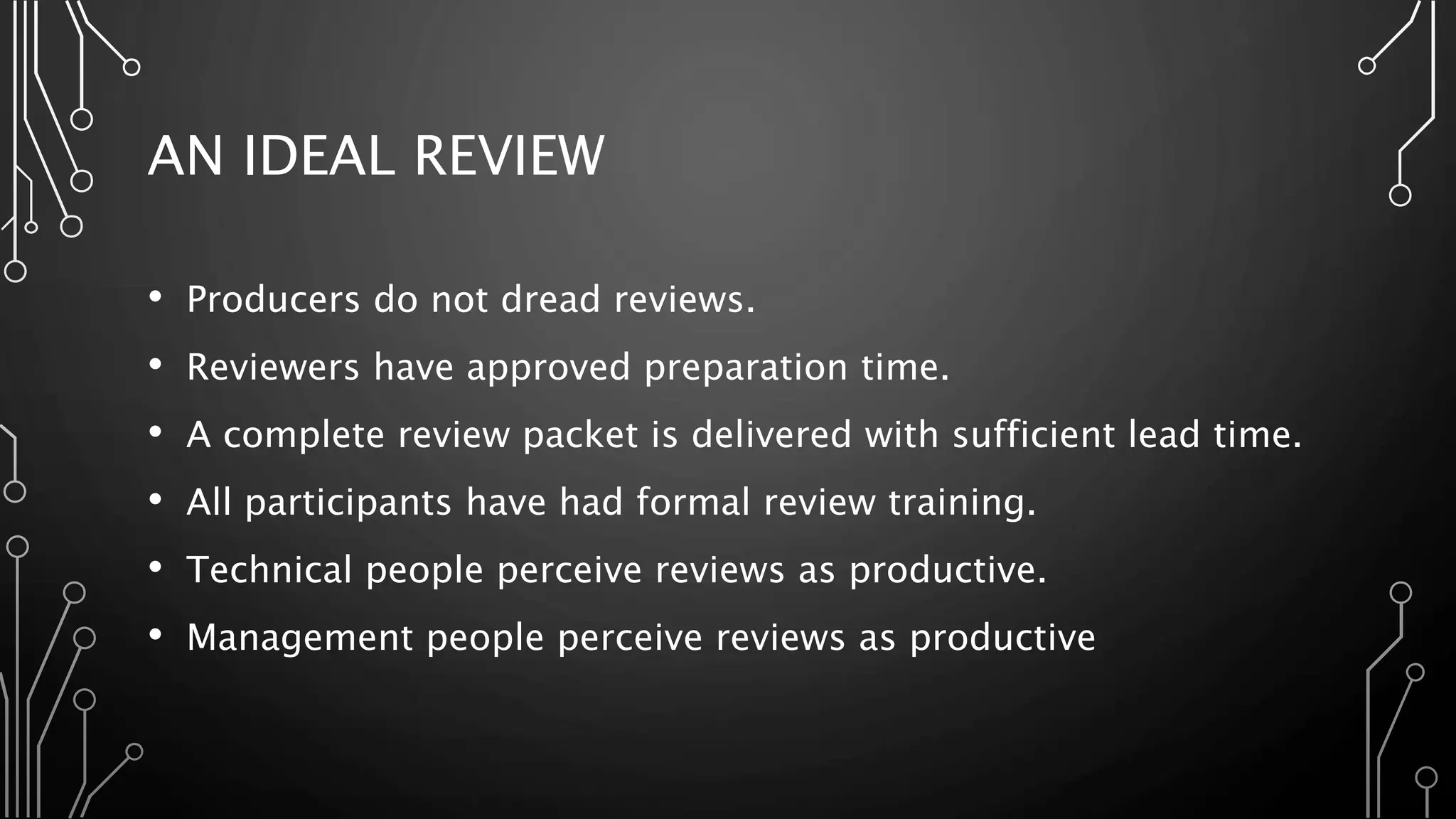
AN IDEAL REVIEW
• Producers do not dread reviews.
• Reviewers have approved preparation time.
• A complete review packet is delivered with sufficient lead time.
• All participants have had formal review training.
• Technical people perceive reviews as productive.
• Management people perceive reviews as productive
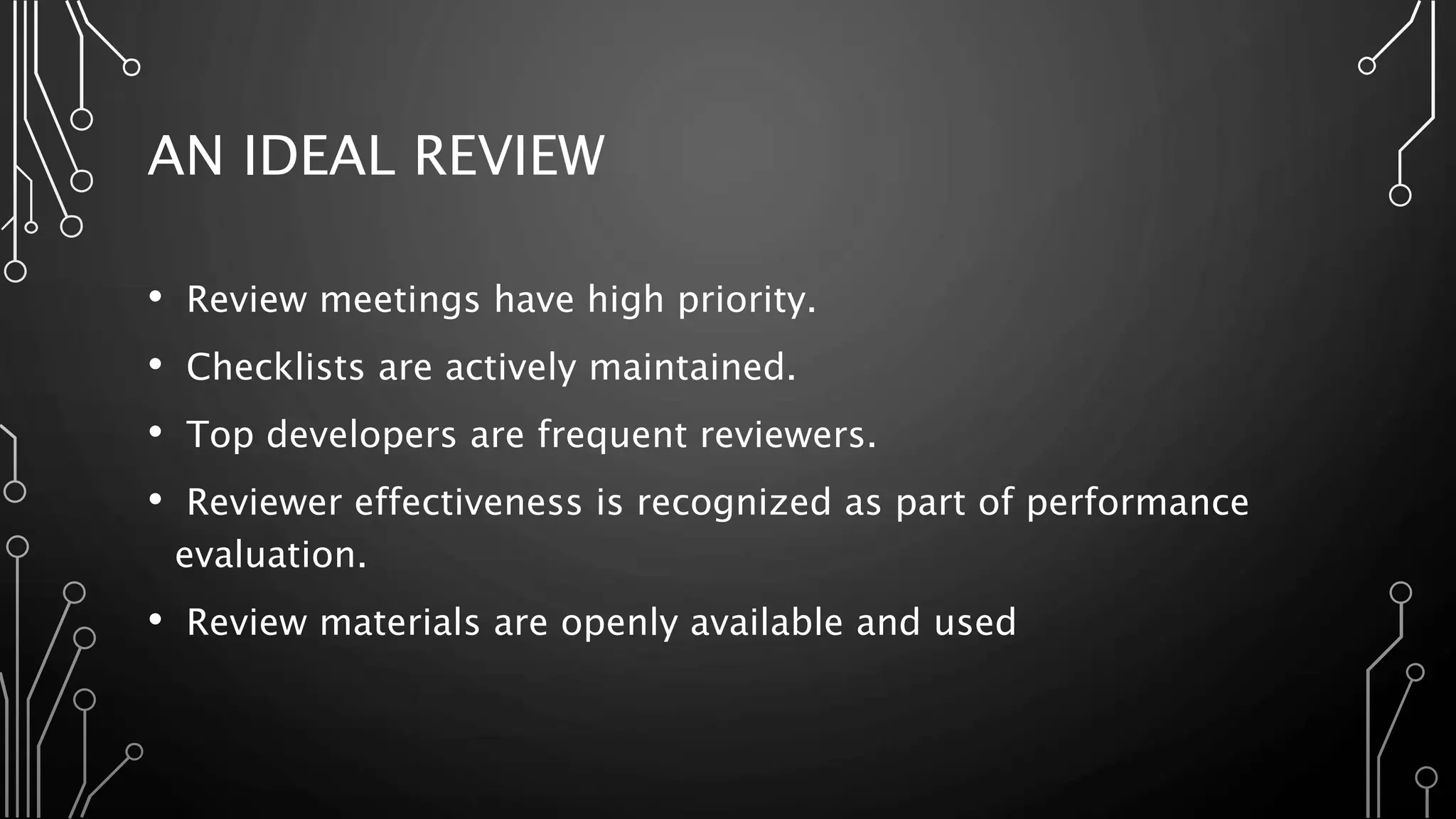
AN IDEAL REVIEW
• Review meetings have high priority.
• Checklists are actively maintained.
• Top developers are frequent reviewers.
• Reviewer effectiveness is recognized as part of performance
evaluation.
• Review materials are openly available and used
THANK YOU

Software Testing PPT.pptx

  • 1.
    SOFTWARE TECHNICAL REVIEWS AWAIS KHAN19011598-008 MUHAMMAD HAMMAD 19011598-026
  • 2.
  • 3.
    AN INDUSTRIAL-STRENGTH INSPECTION PROCESS •Describes a process for technical reviews that gradually evolved over a period of 12 years in a research and development • The developing organization had to produce nearly fault free systems as a matter of economic necessity • Necessity is the mother of invention
  • 4.
  • 5.
    AN INDUSTRIAL-STRENGTH INSPECTION PROCESS •It happens to resemble common depictions of the Waterfall lifecycle mode, but there are several important differences. • The sequence of stages is important, and deviations from the sequence simply do not work.
  • 6.
    COMMITMENT PLANNING • Thetechnical inspection process begins with a meeting between the producer of the work product and his/her supervisor. • The producer may wish to “stack the deck” with close friends • Once the review team is identified, the supervisor completes any necessary administrative approval. • The supervisor should have a commitment meeting, with other supervisors if necessary, to obtain commitments for all review team members. • Any task approvals are communicated at this meeting. • The results are given to the review leader.
  • 7.
    REVIEWER INTRODUCTION • Thereview leader assembles the team for a brief meeting. • The producer prepares the full review packet and freezes the work product to be examined. • The review leader delivers the review packet and gives a brief overview of the work product. • The team should decide whether or not the review packet is complete. • The meeting ends with all team members either committing to the process or possibly disqualifying themselves.
  • 8.
    PREPARATION • The reviewteam members have approved preparation time • The preparation interval for a review of normal duration (60 to 90 minutes) should be five full working days, in which up to eight hours of preparation time can be used by each review team member. • Reviewers examine the work product with respect to the review checklist and their own expertise. • Reviewers should describe the issue, provide a short explanation or description, and then make a severity assessment.
  • 9.
    REVIEW MEETING • Theactual review meeting should be conducted as an effective business meeting. • Some steps in the review process  The review team was carefully selected, so the right people will be in the meeting.  The agenda is based on the prioritized list of issues, so there should not be a sense that the meeting is a waste of time.  The process calls for budgeted preparation time in which issues are identified before the meeting.
  • 10.
    REPORT PREPARATION • Thereview leader is primarily responsible for writing the review report • The report is a technical recommendation to management, and it ends the technical responsibility. • The review report and all other materials should be open to the entire organization, as this enhances accountability
  • 11.
    DISPOSITION • Once theproducer’s supervisor receives the report, it becomes the basis of a management decision. • Assuming the recommendation is to accept the work product, it becomes subject to the configuration management function, and the work product is no longer a Design Object, it is a Configuration Item • Once all action items are resolved, the supervisor either closes the review or starts a re-review process.
  • 12.
    EFFECTIVE REVIEW CULTURE •Reviews can be quite stressful, and this also requires social considerations. • Reviews are a group activity, so group size becomes a question. • Reviews must be seen as valuable activities by both management and technical people. • Part of an effective corporate culture is that reviews must be seen as valuable activities by both management and technical people. • Most review meetings should be in the 60 to 90 minute range. • The best time to have a review meeting?
  • 13.
    ETIQUETTE • To reducethe stress that can accompany a review, the following points of review etiquette should be observed. 1. Be prepared. Otherwise, the review effectiveness will be diminished. In a sense an unprepared team member is disrespecting the rest of the review team. 2. Be respectful. Review the product, not the producer. 3. Avoid discussions of style. 4. Provide minor comments to the producer at the end of the meeting.
  • 14.
    ETIQUETTE 5. Be constructive.Reviews are not the place for personal criticism, nor for praise. 6. Remain focused. Identify issues, do not try to resolve them. 7. Participate, but do not dominate the discussion. 8. Be open. All review information should be widely available to the full organization
  • 15.
    MANAGEMENT PARTICIPATION INREVIEW MEETINGS • Many organizations struggle with the question of management participation in reviews. • Management presence in a review easily creates additional stress on all team members, but in particular, on the producer. • If management participation is common, the whole process can easily degenerate into unspoken agreements among the technical staff • To be fair, there are managers who are technically competent, and they can be disciplined enough to respect the process
  • 16.
    A TALE OFTWO REVIEWS • A Pointy-Haired Supervisor Review • An Ideal Review
  • 17.
    A POINTY-HAIRED SUPERVISORREVIEW • The producer picks friendly reviewers. • There is little or no lead time. • There is no approved preparation time. • The work item is not frozen. • The review meeting is postponed twice. • Some reviewers are absent, others take cell phone calls.
  • 18.
    A POINTY-HAIRED SUPERVISORREVIEW • Some designers never participate because they cannot be spared. • There is no checklist. • No action items are identified and reported. • Reviewers float in and out of the meeting • Faults are resolved “while they are fresh in mind.” • Coffee and lunch breaks are needed. • The producer’s supervisor is the review leader
  • 19.
    AN IDEAL REVIEW •Producers do not dread reviews. • Reviewers have approved preparation time. • A complete review packet is delivered with sufficient lead time. • All participants have had formal review training. • Technical people perceive reviews as productive. • Management people perceive reviews as productive
  • 20.
    AN IDEAL REVIEW •Review meetings have high priority. • Checklists are actively maintained. • Top developers are frequent reviewers. • Reviewer effectiveness is recognized as part of performance evaluation. • Review materials are openly available and used
  • 21.