Software Testing

  An Overview
Introduction & Fundamentals

       •    What is Software Testing?
       •    Why testing is necessary?
       •    Who does the testing?
       •    What has to be tested?
       •    When is testing done?
       •    How often to test?


360Logica
Most Common Software problems

               Incorrect calculation
               Incorrect data edits & ineffective data edits
               Incorrect matching and merging of data
               Data searches that yields incorrect results
               Incorrect processing of data relationship
               Incorrect coding / implementation of business rules


360Logica
   Confusing or misleading data
               Software usability by end users & Obsolete Software
               Inconsistent processing
               Unreliable results or performance
               Inadequate support of business needs
               Incorrect or inadequate interfaces with other systems
               Inadequate performance and security controls
               Incorrect file handling


360Logica
Objectives of testing
   • Executing a program with the intent of finding an error.
   • To check if the system meets the requirements and be executed successfully in the
      Intended environment.
   • To check if the system is “ Fit for purpose”.
   • To check if the system does what it is expected to do.


360Logica
Objectives of testing

   •   A good test case is one that has a probability of finding an as yet undiscovered
       error.
   •   A successful test is one that uncovers a yet undiscovered error.
   •   A good test is not redundant.
   •   A good test should be “best of breed”.
   •   A good test should neither be too simple nor too complex.


360Logica
Objective of a Software Tester
   • Find bugs as early as possible and make sure they get fixed.
   • To understand the application well.
   • Study the functionality in detail to find where the bugs are likely to occur.
   • Study the code to ensure that each and every line of code is tested.
   • Create test cases in such a way that testing is done to uncover the hidden bugs
      and also ensure that the software is usable and reliable


360Logica
VERIFICATION & VALIDATION

 Verification - typically involves reviews and meeting to evaluate documents, plans, code,
 requirements, and specifications. This can be done with checklists, issues lists,
 walkthroughs, and inspection meeting.

 Validation - typically involves actual testing and takes place after verifications are
 completed.

         Validation and Verification process continue in a cycle till the software
 becomes defects free.


360Logica
TESTABILITY

             Operability
             Observe-ability
             Controllability
             Decomposability
             Stability
             Understandability


360Logica
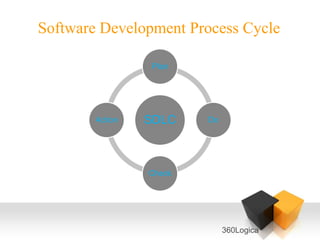
Software Development Process Cycle

                 Plan


        Action   SDLC    Do


                 Check


                              360Logica
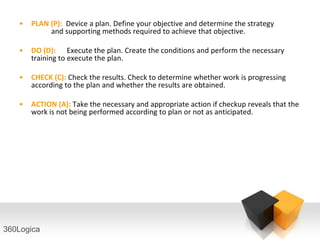
•   PLAN (P): Device a plan. Define your objective and determine the strategy
            and supporting methods required to achieve that objective.

   •   DO (D): Execute the plan. Create the conditions and perform the necessary
       training to execute the plan.

   •   CHECK (C): Check the results. Check to determine whether work is progressing
       according to the plan and whether the results are obtained.

   •   ACTION (A): Take the necessary and appropriate action if checkup reveals that the
       work is not being performed according to plan or not as anticipated.


360Logica

Software testing - An Overview

  • 1.
    Software Testing An Overview
  • 2.
    Introduction & Fundamentals • What is Software Testing? • Why testing is necessary? • Who does the testing? • What has to be tested? • When is testing done? • How often to test? 360Logica
  • 3.
    Most Common Softwareproblems  Incorrect calculation  Incorrect data edits & ineffective data edits  Incorrect matching and merging of data  Data searches that yields incorrect results  Incorrect processing of data relationship  Incorrect coding / implementation of business rules 360Logica
  • 4.
    Confusing or misleading data  Software usability by end users & Obsolete Software  Inconsistent processing  Unreliable results or performance  Inadequate support of business needs  Incorrect or inadequate interfaces with other systems  Inadequate performance and security controls  Incorrect file handling 360Logica
  • 5.
    Objectives of testing • Executing a program with the intent of finding an error. • To check if the system meets the requirements and be executed successfully in the Intended environment. • To check if the system is “ Fit for purpose”. • To check if the system does what it is expected to do. 360Logica
  • 6.
    Objectives of testing • A good test case is one that has a probability of finding an as yet undiscovered error. • A successful test is one that uncovers a yet undiscovered error. • A good test is not redundant. • A good test should be “best of breed”. • A good test should neither be too simple nor too complex. 360Logica
  • 7.
    Objective of aSoftware Tester • Find bugs as early as possible and make sure they get fixed. • To understand the application well. • Study the functionality in detail to find where the bugs are likely to occur. • Study the code to ensure that each and every line of code is tested. • Create test cases in such a way that testing is done to uncover the hidden bugs and also ensure that the software is usable and reliable 360Logica
  • 8.
    VERIFICATION & VALIDATION Verification - typically involves reviews and meeting to evaluate documents, plans, code, requirements, and specifications. This can be done with checklists, issues lists, walkthroughs, and inspection meeting. Validation - typically involves actual testing and takes place after verifications are completed. Validation and Verification process continue in a cycle till the software becomes defects free. 360Logica
  • 9.
    TESTABILITY  Operability  Observe-ability  Controllability  Decomposability  Stability  Understandability 360Logica
  • 10.
    Software Development ProcessCycle Plan Action SDLC Do Check 360Logica
  • 11.
    PLAN (P): Device a plan. Define your objective and determine the strategy and supporting methods required to achieve that objective. • DO (D): Execute the plan. Create the conditions and perform the necessary training to execute the plan. • CHECK (C): Check the results. Check to determine whether work is progressing according to the plan and whether the results are obtained. • ACTION (A): Take the necessary and appropriate action if checkup reveals that the work is not being performed according to plan or not as anticipated. 360Logica