PROCESS MONITORING
AND AUDIT
1
Presented by:
Priyanka Pradhan
M.Tech(SE)
Batch:2013
CONTENTS
1. Introduction Of Monitoring
2. Characteristics Of Monitoring
3. Introduction Of Audit
4. Characteristics Of Audit
5. Audit Analysis
6. Steps To Implement Audit
7. Audit Activities
8. Types Of Audit
9. Audit Function
10. Conclusion
11. Reference 2
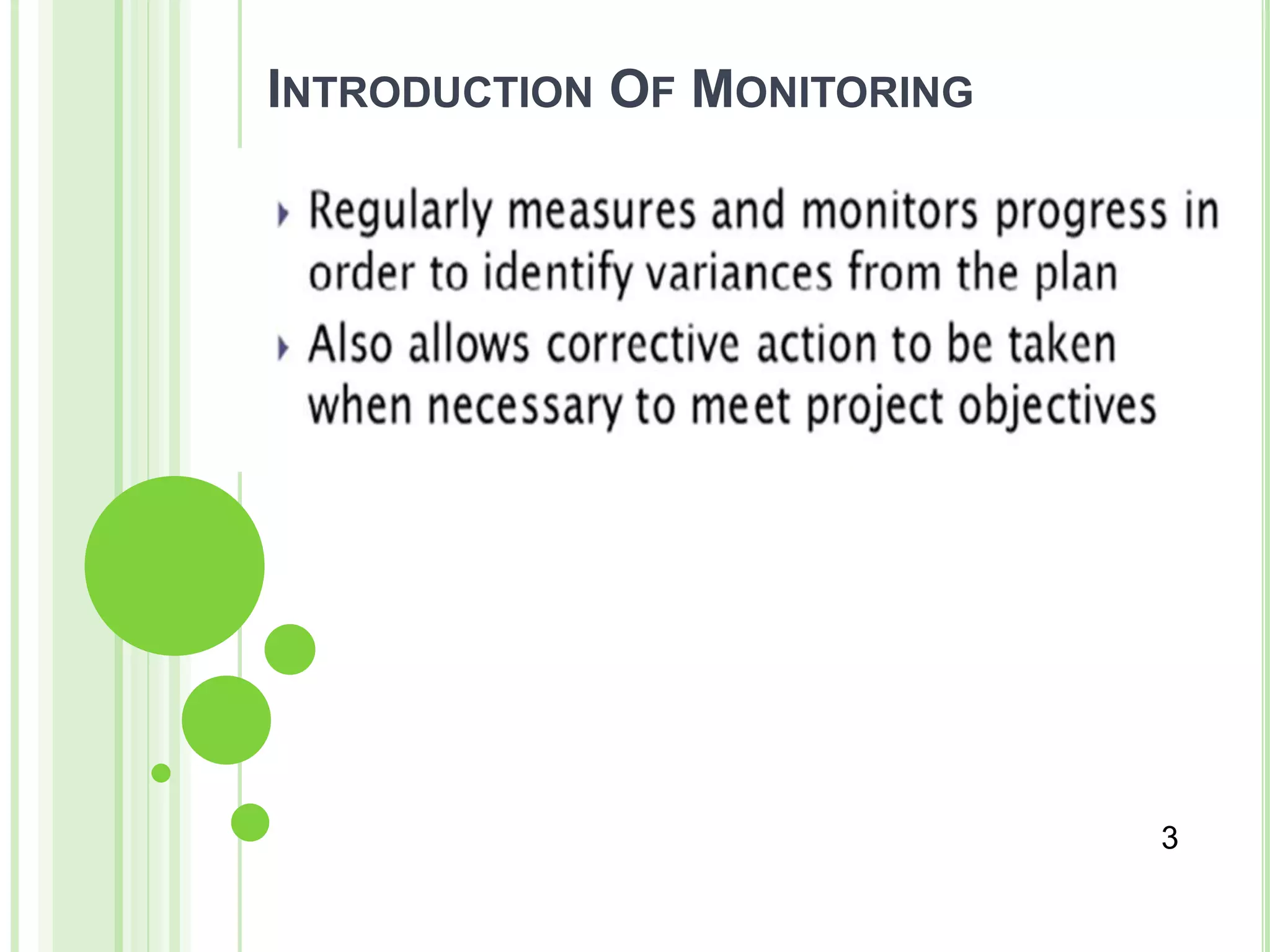
INTRODUCTION OF MONITORING
3
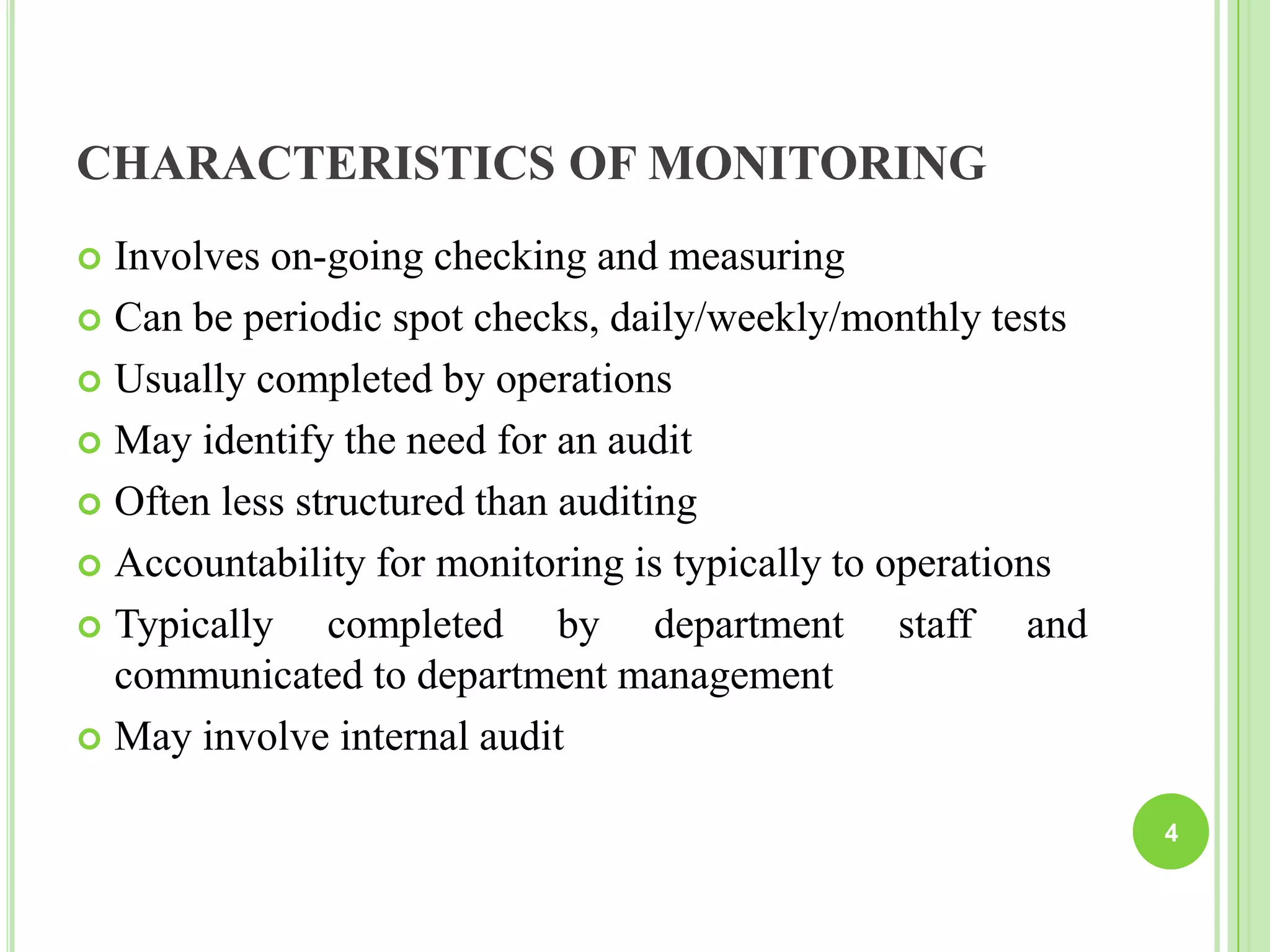
CHARACTERISTICS OF MONITORING
 Involves on-going checking and measuring
 Can be periodic spot checks, daily/weekly/monthly tests
 Usually completed by operations
 May identify the need for an audit
 Often less structured than auditing
 Accountability for monitoring is typically to operations
 Typically completed by department staff and
communicated to department management
 May involve internal audit
4
INTRODUCTION OF AUDIT
 Audit is a formal, systematic and disciplined approach
designed to evaluate and improve the effectiveness of
processes and related controls.
 Provides the means to understand performance versus
established standards and identify areas for continued
improvement.
5
CHARACTERISTICS OF AUDIT
 Formal review governed by professional standards
 Completed by individual independent of the operation
 Formal, systematic and structured approach
 Involves planning, sampling, testing, and validating
 Formal communication with recommendations and
corrective action measures
 Documented follow-up of corrective actions
6
7
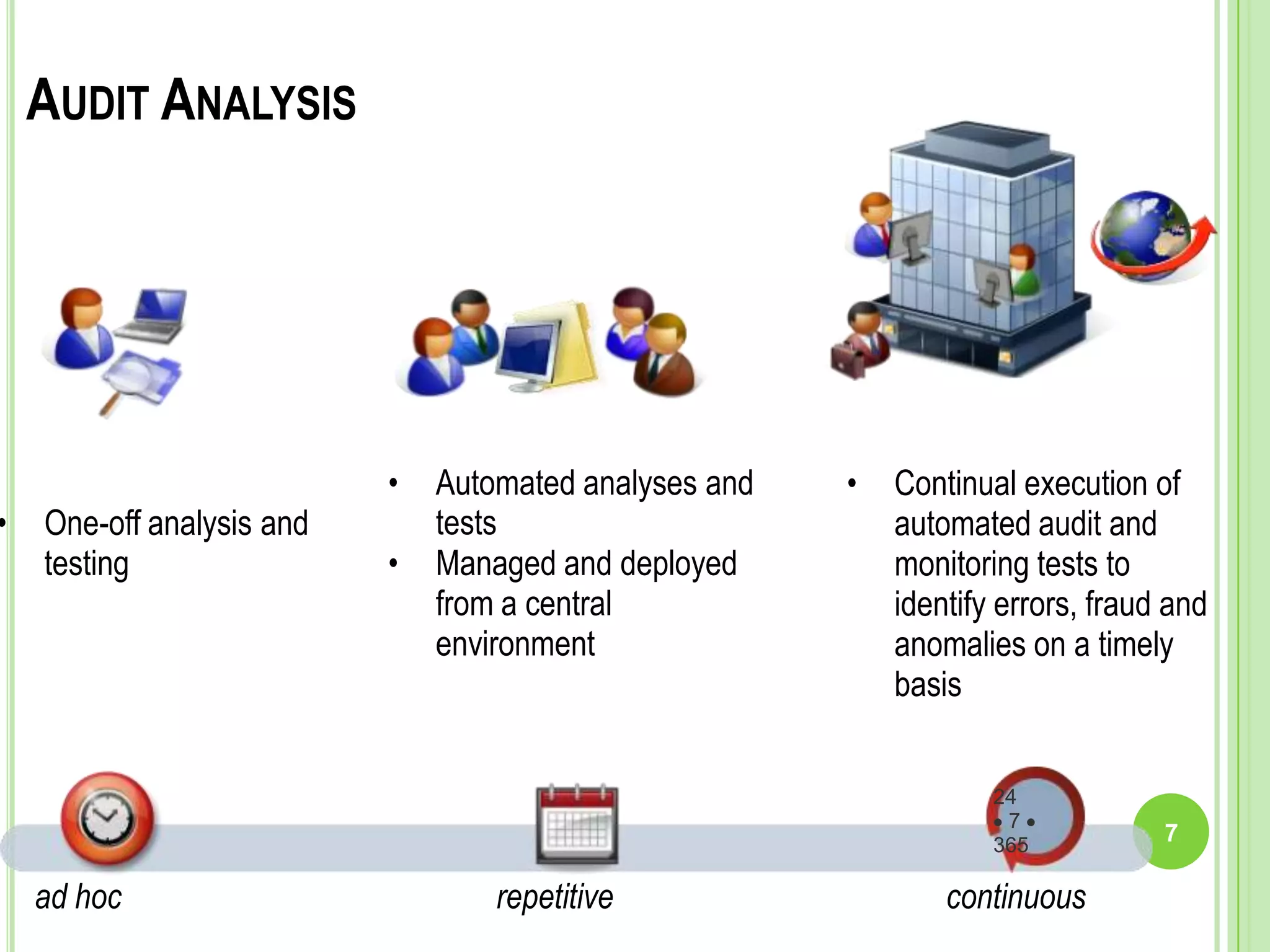
ad hoc repetitive
24
7
365
continuous
AUDIT ANALYSIS
• One-off analysis and
testing
• Automated analyses and
tests
• Managed and deployed
from a central
environment
• Continual execution of
automated audit and
monitoring tests to
identify errors, fraud and
anomalies on a timely
basis
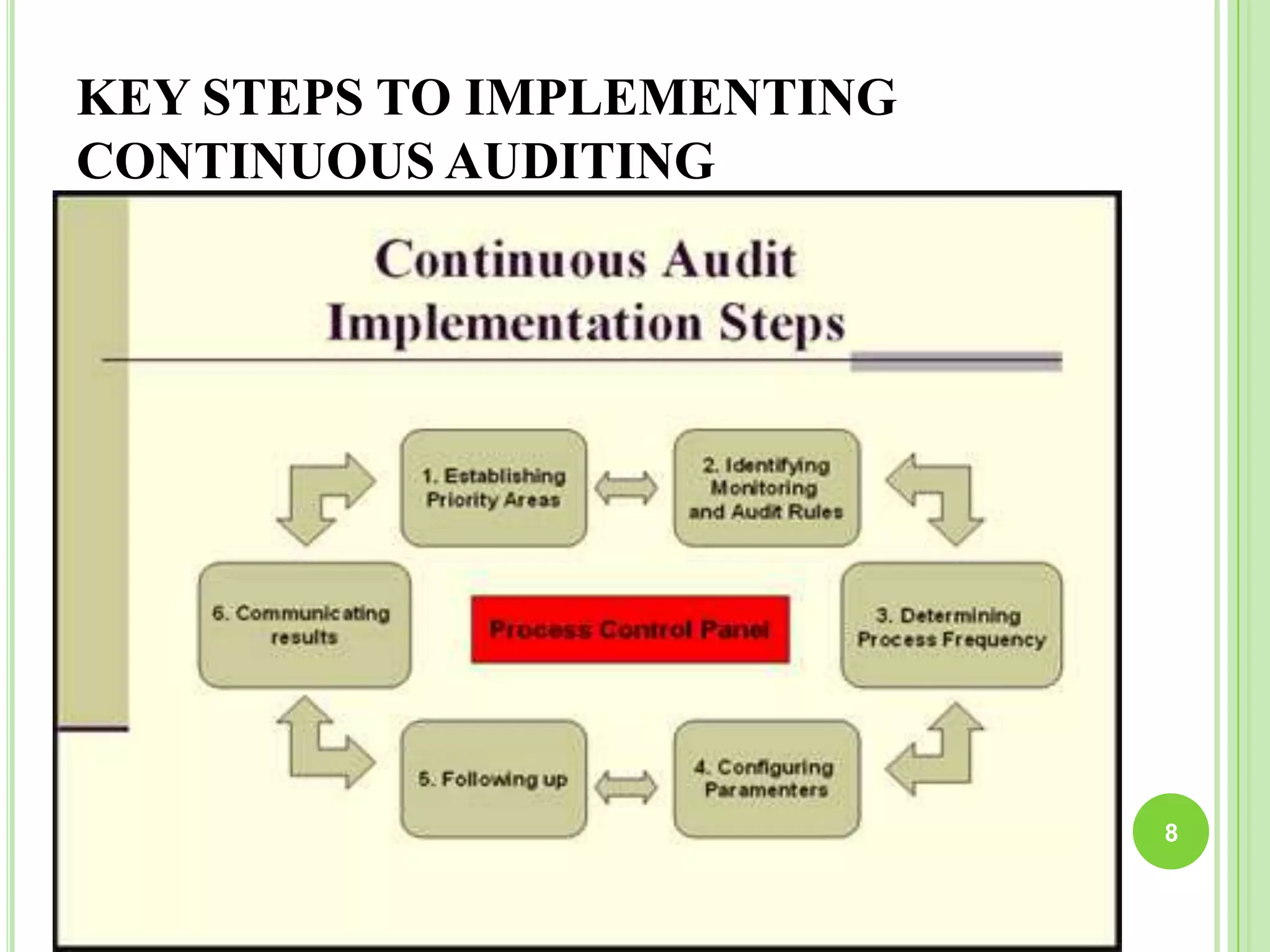
KEY STEPS TO IMPLEMENTING
CONTINUOUS AUDITING
8
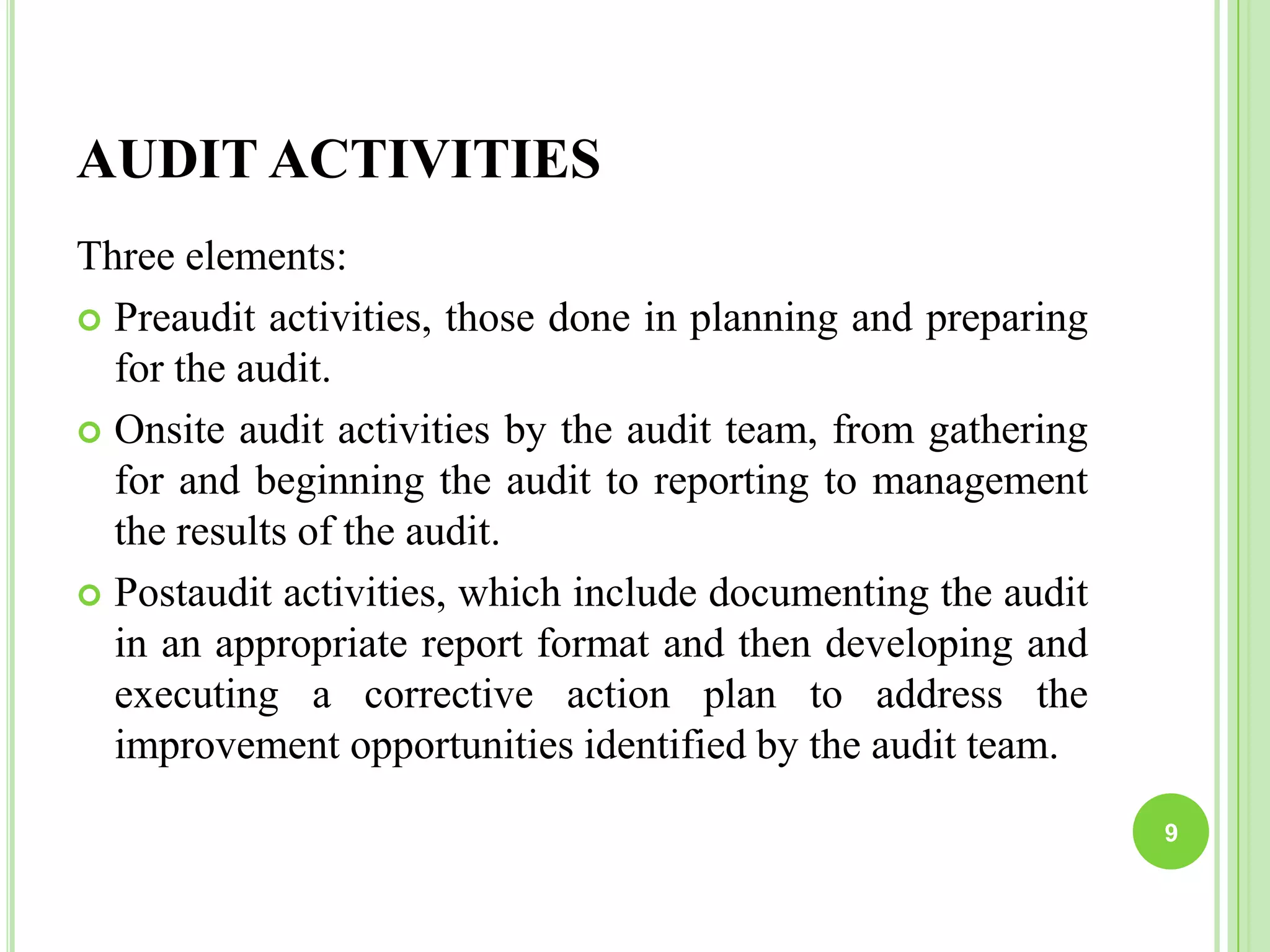
AUDIT ACTIVITIES
Three elements:
 Preaudit activities, those done in planning and preparing
for the audit.
 Onsite audit activities by the audit team, from gathering
for and beginning the audit to reporting to management
the results of the audit.
 Postaudit activities, which include documenting the audit
in an appropriate report format and then developing and
executing a corrective action plan to address the
improvement opportunities identified by the audit team.
9
TYPES OF AUDITING
INTERNAL AUDIT
Performed by trained employee
EXTERNAL AUDIT
Independent audit organization
Certification
10
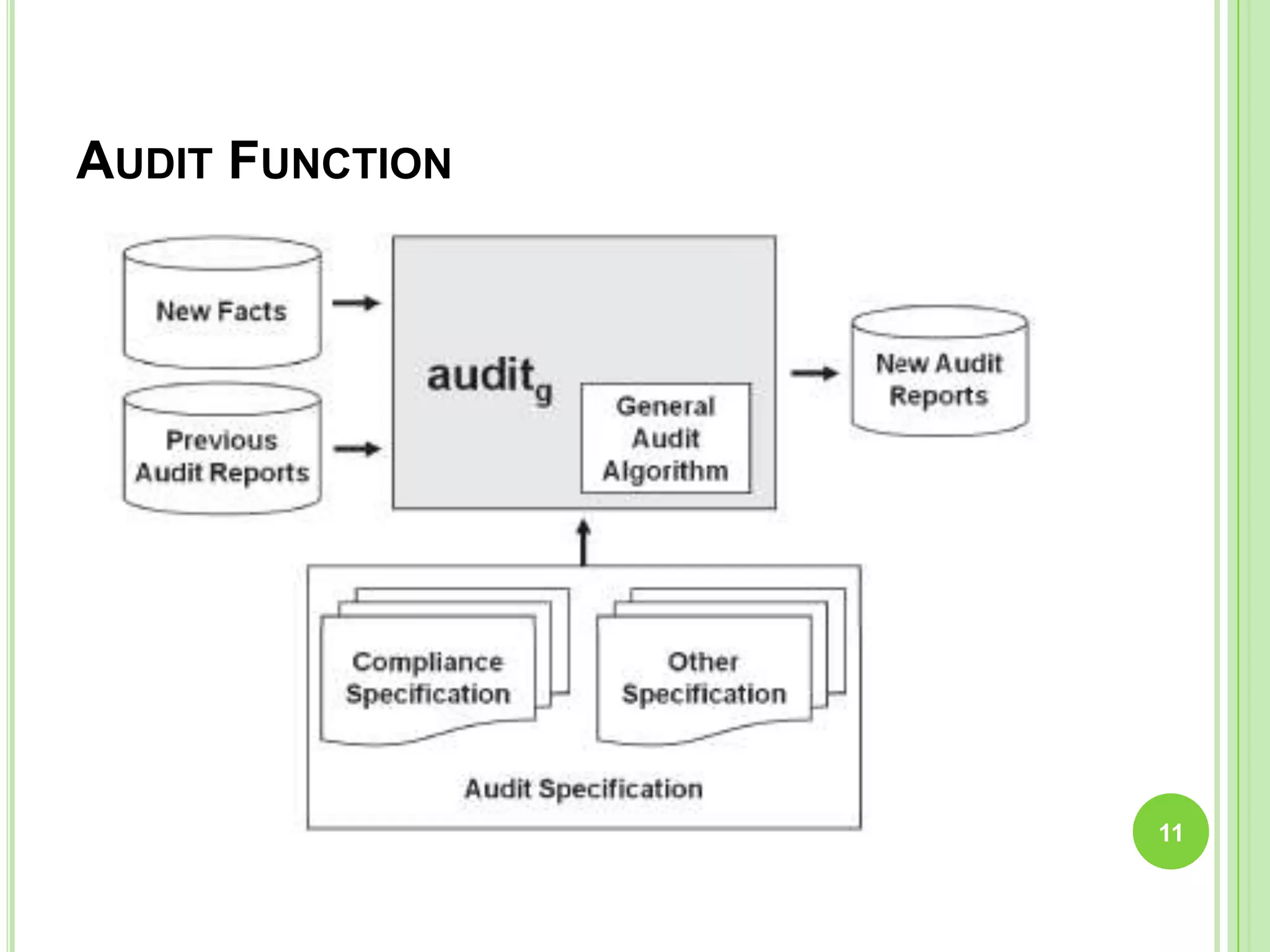
AUDIT FUNCTION
11
CONCLUSION
 Auditing tasks is the determination of compliance of
facts with pre-defined specifications.
 Auditing is the review of an organization’s quality
system in order to achieve quality throughout the
process.
 Audits are the most effective when performed by
qualified professionals who work together and are
focussed on clear objectives.
12
REFERENCE
[1] Musa, J.D, Software Reliability Engineering McGraw-
Hill, 1998
[2] Musa, J.D., Iannino, A., Okumoto, k., 1987. “Software
Reliability: Measurement Prediction Application”. McGraw-
Hill, New York.
[3] Pham. H., 2003. “Handbook of Reliability Engineering”,
Springer
[4] Balakrishnan.N., Clifford Cohen; Order Statistics and
Inference; Academic Press inc.;1991.
[5] K.Ramchand H Rao, Dr. R.Satya Prasad, Dr.
R.R.L.Kantham, Assessing Software Reliability Using SPC
: An Order Statistics Approach, International Journal of
Computer Science, Engineering and Applications
(IJCSEA) Vol.1, No.4, August 2011 13
QUERIES???
14
THANK YOU
15

SOFTWARE PROCESS MONITORING AND AUDIT

  • 1.
    PROCESS MONITORING AND AUDIT 1 Presentedby: Priyanka Pradhan M.Tech(SE) Batch:2013
  • 2.
    CONTENTS 1. Introduction OfMonitoring 2. Characteristics Of Monitoring 3. Introduction Of Audit 4. Characteristics Of Audit 5. Audit Analysis 6. Steps To Implement Audit 7. Audit Activities 8. Types Of Audit 9. Audit Function 10. Conclusion 11. Reference 2
  • 3.
  • 4.
    CHARACTERISTICS OF MONITORING Involves on-going checking and measuring  Can be periodic spot checks, daily/weekly/monthly tests  Usually completed by operations  May identify the need for an audit  Often less structured than auditing  Accountability for monitoring is typically to operations  Typically completed by department staff and communicated to department management  May involve internal audit 4
  • 5.
    INTRODUCTION OF AUDIT Audit is a formal, systematic and disciplined approach designed to evaluate and improve the effectiveness of processes and related controls.  Provides the means to understand performance versus established standards and identify areas for continued improvement. 5
  • 6.
    CHARACTERISTICS OF AUDIT Formal review governed by professional standards  Completed by individual independent of the operation  Formal, systematic and structured approach  Involves planning, sampling, testing, and validating  Formal communication with recommendations and corrective action measures  Documented follow-up of corrective actions 6
  • 7.
    7 ad hoc repetitive 24 7 365 continuous AUDITANALYSIS • One-off analysis and testing • Automated analyses and tests • Managed and deployed from a central environment • Continual execution of automated audit and monitoring tests to identify errors, fraud and anomalies on a timely basis
  • 8.
    KEY STEPS TOIMPLEMENTING CONTINUOUS AUDITING 8
  • 9.
    AUDIT ACTIVITIES Three elements: Preaudit activities, those done in planning and preparing for the audit.  Onsite audit activities by the audit team, from gathering for and beginning the audit to reporting to management the results of the audit.  Postaudit activities, which include documenting the audit in an appropriate report format and then developing and executing a corrective action plan to address the improvement opportunities identified by the audit team. 9
  • 10.
    TYPES OF AUDITING INTERNALAUDIT Performed by trained employee EXTERNAL AUDIT Independent audit organization Certification 10
  • 11.
  • 12.
    CONCLUSION  Auditing tasksis the determination of compliance of facts with pre-defined specifications.  Auditing is the review of an organization’s quality system in order to achieve quality throughout the process.  Audits are the most effective when performed by qualified professionals who work together and are focussed on clear objectives. 12
  • 13.
    REFERENCE [1] Musa, J.D,Software Reliability Engineering McGraw- Hill, 1998 [2] Musa, J.D., Iannino, A., Okumoto, k., 1987. “Software Reliability: Measurement Prediction Application”. McGraw- Hill, New York. [3] Pham. H., 2003. “Handbook of Reliability Engineering”, Springer [4] Balakrishnan.N., Clifford Cohen; Order Statistics and Inference; Academic Press inc.;1991. [5] K.Ramchand H Rao, Dr. R.Satya Prasad, Dr. R.R.L.Kantham, Assessing Software Reliability Using SPC : An Order Statistics Approach, International Journal of Computer Science, Engineering and Applications (IJCSEA) Vol.1, No.4, August 2011 13
  • 14.
  • 15.