
© 2015 IBM Corporation
#ibminterconnect #AEC-1649
Software Defined WebSphere
Messaging Infrastructure with
Puppet
AEC-1649
Rakesh Sharma
Walmart Stores Inc.
Rahul Gupta
IBM
Global Technology Services
@rahulguptaibm
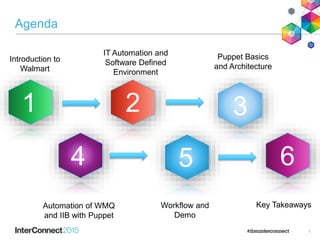
Agenda
1
1 2 3
4 5 6
Introduction to
Walmart
IT Automation and
Software Defined
Environment
Puppet Basics
and Architecture
Automation of WMQ
and IIB with Puppet
Workflow and
Demo
Key Takeaways
2
1
Introduction to Walmart
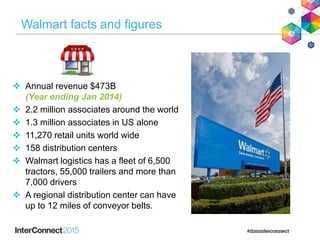
Walmart facts and figures
 Annual revenue $473B
(Year ending Jan 2014)
 2.2 million associates around the world
 1.3 million associates in US alone
 11,270 retail units world wide
 158 distribution centers
 Walmart logistics has a fleet of 6,500
tractors, 55,000 trailers and more than
7,000 drivers
 A regional distribution center can have
up to 12 miles of conveyor belts.
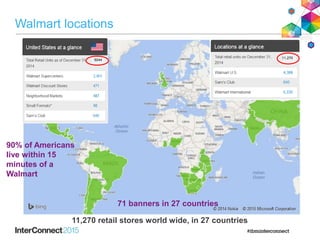
Walmart locations
11,270 retail stores world wide, in 27 countries
90% of Americans
live within 15
minutes of a
Walmart
11,270
5044
71 banners in 27 countries
5
2
IT Automation and Software Defined Environment
Power, Complexity, Expectations and Opportunities
6
 MORE COMPUTING POWER
 MORE COMPLEXITY
 GREATER EXPECTATIONS
 GREATER OPPORTUNITIES
http://www.slideshare.net/PuppetLabs/top-10-business-benefits-of-it-automation
7
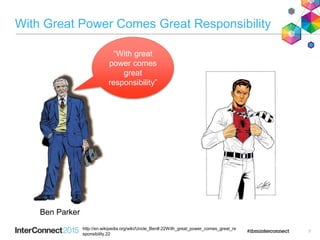
http://en.wikipedia.org/wiki/Uncle_Ben#.22With_great_power_comes_great_re
sponsibility.22
“With great
power comes
great
responsibility”
Ben Parker
With Great Power Comes Great Responsibility
8
With Greater Computing Power, We
have greater responsibilities and
opportunities for IT Automation
9
Manual Configurations
Custom Scripts
Golden Images
Legacy Tools
DON’T WORK
It costs reliability, speed, productivity & insight
10
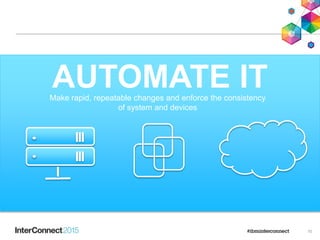
AUTOMATE ITMake rapid, repeatable changes and enforce the consistency
of system and devices
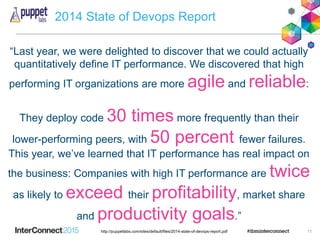
2014 State of Devops Report
11http://puppetlabs.com/sites/default/files/2014-state-of-devops-report.pdf
“Last year, we were delighted to discover that we could actually
quantitatively define IT performance. We discovered that high
performing IT organizations are more agile and reliable:
They deploy code 30 times more frequently than their
lower-performing peers, with 50 percent fewer failures.
This year, we’ve learned that IT performance has real impact on
the business: Companies with high IT performance are twice
as likely to exceed their profitability, market share
and productivity goals.”
Why Automation
12
#1. Avoiding Downtime
http://dealbook.nytimes.com/2012/08/02/knight-capital-says-trading-mishap-cost-
it-440-million/?_r=0
“Knight Capital Says Trading
Glitch Cost It $440 Million”
The company said the problems happened because of
new trading software that had been installed. The event
was the latest to draw attention to the potentially
destabilizing effect of the computerized trading that has
increasingly dominated the nation’s stock markets
Why Automation
13
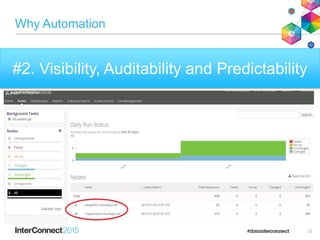
#2. Visibility, Auditability and Predictability
Why Automation
14
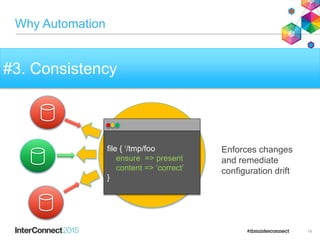
#3. Consistency
file { ‘/tmp/foo
ensure => present
content => ‘correct’
}
Enforces changes
and remediate
configuration drift
Why Automation
15
#4. Quicker Recovery
High Performing IT Organizations have double
the change success rate and restore services
12 times faster than peers.
Fewer failures and faster recovery mean less risk
to business when changes are deployed.
http://puppetlabs.com/sites/default/files/2014-state-of-devops-report.pdf
Why Automation
16
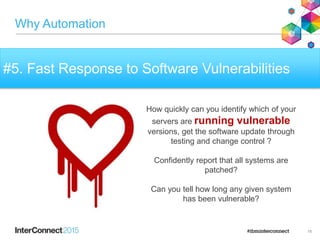
#5. Fast Response to Software Vulnerabilities
How quickly can you identify which of your
servers are running vulnerable
versions, get the software update through
testing and change control ?
Confidently report that all systems are
patched?
Can you tell how long any given system
has been vulnerable?
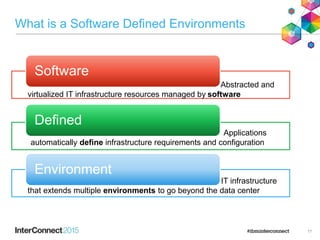
What is a Software Defined Environments
17
Software
Defined
Environment
Abstracted and
virtualized IT infrastructure resources managed by software
IT infrastructure
that extends multiple environments to go beyond the data center
Applications
automatically define infrastructure requirements and configuration
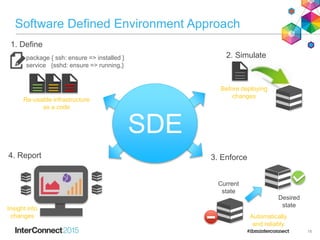
Software Defined Environment Approach
18
4. Report
package { ssh: ensure => installed }
service {sshd: ensure => running,}
1. Define
Re-usable infrastructure
as a code
2. Simulate
Before deploying
changes
3. Enforce
Current
state
Desired
state
Automatically
and reliably
Insight into
changes
SDE
19
3
Puppet Basics and Architecture
What is Puppet
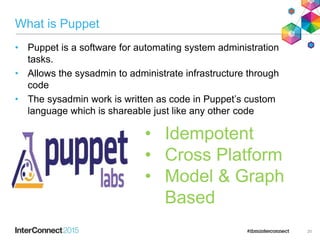
• Puppet is a software for automating system administration
tasks.
• Allows the sysadmin to administrate infrastructure through
code
• The sysadmin work is written as code in Puppet’s custom
language which is shareable just like any other code
20
• Idempotent
• Cross Platform
• Model & Graph
Based
Puppet Architecture
21
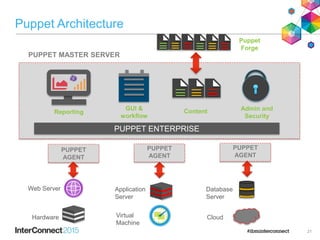
PUPPET
AGENT
PUPPET
AGENT
PUPPET
AGENT
Web Server
Hardware
Application
Server
Virtual
Machine
PUPPET MASTER SERVER
PUPPET ENTERPRISE
Database
Server
Cloud
Reporting
GUI &
workflow
Content Admin and
Security
Puppet
Forge
What do Agent and Masters Do ?
22
https://docs.puppetlabs.com/learning/agent_master_basic.html
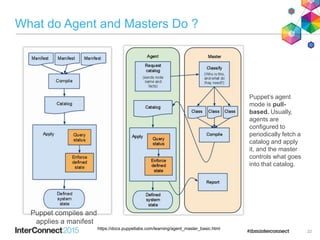
Puppet compiles and
applies a manifest
Puppet’s agent
mode is pull-
based. Usually,
agents are
configured to
periodically fetch a
catalog and apply
it, and the master
controls what goes
into that catalog.
Lifecycle of a Puppet Run
23
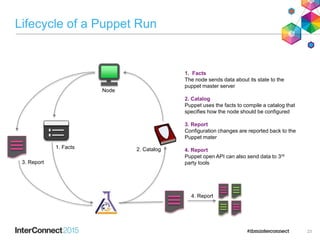
Node
1. Facts 2. Catalog
3. Report
4. Report
1. Facts
The node sends data about its state to the
puppet master server
2. Catalog
Puppet uses the facts to compile a catalog that
specifies how the node should be configured
3. Report
Configuration changes are reported back to the
Puppet mater
4. Report
Puppet open API can also send data to 3rd
party tools
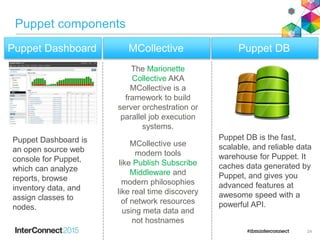
Puppet components
24
Puppet Dashboard MCollective Puppet DB
The Marionette
Collective AKA
MCollective is a
framework to build
server orchestration or
parallel job execution
systems.
MCollective use
modern tools
like Publish Subscribe
Middleware and
modern philosophies
like real time discovery
of network resources
using meta data and
not hostnames
Puppet Dashboard is
an open source web
console for Puppet,
which can analyze
reports, browse
inventory data, and
assign classes to
nodes.
Puppet DB is the fast,
scalable, and reliable data
warehouse for Puppet. It
caches data generated by
Puppet, and gives you
advanced features at
awesome speed with a
powerful API.
25
4
Puppet with WebSphere MQ and IBM Integration Bus
Everyday Challenges for Middleware Administrator
 Create new middleware environment for new projects or for
disaster recovery
 Diligently follow naming conventions for creating objects
 Follow the implementation guide, without adding any personality
of their own to the existing work
 Ensure the work is documented appropriately so the other
sysadmins can understand the work done by them.
 Ensure the consistency of middleware infrastructure while
scaling for business requirements
26
27
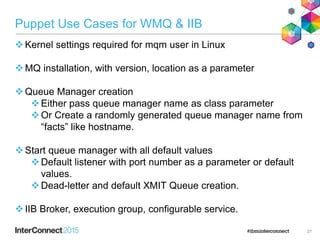
Puppet Use Cases for WMQ & IIB
Kernel settings required for mqm user in Linux
MQ installation, with version, location as a parameter
Queue Manager creation
Either pass queue manager name as class parameter
Or Create a randomly generated queue manager name from
“facts” like hostname.
Start queue manager with all default values
Default listener with port number as a parameter or default
values.
Dead-letter and default XMIT Queue creation.
IIB Broker, execution group, configurable service.
28
5
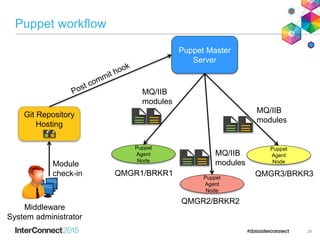
Puppet workflow
Git Repository
Hosting
Puppet Master
Server
Puppet
Agent
Node
Puppet
Agent
Node
Puppet
Agent
Node
QMGR1/BRKR1
QMGR2/BRKR2
QMGR3/BRKR3
Module
check-in
MQ/IIB
modules
MQ/IIB
modules
MQ/IIB
modules
Middleware
System administrator
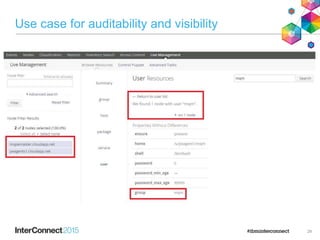
Use case for auditability and visibility
29
30
5
Demo
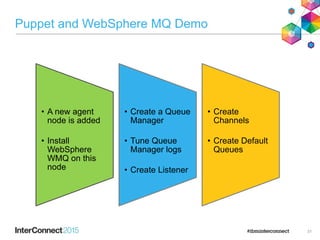
Puppet and WebSphere MQ Demo
31
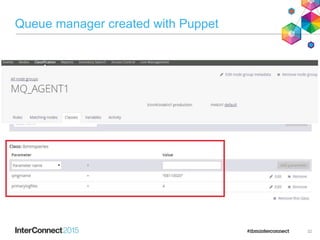
• A new agent
node is added
• Install
WebSphere
WMQ on this
node
• Create a Queue
Manager
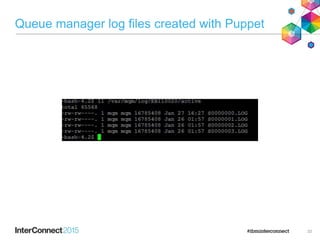
• Tune Queue
Manager logs
• Create Listener
• Create
Channels
• Create Default
Queues
Queue manager created with Puppet
32
Queue manager log files created with Puppet
33
34
6
Key Takeaways
Technical/Business Benefits
 Improved efficiency. Once verified, deploy to as many nodes as
you require to
 Better than gold images/custom scripting
 Low level documentation
 No configuration drift provides confidence to system
administrator about any system in environment
 Reduces operational cost & provides faster decision making
 Engineers do high level layout of environment(architecture
work), low level details taken care by puppet
35
Notices and Disclaimers
Copyright © 2015 by International Business Machines Corporation (IBM). No part of this document may be reproduced or
transmitted in any form without written permission from IBM.
U.S. Government Users Restricted Rights - Use, duplication or disclosure restricted by GSA ADP Schedule Contract with
IBM.
Information in these presentations (including information relating to products that have not yet been announced by IBM) has been
reviewed for accuracy as of the date of initial publication and could include unintentional technical or typographical errors. IBM
shall have no responsibility to update this information. THIS DOCUMENT IS DISTRIBUTED "AS IS" WITHOUT ANY WARRANTY,
EITHER EXPRESS OR IMPLIED. IN NO EVENT SHALL IBM BE LIABLE FOR ANY DAMAGE ARISING FROM THE USE OF
THIS INFORMATION, INCLUDING BUT NOT LIMITED TO, LOSS OF DATA, BUSINESS INTERRUPTION, LOSS OF PROFIT
OR LOSS OF OPPORTUNITY. IBM products and services are warranted according to the terms and conditions of the
agreements under which they are provided.
Any statements regarding IBM's future direction, intent or product plans are subject to change or withdrawal without
notice.
Performance data contained herein was generally obtained in a controlled, isolated environments. Customer examples are
presented as illustrations of how those customers have used IBM products and the results they may have achieved. Actual
performance, cost, savings or other results in other operating environments may vary.
References in this document to IBM products, programs, or services does not imply that IBM intends to make such products,
programs or services available in all countries in which IBM operates or does business.
Workshops, sessions and associated materials may have been prepared by independent session speakers, and do not
necessarily reflect the views of IBM. All materials and discussions are provided for informational purposes only, and are neither
intended to, nor shall constitute legal or other guidance or advice to any individual participant or their specific situation.
It is the customer’s responsibility to insure its own compliance with legal requirements and to obtain advice of competent legal
counsel as to the identification and interpretation of any relevant laws and regulatory requirements that may affect the customer’s
business and any actions the customer may need to take to comply with such laws. IBM does not provide legal advice or
represent or warrant that its services or products will ensure that the customer is in compliance with any law.
Notices and Disclaimers (con’t)
Information concerning non-IBM products was obtained from the suppliers of those products, their published
announcements or other publicly available sources. IBM has not tested those products in connection with this
publication and cannot confirm the accuracy of performance, compatibility or any other claims related to non-IBM
products. Questions on the capabilities of non-IBM products should be addressed to the suppliers of those products.
IBM does not warrant the quality of any third-party products, or the ability of any such third-party products to
interoperate with IBM’s products. IBM EXPRESSLY DISCLAIMS ALL WARRANTIES, EXPRESSED OR IMPLIED,
INCLUDING BUT NOT LIMITED TO, THE IMPLIED WARRANTIES OF MERCHANTABILITY AND FITNESS FOR A
PARTICULAR PURPOSE.
The provision of the information contained herein is not intended to, and does not, grant any right or license under any
IBM patents, copyrights, trademarks or other intellectual property right.
• IBM, the IBM logo, ibm.com, Bluemix, Blueworks Live, CICS, Clearcase, DOORS®, Enterprise Document
Management System™, Global Business Services ®, Global Technology Services ®, Information on Demand,
ILOG, Maximo®, MQIntegrator®, MQSeries®, Netcool®, OMEGAMON, OpenPower, PureAnalytics™,
PureApplication®, pureCluster™, PureCoverage®, PureData®, PureExperience®, PureFlex®, pureQuery®,
pureScale®, PureSystems®, QRadar®, Rational®, Rhapsody®, SoDA, SPSS, StoredIQ, Tivoli®, Trusteer®,
urban{code}®, Watson, WebSphere®, Worklight®, X-Force® and System z® Z/OS, are trademarks of
International Business Machines Corporation, registered in many jurisdictions worldwide. Other product and
service names might be trademarks of IBM or other companies. A current list of IBM trademarks is available on
the Web at "Copyright and trademark information" at: www.ibm.com/legal/copytrade.shtml.
Thank You
Your Feedback is
Important!
Access the InterConnect 2015
Conference CONNECT Attendee
Portal to complete your session
surveys from your smartphone,
laptop or conference kiosk.

Software Defined WebSphere Messaging Infrastructure with Puppet

  • 1.
    © 2015 IBMCorporation #ibminterconnect #AEC-1649 Software Defined WebSphere Messaging Infrastructure with Puppet AEC-1649 Rakesh Sharma Walmart Stores Inc. Rahul Gupta IBM Global Technology Services @rahulguptaibm
  • 2.
    Agenda 1 1 2 3 45 6 Introduction to Walmart IT Automation and Software Defined Environment Puppet Basics and Architecture Automation of WMQ and IIB with Puppet Workflow and Demo Key Takeaways
  • 3.
  • 4.
    Walmart facts andfigures  Annual revenue $473B (Year ending Jan 2014)  2.2 million associates around the world  1.3 million associates in US alone  11,270 retail units world wide  158 distribution centers  Walmart logistics has a fleet of 6,500 tractors, 55,000 trailers and more than 7,000 drivers  A regional distribution center can have up to 12 miles of conveyor belts.
  • 5.
    Walmart locations 11,270 retailstores world wide, in 27 countries 90% of Americans live within 15 minutes of a Walmart 11,270 5044 71 banners in 27 countries
  • 6.
    5 2 IT Automation andSoftware Defined Environment
  • 7.
    Power, Complexity, Expectationsand Opportunities 6  MORE COMPUTING POWER  MORE COMPLEXITY  GREATER EXPECTATIONS  GREATER OPPORTUNITIES http://www.slideshare.net/PuppetLabs/top-10-business-benefits-of-it-automation
  • 8.
  • 9.
    8 With Greater ComputingPower, We have greater responsibilities and opportunities for IT Automation
  • 10.
    9 Manual Configurations Custom Scripts GoldenImages Legacy Tools DON’T WORK It costs reliability, speed, productivity & insight
  • 11.
    10 AUTOMATE ITMake rapid,repeatable changes and enforce the consistency of system and devices
  • 12.
    2014 State ofDevops Report 11http://puppetlabs.com/sites/default/files/2014-state-of-devops-report.pdf “Last year, we were delighted to discover that we could actually quantitatively define IT performance. We discovered that high performing IT organizations are more agile and reliable: They deploy code 30 times more frequently than their lower-performing peers, with 50 percent fewer failures. This year, we’ve learned that IT performance has real impact on the business: Companies with high IT performance are twice as likely to exceed their profitability, market share and productivity goals.”
  • 13.
    Why Automation 12 #1. AvoidingDowntime http://dealbook.nytimes.com/2012/08/02/knight-capital-says-trading-mishap-cost- it-440-million/?_r=0 “Knight Capital Says Trading Glitch Cost It $440 Million” The company said the problems happened because of new trading software that had been installed. The event was the latest to draw attention to the potentially destabilizing effect of the computerized trading that has increasingly dominated the nation’s stock markets
  • 14.
    Why Automation 13 #2. Visibility,Auditability and Predictability
  • 15.
    Why Automation 14 #3. Consistency file{ ‘/tmp/foo ensure => present content => ‘correct’ } Enforces changes and remediate configuration drift
  • 16.
    Why Automation 15 #4. QuickerRecovery High Performing IT Organizations have double the change success rate and restore services 12 times faster than peers. Fewer failures and faster recovery mean less risk to business when changes are deployed. http://puppetlabs.com/sites/default/files/2014-state-of-devops-report.pdf
  • 17.
    Why Automation 16 #5. FastResponse to Software Vulnerabilities How quickly can you identify which of your servers are running vulnerable versions, get the software update through testing and change control ? Confidently report that all systems are patched? Can you tell how long any given system has been vulnerable?
  • 18.
    What is aSoftware Defined Environments 17 Software Defined Environment Abstracted and virtualized IT infrastructure resources managed by software IT infrastructure that extends multiple environments to go beyond the data center Applications automatically define infrastructure requirements and configuration
  • 19.
    Software Defined EnvironmentApproach 18 4. Report package { ssh: ensure => installed } service {sshd: ensure => running,} 1. Define Re-usable infrastructure as a code 2. Simulate Before deploying changes 3. Enforce Current state Desired state Automatically and reliably Insight into changes SDE
  • 20.
  • 21.
    What is Puppet •Puppet is a software for automating system administration tasks. • Allows the sysadmin to administrate infrastructure through code • The sysadmin work is written as code in Puppet’s custom language which is shareable just like any other code 20 • Idempotent • Cross Platform • Model & Graph Based
  • 22.
    Puppet Architecture 21 PUPPET AGENT PUPPET AGENT PUPPET AGENT Web Server Hardware Application Server Virtual Machine PUPPETMASTER SERVER PUPPET ENTERPRISE Database Server Cloud Reporting GUI & workflow Content Admin and Security Puppet Forge
  • 23.
    What do Agentand Masters Do ? 22 https://docs.puppetlabs.com/learning/agent_master_basic.html Puppet compiles and applies a manifest Puppet’s agent mode is pull- based. Usually, agents are configured to periodically fetch a catalog and apply it, and the master controls what goes into that catalog.
  • 24.
    Lifecycle of aPuppet Run 23 Node 1. Facts 2. Catalog 3. Report 4. Report 1. Facts The node sends data about its state to the puppet master server 2. Catalog Puppet uses the facts to compile a catalog that specifies how the node should be configured 3. Report Configuration changes are reported back to the Puppet mater 4. Report Puppet open API can also send data to 3rd party tools
  • 25.
    Puppet components 24 Puppet DashboardMCollective Puppet DB The Marionette Collective AKA MCollective is a framework to build server orchestration or parallel job execution systems. MCollective use modern tools like Publish Subscribe Middleware and modern philosophies like real time discovery of network resources using meta data and not hostnames Puppet Dashboard is an open source web console for Puppet, which can analyze reports, browse inventory data, and assign classes to nodes. Puppet DB is the fast, scalable, and reliable data warehouse for Puppet. It caches data generated by Puppet, and gives you advanced features at awesome speed with a powerful API.
  • 26.
    25 4 Puppet with WebSphereMQ and IBM Integration Bus
  • 27.
    Everyday Challenges forMiddleware Administrator  Create new middleware environment for new projects or for disaster recovery  Diligently follow naming conventions for creating objects  Follow the implementation guide, without adding any personality of their own to the existing work  Ensure the work is documented appropriately so the other sysadmins can understand the work done by them.  Ensure the consistency of middleware infrastructure while scaling for business requirements 26
  • 28.
    27 Puppet Use Casesfor WMQ & IIB Kernel settings required for mqm user in Linux MQ installation, with version, location as a parameter Queue Manager creation Either pass queue manager name as class parameter Or Create a randomly generated queue manager name from “facts” like hostname. Start queue manager with all default values Default listener with port number as a parameter or default values. Dead-letter and default XMIT Queue creation. IIB Broker, execution group, configurable service.
  • 29.
    28 5 Puppet workflow Git Repository Hosting PuppetMaster Server Puppet Agent Node Puppet Agent Node Puppet Agent Node QMGR1/BRKR1 QMGR2/BRKR2 QMGR3/BRKR3 Module check-in MQ/IIB modules MQ/IIB modules MQ/IIB modules Middleware System administrator
  • 30.
    Use case forauditability and visibility 29
  • 31.
  • 32.
    Puppet and WebSphereMQ Demo 31 • A new agent node is added • Install WebSphere WMQ on this node • Create a Queue Manager • Tune Queue Manager logs • Create Listener • Create Channels • Create Default Queues
  • 33.
    Queue manager createdwith Puppet 32
  • 34.
    Queue manager logfiles created with Puppet 33
  • 35.
  • 36.
    Technical/Business Benefits  Improvedefficiency. Once verified, deploy to as many nodes as you require to  Better than gold images/custom scripting  Low level documentation  No configuration drift provides confidence to system administrator about any system in environment  Reduces operational cost & provides faster decision making  Engineers do high level layout of environment(architecture work), low level details taken care by puppet 35
  • 37.
    Notices and Disclaimers Copyright© 2015 by International Business Machines Corporation (IBM). No part of this document may be reproduced or transmitted in any form without written permission from IBM. U.S. Government Users Restricted Rights - Use, duplication or disclosure restricted by GSA ADP Schedule Contract with IBM. Information in these presentations (including information relating to products that have not yet been announced by IBM) has been reviewed for accuracy as of the date of initial publication and could include unintentional technical or typographical errors. IBM shall have no responsibility to update this information. THIS DOCUMENT IS DISTRIBUTED "AS IS" WITHOUT ANY WARRANTY, EITHER EXPRESS OR IMPLIED. IN NO EVENT SHALL IBM BE LIABLE FOR ANY DAMAGE ARISING FROM THE USE OF THIS INFORMATION, INCLUDING BUT NOT LIMITED TO, LOSS OF DATA, BUSINESS INTERRUPTION, LOSS OF PROFIT OR LOSS OF OPPORTUNITY. IBM products and services are warranted according to the terms and conditions of the agreements under which they are provided. Any statements regarding IBM's future direction, intent or product plans are subject to change or withdrawal without notice. Performance data contained herein was generally obtained in a controlled, isolated environments. Customer examples are presented as illustrations of how those customers have used IBM products and the results they may have achieved. Actual performance, cost, savings or other results in other operating environments may vary. References in this document to IBM products, programs, or services does not imply that IBM intends to make such products, programs or services available in all countries in which IBM operates or does business. Workshops, sessions and associated materials may have been prepared by independent session speakers, and do not necessarily reflect the views of IBM. All materials and discussions are provided for informational purposes only, and are neither intended to, nor shall constitute legal or other guidance or advice to any individual participant or their specific situation. It is the customer’s responsibility to insure its own compliance with legal requirements and to obtain advice of competent legal counsel as to the identification and interpretation of any relevant laws and regulatory requirements that may affect the customer’s business and any actions the customer may need to take to comply with such laws. IBM does not provide legal advice or represent or warrant that its services or products will ensure that the customer is in compliance with any law.
  • 38.
    Notices and Disclaimers(con’t) Information concerning non-IBM products was obtained from the suppliers of those products, their published announcements or other publicly available sources. IBM has not tested those products in connection with this publication and cannot confirm the accuracy of performance, compatibility or any other claims related to non-IBM products. Questions on the capabilities of non-IBM products should be addressed to the suppliers of those products. IBM does not warrant the quality of any third-party products, or the ability of any such third-party products to interoperate with IBM’s products. IBM EXPRESSLY DISCLAIMS ALL WARRANTIES, EXPRESSED OR IMPLIED, INCLUDING BUT NOT LIMITED TO, THE IMPLIED WARRANTIES OF MERCHANTABILITY AND FITNESS FOR A PARTICULAR PURPOSE. The provision of the information contained herein is not intended to, and does not, grant any right or license under any IBM patents, copyrights, trademarks or other intellectual property right. • IBM, the IBM logo, ibm.com, Bluemix, Blueworks Live, CICS, Clearcase, DOORS®, Enterprise Document Management System™, Global Business Services ®, Global Technology Services ®, Information on Demand, ILOG, Maximo®, MQIntegrator®, MQSeries®, Netcool®, OMEGAMON, OpenPower, PureAnalytics™, PureApplication®, pureCluster™, PureCoverage®, PureData®, PureExperience®, PureFlex®, pureQuery®, pureScale®, PureSystems®, QRadar®, Rational®, Rhapsody®, SoDA, SPSS, StoredIQ, Tivoli®, Trusteer®, urban{code}®, Watson, WebSphere®, Worklight®, X-Force® and System z® Z/OS, are trademarks of International Business Machines Corporation, registered in many jurisdictions worldwide. Other product and service names might be trademarks of IBM or other companies. A current list of IBM trademarks is available on the Web at "Copyright and trademark information" at: www.ibm.com/legal/copytrade.shtml.
  • 39.
    Thank You Your Feedbackis Important! Access the InterConnect 2015 Conference CONNECT Attendee Portal to complete your session surveys from your smartphone, laptop or conference kiosk.