NETWORKING IN CLOUD
LECTURE 04
BY
BUSHRA ZAHEER
TOPIC: CLOUD SOFTWARE DEFINED ARCHITECTURE
SOFTWARE DRIVEN NETWORK
Software defined networking (SDN) is an approach to network management that enables
dynamic, programmatically efficient network configuration to improve network performance and
monitoring. It is a new way of managing computer networks that makes them easier and more
flexible to control.
In traditional networks, the hardware (like routers and switches) decides how data moves through
the network, but sdn changes this by moving the decision-making to a central software system.This is
done by separating the control plane (which decides where traffic is sent) from the data
plane (which moves packets to the selected destination).
SDN ARCHITECTURE
• In a traditional network, each switch has its own control plane and data plane. Switches
exchange topology information to build a forwarding table that decides where to send data
packets. In software-defined networking (SDN), the control plane is removed from switches
and assigned to a centralized SDN controller. This allows network administrators to manage
traffic from a single console instead of configuring each switch individually.
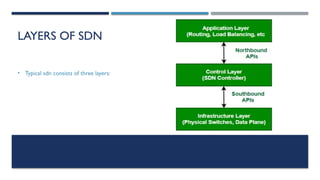
LAYERS OF SDN
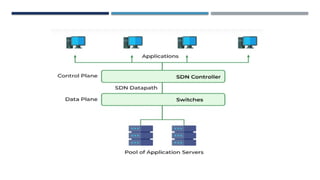
• Typical sdn consists of three layers:
LAYERS OF SDN
•Application layer: it contains the typical network applications like intrusion detection, firewall, and
load balancing.
•Control layer: it consists of the sdn controller which acts as the brain of the network. It also allows
hardware abstraction to the applications written on top of it.
•Infrastructure layer: this consists of physical switches which form the data plane and carries out the
actual movement of data packets.
The layers communicate via a set of interfaces called the north-bound
apis(between the application and control layer) and southbound apis(between
the control and infrastructure layer).
WHAT IS A DATA PLANE?
All the activities involving and resulting from data packets sent by the end-user belong to this plane. Data plane
includes:
•Forwarding of packets.
•Segmentation and reassembly of data.
•Replication of packets for multicasting.
WHAT IS A CONTROL PLANE?
All activities necessary to perform data plane activities but do not involve end-user data packets belong
to this plane. In other words, this is the brain of the network.The activities of the control plane include:
•Making routing tables.
•Setting packet handling policies.
WHAT ARE THE DIFFERENT MODELS OF SDN?
There are several models, which are used in SDN:
•Open SDN
•SDN via apis
•SDN via hypervisor-based overlay network
•Hybrid SDN
CLASS ACTIVITY
RESEARCH ABOUT DIFFERENT SDN
IMPORTANT LINKS
• https://www.ibm.com/think/topics/sdn
• https://www.geeksforgeeks.org/software-defined-networking/

the cloud Software-defined architectures

  • 1.
    NETWORKING IN CLOUD LECTURE04 BY BUSHRA ZAHEER
  • 2.
    TOPIC: CLOUD SOFTWAREDEFINED ARCHITECTURE
  • 3.
    SOFTWARE DRIVEN NETWORK Softwaredefined networking (SDN) is an approach to network management that enables dynamic, programmatically efficient network configuration to improve network performance and monitoring. It is a new way of managing computer networks that makes them easier and more flexible to control. In traditional networks, the hardware (like routers and switches) decides how data moves through the network, but sdn changes this by moving the decision-making to a central software system.This is done by separating the control plane (which decides where traffic is sent) from the data plane (which moves packets to the selected destination).
  • 5.
    SDN ARCHITECTURE • Ina traditional network, each switch has its own control plane and data plane. Switches exchange topology information to build a forwarding table that decides where to send data packets. In software-defined networking (SDN), the control plane is removed from switches and assigned to a centralized SDN controller. This allows network administrators to manage traffic from a single console instead of configuring each switch individually.
  • 6.
    LAYERS OF SDN •Typical sdn consists of three layers:
  • 7.
    LAYERS OF SDN •Applicationlayer: it contains the typical network applications like intrusion detection, firewall, and load balancing. •Control layer: it consists of the sdn controller which acts as the brain of the network. It also allows hardware abstraction to the applications written on top of it. •Infrastructure layer: this consists of physical switches which form the data plane and carries out the actual movement of data packets.
  • 8.
    The layers communicatevia a set of interfaces called the north-bound apis(between the application and control layer) and southbound apis(between the control and infrastructure layer).
  • 9.
    WHAT IS ADATA PLANE? All the activities involving and resulting from data packets sent by the end-user belong to this plane. Data plane includes: •Forwarding of packets. •Segmentation and reassembly of data. •Replication of packets for multicasting.
  • 10.
    WHAT IS ACONTROL PLANE? All activities necessary to perform data plane activities but do not involve end-user data packets belong to this plane. In other words, this is the brain of the network.The activities of the control plane include: •Making routing tables. •Setting packet handling policies.
  • 11.
    WHAT ARE THEDIFFERENT MODELS OF SDN? There are several models, which are used in SDN: •Open SDN •SDN via apis •SDN via hypervisor-based overlay network •Hybrid SDN

  • 12.
  • 13.
    IMPORTANT LINKS • https://www.ibm.com/think/topics/sdn •https://www.geeksforgeeks.org/software-defined-networking/