GROUP 2:
AHEM AHEM,
ARE YOU ALL
SET
TO DELVE
INTO OUR TOPIC?
YES OR NO?
What is Sociology?
Sociology is the study of
society, social relationships,
and institutions. It examines
how culture, norms, and values
shape human behavior. By
understanding sociology, we
can better comprehend the
complexities of social
structures and the interactions
that occur within them.
Social groups are essential
for human interaction,
providing a sense of
belonging and identity. They
can be categorized into
primary and secondary
groups, each serving
di erent functions in society.
Analyzing these groups helps
us understand the dynamics
of social behavior and
influence.
UNDERSTANDING
SOCIAL GROUPS
The Role of Social
Networks
Social networks consist of
relationships and connections
between individuals. They play a
vital role in the dissemination of
information and resources.
Understanding how these networks
operate can help us identify
influencers and predict social trends
within communities.
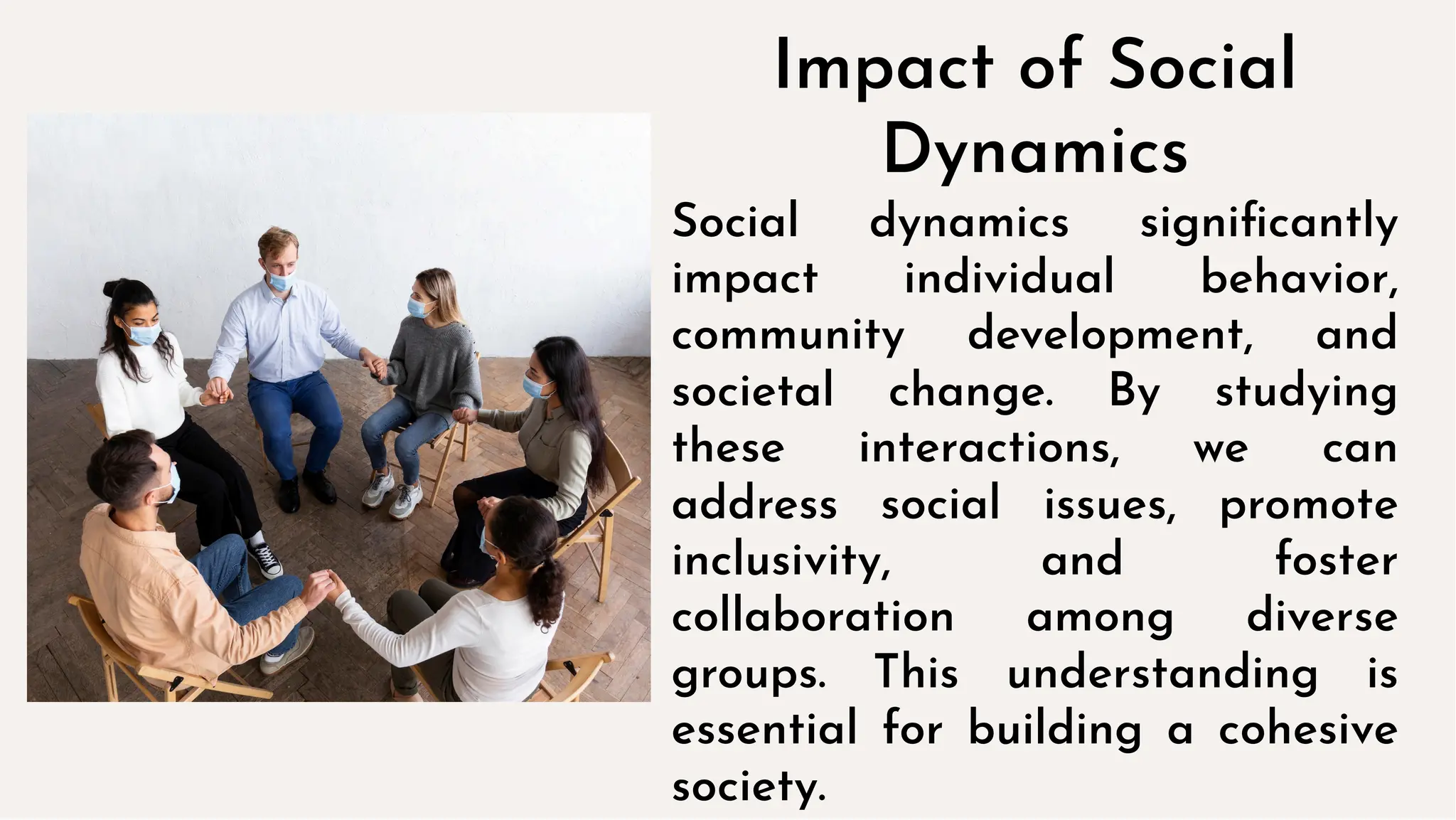
Impact of Social
Dynamics
Social dynamics significantly
impact individual behavior,
community development, and
societal change. By studying
these interactions, we can
address social issues, promote
inclusivity, and foster
collaboration among diverse
groups. This understanding is
essential for building a cohesive
society.
Exploring Social Dynamics:
Simmel's Groups and Mead's Self
in Contemporary Sociology
Exploring Social Dynamics:
Simmel's Groups and Mead's Self
in Contemporary Sociology
Social dynamics explores how individuals interact within groups.
This presentation focuses on Simmel's concepts of group
dynamics and Mead's theory of the self, highlighting their
relevance in contemporary sociology. We will examine how these
theories help us understand social behavior today.
Social dynamics explores how individuals interact within groups.
This presentation focuses on Simmel's concepts of group
dynamics and Mead's theory of the self, highlighting their
relevance in contemporary sociology. We will examine how these
theories help us understand social behavior today.
Georg Simmel (1858–1918), the German
sociologist who rejected simple
materialism and interactionism. He
believed society comprises complex
interactions that create more than the
sum of its parts. His work was
influential in philosophy and
sociology.Simmel's study of groups
and group behavior has gained some
important insights that would later be
used in social psychology and
sociology.
Simmel's Group Theory
Georg Simmel emphasized
the significance of group size
and structure in shaping
social interactions. He
identified different types of
groups, such as dyads and
triads, and how their
dynamics influence individual
behavior and social cohesion.
Understanding these
principles is crucial for
analyzing contemporary
social networks.
Georg Simmel emphasized
the significance of group size
and structure in shaping
social interactions. He
identified different types of
groups, such as dyads and
triads, and how their
dynamics influence individual
behavior and social cohesion.
Understanding these
principles is crucial for
analyzing contemporary
social networks.
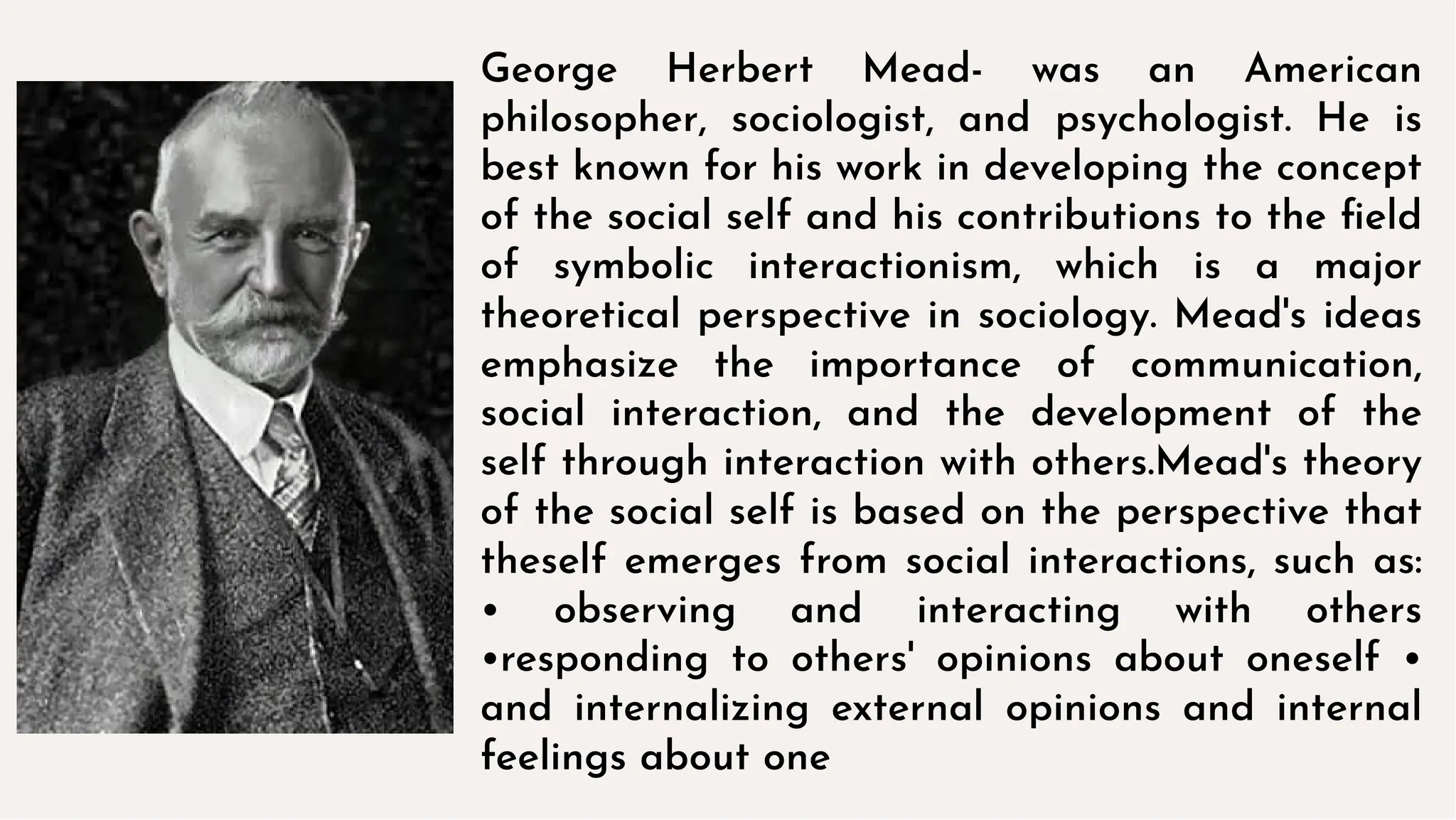
George Herbert Mead- was an American
philosopher, sociologist, and psychologist. He is
best known for his work in developing the concept
of the social self and his contributions to the field
of symbolic interactionism, which is a major
theoretical perspective in sociology. Mead's ideas
emphasize the importance of communication,
social interaction, and the development of the
self through interaction with others.Mead's theory
of the social self is based on the perspective that
theself emerges from social interactions, such as:
• observing and interacting with others
•responding to others' opinions about oneself •
and internalizing external opinions and internal
feelings about one
George Herbert Mead
introduced the idea that the
self is developed through
social interaction. He argued
that our identities are formed
through communication and
the roles we play in society.
This perspective is vital for
understanding individual
behavior in the context of
group dynamics.
George Herbert Mead
introduced the idea that the
self is developed through
social interaction. He argued
that our identities are formed
through communication and
the roles we play in society.
This perspective is vital for
understanding individual
behavior in the context of
group dynamics.
Mead's Concept of Self
In contemporary sociology, Simmel's and Mead's theories are applied
to analyze online communities, social movements, and
organizational behavior. By understanding how groups influence
individual identities, we can better comprehend the complexities of
modern social interactions and societal changes.
In contemporary sociology, Simmel's and Mead's theories are applied
to analyze online communities, social movements, and
organizational behavior. By understanding how groups influence
individual identities, we can better comprehend the complexities of
modern social interactions and societal changes.
The integration of Simmel's and Mead's theories offers valuable
insights into social behavior and identity formation. These frameworks
help sociologists address current challenges, such as polarization,
identity politics, and the impact of technology on social relationships.
Understanding these dynamics is crucial for future research.
The integration of Simmel's and Mead's theories offers valuable
insights into social behavior and identity formation. These frameworks
help sociologists address current challenges, such as polarization,
identity politics, and the impact of technology on social relationships.
Understanding these dynamics is crucial for future research.
Thanks!
Thanks!
MEMBERS:
NICOLE B. LLEGO
MAE C. NUNEZ
ARIANE D. GALEOS
MEMBERS:
NICOLE B. LLEGO
MAE C. NUNEZ
ARIANE D. GALEOS

SOCIOLOGY, GEORGE SIMMEL AND GEORGE HERBERT MEAD THEORY SHORT PRESENTATION

  • 1.
    GROUP 2: AHEM AHEM, AREYOU ALL SET TO DELVE INTO OUR TOPIC? YES OR NO?
  • 2.
    What is Sociology? Sociologyis the study of society, social relationships, and institutions. It examines how culture, norms, and values shape human behavior. By understanding sociology, we can better comprehend the complexities of social structures and the interactions that occur within them.
  • 3.
    Social groups areessential for human interaction, providing a sense of belonging and identity. They can be categorized into primary and secondary groups, each serving di erent functions in society. Analyzing these groups helps us understand the dynamics of social behavior and influence. UNDERSTANDING SOCIAL GROUPS
  • 4.
    The Role ofSocial Networks Social networks consist of relationships and connections between individuals. They play a vital role in the dissemination of information and resources. Understanding how these networks operate can help us identify influencers and predict social trends within communities.
  • 5.
    Impact of Social Dynamics Socialdynamics significantly impact individual behavior, community development, and societal change. By studying these interactions, we can address social issues, promote inclusivity, and foster collaboration among diverse groups. This understanding is essential for building a cohesive society.
  • 6.
    Exploring Social Dynamics: Simmel'sGroups and Mead's Self in Contemporary Sociology Exploring Social Dynamics: Simmel's Groups and Mead's Self in Contemporary Sociology
  • 7.
    Social dynamics exploreshow individuals interact within groups. This presentation focuses on Simmel's concepts of group dynamics and Mead's theory of the self, highlighting their relevance in contemporary sociology. We will examine how these theories help us understand social behavior today. Social dynamics explores how individuals interact within groups. This presentation focuses on Simmel's concepts of group dynamics and Mead's theory of the self, highlighting their relevance in contemporary sociology. We will examine how these theories help us understand social behavior today.
  • 8.
    Georg Simmel (1858–1918),the German sociologist who rejected simple materialism and interactionism. He believed society comprises complex interactions that create more than the sum of its parts. His work was influential in philosophy and sociology.Simmel's study of groups and group behavior has gained some important insights that would later be used in social psychology and sociology.
  • 9.
    Simmel's Group Theory Simmel'sGroup Theory Georg Simmel emphasized the significance of group size and structure in shaping social interactions. He identified different types of groups, such as dyads and triads, and how their dynamics influence individual behavior and social cohesion. Understanding these principles is crucial for analyzing contemporary social networks. Georg Simmel emphasized the significance of group size and structure in shaping social interactions. He identified different types of groups, such as dyads and triads, and how their dynamics influence individual behavior and social cohesion. Understanding these principles is crucial for analyzing contemporary social networks.
  • 10.
    George Herbert Mead-was an American philosopher, sociologist, and psychologist. He is best known for his work in developing the concept of the social self and his contributions to the field of symbolic interactionism, which is a major theoretical perspective in sociology. Mead's ideas emphasize the importance of communication, social interaction, and the development of the self through interaction with others.Mead's theory of the social self is based on the perspective that theself emerges from social interactions, such as: • observing and interacting with others •responding to others' opinions about oneself • and internalizing external opinions and internal feelings about one
  • 11.
    George Herbert Mead introducedthe idea that the self is developed through social interaction. He argued that our identities are formed through communication and the roles we play in society. This perspective is vital for understanding individual behavior in the context of group dynamics. George Herbert Mead introduced the idea that the self is developed through social interaction. He argued that our identities are formed through communication and the roles we play in society. This perspective is vital for understanding individual behavior in the context of group dynamics. Mead's Concept of Self Mead's Concept of Self
  • 12.
    In contemporary sociology,Simmel's and Mead's theories are applied to analyze online communities, social movements, and organizational behavior. By understanding how groups influence individual identities, we can better comprehend the complexities of modern social interactions and societal changes. In contemporary sociology, Simmel's and Mead's theories are applied to analyze online communities, social movements, and organizational behavior. By understanding how groups influence individual identities, we can better comprehend the complexities of modern social interactions and societal changes.
  • 13.
    The integration ofSimmel's and Mead's theories offers valuable insights into social behavior and identity formation. These frameworks help sociologists address current challenges, such as polarization, identity politics, and the impact of technology on social relationships. Understanding these dynamics is crucial for future research. The integration of Simmel's and Mead's theories offers valuable insights into social behavior and identity formation. These frameworks help sociologists address current challenges, such as polarization, identity politics, and the impact of technology on social relationships. Understanding these dynamics is crucial for future research.
  • 14.
    Thanks! Thanks! MEMBERS: NICOLE B. LLEGO MAEC. NUNEZ ARIANE D. GALEOS MEMBERS: NICOLE B. LLEGO MAE C. NUNEZ ARIANE D. GALEOS