CENTRAL SOCIAL WELFARE
BOARD OF INDIA
PREPARED BY,
APARNA.S.S
IV BSc.(N)
SSNMM College of Nursing,
Varkala.
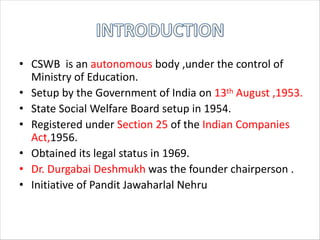
• CSWB is an autonomous body ,under the control of
Ministry of Education.
• Setup by the Government of India on 13th August ,1953.
• State Social Welfare Board setup in 1954.
• Registered under Section 25 of the Indian Companies
Act,1956.
• Obtained its legal status in 1969.
• Dr. Durgabai Deshmukh was the founder chairperson .
• Initiative of Pandit Jawaharlal Nehru
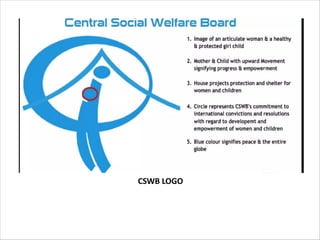
CSWB LOGO
• To raise the awareness about legal and human
rights of women and girl child and to run
campaigns against social evils affecting them.
• Promoting social welfare activities and
implementing welfare programmes for women,
children and the handicapped through voluntary
organizations.
The Board must
• Act as a change maker with humanitarian
approach by reinforcing the spirit of voluntarism
• Create an enabling mechanism to facilitate
networking of committed social workers for the
empowerment of women and children.
• Develop a group of sensitive professionals with a
gender centric vision committed to equity ,justice
and social change.
• Strengthens voluntary organizations.
• Initiate and strengthen its monitoring role to
act as a social audit and guide for the
voluntary sectors so as to access government
funds as resource.
• Generate awareness about the challenges of
society in transition where negative use of
technologies and practices are impacting on
the wellbeing of women and children.
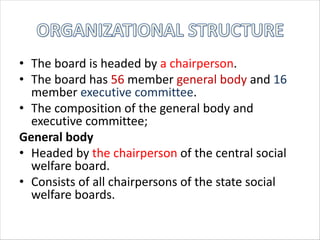
• The board is headed by a chairperson.
• The board has 56 member general body and 16
member executive committee.
• The composition of the general body and
executive committee;
General body
• Headed by the chairperson of the central social
welfare board.
• Consists of all chairpersons of the state social
welfare boards.
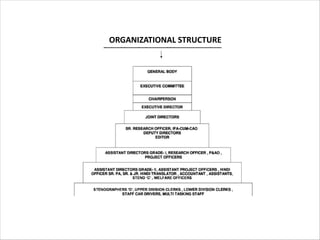
ORGANIZATIONAL STRUCTURE
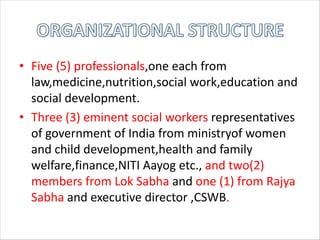
• Five (5) professionals,one each from
law,medicine,nutrition,social work,education and
social development.
• Three (3) eminent social workers representatives
of government of India from ministryof women
and child development,health and family
welfare,finance,NITI Aayog etc., and two(2)
members from Lok Sabha and one (1) from Rajya
Sabha and executive director ,CSWB.
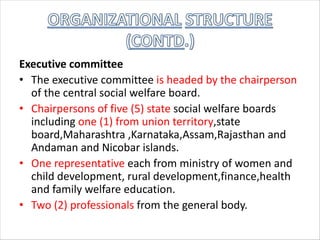
Executive committee
• The executive committee is headed by the chairperson
of the central social welfare board.
• Chairpersons of five (5) state social welfare boards
including one (1) from union territory,state
board,Maharashtra ,Karnataka,Assam,Rajasthan and
Andaman and Nicobar islands.
• One representative each from ministry of women and
child development, rural development,finance,health
and family welfare education.
• Two (2) professionals from the general body.
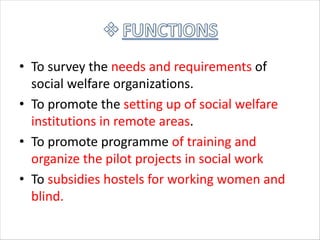
• To survey the needs and requirements of
social welfare organizations.
• To promote the setting up of social welfare
institutions in remote areas.
• To promote programme of training and
organize the pilot projects in social work
• To subsidies hostels for working women and
blind.
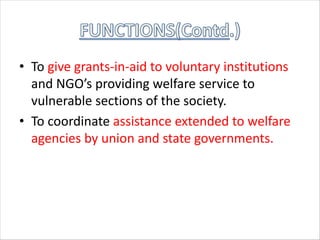
• To give grants-in-aid to voluntary institutions
and NGO’s providing welfare service to
vulnerable sections of the society.
• To coordinate assistance extended to welfare
agencies by union and state governments.
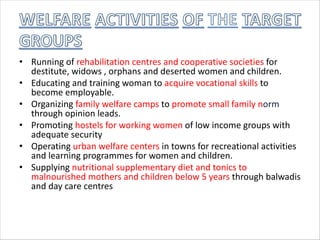
• Running of rehabilitation centres and cooperative societies for
destitute, widows , orphans and deserted women and children.
• Educating and training woman to acquire vocational skills to
become employable.
• Organizing family welfare camps to promote small family norm
through opinion leads.
• Promoting hostels for working women of low income groups with
adequate security
• Operating urban welfare centers in towns for recreational activities
and learning programmes for women and children.
• Supplying nutritional supplementary diet and tonics to
malnourished mothers and children below 5 years through balwadis
and day care centres

CENTRAL SOCIAL WELFARE BOARD.pdf

  • 1.
    CENTRAL SOCIAL WELFARE BOARDOF INDIA PREPARED BY, APARNA.S.S IV BSc.(N) SSNMM College of Nursing, Varkala.
  • 3.
    • CSWB isan autonomous body ,under the control of Ministry of Education. • Setup by the Government of India on 13th August ,1953. • State Social Welfare Board setup in 1954. • Registered under Section 25 of the Indian Companies Act,1956. • Obtained its legal status in 1969. • Dr. Durgabai Deshmukh was the founder chairperson . • Initiative of Pandit Jawaharlal Nehru
  • 4.
  • 5.
    • To raisethe awareness about legal and human rights of women and girl child and to run campaigns against social evils affecting them. • Promoting social welfare activities and implementing welfare programmes for women, children and the handicapped through voluntary organizations.
  • 6.
    The Board must •Act as a change maker with humanitarian approach by reinforcing the spirit of voluntarism • Create an enabling mechanism to facilitate networking of committed social workers for the empowerment of women and children. • Develop a group of sensitive professionals with a gender centric vision committed to equity ,justice and social change.
  • 7.
    • Strengthens voluntaryorganizations. • Initiate and strengthen its monitoring role to act as a social audit and guide for the voluntary sectors so as to access government funds as resource. • Generate awareness about the challenges of society in transition where negative use of technologies and practices are impacting on the wellbeing of women and children.
  • 8.
    • The boardis headed by a chairperson. • The board has 56 member general body and 16 member executive committee. • The composition of the general body and executive committee; General body • Headed by the chairperson of the central social welfare board. • Consists of all chairpersons of the state social welfare boards.
  • 9.
  • 10.
    • Five (5)professionals,one each from law,medicine,nutrition,social work,education and social development. • Three (3) eminent social workers representatives of government of India from ministryof women and child development,health and family welfare,finance,NITI Aayog etc., and two(2) members from Lok Sabha and one (1) from Rajya Sabha and executive director ,CSWB.
  • 11.
    Executive committee • Theexecutive committee is headed by the chairperson of the central social welfare board. • Chairpersons of five (5) state social welfare boards including one (1) from union territory,state board,Maharashtra ,Karnataka,Assam,Rajasthan and Andaman and Nicobar islands. • One representative each from ministry of women and child development, rural development,finance,health and family welfare education. • Two (2) professionals from the general body.
  • 12.
    • To surveythe needs and requirements of social welfare organizations. • To promote the setting up of social welfare institutions in remote areas. • To promote programme of training and organize the pilot projects in social work • To subsidies hostels for working women and blind.
  • 13.
    • To givegrants-in-aid to voluntary institutions and NGO’s providing welfare service to vulnerable sections of the society. • To coordinate assistance extended to welfare agencies by union and state governments.
  • 14.
    • Running ofrehabilitation centres and cooperative societies for destitute, widows , orphans and deserted women and children. • Educating and training woman to acquire vocational skills to become employable. • Organizing family welfare camps to promote small family norm through opinion leads. • Promoting hostels for working women of low income groups with adequate security • Operating urban welfare centers in towns for recreational activities and learning programmes for women and children. • Supplying nutritional supplementary diet and tonics to malnourished mothers and children below 5 years through balwadis and day care centres