Social Recommendation
Social Recommendation with Strong and Weak Ties
References
Social Recommendation with Strong and Weak
Ties
X. Wang12 W. Lu3 M. Ester2 C. Wang1 C. Chun1
1College of Computer Science and Technology
Zhejiang University
2School of Computing Science
Simon Fraser University
3Department of Computer Science
University of British Columbia
CIKM, 2016
X. Wang, W. Lu, M. Ester, C. Wang, C. Chun Social Recommendation with Strong and Weak Ties
Social Recommendation
Social Recommendation with Strong and Weak Ties
References
Outline
1 Social Recommendation
Social Rating Networks
Rating Prediction
Top-N Item Recommendation
2 Social Recommendation with Strong and Weak Ties
Social Ties in Social Science
Social Ties in Online Social Networks
Social Ties in Social Recommendations
X. Wang, W. Lu, M. Ester, C. Wang, C. Chun Social Recommendation with Strong and Weak Ties
Social Recommendation
Social Recommendation with Strong and Weak Ties
References
Social Rating Networks
Rating Prediction
Top-N Item Recommendation
Outline
1 Social Recommendation
Social Rating Networks
Rating Prediction
Top-N Item Recommendation
2 Social Recommendation with Strong and Weak Ties
Social Ties in Social Science
Social Ties in Online Social Networks
Social Ties in Social Recommendations
X. Wang, W. Lu, M. Ester, C. Wang, C. Chun Social Recommendation with Strong and Weak Ties
Social Recommendation
Social Recommendation with Strong and Weak Ties
References
Social Rating Networks
Rating Prediction
Top-N Item Recommendation
Social Rating Networks
Social network, where users are associated with item ratings.
Item ratings can be numeric [1..5]
or Boolean (bookmark url, like article, watch TV series . . .).
Social action: create social relationship, rating action: rate an
item.
Martin Ester: Recommendation in Social Networks, Tutorial at RecSys 2013
13
Social Rating Networks
0.8
0.7
X. Wang, W. Lu, M. Ester, C. Wang, C. Chun Social Recommendation with Strong and Weak Ties
Social Recommendation
Social Recommendation with Strong and Weak Ties
References
Social Rating Networks
Rating Prediction
Top-N Item Recommendation
Matrix Factorization
Rating Prediction
A matrix factorization model [6] assumes the rating matrix R can
be approximated by a multiplication of d-rank factors,
R ≈ PT
Q, (1)
where P ∈ Rd×|U| and Q ∈ Rd×|I|. Normally d is far less than
both |U| and |I|. Thus given a user u and an item i, the rating
Rui of u for i can be approximated by the dot product of user
latent feature vector Pu and item latent feature Qi ,
Rui ≈ PT
u Qi = Pu, Qi , (2)
where Pu ∈ Rd×1 is the uth column of P and Qi ∈ Rd×1 is the ith
column of Q.
X. Wang, W. Lu, M. Ester, C. Wang, C. Chun Social Recommendation with Strong and Weak Ties
Social Recommendation
Social Recommendation with Strong and Weak Ties
References
Social Rating Networks
Rating Prediction
Top-N Item Recommendation
Probabilistic Matrix Factorization
Rating Prediction
Social Networks, Tutorial at RecSys 2013
46
el based approaches
at minimize
)()
222
),
VURR ui
iu
ui ++− λ
)
ks, Tutorial at RecSys 2013
47
SoRec
a et al. 2008]
n model
gs and links together.
a binary matrix.
or items.
for users:
or,
er.
or both contexts (rating
actions). Martin Ester: Recommendation in Social Networks, Tutorial at RecSys 2013
50
Social Trust Ensemble
• Graphical model
Martin Ester: Recommendation in Social Networks, Tutorial at RecSys 2013
SocialMF
)((((
)()(
,,
222
),(
v
vvuu
v
vvu
u
u
ui
iuobservedall
ui
UTUUTU
VURR
∑∑∑
∑
−−+
++−
β
λ
)
(a) PMF[9] (b) SoRec[8] (c) STE[7] (d) SMF[5]
Figure: Graphical Models of Several Social Recommendation Models
X. Wang, W. Lu, M. Ester, C. Wang, C. Chun Social Recommendation with Strong and Weak Ties
Social Recommendation
Social Recommendation with Strong and Weak Ties
References
Social Rating Networks
Rating Prediction
Top-N Item Recommendation
Bayesian Personalized Ranking (BPR)
Top-N Item Recommendation
BPR [10] categorizes items into two groups:
1 Consumed Items. For all u ∈ U, let Cself
u ⊆ I denote the set
of items consumed by u itself.
2 Non-Consumed Items. This category contains the rest of
the items (not consumed by u ): Cnone
u = {i : i ∈ I  Cself
u }.
Clearly, for all u ∈ U, Cself
u ∪ Cnone
u = I.
X. Wang, W. Lu, M. Ester, C. Wang, C. Chun Social Recommendation with Strong and Weak Ties
Social Recommendation
Social Recommendation with Strong and Weak Ties
References
Social Rating Networks
Rating Prediction
Top-N Item Recommendation
Intuitively, each user u should prefer the consumed items to
non-consumed items, i.e., the consumed items should be ranked
ahead of the non-consumed ones. Mathematically,
i u j, if i ∈ Cself
u ∧ j ∈ Cnone
u . (3)
The likelihood function can be expressed as:
L(Θ) =
u∈U i∈Cself
u
j∈Cnone
u
Pr[i u j] , (4)
where the probability that consumed items are preferred over
non-consumed items is as follows:
Pr[i u j] = δ(ˆxui − ˆxuj ) =
1
1 + exp(−(ˆxui − ˆxuj ))
=
1
1 + exp(− Pu, Qi + Pu, Qj )
.
(5)
X. Wang, W. Lu, M. Ester, C. Wang, C. Chun Social Recommendation with Strong and Weak Ties
Social Recommendation
Social Recommendation with Strong and Weak Ties
References
Social Rating Networks
Rating Prediction
Top-N Item Recommendation
Social Bayesian Personalized Ranking (SBPR)
Top-N Item Recommendation
SBPR [11] categorizes items into three groups:
1 Consumed Items. For all u ∈ U, let Cself
u ⊆ I denote the set
of items consumed by u itself.
2 Social-Consumed Items. Any item i ∈ I  Cself
u that has
been consumed by at least one of u’s social ties i.e., Tu,
belongs to this category. We denote this set by
Ctie
u = {i ∈ I  Cself
u : ∃v ∈ Tu s.t. i ∈ Cself
v }
3 Non-Consumed Items. This category contains the rest of
the items (not consumed by u or any of u’s social ties):
X. Wang, W. Lu, M. Ester, C. Wang, C. Chun Social Recommendation with Strong and Weak Ties
Social Recommendation
Social Recommendation with Strong and Weak Ties
References
Social Rating Networks
Rating Prediction
Top-N Item Recommendation
Social Bayesian Personalized Ranking (SBPR)
Top-N Item Recommendation
With the new categorization, Social-Consumed Items are
assumed to lie between Consumed Items and Non-Consumed
Items for each user u :
i u j, if
i ∈ Cself
u ∧ j ∈ Ctie
u or
i ∈ Ctie
u ∧ j ∈ Cnone
u .
(6)
And the likelihood function is:
L(Θ) =
u∈U i∈Cself
u j∈Ctie
u
Pr[i u j]
j∈Ctie
u k∈Cnone
u
Pr[j u k] . (7)
X. Wang, W. Lu, M. Ester, C. Wang, C. Chun Social Recommendation with Strong and Weak Ties
Social Recommendation
Social Recommendation with Strong and Weak Ties
References
Social Ties in Social Science
Social Ties in Online Social Networks
Social Ties in Social Recommendations
Outline
1 Social Recommendation
Social Rating Networks
Rating Prediction
Top-N Item Recommendation
2 Social Recommendation with Strong and Weak Ties
Social Ties in Social Science
Social Ties in Online Social Networks
Social Ties in Social Recommendations
X. Wang, W. Lu, M. Ester, C. Wang, C. Chun Social Recommendation with Strong and Weak Ties
Social Recommendation
Social Recommendation with Strong and Weak Ties
References
Social Ties in Social Science
Social Ties in Online Social Networks
Social Ties in Social Recommendations
Getting a job: A study of contacts and careers
by Granovetter
Statements from Granovetter’s influential work [3, 2]:
Three different types of social ties, measured in terms of how
often they saw the contact person during the period of the job
transition:
Strong : at least once a week
Weak : more than once a year but less than twice a week
Absent : less than once a year
X. Wang, W. Lu, M. Ester, C. Wang, C. Chun Social Recommendation with Strong and Weak Ties
Social Recommendation
Social Recommendation with Strong and Weak Ties
References
Social Ties in Social Science
Social Ties in Online Social Networks
Social Ties in Social Recommendations
Getting a job: A study of contacts and careers
by Granovetter
Statements from Granovetter’s influential work [3, 2]:
Three different types of social ties, measured in terms of how
often they saw the contact person during the period of the job
transition:
Strong : at least once a week
Weak : more than once a year but less than twice a week
Absent : less than once a year
Weak ties are actually the most important reason for new
information or innovations to spread over social networks.
X. Wang, W. Lu, M. Ester, C. Wang, C. Chun Social Recommendation with Strong and Weak Ties
Social Recommendation
Social Recommendation with Strong and Weak Ties
References
Social Ties in Social Science
Social Ties in Online Social Networks
Social Ties in Social Recommendations
Getting a job: A study of contacts and careers
by Granovetter
Statements from Granovetter’s influential work [3, 2]:
Three different types of social ties, measured in terms of how
often they saw the contact person during the period of the job
transition:
Strong : at least once a week
Weak : more than once a year but less than twice a week
Absent : less than once a year
Weak ties are actually the most important reason for new
information or innovations to spread over social networks.
Late 1960s and early 1970s — no online social networks.
X. Wang, W. Lu, M. Ester, C. Wang, C. Chun Social Recommendation with Strong and Weak Ties
Social Recommendation
Social Recommendation with Strong and Weak Ties
References
Social Ties in Social Science
Social Ties in Online Social Networks
Social Ties in Social Recommendations
Two Challenges
Social Ties in Online Social Networks
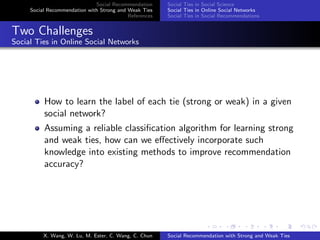
How to learn the label of each tie (strong or weak) in a given
social network?
Assuming a reliable classification algorithm for learning strong
and weak ties, how can we effectively incorporate such
knowledge into existing methods to improve recommendation
accuracy?
X. Wang, W. Lu, M. Ester, C. Wang, C. Chun Social Recommendation with Strong and Weak Ties
Social Recommendation
Social Recommendation with Strong and Weak Ties
References
Social Ties in Social Science
Social Ties in Online Social Networks
Social Ties in Social Recommendations
Solutions
Social Ties in Online Social Networks
Utilizing features intrinsic to the network topology:
Jaccard’s Coefficient
Adamic-Adar
Katz score
In a recent work [1] on how strong ties and weak ties relate to job
finding on Facebook’s social network, Gee et.al use both mutual
interactions and node similarity (similar to Jaccard’s coefficient) to
measure tie strength and find results to be similar for both kinds of
measures, which provides support for using Jaccard’s coefficient as
tie strength measure.
X. Wang, W. Lu, M. Ester, C. Wang, C. Chun Social Recommendation with Strong and Weak Ties
Social Recommendation
Social Recommendation with Strong and Weak Ties
References
Social Ties in Social Science
Social Ties in Online Social Networks
Social Ties in Social Recommendations
Jaccard’s Coefficient and Thresholding
Social Ties in Online Social Networks
Jaccard’s Coefficient [4]:
strength(u, v) =def
|Nu ∩ Nv |
|Nu ∪ Nv |
(Jaccard), (8)
where Nu ⊆ U (resp. Nv ⊆ U) denotes the set of ties of u
(resp. v).
For a given social network graph G, let θG ∈ [0, 1) denote the
threshold of tie strength such that
(u, v) is
strong, if strength(u, v) > θG;
weak, if strength(u, v) ≤ θG.
(9)
X. Wang, W. Lu, M. Ester, C. Wang, C. Chun Social Recommendation with Strong and Weak Ties
Social Recommendation
Social Recommendation with Strong and Weak Ties
References
Social Ties in Social Science
Social Ties in Online Social Networks
Social Ties in Social Recommendations
Categorizing items
Social Ties in Social Recommendations
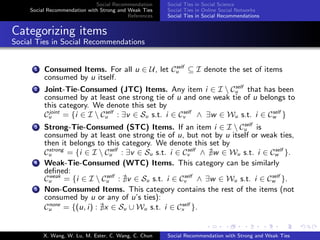
1 Consumed Items. For all u ∈ U, let Cself
u ⊆ I denote the set of items
consumed by u itself.
2 Joint-Tie-Consumed (JTC) Items. Any item i ∈ I  Cself
u that has been
consumed by at least one strong tie of u and one weak tie of u belongs to
this category. We denote this set by
Cjoint
u = {i ∈ I  Cself
u : ∃v ∈ Su s.t. i ∈ Cself
v ∧ ∃w ∈ Wu s.t. i ∈ Cself
w }
3 Strong-Tie-Consumed (STC) Items. If an item i ∈ I  Cself
u is
consumed by at least one strong tie of u, but not by u itself or weak ties,
then it belongs to this category. We denote this set by
Cstrong
u = {i ∈ I  Cself
u : ∃v ∈ Su s.t. i ∈ Cself
v ∧ w ∈ Wu s.t. i ∈ Cself
w }.
4 Weak-Tie-Consumed (WTC) Items. This category can be similarly
defined:
Cweak
u = {i ∈ I  Cself
u : v ∈ Su s.t. i ∈ Cself
v ∧ ∃w ∈ Wu s.t. i ∈ Cself
w }.
5 Non-Consumed Items. This category contains the rest of the items (not
consumed by u or any of u’s ties):
Cnone
u = {(u, i) : x ∈ Su ∪ Wu s.t. i ∈ Cself
x }.
X. Wang, W. Lu, M. Ester, C. Wang, C. Chun Social Recommendation with Strong and Weak Ties
Social Recommendation
Social Recommendation with Strong and Weak Ties
References
Social Ties in Social Science
Social Ties in Online Social Networks
Social Ties in Social Recommendations
TBPR (BPR with Strong and Weak Ties)
Social Ties in Social Recommendations
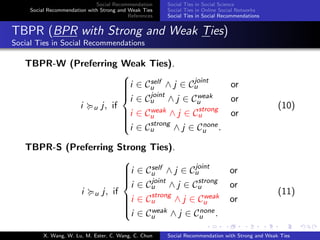
TBPR-W (Preferring Weak Ties).
i u j, if



i ∈ Cself
u ∧ j ∈ Cjoint
u or
i ∈ Cjoint
u ∧ j ∈ Cweak
u or
i ∈ Cweak
u ∧ j ∈ Cstrong
u or
i ∈ Cstrong
u ∧ j ∈ Cnone
u .
(10)
TBPR-S (Preferring Strong Ties).
i u j, if



i ∈ Cself
u ∧ j ∈ Cjoint
u or
i ∈ Cjoint
u ∧ j ∈ Cstrong
u or
i ∈ Cstrong
u ∧ j ∈ Cweak
u or
i ∈ Cweak
u ∧ j ∈ Cnone
u .
(11)
X. Wang, W. Lu, M. Ester, C. Wang, C. Chun Social Recommendation with Strong and Weak Ties
Social Recommendation
Social Recommendation with Strong and Weak Ties
References
Social Ties in Social Science
Social Ties in Online Social Networks
Social Ties in Social Recommendations
Likelihood Function
Social Ties in Social Recommendations
L(Θ) =
u∈U i∈Cself
u j∈C
joint
u
Pr[i u j]
j∈C
joint
u
w∈Cweak
u
Pr[j u w]
w∈Cweak
u s∈C
strong
u
Pr[w u s]
s∈C
strong
u
k∈Cnone
u
Pr[s u k] , (12)
where for instance, the probability that consumed items are
preferred over JTC items can be written as follows.
Pr[i u j] = δ(ˆxui − ˆxuj ) =
1
1 + exp(−(ˆxui − ˆxuj ))
=
1
1 + exp(− Pu, Qi + Pu, Qj )
.
(13)
X. Wang, W. Lu, M. Ester, C. Wang, C. Chun Social Recommendation with Strong and Weak Ties
Social Recommendation
Social Recommendation with Strong and Weak Ties
References
Social Ties in Social Science
Social Ties in Online Social Networks
Social Ties in Social Recommendations
Incorporating the Tie Strength Threshold
Social Ties in Social Recommendations
Given a threshold θG, the degree of separation between strong ties
and weak ties imposed by this threshold can be quantitatively
measured using the following formula:
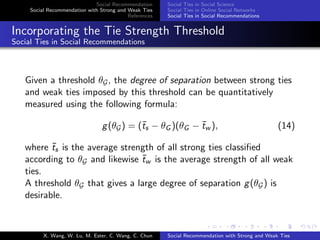
g(θG) = (¯ts − θG )(θG − ¯tw ), (14)
where ¯ts is the average strength of all strong ties classified
according to θG and likewise ¯tw is the average strength of all weak
ties.
A threshold θG that gives a large degree of separation g(θG) is
desirable.
X. Wang, W. Lu, M. Ester, C. Wang, C. Chun Social Recommendation with Strong and Weak Ties
Social Recommendation
Social Recommendation with Strong and Weak Ties
References
Social Ties in Social Science
Social Ties in Online Social Networks
Social Ties in Social Recommendations
Incorporating the Tie Strength Threshold
Social Ties in Social Recommendations
To incorporate the threshold into the objective function so that our
TBPR model is able to learn it in a principled manner, we add a
coefficient 1/g(θG) into the probability that WTC items are
preferred over STC items. More specifically, we define:
Pr[w u s] = δ
ˆxuw − ˆxus
1 + 1/g(θG)
=
1
1 + exp − ˆxuw −ˆxus
1+1/g(θG )
=
1
1 + exp − Pu,Qw + Pu,Qs
1+1/g(θG )
, (15)
where we use 1 + 1/g(θG) to discount (ˆxuw − ˆxus), the difference
between u’s predicted score for w and s. The intuition is that, if
the current threshold θG does not separate the strong and weak
ties well enough, the likelihood that user prefers w (an WTC item
given the current threshold) to s (an STC items given the current
threshold) should be discounted.
X. Wang, W. Lu, M. Ester, C. Wang, C. Chun Social Recommendation with Strong and Weak Ties
Social Recommendation
Social Recommendation with Strong and Weak Ties
References
Social Ties in Social Science
Social Ties in Online Social Networks
Social Ties in Social Recommendations
Experimental Results
Social Ties in Social Recommendations
0.01
0.02
0.03
0.04
0.00 0.05 0.10 0.15
Recall
Precision
Method
TBPR−W
TBPR−S
SBPR
BPR
WRMF
MostPop
0.010
0.015
0.025 0.050 0.075 0.100 0.125
Recall
Precision
Method
TBPR−W
TBPR−S
SBPR
BPR
WRMF
MostPop
0.10
0.14
0.18
0.05 0.10 0.15 0.20
Recall
Precision
Method
TBPR−W
TBPR−S
SBPR
BPR
WRMF
MostPop
0.010
0.015
0.020
0.025
0.025 0.050 0.075 0.100 0.125
Recall
Precision
Method
TBPR−W
TBPR−S
SBPR
BPR
WRMF
MostPop
(a) DBLP (b) Ciao (c) Douban (d) Epinions
Figure: Precision@K vs Recall@K on all users, K ranges from 5 to 50
0.00
0.02
0.04
0.06
Pre@5 Rec@5 MAP MRR
Metrics
Values
Method
BPR
SBPR
TBPR−S
TBPR−W
0.00
0.01
0.02
Pre@5 Rec@5 MAP MRR
Metrics
Values
Method
BPR
SBPR
TBPR−S
TBPR−W
0.000
0.025
0.050
0.075
Pre@5 Rec@5 MAP MRR
Metrics
Values
Method
BPR
SBPR
TBPR−S
TBPR−W
0.00
0.01
0.02
0.03
Pre@5 Rec@5 MAP MRR
Metrics
Values
Method
BPR
SBPR
TBPR−S
TBPR−W
(a) DBLP (b) Ciao (c) Douban (d) Epinions
Figure: Performance (Recall, Precision, MAP, MRR) on cold-start users
X. Wang, W. Lu, M. Ester, C. Wang, C. Chun Social Recommendation with Strong and Weak Ties
Social Recommendation
Social Recommendation with Strong and Weak Ties
References
Thank you !
X. Wang, W. Lu, M. Ester, C. Wang, C. Chun Social Recommendation with Strong and Weak Ties
Social Recommendation
Social Recommendation with Strong and Weak Ties
References
L. K. Gee, J. J. Jones, and M. Burke.
Social networks and labor markets: How strong ties relate to
job finding on facebook’s social network.
2016.
M. S. Granovetter.
The strength of weak ties.
American journal of sociology, pages 1360–1380, 1973.
M. S. Granovetter.
Getting a job: A study of contacts and careers.
University of Chicago Press, 1974.
P. Jaccard.
Distribution de la Flore Alpine: dans le Bassin des dranses et
dans quelques r´egions voisines.
Rouge, 1901.
M. Jamali and M. Ester.
X. Wang, W. Lu, M. Ester, C. Wang, C. Chun Social Recommendation with Strong and Weak Ties
Social Recommendation
Social Recommendation with Strong and Weak Ties
References
A matrix factorization technique with trust propagation for
recommendation in social networks.
In Proceedings of the fourth ACM conference on
Recommender systems, pages 135–142. ACM, 2010.
Y. Koren, R. Bell, and C. Volinsky.
Matrix factorization techniques for recommender systems.
Computer, (8):30–37, 2009.
H. Ma, I. King, and M. R. Lyu.
Learning to recommend with social trust ensemble.
In Proceedings of the 32nd international ACM SIGIR
conference on Research and development in information
retrieval, pages 203–210. ACM, 2009.
H. Ma, H. Yang, M. R. Lyu, and I. King.
SoRec: social recommendation using probabilistic matrix
factorization.
X. Wang, W. Lu, M. Ester, C. Wang, C. Chun Social Recommendation with Strong and Weak Ties
Social Recommendation
Social Recommendation with Strong and Weak Ties
References
In CIKM, pages 931–940, 2008.
A. Mnih and R. Salakhutdinov.
Probabilistic matrix factorization.
In Advances in neural information processing systems, pages
1257–1264, 2007.
S. Rendle, C. Freudenthaler, Z. Gantner, and
L. Schmidt-Thieme.
BPR: Bayesian personalized ranking from implicit feedback.
In UAI, pages 452–461, 2009.
T. Zhao, J. McAuley, and I. King.
Leveraging social connections to improve personalized ranking
for collaborative filtering.
In CIKM, pages 261–270, 2014.
X. Wang, W. Lu, M. Ester, C. Wang, C. Chun Social Recommendation with Strong and Weak Ties

Social Recommendation with Strong and Weak Ties

  • 1.
    Social Recommendation Social Recommendationwith Strong and Weak Ties References Social Recommendation with Strong and Weak Ties X. Wang12 W. Lu3 M. Ester2 C. Wang1 C. Chun1 1College of Computer Science and Technology Zhejiang University 2School of Computing Science Simon Fraser University 3Department of Computer Science University of British Columbia CIKM, 2016 X. Wang, W. Lu, M. Ester, C. Wang, C. Chun Social Recommendation with Strong and Weak Ties
  • 2.
    Social Recommendation Social Recommendationwith Strong and Weak Ties References Outline 1 Social Recommendation Social Rating Networks Rating Prediction Top-N Item Recommendation 2 Social Recommendation with Strong and Weak Ties Social Ties in Social Science Social Ties in Online Social Networks Social Ties in Social Recommendations X. Wang, W. Lu, M. Ester, C. Wang, C. Chun Social Recommendation with Strong and Weak Ties
  • 3.
    Social Recommendation Social Recommendationwith Strong and Weak Ties References Social Rating Networks Rating Prediction Top-N Item Recommendation Outline 1 Social Recommendation Social Rating Networks Rating Prediction Top-N Item Recommendation 2 Social Recommendation with Strong and Weak Ties Social Ties in Social Science Social Ties in Online Social Networks Social Ties in Social Recommendations X. Wang, W. Lu, M. Ester, C. Wang, C. Chun Social Recommendation with Strong and Weak Ties
  • 4.
    Social Recommendation Social Recommendationwith Strong and Weak Ties References Social Rating Networks Rating Prediction Top-N Item Recommendation Social Rating Networks Social network, where users are associated with item ratings. Item ratings can be numeric [1..5] or Boolean (bookmark url, like article, watch TV series . . .). Social action: create social relationship, rating action: rate an item. Martin Ester: Recommendation in Social Networks, Tutorial at RecSys 2013 13 Social Rating Networks 0.8 0.7 X. Wang, W. Lu, M. Ester, C. Wang, C. Chun Social Recommendation with Strong and Weak Ties
  • 5.
    Social Recommendation Social Recommendationwith Strong and Weak Ties References Social Rating Networks Rating Prediction Top-N Item Recommendation Matrix Factorization Rating Prediction A matrix factorization model [6] assumes the rating matrix R can be approximated by a multiplication of d-rank factors, R ≈ PT Q, (1) where P ∈ Rd×|U| and Q ∈ Rd×|I|. Normally d is far less than both |U| and |I|. Thus given a user u and an item i, the rating Rui of u for i can be approximated by the dot product of user latent feature vector Pu and item latent feature Qi , Rui ≈ PT u Qi = Pu, Qi , (2) where Pu ∈ Rd×1 is the uth column of P and Qi ∈ Rd×1 is the ith column of Q. X. Wang, W. Lu, M. Ester, C. Wang, C. Chun Social Recommendation with Strong and Weak Ties
  • 6.
    Social Recommendation Social Recommendationwith Strong and Weak Ties References Social Rating Networks Rating Prediction Top-N Item Recommendation Probabilistic Matrix Factorization Rating Prediction Social Networks, Tutorial at RecSys 2013 46 el based approaches at minimize )() 222 ), VURR ui iu ui ++− λ ) ks, Tutorial at RecSys 2013 47 SoRec a et al. 2008] n model gs and links together. a binary matrix. or items. for users: or, er. or both contexts (rating actions). Martin Ester: Recommendation in Social Networks, Tutorial at RecSys 2013 50 Social Trust Ensemble • Graphical model Martin Ester: Recommendation in Social Networks, Tutorial at RecSys 2013 SocialMF )(((( )()( ,, 222 ),( v vvuu v vvu u u ui iuobservedall ui UTUUTU VURR ∑∑∑ ∑ −−+ ++− β λ ) (a) PMF[9] (b) SoRec[8] (c) STE[7] (d) SMF[5] Figure: Graphical Models of Several Social Recommendation Models X. Wang, W. Lu, M. Ester, C. Wang, C. Chun Social Recommendation with Strong and Weak Ties
  • 7.
    Social Recommendation Social Recommendationwith Strong and Weak Ties References Social Rating Networks Rating Prediction Top-N Item Recommendation Bayesian Personalized Ranking (BPR) Top-N Item Recommendation BPR [10] categorizes items into two groups: 1 Consumed Items. For all u ∈ U, let Cself u ⊆ I denote the set of items consumed by u itself. 2 Non-Consumed Items. This category contains the rest of the items (not consumed by u ): Cnone u = {i : i ∈ I Cself u }. Clearly, for all u ∈ U, Cself u ∪ Cnone u = I. X. Wang, W. Lu, M. Ester, C. Wang, C. Chun Social Recommendation with Strong and Weak Ties
  • 8.
    Social Recommendation Social Recommendationwith Strong and Weak Ties References Social Rating Networks Rating Prediction Top-N Item Recommendation Intuitively, each user u should prefer the consumed items to non-consumed items, i.e., the consumed items should be ranked ahead of the non-consumed ones. Mathematically, i u j, if i ∈ Cself u ∧ j ∈ Cnone u . (3) The likelihood function can be expressed as: L(Θ) = u∈U i∈Cself u j∈Cnone u Pr[i u j] , (4) where the probability that consumed items are preferred over non-consumed items is as follows: Pr[i u j] = δ(ˆxui − ˆxuj ) = 1 1 + exp(−(ˆxui − ˆxuj )) = 1 1 + exp(− Pu, Qi + Pu, Qj ) . (5) X. Wang, W. Lu, M. Ester, C. Wang, C. Chun Social Recommendation with Strong and Weak Ties
  • 9.
    Social Recommendation Social Recommendationwith Strong and Weak Ties References Social Rating Networks Rating Prediction Top-N Item Recommendation Social Bayesian Personalized Ranking (SBPR) Top-N Item Recommendation SBPR [11] categorizes items into three groups: 1 Consumed Items. For all u ∈ U, let Cself u ⊆ I denote the set of items consumed by u itself. 2 Social-Consumed Items. Any item i ∈ I Cself u that has been consumed by at least one of u’s social ties i.e., Tu, belongs to this category. We denote this set by Ctie u = {i ∈ I Cself u : ∃v ∈ Tu s.t. i ∈ Cself v } 3 Non-Consumed Items. This category contains the rest of the items (not consumed by u or any of u’s social ties): X. Wang, W. Lu, M. Ester, C. Wang, C. Chun Social Recommendation with Strong and Weak Ties
  • 10.
    Social Recommendation Social Recommendationwith Strong and Weak Ties References Social Rating Networks Rating Prediction Top-N Item Recommendation Social Bayesian Personalized Ranking (SBPR) Top-N Item Recommendation With the new categorization, Social-Consumed Items are assumed to lie between Consumed Items and Non-Consumed Items for each user u : i u j, if i ∈ Cself u ∧ j ∈ Ctie u or i ∈ Ctie u ∧ j ∈ Cnone u . (6) And the likelihood function is: L(Θ) = u∈U i∈Cself u j∈Ctie u Pr[i u j] j∈Ctie u k∈Cnone u Pr[j u k] . (7) X. Wang, W. Lu, M. Ester, C. Wang, C. Chun Social Recommendation with Strong and Weak Ties
  • 11.
    Social Recommendation Social Recommendationwith Strong and Weak Ties References Social Ties in Social Science Social Ties in Online Social Networks Social Ties in Social Recommendations Outline 1 Social Recommendation Social Rating Networks Rating Prediction Top-N Item Recommendation 2 Social Recommendation with Strong and Weak Ties Social Ties in Social Science Social Ties in Online Social Networks Social Ties in Social Recommendations X. Wang, W. Lu, M. Ester, C. Wang, C. Chun Social Recommendation with Strong and Weak Ties
  • 12.
    Social Recommendation Social Recommendationwith Strong and Weak Ties References Social Ties in Social Science Social Ties in Online Social Networks Social Ties in Social Recommendations Getting a job: A study of contacts and careers by Granovetter Statements from Granovetter’s influential work [3, 2]: Three different types of social ties, measured in terms of how often they saw the contact person during the period of the job transition: Strong : at least once a week Weak : more than once a year but less than twice a week Absent : less than once a year X. Wang, W. Lu, M. Ester, C. Wang, C. Chun Social Recommendation with Strong and Weak Ties
  • 13.
    Social Recommendation Social Recommendationwith Strong and Weak Ties References Social Ties in Social Science Social Ties in Online Social Networks Social Ties in Social Recommendations Getting a job: A study of contacts and careers by Granovetter Statements from Granovetter’s influential work [3, 2]: Three different types of social ties, measured in terms of how often they saw the contact person during the period of the job transition: Strong : at least once a week Weak : more than once a year but less than twice a week Absent : less than once a year Weak ties are actually the most important reason for new information or innovations to spread over social networks. X. Wang, W. Lu, M. Ester, C. Wang, C. Chun Social Recommendation with Strong and Weak Ties
  • 14.
    Social Recommendation Social Recommendationwith Strong and Weak Ties References Social Ties in Social Science Social Ties in Online Social Networks Social Ties in Social Recommendations Getting a job: A study of contacts and careers by Granovetter Statements from Granovetter’s influential work [3, 2]: Three different types of social ties, measured in terms of how often they saw the contact person during the period of the job transition: Strong : at least once a week Weak : more than once a year but less than twice a week Absent : less than once a year Weak ties are actually the most important reason for new information or innovations to spread over social networks. Late 1960s and early 1970s — no online social networks. X. Wang, W. Lu, M. Ester, C. Wang, C. Chun Social Recommendation with Strong and Weak Ties
  • 15.
    Social Recommendation Social Recommendationwith Strong and Weak Ties References Social Ties in Social Science Social Ties in Online Social Networks Social Ties in Social Recommendations Two Challenges Social Ties in Online Social Networks How to learn the label of each tie (strong or weak) in a given social network? Assuming a reliable classification algorithm for learning strong and weak ties, how can we effectively incorporate such knowledge into existing methods to improve recommendation accuracy? X. Wang, W. Lu, M. Ester, C. Wang, C. Chun Social Recommendation with Strong and Weak Ties
  • 16.
    Social Recommendation Social Recommendationwith Strong and Weak Ties References Social Ties in Social Science Social Ties in Online Social Networks Social Ties in Social Recommendations Solutions Social Ties in Online Social Networks Utilizing features intrinsic to the network topology: Jaccard’s Coefficient Adamic-Adar Katz score In a recent work [1] on how strong ties and weak ties relate to job finding on Facebook’s social network, Gee et.al use both mutual interactions and node similarity (similar to Jaccard’s coefficient) to measure tie strength and find results to be similar for both kinds of measures, which provides support for using Jaccard’s coefficient as tie strength measure. X. Wang, W. Lu, M. Ester, C. Wang, C. Chun Social Recommendation with Strong and Weak Ties
  • 17.
    Social Recommendation Social Recommendationwith Strong and Weak Ties References Social Ties in Social Science Social Ties in Online Social Networks Social Ties in Social Recommendations Jaccard’s Coefficient and Thresholding Social Ties in Online Social Networks Jaccard’s Coefficient [4]: strength(u, v) =def |Nu ∩ Nv | |Nu ∪ Nv | (Jaccard), (8) where Nu ⊆ U (resp. Nv ⊆ U) denotes the set of ties of u (resp. v). For a given social network graph G, let θG ∈ [0, 1) denote the threshold of tie strength such that (u, v) is strong, if strength(u, v) > θG; weak, if strength(u, v) ≤ θG. (9) X. Wang, W. Lu, M. Ester, C. Wang, C. Chun Social Recommendation with Strong and Weak Ties
  • 18.
    Social Recommendation Social Recommendationwith Strong and Weak Ties References Social Ties in Social Science Social Ties in Online Social Networks Social Ties in Social Recommendations Categorizing items Social Ties in Social Recommendations 1 Consumed Items. For all u ∈ U, let Cself u ⊆ I denote the set of items consumed by u itself. 2 Joint-Tie-Consumed (JTC) Items. Any item i ∈ I Cself u that has been consumed by at least one strong tie of u and one weak tie of u belongs to this category. We denote this set by Cjoint u = {i ∈ I Cself u : ∃v ∈ Su s.t. i ∈ Cself v ∧ ∃w ∈ Wu s.t. i ∈ Cself w } 3 Strong-Tie-Consumed (STC) Items. If an item i ∈ I Cself u is consumed by at least one strong tie of u, but not by u itself or weak ties, then it belongs to this category. We denote this set by Cstrong u = {i ∈ I Cself u : ∃v ∈ Su s.t. i ∈ Cself v ∧ w ∈ Wu s.t. i ∈ Cself w }. 4 Weak-Tie-Consumed (WTC) Items. This category can be similarly defined: Cweak u = {i ∈ I Cself u : v ∈ Su s.t. i ∈ Cself v ∧ ∃w ∈ Wu s.t. i ∈ Cself w }. 5 Non-Consumed Items. This category contains the rest of the items (not consumed by u or any of u’s ties): Cnone u = {(u, i) : x ∈ Su ∪ Wu s.t. i ∈ Cself x }. X. Wang, W. Lu, M. Ester, C. Wang, C. Chun Social Recommendation with Strong and Weak Ties
  • 19.
    Social Recommendation Social Recommendationwith Strong and Weak Ties References Social Ties in Social Science Social Ties in Online Social Networks Social Ties in Social Recommendations TBPR (BPR with Strong and Weak Ties) Social Ties in Social Recommendations TBPR-W (Preferring Weak Ties). i u j, if    i ∈ Cself u ∧ j ∈ Cjoint u or i ∈ Cjoint u ∧ j ∈ Cweak u or i ∈ Cweak u ∧ j ∈ Cstrong u or i ∈ Cstrong u ∧ j ∈ Cnone u . (10) TBPR-S (Preferring Strong Ties). i u j, if    i ∈ Cself u ∧ j ∈ Cjoint u or i ∈ Cjoint u ∧ j ∈ Cstrong u or i ∈ Cstrong u ∧ j ∈ Cweak u or i ∈ Cweak u ∧ j ∈ Cnone u . (11) X. Wang, W. Lu, M. Ester, C. Wang, C. Chun Social Recommendation with Strong and Weak Ties
  • 20.
    Social Recommendation Social Recommendationwith Strong and Weak Ties References Social Ties in Social Science Social Ties in Online Social Networks Social Ties in Social Recommendations Likelihood Function Social Ties in Social Recommendations L(Θ) = u∈U i∈Cself u j∈C joint u Pr[i u j] j∈C joint u w∈Cweak u Pr[j u w] w∈Cweak u s∈C strong u Pr[w u s] s∈C strong u k∈Cnone u Pr[s u k] , (12) where for instance, the probability that consumed items are preferred over JTC items can be written as follows. Pr[i u j] = δ(ˆxui − ˆxuj ) = 1 1 + exp(−(ˆxui − ˆxuj )) = 1 1 + exp(− Pu, Qi + Pu, Qj ) . (13) X. Wang, W. Lu, M. Ester, C. Wang, C. Chun Social Recommendation with Strong and Weak Ties
  • 21.
    Social Recommendation Social Recommendationwith Strong and Weak Ties References Social Ties in Social Science Social Ties in Online Social Networks Social Ties in Social Recommendations Incorporating the Tie Strength Threshold Social Ties in Social Recommendations Given a threshold θG, the degree of separation between strong ties and weak ties imposed by this threshold can be quantitatively measured using the following formula: g(θG) = (¯ts − θG )(θG − ¯tw ), (14) where ¯ts is the average strength of all strong ties classified according to θG and likewise ¯tw is the average strength of all weak ties. A threshold θG that gives a large degree of separation g(θG) is desirable. X. Wang, W. Lu, M. Ester, C. Wang, C. Chun Social Recommendation with Strong and Weak Ties
  • 22.
    Social Recommendation Social Recommendationwith Strong and Weak Ties References Social Ties in Social Science Social Ties in Online Social Networks Social Ties in Social Recommendations Incorporating the Tie Strength Threshold Social Ties in Social Recommendations To incorporate the threshold into the objective function so that our TBPR model is able to learn it in a principled manner, we add a coefficient 1/g(θG) into the probability that WTC items are preferred over STC items. More specifically, we define: Pr[w u s] = δ ˆxuw − ˆxus 1 + 1/g(θG) = 1 1 + exp − ˆxuw −ˆxus 1+1/g(θG ) = 1 1 + exp − Pu,Qw + Pu,Qs 1+1/g(θG ) , (15) where we use 1 + 1/g(θG) to discount (ˆxuw − ˆxus), the difference between u’s predicted score for w and s. The intuition is that, if the current threshold θG does not separate the strong and weak ties well enough, the likelihood that user prefers w (an WTC item given the current threshold) to s (an STC items given the current threshold) should be discounted. X. Wang, W. Lu, M. Ester, C. Wang, C. Chun Social Recommendation with Strong and Weak Ties
  • 23.
    Social Recommendation Social Recommendationwith Strong and Weak Ties References Social Ties in Social Science Social Ties in Online Social Networks Social Ties in Social Recommendations Experimental Results Social Ties in Social Recommendations 0.01 0.02 0.03 0.04 0.00 0.05 0.10 0.15 Recall Precision Method TBPR−W TBPR−S SBPR BPR WRMF MostPop 0.010 0.015 0.025 0.050 0.075 0.100 0.125 Recall Precision Method TBPR−W TBPR−S SBPR BPR WRMF MostPop 0.10 0.14 0.18 0.05 0.10 0.15 0.20 Recall Precision Method TBPR−W TBPR−S SBPR BPR WRMF MostPop 0.010 0.015 0.020 0.025 0.025 0.050 0.075 0.100 0.125 Recall Precision Method TBPR−W TBPR−S SBPR BPR WRMF MostPop (a) DBLP (b) Ciao (c) Douban (d) Epinions Figure: Precision@K vs Recall@K on all users, K ranges from 5 to 50 0.00 0.02 0.04 0.06 Pre@5 Rec@5 MAP MRR Metrics Values Method BPR SBPR TBPR−S TBPR−W 0.00 0.01 0.02 Pre@5 Rec@5 MAP MRR Metrics Values Method BPR SBPR TBPR−S TBPR−W 0.000 0.025 0.050 0.075 Pre@5 Rec@5 MAP MRR Metrics Values Method BPR SBPR TBPR−S TBPR−W 0.00 0.01 0.02 0.03 Pre@5 Rec@5 MAP MRR Metrics Values Method BPR SBPR TBPR−S TBPR−W (a) DBLP (b) Ciao (c) Douban (d) Epinions Figure: Performance (Recall, Precision, MAP, MRR) on cold-start users X. Wang, W. Lu, M. Ester, C. Wang, C. Chun Social Recommendation with Strong and Weak Ties
  • 24.
    Social Recommendation Social Recommendationwith Strong and Weak Ties References Thank you ! X. Wang, W. Lu, M. Ester, C. Wang, C. Chun Social Recommendation with Strong and Weak Ties
  • 25.
    Social Recommendation Social Recommendationwith Strong and Weak Ties References L. K. Gee, J. J. Jones, and M. Burke. Social networks and labor markets: How strong ties relate to job finding on facebook’s social network. 2016. M. S. Granovetter. The strength of weak ties. American journal of sociology, pages 1360–1380, 1973. M. S. Granovetter. Getting a job: A study of contacts and careers. University of Chicago Press, 1974. P. Jaccard. Distribution de la Flore Alpine: dans le Bassin des dranses et dans quelques r´egions voisines. Rouge, 1901. M. Jamali and M. Ester. X. Wang, W. Lu, M. Ester, C. Wang, C. Chun Social Recommendation with Strong and Weak Ties
  • 26.
    Social Recommendation Social Recommendationwith Strong and Weak Ties References A matrix factorization technique with trust propagation for recommendation in social networks. In Proceedings of the fourth ACM conference on Recommender systems, pages 135–142. ACM, 2010. Y. Koren, R. Bell, and C. Volinsky. Matrix factorization techniques for recommender systems. Computer, (8):30–37, 2009. H. Ma, I. King, and M. R. Lyu. Learning to recommend with social trust ensemble. In Proceedings of the 32nd international ACM SIGIR conference on Research and development in information retrieval, pages 203–210. ACM, 2009. H. Ma, H. Yang, M. R. Lyu, and I. King. SoRec: social recommendation using probabilistic matrix factorization. X. Wang, W. Lu, M. Ester, C. Wang, C. Chun Social Recommendation with Strong and Weak Ties
  • 27.
    Social Recommendation Social Recommendationwith Strong and Weak Ties References In CIKM, pages 931–940, 2008. A. Mnih and R. Salakhutdinov. Probabilistic matrix factorization. In Advances in neural information processing systems, pages 1257–1264, 2007. S. Rendle, C. Freudenthaler, Z. Gantner, and L. Schmidt-Thieme. BPR: Bayesian personalized ranking from implicit feedback. In UAI, pages 452–461, 2009. T. Zhao, J. McAuley, and I. King. Leveraging social connections to improve personalized ranking for collaborative filtering. In CIKM, pages 261–270, 2014. X. Wang, W. Lu, M. Ester, C. Wang, C. Chun Social Recommendation with Strong and Weak Ties