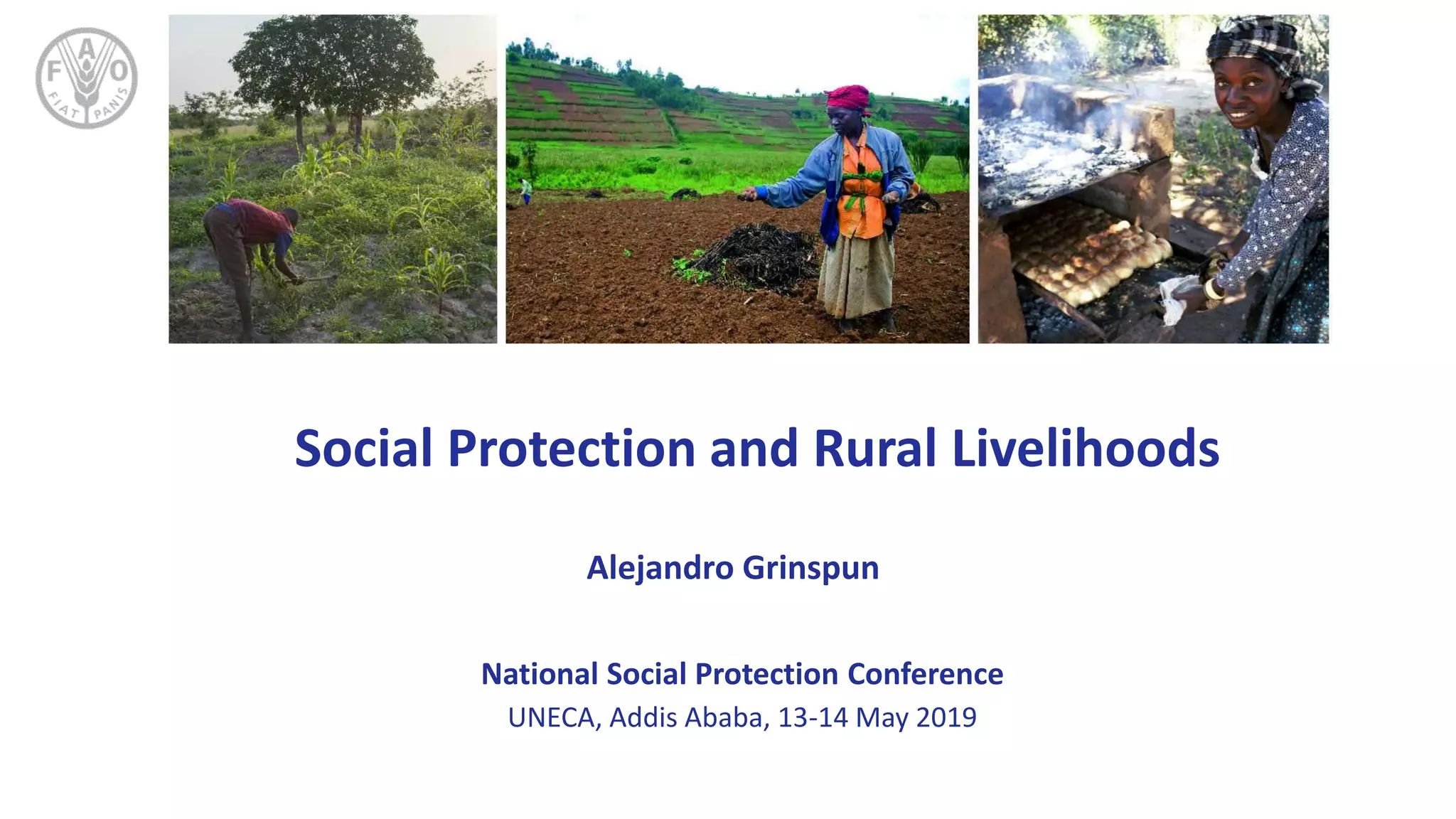
TITLE
Social Protection and Rural Livelihoods
Alejandro Grinspun
National Social Protection Conference
UNECA, Addis Ababa, 13-14 May 2019
Source: UNDESA 2017.
Demographic changes in selected regions,
1975 – 2055
Total population in sub-Saharan Africa,
by age group, 1950 – 2100
Africa’s demographic push
Rural population in Africa, 2015
Evolution of rural population in selected regions,
1950 – 2050
Africa’s rural face
Source: UNDESA 2014. Source: UNDESA 2014.
0
200
400
600
800
EAP SA SSA RoW
Number of extreme poor, by regionEmployment in agriculture by region (%)
SSA
SA
EANA
LAC
E & CA
NA
Source: Davis et al. 2017.
0
10
20
30
40
50
EAP SA SSA RoW
Percentage of extreme poor, by region
1993 2013
Share of income from farm activities among rural households
Africa’s rurality and poverty
Source: ILOSTAT, 2015.
Source World Bank, 2017.
Food security
and nutrition
58
studies
33
studies
46programs
25 countries
26programs
15 countries
Caloric
intake
Livestock
30 measures 70+measures
Value of food
consumed
Diet
diversity
Food
insecurity
Protein and
micronut. intake
Food % of total
consumption
Land
Savings
Farm
productive
assets
Nonfarm
productive
assets
Productive
physical assets
Source: Hidobro et al. 2018
1994-2016
Food security and nutrition
FOOD CONSUMPTION
CALORIES
FRUITS & VEGETABLES
GRAINS
ANIMAL SOURCE FOODS
0
34
20
61
12
6
11
17
32
- 9
- 4
265
43- 19
- 36
Source: Hidobro et al. 2018
ETH
ZAM
ZAM
Productive asset holdings
% OF HOUSEHOLDS
WITH FARM ASSETS
NUMBER OF
AGRICULTURAL ASSESTS
% OF HOUSEHOLDS
WITH LIVESTOCK
NUMBER OF LIVESTOCK
% OF HOUSEHOLDS WITH
NON-FARM ASSETS
SAVINGS
LAND
0
9935- 13
44 53
- 6 14 86
- 6 12 108
- 3 7 38
1504920
- 6 3
0
Source: Hidobro et al. 2018
ZAM
ZAM
ZAM
ETH
ZAM
97
Transfer Project
Country Program Targeting Transfer
Evaluation
design
Survey years Sample size
Ethiopia
SCTPP
(2011)
Ultra-poor, labor constrained
households
Variable / Monthly PSM 2012, 2014 ~3200 hh’s
~10000 ind.
Ghana
LEAP
(2008)
Ultra-poor households with (i) single
parent with OVC, (ii) elderly poor,
(iii) people with severe disability
Variable by # of eligible
household members / Every 2
months
Longitudinal
PSM
2010, 2012, 2016 ~1500 hh’s
~6000 ind.
Kenya
CT-OVC
(2004)
Ultra-poor households with OVC Flat / Every 2 months
DID with PSM
2007, 2009. 2011
1800 – 2300 hh’s
10400 – 12800
individuals
Lesotho
CGP
(2010)
Ultra-poor households with children
Flat, then variable by # of
children / Quarterly
RCT 2011, 2013 ~1400 hh’s
~8200 ind.
Malawi
SCT
(2006)
Ultra-poor, labor constrained
households
Variable by household size +
top-ups for school attendance
/ Every 2 months
RCT 2013, 2014, 2015 ~3500 hh’s
~16000 ind.
Zambia
CG-SCT
(2010)
Households with children under 5
years
Flat / Every 2 months RCT
2010, 2012, 2013,
2014, 2017
2300 – 2500 hh’s
~14000 ind.
Zimbabwe
HSCT
(2011)
Ultra-poor, labor constrained
households
Variable by household size /
Every 2 months
Longitudinal
matched case-
control
2013, 2014, 2017
2600 – 3000 hh’s
12700 – 14600
individuals
Source: Daidone et al. 2019
Smallholder farming, poverty and vulnerability
Basic
technologies
Few
animals
Limited
access to
land
Limited
modern
inputs
Produce
staples
Low
human
capital
Agricultural interventions insufficient to increase production
Economic and productive impacts
Crop output,
value and sales
Livestock
accumulation
Labor
use
Risk
management
Self-esteem and
social capital
Farm inputs
and assets
Source: Daidone et al. 2019
Social protection and productive support = CASH+
• Cash addresses immediate basic needs and supports livelihoods
• Agricultural inputs, assets, training and extension strengthen the
productive impact and sustainability of cash transfers
Conclusions
• SSA is poised to reap the benefits of its demographic transition and young
population structure  unique opportunity
• Need to create enough work for its booming population, provide them
with services and feed them
• Given that Africa will remain largely rural and dependent on agriculture
for years to come, investments are needed to increase farm productivity
and encourage non-farm diversification and inclusive food systems
• Shock-responsive social protection can not only protect basic consumption,
but encourage productive investments with spillover effects for beneficiary
households and rural economy at large
• SCTs targeted to poorest can have productive impacts
• Help households manage risk, increase purchasing power and provide liquidity
Conclusions
• SCTs reduce burden on social networks and informal insurance mechanisms
• No evidence of work disincentives or dependency
• Long term effects of improved human capital
• Nutritional and health status; educational attainment
• Labor productivity and employability
• Importance of complementary interventions to enhance multiplier effects
of cash in the village economy

Social Protection & Rural Livelihoods

  • 1.
    TITLE Social Protection andRural Livelihoods Alejandro Grinspun National Social Protection Conference UNECA, Addis Ababa, 13-14 May 2019
  • 2.
    Source: UNDESA 2017. Source:UNDESA 2017. Demographic changes in selected regions, 1975 – 2055 Total population in sub-Saharan Africa, by age group, 1950 – 2100 Africa’s demographic push
  • 3.
    Rural population inAfrica, 2015 Evolution of rural population in selected regions, 1950 – 2050 Africa’s rural face Source: UNDESA 2014. Source: UNDESA 2014.
  • 4.
    0 200 400 600 800 EAP SA SSARoW Number of extreme poor, by regionEmployment in agriculture by region (%) SSA SA EANA LAC E & CA NA Source: Davis et al. 2017. 0 10 20 30 40 50 EAP SA SSA RoW Percentage of extreme poor, by region 1993 2013 Share of income from farm activities among rural households Africa’s rurality and poverty Source: ILOSTAT, 2015. Source World Bank, 2017.
  • 6.
    Food security and nutrition 58 studies 33 studies 46programs 25countries 26programs 15 countries Caloric intake Livestock 30 measures 70+measures Value of food consumed Diet diversity Food insecurity Protein and micronut. intake Food % of total consumption Land Savings Farm productive assets Nonfarm productive assets Productive physical assets Source: Hidobro et al. 2018 1994-2016
  • 7.
    Food security andnutrition FOOD CONSUMPTION CALORIES FRUITS & VEGETABLES GRAINS ANIMAL SOURCE FOODS 0 34 20 61 12 6 11 17 32 - 9 - 4 265 43- 19 - 36 Source: Hidobro et al. 2018 ETH ZAM ZAM
  • 8.
    Productive asset holdings %OF HOUSEHOLDS WITH FARM ASSETS NUMBER OF AGRICULTURAL ASSESTS % OF HOUSEHOLDS WITH LIVESTOCK NUMBER OF LIVESTOCK % OF HOUSEHOLDS WITH NON-FARM ASSETS SAVINGS LAND 0 9935- 13 44 53 - 6 14 86 - 6 12 108 - 3 7 38 1504920 - 6 3 0 Source: Hidobro et al. 2018 ZAM ZAM ZAM ETH ZAM 97
  • 9.
    Transfer Project Country ProgramTargeting Transfer Evaluation design Survey years Sample size Ethiopia SCTPP (2011) Ultra-poor, labor constrained households Variable / Monthly PSM 2012, 2014 ~3200 hh’s ~10000 ind. Ghana LEAP (2008) Ultra-poor households with (i) single parent with OVC, (ii) elderly poor, (iii) people with severe disability Variable by # of eligible household members / Every 2 months Longitudinal PSM 2010, 2012, 2016 ~1500 hh’s ~6000 ind. Kenya CT-OVC (2004) Ultra-poor households with OVC Flat / Every 2 months DID with PSM 2007, 2009. 2011 1800 – 2300 hh’s 10400 – 12800 individuals Lesotho CGP (2010) Ultra-poor households with children Flat, then variable by # of children / Quarterly RCT 2011, 2013 ~1400 hh’s ~8200 ind. Malawi SCT (2006) Ultra-poor, labor constrained households Variable by household size + top-ups for school attendance / Every 2 months RCT 2013, 2014, 2015 ~3500 hh’s ~16000 ind. Zambia CG-SCT (2010) Households with children under 5 years Flat / Every 2 months RCT 2010, 2012, 2013, 2014, 2017 2300 – 2500 hh’s ~14000 ind. Zimbabwe HSCT (2011) Ultra-poor, labor constrained households Variable by household size / Every 2 months Longitudinal matched case- control 2013, 2014, 2017 2600 – 3000 hh’s 12700 – 14600 individuals Source: Daidone et al. 2019
  • 10.
    Smallholder farming, povertyand vulnerability Basic technologies Few animals Limited access to land Limited modern inputs Produce staples Low human capital Agricultural interventions insufficient to increase production
  • 11.
    Economic and productiveimpacts Crop output, value and sales Livestock accumulation Labor use Risk management Self-esteem and social capital Farm inputs and assets Source: Daidone et al. 2019
  • 12.
    Social protection andproductive support = CASH+ • Cash addresses immediate basic needs and supports livelihoods • Agricultural inputs, assets, training and extension strengthen the productive impact and sustainability of cash transfers
  • 13.
    Conclusions • SSA ispoised to reap the benefits of its demographic transition and young population structure  unique opportunity • Need to create enough work for its booming population, provide them with services and feed them • Given that Africa will remain largely rural and dependent on agriculture for years to come, investments are needed to increase farm productivity and encourage non-farm diversification and inclusive food systems • Shock-responsive social protection can not only protect basic consumption, but encourage productive investments with spillover effects for beneficiary households and rural economy at large
  • 14.
    • SCTs targetedto poorest can have productive impacts • Help households manage risk, increase purchasing power and provide liquidity Conclusions • SCTs reduce burden on social networks and informal insurance mechanisms • No evidence of work disincentives or dependency • Long term effects of improved human capital • Nutritional and health status; educational attainment • Labor productivity and employability • Importance of complementary interventions to enhance multiplier effects of cash in the village economy