Social Media Seminar: Managing
              Risk

        June 20, 2012


      Steven H. Shapiro
Social Media is like teen sex.
      Everyone wants to do it. Nobody knows how.
When it’s finally done, there is surprise it’s not better.

                   Avinash Kaushik, Analytics Evangelist, Google
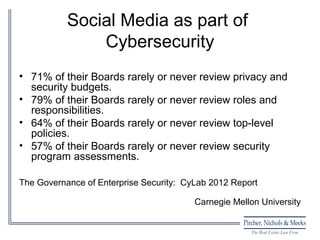
Social Media as part of
               Cybersecurity
• 71% of their Boards rarely or never review privacy and
  security budgets.
• 79% of their Boards rarely or never review roles and
  responsibilities.
• 64% of their Boards rarely or never review top-level
  policies.
• 57% of their Boards rarely or never review security
  program assessments.

The Governance of Enterprise Security: CyLab 2012 Report

                                         Carnegie Mellon University
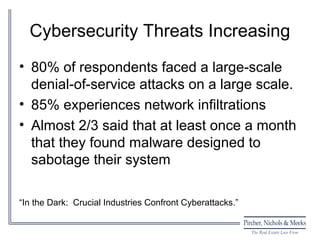
Cybersecurity Threats Increasing
• 80% of respondents faced a large-scale
  denial-of-service attacks on a large scale.
• 85% experiences network infiltrations
• Almost 2/3 said that at least once a month
  that they found malware designed to
  sabotage their system

“In the Dark: Crucial Industries Confront Cyberattacks.”
Bottom Line:


  “Most companies failed to
 adopt many of the available
   security measures. This
means that, for many, security
   remained rudimentary."
What can be done?
1. Pay attention.
2. Get the right people.
3. Organize the function properly.
4. Review regularly – report, audit and
   assess.
5. Review policies to create a culture and
   respect for privacy.
SOCIAL MEDIA:

      NEW
       OR
MORE OF THE SAME?
“The more things change, the
  more they stay the same.”

          * * * *
“The Internet has been the
most fundamental change
 during my lifetime and for
    hundreds of years.”
SOCIAL MEDIA:

      NEW
      AND
MORE OF THE SAME
More of the same

• Conform to strategy and business of
  company
  – Using for offensive or defensive purposes?
• Work within legacy guidelines
  – Existing laws, regulations and case law
  – Existing company policies
• Maintain existing protections – privacy,
  confidentiality and ownership
More of the same (continued)

• Identify who said what and who is
  speaking for whom
• Update, update, update
• When implementing:
  – Train effectively
  – Communicate clearly
• Use general principles, not detailed rules
Differences
•   Can not legislate from the top down
•   Permanence of items posted on the web
•   Internet creates its own reality
•   Not a 24/7 world, an instantaneous world
•   The line between personal and business
    matters is not blurred, but obscured
Differences (continued)
• Communication can and should be 2 way
• Understand the nature of a community
• Use carrot, not stick, to generate desired
  behavior
Some effects
Dell used “Social Media Principles”
  1.   Protect Information
  2.   Be Transparent and Disclose
  3.   Follow the Law, Follow the Code of Conduct
  4.   Be Responsible
  5.   Be Nice, Have Fun and Connect
  6.   Social Media Account Ownership

  Global Policy on Social Media Effective Date: 15 August 2011
Conclusions- Cybersecurity
• Protect yourselves!
  – Pay attention
  – Get the right people
  – Organize yourself the right way
  – Check yourself regularly
Conclusions- Social Media

• Know what your organization needs
• Know where it comes from
• Know how it has to change
DISCUSSION


    Steve Shapiro
  Corporate Partner
sshapiro@pircher.com
    312-915-3175

Social Media: Managing Risk

  • 1.
    Social Media Seminar:Managing Risk June 20, 2012 Steven H. Shapiro
  • 2.
    Social Media islike teen sex. Everyone wants to do it. Nobody knows how. When it’s finally done, there is surprise it’s not better. Avinash Kaushik, Analytics Evangelist, Google
  • 3.
    Social Media aspart of Cybersecurity • 71% of their Boards rarely or never review privacy and security budgets. • 79% of their Boards rarely or never review roles and responsibilities. • 64% of their Boards rarely or never review top-level policies. • 57% of their Boards rarely or never review security program assessments. The Governance of Enterprise Security: CyLab 2012 Report Carnegie Mellon University
  • 4.
    Cybersecurity Threats Increasing •80% of respondents faced a large-scale denial-of-service attacks on a large scale. • 85% experiences network infiltrations • Almost 2/3 said that at least once a month that they found malware designed to sabotage their system “In the Dark: Crucial Industries Confront Cyberattacks.”
  • 5.
    Bottom Line: “Most companies failed to adopt many of the available security measures. This means that, for many, security remained rudimentary."
  • 6.
    What can bedone? 1. Pay attention. 2. Get the right people. 3. Organize the function properly. 4. Review regularly – report, audit and assess. 5. Review policies to create a culture and respect for privacy.
  • 7.
    SOCIAL MEDIA: NEW OR MORE OF THE SAME?
  • 8.
    “The more thingschange, the more they stay the same.” * * * * “The Internet has been the most fundamental change during my lifetime and for hundreds of years.”
  • 9.
    SOCIAL MEDIA: NEW AND MORE OF THE SAME
  • 10.
    More of thesame • Conform to strategy and business of company – Using for offensive or defensive purposes? • Work within legacy guidelines – Existing laws, regulations and case law – Existing company policies • Maintain existing protections – privacy, confidentiality and ownership
  • 11.
    More of thesame (continued) • Identify who said what and who is speaking for whom • Update, update, update • When implementing: – Train effectively – Communicate clearly • Use general principles, not detailed rules
  • 12.
    Differences • Can not legislate from the top down • Permanence of items posted on the web • Internet creates its own reality • Not a 24/7 world, an instantaneous world • The line between personal and business matters is not blurred, but obscured
  • 13.
    Differences (continued) • Communicationcan and should be 2 way • Understand the nature of a community • Use carrot, not stick, to generate desired behavior
  • 14.
    Some effects Dell used“Social Media Principles” 1. Protect Information 2. Be Transparent and Disclose 3. Follow the Law, Follow the Code of Conduct 4. Be Responsible 5. Be Nice, Have Fun and Connect 6. Social Media Account Ownership Global Policy on Social Media Effective Date: 15 August 2011
  • 15.
    Conclusions- Cybersecurity • Protectyourselves! – Pay attention – Get the right people – Organize yourself the right way – Check yourself regularly
  • 16.
    Conclusions- Social Media •Know what your organization needs • Know where it comes from • Know how it has to change
  • 17.
    DISCUSSION Steve Shapiro Corporate Partner sshapiro@pircher.com 312-915-3175