Social Media in the Work Environment A Presentation By Monday, July 25, 2011
Agenda Intro A Social Media Revolution? Social media in the workplace: What is its role? Establishing guidelines and company policies Social media channels The pros and cons of social media marketing Integrating social media with other marketing channels Measuring engagement
Intro :  www.cherylsantamaria.com :  http://cherylsantamaria.com/blog :  www.twitter.com/chersantamaria :  ca.linkedin.com/in/cherylsantamaria
Right Here, Right Now
Social Media in the Workplace | Stats 54% of business block employee access to social networking sites 19% allow social networking for work-related purposes 16% allow limited personal use 10% allow full use … [Source: Robert Half Technology Survery, Oct. 2009]
…  Yet over 94% of companies invest in social media. [Source: PR Newswire, Oct. 2009]
So, What IS Social Media's Role in The Workplace? Disseminate information Communicate and network Promote brand recognition (both internal and external) Increase productivity (We'll come back to this later ...)
Establishing Guidelines and Company Policies “ Most people don't plan to fail, they fail to plan.” - John L. Beckley, first librarian of the U.S. congress
Prep Work Assemble a “social media task force” (comprise of employees, third-party consultants or a mix of both) Do your research. Conversations about your company will happen whether you like it or not. Do you know what people are saying about your brand? Identify “red flags”/PR issues Decide which social media channels are to be utilized
Devising a Company Policy A good policy should include approximately 10 guidelines, including: Representation of the brand and the user   Disclosure, confidentiality and privacy Defining the desired “purpose” of social networking, as defined by the company Guidelines for usage during business hours (and after hours) Professionalism and response time to customer service queries via SM Tip:  Social media is constantly changing.  A good policy should try to anticipate issues before they occur, including: “friending/following” colleagues, posting images online, language, usage, etc.
Crisis Management Appoint a spokesperson (and a backup) to speak on behalf of the company, should an issue arise Prepare a template statement and press release that can be modified easily Determine and document the “chain of command” for dealing with a PR/SM issue (i.e. who will coordinate crisis management, who will speak to media, who will send out press releases etc.) Appoint a project manager (and a backup) to oversee the execution of the response strategy and ensure all timelines/tasks are met
Social Media Channels Which platforms should your company be using? Dependent upon the goals of the organization and the results of your preliminary research:  What SM channels does your primary and secondary target audience use the most frequently?  Are your competitors using social media effectively? What channels?  Will you allow for two-way communication? There are A LOT of social media channels. Hone in on 1-3 of them ...
[Source ]
SMM | The Pros Social media is social! Social media allows you to reach people above and beyond your target audience Social networking can help you find resources/answers faster, improving productivity If done correctly, social media can help to position your company as adaptable, on trend and resourceful
SMM is a  major  time investment.  If you are going to utilize social media, engage regularly or don't engage at all Users will expect a quick response time to social media queries  You cannot pick and choose which comments/issues you address on SM SM strategies need to be monitored, revised and repositioned regularly (I recommend once a month) True SM influence grows slowly, over time You will not see much ROI in the first few months (that's the nature of the beast) SMM | The Cons
Integrating SM with Other Mktg Channels Anything with a URL (press releases, mentions in the newspaper, YouTube videos of recent commercials) can become SM content (whether it be through Twitter, Tumblr, Facebook or a blog) Add links to social media on business cards and in email signatures All print/radio advertising and promotions should contain links to SM channels Work with your company's social media task force to develop a strategic short and long term plan for integrating social media with other marketing channels
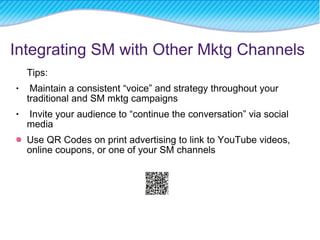
Tips: Maintain a consistent “voice” and strategy throughout your traditional and SM mktg campaigns Invite your audience to “continue the conversation” via social media Use QR Codes on print advertising to link to YouTube videos, online coupons, or one of your SM channels Integrating SM with Other Mktg Channels
Measuring Engagement Google Analytics/Count Per Day Klout Timely.is Bit.ly Goo.gl
Questions?

Social Media and the Workplace

  • 1.
    Social Media inthe Work Environment A Presentation By Monday, July 25, 2011
  • 2.
    Agenda Intro ASocial Media Revolution? Social media in the workplace: What is its role? Establishing guidelines and company policies Social media channels The pros and cons of social media marketing Integrating social media with other marketing channels Measuring engagement
  • 3.
    Intro : www.cherylsantamaria.com : http://cherylsantamaria.com/blog : www.twitter.com/chersantamaria : ca.linkedin.com/in/cherylsantamaria
  • 4.
  • 5.
    Social Media inthe Workplace | Stats 54% of business block employee access to social networking sites 19% allow social networking for work-related purposes 16% allow limited personal use 10% allow full use … [Source: Robert Half Technology Survery, Oct. 2009]
  • 6.
    … Yetover 94% of companies invest in social media. [Source: PR Newswire, Oct. 2009]
  • 7.
    So, What ISSocial Media's Role in The Workplace? Disseminate information Communicate and network Promote brand recognition (both internal and external) Increase productivity (We'll come back to this later ...)
  • 8.
    Establishing Guidelines andCompany Policies “ Most people don't plan to fail, they fail to plan.” - John L. Beckley, first librarian of the U.S. congress
  • 9.
    Prep Work Assemblea “social media task force” (comprise of employees, third-party consultants or a mix of both) Do your research. Conversations about your company will happen whether you like it or not. Do you know what people are saying about your brand? Identify “red flags”/PR issues Decide which social media channels are to be utilized
  • 10.
    Devising a CompanyPolicy A good policy should include approximately 10 guidelines, including: Representation of the brand and the user Disclosure, confidentiality and privacy Defining the desired “purpose” of social networking, as defined by the company Guidelines for usage during business hours (and after hours) Professionalism and response time to customer service queries via SM Tip: Social media is constantly changing. A good policy should try to anticipate issues before they occur, including: “friending/following” colleagues, posting images online, language, usage, etc.
  • 11.
    Crisis Management Appointa spokesperson (and a backup) to speak on behalf of the company, should an issue arise Prepare a template statement and press release that can be modified easily Determine and document the “chain of command” for dealing with a PR/SM issue (i.e. who will coordinate crisis management, who will speak to media, who will send out press releases etc.) Appoint a project manager (and a backup) to oversee the execution of the response strategy and ensure all timelines/tasks are met
  • 12.
    Social Media ChannelsWhich platforms should your company be using? Dependent upon the goals of the organization and the results of your preliminary research:  What SM channels does your primary and secondary target audience use the most frequently?  Are your competitors using social media effectively? What channels?  Will you allow for two-way communication? There are A LOT of social media channels. Hone in on 1-3 of them ...
  • 13.
  • 14.
    SMM | ThePros Social media is social! Social media allows you to reach people above and beyond your target audience Social networking can help you find resources/answers faster, improving productivity If done correctly, social media can help to position your company as adaptable, on trend and resourceful
  • 15.
    SMM is a major time investment. If you are going to utilize social media, engage regularly or don't engage at all Users will expect a quick response time to social media queries You cannot pick and choose which comments/issues you address on SM SM strategies need to be monitored, revised and repositioned regularly (I recommend once a month) True SM influence grows slowly, over time You will not see much ROI in the first few months (that's the nature of the beast) SMM | The Cons
  • 16.
    Integrating SM withOther Mktg Channels Anything with a URL (press releases, mentions in the newspaper, YouTube videos of recent commercials) can become SM content (whether it be through Twitter, Tumblr, Facebook or a blog) Add links to social media on business cards and in email signatures All print/radio advertising and promotions should contain links to SM channels Work with your company's social media task force to develop a strategic short and long term plan for integrating social media with other marketing channels
  • 17.
    Tips: Maintain aconsistent “voice” and strategy throughout your traditional and SM mktg campaigns Invite your audience to “continue the conversation” via social media Use QR Codes on print advertising to link to YouTube videos, online coupons, or one of your SM channels Integrating SM with Other Mktg Channels
  • 18.
    Measuring Engagement GoogleAnalytics/Count Per Day Klout Timely.is Bit.ly Goo.gl
  • 19.