Social Journalism Study 2015
United Kingdom
Report by Cision & Canterbury Christ Church University (UK)
Executive Summary
1. The majority of UK journalists use social media as a professional tool. However,
the percentage of journalists using social media regularly, for four hours or more a day, has declined
during the last three years, from 24% in 2012 to 13% in 2014, indicating a level of saturation in its
use.
2. Over half (53.5%) of UK journalists said they cannot carry out their work without so-
cial media, an increase from 42% of journalists last year.
3. Twitter (75.1%) continues to be the most popular social networking channel for jour-
nalists followed by Facebook (56.7%), Google+ (41.2%), Instagram (24.9%) and Hootsuite (24.7%).
4. Publishing and promoting content and sourcing information are the two most impor-
tant reasons for social media use for journalists, a pattern that has remained stable over the
last three years.
5. The number of followers journalists have has steadily increased over the last few
years. While in 2012 less than half of respondents had more than 500 followers, by 2014 about
two-thirds of them did.
6. PR professionals are the most important sources for journalists, followed by experts/
academics and then other journalists and media outlets.
7. While journalists tend to perceive the impact of social media on their work in general in a positive
light, there are growing concerns about the effects it has on privacy, data security and
journalistic values.
8. Previous studies identified five different types of journalists; Sceptics, Observers,
Hunters, Promoters and Architects. Over the last three years, the sizes of each social
media user type have changed significantly. In 2014 the two largest groups were the Promot-
ers and the Sceptics, while in 2012 it was the Hunters and the Promoters. This change suggests an
increasing polarisation in the profession in relation to social media use and attitudes with both the
most negative and the more positive social media user types both increasing in number.
* Data featured in his report was collected between July and September 2014. The title refers to the year of publication.
Key findings of the 2015 survey*
The fourth annual Social Journalism Study, conducted by Cision and
Canterbury Christ Church University, is the latest instalment in our
efforts to understand and chart the changes in how journalists and
media professionals use social media for their work and in their
communication with PR professionals.
This year’s results show that social is part of the journalists’ toolkit
in their everyday work for a range of different tasks, dominated by
sourcing and publishing content.
Whilst there is a unanimous view that journalists could not carry
out their work without social media and that it helps productivity,
this year reflects a level of saturation in social media with its
use remaining stagnant and in some cases, even declining for
journalists.
Survey Background
The study found that journalists use a range sources for
their stories, turning to PR sources, experts and other
media outlets. Email remains the main communication
channel for PR professionals but there is evidence from
a small number of journalists that they would like to see
social media used more widely for sharing PR content with
journalists. As with other years, journalists would like few-
er phone calls from PR professionals.
The relationship with PR professionals is fairly good but
there are areas to improve around the quality of their con-
tribution to journalists’ work and the reliability of informa-
tion shared.
Overall journalists feel that social media has had greatest
impact on the relationship with their audience and copy-
right issues.
3.1 Most journalists use social media up to 2 hours a day but there is a
degree of saturation
The majority of UK journalists use social media regularly. About two-thirds of respondents reported
that they use the tools up to 2 hours a day. There is just a small number who are ‘always on’ and use
the tools for 4 or more hours a day. This suggests that although social media is embedded in daily
practices of journalists, it is not something they are constantly using; rather they tend to ‘check-in’
for shorter periods to carry out specific tasks.
The percentage of journalists using social media for more than 4 hours a day has actually declined
during the last three years (from 24% in 2012 to 13% in 2014), but so too has the proportion of re-
spondents not using the tools (10% in 2012 and 5% in 2014).
This indicates that initially there was a greater division between social media users and non-users. It
also suggests that after an initial excitement of the introductory phase, there is a degree of satura-
tion and an optimum time for social media use. For most journalists there are no additional gains to
be had from constant use.
Social Media Use
None
Time spent using social media for
work (% of respondents)
Up to 2 hours per day
2-4 hours per day
4-8 hours per day
More than 8 hours per day
2012 2013 2014
10% 4.4% 5.2%
34.1% 61% 63.8%
32.4% 22.6% 17.6%
20.7% 9.6% 9.2%
2.8% 2.3% 4.1%
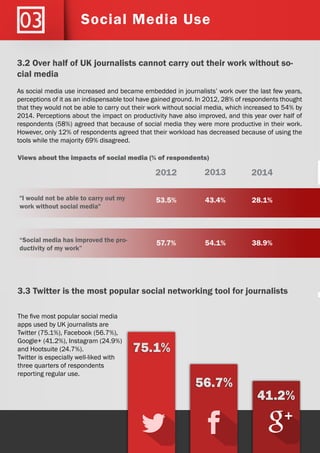
3.2 Over half of UK journalists cannot carry out their work without so-
cial media
As social media use increased and became embedded in journalists’ work over the last few years,
perceptions of it as an indispensable tool have gained ground. In 2012, 28% of respondents thought
that they would not be able to carry out their work without social media, which increased to 54% by
2014. Perceptions about the impact on productivity have also improved, and this year over half of
respondents (58%) agreed that because of social media they were more productive in their work.
However, only 12% of respondents agreed that their workload has decreased because of using the
tools while the majority 69% disagreed.
Social Media Use
Views about the impacts of social media (% of respondents)
3.3 Twitter is the most popular social networking tool for journalists
The five most popular social media
apps used by UK journalists are
Twitter (75.1%), Facebook (56.7%),
Google+ (41.2%), Instagram (24.9%)
and Hootsuite (24.7%).
Twitter is especially well-liked with
three quarters of respondents
reporting regular use.
2012 2013 2014
"I would not be able to carry out my
work without social media"
“Social media has improved the pro-
ductivity of my work”
53.5%
57.7%
43.4%
54.1%
28.1%
38.9%
3.4 Publishing / promoting and sourcing remain the two most impor-
tant reasons for using social media
Publishing / promoting and sourcing remain the two most important reasons for using social media,
a trend that has been present over the last three years.
However, about two-thirds of respondents reported that they use social media regularly for a variety
of purposes involving all key professional tasks: publishing and promoting their own work, sourcing
information, networking, verifying and monitoring what is going on. The table below illustrates the
diversity of social media use by journalists.
Social Media Use
Selected social media activities (% of respondents carrying out daily)
17.4%
50.8%
30.1%
58.9%
47%
40.6%
18.3%
17.3%
11.5%
47.8%
31.7%
Read Blogs
Read postings of people they follow on a social networking or microblogging site
Publish a story based on information found on social media
Read content communities or crowdsourcing sites
Add comments to someone’s page or profile on a social networking site
Reply to comments received in relation to their work on social media sites
Monitor discussions on social media about own content
Post original comments on social networking or microblogging sites
Use social media to make new contacts in their field of work
Re-post on microblogging site
Maintain a work related blog
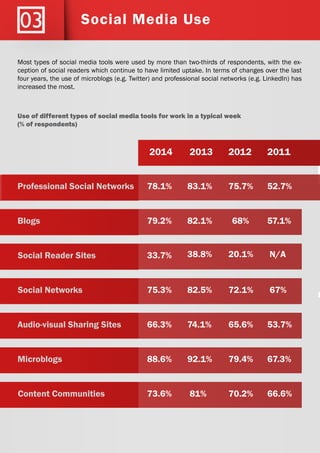
Most types of social media tools were used by more than two-thirds of respondents, with the ex-
ception of social readers which continue to have limited uptake. In terms of changes over the last
four years, the use of microblogs (e.g. Twitter) and professional social networks (e.g. LinkedIn) has
increased the most.
Social Media Use
Use of different types of social media tools for work in a typical week
(% of respondents)
2011
2012
2013
2014
Professional Social Networks
Blogs
Social Reader Sites
Social Networks
Audio-visual Sharing Sites
Microblogs
Content Communities
78.1%
79.2%
33.7%
75.3%
66.3%
88.6%
73.6%
83.1%
82.1%
38.8%
82.5%
74.1%
92.1%
81%
75.7%
68%
20.1%
72.1%
65.6%
79.4%
70.2%
52.7%
57.1%
67%
53.7%
67.3%
66.6%
N/A
3.5 The number of followers among journalists has steadily increased
over the last few years
Respondents in our study had on an average of about 3,600 followers on their preferred social net-
working or microblogging site, while the figure for the general population is slightly above 200. This
suggests that people tend to turn to sources on social media they know and trust, and that journal-
ists remain key sources and interpreters of news and information in society even in the social media
environment.
The number of followers among journalists has steadily increased over the last few years. While in
2012 less than half of respondents had more than 500 followers, by 2014 about two-thirds of them
did.
Number of followers on preferred social media site (% of respondents)
2012
2013
2014
<100
101-500
500+
Social Media Use
5.8%
7.4%
21.1%
65.7% 61.5%
25.2%
7.5%
5.8% 7.6%
13.4%
31.4%
47.6%
None
4.1 Most journalists think that their work changed considerably because
of social media
Respondents in our study generally agreed that social media has changed their work and how they
interact with audiences. 51.4% of respondents said that the way they worked has changed to a large
extent or fundamentally because of social media, and only 5% thought that it did not change at all.
However, views vary about what aspects of their work have changed and to what extent. The largest
perceived impact was in relation to journalists’ relationship with their audience. 61.6% of respond-
ents thought that this relationship changed fundamentally or to a large extent, and a further 20.3%
reported moderate change. The way in which journalists work, their everyday practices, is also an
area on which social media has had a significant impact.
The impact of social media on the content journalists produce was perceived to have been altered
less. But even in this case, nearly 40% of respondents thought that the content they produced has
changed fundamentally or to a large extent because of social media.
Views on Social Media
The way
they work
The content
they produce
Relationship
with their
audience
Copyright
issues
Not at all
To a small extent
To a moderate
extent
To a large
extent
Fundamentally
5.0% 11.3% 7.3% 11.8%
17.0% 19.8% 10.8% 12.3%
26.6% 29.1% 20.3% 29.6%
32.1% 26.3% 37.8% 30.8%
19.3% 13.5% 23.8% 15.5%
Views about the extent to which social media changed the work of journalists
(% of respondents)
4.2 There are growing concerns about the effects social media has on
privacy, data security and journalistic values
While journalists tend to perceive the impact of social media on their work in general in a positive
light, they are more ambivalent about the effects the tools have on their profession. In particular,
they are increasingly concerned that social media undermines traditional journalistic values.
In 2014, nearly half of the respondents agreed that these values, including objectivity and fairness,
are jeopardised because of social media, while a third disagreed and the rest were unsure.
The proportion of those who are concerned has increased over the last three years from 40.5% in
2012 to 48.8% this year. There were a larger percentage of respondents (80.7%) who agreed that a
key way social media is changing their profession is through encouraging opinion-orientated journal-
ism. This in turn, for some of them, has an adverse effect on traditional values. Notable also is the
increase in the number of respondents who have serious concerns over privacy and data security in
relation to social media.
In 2012, 27.5% of respondents had such serious concerns, but despite falling in 2013 the figure in-
creased to 48.5% by 2014. Recent scandals about online privacy and data security has clearly had
an impact on journalists’ views on the issues.
There remains a split among journalists regarding their views on the impacts of social media on their
profession. In 2014, 39.1% of respondents agreed that social media has changed what journalism
was about to a large extent or fundamentally, while 52.9% perceived the impacts as small or moder-
ate, and 8% said that journalism has not changed at all.
Views on Social Media
“I have serious concerns over privacy and
data security”
“Social media is undermining traditional
journalistic values”
2014 2013 2012
48.5% 22.4% 27.5%
48.8% 38% 40.5%
Percentage of respondents who agreed with each of the following statements
5.1 Journalists producing reviews or editorial pieces are affected more
by social media than those who deliver news content
The impact of social media is felt differently among respondents depending on the types of content
they produce.
Those who write reviews or comment/editorial pieces reported stronger impact compared to those
who report news stories. For example, 30.6% of editorial journalists agreed that social media fun-
damentally changed the way they worked, while only 15.6% of respondents publishing hard news
agreed with that.
Differences were also notable regarding the relationship with the audience. While 40.4% review jour-
nalists agreed that their relationship with their audience fundamentally changed because of social
media, only 12.5% of respondents publishing hard news agreed.
Influences on Social Media
Use
Respondents who perceived the impact of social media fundamental on the fol-
lowing aspects of their work (% of journalists by types of content they produce)
The way they work
Soft
News
Hard
News
Aggregate
News
Reviews Editorial Feature
15.6% 20.3% 12.5% 29.8% 30.6% 13.4%
3.1% 6.8% 8.3% 27.7% 22.2% 7.7%
The content they produce
Relationship with their
audience
What journalism is about
12.5% 20.3% 20.8% 40.4% 37.5% 18.3%
18.8% 13.6% 4.2% 19.1% 18.1% 11.3%
5.2 Changing structures and working patterns in media organisations
has impacted social media use
Reviews and editorial journalists were also more likely to agree that social media was indispensable
to their work and that it has improved productivity at the workplace. For example, 38.3% of respond-
ents writing reviews said that they would not be able to carry out their work without social media,
while only 9.4% of hard news journalists agreed with that.
Reasons for these differences are probably multifold including changing structures and working pat-
terns in media organisations, but PRs might want to keep these variations in mind when contacting
different types of journalists.
Influences on Social Media use
Percentage of respondents who strongly agreed with each of the following
statements (% of journalists by types of content they produce)
Soft
News
Hard
News
Aggregate
News
Reviews Editorial Feature
“I would not be able
to carry out my work
without social media”
“Social media
has improved my
productivity”
9.4% 18.6% 29.2% 38.3% 37.5% 17.6%
6.3% 16.9% 20.8% 27.7% 38.9% 20.4%
6.1 PR professionals are the most important sources for journalists
When journalists were asked to choose their two most important sources of information, PR sources
ranked the highest, followed by experts/academics and then other journalists and media outlets.
This suggests that social media has not significantly altered how journalists source their stories as
traditional sources remain the most important regardless of the method of distribution. Alternatives
such as crowdsourcing are yet to become key sources of information for journalists.
Communication with PR
Professionals
Source ranked by importance
PR sources
Experts / academics
Company representative
General public / crowdsourcing
Government officials / public servants
Public figures / celebrities
Journalists / media outlets
1
2
3
4
5
6
7
6. 2 Concerns about the reliability of information shared by PRs
Although PR professionals are the most important source of information, there are some concerns
about their reliability. Four in ten respondents agreed that PR information enhances the quality of
reporting, and less than half thought that PR practitioners are reliable sources of stories.
Given the very different objectives of PR professionals and journalists, distrust may be to some ex-
tent a necessary evil.
Communication with PR Professionals
“PR information enhances the quality of reporting”
23.3% 36.1% 40.6%
“I am happy with my relationship with PR practitioners”
“PR practitioners are a reliable source of stories”
“Because of social media I am less reliant on PR professionals”
12.8% 26.3% 60.9%
26.8% 28.1% 45.2%
35.4% 29.3% 35.3%
Views about PR professionals (% of respondents)
Disagree Ambivalent Agree
6.3 Journalists becoming less reliant on PR professionals because of so-
cial media
Over a third of respondents thought that they were becoming less reliant on PR professionals be-
cause of social media. This suggests that the PR industry needs to revisit the content it produces and
how it presents information for stories on different platforms.
6.4 Email stays top choice for contact from PR professionals though so-
cial media is gaining ground
Email remains the most widely used communication method between PR professionals and journal-
ists with 86.1% respondents stating it was the main method used in 2014, a slight (3%) decrease
since 2013. The second most common method is still via telephone (38.6%), although there has
been a significant decrease. Last year nearly 60% of respondents selected telephone as one of the
two most common ways PR professionals contact them. At the same time, there was an increase in
the use of social media for PR-journalists communication. While last year 18.5% of respondents said
that one of the most common ways PR professionals contacted them was through social media, this
year the figure increased to 32.4%.
Communication with PR Professionals
Selected two most common ways PR professionals contact journalists
(% respondents)
2014 2013
3.6%
38.6%
7.1%
86.1%
32.4%
5.6%
5.3%
59.3%
2.1%
89.3%
18.5%
5.3%
Face-to-face
Telephone
Newswires
Email
Social Media
Post / Hardcopy
When journalists were asked how they would like to be contacted, email remained the preferred
choice but social media came in second. From the differences between preferred choices and the
actual ways journalists are being contacted, it is clear that the use of the telephone continues to be
a major source of irritation for journalists with 16.1% requesting less contact by phone.
Communication with PR professionals
Difference between most common and preferred ways journalists want to be con-
tacted by PR professionals (difference between %)
2014 2013
4.1
-16.1
-1.7
-2.6
1.3
2.6
5.9
-21.8
-0.1
-3
10.9
2.6
Telephone
Newswires
Email
Social Media
Post / Hardcopy
Face-to-face
7.1 Increasing polarisation among social media user types
Three years ago our study identified five types of social media users among journalists and these
continue to be a key feature of social media adoption in the profession. These users are: Architects,
Promoters, Hunters, Observers and Sceptics. Their key characteristics and the differences between
them can be illustrated along a spectrum of social media use, views and attitudes. As these groups
are based on cluster analysis, the specific characteristics of these groups have changed over the
three years as technology itself has evolved and journalists become more skilled and knowledge-
able.
Over the last three years the sizes of each social media user types have changed. In 2014 the two
largest groups were the Promoters and the Sceptics, while in 2012 it was the Hunters and the Pro-
moters. This change suggests an increasing polarisation in the profession in relation to social me-
dia use and attitudes with both the most negative and the more positive social media user types
increasing in number.
Social Media User Types
10%
19%
25%
35%
12%
Sceptics Observers Promoters Hunters Architects
Ratio of the five Social Media User Types (% of respondents)
20%
13%
35%
16%
16%
2012 2014
7.2 Professional Profiles
The size of the five profiles of our social media user type has changed over the last three years, cre-
ating one dominant group, the Promoters: 35% of the respondents. Both Sceptics and Promoters
have seen a 10% increase over the three years, while there has been a corresponding decline in the
numbers of Hunters.
It is interesting to see that Architects have remained fairly stable over the three years, suggesting
that journalists do not automatically progress gradually from Sceptics to Architects as they improve
their skills and knowledge, but retain particular views and behaviours towards social media. What
follows is a summary of the key characteristics of these five groups in 2014.
All groups show increasing reliance on social media over the last three years, although the Sceptics
continue to have a negative view of the technology.
Social Media User Types
I would not be able to carry out my work without social media
Sceptics Observers Promoters Hunters Architects
2014
2013
2012
10% 43% 66% 52% 91%
8%
4%
32%
13%
51%
40%
49%
26%
68%
55%
Architects (16%)
The Architects have varied slightly in size over the last three years and represent the most proac-
tive of all the groups - they could be described as the ‘movers and shakers’ or first movers in terms
of their journalism work and social media. They have always shown greater use of social media, al-
though this is not surprising as 91% claim to work in online journalism.
With a slight female bias (57% are female), journalists in this group are much younger, having the
largest proportion of 18-27 year olds (29%) compared to all the other groups. This group spends
much longer using social media with all of them using these tools daily and 19% accessing social
media more than 8 hours per day.
Not surprisingly, with so much time spent on social media, 78% of this group claim to have extensive
or expert knowledge. They are avid users of Twitter (98%) and Facebook (86%), and the leading us-
ers of Instagram, Google+ and other tools such as Hootsuite (42%), Storify (30%) Flipboard (16%),
and Pingit (6%).
This group uses social media for a range of tasks on a frequent basis, either daily or weekly, and are
busy undertaking a range of reading, posting, and sharing content - they are more active than all
other groups. The most notable increase over the last three years was in relation to those who main-
tain a work-related blog on a daily basis growing a significant 45% in three years.
Interestingly, this group still turn to other media outlets and PR professionals as main sources of in-
formation in equal measure. Although almost all of them are contacted by PR professionals through
email, close to 60% also maintain PR relationships, albeit via social media.
This group is also very positive about the role social media plays in their work, with 91% saying they
could not work without it and 88% saying it has improved their productivity. Although most (62%) are
happy with their relationship with PR professionals, they recognise that they are less reliant on them
because of social media (59%).
Social Media User Types
Promoters (35%)
The Promoters now represent the largest of all the journalist groups and are, as their name suggests,
keen users of social media for publishing and promoting their work, particularly favouring Twitter
(used by 97%) and blogs.
The second most popular activity is sourcing, used by 78% of Promoters. For most tasks and activi-
ties the Promoters use social media widely, although slightly less so than the Architects. Generally
they are positive about social media with two thirds of the group agreeing that social media improves
their productivity (69%) and 66% claiming they would not be able to carry out their work without so-
cial media. The group has the heaviest female bias (60%), and is made up of journalists in all age
categories, with 85% stating they have good/extensive knowledge, although only 8% claim to be ex-
perts.
Promoters tend to spend 1-2 hours a day on social media for work but a quarter spends between 2-4
hours a day. On a daily basis, the most popular activity is posting original content (78%) but mem-
bers of this group are less likely to get involved in reading others’ work and networking, which they
tend to do weekly, prioritising daily publishing commitments. They are most likely to read posts of
people they follow and monitor discussions on social media about their own content.
This group are generally happy with their relationship with PR professionals (68%) and almost half
believe that PRs enhance the quality of reporting and are a reliable source of information.
Hunters (16%)
Hunters generally sit in the middle of the groups in terms of their use of social media – never as
much as Promoters and Architects but more than Sceptics and Observers. This group have seen a
substantial decline over the three years, although a marginal increase since last year (2% increase).
Two years ago Hunters were mainly using social media for gathering information but have moved to-
wards Promoters as they engage more in publishing their content. In fact, their most frequent daily
activity is posting content on Twitter and Facebook (75%), followed by reading other content; social
networking tends to be a weekly activity.
Hunters are most likely to be working for print (magazines) or online organisations, aged 28-45, with
the group including the lowest number of journalists aged 65+. They are not heavy users of social
media compared to some of the other groups with most (38%) spending up to one hour per day and
30% approximately 1-2 hours per day but most say they have a good knowledge (64%) of using so-
cial media. Only 28% say their knowledge is extensive, so lack of advanced skills may restrict more
extensive use.
Social Media User Types
Hunters are happiest with their relationship with PR practitioners (74%) and over half see them as a
reliable source of information. Hunters were the most likely of all groups to say they preferred con-
tact through telephone (41%) although they still want more contact through social media than PR
professionals currently provide.
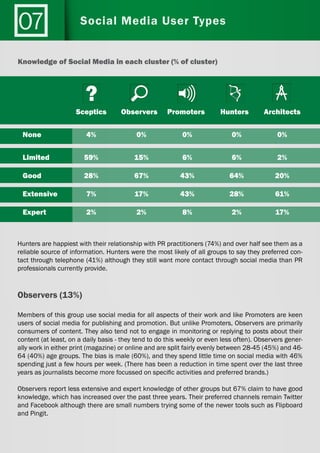
Observers (13%)
Members of this group use social media for all aspects of their work and like Promoters are keen
users of social media for publishing and promotion. But unlike Promoters, Observers are primarily
consumers of content. They also tend not to engage in monitoring or replying to posts about their
content (at least, on a daily basis - they tend to do this weekly or even less often). Observers gener-
ally work in either print (magazine) or online and are split fairly evenly between 28-45 (45%) and 46-
64 (40%) age groups. The bias is male (60%), and they spend little time on social media with 46%
spending just a few hours per week. (There has been a reduction in time spent over the last three
years as journalists become more focussed on specific activities and preferred brands.)
Observers report less extensive and expert knowledge of other groups but 67% claim to have good
knowledge, which has increased over the past three years. Their preferred channels remain Twitter
and Facebook although there are small numbers trying some of the newer tools such as Flipboard
and Pingit.
Social Media User Types
Knowledge of Social Media in each cluster (% of cluster)
Sceptics Observers Promoters Hunters Architects
None
Limited
Good
Extensive
Expert
4% 0% 0% 0% 0%
59% 15% 6% 6% 2%
28% 67% 43% 64% 20%
7% 17% 43% 28% 61%
2% 2% 8% 2% 17%
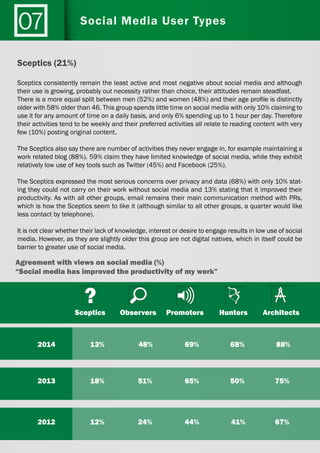
Sceptics (21%)
Sceptics consistently remain the least active and most negative about social media and although
their use is growing, probably out necessity rather than choice, their attitudes remain steadfast.
There is a more equal split between men (52%) and women (48%) and their age profile is distinctly
older with 58% older than 46. This group spends little time on social media with only 10% claiming to
use it for any amount of time on a daily basis, and only 6% spending up to 1 hour per day. Therefore
their activities tend to be weekly and their preferred activities all relate to reading content with very
few (10%) posting original content.
The Sceptics also say there are number of activities they never engage in, for example maintaining a
work related blog (88%). 59% claim they have limited knowledge of social media, while they exhibit
relatively low use of key tools such as Twitter (45%) and Facebook (25%).
The Sceptics expressed the most serious concerns over privacy and data (68%) with only 10% stat-
ing they could not carry on their work without social media and 13% stating that it improved their
productivity. As with all other groups, email remains their main communication method with PRs,
which is how the Sceptics seem to like it (although similar to all other groups, a quarter would like
less contact by telephone).
It is not clear whether their lack of knowledge, interest or desire to engage results in low use of social
media. However, as they are slightly older this group are not digital natives, which in itself could be
barrier to greater use of social media.
Social Media User Types
Sceptics Observers Promoters Hunters Architects
2014
2013
2012
13% 48% 69% 68% 88%
18%
12%
51%
24%
65%
44%
50%
41%
75%
67%
Agreement with views on social media (%)
“Social media has improved the productivity of my work”
•	Journalists deal with a heavy load of social media traffic but are starting to be more discerning
about the time spent on social media and therefore are not ‘always on.’ Hence they could easily
miss content pushed out to them
•	The five different types of journalists; Sceptics, Observers, Hunters, Promoters and Architects
use social media differently; the ways and the content pushed out to them on social media need
to be tailored according to their specific needs. The five social journalists’ types our study identi-
fied will help practitioners map patterns of use and attitudes.
•	Journalists’ appetite to try out new social media tools and services has abated as we are en-
tering a period of consolidation, which needs to be taken into account when developing strate-
gies to reach out and communicate with them.
•	PR sources are very important for journalists and PR professionals need to ensure they are
meeting journalists’ needs in terms of the reliability, quality and contact methods to maintain
what is currently a good relationship
•	Journalists’ role in society as key providers of news and information remains significant, and
thus they continue to be central for PR professionals in reaching out and communicating in an
increasingly ‘noisy’ world.
Implications
•	Time spent on using social media is not going to increase significantly but how journalists use
it will change as it gets more embedded in their work.
•	As journalists become more efficient in their use of social, their workload won’t be reduced -
social media will help them to do more
•	Journalists will continue to rely on mainstream social media platforms but will also start to
use more niche channels selectively
•	Journalists will continue to rely on email as their main source of communication with PR
professionals and phone contact will become even less common.
Predictions
Cision Europe and Canterbury Christ Church University conducted an online survey about the behav-
iours and attitudes and the uses and perceptions of social media among journalists. Respondents
were taken from Cision’s media database of more than 1.5 million influencers globally. This par-
ticular report takes a closer look at United Kingdom and is based on 466 responses from journalists
and media professionals collected during July – September 2014. Throughout the survey the term
‘journalist’ is used to include all media professionals, e.g. researchers, editors, etc., who took part.
The survey is designed to enhance the media industry’s understanding of social media uptake and
the impact of social media technologies and processes on journalists’ work. Cision conducts this
survey on an annual basis to continue to inform on best practices within the PR and communications
field and to deepen the industry’s understanding of how journalists and professional communica-
tors use and value social media and other resources. The research examined the patterns of social
media usage of journalists, for what professional tasks they use social media, and how they view the
impact of social media on journalistic practices and professional values.
For more information about the survey, please contact:
Cision UK
Kirsti Kauronen
Communications & Community Manager
Email: marketing.uk@cision.com
Twitter: @CisionUK
Dr Ágnes Gulyás
Reader in Digital Transformations, School of Media, Art and Design, Canterbury Christ Church Uni-
versity
Email: agnes.gulyas@canterbury.ac.uk
Twitter: @agulyas
Kristine Pole
Senior Lecturer Marketing, Business School, Canterbury Christ Church University
Email: kristine.pole@canterbury.ac.uk
Twitter: @krissypole
About the Survey
About Cision
Cision is a leading provider of public relations software that enables professionals to plan, execute
and measure influencer-oriented campaigns in one integrated platform. Communication profession-
als use Cision to access the world’s largest pitchable media and blogger database, distribute press
releases, manage influencer outreach, measure social media activities, and analyse the effective-
ness of campaigns. Cision, which recently combined with Vocus, also represents Visible Technolo-
gies, PRWeb, Help a Reporter Out (HARO) and iContact brands. Headquartered in Chicago, Cision
has over 120,000 customers and maintains offices in Canada, England, France, Germany, Portugal,
Sweden, Finland and China.
For more information, visit www.cision.com or follow @CisionUK on Twitter.
About Canterbury Christ Church University
Canterbury Christ Church University is a modern university with a particular strength in higher edu-
cation for the public services. With nearly 20,000 students, and five campuses across Kent and
Medway, its courses span a wide range of academic and professional expertise. Along with over a
thousand undergraduate, postgraduate and professional training courses on offer, the University is
also home to world-leading and internationally recognised research.
Visit: http://www.canterbury.ac.uk
About the Survey

Social Journalism Study 2015

  • 1.
    Social Journalism Study2015 United Kingdom Report by Cision & Canterbury Christ Church University (UK)
  • 2.
    Executive Summary 1. Themajority of UK journalists use social media as a professional tool. However, the percentage of journalists using social media regularly, for four hours or more a day, has declined during the last three years, from 24% in 2012 to 13% in 2014, indicating a level of saturation in its use. 2. Over half (53.5%) of UK journalists said they cannot carry out their work without so- cial media, an increase from 42% of journalists last year. 3. Twitter (75.1%) continues to be the most popular social networking channel for jour- nalists followed by Facebook (56.7%), Google+ (41.2%), Instagram (24.9%) and Hootsuite (24.7%). 4. Publishing and promoting content and sourcing information are the two most impor- tant reasons for social media use for journalists, a pattern that has remained stable over the last three years. 5. The number of followers journalists have has steadily increased over the last few years. While in 2012 less than half of respondents had more than 500 followers, by 2014 about two-thirds of them did. 6. PR professionals are the most important sources for journalists, followed by experts/ academics and then other journalists and media outlets. 7. While journalists tend to perceive the impact of social media on their work in general in a positive light, there are growing concerns about the effects it has on privacy, data security and journalistic values. 8. Previous studies identified five different types of journalists; Sceptics, Observers, Hunters, Promoters and Architects. Over the last three years, the sizes of each social media user type have changed significantly. In 2014 the two largest groups were the Promot- ers and the Sceptics, while in 2012 it was the Hunters and the Promoters. This change suggests an increasing polarisation in the profession in relation to social media use and attitudes with both the most negative and the more positive social media user types both increasing in number. * Data featured in his report was collected between July and September 2014. The title refers to the year of publication. Key findings of the 2015 survey*
  • 3.
    The fourth annualSocial Journalism Study, conducted by Cision and Canterbury Christ Church University, is the latest instalment in our efforts to understand and chart the changes in how journalists and media professionals use social media for their work and in their communication with PR professionals. This year’s results show that social is part of the journalists’ toolkit in their everyday work for a range of different tasks, dominated by sourcing and publishing content. Whilst there is a unanimous view that journalists could not carry out their work without social media and that it helps productivity, this year reflects a level of saturation in social media with its use remaining stagnant and in some cases, even declining for journalists. Survey Background The study found that journalists use a range sources for their stories, turning to PR sources, experts and other media outlets. Email remains the main communication channel for PR professionals but there is evidence from a small number of journalists that they would like to see social media used more widely for sharing PR content with journalists. As with other years, journalists would like few- er phone calls from PR professionals. The relationship with PR professionals is fairly good but there are areas to improve around the quality of their con- tribution to journalists’ work and the reliability of informa- tion shared. Overall journalists feel that social media has had greatest impact on the relationship with their audience and copy- right issues.
  • 4.
    3.1 Most journalistsuse social media up to 2 hours a day but there is a degree of saturation The majority of UK journalists use social media regularly. About two-thirds of respondents reported that they use the tools up to 2 hours a day. There is just a small number who are ‘always on’ and use the tools for 4 or more hours a day. This suggests that although social media is embedded in daily practices of journalists, it is not something they are constantly using; rather they tend to ‘check-in’ for shorter periods to carry out specific tasks. The percentage of journalists using social media for more than 4 hours a day has actually declined during the last three years (from 24% in 2012 to 13% in 2014), but so too has the proportion of re- spondents not using the tools (10% in 2012 and 5% in 2014). This indicates that initially there was a greater division between social media users and non-users. It also suggests that after an initial excitement of the introductory phase, there is a degree of satura- tion and an optimum time for social media use. For most journalists there are no additional gains to be had from constant use. Social Media Use None Time spent using social media for work (% of respondents) Up to 2 hours per day 2-4 hours per day 4-8 hours per day More than 8 hours per day 2012 2013 2014 10% 4.4% 5.2% 34.1% 61% 63.8% 32.4% 22.6% 17.6% 20.7% 9.6% 9.2% 2.8% 2.3% 4.1%
  • 5.
    3.2 Over halfof UK journalists cannot carry out their work without so- cial media As social media use increased and became embedded in journalists’ work over the last few years, perceptions of it as an indispensable tool have gained ground. In 2012, 28% of respondents thought that they would not be able to carry out their work without social media, which increased to 54% by 2014. Perceptions about the impact on productivity have also improved, and this year over half of respondents (58%) agreed that because of social media they were more productive in their work. However, only 12% of respondents agreed that their workload has decreased because of using the tools while the majority 69% disagreed. Social Media Use Views about the impacts of social media (% of respondents) 3.3 Twitter is the most popular social networking tool for journalists The five most popular social media apps used by UK journalists are Twitter (75.1%), Facebook (56.7%), Google+ (41.2%), Instagram (24.9%) and Hootsuite (24.7%). Twitter is especially well-liked with three quarters of respondents reporting regular use. 2012 2013 2014 "I would not be able to carry out my work without social media" “Social media has improved the pro- ductivity of my work” 53.5% 57.7% 43.4% 54.1% 28.1% 38.9%
  • 6.
    3.4 Publishing /promoting and sourcing remain the two most impor- tant reasons for using social media Publishing / promoting and sourcing remain the two most important reasons for using social media, a trend that has been present over the last three years. However, about two-thirds of respondents reported that they use social media regularly for a variety of purposes involving all key professional tasks: publishing and promoting their own work, sourcing information, networking, verifying and monitoring what is going on. The table below illustrates the diversity of social media use by journalists. Social Media Use Selected social media activities (% of respondents carrying out daily) 17.4% 50.8% 30.1% 58.9% 47% 40.6% 18.3% 17.3% 11.5% 47.8% 31.7% Read Blogs Read postings of people they follow on a social networking or microblogging site Publish a story based on information found on social media Read content communities or crowdsourcing sites Add comments to someone’s page or profile on a social networking site Reply to comments received in relation to their work on social media sites Monitor discussions on social media about own content Post original comments on social networking or microblogging sites Use social media to make new contacts in their field of work Re-post on microblogging site Maintain a work related blog
  • 7.
    Most types ofsocial media tools were used by more than two-thirds of respondents, with the ex- ception of social readers which continue to have limited uptake. In terms of changes over the last four years, the use of microblogs (e.g. Twitter) and professional social networks (e.g. LinkedIn) has increased the most. Social Media Use Use of different types of social media tools for work in a typical week (% of respondents) 2011 2012 2013 2014 Professional Social Networks Blogs Social Reader Sites Social Networks Audio-visual Sharing Sites Microblogs Content Communities 78.1% 79.2% 33.7% 75.3% 66.3% 88.6% 73.6% 83.1% 82.1% 38.8% 82.5% 74.1% 92.1% 81% 75.7% 68% 20.1% 72.1% 65.6% 79.4% 70.2% 52.7% 57.1% 67% 53.7% 67.3% 66.6% N/A
  • 8.
    3.5 The numberof followers among journalists has steadily increased over the last few years Respondents in our study had on an average of about 3,600 followers on their preferred social net- working or microblogging site, while the figure for the general population is slightly above 200. This suggests that people tend to turn to sources on social media they know and trust, and that journal- ists remain key sources and interpreters of news and information in society even in the social media environment. The number of followers among journalists has steadily increased over the last few years. While in 2012 less than half of respondents had more than 500 followers, by 2014 about two-thirds of them did. Number of followers on preferred social media site (% of respondents) 2012 2013 2014 <100 101-500 500+ Social Media Use 5.8% 7.4% 21.1% 65.7% 61.5% 25.2% 7.5% 5.8% 7.6% 13.4% 31.4% 47.6% None
  • 9.
    4.1 Most journaliststhink that their work changed considerably because of social media Respondents in our study generally agreed that social media has changed their work and how they interact with audiences. 51.4% of respondents said that the way they worked has changed to a large extent or fundamentally because of social media, and only 5% thought that it did not change at all. However, views vary about what aspects of their work have changed and to what extent. The largest perceived impact was in relation to journalists’ relationship with their audience. 61.6% of respond- ents thought that this relationship changed fundamentally or to a large extent, and a further 20.3% reported moderate change. The way in which journalists work, their everyday practices, is also an area on which social media has had a significant impact. The impact of social media on the content journalists produce was perceived to have been altered less. But even in this case, nearly 40% of respondents thought that the content they produced has changed fundamentally or to a large extent because of social media. Views on Social Media The way they work The content they produce Relationship with their audience Copyright issues Not at all To a small extent To a moderate extent To a large extent Fundamentally 5.0% 11.3% 7.3% 11.8% 17.0% 19.8% 10.8% 12.3% 26.6% 29.1% 20.3% 29.6% 32.1% 26.3% 37.8% 30.8% 19.3% 13.5% 23.8% 15.5% Views about the extent to which social media changed the work of journalists (% of respondents)
  • 10.
    4.2 There aregrowing concerns about the effects social media has on privacy, data security and journalistic values While journalists tend to perceive the impact of social media on their work in general in a positive light, they are more ambivalent about the effects the tools have on their profession. In particular, they are increasingly concerned that social media undermines traditional journalistic values. In 2014, nearly half of the respondents agreed that these values, including objectivity and fairness, are jeopardised because of social media, while a third disagreed and the rest were unsure. The proportion of those who are concerned has increased over the last three years from 40.5% in 2012 to 48.8% this year. There were a larger percentage of respondents (80.7%) who agreed that a key way social media is changing their profession is through encouraging opinion-orientated journal- ism. This in turn, for some of them, has an adverse effect on traditional values. Notable also is the increase in the number of respondents who have serious concerns over privacy and data security in relation to social media. In 2012, 27.5% of respondents had such serious concerns, but despite falling in 2013 the figure in- creased to 48.5% by 2014. Recent scandals about online privacy and data security has clearly had an impact on journalists’ views on the issues. There remains a split among journalists regarding their views on the impacts of social media on their profession. In 2014, 39.1% of respondents agreed that social media has changed what journalism was about to a large extent or fundamentally, while 52.9% perceived the impacts as small or moder- ate, and 8% said that journalism has not changed at all. Views on Social Media “I have serious concerns over privacy and data security” “Social media is undermining traditional journalistic values” 2014 2013 2012 48.5% 22.4% 27.5% 48.8% 38% 40.5% Percentage of respondents who agreed with each of the following statements
  • 11.
    5.1 Journalists producingreviews or editorial pieces are affected more by social media than those who deliver news content The impact of social media is felt differently among respondents depending on the types of content they produce. Those who write reviews or comment/editorial pieces reported stronger impact compared to those who report news stories. For example, 30.6% of editorial journalists agreed that social media fun- damentally changed the way they worked, while only 15.6% of respondents publishing hard news agreed with that. Differences were also notable regarding the relationship with the audience. While 40.4% review jour- nalists agreed that their relationship with their audience fundamentally changed because of social media, only 12.5% of respondents publishing hard news agreed. Influences on Social Media Use Respondents who perceived the impact of social media fundamental on the fol- lowing aspects of their work (% of journalists by types of content they produce) The way they work Soft News Hard News Aggregate News Reviews Editorial Feature 15.6% 20.3% 12.5% 29.8% 30.6% 13.4% 3.1% 6.8% 8.3% 27.7% 22.2% 7.7% The content they produce Relationship with their audience What journalism is about 12.5% 20.3% 20.8% 40.4% 37.5% 18.3% 18.8% 13.6% 4.2% 19.1% 18.1% 11.3%
  • 12.
    5.2 Changing structuresand working patterns in media organisations has impacted social media use Reviews and editorial journalists were also more likely to agree that social media was indispensable to their work and that it has improved productivity at the workplace. For example, 38.3% of respond- ents writing reviews said that they would not be able to carry out their work without social media, while only 9.4% of hard news journalists agreed with that. Reasons for these differences are probably multifold including changing structures and working pat- terns in media organisations, but PRs might want to keep these variations in mind when contacting different types of journalists. Influences on Social Media use Percentage of respondents who strongly agreed with each of the following statements (% of journalists by types of content they produce) Soft News Hard News Aggregate News Reviews Editorial Feature “I would not be able to carry out my work without social media” “Social media has improved my productivity” 9.4% 18.6% 29.2% 38.3% 37.5% 17.6% 6.3% 16.9% 20.8% 27.7% 38.9% 20.4%
  • 13.
    6.1 PR professionalsare the most important sources for journalists When journalists were asked to choose their two most important sources of information, PR sources ranked the highest, followed by experts/academics and then other journalists and media outlets. This suggests that social media has not significantly altered how journalists source their stories as traditional sources remain the most important regardless of the method of distribution. Alternatives such as crowdsourcing are yet to become key sources of information for journalists. Communication with PR Professionals Source ranked by importance PR sources Experts / academics Company representative General public / crowdsourcing Government officials / public servants Public figures / celebrities Journalists / media outlets 1 2 3 4 5 6 7
  • 14.
    6. 2 Concernsabout the reliability of information shared by PRs Although PR professionals are the most important source of information, there are some concerns about their reliability. Four in ten respondents agreed that PR information enhances the quality of reporting, and less than half thought that PR practitioners are reliable sources of stories. Given the very different objectives of PR professionals and journalists, distrust may be to some ex- tent a necessary evil. Communication with PR Professionals “PR information enhances the quality of reporting” 23.3% 36.1% 40.6% “I am happy with my relationship with PR practitioners” “PR practitioners are a reliable source of stories” “Because of social media I am less reliant on PR professionals” 12.8% 26.3% 60.9% 26.8% 28.1% 45.2% 35.4% 29.3% 35.3% Views about PR professionals (% of respondents) Disagree Ambivalent Agree
  • 15.
    6.3 Journalists becomingless reliant on PR professionals because of so- cial media Over a third of respondents thought that they were becoming less reliant on PR professionals be- cause of social media. This suggests that the PR industry needs to revisit the content it produces and how it presents information for stories on different platforms. 6.4 Email stays top choice for contact from PR professionals though so- cial media is gaining ground Email remains the most widely used communication method between PR professionals and journal- ists with 86.1% respondents stating it was the main method used in 2014, a slight (3%) decrease since 2013. The second most common method is still via telephone (38.6%), although there has been a significant decrease. Last year nearly 60% of respondents selected telephone as one of the two most common ways PR professionals contact them. At the same time, there was an increase in the use of social media for PR-journalists communication. While last year 18.5% of respondents said that one of the most common ways PR professionals contacted them was through social media, this year the figure increased to 32.4%. Communication with PR Professionals Selected two most common ways PR professionals contact journalists (% respondents) 2014 2013 3.6% 38.6% 7.1% 86.1% 32.4% 5.6% 5.3% 59.3% 2.1% 89.3% 18.5% 5.3% Face-to-face Telephone Newswires Email Social Media Post / Hardcopy
  • 16.
    When journalists wereasked how they would like to be contacted, email remained the preferred choice but social media came in second. From the differences between preferred choices and the actual ways journalists are being contacted, it is clear that the use of the telephone continues to be a major source of irritation for journalists with 16.1% requesting less contact by phone. Communication with PR professionals Difference between most common and preferred ways journalists want to be con- tacted by PR professionals (difference between %) 2014 2013 4.1 -16.1 -1.7 -2.6 1.3 2.6 5.9 -21.8 -0.1 -3 10.9 2.6 Telephone Newswires Email Social Media Post / Hardcopy Face-to-face
  • 17.
    7.1 Increasing polarisationamong social media user types Three years ago our study identified five types of social media users among journalists and these continue to be a key feature of social media adoption in the profession. These users are: Architects, Promoters, Hunters, Observers and Sceptics. Their key characteristics and the differences between them can be illustrated along a spectrum of social media use, views and attitudes. As these groups are based on cluster analysis, the specific characteristics of these groups have changed over the three years as technology itself has evolved and journalists become more skilled and knowledge- able. Over the last three years the sizes of each social media user types have changed. In 2014 the two largest groups were the Promoters and the Sceptics, while in 2012 it was the Hunters and the Pro- moters. This change suggests an increasing polarisation in the profession in relation to social me- dia use and attitudes with both the most negative and the more positive social media user types increasing in number. Social Media User Types 10% 19% 25% 35% 12% Sceptics Observers Promoters Hunters Architects Ratio of the five Social Media User Types (% of respondents) 20% 13% 35% 16% 16% 2012 2014
  • 18.
    7.2 Professional Profiles Thesize of the five profiles of our social media user type has changed over the last three years, cre- ating one dominant group, the Promoters: 35% of the respondents. Both Sceptics and Promoters have seen a 10% increase over the three years, while there has been a corresponding decline in the numbers of Hunters. It is interesting to see that Architects have remained fairly stable over the three years, suggesting that journalists do not automatically progress gradually from Sceptics to Architects as they improve their skills and knowledge, but retain particular views and behaviours towards social media. What follows is a summary of the key characteristics of these five groups in 2014. All groups show increasing reliance on social media over the last three years, although the Sceptics continue to have a negative view of the technology. Social Media User Types I would not be able to carry out my work without social media Sceptics Observers Promoters Hunters Architects 2014 2013 2012 10% 43% 66% 52% 91% 8% 4% 32% 13% 51% 40% 49% 26% 68% 55%
  • 19.
    Architects (16%) The Architectshave varied slightly in size over the last three years and represent the most proac- tive of all the groups - they could be described as the ‘movers and shakers’ or first movers in terms of their journalism work and social media. They have always shown greater use of social media, al- though this is not surprising as 91% claim to work in online journalism. With a slight female bias (57% are female), journalists in this group are much younger, having the largest proportion of 18-27 year olds (29%) compared to all the other groups. This group spends much longer using social media with all of them using these tools daily and 19% accessing social media more than 8 hours per day. Not surprisingly, with so much time spent on social media, 78% of this group claim to have extensive or expert knowledge. They are avid users of Twitter (98%) and Facebook (86%), and the leading us- ers of Instagram, Google+ and other tools such as Hootsuite (42%), Storify (30%) Flipboard (16%), and Pingit (6%). This group uses social media for a range of tasks on a frequent basis, either daily or weekly, and are busy undertaking a range of reading, posting, and sharing content - they are more active than all other groups. The most notable increase over the last three years was in relation to those who main- tain a work-related blog on a daily basis growing a significant 45% in three years. Interestingly, this group still turn to other media outlets and PR professionals as main sources of in- formation in equal measure. Although almost all of them are contacted by PR professionals through email, close to 60% also maintain PR relationships, albeit via social media. This group is also very positive about the role social media plays in their work, with 91% saying they could not work without it and 88% saying it has improved their productivity. Although most (62%) are happy with their relationship with PR professionals, they recognise that they are less reliant on them because of social media (59%). Social Media User Types
  • 20.
    Promoters (35%) The Promotersnow represent the largest of all the journalist groups and are, as their name suggests, keen users of social media for publishing and promoting their work, particularly favouring Twitter (used by 97%) and blogs. The second most popular activity is sourcing, used by 78% of Promoters. For most tasks and activi- ties the Promoters use social media widely, although slightly less so than the Architects. Generally they are positive about social media with two thirds of the group agreeing that social media improves their productivity (69%) and 66% claiming they would not be able to carry out their work without so- cial media. The group has the heaviest female bias (60%), and is made up of journalists in all age categories, with 85% stating they have good/extensive knowledge, although only 8% claim to be ex- perts. Promoters tend to spend 1-2 hours a day on social media for work but a quarter spends between 2-4 hours a day. On a daily basis, the most popular activity is posting original content (78%) but mem- bers of this group are less likely to get involved in reading others’ work and networking, which they tend to do weekly, prioritising daily publishing commitments. They are most likely to read posts of people they follow and monitor discussions on social media about their own content. This group are generally happy with their relationship with PR professionals (68%) and almost half believe that PRs enhance the quality of reporting and are a reliable source of information. Hunters (16%) Hunters generally sit in the middle of the groups in terms of their use of social media – never as much as Promoters and Architects but more than Sceptics and Observers. This group have seen a substantial decline over the three years, although a marginal increase since last year (2% increase). Two years ago Hunters were mainly using social media for gathering information but have moved to- wards Promoters as they engage more in publishing their content. In fact, their most frequent daily activity is posting content on Twitter and Facebook (75%), followed by reading other content; social networking tends to be a weekly activity. Hunters are most likely to be working for print (magazines) or online organisations, aged 28-45, with the group including the lowest number of journalists aged 65+. They are not heavy users of social media compared to some of the other groups with most (38%) spending up to one hour per day and 30% approximately 1-2 hours per day but most say they have a good knowledge (64%) of using so- cial media. Only 28% say their knowledge is extensive, so lack of advanced skills may restrict more extensive use. Social Media User Types
  • 21.
    Hunters are happiestwith their relationship with PR practitioners (74%) and over half see them as a reliable source of information. Hunters were the most likely of all groups to say they preferred con- tact through telephone (41%) although they still want more contact through social media than PR professionals currently provide. Observers (13%) Members of this group use social media for all aspects of their work and like Promoters are keen users of social media for publishing and promotion. But unlike Promoters, Observers are primarily consumers of content. They also tend not to engage in monitoring or replying to posts about their content (at least, on a daily basis - they tend to do this weekly or even less often). Observers gener- ally work in either print (magazine) or online and are split fairly evenly between 28-45 (45%) and 46- 64 (40%) age groups. The bias is male (60%), and they spend little time on social media with 46% spending just a few hours per week. (There has been a reduction in time spent over the last three years as journalists become more focussed on specific activities and preferred brands.) Observers report less extensive and expert knowledge of other groups but 67% claim to have good knowledge, which has increased over the past three years. Their preferred channels remain Twitter and Facebook although there are small numbers trying some of the newer tools such as Flipboard and Pingit. Social Media User Types Knowledge of Social Media in each cluster (% of cluster) Sceptics Observers Promoters Hunters Architects None Limited Good Extensive Expert 4% 0% 0% 0% 0% 59% 15% 6% 6% 2% 28% 67% 43% 64% 20% 7% 17% 43% 28% 61% 2% 2% 8% 2% 17%
  • 22.
    Sceptics (21%) Sceptics consistentlyremain the least active and most negative about social media and although their use is growing, probably out necessity rather than choice, their attitudes remain steadfast. There is a more equal split between men (52%) and women (48%) and their age profile is distinctly older with 58% older than 46. This group spends little time on social media with only 10% claiming to use it for any amount of time on a daily basis, and only 6% spending up to 1 hour per day. Therefore their activities tend to be weekly and their preferred activities all relate to reading content with very few (10%) posting original content. The Sceptics also say there are number of activities they never engage in, for example maintaining a work related blog (88%). 59% claim they have limited knowledge of social media, while they exhibit relatively low use of key tools such as Twitter (45%) and Facebook (25%). The Sceptics expressed the most serious concerns over privacy and data (68%) with only 10% stat- ing they could not carry on their work without social media and 13% stating that it improved their productivity. As with all other groups, email remains their main communication method with PRs, which is how the Sceptics seem to like it (although similar to all other groups, a quarter would like less contact by telephone). It is not clear whether their lack of knowledge, interest or desire to engage results in low use of social media. However, as they are slightly older this group are not digital natives, which in itself could be barrier to greater use of social media. Social Media User Types Sceptics Observers Promoters Hunters Architects 2014 2013 2012 13% 48% 69% 68% 88% 18% 12% 51% 24% 65% 44% 50% 41% 75% 67% Agreement with views on social media (%) “Social media has improved the productivity of my work”
  • 23.
    • Journalists deal witha heavy load of social media traffic but are starting to be more discerning about the time spent on social media and therefore are not ‘always on.’ Hence they could easily miss content pushed out to them • The five different types of journalists; Sceptics, Observers, Hunters, Promoters and Architects use social media differently; the ways and the content pushed out to them on social media need to be tailored according to their specific needs. The five social journalists’ types our study identi- fied will help practitioners map patterns of use and attitudes. • Journalists’ appetite to try out new social media tools and services has abated as we are en- tering a period of consolidation, which needs to be taken into account when developing strate- gies to reach out and communicate with them. • PR sources are very important for journalists and PR professionals need to ensure they are meeting journalists’ needs in terms of the reliability, quality and contact methods to maintain what is currently a good relationship • Journalists’ role in society as key providers of news and information remains significant, and thus they continue to be central for PR professionals in reaching out and communicating in an increasingly ‘noisy’ world. Implications
  • 24.
    • Time spent onusing social media is not going to increase significantly but how journalists use it will change as it gets more embedded in their work. • As journalists become more efficient in their use of social, their workload won’t be reduced - social media will help them to do more • Journalists will continue to rely on mainstream social media platforms but will also start to use more niche channels selectively • Journalists will continue to rely on email as their main source of communication with PR professionals and phone contact will become even less common. Predictions
  • 25.
    Cision Europe andCanterbury Christ Church University conducted an online survey about the behav- iours and attitudes and the uses and perceptions of social media among journalists. Respondents were taken from Cision’s media database of more than 1.5 million influencers globally. This par- ticular report takes a closer look at United Kingdom and is based on 466 responses from journalists and media professionals collected during July – September 2014. Throughout the survey the term ‘journalist’ is used to include all media professionals, e.g. researchers, editors, etc., who took part. The survey is designed to enhance the media industry’s understanding of social media uptake and the impact of social media technologies and processes on journalists’ work. Cision conducts this survey on an annual basis to continue to inform on best practices within the PR and communications field and to deepen the industry’s understanding of how journalists and professional communica- tors use and value social media and other resources. The research examined the patterns of social media usage of journalists, for what professional tasks they use social media, and how they view the impact of social media on journalistic practices and professional values. For more information about the survey, please contact: Cision UK Kirsti Kauronen Communications & Community Manager Email: marketing.uk@cision.com Twitter: @CisionUK Dr Ágnes Gulyás Reader in Digital Transformations, School of Media, Art and Design, Canterbury Christ Church Uni- versity Email: agnes.gulyas@canterbury.ac.uk Twitter: @agulyas Kristine Pole Senior Lecturer Marketing, Business School, Canterbury Christ Church University Email: kristine.pole@canterbury.ac.uk Twitter: @krissypole About the Survey
  • 26.
    About Cision Cision isa leading provider of public relations software that enables professionals to plan, execute and measure influencer-oriented campaigns in one integrated platform. Communication profession- als use Cision to access the world’s largest pitchable media and blogger database, distribute press releases, manage influencer outreach, measure social media activities, and analyse the effective- ness of campaigns. Cision, which recently combined with Vocus, also represents Visible Technolo- gies, PRWeb, Help a Reporter Out (HARO) and iContact brands. Headquartered in Chicago, Cision has over 120,000 customers and maintains offices in Canada, England, France, Germany, Portugal, Sweden, Finland and China. For more information, visit www.cision.com or follow @CisionUK on Twitter. About Canterbury Christ Church University Canterbury Christ Church University is a modern university with a particular strength in higher edu- cation for the public services. With nearly 20,000 students, and five campuses across Kent and Medway, its courses span a wide range of academic and professional expertise. Along with over a thousand undergraduate, postgraduate and professional training courses on offer, the University is also home to world-leading and internationally recognised research. Visit: http://www.canterbury.ac.uk About the Survey