Research 
Report 
2013 
In collaboration with 
Findings from the 2013 social business 
global executive study and research project 
Social Business: 
Shifting Out 
of First Gear 
By David Kiron, Doug Palmer, Anh Nguyen Phillips, Robert Berkman
Authors 
David Kiron is the 
executive editor of the 
Big Ideas Initiatives at 
MIT Sloan Manage-ment 
Review, which 
brings ideas from the 
world of thinkers to the 
executives and manag-ers 
who use them. He 
can be reached at 
dkiron@mit.edu 
Contributors 
Copyright © 2013. Massachusetts Institute of Technology. All rights reserved. 
For more information on permission to distribute or post articles, visit our website FAQ page 
http://sloanreview.mit.edu/faq/ 
Customer service 
E-mail: Smr-help@mit.edu 
Phone: 617-253-7170 
Doug Palmer is a 
principal at Deloitte 
Consulting LLP and 
leader of Deloitte’s 
Social Business 
practice. He can be 
reached at dpalmer@ 
deloitte.com 
Anh Nguyen Phillips 
is a senior manager 
within Deloitte’s 
U.S. Strategy, Brand 
& Innovation group, 
where she leads strate-gic 
thought leadership 
initiatives. She can be 
reached at anhphillips 
@deloitte.com 
Robert Berkman 
is the contributing 
editor for the Big Ideas 
Social Business Initia-tive 
at MIT Sloan 
Management Review. 
He can be reached at 
rberkman@mit.edu 
Natasha Buckley, Senior Manager, Deloitte Services LP 
Jonathan Copulsky, Principal, Deloitte Consulting LLP 
Alex Dea, Consultant, Deloitte Consulting LLP 
Deb Gallagher, Director, Marketing & Operations, MIT Sloan Management Review 
Martha E. Mangelsdorf, Editorial Director, MIT Sloan Management Review 
Mark White, Principal and Global Consulting CTO, Deloitte Consulting LLP 
Edward Ruehle, writer
2 / Key Findings 
• Social Business Is an 
Immediate Opportunity 
• However, Progress Is Slow 
• Shifting Out of First Gear 
3 / Introduction: 
An Opportunity on the 
Immediate Horizon 
•More Industries Are Getting On Board 
• Market Drivers 
• Struggles with Social Business 
5 / Snapshot: 
The State of Play 
•Divergent Paths to Social Maturity 
•Dell’s Path to Social Maturity 
Contents 
7 / Shifting Out of First: 
Focus on Business 
Challenges 
•Marketing and Sales — A Sharper Edge 
•Customer Service — A Step Change 
•Operations — Precision and Visibility 
• Recruitment — Advantage in the 
Talent War 
•Innovation — Top Management Buy-in 
•Plugging Into Other Technologies 
12 / Shifting Out of Second: 
Spur the Effort 
• Leading a Social Culture 
• Measuring What Matters 
• Creating Meaningful Content 
• Changing the Way Work Gets Done 
RESEARCH 
REPORT 
2013 
SOCIAL BUSINESS: SHIFTING OUT OF FIRST GEAR • MIT SLOAN MANAGEMENT REVIEW 1 
19 Appendix 
The Survey: Questions 
and Responses 
19 About the 
Research 
27 Acknowledgments
R e s e a r c h R e p o r t S o c i a l B u s i n e s s : S h i f t i n g o u t o f f i r s t g e a r 
Key Findings 
Seventy percent of respondents to the 2012 global executive social business survey conducted by MIT Sloan 
Management Review and Deloitte1 believe social business is an opportunity to fundamentally change the way 
their organization works. Yet many companies face meaningful barriers to progress. In our 2013 report, 
we delve into why some businesses are reaping value from social business, and what is holding others back. The 
following are our key findings: 
Social Business Is an Immediate Opportunity 
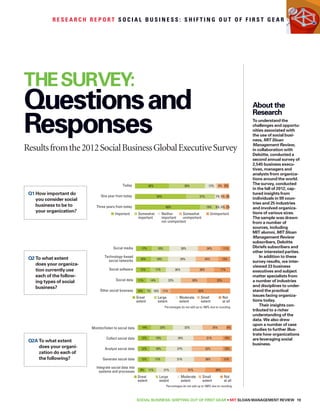
• The importance of social business is mounting. In our 2011 survey, 18% of respondents said it was “impor-tant 
today.” In 2012, the number jumped to 36%. The time horizon is also getting shorter. In 2011, 40% of 
respondents said that social “will be important one year from now.” In 2012 that number leaped to 54%. 
• The importance of social is growing across all industries. Between last year and this year, respondents 
from all industry sectors increased the value they place on social business. None remained at the same level. 
None reversed course. 
However, Progress Is Slow 
• The emergence of socially connected enterprises isn’t fast. When asked to rank their company’s social 
business maturity on a scale of 1 to 10, more than half of respondents gave their company a score of 3 or 
below. Only 31% gave a rating of 4 to 6. Just 17% ranked their company at 7 or above. 
• Companies are facing common barriers. Three major culprits are impeding progress: lack of an overall 
strategy (28% of respondents), too many competing priorities (26%) and lack of a proven business case or 
strong value proposition (21%). 
Shifting Out of First Gear 
•Companies are developing more mature social business capabilities by focusing on key business 
challenges. Businesses that have more developed social business capabilities don’t view social business solely 
as an application or tool. They have integrated it into many functions, such as strategy and operations, and 
use it in daily decision making. As a business solution, social has evolved, moving well beyond the marketing 
department, to address business objectives across the organization: 
65% of respondents use social business tools to understand market shifts. 
45% turn to it to improve visibility into operations. 
45% leverage it to identify internal talent. 
•Leadership support, measurement capability, content, and appropriate processes are must-haves for 
social business success. To spur and maintain the adoption of social, companies are systematically nurturing 
it. Company leaders are driving a conversational culture in very hands-on ways, including using social media 
themselves. Although the discipline of measurement is still evolving, more mature companies don’t let mea-surement 
challenges halt the progress. Successful social business efforts never skimp on content quality. 
Companies continually create it, curate it and keep it fresh to ensure participation. Finally, social business 
changes the way work gets done, and processes need to be designed to assure its adoption and success. 
2 MIT SLOAN MANAGEMENT REVIEW • DELOITTE
Shifting Out 
of First Gear 
Introduction: 
An opportunity on the immediate horizon In an interview for this year’s social business report, Gerald Kane, professor at the 
Carroll School of Management at Boston College, succinctly characterized where 
social business stands today: “Any new technology experiences a faddish hype cycle 
where people adopt it because they feel they have to,” he says. “With social, we are 
passing the peak of faddishness. Companies are starting to crack social’s code and 
turning to it for business advantage, intelligence and insight.” 
In this second annual report from the MIT Sloan Management Review and Deloitte1 Social 
Business Study, we probed executives’ views of the social business opportunity and how com-panies 
are harnessing its value. The study included 2,545 respondents from 25 industries and 
99 countries. It also incorporated interviews with nearly three dozen executives and social 
business thought leaders. 
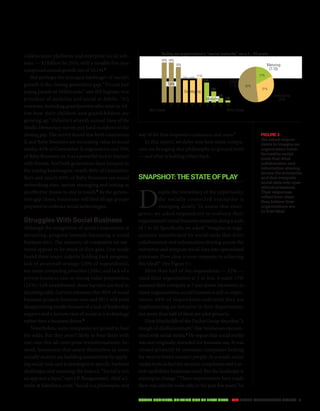
Echoing Kane’s observation, a key finding of the research is the rapid growth in importance 
of social to business. In 2011’s survey, 18% of respondents said it was “important today.” One 
year later, the number doubled to 36%. The time horizon of its importance is also shrinking. In 
last year’s report, 40% of respondents agreed that social would be important one year from 
now. In 2012, the number jumped to 54% (see Figure 1). 
What is Social 
Business? 
We employ the term “social 
business” to describe an 
organization’s use of any or 
all of the following elements: 
Consumer-based social media 
and networks (for example, 
blogs, Twitter, Facebook, 
Google+, YouTube, Slide- 
Share) 
Technology-based, internally 
developed social networks 
(such as GE’s Colab or the 
Cisco Learning Network) 
Social software for enterprise 
use, whether created by third 
parties (for example, Chatter, 
Jive or Yammer) or developed 
in-house 
Data derived from social 
media and technologies (such 
as crowdsourcing or market-ing 
intelligence) 
Neither Unimportant 
important 
SOCIAL BUSINESS: Shifting out of First Gear • MIT SLOAN MANAGEMENT REVIEW 3 
Figure 1 
In the 2011 survey, 
18% of respondents 
said social business 
was “important,” 
the highest possible 
level on a five point 
scale. In the 2012 
survey, that number 
doubled to 36%. 
How important do you consider social 
business to be to your organization? 
Today 
One year from today 
Three years from today 
Today 
One year from today 
Three years from today 
Important Somewhat 
important 
Somewhat 
unimportant 
nor unimportant 
In 2012 
In 2011 
36% 38% 12% 8% 6% 
54% 31% 7% 5% 3% 
69% 19% 6% 4% 2% 
18% 34% 22% 14% 12% 
40% 35% 13% 8% 4% 
63% 23% 8% 4% 3% 
Due to rounding, percentages may not total 100 percent. 
g 1
R e s e a r c h R e p o r t S o c i a l B u s i n e s s : S h i f t i n g o u t o f f i r s t g e a r 
More Industries Are 
Getting On Board 
The immediacy of the social business opportunity 
is growing across industries, another indicator of its 
move from faddish hype to business value. Between 
last year’s study and this year’s, respondents from all 
industry sectors increased the value they place on 
social business. None remained at the same level. 
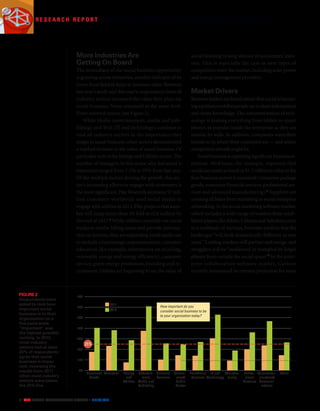
None reversed course (see Figure 2). 
While Media (entertainment, media and pub-lishing) 
and Tech (IT and technology) continue to 
lead all industry sectors in the importance they 
assign to social business, other sectors demonstrated 
a marked increase in the value of social business. Of 
particular note is the Energy and Utilities sector. The 
number of managers in this sector who feel social is 
important surged from 7.1% to 29% from last year. 
Of the multiple factors driving the growth, this sec-tor’s 
increasing efforts to engage with customers is 
the most significant. Pike Research estimates 57 mil-lion 
customers worldwide used social media to 
engage with utilities in 2011. Pike projects that num-ber 
will jump more than 10-fold to 624 million by 
the end of 2017.2 While utilities currently use social 
media to resolve billing issues and provide informa-tion 
on services, they are expanding social media use 
to include crisis/outage communication, customer 
education (for example, information on recycling, 
renewable energy and energy efficiency), customer 
service, green energy promotion, branding and re-cruitment. 
Utilities are beginning to see the value of 
60% 
4 MIT SLOAN MANAGEMENT REVIEW • DELOITTE 
social listening to keep abreast of consumers’ inter-ests. 
This is especially the case as new types of 
competitors enter the market, including solar power 
and energy management providers. 
Market Drivers 
Business leaders are keenly aware that social is becom-ing 
a primary tool that people use to share information 
and create knowledge. The consumerization of tech-nology 
is making everything from tablets to smart 
phones as popular inside the enterprise as they are 
outside its walls. In addition, companies want their 
brands to be where their customers are — and where 
competitors already might be. 
Social business is capturing significant business at-tention. 
McKinsey, for example, reported that 
social can create as much as $1.3 trillion in value in the 
four business sectors it examined (consumer package 
goods, consumer financial services, professional ser-vices 
and advanced manufacturing).3 Suppliers are 
covering all bases from marketing to social enterprise 
networking. In the social marketing software market, 
which includes a wide range of vendors from estab-lished 
players like Adobe, Lithium and Salesforce.com 
to a multitude of startups, Forrester predicts that the 
landscape “will look dramatically different in two 
years.” Leading vendors will partner and merge, and 
stragglers will be “swallowed or trampled by larger 
players from outside the social space.”4 In the enter-prise 
collaboration software market, Gartner 
recently announced its revenue projection for team 
2011 
2012 
70% 
50% 
40% 
30% 
20% 
10% 
0% 
Energy 
and 
Utilities 
Consumer 
Goods 
Education Entertain-ment, 
Media and 
Publishing 
Financial 
Services 
Govern-ment/ 
Public 
Sector 
Healthcare 
Services 
IT and 
Technology 
Manufac-turing 
Profes-sional 
Services 
Telecommu- Other 
nications/ 
Communi-cations 
How important do you 
consider social business to be 
to your organization today? 
25% 
g 2 
Figure 2 
Respondents were 
asked to rank how 
important social 
business is to their 
organization on a 
five point scale. 
“Important” was 
the highest possible 
ranking. In 2012, 
most industry 
sectors had at least 
25% of respondents 
agree that social 
business is impor-tant, 
reversing the 
results from 2011 
when most industry 
sectors were below 
the 25% line.
g 3 
Rating an organization’s “social maturity” on a 1 - 10 scale 
17% 
SOCIAL BUSINESS: Shifting out of First Gear • MIT SLOAN MANAGEMENT REVIEW 5 
collaboration platforms and enterprise social soft-ware 
— $2 billion by 2016, with a notable five-year 
compound annual growth rate of 16.1%.5 
But perhaps the strongest harbinger of social’s 
growth is the closing generation gap. “It’s not just 
young people or Millennials,” says Bill Ingram, vice 
president of analytics and social at Adobe. “It’s 
everyone, including grandparents who want to fol-low 
how their children and grandchildren are 
growing up.” Deloitte’s seventh annual State of the 
Media Democracy survey put hard numbers to the 
closing gap. The survey found that both Generation 
X and Baby Boomers see increasing value in social 
media: 81% of Generation X respondents and 70% 
of Baby Boomers see it as a powerful tool to interact 
with friends. And both generations have jumped on 
the texting bandwagon: nearly 80% of Generation 
Xers and nearly 60% of Baby Boomers see social 
networking sites, instant messaging and texting as 
an effective means to stay in touch.6 As the genera-tion 
gap closes, businesses will find all age groups 
prepared to embrace social technologies. 
Struggles With Social Business 
Although the recognition of social’s importance is 
mounting, progress towards becoming a social 
business isn’t. The majority of companies we sur-veyed 
appear to be stuck in first gear. Our study 
found three major culprits holding back progress: 
lack of an overall strategy (28% of respondents), 
too many competing priorities (26%), and lack of a 
proven business case or strong value proposition 
(21%). Left unaddressed, these barriers can lead to 
daunting odds. Gartner estimates that 80% of social 
business projects between now and 2015 will yield 
disappointing results because of a lack of leadership 
support and a narrow view of social as a technology 
rather than a business driver.7 
Nonetheless, some companies are poised to beat 
the odds. But they aren’t likely to beat them with 
one-size-fits-all enterprise transformations. In-stead, 
businesses that assess themselves as more 
socially mature are building momentum by apply-ing 
social tools and technologies to specific business 
challenges and assessing the impact. “Social is not 
an app nor a layer,” says J.P. Rangaswami, chief sci-entist 
at Salesforce.com. “Social is a philosophy and 
way of life that empowers customers and users.” 
In this report, we delve into how some compa-nies 
are bringing that philosophy to ground level 
— and what is holding others back. 
Snapshot: The State of Play 
Despite the immediacy of the opportunity, 
the socially connected enterprise is 
emerging slowly. To assess that emer-gence, 
we asked respondents to evaluate their 
organization’s social business maturity along a scale 
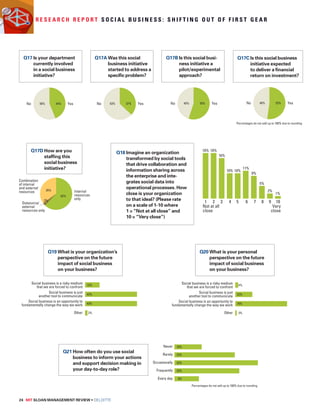
of 1 to 10. Specifically, we asked: “Imagine an orga-nization 
transformed by social tools that drive 
collaboration and information sharing across the 
enterprise and integrate social data into operational 
processes. How close is your company to achieving 
this ideal?” (See Figure 3.) 
More than half of the respondents — 52% — 
rated their organization at 3 or less. A scant 17% 
assessed their company at 7 and above. Moreover, in 
many organizations, social business is still an exper-iment: 
44% of respondents indicated they are 
implementing an initiative in their departments, 
but more than half of these are pilot projects. 
Dion Hinchcliffe of the Dachis Group describes “a 
trough of disillusionment” that businesses encoun-tered 
with social media.8 He argues that social media 
was not originally intended for business use. It was 
created primarily by consumer companies looking 
for ways to better connect people. As a result, social 
media tools lacked the security, compliance and con-trol 
capabilities businesses need. But the landscape is 
starting to change. “These requirements have made 
their way into the tools only in the past few years,” he 
Figure 3 
We asked respon-dents 
to imagine an 
organization trans-formed 
by social 
tools that drive 
collaboration and 
information sharing 
across the enterprise 
and that integrate 
social data into oper-ational 
processes. 
Their responses 
reflect how close 
they believe their 
organizations are 
to that ideal. 
1% 
18% 18% 
52% 
31% 
16% 
10% 10% 
11% 
9% 
5% 
2% 
2 
Early 
Early (1-3) 
Developing 
(4-6) 
Developing 
Maturing 
(7-10) 
Maturing 
1 3 4 5 6 7 8 9 10 
Not close Very close
R e s e a r c h R e p o r t S o c i a l B u s i n e s s : S h i f t i n g o u t o f f i r s t g e a r 
says. “We are now at the point where the tools are 
starting to meet business needs.” 
The point is well taken. However, our study dis-covered 
that there are statistically significant 
markers of success — and barriers to it.9 These 
markers correlate with social business maturity and 
go well beyond the business readiness of any tech-nology. 
(See Figure 4.) For example, companies that 
are moving closer to the ideal of a socially net-worked 
organization share distinct characteristics. 
One significant characteristic is the integration of 
social into many business functions, including mar-keting, 
sales, IT and customer service. At Enterasys 
Networks, a mid-size network infrastructure and 
security company, 100% of employees have access 
to Salesforce.com’s Chatter product, and 80% use it 
to collaborate, share, and work across organiza-tional 
boundaries and functions. 
Companies further along the maturity path 
also use social media technologies in daily decision 
making. The Cisco Learning Network, for exam-ple, 
is integrated with the company’s transaction 
systems, and the marketing team at Learning@ 
Cisco uses data analytics tools to spot major trends 
and address customer requirements. More socially 
mature companies also avail themselves of a vari-ety 
of social business tools and technologies, 
including media, software, data and technology-based 
networks. 
Companies at the low end of the maturity spec-trum 
share common hurdles. Lack of senior 
management sponsorship is significant. In busi-nesses 
where support from senior leadership was 
lacking, respondents typically assessed their organi-zation’s 
maturity a half point lower. 
Lack of an overall strategy was also an influential 
barrier to progress. On average, feeling that their 
organizations lacked a clear social business strategy 
6 MIT SLOAN MANAGEMENT REVIEW • DELOITTE 
knocked nearly a third of a point off respondents’ 
assessment of the company’s maturity. 
Taken together, the positive impact of manage-ment 
sponsorship and need for a clear strategy 
provide company leadership straightforward guid-ance 
on how to move the social needle. “It is 
incumbent on leaders to be intentional about social 
media and have a strategy for what they want to 
achieve with it,” says Michael Slind, co-author of 
Talk, Inc.: The Power of Organizational Conversation. 
Divergent Paths to 
Social Maturity 
There is no single path that leads to social business 
maturity. Company size plays a key role in deter-mining 
the purpose of social business as well as how 
it matures. Among small companies (less than $250 
million annual revenue), more socially mature or-ganizations 
focus their social efforts on providing 
customer support, managing projects and acceler-ating 
innovation. According to our research, 
respondents from small companies that used social 
for any of these purposes rated their companies’ 
social maturity nearly half a point higher (on a 10- 
point maturity scale) than those that didn’t. 
By contrast, larger organizations with more ma-ture 
social capabilities leverage the entire analytical 
social business life cycle — generating social data, 
monitoring collection and integrating it into systems 
and processes. “The potential of social analytics is 
enormous,” says Sheila Jordan, Cisco’s senior vice 
president of communication and collaboration IT. 
“We capture and summarize major trends and com-municate 
them to everyone from executives to 
engineers working on products in real time.” 
More-mature large companies are also more likely 
than their less-mature counterparts to have a business 
case for social efforts. In fact, lack of a business case 
g 4 
Use a variety of 
social business 
tools and 
technologies 
including social 
media and social 
software 
Assign an 
individual(s) with 
direct responsi-bility 
for social 
business 
Integrate social 
business into 
many functions, 
such as strategy 
and operations 
Use social 
business in daily 
decision making 
Obtain senior 
management 
sponsorship and 
develop overall 
social business 
strategy 
Figure 4 
Practices that 
correlate with 
maturing social 
businesses.
g 5 
SOCIAL BUSINESS: Shifting out of First Gear • MIT SLOAN MANAGEMENT REVIEW 7 
detracts considerably from the assessment of social 
business maturity at large companies. It cuts a half 
point. (See Figure 5.) 
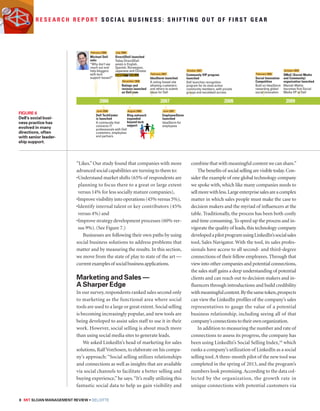
Dell’s Path to Social Maturity 
Dell Inc. is a prime example of how companies can 
capitalize on social business opportunities and 
reach social business maturity over time. At Dell, 
social business began simply enough — a corporate 
blog. Seven years later, social is ingrained in its 
operations, and Dell now provides social business 
services to other companies. (See Figure 6.) 
As a company approaching social business 
maturity, unique aspects of Dell’s social business 
program stand out: 
Dell’s social activity extends beyond the mar-keting 
function. The company leverages social 
media to improve customer engagement, provide 
enhanced customer service and build products 
based on customer input through the company’s 
well-known IdeaStorm program started in 2007. 
The company extended IdeaStorm internally later 
in 2007, to help enhance productivity as well. 
IdeaStorm has led to the implementation of more 
than 500 new product ideas. 
Dell leverages the entire analytical social business 
life cycle — not only generating data, but monitoring 
and using it to make decisions. Building on the success 
of IdeaStorm, Dell realized that it needed to listen 
more carefully to the conversations among its custom-ers 
in social media. In 2010, the company established a 
social media command center that helps it monitor 
online conversations in real-time and more deeply 
understand customer needs. In 2012, Dell enhanced its 
listening program, implementing social technologies 
that grab, sort and analyze vast amounts of digital con-versations 
about Dell, its competitors and specific 
technologies. Applying natural language processing to 
more than 25,000 online mentions of Dell each day, 
the company translates that data into marketing strat-egy 
and customer service offerings. 
Michael Dell’s leadership has contributed to the 
company’s social business progress from the early 
stages to the present. According to Dell’s director of 
social media, Richard Margetic, “without Michael’s 
leadership, there’s no way we would have been able 
to become a social business.” Simply put, he says, 
“we wouldn’t have been able to get anything done.” 
The company’s social business strategies and di-rection 
are centralized, while its social media 
functions and teams are distributed and embedded 
across various functional units at Dell. In order to 
ensure the company is pursuing an agreed-upon 
direction and consistent strategy, the directors of each 
of these social teams meet weekly to work together 
cross-functionally. Richard Margetic brings together 
these directors and oversees the execution of the 
company’s social strategies, governance and policies. 
Today, Dell Inc. has even set up its own consulting 
division to teach other companies how to be an effec-tive 
social enterprise. Its Social Media Services Group 
trains other companies to develop better real-time 
customer insights, engage their audience and better 
understand their customers in the market. Not only 
does Dell show other companies what it has done, it 
also provides training for their staff on how to use 
and create these processes for themselves. 
Shifting Out of First: 
Focus on Business 
Challenges 
As Dell has proven, some companies are suc-cessfully 
shifting out of first gear. The 
evolution of social business has moved well 
beyond the early Facebook marketing forays seeking 
Figure 5 
Certain adoption 
factors measured 
in this year’s sur-vey 
were found 
to correlate 
positively and 
negatively with 
social business 
maturity ratings. 
Regression coeffi-cients 
for factors 
that meaningfully 
impacted both 
small and large 
firms’ social busi-ness 
maturity are 
listed above. 
Survey respon-dents 
rated their 
company’s social 
business maturity 
on a ten-point 
scale. 
-0.519 
-0.457 
-0.378 
-0.301 -0.302 
-0.325 
0.259 
0.627 
0.275 
0.383 
0.290 
0.155 
Small Business 
Large Business 
Lack of senior 
management 
sponsorship 
Lack of individual 
with direct 
responsibility for 
social business 
Lack of an overall 
strategy 
Significant 
integration 
of social 
business into 
many functions 
(operations, 
strategy, etc.) 
High levels of 
use of a 
variety of 
social business 
platforms (social 
media, social 
software, etc.) 
Use of social 
business in daily 
decision making 
Factors that impact social maturity 
for small and large businesses
R e s e a r c h R e p o r t S o c i a l B u s i n e s s : S h i f t i n g o u t o f f i r s t g e a r 
July 2006 
Direct2Dell launched 
Today Direct2Dell 
exists in English, 
Spanish, Norwegian, 
Japanese and Chinese 
“Likes.” Our study found that companies with more 
advanced social capabilities are turning to them to: 
• Understand market shifts (65% of respondents are 
planning to focus there to a great or large extent 
versus 14% for less socially mature companies), 
•Improve visibility into operations (45% versus 5%), 
• Identify internal talent or key contributors (45% 
versus 4%) and 
• Improve strategy development processes (60% ver-sus 
9%). (See Figure 7.) 
Businesses are following their own paths by using 
social business solutions to address problems that 
matter and by measuring the results. In this section, 
we move from the state of play to state of the art — 
current examples of social business applications. 
Marketing and Sales — 
A Sharper Edge 
In our survey, respondents ranked sales second only 
to marketing as the functional area where social 
tools are used to a large or great extent. Social selling 
is becoming increasingly popular, and new tools are 
being developed to assist sales staff to use it in their 
work. However, social selling is about much more 
than using social media sites to generate leads. 
We asked LinkedIn’s head of marketing for sales 
solutions, Ralf VonSosen, to elaborate on his compa-ny’s 
approach: “Social selling utilizes relationships 
and connections as well as insights that are available 
via social channels to facilitate a better selling and 
buying experience,” he says. “It’s really utilizing this 
fantastic social data to help us gain visibility and 
8 MIT SLOAN MANAGEMENT REVIEW • DELOITTE 
combine that with meaningful content we can share.” 
The benefits of social selling are visible today. Con-sider 
the example of one global technology company 
we spoke with, which like many companies needs to 
sell more with less. Large enterprise sales are a complex 
matter in which sales people must make the case to 
decision makers and the myriad of influencers at the 
table. Traditionally, the process has been both costly 
and time consuming. To speed up the process and in-vigorate 
the quality of leads, this technology company 
developed a pilot program using LinkedIn’s social sales 
tool, Sales Navigator. With the tool, its sales profes-sionals 
have access to all second- and third-degree 
connections of their fellow employees. Through that 
view into other companies and potential connections, 
the sales staff gains a deep understanding of potential 
clients and can reach out to decision makers and in-fluencers 
through introductions and build credibility 
with meaningful content. By the same token, prospects 
can view the LinkedIn profiles of the company’s sales 
representatives to gauge the value of a potential 
business relationship, including seeing all of that 
company’s connections to their own organization. 
In addition to measuring the number and rate of 
connections to assess its progress, the company has 
been using LinkedIn’s Social Selling Index,10 which 
ranks a company’s utilization of LinkedIn as a social 
selling tool. A three-month pilot of the new tool was 
completed in the spring of 2013, and the program’s 
numbers look promising. According to the data col-lected 
by the organization, the growth rate in 
unique connections with potential customers via 
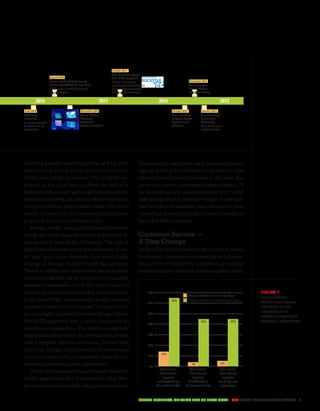
Figure 6 
Dell’s social busi-ness 
practice has 
evolved in many 
directions, often 
with senior leader-ship 
support. 
February 2006 
2006 2007 2008 2009 Michael Dell 
asks 
“Why don’t we 
reach out and 
help bloggers 
with tech 
support issues?” 
June 2006 
Dell TechCenter 
is launched 
A community that 
connects IT 
professionals with Dell 
customers, employees 
and partners 
August 2006 
Blog outreach 
expanded 
beyond tech 
support 
June 2007 
EmployeeStorm 
launched 
IdeaStorm for 
employees 
December 2006 
Ratings and 
reviews launched 
on Dell.com 
February 2007 
IdeaStorm launched 
A voting-based site 
allowing customers 
and others to submit 
ideas for Dell 
October 2007 
Community VIP program 
launched 
Dell launches recognition 
program for its most active 
community members, with private 
groups and escalated access 
October 2009 
SMaC (Social Media 
and Community) 
organization launched 
Manish Mehta 
becomes first Social 
Media VP at Dell 
February 2009 
Social Innovation 
Competition 
Built on IdeaStorm 
rewarding global 
social innovation
December 2012 
Dell launches 
Social Media 
Services Group 
Organizations at an early stage 
60% 
SOCIAL BUSINESS: Shifting out of First Gear • MIT SLOAN MANAGEMENT REVIEW 9 
August 2010 
Social Media  Community 
University (SMaC U) launched 
5,000 team members trained 
by end of year 
LinkedIn grew by more than 200%, and the pilot 
team’s Social Selling Index increased more than 
100%. Anecdotally, more than 75% of the 90 em-ployees 
in the pilot have credited the tool with 
helping to achieve sales goals, and three sales profes-sionals 
immediately purchased LinkedIn’s premium 
service out of their own pockets, rather than wait a 
matter of weeks for the company to purchase a 
long-term license for the broader team. 
Morgan Stanley is using LinkedIn and Twitter to 
change the way its financial advisors acquire new cli-ents 
and build their books of business. “We want to 
help financial advisors source new business in an eas-ier 
way,” says Lauren Boyman, director of digital 
strategy at Morgan Stanley Wealth Management. 
“People reveal life-event information like promotions 
on social media that can be a gateway to a financially 
oriented conversation. Social also allows financial 
advisors to distribute content that enables them to 
build up credibility and eventually develop a trusted 
reputation based on their expertise.” Like many com-panies 
in highly regulated industries, Morgan Stanley 
Wealth Management had to work closely with its 
compliance organization. The wealth management 
organization also needed to provide financial advisors 
with a program that was easy to use. To meet both 
objectives, Morgan Stanley provides its tweeters and 
LinkedIn posters with pre-approved materials that 
are vetted to meet regulatory requirements. 
The program was started as a pilot and moved out 
of pilot stage in June 2012. To measure the value, Mor-gan 
Stanley uses a monthly engagement scorecard. 
The scorecard tracks how many financial advisors 
sign up, as well as their behavior on the sites (i.e., how 
often they post or send invitations). The team also 
surveys the users to understand business impact. Of 
the financial advisors using LinkedIn and/or Twitter 
daily during the pilot, 40% had brought in new busi-ness 
from their social media usage. Perhaps the most 
compelling example: One advisor used LinkedIn to 
land a $70 million account. 
Customer Service — 
A Step Change 
Social offers new horizons for service effectiveness. 
For instance, companies are connecting with dissatis-fied 
customers before their complaints spread and 
providing support wherever customers gather online. 
Figure 7 
More mature 
social businesses 
use their social 
capabilities to 
address important 
business objectives. 
2010 2011 2012 2013 
June 2010 
CAP Days 
launched 
In-person events 
for vocal online 
customers 
December 2010 
Social Media 
Listening 
Command 
Center launched 
October 2011 
Dell launches phase 
two of VIP program 
Brings enhanced 
advocacy relationship to 
Dell’s most passionate 
community members 
October 2012 
Dell launches 
Subject Matter 
Expert social 
program 
January 2013 
Dell Launches 
Social Net 
Advocacy 
Real-time social 
sentiment tool 
Organizations at a maturing stage 
70% 
50% 
40% 
30% 
20% 
10% 
0% 
Use social 
business to 
improve 
understanding 
of market shifts 
Use social 
business to 
improve 
identification 
of internal talent 
Use social 
business to 
improve 
visibility into 
operations 
65% 
4% 
45% 
5% 
45% 
14%
R e s e a r c h R e p o r t S o c i a l B u s i n e s s : S h i f t i n g o u t o f f i r s t g e a r 
Businesses are also able to forge new connections 
between customers and use social analytics to under-stand 
needs and even moods. 
One consumer product company is embarking 
on a step change in social’s application to service. The 
company has turned its staff and in-store representa-tives 
into social brand ambassadors to address 
everything from consumer complaints to questions 
about sunscreen. 
For Facebook inquiries, for example, the com-pany 
has set up chain of command including internal 
experts and store-based sales representatives. Each 
inquiry is assigned as it comes in. If no response has 
been given after several hours, the inquiry goes to the 
next person in the chain. Answers to common ques-tions 
are archived for all employees to use. 
“We leverage the knowledge of our internal 
experts to give customers informed advice,” says a 
company social media executive. “The customer is 
connecting with the expertise they need. If they 
want further information, we drive them to stores.” 
Although the company measures consumer 
engagement in terms of clicks and online buzz, store 
traffic is an important metric. To capture it, the 
business offers coupons through social, blogs and 
partners. The coupons have unique codes so the 
company can measure the sales that come through 
its various online initiatives. 
Operations — Precision 
and Visibility 
The risk of supply-chain interruptions and delays is 
a common challenge in global business. For a phar-maceutical 
company, those risks involve more than 
dollars. They can put lives in danger if a product 
doesn’t ship on time. For the pharmaceutical com-pany 
Teva, speed is of the essence, and rapid 
solutions to supply-chain issues are paramount. 
Before Teva began to experiment with social 
platforms to solve supply-chain issues, resolving a 
problem could take weeks. And not solely because 
of the issue’s complexity. It could take a week or two 
just to schedule a meeting with all concerned. 
“Microsoft Outlook is a good tool,” says Nadine 
Jean-Francois, director of supply chain manage-ment. 
“But because people can book meetings so 
easily, they’re often double- or even triple-booked.” 
10 MIT SLOAN MANAGEMENT REVIEW • DELOITTE 
To reduce the time drag, Teva created a social 
networking environment called Radar, using a 
Facebook-like tool where employees and partners 
can communicate in real time to address immediate 
challenges and build knowledge over the long haul. 
Users can collaborate, share data, comment on 
posts and blog about the issues at hand. 
Measuring the direct impact of the social tool 
can be difficult, according to Jean-Francois. 
Although the cycle time for resolving supply-chain 
issues is getting shorter, process improvements are 
also part of the equation. But that also underscores 
a distinctive value of social business in more socially 
networked organizations — visibility into the spe-cific 
operational issues the company faces. 
Recruitment — Advantage 
in the Talent War 
As the war for talent heats up, companies are ramping 
up efforts to beat competitors to the leading candi-dates. 
Covance, which manages clinical trials for 
pharmaceutical companies, is turning to social to for-tify 
relationships with prospective candidates. “We 
have learned through years of traditional recruiting 
that people like to talk to others who do what they do,” 
says Lisa Calicchio, vice president of employee rela-tions, 
global recruiting  diversity at the company. 
“They aren’t necessarily interested in speaking with a 
recruiter. They want to understand what their experi-ence 
would be working here. The best people to 
answer those questions are the leaders in those roles.” 
To build relationships between prospects and com-pany 
leaders, Covance tweets. The recruiting 
organization works closely with marketing and com-munications 
to develop relevant content and draw 
potential recruits to its career website. For example, a 
Covance scientist might share research he or she is pre-senting 
at a conference. The tweet often generates new 
interest, and recruiters can reach out to new followers. 
Once a potential candidate is in the fold, 
Covance sends text notifications when a position 
opens that matches the profile. The text includes a 
link for easy follow-up. “Mobile texting provides 
convenience that people really value,” says Calic-chio. 
“It often works much better than cold calls or 
junk emails.” In terms of measurement, the com-pany 
is still developing and relies on a combination
SOCIAL BUSINESS: Shifting out of First Gear • MIT SLOAN MANAGEMENT REVIEW 11 
of metrics and anecdotes. However, a telltale sign is 
resource efficiency and source of hires. 
Innovation — Accelerating 
Top Management Buy-in 
Concerns about innovation are constantly on the list 
of executives’ top concerns. The innovation process 
is often slow, and novel ideas are often watered down 
by the time they reach senior ranks. Electrolux tack-led 
this challenge with an internal crowdsourcing 
event that filled a database with 3,500 new ideas and 
10,000 comments on them — in three days. “The en-tire 
company was invited to join the innovation jam, 
and we had knowledgeable and skilled people to 
moderate and facilitate the event,” says Ralf Larsson, 
director of online engagement. “The leadership 
team was a big support and was out there building 
interest and asking people to join.” 
To drive momentum during the three-day event, 
Electrolux created a scoreboard where participants 
earned rewards based on their activity. In addition, 
employees voted to select the top ideas, and three 
went immediately into the product development 
pipeline. “We may have come up with some of these 
ideas anyway,” comments Larsson. “But never with 
such speed, visibility and management buy-in.” 
Plugging Into Other Technologies 
The growth of social business innovation is forging 
new paths with media and other technologies. 
American Express, Nielsen, ConnecTV and Entera-sys 
are cases in point. 
American Express is leveraging Twitter with mo-bile 
phones and computers. In 2012, the company 
began offering statement credits to cardholders when 
they shopped at specific merchants including Whole 
Foods, Best Buy and McDonald’s. Either online or in-store 
with their mobile phone, the cardholder simply 
tweets a specific hashtag to activate the offer on the 
purchases they are making. “No one has ever offered 
anything like this before,” says Leslie Berland, senior 
vice president of digital partnership and development. 
“We have extended thousands of special offers, and 
cardholders have saved millions of dollars.” 
The television ratings company Nielsen is lever-aging 
Twitter to develop a more robust rating of 
television audiences. With its 140 million members, 
Twitter conversations add a deep dimension to any 
metric assessing audience size and engagement. The 
Nielsen Twitter TV Rating complements its existing 
ratings through real-time metrics about a program’s 
social activity, including the number of unique 
tweets associated with it.11 
ConnecTV is capitalizing on the evolution of 
television from broadcast to social TV. A growing 
number of viewers are multitasking with phones 
and computers, giving rise to the second screen ex-perience. 
Through an app, the ConnecTV AdSynch 
Network synchronizes a second screen through key-words 
on television as well as audio recognition 
technology that matches show, day, date, time and 
other television program attributes. The app pro-vides 
viewers with the ability to get more product 
information or make a purchase in real time — all 
while the TV ad is running on the primary screen. 
According to a 2012 Nielsen report, 45%12 of U.S. 
viewers use a tablet daily while watching television, 
and 88% do so at least once a month. In addition, 
27%13 are researching products related to commer-cials. 
Stacy Jolna, co-founder and CMO of 
ConnecTV, says that “amplifying and monetizing 
this new social TV behavior is the challenge.” Con-necTV 
provides both sides of the equation: 
companion content that syncs with the show to let 
viewers chat and share in real time on any second 
screen device, as well as a unique synchronization of 
TV ads that trigger a direct marketing experience, 
for the first time enabling viewers to see a product 
on TV and buy it easily and immediately. “That’s the 
future of television,” says Jolna. 
Enterasys has embarked on machine-to-machine 
applications to provide better service to its business-to- 
business customers. In 2011, the company 
commissioned a team to develop Isaac, a social media 
translator that takes complex machine language and 
converts it into tweets, Facebook messages and chats. 
Isaac connects IT personnel to their networks for 
24/7 monitoring with consumer devices and social 
media. “We have automated the entire front-end 
life cycle of the services interaction, machine to 
machine,” says Vala Afshar, chief marketing and cus-tomer 
officer at Enterasys. “For me, that has been the 
biggest ancillary benefit of becoming a social busi-ness 
— we started developing social machines.”
R e s e a r c h R e p o r t S o c i a l B u s i n e s s : S h i f t i n g o u t o f f i r s t g e a r 
Shifting Out of Second: 
Spur the Effort 
It may be tempting to believe that social media’s 
popularity outside the office will imbue efforts 
inside if the technology is right. Although there 
may be some initial enthusiasm, it can quickly van-ish. 
To spur and maintain the adoption of social, 
companies need to nurture it in a systematic way. 
Businesses that are making the greatest progress 
toward becoming a socially connected enterprise 
focus rigorously on four interrelated areas: leading a 
social culture, measuring what matters, keeping 
content fresh and changing the way work gets done. 
Leading a Social Culture 
Although providing a tool may be a springboard for 
adoption, it is not enough. Company leaders must 
actively drive its use. 
When Teva launched Radar to accelerate the resolu-tion 
of supply-chain issues, for example, the project 
gained bottom-up traction because the tool added 
value to people’s jobs. However, whenever top manage-ment 
support faded, the effort quickly lost steam; with 
every change in top management, Jean-Francois found 
herself reaching out to the new leaders and bringing 
them on board in order to rekindle the momentum. 
Furthermore, “[for] social collaboration to be 
successful in business, leaders have to explain the 
why,” says Michael Slind. “Leaders need to really col-laborate 
and make sure people understand the 
importance of transparency, shared accountability 
— and sharing in general.” Connecting social with 
important business objectives is the crux of 
“explaining the why.” Morgan Stanley’s Boyman, for 
example, credits the head of sales for connecting 
social to business needs and assuring that the bank 
became a social business leader in its industry. “If I 
didn’t have the head of our sales force tell me that 
we have to be the first in the industry to do this, it 
never would have happened,” says Boyman. “Even 
when the project hit initial bumps because of the 
realization it would require IT dollars, he was still 
committed to keeping people focused and getting 
the needed resources.” Leadership also plays a piv-otal 
role in creating a social business culture. 
American Express SVP Leslie Berland notes: “Does 
12 MIT SLOAN MANAGEMENT REVIEW • DELOITTE 
the company have leaders who are believers in 
what’s possible? That’s a big piece of the [social 
business] puzzle.” 
At companies known for their social culture, 
such as Cisco and American Express, an open and 
collaborative culture is always in the room. “Cisco 
has a really open culture of transparency and trust,” 
says Jordan. “When you are working on driving 
successful business outcomes, you need to be in the 
middle of it with your colleagues, peers and cus-tomers 
at the personal level.” Leslie Berland 
emphasizes the importance of American Express’s 
collaborative team-oriented culture and how criti-cal 
it is to drive social business initiatives. “I think 
it’s impossible to win in digital or in social media if 
you’re approaching it in a siloed way. And you can 
see it when you see different brands and companies 
and organizations launching things in the social 
media space, especially if there’s not alignment. It’s 
very transparent. It looks disjointed and not clear.” 
However, lack of a vibrantly open and collabora-tive 
culture isn’t an insurmountable hurdle to the 
progress of social business. Teva, for example, oper-ates 
in a highly regulated industry not necessarily 
known for open cultures. Yet that didn’t impede the 
course of their social program. “At first, people 
thought our internal collaboration was a finger-pointing 
tool that, unlike email, which is seen by a 
limited number of people, could expose one’s flaws or 
failings to many people,” says Jean-Francois at Teva. 
“But when they realized it was a different mindset, 
they started using it extensively.” Mark McDonald, co-author 
of The Digital Edge: Exploiting Information 
and Technology for Business Advantage, goes so far as 
to argue that although social communities don’t 
require extensive structure, managers are more com-fortable 
when social business activities are structured. 
The presence of parameters, security measures and 
controls can ease their fears of the open-ended char-acter 
of collaboration. With that comfort, leaders can 
take a strong role in driving a collaborative culture 
appropriate to the company and industry. 
If the culture isn’t open, leaders may have to 
stimulate collaborative behavior themselves. At a 
global entertainment company, for example, an 
operations executive wanted to build a collabora-tion 
platform for marketing departments to share
Social business is: 
SOCIAL BUSINESS: Shifting out of First Gear • MIT SLOAN MANAGEMENT REVIEW 13 
information about products and promotions in real 
time. The marketing heads, however, rarely shared 
information and voiced doubt about the value of 
participating in a shared data platform. 
To overcome the doubt and cultivate support for 
the idea, the executive convened face-to-face meet-ings 
with the marketing leaders. By the end of the 
meetings, the group had started hammering out a 
process for collaborating together on the project 
and developing the new collaboration platform. 
After 18 months, they had put the protocols, pro-cesses 
and systems in place to capture social media 
data about customer reactions to various marketing 
campaigns across the enterprise. Insights from this 
collaborative effort led to the creation and adapta-tion 
of promotions and products in real time. 
Creating collaborative behavior for social also 
means using it. Richard Branson of Virgin Airlines is 
famous for being a power user of social media. At 
Enterasys, Afshar and other executives actively partic-ipate 
in the company’s new social media channels. 
Without that commitment, Afshar believes social 
would have floundered. “It’s a fundamental equation,” 
he says. “No involvement by leaders, no commitment 
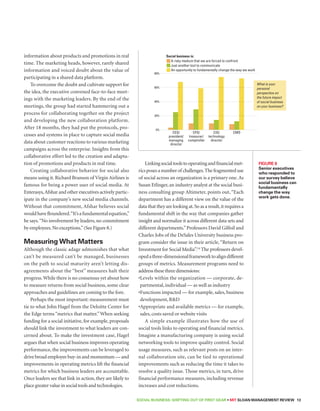
by employees. No exceptions.” (See Figure 8.) 
Measuring What Matters 
Although the classic adage admonishes that what 
can’t be measured can’t be managed, businesses 
on the path to social maturity aren’t letting dis-agreements 
about the “best” measures halt their 
progress. While there is no consensus yet about how 
to measure returns from social business, some clear 
approaches and guidelines are coming to the fore. 
Perhaps the most important: measurement must 
tie to what John Hagel from the Deloitte Center for 
the Edge terms “metrics that matter.” When seeking 
funding for a social initiative, for example, proposals 
should link the investment to what leaders are con-cerned 
about. To make the investment case, Hagel 
argues that when social business improves operating 
performance, the improvements can be leveraged to 
drive broad employee buy-in and momentum — and 
improvements in operating metrics lift the financial 
metrics for which business leaders are accountable. 
Once leaders see that link in action, they are likely to 
place greater value in social tools and technologies. 
Linking social tools to operating and financial met-rics 
poses a number of challenges. The fragmented use 
of social across an organization is a primary one. As 
Susan Etlinger, an industry analyst at the social busi-ness 
consulting group Altimeter, points out, “Each 
department has a different view on the value of the 
data that they are looking at. So as a result, it requires a 
fundamental shift in the way that companies gather 
insight and normalize it across different data sets and 
different departments.” Professors David Gilfoil and 
Charles Jobs of the DeSales University business pro-gram 
consider the issue in their article, “Return on 
Investment for Social Media”.14 The professors devel-oped 
a three-dimensional framework to align different 
groups of metrics. Measurement programs need to 
address these three dimensions: 
• Levels within the organization — corporate, de-partmental, 
individual — as well as industry 
• Functions impacted — for example, sales, business 
development, RD 
• Appropriate and available metrics — for example, 
sales, costs saved or website visits 
A simple example illustrates how the use of 
social tools links to operating and financial metrics. 
Imagine a manufacturing company is using social 
networking tools to improve quality control. Social 
usage measures, such as relevant posts on an inter-nal 
collaboration site, can be tied to operational 
improvements such as reducing the time it takes to 
resolve a quality issue. Those metrics, in turn, drive 
financial performance measures, including revenue 
increases and cost reductions. 
Figure 8 
Senior executives 
who responded to 
our survey believe 
social business can 
fundamentally 
change the way 
work gets done. 
A risky medium that we are forced to confront 
Just another tool to communicate 
An opportunity to fundamentally change the way we work 
What is your 
personal 
perspective on 
the future impact 
of social business 
on your business? 
80% 
60% 
40% 
20% 
0% 
CEO/ 
president/ 
managing 
director 
CFO/ 
treasurer/ 
comptroller 
CIO/ 
technology 
director 
CMO 
g 8
R e s e a r c h R e p o r t S o c i a l B u s i n e s s : S h i f t i n g o u t o f f i r s t g e a r 
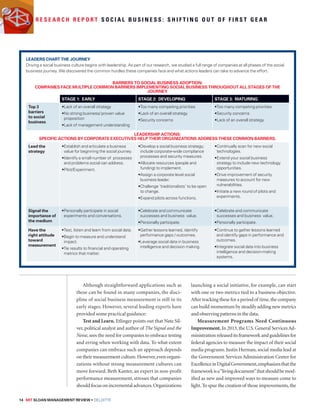
Leaders Chart the Journey 
Driving a social business culture begins with leadership. As part of our research, we studied a full range of companies at all phases of the social 
business journey. We discovered the common hurdles these companies face and what actions leaders can take to advance the effort. 
Barriers to Social Business Adoption: 
Companies face multiple common barriers implementing social business throughout all stages of the 
Although straightforward applications such as 
these can be found in many companies, the disci-pline 
of social business measurement is still in its 
early stages. However, several leading experts have 
provided some practical guidance: 
Test and Learn. Etlinger points out that Nate Sil-ver, 
political analyst and author of The Signal and the 
Noise, sees the need for companies to embrace testing 
and erring when working with data. To what extent 
companies can embrace such an approach depends 
on their measurement culture. However, even organi-zations 
without strong measurement cultures can 
move forward. Beth Kanter, an expert in non-profit 
performance measurement, stresses that companies 
should focus on incremental advances. Organizations 
14 MIT SLOAN MANAGEMENT REVIEW • DELOITTE 
launching a social initiative, for example, can start 
with one or two metrics tied to a business objective. 
After tracking these for a period of time, the company 
can build momentum by steadily adding new metrics 
and observing patterns in the data. 
Measurement Programs Need Continuous 
Improvement. In 2013, the U.S. General Services Ad-ministration 
released its framework and guidelines for 
federal agencies to measure the impact of their social 
media programs. Justin Herman, social media lead at 
the Government Services Administration Center for 
Excellence in Digital Government, emphasizes that the 
framework is a “living document” that should be mod-ified 
as new and improved ways to measure come to 
light. To spur the creation of those improvements, the 
journey. 
Stage 1: Early Stage 2: Developing Stage 3: Maturing 
Top 3 
barriers 
to social 
business 
•Lack of an overall strategy 
• No strong business/ proven value 
proposition 
•Lack of management understanding 
•Too many competing priorities 
•Lack of an overall strategy 
•Security concerns 
•Too many competing priorities 
•Security concerns 
•Lack of an overall strategy 
Leadership Actions: 
Specific actions by corporate executives help their organizations address these common barriers. 
Lead the 
strategy 
• Establish and articulate a business 
value for beginning the social journey. 
• Identify a small number of processes 
and problems social can address. 
•Pilot/Experiment. 
• Develop a social business strategy; 
include corporate-wide compliance 
processes and security measures. 
• Allocate resources (people and 
funding) to implement. 
• Assign a corporate level social 
business leader. 
• Challenge ‘traditionalists’ to be open 
to change. 
•Expand pilots across functions. 
• Continually scan for new social 
technologies. 
• Extend your social business 
strategy to include new technology 
opportunities. 
• Drive improvement of security 
measures to account for new 
vulnerabilities. 
• Initiate a new round of pilots and 
experiments. 
Signal the 
importance of 
the medium 
• Personally participate in social 
experiments and conversations. 
• Celebrate and communicate 
successes and business value. 
•Personally participate. 
• Celebrate and communicate 
successes and business value. 
•Personally participate. 
Have the 
right attitude 
toward 
measurement 
•Test, listen and learn from social data. 
• Begin to measure and understand 
impact. 
• Tie results to financial and operating 
metrics that matter. 
• Gather lessons learned, identify 
performance gaps / outcomes. 
• Leverage social data in business 
intelligence and decision making. 
• Continue to gather lessons learned 
and identify gaps in performance and 
outcomes. 
• Integrate social data into business 
intelligence and decision-making 
systems.
SOCIAL BUSINESS: Shifting out of First Gear • MIT SLOAN MANAGEMENT REVIEW 15 
metrics program is open not only to agencies, but also 
to tool developers and the public.15 
Social Doesn’t Operate in a Vacuum. Compa-nies 
should not worry that social isn’t the sole, or 
even primary, source of improvement. Hagel points 
out that even if other changes occur when rolling 
out a social tool, if the tool was a critical enabler of 
the performance improvement, management 
should credit it accordingly. 
Finally, companies should not try to measure 
everything. As Cisco’s Jordan cautions: “If you try to 
measure every single thing you are doing, you will 
manage the ants while the elephants are storming by.” 
Creating and Curating 
Meaningful Content 
When CARA Operations, the Canadian restaurant 
franchisor, wanted to bolster the morale of its wait 
staff and focus on customer experience, it launched a 
reward program through Facebook where managers 
and restaurant staff could congratulate others for in-novative 
efforts beyond the call of duty. After much 
planning and promotion, Staff Room was launched 
with great expectations — and then quickly fizzled. 
The problem, explains CIO Natasha Nelson, was a 
lack of dedicated resources to manage the program 
and regularly update it with new content. She says that 
the company thought that the program would grow 
organically, but “in hindsight, we see having a dedi-cated 
resource to manage the program would have 
helped to seed the system with the meaningful con-tent 
that would have driven people to the site on a 
regular basis.” Having such a resource, Nelson says, 
would have “yielded a much higher level of adoption.” 
Successful social business hinges on quality of con-tent. 
And with the greater use of social comes much 
stronger demands for fresh, unique content. “We 
are entering the stage of social fatigue,” comments 
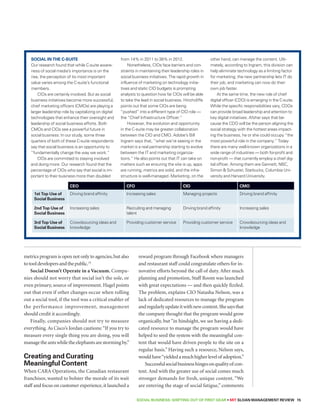
Social in the C-Suite 
Our research found that while C-suite aware-ness 
of social media’s importance is on the 
rise, the perception of its most important 
value varies among the C-suite’s functional 
members. 
CIOs are certainly involved. But as social 
business initiatives become more successful, 
chief marketing officers (CMOs) are playing a 
larger leadership role by capitalizing on digital 
technologies that enhance their oversight and 
leadership of social business efforts. Both 
CMOs and CIOs see a powerful future in 
social business: In our study, some three 
quarters of both of these C-suite respondents 
say that social business is an opportunity to 
“fundamentally change the way we work.” 
CIOs are committed to staying involved 
and doing more. Our research found that the 
percentage of CIOs who say that social is im-portant 
to their business more than doubled 
from 14% in 2011 to 38% in 2012. 
Nonetheless, CIOs face barriers and con-straints 
in maintaining their leadership roles in 
social business initiatives. The rapid growth in 
influence of marketing on technology initia-tives 
and static CIO budgets is prompting 
analysts to question how far CIOs will be able 
to take the lead in social business. Hinchcliffe 
points out that some CIOs are being 
“pushed” into a different type of CIO role — 
the “Chief Infrastructure Officer.” 
However, the evolution and opportunity 
in the C-suite may be greater collaboration 
between the CIO and CMO. Adobe’s Bill 
Ingram says that, “what we’re seeing in the 
market is a real partnership starting to evolve 
between the IT and marketing organiza-tions.” 
He also points out that IT can take on 
matters such as ensuring the site is up, apps 
are running, metrics are solid, and the infra-structure 
is well-managed. Marketing, on the 
other hand, can manage the content. Ulti-mately, 
according to Ingram, this division can 
help eliminate technology as a limiting factor 
for marketing; the new partnership lets IT do 
their job, and marketing can now do their 
own job faster. 
At the same time, the new role of chief 
digital officer (CDO) is emerging in the C-suite. 
While the specific responsibilities vary, CDOs 
can provide broad leadership and attention to 
key digital initiatives. Afshar says that be-cause 
the CDO will be the person aligning the 
social strategy with the hottest areas impact-ing 
the business, he or she could occupy “the 
most powerful role in the company.” Today 
there are many well-known organizations in a 
wide range of industries — both for-profit and 
non-profit — that currently employ a chief dig-ital 
officer. Among them are Gannett, NBC, 
Simon  Schuster, Starbucks, Columbia Uni-versity 
and Harvard University. 
CEO CFO CIO CMO 
1st Top Use of 
Social Business 
Driving brand affinity Increasing sales Managing projects Driving brand affinity 
2nd Top Use of 
Social Business 
Increasing sales Recruiting and managing 
talent 
Driving brand affinity Increasing sales 
3rd Top Use of 
Social Business 
Crowdsourcing ideas and 
knowledge 
Providing customer service Providing customer service Crowdsourcing ideas and 
knowledge
R e s e a r c h R e p o r t S o c i a l B u s i n e s s : S h i f t i n g o u t o f f i r s t g e a r 
Ray Wang, CEO of Constellation Research. “Content 
has to be more relevant and in the context of a rela-tionship, 
location, project and time.” 
To overcome social fatigue, many companies 
devote considerable resources to content develop-ment. 
A 2013 study by Gartner, for example, found 
that nearly 50% of social marketing teams believe 
creating and curating content is their top priority.16 
Coca-Cola is a prime example. 
After becoming the first retail brand to exceed 50 
million Facebook likes, Coca-Cola is shifting its mar-keting 
focus from creative excellence to content 
excellence — generating a steady flow of content that 
average social media users will feel they have to share. 
The goal is to create conversations with consumers by 
shifting from one-way storytelling to dynamic story-telling 
across many social media platforms. 
Coca-Cola’s emphasis is on new content and 
applies a 70/20/10 investment principle to its cre-ation: 
70% of the content created is low-risk 
marketing, which consumes half their time. Another 
20% feeds off ideas that already work and reinvent-ing 
them to see what can be achieved. The final 10% 
is high-risk content marketing. When a high-risk 
effort pays off, it can fuel the content strategy anew.17 
Relevant, timely and accurate content is also par-amount 
at Cisco and drives what the company calls 
its “front” — the Cisco Learning Network. Over five 
years, the network has grown from 600,000 to more 
than 2 million users. It is charged with creating the 
next generation of Cisco customers by providing 
learning tools, training resources, and industry 
guidance to anyone interested in an IT career 
through Cisco certification. The network also pro-vides 
a venue for gathering and discussing the 
company, its product lines, and the industry overall. 
Relevant, quality content is central to the net-work’s 
success, according to Jeanne Beliveau-Dunn, 
vice president and general manager of Learning@ 
Cisco. Without the initial content that Cisco seeded 
into the system, the Cisco Learning Network would 
not have taken off. “The content is what separated the 
Learning Network from other collaboration tools 
such as Facebook,” she says. “The content drives an 
organic community toward Cisco-specific conversa-tions.” 
Given the practical reality of the community’s 
size, Cisco realizes that it can’t create all the content. 
16 MIT SLOAN MANAGEMENT REVIEW • DELOITTE 
Often, it takes the role of curator. But Cisco keeps the 
content fresh. “If you are trying to create community 
and you are lifting and shifting content, you are wast-ing 
your time,” says Beliveau-Dunn. “You don’t want 
to take what was stale and try to make it prettier. The 
key is identifying the interesting and relevant content 
that meets the needs of your audience and making it 
easy to find and digest.” 
Changing the Way 
Work Gets Done 
From responding to markets to fostering internal 
knowledge sharing, achieving social’s impact means 
changing the way work gets done. “Social is about 
using technology in a more thoughtful and broad-based 
way to meets business needs in a social 
context,” says Hagel. “It is front and center to the 
question: How can and should people connect to 
advance business objectives?” 
Companies can change how the work is done by 
revamping processes and embedding social capabili-ties 
into workflows. This process — what we call 
social business reengineering — can break down bar-riers 
that hamper people’s ability to find the right 
information and work effectively across functions. 
Social business reengineering is a planning pro-cess 
that moves systematically from strategy to 
technology.18 It begins by identifying natural groups 
of stakeholders who will see value in connecting in 
new ways — for example, linking RD to market-ers, 
product engineers and sales teams. With these 
stakeholders in mind, the process turns to the “who” 
and the “what” — the key players, business objec-tives 
and incentives that will garner social business 
buy-in and usage. Company leaders then need to 
identify any barriers to adoption and have a plan in 
place to remove them. Once these elements have 
been figured out, the company can identify the most 
appropriate tool for the job. 
Dell is a prime example of social business chang-ing 
the way work gets done. The company’s 
IdeaStorm platform is one of several initiatives 
where social business drives the way the company 
operates. In essence, IdeaStorm is a public sugges-tion 
box where customers can provide input on 
products and features. But the similarity ends there. 
As the company listens to the market, it identifies
Reading the Signposts 
Companies want to chart their social business progress, both in terms of their 
capability and that of their competitors. However, social business adoption is 
uneven, making progress difficult to track and monitor. In his research, Hagel 
found three common adoption patterns.i The first is under the table: teams using 
social software on their own to help their efforts. Ad hoc approaches are a bit 
more visible. For example, executives may see an opportunity for social and 
leverage it in his or her part of the organization. Finally, some efforts get a green 
light when senior executives “check the box,” acknowledging the importance of 
social but without a deep understanding of its value. 
Although adoption is uneven, Wang has identified signposts that signal how 
an organization is progressing. He sees five stages — Discovery, Experimenta-tion, 
Evangelization, Pervasiveness and Realization — and outlines these markers 
of progress from one to the next: 
From Discovery to Experimentation: When an organization identifies an 
outcome to achieve 
From Experimentation to Evangelization: The experiment in one depart-ment 
or division becomes the model of similar experiments in other parts of 
the organization 
From Evangelization to Pervasiveness: The number of projects proliferates, 
creating a demand for context and relevancy in response to an explosion of 
information 
From Pervasiveness to Realization: When an organization establishes gover-nance 
to address disruptive technologies and business-model change 
SOCIAL BUSINESS: Shifting out of First Gear • MIT SLOAN MANAGEMENT REVIEW 17 
opportunities to refine product features. It then 
reaches out to the customer community and works 
with it to identify the specific requirements. “We 
begin by listening,” says Richard Margetic, Dell’s di-rector 
of global social media. “We then work with 
the customers who are most active in the conversa-tion 
and drive to a product launch.” 
Companies shifting out of first gear are 
finding value from their social business efforts. 
Many realize that their companies need to be where 
their customers are, and they are using social busi-ness 
to tackle everything from sudden market shifts 
to the war for talent. McKinsey estimates that the 
global dollar worth of social business activity will be 
measured in the trillions. We found that executives 
see that value and immediacy. 
Yet companies nonetheless face formidable odds. 
Gartner estimates that 80% of social initiatives will not 
meet expectations. In this report, we probed how com-panies 
stuck in first gear — or looking to boost mature 
efforts — can steer clear of Gartner’s prediction. 
Focusing social business on business challenges is 
the key lesson learned. Companies that are success-fully 
shifting out of first gear don’t view social as “an 
app” that will thrive at work simply because it thrives 
outside the office. These companies use social to 
address specific issues and define a role for social 
business in the solution. Be it tackling supply-chain 
issues or driving higher-octane innovation, success is 
about leveraging a business tool — not a technology. 
Focusing on business challenges, however, is only 
part of the equation. To spur the effort, company lead-ers 
are cultivating new modes of communication and 
new patterns of dialogue. Sometimes that means mod-eling 
the behavior long before the tool is launched. 
Measurement is also critical. An effective measurement 
mindset, however, focuses on measurement that 
matters. Although the discipline of measurement is 
evolving, successful social initiatives don’t make the 
great the enemy of the good. Social business success is 
also about generating and sustaining content. Whether 
it is created or curated, its freshness is the draw and the 
glue that holds the effort together. Finally, social busi-ness 
changes the way work is getting done, by 
reengineering processes. 
In the time it took to read this report, millions of 
tweets have been posted to Twitter, tens of millions 
of new postings have appeared on Facebook, and 
thousands of hours of new video are streaming 
from YouTube.19 Social media is evolving rapidly — 
and that evolution is changing the face of how 
businesses work and compete. 
References 
1. As used in this document, “Deloitte” means Deloitte 
Consulting LLP and Deloitte Services LP, which are sepa-rate 
subsidiaries of Deloitte LLP. Please see www.deloitte. 
com/us/about for a detailed description of the legal struc-ture 
of Deloitte LLP and its subsidiaries. Certain services 
may not be available to attest clients under the rules and 
regulations of public accounting. 
2. Pike Research: Social Media in the Utility Industry 
Consumer Survey, 2011 (Pike Research rebranded as 
Navigant Research in 2012). 
3. McKinsey Global Institute: The Social Economy: Unlock-ing 
Value and Productivity through Social Technologies, 
July 2012 
4. Forrester: The Four Social Marketing Tools You Need, 
February 25, 2013 
5. Gartner: Agenda Overview for Social Software and 
Collaboration, 2013. January 2, 2013
R e s e a r c h R e p o r t S o c i a l B u s i n e s s : S h i f t i n g o u t o f f i r s t g e a r 
6. Deloitte: U.S. State of the Media Democracy Survey, 
Seventh Edition, 2013 www.deloitte.com/us/tmttrends 
7. Gartner: Predicts 2013 Social and Collaboration Go 
Deeper and Wider, November 28, 2012 
8. Dion Hinchcliffe interview with Robert Berkman, MIT 
Sloan Management Review, June 3, 2013. See: http:// 
sloanreview.mit.edu/article/how-companies-can-move-past- 
a-trough-of-disillusionment-in-social-business/ 
9. In order to assess the impact of multiple variables at 
once, a regression analysis was used to identify statisti-cally 
significant and practically meaningful adoption factors 
that contributed to social business maturity. 
10. LinkedIn’s Social Selling Index assesses a company’s 
activity on LinkedIn by measuring four areas: brand, reach, 
activity and contribution. Brand is measured based on the 
completeness of a company’s sales force profile. Reach is 
measured by the number of LinkedIn connections. Activity 
is measured by the number of searches and messages 
(InMails) sales professionals are executing and sending. 
Contribution is measured by the amount of content 
updates sales professionals are posting to LinkedIn. 
11. http://www.nielsen.com/us/en/press-room/2012/ 
nielsen-and-twitter-establish-social-tv-rating.html 
12. Nielsen: Double Vision — Global Trends in Tablet and 
Smartphone Use While Watching TV, April 5, 2012 
18 MIT SLOAN MANAGEMENT REVIEW • DELOITTE 
13. Nielsen: State of the Media Spring 2012 Advertising  
Audiences, Part 2: By Demographic, April 27, 2012 
14. David M. Gilfoil and Charles Jobs: Return on Invest-ment 
for Social Media: A Proposed Framework for 
Understanding, Implementing, and Measuring the Return, 
Journal of Business  Economic Research, Vol. 10 No. 11, 
2012. journals.cluteonline.com/index.php/JBER/article/ 
download/7363/7431 
15. Jason Miller: New metrics to help agencies determine 
value of social media, February 20, 2013. http://www. 
federalnewsradio.com/513/3229214/New-metrics-to-help- 
agencies-determine-value-of-social-media 
16. Gartner: 2013 Social Marketing Survey Finding: Con-tent 
Creation Fuels Social Marketing, March 25, 2013 
17. http://smbp.uwaterloo.ca/2012/10/cocacola/ 
(Accessed May 3, 2013) 
18. Deloitte: Tech Trends 2013: Elements of postdigital, 
2013 
19. Punit Renjen: Lead or Be Left Behind: A Chairman’s 
Perspective on Social Media, Directors  Boards, First 
Quarter 2013 
i. John Hagel: Enterprises Still Honing Their Social Skills, 
February 1, 2013 http://deloitte.wsj.com/cio/2013/02/01/ 
john-hagel-enterprises-still-honing-their-social-skills/
R e s e a r c h R e p o r t S o c i a l B u s i n e s s : s h i f t i n g o u t o f f i r s t g e a r 
The Survey: 
Questions and 
Responses 
Results from the 2012 Social Business Global Executive Survey 
About the 
Research 
To understand the 
challenges and opportu-nities 
associated with 
the use of social busi-ness, 
MIT Sloan 
Management Review, 
in collaboration with 
Deloitte, conducted a 
second annual survey of 
2,545 business execu-tives, 
managers and 
analysts from organiza-tions 
around the world. 
The survey, conducted 
in the fall of 2012, cap-tured 
insights from 
individuals in 99 coun-tries 
and 25 industries 
and involved organiza-tions 
of various sizes. 
The sample was drawn 
from a number of 
sources, including 
MIT alumni, MIT Sloan 
Management Review 
subscribers, Deloitte 
Dbriefs subscribers and 
other interested parties. 
In addition to these 
survey results, we inter-viewed 
33 business 
executives and subject 
matter specialists from 
a number of industries 
and disciplines to under-stand 
the practical 
issues facing organiza-tions 
today. 
Their insights con-tributed 
to a richer 
understanding of the 
data. We also drew 
upon a number of case 
studies to further illus-trate 
how organizations 
are leveraging social 
business. 
8% 
5% 
4% 
1. How important do you consider social business to be to your organization? 
12% 
7% 
6% 
38% 
31% 
19% 
36% 
54% 
69% 
2. To what extent does your organization currently use each of the following types of 
social business? 
19% 
18% 
17% 
14% 
17% 
25% 
23% 32% 
SOCIAL BUSINESS: Shifting out of First Gear • MIT SLOAN MANAGEMENT REVIEW 19 
Today 
One year from today 
Three years from today 
6% 
3% 
2% 
Important Somewhat 
important 
Neither 
important 
nor unimportant 
Somewhat 
unimportant 
Unimportant 
Q1 How important do 
you consider social 
business to be to 
your organization? 
24% 
24% 
26% 
28% 
11% 
30% 
29% 
26% 
23% 
10% 
7% 
16% 
15% 
11% 
10% 
Social media 
Technology-based 
social networks 
Social software 
Social data 
Other social business 
11% 
13% 
17% 
25% 
63% 
Great 
extent 
Large 
extent 
Moderate 
extent 
Small 
extent 
Not 
at all 
Percentages do not add up to 100% due to rounding 
Q2 To what extent 
does your organiza-tion 
currently use 
each of the follow-ing 
types of social 
business? 
2A. To what extent does your organization do each of the following? 
10% 
10% 
12% 
28% 
31% 
33% 
28% 
31% 
29% 
27% 
31% 
21% 
6% 
19% 
18% 
17% 
11% 
14% 
12% 
12% 
12% 
9% 
Monitor/listen to social data 
Collect social data 
Analyze social data 
Generate social data 
Integrate social data into 
systems and processes 
Great 
extent 
Large 
extent 
Moderate 
extent 
Small 
extent 
Not 
at all 
Percentages do not add up to 100% due to rounding 
Q2A To what extent 
does your organi-zation 
do each of 
the following?
R e s e a r c h R e p o r t S o c i a l B u s i n e s s : S h i f t i n g o u t o f f i r s t g e a r 
Q3 How important is 
social business to 
each of the follow-ing 
areas in your 
organization? 
20 MIT SLOAN MANAGEMENT REVIEW • DELOITTE 
6% 
8% 
8% 
10% 
3. How important is social business to each of the following areas in your 
organization? 
13% 
9% 
12% 
13% 
16% 
22% 
27% 
29% 
29% 
31% 
27% 
53% 
45% 
41% 
32% 
22% 
Marketing/branding/ 
reputation management 
Customer service/ 
audience engagement 
Innovation (knowledge sharing, 
product/service development) 
New/prospective talent 
management (onboarding 
and training, recruiting) 
Supplier/partner engagement 
6% 
7% 
8% 
11% 
16% 
Important Somewhat 
important 
Neither 
important 
nor unimportant 
Somewhat 
unimportant 
Unimportant 
Percentages do not add up to 100% due to rounding 
4. How important is social business to each of the following objectives for your 
organization? 
7% 
8% 
8% 
8% 
10% 
12% 
13% 
15% 
16% 
41% 
7% 
7% 
8% 
9% 
8% 
10% 
10% 
11% 
11% 
6% 
10% 
12% 
13% 
14% 
15% 
18% 
20% 
18% 
20% 
13% 
28% 
30% 
29% 
30% 
30% 
29% 
27% 
31% 
28% 
12% 
47% 
42% 
42% 
40% 
37% 
31% 
29% 
25% 
24% 
28% 
Manage brand/reputation risk 
Understand market trends 
Improve (or increase) 
collaboration 
Manage customer relations 
Improve innovation 
Identify expertise and 
internal knowledge 
Improve productivity 
Acquire and retain employees 
Break down internal silos 
Other 
Important Somewhat 
important 
Neither 
important 
nor unimportant 
Somewhat 
unimportant 
Unimportant 
Percentages do not add up to 100% due to rounding 
5. Which uses of social business have increased within your organization within the 
last 12 months? (Select up to 3) 
36% 
35% 
27% 
26% 
24% 
21% 
19% 
17% 
14% 
2% 
7% 
Managing reputation 
Driving brand affinity (e.g., loyalty or trust) 
Providing customer service and support 
Crowdsourcing ideas and sharing knowledge 
Generating social leads 
Fostering innovation 
Managing projects 
Identifying expertise 
Managing talent 
Other 
None 
Q4 How important is 
social business to 
each of the follow-ing 
objectives for 
your organization? 
Q5 Which uses of social 
business have in-creased 
within your 
organization within 
the last 12 months? 
(Select up to 3)
14% 
6. To what extent does each of the following functional areas currently use 
social business ? 
21% 
19% 
21% 
23% 
19% 
21% 
23% 
28% 
25% 
24% 
26% 
24% 
23% 
23% 
25% 
24% 
25% 
29% 
25% 
25% 
22% 
21% 
21% 
26% 
17% 
17% 
16% 
19% 
19% 
29% 
15% 
11% 
16% 
17% 
17% 
17% 
10% 
9% 
13% 
12% 
11% 
11% 
7% 
9% 
7% 
7% 
5% 
27% 
25% 
7A. What is the highest level/rank of the individual whose job it is 
to oversee/manage your organization's social business initiatives? 
VP level, business unit president or other 
top level executive but below C-suite 
7B. What is the functional affiliation of the person who oversees/manages 
social business in your organization? 
Marketing 
Senior management 
SOCIAL BUSINESS: Shifting out of First Gear • MIT SLOAN MANAGEMENT REVIEW 21 
Information technology 
Library/information center 
Supply chain operations 
Q7 Does anyone have the respon-sibility 
to oversee/manage 
your organization's social 
business initiatives? 
Marketing 
Sales 
Customer service 
Product development 
Human resources 
Senior management 
Operations 
Risk management 
Finance 
Q7A What is the highest level/rank of the individ-ual 
whose job it is to oversee/manage your 
organization’s social business initiatives? 
8% 
16% 
17% 
17% 
21% 
21% 
29% 
41% 
42% 
47% 
Great 
extent 
Large 
extent 
Moderate 
extent 
Small 
extent 
Not 
at all 
Percentages do not add up to 100% due to rounding 
Q6 To what extent 
does each of the 
following functional 
areas currently use 
social business? 
7. Does anyone have the responsibility to 
oversee/manage your organization's social 
business initiatives? 
No 42% 58% 
Yes 
21% 
23% 
25% 
21% 
10% 
C-suite 
Director level 
Manager level 
Staff-level coordinator 
33% 
19% 
16% 
11% 
4% 
3% 
3% 
3% 
2% 
1% 
6% 
Corporate communications/public relations 
Information technology 
Human resources 
Operations 
Product development 
Customer service 
Sales 
Finance 
Other 
Percentages do not add up 
to 100%due to rounding 
Q7B What is the func-tional 
affiliation of 
the person who 
oversees/manages 
social business in 
your organization?
R e s e a r c h R e p o r t S o c i a l B u s i n e s s : S h i f t i n g o u t o f f i r s t g e a r 
8. What metrics does your organization use to determine the success of internal 
social initiatives? (Select up to 3) 
22% 
20% 
19% 
17% 
14% 
12% 
9% 
7% 
1% 
27% 
Employee engagement 
Internal social activities 
Customer satisfaction 
Employee satisfaction 
Productivity 
Sales 
Cost (e.g., changes in efficiency) 
Time to market/product development lifecycle 
Other 
None/Do not measure 
10. What are the top barriers impeding the use of social business within your organization? 
(Select up to 3) 
22 MIT SLOAN MANAGEMENT REVIEW • DELOITTE 
Q9 What metrics does your organization 
use to determine the success of 
externally-facing social initiatives? 
(Select up to 3) 
9. What metrics does your organization use to determine the success of 
externally-facing social initiatives? (Select up to 3) 
23% 
21% 
18% 
18% 
15% 
14% 
13% 
12% 
11% 
4% 
1% 
19% 
Social reach (e.g., number of followers/ 
fans/subscribers on social networks) 
Brand/reputation enhancement 
Customer satisfaction 
Engagement numbers/scores (e.g., social 
mentions, retweets, likes, shares) 
Activities on social communities 
(e.g., reviews, comments) 
Sales 
Referral traffic from social sites 
Blog subscribers/blog traffic 
Press mentions 
Time to market/product development lifecycle 
Other 
None/Do not measure 
28% 
26% 
21% 
20% 
20% 
16% 
14% 
14% 
12% 
11% 
9% 
9% 
3% 
5% 
Lack of an overall strategy 
Too many competing priorities 
No strong business case or 
proven value proposition 
Lack of management understanding of SB 
Security concerns (e.g., brand risk, lack of control, 
intellectual property leakage) 
Lack of a knowledge-sharing culture 
Lack of senior management sponsorship 
Fear of employee abuse (e.g., wasting time) 
Lack of technical implementation skills 
Legal or regulatory concerns 
Fear of challenging established 
norms and practices 
Insufficient customer demand 
Other 
None/No barriers exist 
11. What are the top uses of social business in your department? (Select up to 3) 
22% 
21% 
20% 
18% 
18% 
18% 
17% 
13% 
13% 
12% 
4% 
4% 
Driving brand affinity (e.g., loyalty or trust) 
Crowdsourcing ideas and sharing knowledge 
Managing projects, including document 
creation and collaboration 
Increasing sales 
Analyzing customer sentiment 
Providing customer service and support 
Engaging key stakeholders 
Driving product/project innovation 
Recruiting/managing talent 
Identifying expertise 
Crisis management 
Other 
Q8 What metrics does your organization use to determine 
the success of internal social initiatives? (Select up to 3) 
Q10 What are the top barriers impeding the use of social 
business within your organization? (Select up to 3) 
Q11 What are the top uses of social business 
in your department? (Select up to 3)
12. To what extent is your department using insights from either social data or 
the use of social tools to improve each of the following? 
21% 
24% 
24% 
25% 
25% 
22% 
5% 
20% 
21% 
11% 
18% 
14% 
12% 
12% 
11% 
12% 
10% 
6% 
6% 
14% 
Understanding of market shifts 
Strategy development process 
Visibility into your 
department’s operations 
Identification of internal talent 
or key contributors 
Other 
23% 
30% 
37% 
37% 
58% 
Great 
extent 
Large 
extent 
Moderate 
extent 
Small 
extent 
Not 
at all 
Percentages do not add up to 100% due to rounding 
13. In general, how important is it for your department to improve each of the following? 
6% 
6% 
7% 
10% 
9% 
10% 
5% 
26% 
15% 
29% 
16% 
29% 
28% 
8% 
13% 
54% 
48% 
34% 
32% 
31% 
Understanding of market shifts 
Strategy development process 
Identification of internal 
talent or key contributors 
Visibility into your 
department’s operations 
Other 
7% 
7% 
13% 
14% 
44% 
Important Somewhat 
important 
Neither 
important 
nor unimportant 
Somewhat 
unimportant 
Unimportant 
Percentages do not add up to 100% due to rounding 
14. What collaborative benefits are you getting from social business in 
your department? (Select all that apply) 
36% 
Faster problem resolution 
15. What operational benefits are you getting from social business in your department? 
(Select all that apply) 
Faster time to innovation 
16. What strategic benefits are you getting from social business in your department? 
(Select all that apply) 
SOCIAL BUSINESS: Shifting out of First Gear • MIT SLOAN MANAGEMENT REVIEW 23 
Q12 To what extent is 
your department 
using insights 
from either social 
data or the use of 
social tools to 
improve each of 
the following? 
35% 
34% 
9% 
Better access to internal resources 
Better use of internal staff expertise 
Other collaborative benefit 
34% 
31% 
31% 
7% 
Breaking down silos 
Improving employee morale and motivation 
Other operational benefit 
31% 
30% 
29% 
21% 
13% 
5% 
Access to strategic marketing data 
Improved competitiveness 
Enhanced customer satisfaction 
with customer service 
More effective identification 
of talent in your organization 
More effective hiring procedures 
Other strategic benefit 
Q13 In general, how 
important is it for 
your department 
to improve each of 
the following? 
Q14 What collaborative 
benefits are you 
getting from social 
business in your 
department? 
(Select all that apply) 
Q15 What operational 
benefits are you 
getting from social 
business in your 
department? 
(Select all that apply) 
Q16 What strategic bene-fits 
are you getting 
from social business 
in your department? 
(Select all that apply)
R e s e a r c h R e p o r t S o c i a l B u s i n e s s : S h i f t i n g o u t o f f i r s t g e a r 
17. Is your department currently involved in an 
social business initiative? 
17A. Was this social business initiative started to 
address a specific problem? 
No 63% 37% 
Yes 45% 55% 
No Yes 
17D. How are you staffing this social business 
initiative? 
Combination 
of internal 
and external 
resources Internal 
19. What is your organization’s perspective on the 
future impact of social business on your business? 
12% 
43% 
43% 
Social business is a risky medium 
that we are forced to confront 
Social business is just 
another tool to communicate 
Social business is an opportunity to 
fundamentally change the way we work 
24 MIT SLOAN MANAGEMENT REVIEW • DELOITTE 
17B. Is this social business initiative a 
pilot/experimental approach? 
No Yes 
35% 
62% 
3% 
resources 
only 
Outsource/ 
external 
resources only 
17C. Is this social business initiative expected to 
deliver a financial return on investment? 
No Yes 
18. Imagine an organization transformed 
by social tools that drive collaboration 
and information sharing across the 
enterprise and integrates social data 
into operational processes. How close 
is your organization to that ideal? 
1% 
18% 18% 
16% 
10% 10% 
11% 
9% 
5% 
2% 
1 2 3 4 5 6 7 8 9 10 
Not at all 
close 
Very 
close 
2% 
Other 
Q18 Imagine an organization 
transformed by social tools 
that drive collaboration and 
information sharing across 
the enterprise and inte-grates 
20. What is your personal perspective on the future 
impact of social business on your business? 
4% 
23% 
70% 
3% 
Social business is a risky medium 
that we are forced to confront 
Social business is just 
another tool to communicate 
Social business is an opportunity to 
fundamentally change the way we work 
Other 
21. How often do you use social business to inform your 
actions and support decision-making in your day-to-day role? 
Percentages do not add up to 100% due to rounding 
Never 
Rarely 
Occasionally 
Frequently 
Every day 
10% 
23% 
32% 
25% 
9% 
social data into 
operational processes. How 
close is your organization 
to that ideal? (Please rate 
on a scale of 1-10 where 
1 = “Not at all close” and 
10 = “Very close”) 
Q17 Is your department 
currently involved 
in a social business 
initiative? 
56% 44% 
Q17A Was this social 
business initiative 
started to address a 
specific problem? 
Q17B Is this social busi-ness 
initiative a 
pilot/experimental 
approach? 
Q17C Is this social business 
initiative expected 
to deliver a financial 
return on investment? 
48% 53% 
Percentages do not add up to 100% due to rounding 
Q17D How are you 
staffing this 
social business 
initiative? 
Q19 What is your organization’s 
perspective on the future 
impact of social business 
on your business? 
Q20 What is your personal 
perspective on the future 
impact of social business 
on your business? 
Q21 How often do you use social 
business to inform your actions 
and support decision making in 
your day-to-day role?
B. What is your organization’s total 
employee headcount? 
16% 
10,001 – 100,000 
5,001 – 10,000 
D. Is your organization business-to-business (B2B) 
or business-to-consumer (B2C)? 
E. What portion of your company’s revenues are 
generated from an online presence? 
SOCIAL BUSINESS: Shifting out of First Gear • MIT SLOAN MANAGEMENT REVIEW 25 
A. What were the revenues of your parent 
organization in its last fiscal year (in US dollars)? 
Less than $250M 
$250M – $499M 
$500M – $999M 
$1B – $4.9B 
$5B – $9.9B 
$10B – $20B 
More than $20B 
49% 
10% 
8% 
11% 
5% 
6% 
12% 
53% 
15% 
8% 
9% 
More than 100,000 
Fewer than 1,000 
1,000 – 5,000 
C. Which best describes your organization’s primary industry? 
19% 
14% 
13% 
6% 
4% 
4% 
4% 
3% 
3% 
3% 
3% 
3% 
2% 
2% 
2% 
2% 
2% 
2% 
2% 
2% 
1% 
1% 
1% 
1% 
1% 
Professional Services 
Education 
IT and Technology 
Manufacturing 
Financial Services – Banking 
Entertainment, Media and Publishing 
Government/Public Sector – Federal/State 
Energy and Utilities 
Telecommunications/Communications 
Consumer Goods 
Healthcare Services – Provider 
Retail 
Construction and Real Estate 
Financial Services – 
Asset Management, Private Equity 
Financial Services – Insurance 
Aerospace and Defense 
Chemicals and Petroleum 
Pharmaceuticals and Biotechnology 
Logistics and Distribution 
Transportation, Travel or Tourism 
Automotive 
Agriculture and Agribusiness 
Electronics 
Government/Public Sector – City/Local 
Healthcare Services – Payer 
20% 
50% 
30% 
Equally B2B 
and B2C 
Primarily B2B 
Primarily B2C 
Less than 25% 
25% - 50% 
51% - 75% 
More than 75% 
80% 
10% 
4% 
5% 
A. What were the revenues of your 
parent organization in its last 
fiscal year (in US dollars)? 
B. What is your organization’s 
total employee headcount? 
C. Which best describes 
your organization’s 
primary industry? 
D. Is your organization busi-ness- 
to-business (B2B) or 
business-to-consumer 
(B2C)? 
E. What portion of your 
company’s revenues are 
generated from an online 
presence? 
Percentages in exhibits A, B, E, F, G, H, J do not add up to 100% 
due to rounding
R e s e a r c h R e p o r t S o c i a l B u s i n e s s : S h i f t i n g o u t o f f i r s t g e a r 
F. What is your primary functional affiliation? 
G. Which of the following 
best describes your 
role? 
G. Which of the following best describes your role? 
26 MIT SLOAN MANAGEMENT REVIEW • DELOITTE 
22% 
11% 
10% 
9% 
7% 
6% 
5% 
5% 
5% 
5% 
2% 
2% 
2% 
10% 
General management 
Marketing 
Information technology 
Operations 
Research 
Product development 
Sales 
Finance 
Human resources 
Customer service 
Risk management 
Corporate communications 
Supply chain operations management 
Other 
H. What is your age? 
13% 
15% 
23% 
22% 
16% 
H. What is your age? 
60 or older 
53 to 59 
45 to 52 
36 to 44 
28 to 35 
22 to 27 
I. What is your level of technological interest? 
I like to get the latest and greatest gadgets; my 
friends consult me for tech advice 
I like playing with new toys, but I don’t have to be 
an early adopter 
I take what I’m given, but it’s fun to have good 
technology once I’m used to it 
J. In which country do you live? 
41% 
12% 
4% 
3% 
3% 
3% 
2% 
2% 
2% 
2% 
1% 
USA 
India 
Brazil 
Canada 
United Kingdom 
Mexico 
Australia 
Germany 
Italy 
Spain 
Other* 
26% 
40% 
26% 
7% 
*Approximately 1% each for 
Argentina, Chile, China, Colombia, 
Denmark, Finland, France, Greece, 
Hong Kong, Indonesia, Malaysia, 
Netherlands, New Zealand, 
Norway, Philippines, Portugal, 
Singapore, South Africa, Sweden, 
Switzerland and Turkey 
F. What is your primary 
functional affiliation? 
2% 
16% 
2% 
3% 
1% 
1% 
3% 
15% 
12% 
23% 
3% 
3% 
2% 
4% 
11% 
Board member 
CEO/President/Managing director 
CFO/Treasurer/Comptroller 
CIO/Technology director 
CMO 
Other C-level executive focused on social media 
Other C-level executive or equivalent 
Senior VP/VP/Director 
Head of business unit or department 
Manager 
Marketing staff 
IT staff 
Sales staff 
Product development staff 
Other 
8% 
0% 
2% 
21 or younger 
Prefer not to answer 
I’m aware of blockbuster technology trends, and I 
may get certain new items in their first few months 
of release, but tech tools are just means to an end 
I just use the tools I’m given to get the job done; 
learning new gadgets is a waste of time 
1% 
I. What is your level of technological interest? 
Very high 
Somewhat high 
Medium 
Somewhat low 
Low 
J. In which country 
do you live?
Acknowledgments 
We thank each of the following individuals, who were interviewed for this report: 
Vala Afshar, Chief Marketing Officer  Chief Customer Officer, Enterasys Networks; Jeanne Beliveau-Dunn, 
Vice President and General Manager, Cisco; Leslie Berland, Senior Vice President, Digital Partnerships and 
Development, American Express; Lauren Boyman, Director of Digital Strategy, Morgan Stanley Wealth 
Management; Vernon Bubb, Business Development Director, BT Global Services; Lisa Calicchio, Vice 
President, Employee Relations, Global Recruiting  Diversity, Covance; Susan Etlinger, Industry Analyst, 
Altimeter Group; Darrell Flewell, CFO, Linux Professional Institute; Sam Ford, Director of Digital Strategy, 
Peppercomm Strategic Communications; Anna Granholm-Brun, Corporate Brand Manager, Maersk 
Group; Paul Green Jr., Self Management Institute, Morningstar Tomato Processing; Justin Herman, Social 
Media Program Manager, Center for Excellence in Digital Government, Office of Citizen Services and 
Innovative Technologies, General Services Administration; Dion Hinchcliffe, Chief Strategy Officer, 
Dachis Group; Bill Ingram, Vice President Analytics and Social at Adobe Systems, Nadine Jean-Francois, 
Director Supply Chain Management, Teva Canada; Stacy Jolna, Co-Founder and Chief Marketing Officer, 
ConnecTV; Sheila Jordan, Senior Vice President of Communication and Collaboration IT, Cisco; 
Jerry Kane, Professor, Carroll School of Management, Boston College; Beth Kanter; trainer and blogger; 
Ralf Larsson, Director of Online Employee Engagement and Development, Electrolux; Richard Margetic, 
Director of Global Social Media, Dell Inc.; Mark McDonald, co-author, The Digital Edge: Exploiting Information 
and Technology for Business Advantage; Jo Natale, Director of Media Relations, Wegmans Food Markets; 
Natasha Nelson, CIO, CARA Operations; J.P. Rangaswami, Chief Scientist, Salesforce.com; James M. Sheppard, 
Chief of Police, City of Rochester, New York; Michelle Shildkret, Social Media Consultant; Genevieve Shore, 
CIO and Chief Product and Marketing Officer, Pearson PLC; Michael Slind, co-author, Talk, Inc.: How 
Trusted Leaders Use Conversation to Power Their Organizations; Ron Utterbeck, CIO for GE Corporate and 
Director, Advanced Manufacturing and Technology Center, GE; Ralf VonSosen, Head of Marketing for Sales 
Solutions, LinkedIn; Ray Wang, CEO, Constellation Research; Amy Sample Ward, Chief Executive Officer, NTEN. 
The Deloitte research team would also like to thank 
the following individuals for their contributions: 
Daniel Byler, Deloitte Services LP 
Kelly Ganis, Deloitte Services LP 
Maria Gutierrez, Deloitte Services LP 
Satish Nelanuthula, Deloitte Services LP 
Negina Rood, Deloitte Services LP 
Prathima Shetty, Deloitte Services LP 
Cynthia Switzer, Deloitte Services LP 
SOCIAL BUSINESS: Shifting out of First Gear • MIT SLOAN MANAGEMENT REVIEW 27
R e s e a r c h R e p o r t S o c i a l B u s i n e s s : S h i f t i n g o u t o f f i r s t g e a r 
MIT Sloan Management Review 
MIT Sloan Management Review leads the discourse among academic researchers, business executives and 
other influential thought leaders about advances in management practice that are transforming how people 
lead and innovate. MIT SMR disseminates new management research and innovative ideas so that thought-ful 
executives can capitalize on the opportunities generated by rapid organizational, technological and 
societal change. 
About Deloitte University Press 
Deloitte University Press publishes original articles, reports and periodicals that provide insights for busi-nesses, 
the public sector and NGOs. Our goal is to draw upon research and experience from throughout our 
professional services organization, and that of coauthors in academia and business, to advance the conversa-tion 
on a broad spectrum of topics of interest to executives and government leaders. You may contact the 
authors or send an e-mail to dupress@deloitte.com for more information. 
Deloitte 
This publication contains general information only and is based on the experiences and research of Deloitte 
practitioners. Deloitte is not, by means of this publication, rendering business, financial, investment or 
other professional advice or services. This publication is not a substitute for such professional advice or ser-vices, 
nor should it be used as a basis for any decision or action that may affect your business. Before making 
any decision or taking any action that may affect your business, you should consult a qualified professional 
advisor. Deloitte, its affiliates and related entities shall not be responsible for any loss sustained by any per-son 
who relies on this publication. 
As used in this document, “Deloitte” means Deloitte Consulting LLP and Deloitte Services LP, which are 
separate subsidiaries of Deloitte LLP. Please see www.deloitte.com/us/about for a detailed description of the 
legal structure of Deloitte LLP and its subsidiaries. Certain services may not be available to attest clients 
under the rules and regulations of public accounting. Member of Deloitte Touche Tohmatsu Limited. 
28 MIT SLOAN MANAGEMENT REVIEW • DELOITTE
Social business report 2014

Social business report 2014

  • 1.
    Research Report 2013 In collaboration with Findings from the 2013 social business global executive study and research project Social Business: Shifting Out of First Gear By David Kiron, Doug Palmer, Anh Nguyen Phillips, Robert Berkman
  • 2.
    Authors David Kironis the executive editor of the Big Ideas Initiatives at MIT Sloan Manage-ment Review, which brings ideas from the world of thinkers to the executives and manag-ers who use them. He can be reached at dkiron@mit.edu Contributors Copyright © 2013. Massachusetts Institute of Technology. All rights reserved. For more information on permission to distribute or post articles, visit our website FAQ page http://sloanreview.mit.edu/faq/ Customer service E-mail: Smr-help@mit.edu Phone: 617-253-7170 Doug Palmer is a principal at Deloitte Consulting LLP and leader of Deloitte’s Social Business practice. He can be reached at dpalmer@ deloitte.com Anh Nguyen Phillips is a senior manager within Deloitte’s U.S. Strategy, Brand & Innovation group, where she leads strate-gic thought leadership initiatives. She can be reached at anhphillips @deloitte.com Robert Berkman is the contributing editor for the Big Ideas Social Business Initia-tive at MIT Sloan Management Review. He can be reached at rberkman@mit.edu Natasha Buckley, Senior Manager, Deloitte Services LP Jonathan Copulsky, Principal, Deloitte Consulting LLP Alex Dea, Consultant, Deloitte Consulting LLP Deb Gallagher, Director, Marketing & Operations, MIT Sloan Management Review Martha E. Mangelsdorf, Editorial Director, MIT Sloan Management Review Mark White, Principal and Global Consulting CTO, Deloitte Consulting LLP Edward Ruehle, writer
  • 3.
    2 / KeyFindings • Social Business Is an Immediate Opportunity • However, Progress Is Slow • Shifting Out of First Gear 3 / Introduction: An Opportunity on the Immediate Horizon •More Industries Are Getting On Board • Market Drivers • Struggles with Social Business 5 / Snapshot: The State of Play •Divergent Paths to Social Maturity •Dell’s Path to Social Maturity Contents 7 / Shifting Out of First: Focus on Business Challenges •Marketing and Sales — A Sharper Edge •Customer Service — A Step Change •Operations — Precision and Visibility • Recruitment — Advantage in the Talent War •Innovation — Top Management Buy-in •Plugging Into Other Technologies 12 / Shifting Out of Second: Spur the Effort • Leading a Social Culture • Measuring What Matters • Creating Meaningful Content • Changing the Way Work Gets Done RESEARCH REPORT 2013 SOCIAL BUSINESS: SHIFTING OUT OF FIRST GEAR • MIT SLOAN MANAGEMENT REVIEW 1 19 Appendix The Survey: Questions and Responses 19 About the Research 27 Acknowledgments
  • 4.
    R e se a r c h R e p o r t S o c i a l B u s i n e s s : S h i f t i n g o u t o f f i r s t g e a r Key Findings Seventy percent of respondents to the 2012 global executive social business survey conducted by MIT Sloan Management Review and Deloitte1 believe social business is an opportunity to fundamentally change the way their organization works. Yet many companies face meaningful barriers to progress. In our 2013 report, we delve into why some businesses are reaping value from social business, and what is holding others back. The following are our key findings: Social Business Is an Immediate Opportunity • The importance of social business is mounting. In our 2011 survey, 18% of respondents said it was “impor-tant today.” In 2012, the number jumped to 36%. The time horizon is also getting shorter. In 2011, 40% of respondents said that social “will be important one year from now.” In 2012 that number leaped to 54%. • The importance of social is growing across all industries. Between last year and this year, respondents from all industry sectors increased the value they place on social business. None remained at the same level. None reversed course. However, Progress Is Slow • The emergence of socially connected enterprises isn’t fast. When asked to rank their company’s social business maturity on a scale of 1 to 10, more than half of respondents gave their company a score of 3 or below. Only 31% gave a rating of 4 to 6. Just 17% ranked their company at 7 or above. • Companies are facing common barriers. Three major culprits are impeding progress: lack of an overall strategy (28% of respondents), too many competing priorities (26%) and lack of a proven business case or strong value proposition (21%). Shifting Out of First Gear •Companies are developing more mature social business capabilities by focusing on key business challenges. Businesses that have more developed social business capabilities don’t view social business solely as an application or tool. They have integrated it into many functions, such as strategy and operations, and use it in daily decision making. As a business solution, social has evolved, moving well beyond the marketing department, to address business objectives across the organization: 65% of respondents use social business tools to understand market shifts. 45% turn to it to improve visibility into operations. 45% leverage it to identify internal talent. •Leadership support, measurement capability, content, and appropriate processes are must-haves for social business success. To spur and maintain the adoption of social, companies are systematically nurturing it. Company leaders are driving a conversational culture in very hands-on ways, including using social media themselves. Although the discipline of measurement is still evolving, more mature companies don’t let mea-surement challenges halt the progress. Successful social business efforts never skimp on content quality. Companies continually create it, curate it and keep it fresh to ensure participation. Finally, social business changes the way work gets done, and processes need to be designed to assure its adoption and success. 2 MIT SLOAN MANAGEMENT REVIEW • DELOITTE
  • 5.
    Shifting Out ofFirst Gear Introduction: An opportunity on the immediate horizon In an interview for this year’s social business report, Gerald Kane, professor at the Carroll School of Management at Boston College, succinctly characterized where social business stands today: “Any new technology experiences a faddish hype cycle where people adopt it because they feel they have to,” he says. “With social, we are passing the peak of faddishness. Companies are starting to crack social’s code and turning to it for business advantage, intelligence and insight.” In this second annual report from the MIT Sloan Management Review and Deloitte1 Social Business Study, we probed executives’ views of the social business opportunity and how com-panies are harnessing its value. The study included 2,545 respondents from 25 industries and 99 countries. It also incorporated interviews with nearly three dozen executives and social business thought leaders. Echoing Kane’s observation, a key finding of the research is the rapid growth in importance of social to business. In 2011’s survey, 18% of respondents said it was “important today.” One year later, the number doubled to 36%. The time horizon of its importance is also shrinking. In last year’s report, 40% of respondents agreed that social would be important one year from now. In 2012, the number jumped to 54% (see Figure 1). What is Social Business? We employ the term “social business” to describe an organization’s use of any or all of the following elements: Consumer-based social media and networks (for example, blogs, Twitter, Facebook, Google+, YouTube, Slide- Share) Technology-based, internally developed social networks (such as GE’s Colab or the Cisco Learning Network) Social software for enterprise use, whether created by third parties (for example, Chatter, Jive or Yammer) or developed in-house Data derived from social media and technologies (such as crowdsourcing or market-ing intelligence) Neither Unimportant important SOCIAL BUSINESS: Shifting out of First Gear • MIT SLOAN MANAGEMENT REVIEW 3 Figure 1 In the 2011 survey, 18% of respondents said social business was “important,” the highest possible level on a five point scale. In the 2012 survey, that number doubled to 36%. How important do you consider social business to be to your organization? Today One year from today Three years from today Today One year from today Three years from today Important Somewhat important Somewhat unimportant nor unimportant In 2012 In 2011 36% 38% 12% 8% 6% 54% 31% 7% 5% 3% 69% 19% 6% 4% 2% 18% 34% 22% 14% 12% 40% 35% 13% 8% 4% 63% 23% 8% 4% 3% Due to rounding, percentages may not total 100 percent. g 1
  • 6.
    R e se a r c h R e p o r t S o c i a l B u s i n e s s : S h i f t i n g o u t o f f i r s t g e a r More Industries Are Getting On Board The immediacy of the social business opportunity is growing across industries, another indicator of its move from faddish hype to business value. Between last year’s study and this year’s, respondents from all industry sectors increased the value they place on social business. None remained at the same level. None reversed course (see Figure 2). While Media (entertainment, media and pub-lishing) and Tech (IT and technology) continue to lead all industry sectors in the importance they assign to social business, other sectors demonstrated a marked increase in the value of social business. Of particular note is the Energy and Utilities sector. The number of managers in this sector who feel social is important surged from 7.1% to 29% from last year. Of the multiple factors driving the growth, this sec-tor’s increasing efforts to engage with customers is the most significant. Pike Research estimates 57 mil-lion customers worldwide used social media to engage with utilities in 2011. Pike projects that num-ber will jump more than 10-fold to 624 million by the end of 2017.2 While utilities currently use social media to resolve billing issues and provide informa-tion on services, they are expanding social media use to include crisis/outage communication, customer education (for example, information on recycling, renewable energy and energy efficiency), customer service, green energy promotion, branding and re-cruitment. Utilities are beginning to see the value of 60% 4 MIT SLOAN MANAGEMENT REVIEW • DELOITTE social listening to keep abreast of consumers’ inter-ests. This is especially the case as new types of competitors enter the market, including solar power and energy management providers. Market Drivers Business leaders are keenly aware that social is becom-ing a primary tool that people use to share information and create knowledge. The consumerization of tech-nology is making everything from tablets to smart phones as popular inside the enterprise as they are outside its walls. In addition, companies want their brands to be where their customers are — and where competitors already might be. Social business is capturing significant business at-tention. McKinsey, for example, reported that social can create as much as $1.3 trillion in value in the four business sectors it examined (consumer package goods, consumer financial services, professional ser-vices and advanced manufacturing).3 Suppliers are covering all bases from marketing to social enterprise networking. In the social marketing software market, which includes a wide range of vendors from estab-lished players like Adobe, Lithium and Salesforce.com to a multitude of startups, Forrester predicts that the landscape “will look dramatically different in two years.” Leading vendors will partner and merge, and stragglers will be “swallowed or trampled by larger players from outside the social space.”4 In the enter-prise collaboration software market, Gartner recently announced its revenue projection for team 2011 2012 70% 50% 40% 30% 20% 10% 0% Energy and Utilities Consumer Goods Education Entertain-ment, Media and Publishing Financial Services Govern-ment/ Public Sector Healthcare Services IT and Technology Manufac-turing Profes-sional Services Telecommu- Other nications/ Communi-cations How important do you consider social business to be to your organization today? 25% g 2 Figure 2 Respondents were asked to rank how important social business is to their organization on a five point scale. “Important” was the highest possible ranking. In 2012, most industry sectors had at least 25% of respondents agree that social business is impor-tant, reversing the results from 2011 when most industry sectors were below the 25% line.
  • 7.
    g 3 Ratingan organization’s “social maturity” on a 1 - 10 scale 17% SOCIAL BUSINESS: Shifting out of First Gear • MIT SLOAN MANAGEMENT REVIEW 5 collaboration platforms and enterprise social soft-ware — $2 billion by 2016, with a notable five-year compound annual growth rate of 16.1%.5 But perhaps the strongest harbinger of social’s growth is the closing generation gap. “It’s not just young people or Millennials,” says Bill Ingram, vice president of analytics and social at Adobe. “It’s everyone, including grandparents who want to fol-low how their children and grandchildren are growing up.” Deloitte’s seventh annual State of the Media Democracy survey put hard numbers to the closing gap. The survey found that both Generation X and Baby Boomers see increasing value in social media: 81% of Generation X respondents and 70% of Baby Boomers see it as a powerful tool to interact with friends. And both generations have jumped on the texting bandwagon: nearly 80% of Generation Xers and nearly 60% of Baby Boomers see social networking sites, instant messaging and texting as an effective means to stay in touch.6 As the genera-tion gap closes, businesses will find all age groups prepared to embrace social technologies. Struggles With Social Business Although the recognition of social’s importance is mounting, progress towards becoming a social business isn’t. The majority of companies we sur-veyed appear to be stuck in first gear. Our study found three major culprits holding back progress: lack of an overall strategy (28% of respondents), too many competing priorities (26%), and lack of a proven business case or strong value proposition (21%). Left unaddressed, these barriers can lead to daunting odds. Gartner estimates that 80% of social business projects between now and 2015 will yield disappointing results because of a lack of leadership support and a narrow view of social as a technology rather than a business driver.7 Nonetheless, some companies are poised to beat the odds. But they aren’t likely to beat them with one-size-fits-all enterprise transformations. In-stead, businesses that assess themselves as more socially mature are building momentum by apply-ing social tools and technologies to specific business challenges and assessing the impact. “Social is not an app nor a layer,” says J.P. Rangaswami, chief sci-entist at Salesforce.com. “Social is a philosophy and way of life that empowers customers and users.” In this report, we delve into how some compa-nies are bringing that philosophy to ground level — and what is holding others back. Snapshot: The State of Play Despite the immediacy of the opportunity, the socially connected enterprise is emerging slowly. To assess that emer-gence, we asked respondents to evaluate their organization’s social business maturity along a scale of 1 to 10. Specifically, we asked: “Imagine an orga-nization transformed by social tools that drive collaboration and information sharing across the enterprise and integrate social data into operational processes. How close is your company to achieving this ideal?” (See Figure 3.) More than half of the respondents — 52% — rated their organization at 3 or less. A scant 17% assessed their company at 7 and above. Moreover, in many organizations, social business is still an exper-iment: 44% of respondents indicated they are implementing an initiative in their departments, but more than half of these are pilot projects. Dion Hinchcliffe of the Dachis Group describes “a trough of disillusionment” that businesses encoun-tered with social media.8 He argues that social media was not originally intended for business use. It was created primarily by consumer companies looking for ways to better connect people. As a result, social media tools lacked the security, compliance and con-trol capabilities businesses need. But the landscape is starting to change. “These requirements have made their way into the tools only in the past few years,” he Figure 3 We asked respon-dents to imagine an organization trans-formed by social tools that drive collaboration and information sharing across the enterprise and that integrate social data into oper-ational processes. Their responses reflect how close they believe their organizations are to that ideal. 1% 18% 18% 52% 31% 16% 10% 10% 11% 9% 5% 2% 2 Early Early (1-3) Developing (4-6) Developing Maturing (7-10) Maturing 1 3 4 5 6 7 8 9 10 Not close Very close
  • 8.
    R e se a r c h R e p o r t S o c i a l B u s i n e s s : S h i f t i n g o u t o f f i r s t g e a r says. “We are now at the point where the tools are starting to meet business needs.” The point is well taken. However, our study dis-covered that there are statistically significant markers of success — and barriers to it.9 These markers correlate with social business maturity and go well beyond the business readiness of any tech-nology. (See Figure 4.) For example, companies that are moving closer to the ideal of a socially net-worked organization share distinct characteristics. One significant characteristic is the integration of social into many business functions, including mar-keting, sales, IT and customer service. At Enterasys Networks, a mid-size network infrastructure and security company, 100% of employees have access to Salesforce.com’s Chatter product, and 80% use it to collaborate, share, and work across organiza-tional boundaries and functions. Companies further along the maturity path also use social media technologies in daily decision making. The Cisco Learning Network, for exam-ple, is integrated with the company’s transaction systems, and the marketing team at Learning@ Cisco uses data analytics tools to spot major trends and address customer requirements. More socially mature companies also avail themselves of a vari-ety of social business tools and technologies, including media, software, data and technology-based networks. Companies at the low end of the maturity spec-trum share common hurdles. Lack of senior management sponsorship is significant. In busi-nesses where support from senior leadership was lacking, respondents typically assessed their organi-zation’s maturity a half point lower. Lack of an overall strategy was also an influential barrier to progress. On average, feeling that their organizations lacked a clear social business strategy 6 MIT SLOAN MANAGEMENT REVIEW • DELOITTE knocked nearly a third of a point off respondents’ assessment of the company’s maturity. Taken together, the positive impact of manage-ment sponsorship and need for a clear strategy provide company leadership straightforward guid-ance on how to move the social needle. “It is incumbent on leaders to be intentional about social media and have a strategy for what they want to achieve with it,” says Michael Slind, co-author of Talk, Inc.: The Power of Organizational Conversation. Divergent Paths to Social Maturity There is no single path that leads to social business maturity. Company size plays a key role in deter-mining the purpose of social business as well as how it matures. Among small companies (less than $250 million annual revenue), more socially mature or-ganizations focus their social efforts on providing customer support, managing projects and acceler-ating innovation. According to our research, respondents from small companies that used social for any of these purposes rated their companies’ social maturity nearly half a point higher (on a 10- point maturity scale) than those that didn’t. By contrast, larger organizations with more ma-ture social capabilities leverage the entire analytical social business life cycle — generating social data, monitoring collection and integrating it into systems and processes. “The potential of social analytics is enormous,” says Sheila Jordan, Cisco’s senior vice president of communication and collaboration IT. “We capture and summarize major trends and com-municate them to everyone from executives to engineers working on products in real time.” More-mature large companies are also more likely than their less-mature counterparts to have a business case for social efforts. In fact, lack of a business case g 4 Use a variety of social business tools and technologies including social media and social software Assign an individual(s) with direct responsi-bility for social business Integrate social business into many functions, such as strategy and operations Use social business in daily decision making Obtain senior management sponsorship and develop overall social business strategy Figure 4 Practices that correlate with maturing social businesses.
  • 9.
    g 5 SOCIALBUSINESS: Shifting out of First Gear • MIT SLOAN MANAGEMENT REVIEW 7 detracts considerably from the assessment of social business maturity at large companies. It cuts a half point. (See Figure 5.) Dell’s Path to Social Maturity Dell Inc. is a prime example of how companies can capitalize on social business opportunities and reach social business maturity over time. At Dell, social business began simply enough — a corporate blog. Seven years later, social is ingrained in its operations, and Dell now provides social business services to other companies. (See Figure 6.) As a company approaching social business maturity, unique aspects of Dell’s social business program stand out: Dell’s social activity extends beyond the mar-keting function. The company leverages social media to improve customer engagement, provide enhanced customer service and build products based on customer input through the company’s well-known IdeaStorm program started in 2007. The company extended IdeaStorm internally later in 2007, to help enhance productivity as well. IdeaStorm has led to the implementation of more than 500 new product ideas. Dell leverages the entire analytical social business life cycle — not only generating data, but monitoring and using it to make decisions. Building on the success of IdeaStorm, Dell realized that it needed to listen more carefully to the conversations among its custom-ers in social media. In 2010, the company established a social media command center that helps it monitor online conversations in real-time and more deeply understand customer needs. In 2012, Dell enhanced its listening program, implementing social technologies that grab, sort and analyze vast amounts of digital con-versations about Dell, its competitors and specific technologies. Applying natural language processing to more than 25,000 online mentions of Dell each day, the company translates that data into marketing strat-egy and customer service offerings. Michael Dell’s leadership has contributed to the company’s social business progress from the early stages to the present. According to Dell’s director of social media, Richard Margetic, “without Michael’s leadership, there’s no way we would have been able to become a social business.” Simply put, he says, “we wouldn’t have been able to get anything done.” The company’s social business strategies and di-rection are centralized, while its social media functions and teams are distributed and embedded across various functional units at Dell. In order to ensure the company is pursuing an agreed-upon direction and consistent strategy, the directors of each of these social teams meet weekly to work together cross-functionally. Richard Margetic brings together these directors and oversees the execution of the company’s social strategies, governance and policies. Today, Dell Inc. has even set up its own consulting division to teach other companies how to be an effec-tive social enterprise. Its Social Media Services Group trains other companies to develop better real-time customer insights, engage their audience and better understand their customers in the market. Not only does Dell show other companies what it has done, it also provides training for their staff on how to use and create these processes for themselves. Shifting Out of First: Focus on Business Challenges As Dell has proven, some companies are suc-cessfully shifting out of first gear. The evolution of social business has moved well beyond the early Facebook marketing forays seeking Figure 5 Certain adoption factors measured in this year’s sur-vey were found to correlate positively and negatively with social business maturity ratings. Regression coeffi-cients for factors that meaningfully impacted both small and large firms’ social busi-ness maturity are listed above. Survey respon-dents rated their company’s social business maturity on a ten-point scale. -0.519 -0.457 -0.378 -0.301 -0.302 -0.325 0.259 0.627 0.275 0.383 0.290 0.155 Small Business Large Business Lack of senior management sponsorship Lack of individual with direct responsibility for social business Lack of an overall strategy Significant integration of social business into many functions (operations, strategy, etc.) High levels of use of a variety of social business platforms (social media, social software, etc.) Use of social business in daily decision making Factors that impact social maturity for small and large businesses
  • 10.
    R e se a r c h R e p o r t S o c i a l B u s i n e s s : S h i f t i n g o u t o f f i r s t g e a r July 2006 Direct2Dell launched Today Direct2Dell exists in English, Spanish, Norwegian, Japanese and Chinese “Likes.” Our study found that companies with more advanced social capabilities are turning to them to: • Understand market shifts (65% of respondents are planning to focus there to a great or large extent versus 14% for less socially mature companies), •Improve visibility into operations (45% versus 5%), • Identify internal talent or key contributors (45% versus 4%) and • Improve strategy development processes (60% ver-sus 9%). (See Figure 7.) Businesses are following their own paths by using social business solutions to address problems that matter and by measuring the results. In this section, we move from the state of play to state of the art — current examples of social business applications. Marketing and Sales — A Sharper Edge In our survey, respondents ranked sales second only to marketing as the functional area where social tools are used to a large or great extent. Social selling is becoming increasingly popular, and new tools are being developed to assist sales staff to use it in their work. However, social selling is about much more than using social media sites to generate leads. We asked LinkedIn’s head of marketing for sales solutions, Ralf VonSosen, to elaborate on his compa-ny’s approach: “Social selling utilizes relationships and connections as well as insights that are available via social channels to facilitate a better selling and buying experience,” he says. “It’s really utilizing this fantastic social data to help us gain visibility and 8 MIT SLOAN MANAGEMENT REVIEW • DELOITTE combine that with meaningful content we can share.” The benefits of social selling are visible today. Con-sider the example of one global technology company we spoke with, which like many companies needs to sell more with less. Large enterprise sales are a complex matter in which sales people must make the case to decision makers and the myriad of influencers at the table. Traditionally, the process has been both costly and time consuming. To speed up the process and in-vigorate the quality of leads, this technology company developed a pilot program using LinkedIn’s social sales tool, Sales Navigator. With the tool, its sales profes-sionals have access to all second- and third-degree connections of their fellow employees. Through that view into other companies and potential connections, the sales staff gains a deep understanding of potential clients and can reach out to decision makers and in-fluencers through introductions and build credibility with meaningful content. By the same token, prospects can view the LinkedIn profiles of the company’s sales representatives to gauge the value of a potential business relationship, including seeing all of that company’s connections to their own organization. In addition to measuring the number and rate of connections to assess its progress, the company has been using LinkedIn’s Social Selling Index,10 which ranks a company’s utilization of LinkedIn as a social selling tool. A three-month pilot of the new tool was completed in the spring of 2013, and the program’s numbers look promising. According to the data col-lected by the organization, the growth rate in unique connections with potential customers via Figure 6 Dell’s social busi-ness practice has evolved in many directions, often with senior leader-ship support. February 2006 2006 2007 2008 2009 Michael Dell asks “Why don’t we reach out and help bloggers with tech support issues?” June 2006 Dell TechCenter is launched A community that connects IT professionals with Dell customers, employees and partners August 2006 Blog outreach expanded beyond tech support June 2007 EmployeeStorm launched IdeaStorm for employees December 2006 Ratings and reviews launched on Dell.com February 2007 IdeaStorm launched A voting-based site allowing customers and others to submit ideas for Dell October 2007 Community VIP program launched Dell launches recognition program for its most active community members, with private groups and escalated access October 2009 SMaC (Social Media and Community) organization launched Manish Mehta becomes first Social Media VP at Dell February 2009 Social Innovation Competition Built on IdeaStorm rewarding global social innovation
  • 11.
    December 2012 Delllaunches Social Media Services Group Organizations at an early stage 60% SOCIAL BUSINESS: Shifting out of First Gear • MIT SLOAN MANAGEMENT REVIEW 9 August 2010 Social Media Community University (SMaC U) launched 5,000 team members trained by end of year LinkedIn grew by more than 200%, and the pilot team’s Social Selling Index increased more than 100%. Anecdotally, more than 75% of the 90 em-ployees in the pilot have credited the tool with helping to achieve sales goals, and three sales profes-sionals immediately purchased LinkedIn’s premium service out of their own pockets, rather than wait a matter of weeks for the company to purchase a long-term license for the broader team. Morgan Stanley is using LinkedIn and Twitter to change the way its financial advisors acquire new cli-ents and build their books of business. “We want to help financial advisors source new business in an eas-ier way,” says Lauren Boyman, director of digital strategy at Morgan Stanley Wealth Management. “People reveal life-event information like promotions on social media that can be a gateway to a financially oriented conversation. Social also allows financial advisors to distribute content that enables them to build up credibility and eventually develop a trusted reputation based on their expertise.” Like many com-panies in highly regulated industries, Morgan Stanley Wealth Management had to work closely with its compliance organization. The wealth management organization also needed to provide financial advisors with a program that was easy to use. To meet both objectives, Morgan Stanley provides its tweeters and LinkedIn posters with pre-approved materials that are vetted to meet regulatory requirements. The program was started as a pilot and moved out of pilot stage in June 2012. To measure the value, Mor-gan Stanley uses a monthly engagement scorecard. The scorecard tracks how many financial advisors sign up, as well as their behavior on the sites (i.e., how often they post or send invitations). The team also surveys the users to understand business impact. Of the financial advisors using LinkedIn and/or Twitter daily during the pilot, 40% had brought in new busi-ness from their social media usage. Perhaps the most compelling example: One advisor used LinkedIn to land a $70 million account. Customer Service — A Step Change Social offers new horizons for service effectiveness. For instance, companies are connecting with dissatis-fied customers before their complaints spread and providing support wherever customers gather online. Figure 7 More mature social businesses use their social capabilities to address important business objectives. 2010 2011 2012 2013 June 2010 CAP Days launched In-person events for vocal online customers December 2010 Social Media Listening Command Center launched October 2011 Dell launches phase two of VIP program Brings enhanced advocacy relationship to Dell’s most passionate community members October 2012 Dell launches Subject Matter Expert social program January 2013 Dell Launches Social Net Advocacy Real-time social sentiment tool Organizations at a maturing stage 70% 50% 40% 30% 20% 10% 0% Use social business to improve understanding of market shifts Use social business to improve identification of internal talent Use social business to improve visibility into operations 65% 4% 45% 5% 45% 14%
  • 12.
    R e se a r c h R e p o r t S o c i a l B u s i n e s s : S h i f t i n g o u t o f f i r s t g e a r Businesses are also able to forge new connections between customers and use social analytics to under-stand needs and even moods. One consumer product company is embarking on a step change in social’s application to service. The company has turned its staff and in-store representa-tives into social brand ambassadors to address everything from consumer complaints to questions about sunscreen. For Facebook inquiries, for example, the com-pany has set up chain of command including internal experts and store-based sales representatives. Each inquiry is assigned as it comes in. If no response has been given after several hours, the inquiry goes to the next person in the chain. Answers to common ques-tions are archived for all employees to use. “We leverage the knowledge of our internal experts to give customers informed advice,” says a company social media executive. “The customer is connecting with the expertise they need. If they want further information, we drive them to stores.” Although the company measures consumer engagement in terms of clicks and online buzz, store traffic is an important metric. To capture it, the business offers coupons through social, blogs and partners. The coupons have unique codes so the company can measure the sales that come through its various online initiatives. Operations — Precision and Visibility The risk of supply-chain interruptions and delays is a common challenge in global business. For a phar-maceutical company, those risks involve more than dollars. They can put lives in danger if a product doesn’t ship on time. For the pharmaceutical com-pany Teva, speed is of the essence, and rapid solutions to supply-chain issues are paramount. Before Teva began to experiment with social platforms to solve supply-chain issues, resolving a problem could take weeks. And not solely because of the issue’s complexity. It could take a week or two just to schedule a meeting with all concerned. “Microsoft Outlook is a good tool,” says Nadine Jean-Francois, director of supply chain manage-ment. “But because people can book meetings so easily, they’re often double- or even triple-booked.” 10 MIT SLOAN MANAGEMENT REVIEW • DELOITTE To reduce the time drag, Teva created a social networking environment called Radar, using a Facebook-like tool where employees and partners can communicate in real time to address immediate challenges and build knowledge over the long haul. Users can collaborate, share data, comment on posts and blog about the issues at hand. Measuring the direct impact of the social tool can be difficult, according to Jean-Francois. Although the cycle time for resolving supply-chain issues is getting shorter, process improvements are also part of the equation. But that also underscores a distinctive value of social business in more socially networked organizations — visibility into the spe-cific operational issues the company faces. Recruitment — Advantage in the Talent War As the war for talent heats up, companies are ramping up efforts to beat competitors to the leading candi-dates. Covance, which manages clinical trials for pharmaceutical companies, is turning to social to for-tify relationships with prospective candidates. “We have learned through years of traditional recruiting that people like to talk to others who do what they do,” says Lisa Calicchio, vice president of employee rela-tions, global recruiting diversity at the company. “They aren’t necessarily interested in speaking with a recruiter. They want to understand what their experi-ence would be working here. The best people to answer those questions are the leaders in those roles.” To build relationships between prospects and com-pany leaders, Covance tweets. The recruiting organization works closely with marketing and com-munications to develop relevant content and draw potential recruits to its career website. For example, a Covance scientist might share research he or she is pre-senting at a conference. The tweet often generates new interest, and recruiters can reach out to new followers. Once a potential candidate is in the fold, Covance sends text notifications when a position opens that matches the profile. The text includes a link for easy follow-up. “Mobile texting provides convenience that people really value,” says Calic-chio. “It often works much better than cold calls or junk emails.” In terms of measurement, the com-pany is still developing and relies on a combination
  • 13.
    SOCIAL BUSINESS: Shiftingout of First Gear • MIT SLOAN MANAGEMENT REVIEW 11 of metrics and anecdotes. However, a telltale sign is resource efficiency and source of hires. Innovation — Accelerating Top Management Buy-in Concerns about innovation are constantly on the list of executives’ top concerns. The innovation process is often slow, and novel ideas are often watered down by the time they reach senior ranks. Electrolux tack-led this challenge with an internal crowdsourcing event that filled a database with 3,500 new ideas and 10,000 comments on them — in three days. “The en-tire company was invited to join the innovation jam, and we had knowledgeable and skilled people to moderate and facilitate the event,” says Ralf Larsson, director of online engagement. “The leadership team was a big support and was out there building interest and asking people to join.” To drive momentum during the three-day event, Electrolux created a scoreboard where participants earned rewards based on their activity. In addition, employees voted to select the top ideas, and three went immediately into the product development pipeline. “We may have come up with some of these ideas anyway,” comments Larsson. “But never with such speed, visibility and management buy-in.” Plugging Into Other Technologies The growth of social business innovation is forging new paths with media and other technologies. American Express, Nielsen, ConnecTV and Entera-sys are cases in point. American Express is leveraging Twitter with mo-bile phones and computers. In 2012, the company began offering statement credits to cardholders when they shopped at specific merchants including Whole Foods, Best Buy and McDonald’s. Either online or in-store with their mobile phone, the cardholder simply tweets a specific hashtag to activate the offer on the purchases they are making. “No one has ever offered anything like this before,” says Leslie Berland, senior vice president of digital partnership and development. “We have extended thousands of special offers, and cardholders have saved millions of dollars.” The television ratings company Nielsen is lever-aging Twitter to develop a more robust rating of television audiences. With its 140 million members, Twitter conversations add a deep dimension to any metric assessing audience size and engagement. The Nielsen Twitter TV Rating complements its existing ratings through real-time metrics about a program’s social activity, including the number of unique tweets associated with it.11 ConnecTV is capitalizing on the evolution of television from broadcast to social TV. A growing number of viewers are multitasking with phones and computers, giving rise to the second screen ex-perience. Through an app, the ConnecTV AdSynch Network synchronizes a second screen through key-words on television as well as audio recognition technology that matches show, day, date, time and other television program attributes. The app pro-vides viewers with the ability to get more product information or make a purchase in real time — all while the TV ad is running on the primary screen. According to a 2012 Nielsen report, 45%12 of U.S. viewers use a tablet daily while watching television, and 88% do so at least once a month. In addition, 27%13 are researching products related to commer-cials. Stacy Jolna, co-founder and CMO of ConnecTV, says that “amplifying and monetizing this new social TV behavior is the challenge.” Con-necTV provides both sides of the equation: companion content that syncs with the show to let viewers chat and share in real time on any second screen device, as well as a unique synchronization of TV ads that trigger a direct marketing experience, for the first time enabling viewers to see a product on TV and buy it easily and immediately. “That’s the future of television,” says Jolna. Enterasys has embarked on machine-to-machine applications to provide better service to its business-to- business customers. In 2011, the company commissioned a team to develop Isaac, a social media translator that takes complex machine language and converts it into tweets, Facebook messages and chats. Isaac connects IT personnel to their networks for 24/7 monitoring with consumer devices and social media. “We have automated the entire front-end life cycle of the services interaction, machine to machine,” says Vala Afshar, chief marketing and cus-tomer officer at Enterasys. “For me, that has been the biggest ancillary benefit of becoming a social busi-ness — we started developing social machines.”
  • 14.
    R e se a r c h R e p o r t S o c i a l B u s i n e s s : S h i f t i n g o u t o f f i r s t g e a r Shifting Out of Second: Spur the Effort It may be tempting to believe that social media’s popularity outside the office will imbue efforts inside if the technology is right. Although there may be some initial enthusiasm, it can quickly van-ish. To spur and maintain the adoption of social, companies need to nurture it in a systematic way. Businesses that are making the greatest progress toward becoming a socially connected enterprise focus rigorously on four interrelated areas: leading a social culture, measuring what matters, keeping content fresh and changing the way work gets done. Leading a Social Culture Although providing a tool may be a springboard for adoption, it is not enough. Company leaders must actively drive its use. When Teva launched Radar to accelerate the resolu-tion of supply-chain issues, for example, the project gained bottom-up traction because the tool added value to people’s jobs. However, whenever top manage-ment support faded, the effort quickly lost steam; with every change in top management, Jean-Francois found herself reaching out to the new leaders and bringing them on board in order to rekindle the momentum. Furthermore, “[for] social collaboration to be successful in business, leaders have to explain the why,” says Michael Slind. “Leaders need to really col-laborate and make sure people understand the importance of transparency, shared accountability — and sharing in general.” Connecting social with important business objectives is the crux of “explaining the why.” Morgan Stanley’s Boyman, for example, credits the head of sales for connecting social to business needs and assuring that the bank became a social business leader in its industry. “If I didn’t have the head of our sales force tell me that we have to be the first in the industry to do this, it never would have happened,” says Boyman. “Even when the project hit initial bumps because of the realization it would require IT dollars, he was still committed to keeping people focused and getting the needed resources.” Leadership also plays a piv-otal role in creating a social business culture. American Express SVP Leslie Berland notes: “Does 12 MIT SLOAN MANAGEMENT REVIEW • DELOITTE the company have leaders who are believers in what’s possible? That’s a big piece of the [social business] puzzle.” At companies known for their social culture, such as Cisco and American Express, an open and collaborative culture is always in the room. “Cisco has a really open culture of transparency and trust,” says Jordan. “When you are working on driving successful business outcomes, you need to be in the middle of it with your colleagues, peers and cus-tomers at the personal level.” Leslie Berland emphasizes the importance of American Express’s collaborative team-oriented culture and how criti-cal it is to drive social business initiatives. “I think it’s impossible to win in digital or in social media if you’re approaching it in a siloed way. And you can see it when you see different brands and companies and organizations launching things in the social media space, especially if there’s not alignment. It’s very transparent. It looks disjointed and not clear.” However, lack of a vibrantly open and collabora-tive culture isn’t an insurmountable hurdle to the progress of social business. Teva, for example, oper-ates in a highly regulated industry not necessarily known for open cultures. Yet that didn’t impede the course of their social program. “At first, people thought our internal collaboration was a finger-pointing tool that, unlike email, which is seen by a limited number of people, could expose one’s flaws or failings to many people,” says Jean-Francois at Teva. “But when they realized it was a different mindset, they started using it extensively.” Mark McDonald, co-author of The Digital Edge: Exploiting Information and Technology for Business Advantage, goes so far as to argue that although social communities don’t require extensive structure, managers are more com-fortable when social business activities are structured. The presence of parameters, security measures and controls can ease their fears of the open-ended char-acter of collaboration. With that comfort, leaders can take a strong role in driving a collaborative culture appropriate to the company and industry. If the culture isn’t open, leaders may have to stimulate collaborative behavior themselves. At a global entertainment company, for example, an operations executive wanted to build a collabora-tion platform for marketing departments to share
  • 15.
    Social business is: SOCIAL BUSINESS: Shifting out of First Gear • MIT SLOAN MANAGEMENT REVIEW 13 information about products and promotions in real time. The marketing heads, however, rarely shared information and voiced doubt about the value of participating in a shared data platform. To overcome the doubt and cultivate support for the idea, the executive convened face-to-face meet-ings with the marketing leaders. By the end of the meetings, the group had started hammering out a process for collaborating together on the project and developing the new collaboration platform. After 18 months, they had put the protocols, pro-cesses and systems in place to capture social media data about customer reactions to various marketing campaigns across the enterprise. Insights from this collaborative effort led to the creation and adapta-tion of promotions and products in real time. Creating collaborative behavior for social also means using it. Richard Branson of Virgin Airlines is famous for being a power user of social media. At Enterasys, Afshar and other executives actively partic-ipate in the company’s new social media channels. Without that commitment, Afshar believes social would have floundered. “It’s a fundamental equation,” he says. “No involvement by leaders, no commitment by employees. No exceptions.” (See Figure 8.) Measuring What Matters Although the classic adage admonishes that what can’t be measured can’t be managed, businesses on the path to social maturity aren’t letting dis-agreements about the “best” measures halt their progress. While there is no consensus yet about how to measure returns from social business, some clear approaches and guidelines are coming to the fore. Perhaps the most important: measurement must tie to what John Hagel from the Deloitte Center for the Edge terms “metrics that matter.” When seeking funding for a social initiative, for example, proposals should link the investment to what leaders are con-cerned about. To make the investment case, Hagel argues that when social business improves operating performance, the improvements can be leveraged to drive broad employee buy-in and momentum — and improvements in operating metrics lift the financial metrics for which business leaders are accountable. Once leaders see that link in action, they are likely to place greater value in social tools and technologies. Linking social tools to operating and financial met-rics poses a number of challenges. The fragmented use of social across an organization is a primary one. As Susan Etlinger, an industry analyst at the social busi-ness consulting group Altimeter, points out, “Each department has a different view on the value of the data that they are looking at. So as a result, it requires a fundamental shift in the way that companies gather insight and normalize it across different data sets and different departments.” Professors David Gilfoil and Charles Jobs of the DeSales University business pro-gram consider the issue in their article, “Return on Investment for Social Media”.14 The professors devel-oped a three-dimensional framework to align different groups of metrics. Measurement programs need to address these three dimensions: • Levels within the organization — corporate, de-partmental, individual — as well as industry • Functions impacted — for example, sales, business development, RD • Appropriate and available metrics — for example, sales, costs saved or website visits A simple example illustrates how the use of social tools links to operating and financial metrics. Imagine a manufacturing company is using social networking tools to improve quality control. Social usage measures, such as relevant posts on an inter-nal collaboration site, can be tied to operational improvements such as reducing the time it takes to resolve a quality issue. Those metrics, in turn, drive financial performance measures, including revenue increases and cost reductions. Figure 8 Senior executives who responded to our survey believe social business can fundamentally change the way work gets done. A risky medium that we are forced to confront Just another tool to communicate An opportunity to fundamentally change the way we work What is your personal perspective on the future impact of social business on your business? 80% 60% 40% 20% 0% CEO/ president/ managing director CFO/ treasurer/ comptroller CIO/ technology director CMO g 8
  • 16.
    R e se a r c h R e p o r t S o c i a l B u s i n e s s : S h i f t i n g o u t o f f i r s t g e a r Leaders Chart the Journey Driving a social business culture begins with leadership. As part of our research, we studied a full range of companies at all phases of the social business journey. We discovered the common hurdles these companies face and what actions leaders can take to advance the effort. Barriers to Social Business Adoption: Companies face multiple common barriers implementing social business throughout all stages of the Although straightforward applications such as these can be found in many companies, the disci-pline of social business measurement is still in its early stages. However, several leading experts have provided some practical guidance: Test and Learn. Etlinger points out that Nate Sil-ver, political analyst and author of The Signal and the Noise, sees the need for companies to embrace testing and erring when working with data. To what extent companies can embrace such an approach depends on their measurement culture. However, even organi-zations without strong measurement cultures can move forward. Beth Kanter, an expert in non-profit performance measurement, stresses that companies should focus on incremental advances. Organizations 14 MIT SLOAN MANAGEMENT REVIEW • DELOITTE launching a social initiative, for example, can start with one or two metrics tied to a business objective. After tracking these for a period of time, the company can build momentum by steadily adding new metrics and observing patterns in the data. Measurement Programs Need Continuous Improvement. In 2013, the U.S. General Services Ad-ministration released its framework and guidelines for federal agencies to measure the impact of their social media programs. Justin Herman, social media lead at the Government Services Administration Center for Excellence in Digital Government, emphasizes that the framework is a “living document” that should be mod-ified as new and improved ways to measure come to light. To spur the creation of those improvements, the journey. Stage 1: Early Stage 2: Developing Stage 3: Maturing Top 3 barriers to social business •Lack of an overall strategy • No strong business/ proven value proposition •Lack of management understanding •Too many competing priorities •Lack of an overall strategy •Security concerns •Too many competing priorities •Security concerns •Lack of an overall strategy Leadership Actions: Specific actions by corporate executives help their organizations address these common barriers. Lead the strategy • Establish and articulate a business value for beginning the social journey. • Identify a small number of processes and problems social can address. •Pilot/Experiment. • Develop a social business strategy; include corporate-wide compliance processes and security measures. • Allocate resources (people and funding) to implement. • Assign a corporate level social business leader. • Challenge ‘traditionalists’ to be open to change. •Expand pilots across functions. • Continually scan for new social technologies. • Extend your social business strategy to include new technology opportunities. • Drive improvement of security measures to account for new vulnerabilities. • Initiate a new round of pilots and experiments. Signal the importance of the medium • Personally participate in social experiments and conversations. • Celebrate and communicate successes and business value. •Personally participate. • Celebrate and communicate successes and business value. •Personally participate. Have the right attitude toward measurement •Test, listen and learn from social data. • Begin to measure and understand impact. • Tie results to financial and operating metrics that matter. • Gather lessons learned, identify performance gaps / outcomes. • Leverage social data in business intelligence and decision making. • Continue to gather lessons learned and identify gaps in performance and outcomes. • Integrate social data into business intelligence and decision-making systems.
  • 17.
    SOCIAL BUSINESS: Shiftingout of First Gear • MIT SLOAN MANAGEMENT REVIEW 15 metrics program is open not only to agencies, but also to tool developers and the public.15 Social Doesn’t Operate in a Vacuum. Compa-nies should not worry that social isn’t the sole, or even primary, source of improvement. Hagel points out that even if other changes occur when rolling out a social tool, if the tool was a critical enabler of the performance improvement, management should credit it accordingly. Finally, companies should not try to measure everything. As Cisco’s Jordan cautions: “If you try to measure every single thing you are doing, you will manage the ants while the elephants are storming by.” Creating and Curating Meaningful Content When CARA Operations, the Canadian restaurant franchisor, wanted to bolster the morale of its wait staff and focus on customer experience, it launched a reward program through Facebook where managers and restaurant staff could congratulate others for in-novative efforts beyond the call of duty. After much planning and promotion, Staff Room was launched with great expectations — and then quickly fizzled. The problem, explains CIO Natasha Nelson, was a lack of dedicated resources to manage the program and regularly update it with new content. She says that the company thought that the program would grow organically, but “in hindsight, we see having a dedi-cated resource to manage the program would have helped to seed the system with the meaningful con-tent that would have driven people to the site on a regular basis.” Having such a resource, Nelson says, would have “yielded a much higher level of adoption.” Successful social business hinges on quality of con-tent. And with the greater use of social comes much stronger demands for fresh, unique content. “We are entering the stage of social fatigue,” comments Social in the C-Suite Our research found that while C-suite aware-ness of social media’s importance is on the rise, the perception of its most important value varies among the C-suite’s functional members. CIOs are certainly involved. But as social business initiatives become more successful, chief marketing officers (CMOs) are playing a larger leadership role by capitalizing on digital technologies that enhance their oversight and leadership of social business efforts. Both CMOs and CIOs see a powerful future in social business: In our study, some three quarters of both of these C-suite respondents say that social business is an opportunity to “fundamentally change the way we work.” CIOs are committed to staying involved and doing more. Our research found that the percentage of CIOs who say that social is im-portant to their business more than doubled from 14% in 2011 to 38% in 2012. Nonetheless, CIOs face barriers and con-straints in maintaining their leadership roles in social business initiatives. The rapid growth in influence of marketing on technology initia-tives and static CIO budgets is prompting analysts to question how far CIOs will be able to take the lead in social business. Hinchcliffe points out that some CIOs are being “pushed” into a different type of CIO role — the “Chief Infrastructure Officer.” However, the evolution and opportunity in the C-suite may be greater collaboration between the CIO and CMO. Adobe’s Bill Ingram says that, “what we’re seeing in the market is a real partnership starting to evolve between the IT and marketing organiza-tions.” He also points out that IT can take on matters such as ensuring the site is up, apps are running, metrics are solid, and the infra-structure is well-managed. Marketing, on the other hand, can manage the content. Ulti-mately, according to Ingram, this division can help eliminate technology as a limiting factor for marketing; the new partnership lets IT do their job, and marketing can now do their own job faster. At the same time, the new role of chief digital officer (CDO) is emerging in the C-suite. While the specific responsibilities vary, CDOs can provide broad leadership and attention to key digital initiatives. Afshar says that be-cause the CDO will be the person aligning the social strategy with the hottest areas impact-ing the business, he or she could occupy “the most powerful role in the company.” Today there are many well-known organizations in a wide range of industries — both for-profit and non-profit — that currently employ a chief dig-ital officer. Among them are Gannett, NBC, Simon Schuster, Starbucks, Columbia Uni-versity and Harvard University. CEO CFO CIO CMO 1st Top Use of Social Business Driving brand affinity Increasing sales Managing projects Driving brand affinity 2nd Top Use of Social Business Increasing sales Recruiting and managing talent Driving brand affinity Increasing sales 3rd Top Use of Social Business Crowdsourcing ideas and knowledge Providing customer service Providing customer service Crowdsourcing ideas and knowledge
  • 18.
    R e se a r c h R e p o r t S o c i a l B u s i n e s s : S h i f t i n g o u t o f f i r s t g e a r Ray Wang, CEO of Constellation Research. “Content has to be more relevant and in the context of a rela-tionship, location, project and time.” To overcome social fatigue, many companies devote considerable resources to content develop-ment. A 2013 study by Gartner, for example, found that nearly 50% of social marketing teams believe creating and curating content is their top priority.16 Coca-Cola is a prime example. After becoming the first retail brand to exceed 50 million Facebook likes, Coca-Cola is shifting its mar-keting focus from creative excellence to content excellence — generating a steady flow of content that average social media users will feel they have to share. The goal is to create conversations with consumers by shifting from one-way storytelling to dynamic story-telling across many social media platforms. Coca-Cola’s emphasis is on new content and applies a 70/20/10 investment principle to its cre-ation: 70% of the content created is low-risk marketing, which consumes half their time. Another 20% feeds off ideas that already work and reinvent-ing them to see what can be achieved. The final 10% is high-risk content marketing. When a high-risk effort pays off, it can fuel the content strategy anew.17 Relevant, timely and accurate content is also par-amount at Cisco and drives what the company calls its “front” — the Cisco Learning Network. Over five years, the network has grown from 600,000 to more than 2 million users. It is charged with creating the next generation of Cisco customers by providing learning tools, training resources, and industry guidance to anyone interested in an IT career through Cisco certification. The network also pro-vides a venue for gathering and discussing the company, its product lines, and the industry overall. Relevant, quality content is central to the net-work’s success, according to Jeanne Beliveau-Dunn, vice president and general manager of Learning@ Cisco. Without the initial content that Cisco seeded into the system, the Cisco Learning Network would not have taken off. “The content is what separated the Learning Network from other collaboration tools such as Facebook,” she says. “The content drives an organic community toward Cisco-specific conversa-tions.” Given the practical reality of the community’s size, Cisco realizes that it can’t create all the content. 16 MIT SLOAN MANAGEMENT REVIEW • DELOITTE Often, it takes the role of curator. But Cisco keeps the content fresh. “If you are trying to create community and you are lifting and shifting content, you are wast-ing your time,” says Beliveau-Dunn. “You don’t want to take what was stale and try to make it prettier. The key is identifying the interesting and relevant content that meets the needs of your audience and making it easy to find and digest.” Changing the Way Work Gets Done From responding to markets to fostering internal knowledge sharing, achieving social’s impact means changing the way work gets done. “Social is about using technology in a more thoughtful and broad-based way to meets business needs in a social context,” says Hagel. “It is front and center to the question: How can and should people connect to advance business objectives?” Companies can change how the work is done by revamping processes and embedding social capabili-ties into workflows. This process — what we call social business reengineering — can break down bar-riers that hamper people’s ability to find the right information and work effectively across functions. Social business reengineering is a planning pro-cess that moves systematically from strategy to technology.18 It begins by identifying natural groups of stakeholders who will see value in connecting in new ways — for example, linking RD to market-ers, product engineers and sales teams. With these stakeholders in mind, the process turns to the “who” and the “what” — the key players, business objec-tives and incentives that will garner social business buy-in and usage. Company leaders then need to identify any barriers to adoption and have a plan in place to remove them. Once these elements have been figured out, the company can identify the most appropriate tool for the job. Dell is a prime example of social business chang-ing the way work gets done. The company’s IdeaStorm platform is one of several initiatives where social business drives the way the company operates. In essence, IdeaStorm is a public sugges-tion box where customers can provide input on products and features. But the similarity ends there. As the company listens to the market, it identifies
  • 19.
    Reading the Signposts Companies want to chart their social business progress, both in terms of their capability and that of their competitors. However, social business adoption is uneven, making progress difficult to track and monitor. In his research, Hagel found three common adoption patterns.i The first is under the table: teams using social software on their own to help their efforts. Ad hoc approaches are a bit more visible. For example, executives may see an opportunity for social and leverage it in his or her part of the organization. Finally, some efforts get a green light when senior executives “check the box,” acknowledging the importance of social but without a deep understanding of its value. Although adoption is uneven, Wang has identified signposts that signal how an organization is progressing. He sees five stages — Discovery, Experimenta-tion, Evangelization, Pervasiveness and Realization — and outlines these markers of progress from one to the next: From Discovery to Experimentation: When an organization identifies an outcome to achieve From Experimentation to Evangelization: The experiment in one depart-ment or division becomes the model of similar experiments in other parts of the organization From Evangelization to Pervasiveness: The number of projects proliferates, creating a demand for context and relevancy in response to an explosion of information From Pervasiveness to Realization: When an organization establishes gover-nance to address disruptive technologies and business-model change SOCIAL BUSINESS: Shifting out of First Gear • MIT SLOAN MANAGEMENT REVIEW 17 opportunities to refine product features. It then reaches out to the customer community and works with it to identify the specific requirements. “We begin by listening,” says Richard Margetic, Dell’s di-rector of global social media. “We then work with the customers who are most active in the conversa-tion and drive to a product launch.” Companies shifting out of first gear are finding value from their social business efforts. Many realize that their companies need to be where their customers are, and they are using social busi-ness to tackle everything from sudden market shifts to the war for talent. McKinsey estimates that the global dollar worth of social business activity will be measured in the trillions. We found that executives see that value and immediacy. Yet companies nonetheless face formidable odds. Gartner estimates that 80% of social initiatives will not meet expectations. In this report, we probed how com-panies stuck in first gear — or looking to boost mature efforts — can steer clear of Gartner’s prediction. Focusing social business on business challenges is the key lesson learned. Companies that are success-fully shifting out of first gear don’t view social as “an app” that will thrive at work simply because it thrives outside the office. These companies use social to address specific issues and define a role for social business in the solution. Be it tackling supply-chain issues or driving higher-octane innovation, success is about leveraging a business tool — not a technology. Focusing on business challenges, however, is only part of the equation. To spur the effort, company lead-ers are cultivating new modes of communication and new patterns of dialogue. Sometimes that means mod-eling the behavior long before the tool is launched. Measurement is also critical. An effective measurement mindset, however, focuses on measurement that matters. Although the discipline of measurement is evolving, successful social initiatives don’t make the great the enemy of the good. Social business success is also about generating and sustaining content. Whether it is created or curated, its freshness is the draw and the glue that holds the effort together. Finally, social busi-ness changes the way work is getting done, by reengineering processes. In the time it took to read this report, millions of tweets have been posted to Twitter, tens of millions of new postings have appeared on Facebook, and thousands of hours of new video are streaming from YouTube.19 Social media is evolving rapidly — and that evolution is changing the face of how businesses work and compete. References 1. As used in this document, “Deloitte” means Deloitte Consulting LLP and Deloitte Services LP, which are sepa-rate subsidiaries of Deloitte LLP. Please see www.deloitte. com/us/about for a detailed description of the legal struc-ture of Deloitte LLP and its subsidiaries. Certain services may not be available to attest clients under the rules and regulations of public accounting. 2. Pike Research: Social Media in the Utility Industry Consumer Survey, 2011 (Pike Research rebranded as Navigant Research in 2012). 3. McKinsey Global Institute: The Social Economy: Unlock-ing Value and Productivity through Social Technologies, July 2012 4. Forrester: The Four Social Marketing Tools You Need, February 25, 2013 5. Gartner: Agenda Overview for Social Software and Collaboration, 2013. January 2, 2013
  • 20.
    R e se a r c h R e p o r t S o c i a l B u s i n e s s : S h i f t i n g o u t o f f i r s t g e a r 6. Deloitte: U.S. State of the Media Democracy Survey, Seventh Edition, 2013 www.deloitte.com/us/tmttrends 7. Gartner: Predicts 2013 Social and Collaboration Go Deeper and Wider, November 28, 2012 8. Dion Hinchcliffe interview with Robert Berkman, MIT Sloan Management Review, June 3, 2013. See: http:// sloanreview.mit.edu/article/how-companies-can-move-past- a-trough-of-disillusionment-in-social-business/ 9. In order to assess the impact of multiple variables at once, a regression analysis was used to identify statisti-cally significant and practically meaningful adoption factors that contributed to social business maturity. 10. LinkedIn’s Social Selling Index assesses a company’s activity on LinkedIn by measuring four areas: brand, reach, activity and contribution. Brand is measured based on the completeness of a company’s sales force profile. Reach is measured by the number of LinkedIn connections. Activity is measured by the number of searches and messages (InMails) sales professionals are executing and sending. Contribution is measured by the amount of content updates sales professionals are posting to LinkedIn. 11. http://www.nielsen.com/us/en/press-room/2012/ nielsen-and-twitter-establish-social-tv-rating.html 12. Nielsen: Double Vision — Global Trends in Tablet and Smartphone Use While Watching TV, April 5, 2012 18 MIT SLOAN MANAGEMENT REVIEW • DELOITTE 13. Nielsen: State of the Media Spring 2012 Advertising Audiences, Part 2: By Demographic, April 27, 2012 14. David M. Gilfoil and Charles Jobs: Return on Invest-ment for Social Media: A Proposed Framework for Understanding, Implementing, and Measuring the Return, Journal of Business Economic Research, Vol. 10 No. 11, 2012. journals.cluteonline.com/index.php/JBER/article/ download/7363/7431 15. Jason Miller: New metrics to help agencies determine value of social media, February 20, 2013. http://www. federalnewsradio.com/513/3229214/New-metrics-to-help- agencies-determine-value-of-social-media 16. Gartner: 2013 Social Marketing Survey Finding: Con-tent Creation Fuels Social Marketing, March 25, 2013 17. http://smbp.uwaterloo.ca/2012/10/cocacola/ (Accessed May 3, 2013) 18. Deloitte: Tech Trends 2013: Elements of postdigital, 2013 19. Punit Renjen: Lead or Be Left Behind: A Chairman’s Perspective on Social Media, Directors Boards, First Quarter 2013 i. John Hagel: Enterprises Still Honing Their Social Skills, February 1, 2013 http://deloitte.wsj.com/cio/2013/02/01/ john-hagel-enterprises-still-honing-their-social-skills/
  • 21.
    R e se a r c h R e p o r t S o c i a l B u s i n e s s : s h i f t i n g o u t o f f i r s t g e a r The Survey: Questions and Responses Results from the 2012 Social Business Global Executive Survey About the Research To understand the challenges and opportu-nities associated with the use of social busi-ness, MIT Sloan Management Review, in collaboration with Deloitte, conducted a second annual survey of 2,545 business execu-tives, managers and analysts from organiza-tions around the world. The survey, conducted in the fall of 2012, cap-tured insights from individuals in 99 coun-tries and 25 industries and involved organiza-tions of various sizes. The sample was drawn from a number of sources, including MIT alumni, MIT Sloan Management Review subscribers, Deloitte Dbriefs subscribers and other interested parties. In addition to these survey results, we inter-viewed 33 business executives and subject matter specialists from a number of industries and disciplines to under-stand the practical issues facing organiza-tions today. Their insights con-tributed to a richer understanding of the data. We also drew upon a number of case studies to further illus-trate how organizations are leveraging social business. 8% 5% 4% 1. How important do you consider social business to be to your organization? 12% 7% 6% 38% 31% 19% 36% 54% 69% 2. To what extent does your organization currently use each of the following types of social business? 19% 18% 17% 14% 17% 25% 23% 32% SOCIAL BUSINESS: Shifting out of First Gear • MIT SLOAN MANAGEMENT REVIEW 19 Today One year from today Three years from today 6% 3% 2% Important Somewhat important Neither important nor unimportant Somewhat unimportant Unimportant Q1 How important do you consider social business to be to your organization? 24% 24% 26% 28% 11% 30% 29% 26% 23% 10% 7% 16% 15% 11% 10% Social media Technology-based social networks Social software Social data Other social business 11% 13% 17% 25% 63% Great extent Large extent Moderate extent Small extent Not at all Percentages do not add up to 100% due to rounding Q2 To what extent does your organiza-tion currently use each of the follow-ing types of social business? 2A. To what extent does your organization do each of the following? 10% 10% 12% 28% 31% 33% 28% 31% 29% 27% 31% 21% 6% 19% 18% 17% 11% 14% 12% 12% 12% 9% Monitor/listen to social data Collect social data Analyze social data Generate social data Integrate social data into systems and processes Great extent Large extent Moderate extent Small extent Not at all Percentages do not add up to 100% due to rounding Q2A To what extent does your organi-zation do each of the following?
  • 22.
    R e se a r c h R e p o r t S o c i a l B u s i n e s s : S h i f t i n g o u t o f f i r s t g e a r Q3 How important is social business to each of the follow-ing areas in your organization? 20 MIT SLOAN MANAGEMENT REVIEW • DELOITTE 6% 8% 8% 10% 3. How important is social business to each of the following areas in your organization? 13% 9% 12% 13% 16% 22% 27% 29% 29% 31% 27% 53% 45% 41% 32% 22% Marketing/branding/ reputation management Customer service/ audience engagement Innovation (knowledge sharing, product/service development) New/prospective talent management (onboarding and training, recruiting) Supplier/partner engagement 6% 7% 8% 11% 16% Important Somewhat important Neither important nor unimportant Somewhat unimportant Unimportant Percentages do not add up to 100% due to rounding 4. How important is social business to each of the following objectives for your organization? 7% 8% 8% 8% 10% 12% 13% 15% 16% 41% 7% 7% 8% 9% 8% 10% 10% 11% 11% 6% 10% 12% 13% 14% 15% 18% 20% 18% 20% 13% 28% 30% 29% 30% 30% 29% 27% 31% 28% 12% 47% 42% 42% 40% 37% 31% 29% 25% 24% 28% Manage brand/reputation risk Understand market trends Improve (or increase) collaboration Manage customer relations Improve innovation Identify expertise and internal knowledge Improve productivity Acquire and retain employees Break down internal silos Other Important Somewhat important Neither important nor unimportant Somewhat unimportant Unimportant Percentages do not add up to 100% due to rounding 5. Which uses of social business have increased within your organization within the last 12 months? (Select up to 3) 36% 35% 27% 26% 24% 21% 19% 17% 14% 2% 7% Managing reputation Driving brand affinity (e.g., loyalty or trust) Providing customer service and support Crowdsourcing ideas and sharing knowledge Generating social leads Fostering innovation Managing projects Identifying expertise Managing talent Other None Q4 How important is social business to each of the follow-ing objectives for your organization? Q5 Which uses of social business have in-creased within your organization within the last 12 months? (Select up to 3)
  • 23.
    14% 6. Towhat extent does each of the following functional areas currently use social business ? 21% 19% 21% 23% 19% 21% 23% 28% 25% 24% 26% 24% 23% 23% 25% 24% 25% 29% 25% 25% 22% 21% 21% 26% 17% 17% 16% 19% 19% 29% 15% 11% 16% 17% 17% 17% 10% 9% 13% 12% 11% 11% 7% 9% 7% 7% 5% 27% 25% 7A. What is the highest level/rank of the individual whose job it is to oversee/manage your organization's social business initiatives? VP level, business unit president or other top level executive but below C-suite 7B. What is the functional affiliation of the person who oversees/manages social business in your organization? Marketing Senior management SOCIAL BUSINESS: Shifting out of First Gear • MIT SLOAN MANAGEMENT REVIEW 21 Information technology Library/information center Supply chain operations Q7 Does anyone have the respon-sibility to oversee/manage your organization's social business initiatives? Marketing Sales Customer service Product development Human resources Senior management Operations Risk management Finance Q7A What is the highest level/rank of the individ-ual whose job it is to oversee/manage your organization’s social business initiatives? 8% 16% 17% 17% 21% 21% 29% 41% 42% 47% Great extent Large extent Moderate extent Small extent Not at all Percentages do not add up to 100% due to rounding Q6 To what extent does each of the following functional areas currently use social business? 7. Does anyone have the responsibility to oversee/manage your organization's social business initiatives? No 42% 58% Yes 21% 23% 25% 21% 10% C-suite Director level Manager level Staff-level coordinator 33% 19% 16% 11% 4% 3% 3% 3% 2% 1% 6% Corporate communications/public relations Information technology Human resources Operations Product development Customer service Sales Finance Other Percentages do not add up to 100%due to rounding Q7B What is the func-tional affiliation of the person who oversees/manages social business in your organization?
  • 24.
    R e se a r c h R e p o r t S o c i a l B u s i n e s s : S h i f t i n g o u t o f f i r s t g e a r 8. What metrics does your organization use to determine the success of internal social initiatives? (Select up to 3) 22% 20% 19% 17% 14% 12% 9% 7% 1% 27% Employee engagement Internal social activities Customer satisfaction Employee satisfaction Productivity Sales Cost (e.g., changes in efficiency) Time to market/product development lifecycle Other None/Do not measure 10. What are the top barriers impeding the use of social business within your organization? (Select up to 3) 22 MIT SLOAN MANAGEMENT REVIEW • DELOITTE Q9 What metrics does your organization use to determine the success of externally-facing social initiatives? (Select up to 3) 9. What metrics does your organization use to determine the success of externally-facing social initiatives? (Select up to 3) 23% 21% 18% 18% 15% 14% 13% 12% 11% 4% 1% 19% Social reach (e.g., number of followers/ fans/subscribers on social networks) Brand/reputation enhancement Customer satisfaction Engagement numbers/scores (e.g., social mentions, retweets, likes, shares) Activities on social communities (e.g., reviews, comments) Sales Referral traffic from social sites Blog subscribers/blog traffic Press mentions Time to market/product development lifecycle Other None/Do not measure 28% 26% 21% 20% 20% 16% 14% 14% 12% 11% 9% 9% 3% 5% Lack of an overall strategy Too many competing priorities No strong business case or proven value proposition Lack of management understanding of SB Security concerns (e.g., brand risk, lack of control, intellectual property leakage) Lack of a knowledge-sharing culture Lack of senior management sponsorship Fear of employee abuse (e.g., wasting time) Lack of technical implementation skills Legal or regulatory concerns Fear of challenging established norms and practices Insufficient customer demand Other None/No barriers exist 11. What are the top uses of social business in your department? (Select up to 3) 22% 21% 20% 18% 18% 18% 17% 13% 13% 12% 4% 4% Driving brand affinity (e.g., loyalty or trust) Crowdsourcing ideas and sharing knowledge Managing projects, including document creation and collaboration Increasing sales Analyzing customer sentiment Providing customer service and support Engaging key stakeholders Driving product/project innovation Recruiting/managing talent Identifying expertise Crisis management Other Q8 What metrics does your organization use to determine the success of internal social initiatives? (Select up to 3) Q10 What are the top barriers impeding the use of social business within your organization? (Select up to 3) Q11 What are the top uses of social business in your department? (Select up to 3)
  • 25.
    12. To whatextent is your department using insights from either social data or the use of social tools to improve each of the following? 21% 24% 24% 25% 25% 22% 5% 20% 21% 11% 18% 14% 12% 12% 11% 12% 10% 6% 6% 14% Understanding of market shifts Strategy development process Visibility into your department’s operations Identification of internal talent or key contributors Other 23% 30% 37% 37% 58% Great extent Large extent Moderate extent Small extent Not at all Percentages do not add up to 100% due to rounding 13. In general, how important is it for your department to improve each of the following? 6% 6% 7% 10% 9% 10% 5% 26% 15% 29% 16% 29% 28% 8% 13% 54% 48% 34% 32% 31% Understanding of market shifts Strategy development process Identification of internal talent or key contributors Visibility into your department’s operations Other 7% 7% 13% 14% 44% Important Somewhat important Neither important nor unimportant Somewhat unimportant Unimportant Percentages do not add up to 100% due to rounding 14. What collaborative benefits are you getting from social business in your department? (Select all that apply) 36% Faster problem resolution 15. What operational benefits are you getting from social business in your department? (Select all that apply) Faster time to innovation 16. What strategic benefits are you getting from social business in your department? (Select all that apply) SOCIAL BUSINESS: Shifting out of First Gear • MIT SLOAN MANAGEMENT REVIEW 23 Q12 To what extent is your department using insights from either social data or the use of social tools to improve each of the following? 35% 34% 9% Better access to internal resources Better use of internal staff expertise Other collaborative benefit 34% 31% 31% 7% Breaking down silos Improving employee morale and motivation Other operational benefit 31% 30% 29% 21% 13% 5% Access to strategic marketing data Improved competitiveness Enhanced customer satisfaction with customer service More effective identification of talent in your organization More effective hiring procedures Other strategic benefit Q13 In general, how important is it for your department to improve each of the following? Q14 What collaborative benefits are you getting from social business in your department? (Select all that apply) Q15 What operational benefits are you getting from social business in your department? (Select all that apply) Q16 What strategic bene-fits are you getting from social business in your department? (Select all that apply)
  • 26.
    R e se a r c h R e p o r t S o c i a l B u s i n e s s : S h i f t i n g o u t o f f i r s t g e a r 17. Is your department currently involved in an social business initiative? 17A. Was this social business initiative started to address a specific problem? No 63% 37% Yes 45% 55% No Yes 17D. How are you staffing this social business initiative? Combination of internal and external resources Internal 19. What is your organization’s perspective on the future impact of social business on your business? 12% 43% 43% Social business is a risky medium that we are forced to confront Social business is just another tool to communicate Social business is an opportunity to fundamentally change the way we work 24 MIT SLOAN MANAGEMENT REVIEW • DELOITTE 17B. Is this social business initiative a pilot/experimental approach? No Yes 35% 62% 3% resources only Outsource/ external resources only 17C. Is this social business initiative expected to deliver a financial return on investment? No Yes 18. Imagine an organization transformed by social tools that drive collaboration and information sharing across the enterprise and integrates social data into operational processes. How close is your organization to that ideal? 1% 18% 18% 16% 10% 10% 11% 9% 5% 2% 1 2 3 4 5 6 7 8 9 10 Not at all close Very close 2% Other Q18 Imagine an organization transformed by social tools that drive collaboration and information sharing across the enterprise and inte-grates 20. What is your personal perspective on the future impact of social business on your business? 4% 23% 70% 3% Social business is a risky medium that we are forced to confront Social business is just another tool to communicate Social business is an opportunity to fundamentally change the way we work Other 21. How often do you use social business to inform your actions and support decision-making in your day-to-day role? Percentages do not add up to 100% due to rounding Never Rarely Occasionally Frequently Every day 10% 23% 32% 25% 9% social data into operational processes. How close is your organization to that ideal? (Please rate on a scale of 1-10 where 1 = “Not at all close” and 10 = “Very close”) Q17 Is your department currently involved in a social business initiative? 56% 44% Q17A Was this social business initiative started to address a specific problem? Q17B Is this social busi-ness initiative a pilot/experimental approach? Q17C Is this social business initiative expected to deliver a financial return on investment? 48% 53% Percentages do not add up to 100% due to rounding Q17D How are you staffing this social business initiative? Q19 What is your organization’s perspective on the future impact of social business on your business? Q20 What is your personal perspective on the future impact of social business on your business? Q21 How often do you use social business to inform your actions and support decision making in your day-to-day role?
  • 27.
    B. What isyour organization’s total employee headcount? 16% 10,001 – 100,000 5,001 – 10,000 D. Is your organization business-to-business (B2B) or business-to-consumer (B2C)? E. What portion of your company’s revenues are generated from an online presence? SOCIAL BUSINESS: Shifting out of First Gear • MIT SLOAN MANAGEMENT REVIEW 25 A. What were the revenues of your parent organization in its last fiscal year (in US dollars)? Less than $250M $250M – $499M $500M – $999M $1B – $4.9B $5B – $9.9B $10B – $20B More than $20B 49% 10% 8% 11% 5% 6% 12% 53% 15% 8% 9% More than 100,000 Fewer than 1,000 1,000 – 5,000 C. Which best describes your organization’s primary industry? 19% 14% 13% 6% 4% 4% 4% 3% 3% 3% 3% 3% 2% 2% 2% 2% 2% 2% 2% 2% 1% 1% 1% 1% 1% Professional Services Education IT and Technology Manufacturing Financial Services – Banking Entertainment, Media and Publishing Government/Public Sector – Federal/State Energy and Utilities Telecommunications/Communications Consumer Goods Healthcare Services – Provider Retail Construction and Real Estate Financial Services – Asset Management, Private Equity Financial Services – Insurance Aerospace and Defense Chemicals and Petroleum Pharmaceuticals and Biotechnology Logistics and Distribution Transportation, Travel or Tourism Automotive Agriculture and Agribusiness Electronics Government/Public Sector – City/Local Healthcare Services – Payer 20% 50% 30% Equally B2B and B2C Primarily B2B Primarily B2C Less than 25% 25% - 50% 51% - 75% More than 75% 80% 10% 4% 5% A. What were the revenues of your parent organization in its last fiscal year (in US dollars)? B. What is your organization’s total employee headcount? C. Which best describes your organization’s primary industry? D. Is your organization busi-ness- to-business (B2B) or business-to-consumer (B2C)? E. What portion of your company’s revenues are generated from an online presence? Percentages in exhibits A, B, E, F, G, H, J do not add up to 100% due to rounding
  • 28.
    R e se a r c h R e p o r t S o c i a l B u s i n e s s : S h i f t i n g o u t o f f i r s t g e a r F. What is your primary functional affiliation? G. Which of the following best describes your role? G. Which of the following best describes your role? 26 MIT SLOAN MANAGEMENT REVIEW • DELOITTE 22% 11% 10% 9% 7% 6% 5% 5% 5% 5% 2% 2% 2% 10% General management Marketing Information technology Operations Research Product development Sales Finance Human resources Customer service Risk management Corporate communications Supply chain operations management Other H. What is your age? 13% 15% 23% 22% 16% H. What is your age? 60 or older 53 to 59 45 to 52 36 to 44 28 to 35 22 to 27 I. What is your level of technological interest? I like to get the latest and greatest gadgets; my friends consult me for tech advice I like playing with new toys, but I don’t have to be an early adopter I take what I’m given, but it’s fun to have good technology once I’m used to it J. In which country do you live? 41% 12% 4% 3% 3% 3% 2% 2% 2% 2% 1% USA India Brazil Canada United Kingdom Mexico Australia Germany Italy Spain Other* 26% 40% 26% 7% *Approximately 1% each for Argentina, Chile, China, Colombia, Denmark, Finland, France, Greece, Hong Kong, Indonesia, Malaysia, Netherlands, New Zealand, Norway, Philippines, Portugal, Singapore, South Africa, Sweden, Switzerland and Turkey F. What is your primary functional affiliation? 2% 16% 2% 3% 1% 1% 3% 15% 12% 23% 3% 3% 2% 4% 11% Board member CEO/President/Managing director CFO/Treasurer/Comptroller CIO/Technology director CMO Other C-level executive focused on social media Other C-level executive or equivalent Senior VP/VP/Director Head of business unit or department Manager Marketing staff IT staff Sales staff Product development staff Other 8% 0% 2% 21 or younger Prefer not to answer I’m aware of blockbuster technology trends, and I may get certain new items in their first few months of release, but tech tools are just means to an end I just use the tools I’m given to get the job done; learning new gadgets is a waste of time 1% I. What is your level of technological interest? Very high Somewhat high Medium Somewhat low Low J. In which country do you live?
  • 29.
    Acknowledgments We thankeach of the following individuals, who were interviewed for this report: Vala Afshar, Chief Marketing Officer Chief Customer Officer, Enterasys Networks; Jeanne Beliveau-Dunn, Vice President and General Manager, Cisco; Leslie Berland, Senior Vice President, Digital Partnerships and Development, American Express; Lauren Boyman, Director of Digital Strategy, Morgan Stanley Wealth Management; Vernon Bubb, Business Development Director, BT Global Services; Lisa Calicchio, Vice President, Employee Relations, Global Recruiting Diversity, Covance; Susan Etlinger, Industry Analyst, Altimeter Group; Darrell Flewell, CFO, Linux Professional Institute; Sam Ford, Director of Digital Strategy, Peppercomm Strategic Communications; Anna Granholm-Brun, Corporate Brand Manager, Maersk Group; Paul Green Jr., Self Management Institute, Morningstar Tomato Processing; Justin Herman, Social Media Program Manager, Center for Excellence in Digital Government, Office of Citizen Services and Innovative Technologies, General Services Administration; Dion Hinchcliffe, Chief Strategy Officer, Dachis Group; Bill Ingram, Vice President Analytics and Social at Adobe Systems, Nadine Jean-Francois, Director Supply Chain Management, Teva Canada; Stacy Jolna, Co-Founder and Chief Marketing Officer, ConnecTV; Sheila Jordan, Senior Vice President of Communication and Collaboration IT, Cisco; Jerry Kane, Professor, Carroll School of Management, Boston College; Beth Kanter; trainer and blogger; Ralf Larsson, Director of Online Employee Engagement and Development, Electrolux; Richard Margetic, Director of Global Social Media, Dell Inc.; Mark McDonald, co-author, The Digital Edge: Exploiting Information and Technology for Business Advantage; Jo Natale, Director of Media Relations, Wegmans Food Markets; Natasha Nelson, CIO, CARA Operations; J.P. Rangaswami, Chief Scientist, Salesforce.com; James M. Sheppard, Chief of Police, City of Rochester, New York; Michelle Shildkret, Social Media Consultant; Genevieve Shore, CIO and Chief Product and Marketing Officer, Pearson PLC; Michael Slind, co-author, Talk, Inc.: How Trusted Leaders Use Conversation to Power Their Organizations; Ron Utterbeck, CIO for GE Corporate and Director, Advanced Manufacturing and Technology Center, GE; Ralf VonSosen, Head of Marketing for Sales Solutions, LinkedIn; Ray Wang, CEO, Constellation Research; Amy Sample Ward, Chief Executive Officer, NTEN. The Deloitte research team would also like to thank the following individuals for their contributions: Daniel Byler, Deloitte Services LP Kelly Ganis, Deloitte Services LP Maria Gutierrez, Deloitte Services LP Satish Nelanuthula, Deloitte Services LP Negina Rood, Deloitte Services LP Prathima Shetty, Deloitte Services LP Cynthia Switzer, Deloitte Services LP SOCIAL BUSINESS: Shifting out of First Gear • MIT SLOAN MANAGEMENT REVIEW 27
  • 30.
    R e se a r c h R e p o r t S o c i a l B u s i n e s s : S h i f t i n g o u t o f f i r s t g e a r MIT Sloan Management Review MIT Sloan Management Review leads the discourse among academic researchers, business executives and other influential thought leaders about advances in management practice that are transforming how people lead and innovate. MIT SMR disseminates new management research and innovative ideas so that thought-ful executives can capitalize on the opportunities generated by rapid organizational, technological and societal change. About Deloitte University Press Deloitte University Press publishes original articles, reports and periodicals that provide insights for busi-nesses, the public sector and NGOs. Our goal is to draw upon research and experience from throughout our professional services organization, and that of coauthors in academia and business, to advance the conversa-tion on a broad spectrum of topics of interest to executives and government leaders. You may contact the authors or send an e-mail to dupress@deloitte.com for more information. Deloitte This publication contains general information only and is based on the experiences and research of Deloitte practitioners. Deloitte is not, by means of this publication, rendering business, financial, investment or other professional advice or services. This publication is not a substitute for such professional advice or ser-vices, nor should it be used as a basis for any decision or action that may affect your business. Before making any decision or taking any action that may affect your business, you should consult a qualified professional advisor. Deloitte, its affiliates and related entities shall not be responsible for any loss sustained by any per-son who relies on this publication. As used in this document, “Deloitte” means Deloitte Consulting LLP and Deloitte Services LP, which are separate subsidiaries of Deloitte LLP. Please see www.deloitte.com/us/about for a detailed description of the legal structure of Deloitte LLP and its subsidiaries. Certain services may not be available to attest clients under the rules and regulations of public accounting. Member of Deloitte Touche Tohmatsu Limited. 28 MIT SLOAN MANAGEMENT REVIEW • DELOITTE