Customer Retention in 2017:
Driving Emotion with Technology
Contents
Introduction
I. The Four Dimensions of Customer Loyalty
1. Inertia Loyalty
2. Mercenary Loyalty
3. True Loyalty
4. Cult Loyalty
II. Emotional Ideals Driving Loyalty
1. Compassion
2. Respect
3. Nostalgia
4. Corporate Social Responsibility
III. Operating within the Framework of Advocate Loyalty
IV. Making It Personal: Innovative Recommendations
1. Personalized Videos
2. Virtual Reality
3. Omni-Channel Approaches
4. Connected Devices
5. M-Commerce
V. How the Best in the Business are Implementing Loyalty Programs
1. Starbucks
2. Olympus Camera
3. Sephora
4. Waitrose
5. Bebe
Conclusion
Introduction
Customer retention creates a steady funnel of sustainable growth. It’s universally known that
attracting a new customer costs much more than keeping an existing one, and that there’s a
much higher probability of selling to the latter versus the former.
• Attracting a new customer costs five
times as much as keeping an existing one
(Lee Resources 2010)
• Globally, the average value of a lost
customer is $243 (KISSmetrics)
• The probability of selling to an existing
customer is 60 –70%. The probability of
selling to a new prospect is 5-20%
(Marketing Metrics)
• Increasing your customer retention rate
by 5% increases profit by 25-95%
• A 2% increase in customer retention has
the same effect as decreasing costs by 10%
• 80% of your revenue is being generated
by 20% of your existing customers
• Existing customers spend 67% more than
new customers
While the value of retention is widely
acknowledged, many marketers,
e-commerce managers, and customer
support specialists (among others)
misunderstand the nuances of how to
increase it. Retention is essentially
synonymous with customer loyalty. It’s a
coveted ideal, but many marketers have a
slight misunderstanding of what drives it
and how to cultivate it. Marketers can
find great success with customer loyalty
programs, that is, if they approach their
campaigns in the right way.
After all, 73% of shoppers think that
loyalty programs should demonstrate
how loyal a company is to its customers,
while 66% of marketing executives
should be a way for customers to
prove their loyalty to brands. This is an
extremely dangerous manner of
thinking—customers rarely need to prove
anything to businesses, and believing
otherwise will only set you up for failure.
These statistics will throw light
on the might of retention.
In an ideal world, loyalty should be a two-way street. It’s wonderful when customers express
appreciation for companies, but it’s more important that businesses show their clientele how
vital and valued they are.
In short, real loyalty is driven by emotion—feelings of trust, satisfaction, and reward. Today we
can nurture these emotions with technology like never before.
Before we examine how to do this, it’s worthwhile to consider your goals and the type of
loyalty your customers currently harbor.
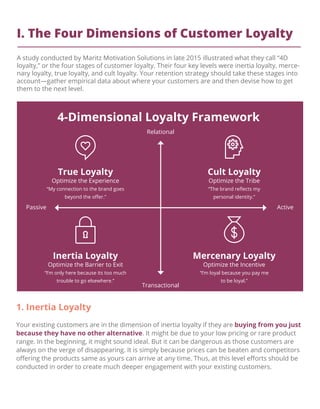
I. The Four Dimensions of Customer Loyalty
A study conducted by Maritz Motivation Solutions in late 2015 illustrated what they call “4D
loyalty,” or the four stages of customer loyalty. Their four key levels were inertia loyalty, merce-
nary loyalty, true loyalty, and cult loyalty. Your retention strategy should take these stages into
account—gather empirical data about where your customers are and then devise how to get
them to the next level.
4-Dimensional Loyalty Framework
True Loyalty
Optimize the Experience
“My connection to the brand goes
beyond the offer.”
Cult Loyalty
Optimize the Tribe
“The brand reflects my
personal identity.”
Inertia Loyalty
Optimize the Barrier to Exit
“I’m only here because its too much
trouble to go elsewhere.”
Mercenary Loyalty
Optimize the Incentive
“I’m loyal because you pay me
to be loyal.”
Passive Active
Transactional
Relational
1. Inertia Loyalty
Your existing customers are in the dimension of inertia loyalty if they are buying from you just
because they have no other alternative. It might be due to your low pricing or rare product
range. In the beginning, it might sound ideal. But it can be dangerous as those customers are
always on the verge of disappearing. It is simply because prices can be beaten and competitors
offering the products same as yours can arrive at any time. Thus, at this level efforts should be
conducted in order to create much deeper engagement with your existing customers.
II. Emotional Ideals Driving Loyalty
Before we launch into recommendations, it will be useful to examine some of the goals of
loyalty strategies in terms of the emotional qualities towards which they should strive. After all,
these will be the foundations of all your communications and a lot of your strategy. The four
ideals we list below are all time-tested traits, but it’s always worthwhile to explore and define
your goals before setting out to reach them.
4. Cult Loyalty
As the name suggests, customers are in the dimension of cult loyalty when your business has
been able to create a cult following. That is, you haven’t merely had success selling your
products; you’ve also had success selling your ideas and your brand. Here, people feel a
kinship with other customers of the same company. Cult loyalty is usually a result of both
powerful brand messaging and outstanding quality. Sometimes it happens almost organically.
Other times, companies position themselves as thought leaders—often with a highly visible
CEO or spokesperson—and take steps to actively cultivate community, whether online or in the
real world. In short, this kind of loyalty is possible when customers feel proud to be associated
with you.
2. Mercenary Loyalty
Mercenary loyalty simply means that customers are with you just because they don’t want
to miss an opportunity to get discounts from you. Though customers are more engaged in
this phase than in inertia loyalty, they’re opportunistic and not committed to your products or
values. One takeaway from the idea of mercenary loyalty is that rewards really do help make
customers stay. Instead of basing your whole strategy on rewards, though, we recommend
leveraging rewards to encourage certain behaviors and viewpoints. We’ll discuss this more in
our section on advocate loyalty.
3. True Loyalty
True loyalty is based upon the quality of your products and/or services. It means only one
thing that customers are buying from you just because they truly love what you sell. The key to
achieving this kind of loyalty is to try to keep your customers satisfied at all possible levels—not
just your products and services, but also with your communication strategy, customer service
and digital access to your store.
After trying multiple stores for help, she decided to call Trader Joe’s. Much to her relief and
delight, they agreed to deliver the food directly to the man's home, and even suggested other
items that would fit perfectly with his special low-sodium diet. They didn’t charge the daughter
for delivery.
The important thing to note here is that Trader Joe’s doesn’t normally deliver food, but their
employees made a judgment call based on the gravity of the situation. By doing so, they
helped this family and generated a lot of goodwill.
2. Respect
While compassion is usually practiced more on the individual, person-to-person level, respect
involves treating customers fairly and communicating with them honestly on a broader
level. In this case, respect is intimately connected with customer service and transparency.
1. Compassion
Nothing moves a human being more than a simple act of compassion. You can exhibit compassion
when your customers are facing moments of crises and compassion from your side at such
moments can become moments of magic for them. More than anything, they will never forget your
kind gesture. The thread of respect which such acts build is enough for your customers to stay
loyal to you.
When we speak of compassion in this context, we mean a systematic commitment to “the little
things,” rather than to the broad social programs that corporate social responsibility and mission
statements entail.
This example from Trader Joe’s, an American grocery store chain, is a practical implementation of
this “Compassion in Business” theory, and shows the power of small acts of kindness…
An elderly and helpless man of 89 was stuck in his Pennsylvanian home due to rough weather. His
daughter was worried, as there was no way that he could have accessed enough food to endure
the storm, both because of the weather and his frail condition.
Respect can manifest itself in thousands, if not millions of ways, but here are several basic
methods:
• Customer service evaluations
• Opening up as many lines of customer communication as possible, from live chat to
Facebook Messenger
• Transparency with the public about scandals and mistakes
• Product guarantees and warranties
• Pay-what-you-want pricing strategies, like Everlane and the band Radiohead have used
• Transparency about supply chains, your business’s environmental impact, etc., like
Reformation employs
3. Nostalgia
Despite the fact that many of your decisions are—and should be—decided by hard data and budgets,
you have to keep in mind that your consumers are human beings and human beings are made up of
emotions. Few things have a greater pull than nostalgia. So, if your brand is fortunate enough to have a
long history, then use it to create a web of nostalgia…and tell people how they have grown up with your
brand. It’s a great hook or motive for people to stay with your brand.
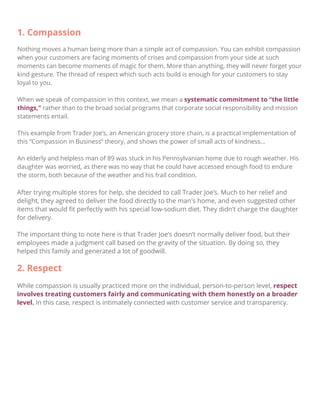
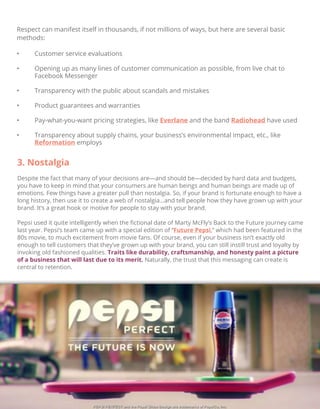
Pepsi used it quite intelligently when the fictional date of Marty McFly’s Back to the Future journey came
last year. Pepsi’s team came up with a special edition of “Future Pepsi,” which had been featured in the
80s movie, to much excitement from movie fans. Of course, even if your business isn’t exactly old
enough to tell customers that they’ve grown up with your brand, you can still instill trust and loyalty by
invoking old fashioned qualities. Traits like durability, craftsmanship, and honesty paint a picture
of a business that will last due to its merit. Naturally, the trust that this messaging can create is
central to retention.
4. Corporate Social
Responsibility (CSR)
Customers characterized by “cult loyalty”
don’t just want to be associated with your
products. They want to be associated with
your values and principles as well. They
want alignment with a brand that has
similar personal beliefs. The basic fact is
they want to feel proud to be a part of
the brand.
This is where corporate social
responsibility comes in. While it’s been a
buzzword over the past few years, it’s
become so ubiquitous that it deserves to
be labeled as an emotional ideal in its own
right.
Even the statistics stand behind this assertion.
• 93% of consumers are more loyal to
companies that engage in corporate
social responsibility
• 90% of consumers would stop buying a
company’s products when they learned
of its irresponsible or deceptive business
practices
• 55% of customers have stopped buying
from a company due to irresponsible or
deceptive business practices
• 66% of global respondents are willing to
pay more for products and services from
companies dedicated to social and
environmental change
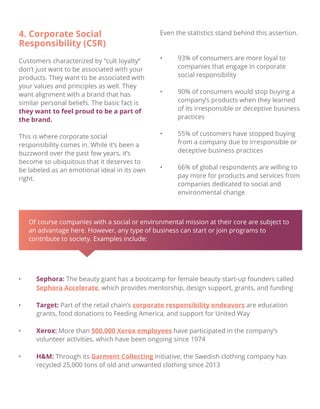
• Sephora: The beauty giant has a bootcamp for female beauty start-up founders called
Sephora Accelerate, which provides mentorship, design support, grants, and funding
• Target: Part of the retail chain’s corporate responsibility endeavors are education
grants, food donations to Feeding America, and support for United Way
• Xerox: More than 500,000 Xerox employees have participated in the company’s
volunteer activities, which have been ongoing since 1974
• H&M: Through its Garment Collecting initiative, the Swedish clothing company has
recycled 25,000 tons of old and unwanted clothing since 2013
Of course companies with a social or environmental mission at their core are subject to
an advantage here. However, any type of business can start or join programs to
contribute to society. Examples include:
III. Operating Within the Framework of
Advocate Loyalty
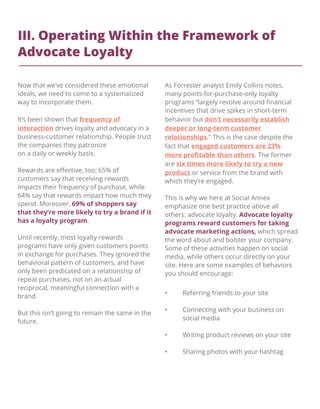
• Referring friends to your site
• Connecting with your business on
social media
• Writing product reviews on your site
• Sharing photos with your hashtag
Now that we’ve considered these emotional
ideals, we need to come to a systematized
way to incorporate them.
It’s been shown that frequency of
interaction drives loyalty and advocacy in a
business-customer relationship. People trust
the companies they patronize
on a daily or weekly basis.
Rewards are effective, too: 65% of
customers say that receiving rewards
impacts their frequency of purchase, while
64% say that rewards impact how much they
spend. Moreover, 69% of shoppers say
that they’re more likely to try a brand if it
has a loyalty program.
Until recently, most loyalty rewards
programs have only given customers points
in exchange for purchases. They ignored the
behavioral pattern of customers, and have
only been predicated on a relationship of
repeat purchases, not on an actual
reciprocal, meaningful connection with a
brand.
But this isn’t going to remain the same in the
future.
As Forrester analyst Emily Collins notes,
many points-for-purchase-only loyalty
programs “largely revolve around financial
incentives that drive spikes in short-term
behavior but don’t necessarily establish
deeper or long-term customer
relationships.” This is the case despite the
fact that engaged customers are 23%
more profitable than others. The former
are six times more likely to try a new
product or service from the brand with
which they’re engaged.
This is why we here at Social Annex
emphasize one best practice above all
others: advocate loyalty. Advocate loyalty
programs reward customers for taking
advocate marketing actions, which spread
the word about and bolster your company.
Some of these activities happen on social
media, while others occur directly on your
site. Here are some examples of behaviors
you should encourage:
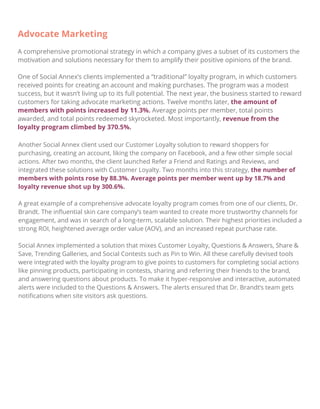
Advocate Marketing
A comprehensive promotional strategy in which a company gives a subset of its customers the
motivation and solutions necessary for them to amplify their positive opinions of the brand.
One of Social Annex’s clients implemented a “traditional” loyalty program, in which customers
received points for creating an account and making purchases. The program was a modest
success, but it wasn’t living up to its full potential. The next year, the business started to reward
customers for taking advocate marketing actions. Twelve months later, the amount of
members with points increased by 11.3%. Average points per member, total points
awarded, and total points redeemed skyrocketed. Most importantly, revenue from the
loyalty program climbed by 370.5%.
Another Social Annex client used our Customer Loyalty solution to reward shoppers for
purchasing, creating an account, liking the company on Facebook, and a few other simple social
actions. After two months, the client launched Refer a Friend and Ratings and Reviews, and
integrated these solutions with Customer Loyalty. Two months into this strategy, the number of
members with points rose by 88.3%. Average points per member went up by 18.7% and
loyalty revenue shot up by 300.6%.
A great example of a comprehensive advocate loyalty program comes from one of our clients, Dr.
Brandt. The influential skin care company’s team wanted to create more trustworthy channels for
engagement, and was in search of a long-term, scalable solution. Their highest priorities included a
strong ROI, heightened average order value (AOV), and an increased repeat purchase rate.
Social Annex implemented a solution that mixes Customer Loyalty, Questions & Answers, Share &
Save, Trending Galleries, and Social Contests such as Pin to Win. All these carefully devised tools
were integrated with the loyalty program to give points to customers for completing social actions
like pinning products, participating in contests, sharing and referring their friends to the brand,
and answering questions about products. To make it hyper-responsive and interactive, automated
alerts were included to the Questions & Answers. The alerts ensured that Dr. Brandt’s team gets
notifications when site visitors ask questions.
• Dr. Brandt’s AOV has gone up by 10%
• Repeat customers spend about 3x more than new customers
• 50% of users redeemed their points in the first 3 months of 2016
• There’s a 23.5% conversion rate among users who interact with Questions & Answers
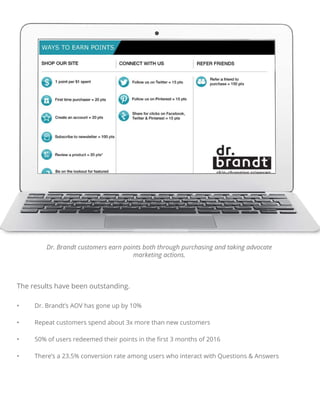
Dr. Brandt customers earn points both through purchasing and taking advocate
marketing actions.
The results have been outstanding.
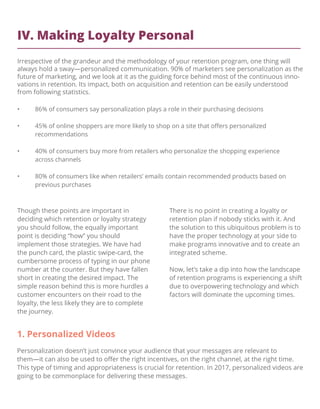
IV. Making Loyalty Personal
Irrespective of the grandeur and the methodology of your retention program, one thing will
always hold a sway—personalized communication. 90% of marketers see personalization as the
future of marketing, and we look at it as the guiding force behind most of the continuous inno-
vations in retention. Its impact, both on acquisition and retention can be easily understood
from following statistics.
• 86% of consumers say personalization plays a role in their purchasing decisions
• 45% of online shoppers are more likely to shop on a site that offers personalized
recommendations
• 40% of consumers buy more from retailers who personalize the shopping experience
across channels
• 80% of consumers like when retailers’ emails contain recommended products based on
previous purchases
Though these points are important in
deciding which retention or loyalty strategy
you should follow, the equally important
point is deciding “how” you should
implement those strategies. We have had
the punch card, the plastic swipe-card, the
cumbersome process of typing in our phone
number at the counter. But they have fallen
short in creating the desired impact. The
simple reason behind this is more hurdles a
customer encounters on their road to the
loyalty, the less likely they are to complete
the journey.
1. Personalized Videos
Personalization doesn’t just convince your audience that your messages are relevant to
them—it can also be used to offer the right incentives, on the right channel, at the right time.
This type of timing and appropriateness is crucial for retention. In 2017, personalized videos are
going to be commonplace for delivering these messages.
There is no point in creating a loyalty or
retention plan if nobody sticks with it. And
the solution to this ubiquitous problem is to
have the proper technology at your side to
make programs innovative and to create an
integrated scheme.
Now, let’s take a dip into how the landscape
of retention programs is experiencing a shift
due to overpowering technology and which
factors will dominate the upcoming times.
Personalized videos are unique videos tailored for audiences, content types, or occasions. They
are created on the cloud in real-time based on customer data or any other content feed.
Designed for 1:1 communication, personalized videos move each customer to action by
addressing them personally with relevant experiences that matter to them.
These messages can be based on variables like:
• Location
• Age
• Level of engagement with business
• Buying and browsing behavior
Generally speaking, here’s how it works: After choosing a template video, you link data from your
marketing automation or CRM platform. Data then gets pulled by your personalized video
provider. They feed it into the areas in the video where personalization tokens have been placed.
Interactive personalized video, however, is usually a manner of compiling videos in near real-time
according to the specific needs of a user. A business needs to have pre-recorded content segments
that address common situations. Per Forbes, this personalization is “facilitated both by user input
(the customer’s name, for example)…[as well as] data from internal systems (products held,
location, etc.) and external providers (such as demographics and regional news).”
The crux of the personalized video is that you never want to create a feeling among your
customers that you are addressing a random audience of strangers. Every customer should feel
that you are talking to him/her personally. By crafting the content, images and context of the video
to a specific customer, you make them feel valued and important, making them more likely to not
only buy once but to continue coming back.
As an example of the potential of personalized video in retention, AT&T created a personalized
video bill service for its U-verse customers. 80% of recipients opened and watched the video, and
ROI for customers that viewed the video increased 10 times over.
Steimatzky, an Israeli bookstore chain, used personalized videos to send birthday messages to its
loyalty club members. 15% of recipients made an in-store purchase within two weeks.
2. Virtual Reality
Virtual reality is fast becoming a popular new medium for both consumers and businesses. As
customer experience is the key to retaining your existing customers, VR will instantly radicalize
the ways in which they experience your services or products. That’s why experts are saying that
annual revenue of the VR industry is forecasted to grow from less than $1 billion to $30
billion by 2020. Retailers are going to be the big contributors in that economy as VR
technologies are all set to play a key role in how companies showcase experience-based
products to their customers. Besides, for stores, this can be a good factor to differentiate
themselves from others. No wonder that all industries irrespective of their core competencies
are welcoming this new offering from the tech world.
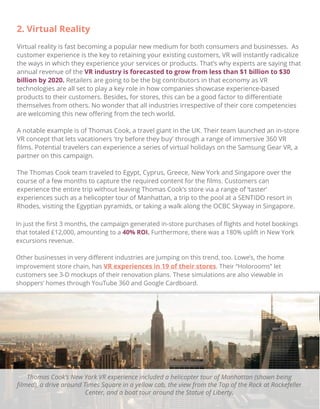
A notable example is of Thomas Cook, a travel giant in the UK. Their team launched an in-store
VR concept that lets vacationers 'try before they buy' through a range of immersive 360 VR
films. Potential travelers can experience a series of virtual holidays on the Samsung Gear VR, a
partner on this campaign.
The Thomas Cook team traveled to Egypt, Cyprus, Greece, New York and Singapore over the
course of a few months to capture the required content for the films. Customers can
experience the entire trip without leaving Thomas Cook’s store via a range of ‘taster’
experiences such as a helicopter tour of Manhattan, a trip to the pool at a SENTIDO resort in
Rhodes, visiting the Egyptian pyramids, or taking a walk along the OCBC Skyway in Singapore.
In just the first 3 months, the campaign generated in-store purchases of flights and hotel bookings
that totaled £12,000, amounting to a 40% ROI. Furthermore, there was a 180% uplift in New York
excursions revenue.
Other businesses in very different industries are jumping on this trend, too. Lowe’s, the home
improvement store chain, has VR experiences in 19 of their stores. Their “Holorooms” let
customers see 3-D mockups of their renovation plans. These simulations are also viewable in
shoppers’ homes through YouTube 360 and Google Cardboard.
Thomas Cook’s New York VR experience included a helicopter tour of Manhattan (shown being
filmed), a drive around Times Square in a yellow cab, the view from the Top of the Rock at Rockefeller
Center, and a boat tour around the Statue of Liberty.
Toms, which is known primarily for its footwear and one-for-one donation model, has VR
headsets in more than 100 of their stores. These transport shoppers to Peru, where they
witness children receiving donations of Toms shoes. For those curious about costs, filming
cost $250,000, outfitting each store took $1,000, but the biggest expense was employee
training. Toms founder Blake Mycoskie reported that the VR campaign was completely worth
the money, though. In fact, his company will be launching another one soon.
Of course, all of these campaigns likely affected customer acquisition and conversion in
addition to retention. There are more targeted ways, though, to use VR to increase retention,
like providing an exclusive experience to your best customers.
3. Omni-Channel Approaches
The understanding that your customers use different channels—and that they do so in varied
ways—is elemental to providing a comprehensive and personalized experience.
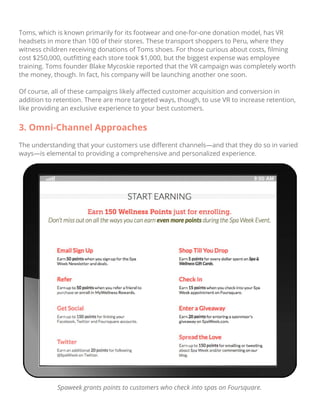
Spaweek grants points to customers who check into spas on Foursquare.
In the context of loyalty programs, this involves enabling sign-up, point accrual, redemption,
and communication online, in your app, and in-store. Beyond these basic components, there
are many ways to incentivize shoppers to visit your stores or use your app—whichever
channel you prefer. These include:
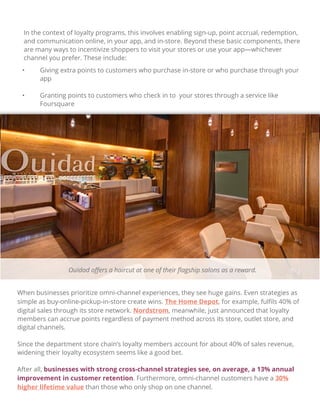
• Giving extra points to customers who purchase in-store or who purchase through your
app
• Granting points to customers who check in to your stores through a service like
Foursquare
When businesses prioritize omni-channel experiences, they see huge gains. Even strategies as
simple as buy-online-pickup-in-store create wins. The Home Depot, for example, fulfils 40% of
digital sales through its store network. Nordstrom, meanwhile, just announced that loyalty
members can accrue points regardless of payment method across its store, outlet store, and
digital channels.
Since the department store chain’s loyalty members account for about 40% of sales revenue,
widening their loyalty ecosystem seems like a good bet.
After all, businesses with strong cross-channel strategies see, on average, a 13% annual
improvement in customer retention. Furthermore, omni-channel customers have a 30%
higher lifetime value than those who only shop on one channel.
Ouidad offers a haircut at one of their flagship salons as a reward.
4. Connected Devices
Though they’re in a nascent stage, connected devices—an integral part of the Internet of Things
(IoT)—will emerge as a key cog in in the retention machine. One of the best examples of
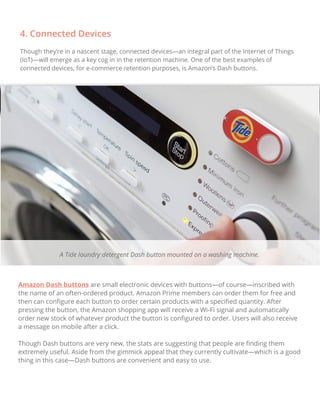
connected devices, for e-commerce retention purposes, is Amazon’s Dash buttons.
Amazon Dash buttons are small electronic devices with buttons—of course—inscribed with
the name of an often-ordered product. Amazon Prime members can order them for free and
then can configure each button to order certain products with a specified quantity. After
pressing the button, the Amazon shopping app will receive a Wi-Fi signal and automatically
order new stock of whatever product the button is configured to order. Users will also receive
a message on mobile after a click.
Though Dash buttons are very new, the stats are suggesting that people are finding them
extremely useful. Aside from the gimmick appeal that they currently cultivate—which is a good
thing in this case—Dash buttons are convenient and easy to use.
A Tide laundry detergent Dash button mounted on a washing machine.
• 27% of people said they are extremely positive about the use of Dash buttons in the
future
• 31% of the total 2015 sales of Procter & Gamble on Amazon were generated via Dash
buttons
• 10% of the total 2015 sales of soft drinks on Amazon were generated via Dash buttons
• 14% of the total 2015 sales of Kimberley Clark on Amazon were generated via Dash
buttons
Beyond Dash buttons, there are numerous examples of connected devices making a splash
in the customer loyalty sphere. Some IoT innovations include connected Nespresso machines,
Xiaomi’s connected nightlight, TP Link’s smart plug, the June intelligent oven, Awair’s smart air
quality monitor, the Nest cam, and the SmartMat yoga mat. Currently, most connected devices
are centered in the smart home and wearables categories, but there’s tons of room to grow.
One particularly impressive device is Disney’s MagicBand, which is an all-in-one wristband that
lets Disney World guests unlock their hotel rooms, enter theme parks, check in at FastPass
entrances, connect photos to their accounts, and pay for food and merchandise. Disney also
touts that the MagicBand unlocks personalized surprises for guests throughout their resort.
Of course, innovations like these don’t just make the customer journey more seamless, with the
effect of larger revenue. The other substantial benefit is all the data that businesses can collect.
With the MagicBand, for example, Disney’s team can track essentially every move and purchase
that their customers make. This provides almost-endless opportunities to refine their customer
journey mapping and consequent marketing strategy.
5. Innovative Customer Care Services
We are all well aware of the power of customer service in retaining customers. That’s precisely
why we are going to see rapid innovation in order to enhance the entire working of customer
care services.
Just as marketers need to meet customers on all channels, so does customer support. In-app
chat support is a huge key to this, and it’s becoming easier and easier for businesses to add this
functionality. Certain mobile chat and service solutions can reduce support tickets by 25% or
more.
Social channels are still booming business for customer service, and their potential keeps
growing. Periscope is a strong but underutilized medium to offer nearly-instantaneous support,
especially as Twitter is now a go-to forum for complaints and questions.
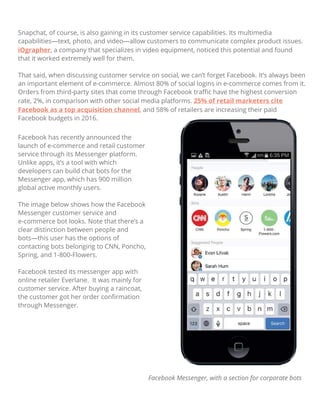
Facebook has recently announced the
launch of e-commerce and retail customer
service through its Messenger platform.
Unlike apps, it’s a tool with which
developers can build chat bots for the
Messenger app, which has 900 million
global active monthly users.
The image below shows how the Facebook
Messenger customer service and
e-commerce bot looks. Note that there’s a
clear distinction between people and
bots—this user has the options of
contacting bots belonging to CNN, Poncho,
Spring, and 1-800-Flowers.
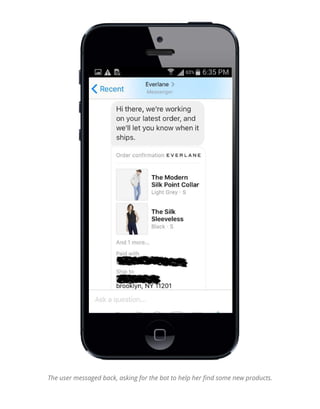
Facebook tested its messenger app with
online retailer Everlane. It was mainly for
customer service. After buying a raincoat,
the customer got her order confirmation
through Messenger.
Facebook Messenger, with a section for corporate bots
Snapchat, of course, is also gaining in its customer service capabilities. Its multimedia
capabilities—text, photo, and video—allow customers to communicate complex product issues.
iOgrapher, a company that specializes in video equipment, noticed this potential and found
that it worked extremely well for them.
That said, when discussing customer service on social, we can’t forget Facebook. It’s always been
an important element of e-commerce. Almost 80% of social logins in e-commerce comes from it.
Orders from third-party sites that come through Facebook traffic have the highest conversion
rate, 2%, in comparison with other social media platforms. 25% of retail marketers cite
Facebook as a top acquisition channel, and 58% of retailers are increasing their paid
Facebook budgets in 2016.
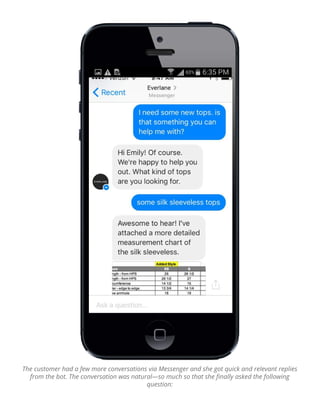
The user messaged back, asking for the bot to help her find some new products.
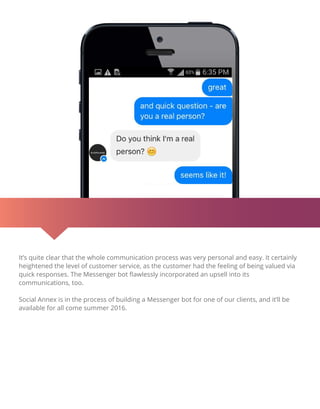
The customer had a few more conversations via Messenger and she got quick and relevant replies
from the bot. The conversation was natural—so much so that she finally asked the following
question:
It’s quite clear that the whole communication process was very personal and easy. It certainly
heightened the level of customer service, as the customer had the feeling of being valued via
quick responses. The Messenger bot flawlessly incorporated an upsell into its
communications, too.
Social Annex is in the process of building a Messenger bot for one of our clients, and it’ll be
available for all come summer 2016.
V. Loyalty Implementations from the Best
in the Business
1. Starbucks
My Starbucks Rewards is a well-devised methodology to track and transform customer buying
behavior and recommendations into usable data. This allows Starbucks to modify their
products according to demand. For its implementation, they are approaching people where
they spend most of the time—on their mobile phones.
With almost 12 million active users on their Starbucks app, people have the option to pay with
their mobile phones in order to earn rewards from the coffee
giant. Besides, this app also allows customers to monitor their progress in real time on the
Starbucks app, which is a great way for a customer to have a complete visibility of their
earnings.
Another point to note here is Starbucks is constantly trying to save their customers time. The
app comes with an option where customers can pay for drinks beforehand and schedule
pick-ups in store. In short, they are not using their loyalty program just to retain customers;
they are using it to better serve people as well.
The program has seen considerable success even after making a controversial change to its
rewards scheme earlier in 2016. My Starbucks Rewards used to award points to customers
based on their number of visits. Those who bought a tall, plain coffee every day got the same
amount of points as those who bought two venti Frappucinos and three venti lattes, for
example.
• As of mid-2016, Starbucks had 12 million active rewards members in the US
• Mobile payment through their app amounted to 24% of orders in Q2 2016
• According to Starbucks they have seen a 26% rise in their profit margins and an 11%
bump in total revenue
Furthermore, the company announced that it will launch a reloadable prepaid card by the
end of 2016. Customers can use the card anywhere where Visa is accepted, and will earn points
for doing so. They’ll rack up even more rewards for buying at Starbucks locations, of course.
That said, here are the key takeaways from Starbucks’s success:
• Communicate on all devices with the end-goal of convenience
• Add value to the customer experience with your app and loyalty program
2. Olympus Camera
Olympus Camera has a comprehensive advocate loyalty program called Olympus Rewards,
which creates a unique and exciting experience. Shoppers earn points for virtually any kind of
engagement with the company, and in turn Olympus gets thousands of enthusiastic
marketers.
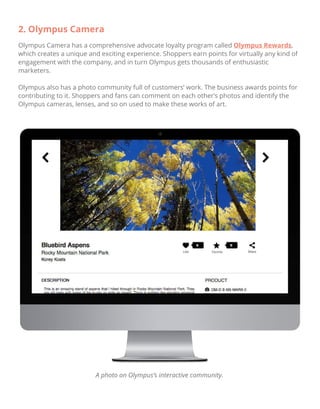
Olympus also has a photo community full of customers’ work. The business awards points for
contributing to it. Shoppers and fans can comment on each other’s photos and identify the
Olympus cameras, lenses, and so on used to make these works of art.
A photo on Olympus’s interactive community.
Perhaps the most remarkable feature of the program is its dealer rewards app. Third-party dealers
of Olympus products, like Best Buy, have their store associates download the app in order to let
customers accrue and use Olympus Rewards points in their brick-and-mortar shops.
This creates a much more flexible loyalty ecosystem, as customers can engage with Olympus’s
on-site product information and resources and discover products in stores, while accumulating and
using points across the board. In effect, Olympus has extended its seamless experience to channels
that it doesn’t even own.
This program has resulted in:
• Tens of thousands of photo uploads
• Magnified engagement and social activity
• Bountiful customer data
Here are some notable takeaways:
• Loop advocate marketing tactics, like photo and review contributions, social sharing, and
referrals into your points structure
• Ensure that points are available to use and earn at all touchpoints
3. Sephora
Sephora, a leading retailer of cosmetics, needed to find out a way to compete with other stores
without lowering their prices. Thus, they came up with a Beauty Insider reward system.
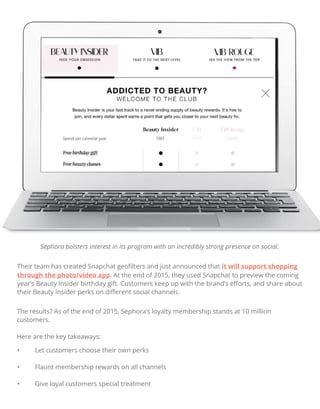
Their Beauty Insider system is entirely flexible as it allows customers to select benefits as per
their requirements. There is no entry fee and every dollar spent will reward customers with
points. In exchange, customers get free products, personal recommendations, and a birthday
gift.
Members of the higher two tiers of the program have access to seasonal savings, handpicked gifts,
and free makeovers. Top tier members also get free 2-day shipping, a private hotline, and
invitations to exclusive events.
Their team has created Snapchat geofilters and just announced that it will support shopping
through the photo/video app. At the end of 2015, they used Snapchat to preview the coming
year’s Beauty Insider birthday gift. Customers keep up with the brand’s efforts, and share about
their Beauty Insider perks on different social channels.
The results? As of the end of 2015, Sephora’s loyalty membership stands at 10 million
customers.
Here are the key takeaways:
• Let customers choose their own perks
• Flaunt membership rewards on all channels
• Give loyal customers special treatment
Sephora bolsters interest in its program with an incredibly strong presence on social.
4. Waitrose
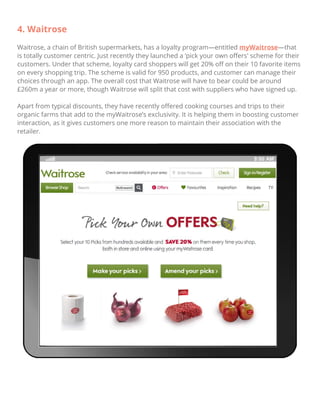
Waitrose, a chain of British supermarkets, has a loyalty program—entitled myWaitrose—that
is totally customer centric. Just recently they launched a ‘pick your own offers' scheme for their
customers. Under that scheme, loyalty card shoppers will get 20% off on their 10 favorite items
on every shopping trip. The scheme is valid for 950 products, and customer can manage their
choices through an app. The overall cost that Waitrose will have to bear could be around
£260m a year or more, though Waitrose will split that cost with suppliers who have signed up.
Apart from typical discounts, they have recently offered cooking courses and trips to their
organic farms that add to the myWaitrose’s exclusivity. It is helping them in boosting customer
interaction, as it gives customers one more reason to maintain their association with the
retailer.
myWaitrose’s choose-your-perks approach seems to be working incredibly well:
• 8,000 customers a day are signing up
• 50% of Waitrose’s customer base are now buying products through their loyalty program
Lessons for other retailers include:
• Keep offerings as flexible as possible
• Strike an understanding with suppliers to make loyalty offerings more feasible
5. Bebe
Bebe, an American clothing brand, has a loyalty program that’s notable for its incorporation of
everyday consumer actions into its points structure.
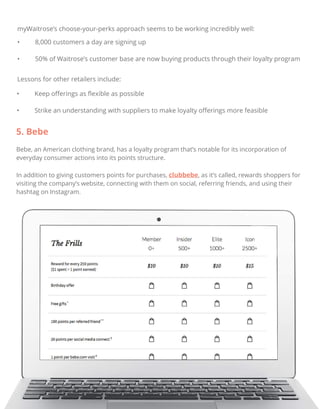
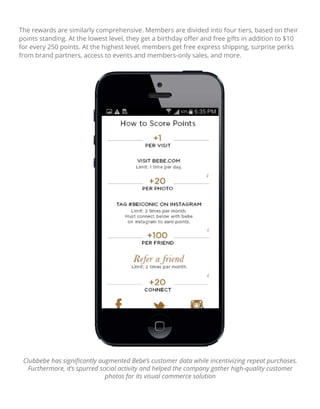
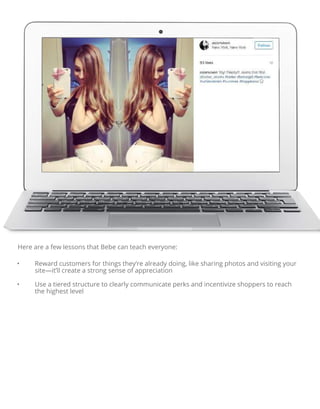
In addition to giving customers points for purchases, clubbebe, as it’s called, rewards shoppers for
visiting the company’s website, connecting with them on social, referring friends, and using their
hashtag on Instagram.
Clubbebe has significantly augmented Bebe’s customer data while incentivizing repeat purchases.
Furthermore, it’s spurred social activity and helped the company gather high-quality customer
photos for its visual commerce solution
The rewards are similarly comprehensive. Members are divided into four tiers, based on their
points standing. At the lowest level, they get a birthday offer and free gifts in addition to $10
for every 250 points. At the highest level, members get free express shipping, surprise perks
from brand partners, access to events and members-only sales, and more.
Here are a few lessons that Bebe can teach everyone:
• Reward customers for things they’re already doing, like sharing photos and visiting your
site—it’ll create a strong sense of appreciation
• Use a tiered structure to clearly communicate perks and incentivize shoppers to reach
the highest level
Conclusion
Achieving a high retention rate is no easy feat, but it’s well-worth the challenge. No matter
what your messaging goals or strategies are, it’s vital to collect data throughout every step of
your process. Consequently, it’s wise to invest in systems that provide comprehensive but
straightforward metrics about your program’s success and your customers’ behaviors. When
you can unify the data from your various dashboards and databases, you can learn so much
more.
On the customer-facing side, the idea of the customer lifecycle cannot be emphasized enough.
After all, loyalty and retention imply repeatable processes that feed back into the same goal.
Engagement, acquisition, conversion, and retention suffer when your programs are siloed and
you don’t map your shoppers’ return to you. Customer lifecycles are multidimensional, and
your marketing programs should be too. Generally, you should aim to make the buyer
journey easy, fast, and fun. If you can describe your retention strategies with these three
words, you’re onto something.
Ready to talk?
North America Headquarters
5301 Beethoven St. Unit #260
Los Angeles, CA 90066
Call: 1-866-802-8806
Website: www.socialannex.com
Copyright © 2016, Social Annex. All rights reserved.
Social Annex is a privately owned entity.
This document is provided for information purposes only and the contents hereof are subject to
change without notice. This document is not warranted to be error-free, nor subject to any other
warranties or conditions, whether expressed orally or implied in law, including implied warranties and
conditions of merchantability or fitness for a particular purpose. We specifically disclaim any liability
with respect to this document and no contractual obligations are formed either directly or indirectly by
this document. This document may not be reproduced or transmitted in any form or by any means,
electronic or mechanical, for any purpose, without our prior written permission of Social Annex.

Social annex customerretentionin2017_redesign

  • 1.
    Customer Retention in2017: Driving Emotion with Technology
  • 2.
    Contents Introduction I. The FourDimensions of Customer Loyalty 1. Inertia Loyalty 2. Mercenary Loyalty 3. True Loyalty 4. Cult Loyalty II. Emotional Ideals Driving Loyalty 1. Compassion 2. Respect 3. Nostalgia 4. Corporate Social Responsibility III. Operating within the Framework of Advocate Loyalty IV. Making It Personal: Innovative Recommendations 1. Personalized Videos 2. Virtual Reality 3. Omni-Channel Approaches 4. Connected Devices 5. M-Commerce V. How the Best in the Business are Implementing Loyalty Programs 1. Starbucks 2. Olympus Camera 3. Sephora 4. Waitrose 5. Bebe Conclusion
  • 3.
    Introduction Customer retention createsa steady funnel of sustainable growth. It’s universally known that attracting a new customer costs much more than keeping an existing one, and that there’s a much higher probability of selling to the latter versus the former. • Attracting a new customer costs five times as much as keeping an existing one (Lee Resources 2010) • Globally, the average value of a lost customer is $243 (KISSmetrics) • The probability of selling to an existing customer is 60 –70%. The probability of selling to a new prospect is 5-20% (Marketing Metrics) • Increasing your customer retention rate by 5% increases profit by 25-95% • A 2% increase in customer retention has the same effect as decreasing costs by 10% • 80% of your revenue is being generated by 20% of your existing customers • Existing customers spend 67% more than new customers While the value of retention is widely acknowledged, many marketers, e-commerce managers, and customer support specialists (among others) misunderstand the nuances of how to increase it. Retention is essentially synonymous with customer loyalty. It’s a coveted ideal, but many marketers have a slight misunderstanding of what drives it and how to cultivate it. Marketers can find great success with customer loyalty programs, that is, if they approach their campaigns in the right way. After all, 73% of shoppers think that loyalty programs should demonstrate how loyal a company is to its customers, while 66% of marketing executives should be a way for customers to prove their loyalty to brands. This is an extremely dangerous manner of thinking—customers rarely need to prove anything to businesses, and believing otherwise will only set you up for failure. These statistics will throw light on the might of retention. In an ideal world, loyalty should be a two-way street. It’s wonderful when customers express appreciation for companies, but it’s more important that businesses show their clientele how vital and valued they are. In short, real loyalty is driven by emotion—feelings of trust, satisfaction, and reward. Today we can nurture these emotions with technology like never before. Before we examine how to do this, it’s worthwhile to consider your goals and the type of loyalty your customers currently harbor.
  • 4.
    I. The FourDimensions of Customer Loyalty A study conducted by Maritz Motivation Solutions in late 2015 illustrated what they call “4D loyalty,” or the four stages of customer loyalty. Their four key levels were inertia loyalty, merce- nary loyalty, true loyalty, and cult loyalty. Your retention strategy should take these stages into account—gather empirical data about where your customers are and then devise how to get them to the next level. 4-Dimensional Loyalty Framework True Loyalty Optimize the Experience “My connection to the brand goes beyond the offer.” Cult Loyalty Optimize the Tribe “The brand reflects my personal identity.” Inertia Loyalty Optimize the Barrier to Exit “I’m only here because its too much trouble to go elsewhere.” Mercenary Loyalty Optimize the Incentive “I’m loyal because you pay me to be loyal.” Passive Active Transactional Relational 1. Inertia Loyalty Your existing customers are in the dimension of inertia loyalty if they are buying from you just because they have no other alternative. It might be due to your low pricing or rare product range. In the beginning, it might sound ideal. But it can be dangerous as those customers are always on the verge of disappearing. It is simply because prices can be beaten and competitors offering the products same as yours can arrive at any time. Thus, at this level efforts should be conducted in order to create much deeper engagement with your existing customers.
  • 5.
    II. Emotional IdealsDriving Loyalty Before we launch into recommendations, it will be useful to examine some of the goals of loyalty strategies in terms of the emotional qualities towards which they should strive. After all, these will be the foundations of all your communications and a lot of your strategy. The four ideals we list below are all time-tested traits, but it’s always worthwhile to explore and define your goals before setting out to reach them. 4. Cult Loyalty As the name suggests, customers are in the dimension of cult loyalty when your business has been able to create a cult following. That is, you haven’t merely had success selling your products; you’ve also had success selling your ideas and your brand. Here, people feel a kinship with other customers of the same company. Cult loyalty is usually a result of both powerful brand messaging and outstanding quality. Sometimes it happens almost organically. Other times, companies position themselves as thought leaders—often with a highly visible CEO or spokesperson—and take steps to actively cultivate community, whether online or in the real world. In short, this kind of loyalty is possible when customers feel proud to be associated with you. 2. Mercenary Loyalty Mercenary loyalty simply means that customers are with you just because they don’t want to miss an opportunity to get discounts from you. Though customers are more engaged in this phase than in inertia loyalty, they’re opportunistic and not committed to your products or values. One takeaway from the idea of mercenary loyalty is that rewards really do help make customers stay. Instead of basing your whole strategy on rewards, though, we recommend leveraging rewards to encourage certain behaviors and viewpoints. We’ll discuss this more in our section on advocate loyalty. 3. True Loyalty True loyalty is based upon the quality of your products and/or services. It means only one thing that customers are buying from you just because they truly love what you sell. The key to achieving this kind of loyalty is to try to keep your customers satisfied at all possible levels—not just your products and services, but also with your communication strategy, customer service and digital access to your store.
  • 6.
    After trying multiplestores for help, she decided to call Trader Joe’s. Much to her relief and delight, they agreed to deliver the food directly to the man's home, and even suggested other items that would fit perfectly with his special low-sodium diet. They didn’t charge the daughter for delivery. The important thing to note here is that Trader Joe’s doesn’t normally deliver food, but their employees made a judgment call based on the gravity of the situation. By doing so, they helped this family and generated a lot of goodwill. 2. Respect While compassion is usually practiced more on the individual, person-to-person level, respect involves treating customers fairly and communicating with them honestly on a broader level. In this case, respect is intimately connected with customer service and transparency. 1. Compassion Nothing moves a human being more than a simple act of compassion. You can exhibit compassion when your customers are facing moments of crises and compassion from your side at such moments can become moments of magic for them. More than anything, they will never forget your kind gesture. The thread of respect which such acts build is enough for your customers to stay loyal to you. When we speak of compassion in this context, we mean a systematic commitment to “the little things,” rather than to the broad social programs that corporate social responsibility and mission statements entail. This example from Trader Joe’s, an American grocery store chain, is a practical implementation of this “Compassion in Business” theory, and shows the power of small acts of kindness… An elderly and helpless man of 89 was stuck in his Pennsylvanian home due to rough weather. His daughter was worried, as there was no way that he could have accessed enough food to endure the storm, both because of the weather and his frail condition.
  • 7.
    Respect can manifestitself in thousands, if not millions of ways, but here are several basic methods: • Customer service evaluations • Opening up as many lines of customer communication as possible, from live chat to Facebook Messenger • Transparency with the public about scandals and mistakes • Product guarantees and warranties • Pay-what-you-want pricing strategies, like Everlane and the band Radiohead have used • Transparency about supply chains, your business’s environmental impact, etc., like Reformation employs 3. Nostalgia Despite the fact that many of your decisions are—and should be—decided by hard data and budgets, you have to keep in mind that your consumers are human beings and human beings are made up of emotions. Few things have a greater pull than nostalgia. So, if your brand is fortunate enough to have a long history, then use it to create a web of nostalgia…and tell people how they have grown up with your brand. It’s a great hook or motive for people to stay with your brand. Pepsi used it quite intelligently when the fictional date of Marty McFly’s Back to the Future journey came last year. Pepsi’s team came up with a special edition of “Future Pepsi,” which had been featured in the 80s movie, to much excitement from movie fans. Of course, even if your business isn’t exactly old enough to tell customers that they’ve grown up with your brand, you can still instill trust and loyalty by invoking old fashioned qualities. Traits like durability, craftsmanship, and honesty paint a picture of a business that will last due to its merit. Naturally, the trust that this messaging can create is central to retention.
  • 8.
    4. Corporate Social Responsibility(CSR) Customers characterized by “cult loyalty” don’t just want to be associated with your products. They want to be associated with your values and principles as well. They want alignment with a brand that has similar personal beliefs. The basic fact is they want to feel proud to be a part of the brand. This is where corporate social responsibility comes in. While it’s been a buzzword over the past few years, it’s become so ubiquitous that it deserves to be labeled as an emotional ideal in its own right. Even the statistics stand behind this assertion. • 93% of consumers are more loyal to companies that engage in corporate social responsibility • 90% of consumers would stop buying a company’s products when they learned of its irresponsible or deceptive business practices • 55% of customers have stopped buying from a company due to irresponsible or deceptive business practices • 66% of global respondents are willing to pay more for products and services from companies dedicated to social and environmental change • Sephora: The beauty giant has a bootcamp for female beauty start-up founders called Sephora Accelerate, which provides mentorship, design support, grants, and funding • Target: Part of the retail chain’s corporate responsibility endeavors are education grants, food donations to Feeding America, and support for United Way • Xerox: More than 500,000 Xerox employees have participated in the company’s volunteer activities, which have been ongoing since 1974 • H&M: Through its Garment Collecting initiative, the Swedish clothing company has recycled 25,000 tons of old and unwanted clothing since 2013 Of course companies with a social or environmental mission at their core are subject to an advantage here. However, any type of business can start or join programs to contribute to society. Examples include:
  • 9.
    III. Operating Withinthe Framework of Advocate Loyalty • Referring friends to your site • Connecting with your business on social media • Writing product reviews on your site • Sharing photos with your hashtag Now that we’ve considered these emotional ideals, we need to come to a systematized way to incorporate them. It’s been shown that frequency of interaction drives loyalty and advocacy in a business-customer relationship. People trust the companies they patronize on a daily or weekly basis. Rewards are effective, too: 65% of customers say that receiving rewards impacts their frequency of purchase, while 64% say that rewards impact how much they spend. Moreover, 69% of shoppers say that they’re more likely to try a brand if it has a loyalty program. Until recently, most loyalty rewards programs have only given customers points in exchange for purchases. They ignored the behavioral pattern of customers, and have only been predicated on a relationship of repeat purchases, not on an actual reciprocal, meaningful connection with a brand. But this isn’t going to remain the same in the future. As Forrester analyst Emily Collins notes, many points-for-purchase-only loyalty programs “largely revolve around financial incentives that drive spikes in short-term behavior but don’t necessarily establish deeper or long-term customer relationships.” This is the case despite the fact that engaged customers are 23% more profitable than others. The former are six times more likely to try a new product or service from the brand with which they’re engaged. This is why we here at Social Annex emphasize one best practice above all others: advocate loyalty. Advocate loyalty programs reward customers for taking advocate marketing actions, which spread the word about and bolster your company. Some of these activities happen on social media, while others occur directly on your site. Here are some examples of behaviors you should encourage:
  • 10.
    Advocate Marketing A comprehensivepromotional strategy in which a company gives a subset of its customers the motivation and solutions necessary for them to amplify their positive opinions of the brand. One of Social Annex’s clients implemented a “traditional” loyalty program, in which customers received points for creating an account and making purchases. The program was a modest success, but it wasn’t living up to its full potential. The next year, the business started to reward customers for taking advocate marketing actions. Twelve months later, the amount of members with points increased by 11.3%. Average points per member, total points awarded, and total points redeemed skyrocketed. Most importantly, revenue from the loyalty program climbed by 370.5%. Another Social Annex client used our Customer Loyalty solution to reward shoppers for purchasing, creating an account, liking the company on Facebook, and a few other simple social actions. After two months, the client launched Refer a Friend and Ratings and Reviews, and integrated these solutions with Customer Loyalty. Two months into this strategy, the number of members with points rose by 88.3%. Average points per member went up by 18.7% and loyalty revenue shot up by 300.6%. A great example of a comprehensive advocate loyalty program comes from one of our clients, Dr. Brandt. The influential skin care company’s team wanted to create more trustworthy channels for engagement, and was in search of a long-term, scalable solution. Their highest priorities included a strong ROI, heightened average order value (AOV), and an increased repeat purchase rate. Social Annex implemented a solution that mixes Customer Loyalty, Questions & Answers, Share & Save, Trending Galleries, and Social Contests such as Pin to Win. All these carefully devised tools were integrated with the loyalty program to give points to customers for completing social actions like pinning products, participating in contests, sharing and referring their friends to the brand, and answering questions about products. To make it hyper-responsive and interactive, automated alerts were included to the Questions & Answers. The alerts ensured that Dr. Brandt’s team gets notifications when site visitors ask questions.
  • 11.
    • Dr. Brandt’sAOV has gone up by 10% • Repeat customers spend about 3x more than new customers • 50% of users redeemed their points in the first 3 months of 2016 • There’s a 23.5% conversion rate among users who interact with Questions & Answers Dr. Brandt customers earn points both through purchasing and taking advocate marketing actions. The results have been outstanding.
  • 12.
    IV. Making LoyaltyPersonal Irrespective of the grandeur and the methodology of your retention program, one thing will always hold a sway—personalized communication. 90% of marketers see personalization as the future of marketing, and we look at it as the guiding force behind most of the continuous inno- vations in retention. Its impact, both on acquisition and retention can be easily understood from following statistics. • 86% of consumers say personalization plays a role in their purchasing decisions • 45% of online shoppers are more likely to shop on a site that offers personalized recommendations • 40% of consumers buy more from retailers who personalize the shopping experience across channels • 80% of consumers like when retailers’ emails contain recommended products based on previous purchases Though these points are important in deciding which retention or loyalty strategy you should follow, the equally important point is deciding “how” you should implement those strategies. We have had the punch card, the plastic swipe-card, the cumbersome process of typing in our phone number at the counter. But they have fallen short in creating the desired impact. The simple reason behind this is more hurdles a customer encounters on their road to the loyalty, the less likely they are to complete the journey. 1. Personalized Videos Personalization doesn’t just convince your audience that your messages are relevant to them—it can also be used to offer the right incentives, on the right channel, at the right time. This type of timing and appropriateness is crucial for retention. In 2017, personalized videos are going to be commonplace for delivering these messages. There is no point in creating a loyalty or retention plan if nobody sticks with it. And the solution to this ubiquitous problem is to have the proper technology at your side to make programs innovative and to create an integrated scheme. Now, let’s take a dip into how the landscape of retention programs is experiencing a shift due to overpowering technology and which factors will dominate the upcoming times.
  • 13.
    Personalized videos areunique videos tailored for audiences, content types, or occasions. They are created on the cloud in real-time based on customer data or any other content feed. Designed for 1:1 communication, personalized videos move each customer to action by addressing them personally with relevant experiences that matter to them. These messages can be based on variables like: • Location • Age • Level of engagement with business • Buying and browsing behavior Generally speaking, here’s how it works: After choosing a template video, you link data from your marketing automation or CRM platform. Data then gets pulled by your personalized video provider. They feed it into the areas in the video where personalization tokens have been placed. Interactive personalized video, however, is usually a manner of compiling videos in near real-time according to the specific needs of a user. A business needs to have pre-recorded content segments that address common situations. Per Forbes, this personalization is “facilitated both by user input (the customer’s name, for example)…[as well as] data from internal systems (products held, location, etc.) and external providers (such as demographics and regional news).” The crux of the personalized video is that you never want to create a feeling among your customers that you are addressing a random audience of strangers. Every customer should feel that you are talking to him/her personally. By crafting the content, images and context of the video to a specific customer, you make them feel valued and important, making them more likely to not only buy once but to continue coming back. As an example of the potential of personalized video in retention, AT&T created a personalized video bill service for its U-verse customers. 80% of recipients opened and watched the video, and ROI for customers that viewed the video increased 10 times over. Steimatzky, an Israeli bookstore chain, used personalized videos to send birthday messages to its loyalty club members. 15% of recipients made an in-store purchase within two weeks.
  • 14.
    2. Virtual Reality Virtualreality is fast becoming a popular new medium for both consumers and businesses. As customer experience is the key to retaining your existing customers, VR will instantly radicalize the ways in which they experience your services or products. That’s why experts are saying that annual revenue of the VR industry is forecasted to grow from less than $1 billion to $30 billion by 2020. Retailers are going to be the big contributors in that economy as VR technologies are all set to play a key role in how companies showcase experience-based products to their customers. Besides, for stores, this can be a good factor to differentiate themselves from others. No wonder that all industries irrespective of their core competencies are welcoming this new offering from the tech world. A notable example is of Thomas Cook, a travel giant in the UK. Their team launched an in-store VR concept that lets vacationers 'try before they buy' through a range of immersive 360 VR films. Potential travelers can experience a series of virtual holidays on the Samsung Gear VR, a partner on this campaign. The Thomas Cook team traveled to Egypt, Cyprus, Greece, New York and Singapore over the course of a few months to capture the required content for the films. Customers can experience the entire trip without leaving Thomas Cook’s store via a range of ‘taster’ experiences such as a helicopter tour of Manhattan, a trip to the pool at a SENTIDO resort in Rhodes, visiting the Egyptian pyramids, or taking a walk along the OCBC Skyway in Singapore. In just the first 3 months, the campaign generated in-store purchases of flights and hotel bookings that totaled £12,000, amounting to a 40% ROI. Furthermore, there was a 180% uplift in New York excursions revenue. Other businesses in very different industries are jumping on this trend, too. Lowe’s, the home improvement store chain, has VR experiences in 19 of their stores. Their “Holorooms” let customers see 3-D mockups of their renovation plans. These simulations are also viewable in shoppers’ homes through YouTube 360 and Google Cardboard. Thomas Cook’s New York VR experience included a helicopter tour of Manhattan (shown being filmed), a drive around Times Square in a yellow cab, the view from the Top of the Rock at Rockefeller Center, and a boat tour around the Statue of Liberty.
  • 15.
    Toms, which isknown primarily for its footwear and one-for-one donation model, has VR headsets in more than 100 of their stores. These transport shoppers to Peru, where they witness children receiving donations of Toms shoes. For those curious about costs, filming cost $250,000, outfitting each store took $1,000, but the biggest expense was employee training. Toms founder Blake Mycoskie reported that the VR campaign was completely worth the money, though. In fact, his company will be launching another one soon. Of course, all of these campaigns likely affected customer acquisition and conversion in addition to retention. There are more targeted ways, though, to use VR to increase retention, like providing an exclusive experience to your best customers. 3. Omni-Channel Approaches The understanding that your customers use different channels—and that they do so in varied ways—is elemental to providing a comprehensive and personalized experience. Spaweek grants points to customers who check into spas on Foursquare.
  • 16.
    In the contextof loyalty programs, this involves enabling sign-up, point accrual, redemption, and communication online, in your app, and in-store. Beyond these basic components, there are many ways to incentivize shoppers to visit your stores or use your app—whichever channel you prefer. These include: • Giving extra points to customers who purchase in-store or who purchase through your app • Granting points to customers who check in to your stores through a service like Foursquare When businesses prioritize omni-channel experiences, they see huge gains. Even strategies as simple as buy-online-pickup-in-store create wins. The Home Depot, for example, fulfils 40% of digital sales through its store network. Nordstrom, meanwhile, just announced that loyalty members can accrue points regardless of payment method across its store, outlet store, and digital channels. Since the department store chain’s loyalty members account for about 40% of sales revenue, widening their loyalty ecosystem seems like a good bet. After all, businesses with strong cross-channel strategies see, on average, a 13% annual improvement in customer retention. Furthermore, omni-channel customers have a 30% higher lifetime value than those who only shop on one channel. Ouidad offers a haircut at one of their flagship salons as a reward.
  • 17.
    4. Connected Devices Thoughthey’re in a nascent stage, connected devices—an integral part of the Internet of Things (IoT)—will emerge as a key cog in in the retention machine. One of the best examples of connected devices, for e-commerce retention purposes, is Amazon’s Dash buttons. Amazon Dash buttons are small electronic devices with buttons—of course—inscribed with the name of an often-ordered product. Amazon Prime members can order them for free and then can configure each button to order certain products with a specified quantity. After pressing the button, the Amazon shopping app will receive a Wi-Fi signal and automatically order new stock of whatever product the button is configured to order. Users will also receive a message on mobile after a click. Though Dash buttons are very new, the stats are suggesting that people are finding them extremely useful. Aside from the gimmick appeal that they currently cultivate—which is a good thing in this case—Dash buttons are convenient and easy to use. A Tide laundry detergent Dash button mounted on a washing machine.
  • 18.
    • 27% ofpeople said they are extremely positive about the use of Dash buttons in the future • 31% of the total 2015 sales of Procter & Gamble on Amazon were generated via Dash buttons • 10% of the total 2015 sales of soft drinks on Amazon were generated via Dash buttons • 14% of the total 2015 sales of Kimberley Clark on Amazon were generated via Dash buttons Beyond Dash buttons, there are numerous examples of connected devices making a splash in the customer loyalty sphere. Some IoT innovations include connected Nespresso machines, Xiaomi’s connected nightlight, TP Link’s smart plug, the June intelligent oven, Awair’s smart air quality monitor, the Nest cam, and the SmartMat yoga mat. Currently, most connected devices are centered in the smart home and wearables categories, but there’s tons of room to grow. One particularly impressive device is Disney’s MagicBand, which is an all-in-one wristband that lets Disney World guests unlock their hotel rooms, enter theme parks, check in at FastPass entrances, connect photos to their accounts, and pay for food and merchandise. Disney also touts that the MagicBand unlocks personalized surprises for guests throughout their resort. Of course, innovations like these don’t just make the customer journey more seamless, with the effect of larger revenue. The other substantial benefit is all the data that businesses can collect. With the MagicBand, for example, Disney’s team can track essentially every move and purchase that their customers make. This provides almost-endless opportunities to refine their customer journey mapping and consequent marketing strategy. 5. Innovative Customer Care Services We are all well aware of the power of customer service in retaining customers. That’s precisely why we are going to see rapid innovation in order to enhance the entire working of customer care services. Just as marketers need to meet customers on all channels, so does customer support. In-app chat support is a huge key to this, and it’s becoming easier and easier for businesses to add this functionality. Certain mobile chat and service solutions can reduce support tickets by 25% or more. Social channels are still booming business for customer service, and their potential keeps growing. Periscope is a strong but underutilized medium to offer nearly-instantaneous support, especially as Twitter is now a go-to forum for complaints and questions.
  • 19.
    Facebook has recentlyannounced the launch of e-commerce and retail customer service through its Messenger platform. Unlike apps, it’s a tool with which developers can build chat bots for the Messenger app, which has 900 million global active monthly users. The image below shows how the Facebook Messenger customer service and e-commerce bot looks. Note that there’s a clear distinction between people and bots—this user has the options of contacting bots belonging to CNN, Poncho, Spring, and 1-800-Flowers. Facebook tested its messenger app with online retailer Everlane. It was mainly for customer service. After buying a raincoat, the customer got her order confirmation through Messenger. Facebook Messenger, with a section for corporate bots Snapchat, of course, is also gaining in its customer service capabilities. Its multimedia capabilities—text, photo, and video—allow customers to communicate complex product issues. iOgrapher, a company that specializes in video equipment, noticed this potential and found that it worked extremely well for them. That said, when discussing customer service on social, we can’t forget Facebook. It’s always been an important element of e-commerce. Almost 80% of social logins in e-commerce comes from it. Orders from third-party sites that come through Facebook traffic have the highest conversion rate, 2%, in comparison with other social media platforms. 25% of retail marketers cite Facebook as a top acquisition channel, and 58% of retailers are increasing their paid Facebook budgets in 2016.
  • 20.
    The user messagedback, asking for the bot to help her find some new products.
  • 21.
    The customer hada few more conversations via Messenger and she got quick and relevant replies from the bot. The conversation was natural—so much so that she finally asked the following question:
  • 22.
    It’s quite clearthat the whole communication process was very personal and easy. It certainly heightened the level of customer service, as the customer had the feeling of being valued via quick responses. The Messenger bot flawlessly incorporated an upsell into its communications, too. Social Annex is in the process of building a Messenger bot for one of our clients, and it’ll be available for all come summer 2016.
  • 23.
    V. Loyalty Implementationsfrom the Best in the Business 1. Starbucks My Starbucks Rewards is a well-devised methodology to track and transform customer buying behavior and recommendations into usable data. This allows Starbucks to modify their products according to demand. For its implementation, they are approaching people where they spend most of the time—on their mobile phones. With almost 12 million active users on their Starbucks app, people have the option to pay with their mobile phones in order to earn rewards from the coffee giant. Besides, this app also allows customers to monitor their progress in real time on the Starbucks app, which is a great way for a customer to have a complete visibility of their earnings. Another point to note here is Starbucks is constantly trying to save their customers time. The app comes with an option where customers can pay for drinks beforehand and schedule pick-ups in store. In short, they are not using their loyalty program just to retain customers; they are using it to better serve people as well. The program has seen considerable success even after making a controversial change to its rewards scheme earlier in 2016. My Starbucks Rewards used to award points to customers based on their number of visits. Those who bought a tall, plain coffee every day got the same amount of points as those who bought two venti Frappucinos and three venti lattes, for example. • As of mid-2016, Starbucks had 12 million active rewards members in the US • Mobile payment through their app amounted to 24% of orders in Q2 2016 • According to Starbucks they have seen a 26% rise in their profit margins and an 11% bump in total revenue Furthermore, the company announced that it will launch a reloadable prepaid card by the end of 2016. Customers can use the card anywhere where Visa is accepted, and will earn points for doing so. They’ll rack up even more rewards for buying at Starbucks locations, of course. That said, here are the key takeaways from Starbucks’s success: • Communicate on all devices with the end-goal of convenience • Add value to the customer experience with your app and loyalty program
  • 24.
    2. Olympus Camera OlympusCamera has a comprehensive advocate loyalty program called Olympus Rewards, which creates a unique and exciting experience. Shoppers earn points for virtually any kind of engagement with the company, and in turn Olympus gets thousands of enthusiastic marketers. Olympus also has a photo community full of customers’ work. The business awards points for contributing to it. Shoppers and fans can comment on each other’s photos and identify the Olympus cameras, lenses, and so on used to make these works of art. A photo on Olympus’s interactive community.
  • 25.
    Perhaps the mostremarkable feature of the program is its dealer rewards app. Third-party dealers of Olympus products, like Best Buy, have their store associates download the app in order to let customers accrue and use Olympus Rewards points in their brick-and-mortar shops. This creates a much more flexible loyalty ecosystem, as customers can engage with Olympus’s on-site product information and resources and discover products in stores, while accumulating and using points across the board. In effect, Olympus has extended its seamless experience to channels that it doesn’t even own. This program has resulted in: • Tens of thousands of photo uploads • Magnified engagement and social activity • Bountiful customer data Here are some notable takeaways: • Loop advocate marketing tactics, like photo and review contributions, social sharing, and referrals into your points structure • Ensure that points are available to use and earn at all touchpoints 3. Sephora Sephora, a leading retailer of cosmetics, needed to find out a way to compete with other stores without lowering their prices. Thus, they came up with a Beauty Insider reward system. Their Beauty Insider system is entirely flexible as it allows customers to select benefits as per their requirements. There is no entry fee and every dollar spent will reward customers with points. In exchange, customers get free products, personal recommendations, and a birthday gift. Members of the higher two tiers of the program have access to seasonal savings, handpicked gifts, and free makeovers. Top tier members also get free 2-day shipping, a private hotline, and invitations to exclusive events.
  • 26.
    Their team hascreated Snapchat geofilters and just announced that it will support shopping through the photo/video app. At the end of 2015, they used Snapchat to preview the coming year’s Beauty Insider birthday gift. Customers keep up with the brand’s efforts, and share about their Beauty Insider perks on different social channels. The results? As of the end of 2015, Sephora’s loyalty membership stands at 10 million customers. Here are the key takeaways: • Let customers choose their own perks • Flaunt membership rewards on all channels • Give loyal customers special treatment Sephora bolsters interest in its program with an incredibly strong presence on social.
  • 27.
    4. Waitrose Waitrose, achain of British supermarkets, has a loyalty program—entitled myWaitrose—that is totally customer centric. Just recently they launched a ‘pick your own offers' scheme for their customers. Under that scheme, loyalty card shoppers will get 20% off on their 10 favorite items on every shopping trip. The scheme is valid for 950 products, and customer can manage their choices through an app. The overall cost that Waitrose will have to bear could be around £260m a year or more, though Waitrose will split that cost with suppliers who have signed up. Apart from typical discounts, they have recently offered cooking courses and trips to their organic farms that add to the myWaitrose’s exclusivity. It is helping them in boosting customer interaction, as it gives customers one more reason to maintain their association with the retailer.
  • 28.
    myWaitrose’s choose-your-perks approachseems to be working incredibly well: • 8,000 customers a day are signing up • 50% of Waitrose’s customer base are now buying products through their loyalty program Lessons for other retailers include: • Keep offerings as flexible as possible • Strike an understanding with suppliers to make loyalty offerings more feasible 5. Bebe Bebe, an American clothing brand, has a loyalty program that’s notable for its incorporation of everyday consumer actions into its points structure. In addition to giving customers points for purchases, clubbebe, as it’s called, rewards shoppers for visiting the company’s website, connecting with them on social, referring friends, and using their hashtag on Instagram.
  • 29.
    Clubbebe has significantlyaugmented Bebe’s customer data while incentivizing repeat purchases. Furthermore, it’s spurred social activity and helped the company gather high-quality customer photos for its visual commerce solution The rewards are similarly comprehensive. Members are divided into four tiers, based on their points standing. At the lowest level, they get a birthday offer and free gifts in addition to $10 for every 250 points. At the highest level, members get free express shipping, surprise perks from brand partners, access to events and members-only sales, and more.
  • 30.
    Here are afew lessons that Bebe can teach everyone: • Reward customers for things they’re already doing, like sharing photos and visiting your site—it’ll create a strong sense of appreciation • Use a tiered structure to clearly communicate perks and incentivize shoppers to reach the highest level
  • 31.
    Conclusion Achieving a highretention rate is no easy feat, but it’s well-worth the challenge. No matter what your messaging goals or strategies are, it’s vital to collect data throughout every step of your process. Consequently, it’s wise to invest in systems that provide comprehensive but straightforward metrics about your program’s success and your customers’ behaviors. When you can unify the data from your various dashboards and databases, you can learn so much more. On the customer-facing side, the idea of the customer lifecycle cannot be emphasized enough. After all, loyalty and retention imply repeatable processes that feed back into the same goal. Engagement, acquisition, conversion, and retention suffer when your programs are siloed and you don’t map your shoppers’ return to you. Customer lifecycles are multidimensional, and your marketing programs should be too. Generally, you should aim to make the buyer journey easy, fast, and fun. If you can describe your retention strategies with these three words, you’re onto something.
  • 32.
    Ready to talk? NorthAmerica Headquarters 5301 Beethoven St. Unit #260 Los Angeles, CA 90066 Call: 1-866-802-8806 Website: www.socialannex.com Copyright © 2016, Social Annex. All rights reserved. Social Annex is a privately owned entity. This document is provided for information purposes only and the contents hereof are subject to change without notice. This document is not warranted to be error-free, nor subject to any other warranties or conditions, whether expressed orally or implied in law, including implied warranties and conditions of merchantability or fitness for a particular purpose. We specifically disclaim any liability with respect to this document and no contractual obligations are formed either directly or indirectly by this document. This document may not be reproduced or transmitted in any form or by any means, electronic or mechanical, for any purpose, without our prior written permission of Social Annex.