SOAP
SOAP is a simple XML-based protocol to let
applications exchange information over HTTP.
In our SOAP tutorial, you will learn what SOAP is,
and how it uses XML to exchange information
between applications.
SOAP is a simple XML-based protocol to let
applications exchange information over HTTP.
Or more simply: SOAP is a protocol for accessing a
Web Service.
What You Should Already Know
Before you study SOAP you should have a basic
understanding of XML and XML Namespaces
What is SOAP?
 SOAP stands for Simple Object Access Protocol
 SOAP is a communication protocol
 SOAP is for communication between
applications
 SOAP is a format for sending messages
 SOAP communicates via Internet
 SOAP is platform independent
 SOAP is language independent
 SOAP is based on XML
 SOAP is simple and extensible
 SOAP allows you to get around firewalls
 SOAP is a W3C recommendation
Why SOAP?
It is important for application development to allow
Internet communication between programs.
Today's applications communicate using Remote
Procedure Calls (RPC) between objects like DCOM
and CORBA, but HTTP was not designed for this.
RPC represents a compatibility and security
problem; firewalls and proxy servers will normally
block this kind of traffic.
A better way to communicate between applications
is over HTTP, because HTTP is supported by all
Internet browsers and servers. SOAP was created
to accomplish this.
SOAP provides a way to communicate between
applications running on different operating
systems, with different technologies and
programming languages.
SOAP Building Blocks
A SOAP message is an ordinary XML document
containing the following elements:
 An Envelope element that identifies the XML
document as a SOAP message
 A Header element that contains header
information
 A Body element that contains call and response
information
 A Fault element containing errors and status
information
All the elements above are declared in the default
namespace for the SOAP envelope:
Syntax Rules
Here are some important syntax rules:
 A SOAP message MUST be encoded using XML
 A SOAP message MUST use the SOAP Envelope
namespace
 A SOAP message MUST use the SOAP Encoding
namespace
 A SOAP message must NOT contain a DTD
reference
 A SOAP message must NOT contain XML
Processing Instructions
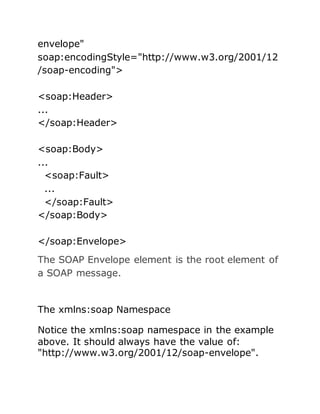
Skeleton SOAP Message
<? Xml version="1.0"?>
<soap: Envelope
xmlns:soap="http://www.w3.org/2001/12/soap-
envelope"
soap:encodingStyle="http://www.w3.org/2001/12
/soap-encoding">
<soap:Header>
...
</soap:Header>
<soap:Body>
...
<soap:Fault>
...
</soap:Fault>
</soap:Body>
</soap:Envelope>
The SOAP Envelope element is the root element of
a SOAP message.
The xmlns:soap Namespace
Notice the xmlns:soap namespace in the example
above. It should always have the value of:
"http://www.w3.org/2001/12/soap-envelope".
The namespace defines the Envelope as a SOAP
Envelope.
If a different namespace is used, the application
generates an error and discards the message.
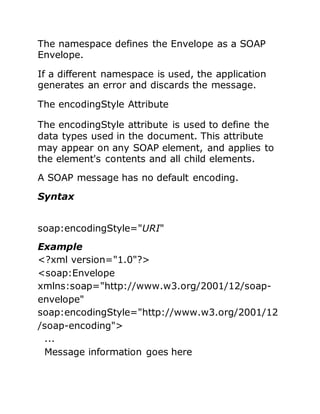
The encodingStyle Attribute
The encodingStyle attribute is used to define the
data types used in the document. This attribute
may appear on any SOAP element, and applies to
the element's contents and all child elements.
A SOAP message has no default encoding.
Syntax
soap:encodingStyle="URI"
Example
<?xml version="1.0"?>
<soap:Envelope
xmlns:soap="http://www.w3.org/2001/12/soap-
envelope"
soap:encodingStyle="http://www.w3.org/2001/12
/soap-encoding">
...
Message information goes here
...
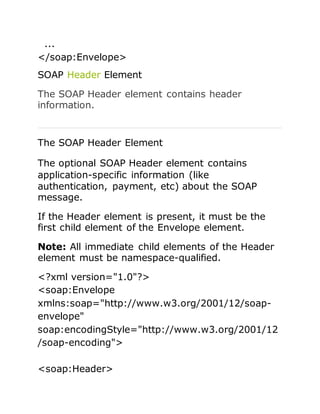
</soap:Envelope>
SOAP Header Element
The SOAP Header element contains header
information.
The SOAP Header Element
The optional SOAP Header element contains
application-specific information (like
authentication, payment, etc) about the SOAP
message.
If the Header element is present, it must be the
first child element of the Envelope element.
Note: All immediate child elements of the Header
element must be namespace-qualified.
<?xml version="1.0"?>
<soap:Envelope
xmlns:soap="http://www.w3.org/2001/12/soap-
envelope"
soap:encodingStyle="http://www.w3.org/2001/12
/soap-encoding">
<soap:Header>
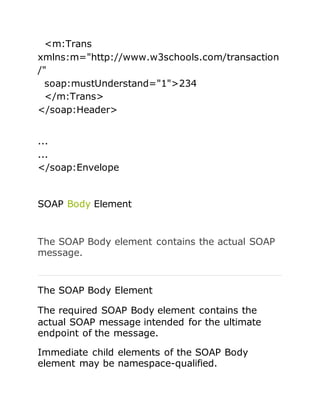
<m:Trans
xmlns:m="http://www.w3schools.com/transaction
/"
soap:mustUnderstand="1">234
</m:Trans>
</soap:Header>
...
...
</soap:Envelope
SOAP Body Element
The SOAP Body element contains the actual SOAP
message.
The SOAP Body Element
The required SOAP Body element contains the
actual SOAP message intended for the ultimate
endpoint of the message.
Immediate child elements of the SOAP Body
element may be namespace-qualified.
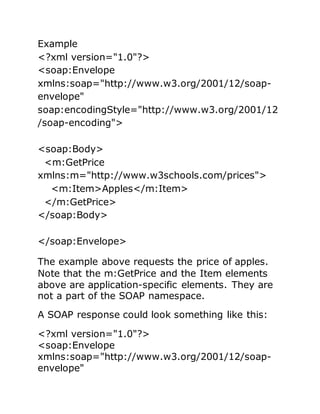
Example
<?xml version="1.0"?>
<soap:Envelope
xmlns:soap="http://www.w3.org/2001/12/soap-
envelope"
soap:encodingStyle="http://www.w3.org/2001/12
/soap-encoding">
<soap:Body>
<m:GetPrice
xmlns:m="http://www.w3schools.com/prices">
<m:Item>Apples</m:Item>
</m:GetPrice>
</soap:Body>
</soap:Envelope>
The example above requests the price of apples.
Note that the m:GetPrice and the Item elements
above are application-specific elements. They are
not a part of the SOAP namespace.
A SOAP response could look something like this:
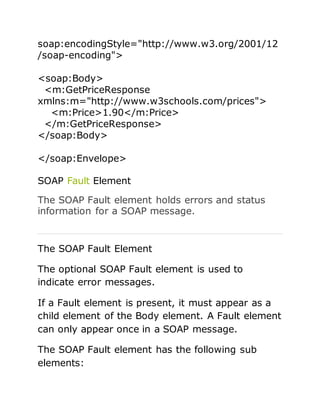
<?xml version="1.0"?>
<soap:Envelope
xmlns:soap="http://www.w3.org/2001/12/soap-
envelope"
soap:encodingStyle="http://www.w3.org/2001/12
/soap-encoding">
<soap:Body>
<m:GetPriceResponse
xmlns:m="http://www.w3schools.com/prices">
<m:Price>1.90</m:Price>
</m:GetPriceResponse>
</soap:Body>
</soap:Envelope>
SOAP Fault Element
The SOAP Fault element holds errors and status
information for a SOAP message.
The SOAP Fault Element
The optional SOAP Fault element is used to
indicate error messages.
If a Fault element is present, it must appear as a
child element of the Body element. A Fault element
can only appear once in a SOAP message.
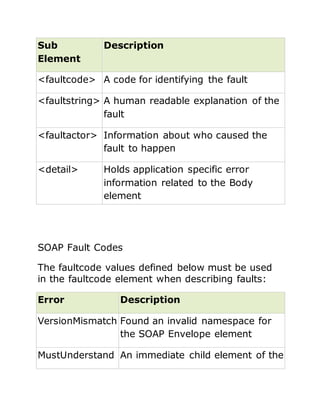
The SOAP Fault element has the following sub
elements:
Sub
Element
Description
<faultcode> A code for identifying the fault
<faultstring> A human readable explanation of the
fault
<faultactor> Information about who caused the
fault to happen
<detail> Holds application specific error
information related to the Body
element
SOAP Fault Codes
The faultcode values defined below must be used
in the faultcode element when describing faults:
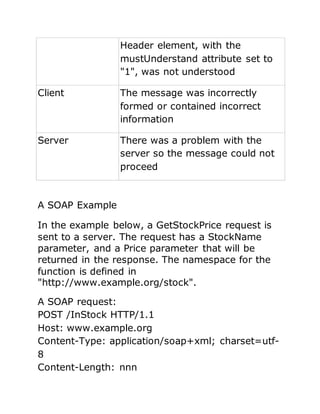
Error Description
VersionMismatch Found an invalid namespace for
the SOAP Envelope element
MustUnderstand An immediate child element of the
Header element, with the
mustUnderstand attribute set to
"1", was not understood
Client The message was incorrectly
formed or contained incorrect
information
Server There was a problem with the
server so the message could not
proceed
A SOAP Example
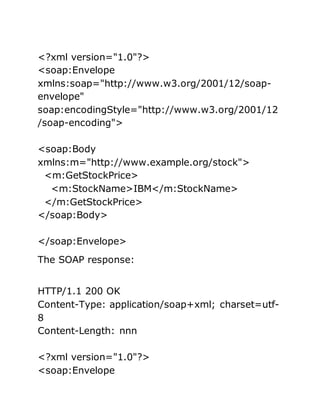
In the example below, a GetStockPrice request is
sent to a server. The request has a StockName
parameter, and a Price parameter that will be
returned in the response. The namespace for the
function is defined in
"http://www.example.org/stock".
A SOAP request:
POST /InStock HTTP/1.1
Host: www.example.org
Content-Type: application/soap+xml; charset=utf-
8
Content-Length: nnn
<?xml version="1.0"?>
<soap:Envelope
xmlns:soap="http://www.w3.org/2001/12/soap-
envelope"
soap:encodingStyle="http://www.w3.org/2001/12
/soap-encoding">
<soap:Body
xmlns:m="http://www.example.org/stock">
<m:GetStockPrice>
<m:StockName>IBM</m:StockName>
</m:GetStockPrice>
</soap:Body>
</soap:Envelope>
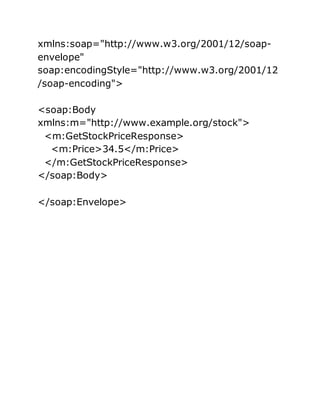
The SOAP response:
HTTP/1.1 200 OK
Content-Type: application/soap+xml; charset=utf-
8
Content-Length: nnn
<?xml version="1.0"?>
<soap:Envelope
xmlns:soap="http://www.w3.org/2001/12/soap-
envelope"
soap:encodingStyle="http://www.w3.org/2001/12
/soap-encoding">
<soap:Body
xmlns:m="http://www.example.org/stock">
<m:GetStockPriceResponse>
<m:Price>34.5</m:Price>
</m:GetStockPriceResponse>
</soap:Body>
</soap:Envelope>

Soap.doc