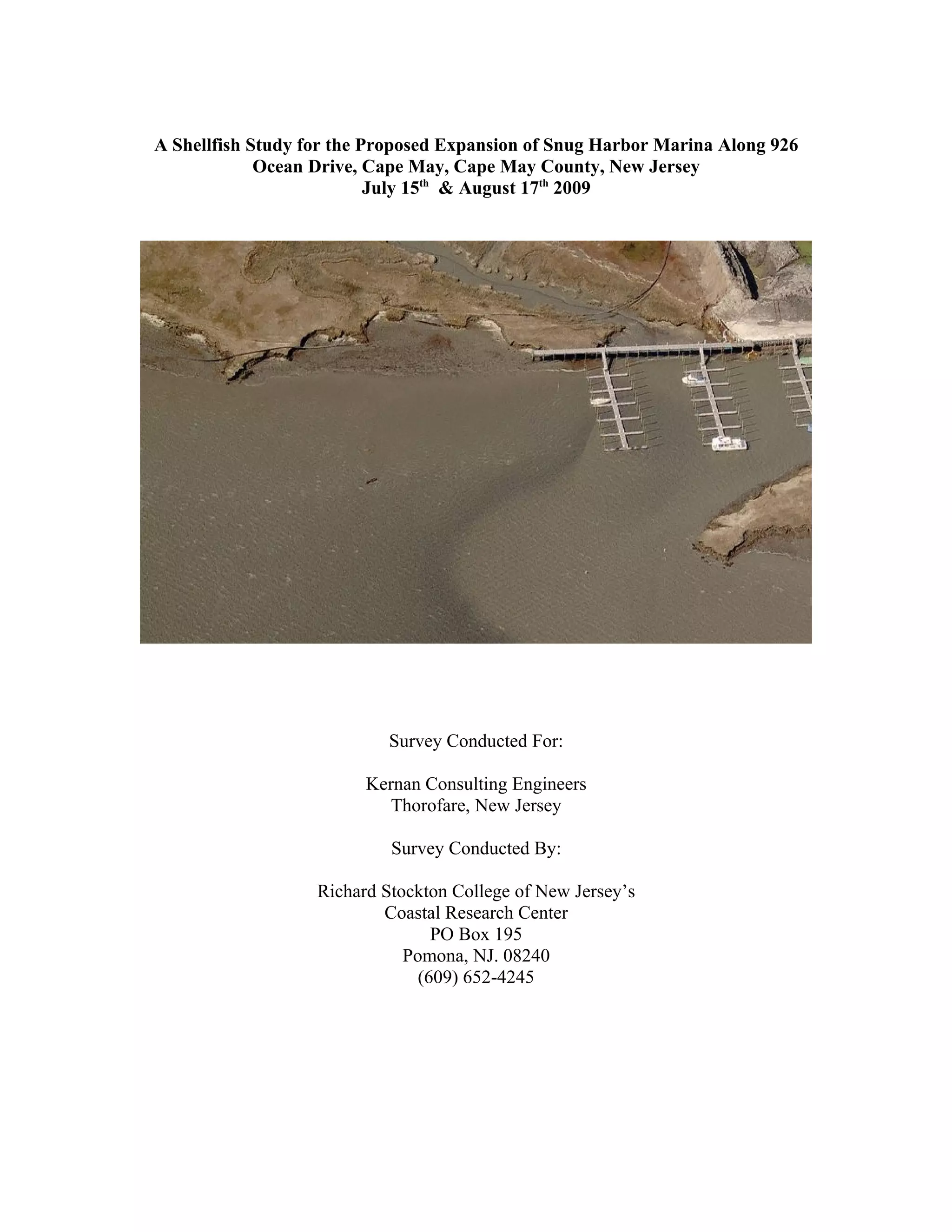
A Shellfish Study for the Proposed Expansion of Snug Harbor Marina Along 926
             Ocean Drive, Cape May, Cape May County, New Jersey
                           July 15th & August 17th 2009


                            Survey Conducted For:

                         Kernan Consulting Engineers
                            Thorofare, New Jersey

                            Survey Conducted By:

                   Richard Stockton College of New Jersey’s
                           Coastal Research Center
                                  PO Box 195
                              Pomona, NJ. 08240
                                (609) 652-4245
A Shellfish Study for the Proposed Expansion of Snug Harbor Marina Along 926
              Ocean Drive, Cape May, Cape May County, New Jersey
                            July 15th & August 17th 2009

Introduction

The shellfish study was designed and implemented using the Shellfish Survey Guidelines
published by the New Jersey Department of Environmental Protection (NJDEP) as
authorized by Jeffrey C. Lockwood, 1991 National Marine Fisheries Service, Habitat and
Protected Resources Division. The proposed expansion includes a floating dock and slip
system connecting to pre-existing structure and extending southwest approximately 500
feet, and extending southeast approximately 400 feet with a timber breakwater enclosing
the entire marina. The entire proposed dredge and project area is approximately 4 acres.
The marina is fringed by salt marsh vegetation, and includes a muddy intertidal flat,
which slopes gently into a sub-tidal habitat, and out to a depth of 7.10 feet Mean Lower
Low Water. The target species is the Hard Clam (Mercenaria mercenaria) a shellfish of
commercial significance.

Methods and Materials

The study area was selected by analyzing the area of expansion and evenly distributing
the entire study area into uniform sub-sections (chart 1). The Mean Lower Low Water
for the entire area ranged only from 4.46 – 7.10ft

Using ESRI ArcGIS 9.1 a virtual grid was set up with corresponding known locations
(table 5) at each of the intersections of the grid totaling 28 points (G1-G28). Each point
is set at 100 foot intervals, thus the dimensions of each box 100’ x 100’. The 28 points
were the sites surveyed in the juvenile clam study. As stated earlier; these 28 points
formed a grid system, and also 18 individual boxes. Within each box, a center point was
established using ArcGIS with corresponding known locations (table 6). These 18 points
were the locations used for the adult clam raking portion of the study (B1-B18). Using
RTK GPS Leica system 1200, all the data points for both the juvenile clam study and the
adult clam raking study were entered into the GPS system.

To conduct the juvenile clam study the 28 data point locations stored on the GPS system
were used as waypoints to locate each sample site (chart 1). At each location, a single
anchor was set to help stabilize the boat. A Wildco Ponar grab sample; with an area of
0.75 sq. ft., was used to acquire the samples. Replicate grabs were often necessary to
obtain a full sample size. Once a full sample was obtained, the material was sifted
through a 5mm sieve and inspected for juvenile clams. This process was repeated at each
individual location. Additional variables such as sediment type, additional bivalve
mollusks, as well as aquatic vegetation were also noted at each site. At each location the
abundance per ft2 and size distribution (mean and range) were also reported (tables 1 & 3)

To conduct the adult clam rake study, site locations stored on the GPS were again used to
navigate to the pre-established locations(chart 1). At each location, buoys were placed
30’ apart. Two anchors were set, one at the bow and one at the stern. The anchor lines
were let out equally to travel the required 30’ transect distance for proper sampling. Each
area was raked using a 16” x 3” toothed bull rake, and pulled for 30’, using the buoys as a
guide for the distance raked. Additional variables such as sediment type, additional
bivalve mollusks, as well as aquatic vegetation were also noted at each site. At each
location, the abundance per ft2 and size distribution (mean and range) were also reported.
(tables 2 & 4)

Results – juvenile shellfish survey

As reported above the study area was sampled for juvenile shellfish by utilizing a Wildco
Ponar Grab Sample with an area of 0.75 sq. ft. Twenty eight sites were established and
sampled representing a wide cross-section of the study areas depth and contours. Only 1
(6 mm) juvenile Hard Clam (Mercenaria mercenaria) was found at point G11 in the
entire study area. At that individual location the clam density was 1.333 clams/sq. ft.
However, the density for the entire area is only 0.04 clams/sq. ft. The sedementology of
the area consisted of either black mud, very fine sandy mud, or fine sandy mud. Their
were only 2 major species of aquatic vegetation in all of the locations surveyed, Sea
Lettuce (Ulva lactuca) and Agardh’s Red Weed (Agardhiella tenera). A small amount of
Phragmites roots (Phragmites australis) was found at the locations nearest to the salt
marshes (tables 1 & 3). Two Blook Ark’s were found in the process of locating juvenile
Hard Clams, one juvenile, and one adult.

Results – adult shellfish survey

As reported above the study area was sampled using a 16” x 3” toothed bull rake. A total
of 62 Hard Clams (Mercenaria mercenaria) were found in the entire area which
consisted of 18 individual sites approximately 100 feet from each other. Each site was
raked a distance of 30’. Clams were found in 13 of the 18 sites. A total of 719.82 square
feet was raked with an overall density of 0.086 clams/sq. ft. The mean size of the clams
collected was 7.88cm with the overall range being 9cm. The sedementology of the area
consisted of either black mud, very fine sandy mud, or fine sandy mud. Their were only
2 major species of aquatic vegetation in all of the locations surveyed, Sea Lettuce (Ulva
lactuca) and Agardh’s Red Weed (Agardhiella tenera). A small amount of Phragmites
roots (Phragmites australis) was found at the locations nearest to the salt marshes. Their
were also a certain amount of Blood Ark (Anadara ovalis) found. There were 11 Blood
Ark’s were found at 8 separate locations (tables 2 & 4).


Conclusion
The study area at Snug Harbor Marina is the location of the proposed expansion of the
pre-existing structure; which includes a floating dock and boat slip system. The area was
surveyed by utilizing ArcGIS software, GPS equipment, grab sampling techniques, and a
clam rake to help isolate the Hard Clam (Mercenaria mercenria). The NJDEP cites that
0.2 clams/sq. ft. is the threshold at which habitat is deemed viable as clam habitat. Both
the juvenile and the adult clam study had densities below the cited threshold; the
juveniles at 0.04, and the adults at 0.086. These numbers indicate that the majority of the
study area doesn’t support a viable Hard Clam population. Small areas near the salt
marshes supported a viable adult clam habitat, but the vast majority wasn’t suitable.

Snug Harbor Report

  • 1.
    A Shellfish Studyfor the Proposed Expansion of Snug Harbor Marina Along 926 Ocean Drive, Cape May, Cape May County, New Jersey July 15th & August 17th 2009 Survey Conducted For: Kernan Consulting Engineers Thorofare, New Jersey Survey Conducted By: Richard Stockton College of New Jersey’s Coastal Research Center PO Box 195 Pomona, NJ. 08240 (609) 652-4245
  • 2.
    A Shellfish Studyfor the Proposed Expansion of Snug Harbor Marina Along 926 Ocean Drive, Cape May, Cape May County, New Jersey July 15th & August 17th 2009 Introduction The shellfish study was designed and implemented using the Shellfish Survey Guidelines published by the New Jersey Department of Environmental Protection (NJDEP) as authorized by Jeffrey C. Lockwood, 1991 National Marine Fisheries Service, Habitat and Protected Resources Division. The proposed expansion includes a floating dock and slip system connecting to pre-existing structure and extending southwest approximately 500 feet, and extending southeast approximately 400 feet with a timber breakwater enclosing the entire marina. The entire proposed dredge and project area is approximately 4 acres. The marina is fringed by salt marsh vegetation, and includes a muddy intertidal flat, which slopes gently into a sub-tidal habitat, and out to a depth of 7.10 feet Mean Lower Low Water. The target species is the Hard Clam (Mercenaria mercenaria) a shellfish of commercial significance. Methods and Materials The study area was selected by analyzing the area of expansion and evenly distributing the entire study area into uniform sub-sections (chart 1). The Mean Lower Low Water for the entire area ranged only from 4.46 – 7.10ft Using ESRI ArcGIS 9.1 a virtual grid was set up with corresponding known locations (table 5) at each of the intersections of the grid totaling 28 points (G1-G28). Each point is set at 100 foot intervals, thus the dimensions of each box 100’ x 100’. The 28 points were the sites surveyed in the juvenile clam study. As stated earlier; these 28 points formed a grid system, and also 18 individual boxes. Within each box, a center point was established using ArcGIS with corresponding known locations (table 6). These 18 points were the locations used for the adult clam raking portion of the study (B1-B18). Using RTK GPS Leica system 1200, all the data points for both the juvenile clam study and the adult clam raking study were entered into the GPS system. To conduct the juvenile clam study the 28 data point locations stored on the GPS system were used as waypoints to locate each sample site (chart 1). At each location, a single anchor was set to help stabilize the boat. A Wildco Ponar grab sample; with an area of 0.75 sq. ft., was used to acquire the samples. Replicate grabs were often necessary to obtain a full sample size. Once a full sample was obtained, the material was sifted through a 5mm sieve and inspected for juvenile clams. This process was repeated at each individual location. Additional variables such as sediment type, additional bivalve mollusks, as well as aquatic vegetation were also noted at each site. At each location the abundance per ft2 and size distribution (mean and range) were also reported (tables 1 & 3) To conduct the adult clam rake study, site locations stored on the GPS were again used to navigate to the pre-established locations(chart 1). At each location, buoys were placed
  • 3.
    30’ apart. Twoanchors were set, one at the bow and one at the stern. The anchor lines were let out equally to travel the required 30’ transect distance for proper sampling. Each area was raked using a 16” x 3” toothed bull rake, and pulled for 30’, using the buoys as a guide for the distance raked. Additional variables such as sediment type, additional bivalve mollusks, as well as aquatic vegetation were also noted at each site. At each location, the abundance per ft2 and size distribution (mean and range) were also reported. (tables 2 & 4) Results – juvenile shellfish survey As reported above the study area was sampled for juvenile shellfish by utilizing a Wildco Ponar Grab Sample with an area of 0.75 sq. ft. Twenty eight sites were established and sampled representing a wide cross-section of the study areas depth and contours. Only 1 (6 mm) juvenile Hard Clam (Mercenaria mercenaria) was found at point G11 in the entire study area. At that individual location the clam density was 1.333 clams/sq. ft. However, the density for the entire area is only 0.04 clams/sq. ft. The sedementology of the area consisted of either black mud, very fine sandy mud, or fine sandy mud. Their were only 2 major species of aquatic vegetation in all of the locations surveyed, Sea Lettuce (Ulva lactuca) and Agardh’s Red Weed (Agardhiella tenera). A small amount of Phragmites roots (Phragmites australis) was found at the locations nearest to the salt marshes (tables 1 & 3). Two Blook Ark’s were found in the process of locating juvenile Hard Clams, one juvenile, and one adult. Results – adult shellfish survey As reported above the study area was sampled using a 16” x 3” toothed bull rake. A total of 62 Hard Clams (Mercenaria mercenaria) were found in the entire area which consisted of 18 individual sites approximately 100 feet from each other. Each site was raked a distance of 30’. Clams were found in 13 of the 18 sites. A total of 719.82 square feet was raked with an overall density of 0.086 clams/sq. ft. The mean size of the clams collected was 7.88cm with the overall range being 9cm. The sedementology of the area consisted of either black mud, very fine sandy mud, or fine sandy mud. Their were only 2 major species of aquatic vegetation in all of the locations surveyed, Sea Lettuce (Ulva lactuca) and Agardh’s Red Weed (Agardhiella tenera). A small amount of Phragmites roots (Phragmites australis) was found at the locations nearest to the salt marshes. Their were also a certain amount of Blood Ark (Anadara ovalis) found. There were 11 Blood Ark’s were found at 8 separate locations (tables 2 & 4). Conclusion
  • 4.
    The study areaat Snug Harbor Marina is the location of the proposed expansion of the pre-existing structure; which includes a floating dock and boat slip system. The area was surveyed by utilizing ArcGIS software, GPS equipment, grab sampling techniques, and a clam rake to help isolate the Hard Clam (Mercenaria mercenria). The NJDEP cites that 0.2 clams/sq. ft. is the threshold at which habitat is deemed viable as clam habitat. Both the juvenile and the adult clam study had densities below the cited threshold; the juveniles at 0.04, and the adults at 0.086. These numbers indicate that the majority of the study area doesn’t support a viable Hard Clam population. Small areas near the salt marshes supported a viable adult clam habitat, but the vast majority wasn’t suitable.