National Fisheries College in
Association with the University of
Natural Resources and
Environment
 Sea cucumbers/Holothuria are of the class
Holothuroidea under phylum Echinodermata.
 Consists of 6 orders, 25 families, 200 genera
and over 1200 to 1400 species
 Much research has been done on Sea
Cucumbers but mainly focused on its
commercial value and how to sustain it for
further exploitation
 But there are still gaps in the scientific
knowledge of their reproduction cycles,
larvae, etc..
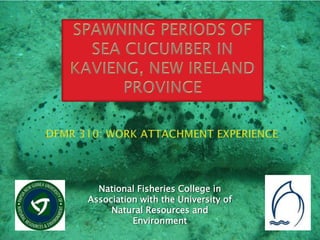
 This study was mainly focused on their
spawning behaviours and the months
spawning occurred around Kavieng, New
Ireland Province
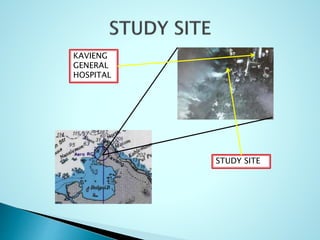
 This study was conducted at a site in New
Ireland Province: Sivasat, Ward 4 of the
Kavieng Urban LLG.
 Terms to note in this study: Holothurians/Sea
Cucumber (live) and Beche-de-mer (dead)
 Note also: time did not allow for the study to
fully achieve its potential for the study started
way behind schedule. Therefore the results
shown are what has been noted down since
the start until recently.
 Build a sturdy pen
 Stock the pen with species of sea cucumber
to be studied
 Study their growth rates
 Observe their spawning behaviours
 Study larvae specimens of the different
species
 And generally find suitable ways to increase
the stock numbers around the project site
 Cocoa Mesh Wire-900 mm by 30 metres
 Shade cloth-30 metres
 Tie wire x 1 coil-1.6 mm
 Sledge hammer
 Rods x4- 16 mm
 Temperature meter
 Casio fx-100MS scientific calculator
 Waterproof data board
 Measuring tape and measuring board
 Buckets x2
 Snorkelling gear: diving masks, snorkels and
reef boots
 Circular saw
CONSTRUCTION OF THE PROJECT
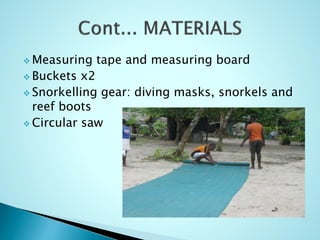
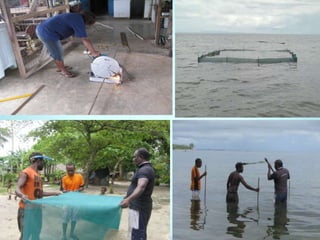
 Rods cut up into 3 parts
 Usage of the sledge hammer, the rods were
hammered into the sea bed.
 An outline of a pen of 7 m x 3 m
 Cocoa mesh wire unrolled around
 Shade cloth measured, cut and unrolled
around the mesh wire set in place by tie wires
STOCKING OF THE PROJECT SITE
 Specimens were collected from the
surrounding waters of Sivasat and the
mangrove area there.
COLLECTION AND ANALYZING OF THE DATA
 Two sets of data was collected during the
month of May
 A 3 m radius search was conducted before
each set of data was collected
 A measuring table was used but discarded
along with the data collected due to
inconsistency of data being collected
 Raw data was recorded down and entered
into MS Excel in a table form
 Mean total of circumference and length of
each species was calculated using Auto
Average
 Percentage of the mean was then calculated
 Comparing the mean length to the mean
circumference, a table was formed for each
category and a column graph formed.
 Spawning was observed once and the water
temperature with the depth was recorded
down
 Three measurements were taken of each
category and the mean of each was calculated
from them
KAVIENG
GENERAL
HOSPITAL
STUDY SITE
COMMON NAMES SCIENTIFIC NAMES
BLACKFISH Actinopyga miliaris
CURRYFISH Stichopus hermanni
DEEPWATER REDFISH Actinopyga echinites
LOLLYFISH Holothuria (Halodeima) atra
SANDFISH Holothuria (Metriatyla) scabra
SNAKEFISH Holothuria (Acanthotrapeza) coluber
WHITE TEATFISH Holothuria (Microthele) fuscogilva
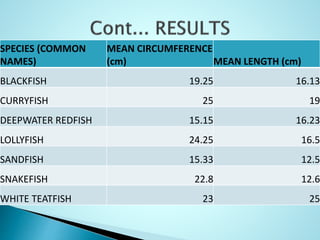
SPECIES (COMMON
NAMES)
MEAN CIRCUMFERENCE
(cm) MEAN LENGTH (cm)
BLACKFISH 19.25 16.13
CURRYFISH 25 19
DEEPWATER REDFISH 15.15 16.23
LOLLYFISH 24.25 16.5
SANDFISH 15.33 12.5
SNAKEFISH 22.8 12.6
WHITE TEATFISH 23 25
SPECIES (COMMON
NAMES)
PERCENTAGE (CIRCUM)-
1st data
PERCENTAGE (CIRCUM)-
2nd data
BLACKFISH 13.3 24.72
CURRYFISH 17.27 10.75
DEEPWATER REDFISH 10.46 18.03
LOLLYFISH 16.75 6.72
SANDFISH 10.59 13.13
SNAKEFISH 15.75 15.91
WHITE TEATFISH 15.88 10.74
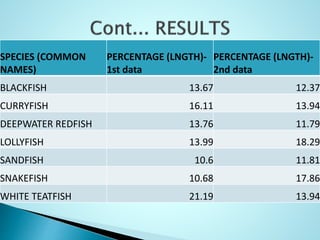
SPECIES (COMMON
NAMES)
PERCENTAGE (LNGTH)-
1st data
PERCENTAGE (LNGTH)-
2nd data
BLACKFISH 13.67 12.37
CURRYFISH 16.11 13.94
DEEPWATER REDFISH 13.76 11.79
LOLLYFISH 13.99 18.29
SANDFISH 10.6 11.81
SNAKEFISH 10.68 17.86
WHITE TEATFISH 21.19 13.94
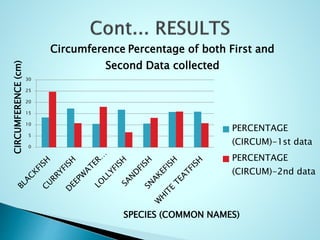
0
5
10
15
20
25
30
CIRCUMFERENCE(cm)
SPECIES (COMMON NAMES)
Circumference Percentage of both First and
Second Data collected
PERCENTAGE
(CIRCUM)-1st data
PERCENTAGE
(CIRCUM)-2nd data
0
5
10
15
20
25
LENGTH(cm)
SPECIES (COMMON NAMES)
Length Percentage of both the First and Second
Data collected
PERCENTAGE
(LNGTH)-1st data
PERCENTAGE
(LNGTH)-2nd data
 The eco-system inside the pen as much as
possible mimicked the eco-system outside.
 Species of sea cucumber identified using
Pacific Island Sea Cucumber and beche-de-
mer ID cards which were produced by the SPC
 Positive changes in the growth and
development of marine plants and organisms
in the pen.
 Mobile organisms including the specimens of
species of holothurians were able to escape
 The weight of each individual of different
species was not collected to due lack of
resources
 Attempts of measuring their growth rate was
made but proved Conand in 1990 publication
of Fisheries Technical Paper No. 272.2-FAO
correct. Growth is very difficult to measure
 Species such as Blackfish, Deepwater Redfish,
Sandfish positively changed in their
circumference measurement but can be due
to human error
 For in their length percentage, it is the Lollyfish,
Sandfish and Snakefish that changes positively
 Spawning peaks around the months of November
and December when the water is warm and
usually the North-westerly wind blows
 Spawning occurred at the site on the
13/06/2012. the water temperature: 30.9°C with
the water at an average depth of 67 cm. Larvae
specimens was not captured due to unfortunate
passing away of diploma technical officer.
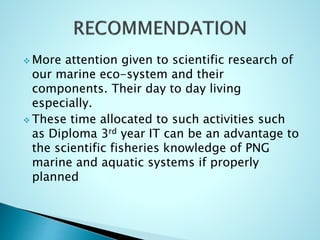
 More attention given to scientific research of
our marine eco-system and their
components. Their day to day living
especially.
 These time allocated to such activities such
as Diploma 3rd year IT can be an advantage to
the scientific fisheries knowledge of PNG
marine and aquatic systems if properly
planned
 The major objectives were not fully achieved
 Steps were taken to ensure a more consistent
collection of data as possible but human
error interfered
 Much was learnt though, experience wise
 Growth rate was very difficult to measure
though there are ways to measure but it
would quite expensive
 My supervisory team under the Commercial Fishing
Operations (CFO): Mr L Pomat, Mr J Bagat, Mr S
Kanawi, Mr K Mai, Mr G Yowai, Mr M Komai and the
program leader, Mr J Oswyn
 Mr L Pomat & family
 The National Fisheries College
 Diploma Office team of The National Fisheries
College
 And my fellow colleagues: Ms P Hombhanje, Mr P
Kanawi, Mr G Maiva, Mr R Esi, Mr B Rero, Mr A Goiye,
Ms M Andrew, Ms M Kelokelo, Mr R Daniel, Mr R
Harangu, Ms M Ovasuru, Mr C Molai, Ms J Kalo, Mr H
Meria, Ms M Simwale and Mr A Kamaram
IGAT SUMPLA ASKIM...ANY QUESTIONS?

SEA CUCUMBER IT-RYAN.I

  • 1.
    National Fisheries Collegein Association with the University of Natural Resources and Environment
  • 3.
     Sea cucumbers/Holothuriaare of the class Holothuroidea under phylum Echinodermata.  Consists of 6 orders, 25 families, 200 genera and over 1200 to 1400 species  Much research has been done on Sea Cucumbers but mainly focused on its commercial value and how to sustain it for further exploitation  But there are still gaps in the scientific knowledge of their reproduction cycles, larvae, etc..
  • 4.
     This studywas mainly focused on their spawning behaviours and the months spawning occurred around Kavieng, New Ireland Province  This study was conducted at a site in New Ireland Province: Sivasat, Ward 4 of the Kavieng Urban LLG.
  • 5.
     Terms tonote in this study: Holothurians/Sea Cucumber (live) and Beche-de-mer (dead)  Note also: time did not allow for the study to fully achieve its potential for the study started way behind schedule. Therefore the results shown are what has been noted down since the start until recently.
  • 6.
     Build asturdy pen  Stock the pen with species of sea cucumber to be studied  Study their growth rates  Observe their spawning behaviours  Study larvae specimens of the different species  And generally find suitable ways to increase the stock numbers around the project site
  • 7.
     Cocoa MeshWire-900 mm by 30 metres  Shade cloth-30 metres  Tie wire x 1 coil-1.6 mm  Sledge hammer  Rods x4- 16 mm  Temperature meter  Casio fx-100MS scientific calculator  Waterproof data board
  • 8.
     Measuring tapeand measuring board  Buckets x2  Snorkelling gear: diving masks, snorkels and reef boots  Circular saw
  • 9.
    CONSTRUCTION OF THEPROJECT  Rods cut up into 3 parts  Usage of the sledge hammer, the rods were hammered into the sea bed.  An outline of a pen of 7 m x 3 m  Cocoa mesh wire unrolled around  Shade cloth measured, cut and unrolled around the mesh wire set in place by tie wires
  • 10.
    STOCKING OF THEPROJECT SITE  Specimens were collected from the surrounding waters of Sivasat and the mangrove area there. COLLECTION AND ANALYZING OF THE DATA  Two sets of data was collected during the month of May  A 3 m radius search was conducted before each set of data was collected
  • 11.
     A measuringtable was used but discarded along with the data collected due to inconsistency of data being collected  Raw data was recorded down and entered into MS Excel in a table form  Mean total of circumference and length of each species was calculated using Auto Average  Percentage of the mean was then calculated
  • 12.
     Comparing themean length to the mean circumference, a table was formed for each category and a column graph formed.  Spawning was observed once and the water temperature with the depth was recorded down  Three measurements were taken of each category and the mean of each was calculated from them
  • 13.
  • 14.
    COMMON NAMES SCIENTIFICNAMES BLACKFISH Actinopyga miliaris CURRYFISH Stichopus hermanni DEEPWATER REDFISH Actinopyga echinites LOLLYFISH Holothuria (Halodeima) atra SANDFISH Holothuria (Metriatyla) scabra SNAKEFISH Holothuria (Acanthotrapeza) coluber WHITE TEATFISH Holothuria (Microthele) fuscogilva
  • 15.
    SPECIES (COMMON NAMES) MEAN CIRCUMFERENCE (cm)MEAN LENGTH (cm) BLACKFISH 19.25 16.13 CURRYFISH 25 19 DEEPWATER REDFISH 15.15 16.23 LOLLYFISH 24.25 16.5 SANDFISH 15.33 12.5 SNAKEFISH 22.8 12.6 WHITE TEATFISH 23 25
  • 16.
    SPECIES (COMMON NAMES) PERCENTAGE (CIRCUM)- 1stdata PERCENTAGE (CIRCUM)- 2nd data BLACKFISH 13.3 24.72 CURRYFISH 17.27 10.75 DEEPWATER REDFISH 10.46 18.03 LOLLYFISH 16.75 6.72 SANDFISH 10.59 13.13 SNAKEFISH 15.75 15.91 WHITE TEATFISH 15.88 10.74
  • 17.
    SPECIES (COMMON NAMES) PERCENTAGE (LNGTH)- 1stdata PERCENTAGE (LNGTH)- 2nd data BLACKFISH 13.67 12.37 CURRYFISH 16.11 13.94 DEEPWATER REDFISH 13.76 11.79 LOLLYFISH 13.99 18.29 SANDFISH 10.6 11.81 SNAKEFISH 10.68 17.86 WHITE TEATFISH 21.19 13.94
  • 18.
    0 5 10 15 20 25 30 CIRCUMFERENCE(cm) SPECIES (COMMON NAMES) CircumferencePercentage of both First and Second Data collected PERCENTAGE (CIRCUM)-1st data PERCENTAGE (CIRCUM)-2nd data
  • 19.
    0 5 10 15 20 25 LENGTH(cm) SPECIES (COMMON NAMES) LengthPercentage of both the First and Second Data collected PERCENTAGE (LNGTH)-1st data PERCENTAGE (LNGTH)-2nd data
  • 20.
     The eco-systeminside the pen as much as possible mimicked the eco-system outside.  Species of sea cucumber identified using Pacific Island Sea Cucumber and beche-de- mer ID cards which were produced by the SPC  Positive changes in the growth and development of marine plants and organisms in the pen.  Mobile organisms including the specimens of species of holothurians were able to escape
  • 21.
     The weightof each individual of different species was not collected to due lack of resources  Attempts of measuring their growth rate was made but proved Conand in 1990 publication of Fisheries Technical Paper No. 272.2-FAO correct. Growth is very difficult to measure  Species such as Blackfish, Deepwater Redfish, Sandfish positively changed in their circumference measurement but can be due to human error
  • 22.
     For intheir length percentage, it is the Lollyfish, Sandfish and Snakefish that changes positively  Spawning peaks around the months of November and December when the water is warm and usually the North-westerly wind blows  Spawning occurred at the site on the 13/06/2012. the water temperature: 30.9°C with the water at an average depth of 67 cm. Larvae specimens was not captured due to unfortunate passing away of diploma technical officer.
  • 23.
     More attentiongiven to scientific research of our marine eco-system and their components. Their day to day living especially.  These time allocated to such activities such as Diploma 3rd year IT can be an advantage to the scientific fisheries knowledge of PNG marine and aquatic systems if properly planned
  • 24.
     The majorobjectives were not fully achieved  Steps were taken to ensure a more consistent collection of data as possible but human error interfered  Much was learnt though, experience wise  Growth rate was very difficult to measure though there are ways to measure but it would quite expensive
  • 26.
     My supervisoryteam under the Commercial Fishing Operations (CFO): Mr L Pomat, Mr J Bagat, Mr S Kanawi, Mr K Mai, Mr G Yowai, Mr M Komai and the program leader, Mr J Oswyn  Mr L Pomat & family  The National Fisheries College  Diploma Office team of The National Fisheries College  And my fellow colleagues: Ms P Hombhanje, Mr P Kanawi, Mr G Maiva, Mr R Esi, Mr B Rero, Mr A Goiye, Ms M Andrew, Ms M Kelokelo, Mr R Daniel, Mr R Harangu, Ms M Ovasuru, Mr C Molai, Ms J Kalo, Mr H Meria, Ms M Simwale and Mr A Kamaram
  • 27.