Cynthia Silva Parker
Maanav Thakore
EQUITY

Our mission is to …
ignite and sustain social transformation,
catalyze collective action and
build collaborative skill
… to bring alive our vision of a just and
sustainable world.

Collaboration
EQUITY

To explore collaborative tools and mindsets
to guide communities from vision to action
in pursuit of equity

Collaboration
EQUITY

 Moving

toward equity is an adaptive
challenge
 Benefits and risks of collaboration
 Tools for engaging stakeholders

Collaboration
EQUITY

 What

is your name and organization?

 What

brought you to your work as a
planner?

 What

challenge do you bring to this
conversation?

Collaboration
EQUITY

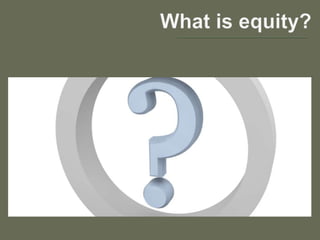
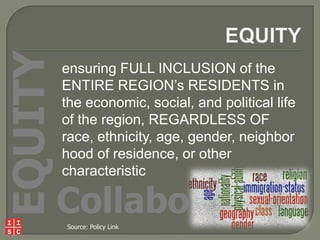
ensuring FULL INCLUSION of the
ENTIRE REGION’s RESIDENTS in
the economic, social, and political life
of the region, REGARDLESS OF
race, ethnicity, age, gender, neighbor
hood of residence, or other
characteristic

Collaboration
Source: Policy Link
EQUITY

Collaboration
EQUITY



Collaboration
EQUITY

“Adaptive problems . . . are not so well
defined, the answers are not known in
advance…
[They] require innovation and learning among
the interested parties and,
even when a solution is discovered, no single
entity has the authority to impose it on the
others.
The stakeholders themselves must create and
implement the solution because
the problem itself lies in their
attitudes, priorities or behavior, and only a
change within and between them will produce
a solution.”V. Kania and Mark R. Kramer
Ronald A. Heifetz, John

Collaboration

The Dilemma of Foundation Leadership
EQUITY

Collaboration
EQUITY

Collaboration
EQUITY

Collaboration
EQUITY

Collaboration
EQUITY

Collaboration
EQUITY

Collaboration
Adapted from Roger Hart, UNICEF, Tom Wolff (1997)
EQUITY

Collaboration
Adapted from Roger Hart, UNICEF, Tom Wolff (1997)
EQUITY

Collaboration
Adapted from Roger Hart, UNICEF, Tom Wolff (1997)
EQUITY

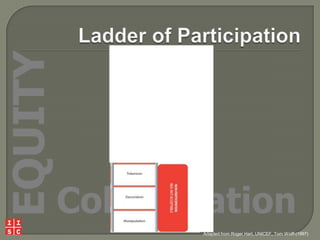
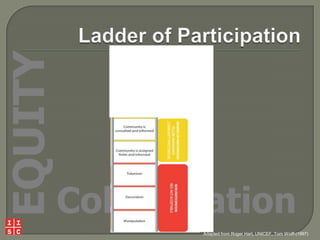
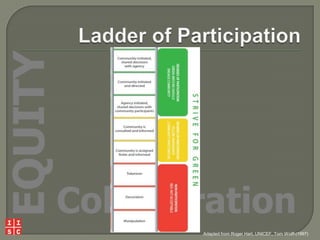
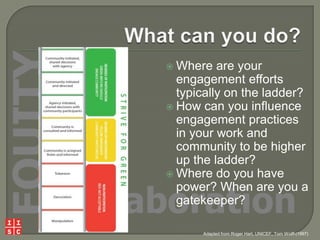
 Where

are your
engagement efforts
typically on the ladder?
 How can you influence
engagement practices
in your work and
community to be higher
up the ladder?
 Where do you have
power? When are you a
gatekeeper?

Collaboration

Adapted from Roger Hart, UNICEF, Tom Wolff (1997)
EQUITY

“The success of an intervention
depends on the interior condition of
the intervenor.”

William O’Brien

Collaboration
EQUITY

Collaboration
EQUITY

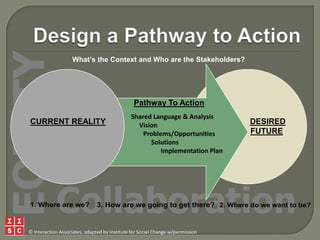
What’s the Context and Who are the Stakeholders?

Pathway To Action

CURRENT REALITY

Shared Language & Analysis
PATHWAY TO ACTION
Vision
Problems/Opportunities
Solutions
Implementation Plan

DESIRED
FUTURE

Collaboration

1. Where are we?

3. How are we going to get there? 2. Where do we want to be?

© Interaction Associates, adapted by Institute for Social Change w/permission
EQUITY
..

Pluses +

Delta’s ∆
..

Collaboration
EQUITY

Cynthia Silva Parker
cparker@interactioninstitute.org
Maanav Thakore
mthakore@interactioninstitute.org
Join the conversation at our blog:
www.interactioninstitute.org/blog
Check out our workshops
www.interactioninstitute.org/workshops

Collaboration
EQUITY

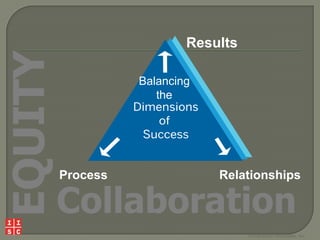
Results
Balancing
the

Process

Relationships

Collaboration

© Interaction Associates, Inc.

SNEAPA 2013 Thursday a4 9_15_collaboration for equitable communities

Editor's Notes

  • #3 We accomplish this by providing network-building, consulting, facilitation and training services designed to transform communities and organizations and build the capacity of leaders of social change.Focused on equity, power and inclusion – a systems focusLeveraging the power of networks for social changeGrounding the work in the love that does justice
  • #6 Pair up for these questions.Afterward, in large group, get a few highlights about challengesAlso do a quick “Who’s in the room” … raise your hand if you…Work for public or quasi-public planning agencyWork for a nonprofit that engages in community planning activitiesLive in an urban communityLive in a suburban communityLive in a rural communityEver been responsible for engaging community organizations in a planning processEver been responsible for engaging community residents in a planning processEver been part of a planning process that focused explicitly on addressing inequities or achieving equitable outcomes
  • #9 Get a few responses from group, then fill in blanks if anything below isn’t mentioned.Critical to economic health and community vitality – community can’t succeed overall while portions struggle; as demographics change, larger segments will be struggling if we don’t work toward equityImportant corrective / prevention in light of the historic role of public policy in creating many of the inequities our communities are facing (e.g., land grants to homesteaders-taking land from Native Americans; slavery; FHA loans and infrastructure investments in highways and suburbs from which people of color were excluded; urban renewal)(transition to next slide…)Increasingly an explicit requirement of HUD (sustainable communities grants require focus on equity), HHS (racial impact assessments for public health initiatives) and other fundersAsk how many are working on an initiative for which a funder has included a focus on equity among its requirements?
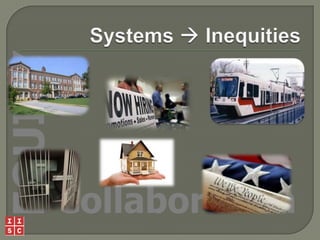
  • #10 Without explicit attention, things will tend to stay the same or get worse.Example of how Interlocking set of systems that create an opportunity environment that is unequal by race… and that reproduces racialized outcomes—measures of well being that differ based on a person’s race, predictable racial patterns that don’t require individual racist actors.Housing … education .. Transportation … jobs … jails … politicsInequities in educational outcomes… Post WW2 government investment in suburban homeownership—98% of that money went to white families—on purpose!Ways in which inequalities have become inscribed in geography.Accumulation of advantages in:Education Decent jobs and livable wagesHomeownershipRetirement plans and other employment benefitsHealth and access to health careControl of the mediaPolitical representation and votingAccumulation of wealthEducation (financing, placement in advanced courses/sped, discipline)Juvenile Justice (suspect profiling, arrests, referrals to court, detention, formal processing, waiver to adult court, disposition, incarceration in juv and adult prisons)… mad (mental health)/sad (Cwelfare)/bad (JJ)/can’t add kids (SPED)Labor (zip code, name, segregation by job, networking/informal hiring process
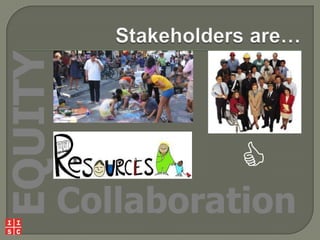
  • #12 Who is “the community?”-- where do you stop (at nonprofit leaders or civic leaders vs. actual people you want to help. Who are the right stakeholders for this goal? Stakeholders are people who ---are most affected by the issues you are addressing---will be involved in implementing whatever you’re doing (right down to line staff, not just executives of agencies---resources (time, talent, treasure) that could support your thinking and action---have decision making authority (public, private and non profit sector players)Who’s most often left out?
  • #13 Stakeholder engagement can yield the following:Greater trust, understanding, and agreement among stakeholdersMore effective solutions to complex problemsIncreased support for and ownership of proposed solutionsIncreased efficiency with respect to time and other resources (in the long run)Greater scale and reach through the building of robust, diverse, and resilient networks
  • #14 Slide peels off the quote in 5 clicks… ask for readers for each click…“Adaptive problems . . . are not so well defined, the answers are not known in advance… [They] require innovation and learning among the interested parties and, even when a solution is discovered, no single entity has the authority to impose it on the others. The stakeholders themselves must create and implement the solution because the problem itself lies in their attitudes, priorities or behavior, and only a change within and between them will produce a solution.”Ronald A. Heifetz, John V. Kania and Mark R. Kramer“The Dilemma of Foundation LeadershipWorking in this way can …Build trust and commitment to actionMake networks denser and more capable of acting in the futureGenerate effective solutions
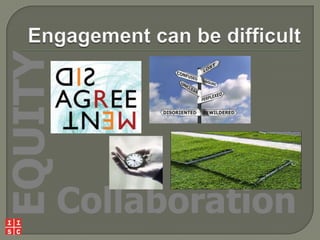
  • #16 One click gets pictures quickly in this order:DisagreementConfusionTurfTime
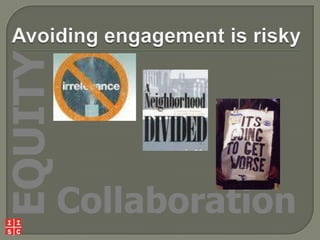
  • #17 One click gets three quickly in this order:IrrelevanceDivisionsMaking things worse
  • #23 As you explain the ladder, ask if they have ever seen this type of participation(note framed from community perspective not agency perspective)
  • #28 Putting a few key values into action can help you to move up the ladder of participation.Transparency Acknowledge and balance power; be honest about what’s up for discussion Respect Value diversity of identity, experience and expertiseTrust Build relationshipsHumilityDo your homework and know what you don’t knowMutualityExpect to learn; participate when you’re not the leadPatienceBuild in time to do the work wellFlexibilityExpect the unexpectedPower is the capacity to influence people and your environment, create change, address needs, pursue desires, and/or protect interests. Power is not a fixed asset that people possess. Rather, it is socially constructed, understood, and legitimized through social relationships among individuals and groups of people. Social power is never the property of an individual; it belongs to a group and remains in existence only so long as the group keeps together and continues to give the person power. It is created through social interaction.Power can be developed and exercised either as “power over” or as “power with” others. It can be exercised in ways that affirm human dignity, protect individuals and groups from oppression, and support a just and sustainable distribution of resources. Alternatively, it can be exercised in ways that undermine human dignity, oppress or disenfranchise individuals and groups, and maintain unfair, unsustainable distributions of resources.
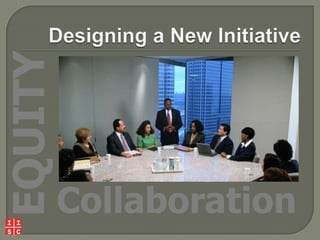
  • #29 Key to collaborative planning is collaborative design.
  • #30 Work together with stakeholders to: Explore the contextDo stakeholder analysisExplore the current reality Power and Privilege – who has it, who’s left out, how can it be built, leveraged…Espoused vs. Operational ValuesSystems, Structures, ProcessesTheories of Change, Programming ModelsOrganizational Climate and CultureDevelop a shared desire for the futureDesign your planning pathwayBuild shared language and analysisVision Problem/opportunity analysisSolutionsImplementation plan
  • #32 Facilitative Leadership for Social Change Lead in a way that inspires, invites participation, and builds commitment2 daysNov 12-13, 2013 [NYC ] Dec 10-11, 2013 [Boston ] Feb 12-13, 2014 [Boston ] Feb 19-20, 2014 [NYC ] Mar 12-13, 2014 [Oakland, CA ] April 22-23, 2014 [NYC ] June 18-19, 2014 [Boston ] Sep 10-11, 2014 [Boston ] Oct 1-2, 2014 [Oakland, CA ] Oct 22-23, 2014 [NYC ] Dec 10-11, 2014 [Boston ] Facilitative Leadership (Ireland)Tapping the Power of Participation3 daysNonprofit: $650Foundation: $1,00010-11 Oct, 2013 [Belfast ] 23-24 Oct, 2013 [Dublin] Essential Facilitation®Facilitate strategic thinking, collaborative problem solving, and agreement building3 daysNonprofit: $750Foundation: $1,150Oct 22-24, 2013 [Boston ] April 15-17, 2014 [Boston ] June 10-12, 2014 [Oakland, CA ] Oct 8-10, 2014 [Boston ] Nov 4-6, 2014 [NYC] Whole Measures: A Tool for Creating Change4 daysNonprofits: Pricing based on budget size: $850 and $1,050 Click here for more informationNonprofit: $850Foundation: $1,3502014 dates coming soon! Fundamentals of Facilitation for Racial Justice WorkDesign and facilitate the challenging conversations that catalyze breakthrough thinking and lasting agreements2 daysNonprofit: $650Foundation: $1,000Mar 26-27, 2014 [Boston ] July 23-24, 2014 [NYC] The Masterful Trainer™Facilitate and design dynamic, interactive trainings and learning experiences2 daysNonprofit: $650Foundation: $1,000Sept 24-25, 2013 [NYC ] May 20-21, 2014 [NYC]