© 2012 Virginia Mason Medical Center© 2012 Virginia Mason Medical Center
The Smoking Elephant in the
Exam Room
an evidence based look at the mortality
benefits, surgical complications and
approach to smoking cessation
Noon Conference April 14, 2019
Our Strategic PlanOur Strategic Plan
© 2012 Virginia Mason Medical Center
© 2012 Virginia Mason Medical Center© 2012 Virginia Mason Medical Center
Disclosures
No financial disclosures
© 2012 Virginia Mason Medical Center© 2012 Virginia Mason Medical Center
Smoking is the leading cause of
preventable death in the US
• 440,000 premature deaths
© 2012 Virginia Mason Medical Center© 2012 Virginia Mason Medical Center
Smoking is the leading cause of
preventable death in the US
• 440,000 premature deaths
• $193 billion dollars healthcare $ and lost
productivity
• Touches every speciality
Encourage
smoking
cessation
© 2012 Virginia Mason Medical Center© 2012 Virginia Mason Medical Center
Objectives: Smoking Cessation
• Describe the mortality impact of smoking
cessation
• Identify and define teachable moments
• Discuss the timing of smoking cessation
with surgery
• Review the 5A’s approach to cessation
• Review therapies
© 2012 Virginia Mason Medical Center© 2012 Virginia Mason Medical Center
• Looked at multiple prospective cohorts
over the last 5 decades
• Definitions: former smoker quit > 2years
• Avoid bias of cessation following life-
threatening illness
Changes in Rates of Death from Lung Cancer and Chronic Obstructive Pulmonary
Disease (COPD) over Time among Current Female and Male Smokers in the Three
Time Periods.
Thun MJ et al. N Engl J Med 2013;368:351-364
Lung cancer
COPD
Changes in Rates of Death from Lung Cancer and Chronic Obstructive Pulmonary
Disease (COPD) over Time among Current Female and Male Smokers in the Three
Time Periods.
Thun MJ et al. N Engl J Med 2013;368:351-364
16.8x
increase in
lung cancer
deaths for
women over
50 years
• US National Health Interview Survey
• N=216,917 adults between 1997-2004
• Outcome: mortality by the end of 2006
• Definitions:
• Former smokers quit >5 years prior to death
• Former smokers had to have smoked >100 cig/life
• Never smokers <100 cig/life
Survival Probabilities for Current Smokers and for Those Who Never Smoked among
Men and Women 25 to 80 Years of Age.
Jha P et al. N Engl J Med 2013;368:341-350
Risks of Death for Participants Who Continued to Smoke and for Those Who Quit
Smoking According to Age at the Time of Cessation.
Jha P et al. N Engl J Med 2013;368:341-350
© 2012 Virginia Mason Medical Center© 2012 Virginia Mason Medical Center
25-34
years
35-44
years
45-54
years
55-64
years
Jha P, et al. NEJM. 2013; 368:341-50
Benefits of smoking cessation
Identical mortality
to nonsmokers
Reduced risk of
death from any
cause 90%
Gain 9 years of life
Reduced risk of
death from any
cause by 66%
Gain 6 years of life
Gain 4 years of life
© 2012 Virginia Mason Medical Center© 2012 Virginia Mason Medical Center
Teachable Moments
• A moment in time when the patient is:
• susceptible
• vulnerable
• motivated
• receptive
• To change their lifestyle for their health.
• Emotional component, positive or negative
© 2012 Virginia Mason Medical Center© 2012 Virginia Mason Medical Center
Teachable Moments
• Pregnancy
• Mother and father, grandparents
• Health screening
• Pap smears
• Lung cancer
• Hospitalizations and ER visits
• Surgery and procedures
• Malignancy diagnosis
• Goal: to identify earlier moments
© 2012 Virginia Mason Medical Center© 2012 Virginia Mason Medical Center
Lung cancer screening as a TM
• Motivated population
• Concerned about their health
• 2/3 want to quit in the next 6 months
• Fear:
• Smoking patients will delay cessation due to
“reassurance” effect of normal CT scan
Taylor KL, et al. Lung Cancer. 2007; 56: 125-34
Lung cancer screening as a TM
• Trials report abstinence rates 7-42%
• NELSON trial: no data to suggest reassurance effect
• Taylor, et al. LSS with normal CT were less ready to quit,
but NLSCT sample showed no reassurance effect
Taylor KL, et al. Lung Cancer. 2007; 56: 125-34 Townsend CO, et al. Cancer. 2005; 103 (10): 2154-61
Van der Aalst, et al. Eur Resp J. 2011; 37: 1466-73 (NELSON)
Surgery as a TM
• 35 million ambulatory surgeries/year in 2006
(www.cdc.gov)
• 10% of the population has surgery/year
Shi Y, et al. Anesthesiology. 2010; 112: 102-7
Shannon-Cain J, et al. Am As Nurse Anes J. 2002; 70: 33-40
© 2012 Virginia Mason Medical Center© 2012 Virginia Mason Medical Center
Surgery as a TM
• 35 million ambulatory surgeries/year in 2006
(www.cdc.gov)
• 10% of the population has surgery/year
• Higher abstinence rates following major surgery
related to smoking risk such as CABG
• Any major surgery doubled the rate of cessation
• 58% of patients are asked to quit prior to their
surgery
Shi Y, et al. Anesthesiology. 2010; 112: 102-7
Shannon-Cain J, et al. Am As Nurse Anes J. 2002; 70: 33-40
© 2012 Virginia Mason Medical Center© 2012 Virginia Mason Medical Center
Cessation as surgical safety issue
• Smokers and wound complications:
• Every surgical specialty: GI, vascular, GYN, etc.
• Flap failures
• Skin slough 12x higher face lift
• Wound dehiscence
• Delayed fracture healing
• Surgical site infections
Sorensen LT. Annals of Surgery. 2012; 255 (6): 1069-79
© 2012 Virginia Mason Medical Center© 2012 Virginia Mason Medical Center
Smoking cessation and surgical
outcomes
Sorensen LT. Annals of Surgery. 2012; 255 (6): 1069-79
© 2012 Virginia Mason Medical Center© 2012 Virginia Mason Medical Center
6-8 wks of cessation prior to elective
orthopedic surgery
Moller AM, et al. Lancet. 2002; 359: 114-7
© 2012 Virginia Mason Medical Center© 2012 Virginia Mason Medical Center
4 weeks of smoking cessation reduces
postoperative complications
Lindstrom D, et al. Annals of Surgery. 2008; 248: 739
© 2012 Virginia Mason Medical Center© 2012 Virginia Mason Medical Center
Smoking Cessation and Surgery
• Smoking cessation improves
complication rates across surgical
specialties
• Surgery offers an effective teachable
moment
© 2012 Virginia Mason Medical Center© 2012 Virginia Mason Medical Center
Smoking Cessation and Surgery
• Only 58% of surgeons advise their patients
to quit
• Only 30% of anesthesiologists advise their
patients to quit
© 2012 Virginia Mason Medical Center© 2012 Virginia Mason Medical Center
Smoking Cessation and All
Providers
• Only 58% of surgeons advise their patients
to quit
• Only 30% of anesthesiologists advise their
patients to quit
• Only 48% of smokers who saw any
provider in 2010 recall being asked to quit.
© 2012 Virginia Mason Medical Center© 2012 Virginia Mason Medical Center
The Five A’s Approach
• ASK
• ADVISE
• ASSESS
• ASSIST
• ARRANGE
CS2day.com
© 2012 Virginia Mason Medical Center© 2012 Virginia Mason Medical Center
ASK
© 2012 Virginia Mason Medical Center© 2012 Virginia Mason Medical Center
ASK
• Do you use tobacco?
• 70% of smokers will visit a doctor in a year
• 70-85% of smokers want to quit
• Only 20-30% are ready RIGHT NOW
• If you don’t ask, you will never advise them to quit
• Ask every time:
• Tobacco use is a chronic illness
• High relapse rate (up to 50% at one year)
• Tobacco use documentation with the vital signs
CS2day.com
AAMC Summary Report 2007, Rigotti NA. Lancet Respir Med; 1:
243-50
© 2012 Virginia Mason Medical Center© 2012 Virginia Mason Medical Center
The Five A’s Approach
• ASK
• ADVISE
• Clear: It is important for you to quit smoking
• Strong: Quitting smoking is the most important thing
that you can do for your health
• Personalized: With your grandson living in the house,
your smoking could impact his health.
CS2day.com
© 2012 Virginia Mason Medical Center© 2012 Virginia Mason Medical Center
ASSESS
CS2day.com
ASSIST
• Define quit date in
next 2 weeks
• Identify triggers
• Stress
• Alcohol
• Visual cues
• Select meds
• Encourage counseling
© 2012 Virginia Mason Medical Center© 2012 Virginia Mason Medical Center
ASSIST-3 step process
• Define quit date in
next 2 weeks
• Identify triggers
• Stress
• Alcohol
• Visual cues
• Select meds
• Encourage counseling
x
April 26,
2013
Avoid
casinoTell best
friend
x
x
x
x
x
x
x
April 26,
2013
© 2012 Virginia Mason Medical Center© 2012 Virginia Mason Medical Center
ASSIST: Quitlines
• Quitline users are 4x more likely to quit
• Dose response relationship with time of
counseling and likelihood of quitting
• Initial, free assessment 20-40 minutes
• Advise on quitting
• Follow up phone calls from coaches
• Alternative media counseling
• Texts, chat rooms
CS2day.com
© 2012 Virginia Mason Medical Center© 2012 Virginia Mason Medical Center
The Five A’s Approach
• ASK
• ADVISE
• ASSESS
• ASSIST
• ARRANGE
• Follow up by phone or in person 1 weeks after quit
date
• Address failures, temptations, drug side effects
CS2day.com
© 2012 Virginia Mason Medical Center© 2012 Virginia Mason Medical Center
What about the unwilling?
Motivational interviewing for the unwilling
• Non-confrontational counseling
• Empathy “What would quitting be like”
• Discrepancy “You’re short of breath, but still
smoking?”
• Roll with resistance: “You’re worried about
managing stress without cigarettes…”
• Support self efficacy: refer to quit lines
• Increased 6 month cessation rates by 30%
compared to usual care.
• “Dose” (time) response relationship.
Fiore NEJM 2011, cs2day.com
Motivational interviewing with 5R’s
•Relevance:
• new grandchild, new health problem
• Risks: personalized
• Cost, AECOPD, MI, Stroke
• Rewards:
• Better health, food tastes better, save $, better
example for their kids/grandkids.
• Roadblocks:
• Fears, prior failures
• Repetition
Cs2day.com
Approach to the Smoking Patient
• Willing?
CS2day.com
• Not willing?
• 5 R's and set up
follow up
© 2012 Virginia Mason Medical Center© 2012 Virginia Mason Medical Center
Smoking Cessation Treatments
• insert table
CS2day.com
Monotherapy
Intervention # 6 month cessation rate OR (CI)
Spontaneous quit rate 3-5%
Placebo 80 13.8% 1.0
Varenicline 2mg/d 5 33.2% (28.9-37.8) 3.1 (2.5-3.8)
Nicotine nasal spray 4 26.7 (21.5-32.5) 2.3 (1.7-3.0)
Nicotine patch >25mg 4 26.5 (21.3-32.5) 2.3 (1.7-3.0)
>14 weeks Nicotine gum 6 26.1 (19.7-33.6) 2.2 (1.5-3.2)
Varenicline 1mg/d 3 25.4 (19.6-33.6) 2.1 (1.5-3.0)
Nicotine inhaler 6 24.8 (19.1-31.6) 2.1 (1.5-2.9)
Clonidine 3 25.0 (15.7-37.3) 2.1 (1.2-3.7)
Bupropion SR 26 24.2 (22.2-26.4) 2.0 (1.8-2.2)
Nicotine patch 6-14weeks 32 23.7 (21.0-26.6) 1.9 (1.7-2.3)
Nortryptyline 5 22.5 (16.8-29.4) 1.8 (1.3-2.6)
Nicotine gum 6-14weeks 15 19.0 (16.5-21.9) 1.5 (1.2-1.7)
Adapted from Fiore MC Clinical Practice Guidelines: Treating Tobacco Use and Dependence: 2008 Update.
US Department of Health and Human Services, 2008.
Combination therapy
Intervention # 6 month cessation OR (CI)
Patch + ad lib NRT (gum or
spray)
3 36.5 (28.6-45.3) 3.6 (2.5-5.2)
Patch + bupropion 3 28.9 (23.5-35.1) 2.5 (1.9-3.4)
Patch + nortriptyline 2 27.3 (17.2-40.4) 2.3 (1.3-3.6)
Patch + inhaler 2 25.8 (17.4-36.5) 2.2 (1.3-3.6)
Patch +
paroxetine/venlafaxine
3 24.3 (16.1-35.0) 2.0 (1.2-3.4)
INEFFECTIVE THERAPIES
SSRIs 3 13.7 (10.2-18) 1.0 (0.7-1.4)
Naltrexone 2
Adapted from Fiore MC Clinical Practice Guidelines: Treating Tobacco Use and
Dependence: 2008 Update. US Department of Health and Human Services, 2008.
© 2012 Virginia Mason Medical Center© 2012 Virginia Mason Medical Center
Smoking Cessation Treatments
• Medication increases quit rates
• 2/3 of smokers try to quit without meds
Rigotti NA. JAMA: 308: 15: 1573-80
© 2012 Virginia Mason Medical Center© 2012 Virginia Mason Medical Center
Financial Incentives
• Smokers
• Increases # smokers who attempt to quit
• Increases # smokers who use
pharmacotherapy
• Increases success rates
Reda, AA, et al. Cochrane Database of Systematic Reviews, 2012
© 2012 Virginia Mason Medical Center© 2012 Virginia Mason Medical Center
Financial Incentives
• Smokers
• Increases # smokers who attempt to quit
• Increases # smokers who use
pharmacotherapy
• Increases success rates
• Healthcare professionals
• No impact on recruiting smokers to quit
Reda, AA, et al. Cochrane Database of Systematic Reviews, 2012
E-cigarettes
• Discouraged by FDA, ERS, Health
Canada, WHO as cessation device
• Safety concerns:
• Gratziou C, et al. ERS Vienna 2012. n=32
• Smokers and nonsmokers
• Airway resistance after exposure to e-cigarette
• Increased in nonsmokers and smokers with COPD
• FDA alert: diethylene glycol and carcinogens
• Mixed data on utility for smoking cessation
Caponnetto P, et al. In J Environ Res Public Health, 2013; 10(2): 446-61
© 2012 Virginia Mason Medical Center© 2012 Virginia Mason Medical Center
Therapy Summary
• The 5 A’s approach
• FDA approved treatments:
•Nicotine replacement therapy
•Varenicline
•Bupropion
• More intensive counseling  more
successful cessation
© 2012 Virginia Mason Medical Center© 2012 Virginia Mason Medical Center
The Smoking Elephant
• Define mortality benefits to smoking
cessation
• Define impact on surgical outcomes
• Identify teachable moments
• Combination of motivational interviewing,
FDA approved medications, and
counseling best outcomes
Questions?
Smoking cessation for residents

Smoking cessation for residents

  • 1.
    © 2012 VirginiaMason Medical Center© 2012 Virginia Mason Medical Center The Smoking Elephant in the Exam Room an evidence based look at the mortality benefits, surgical complications and approach to smoking cessation Noon Conference April 14, 2019
  • 2.
    Our Strategic PlanOurStrategic Plan © 2012 Virginia Mason Medical Center
  • 3.
    © 2012 VirginiaMason Medical Center© 2012 Virginia Mason Medical Center Disclosures No financial disclosures
  • 5.
    © 2012 VirginiaMason Medical Center© 2012 Virginia Mason Medical Center Smoking is the leading cause of preventable death in the US • 440,000 premature deaths
  • 6.
    © 2012 VirginiaMason Medical Center© 2012 Virginia Mason Medical Center Smoking is the leading cause of preventable death in the US • 440,000 premature deaths • $193 billion dollars healthcare $ and lost productivity • Touches every speciality
  • 7.
  • 8.
    © 2012 VirginiaMason Medical Center© 2012 Virginia Mason Medical Center Objectives: Smoking Cessation • Describe the mortality impact of smoking cessation • Identify and define teachable moments • Discuss the timing of smoking cessation with surgery • Review the 5A’s approach to cessation • Review therapies
  • 11.
    © 2012 VirginiaMason Medical Center© 2012 Virginia Mason Medical Center • Looked at multiple prospective cohorts over the last 5 decades • Definitions: former smoker quit > 2years • Avoid bias of cessation following life- threatening illness
  • 12.
    Changes in Ratesof Death from Lung Cancer and Chronic Obstructive Pulmonary Disease (COPD) over Time among Current Female and Male Smokers in the Three Time Periods. Thun MJ et al. N Engl J Med 2013;368:351-364 Lung cancer COPD
  • 13.
    Changes in Ratesof Death from Lung Cancer and Chronic Obstructive Pulmonary Disease (COPD) over Time among Current Female and Male Smokers in the Three Time Periods. Thun MJ et al. N Engl J Med 2013;368:351-364 16.8x increase in lung cancer deaths for women over 50 years
  • 14.
    • US NationalHealth Interview Survey • N=216,917 adults between 1997-2004 • Outcome: mortality by the end of 2006 • Definitions: • Former smokers quit >5 years prior to death • Former smokers had to have smoked >100 cig/life • Never smokers <100 cig/life
  • 16.
    Survival Probabilities forCurrent Smokers and for Those Who Never Smoked among Men and Women 25 to 80 Years of Age. Jha P et al. N Engl J Med 2013;368:341-350
  • 17.
    Risks of Deathfor Participants Who Continued to Smoke and for Those Who Quit Smoking According to Age at the Time of Cessation. Jha P et al. N Engl J Med 2013;368:341-350
  • 18.
    © 2012 VirginiaMason Medical Center© 2012 Virginia Mason Medical Center 25-34 years 35-44 years 45-54 years 55-64 years Jha P, et al. NEJM. 2013; 368:341-50 Benefits of smoking cessation Identical mortality to nonsmokers Reduced risk of death from any cause 90% Gain 9 years of life Reduced risk of death from any cause by 66% Gain 6 years of life Gain 4 years of life
  • 20.
    © 2012 VirginiaMason Medical Center© 2012 Virginia Mason Medical Center Teachable Moments • A moment in time when the patient is: • susceptible • vulnerable • motivated • receptive • To change their lifestyle for their health. • Emotional component, positive or negative
  • 21.
    © 2012 VirginiaMason Medical Center© 2012 Virginia Mason Medical Center Teachable Moments • Pregnancy • Mother and father, grandparents • Health screening • Pap smears • Lung cancer • Hospitalizations and ER visits • Surgery and procedures • Malignancy diagnosis • Goal: to identify earlier moments
  • 22.
    © 2012 VirginiaMason Medical Center© 2012 Virginia Mason Medical Center Lung cancer screening as a TM • Motivated population • Concerned about their health • 2/3 want to quit in the next 6 months • Fear: • Smoking patients will delay cessation due to “reassurance” effect of normal CT scan Taylor KL, et al. Lung Cancer. 2007; 56: 125-34
  • 23.
    Lung cancer screeningas a TM • Trials report abstinence rates 7-42% • NELSON trial: no data to suggest reassurance effect • Taylor, et al. LSS with normal CT were less ready to quit, but NLSCT sample showed no reassurance effect Taylor KL, et al. Lung Cancer. 2007; 56: 125-34 Townsend CO, et al. Cancer. 2005; 103 (10): 2154-61 Van der Aalst, et al. Eur Resp J. 2011; 37: 1466-73 (NELSON)
  • 24.
    Surgery as aTM • 35 million ambulatory surgeries/year in 2006 (www.cdc.gov) • 10% of the population has surgery/year Shi Y, et al. Anesthesiology. 2010; 112: 102-7 Shannon-Cain J, et al. Am As Nurse Anes J. 2002; 70: 33-40
  • 25.
    © 2012 VirginiaMason Medical Center© 2012 Virginia Mason Medical Center Surgery as a TM • 35 million ambulatory surgeries/year in 2006 (www.cdc.gov) • 10% of the population has surgery/year • Higher abstinence rates following major surgery related to smoking risk such as CABG • Any major surgery doubled the rate of cessation • 58% of patients are asked to quit prior to their surgery Shi Y, et al. Anesthesiology. 2010; 112: 102-7 Shannon-Cain J, et al. Am As Nurse Anes J. 2002; 70: 33-40
  • 26.
    © 2012 VirginiaMason Medical Center© 2012 Virginia Mason Medical Center Cessation as surgical safety issue • Smokers and wound complications: • Every surgical specialty: GI, vascular, GYN, etc. • Flap failures • Skin slough 12x higher face lift • Wound dehiscence • Delayed fracture healing • Surgical site infections
  • 27.
    Sorensen LT. Annalsof Surgery. 2012; 255 (6): 1069-79
  • 28.
    © 2012 VirginiaMason Medical Center© 2012 Virginia Mason Medical Center Smoking cessation and surgical outcomes
  • 29.
    Sorensen LT. Annalsof Surgery. 2012; 255 (6): 1069-79
  • 30.
    © 2012 VirginiaMason Medical Center© 2012 Virginia Mason Medical Center 6-8 wks of cessation prior to elective orthopedic surgery Moller AM, et al. Lancet. 2002; 359: 114-7
  • 31.
    © 2012 VirginiaMason Medical Center© 2012 Virginia Mason Medical Center 4 weeks of smoking cessation reduces postoperative complications Lindstrom D, et al. Annals of Surgery. 2008; 248: 739
  • 32.
    © 2012 VirginiaMason Medical Center© 2012 Virginia Mason Medical Center Smoking Cessation and Surgery • Smoking cessation improves complication rates across surgical specialties • Surgery offers an effective teachable moment
  • 33.
    © 2012 VirginiaMason Medical Center© 2012 Virginia Mason Medical Center Smoking Cessation and Surgery • Only 58% of surgeons advise their patients to quit • Only 30% of anesthesiologists advise their patients to quit
  • 34.
    © 2012 VirginiaMason Medical Center© 2012 Virginia Mason Medical Center
  • 35.
    © 2012 VirginiaMason Medical Center© 2012 Virginia Mason Medical Center Smoking Cessation and All Providers • Only 58% of surgeons advise their patients to quit • Only 30% of anesthesiologists advise their patients to quit • Only 48% of smokers who saw any provider in 2010 recall being asked to quit.
  • 36.
    © 2012 VirginiaMason Medical Center© 2012 Virginia Mason Medical Center The Five A’s Approach • ASK • ADVISE • ASSESS • ASSIST • ARRANGE CS2day.com
  • 37.
    © 2012 VirginiaMason Medical Center© 2012 Virginia Mason Medical Center ASK
  • 38.
    © 2012 VirginiaMason Medical Center© 2012 Virginia Mason Medical Center ASK • Do you use tobacco? • 70% of smokers will visit a doctor in a year • 70-85% of smokers want to quit • Only 20-30% are ready RIGHT NOW • If you don’t ask, you will never advise them to quit • Ask every time: • Tobacco use is a chronic illness • High relapse rate (up to 50% at one year) • Tobacco use documentation with the vital signs CS2day.com AAMC Summary Report 2007, Rigotti NA. Lancet Respir Med; 1: 243-50
  • 39.
    © 2012 VirginiaMason Medical Center© 2012 Virginia Mason Medical Center The Five A’s Approach • ASK • ADVISE • Clear: It is important for you to quit smoking • Strong: Quitting smoking is the most important thing that you can do for your health • Personalized: With your grandson living in the house, your smoking could impact his health. CS2day.com
  • 40.
    © 2012 VirginiaMason Medical Center© 2012 Virginia Mason Medical Center ASSESS CS2day.com
  • 41.
    ASSIST • Define quitdate in next 2 weeks • Identify triggers • Stress • Alcohol • Visual cues • Select meds • Encourage counseling
  • 42.
    © 2012 VirginiaMason Medical Center© 2012 Virginia Mason Medical Center ASSIST-3 step process • Define quit date in next 2 weeks • Identify triggers • Stress • Alcohol • Visual cues • Select meds • Encourage counseling x April 26, 2013 Avoid casinoTell best friend x x x x x x x April 26, 2013
  • 43.
    © 2012 VirginiaMason Medical Center© 2012 Virginia Mason Medical Center ASSIST: Quitlines • Quitline users are 4x more likely to quit • Dose response relationship with time of counseling and likelihood of quitting • Initial, free assessment 20-40 minutes • Advise on quitting • Follow up phone calls from coaches • Alternative media counseling • Texts, chat rooms CS2day.com
  • 44.
    © 2012 VirginiaMason Medical Center© 2012 Virginia Mason Medical Center The Five A’s Approach • ASK • ADVISE • ASSESS • ASSIST • ARRANGE • Follow up by phone or in person 1 weeks after quit date • Address failures, temptations, drug side effects CS2day.com
  • 45.
    © 2012 VirginiaMason Medical Center© 2012 Virginia Mason Medical Center What about the unwilling?
  • 46.
    Motivational interviewing forthe unwilling • Non-confrontational counseling • Empathy “What would quitting be like” • Discrepancy “You’re short of breath, but still smoking?” • Roll with resistance: “You’re worried about managing stress without cigarettes…” • Support self efficacy: refer to quit lines • Increased 6 month cessation rates by 30% compared to usual care. • “Dose” (time) response relationship. Fiore NEJM 2011, cs2day.com
  • 47.
    Motivational interviewing with5R’s •Relevance: • new grandchild, new health problem • Risks: personalized • Cost, AECOPD, MI, Stroke • Rewards: • Better health, food tastes better, save $, better example for their kids/grandkids. • Roadblocks: • Fears, prior failures • Repetition Cs2day.com
  • 48.
    Approach to theSmoking Patient • Willing? CS2day.com • Not willing? • 5 R's and set up follow up
  • 49.
    © 2012 VirginiaMason Medical Center© 2012 Virginia Mason Medical Center Smoking Cessation Treatments • insert table CS2day.com
  • 50.
    Monotherapy Intervention # 6month cessation rate OR (CI) Spontaneous quit rate 3-5% Placebo 80 13.8% 1.0 Varenicline 2mg/d 5 33.2% (28.9-37.8) 3.1 (2.5-3.8) Nicotine nasal spray 4 26.7 (21.5-32.5) 2.3 (1.7-3.0) Nicotine patch >25mg 4 26.5 (21.3-32.5) 2.3 (1.7-3.0) >14 weeks Nicotine gum 6 26.1 (19.7-33.6) 2.2 (1.5-3.2) Varenicline 1mg/d 3 25.4 (19.6-33.6) 2.1 (1.5-3.0) Nicotine inhaler 6 24.8 (19.1-31.6) 2.1 (1.5-2.9) Clonidine 3 25.0 (15.7-37.3) 2.1 (1.2-3.7) Bupropion SR 26 24.2 (22.2-26.4) 2.0 (1.8-2.2) Nicotine patch 6-14weeks 32 23.7 (21.0-26.6) 1.9 (1.7-2.3) Nortryptyline 5 22.5 (16.8-29.4) 1.8 (1.3-2.6) Nicotine gum 6-14weeks 15 19.0 (16.5-21.9) 1.5 (1.2-1.7) Adapted from Fiore MC Clinical Practice Guidelines: Treating Tobacco Use and Dependence: 2008 Update. US Department of Health and Human Services, 2008.
  • 51.
    Combination therapy Intervention #6 month cessation OR (CI) Patch + ad lib NRT (gum or spray) 3 36.5 (28.6-45.3) 3.6 (2.5-5.2) Patch + bupropion 3 28.9 (23.5-35.1) 2.5 (1.9-3.4) Patch + nortriptyline 2 27.3 (17.2-40.4) 2.3 (1.3-3.6) Patch + inhaler 2 25.8 (17.4-36.5) 2.2 (1.3-3.6) Patch + paroxetine/venlafaxine 3 24.3 (16.1-35.0) 2.0 (1.2-3.4) INEFFECTIVE THERAPIES SSRIs 3 13.7 (10.2-18) 1.0 (0.7-1.4) Naltrexone 2 Adapted from Fiore MC Clinical Practice Guidelines: Treating Tobacco Use and Dependence: 2008 Update. US Department of Health and Human Services, 2008.
  • 52.
    © 2012 VirginiaMason Medical Center© 2012 Virginia Mason Medical Center Smoking Cessation Treatments • Medication increases quit rates • 2/3 of smokers try to quit without meds Rigotti NA. JAMA: 308: 15: 1573-80
  • 53.
    © 2012 VirginiaMason Medical Center© 2012 Virginia Mason Medical Center Financial Incentives • Smokers • Increases # smokers who attempt to quit • Increases # smokers who use pharmacotherapy • Increases success rates Reda, AA, et al. Cochrane Database of Systematic Reviews, 2012
  • 54.
    © 2012 VirginiaMason Medical Center© 2012 Virginia Mason Medical Center Financial Incentives • Smokers • Increases # smokers who attempt to quit • Increases # smokers who use pharmacotherapy • Increases success rates • Healthcare professionals • No impact on recruiting smokers to quit Reda, AA, et al. Cochrane Database of Systematic Reviews, 2012
  • 55.
    E-cigarettes • Discouraged byFDA, ERS, Health Canada, WHO as cessation device • Safety concerns: • Gratziou C, et al. ERS Vienna 2012. n=32 • Smokers and nonsmokers • Airway resistance after exposure to e-cigarette • Increased in nonsmokers and smokers with COPD • FDA alert: diethylene glycol and carcinogens • Mixed data on utility for smoking cessation Caponnetto P, et al. In J Environ Res Public Health, 2013; 10(2): 446-61
  • 56.
    © 2012 VirginiaMason Medical Center© 2012 Virginia Mason Medical Center Therapy Summary • The 5 A’s approach • FDA approved treatments: •Nicotine replacement therapy •Varenicline •Bupropion • More intensive counseling  more successful cessation
  • 57.
    © 2012 VirginiaMason Medical Center© 2012 Virginia Mason Medical Center The Smoking Elephant • Define mortality benefits to smoking cessation • Define impact on surgical outcomes • Identify teachable moments • Combination of motivational interviewing, FDA approved medications, and counseling best outcomes
  • 58.

Editor's Notes

  • #2 The smoking elephant in the exam room: an evidence based look at mortality benefits, surgical complications and smoking cessation
  • #5 SCOPE of problem: About 20% of Americans smoke. This is down from 1965 42% We never talk about it. The most preventable cause of death. Smoking effects every speciality..Dermatology, ENT, Gastroenterology, I call it ... the smoking elephant in the room. My desire to do this talk came at the ERS this year. I realized that I had been a pulmonologist for 6 years, dutifully attended yearly conferences and I had never been to a eBM talk on smoking cessation. Peak smoking for men was in the 1970’s Peak smoking for woman was in the 1980’s, but at that point there was less gender difference in age at onset of smoking or
  • #6 440K is the population of a medium midwestern city like Kansas City. Just the MO side.
  • #7 440K is the population of a medium midwestern city like Kansas City. Just the MO side.
  • #9 I’m not going to discuss the therapies in detail or treatment of special populations in detail. There are excellent resources on those categories in uptodate
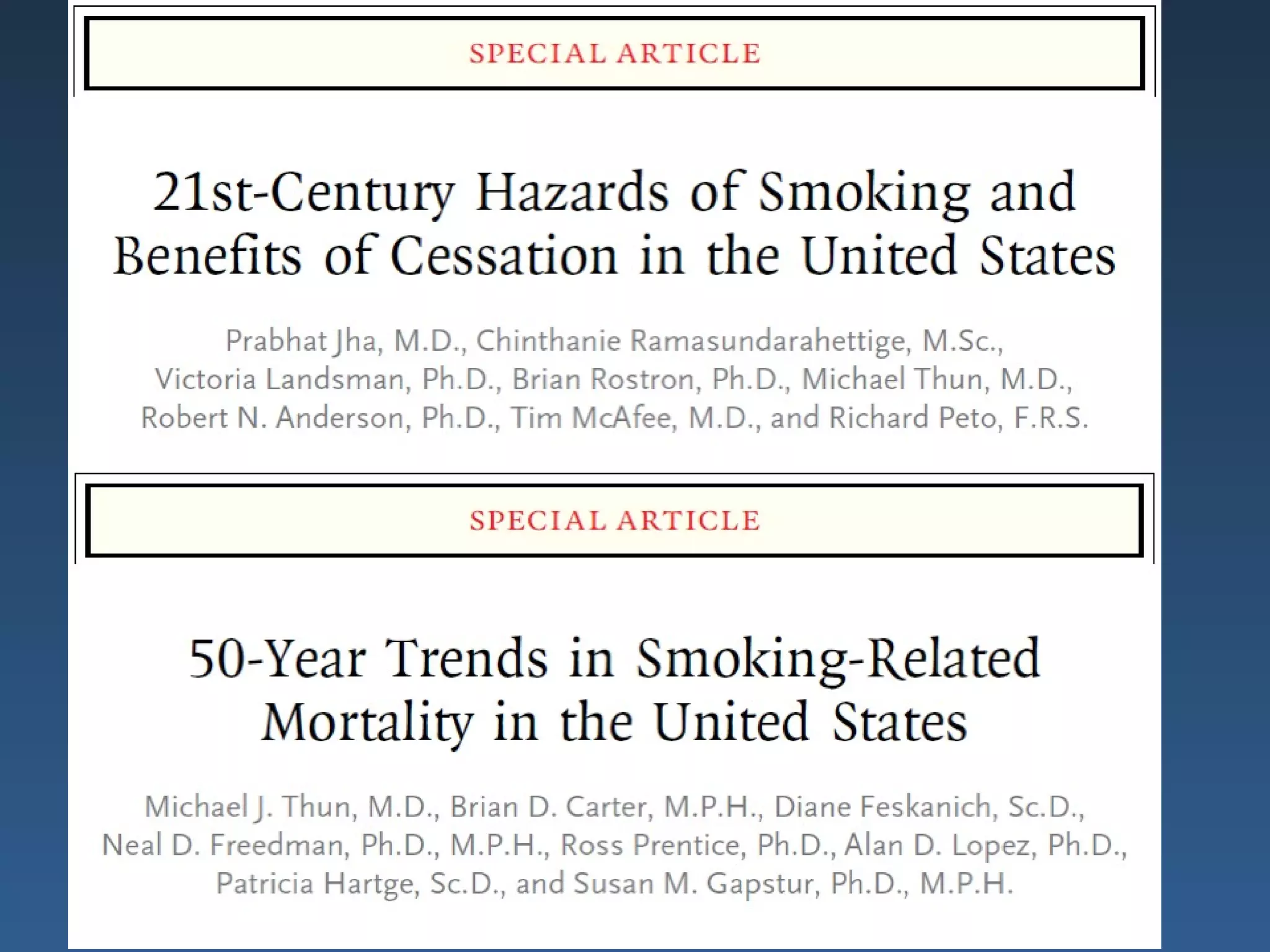
  • #10 But there&amp;apos;s actually breaking news on the mortality front of smoking..This January, the NEJM had 2 articles discussing smoking related mortality and the benefits of smoking cessation
  • #12 CPS I early 60’s (500K), CPS 2 80’s (750K), contemporary combined data from 5 trial WHI, NIH-AARP, NHS for 2000s
  • #13 For nonsmokers in the same period, there was a 50% decreased in death over the decades, a benefit that smokers did not achieve. In fact, both men and female smokers had a 3x increased risk of death from any cause Lung cancer deaths in men STABILIZES first cohort in black was obtained from the 1st cancer prevention study 1959-1965 second cohort from the 2nd CPS1982-1988 third, in red, combines 5 contemporary cohorts from 2000-2010 -peak smoking rates for men in the 60-70&amp;apos;s, for women 80&amp;apos;s -increased rates of lung cancer and COPD deaths for women Figure 1 Changes in Rates of Death from Lung Cancer and Chronic Obstructive Pulmonary Disease (COPD) over Time among Current Female and Male Smokers in the Three Time Periods. Data were obtained from the first Cancer Prevention Study (CPS I) for the period from 1959 to 1965, from the second Cancer Prevention Study (CPS II) for the period from 1982 to 1988, and from five contemporary cohort studies for the period from 2000 to 2010. Peak smoking rates for women was in the 80’s, peak smoking rate for men was in the 70’s. Imagine China in which 52.9% men were smokers in 2010
  • #14 first cohort in black was obtained from the 1st cancer prevention study 1959-1965 second cohort from the 2nd CPS1982-1988 third, in red, combines 5 contemporary cohorts from 2000-2010 -peak smoking rates for men in the 60-70&amp;apos;s, for women 80&amp;apos;s -increased rates of lung cancer and COPD deaths for women Figure 1 Changes in Rates of Death from Lung Cancer and Chronic Obstructive Pulmonary Disease (COPD) over Time among Current Female and Male Smokers in the Three Time Periods. Data were obtained from the first Cancer Prevention Study (CPS I) for the period from 1959 to 1965, from the second Cancer Prevention Study (CPS II) for the period from 1982 to 1988, and from five contemporary cohort studies for the period from 2000 to 2010. Peak smoking rates for women was in the 80’s, peak smoking rate for men was in the 70’s. Imagine China in which 52.9% men were smokers in 2010
  • #15 so let&amp;apos;s look at the other article with it&amp;apos;s hazards and benefits. This data was obtained thru repeated interviews with just over 200K. This definition of former smokers was employed to avoid bias as many smokers quit when faced with a lifethreatening illness
  • #17 Figure 2 Survival Probabilities for Current Smokers and for Those Who Never Smoked among Men and Women 25 to 80 Years of Age. The vertical lines at 80 years of age represent the 99% confidence intervals for cumulative survival probabilities, as derived from the standard errors estimated with the use of the jackknife procedure. Survival probabilities have been scaled from the National Health Interview Survey to the U.S. rates of death from all causes at these ages for 2004,13,16 with adjustment for differences in age, educational level, alcohol consumption, and adiposity (body-mass index). -mortality in smokers is 3x higher than nonsmoker -smokers lose a decade of life -true even if adjust for adiposity, etoh, education
  • #18 Figure 4 Risks of Death for Participants Who Continued to Smoke and for Those Who Quit Smoking According to Age at the Time of Cessation. The total and excess risks of death are shown for NHIS participants who continued smoking, as compared with those who quit smoking. CI denotes confidence interval.
  • #20 So what we can take away from both of these studies is that we need to get people to quit sooner than when they show up in my office at age 65
  • #24 Taylor et al: Recruited participants in the Georgetown LSS (lung screening study) and LCST and interviewed regarding motivation to quit one month after their first CT result Now, remember in NLSCT trial majority of patients were aged 55-59 In the LSS sample, among younger participants (&amp;lt;or=64), an abnormal screening result was significantly associated with becoming more ready to stop smoking, whereas a normal result was associated with becoming less ready to stop smoking (p=.02). Vanderaalst from the NELSON trial of lcs in which the avg age 58. (based on questionnaire about smoking 2 years after randomization 8.9-11.5% abstinence at 2 years) for people with negative or indeterminate To a high of 42% in the Mayo trial in patient with 3 abnormal CTs
  • #25 “motivating event in which individuals are primed to commit to less risky behaviors.
  • #26 “motivating event in which individuals are primed to commit to less risky behaviors.
  • #27 Perhaps we need to reframe smoking cessation in surgery as more of a safety risk
  • #28 Smoking increases oxidative stress, leading to (1) an immediate physiologic response, reducing blood flow, tissue oxygenation, and aerobe metabolism; (2) aninflammatory response, which modulates inflammatory cell function, increases proteolytic enzyme release, and reduces oxidative killing mechanisms; and (3) a proliferative response, which reduces fibroblast function, epidermal regeneration, collagen synthesis and increases collagen degradation. These mechanisms may occur exclusively or in combination and lead to tissue/wound necrosis, dehiscence, surgical site infection, delayed healing, hernia, and unhealed tissue. Vitamin C is cofactor for collagen synthesis
  • #29 Reduction of 65% of complications with NRT and counseling. 36/60 stopped smoking BACKGROUND: Smokers are at higher risk of cardiopulmonary and wound-related postoperative complications than non-smokers. Our aim was to investigate the effect of preoperative smoking intervention on the frequency of postoperative complications in patients undergoing hip and knee replacement. METHODS: We did a randomised trial in three hospitals in Denmark. 120 patients were randomly assigned 6-8 weeks before scheduled surgery to either the control (n=60) or smoking intervention (60) group. Smoking intervention was counselling and nicotine replacement therapy, and either smoking cessation or at least 50% smoking reduction. An assessor, who was masked to the intervention, registered the occurrence of cardiopulmonary, renal, neurological, or surgical complications and duration of hospital admittance. The main analysis was by intention to treat. FINDINGS: Eight controls and four patients from the intervention group were excluded from the final analysis because their operations were either postponed or cancelled. Thus, 52 and 56 patients, respectively, were analysed for outcome. The overall complication rate was 18% in the smoking intervention group and 52% in controls (p=0.0003). The most significant effects of intervention were seen for wound-related complications (5% vs 31%, p=0.001), cardiovascular complications (0% vs 10%, p=0.08), and secondary surgery (4% vs 15%, p=0.07). The median length of stay was 11 days (range 7-55) in the intervention group and 13 days (8-65) in the control group. INTERPRETATION: An effective smoking intervention programme 6-8 weeks before surgery reduces postoperative morbidity, and we recommend, on the basis of our results, this programme be adopted.
  • #30 FIGURE 3. The immediate physiologic response is reversible within 1 hour and is associated with normalization of blood flow, tissue oxygenation, and aerobe metabolism. The inflammatory response is reversible within 3 to 4 weeks with inflammatory cell function, proteolytic enzyme release,and oxidative killing mechanisms returning to normal. The proliferative response appears not to be reversible as fibroblast function, epidermal regeneration, collagen synthesis, and collagen degradation are unaffected by smoking cessation. The impact of smoking cessation reduces surgical site infection, whereas thaton necrosis, wound/tissue dehiscence, delayed healing, hernia, and unhealed tissue is unclear.
  • #31 Reduction of 65% of complications with NRT and counseling. 36/60 stopped smoking BACKGROUND: Smokers are at higher risk of cardiopulmonary and wound-related postoperative complications than non-smokers. Our aim was to investigate the effect of preoperative smoking intervention on the frequency of postoperative complications in patients undergoing hip and knee replacement. METHODS: We did a randomised trial in three hospitals in Denmark. 120 patients were randomly assigned 6-8 weeks before scheduled surgery to either the control (n=60) or smoking intervention (60) group. Smoking intervention was counselling and nicotine replacement therapy, and either smoking cessation or at least 50% smoking reduction. An assessor, who was masked to the intervention, registered the occurrence of cardiopulmonary, renal, neurological, or surgical complications and duration of hospital admittance. The main analysis was by intention to treat. FINDINGS: Eight controls and four patients from the intervention group were excluded from the final analysis because their operations were either postponed or cancelled. Thus, 52 and 56 patients, respectively, were analysed for outcome. The overall complication rate was 18% in the smoking intervention group and 52% in controls (p=0.0003). The most significant effects of intervention were seen for wound-related complications (5% vs 31%, p=0.001), cardiovascular complications (0% vs 10%, p=0.08), and secondary surgery (4% vs 15%, p=0.07). The median length of stay was 11 days (range 7-55) in the intervention group and 13 days (8-65) in the control group. INTERPRETATION: An effective smoking intervention programme 6-8 weeks before surgery reduces postoperative morbidity, and we recommend, on the basis of our results, this programme be adopted.
  • #32 Cessation of smoking 4 weeks using NRT and counseling before elective surgery reduced PC mostly hernias, chole&amp;apos;s, hips and knees. No difference based on type of surgery OBJECTIVE: To determine whether an intervention with smoking cessation starting 4 weeks before general and orthopedic surgery would reduce the frequency of postoperative complications. SUMMARY BACKGROUND DATA: Complications are a major concern after elective surgery and smokers have an increased risk. There is insufficient evidence concerning how the duration of preoperative smoking intervention affects postoperative complications. METHODS: A randomized controlled trial, conducted between February 2004 and December 2006 at 4 university-affiliated hospitals in the Stockholm region, Sweden. The outcome assessment was blinded. The follow-up period for the primary outcome was 30 days. Eligibility criteria were active daily smokers, aged 18 to 79 years. Of the 238 patients assessed, 76 refused participating, and 117 men and women undergoing surgery for primary hernia repair, laparoscopic cholecystectomy, or a hip or knee prosthesis were enrolled. INTERVENTION: Smoking cessation therapy with individual counseling and nicotine substitution started 4 weeks before surgery and continued 4 weeks postoperatively. The control group received standard care. The main outcome measure was frequency of any postoperative complication. RESULTS: An intention-to-treat analysis showed that the overall complication rate in the control group was 41%, and in the intervention group, it was 21% (P = 0.03). Relative risk reduction for the primary outcome of any postoperative complication was 49% and number needed to treat was 5 (95% CI, 3-40). An analysis per protocol showed that abstainers had fewer complications (15%) than those who continued to smoke or only reduced smoking (35%), although this difference was not statistically significant. CONCLUSION: Perioperative smoking cessation seems to be an effective tool to reduce postoperative complications even if it is introduced as late as 4 weeks before surgery.
  • #42 If you do this , you will be doing better than 87% of primary care providers. Studies suggest that referring people out
  • #45 Only 17% of patients are offered follow up.. 2/3 of patients who try to quit will try again in one month
  • #47 In meta-analysis if 14 clinical trials in which MD had &amp;gt;2h training in motivational interviewing Increased from 2% to 8%
  • #49 Maybe you’ll plant a seed that will lead them to be ready next time
  • #51 Stead LF, et al. Cochrane Database of Systematic Reviews 2008
  • #54 Costs 119-6450 per smoker, did not matter if it was full or partial coverage
  • #55 Costs 119-6450 per smoker, did not matter if it was full or partial coverage
  • #58 Definable benefits to smoking cessation Cessation prior to 40 mitigates smoking related Impact on surgical outcomes The 5A&amp;apos;s Combination of motivational interviewing, FDA approved medications, and counseling