Virtualization for Midsize Businesses:
 Keep Your Foot on the Accelerator


                                     An Executive Brief
                                     Sponsored by IBM


                     February 2012     www.frost.com
Stratecast | Frost & Sullivan


                                                   VIRTUALIZATION FOR MIDSIZE BUSINESSES:
                                                      KEEP YOUR FOOT ON THE ACCELERATOR


                                   INTRODUCTION


                                   Virtualization—the abstraction of the logical from the physical—has been an outstanding
                                   tool in IT’s never ending quest to wring increasing levels of cost efficiency and flexibility
                                   from existing server hardware and data center infrastructure. Prior to virtualization, a
Does this mean that the            static relationship existed that tied a single instance of the operating system software and
benefits of virtualization         its collection of applications to a dedicated server. If the operating system and
will soon reach a                  application workload—that is, the demand on the server’s resources—was constant,
crescendo, and IT                  utilization of the server could be maximized, resulting in minimal dormant or unused
managers will be                   hardware resources. Furthermore, the power consumption by the server and the cooling
scrambling for the next            of that server is efficient; there is little waste in supporting an active server. Yet,
wave of efficiency and             application usage is seldom constant. The existence of peaks and valleys during the day,
flexibility? Not by a              within the workweek, seasonally, and unexpectedly, is the reality for most businesses.
long shot.                         Consequently, average server utilization without virtualization is low, and energy and
                                   cooling is wasted on servers that are ‘on’ but are not actively serving a business need.

                                   Server virtualization upends this serial relationship. With server virtualization, a
                                   hypervisor dynamically creates multiple, isolated software instances, or virtual machines
                                   (VMs), on a single server. This abstraction allows multiple workloads to simultaneously
                                   share the server’s resources. By interleaving the ebb and flow of multiple workloads,
                                   server utilization rates can be dramatically and permanently improved. In addition, server
                                   sprawl can, for a period of time, be reversed.

                                   Given the inherent benefits of server virtualization, it is not surprising that server
                                   virtualization is rapidly being adopted. Based on a 2011 sampling of U.S. IT decision
                                   markers at midsize and large businesses, use of virtualization exceeds 70%. 1 Furthermore,
                                   the percentage of servers virtualized is already high and increasing. Thirty-four percent
                                   of the survey respondents stated that 50% or more of their servers are currently
                                   virtualized; and 62% predict that 50% or more of their servers will be virtualized in five
                                   years. It is noteworthy that these trends are not unique to the U.S. In a global survey of
                                   midsize businesses commissioned by IBM, 67% list virtualization as an IT project that is
                                   already underway or planned to be implemented in 2011. 2

                                   Does this mean that the benefits of virtualization will soon reach a crescendo, and IT
                                   managers will be scrambling for the next wave of efficiency and flexibility? Not by a long
                                   shot. There are other streams of benefits virtualization can deliver, especially for the
                                   growing number of midsize businesses with shifting strategic priorities toward customer
                                   1
                                       Frost & Sullivan survey conducted in the second quarter of 2011.
                                   2
                                     Survey of 2,112 business and information technology decision makers in midsize businesses was conducted by KS&R, Inc. in
                                   late 2010. Survey findings are summarized in Inside the Midmarket: A 2011 Perspective; available at http://www-304.ibm.com/
                                   businesscenter/cpe/download0/212133/Inside_the_Midmarket__Global_Report.pdf.

    2        February 2012                                                                                         © 2012 Stratecast. All Rights Reserved.
Virtualization for Midsize Businesses


focus, innovation, and revenue growth. 3 The challenge is in knowing what this broader
virtualization toolset is and how to make it work for your midsize business.


WHY SERVER VIRTUALIZATION?


No IT project is considered unless there is a need and the means to address that need.
                                                                                                              If the midsize business
Such is the case in the data center challenges that IT faces. This is particularly relevant to
                                                                                                              is not focusing on how
midsize businesses, many of whom do not have sophisticated data centers with                                  to improve its
designated personnel whose sole responsibility is to care for that data center. Rather,                       effectiveness and, by
midsize businesses frequently have a standard room that has been put into service to                          association, its business,
host the company’s server and storage infrastructure. Moreover, they do not have the                          the competitive vise will
luxury to expand; they must work within their constrained space. And, the same skeleton                       definitely tighten.
staff that oversees this room also attends to all of the business’s IT needs, such as
desktop management, monitoring and managing critical business applications, and
providing direction on how technology developments in IT can advance their business’s
strategic plans. This is an immense and complex role, confirmed through a Frost &
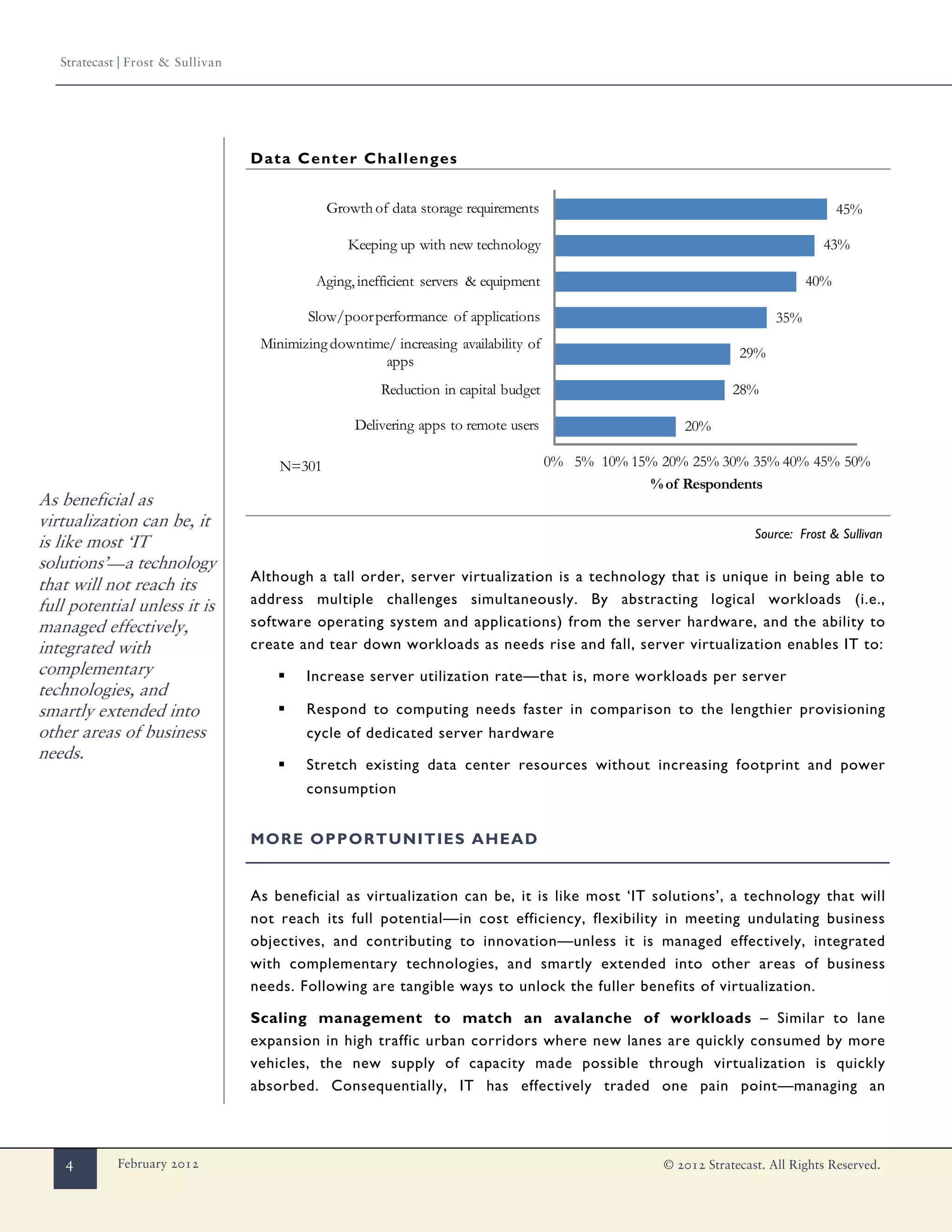
Sullivan survey that highlights the many recurring challenges pertaining to data centers.

        ▪    Increase capacity – Computing and storage requirements are only heading in
             one direction—upward. Attempting to increase capacity is particularly challenging
             when the footprint of the ‘data center’ is fixed and, of increasing relevancy,
             power availability is limited.

        ▪    Improve effectiveness with greater speed, flexibility, and reliability –
             Midsize businesses are caught in a competitive vise—smaller businesses are
             nibbling at their heels and large enterprises will redirect their resources to
             protect their turf. If the midsize business is not focusing on how to improve its
             effectiveness and, by association, its business, the competitive vise will definitely
             tighten.

        ▪    Gain cost efficiencies in both technological and human resources – The
             wrenching adjustments that were required during the recent economic downturn
             will not be reversing anytime soon. Even as general economic conditions
             improve, businesses will seek first to reestablish profitability before adding
             headcount or increasing budgets. Consequently, the midsize business IT
             organization, which for most has the same internal departments to support as a
             large enterprise, will be expected to do more with the same. And, where
             increased spending has been approved, this will only occur if there is a near-term
             financial benefit.


3
    Each of these strategic priorities intensified from 2009 to 2010, according to the KS&R survey.


© 2012 Stratecast. All Rights Reserved.                                                                           February 2012       3
Stratecast | Frost & Sullivan


                                   Data Center Challenges


                                               Growth of data storage requirements                                                   45%

                                                  Keeping up with new technology                                                 43%

                                             Aging, inefficient servers & equipment                                            40%

                                            Slow/poor performance of applications                                        35%
                                    Minimizing downtime/ increasing availability of
                                                                                                                  29%
                                                       apps
                                                        Reduction in capital budget                              28%

                                                   Delivering apps to remote users                      20%

                                       N=301                                          0% 5% 10% 15% 20% 25% 30% 35% 40% 45% 50%
                                                                                                  % of Respondents
As beneficial as
virtualization can be, it
                                                                                                                     Source: Frost & Sullivan
is like most ‘IT
solutions’—a technology
                                   Although a tall order, server virtualization is a technology that is unique in being able to
that will not reach its
full potential unless it is        address multiple challenges simultaneously. By abstracting logical workloads (i.e.,
managed effectively,               software operating system and applications) from the server hardware, and the ability to
integrated with                    create and tear down workloads as needs rise and fall, server virtualization enables IT to:
complementary                          ▪   Increase server utilization rate—that is, more workloads per server
technologies, and
smartly extended into                  ▪   Respond to computing needs faster in comparison to the lengthier provisioning
other areas of business                    cycle of dedicated server hardware
needs.
                                       ▪   Stretch existing data center resources without increasing footprint and power
                                           consumption


                                   MORE OPPORTUNITIES AHEAD


                                   As beneficial as virtualization can be, it is like most ‘IT solutions’, a technology that will
                                   not reach its full potential—in cost efficiency, flexibility in meeting undulating business
                                   objectives, and contributing to innovation—unless it is managed effectively, integrated
                                   with complementary technologies, and smartly extended into other areas of business
                                   needs. Following are tangible ways to unlock the fuller benefits of virtualization.

                                   Scaling management to match an avalanche of workloads – Similar to lane
                                   expansion in high traffic urban corridors where new lanes are quickly consumed by more
                                   vehicles, the new supply of capacity made possible through virtualization is quickly
                                   absorbed. Consequentially, IT has effectively traded one pain point—managing an


    4        February 2012                                                                           © 2012 Stratecast. All Rights Reserved.
Virtualization for Midsize Businesses


increasing number of physical servers, for another—managing an avalanche of virtual
workloads. This management pain can quickly escalate from a dull headache to a
throbbing migraine in short order unless prescriptive steps are taken to manage the
virtual. In essence, the honed effectiveness of managing physical servers must be
practiced faster, with greater precision, and at higher scale with virtual workloads. This
entails:

    ▪    Real-time visibility into individual workload performance, and alerting before
         problems become service impacting

    ▪    Workload relocation and rapid provisioning to circumvent performance issues,
         ensure high availability, and elevate system-wide utilization

    ▪    Capacity planning based on trends of actual usage

Driving out slack expenses and directing confirmed expenses to workload users
Although virtualization drives cost efficiencies through the shared use of resources, in
doing so, it also obscures the connection between user and resource cost. However,
                                                                                                            With virtualization
effective business decisions demand driving costs accurately to users’ organizations.
                                                                                                            contributing to an
Ensuring this requires the following on-going activities:
                                                                                                            avalanche of virtual,
    ▪    Gathering and compiling resource consumption at the workload level and                             on-demand workloads,
         charging back to the workload users                                                                the volume of data will
                                                                                                            grow exponentially.
    ▪    Assessing      software      inventory   and   license   entitlements   to   identify   over-
         subscriptions and unaccounted use

    ▪    Automating routine processes and identifying opportunities to standardize virtual
         machine images within and across departmental users

Adjusting data and storage management processes – With virtualization
contributing to an avalanche of virtual, on-demand workloads, the volume of data will
grow exponentially. With that, data and storage management policies and processes
designed for a physical environment must be recalibrated for a virtualized environment.
A host of questions arise as part of this recalibration:

    ▪    Is data adequately protected while in use, in transit among virtual workloads and
         storage, and at rest?

    ▪    Will existing identity and access policies remain in effect, and what modifications
         to these policies are required?

    ▪    Will audits regarding data privacy regulations be supported?

    ▪    Are data backup, recovery, retention, and destruction procedures being followed,
         and how should they be updated for the increasing volume of data?


© 2012 Stratecast. All Rights Reserved.                                                                         February 2012       5
Stratecast | Frost & Sullivan


                                   Migrating from pre-virtualization servers to servers optimized for
                                   virtualization – The density of virtual workloads, as previously stated, drives cost
                                   efficiencies within existing physical servers, and allows existing data center space to
Devising and following             support a higher level of business operations. In time, however, a new capacity threshold
a server upgrade plan              will be tested. Just as PCs and consumer electronics continuously evolve to better
that includes servers              support advanced applications, the same is true with servers optimized to support
explicitly built—from              virtualization. Devising and following a server upgrade plan that includes servers
the silicon up—to
                                   explicitly built—from the silicon up—to support virtualization, will not only stretch
support virtualization,
                                   existing data center space further but will also produce incremental gains in energy
will not only stretch
                                   efficiency (less power consumption per workload and lower heat emissions).
existing data center
space further but will             Expanding beyond server virtualization – The underlying concept of virtualization—
also produce incremental           abstracting the logical from the physical—is not restricted to server virtualization.
gains in energy efficiency.        Virtualization is applicable in other IT domains, each delivering additional benefits.

                                      ▪   Storage Virtualization – Logic dictates that if virtual workloads are increasing
                                          in number and in data creation, IT’s approach to storage must parallel the on-
                                          demand, instant scalability, and high density attributes of server virtualization.
                                          Otherwise, storage is at risk of becoming an operational and costly bottleneck.
                                          Like server virtualization, storage virtualization, if designed and managed
                                          effectively, can deliver business benefits in many areas, such as: object
                                          centralization; file synchronization and version control; electronic collaboration;
                                          automated storage provisioning and data placement; aligning storage costs with
                                          performance priorities; and supporting business analytics. Business analytics is
                                          among the top IT project implementations for midsize businesses, according to
                                          the KS&R survey. Seventy percent of respondents have either started or plan to
                                          start a business analytics project. Information management and customer
                                          relationship management—projects that rely on large data sets and highly scalable
Logic dictates that if
                                          computing capabilities—are also high on project priority lists.
virtual workloads are
increasing in number                  ▪   Desktop Virtualization – Desktop virtualization bends virtualization into a
and in data creation,                     complementary direction. In desktop virtualization, multiple end-users’ desktops
IT’s approach to                          are created, managed, and run on a server, rather than individually on each end-
storage must parallel                     user’s device. Essentially, the desktop ‘lives’ on the server; and the end-user’s
the on-demand, instant                    device—a laptop, a home PC, thin computing device, or tablet—is an interface
scalability, and high
                                          and display mechanism. Desktop virtualization presents several benefits to IT and
density attributes of
                                          end-users. Server-based virtualized desktops provide IT with the uniform control
server virtualization.
Otherwise, storage is at                  they lack—and end up paying for in helpdesk calls associated with maintaining and
risk of becoming an                       repairing traditional PCs. With the end-user device in desktop virtualization not
operational and costly                    having the same processing requirements as a traditional PC, IT can start
bottleneck.                               swapping out corporate-owned desktops and laptops with thin-computing devices
                                          that cost less, require less maintenance, and consume less electricity. For end-
                                          users, they retain the same desktop experience they had plus gain the ability to
                                          access their personalized desktops from multiple devices. As an end user moves


    6        February 2012                                                                   © 2012 Stratecast. All Rights Reserved.
Virtualization for Midsize Businesses


          among devices, he or she has seamless workflow as the last desktop session,
          including personal files, is stored on the server. With the advances that have          As virtualization takes
          occurred in desktop virtualization over the last three years, all businesses should     root, communication
          include desktop virtualization as a ‘must evaluate’ solution to desktop computing       flows become more
          and management.                                                                         Web-like as the physical
                                                                                                  location of workloads is
     ▪    Network Virtualization - Reliance on communication networks’ adaptability
                                                                                                  a real-time selection,
          intensifies with virtualization. As virtualization takes root, communication flows      has the potential to be
          become more Web-like as the physical location of workloads is a real-time               transferred from one
          selection, has the potential to be transferred from one physical server to another      physical server to
          within a session, and be disseminated among multiple computing and storage              another within a
          devices; all in the name of resource efficiency and performance. Whether in a           session, and be
          server room or a high-end data center, server-to-server and server-to-storage           disseminated among
          communication will increase with virtualization. Server-based desktop                   multiple computing and
          virtualization further adds to network traffic on Local Area Networks and Wide          storage devices.
          Area Networks, as the end user is accessing his or her desktop through a
          network. While workload performance (e.g., responsiveness and resiliency) is a
          critical attribute to monitor and manage in this dynamic web of communication
          flows, it is not the only manageable attribute. Cost efficiency in the use of
          networks is also possible if networks are constructed with the same adaptability
          principles as other forms of virtualization.


MOVING VIRTUALIZATION FORWARD


Knowledge is power, but holding a power advantage in the rapidly evolving IT discipline
is unattainable for most midsize businesses. This is especially the case when taken in the
context of doing more with less; and, as articulated in this paper, when basic server
                                                                                                  Of midsize businesses
virtualization only scratches the surface of potential benefits. Partnering with a                from around the world,
knowledgeable provider is the preferred approach. Surveys confirm this. In the KS&R               70% of respondents
survey of midsize businesses from around the world, 70% of respondents indicated that             indicated that they are
they are “seeking a consultative versus a purely transactional relationship with their            “seeking a consultative
primary IT provider.” This position is also supported by what they cited as execution             versus a purely
barriers—difficulty in acquiring and implementing solutions, inability to implement               transactional
technology with existing resources and infrastructure, and lack of skills and resources. Of       relationship with their
even higher magnitude, 88% of U.S.-based midsize businesses in Frost & Sullivan’s 2011            primary IT provider.”
survey will seek outside assistance in developing and implementing a cloud strategy,
which includes virtualization in private data centers.

Having concluded that partnering is not only advantageous but essential, choosing the
right partner is imperative. While there are numerous partnering choices, we
recommend narrowing the choices to providers that embody these characteristics:


© 2012 Stratecast. All Rights Reserved.                                                               February 2012       7
Stratecast | Frost & Sullivan


                                       ▪   Views virtualization as an evolutionary process aimed at contributing to business
                                           outcomes

                                       ▪   Understands that this process starts at a different point for each business and
                                           varies in timeline and milestones

                                       ▪   Supports a heterogeneous environment consisting of physical and virtual
                                           infrastructure, private and public cloud installations, and standards-based, vendor
                                           -agnostic computing, storage, and network components

                                       ▪   Places management, the engine of efficiency and “no surprise” operations, at the
                                           center of all virtualization projects

                                       ▪   Has built and continuously enhances a synergistic and broad suite of hardware
                                           and software products designed to maximize the benefits of virtualization

                                       ▪   Offers “pay as you grow” financing options to assist businesses in breaking
                                           through budgetary barriers and in aligning costs with projected benefits

                                       ▪   Is experienced and has a reputation of applying that experience in all of its
                                           projects
Regardless of where
businesses enter this              IBM, A TRUE PARTNER IN THE VIRTUALIZATION JOURNEY
four-point journey—
consolidate resources,
manage workloads,                  IBM epitomizes the evolution process of virtualization through its virtualization journey.
automate process, and              Regardless of where businesses enter this four-point journey—consolidate resources,
optimize delivery—                 manage workloads, automate process, and optimize delivery—IBM is poised to serve.
IBM is poised to serve.            Furthermore, IBM’s community of value-added resellers and local IT management firms
                                   fosters tight strategic relationships with businesses, regardless of size and industry.

                                   Consolidate resources – Consolidation of computing power into fewer servers—a
                                   natural starting point for most businesses—supports the business objective of lowering
                                   its cost structure in both capital expenditures and ongoing operational costs. The cost
                                   savings are straightforward: fewer devices to purchase, configure, and manage; and
                                   avoidance of data center expansion. For businesses that have just started or already
                                   pivoting to server virtualization, IBM can further assist them in reaching a higher tier of
                                   utilization and cost efficiency through the migration to IBM systems engineered for
                                   virtualization. Well suited for midsize businesses, IBM Power Systems servers with IBM
                                   PowerVM technology, and IBM x86-based Enterprise X-Architecture servers, separately
                                   and combined, make this objective a reality. Behind the scene, IBM Global Technology
                                   Services has developed analytical tools that model workloads and outcomes to determine
                                   the optimal approach to virtualize infrastructures. Using these tools and methodologies,
                                   IBM has helped clients achieve 60 to 70 percent server virtualization; halve their
                                   transformation time windows to virtualized servers; trim up to 50 percent of floor space
                                   requirements and facility costs; and produce a 6 to 18 month return on investment. Add


   8         February 2012                                                                    © 2012 Stratecast. All Rights Reserved.
Virtualization for Midsize Businesses


in IBM Storwize V7000 and the virtualization journey moves from servers into storage.
Further, IBM storage virtualization services assist clients in reaching higher tiers of
storage infrastructure responsiveness and utilization, and reduce cost and complexity
across the client’s existing and heterogeneous mix of storage platforms. Sophisticated
analytics is also employed to automate data movement, which improves operational                 Not only does
efficiencies and reduces risk. The benefits of storage virtualization done right can be as       virtualization contribute
substantial as server virtualization: up to 25 percent reduction in storage capacity             to physical device
requirements, and up to 300 percent increase in utilization rates of storage                     consolidation—a boost
infrastructure. IBM Global Financing can be folded into this virtualization journey to aid       to cost containment and
IBM customers in attaining the technology they need, when they need it, and sequence             efficiency—it also
payments to match the flow of benefits.                                                          indirectly contributes to
                                                                                                 what can be a massive
Manage workloads – As described earlier, not only does virtualization contribute to              uptick in workloads
physical device consolidation—a boost to cost containment and efficiency—it also                 and data. The net result
indirectly contributes to what can be a massive uptick in workloads and data. The net            can be a significant
result can be a significant management challenge. If not addressed effectively, a portion of     management challenge.
the cost efficiency gains through consolidation of physical resources will be erased by
inadequate and clumsy workload management. IBM offers three products—IBM Systems
Director, IBM Maximo Asset Management Essentials, and IBM Tivoli—designed to unify
and simplify management of virtual and physical environments. IBM Systems Director
provides that single pane of glass that is so essential in coordinating administrative tasks
across servers and storage in virtualized and physical environments. IBM Maximo Asset
Management Essentials brings enterprise-class asset optimization to midsize businesses.
Last, IBM Tivoli Monitoring consolidates correlated workload management objectives
into a single solution—capacity management and planning, and performance problem
identification and isolation—across virtualized and physical environments. With few
businesses claiming or even aspiring to be 100% virtualized, the importance of unified
workload management across physical and virtual server and storage environments
should not go unnoticed.

Automate process – In this portion of the virtualization journey, the goal is to
automate the delivery of applications and services to the business, independent of
platform or operating systems. In addition to feeding cost savings by reaching resource
optimization decisions faster than manually possible, human configuration errors can be
taken out of the equation; and the recording that is standard with automation directly
supports regulatory requirements. For this goal to be realized, the linkages between
business rules and priorities with IT operations must entail a high level of process
automation. IBM Tivoli software—IBM Tivoli Monitoring, Tivoli Endpoint Manager, and
Tivoli Provisioning Manager—are just a few of the IBM products that automate service
delivery. Other supporting products include IBM Tivoli Live Monitoring Services and TSM
FastBack for Storwize V7000. As in this step, and the preceding steps in the virtualization
journey, they can include several IBM products. IBM or the company’s certified partners


© 2012 Stratecast. All Rights Reserved.                                                              February 2012       9
Stratecast | Frost & Sullivan


                                   consult with each customer in selecting an optimal mix of IBM products to best meet
                                   that customer’s business aspirations.

                                   Optimize delivery – In optimized delivery, the user community in equipped to serve
                                   themselves—a self-service model. In the substantiation of this model, IT attention can be
                                   redirected from mundane tasks to strategic business endeavors. To make optimized
                                   delivery a reality, IT will need to assemble and automate technology to deliver services
                                   and resources in the most cost effective and reliable manner. In turn, business users
                                   define their needs, and the services and resources they need are automatically and
                                   transparently provisioned. IBM’s growing portfolio of cloud services will form the
                                   footstones for optimized delivery.


                                                                       Stratecast
Midsize businesses                                                   The Last Word
should not wait for
proof to materialize of             Virtualization has rapidly gone from experimentation to production in the server
virtualization’s broader            environment for most midsize businesses. Even so, midsize businesses should not
and more holistic                   wait for proof to materialize of virtualization’s broader and more holistic benefits in
benefits in other areas             other areas touched by IT—notably storage, desktops, and networks. They must
touched by IT—notably               move forward with purpose.
storage, desktops, and
networks. They must                 Doing so is not risk free. For one, there is no universal map that is suitable for each
move forward with                   business as to how virtualization should be melded into its IT operations in a manner
purpose.                            that maximizes business benefits. The virtualization journey is as unique as the
                                    individual business. Also, virtualization must be priced and packaged for midsize
                                    businesses. Compared to their large enterprise competitors, midsize businesses’
                                    objectives are similar but their in-house resources and funding avenues are not as
                                    abundant.

                                    Our recommendation is to select a business partner with proven experience in
                                    virtualization implementations across a range of industries; one that offers
                                    virtualization products that are not watered-down versions of large enterprise
                                    products, but explicitly designed for midsize business implementations and budgets;
                                    and has a community of certified partners poised to provide lifecycle assistance. IBM
                                    qualifies in all of these areas.


                                     Michael Suby
                                     Vice President of Research
                                     Stratecast | Frost & Sullivan
                                     msuby@frost.com


   10        February 2012                                                                   © 2012 Stratecast. All Rights Reserved.
Silicon Valley                                   San Antonio                                       London
331 E. Evelyn Ave., Suite 100                    7550 West Interstate 10, Suite 400                4, Grosvenor Gardens,
Mountain View, CA 94041                          San Antonio, Texas 78229-5616                     London SWIW ODH,UK
Tel 650.475.4500                                 Tel 210.348.1000                                  Tel 44(0)20 7730 3438
Fax 650.475.1570                                 Fax 210.348.1003                                  Fax 44(0)20 7730 3343


                                       877.GoFrost • myfrost@frost.com
                                             http://www.frost.com


  ABOUT STRATECAST

  Stratecast collaborates with our clients to reach smart business decisions in the rapidly evolving and hyper-
  competitive Information and Communications Technology markets. Leveraging a mix of action-oriented subscription
  research and customized consulting engagements, Stratecast delivers knowledge and perspective that is only
  attainable through years of real-world experience in an industry where customers are collaborators; today’s
  partners are tomorrow’s competitors; and agility and innovation are essential elements for success. Contact your
  Stratecast Account Executive to engage our experience to assist you in attaining your growth objectives.


  ABOUT FROST & SULLIVAN

  Frost & Sullivan, the Growth Partnership Company, partners with clients to accelerate their growth. The company's
  TEAM Research, Growth Consulting, and Growth Team Membership™ empower clients to create a growth-focused
  culture that generates, evaluates, and implements effective growth strategies. Frost & Sullivan employs over 50
  years of experience in partnering with Global 1000 companies, emerging businesses, and the investment community
  from more than 40 offices on six continents. For more information about Frost & Sullivan’s Growth Partnership
  Services, visit http://www.frost.com.


   Auckland                       Dubai                                    Mumbai                  Sophia Antipolis
   Bangkok                        Frankfurt                                Manhattan               Sydney
   Beijing                        Hong Kong                                Oxford                  Taipei
   Bengaluru                      Istanbul                                 Paris                   Tel Aviv
   Bogotá                         Jakarta                                  Rockville Centre        Tokyo
   Buenos Aires                   Kolkata                                  San Antonio             Toronto
   Cape Town                      Kuala Lumpur                             São Paulo               Warsaw
   Chennai                        London                                   Seoul                   Washington, DC
   Colombo                        Mexico City                              Shanghai
   Delhi / NCR                    Milan                                    Silicon Valley
   Dhaka                          Moscow                                   Singapore

                                                                                                           SML12345USEN-00

Virtualization for Midsize Businesses: Keep Your Foot on the Accelerator

  • 1.
    Virtualization for MidsizeBusinesses: Keep Your Foot on the Accelerator An Executive Brief Sponsored by IBM February 2012 www.frost.com
  • 2.
    Stratecast | Frost& Sullivan VIRTUALIZATION FOR MIDSIZE BUSINESSES: KEEP YOUR FOOT ON THE ACCELERATOR INTRODUCTION Virtualization—the abstraction of the logical from the physical—has been an outstanding tool in IT’s never ending quest to wring increasing levels of cost efficiency and flexibility from existing server hardware and data center infrastructure. Prior to virtualization, a Does this mean that the static relationship existed that tied a single instance of the operating system software and benefits of virtualization its collection of applications to a dedicated server. If the operating system and will soon reach a application workload—that is, the demand on the server’s resources—was constant, crescendo, and IT utilization of the server could be maximized, resulting in minimal dormant or unused managers will be hardware resources. Furthermore, the power consumption by the server and the cooling scrambling for the next of that server is efficient; there is little waste in supporting an active server. Yet, wave of efficiency and application usage is seldom constant. The existence of peaks and valleys during the day, flexibility? Not by a within the workweek, seasonally, and unexpectedly, is the reality for most businesses. long shot. Consequently, average server utilization without virtualization is low, and energy and cooling is wasted on servers that are ‘on’ but are not actively serving a business need. Server virtualization upends this serial relationship. With server virtualization, a hypervisor dynamically creates multiple, isolated software instances, or virtual machines (VMs), on a single server. This abstraction allows multiple workloads to simultaneously share the server’s resources. By interleaving the ebb and flow of multiple workloads, server utilization rates can be dramatically and permanently improved. In addition, server sprawl can, for a period of time, be reversed. Given the inherent benefits of server virtualization, it is not surprising that server virtualization is rapidly being adopted. Based on a 2011 sampling of U.S. IT decision markers at midsize and large businesses, use of virtualization exceeds 70%. 1 Furthermore, the percentage of servers virtualized is already high and increasing. Thirty-four percent of the survey respondents stated that 50% or more of their servers are currently virtualized; and 62% predict that 50% or more of their servers will be virtualized in five years. It is noteworthy that these trends are not unique to the U.S. In a global survey of midsize businesses commissioned by IBM, 67% list virtualization as an IT project that is already underway or planned to be implemented in 2011. 2 Does this mean that the benefits of virtualization will soon reach a crescendo, and IT managers will be scrambling for the next wave of efficiency and flexibility? Not by a long shot. There are other streams of benefits virtualization can deliver, especially for the growing number of midsize businesses with shifting strategic priorities toward customer 1 Frost & Sullivan survey conducted in the second quarter of 2011. 2 Survey of 2,112 business and information technology decision makers in midsize businesses was conducted by KS&R, Inc. in late 2010. Survey findings are summarized in Inside the Midmarket: A 2011 Perspective; available at http://www-304.ibm.com/ businesscenter/cpe/download0/212133/Inside_the_Midmarket__Global_Report.pdf. 2 February 2012 © 2012 Stratecast. All Rights Reserved.
  • 3.
    Virtualization for MidsizeBusinesses focus, innovation, and revenue growth. 3 The challenge is in knowing what this broader virtualization toolset is and how to make it work for your midsize business. WHY SERVER VIRTUALIZATION? No IT project is considered unless there is a need and the means to address that need. If the midsize business Such is the case in the data center challenges that IT faces. This is particularly relevant to is not focusing on how midsize businesses, many of whom do not have sophisticated data centers with to improve its designated personnel whose sole responsibility is to care for that data center. Rather, effectiveness and, by midsize businesses frequently have a standard room that has been put into service to association, its business, host the company’s server and storage infrastructure. Moreover, they do not have the the competitive vise will luxury to expand; they must work within their constrained space. And, the same skeleton definitely tighten. staff that oversees this room also attends to all of the business’s IT needs, such as desktop management, monitoring and managing critical business applications, and providing direction on how technology developments in IT can advance their business’s strategic plans. This is an immense and complex role, confirmed through a Frost & Sullivan survey that highlights the many recurring challenges pertaining to data centers. ▪ Increase capacity – Computing and storage requirements are only heading in one direction—upward. Attempting to increase capacity is particularly challenging when the footprint of the ‘data center’ is fixed and, of increasing relevancy, power availability is limited. ▪ Improve effectiveness with greater speed, flexibility, and reliability – Midsize businesses are caught in a competitive vise—smaller businesses are nibbling at their heels and large enterprises will redirect their resources to protect their turf. If the midsize business is not focusing on how to improve its effectiveness and, by association, its business, the competitive vise will definitely tighten. ▪ Gain cost efficiencies in both technological and human resources – The wrenching adjustments that were required during the recent economic downturn will not be reversing anytime soon. Even as general economic conditions improve, businesses will seek first to reestablish profitability before adding headcount or increasing budgets. Consequently, the midsize business IT organization, which for most has the same internal departments to support as a large enterprise, will be expected to do more with the same. And, where increased spending has been approved, this will only occur if there is a near-term financial benefit. 3 Each of these strategic priorities intensified from 2009 to 2010, according to the KS&R survey. © 2012 Stratecast. All Rights Reserved. February 2012 3
  • 4.
    Stratecast | Frost& Sullivan Data Center Challenges Growth of data storage requirements 45% Keeping up with new technology 43% Aging, inefficient servers & equipment 40% Slow/poor performance of applications 35% Minimizing downtime/ increasing availability of 29% apps Reduction in capital budget 28% Delivering apps to remote users 20% N=301 0% 5% 10% 15% 20% 25% 30% 35% 40% 45% 50% % of Respondents As beneficial as virtualization can be, it Source: Frost & Sullivan is like most ‘IT solutions’—a technology Although a tall order, server virtualization is a technology that is unique in being able to that will not reach its full potential unless it is address multiple challenges simultaneously. By abstracting logical workloads (i.e., managed effectively, software operating system and applications) from the server hardware, and the ability to integrated with create and tear down workloads as needs rise and fall, server virtualization enables IT to: complementary ▪ Increase server utilization rate—that is, more workloads per server technologies, and smartly extended into ▪ Respond to computing needs faster in comparison to the lengthier provisioning other areas of business cycle of dedicated server hardware needs. ▪ Stretch existing data center resources without increasing footprint and power consumption MORE OPPORTUNITIES AHEAD As beneficial as virtualization can be, it is like most ‘IT solutions’, a technology that will not reach its full potential—in cost efficiency, flexibility in meeting undulating business objectives, and contributing to innovation—unless it is managed effectively, integrated with complementary technologies, and smartly extended into other areas of business needs. Following are tangible ways to unlock the fuller benefits of virtualization. Scaling management to match an avalanche of workloads – Similar to lane expansion in high traffic urban corridors where new lanes are quickly consumed by more vehicles, the new supply of capacity made possible through virtualization is quickly absorbed. Consequentially, IT has effectively traded one pain point—managing an 4 February 2012 © 2012 Stratecast. All Rights Reserved.
  • 5.
    Virtualization for MidsizeBusinesses increasing number of physical servers, for another—managing an avalanche of virtual workloads. This management pain can quickly escalate from a dull headache to a throbbing migraine in short order unless prescriptive steps are taken to manage the virtual. In essence, the honed effectiveness of managing physical servers must be practiced faster, with greater precision, and at higher scale with virtual workloads. This entails: ▪ Real-time visibility into individual workload performance, and alerting before problems become service impacting ▪ Workload relocation and rapid provisioning to circumvent performance issues, ensure high availability, and elevate system-wide utilization ▪ Capacity planning based on trends of actual usage Driving out slack expenses and directing confirmed expenses to workload users Although virtualization drives cost efficiencies through the shared use of resources, in doing so, it also obscures the connection between user and resource cost. However, With virtualization effective business decisions demand driving costs accurately to users’ organizations. contributing to an Ensuring this requires the following on-going activities: avalanche of virtual, ▪ Gathering and compiling resource consumption at the workload level and on-demand workloads, charging back to the workload users the volume of data will grow exponentially. ▪ Assessing software inventory and license entitlements to identify over- subscriptions and unaccounted use ▪ Automating routine processes and identifying opportunities to standardize virtual machine images within and across departmental users Adjusting data and storage management processes – With virtualization contributing to an avalanche of virtual, on-demand workloads, the volume of data will grow exponentially. With that, data and storage management policies and processes designed for a physical environment must be recalibrated for a virtualized environment. A host of questions arise as part of this recalibration: ▪ Is data adequately protected while in use, in transit among virtual workloads and storage, and at rest? ▪ Will existing identity and access policies remain in effect, and what modifications to these policies are required? ▪ Will audits regarding data privacy regulations be supported? ▪ Are data backup, recovery, retention, and destruction procedures being followed, and how should they be updated for the increasing volume of data? © 2012 Stratecast. All Rights Reserved. February 2012 5
  • 6.
    Stratecast | Frost& Sullivan Migrating from pre-virtualization servers to servers optimized for virtualization – The density of virtual workloads, as previously stated, drives cost efficiencies within existing physical servers, and allows existing data center space to Devising and following support a higher level of business operations. In time, however, a new capacity threshold a server upgrade plan will be tested. Just as PCs and consumer electronics continuously evolve to better that includes servers support advanced applications, the same is true with servers optimized to support explicitly built—from virtualization. Devising and following a server upgrade plan that includes servers the silicon up—to explicitly built—from the silicon up—to support virtualization, will not only stretch support virtualization, existing data center space further but will also produce incremental gains in energy will not only stretch efficiency (less power consumption per workload and lower heat emissions). existing data center space further but will Expanding beyond server virtualization – The underlying concept of virtualization— also produce incremental abstracting the logical from the physical—is not restricted to server virtualization. gains in energy efficiency. Virtualization is applicable in other IT domains, each delivering additional benefits. ▪ Storage Virtualization – Logic dictates that if virtual workloads are increasing in number and in data creation, IT’s approach to storage must parallel the on- demand, instant scalability, and high density attributes of server virtualization. Otherwise, storage is at risk of becoming an operational and costly bottleneck. Like server virtualization, storage virtualization, if designed and managed effectively, can deliver business benefits in many areas, such as: object centralization; file synchronization and version control; electronic collaboration; automated storage provisioning and data placement; aligning storage costs with performance priorities; and supporting business analytics. Business analytics is among the top IT project implementations for midsize businesses, according to the KS&R survey. Seventy percent of respondents have either started or plan to start a business analytics project. Information management and customer relationship management—projects that rely on large data sets and highly scalable Logic dictates that if computing capabilities—are also high on project priority lists. virtual workloads are increasing in number ▪ Desktop Virtualization – Desktop virtualization bends virtualization into a and in data creation, complementary direction. In desktop virtualization, multiple end-users’ desktops IT’s approach to are created, managed, and run on a server, rather than individually on each end- storage must parallel user’s device. Essentially, the desktop ‘lives’ on the server; and the end-user’s the on-demand, instant device—a laptop, a home PC, thin computing device, or tablet—is an interface scalability, and high and display mechanism. Desktop virtualization presents several benefits to IT and density attributes of end-users. Server-based virtualized desktops provide IT with the uniform control server virtualization. Otherwise, storage is at they lack—and end up paying for in helpdesk calls associated with maintaining and risk of becoming an repairing traditional PCs. With the end-user device in desktop virtualization not operational and costly having the same processing requirements as a traditional PC, IT can start bottleneck. swapping out corporate-owned desktops and laptops with thin-computing devices that cost less, require less maintenance, and consume less electricity. For end- users, they retain the same desktop experience they had plus gain the ability to access their personalized desktops from multiple devices. As an end user moves 6 February 2012 © 2012 Stratecast. All Rights Reserved.
  • 7.
    Virtualization for MidsizeBusinesses among devices, he or she has seamless workflow as the last desktop session, including personal files, is stored on the server. With the advances that have As virtualization takes occurred in desktop virtualization over the last three years, all businesses should root, communication include desktop virtualization as a ‘must evaluate’ solution to desktop computing flows become more and management. Web-like as the physical location of workloads is ▪ Network Virtualization - Reliance on communication networks’ adaptability a real-time selection, intensifies with virtualization. As virtualization takes root, communication flows has the potential to be become more Web-like as the physical location of workloads is a real-time transferred from one selection, has the potential to be transferred from one physical server to another physical server to within a session, and be disseminated among multiple computing and storage another within a devices; all in the name of resource efficiency and performance. Whether in a session, and be server room or a high-end data center, server-to-server and server-to-storage disseminated among communication will increase with virtualization. Server-based desktop multiple computing and virtualization further adds to network traffic on Local Area Networks and Wide storage devices. Area Networks, as the end user is accessing his or her desktop through a network. While workload performance (e.g., responsiveness and resiliency) is a critical attribute to monitor and manage in this dynamic web of communication flows, it is not the only manageable attribute. Cost efficiency in the use of networks is also possible if networks are constructed with the same adaptability principles as other forms of virtualization. MOVING VIRTUALIZATION FORWARD Knowledge is power, but holding a power advantage in the rapidly evolving IT discipline is unattainable for most midsize businesses. This is especially the case when taken in the context of doing more with less; and, as articulated in this paper, when basic server Of midsize businesses virtualization only scratches the surface of potential benefits. Partnering with a from around the world, knowledgeable provider is the preferred approach. Surveys confirm this. In the KS&R 70% of respondents survey of midsize businesses from around the world, 70% of respondents indicated that indicated that they are they are “seeking a consultative versus a purely transactional relationship with their “seeking a consultative primary IT provider.” This position is also supported by what they cited as execution versus a purely barriers—difficulty in acquiring and implementing solutions, inability to implement transactional technology with existing resources and infrastructure, and lack of skills and resources. Of relationship with their even higher magnitude, 88% of U.S.-based midsize businesses in Frost & Sullivan’s 2011 primary IT provider.” survey will seek outside assistance in developing and implementing a cloud strategy, which includes virtualization in private data centers. Having concluded that partnering is not only advantageous but essential, choosing the right partner is imperative. While there are numerous partnering choices, we recommend narrowing the choices to providers that embody these characteristics: © 2012 Stratecast. All Rights Reserved. February 2012 7
  • 8.
    Stratecast | Frost& Sullivan ▪ Views virtualization as an evolutionary process aimed at contributing to business outcomes ▪ Understands that this process starts at a different point for each business and varies in timeline and milestones ▪ Supports a heterogeneous environment consisting of physical and virtual infrastructure, private and public cloud installations, and standards-based, vendor -agnostic computing, storage, and network components ▪ Places management, the engine of efficiency and “no surprise” operations, at the center of all virtualization projects ▪ Has built and continuously enhances a synergistic and broad suite of hardware and software products designed to maximize the benefits of virtualization ▪ Offers “pay as you grow” financing options to assist businesses in breaking through budgetary barriers and in aligning costs with projected benefits ▪ Is experienced and has a reputation of applying that experience in all of its projects Regardless of where businesses enter this IBM, A TRUE PARTNER IN THE VIRTUALIZATION JOURNEY four-point journey— consolidate resources, manage workloads, IBM epitomizes the evolution process of virtualization through its virtualization journey. automate process, and Regardless of where businesses enter this four-point journey—consolidate resources, optimize delivery— manage workloads, automate process, and optimize delivery—IBM is poised to serve. IBM is poised to serve. Furthermore, IBM’s community of value-added resellers and local IT management firms fosters tight strategic relationships with businesses, regardless of size and industry. Consolidate resources – Consolidation of computing power into fewer servers—a natural starting point for most businesses—supports the business objective of lowering its cost structure in both capital expenditures and ongoing operational costs. The cost savings are straightforward: fewer devices to purchase, configure, and manage; and avoidance of data center expansion. For businesses that have just started or already pivoting to server virtualization, IBM can further assist them in reaching a higher tier of utilization and cost efficiency through the migration to IBM systems engineered for virtualization. Well suited for midsize businesses, IBM Power Systems servers with IBM PowerVM technology, and IBM x86-based Enterprise X-Architecture servers, separately and combined, make this objective a reality. Behind the scene, IBM Global Technology Services has developed analytical tools that model workloads and outcomes to determine the optimal approach to virtualize infrastructures. Using these tools and methodologies, IBM has helped clients achieve 60 to 70 percent server virtualization; halve their transformation time windows to virtualized servers; trim up to 50 percent of floor space requirements and facility costs; and produce a 6 to 18 month return on investment. Add 8 February 2012 © 2012 Stratecast. All Rights Reserved.
  • 9.
    Virtualization for MidsizeBusinesses in IBM Storwize V7000 and the virtualization journey moves from servers into storage. Further, IBM storage virtualization services assist clients in reaching higher tiers of storage infrastructure responsiveness and utilization, and reduce cost and complexity across the client’s existing and heterogeneous mix of storage platforms. Sophisticated analytics is also employed to automate data movement, which improves operational Not only does efficiencies and reduces risk. The benefits of storage virtualization done right can be as virtualization contribute substantial as server virtualization: up to 25 percent reduction in storage capacity to physical device requirements, and up to 300 percent increase in utilization rates of storage consolidation—a boost infrastructure. IBM Global Financing can be folded into this virtualization journey to aid to cost containment and IBM customers in attaining the technology they need, when they need it, and sequence efficiency—it also payments to match the flow of benefits. indirectly contributes to what can be a massive Manage workloads – As described earlier, not only does virtualization contribute to uptick in workloads physical device consolidation—a boost to cost containment and efficiency—it also and data. The net result indirectly contributes to what can be a massive uptick in workloads and data. The net can be a significant result can be a significant management challenge. If not addressed effectively, a portion of management challenge. the cost efficiency gains through consolidation of physical resources will be erased by inadequate and clumsy workload management. IBM offers three products—IBM Systems Director, IBM Maximo Asset Management Essentials, and IBM Tivoli—designed to unify and simplify management of virtual and physical environments. IBM Systems Director provides that single pane of glass that is so essential in coordinating administrative tasks across servers and storage in virtualized and physical environments. IBM Maximo Asset Management Essentials brings enterprise-class asset optimization to midsize businesses. Last, IBM Tivoli Monitoring consolidates correlated workload management objectives into a single solution—capacity management and planning, and performance problem identification and isolation—across virtualized and physical environments. With few businesses claiming or even aspiring to be 100% virtualized, the importance of unified workload management across physical and virtual server and storage environments should not go unnoticed. Automate process – In this portion of the virtualization journey, the goal is to automate the delivery of applications and services to the business, independent of platform or operating systems. In addition to feeding cost savings by reaching resource optimization decisions faster than manually possible, human configuration errors can be taken out of the equation; and the recording that is standard with automation directly supports regulatory requirements. For this goal to be realized, the linkages between business rules and priorities with IT operations must entail a high level of process automation. IBM Tivoli software—IBM Tivoli Monitoring, Tivoli Endpoint Manager, and Tivoli Provisioning Manager—are just a few of the IBM products that automate service delivery. Other supporting products include IBM Tivoli Live Monitoring Services and TSM FastBack for Storwize V7000. As in this step, and the preceding steps in the virtualization journey, they can include several IBM products. IBM or the company’s certified partners © 2012 Stratecast. All Rights Reserved. February 2012 9
  • 10.
    Stratecast | Frost& Sullivan consult with each customer in selecting an optimal mix of IBM products to best meet that customer’s business aspirations. Optimize delivery – In optimized delivery, the user community in equipped to serve themselves—a self-service model. In the substantiation of this model, IT attention can be redirected from mundane tasks to strategic business endeavors. To make optimized delivery a reality, IT will need to assemble and automate technology to deliver services and resources in the most cost effective and reliable manner. In turn, business users define their needs, and the services and resources they need are automatically and transparently provisioned. IBM’s growing portfolio of cloud services will form the footstones for optimized delivery. Stratecast Midsize businesses The Last Word should not wait for proof to materialize of Virtualization has rapidly gone from experimentation to production in the server virtualization’s broader environment for most midsize businesses. Even so, midsize businesses should not and more holistic wait for proof to materialize of virtualization’s broader and more holistic benefits in benefits in other areas other areas touched by IT—notably storage, desktops, and networks. They must touched by IT—notably move forward with purpose. storage, desktops, and networks. They must Doing so is not risk free. For one, there is no universal map that is suitable for each move forward with business as to how virtualization should be melded into its IT operations in a manner purpose. that maximizes business benefits. The virtualization journey is as unique as the individual business. Also, virtualization must be priced and packaged for midsize businesses. Compared to their large enterprise competitors, midsize businesses’ objectives are similar but their in-house resources and funding avenues are not as abundant. Our recommendation is to select a business partner with proven experience in virtualization implementations across a range of industries; one that offers virtualization products that are not watered-down versions of large enterprise products, but explicitly designed for midsize business implementations and budgets; and has a community of certified partners poised to provide lifecycle assistance. IBM qualifies in all of these areas. Michael Suby Vice President of Research Stratecast | Frost & Sullivan msuby@frost.com 10 February 2012 © 2012 Stratecast. All Rights Reserved.
  • 11.
    Silicon Valley San Antonio London 331 E. Evelyn Ave., Suite 100 7550 West Interstate 10, Suite 400 4, Grosvenor Gardens, Mountain View, CA 94041 San Antonio, Texas 78229-5616 London SWIW ODH,UK Tel 650.475.4500 Tel 210.348.1000 Tel 44(0)20 7730 3438 Fax 650.475.1570 Fax 210.348.1003 Fax 44(0)20 7730 3343 877.GoFrost • myfrost@frost.com http://www.frost.com ABOUT STRATECAST Stratecast collaborates with our clients to reach smart business decisions in the rapidly evolving and hyper- competitive Information and Communications Technology markets. Leveraging a mix of action-oriented subscription research and customized consulting engagements, Stratecast delivers knowledge and perspective that is only attainable through years of real-world experience in an industry where customers are collaborators; today’s partners are tomorrow’s competitors; and agility and innovation are essential elements for success. Contact your Stratecast Account Executive to engage our experience to assist you in attaining your growth objectives. ABOUT FROST & SULLIVAN Frost & Sullivan, the Growth Partnership Company, partners with clients to accelerate their growth. The company's TEAM Research, Growth Consulting, and Growth Team Membership™ empower clients to create a growth-focused culture that generates, evaluates, and implements effective growth strategies. Frost & Sullivan employs over 50 years of experience in partnering with Global 1000 companies, emerging businesses, and the investment community from more than 40 offices on six continents. For more information about Frost & Sullivan’s Growth Partnership Services, visit http://www.frost.com. Auckland Dubai Mumbai Sophia Antipolis Bangkok Frankfurt Manhattan Sydney Beijing Hong Kong Oxford Taipei Bengaluru Istanbul Paris Tel Aviv Bogotá Jakarta Rockville Centre Tokyo Buenos Aires Kolkata San Antonio Toronto Cape Town Kuala Lumpur São Paulo Warsaw Chennai London Seoul Washington, DC Colombo Mexico City Shanghai Delhi / NCR Milan Silicon Valley Dhaka Moscow Singapore SML12345USEN-00