Smith Chart
Mohd Vasim
D. J. College, Baraut (Baghpat)
Introduction
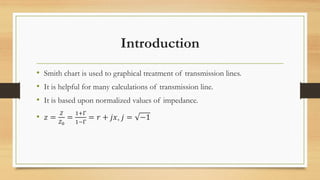
• Smith chart is used to graphical treatment of transmission lines.
• It is helpful for many calculations of transmission line.
• It is based upon normalized values of impedance.
• 𝑧 =
𝑍
𝑍0
=
1+Γ
1−Γ
= 𝑟 + 𝑗𝑥, 𝑗 = −1
Transmission lines
• Metallic conductor confines the TEM wave to the vicinity of dielectric
surrounded by conductor. (In transmission lines)
Primary line constant
Characteristic Impedance
• Energy travels along the transmission line and a portion of energy is reflected back
from the load.
• If we consider a transmission line of infinite length where signal will never reach
the load. In this case, the ratio of voltage to the current at any point will be called
characteristic impedance 𝑍0.
• For the transmission line of finite length, if load resistance 𝑍𝐿 is equal to 𝑍0, then
transmission line will appear as infinite line and energy will not be reflected back to
the line.
• Characteristic impedance 𝑍0 of a transmission line is defined as the ratio of voltage
to the current at any point on line where no reflected wave exist.
Characteristic impedance (Cont.)
• Characteristic impedance 𝑍0 is also related to primary line constant R, L, G and C.
• 𝑍0 =
𝑅+𝑗𝜔𝐿
𝐺+𝑗𝜔𝐶
where 𝑗 = −1
• For low frequency 𝑅 ≫ 𝜔𝐿 and 𝐺 ≫ 𝜔𝐶 and 𝑍0 =
𝑅
𝐺
• For high frequency 𝑍0 =
𝐿
𝐶
• In both case 𝑍0 is purely resistive.
Voltage reflection coefficient ( 𝚪𝐋 )
• It is the ratio of voltage of reflected wave (𝑉𝑅 ) at the load and voltage of
incident wave (𝑉𝐼 ) at the load.
• ΓL =
𝑉𝑅
𝑉𝐼
=
𝑍𝐿−𝑍0
𝑍𝐿+𝑍0
or Γ𝐿 =
1−
𝑍0
𝑍𝐿
1+
𝑍0
𝑍𝐿
or
𝑍0
𝑍𝐿
=
1−Γ𝐿
1+Γ𝐿
or
𝑍𝐿
𝑍0
=
1+Γ𝐿
1−Γ𝐿
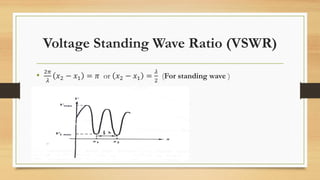
Voltage Standing Wave Ratio (VSWR)
•
2𝜋
𝜆
𝑥2 − 𝑥1 = 𝜋 or 𝑥2 − 𝑥1 =
𝜆
2
(For standing wave )
VSWR (Cont.)
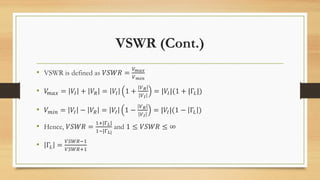
• VSWR is defined as 𝑉𝑆𝑊𝑅 =
𝑉𝑚𝑎𝑥
𝑉𝑚𝑖𝑛
• 𝑉
𝑚𝑎𝑥 = 𝑉𝐼 + 𝑉𝑅 = 𝑉𝐼 1 +
𝑉𝑅
𝑉𝐼
= |𝑉𝐼|(1 + |Γ𝐿|)
• 𝑉𝑚𝑖𝑛 = 𝑉𝐼 − 𝑉𝑅 = 𝑉𝐼 1 −
𝑉𝑅
𝑉𝐼
= |𝑉𝐼|(1 − Γ𝐿 )
• Hence, 𝑉𝑆𝑊𝑅 =
1+|Γ𝐿|
1−|Γ𝐿|
and 1 ≤ 𝑉𝑆𝑊𝑅 ≤ ∞
• Γ𝐿 =
𝑉𝑆𝑊𝑅−1
𝑉𝑆𝑊𝑅+1
Measurements at distance 𝒍 from the load
• The voltage reflection coefficient at distance 𝑙 from the load is given by
Γ =
𝑉𝑟
𝑉𝑖
, where 𝑉
𝑟 is the voltage of reflected wave and 𝑉𝑖 is the voltage of
incident wave.
• 𝑉
𝑟 = 𝑉𝑅𝑒−𝑗𝛽𝑙 and 𝑉𝑖 = 𝑉𝐼𝑒𝑗𝛽𝑙, Hence Γ = Γ𝐿𝑒−2𝑗𝛽𝑙
• Γ𝐿 may be complex and Γ𝐿 = Γ𝐿 𝑒𝑗ΦL, Φ𝐿 represents the phase difference
between incident and reflected wave at the load.
Measurements at distance 𝒍 from the load
(Cont.)
• Hence, Γ =
𝑉𝑟
𝑉𝑖
=
𝑍−𝑍0
𝑍+𝑍0
or
𝑍
𝑍0
=
1+Γ
1−Γ
= 𝑧, where z is called normalized resistance.
• And the angle Φ will be called the phase difference between reflected and incident
wave at a distance 𝑙 from the load.
• 𝑧 = 𝑟 + 𝑗𝑥, r is normalized resistance and x is normalized reactance. For +ve x,
nature is inductive and for –ve x, nature is capacitive.
• Normalized admittance 𝑦 = 𝑔 + 𝑗𝑏 =
1
𝑧
=
1−Γ
1+Γ
and −Γ = Γ ∠ 180𝑜 + Φ ,
where g is normalized conductance and b is normalized susceptance.
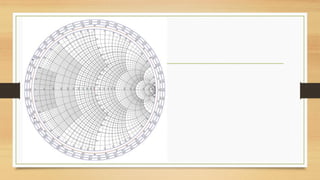
Smith Chart
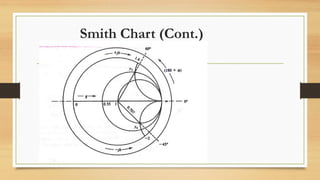
Smith Chart (Cont.)
Thank
You

Smith Chart msc.pdf

  • 1.
    Smith Chart Mohd Vasim D.J. College, Baraut (Baghpat)
  • 3.
    Introduction • Smith chartis used to graphical treatment of transmission lines. • It is helpful for many calculations of transmission line. • It is based upon normalized values of impedance. • 𝑧 = 𝑍 𝑍0 = 1+Γ 1−Γ = 𝑟 + 𝑗𝑥, 𝑗 = −1
  • 4.
    Transmission lines • Metallicconductor confines the TEM wave to the vicinity of dielectric surrounded by conductor. (In transmission lines)
  • 5.
  • 6.
    Characteristic Impedance • Energytravels along the transmission line and a portion of energy is reflected back from the load. • If we consider a transmission line of infinite length where signal will never reach the load. In this case, the ratio of voltage to the current at any point will be called characteristic impedance 𝑍0. • For the transmission line of finite length, if load resistance 𝑍𝐿 is equal to 𝑍0, then transmission line will appear as infinite line and energy will not be reflected back to the line. • Characteristic impedance 𝑍0 of a transmission line is defined as the ratio of voltage to the current at any point on line where no reflected wave exist.
  • 7.
    Characteristic impedance (Cont.) •Characteristic impedance 𝑍0 is also related to primary line constant R, L, G and C. • 𝑍0 = 𝑅+𝑗𝜔𝐿 𝐺+𝑗𝜔𝐶 where 𝑗 = −1 • For low frequency 𝑅 ≫ 𝜔𝐿 and 𝐺 ≫ 𝜔𝐶 and 𝑍0 = 𝑅 𝐺 • For high frequency 𝑍0 = 𝐿 𝐶 • In both case 𝑍0 is purely resistive.
  • 8.
    Voltage reflection coefficient( 𝚪𝐋 ) • It is the ratio of voltage of reflected wave (𝑉𝑅 ) at the load and voltage of incident wave (𝑉𝐼 ) at the load. • ΓL = 𝑉𝑅 𝑉𝐼 = 𝑍𝐿−𝑍0 𝑍𝐿+𝑍0 or Γ𝐿 = 1− 𝑍0 𝑍𝐿 1+ 𝑍0 𝑍𝐿 or 𝑍0 𝑍𝐿 = 1−Γ𝐿 1+Γ𝐿 or 𝑍𝐿 𝑍0 = 1+Γ𝐿 1−Γ𝐿
  • 9.
    Voltage Standing WaveRatio (VSWR) • 2𝜋 𝜆 𝑥2 − 𝑥1 = 𝜋 or 𝑥2 − 𝑥1 = 𝜆 2 (For standing wave )
  • 10.
    VSWR (Cont.) • VSWRis defined as 𝑉𝑆𝑊𝑅 = 𝑉𝑚𝑎𝑥 𝑉𝑚𝑖𝑛 • 𝑉 𝑚𝑎𝑥 = 𝑉𝐼 + 𝑉𝑅 = 𝑉𝐼 1 + 𝑉𝑅 𝑉𝐼 = |𝑉𝐼|(1 + |Γ𝐿|) • 𝑉𝑚𝑖𝑛 = 𝑉𝐼 − 𝑉𝑅 = 𝑉𝐼 1 − 𝑉𝑅 𝑉𝐼 = |𝑉𝐼|(1 − Γ𝐿 ) • Hence, 𝑉𝑆𝑊𝑅 = 1+|Γ𝐿| 1−|Γ𝐿| and 1 ≤ 𝑉𝑆𝑊𝑅 ≤ ∞ • Γ𝐿 = 𝑉𝑆𝑊𝑅−1 𝑉𝑆𝑊𝑅+1
  • 11.
    Measurements at distance𝒍 from the load • The voltage reflection coefficient at distance 𝑙 from the load is given by Γ = 𝑉𝑟 𝑉𝑖 , where 𝑉 𝑟 is the voltage of reflected wave and 𝑉𝑖 is the voltage of incident wave. • 𝑉 𝑟 = 𝑉𝑅𝑒−𝑗𝛽𝑙 and 𝑉𝑖 = 𝑉𝐼𝑒𝑗𝛽𝑙, Hence Γ = Γ𝐿𝑒−2𝑗𝛽𝑙 • Γ𝐿 may be complex and Γ𝐿 = Γ𝐿 𝑒𝑗ΦL, Φ𝐿 represents the phase difference between incident and reflected wave at the load.
  • 12.
    Measurements at distance𝒍 from the load (Cont.) • Hence, Γ = 𝑉𝑟 𝑉𝑖 = 𝑍−𝑍0 𝑍+𝑍0 or 𝑍 𝑍0 = 1+Γ 1−Γ = 𝑧, where z is called normalized resistance. • And the angle Φ will be called the phase difference between reflected and incident wave at a distance 𝑙 from the load. • 𝑧 = 𝑟 + 𝑗𝑥, r is normalized resistance and x is normalized reactance. For +ve x, nature is inductive and for –ve x, nature is capacitive. • Normalized admittance 𝑦 = 𝑔 + 𝑗𝑏 = 1 𝑧 = 1−Γ 1+Γ and −Γ = Γ ∠ 180𝑜 + Φ , where g is normalized conductance and b is normalized susceptance.
  • 13.
  • 14.
  • 17.