INTRODUCTION TO
TRANSMISSION LINES
PART II
DR. FARID FARAHMAND
FALL 2012
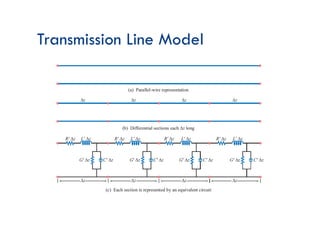
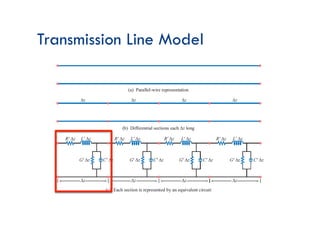
Transmission Line Model
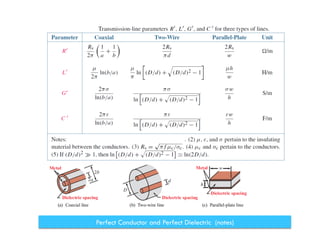
Perfect Conductor and Perfect Dielectric (notes)
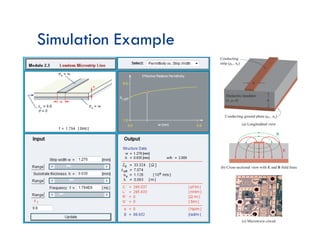
Simulation Example
Transmission Line Model
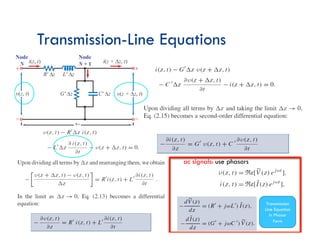
Transmission-Line Equations
Kirchhoff Voltage Law:
Vin-Vout – VRʼ – VLʼ=0
Kirchhoff Current Law:
Iin – Iout – Icʼ – IGʼ=0
Note:
VL=L . di/dt
Ic=C . dv/dt
Remember:
2
2
|
|
;
tan
1
|
|
|
)
(
|
)
(
]
Im[
)
sin(
]
Re[
)
cos(
)
sin(
)
cos(
B
A
C
A
B
jB
A
C
e
e
z
E
z
E
Ae
A
Ae
A
Aj
A
Ae
j
j
j
j
j
z
+
=
=
→
+
=
=
=
=
=
+
=
θ
θ
θ
θ
θ
θ
θ
θ
θ
θ
Transmission-Line Equations
ac signals: use phasors
Transmission
Line Equation
in Phasor
Form
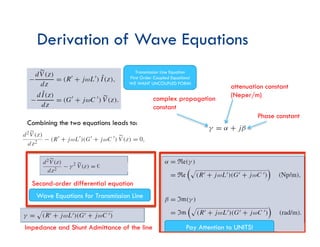
Derivation of Wave Equations
Combining the two equations leads to:
Second-order differential equation
complex propagation
constant
attenuation constant
(Neper/m)
Phase constant
Transmission Line Equation
First Order Coupled Equations!
WE WANT UNCOUPLED FORM!
Pay Attention to UNITS!
Wave Equations for Transmission Line
Impedance and Shunt Admittance of the line
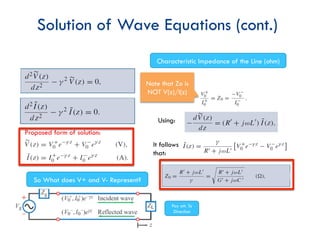
Solution of Wave Equations (cont.)
Proposed form of solution:
Using:
It follows
that:
Characteristic Impedance of the Line (ohm)
So What does V+ and V- Represent?
Pay att. To
Direction
Note that Zo is
NOT V(z)/I(z)
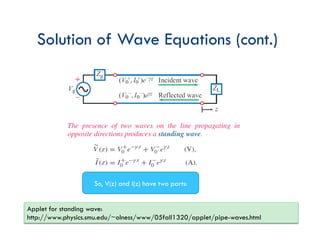
Solution of Wave Equations (cont.)
Applet for standing wave:
http://www.physics.smu.edu/~olness/www/05fall1320/applet/pipe-waves.html
So, V(z) and I(z) have two parts:
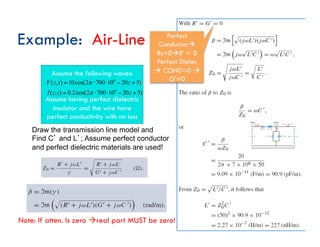
Assume the following waves:
Assume having perfect dielectric
insulator and the wire have
perfect conductivity with no loss
Example: Air-Line
Draw the transmission line model and
Find Cʼ and Lʼ; Assume perfect conductor
and perfect dielectric materials are used!
)
5
20
10
700
2
cos(
2
.
0
)
,
(
)
5
20
10
700
2
cos(
10
)
,
(
6
6
+
−
⋅
⋅
=
+
−
⋅
⋅
=
z
t
z
I
z
t
z
V
π
π
Perfect
Conductorà
Rs=0àR’ = 0
Perfect Dielec
à COND=0 à
G’=0
Note: If atten. Is zero àreal part MUST be zero!
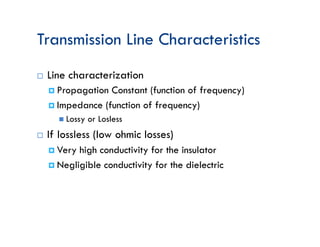
Transmission Line Characteristics
¨ Line characterization
¤ Propagation Constant (function of frequency)
¤ Impedance (function of frequency)
n Lossy or Losless
¨ If lossless (low ohmic losses)
¤ Very high conductivity for the insulator
¤ Negligible conductivity for the dielectric
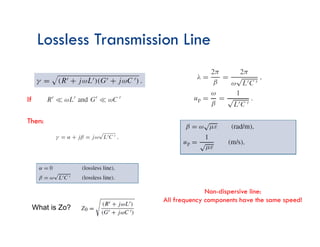
Lossless Transmission Line
If
Then:
Non-dispersive line:
All frequency components have the same speed!
What is Zo?
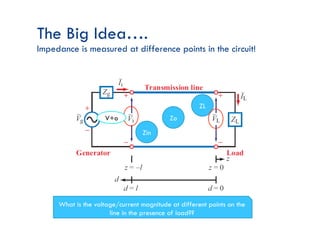
The Big Idea….
Impedance is measured at difference points in the circuit!
Zin
ZL
Zo
V+o
What is the voltage/current magnitude at different points on the
line in the presence of load??
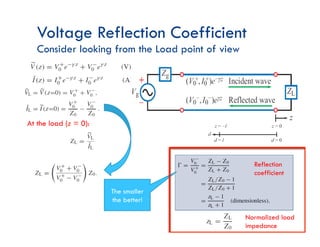
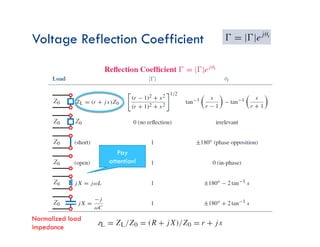
Voltage Reflection Coefficient
Consider looking from the Load point of view
At the load (z = 0):
Reflection
coefficient
Normalized load
impedance
The smaller
the better!
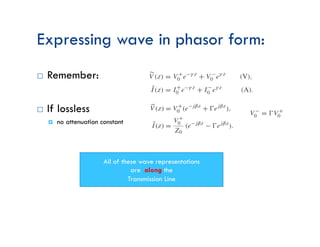
Expressing wave in phasor form:
¨ Remember:
¨ If lossless
¤ no attenuation constant
All of these wave representations
are along the
Transmission Line
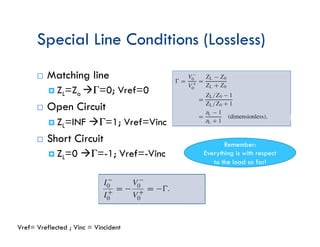
Special Line Conditions (Lossless)
¨ Matching line
¤ ZL=Zo àΓ=0; Vref=0
¨ Open Circuit
¤ ZL=INF àΓ=1; Vref=Vinc
¨ Short Circuit
¤ ZL=0 àΓ=-1; Vref=-Vinc
Remember:
Everything is with respect
to the load so far!
Vref= Vreflected ; Vinc = Vincident
Voltage Reflection Coefficient
Normalized load
impedance
Pay
attention!
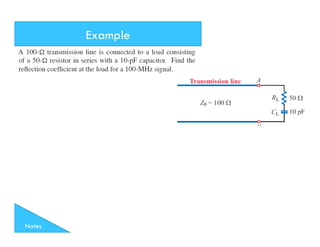
Example
Example
Example
Notes
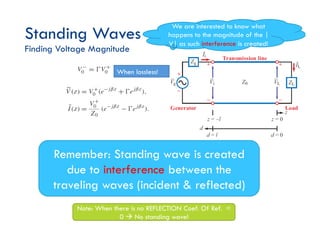
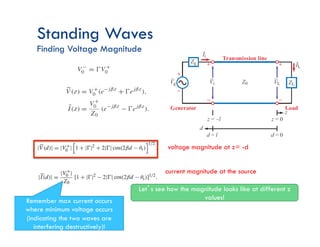
Standing Waves
Finding Voltage Magnitude
Note: When there is no REFLECTION Coef. Of Ref. =
0 à No standing wave!
Remember: Standing wave is created
due to interference between the
traveling waves (incident & reflected)
When lossless!
We are interested to know what
happens to the magnitude of the |
V| as such interference is created!
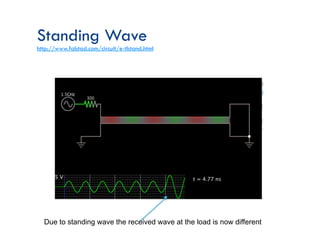
Standing Wave
http://www.falstad.com/circuit/e-tlstand.html
Due to standing wave the received wave at the load is now different
Standing Waves
Finding Voltage Magnitude
voltage magnitude at z= -d
current magnitude at the source
Letʼs see how the magnitude looks like at different z
values!
Remember max current occurs
where minimum voltage occurs
(indicating the two waves are
interfering destructively)!
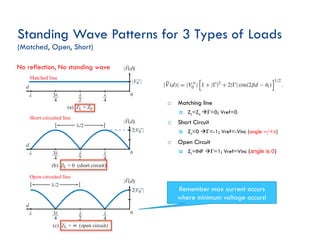
Standing Wave Patterns for 3 Types of Loads
(Matched, Open, Short)
¨ Matching line
¤ ZL=Zo àΓ=0; Vref=0
¨ Short Circuit
¤ ZL=0 àΓ=-1; Vref=-Vinc (angle –/+π)
¨ Open Circuit
¤ ZL=INF àΓ=1; Vref=Vinc (angle is 0)
Remember max current occurs
where minimum voltage occurs!
No reflection, No standing wave
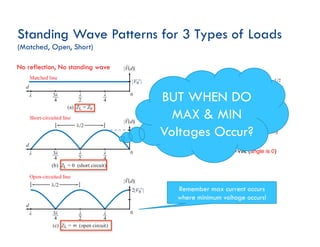
Standing Wave Patterns for 3 Types of Loads
(Matched, Open, Short)
¨ Matching line
¤ ZL=Zo àΓ=0; Vref=0
¨ Short Circuit
¤ ZL=0 àΓ=-1; Vref=-Vinc (angle –/+π)
¨ Open Circuit
¤ ZL=INF àΓ=1; Vref=Vinc (angle is 0)
Remember max current occurs
where minimum voltage occurs!
No reflection, No standing wave
BUT WHEN DO
MAX & MIN
Voltages Occur?
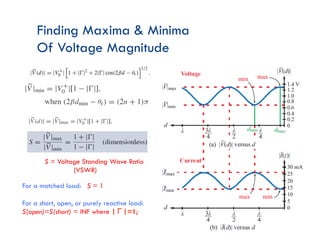
Finding Maxima & Minima
Of Voltage Magnitude
S = Voltage Standing Wave Ratio
(VSWR)
For a matched load: S = 1
For a short, open, or purely reactive load:
S(open)=S(short) = INF where |Γ|=1;
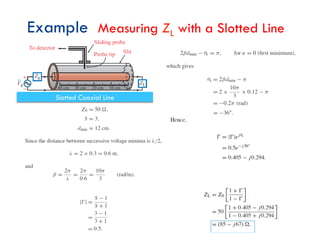
Example Measuring ZL with a Slotted Line
Slotted Coaxial Line
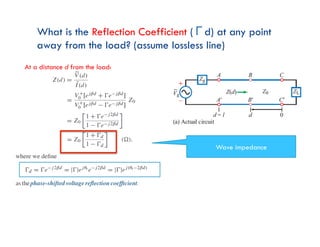
What is the Reflection Coefficient (Γd) at any point
away from the load? (assume lossless line)
At a distance d from the load:
Wave impedance
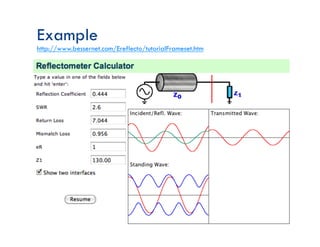
Example
http://www.bessernet.com/Ereflecto/tutorialFrameset.htm
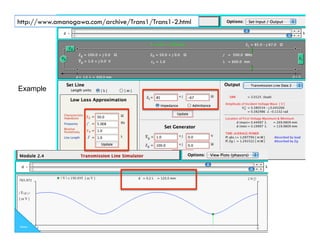
Example
Notes
http://www.amanogawa.com/archive/Trans1/Trans1-2.html
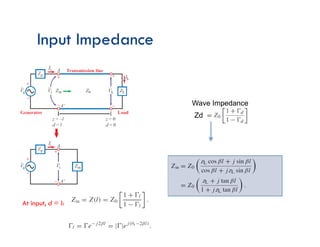
Input Impedance
At input, d = l:
Zd
Wave Impedance
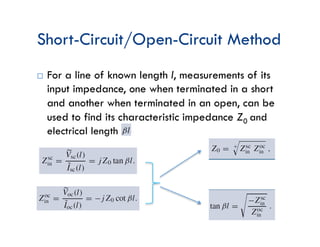
Short-Circuit/Open-Circuit Method
¨ For a line of known length l, measurements of its
input impedance, one when terminated in a short
and another when terminated in an open, can be
used to find its characteristic impedance Z0 and
electrical length
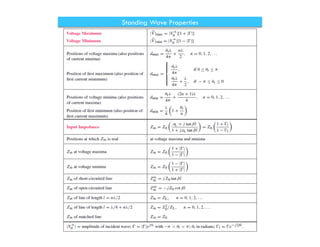
Standing Wave Properties
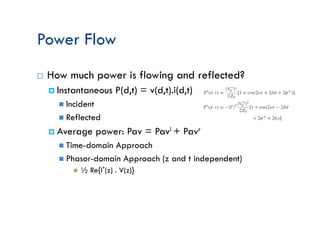
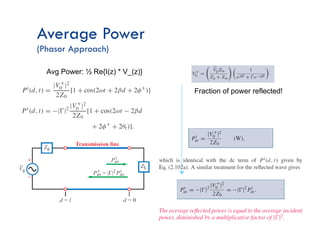
Power Flow
¨ How much power is flowing and reflected?
¤ Instantaneous P(d,t) = v(d,t).i(d,t)
n Incident
n Reflected
¤ Average power: Pav = Pavi + Pavr
n Time-domain Approach
n Phasor-domain Approach (z and t independent)
n ½ Re{I*(z) . V(z)}
Average Power
(Phasor Approach)
Fraction of power reflected!
Avg Power: ½ Re{I(z) * V_(z)}
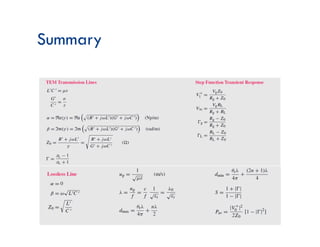
Summary
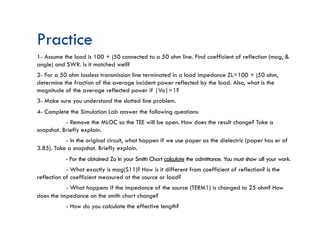
Practice
1- Assume the load is 100 + j50 connected to a 50 ohm line. Find coefficient of reflection (mag, &
angle) and SWR. Is it matched well?
2- For a 50 ohm lossless transmission line terminated in a load impedance ZL=100 + j50 ohm,
determine the fraction of the average incident power reflected by the load. Also, what is the
magnitude of the average reflected power if |Vo|=1?
3- Make sure you understand the slotted line problem.
4- Complete the Simulation Lab answer the following questions:
- Remove the MLOC so the TEE will be open. How does the result change? Take a
snapshot. Briefly explain.
- In the original circuit, what happen if we use paper as the dielectric (paper has er of
3.85). Take a snapshot. Briefly explain.
- For the obtained Zo in your Smith Chart calculate the admittance. You must show all your work.
- What exactly is mag(S11)? How is it different from coefficient of reflection? Is the
reflection of coefficient measured at the source or load?
- What happens if the impedance of the source (TERM1) is changed to 25 ohm? How
does the impedance on the smith chart change?
- How do you calculate the effective length?

TransmissionLinesPart_II.pdf

  • 1.
    INTRODUCTION TO TRANSMISSION LINES PARTII DR. FARID FARAHMAND FALL 2012
  • 2.
  • 3.
    Perfect Conductor andPerfect Dielectric (notes)
  • 4.
  • 5.
  • 6.
    Transmission-Line Equations Kirchhoff VoltageLaw: Vin-Vout – VRʼ – VLʼ=0 Kirchhoff Current Law: Iin – Iout – Icʼ – IGʼ=0 Note: VL=L . di/dt Ic=C . dv/dt Remember: 2 2 | | ; tan 1 | | | ) ( | ) ( ] Im[ ) sin( ] Re[ ) cos( ) sin( ) cos( B A C A B jB A C e e z E z E Ae A Ae A Aj A Ae j j j j j z + = = → + = = = = = + = θ θ θ θ θ θ θ θ θ θ
  • 7.
    Transmission-Line Equations ac signals:use phasors Transmission Line Equation in Phasor Form
  • 8.
    Derivation of WaveEquations Combining the two equations leads to: Second-order differential equation complex propagation constant attenuation constant (Neper/m) Phase constant Transmission Line Equation First Order Coupled Equations! WE WANT UNCOUPLED FORM! Pay Attention to UNITS! Wave Equations for Transmission Line Impedance and Shunt Admittance of the line
  • 9.
    Solution of WaveEquations (cont.) Proposed form of solution: Using: It follows that: Characteristic Impedance of the Line (ohm) So What does V+ and V- Represent? Pay att. To Direction Note that Zo is NOT V(z)/I(z)
  • 10.
    Solution of WaveEquations (cont.) Applet for standing wave: http://www.physics.smu.edu/~olness/www/05fall1320/applet/pipe-waves.html So, V(z) and I(z) have two parts:
  • 11.
    Assume the followingwaves: Assume having perfect dielectric insulator and the wire have perfect conductivity with no loss Example: Air-Line Draw the transmission line model and Find Cʼ and Lʼ; Assume perfect conductor and perfect dielectric materials are used! ) 5 20 10 700 2 cos( 2 . 0 ) , ( ) 5 20 10 700 2 cos( 10 ) , ( 6 6 + − ⋅ ⋅ = + − ⋅ ⋅ = z t z I z t z V π π Perfect Conductorà Rs=0àR’ = 0 Perfect Dielec à COND=0 à G’=0 Note: If atten. Is zero àreal part MUST be zero!
  • 12.
    Transmission Line Characteristics ¨Line characterization ¤ Propagation Constant (function of frequency) ¤ Impedance (function of frequency) n Lossy or Losless ¨ If lossless (low ohmic losses) ¤ Very high conductivity for the insulator ¤ Negligible conductivity for the dielectric
  • 13.
    Lossless Transmission Line If Then: Non-dispersiveline: All frequency components have the same speed! What is Zo?
  • 14.
    The Big Idea…. Impedanceis measured at difference points in the circuit! Zin ZL Zo V+o What is the voltage/current magnitude at different points on the line in the presence of load??
  • 15.
    Voltage Reflection Coefficient Considerlooking from the Load point of view At the load (z = 0): Reflection coefficient Normalized load impedance The smaller the better!
  • 16.
    Expressing wave inphasor form: ¨ Remember: ¨ If lossless ¤ no attenuation constant All of these wave representations are along the Transmission Line
  • 17.
    Special Line Conditions(Lossless) ¨ Matching line ¤ ZL=Zo àΓ=0; Vref=0 ¨ Open Circuit ¤ ZL=INF àΓ=1; Vref=Vinc ¨ Short Circuit ¤ ZL=0 àΓ=-1; Vref=-Vinc Remember: Everything is with respect to the load so far! Vref= Vreflected ; Vinc = Vincident
  • 18.
    Voltage Reflection Coefficient Normalizedload impedance Pay attention!
  • 19.
  • 20.
    Standing Waves Finding VoltageMagnitude Note: When there is no REFLECTION Coef. Of Ref. = 0 à No standing wave! Remember: Standing wave is created due to interference between the traveling waves (incident & reflected) When lossless! We are interested to know what happens to the magnitude of the | V| as such interference is created!
  • 21.
    Standing Wave http://www.falstad.com/circuit/e-tlstand.html Due tostanding wave the received wave at the load is now different
  • 22.
    Standing Waves Finding VoltageMagnitude voltage magnitude at z= -d current magnitude at the source Letʼs see how the magnitude looks like at different z values! Remember max current occurs where minimum voltage occurs (indicating the two waves are interfering destructively)!
  • 23.
    Standing Wave Patternsfor 3 Types of Loads (Matched, Open, Short) ¨ Matching line ¤ ZL=Zo àΓ=0; Vref=0 ¨ Short Circuit ¤ ZL=0 àΓ=-1; Vref=-Vinc (angle –/+π) ¨ Open Circuit ¤ ZL=INF àΓ=1; Vref=Vinc (angle is 0) Remember max current occurs where minimum voltage occurs! No reflection, No standing wave
  • 24.
    Standing Wave Patternsfor 3 Types of Loads (Matched, Open, Short) ¨ Matching line ¤ ZL=Zo àΓ=0; Vref=0 ¨ Short Circuit ¤ ZL=0 àΓ=-1; Vref=-Vinc (angle –/+π) ¨ Open Circuit ¤ ZL=INF àΓ=1; Vref=Vinc (angle is 0) Remember max current occurs where minimum voltage occurs! No reflection, No standing wave BUT WHEN DO MAX & MIN Voltages Occur?
  • 25.
    Finding Maxima &Minima Of Voltage Magnitude S = Voltage Standing Wave Ratio (VSWR) For a matched load: S = 1 For a short, open, or purely reactive load: S(open)=S(short) = INF where |Γ|=1;
  • 26.
    Example Measuring ZLwith a Slotted Line Slotted Coaxial Line
  • 27.
    What is theReflection Coefficient (Γd) at any point away from the load? (assume lossless line) At a distance d from the load: Wave impedance
  • 28.
  • 29.
  • 30.
    Input Impedance At input,d = l: Zd Wave Impedance
  • 31.
    Short-Circuit/Open-Circuit Method ¨ Fora line of known length l, measurements of its input impedance, one when terminated in a short and another when terminated in an open, can be used to find its characteristic impedance Z0 and electrical length
  • 32.
  • 33.
    Power Flow ¨ Howmuch power is flowing and reflected? ¤ Instantaneous P(d,t) = v(d,t).i(d,t) n Incident n Reflected ¤ Average power: Pav = Pavi + Pavr n Time-domain Approach n Phasor-domain Approach (z and t independent) n ½ Re{I*(z) . V(z)}
  • 34.
    Average Power (Phasor Approach) Fractionof power reflected! Avg Power: ½ Re{I(z) * V_(z)}
  • 35.
  • 36.
    Practice 1- Assume theload is 100 + j50 connected to a 50 ohm line. Find coefficient of reflection (mag, & angle) and SWR. Is it matched well? 2- For a 50 ohm lossless transmission line terminated in a load impedance ZL=100 + j50 ohm, determine the fraction of the average incident power reflected by the load. Also, what is the magnitude of the average reflected power if |Vo|=1? 3- Make sure you understand the slotted line problem. 4- Complete the Simulation Lab answer the following questions: - Remove the MLOC so the TEE will be open. How does the result change? Take a snapshot. Briefly explain. - In the original circuit, what happen if we use paper as the dielectric (paper has er of 3.85). Take a snapshot. Briefly explain. - For the obtained Zo in your Smith Chart calculate the admittance. You must show all your work. - What exactly is mag(S11)? How is it different from coefficient of reflection? Is the reflection of coefficient measured at the source or load? - What happens if the impedance of the source (TERM1) is changed to 25 ohm? How does the impedance on the smith chart change? - How do you calculate the effective length?