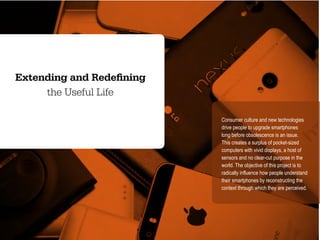
Extending and Redefining
the Useful Life
of Smartphones
Consumer culture and new technologies
drive people to upgrade smartphones
long before obsolescence is an issue.
This creates a surplus of pocket-sized
computers with vivid displays, a host of
sensors and no clear-cut purpose in the
world. The objective of this project is to
radically influence how people understand
their smartphones by reconstructing the
context through which they are perceived.
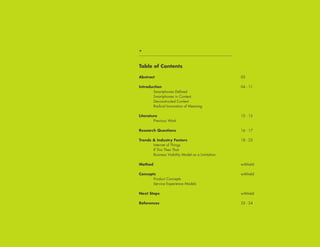
Table of Contents
Abstract 03
Introduction 04 - 11
Smartphones Defined
Smartphones in Context
Deconstructed Context
Radical Innovation of Meaning
Literature 12 - 15
Previous Work
Research Questions 16 - 17
Trends & Industry Factors 18 - 22
Internet of Things
If This Then That
Business Viability Model as a Limitation
Method withheld
Concepts withheld
Product Concepts
Service Experience Models
Next Steps withheld
References 23 - 24
+
Introduction
Smartphone Defined
Smartphones are some of the most
sophisticated, widespread and technologically
advanced devices on the planet. Smartphones
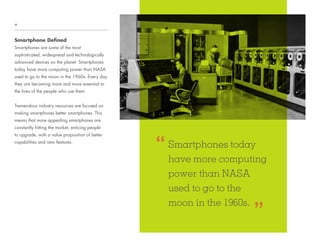
today have more computing power than NASA
used to go to the moon in the 1960s. Every day
they are becoming more and more essential to
the lives of the people who use them.
Tremendous industry resources are focused on
making smartphones better smartphones. This
means that more appealing smartphones are
constantly hitting the market, enticing people
to upgrade, with a value proposition of better
capabilities and new features.
+
Smartphones today
have more computing
power than NASA
used to go to the
moon in the 1960s.
“
”
Smartphones in Context
So what is a smartphone? What does it mean to the people who use them? A smartphone is how
we connect with the people we love, how we capture precious life events, and how we access the
wealth of information in the world. It’s the first thing we reach for when we wake up and the last
thing we set down before bed. It is a single device that is arguably more essential than any other in
our lives.
We understand smartphones in a very narrow and specific context. It is something that must
function in a myriad of different capacities. We must be able to hold it in our hand, it must have a
beautiful display and poses a multitude of sensors and features that are all powered by a reliable
battery which provides hours if not days of continuous use. With this long list of requirements,
comes an even longer list of trade-offs and compromises.
The whole industry is making incremental improvements that better satisfy the specific use case of
a smartphone. These improvements entice users to upgrade long before obsolescence is an issue -
and nobody needs more than one smartphone at the same time.
+
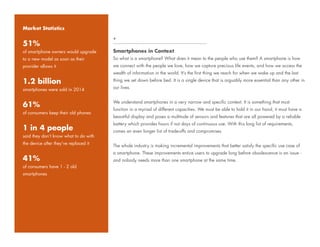
Market Statistics
51%
of smartphone owners would upgrade
to a new model as soon as their
provider allows it
1.2 billion
smartphones were sold in 2014
61%
of consumers keep their old phones
1 in 4 people
said they don’t know what to do with
the device after they’ve replaced it
41%
of consumers have 1 - 2 old
smartphones
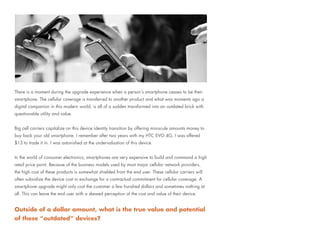
There is a moment during the upgrade experience when a person’s smartphone ceases to be their
smartphone. The cellular coverage is transferred to another product and what was moments ago a
digital companion in this modern world, is all of a sudden transformed into an outdated brick with
questionable utility and value.
Big cell carriers capitalize on this device identity transition by offering miniscule amounts money to
buy back your old smartphone. I remember after two years with my HTC EVO 4G, I was offered
$13 to trade it in. I was astonished at the undervaluation of this device.
In the world of consumer electronics, smartphones are very expensive to build and command a high
retail price point. Because of the business models used by most major cellular network providers,
the high cost of these products is somewhat shielded from the end user. These cellular carriers will
often subsidize the device cost in exchange for a contractual commitment for cellular coverage. A
smartphone upgrade might only cost the customer a few hundred dollars and sometimes nothing at
all. This can leave the end user with a skewed perception of the cost and value of their device.
Outside of a dollar amount, what is the true value and potential
of these “outdated” devices?
Deconstructed Context
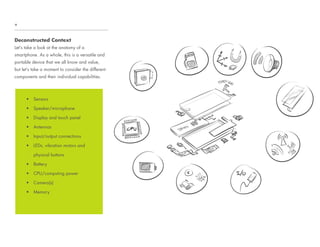
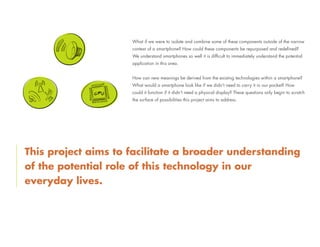
Let’s take a look at the anatomy of a
smartphone. As a whole, this is a versatile and
portable device that we all know and value,
but let’s take a moment to consider the different
components and their individual capabilities.
+
UÊ Sensors
UÊ Speaker/microphone
UÊ Display and touch panel
UÊ Antennas
UÊ Input/output connections
UÊ LEDs, vibration motors and
physical buttons
UÊ Battery
UÊ CPU/computing power
UÊ Camera(s)
UÊ Memory
What if we were to isolate and combine some of these components outside of the narrow
context of a smartphone? How could these components be repurposed and redefined?
We understand smartphones so well it is difficult to immediately understand the potential
application in this area.
How can new meanings be derived from the existing technologies within a smartphone?
What would a smartphone look like if we didn’t need to carry it in our pocket? How
could it function if it didn’t need a physical display? These questions only begin to scratch
the surface of possibilities this project aims to address.
This project aims to facilitate a broader understanding
of the potential role of this technology in our
everyday lives.
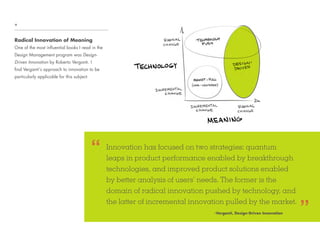
Radical Innovation of Meaning
One of the most influential books I read in the
Design Management program was Design-
Driven Innovation by Roberto Verganti. I
find Verganti’s approach to innovation to be
particularly applicable for this subject:
+
Innovation has focused on two strategies: quantum
leaps in product performance enabled by breakthrough
technologies, and improved product solutions enabled
by better analysis of users’ needs. The former is the
domain of radical innovation pushed by technology, and
the latter of incremental innovation pulled by the market.
“
”
-Verganti, Design-Driven Innovation
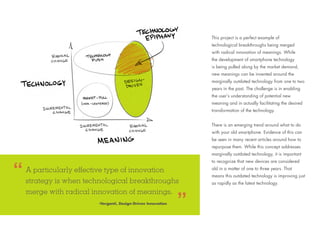
A particularly effective type of innovation
strategy is when technological breakthroughs
merge with radical innovation of meanings.
“
”
-Verganti, Design-Driven Innovation
This project is a perfect example of
technological breakthroughs being merged
with radical innovation of meanings. While
the development of smartphone technology
is being pulled along by the market demand,
new meanings can be invented around the
marginally outdated technology from one to two
years in the past. The challenge is in enabling
the user’s understanding of potential new
meaning and in actually facilitating the desired
transformation of the technology.
There is an emerging trend around what to do
with your old smartphone. Evidence of this can
be seen in many recent articles around how to
repurpose them. While this concept addresses
marginally outdated technology, it is important
to recognize that new devices are considered
old in a matter of one to three years. That
means this outdated technology is improving just
as rapidly as the latest technology.
Literature
Previous Work
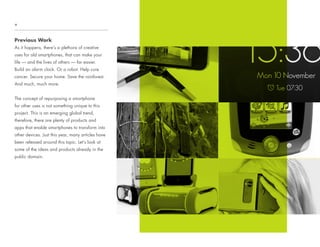
As it happens, there’s a plethora of creative
uses for old smartphones, that can make your
life — and the lives of others — far easier.
Build an alarm clock. Or a robot. Help cure
cancer. Secure your home. Save the rainforest.
And much, much more.
The concept of repurposing a smartphone
for other uses is not something unique to this
project. This is an emerging global trend,
therefore, there are plenty of products and
apps that enable smartphones to transform into
other devices. Just this year, many articles have
been released around this topic. Let’s look at
some of the ideas and products already in the
public domain.
+
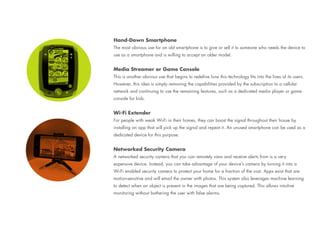
Hand-Down Smartphone
The most obvious use for an old smartphone is to give or sell it to someone who needs the device to
use as a smartphone and is willing to accept an older model.
Media Streamer or Game Console
This is another obvious use that begins to redefine how this technology fits into the lives of its users.
However, this idea is simply removing the capabilities provided by the subscription to a cellular
network and continuing to use the remaining features, such as a dedicated media player or game
console for kids.
Wi-Fi Extender
For people with weak Wi-Fi in their homes, they can boost the signal throughout their house by
installing an app that will pick up the signal and repeat it. An unused smartphone can be used as a
dedicated device for this purpose.
Networked Security Camera
A networked security camera that you can remotely view and receive alerts from is a very
expensive device. Instead, you can take advantage of your device’s camera by turning it into a
Wi-Fi enabled security camera to protect your home for a fraction of the cost. Apps exist that are
motion-sensitive and will email the owner with photos. This system also leverages machine learning
to detect when an object is present in the images that are being captured. This allows intuitive
monitoring without bothering the user with false alarms.
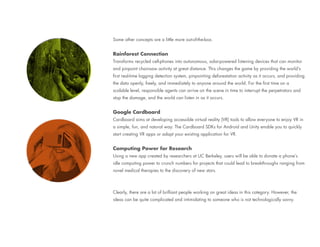
Some other concepts are a little more out-of-the-box.
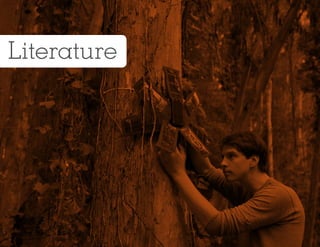
Rainforest Connection
Transforms recycled cell-phones into autonomous, solar-powered listening devices that can monitor
and pinpoint chainsaw activity at great distance. This changes the game by providing the world’s
first real-time logging detection system, pinpointing deforestation activity as it occurs, and providing
the data openly, freely, and immediately to anyone around the world. For the first time on a
scalable level, responsible agents can arrive on the scene in time to interrupt the perpetrators and
stop the damage, and the world can listen in as it occurs.
Google Cardboard
Cardboard aims at developing accessible virtual reality (VR) tools to allow everyone to enjoy VR in
a simple, fun, and natural way. The Cardboard SDKs for Android and Unity enable you to quickly
start creating VR apps or adapt your existing application for VR.
Computing Power for Research
Using a new app created by researchers at UC Berkeley, users will be able to donate a phone’s
idle computing power to crunch numbers for projects that could lead to breakthroughs ranging from
novel medical therapies to the discovery of new stars.
Clearly, there are a lot of brilliant people working on great ideas in this category. However, the
ideas can be quite complicated and intimidating to someone who is not technologically savvy.
Research Questions
+
How can all of the incredible and unexpected
potential uses for an old smartphone be made
more accessible and approachable to people?
Research Questions
+
How can we foster the creative thinking
responsible for these transformations?
Trends &
Industry Factors
Internet of Things
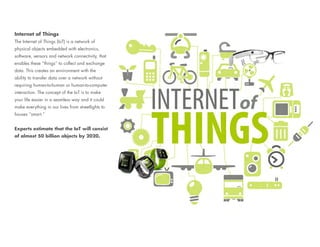
The Internet of Things (IoT) is a network of
physical objects embedded with electronics,
software, sensors and network connectivity, that
enables these “things” to collect and exchange
data. This creates an environment with the
ability to transfer data over a network without
requiring human-to-human or human-to-computer
interaction. The concept of the IoT is to make
your life easier in a seamless way and it could
make everything in our lives from streetlights to
houses “smart.”
Experts estimate that the IoT will consist
of almost 50 billion objects by 2020.
If This Then That
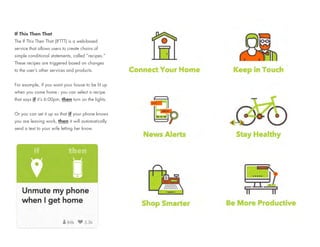
The If This Then That (IFTTT) is a web-based
service that allows users to create chains of
simple conditional statements, called “recipes.”
These recipes are triggered based on changes
to the user’s other services and products.
For example, if you want your house to be lit up
when you come home - you can select a recipe
that says if it’s 6:00pm, then turn on the lights.
Or you can set it up so that if your phone knows
you are leaving work, then it will automatically
send a text to your wife letting her know.
Business Viability Model as a Limitation
I personally, have worked in the consumer electronics industry for more than five years. My particular role is to identify new and exciting product
concepts to enrich the lives of our users. In my time in this industry and role, I have become very familiar with a paradigm: Just because a product
concept makes perfect sense from the perspective of a user, it is not necessarily justified for production from a business perspective. The cost of
materials required to build a specific product is referred to as a BOM (bill of materials).
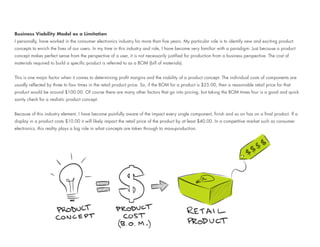
This is one major factor when it comes to determining profit margins and the viability of a product concept. The individual costs of components are
usually reflected by three to four times in the retail product price. So, if the BOM for a product is $25.00, then a reasonable retail price for that
product would be around $100.00. Of course there are many other factors that go into pricing, but taking the BOM times four is a good and quick
sanity check for a realistic product concept.
Because of this industry element, I have become painfully aware of the impact every single component, finish and so on has on a final product. If a
display in a product costs $10.00 it will likely impact the retail price of the product by at least $40.00. In a competitive market such as consumer
electronics, this reality plays a big role in what concepts are taken through to mass-production.
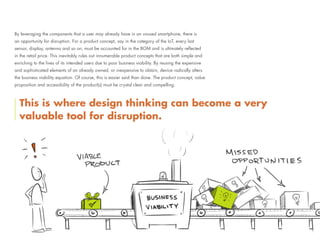
By leveraging the components that a user may already have in an unused smartphone, there is
an opportunity for disruption. For a product concept, say in the category of the IoT, every last
sensor, display, antenna and so on, must be accounted for in the BOM and is ultimately reflected
in the retail price. This inevitably rules out innumerable product concepts that are both simple and
enriching to the lives of its intended users due to poor business viability. By reusing the expensive
and sophisticated elements of an already owned, or inexpensive to obtain, device radically alters
the business viability equation. Of course, this is easier said than done. The product concept, value
proposition and accessibility of the product(s) must be crystal clear and compelling.
This is where design thinking can become a very
valuable tool for disruption.

Smartphone Design & Trend Analysis (UX Review)

  • 1.
    Extending and Redefining theUseful Life of Smartphones Consumer culture and new technologies drive people to upgrade smartphones long before obsolescence is an issue. This creates a surplus of pocket-sized computers with vivid displays, a host of sensors and no clear-cut purpose in the world. The objective of this project is to radically influence how people understand their smartphones by reconstructing the context through which they are perceived.
  • 2.
    Table of Contents Abstract03 Introduction 04 - 11 Smartphones Defined Smartphones in Context Deconstructed Context Radical Innovation of Meaning Literature 12 - 15 Previous Work Research Questions 16 - 17 Trends & Industry Factors 18 - 22 Internet of Things If This Then That Business Viability Model as a Limitation Method withheld Concepts withheld Product Concepts Service Experience Models Next Steps withheld References 23 - 24 +
  • 3.
  • 4.
    Smartphone Defined Smartphones aresome of the most sophisticated, widespread and technologically advanced devices on the planet. Smartphones today have more computing power than NASA used to go to the moon in the 1960s. Every day they are becoming more and more essential to the lives of the people who use them. Tremendous industry resources are focused on making smartphones better smartphones. This means that more appealing smartphones are constantly hitting the market, enticing people to upgrade, with a value proposition of better capabilities and new features. + Smartphones today have more computing power than NASA used to go to the moon in the 1960s. “ ”
  • 5.
    Smartphones in Context Sowhat is a smartphone? What does it mean to the people who use them? A smartphone is how we connect with the people we love, how we capture precious life events, and how we access the wealth of information in the world. It’s the first thing we reach for when we wake up and the last thing we set down before bed. It is a single device that is arguably more essential than any other in our lives. We understand smartphones in a very narrow and specific context. It is something that must function in a myriad of different capacities. We must be able to hold it in our hand, it must have a beautiful display and poses a multitude of sensors and features that are all powered by a reliable battery which provides hours if not days of continuous use. With this long list of requirements, comes an even longer list of trade-offs and compromises. The whole industry is making incremental improvements that better satisfy the specific use case of a smartphone. These improvements entice users to upgrade long before obsolescence is an issue - and nobody needs more than one smartphone at the same time. + Market Statistics 51% of smartphone owners would upgrade to a new model as soon as their provider allows it 1.2 billion smartphones were sold in 2014 61% of consumers keep their old phones 1 in 4 people said they don’t know what to do with the device after they’ve replaced it 41% of consumers have 1 - 2 old smartphones
  • 6.
    There is amoment during the upgrade experience when a person’s smartphone ceases to be their smartphone. The cellular coverage is transferred to another product and what was moments ago a digital companion in this modern world, is all of a sudden transformed into an outdated brick with questionable utility and value. Big cell carriers capitalize on this device identity transition by offering miniscule amounts money to buy back your old smartphone. I remember after two years with my HTC EVO 4G, I was offered $13 to trade it in. I was astonished at the undervaluation of this device. In the world of consumer electronics, smartphones are very expensive to build and command a high retail price point. Because of the business models used by most major cellular network providers, the high cost of these products is somewhat shielded from the end user. These cellular carriers will often subsidize the device cost in exchange for a contractual commitment for cellular coverage. A smartphone upgrade might only cost the customer a few hundred dollars and sometimes nothing at all. This can leave the end user with a skewed perception of the cost and value of their device. Outside of a dollar amount, what is the true value and potential of these “outdated” devices?
  • 7.
    Deconstructed Context Let’s takea look at the anatomy of a smartphone. As a whole, this is a versatile and portable device that we all know and value, but let’s take a moment to consider the different components and their individual capabilities. + UÊ Sensors UÊ Speaker/microphone UÊ Display and touch panel UÊ Antennas UÊ Input/output connections UÊ LEDs, vibration motors and physical buttons UÊ Battery UÊ CPU/computing power UÊ Camera(s) UÊ Memory
  • 8.
    What if wewere to isolate and combine some of these components outside of the narrow context of a smartphone? How could these components be repurposed and redefined? We understand smartphones so well it is difficult to immediately understand the potential application in this area. How can new meanings be derived from the existing technologies within a smartphone? What would a smartphone look like if we didn’t need to carry it in our pocket? How could it function if it didn’t need a physical display? These questions only begin to scratch the surface of possibilities this project aims to address. This project aims to facilitate a broader understanding of the potential role of this technology in our everyday lives.
  • 9.
    Radical Innovation ofMeaning One of the most influential books I read in the Design Management program was Design- Driven Innovation by Roberto Verganti. I find Verganti’s approach to innovation to be particularly applicable for this subject: + Innovation has focused on two strategies: quantum leaps in product performance enabled by breakthrough technologies, and improved product solutions enabled by better analysis of users’ needs. The former is the domain of radical innovation pushed by technology, and the latter of incremental innovation pulled by the market. “ ” -Verganti, Design-Driven Innovation
  • 10.
    A particularly effectivetype of innovation strategy is when technological breakthroughs merge with radical innovation of meanings. “ ” -Verganti, Design-Driven Innovation This project is a perfect example of technological breakthroughs being merged with radical innovation of meanings. While the development of smartphone technology is being pulled along by the market demand, new meanings can be invented around the marginally outdated technology from one to two years in the past. The challenge is in enabling the user’s understanding of potential new meaning and in actually facilitating the desired transformation of the technology. There is an emerging trend around what to do with your old smartphone. Evidence of this can be seen in many recent articles around how to repurpose them. While this concept addresses marginally outdated technology, it is important to recognize that new devices are considered old in a matter of one to three years. That means this outdated technology is improving just as rapidly as the latest technology.
  • 11.
  • 12.
    Previous Work As ithappens, there’s a plethora of creative uses for old smartphones, that can make your life — and the lives of others — far easier. Build an alarm clock. Or a robot. Help cure cancer. Secure your home. Save the rainforest. And much, much more. The concept of repurposing a smartphone for other uses is not something unique to this project. This is an emerging global trend, therefore, there are plenty of products and apps that enable smartphones to transform into other devices. Just this year, many articles have been released around this topic. Let’s look at some of the ideas and products already in the public domain. +
  • 13.
    Hand-Down Smartphone The mostobvious use for an old smartphone is to give or sell it to someone who needs the device to use as a smartphone and is willing to accept an older model. Media Streamer or Game Console This is another obvious use that begins to redefine how this technology fits into the lives of its users. However, this idea is simply removing the capabilities provided by the subscription to a cellular network and continuing to use the remaining features, such as a dedicated media player or game console for kids. Wi-Fi Extender For people with weak Wi-Fi in their homes, they can boost the signal throughout their house by installing an app that will pick up the signal and repeat it. An unused smartphone can be used as a dedicated device for this purpose. Networked Security Camera A networked security camera that you can remotely view and receive alerts from is a very expensive device. Instead, you can take advantage of your device’s camera by turning it into a Wi-Fi enabled security camera to protect your home for a fraction of the cost. Apps exist that are motion-sensitive and will email the owner with photos. This system also leverages machine learning to detect when an object is present in the images that are being captured. This allows intuitive monitoring without bothering the user with false alarms.
  • 14.
    Some other conceptsare a little more out-of-the-box. Rainforest Connection Transforms recycled cell-phones into autonomous, solar-powered listening devices that can monitor and pinpoint chainsaw activity at great distance. This changes the game by providing the world’s first real-time logging detection system, pinpointing deforestation activity as it occurs, and providing the data openly, freely, and immediately to anyone around the world. For the first time on a scalable level, responsible agents can arrive on the scene in time to interrupt the perpetrators and stop the damage, and the world can listen in as it occurs. Google Cardboard Cardboard aims at developing accessible virtual reality (VR) tools to allow everyone to enjoy VR in a simple, fun, and natural way. The Cardboard SDKs for Android and Unity enable you to quickly start creating VR apps or adapt your existing application for VR. Computing Power for Research Using a new app created by researchers at UC Berkeley, users will be able to donate a phone’s idle computing power to crunch numbers for projects that could lead to breakthroughs ranging from novel medical therapies to the discovery of new stars. Clearly, there are a lot of brilliant people working on great ideas in this category. However, the ideas can be quite complicated and intimidating to someone who is not technologically savvy.
  • 15.
    Research Questions + How canall of the incredible and unexpected potential uses for an old smartphone be made more accessible and approachable to people?
  • 16.
    Research Questions + How canwe foster the creative thinking responsible for these transformations?
  • 17.
  • 18.
    Internet of Things TheInternet of Things (IoT) is a network of physical objects embedded with electronics, software, sensors and network connectivity, that enables these “things” to collect and exchange data. This creates an environment with the ability to transfer data over a network without requiring human-to-human or human-to-computer interaction. The concept of the IoT is to make your life easier in a seamless way and it could make everything in our lives from streetlights to houses “smart.” Experts estimate that the IoT will consist of almost 50 billion objects by 2020.
  • 19.
    If This ThenThat The If This Then That (IFTTT) is a web-based service that allows users to create chains of simple conditional statements, called “recipes.” These recipes are triggered based on changes to the user’s other services and products. For example, if you want your house to be lit up when you come home - you can select a recipe that says if it’s 6:00pm, then turn on the lights. Or you can set it up so that if your phone knows you are leaving work, then it will automatically send a text to your wife letting her know.
  • 20.
    Business Viability Modelas a Limitation I personally, have worked in the consumer electronics industry for more than five years. My particular role is to identify new and exciting product concepts to enrich the lives of our users. In my time in this industry and role, I have become very familiar with a paradigm: Just because a product concept makes perfect sense from the perspective of a user, it is not necessarily justified for production from a business perspective. The cost of materials required to build a specific product is referred to as a BOM (bill of materials). This is one major factor when it comes to determining profit margins and the viability of a product concept. The individual costs of components are usually reflected by three to four times in the retail product price. So, if the BOM for a product is $25.00, then a reasonable retail price for that product would be around $100.00. Of course there are many other factors that go into pricing, but taking the BOM times four is a good and quick sanity check for a realistic product concept. Because of this industry element, I have become painfully aware of the impact every single component, finish and so on has on a final product. If a display in a product costs $10.00 it will likely impact the retail price of the product by at least $40.00. In a competitive market such as consumer electronics, this reality plays a big role in what concepts are taken through to mass-production.
  • 21.
    By leveraging thecomponents that a user may already have in an unused smartphone, there is an opportunity for disruption. For a product concept, say in the category of the IoT, every last sensor, display, antenna and so on, must be accounted for in the BOM and is ultimately reflected in the retail price. This inevitably rules out innumerable product concepts that are both simple and enriching to the lives of its intended users due to poor business viability. By reusing the expensive and sophisticated elements of an already owned, or inexpensive to obtain, device radically alters the business viability equation. Of course, this is easier said than done. The product concept, value proposition and accessibility of the product(s) must be crystal clear and compelling. This is where design thinking can become a very valuable tool for disruption.