International Research Journal of Engineering and Technology (IRJET) e-ISSN: 2395-0056
Volume: 09 Issue: 05 | May 2022 www.irjet.net p-ISSN: 2395-0072
© 2022, IRJET | Impact Factor value: 7.529 | ISO 9001:2008 Certified Journal | Page 861
SMART WASTE MANAGEMENT SYSTEM
Shraddha Golande1, Kaushal Purohit2, Aalok Marathe3, Anuja Ghotekar4,
Ms. Sonam Borhade5
1,2,3,4 B.Tech student, Computer Science, Sinhgad Institute of Technology and Science , Pune, India
5B.Tech Professor, Computer Science, Sinhgad Institute of Technology and Science , Pune, India
---------------------------------------------------------------------***---------------------------------------------------------------------
Abstract - Current waste management systems are
inefficient and costly. Electronic sensors can be used to
efficiently manage the waste and significantly reduce the
cost of man labor. In this project raspberry Pi is used along
with servo motors and conveyor belt. TensorFlow is used to
build the waste object detection model. Waste will be
carried by the conveyor belt and servo motors will turn the
flaps in order to segregate the waste into solid and wet
waste.
Key Words: Object detection, waste management
system, TensorFlow
1. INTRODUCTION
2.01 billion tons of municipal waste is being generated
worldwide every year. It is projected to increase at least
by 70% to reach 3.4 billion tons by 2050 due to rapid
urbanization, population growth and economic
development unless urgent measures are not taken.
Segregation at the source level is critical to its recycling
and disposal. Lack of segregation, collection and
transportation of unsegregated mixed waste being
dumped in the landfills has an impact on the environment.
During such times reducing man labor and automating the
tasks of segregation and collection to increase the
efficiency can be helpful and this project helps in achieving
the same. It helps in reducing the labor cost as well as
helps in segregating the waste in the form of solid and wet
waste.
1.1 INTERNET OF THINGS
The Internet of Things helps in acknowledging the objects
in the real world with the help of cameras, sensors and
various softwares who have the ability to process it over
the internet or other networks used in communication.
Advancements in the field of Internet of Things have made
it possible to improve the existing waste management
system. Implementation of the sensors in the waste bin
along with Internet of Things connectivity allows for the
real-time monitoring of the waste being collected, which is
absent in the existing waste management system. Data
such as the type of waste, and any necessary data can be
collected from the sensors. This data can then be uploaded
to the cloud for storage and processing. The processed
data can then be used to study and assess the limitations
of the existing waste management system and hence
improve the system’s efficiency as a whole. The Internet of
Things application in the waste bin is one step towards a
smart city. With the help of Internet of Things, the workers
can get to know the actual fill level of each compartment of
the segregated waste, which will further help them in the
management phase and also cut the management costs
considerably. The waste can also be segregated in solid
and wet waste. With the help of Internet of Things one can
also record the number of times the bin has been emptied.
2. Requirements
Following are the requirements for the smart waste
management system.
● Raspberry Pi 4B (4GB ram or more)
● Moisture sensor
● Servo motors
● Conveyor belt
● Pi camera (5MP or more)
3. METHODOLOGY
3.1 IMPLEMENTATION
The camera module is connected to Raspberry Pi to
capture the waste image for the purpose of object
detection and identification. Waste is dumped on the
conveyor belt and the raspberry pi detects it. After this the
waste will come in front of the moisture detector and then
the detector will check whether there is moisture present
or not. After the waste is detected, we will carry out
classification with the help of SVM (Support Vector
Machine) algorithm. And then after applying CNN
(Convolution neural network) model we can detect the
waste and determine whether it is solid or wet waste.
Waste detected is added to the database by calling the api.
Then the flaps will turn accordingly to dump the waste in
the specified bin. If there is moisture present in the waste
,then that particular waste will be dropped off at the wet
waste compartment. Speed of the conveyor is to be
considered with reference to the time required by the
object detection model to identify the waste.
International Research Journal of Engineering and Technology (IRJET) e-ISSN: 2395-0056
Volume: 09 Issue: 05 | May 2022 www.irjet.net p-ISSN: 2395-0072
© 2022, IRJET | Impact Factor value: 7.529 | ISO 9001:2008 Certified Journal | Page 862
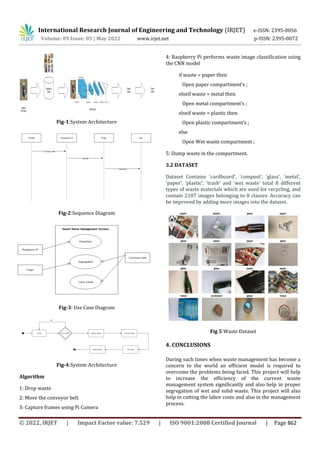
Fig-1:System Architecture
Fig-2:Sequence Diagram
Fig-3: Use Case Diagram
Fig-4:System Architecture
Algorithm
1: Drop waste
2: Move the conveyor belt
3: Capture frames using Pi Camera
4: Raspberry Pi performs waste image classification using
the CNN model
if waste = paper then
Open paper compartment’s ;
elseif waste = metal then
Open metal compartment’s ;
elseif waste = plastic then
Open plastic compartment’s ;
else
Open Wet waste compartment ;
5: Dump waste in the compartment.
3.2 DATASET
Dataset Contains 'cardboard', 'compost', 'glass', 'metal',
'paper', 'plastic', 'trash' and ‘wet waste’ total 8 different
types of waste materials which are used for recycling, and
contain 2187 images belonging to 8 classes. Accuracy can
be improved by adding more images into the dataset.
Fig 5:Waste Dataset
4. CONCLUSIONS
During such times when waste management has become a
concern to the world an efficient model is required to
overcome the problems being faced. This project will help
to increase the efficiency of the current waste
management system significantly and also help in proper
segregation of wet and solid waste. This project will also
help in cutting the labor costs and also in the management
process.
International Research Journal of Engineering and Technology (IRJET) e-ISSN: 2395-0056
Volume: 09 Issue: 05 | May 2022 www.irjet.net p-ISSN: 2395-0072
© 2022, IRJET | Impact Factor value: 7.529 | ISO 9001:2008 Certified Journal | Page 863
5. ACKNOWLEDGEMENT
We would like to thank our Principal Dr. S. D. Markande,
Head of the Department Dr.Geeta S. Navale, our project
Coordinator Mrs. B. D. Shendkar, our guide Ms. Sonam
Borhade for their valuable advice and technical assistance.
REFERENCES
[1] M. Shahidul Islam, M. T. Islam, A. F. Almutairi, G. K.
Beng, N. Misran, and N. Amin, “Monitoring of the human
body signal through the Internet of Things (IoT) based
LoRa wireless network system,” Appl. Sci., vol. 9, no. 9, p.
1884, May 2019.
[2] M. A. Abu, N. H. Indra, A. H. A. Rahman, N. A. Sapiee, and
I. Ahmad, “A study on image classification based on deep
learning and tensorflow,” Int. J. Eng. Res. Technol., vol. 12,
pp. 563–569, Oct. 2019.
[3] N. Misran, M. S. Islam, G. K. Beng, N. Amin, and M. T.
Islam, “IoT based health monitoring system with LoRa
communication technology,”in Proc. Int. Conf. Electr. Eng.
Informat. (ICEEI), Bandung, IN, USA, 2019, pp. 514–517.
[4]K. Kumar and S. Kumar, “Energy efficient link stable
routing in Internet of Things,” International Journal of
Information Technology, vol. 10, no. 4, pp. 465–479, 2018.
[5] A. Meijer and M.P.R.Bol´ıvar, “Governing The
Smartcity:A Review Of The literature on smart urban
governance,” Int. Rev. Adm. Sci., vol. 82, no. 2, pp. 392–408,
2016.
[6] A. Zanella, N. Bui, A. Castellani, L. Vangelista, and M.
Zorzi, “Internet of Things for smart cities,’ ’IEEE Internet
Things J.,vol.1,no.1, pp. 22–32, Feb. 2014.
[7] O. Vermesan, P. Friess, P. Guillemin et al., “Internet of
things strategic research roadmap,” Internet of Things-
Global Technological and Societal Trends, vol. 1, pp. 9–52,
2011.
[8] L. Atzori, A. Iera, and G. Morabito, “The Internet of
Things: A survey,” Comput. Netw., vol. 54, no. 15, pp.
2787–2805, Oct. 2010.
[9] M.O.Saeed,M.N.Hassan, and M.A.Mujeebu,“Assessment
Of Municipal solid waste generation and recyclable
materials potential in kuala lumpur, malaysia,” Waste
Manage., vol. 29, no. 7, pp. 2209–2213, Jul. 2009.
BIOGRAPHIES
Shraddha Golande is currently a final year B.student of
savitribai phule pune University.
Kaushal Purohit is currently a final year B.student of
savitribai phule pune University.
Aalok Marathe is currently a final year B.student of
savitribai phule pune University.
Anuja Ghotkar is currently a final year B.student of
savitribai phule pune University
Ms. Sonam Borhade is currently working as a Professor
in Sinhgad Institute of Technology and Science, Narhe

SMART WASTE MANAGEMENT SYSTEM

  • 1.
    International Research Journalof Engineering and Technology (IRJET) e-ISSN: 2395-0056 Volume: 09 Issue: 05 | May 2022 www.irjet.net p-ISSN: 2395-0072 © 2022, IRJET | Impact Factor value: 7.529 | ISO 9001:2008 Certified Journal | Page 861 SMART WASTE MANAGEMENT SYSTEM Shraddha Golande1, Kaushal Purohit2, Aalok Marathe3, Anuja Ghotekar4, Ms. Sonam Borhade5 1,2,3,4 B.Tech student, Computer Science, Sinhgad Institute of Technology and Science , Pune, India 5B.Tech Professor, Computer Science, Sinhgad Institute of Technology and Science , Pune, India ---------------------------------------------------------------------***--------------------------------------------------------------------- Abstract - Current waste management systems are inefficient and costly. Electronic sensors can be used to efficiently manage the waste and significantly reduce the cost of man labor. In this project raspberry Pi is used along with servo motors and conveyor belt. TensorFlow is used to build the waste object detection model. Waste will be carried by the conveyor belt and servo motors will turn the flaps in order to segregate the waste into solid and wet waste. Key Words: Object detection, waste management system, TensorFlow 1. INTRODUCTION 2.01 billion tons of municipal waste is being generated worldwide every year. It is projected to increase at least by 70% to reach 3.4 billion tons by 2050 due to rapid urbanization, population growth and economic development unless urgent measures are not taken. Segregation at the source level is critical to its recycling and disposal. Lack of segregation, collection and transportation of unsegregated mixed waste being dumped in the landfills has an impact on the environment. During such times reducing man labor and automating the tasks of segregation and collection to increase the efficiency can be helpful and this project helps in achieving the same. It helps in reducing the labor cost as well as helps in segregating the waste in the form of solid and wet waste. 1.1 INTERNET OF THINGS The Internet of Things helps in acknowledging the objects in the real world with the help of cameras, sensors and various softwares who have the ability to process it over the internet or other networks used in communication. Advancements in the field of Internet of Things have made it possible to improve the existing waste management system. Implementation of the sensors in the waste bin along with Internet of Things connectivity allows for the real-time monitoring of the waste being collected, which is absent in the existing waste management system. Data such as the type of waste, and any necessary data can be collected from the sensors. This data can then be uploaded to the cloud for storage and processing. The processed data can then be used to study and assess the limitations of the existing waste management system and hence improve the system’s efficiency as a whole. The Internet of Things application in the waste bin is one step towards a smart city. With the help of Internet of Things, the workers can get to know the actual fill level of each compartment of the segregated waste, which will further help them in the management phase and also cut the management costs considerably. The waste can also be segregated in solid and wet waste. With the help of Internet of Things one can also record the number of times the bin has been emptied. 2. Requirements Following are the requirements for the smart waste management system. ● Raspberry Pi 4B (4GB ram or more) ● Moisture sensor ● Servo motors ● Conveyor belt ● Pi camera (5MP or more) 3. METHODOLOGY 3.1 IMPLEMENTATION The camera module is connected to Raspberry Pi to capture the waste image for the purpose of object detection and identification. Waste is dumped on the conveyor belt and the raspberry pi detects it. After this the waste will come in front of the moisture detector and then the detector will check whether there is moisture present or not. After the waste is detected, we will carry out classification with the help of SVM (Support Vector Machine) algorithm. And then after applying CNN (Convolution neural network) model we can detect the waste and determine whether it is solid or wet waste. Waste detected is added to the database by calling the api. Then the flaps will turn accordingly to dump the waste in the specified bin. If there is moisture present in the waste ,then that particular waste will be dropped off at the wet waste compartment. Speed of the conveyor is to be considered with reference to the time required by the object detection model to identify the waste.
  • 2.
    International Research Journalof Engineering and Technology (IRJET) e-ISSN: 2395-0056 Volume: 09 Issue: 05 | May 2022 www.irjet.net p-ISSN: 2395-0072 © 2022, IRJET | Impact Factor value: 7.529 | ISO 9001:2008 Certified Journal | Page 862 Fig-1:System Architecture Fig-2:Sequence Diagram Fig-3: Use Case Diagram Fig-4:System Architecture Algorithm 1: Drop waste 2: Move the conveyor belt 3: Capture frames using Pi Camera 4: Raspberry Pi performs waste image classification using the CNN model if waste = paper then Open paper compartment’s ; elseif waste = metal then Open metal compartment’s ; elseif waste = plastic then Open plastic compartment’s ; else Open Wet waste compartment ; 5: Dump waste in the compartment. 3.2 DATASET Dataset Contains 'cardboard', 'compost', 'glass', 'metal', 'paper', 'plastic', 'trash' and ‘wet waste’ total 8 different types of waste materials which are used for recycling, and contain 2187 images belonging to 8 classes. Accuracy can be improved by adding more images into the dataset. Fig 5:Waste Dataset 4. CONCLUSIONS During such times when waste management has become a concern to the world an efficient model is required to overcome the problems being faced. This project will help to increase the efficiency of the current waste management system significantly and also help in proper segregation of wet and solid waste. This project will also help in cutting the labor costs and also in the management process.
  • 3.
    International Research Journalof Engineering and Technology (IRJET) e-ISSN: 2395-0056 Volume: 09 Issue: 05 | May 2022 www.irjet.net p-ISSN: 2395-0072 © 2022, IRJET | Impact Factor value: 7.529 | ISO 9001:2008 Certified Journal | Page 863 5. ACKNOWLEDGEMENT We would like to thank our Principal Dr. S. D. Markande, Head of the Department Dr.Geeta S. Navale, our project Coordinator Mrs. B. D. Shendkar, our guide Ms. Sonam Borhade for their valuable advice and technical assistance. REFERENCES [1] M. Shahidul Islam, M. T. Islam, A. F. Almutairi, G. K. Beng, N. Misran, and N. Amin, “Monitoring of the human body signal through the Internet of Things (IoT) based LoRa wireless network system,” Appl. Sci., vol. 9, no. 9, p. 1884, May 2019. [2] M. A. Abu, N. H. Indra, A. H. A. Rahman, N. A. Sapiee, and I. Ahmad, “A study on image classification based on deep learning and tensorflow,” Int. J. Eng. Res. Technol., vol. 12, pp. 563–569, Oct. 2019. [3] N. Misran, M. S. Islam, G. K. Beng, N. Amin, and M. T. Islam, “IoT based health monitoring system with LoRa communication technology,”in Proc. Int. Conf. Electr. Eng. Informat. (ICEEI), Bandung, IN, USA, 2019, pp. 514–517. [4]K. Kumar and S. Kumar, “Energy efficient link stable routing in Internet of Things,” International Journal of Information Technology, vol. 10, no. 4, pp. 465–479, 2018. [5] A. Meijer and M.P.R.Bol´ıvar, “Governing The Smartcity:A Review Of The literature on smart urban governance,” Int. Rev. Adm. Sci., vol. 82, no. 2, pp. 392–408, 2016. [6] A. Zanella, N. Bui, A. Castellani, L. Vangelista, and M. Zorzi, “Internet of Things for smart cities,’ ’IEEE Internet Things J.,vol.1,no.1, pp. 22–32, Feb. 2014. [7] O. Vermesan, P. Friess, P. Guillemin et al., “Internet of things strategic research roadmap,” Internet of Things- Global Technological and Societal Trends, vol. 1, pp. 9–52, 2011. [8] L. Atzori, A. Iera, and G. Morabito, “The Internet of Things: A survey,” Comput. Netw., vol. 54, no. 15, pp. 2787–2805, Oct. 2010. [9] M.O.Saeed,M.N.Hassan, and M.A.Mujeebu,“Assessment Of Municipal solid waste generation and recyclable materials potential in kuala lumpur, malaysia,” Waste Manage., vol. 29, no. 7, pp. 2209–2213, Jul. 2009. BIOGRAPHIES Shraddha Golande is currently a final year B.student of savitribai phule pune University. Kaushal Purohit is currently a final year B.student of savitribai phule pune University. Aalok Marathe is currently a final year B.student of savitribai phule pune University. Anuja Ghotkar is currently a final year B.student of savitribai phule pune University Ms. Sonam Borhade is currently working as a Professor in Sinhgad Institute of Technology and Science, Narhe