Download to read offline
![International Research Journal of Engineering and Technology (IRJET) e-ISSN: 2395-0056
Volume: 09 Issue: 07 | July 2022 www.irjet.net p-ISSN: 2395-0072
© 2022, IRJET | Impact Factor value: 7.529 | ISO 9001:2008 Certified Journal | Page 1226
SMART TOUCH PANEL FOR AUTOMATION
Vishnudas Nayak P1, Lakshya N K2, Pavithra R3, Shashwath Rao4, Praveen Kumar M5
1,2,3,4 Students, Department of Electronics & Communication Engineering, Sahyadri College of Engineering and
Management, Mangalore, India
5Asst. Professor, Department of Electronics & Communication Engineering, Sahyadri College of Engineering and
Management, Mangalore, India
---------------------------------------------------------------------***---------------------------------------------------------------------
Abstract - Switch is a device which is used for making and
breaking the connection in an electric circuit. Traditional
switches are outdated as they have mechanical moving parts
which are prone to wear and tear. In the 21st century, the use
of mechanical switches for switching on the appliance is
outdated. Hence, the TFT display will act as a substitute to the
mechanical switches. The TFT (Thin Film Transistor) display
consumes less power and has very less response time. It
displays information such astemperature, numberofpeoplein
the room etc. The system contains 2 modes namely, automatic
and manual mode. The automatic modeusesthedatafromthe
sensors to give the appropriate lighting and fans speed. If the
lights falling on the sensors are not too much, then the lights
will be switched on automatically. Similarly, dependingonthe
temperature, the fan speed is determined. Whereas, inmanual
mode, the data from the sensors are not utilized. If a person
enters the room, the appliances will work in their default
working condition. The light and the speed of the fan can be
controlled using the TFT display as well.
Key Words: TFT display, Automation, Manual mode,
Automatic mode, Sensors, Raspberry Pi
1. INTRODUCTION
Switches are used in all households for switching on the
appliances. It is an integral part of a house. Over the years,
there has been no significant changeintheappearanceofthe
switchboard. These switches contain mechanical moving
elements that degrade with prolonged usage.. These
switchboards even develop cracks on them leading to the
potential leakage of current through it leading to electric
shock to the person touching it which is
dangerous and unfavourable. According to a recent report,
[1] 71.6% of total people electrocutedbylowtension electric
supply out of which 67.8% were electrocuted at their
respective homes by iron, switches, cooler and other
appliances etc.
Lately, there has been some development in this field. Many
traditional switchboards are being replaced with
contemporary touch switches that not only improve the
appearance of our houses but also make using them easier
and safer as well. But it isn’t cost effective. It isn’t affordable
for the common man due to which it isn’t widely used.
In the 21st century, the use of mechanical switches for
switching on the appliance is outdated. The use of a TFT
display will act as a substitute for the mechanical switches.
TFT (Thin-Film Transistor) is a device which is used to
display the information of the fan speed, the status of lights
in the room etc. The smart touch panel will be a cheaper
alternative with rich
features. The smart touch panel uses a TFT touch display.
This uses a single click on the touch panel to operate the
household appliances.. This also actslikea homeautomation
device where the user cancontrol theappliancesthrough the
internet.
In this fast-moving world, people usually tend to forget to
switch off the lights and fans after use. On a long-term basis,
this is a waste of a natural resource and a complete waste
of money as well.
The aged and the specially abled usually find it difficult to
use the switches and hence have to experience difficulty to
just switch on the lights and fans. All these can beavoided by
implementing our project.
2. LITERATURE SURVEY
V. Ricquebourg et al.[2] explains why a network
infrastructure is required to transport data from
heterogeneous smart things. This article also discusses the
necessity to use information for a software architecture. To
do so, they employ a service - oriented strategy to manage
data and deliver more tailored services through the use of
heterogeneous sensors. They use a publish or a subscribe
bus to manage sensor data as they model and infer utilising
contextual knowledge.
V. M. Reddy, N. Vinay, T. Pokharna et al.[3] presented the
usage of a cloud and web application to manage the switch's
functionality. It's time to set up a cloud server. The switches
are connected to a processor and a few electronic parts,
including 555 timers, logic gates and flip-flops.The Web App
is used to communicate with the processor. Following the
control operation to the cloud, the processor uses the user's
commands to control the switches and notifies the user of
the switches' status.](https://image.slidesharecdn.com/irjet-v9i7236-221022095201-3d2d0d06/85/SMART-TOUCH-PANEL-FOR-AUTOMATION-1-320.jpg)
![International Research Journal of Engineering and Technology (IRJET) e-ISSN: 2395-0056
Volume: 09 Issue: 07 | July 2022 www.irjet.net p-ISSN: 2395-0072
© 2022, IRJET | Impact Factor value: 7.529 | ISO 9001:2008 Certified Journal | Page 1227
G Indira Devi, D Chandra Mouli et al.[4] utilized TFT touch
display to build a home automation system, as well
asconnectivity of bluetooth, switching by relay drivers, an
app or a website to control the devices remotely.
M. Asadullah and A. Raza [5] studied different home
automation systems and their benefits and drawbacks are
highlighted. Although a home automation based on
bluetooth system is versatile and inexpensive, it can only
operate inside the range of the bluetooth. The elderly and
handicapped benefit the most from voice recognition-based
systems since they may manage their equipment simply by
uttering their names. Such systems are noise-sensitive, and
the signal-to-noise ratio can impair their accuracy (SNR).
Another automation system utilizes ZigBee RF modules to
create a wireless network, which allows users to manage
house appliances remotely.A GSM-based home automation
system is also being investigated, with the user being able to
operate and monitor household appliances by sendinga text
message from their cell phone. A home automation system
based on the concept of the internet of things can only
function in the presence of the internet. The fast
proliferation of IoT devices raises both dangers and
opportunities. In terms of energy consumption,anEnOcean-
based home automation system is more helpful. Due to the
fact that they gather energy, their energy usage is nearly
negligible.
3. METHODOLOGY
3.1 AUTOMATIC MODE
In this mode, the sensors play a vital role in determining the
state of fan and light. If the light rays falling onthesensorare
high, then the lights won’t be switched on. Whereas if the
lights falling on the sensors are not too much, then the lights
will be switched on automatically. Similarly, depending on
the temperature, the speed of the fan is determined. If there
is low temperature, the speed of the fan is decreased and
below a particular value, the fan will not turn on. If there is
high temperature, then the speed of the fan will increase and
above a threshold value, the fan will operate at its maximum
capable speed.
3.1 MANUAL MODE
In this mode, the sensors do not have any role to play. The IR
sensors just check whether the personinthe roomispresent
or not. If no one is present in the room, then all the
appliances are switched off. As soon as a person enters the
room, the appliances turn on. The freedom is given to the
user to control the speed of the fan and to control the
intensity of the light. The person can increase and decrease
the speed of the fan according to his/her needs and comfort.
3.3 DESIGN
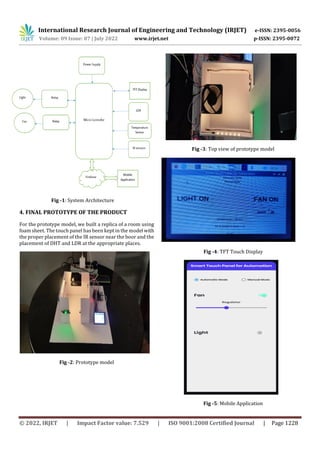
This system contains a temperature sensor, IR sensor and
light sensor. These sensors are used to get the specific data.
This data is then used to control the appliances such as fans,
lights etc.
The IR sensors are kept near the entrance. The IR sensors
are used to count the number of people in the room. As the
count becomes greater than one, the lights and fans switch
on and work according to the data provided by the sensors.
If the temperature is high, then the fan speed increases
automatically without the need of any human intervention.
Similarly, in the case of light’s intensity. If a personforgetsto
switch off, the sensor detects the number of people and if it
is zero, will automatically switch off the appliances
irrespective of the data from the sensors.
There are two modes namely, manual and automatic. The
above-mentioned steps are for automatic mode. In manual
mode, the sensors have no role to play. If the appliance is
switched on, it will work on its full capacity and the data
from the sensor is neglected.
When the number of people is greater than zero, depending
on the temperature of the room and the amount of light in
the room, the fan speed and the intensity of the light is
varied. This makes the experience of staying in the room a
luxurious feel.
In manual mode, the TFT display is used in the place of
traditional old switches. As the number of people becomes
greater than zero, the appliances switch onandthepersonis
given the freedom to change the fan speed and the intensity
of the light based on their needs. The TFT display enhances
the beauty of the house. It is durable when compared with
the old traditional switchesasitdoesn’thaveanymechanical
moving parts thereby reducing wear and tear. All these are
present in the form of a mobile application as well. The
appliance can be controlled with the help of the internet
from anywhere in the world.](https://image.slidesharecdn.com/irjet-v9i7236-221022095201-3d2d0d06/85/SMART-TOUCH-PANEL-FOR-AUTOMATION-2-320.jpg)
![International Research Journal of Engineering and Technology (IRJET) e-ISSN: 2395-0056
Volume: 09 Issue: 07 | July 2022 www.irjet.net p-ISSN: 2395-0072
© 2022, IRJET | Impact Factor value: 7.529 | ISO 9001:2008 Certified Journal | Page 1229
5. RESULTS
This project mainly focusesonupdatingtheoldandoutdated
mechanical switches used in our homes. It focuses on
replacing it with the TFT display which shows the
temperature of the room, the fan speed and the number of
people in the room. It even enables the appliances in the
room to be fully automatic, solely controlled by the
temperature and the amount of light in the room. The user
also has the freedom to change the settings of theappliances
according to their need.
6. CONCLUSION
This system replaces the old and dangerous mechanical
switches with a smart TFT display which gives a luxurious
feel to the user. Since this system is automated, the amount
of electricity consumed decreases thereby reducingthecost.
This system even gives the liberty to the user to set the fan
speed and light intensity as per their needs. Even in manual
mode, if the user forgets to switch off the appliance, as soon
as the person leaves the room, the system recognises this
and switches off all the appliances at once thereby
eliminating the wastage of current. Since it replaces the
switchboard containing the mechanical moving parts, it
doesn’t get spoilt and hence has longer lifetime usage.
7. REFERENCES
[1]Umesh Kumar Choudhary, Vinod V Rathod, Pankaj S
Ghormade, Ajay N Keoliya, “Deaths Due to Electrocution in
Central India: A Study of Two Years” Medico- legal Update,
Volume 19, 2019, doi: 10.5958/0974-1283.2019.00190.7.
[2]Ricquebourg, D. Menga, D. Durand, B. Marhic, L.
Delahoche and C. Loge, "The Smart Home Concept : our
immediate future," 2006 1ST IEEE International Conference
on E-Learning in Industrial Electronics, 2006, pp.23-28,doi:
10.1109/ICELIE.2006.347206
[3]V. M. Reddy, N. Vinay, T. Pokharna and S. S. K. Jha,
"Internet of Things enabled smart switch," 2016 Thirteenth
International Conference on Wireless and Optical
Communications Networks (WOCN), 2016, pp. 1-4, doi:
10.1109/WOCN.2016.7759026.
[4]G Indira Devi, D Chandra Mouli,BVenkatesh,LaxmiLydia.
“Design of Smart Arduino Touch Switch Panel for Smart
Home Using IOT. Journal of Critical Reviews, 2020.
[5]M. Asadullah and A. Raza, "An overview of home
automation systems," 2016 2nd International Conference on
Robotics and Artificial Intelligence (ICRAI), 2016, pp. 27-31,
doi: 10.1109/ICRAI.2016.7791223.
Vishnudas Nayak P,
B.E. Student, Dept. of Electronics &
Communication Engineering.
Lakshya N K,
B.E. Student, Dept. of Electronics &
Communication Engineering.
Pavithra R,
B.E. Student, Dept. of Electronics &
Communication Engineering.
Shashwath Rao,
B.E. Student, Dept. of Electronics &
Communication Engineering.
Praveen Kumar M,
Assistant Professor,
Dept. of Electronics & Communication
Engineering.
BIOGRAPHIES](https://image.slidesharecdn.com/irjet-v9i7236-221022095201-3d2d0d06/85/SMART-TOUCH-PANEL-FOR-AUTOMATION-4-320.jpg)

The document describes a smart touch panel system for home automation. The system uses sensors like temperature, light, and infrared sensors along with a Raspberry Pi microcontroller and TFT touch display. It has two modes: automatic and manual. In automatic mode, sensors control appliances like lights and fans based on temperature and light levels. In manual mode, a user can control appliances via the touch display without using sensor data. The system aims to replace outdated mechanical switches and allow remote control via a mobile app for improved convenience, safety, and energy efficiency compared to traditional switches. A prototype was created to demonstrate the concept.


