SMART TECHNIQUES MATERIALS PPT THAT HELP TO CONSTRUCT A BUILDING).pptx
1.
DEPARTMENT OF CIVILENGINEERING
TECHNICAL SEMINAR ON
“SMART MATERIALS”
PRESENTED BY
ABDUL SAMAD PADAGAM
2SA22CV401
UNDER THE GUIDANCE OF:
Prof. SADIK MUJAWAR
2.
CONTENTS
1. Introduction.
2. Objectives.
3.Advantages of Smart Material.
4. Disadvantages of Smart Material.
5. Government Initiatives.
6. Applications of Smart Material.
7. Case Studies.
8. Conclusion.
9. Future Scope.
3.
INTRODUCTION
• Smart materialsplay a crucial role in enhancing the durability, safety, and
longevity of infrastructures such as bridges, buildings, and dams.
• They help in mitigating the effects of natural disasters, reducing maintenance
costs, and improving overall performance.
• The field of civil engineering has witnessed remarkable advancements over the
past few decades, driven by the demand for safer, more efficient, and sustainable
infrastructure.
• They help in mitigating the effects of natural disasters, reducing maintenance
costs, and improving overall performance.
OBJECTIVES
• Explore Typesof Smart Materials such as piezoelectric materials, shape memory
alloys, electroactive polymers, and thermochromic materials.
• To demonstrate real-world applications in fields such as aerospace, biomedical
engineering, robotics, civil infrastructure, and consumer electronics.
• To analyze the advantages of using smart materials
• To discuss emerging trends, future applications, and the potential impact of smart
materials on technology and society.
7.
ADVANTAGES OF SMART
MATERIAL
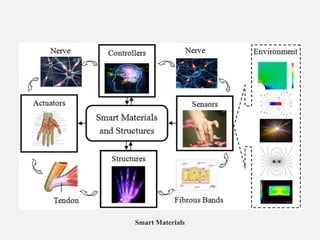
Smart materials can adapt their properties automatically in response to environmental
changes, improving system performance and efficiency.
They offer multifunctional capabilities, such as self-healing, shape changing, or
sensing, which traditional materials cannot provide.
Many smart materials enable systems to operate more efficiently by reducing the need
for external energy inputs or active controls.
Smart materials can detect damage or changes in their environment.
Some smart materials contribute to sustainability by improving energy efficiency and
reducing waste through longer product life cycles.
8.
DISADVANTAGES OF SMART
MATERIAL
•Smart materials are often expensive to develop and manufacture due to complex
processes and specialized raw materials.
• Some smart materials degrade or lose functionality after repeated use or exposure
to harsh environmental conditions.
• Certain smart materials require continuous energy input or high power to maintain
their active state, limiting their use in low-power applications.
• Some smart materials do not respond quickly enough for real-time applications,
reducing their effectiveness in dynamic environments.
• Some smart materials may involve toxic or non-biodegradable components, raising
environmental and health risks.
9.
GOVERNMENT INITIATIVES
India –Department of Science and Technology (DST) & DRDO
DST funds research in functional and advanced materials through its Materials for Energy and Environmental
Sustainability (MEES) and Technology Mission Division.
DRDO (Defence Research and Development Organization) invests in smart materials for use in defense
platforms, such as adaptive camouflage, vibration control, and sensor-integrated structures.
ISRO also explores smart materials for use in space applications, including thermal protection systems and
self-healing coatings.
United States – National Science Foundation (NSF) & DARPA
NSF Materials Research Programs fund projects on advanced materials, including smart and responsive
materials, through initiatives such as the Materials Research Science and Engineering Centers
(MRSEC).
DARPA (Defense Advanced Research Projects Agency) supports high-risk, high-reward research in
smart materials for defense applications, including self-healing materials, adaptive armor, and sensors.
10.
APPLICATIONS OF SMART
MATERIAL
Aerospace: Morphing wings, vibration control
Automotive: Self-healing paints, sensors
Healthcare: Smart implants, drug delivery systems
Civil Engineering: Smart concrete, responsive facades
Consumer Electronics: Adaptive lenses, responsive wearables
11.
CASE STUDIES
Case Study1: Self-Healing Concrete in the Netherlands
Industry: Civil Engineering
Smart Material Used: Bacteria-based self-healing concrete
Application: A pilot project in the Netherlands used concrete infused
with limestone-producing bacteria to fill cracks automatically when
exposed to water.
Impact: Increased service life of structures, reduced maintenance costs,
and enhanced safety of roads and bridges.
12.
Case Study 2:Nike Adapt BB – Smart Self-Lacing Shoes
Industry: Consumer Electronics / Sportswear
Smart Material Used: Shape memory alloy wires
Application: Nike’s Adapt BB shoes use SMA-based motors that tighten or
loosen the laces based on the wearer’s foot shape and activity. Users can
control the fit via a smartphone app or manually.
Impact: Personalized comfort, futuristic wearable technology, and integration
of smart materials into consumer fashion.
•
13.
CONCLUSION
Smart materialsrepresent a transformative advancement in the field of materials science and
engineering.
Their unique ability to sense, respond, and adapt to external such as temperature, pressure,
light, and electric or magnetic fields makes them invaluable across a wide range of industries.
From aerospace and automotive to healthcare, civil engineering, and consumer electronics,
smart materials are enabling the development of intelligent, efficient, and sustainable systems.
As industries continue to move toward automation, digitization, and sustainability, smart
materials will play a central role in shaping the next generation of products and infrastructure.
14.
FUTURE SCOPE
Integrationwith Artificial Intelligence and IoT
Smart materials will increasingly be integrated with AI and Internet of Things (IoT) platforms for real-time
sensing, data collection, and decision-making.
Expansion in Biomedical Applications
Development of bio-compatible and responsive materials will lead to next-generation medical implants, drug
delivery systems, and tissue engineering solutions.
Growth in Smart Infrastructure and Urban Development
Smart materials will play a key role in building self-monitoring, adaptive, and disaster-resilient infrastructure.
Advancements in Soft Robotics
Smart polymers and electroactive materials will drive innovations in soft robotics for surgical tools, rescue
missions, and industrial automation.