‘Smart’ sustainable urban
regeneration: institutions, quality
and financial innovation
Simon Huston , Reyhaneh Rahimzad, and Ali Parsa
School of Real Estate and Land Management, The
Royal Agricultural University, Cirencester,
Gloucestershire, GL7 6JS, UK
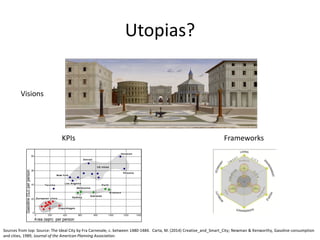
Visions
FrameworksKPIs
Utopias?
Sources from top: Source: The Ideal City by Fra Carnevale, c. between 1480-1484. Carta, M. (2014) Creative_and_Smart_City; Newman & Kenworthy, Gasoline consumption
and cities, 1989, Journal of the American Planning Association.
Smart-SUR framework
Figure 1: Outline of putative smart-SUR conceptual framework, involving institutional, project and funding dimensions. Sources: Authors (2014),
adapted from Thomas et al. (2000); López et al. (2008); von Brown et al. (2013) and Floater et al. (2015).
Smart institutions presume sound macro policy to incentivize balanced development and correct market failures. At urban scale, the green
‘design’ aspect incorporates conservation of ‘natural capital’ and ‘connectivity’. Technical progress and productivity sit within ‘efficiency’. ‘Spatial
Project ‘Hard’/ tangible investment ‘Soft’/ Intangible
Bordeaux Bordeaux
Métropole
Aménagement (France
1995-2007)
 Waterfront development
 Housing construction
 Public realm upgrades
 Tram system
 Youth training
 heritage management
Paris Promenade
Plantée (France 2000)
 Elevated causeway and park  Access to Bastille Opera
Madrid Rio Manzanares
(Spain
2006 a 2011)
 Riverfront remediation of
 Central 8km green space, foot-bridges,
and cycle routes.
 Public plaza
 Job access to CBD
San Francisco,
Embarcadero (USA 1991)
 Demolition of ugly freeway
 Construction of palm-lined boulevard,
squares and plazas
 Waterfront promenade
 New retail in public plaza
Bogotá Juan Amarillo
(Colombia
1990s)
 45km of greenway and 300 km bike
lanes
 Mass-transit system
 Job access to downtown
Seoul Cheonggyecheon
(South Korea 2003-2005)
 Reclaimed river frontage
 Upgrades to local retail
 Enhanced public transit
 Pedestrian park amenity
Human development
Table 1 Eclectic sample of global iconic regeneration transformations, illustrating ‘hard’ and ‘soft’ aspects (Source: authors 2104).
Smart aspect Smart institutions Smart projects Smart funding
Attribute Intellige
nce
Resilien
ce
Creativit
y
Govern
ance
Scale Fit Commu
nity
Baseline Genius
loci
Design Efficienc
y
Justice Collabor
ation
De-
risking
Payback
Olympic 3 4 4 4 4 4 3 3 2 3 4 4 3 3 3
Arsenal 3 4 2 3 3 3 3 3 2 2 4 4 3 3 3
Wembley 3 4 3 3 3 3 4 3 2 3 4 4 4 3 3
Greenwich 4 4 3 3 3 3 3 3 2 3 4 4 4 3 4
Barking 3 4 3 3 3 3 3 3 2 3 4 4 3 3 3
Nine elms 4 4 3 3 3 3 3 3 4 3 4 4 4 3 4
Kings Cross 3 4 4 3 3 3 3 3 2 3 4 4 3 3 3
Kidbrooke 3 4 3 3 3 3 4 3 4 3 4 4 3 3 3
Wirral 4 4 4 3 3 3 4 4 2 3 4 4 3 2 4
Canning 3 4 3 3 3 3 4 4 3 3 4 4 3 3 3
Limitations of secondary data
evaluation
Table 3: Results of UK urban regeneration project desktop screening with Smart-SUR with secondary-data (source: Authors 2014)
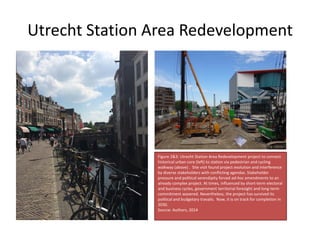
Utrecht Station Area Redevelopment
Figure 2&3: Utrecht Station Area Redevelopment project to connect
historical urban core (left) to station via pedestrian and cycling
walkway (above) . Site visit found project evolution and interference
by diverse stakeholders with conflicting agendas. Stakeholder
pressure and political serendipity forced ad-hoc amendments to an
already complex project. At times, influenced by short-term electoral
and business cycles, government territorial foresight and long-term
commitment wavered. Nevertheless, the project has survived its
political and budgetary travails. Now, it is on track for completion in
2030.
Source: Authors, 2014
Smart-SUR contributions
• Investment in regional town infrastructure essential
• Policy flux, complexity or stakeholder dynamics can scupper
projects
• Multi-criteria framework considers both process and
outcomes (KPIs)
• Secondary data necessary insufficient for assessment
• Scuttlebutt site investigations capture fine-grained
institutional or site-specific issues
• Invokes inclusive stakeholder dialogue, process observation
and audit of outputs, outcomes and impacts.
• Partnerships is informed by independent, scientific
assessment with conflict resolution mechanisms

Smart Sustainable Urban Regeneration

  • 1.
    ‘Smart’ sustainable urban regeneration:institutions, quality and financial innovation Simon Huston , Reyhaneh Rahimzad, and Ali Parsa School of Real Estate and Land Management, The Royal Agricultural University, Cirencester, Gloucestershire, GL7 6JS, UK
  • 2.
    Visions FrameworksKPIs Utopias? Sources from top:Source: The Ideal City by Fra Carnevale, c. between 1480-1484. Carta, M. (2014) Creative_and_Smart_City; Newman & Kenworthy, Gasoline consumption and cities, 1989, Journal of the American Planning Association.
  • 3.
    Smart-SUR framework Figure 1:Outline of putative smart-SUR conceptual framework, involving institutional, project and funding dimensions. Sources: Authors (2014), adapted from Thomas et al. (2000); López et al. (2008); von Brown et al. (2013) and Floater et al. (2015). Smart institutions presume sound macro policy to incentivize balanced development and correct market failures. At urban scale, the green ‘design’ aspect incorporates conservation of ‘natural capital’ and ‘connectivity’. Technical progress and productivity sit within ‘efficiency’. ‘Spatial
  • 4.
    Project ‘Hard’/ tangibleinvestment ‘Soft’/ Intangible Bordeaux Bordeaux Métropole Aménagement (France 1995-2007)  Waterfront development  Housing construction  Public realm upgrades  Tram system  Youth training  heritage management Paris Promenade Plantée (France 2000)  Elevated causeway and park  Access to Bastille Opera Madrid Rio Manzanares (Spain 2006 a 2011)  Riverfront remediation of  Central 8km green space, foot-bridges, and cycle routes.  Public plaza  Job access to CBD San Francisco, Embarcadero (USA 1991)  Demolition of ugly freeway  Construction of palm-lined boulevard, squares and plazas  Waterfront promenade  New retail in public plaza Bogotá Juan Amarillo (Colombia 1990s)  45km of greenway and 300 km bike lanes  Mass-transit system  Job access to downtown Seoul Cheonggyecheon (South Korea 2003-2005)  Reclaimed river frontage  Upgrades to local retail  Enhanced public transit  Pedestrian park amenity Human development Table 1 Eclectic sample of global iconic regeneration transformations, illustrating ‘hard’ and ‘soft’ aspects (Source: authors 2104).
  • 5.
    Smart aspect Smartinstitutions Smart projects Smart funding Attribute Intellige nce Resilien ce Creativit y Govern ance Scale Fit Commu nity Baseline Genius loci Design Efficienc y Justice Collabor ation De- risking Payback Olympic 3 4 4 4 4 4 3 3 2 3 4 4 3 3 3 Arsenal 3 4 2 3 3 3 3 3 2 2 4 4 3 3 3 Wembley 3 4 3 3 3 3 4 3 2 3 4 4 4 3 3 Greenwich 4 4 3 3 3 3 3 3 2 3 4 4 4 3 4 Barking 3 4 3 3 3 3 3 3 2 3 4 4 3 3 3 Nine elms 4 4 3 3 3 3 3 3 4 3 4 4 4 3 4 Kings Cross 3 4 4 3 3 3 3 3 2 3 4 4 3 3 3 Kidbrooke 3 4 3 3 3 3 4 3 4 3 4 4 3 3 3 Wirral 4 4 4 3 3 3 4 4 2 3 4 4 3 2 4 Canning 3 4 3 3 3 3 4 4 3 3 4 4 3 3 3 Limitations of secondary data evaluation Table 3: Results of UK urban regeneration project desktop screening with Smart-SUR with secondary-data (source: Authors 2014)
  • 6.
    Utrecht Station AreaRedevelopment Figure 2&3: Utrecht Station Area Redevelopment project to connect historical urban core (left) to station via pedestrian and cycling walkway (above) . Site visit found project evolution and interference by diverse stakeholders with conflicting agendas. Stakeholder pressure and political serendipity forced ad-hoc amendments to an already complex project. At times, influenced by short-term electoral and business cycles, government territorial foresight and long-term commitment wavered. Nevertheless, the project has survived its political and budgetary travails. Now, it is on track for completion in 2030. Source: Authors, 2014
  • 7.
    Smart-SUR contributions • Investmentin regional town infrastructure essential • Policy flux, complexity or stakeholder dynamics can scupper projects • Multi-criteria framework considers both process and outcomes (KPIs) • Secondary data necessary insufficient for assessment • Scuttlebutt site investigations capture fine-grained institutional or site-specific issues • Invokes inclusive stakeholder dialogue, process observation and audit of outputs, outcomes and impacts. • Partnerships is informed by independent, scientific assessment with conflict resolution mechanisms