Smart City Techtalk
Viktoriia Taraniuk
September, 2018
Smart city
Overview
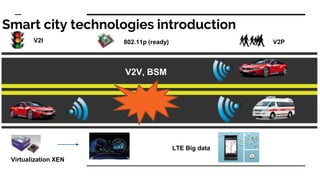
Smart city technologies introduction
Virtualization XEN
V2V, BSM
802.11p (ready)V2I V2P
LTE Big data
Architecture
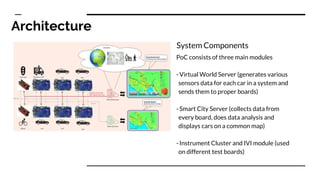
PoC consists of three main modules
-Virtual World Server (generates various
sensors data for each car in a system and
sends them to proper boards)
-Smart City Server (collects data from
every board, does data analysis and
displays cars on a common map)
-Instrument Cluster and IVI module (used
on different test boards)
System Components
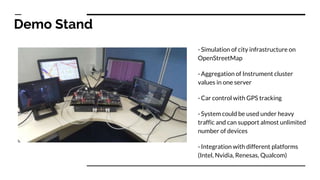
Demo Stand
-Simulation of city infrastructure on
OpenStreetMap
-Aggregation of Instrument cluster
values in one server
-Car control with GPS tracking
-System could be used under heavy
traffic and can support almost unlimited
number of devices
-Integration with different platforms
(Intel, Nvidia, Renesas, Qualcom)
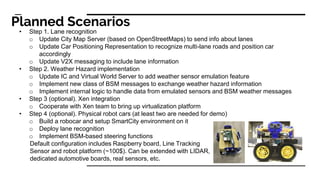
• Step 1. Lane recognition
o Update City Map Server (based on OpenStreetMaps) to send info about lanes
o Update Car Positioning Representation to recognize multi-lane roads and position car
accordingly
o Update V2X messaging to include lane information
• Step 2. Weather Hazard implementation
o Update IC and Virtual World Server to add weather sensor emulation feature
o Implement new class of BSM messages to exchange weather hazard information
o Implement internal logic to handle data from emulated sensors and BSM weather messages
• Step 3 (optional). Xen integration
o Cooperate with Xen team to bring up virtualization platform
• Step 4 (optional). Physical robot cars (at least two are needed for demo)
o Build a robocar and setup SmartCity environment on it
o Deploy lane recognition
o Implement BSM-based steering functions
Default configuration includes Raspberry board, Line Tracking
Sensor and robot platform (~100$). Can be extended with LIDAR,
dedicated automotive boards, real sensors, etc.
Planned Scenarios
Emergency Lane
Slide 14 CONFIDENTIAL
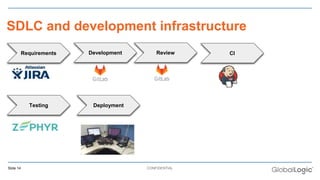
SDLC and development infrastructure
Requirements Development Review CI
Testing Deployment
Solution
Achivements
January 9 –
12, 2018
February 27-
28, 2018
March
18, 2017
April 14,
2018
In-demand expertise and feature demo stand saw
SmartCity used for pre-sales and HR events:
● Tech talks
● Hiring events
● Office tours
● Mentoring and trainings
● External Marketing Events
● As proof of expertize for potential Customers
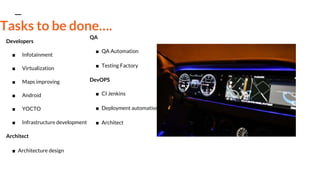
Developers
■ Infotainment
■ Virtualization
■ Maps improving
■ Android
■ YOCTO
■ Infrastructure development
Architect
■ Architecture design
Tasks to be done….
QA
■ QA Automation
■ Testing Factory
DevOPS
■ CI Jenkins
■ Deployment automation
■ Architect
Thank you!

Smart City —a GlobalLogic PoC

  • 1.
    Smart City Techtalk ViktoriiaTaraniuk September, 2018
  • 2.
  • 3.
  • 4.
    Smart city technologiesintroduction Virtualization XEN V2V, BSM 802.11p (ready)V2I V2P LTE Big data
  • 5.
    Architecture PoC consists ofthree main modules -Virtual World Server (generates various sensors data for each car in a system and sends them to proper boards) -Smart City Server (collects data from every board, does data analysis and displays cars on a common map) -Instrument Cluster and IVI module (used on different test boards) System Components
  • 6.
    Demo Stand -Simulation ofcity infrastructure on OpenStreetMap -Aggregation of Instrument cluster values in one server -Car control with GPS tracking -System could be used under heavy traffic and can support almost unlimited number of devices -Integration with different platforms (Intel, Nvidia, Renesas, Qualcom)
  • 7.
    • Step 1.Lane recognition o Update City Map Server (based on OpenStreetMaps) to send info about lanes o Update Car Positioning Representation to recognize multi-lane roads and position car accordingly o Update V2X messaging to include lane information • Step 2. Weather Hazard implementation o Update IC and Virtual World Server to add weather sensor emulation feature o Implement new class of BSM messages to exchange weather hazard information o Implement internal logic to handle data from emulated sensors and BSM weather messages • Step 3 (optional). Xen integration o Cooperate with Xen team to bring up virtualization platform • Step 4 (optional). Physical robot cars (at least two are needed for demo) o Build a robocar and setup SmartCity environment on it o Deploy lane recognition o Implement BSM-based steering functions Default configuration includes Raspberry board, Line Tracking Sensor and robot platform (~100$). Can be extended with LIDAR, dedicated automotive boards, real sensors, etc. Planned Scenarios
  • 8.
  • 9.
    Slide 14 CONFIDENTIAL SDLCand development infrastructure Requirements Development Review CI Testing Deployment
  • 10.
    Solution Achivements January 9 – 12,2018 February 27- 28, 2018 March 18, 2017 April 14, 2018 In-demand expertise and feature demo stand saw SmartCity used for pre-sales and HR events: ● Tech talks ● Hiring events ● Office tours ● Mentoring and trainings ● External Marketing Events ● As proof of expertize for potential Customers
  • 11.
    Developers ■ Infotainment ■ Virtualization ■Maps improving ■ Android ■ YOCTO ■ Infrastructure development Architect ■ Architecture design Tasks to be done…. QA ■ QA Automation ■ Testing Factory DevOPS ■ CI Jenkins ■ Deployment automation ■ Architect
  • 12.