Una mirada a la agricultura
moderna y smart
agriculture
Juan Diego Borrero Sánchez
jdiego@uhu.es
University of Huelva (Spain)
Universidad de Concepción, Campus Chillán, Chile
15 de Noviembre de 2017
World population
projected to reach
9.8 billion in 2050, and
11.2 billion in 2100
https://www.un.org/development/desa/en/news/population/world-
population-prospects-2017.html
We must increase food
production
BUT
The ability of the world food system to
ensure food is en doubt
www.fao.org/.../wsfs/.../How_to_Feed_the_World_in_2050.pdf
1.Limited availability of arable land.
2.Global climate change.
3.The growing scarcity of water.
4.The price and availability of energy,
particularly from fossil fuel.
5.The impact on rural labour supply
For goverments worldwide,
food supply assurance&water
supply of suitable quality have
become priority issues to
address
1 Biotechnology
CRISPR-Cas9
https://www.broadinstitute.org/news/dupont-pioneer-and-broad-institute-join-forces-enable-
democratic-crispr-licensing-agriculture
How to do it?
2 Permaculture
Urban Agriculture
(Dion, C. 2017)
How to do it?
3
Internet of Things
How to do it?
Precision Agriculture is sometimes knows as "smart
farming", “smart agriculture” an umbrella term for
easier comparison with other M2M bases
implementations such as smart cities and so on.
Internet of Things (IoT) is the network of physical
devices, and other
items embedded with electronics, software, sensors,
actuators, and network connectivity which enable
these objects to connect and exchange data
Introducing the concept of Smart Agriculture
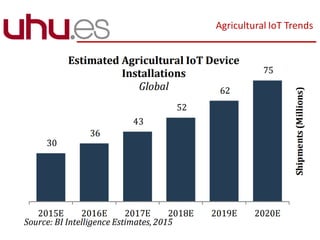
Agricultural IoT Trends
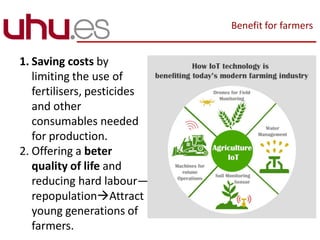
Benefit for farmers
1. Saving costs by
limiting the use of
fertilisers, pesticides
and other
consumables needed
for production.
2. Offering a beter
quality of life and
reducing hard labour—
repopulationAttract
young generations of
farmers.
Benefit s
Not only saving time and money, but also
savings related to the environment
1. Farmers with poor training in the technological area
and also innovative solutions
2. Fields located in remote or isolated areas
3. Low budgets to carry out projects due to the
dependence on harvest
4. Most of the companies of Agriculture sector are very
small with just a few employees
5. Global climate change: is vital to control weather and
ambient conditions
6. Pests can ruin the entire harvest
The greatest challenges in Smart Agriculture sector
The main barriers of the sector that IoT is breaking down
Overview agriculture technologies
Sensing and data adquisition
There are a variety of applications
Data collected, where are located, how many
are needed at the site, how frequently data is
collected, the size of the data, power system
(battery, solar power)
Overview agriculture technologies
Modes of Connectivity
The new range of LPWAN (Low Power Wide area
Network) is seen as a potential substitution in
low-data rate, long battery life and long range
connectivity scenarios
Overview agriculture technologies
Farm management information system
Smart farming would become decision farming
Overview agriculture technologies
Protocols
Zigbee, 4G/GPRS, bluetooth, Wifi, RFID, NFC,
LORA, SIGFOG
Cloud Platforms
Bluemix, Vantara, Sofia2, Amazon Web Services
Applications
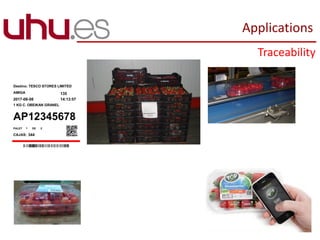
Applications
Traceability
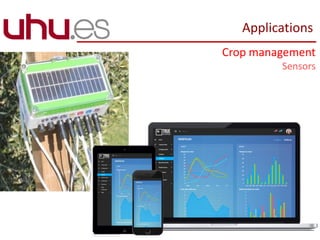
Crop management
Sensors
Applications
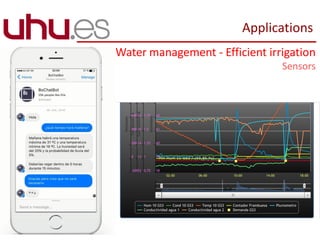
Water management - Efficient irrigation
Sensors
Applications
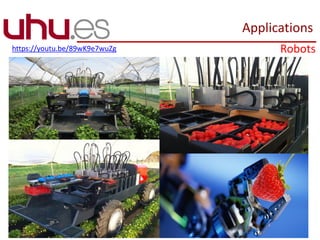
Robotshttps://youtu.be/89wK9e7wuZg
Applications

Smart agriculture 20171115_udec_chile