Johnson1
Jarrett Johnson
CST 350—Small Group and Team Communication
The Winner’s Circle—Analysis Paper #2
Introduction
On Monday, March 16th
, 2015, I entered CST 350—Small Group and Team
Communication, anticipating “New Group Orientation.” Dr. Jessica McCall, Professor of Small
Group and Team Communication at the University of Greensboro, handed me a slip of paper
labeled “Who Let the Dogs Out?” Confused, I glanced at my neighbor’s slip of paper, and
realized that she too had a slip of paper with a popular song written on it. “Sing and find your
new group members,” Dr. McCall said. From the front of the classroom, I heard fellow
classmate, Modestas Masilionis, singing the song labeled on my slip of paper. Soon, Modestas
and I would be joined by Shelbi Flanagan and Erica Gunter. We were later informed that Joshua
“Reid” Rivers was also in our group, but he was not present on “New Group Orientation” day.
Having to disband from “Connect Five,” I was unenthusiastic about a new group because my
previous group experience had been such a successful one. Still, in order to be successful in the
course, I realized that I would have to learn to cooperate with my new group members as we
explored new group concepts, such as, leadership, conflict, and diversity in addition to previous
concepts, too.
Background
According to Galanes and Adams, (2013), “Input variables are the energy, information,
and raw materials used by an open system that are transformed into output by throughput
processes” (pp.60). Indeed, Galanes and Adams (2013) would agree that recognizing group
input variables such as, attitudes, skills, and personal characteristics are not enough to achieve
Johnson2
group success, but “group members must regularly assess how effective those variables are and
determine how best to enact them as the strive toward their interdependent goal” (pp.62). There
are ideal standards for input variables that groups should strive to accomplish in order to achieve
a sense of success. As for me, sharing basic beliefs or values about the purpose of the group,
understanding or accepting the group’s purpose, and having enough time to complete the task are
the three ideal standards that I demonstrated in my previous group experience, and it would be
the same input variables that I would demonstrate in my new group. According to Galanes and
Adams, (2013), “As with input variables, group members must consistently reflect upon and
assess the effectiveness of these processes in order to transform their input variables into positive
synergy that promotes viable outcomes. Furthermore, these especially reflect the ethical stands
for group behavior” (pp.64). Lastly, “output variables of a group are the results or products of
the group’s input variables and throughput processes, including tangible work accomplished,
changes in the members, the group’s effect on its environment, and changes in the group’s
procedures” (Galanes & Adams, 2013, pp.65). Based on these standards for effective throughput
and output variables, I will analyze the effectiveness of decision-making, problem-solving, roles
and relationships, socialization, leadership, conflict management, and diversity according to my
experience with my new group, “The Winner’s Circle.”
Analysis
Decision-Making/Problem-Solving/Leadership. As with our previous group experiences, Modestas,
Reid, Shelbi, Erica, and I were given the T.I.P. assignment to complete. The purpose of this task
is to develop a team name or identity, team slogan, team logo, and a team cheer. “We could be
the Winner’s Circle,” Modestas said. Because we were still in the orientation stage, no one in
the group had a rebuttal for Modestas’s suggestion. No one was familiar with each other’s
Johnson3
decision-making skills, problem-solving skills, or attitudes, but it was apparent that we were all
familiar with the assignment, and we all shared a basic belief or value that we would get a good
grade on the T.I.P. project, no matter what our name was. So, just like that, we became “The
Winner’s Circle.” On Wednesday, March 25th
, 2015, the class participated in the final session of
TeamQuest. I realized that this would provide a better opportunity to assess my group’s
decision-making or problem-solving strategies. The first activity was “Something’s Missing.”
In “Something’s Missing,” the participants are given a set of shapes with two shapes removed.
By logical reasoning, communication, and teamwork, the participants have to decide the shape
and the color of the two missing pieces. Too, all of the participants are wearing blindfolds. So,
with the objects in our hands, we began the activity. First, we each described distinguishing
features of the objects in our hands, for example, I noticed that the objects in my hands were in
the shapes of arrows or houses. Shelbi, Erica, and Reid each described their respective objects,
but Modestas was completely quiet. Our facilitator asked us to reflect on that experience.
Although we were still in the orientation stage, there were certain leadership roles that emerged
in my group members that would later dictate future throughput processes. According to
Galanes and Adams (2013), "Fisher’s three-stage model presumes that all members are potential
candidates for emergent leadership. In Stage 1, one or more members drop from consideration
right away. They may be uninterested in leading, unable to lead, or may communicate in ways
others perceive as nonleaderlike" (pp.183). In regards to the latter, Modestas became the
eliminated candidate in our group. When we were reflecting on the “Something’s Missing”
activity, he did not give any feedback, and he seemed apathetic to the whole group experience.
During this activity, I would claim Shelbi and I became emergent leaders. Shelbi and I
communicated very well about the colors of the objects, and we took note that some objects were
Johnson4
similar in color and structure. Ultimately, we came to a group consensus, and made the decision
what we believed was missing, and as a result, we made the right decision. Thus, Shelbi and I
became the emergent leaders for the group throughout the group experience. Interestingly,
Fisher’s model suggest “Eventually, one contender fails at his or her bid for leadership and drops
out. The candidate who falls out of contention is usually seen as too directive or offensive to the
others” (pp.183). However, I would contest that Shelbi and I were never at competition with one
another, but we were a coalition, or lieutenants, who supported each other’s decisions for the
group. Everyone else just felled in line with Shelbi and I, and this is how our decision-making
and problem-solving played out in the group. In regards to leadership, authors Galanes and
Adams (2013) would agree that I and Shelbi’s traits attributed to our leadership positions. “The
traits approach to leadership examines how traits are related to leadership and assumes that
leaders are more likely to have certain traits than other group members are” (Galanes & Adams,
2013, pp.188). Honestly, I would argue that Shelbi and I acquired our leadership positions
because we just simply talked the most in our group, while Erica, Reid, and Modestas were more
reserved and cooperative to our suggestions.
Roles and Relationships. Authors Galanes and Adams (2013) argues, “The number of members,
their personal characteristics, and their attitudes are input variables that help shape the group’s
throughput processes, including the interaction and development of member roles (pp.115).
Furthermore, a “member’s role represents the cluster of behaviors performed by that member and
the overall functions those behaviors perform for the group” (Galanes & Adams, 2013, p.129).
Within The Winner’s Circle, there were many “informal roles,” or “unique roles created as a
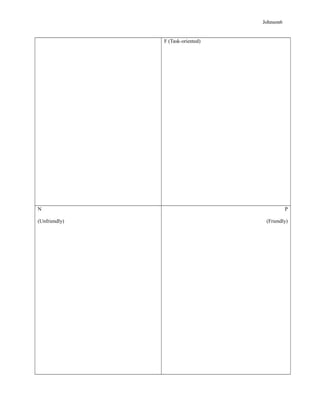
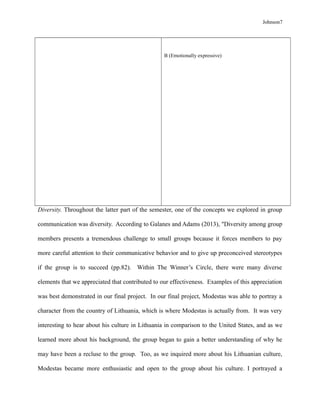
result of a member’s behaviors” (Galanes & Adams, 2013, p.130). In reference to the SYMLOG
diagram below, Shelbi and I occupy large circles that are located to the top right in the first
Johnson5
quadrant. We were really concerned with completing assignments given, and were equally
dominant in our leadership positions. This is a complete contrast to my previous group
experience where I would have been more emotionally expressive, maintaining the
“interpersonal relationships,” or the “maintenance functions” (Galanes & Adams, 2013, pp.135).
Erica would be the one to influence the interpersonal relationships within our group. Erica was
so friendly and kind, which is why her circle is located to the bottom right corner in the first
quadrant. However, her circle is smaller compared to mine and Shelbi’s because Erica would
often just accommodate to the rest of the group. She would provide rebuttals sometimes,
illustrating her desire to contribute to the tasks of the group, but Shelbi and I would often ignore
her suggestions because there were times when we would argue that she was just overthinking on
concepts. Reid, too, was a friendly group member, which is why his circle is located to the top
right corner, but he occupies the fourth quadrant, because it seemed that he was not as concerned
with completing the group’s tasks. Reid seemed to “just go with the flow,” providing insight
whenever he was delegated. However, his laissez-faire approach did not hinder the group’s
throughput processes. Modestas occupies the smallest circle on the diagram, and is located in
the third quadrant, or unfriendly side. There was just days when Modestas did not contribute
anything to the group. He missed class, quizzes, and tests, and it just seemed that he was
counting down the days until he would be done with group work. Still, even though Modestas
demonstrated he was not interested in working with the rest of the group, Shelbi and I did not
allow his behavior to hurt the overall group. There were times when Erica would want to
confront Modestas for his attitude, but Shelbi and I would reassure her that she would be wasting
her time trying to get someone to participate who clearly was self-centered.
Johnson6
F (Task-oriented)
N
(Unfriendly)
P
(Friendly)
Johnson7
B (Emotionally expressive)
Diversity. Throughout the latter part of the semester, one of the concepts we explored in group
communication was diversity. According to Galanes and Adams (2013), "Diversity among group
members presents a tremendous challenge to small groups because it forces members to pay
more careful attention to their communicative behavior and to give up preconceived stereotypes
if the group is to succeed (pp.82). Within The Winner’s Circle, there were many diverse
elements that we appreciated that contributed to our effectiveness. Examples of this appreciation
was best demonstrated in our final project. In our final project, Modestas was able to portray a
character from the country of Lithuania, which is where Modestas is actually from. It was very
interesting to hear about his culture in Lithuania in comparison to the United States, and as we
learned more about his background, the group began to gain a better understanding of why he
may have been a recluse to the group. Too, as we inquired more about his Lithuanian culture,
Modestas became more enthusiastic and open to the group about his culture. I portrayed a
Johnson8
character from the country of Kenya, paying homage to the fact that I am a person of African
descent. Erica was able to portray a character from the “Bible Belt of the South,” because she
was adamant about her spiritual life. All of these aspects of diversity was within our group, and
many more, and it was refreshing that we respected each other, and we allowed our diversity to
enhance the group’s performance. And, author Galanes and Adams (2013) would agree that
“Diversity can enhance a group’s performance, if a group’s communication process allow
members to integrate their diverse perspectives. (pp.83).
Conclusion
In my conclusion, based on the criteria for evaluating a group’s throughput and output
processes, I will conclude that “The Winner’s Circle” was effective. If I were to rank my
individual satisfaction with my group experience on a scale of 1-5, with 1 being highly
dissatisfied, and 5 being highly satisfied, I would give this group experience a 4. I enjoyed
working with this group, especially in our final project which brought us closer together. At first,
it seemed that everyone’s scheduling conflicted with the final project; we just could not find a
time that worked for everyone. Too, the final project was so broad, it provided the group with an
opportunity to do whatever we wanted as long as it was relevant to group communication, and
pertained to concepts we had discussed throughout the semester. However, one day, we met in
the Rec, and we talked, laughed, and exercised our way to a successful final project. Kudos to
Shelbi for editing the footage for the whole group, and we all agreed she did an amazing job
capturing how an Olympic worked together, despite their diverse differences. It was bliss to see
that she captured all the little, funny moments, too. As I concluded with my previous group, I
said that I would hope to continue to be the friendly person that I am because that is one of the
aspects of my identity that my group members appreciated. With “The Winner’s Circle,” I was
Johnson9
put to the test to contribute more to the group than just a few jokes. I acquired a more leadership
position with this group experience, and it is reassuring to know that, although I can be the group
member that makes everyone laugh, I can also be the group member that everyone looks up to be
a leader. It is reassuring to know that as I come closer to ending my journey here at the
University, I am going to embark into the world where I will have to work with other people. As
the book explains, groups are just human nature. It is encouraging to know that I may not always
be a follower, though, but I may be able to lead people because they trust me, they look up to me,
and they believe in me. So, I say, “Thank-You,” Winner’s Circle. Thank-you for this group
experience, and to you, too, Dr. McCall. All we do is win, win, and win, no matter what!
References
Galanes, G.J., & Adams, K. (2013). Effective group discussion. 14th
e.d. New York: McGraw
Hill.
Johnson9
put to the test to contribute more to the group than just a few jokes. I acquired a more leadership
position with this group experience, and it is reassuring to know that, although I can be the group
member that makes everyone laugh, I can also be the group member that everyone looks up to be
a leader. It is reassuring to know that as I come closer to ending my journey here at the
University, I am going to embark into the world where I will have to work with other people. As
the book explains, groups are just human nature. It is encouraging to know that I may not always
be a follower, though, but I may be able to lead people because they trust me, they look up to me,
and they believe in me. So, I say, “Thank-You,” Winner’s Circle. Thank-you for this group
experience, and to you, too, Dr. McCall. All we do is win, win, and win, no matter what!
References
Galanes, G.J., & Adams, K. (2013). Effective group discussion. 14th
e.d. New York: McGraw
Hill.

Small Group and Team Communication Analysis

  • 1.
    Johnson1 Jarrett Johnson CST 350—SmallGroup and Team Communication The Winner’s Circle—Analysis Paper #2 Introduction On Monday, March 16th , 2015, I entered CST 350—Small Group and Team Communication, anticipating “New Group Orientation.” Dr. Jessica McCall, Professor of Small Group and Team Communication at the University of Greensboro, handed me a slip of paper labeled “Who Let the Dogs Out?” Confused, I glanced at my neighbor’s slip of paper, and realized that she too had a slip of paper with a popular song written on it. “Sing and find your new group members,” Dr. McCall said. From the front of the classroom, I heard fellow classmate, Modestas Masilionis, singing the song labeled on my slip of paper. Soon, Modestas and I would be joined by Shelbi Flanagan and Erica Gunter. We were later informed that Joshua “Reid” Rivers was also in our group, but he was not present on “New Group Orientation” day. Having to disband from “Connect Five,” I was unenthusiastic about a new group because my previous group experience had been such a successful one. Still, in order to be successful in the course, I realized that I would have to learn to cooperate with my new group members as we explored new group concepts, such as, leadership, conflict, and diversity in addition to previous concepts, too. Background According to Galanes and Adams, (2013), “Input variables are the energy, information, and raw materials used by an open system that are transformed into output by throughput processes” (pp.60). Indeed, Galanes and Adams (2013) would agree that recognizing group input variables such as, attitudes, skills, and personal characteristics are not enough to achieve
  • 2.
    Johnson2 group success, but“group members must regularly assess how effective those variables are and determine how best to enact them as the strive toward their interdependent goal” (pp.62). There are ideal standards for input variables that groups should strive to accomplish in order to achieve a sense of success. As for me, sharing basic beliefs or values about the purpose of the group, understanding or accepting the group’s purpose, and having enough time to complete the task are the three ideal standards that I demonstrated in my previous group experience, and it would be the same input variables that I would demonstrate in my new group. According to Galanes and Adams, (2013), “As with input variables, group members must consistently reflect upon and assess the effectiveness of these processes in order to transform their input variables into positive synergy that promotes viable outcomes. Furthermore, these especially reflect the ethical stands for group behavior” (pp.64). Lastly, “output variables of a group are the results or products of the group’s input variables and throughput processes, including tangible work accomplished, changes in the members, the group’s effect on its environment, and changes in the group’s procedures” (Galanes & Adams, 2013, pp.65). Based on these standards for effective throughput and output variables, I will analyze the effectiveness of decision-making, problem-solving, roles and relationships, socialization, leadership, conflict management, and diversity according to my experience with my new group, “The Winner’s Circle.” Analysis Decision-Making/Problem-Solving/Leadership. As with our previous group experiences, Modestas, Reid, Shelbi, Erica, and I were given the T.I.P. assignment to complete. The purpose of this task is to develop a team name or identity, team slogan, team logo, and a team cheer. “We could be the Winner’s Circle,” Modestas said. Because we were still in the orientation stage, no one in the group had a rebuttal for Modestas’s suggestion. No one was familiar with each other’s
  • 3.
    Johnson3 decision-making skills, problem-solvingskills, or attitudes, but it was apparent that we were all familiar with the assignment, and we all shared a basic belief or value that we would get a good grade on the T.I.P. project, no matter what our name was. So, just like that, we became “The Winner’s Circle.” On Wednesday, March 25th , 2015, the class participated in the final session of TeamQuest. I realized that this would provide a better opportunity to assess my group’s decision-making or problem-solving strategies. The first activity was “Something’s Missing.” In “Something’s Missing,” the participants are given a set of shapes with two shapes removed. By logical reasoning, communication, and teamwork, the participants have to decide the shape and the color of the two missing pieces. Too, all of the participants are wearing blindfolds. So, with the objects in our hands, we began the activity. First, we each described distinguishing features of the objects in our hands, for example, I noticed that the objects in my hands were in the shapes of arrows or houses. Shelbi, Erica, and Reid each described their respective objects, but Modestas was completely quiet. Our facilitator asked us to reflect on that experience. Although we were still in the orientation stage, there were certain leadership roles that emerged in my group members that would later dictate future throughput processes. According to Galanes and Adams (2013), "Fisher’s three-stage model presumes that all members are potential candidates for emergent leadership. In Stage 1, one or more members drop from consideration right away. They may be uninterested in leading, unable to lead, or may communicate in ways others perceive as nonleaderlike" (pp.183). In regards to the latter, Modestas became the eliminated candidate in our group. When we were reflecting on the “Something’s Missing” activity, he did not give any feedback, and he seemed apathetic to the whole group experience. During this activity, I would claim Shelbi and I became emergent leaders. Shelbi and I communicated very well about the colors of the objects, and we took note that some objects were
  • 4.
    Johnson4 similar in colorand structure. Ultimately, we came to a group consensus, and made the decision what we believed was missing, and as a result, we made the right decision. Thus, Shelbi and I became the emergent leaders for the group throughout the group experience. Interestingly, Fisher’s model suggest “Eventually, one contender fails at his or her bid for leadership and drops out. The candidate who falls out of contention is usually seen as too directive or offensive to the others” (pp.183). However, I would contest that Shelbi and I were never at competition with one another, but we were a coalition, or lieutenants, who supported each other’s decisions for the group. Everyone else just felled in line with Shelbi and I, and this is how our decision-making and problem-solving played out in the group. In regards to leadership, authors Galanes and Adams (2013) would agree that I and Shelbi’s traits attributed to our leadership positions. “The traits approach to leadership examines how traits are related to leadership and assumes that leaders are more likely to have certain traits than other group members are” (Galanes & Adams, 2013, pp.188). Honestly, I would argue that Shelbi and I acquired our leadership positions because we just simply talked the most in our group, while Erica, Reid, and Modestas were more reserved and cooperative to our suggestions. Roles and Relationships. Authors Galanes and Adams (2013) argues, “The number of members, their personal characteristics, and their attitudes are input variables that help shape the group’s throughput processes, including the interaction and development of member roles (pp.115). Furthermore, a “member’s role represents the cluster of behaviors performed by that member and the overall functions those behaviors perform for the group” (Galanes & Adams, 2013, p.129). Within The Winner’s Circle, there were many “informal roles,” or “unique roles created as a result of a member’s behaviors” (Galanes & Adams, 2013, p.130). In reference to the SYMLOG diagram below, Shelbi and I occupy large circles that are located to the top right in the first
  • 5.
    Johnson5 quadrant. We werereally concerned with completing assignments given, and were equally dominant in our leadership positions. This is a complete contrast to my previous group experience where I would have been more emotionally expressive, maintaining the “interpersonal relationships,” or the “maintenance functions” (Galanes & Adams, 2013, pp.135). Erica would be the one to influence the interpersonal relationships within our group. Erica was so friendly and kind, which is why her circle is located to the bottom right corner in the first quadrant. However, her circle is smaller compared to mine and Shelbi’s because Erica would often just accommodate to the rest of the group. She would provide rebuttals sometimes, illustrating her desire to contribute to the tasks of the group, but Shelbi and I would often ignore her suggestions because there were times when we would argue that she was just overthinking on concepts. Reid, too, was a friendly group member, which is why his circle is located to the top right corner, but he occupies the fourth quadrant, because it seemed that he was not as concerned with completing the group’s tasks. Reid seemed to “just go with the flow,” providing insight whenever he was delegated. However, his laissez-faire approach did not hinder the group’s throughput processes. Modestas occupies the smallest circle on the diagram, and is located in the third quadrant, or unfriendly side. There was just days when Modestas did not contribute anything to the group. He missed class, quizzes, and tests, and it just seemed that he was counting down the days until he would be done with group work. Still, even though Modestas demonstrated he was not interested in working with the rest of the group, Shelbi and I did not allow his behavior to hurt the overall group. There were times when Erica would want to confront Modestas for his attitude, but Shelbi and I would reassure her that she would be wasting her time trying to get someone to participate who clearly was self-centered.
  • 6.
  • 7.
    Johnson7 B (Emotionally expressive) Diversity.Throughout the latter part of the semester, one of the concepts we explored in group communication was diversity. According to Galanes and Adams (2013), "Diversity among group members presents a tremendous challenge to small groups because it forces members to pay more careful attention to their communicative behavior and to give up preconceived stereotypes if the group is to succeed (pp.82). Within The Winner’s Circle, there were many diverse elements that we appreciated that contributed to our effectiveness. Examples of this appreciation was best demonstrated in our final project. In our final project, Modestas was able to portray a character from the country of Lithuania, which is where Modestas is actually from. It was very interesting to hear about his culture in Lithuania in comparison to the United States, and as we learned more about his background, the group began to gain a better understanding of why he may have been a recluse to the group. Too, as we inquired more about his Lithuanian culture, Modestas became more enthusiastic and open to the group about his culture. I portrayed a
  • 8.
    Johnson8 character from thecountry of Kenya, paying homage to the fact that I am a person of African descent. Erica was able to portray a character from the “Bible Belt of the South,” because she was adamant about her spiritual life. All of these aspects of diversity was within our group, and many more, and it was refreshing that we respected each other, and we allowed our diversity to enhance the group’s performance. And, author Galanes and Adams (2013) would agree that “Diversity can enhance a group’s performance, if a group’s communication process allow members to integrate their diverse perspectives. (pp.83). Conclusion In my conclusion, based on the criteria for evaluating a group’s throughput and output processes, I will conclude that “The Winner’s Circle” was effective. If I were to rank my individual satisfaction with my group experience on a scale of 1-5, with 1 being highly dissatisfied, and 5 being highly satisfied, I would give this group experience a 4. I enjoyed working with this group, especially in our final project which brought us closer together. At first, it seemed that everyone’s scheduling conflicted with the final project; we just could not find a time that worked for everyone. Too, the final project was so broad, it provided the group with an opportunity to do whatever we wanted as long as it was relevant to group communication, and pertained to concepts we had discussed throughout the semester. However, one day, we met in the Rec, and we talked, laughed, and exercised our way to a successful final project. Kudos to Shelbi for editing the footage for the whole group, and we all agreed she did an amazing job capturing how an Olympic worked together, despite their diverse differences. It was bliss to see that she captured all the little, funny moments, too. As I concluded with my previous group, I said that I would hope to continue to be the friendly person that I am because that is one of the aspects of my identity that my group members appreciated. With “The Winner’s Circle,” I was
  • 9.
    Johnson9 put to thetest to contribute more to the group than just a few jokes. I acquired a more leadership position with this group experience, and it is reassuring to know that, although I can be the group member that makes everyone laugh, I can also be the group member that everyone looks up to be a leader. It is reassuring to know that as I come closer to ending my journey here at the University, I am going to embark into the world where I will have to work with other people. As the book explains, groups are just human nature. It is encouraging to know that I may not always be a follower, though, but I may be able to lead people because they trust me, they look up to me, and they believe in me. So, I say, “Thank-You,” Winner’s Circle. Thank-you for this group experience, and to you, too, Dr. McCall. All we do is win, win, and win, no matter what! References Galanes, G.J., & Adams, K. (2013). Effective group discussion. 14th e.d. New York: McGraw Hill.
  • 10.
    Johnson9 put to thetest to contribute more to the group than just a few jokes. I acquired a more leadership position with this group experience, and it is reassuring to know that, although I can be the group member that makes everyone laugh, I can also be the group member that everyone looks up to be a leader. It is reassuring to know that as I come closer to ending my journey here at the University, I am going to embark into the world where I will have to work with other people. As the book explains, groups are just human nature. It is encouraging to know that I may not always be a follower, though, but I may be able to lead people because they trust me, they look up to me, and they believe in me. So, I say, “Thank-You,” Winner’s Circle. Thank-you for this group experience, and to you, too, Dr. McCall. All we do is win, win, and win, no matter what! References Galanes, G.J., & Adams, K. (2013). Effective group discussion. 14th e.d. New York: McGraw Hill.