Joseph Fabiilli
Debt or Equity Financing?
12–2
1. Describe how the nature of a firm affects its financing sources.
2. Evaluate the choice between debt financing and equity financing.
3. Identify typical sources of financing used at the outset of a new venture.
4. Discuss the basic process for acquiring and structuring a bank loan.
5. Explain how business relationships can be used to finance a small firm.
6. Describe the two types of private equity investors that offer financing to
small firms.
7. Distinguish among the different government loan programs available to
small companies.
8. Explain when large companies and public stock offerings can be
sources of financing.
Looking Ahead
After studying this chapter, you should be able to:
12–3
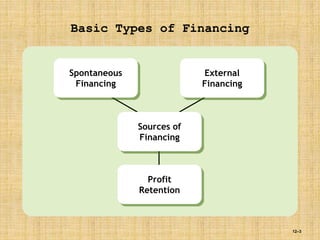
Basic Types of Financing
Sources of
Financing
Spontaneous
Financing
Profit
Retention
External
Financing
12–4
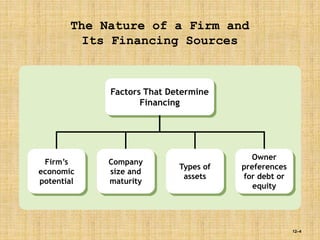
The Nature of a Firm and
Its Financing Sources
Firm’s
economic
potential
Owner
preferences
for debt or
equity
Company
size and
maturity
Factors That Determine
Financing
Types of
assets
12–5
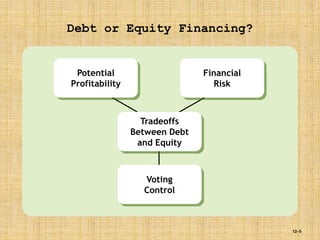
Debt or Equity Financing?
Tradeoffs
Between Debt
and Equity
Potential
Profitability
Voting
Control
Financial
Risk
12–6
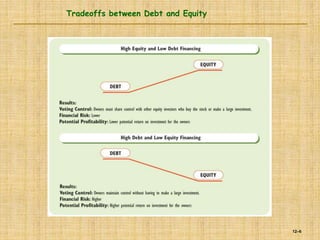
Tradeoffs between Debt and Equity
12–7
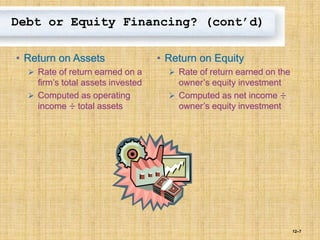
Debt or Equity Financing? (cont’d)
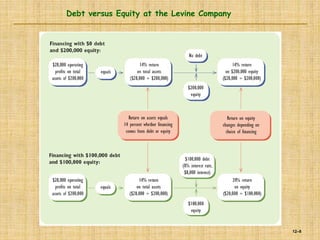
• Return on Assets
 Rate of return earned on a
firm’s total assets invested
 Computed as operating
income ÷ total assets
• Return on Equity
 Rate of return earned on the
owner’s equity investment
 Computed as net income ÷
owner’s equity investment
12–8
Debt versus Equity at the Levine Company
12–9
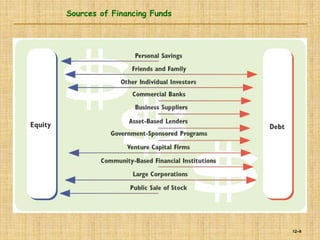
Sources of Financing Funds
12–10
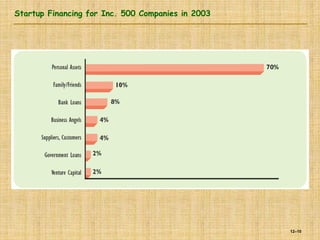
Startup Financing for Inc. 500 Companies in 2003
12–11
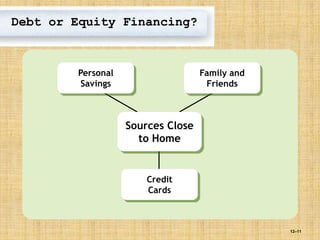
Debt or Equity Financing?
Sources Close
to Home
Personal
Savings
Credit
Cards
Family and
Friends
12–12
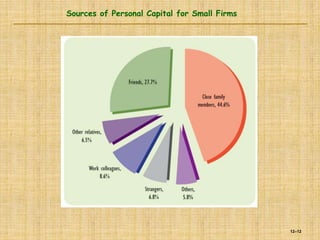
Sources of Personal Capital for Small Firms
12–13
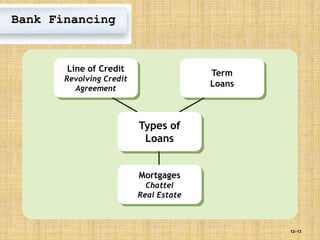
Bank Financing
Types of
Loans
Line of Credit
Revolving Credit
Agreement
Mortgages
Chattel
Real Estate
Term
Loans
12–14
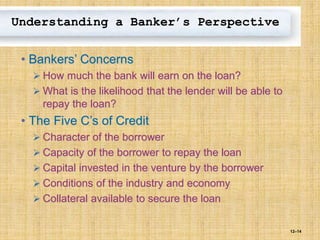
Understanding a Banker’s Perspective
• Bankers’ Concerns
 How much the bank will earn on the loan?
 What is the likelihood that the lender will be able to
repay the loan?
• The Five C’s of Credit
 Character of the borrower
 Capacity of the borrower to repay the loan
 Capital invested in the venture by the borrower
 Conditions of the industry and economy
 Collateral available to secure the loan
12–15
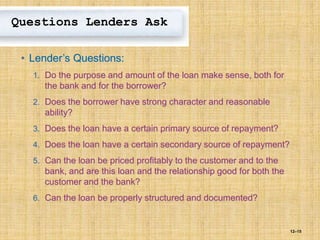
Questions Lenders Ask
• Lender’s Questions:
1. Do the purpose and amount of the loan make sense, both for
the bank and for the borrower?
2. Does the borrower have strong character and reasonable
ability?
3. Does the loan have a certain primary source of repayment?
4. Does the loan have a certain secondary source of repayment?
5. Can the loan be priced profitably to the customer and to the
bank, and are this loan and the relationship good for both the
customer and the bank?
6. Can the loan be properly structured and documented?
12–16
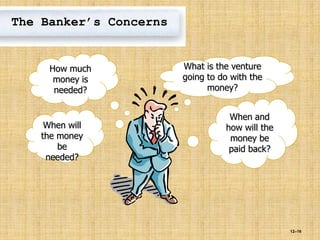
The Banker’s Concerns
How much
money is
needed?
What is the venture
going to do with the
money?
When and
how will the
money be
paid back?
When will
the money
be
needed?
12–17
Financial Information Required
for a Bank Loan
• Three years of the firm’s historical statements
 Balance sheets, income statements, and statements
of cash flow
• The firm’s pro forma financial statements
 The timing and amounts of the debt repayment
included as part of the forecasts
• Personal financial statements
 The borrower’s personal net worth (assets – debts)
and estimated annual income
12–18
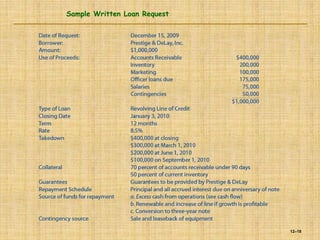
Sample Written Loan Request
12–19
Negotiating a Loan: Interest Rate
• Prime Rate
 Interest rate charged by a commercial bank on loans
to its most creditworthy customers
• LIBOR (London InterBank Offered Rate)
 Interest rate charged by London banks on loans to
other London banks
• Fixed Interest Rates
 Interest rate remains the same for the term of the loan
• Floating Interest Rates
 Interest rate varies with the changes in the prime rate
12–20
Negotiating a Loan: Term of the Loan
• Loan Maturity Date
 Maturity date matched to use of funds
• Repayment Schedule
 Equal monthly or annual payments
 Decreasing monthly or annual payments
• Loan Covenants
 Bank-imposed restrictions on a borrower
 Financial statements
 Loan use restrictions and salary limits
 Equity requirements
 Personal guarantees by borrower
12–21
Business Suppliers and
Asset-Based Lenders
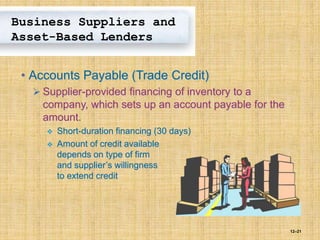
• Accounts Payable (Trade Credit)
 Supplier-provided financing of inventory to a
company, which sets up an account payable for the
amount.
 Short-duration financing (30 days)
 Amount of credit available
depends on type of firm
and supplier’s willingness
to extend credit
12–22
Business Suppliers and
Asset-Based Lenders (cont’d)
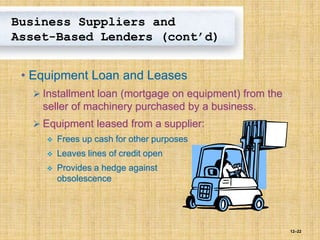
• Equipment Loan and Leases
 Installment loan (mortgage on equipment) from the
seller of machinery purchased by a business.
 Equipment leased from a supplier:
 Frees up cash for other purposes
 Leaves lines of credit open
 Provides a hedge against
obsolescence
12–23
Business Suppliers and
Asset-Based Lenders (cont’d)
• Asset-Based Lending
 A line of credit secured by working-capital assets
 Factoring
 Obtaining cash by selling accounts receivable to factor at
discount to invoice value.
 Factor can refuse questionable accounts.
 Factor charges fees for servicing accounts and for amount
advanced to firm prior to collection.
 Purchase-order financing
 Lender advances the amount of the borrower’s cost of goods
sold for a specific customer order.
12–24
Private Equity Investors
• Business Angels
 Private individuals who invest in others’
entrepreneurial ventures.
• Informal Venture Capital
 Funds provided by wealthy private individuals
(business angels) to high-risk ventures
• Formal Venture Capitalists
 Form limited partnerships for the purpose of raising
venture capital from large institutional investors
 The firm’s expected profits in future years
 The venture capitalist’s required rate of return.
12–25
The Government
• Small Business Administration (SBA) loans
 The 7 (a) Guaranty Loan Program
 SBA guarantees repayment of loan to lender
 The Certified Development Company (CDC) 504
Loan Program
 The 7(m) Microloan Program
 Small Business Investment Companies (SBICs)
 Small Business Innovative Research (SBIR)
12–26
The Government (cont’d)
• State and Local Government Assistance
 Loan guarantees help lower down payment.
 Focus on enhancing specific industries or facilitating
certain community goals.
• Community-Based Financial Institutions
 Lenders that provide financing to small businesses in
low-income communities for the purpose of
encouraging economic development.
12–27
Where Else to Look
• Large Corporations
 Provide financing and technical assistance to critical
suppliers and technology developers
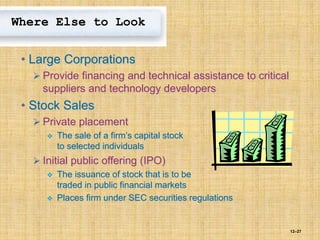
• Stock Sales
 Private placement
 The sale of a firm’s capital stock
to selected individuals
 Initial public offering (IPO)
 The issuance of stock that is to be
traded in public financial markets
 Places firm under SEC securities regulations
12–28
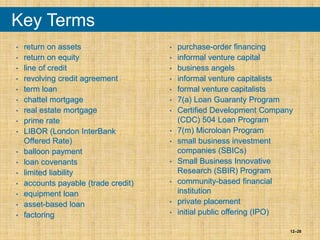
Key Terms
• return on assets
• return on equity
• line of credit
• revolving credit agreement
• term loan
• chattel mortgage
• real estate mortgage
• prime rate
• LIBOR (London InterBank
Offered Rate)
• balloon payment
• loan covenants
• limited liability
• accounts payable (trade credit)
• equipment loan
• asset-based loan
• factoring
• purchase-order financing
• informal venture capital
• business angels
• informal venture capitalists
• formal venture capitalists
• 7(a) Loan Guaranty Program
• Certified Development Company
(CDC) 504 Loan Program
• 7(m) Microloan Program
• small business investment
companies (SBICs)
• Small Business Innovative
Research (SBIR) Program
• community-based financial
institution
• private placement
• initial public offering (IPO)

Joseph Fabiilli | Debt or Equity Financing

  • 1.
    Joseph Fabiilli Debt orEquity Financing?
  • 2.
    12–2 1. Describe howthe nature of a firm affects its financing sources. 2. Evaluate the choice between debt financing and equity financing. 3. Identify typical sources of financing used at the outset of a new venture. 4. Discuss the basic process for acquiring and structuring a bank loan. 5. Explain how business relationships can be used to finance a small firm. 6. Describe the two types of private equity investors that offer financing to small firms. 7. Distinguish among the different government loan programs available to small companies. 8. Explain when large companies and public stock offerings can be sources of financing. Looking Ahead After studying this chapter, you should be able to:
  • 3.
    12–3 Basic Types ofFinancing Sources of Financing Spontaneous Financing Profit Retention External Financing
  • 4.
    12–4 The Nature ofa Firm and Its Financing Sources Firm’s economic potential Owner preferences for debt or equity Company size and maturity Factors That Determine Financing Types of assets
  • 5.
    12–5 Debt or EquityFinancing? Tradeoffs Between Debt and Equity Potential Profitability Voting Control Financial Risk
  • 6.
  • 7.
    12–7 Debt or EquityFinancing? (cont’d) • Return on Assets  Rate of return earned on a firm’s total assets invested  Computed as operating income ÷ total assets • Return on Equity  Rate of return earned on the owner’s equity investment  Computed as net income ÷ owner’s equity investment
  • 8.
    12–8 Debt versus Equityat the Levine Company
  • 9.
  • 10.
    12–10 Startup Financing forInc. 500 Companies in 2003
  • 11.
    12–11 Debt or EquityFinancing? Sources Close to Home Personal Savings Credit Cards Family and Friends
  • 12.
    12–12 Sources of PersonalCapital for Small Firms
  • 13.
    12–13 Bank Financing Types of Loans Lineof Credit Revolving Credit Agreement Mortgages Chattel Real Estate Term Loans
  • 14.
    12–14 Understanding a Banker’sPerspective • Bankers’ Concerns  How much the bank will earn on the loan?  What is the likelihood that the lender will be able to repay the loan? • The Five C’s of Credit  Character of the borrower  Capacity of the borrower to repay the loan  Capital invested in the venture by the borrower  Conditions of the industry and economy  Collateral available to secure the loan
  • 15.
    12–15 Questions Lenders Ask •Lender’s Questions: 1. Do the purpose and amount of the loan make sense, both for the bank and for the borrower? 2. Does the borrower have strong character and reasonable ability? 3. Does the loan have a certain primary source of repayment? 4. Does the loan have a certain secondary source of repayment? 5. Can the loan be priced profitably to the customer and to the bank, and are this loan and the relationship good for both the customer and the bank? 6. Can the loan be properly structured and documented?
  • 16.
    12–16 The Banker’s Concerns Howmuch money is needed? What is the venture going to do with the money? When and how will the money be paid back? When will the money be needed?
  • 17.
    12–17 Financial Information Required fora Bank Loan • Three years of the firm’s historical statements  Balance sheets, income statements, and statements of cash flow • The firm’s pro forma financial statements  The timing and amounts of the debt repayment included as part of the forecasts • Personal financial statements  The borrower’s personal net worth (assets – debts) and estimated annual income
  • 18.
  • 19.
    12–19 Negotiating a Loan:Interest Rate • Prime Rate  Interest rate charged by a commercial bank on loans to its most creditworthy customers • LIBOR (London InterBank Offered Rate)  Interest rate charged by London banks on loans to other London banks • Fixed Interest Rates  Interest rate remains the same for the term of the loan • Floating Interest Rates  Interest rate varies with the changes in the prime rate
  • 20.
    12–20 Negotiating a Loan:Term of the Loan • Loan Maturity Date  Maturity date matched to use of funds • Repayment Schedule  Equal monthly or annual payments  Decreasing monthly or annual payments • Loan Covenants  Bank-imposed restrictions on a borrower  Financial statements  Loan use restrictions and salary limits  Equity requirements  Personal guarantees by borrower
  • 21.
    12–21 Business Suppliers and Asset-BasedLenders • Accounts Payable (Trade Credit)  Supplier-provided financing of inventory to a company, which sets up an account payable for the amount.  Short-duration financing (30 days)  Amount of credit available depends on type of firm and supplier’s willingness to extend credit
  • 22.
    12–22 Business Suppliers and Asset-BasedLenders (cont’d) • Equipment Loan and Leases  Installment loan (mortgage on equipment) from the seller of machinery purchased by a business.  Equipment leased from a supplier:  Frees up cash for other purposes  Leaves lines of credit open  Provides a hedge against obsolescence
  • 23.
    12–23 Business Suppliers and Asset-BasedLenders (cont’d) • Asset-Based Lending  A line of credit secured by working-capital assets  Factoring  Obtaining cash by selling accounts receivable to factor at discount to invoice value.  Factor can refuse questionable accounts.  Factor charges fees for servicing accounts and for amount advanced to firm prior to collection.  Purchase-order financing  Lender advances the amount of the borrower’s cost of goods sold for a specific customer order.
  • 24.
    12–24 Private Equity Investors •Business Angels  Private individuals who invest in others’ entrepreneurial ventures. • Informal Venture Capital  Funds provided by wealthy private individuals (business angels) to high-risk ventures • Formal Venture Capitalists  Form limited partnerships for the purpose of raising venture capital from large institutional investors  The firm’s expected profits in future years  The venture capitalist’s required rate of return.
  • 25.
    12–25 The Government • SmallBusiness Administration (SBA) loans  The 7 (a) Guaranty Loan Program  SBA guarantees repayment of loan to lender  The Certified Development Company (CDC) 504 Loan Program  The 7(m) Microloan Program  Small Business Investment Companies (SBICs)  Small Business Innovative Research (SBIR)
  • 26.
    12–26 The Government (cont’d) •State and Local Government Assistance  Loan guarantees help lower down payment.  Focus on enhancing specific industries or facilitating certain community goals. • Community-Based Financial Institutions  Lenders that provide financing to small businesses in low-income communities for the purpose of encouraging economic development.
  • 27.
    12–27 Where Else toLook • Large Corporations  Provide financing and technical assistance to critical suppliers and technology developers • Stock Sales  Private placement  The sale of a firm’s capital stock to selected individuals  Initial public offering (IPO)  The issuance of stock that is to be traded in public financial markets  Places firm under SEC securities regulations
  • 28.
    12–28 Key Terms • returnon assets • return on equity • line of credit • revolving credit agreement • term loan • chattel mortgage • real estate mortgage • prime rate • LIBOR (London InterBank Offered Rate) • balloon payment • loan covenants • limited liability • accounts payable (trade credit) • equipment loan • asset-based loan • factoring • purchase-order financing • informal venture capital • business angels • informal venture capitalists • formal venture capitalists • 7(a) Loan Guaranty Program • Certified Development Company (CDC) 504 Loan Program • 7(m) Microloan Program • small business investment companies (SBICs) • Small Business Innovative Research (SBIR) Program • community-based financial institution • private placement • initial public offering (IPO)