Slideshow
MASTERING THE
FUNDAMENTAL FIVE
What are the business objectives driving your
organisation's move to the cloud? Are you
looking to better compete in the digital
marketplace? Get products to market faster?
Improve customer service?
FUNDAMENTAL 1: ALIGNED STRATEGY
MAPPING THE CLOUD MATURITY CURVE
Registered Name: The Economist Intelligence Unit, NA, Incorporated
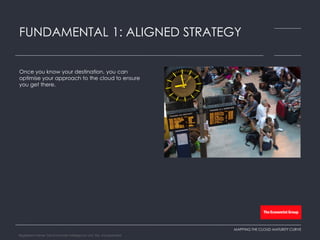
Once you know your destination, you can
optimise your approach to the cloud to ensure
you get there.
FUNDAMENTAL 1: ALIGNED STRATEGY
MAPPING THE CLOUD MATURITY CURVE
Registered Name: The Economist Intelligence Unit, NA, Incorporated
Eurostar, the London-based rail operator, focused
its cloud effort on improving the customer
experience with the goal of boosting loyalty,
recommendations and sales. “We are all about
providing the best travelling experience in
Europe. We try make it an effortless experience,”
says Antoine de Kerviler, Eurostar’s chief
information officer. “It’s all about speed with the
trains, and it’s all about speed when we deliver
[digital] services.”
FUNDAMENTAL 1: ALIGNED STRATEGY
4
MAPPING THE CLOUD MATURITY CURVE
Registered Name: The Economist Intelligence Unit, NA, Incorporated
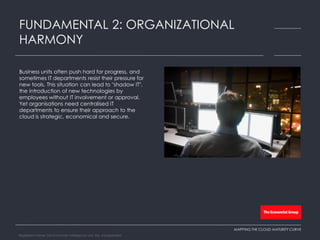
Business units often push hard for progress, and
sometimes IT departments resist their pressure for
new tools. This situation can lead to "shadow IT",
the introduction of new technologies by
employees without IT involvement or approval.
Yet organisations need centralised IT
departments to ensure their approach to the
cloud is strategic, economical and secure.
FUNDAMENTAL 2: ORGANIZATIONAL
HARMONY
MAPPING THE CLOUD MATURITY CURVE
Registered Name: The Economist Intelligence Unit, NA, Incorporated
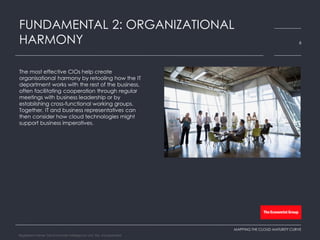
The most effective CIOs help create
organisational harmony by retooling how the IT
department works with the rest of the business,
often facilitating cooperation through regular
meetings with business leadership or by
establishing cross-functional working groups.
Together, IT and business representatives can
then consider how cloud technologies might
support business imperatives.
FUNDAMENTAL 2: ORGANIZATIONAL
HARMONY 6
MAPPING THE CLOUD MATURITY CURVE
Registered Name: The Economist Intelligence Unit, NA, Incorporated
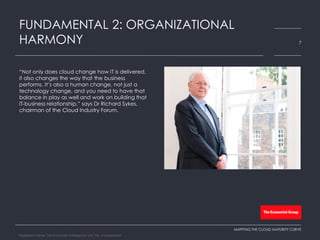
“Not only does cloud change how IT is delivered,
it also changes the way that the business
performs. It’s also a human change, not just a
technology change, and you need to have that
balance in play as well and work on building that
IT-business relationship,” says Dr Richard Sykes,
chairman of the Cloud Industry Forum.
FUNDAMENTAL 2: ORGANIZATIONAL
HARMONY 7
MAPPING THE CLOUD MATURITY CURVE
Registered Name: The Economist Intelligence Unit, NA, Incorporated
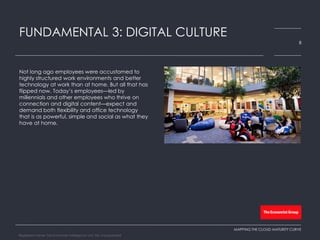
Not long ago employees were accustomed to
highly structured work environments and better
technology at work than at home. But all that has
flipped now. Today’s employees—led by
millennials and other employees who thrive on
connection and digital content—expect and
demand both flexibility and office technology
that is as powerful, simple and social as what they
have at home.
FUNDAMENTAL 3: DIGITAL CULTURE
8
MAPPING THE CLOUD MATURITY CURVE
Registered Name: The Economist Intelligence Unit, NA, Incorporated
“It’s important to think about the role of people in
driving the adoption of cloud computing....
They’ve been getting a wonderful experience
[from Apple and Google], and they’ve been
getting exactly what they need,” said Barry
Jennings, of law firm Bird & Bird, at a September
2014 conference. “Employees’ expectations of
what technology can do have risen, [and] that’s
put pressure on IT departments within
corporations to deliver those benefits.”
FUNDAMENTAL 3: DIGITAL CULTURE
9
MAPPING THE CLOUD MATURITY CURVE
Registered Name: The Economist Intelligence Unit, NA, Incorporated
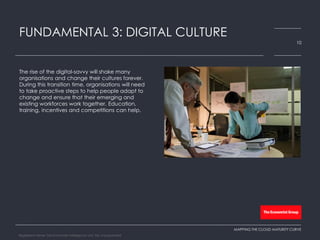
The rise of the digital-savvy will shake many
organisations and change their cultures forever.
During this transition time, organisations will need
to take proactive steps to help people adapt to
change and ensure that their emerging and
existing workforces work together. Education,
training, incentives and competitions can help.
FUNDAMENTAL 3: DIGITAL CULTURE
10
MAPPING THE CLOUD MATURITY CURVE
Registered Name: The Economist Intelligence Unit, NA, Incorporated
Once business and cloud strategies are in
alignment and employees are prepared to
execute them, companies will want to revisit and
perhaps redesign their underlying technology
infrastructure to ensure it supports their mission
and goals. This effort is often presented as
requiring an either-or choice between private
clouds and public clouds, though it is seldom the
case.
FUNDAMENTAL4 : DYNAMIC
INFRASTRUCTURE 11
MAPPING THE CLOUD MATURITY CURVE
Registered Name: The Economist Intelligence Unit, NA, Incorporated
That redesign should involve practical technology
choices that respond to a company's particular
needs and capabilities and its current business
requirements. Most organizations need to protect
existing investments even as they add more
flexible, up-to-date systems.
FUNDAMENTAL4 : DYNAMIC
INFRASTRUCTURE
MAPPING THE CLOUD MATURITY CURVE
Registered Name: The Economist Intelligence Unit, NA, Incorporated
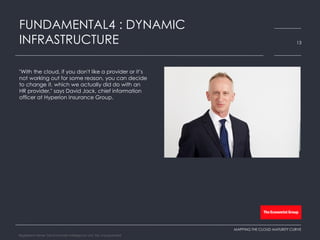
​"With the cloud, if you don't like a provider or it’s
not working out for some reason, you can decide
to change it, which we actually did do with an
HR provider," says David Jack, chief information
officer at Hyperion Insurance Group.
FUNDAMENTAL4 : DYNAMIC
INFRASTRUCTURE 13
MAPPING THE CLOUD MATURITY CURVE
Registered Name: The Economist Intelligence Unit, NA, Incorporated
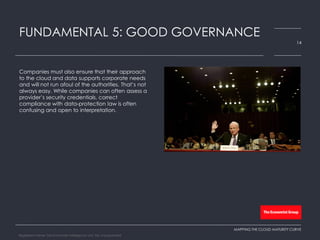
Companies must also ensure that their approach
to the cloud and data supports corporate needs
and will not run afoul of the authorities. That’s not
always easy. While companies can often assess a
provider’s security credentials, correct
compliance with data-protection law is often
confusing and open to interpretation.
FUNDAMENTAL 5: GOOD GOVERNANCE
14
MAPPING THE CLOUD MATURITY CURVE
Registered Name: The Economist Intelligence Unit, NA, Incorporated
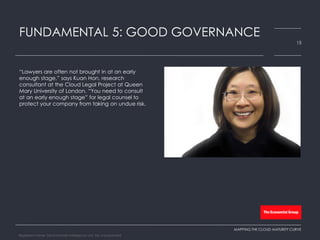
“Lawyers are often not brought in at an early
enough stage,” says Kuan Hon, research
consultant at the Cloud Legal Project at Queen
Mary University of London. “You need to consult
at an early enough stage” for legal counsel to
protect your company from taking on undue risk.
FUNDAMENTAL 5: GOOD GOVERNANCE
15
MAPPING THE CLOUD MATURITY CURVE
Registered Name: The Economist Intelligence Unit, NA, Incorporated
Organisations must take effective measures to
ensure the prudent management of digital-era
risks. Bottom line: Successful cloud adopters
approach cloud technologies with strategic
seriousness. Their cloud strategies support their
business strategies. They create organisational
harmony and cultural cohesion, make practical
infrastructure choices and ensure good
governance. They have a mature approach to
the cloud that sets them up for success.
FUNDAMENTAL 5: GOOD GOVERNANCE
16
MAPPING THE CLOUD MATURITY CURVE
Registered Name: The Economist Intelligence Unit, NA, Incorporated

Slideshow: Mastering the fundamental five

  • 1.
  • 2.
    What are thebusiness objectives driving your organisation's move to the cloud? Are you looking to better compete in the digital marketplace? Get products to market faster? Improve customer service? FUNDAMENTAL 1: ALIGNED STRATEGY MAPPING THE CLOUD MATURITY CURVE Registered Name: The Economist Intelligence Unit, NA, Incorporated
  • 3.
    Once you knowyour destination, you can optimise your approach to the cloud to ensure you get there. FUNDAMENTAL 1: ALIGNED STRATEGY MAPPING THE CLOUD MATURITY CURVE Registered Name: The Economist Intelligence Unit, NA, Incorporated
  • 4.
    Eurostar, the London-basedrail operator, focused its cloud effort on improving the customer experience with the goal of boosting loyalty, recommendations and sales. “We are all about providing the best travelling experience in Europe. We try make it an effortless experience,” says Antoine de Kerviler, Eurostar’s chief information officer. “It’s all about speed with the trains, and it’s all about speed when we deliver [digital] services.” FUNDAMENTAL 1: ALIGNED STRATEGY 4 MAPPING THE CLOUD MATURITY CURVE Registered Name: The Economist Intelligence Unit, NA, Incorporated
  • 5.
    Business units oftenpush hard for progress, and sometimes IT departments resist their pressure for new tools. This situation can lead to "shadow IT", the introduction of new technologies by employees without IT involvement or approval. Yet organisations need centralised IT departments to ensure their approach to the cloud is strategic, economical and secure. FUNDAMENTAL 2: ORGANIZATIONAL HARMONY MAPPING THE CLOUD MATURITY CURVE Registered Name: The Economist Intelligence Unit, NA, Incorporated
  • 6.
    The most effectiveCIOs help create organisational harmony by retooling how the IT department works with the rest of the business, often facilitating cooperation through regular meetings with business leadership or by establishing cross-functional working groups. Together, IT and business representatives can then consider how cloud technologies might support business imperatives. FUNDAMENTAL 2: ORGANIZATIONAL HARMONY 6 MAPPING THE CLOUD MATURITY CURVE Registered Name: The Economist Intelligence Unit, NA, Incorporated
  • 7.
    “Not only doescloud change how IT is delivered, it also changes the way that the business performs. It’s also a human change, not just a technology change, and you need to have that balance in play as well and work on building that IT-business relationship,” says Dr Richard Sykes, chairman of the Cloud Industry Forum. FUNDAMENTAL 2: ORGANIZATIONAL HARMONY 7 MAPPING THE CLOUD MATURITY CURVE Registered Name: The Economist Intelligence Unit, NA, Incorporated
  • 8.
    Not long agoemployees were accustomed to highly structured work environments and better technology at work than at home. But all that has flipped now. Today’s employees—led by millennials and other employees who thrive on connection and digital content—expect and demand both flexibility and office technology that is as powerful, simple and social as what they have at home. FUNDAMENTAL 3: DIGITAL CULTURE 8 MAPPING THE CLOUD MATURITY CURVE Registered Name: The Economist Intelligence Unit, NA, Incorporated
  • 9.
    “It’s important tothink about the role of people in driving the adoption of cloud computing.... They’ve been getting a wonderful experience [from Apple and Google], and they’ve been getting exactly what they need,” said Barry Jennings, of law firm Bird & Bird, at a September 2014 conference. “Employees’ expectations of what technology can do have risen, [and] that’s put pressure on IT departments within corporations to deliver those benefits.” FUNDAMENTAL 3: DIGITAL CULTURE 9 MAPPING THE CLOUD MATURITY CURVE Registered Name: The Economist Intelligence Unit, NA, Incorporated
  • 10.
    The rise ofthe digital-savvy will shake many organisations and change their cultures forever. During this transition time, organisations will need to take proactive steps to help people adapt to change and ensure that their emerging and existing workforces work together. Education, training, incentives and competitions can help. FUNDAMENTAL 3: DIGITAL CULTURE 10 MAPPING THE CLOUD MATURITY CURVE Registered Name: The Economist Intelligence Unit, NA, Incorporated
  • 11.
    Once business andcloud strategies are in alignment and employees are prepared to execute them, companies will want to revisit and perhaps redesign their underlying technology infrastructure to ensure it supports their mission and goals. This effort is often presented as requiring an either-or choice between private clouds and public clouds, though it is seldom the case. FUNDAMENTAL4 : DYNAMIC INFRASTRUCTURE 11 MAPPING THE CLOUD MATURITY CURVE Registered Name: The Economist Intelligence Unit, NA, Incorporated
  • 12.
    That redesign shouldinvolve practical technology choices that respond to a company's particular needs and capabilities and its current business requirements. Most organizations need to protect existing investments even as they add more flexible, up-to-date systems. FUNDAMENTAL4 : DYNAMIC INFRASTRUCTURE MAPPING THE CLOUD MATURITY CURVE Registered Name: The Economist Intelligence Unit, NA, Incorporated
  • 13.
    ​"With the cloud,if you don't like a provider or it’s not working out for some reason, you can decide to change it, which we actually did do with an HR provider," says David Jack, chief information officer at Hyperion Insurance Group. FUNDAMENTAL4 : DYNAMIC INFRASTRUCTURE 13 MAPPING THE CLOUD MATURITY CURVE Registered Name: The Economist Intelligence Unit, NA, Incorporated
  • 14.
    Companies must alsoensure that their approach to the cloud and data supports corporate needs and will not run afoul of the authorities. That’s not always easy. While companies can often assess a provider’s security credentials, correct compliance with data-protection law is often confusing and open to interpretation. FUNDAMENTAL 5: GOOD GOVERNANCE 14 MAPPING THE CLOUD MATURITY CURVE Registered Name: The Economist Intelligence Unit, NA, Incorporated
  • 15.
    “Lawyers are oftennot brought in at an early enough stage,” says Kuan Hon, research consultant at the Cloud Legal Project at Queen Mary University of London. “You need to consult at an early enough stage” for legal counsel to protect your company from taking on undue risk. FUNDAMENTAL 5: GOOD GOVERNANCE 15 MAPPING THE CLOUD MATURITY CURVE Registered Name: The Economist Intelligence Unit, NA, Incorporated
  • 16.
    Organisations must takeeffective measures to ensure the prudent management of digital-era risks. Bottom line: Successful cloud adopters approach cloud technologies with strategic seriousness. Their cloud strategies support their business strategies. They create organisational harmony and cultural cohesion, make practical infrastructure choices and ensure good governance. They have a mature approach to the cloud that sets them up for success. FUNDAMENTAL 5: GOOD GOVERNANCE 16 MAPPING THE CLOUD MATURITY CURVE Registered Name: The Economist Intelligence Unit, NA, Incorporated