1!
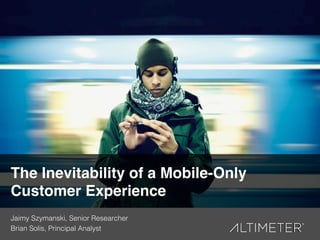
The Inevitability of a Mobile-Only
Customer Experience!
Jaimy Szymanski, Senior Researcher!
Brian Solis, Principal Analyst!
2!
Welcome!!
·  Hashtag: #MobileCX!
·  Submit questions via chat window!
·  Q&A at webinar’s end with follow-up blog post
covering questions we didn’t get to!
·  Slides and recording will be emailed to you
following the webinar!
Jaimy Szymanski!
jaimy@altimetergroup.com!
@jaimy_marie!
!
Brian Solis!
brian@altimetergroup.com!
@briansolis!
!
3!
Download the report at: !
http://pages.altimetergroup.com/mobile-only-customer-experience-report.html!
4!
Customers are
becoming
increasingly
mobile, and, as a
result, the customer
journey is in need
of an overhaul.!
5!
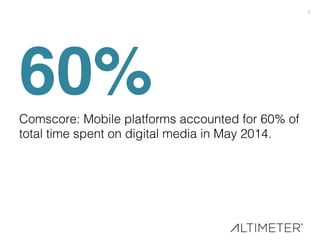
60%!Comscore: Mobile platforms accounted for 60% of
total time spent on digital media in May 2014. !
6!
60%!Comscore: Mobile platforms accounted for 60% of
total time spent on digital media in May 2014. !
The truth is, mobile should be the
standard for all things digital.!
7!
Consumers are quickly
learning to operate in a
mobile-only world.!
!
“Mobile-first” may not be enough: !
1/3 of shoppers use mobile exclusively, and more
than 1/2 consider mobile the most important
resource in the purchase decision process.!
8!
9!
10!
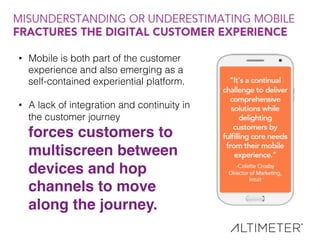
•  Mobile is both part of the customer
experience and also emerging as a
self-contained experiential platform.!
•  A lack of integration and continuity in
the customer journey !
forces customers to
multiscreen between
devices and hop
channels to move
along the journey.!
11!
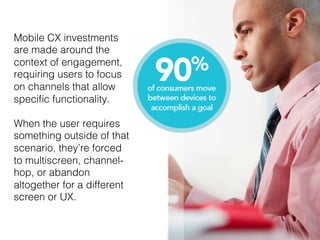
Mobile CX investments
are made around the
context of engagement,
requiring users to focus
on channels that allow
specific functionality. !
!
When the user requires!
something outside of that
scenario, they’re forced
to multiscreen, channel-
hop, or abandon
altogether for a different
screen or UX.!
12!
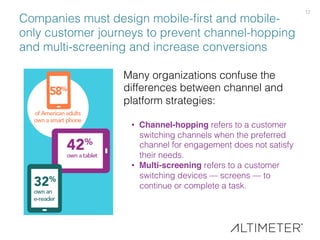
Companies must design mobile-first and mobile-
only customer journeys to prevent channel-hopping
and multi-screening and increase conversions!
Many organizations confuse the
differences between channel and
platform strategies:!
!
•  Channel-hopping refers to a customer
switching channels when the preferred
channel for engagement does not satisfy
their needs. !
•  Multi-screening refers to a customer
switching devices — screens — to
continue or complete a task.!
13!
14!
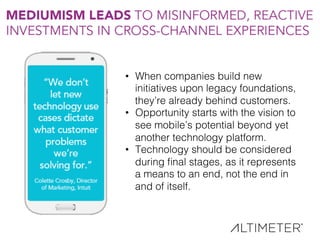
•  When companies build new
initiatives upon legacy foundations,
they’re already behind customers.!
•  Opportunity starts with the vision to
see mobile’s potential beyond yet
another technology platform.!
•  Technology should be considered
during final stages, as it represents
a means to an end, not the end in
and of itself.!
15!
16!
17!
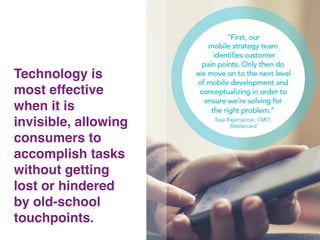
Technology is
most effective
when it is
invisible, allowing
consumers to
accomplish tasks
without getting
lost or hindered
by old-school
touchpoints.!
18!
19!
Without proof of mobile conversion,
strategists struggle to rally support, funding!
·  Without associating customers with a unique ID,
change agents can’t prove mobile conversion.!
·  Forced channel-hopping behavior gives the
false impression that customers prefer a
multiscreen experience.!
· Catch 22: Executives require results to
approve funding, yet funding is required
to build the case.!
20!
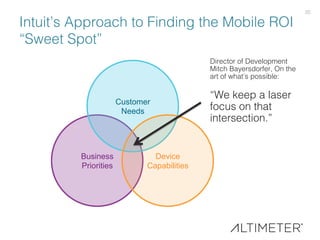
Intuit’s Approach to Finding the Mobile ROI
“Sweet Spot”!
Business
Priorities
Customer
Needs
Device
Capabilities
Director of Development !
Mitch Bayersdorfer, On the
art of what’s possible: !
!
“We keep a laser
focus on that
intersection.”!
21!
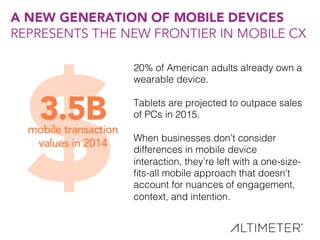
20% of American adults already own a
wearable device.!
!
Tablets are projected to outpace sales
of PCs in 2015.!
!
When businesses don’t consider
differences in mobile device
interaction, they’re left with a one-size-
fits-all mobile approach that doesn’t
account for nuances of engagement,
context, and intention.!
!
22!
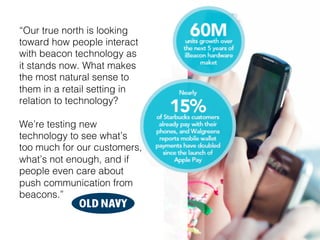
“Our true north is looking
toward how people interact
with beacon technology as
it stands now. What makes
the most natural sense to
them in a retail setting in
relation to technology?!
!
We’re testing new
technology to see what’s
too much for our customers,
what’s not enough, and if
people even care about
push communication from
beacons.”!
23!
Mobile is often positioned as a facet of
digital, itself part of a larger marketing
division. This is a result of two factors:!
1.  An outdated, uninformed culture
that views mobile as a channel,
not a lifestyle!
2.  Limited resources and support to
empower mobile leaders to make
decisions that align with
customer consumption habits!
!
This buries mobile in slow-moving
bureaucracy, unable to nimbly adapt!
to shifting customer expectations.!
24!
Mobile Working Groups can act as !
powerful internal lobbying
organizations to showcase mobile’s
importance to leadership, as well as provide
the manpower needed to consistently
keep tabs on customer experiences !
and analyze related data.!
25!
Once companies have
fully embraced mobile
as part of their
customer’s lifestyle,
they embrace it at
their core.!
26!
27!
28!
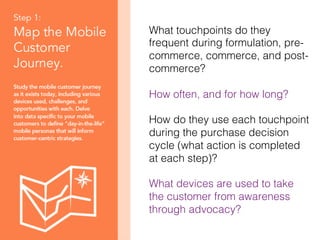
What touchpoints do they
frequent during formulation, pre-
commerce, commerce, and post-
commerce? !
!
How often, and for how long?!
!
How do they use each touchpoint
during the purchase decision
cycle (what action is completed
at each step)?!
!
What devices are used to take
the customer from awareness
through advocacy?!
29!
30!
Top Mobile Persona Questions to Ask & Answer!
·  What uniquely defines our mobile customers?!
·  What is different about their customer journey?!
·  What are their expectations, what do they value,
and how do they define success?!
·  How are they influenced, and by whom? !
How and whom do they in turn influence?!
·  How can you design for device or platform-
specific journeys to minimalize channel-hopping
or multiscreening?!
31!
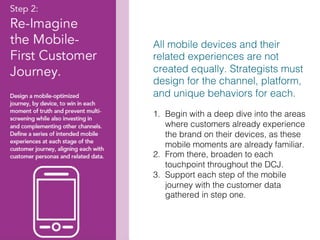
All mobile devices and their
related experiences are not
created equally. Strategists must
design for the channel, platform,
and unique behaviors for each.!
!
1.  Begin with a deep dive into the areas
where customers already experience
the brand on their devices, as these
mobile moments are already familiar. !
2.  From there, broaden to each
touchpoint throughout the DCJ.!
3.  Support each step of the mobile
journey with the customer data
gathered in step one.!
32!
33!
By looking deeper into
customer insights,
beyond current
behaviors, and toward
desired experiences,
mobile strategies are
quickly moved from
misinformed to
engaging.!
!
Data analysis and
predictive
experience
mapping must
take center stage.!
34!
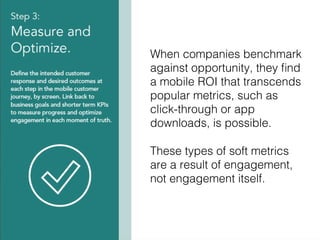
When companies benchmark
against opportunity, they find
a mobile ROI that transcends
popular metrics, such as
click-through or app
downloads, is possible. !
!
These types of soft metrics
are a result of engagement,
not engagement itself.!
35!
36!
It’s critical to consider
existing digital,
marketing, and CX
goals when defining
mobile metrics.!
!
Whenever possible,
connect mobile
initiatives to larger
strategies that move the
needle toward impact. !
!
Doing so aids in your
quest for internal buy-in
when you can prove
mobile’s contributions
both alone and in a
larger digital strategy.!
37!
•  Forming strategic alliances with
other groups can help prove
mobile’s value.!
•  Mobile working groups and digital
CoEs can be instrumental in
providing the launch pad to get
mobile noticed.!
•  Once in alignment, strategists test
and re-test their mobile strategies
internally and externally. !
•  IT leads software and hardware
development and coding needed
to execute on the architected
mobile experience. !
38!
In the future, mobile, through the
sum of its parts, will become 

the standard for hosting the
customer journey.!
39!
Thank you! Questions?!
Jaimy Szymanski!
jaimy@altimetergroup.com!
@jaimy_marie!
!
Brian Solis!
brian@altimetergroup.com!
@briansolis!
!
Download the report at: !
http://pages.altimetergroup.com/mobile-only-
customer-experience-report.html!

[Slides] The Inevitability of a Mobile-Only Customer Experience by Altimeter Group

  • 1.
    1! The Inevitability ofa Mobile-Only Customer Experience! Jaimy Szymanski, Senior Researcher! Brian Solis, Principal Analyst!
  • 2.
    2! Welcome!! ·  Hashtag: #MobileCX! · Submit questions via chat window! ·  Q&A at webinar’s end with follow-up blog post covering questions we didn’t get to! ·  Slides and recording will be emailed to you following the webinar! Jaimy Szymanski! jaimy@altimetergroup.com! @jaimy_marie! ! Brian Solis! brian@altimetergroup.com! @briansolis! !
  • 3.
    3! Download the reportat: ! http://pages.altimetergroup.com/mobile-only-customer-experience-report.html!
  • 4.
    4! Customers are becoming increasingly mobile, and,as a result, the customer journey is in need of an overhaul.!
  • 5.
    5! 60%!Comscore: Mobile platformsaccounted for 60% of total time spent on digital media in May 2014. !
  • 6.
    6! 60%!Comscore: Mobile platformsaccounted for 60% of total time spent on digital media in May 2014. ! The truth is, mobile should be the standard for all things digital.!
  • 7.
    7! Consumers are quickly learningto operate in a mobile-only world.! ! “Mobile-first” may not be enough: ! 1/3 of shoppers use mobile exclusively, and more than 1/2 consider mobile the most important resource in the purchase decision process.!
  • 8.
  • 9.
  • 10.
    10! •  Mobile isboth part of the customer experience and also emerging as a self-contained experiential platform.! •  A lack of integration and continuity in the customer journey ! forces customers to multiscreen between devices and hop channels to move along the journey.!
  • 11.
    11! Mobile CX investments aremade around the context of engagement, requiring users to focus on channels that allow specific functionality. ! ! When the user requires! something outside of that scenario, they’re forced to multiscreen, channel- hop, or abandon altogether for a different screen or UX.!
  • 12.
    12! Companies must designmobile-first and mobile- only customer journeys to prevent channel-hopping and multi-screening and increase conversions! Many organizations confuse the differences between channel and platform strategies:! ! •  Channel-hopping refers to a customer switching channels when the preferred channel for engagement does not satisfy their needs. ! •  Multi-screening refers to a customer switching devices — screens — to continue or complete a task.!
  • 13.
  • 14.
    14! •  When companiesbuild new initiatives upon legacy foundations, they’re already behind customers.! •  Opportunity starts with the vision to see mobile’s potential beyond yet another technology platform.! •  Technology should be considered during final stages, as it represents a means to an end, not the end in and of itself.!
  • 15.
  • 16.
  • 17.
    17! Technology is most effective whenit is invisible, allowing consumers to accomplish tasks without getting lost or hindered by old-school touchpoints.!
  • 18.
  • 19.
    19! Without proof ofmobile conversion, strategists struggle to rally support, funding! ·  Without associating customers with a unique ID, change agents can’t prove mobile conversion.! ·  Forced channel-hopping behavior gives the false impression that customers prefer a multiscreen experience.! · Catch 22: Executives require results to approve funding, yet funding is required to build the case.!
  • 20.
    20! Intuit’s Approach toFinding the Mobile ROI “Sweet Spot”! Business Priorities Customer Needs Device Capabilities Director of Development ! Mitch Bayersdorfer, On the art of what’s possible: ! ! “We keep a laser focus on that intersection.”!
  • 21.
    21! 20% of Americanadults already own a wearable device.! ! Tablets are projected to outpace sales of PCs in 2015.! ! When businesses don’t consider differences in mobile device interaction, they’re left with a one-size- fits-all mobile approach that doesn’t account for nuances of engagement, context, and intention.! !
  • 22.
    22! “Our true northis looking toward how people interact with beacon technology as it stands now. What makes the most natural sense to them in a retail setting in relation to technology?! ! We’re testing new technology to see what’s too much for our customers, what’s not enough, and if people even care about push communication from beacons.”!
  • 23.
    23! Mobile is oftenpositioned as a facet of digital, itself part of a larger marketing division. This is a result of two factors:! 1.  An outdated, uninformed culture that views mobile as a channel, not a lifestyle! 2.  Limited resources and support to empower mobile leaders to make decisions that align with customer consumption habits! ! This buries mobile in slow-moving bureaucracy, unable to nimbly adapt! to shifting customer expectations.!
  • 24.
    24! Mobile Working Groupscan act as ! powerful internal lobbying organizations to showcase mobile’s importance to leadership, as well as provide the manpower needed to consistently keep tabs on customer experiences ! and analyze related data.!
  • 25.
    25! Once companies have fullyembraced mobile as part of their customer’s lifestyle, they embrace it at their core.!
  • 26.
  • 27.
  • 28.
    28! What touchpoints dothey frequent during formulation, pre- commerce, commerce, and post- commerce? ! ! How often, and for how long?! ! How do they use each touchpoint during the purchase decision cycle (what action is completed at each step)?! ! What devices are used to take the customer from awareness through advocacy?!
  • 29.
  • 30.
    30! Top Mobile PersonaQuestions to Ask & Answer! ·  What uniquely defines our mobile customers?! ·  What is different about their customer journey?! ·  What are their expectations, what do they value, and how do they define success?! ·  How are they influenced, and by whom? ! How and whom do they in turn influence?! ·  How can you design for device or platform- specific journeys to minimalize channel-hopping or multiscreening?!
  • 31.
    31! All mobile devicesand their related experiences are not created equally. Strategists must design for the channel, platform, and unique behaviors for each.! ! 1.  Begin with a deep dive into the areas where customers already experience the brand on their devices, as these mobile moments are already familiar. ! 2.  From there, broaden to each touchpoint throughout the DCJ.! 3.  Support each step of the mobile journey with the customer data gathered in step one.!
  • 32.
  • 33.
    33! By looking deeperinto customer insights, beyond current behaviors, and toward desired experiences, mobile strategies are quickly moved from misinformed to engaging.! ! Data analysis and predictive experience mapping must take center stage.!
  • 34.
    34! When companies benchmark againstopportunity, they find a mobile ROI that transcends popular metrics, such as click-through or app downloads, is possible. ! ! These types of soft metrics are a result of engagement, not engagement itself.!
  • 35.
  • 36.
    36! It’s critical toconsider existing digital, marketing, and CX goals when defining mobile metrics.! ! Whenever possible, connect mobile initiatives to larger strategies that move the needle toward impact. ! ! Doing so aids in your quest for internal buy-in when you can prove mobile’s contributions both alone and in a larger digital strategy.!
  • 37.
    37! •  Forming strategicalliances with other groups can help prove mobile’s value.! •  Mobile working groups and digital CoEs can be instrumental in providing the launch pad to get mobile noticed.! •  Once in alignment, strategists test and re-test their mobile strategies internally and externally. ! •  IT leads software and hardware development and coding needed to execute on the architected mobile experience. !
  • 38.
    38! In the future,mobile, through the sum of its parts, will become 
 the standard for hosting the customer journey.!
  • 39.
    39! Thank you! Questions?! JaimySzymanski! jaimy@altimetergroup.com! @jaimy_marie! ! Brian Solis! brian@altimetergroup.com! @briansolis! ! Download the report at: ! http://pages.altimetergroup.com/mobile-only- customer-experience-report.html!