Modal verbs
upperintermediate
Summary
Modal verbs
upperintermediate
1. Introduction
2. Understanding Modal Verbs
3. Expressing Ability and Possibility
4. Making Requests and Offers
5. Expressing Necessity and Advice
6. Conclusion
7. Exercises
Modal verbs
upperintermedia
te
Lesson objectives
Students will master modal verbs at an
upper-intermediate level, enabling them
to answer questions, solve related
problems, and apply their knowledge in
practical scenarios.
Introduction
Contextualization
Modal verbs are essential in conveying ability, permission, necessity,
and possibility in everyday conversations. Mastering their use can
enhance students' fluency and comprehension in both spoken and
written English, making their communication more effective.
Problem Situation
Imagine you are planning a group project, but your classmates have
differing opinions on what should be done. How can you express your
suggestions, ask for permission, or discuss possibilities using modal
verbs? This situation illustrates the importance of mastering modal
verbs in effective collaboration and communication.
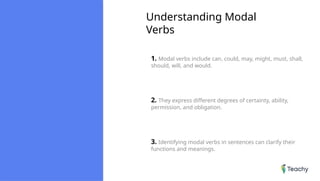
Understanding Modal
Verbs
1. Modal verbs include can, could, may, might, must, shall,
should, will, and would.
2. They express different degrees of certainty, ability,
permission, and obligation.
3. Identifying modal verbs in sentences can clarify their
functions and meanings.
Examples and practical applications
For instance, in the sentence, 'You must
finish your homework,' the modal verb
'must' indicates a strong obligation.
Expressing Ability and
Possibility
1. Use 'can' and 'could' to express ability: 'I can swim' vs. 'I
could swim when I was younger.'
2. Use 'may' and 'might' to indicate possibility: 'It may rain
tomorrow.'
3. Context matters: 'can' suggests a present ability, while
'could' implies past potential.
Examples and practical applications
In a conversation about travel, a
student might say, 'I can travel abroad
next summer,' emphasizing current
capability.
Making Requests and
Offers
1. 'Can you pass the salt?' is a common request using 'can.'
2. 'Would you like to join us?' is a polite way to extend an
offer.
3. Using 'could' softens requests: 'Could you help me with
this task?'
Examples and practical applications
While planning an event, a student
might say, 'Would you help organize
the decoration?', showing politeness
through modal verbs.
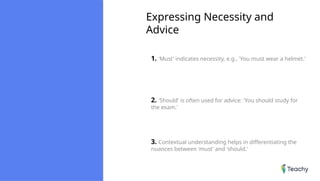
Expressing Necessity and
Advice
1. 'Must' indicates necessity, e.g., 'You must wear a helmet.'
2. 'Should' is often used for advice: 'You should study for
the exam.'
3. Contextual understanding helps in differentiating the
nuances between 'must' and 'should.'
Examples and practical applications
In a health discussion, a student might
say, 'You should exercise regularly,'
giving advice on well-being.
Conclusion
Modal verbs
upperintermediate
1. Modal verbs enhance communication by expressing
capability, necessity, and politeness.
2. Understanding the context is vital for using modal
verbs effectively.
3. Practice in real-life situations helps solidify the
knowledge of modal verbs.
4. Using modal verbs correctly can improve fluency and
clarity in both writing and speaking.
Exercises
Identify the modal verbs in the following sentence: 'You should see a doctor if you feel unwell.'
Rewrite this sentence using a modal verb: 'It is necessary for you to finish your project.'
Create a dialog using at least three different modal verbs in context.
Thank You
https://www.teachy.app

Slide_Modal_verbs_upperintermediate.pptx

  • 1.
  • 2.
    Summary Modal verbs upperintermediate 1. Introduction 2.Understanding Modal Verbs 3. Expressing Ability and Possibility 4. Making Requests and Offers 5. Expressing Necessity and Advice 6. Conclusion 7. Exercises
  • 3.
    Modal verbs upperintermedia te Lesson objectives Studentswill master modal verbs at an upper-intermediate level, enabling them to answer questions, solve related problems, and apply their knowledge in practical scenarios.
  • 4.
    Introduction Contextualization Modal verbs areessential in conveying ability, permission, necessity, and possibility in everyday conversations. Mastering their use can enhance students' fluency and comprehension in both spoken and written English, making their communication more effective. Problem Situation Imagine you are planning a group project, but your classmates have differing opinions on what should be done. How can you express your suggestions, ask for permission, or discuss possibilities using modal verbs? This situation illustrates the importance of mastering modal verbs in effective collaboration and communication.
  • 5.
    Understanding Modal Verbs 1. Modalverbs include can, could, may, might, must, shall, should, will, and would. 2. They express different degrees of certainty, ability, permission, and obligation. 3. Identifying modal verbs in sentences can clarify their functions and meanings.
  • 6.
    Examples and practicalapplications For instance, in the sentence, 'You must finish your homework,' the modal verb 'must' indicates a strong obligation.
  • 7.
    Expressing Ability and Possibility 1.Use 'can' and 'could' to express ability: 'I can swim' vs. 'I could swim when I was younger.' 2. Use 'may' and 'might' to indicate possibility: 'It may rain tomorrow.' 3. Context matters: 'can' suggests a present ability, while 'could' implies past potential.
  • 8.
    Examples and practicalapplications In a conversation about travel, a student might say, 'I can travel abroad next summer,' emphasizing current capability.
  • 9.
    Making Requests and Offers 1.'Can you pass the salt?' is a common request using 'can.' 2. 'Would you like to join us?' is a polite way to extend an offer. 3. Using 'could' softens requests: 'Could you help me with this task?'
  • 10.
    Examples and practicalapplications While planning an event, a student might say, 'Would you help organize the decoration?', showing politeness through modal verbs.
  • 11.
    Expressing Necessity and Advice 1.'Must' indicates necessity, e.g., 'You must wear a helmet.' 2. 'Should' is often used for advice: 'You should study for the exam.' 3. Contextual understanding helps in differentiating the nuances between 'must' and 'should.'
  • 12.
    Examples and practicalapplications In a health discussion, a student might say, 'You should exercise regularly,' giving advice on well-being.
  • 13.
    Conclusion Modal verbs upperintermediate 1. Modalverbs enhance communication by expressing capability, necessity, and politeness. 2. Understanding the context is vital for using modal verbs effectively. 3. Practice in real-life situations helps solidify the knowledge of modal verbs. 4. Using modal verbs correctly can improve fluency and clarity in both writing and speaking.
  • 14.
    Exercises Identify the modalverbs in the following sentence: 'You should see a doctor if you feel unwell.' Rewrite this sentence using a modal verb: 'It is necessary for you to finish your project.' Create a dialog using at least three different modal verbs in context.
  • 15.