UNIVERSITY OF THE PUNJAB
Presented By :
Presented to :
Subject :
Degree :
Department :
Saeed Murad (08), M.Mubashir(22), Iqra Sandhu(), Kira Muzaffar (29)
Ms. Nigham Khalid
English
BS SOCIOLOGY
Institute of Social & Cultural Studies
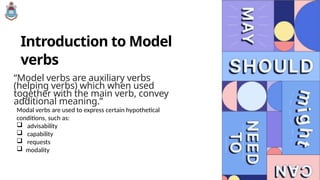
Introduction to Model
verbs
“Model verbs are auxiliary verbs
(helping verbs) which when used
together with the main verb, convey
additional meaning.”
Modal verbs are used to express certain hypothetical
conditions, such as:
 advisability
 capability
 requests
 modality
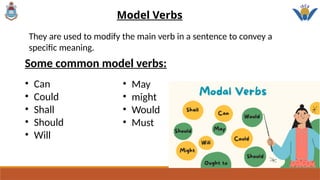
Some common model verbs:
• Can
• Could
• Shall
• Should
• Will
• May
• might
• Would
• Must
Model Verbs
They are used to modify the main verb in a sentence to convey a
specific meaning.
6 Different types of Situations
1. Ability (can, could)
2. Possibility (could, may , might)
3. Advice (should)
4. Permission (can, may, could)
5. Obligation (must, have to)
6. Hypothetical or conditional
Importance of model verbs
o Expression of Modality
o Nuance
o Clarity & Precision
o Softening statements
o Effective Communication
o Conditional sentences
Can
Can is used to express:
 Ability to do something,
 Permission (informal)
 Possibility
 Request
 Offer
For Example:
• I can swim (ability)
• I can’t swim (lack of ability)
• It can rain tomorrow (possibility)
• Can I go to the bathroom? (permission)
• she can’t cook (lack of ability)
• He can speak English (ability)
Could
For Example:
• I could run fast when I was younger (past ability )
• He could survive in the traffic (possibility)
• Could you please assist me? (permission)
• Could you pas me the salt? (request)
Could is used to express:
 Ability (past)
 Permission (formal, polite)
 Possibility (past)
 Request (polite)
May
For Example:
• May I come in ? (request)
• It may rain tomorrow (possibility )
• May you live long! (prayer)
• May Allah bless you! (wish)
• May I take your mobile? (permission)
May is used to express:
 Wishes
 Permission
 Possibility
 Request
 Prayer
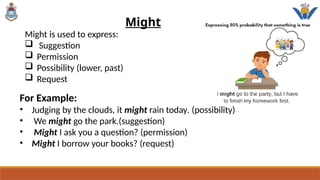
Might
For Example:
• Judging by the clouds, it might rain today. (possibility)
• We might go the park.(suggestion)
• Might I ask you a question? (permission)
• Might I borrow your books? (request)
Might is used to express:
 Suggestion
 Permission
 Possibility (lower, past)
 Request
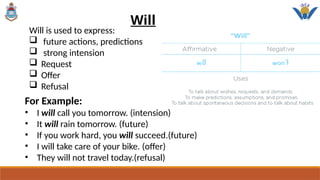
Will
For Example:
• I will call you tomorrow. (intension)
• It will rain tomorrow. (future)
• If you work hard, you will succeed.(future)
• I will take care of your bike. (offer)
• They will not travel today.(refusal)
Will is used to express:
 future actions, predictions
 strong intension
 Request
 Offer
 Refusal
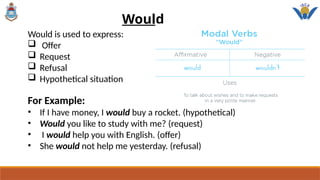
Would
For Example:
• If I have money, I would buy a rocket. (hypothetical)
• Would you like to study with me? (request)
• I would help you with English. (offer)
• She would not help me yesterday. (refusal)
Would is used to express:
 Offer
 Request
 Refusal
 Hypothetical situation
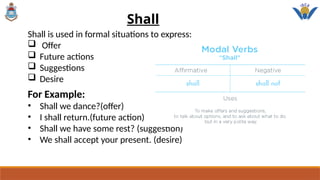
Shall
For Example:
• Shall we dance?(offer)
• I shall return.(future action)
• Shall we have some rest? (suggestion)
• We shall accept your present. (desire)
Shall is used in formal situations to express:
 Offer
 Future actions
 Suggestions
 Desire
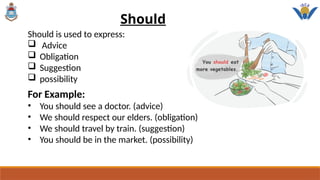
Should
For Example:
• You should see a doctor. (advice)
• We should respect our elders. (obligation)
• We should travel by train. (suggestion)
• You should be in the market. (possibility)
Should is used to express:
 Advice
 Obligation
 Suggestion
 possibility
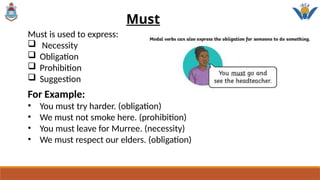
Must
For Example:
• You must try harder. (obligation)
• We must not smoke here. (prohibition)
• You must leave for Murree. (necessity)
• We must respect our elders. (obligation)
Must is used to express:
 Necessity
 Obligation
 Prohibition
 Suggestion
Ought to
For Example:
• You ought to obey the rule. (obligation)
• You ought to study more. (advice)
Ought to is used to express:
 Advice
 Obligation(partial)
 Expectation
Some rules for using modal verbs correctly in
English
• They have no –ing form, present participle. ...
• They have no past tense form. ...
• They do not change form for person. ...
• They cannot be used with another modal.
• Modal verbs are always followed by a base verb (the infinitive without "to").
• Modal verbs do not change form to agree with the subject of the sentence.
• Modal verbs are used to express ideas like ability, permission, obligation, or
possibility.
• Modal verbs are often used in negative sentences and questions.
• Some modal verbs have specific uses and meanings, such as "should" for
advice or "could" for possibility.
• Modal verbs can also be used to express degrees of certainty or probability.
Conclusion
• In conclusion, model verbs are a fundamental component of the English
language, enabling us to express nuanced shades of meaning and
modality.
• Through our exploration of these verbs, we have discovered their
versatility and adaptability in conveying from ability to obligation.
• By understanding the subtleties of these model verbs, we can refine our
language skills and enhance our expression.
• As we continue to navigate the complexities of English, let us embrace the
power of model verbs to articulate our thoughts, persuade our audiences,
and connect with others.
• In the words of Linguist John Lyons, “The study of language is the study of
the human mind.”
Credit goes to @Mubashir Hashmi

Model verbs english_presentation_semester_2(1).pptx

  • 1.
    UNIVERSITY OF THEPUNJAB Presented By : Presented to : Subject : Degree : Department : Saeed Murad (08), M.Mubashir(22), Iqra Sandhu(), Kira Muzaffar (29) Ms. Nigham Khalid English BS SOCIOLOGY Institute of Social & Cultural Studies
  • 2.
    Introduction to Model verbs “Modelverbs are auxiliary verbs (helping verbs) which when used together with the main verb, convey additional meaning.” Modal verbs are used to express certain hypothetical conditions, such as:  advisability  capability  requests  modality
  • 3.
    Some common modelverbs: • Can • Could • Shall • Should • Will • May • might • Would • Must Model Verbs They are used to modify the main verb in a sentence to convey a specific meaning.
  • 4.
    6 Different typesof Situations 1. Ability (can, could) 2. Possibility (could, may , might) 3. Advice (should) 4. Permission (can, may, could) 5. Obligation (must, have to) 6. Hypothetical or conditional
  • 5.
    Importance of modelverbs o Expression of Modality o Nuance o Clarity & Precision o Softening statements o Effective Communication o Conditional sentences
  • 6.
    Can Can is usedto express:  Ability to do something,  Permission (informal)  Possibility  Request  Offer For Example: • I can swim (ability) • I can’t swim (lack of ability) • It can rain tomorrow (possibility) • Can I go to the bathroom? (permission) • she can’t cook (lack of ability) • He can speak English (ability)
  • 7.
    Could For Example: • Icould run fast when I was younger (past ability ) • He could survive in the traffic (possibility) • Could you please assist me? (permission) • Could you pas me the salt? (request) Could is used to express:  Ability (past)  Permission (formal, polite)  Possibility (past)  Request (polite)
  • 8.
    May For Example: • MayI come in ? (request) • It may rain tomorrow (possibility ) • May you live long! (prayer) • May Allah bless you! (wish) • May I take your mobile? (permission) May is used to express:  Wishes  Permission  Possibility  Request  Prayer
  • 9.
    Might For Example: • Judgingby the clouds, it might rain today. (possibility) • We might go the park.(suggestion) • Might I ask you a question? (permission) • Might I borrow your books? (request) Might is used to express:  Suggestion  Permission  Possibility (lower, past)  Request
  • 10.
    Will For Example: • Iwill call you tomorrow. (intension) • It will rain tomorrow. (future) • If you work hard, you will succeed.(future) • I will take care of your bike. (offer) • They will not travel today.(refusal) Will is used to express:  future actions, predictions  strong intension  Request  Offer  Refusal
  • 11.
    Would For Example: • IfI have money, I would buy a rocket. (hypothetical) • Would you like to study with me? (request) • I would help you with English. (offer) • She would not help me yesterday. (refusal) Would is used to express:  Offer  Request  Refusal  Hypothetical situation
  • 12.
    Shall For Example: • Shallwe dance?(offer) • I shall return.(future action) • Shall we have some rest? (suggestion) • We shall accept your present. (desire) Shall is used in formal situations to express:  Offer  Future actions  Suggestions  Desire
  • 13.
    Should For Example: • Youshould see a doctor. (advice) • We should respect our elders. (obligation) • We should travel by train. (suggestion) • You should be in the market. (possibility) Should is used to express:  Advice  Obligation  Suggestion  possibility
  • 14.
    Must For Example: • Youmust try harder. (obligation) • We must not smoke here. (prohibition) • You must leave for Murree. (necessity) • We must respect our elders. (obligation) Must is used to express:  Necessity  Obligation  Prohibition  Suggestion
  • 15.
    Ought to For Example: •You ought to obey the rule. (obligation) • You ought to study more. (advice) Ought to is used to express:  Advice  Obligation(partial)  Expectation
  • 16.
    Some rules forusing modal verbs correctly in English • They have no –ing form, present participle. ... • They have no past tense form. ... • They do not change form for person. ... • They cannot be used with another modal. • Modal verbs are always followed by a base verb (the infinitive without "to"). • Modal verbs do not change form to agree with the subject of the sentence. • Modal verbs are used to express ideas like ability, permission, obligation, or possibility. • Modal verbs are often used in negative sentences and questions. • Some modal verbs have specific uses and meanings, such as "should" for advice or "could" for possibility. • Modal verbs can also be used to express degrees of certainty or probability.
  • 17.
    Conclusion • In conclusion,model verbs are a fundamental component of the English language, enabling us to express nuanced shades of meaning and modality. • Through our exploration of these verbs, we have discovered their versatility and adaptability in conveying from ability to obligation. • By understanding the subtleties of these model verbs, we can refine our language skills and enhance our expression. • As we continue to navigate the complexities of English, let us embrace the power of model verbs to articulate our thoughts, persuade our audiences, and connect with others. • In the words of Linguist John Lyons, “The study of language is the study of the human mind.”
  • 18.
    Credit goes to@Mubashir Hashmi