ENVIRONMENTAL SCAN Smith’s Landing First Nation 1
SMITH’S LANDING FIRST NATION
Community and Economic Development
Phase One: Environmental Scan
Smith’s Landing First Nation ENVIRONMENTAL SCAN2
We would like to acknowledge and thank the following
funding partners for this study
ENVIRONMENTAL SCAN Smith’s Landing First Nation 3
On behalf of ALIF Partners, each one of our team would like to take this
opportunity to express our genuine appreciation for all who have made the
development of this report possible.
This includes the informative discussions held with members of the Smith's
Landing First Nation through various community engagement activities,
as well as the insightful opportunities our team members have had with
Smith's Landing First Nation Chief Andrew Wandering Spirit, Band Council,
Management and members of staff.
This report contains information collected through dialogue with Smith's
Landing First Nation, dialogue with non-band members, as well as
perspectives gathered through research into the social and economic
activities of other First Nations, Métis and Inuit groups throughout Canada.
To those mentioned below, as well as First Nations, Métis and Inuit
communities referred to throughout this report, thank you.
T H A N K S A N D A C K N O W L E D G E M E N T S
Smith’s Landing First Nation
Chief & Band Council
Chief Andrew Wandering Spirit; Francois Paulette, Elder; Mary Abraham,
Elder; Councillor Dianne Benwell; Councillor Anges Cheezie; Councillor
Geronimo Paulette; Councillor Thaidene Paulette.
Smith’s Landing First Nation Community
Bernadette Benwell; Riley Hessdorfer; Harvey Lepine; Cheyanne Paulette;
Leslie Paulette; Tony Vermillion, Anthony Vermillion.
Smith’s Landing First Nation Management & Staff
Lorraine MacDonald & Smith’s Landing First Nation Staff, including:
Jeff Dixon; Paula Cadwell-Lepine; Destiny Martin; Cochise Paulette;
Christine Seabrook; Sharon Tourangeau.
Non-Smith’s Landing First Nation Fort Smith Community
Government of Northwest Territories; Tom Colosimo and Michelle Keizer.
Thebacha Business Development Services: Linda Martin
Uncle Gabe’s Friendship Centre; Tina Chalifoux and Amy Harris.
Wood Buffalo National Park, Parks Canada; Mike Keizer and
Melissa Zimmer.
Special thanks to the insights provided by Francois and Leslie Paulette.
Smith’s Landing First Nation ENVIRONMENTAL SCAN4
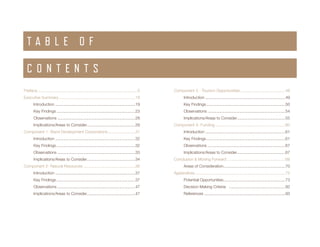
Preface..........................................................................................5
Executive Summary.....................................................................18
Introduction........................................................................19
Key Findings.......................................................................23
Observations......................................................................28
Implications/Areas to Consider............................................29
Component 1- Band Development Corporations.........................31
Introduction........................................................................32
Key Findings.......................................................................32
Observations......................................................................33
Implications/Areas to Consider............................................34
Component 2- Natural Resources...............................................36
Introduction........................................................................37
Key Findings.......................................................................37
Observations......................................................................47
Implications/Areas to Consider............................................47
Component 3 - Tourism Opportunities.........................................48
Introduction........................................................................49
Key Findings.......................................................................50
Observations......................................................................54
Implications/Areas to Consider............................................55
Component 4- Funding...............................................................60
Introduction........................................................................61
Key Findings.......................................................................61
Observations......................................................................67
Implications/Areas to Consider............................................67
Conclusion & Moving Forward.....................................................68
Areas of Consideration........................................................70
Appendices.................................................................................72
Potential Opportunities........................................................73
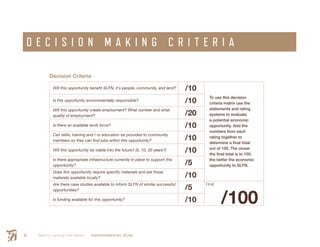
Decision Making Criteria ...................................................92
References.........................................................................93
T A B L E O F
C O N T E N T S
ENVIRONMENTAL SCAN Smith’s Landing First Nation 5
P R E F A C E
W H A T W E H E A R D
F R O M T H E S L F N
C O M M U N I T Y
Smith’s Landing First Nation ENVIRONMENTAL SCAN6
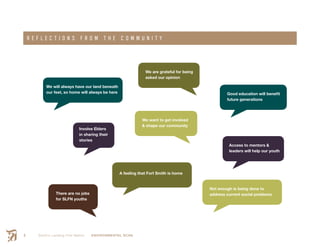
R E F L E C T I O N S F R O M T H E C O M M U N I T Y
We will always have our land beneath
our feet, so home will always be here
We are grateful for being
asked our opinion
There are no jobs
for SLFN youths
Access to mentors &
leaders will help our youth
Involve Elders
in sharing their
stories
Good education will benefit
future generations
A feeling that Fort Smith is home
We want to get involved
& shape our community
Not enough is being done to
address current social problems
ENVIRONMENTAL SCAN Smith’s Landing First Nation 7
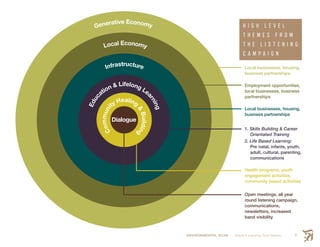
Generative Economy
Local Economy
Educ ation & Lifelong Le
arning
Infrastructure
Communi
ty Healing
&
Building
H I G H L E V E L
T H E M E S F R O M
T H E L I S T E N I N G
C A M P A I G N
Open meetings, all year
round listening campaign,
communications,
newsletters, increased
band visibility
Health programs, youth
engagement activities,
community based activities
1. Skills Building & Career
Orientated Training
2. Life Based Learning:
Pre natal, infants, youth,
adult, cultural, parenting,
communications
Local businesses, housing,
business partnerships
Employment opportunities,
local businesses, business
partnerships
Local businesses, housing,
business partnerships
Dialogue
Smith’s Landing First Nation ENVIRONMENTAL SCAN8
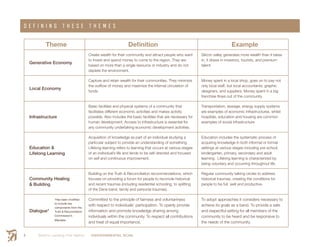
D E F I N I N G T H E S E T H E M E S
*Has been modified
to include key
components from the
Truth & Reconciliation
Commission’s
Mandate
Theme Definition Example
Generative Economy
Create wealth for their community and attract people who want
to invest and spend money to come to the region. They are
based on more than a single resource or industry and do not
deplete the environment.
Silicon valley generates more wealth than it takes
in, it draws in investors, tourists, and premium
talent.
Local Economy
Capture and retain wealth for their communities. They minimize
the outflow of money and maximize the internal circulation of
funds.
Money spent in a local shop, goes on to pay not
only local staff, but local accountants, graphic
designers, and suppliers. Money spent in a big
franchise flows out of the community.
Infrastructure
Basic facilities and physical systems of a community that
facilitates different economic activities and makes activity
possible. Also includes the basic facilities that are necessary for
human development. Access to infrastructure is essential for
any community undertaking economic development activities.
Transportation, sewage, energy supply systems
are examples of economic infrastructures, whilst
hospitals, education and housing are common
examples of social infrastructure.
Education &
Lifelong Learning
Acquisition of knowledge as part of an individual studying a
particular subject to provide an understanding of something.
Lifelong learning refers to learning that occurs at various stages
of an individual’s life and tends to be self directed and focused
on self and continuous improvement.
Education includes the systematic process of
acquiring knowledge in both informal or formal
settings at various stages including pre school,
kindergarten, primary, secondary and adult
learning. Lifelong learning is characterized by
being voluntary and occurring throughout life.
Community Healing
& Building
Building on the Truth & Reconciliation recommendations, which
focuses on providing a forum for people to reconcile historical
and recent traumas (including residential schooling, to splitting
of the Dene band, family and personal traumas).
Regular community talking circles to address
historical traumas, creating the conditions for
people to be full, well and productive.
Dialogue*
Committed to the principle of fairness and voluntariness
with respect to individuals’ participation. To openly provide
information and promote knowledge sharing among
individuals within the community. To respect all contributions
and treat of equal importance.
To adopt approaches it considers necessary to
achieve its goals as a band. To provide a safe
and respectful setting for all members of the
community to be heard and be responsive to
the needs of the community.
ENVIRONMENTAL SCAN Smith’s Landing First Nation 9
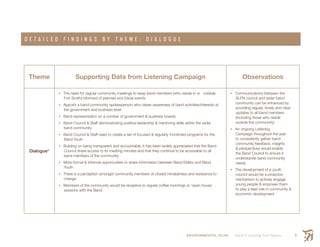
D E T A I L E D F I N D I N G S B Y T H E M E : D I A L O G U E
Theme Supporting Data from Listening Campaign Observations
Dialogue*
•	The need for regular community meetings to keep band members (who reside in or outside
Fort Smith) informed of planned and future events
•	Appoint a band community spokesperson who raises awareness of band activities/interests at
the government and business level
•	Band representation on a number of government & business boards
•	Band Council & Staff demonstrating positive leadership & mentoring skills within the wider
band community
•	Band Council & Staff need to create a set of focused & regularly monitored programs for the
Band Youth
•	Building on being transparent and accountable, it has been widely appreciated that the Band
Council share access to its meeting minutes and that they continue to be accessible to all
band members of the community
•	More formal & informal opportunities to share information between Band Elders and Band
Youth
•	There is a perception amongst community members of closed mindedness and resistance to
change
•	Members of the community would be receptive to regular coffee mornings or ‘open house’
sessions with the Band
•	Communications between the
SLFN council and wider band
community can be enhanced by
providing regular, timely and clear
updates to all band members
(including those who reside
outside the community)
•	An ongoing Listening
Campaign throughout the year
to consistently gather band
community feedback, insights
& perspectives would enable
the Band Council to ensure it
understands band community
needs
•	The development of a youth
council would be a proactive
mechanism to actively engage
young people & empower them
to play a lead role in community &
economic development
Smith’s Landing First Nation ENVIRONMENTAL SCAN10
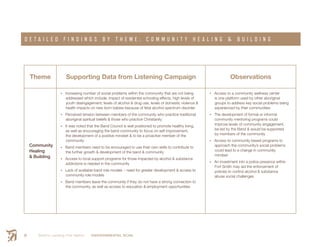
D E T A I L E D F I N D I N G S B Y T H E M E : C O M M U N I T Y H E A L I N G & B U I L D I N G
Theme Supporting Data from Listening Campaign Observations
Community
Healing
& Building
•	Increasing number of social problems within the community that are not being
addressed which include: impact of residential schooling effects; high levels of
youth disengagement; levels of alcohol & drug use, levels of domestic violence &
health impacts on new born babies because of fetal alcohol spectrum disorder
•	Perceived tension between members of the community who practice traditional
aboriginal spiritual beliefs & those who practice Christianity
•	It was noted that the Band Council is well positioned to promote healthy living,
as well as encouraging the band community to focus on self improvement,
the development of a positive mindset & to be a proactive member of the
community
•	Band members need to be encouraged to use their own skills to contribute to
the further growth & development of the band & community
•	Access to local support programs for those impacted by alcohol & substance
addictions is needed in the community
•	Lack of available band role models – need for greater development & access to
community role models
•	Band members leave the community if they do not have a strong connection to
the community, as well as access to education & employment opportunities
•	Access to a community wellness center
is one platform used by other aboriginal
groups to address key social problems being
experienced by their communities
•	The development of formal or informal
community mentoring programs could
improve levels of community engagement,
be led by the Band & would be supported
by members of the community
•	Access to community based programs to
approach the community’s social problems
could lead to a change in community
mindset
•	An investment into a police presence within
Fort Smith may aid the enforcement of
policies to control alcohol & substance
abuse social challenges
ENVIRONMENTAL SCAN Smith’s Landing First Nation 11
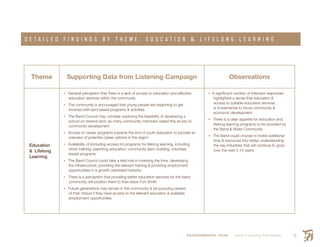
D E T A I L E D F I N D I N G S B Y T H E M E : E D U C A T I O N & L I F E L O N G L E A R N I N G
Theme Supporting Data from Listening Campaign Observations
Education
& Lifelong
Learning
•	General perception that there is a lack of access to education and effective
education services within the community
•	The community is encouraged that young people are beginning to get
involved with land based programs & activities
•	The Band Council may consider exploring the feasibility of developing a
school on reserve land, as many community members raised this as key to
community development
•	Access to career programs towards the end of youth education to provide an
overview of potential career options in the region
•	Availability of (including access to) programs for lifelong learning, including:
driver training; parenting education; community team building; volunteer
based programs
•	The Band Council could take a lead role in investing the time, developing
the infrastructure, providing the relevant training & providing employment
opportunities in a growth orientated industry
•	There is a perception that providing better education services for the band
community will position them to then leave Fort Smith
•	Future generations may remain in the community & be pursuing careers
of their choice if they have access to the relevant education & available
employment opportunities
•	A significant number of interview responses
highlighted a sense that education &
access to suitable education services
is fundamental to future community &
economic development
•	There is a clear appetite for education and
lifelong learning programs to be provided by
the Band & Wider Community
•	The Band could choose to invest additional
time & resources into better understanding
the key industries that will continue to grow
over the next 5-10 years
Smith’s Landing First Nation ENVIRONMENTAL SCAN12
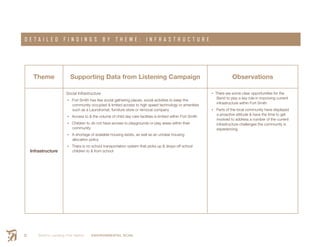
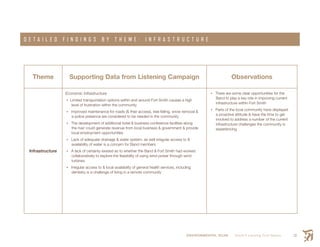
D E T A I L E D F I N D I N G S B Y T H E M E : I N F R A S T R U C T U R E
Theme Supporting Data from Listening Campaign Observations
Infrastructure
Social Infrastructure
•	Fort Smith has few social gathering places, social activities to keep the
community occupied & limited access to high speed technology or amenities
such as a Laundromat, furniture store or removal company
•	Access to & the volume of child day care facilities is limited within Fort Smith
•	Children to do not have access to playgrounds or play areas within their
community
•	A shortage of available housing exists, as well as an unclear housing
allocation policy
•	There is no school transportation system that picks up & drops off school
children to & from school
•	There are some clear opportunities for the
Band to play a key role in improving current
infrastructure within Fort Smith
•	Parts of the local community have displayed
a proactive attitude & have the time to get
involved to address a number of the current
infrastructure challenges the community is
experiencing
ENVIRONMENTAL SCAN Smith’s Landing First Nation 13
D E T A I L E D F I N D I N G S B Y T H E M E : I N F R A S T R U C T U R E
Theme Supporting Data from Listening Campaign Observations
Infrastructure
Economic Infrastructure
•	Limited transportation options within and around Fort Smith causes a high
level of frustration within the community
•	Improved maintenance for roads (& their access), tree felling, snow removal &
a police presence are considered to be needed in the community
•	The development of additional hotel & business conference facilities along
the river could generate revenue from local business & government & provide
local employment opportunities
•	Lack of adequate drainage & water system, as well irregular access to &
availability of water is a concern for Band members
•	A lack of certainty existed as to whether the Band & Fort Smith had worked
collaboratively to explore the feasibility of using wind power through wind
turbines
•	Irregular access to & local availability of general health services, including
dentistry is a challenge of living in a remote community
•	There are some clear opportunities for the
Band to play a key role in improving current
infrastructure within Fort Smith
•	Parts of the local community have displayed
a proactive attitude & have the time to get
involved to address a number of the current
infrastructure challenges the community is
experiencing
Smith’s Landing First Nation ENVIRONMENTAL SCAN14
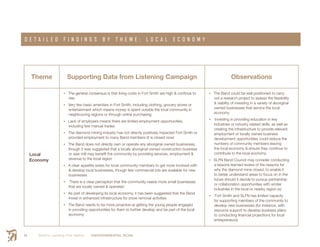
D E T A I L E D F I N D I N G S B Y T H E M E : L O C A L E C O N O M Y
Theme Supporting Data from Listening Campaign Observations
Local
Economy
•	The general consensus is that living costs in Fort Smith are high & continue to
rise
•	Very few basic amenities in Fort Smith, including clothing, grocery stores or
entertainment which means money is spent outside the local community in
neighbouring regions or through online purchasing
•	Lack of employers means there are limited employment opportunities,
including few manual trades
•	The diamond mining industry has not directly positively impacted Fort Smith or
provided employment to many Band members (it is closed now)
•	The Band does not directly own or operate any aboriginal owned businesses,
though it was suggested that a locally aboriginal owned construction business
or saw mill may benefit the community by providing services, employment &
revenue to the local region
•	A clear appetite exists for local community members to get more involved with
& develop local businesses, though few commercial lots are available for new
businesses
•	 There is a clear perception that the community needs more small businesses
that are locally owned & operated
•	As part of developing its local economy, it has been suggested that the Band
invest in enhanced infrastructure for snow removal activities
•	The Band needs to be more proactive at getting the young people engaged
in providing opportunities for them to further develop and be part of the local
economy
•	The Band could be well positioned to carry
out a research project to assess the feasibility
& viability of investing in a variety of aboriginal
owned businesses that service the local
economy
•	 Investing in providing education in key
industries or industry related skills, as well as
creating the infrastructure to provide relevant
employment or locally owned business
development opportunities could reduce the
numbers of community members leaving
the local economy & ensure they continue to
contribute to the local economy
•	SLFN Band Council may consider conducting
a lessons learned review of the reasons for
why the diamond mine closed, to enable it
to better understand areas to focus on in the
future should it decide to pursue partnership
or collaboration opportunities with similar
industries in the local or nearby region (s)
•	 Fort Smith and SLFN has limited capacity
for supporting members of the community to
develop new businesses (for instance, with
resource support to develop business plans
to conducting financial projections for local
entrepreneurs)
ENVIRONMENTAL SCAN Smith’s Landing First Nation 15
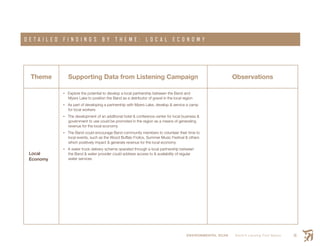
D E T A I L E D F I N D I N G S B Y T H E M E : L O C A L E C O N O M Y
Theme Supporting Data from Listening Campaign Observations
Local
Economy
•	Explore the potential to develop a local partnership between the Band and
Myers Lake to position the Band as a distributor of gravel in the local region
•	As part of developing a partnership with Myers Lake, develop & service a camp
for local workers
•	The development of an additional hotel & conference center for local business &
government to use could be promoted in the region as a means of generating
revenue for the local economy
•	The Band could encourage Band community members to volunteer their time to
local events, such as the Wood Buffalo Frolics, Summer Music Festival & others
which positively impact & generate revenue for the local economy
•	A water truck delivery scheme operated through a local partnership between
the Band & water provider could address access to & availability of regular
water services
Smith’s Landing First Nation ENVIRONMENTAL SCAN16
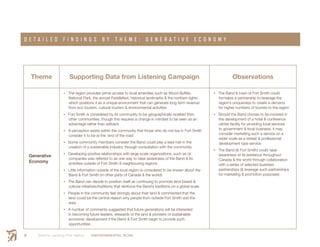
D E T A I L E D F I N D I N G S B Y T H E M E : G E N E R A T I V E E C O N O M Y
Theme Supporting Data from Listening Campaign Observations
Generative
Economy
•	The region provides prime access to local amenities such as Wood Buffalo
National Park, the annual Paddlefest, historical landmarks & the northern lights
which positions it as a unique environment that can generate long term revenue
from eco tourism, cultural tourism & environmental activities
•	Fort Smith is considered by its community to be geographically isolated from
other communities, though this requires a change in mindset to be seen as an
advantage rather than setback
•	A perception exists within the community that those who do not live in Fort Smith
consider it to be at the ‘end of the road’
•	Some community members consider the Band could play a lead role in the
creation of a sustainable industry, through consultation with the community
•	Developing positive relationships with large scale organizations, such as oil
companies was referred to as one way to raise awareness of the Band & its
activities outside of Fort Smith & neighbouring regions
•	Little information outside of the local region is considered to be known about the
Band & Fort Smith (in other parts of Canada & the world)
•	The Band can decide to position itself as continuing to promote land based &
cultural initiatives/traditions that reinforce the Band’s traditions on a global scale
•	People in the community feel strongly about their land & commented that the
land could be the central reason why people from outside Fort Smith visit the
area
•	A number of comments suggested that future generations will be interested
in becoming future leaders, stewards of the land & pioneers of sustainable
economic development if the Band & Fort Smith begin to provide such
opportunities
•	The Band & town of Fort Smith could
formalize a partnership to leverage the
region’s uniqueness to create a demand
for higher numbers of tourists to the region
•	Should the Band choose to be involved in
the development of a hotel & conference
center facility for providing local services
to government & local business, it may
consider marketing such a service on a
wider scale as a retreat & professional
development type service
•	The Band (& Fort Smith) could raise
awareness of its existence throughout
Canada & the world through collaboration
with a series of selected business
partnerships (& leverage such partnerships
for marketing & promotion purposes)
ENVIRONMENTAL SCAN Smith’s Landing First Nation 17
E X E C U T I V E
S U M M A R Y
Smith’s Landing First Nation ENVIRONMENTAL SCAN18
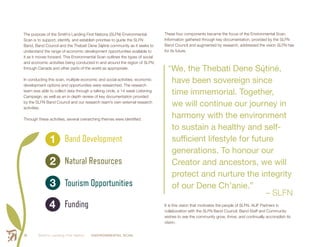
1
2
3
4
Band Development
Natural Resources
Tourism Opportunities
Funding
The purpose of the Smith’s Landing First Nations (SLFN) Environmental
Scan is to support, identify, and establish priorities to guide the SLFN
Band, Band Council and the Thebati Dene Sų́tiné community as it seeks to
understand the range of economic development opportunities available to
it as it moves forward. This Environmental Scan outlines the types of social
and economic activities being conducted in and around the region of SLFN,
through Canada and other parts of the world as appropriate.
In conducting this scan, multiple economic and social activities, economic
development options and opportunities were researched. The research
team was able to collect data through a talking circle, a 14 week Listening
Campaign, as well as an in depth review of key documentation provided
by the SLFN Band Council and our research team’s own external research
activities.
Through these activities, several overarching themes were identified:
These four components became the focus of the Environmental Scan.
Information gathered through key documentation, provided by the SLFN
Band Council and augmented by research, addressed the vision SLFN has
for its future.
“We, the Thebati Dene Sų́tiné,
have been sovereign since
time immemorial. Together,
we will continue our journey in
harmony with the environment
to sustain a healthy and self-
sufficient lifestyle for future
generations. To honour our
Creator and ancestors, we will
protect and nurture the integrity
of our Dene Ch’anie.”
– SLFN
It is this vision that motivates the people of SLFN. ALIF Partners in
collaboration with the SLFN Band Council, Band Staff and Community
wishes to see the community grow, thrive, and continually accomplish its
vision.
ENVIRONMENTAL SCAN Smith’s Landing First Nation 19
Introduction
The Environmental Scan is a community and research based exploration
of the current social and economic activities, resources and future
potential for community and economic development opportunities that
we have found other First Nations, Métis, and Inuit Groups to be focusing
on. This Environmental Scan summarizes the research process, key
findings obtained from the Environmental Scan research, observations,
and implications/areas to consider for economic development of SLFN
as it moves forward with selecting the right opportunities for its First
Nation, whilst bearing in mind SLFN’s limited infrastructure and access
to resources, remote location, and small and dispersed population.
Determining what economic development opportunities will best serve the
people, community and future generations will be explored as a subsequent
phase of supporting SLFN. This Environmental Scan is one of many steps
that will guide and prepare SLFN towards creating long-term livelihoods and
wealth for its community.
Purpose and Structure
Typically an Environmental Scan is a research-based document,
focusing on the consolidation and review of existing and
anticipated environmental factors that may impact an organization. For the
purposes of supporting SLFN as part of this activity, the research team
focused on the following four components it considered most valuable
to supporting SLFN: Band Development, Resources; both natural and
situational, Tourism Opportunities and Funding.
Each of the components explored focuses on a variety of short
term, medium term, and long term potential economic development
opportunities. These opportunities have been identified through the
research activities highlighted above and where appropriate, a relevant case
study is included within that section to illustrate how other Bands have
addressed such an opportunity. It should be noted that the Environmental
Scan is phase one of a four phase process to support SLFN in the
identification, selection and high level planning of community and economic
development opportunities.
Key Components
These key components are discussed in more detail below:
Component 1 - Band Development
•	 This component focuses on organizational, policy, and planning
documents provided to by the SLFN Band Council to the research
team. This information was supplemented with reference materials
from Federal, Provincial, and Territorial Governments, Educational
facilities, and case studies of successful Band Development
Corporations across Canada.
Component 2 - Natural Resources
•	 This component focuses on documentation obtained through
external based research. Research materials include:
environmental policy documentation, Federal, Provincial, and
Territorial Government documentation and supporting websites,
online news stories, and case studies.
Component 3 - Tourism Opportunities
•	 This component focuses on documentation obtained through
external based research. Research materials include: Federal,
Provincial and Territorial Government documentation and websites,
online news stories, and case studies.
Component 4 - Funding
•	 This component focuses on documentation obtained through
external based research. The research materials complied
within this component focus on potential funding streams for
community and economic development opportunities within the
above components. These reference materials include: Federal,
Smith’s Landing First Nation ENVIRONMENTAL SCAN20
Provincial and Territorial Government documentation and websites,
educational facility documents and websites, and online news
stories.
High Level Findings
It should be noted that the findings collected, themed and analyzed as
part of this Environmental Scan will be used as part of subsequent phases.
Key decision making criteria will also be developed to enable the Band
Council to evaluate the potential and viability of the economic development
opportunities outlined within each of the four components addressed within
this Environmental Scan. With such a decision making criteria, SLFN will be
better equipped with strategies and metrics to best determine the potential
of and for economic development within its community.
Band Development
The high level findings obtained from research into the Band Development
component reveal the need for SLFN to establish a functional Band
Development Corporation (BDC). A functional BDC is a powerful
organization that will enhance the ability of Band to pursue economic
development opportunities, work alongside the Band Council, and maintain
all “for profit” economic endeavours. Along with establishing a functional
BDC, it is important for SLFN to revisit and revise both the Strategic Plan
(2010-2013)1
and the Housing Policy (2001)2
. These two documents
contain valuable information into strategic priorities, housing development
plans, and the future vision of SLFN.
Community engagement, kinship, unity, and appreciation of and for
traditional and cultural values are all of importance to the past, present,
and future of SLFN. A Community Wellness Center will be the setting for
1
The Imagination Group. (2010). Strategic Plan Report Smith’s Landing First Nations (2010-
2013). Internal Document.
2
Smith’s Landing First Nation: Housing Policy. (July 25, 2001). Internal document.
a variety of community gatherings, skills and education training, wellness
seminars, group functions, and a safe place where community members
can feel welcomed and appreciated. The development and construction of
a Community Wellness Center SLFN will bring the community together and
foster many positive outcomes.
Natural Resources
With the abundant Natural Resources within and around SLFN, there are
a variety of economic development opportunities available. The focus of
the Natural Resources component includes 4 areas: potential uses for the
excess mega Watt (mw) generation from the Taltson Hydro facility, renewable
energy technology, forest management, and nearby Myers Lake gravel
resource.
SLFN has a unique situation, in that it has access to excess power
generation from a nearby hydroelectric facility. Currently the Taltson Hydro
Electric facility produces an average excess of 5 mw. That excess power
production is more than enough to power 5000 average sized Albertan
homes. The possibilities of what to do with the excess power are vast.
The SLFN Environmental Scan focuses on sustainable agriculture, housing
development, and facility enhancement of a local campground.
Renewable energy technology provides northern communities with energy
independence; little or no reliance on power companies due to energy
production occurring locally. SLFN, from initial research, has good solar
photovoltaic (PV) and biomass potential. Solar PV is increasingly installed in
remote northern areas. The power produced from the solar PV installations
can reduce or eliminate the need for expensive diesel, gas, and/or propane
generators. Biomass, specifically pellet production for use in biomass
(pellet) stoves, is another potential area for economic development. With
access to surrounding forests and organic materials, SLFN could feasibly
construct a peletization facility. Forest management would work alongside
potential biomass operations. Timber harvesting and leveraging, and fire
ENVIRONMENTAL SCAN Smith’s Landing First Nation 21
crew training all have potential for economic development within SLFN.
The frequently discussed Myers Lake gravel deposit is another potential
natural resource that SLFN could benefit from.
Tourism Opportunities
SLFN is surrounded by natural beauty. Due to the low Canadian dollar,
foreign and home grown tourism is expected to increase. With other
countries taking advantage of the exchange rate and Canadians travelling
more within their country, Tourism Canada is expecting a large increase in
the amount of visitors to all National and Provincial parks and campgrounds
in 2016.
Tourism opportunities to be considered by SLFN include: cultural/
aboriginal tourism, hunting, fishing, nature photography, bird watching,
and the enhancement of campgrounds and facilities. Due to its location
within the boundaries of Wood Buffalo national Park, SLFN has a unique
advantage when it comes to nature tourism. Many species of birds and
animals call Wood Buffalo National park home, and some of these creatures
are incredibly rare. Nature photography, bird watching, and the ability to
commune with nature have excellent appeal to tourist and the tourism
industry. Fishing and hunting, canoeing and camping, and the allure of
adventure in the remoteness of the North will appeal to a different kind
of tourist. Indigenous tradition, culture, arts and crafts, storytelling, song,
dance and traditional foods appeal to those looking for a more cultural type
of tourism. With endless natural beauty and a deep cultural heritage, SLFN
has a lot to offer and definite tourism potential.
Funding
With the many different potential economic development opportunities
explored as part of this Environmental Scan SLFN, the ability to
appropriately fund these opportunities is a priority for First Nations, Métis,
and Inuit Groups. The Funding component focuses on multiple areas
including: the development of a funding committee and funding options for:
skills, education, and development training; tourism opportunities, housing
developments, and infrastructure development and enhancement.
There are a variety of funding streams and sources available in Canada. To
better understand the complexities of funding, it is advisable for SLFN to
establish a full-time staff position (or committee) focused entirely on funding
opportunities.
Research Approach
The information obtained through research and case study analysis of each
component is contained within this report. The research conducted into the
four components occurred over a two month timeframe, which included
over one hundred documents being reviewed. The findings outlined within
the Environmental Scan are an overview of the potential current and
potential opportunities that could be available to SLFN. Further investigation
of these opportunities will occur in later phases.
Through consultation with the SLFN band and Wider Community, several
concerns and priorities of the Band Council and community were identified.
These concerns and priorities have been incorporated within the relevant
components of this report.
A series of site visits to the town of Fort Smith and to get to know the SLFN
community were conducted between November 2015 and December
2015. Prior to commencing the Environmental Scan research, it was
essential for the research team to fully understand the community’s long
term vision, challenges, expectations and concerns about community and
economic development. The following key activities underpin the way in
which the research team has approached this Environmental Scan:
Smith’s Landing First Nation ENVIRONMENTAL SCAN22
1.	 Respect Tradition: To commence the project with SLFN, a
traditional talking circle with the SLFN community was organized.
This enabled the research team to hear the views of those who
turned up. Approximately 20 SLFN community and non-SLFN
community members provided input as part of the talking circle
2.	 Listen: The next activity was to organize a 14-week community
engagement process termed a ‘Listening Campaign’. Listening
Campaigns augment other forms of community engagement
because they provide a means by which community members
are interviewed on an informal basis by members of their own
community. Using this approach, data was collected from 25
community members of various ages and backgrounds
3.	 Discuss: A series of 1:1 informal sessions were held with the SLFN
Chief, Band Council and staff, as well as a group session. This
provided the research team with a better understanding of both the
strategic and operational opportunities and challenges faced by the
SLFN Band. This was integral to planning the structure of how the
Environmental Scan would be developed.
The Environmental Scan used information obtained from the above three
activities to then conduct comprehensive research into understanding
the many different community and economic development opportunities
being employed throughout Canada that have potential to be successful
in SLFN. The visits to Fort Smith allowed the research team to gain a
better understanding of the geographic area, lands and current social and
business infrastructure.
The scope of the Environmental Scan is extensive. For the purposes of
developing this report, the scope of the Environmental Scan has been to
address the four key components outlined earlier.
Research conducted within each of these four components is intended to
explore and understand potential community and economic development
activities currently being conducted in parts of Canada, as well as
highlighting a range of potential opportunities that regions similar to SLFN
have pursued. The Environmental Scan will form the basis for subsequent
research into the feasibility of opportunities that may be right for SLFN,
given its uniqueness.
Assumptions
In order for SLFN to pursue the range of potential opportunities outlined
in the relevant components of this report, the research team have had to
make a number of key assumptions. Key assumptions have aided the
research team in the development of this report and it is suggested that
these initial assumptions (and others) are discussed further with SLFN prior
to SLFN commencing the identification of potential economic development
opportunities it may seek to explore. Assumptions include:
•	 The continued decline and/or fluctuation of the Canadian Dollar will
affect the ability of SLFN to pursue potential opportunities
•	 Climate change awareness and mitigation will be a focus of
Federal, Provincial, and Territorial Governments
•	 The 94 Calls to Action outlined by the Truth and Reconciliation
Committee will be addressed by Federal, Territorial, and Provincial
Governments and may impact SLFN’s choices in deciding which
economic development opportunities to pursue
•	 Fuel prices will continue to fluctuate, impacting the ability of service
providers to service remote areas such as Fort Smith
•	 Federal Government spending on infrastructure will increase
•	 Information obtained through the Listening Campaign reflects SLFN
community members thoughts and perspectives for community
and economic development
ENVIRONMENTAL SCAN Smith’s Landing First Nation 23
•	 Documentation provided by the SLFN Band Council to ALIF
Partners is relevant, recent, and complete
•	 The SLFN Band Council will assume responsibility to continue the
implementation of the SLFN Strategic Plan
•	 Education, skills and development training for all members of SLFN
will be considered and steps taken to ensure a locally available
workforce wherever possible
•	 The contents of this Environmental Scan is the basis for further
discussion and development of economic development activities
Key Documentation
To position the research team to conduct this Environmental Scan, a range
of key documentation and supporting materials were provided by the SLFN
Band Council, Band Staff and Wider Community (SLFN and non-SLFN). In
addition, this information was supplemented with reference materials from
the Federal Government of Canada, Provincial and Territorial Governments,
the United Nations, and the Truth and Reconciliation Commission. A list
of the key documentation reviewed as part of this Environmental Scan is
contained within the appendix section of this report though the key findings
are outlined below.
Through interviews conducted with the SLFN Band, Staff and the wider
SLFN community, our research team has a more in depth understanding
and appreciation of and for the SLFN vision, its people, policies, land and
resources.
SLFN concerns surrounding limited education, training, and employment
opportunities, and inadequate housing and local infrastructure within
the community were a common theme throughout the sessions held
with SLFN, as well as through the listening campaign. Within the SLFN’s
Strategic Plan Report and Housing Policy Document a variety of measures
and solutions to these issues were addressed. Further information,
researched from government and advocacy groups, was used to
supplement the documentation provided by the SLFN Band Council.
Key Findings
The key findings of the Key Documentation Component are focused on 4
areas:
1.	 The 2010-2013 SLFN Strategic Plan
2.	 The 2001-2006 SLFN Housing Plan
3.	 Education, Skills, Training and Development
4.	 Development of a Community Wellness Center
Each of the 4 areas of focus will be investigated and areas of opportunity
will be addressed.
1. 2010-2013 SLFN Strategic Plan
In 2010 the Chief and Band Council established strategic priorities for
SLFN, this was revisited and revised in 2013. From the Strategic Plan
Report- Smith’s Landing3
, it is clear that the band, Chief and Band Council
have a grand vision for their community and their future. Strategic priority
action plans covered within the Strategic Plan Report include: Governance,
Economic Development, Health and Addictions, Trust Agreement, Capacity
Development (Education and Skills Training), History and Culture, a
Community Plan, Communications, and Land and Resources. A focus on
strategic priorities and a methodology to reach these goals is important to
the success of the Strategic Plan, however it is unclear if this multifaceted
and meaningful document is being utilized to its full potential.
3
 The Imagination Group. (2010). Strategic Plan Report Smith’s Landing First Nations (2010-
2013). Internal Document.
Smith’s Landing First Nation ENVIRONMENTAL SCAN24
Highlights from the 2010-2013 SLFN Strategic Plan:
Governance
“Leadership is key to the
development of a community”
The SLFN has an established council based on band membership, with a
formal organizational chart of the council to be developed. Establishing a
functional Band Development Corporation (BDC) is recommended. SLFN
has two BDC in name, however these organizations are not being utilized
to their full potential. A Band Development Corporation is an organization of
members, chosen by the band, to facilitate and operate business ventures
to improve economic development. This will be discussed further within
Component 2: Band Development.
Economic Development
“To improve economic well-
being and quality of life for
the members of SLFN and
community, creating employment
opportunities and supporting
development is of importance”
The SLFN band has a vision for the future: where an established economy
provides for continued development of the self-sustaining community
and business opportunities. This future vision includes a focus on land
reclamation and green technology opportunities. Economic development
includes areas of: member education/skill training, land and resource
development with a focus on Northern Tourism, and the implementation
of renewable and sustainable technologies. Strategies to address and
implement the above areas will require funding strategies and initiatives.
Health and Addictions
“Your present circumstances
don’t determine where you can
go, they merely determine where
you start”
– Nido Qubien
Physical, mental, and spiritual health is of incredible importance for the
success of the SLFN’s Strategic Priorities, the growth of the community,
and the wellbeing of all people that call SLFN home. The ability for people
to access health services, traditional medicines, and health strategies will
ensure the success of future development. A healthy population provides
the roots to a strong economy.
History and Culture
Initiatives are required to reinforce the history, language and culture of
the SLFN people. With deep rooted history in the land, there are many
valuable lessons and learning experiences that will come out of a focused
Cultural and Historical Strategic Plan that integrates other aspects of the
Strategic Plan, including: health and wellness programs, education, skills
ENVIRONMENTAL SCAN Smith’s Landing First Nation 25
development and training, and tourism opportunities. This component
of the strategic plan will require a community task force to steward the
initiative and to document and research the history of the people and land.
From these findings a cultural and interpretive center can be developed.
An annual “Culture Days” celebration and festival would be an ideal initial
project for the Cultural and Historical task force. “Culture Days” would unite
the community and educate and celebrate the people and future visitors.
The preservation of the history and culture of SLFN will provide a way for
community members to take pride in and honor their past, present, and
future.
Communications
Open, honest, and respectful communication is necessary for the
development and implementation of the SLFN Strategic Plan. The
development of a Communication Plan must address the needs of all
community members. A variety of communication types are necessary in
order to reach all members of the community and be available to tourists
and people new to the community. These communication types must be
kept up to date and incorporate relevant materials (history and culture,
current and upcoming events, information regarding health services,
membership, education and training, land and resource development, etc.).
Communication areas to consider include:
•	 Social Media (FaceBook, Twitter, updated website)
•	 Town Meetings; information from town meetings should be made
available to the community and as reference material for future
meetings. Minutes from meetings, agendas discussed, parking lot
issues, etc. could all be incorporated into a data base.
•	 Paper media (community newspapers, flyers, community message
boards)
The SLFN Strategic Plan contains numerous important priorities and areas
of focus for the Band Council, members, and communities. The information
contained within this document should be considered as a basis for future
strategic planning and economic development.
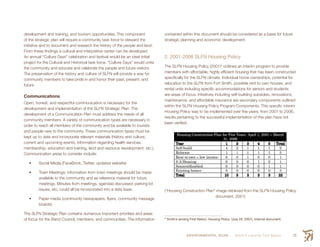
2. 2001-2006 SLFN Housing Policy
The SLFN Housing Policy (2001)4
outlines an interim program to provide
members with affordable, highly efficient housing that has been constructed
specifically for the SLFN climate. Individual home ownerships, potential for
relocation to the SLFN from Fort Smith, possible rent to own houses, and
rental units including specific accommodations for seniors and students
are areas of focus. Initiatives including self-building subsidies, renovations,
maintenance, and affordable insurance are secondary components outlined
within the SLFN Housing Policy Program Components. This specific interim
Housing Policy was to be implemented over five years, from 2001 to 2006,
results pertaining to the successful implementation of this plan have not
been verified.
(“Housing Construction Plan” image retrieved from the SLFN Housing Policy
document, 2001)
4
 Smith’s landing First Nation: Housing Policy. (July 25, 2001). Internal document.
Smith’s Landing First Nation ENVIRONMENTAL SCAN26
Community Plan
Associated with the 2001 SLFN Housing Policy is the development of a
Community Land Use Plan. This plan will provide an outline for future and
necessary infrastructure and services to the members and community of
SLFN. This plan is currently under development, but will focus on:
•	 The creation and review of a Community Plan.
•	 The creation and submission of a 5-year Capital Plan
•	 An outline of projected priorities and opportunities to be funded by
the First Nations Development Fund
•	 The creation and implementation of a Land Use Plan
•	 The implementation and monitoring of the Municipal Services
Agreement with the town of Fort Smith
•	 Community consultation regarding health services
•	A Health Services Agreement
•	 Develop and implement a Housing Plan
•	To include current housing maintenance and future housing
development
The SLFN Housing Policy and developing Community Plan outline a vision
for the future. Housing creates economic development opportunities,
engages members of the community, and develops pride within
homeowners, renters, and home builders.
3. Education, Skills, Training and Development
Education at all levels is a priority of the SLFN Strategic Plan, and is an
area of concern to council and community members. With limited access
to various levels of education, the skills, training and development of SLFN
members to obtain and maintain jobs is difficult. SLFN has a vision:
“[Where] all members will be
provided with every opportunity
for education and preparation
to participate fully in building our
envisioned future”5
The SLFN Strategic Plan includes a workforce plan, designed to assess
development and current capacity. The workforce plan discusses a pilot
workforce training initiative to be done in partnership with Aurora College
(Fort Smith) and the Government of Alberta. Aurora College6
offers a variety
of courses and classes that will enhance employability among SLFN band
members. Identification of potential employers and the creation of an
employment coordinator position within the SLFN Band Council has been
discussed, and will be necessary for the implementation of this program.
The end result of the workforce plan is to prepare the people of SLFN to
pursue and participate in economic development opportunities.
5
 The Imagination Group. (2010). Strategic Plan Report Smith’s Landing First Nations (2010-
2013). Internal Document.
6
 Aurora College. (2013). 2013-2014 Annual Report. Retrieved from http://www.
auroracollege.nt.ca/_live/documents/content/Annual_Report_13-14.pdf
ENVIRONMENTAL SCAN Smith’s Landing First Nation 27
4. Development of a Community Wellness Center
The SLFN Strategic Plan and Housing Policy have been created to ensure
that the community is educated, healthy, and engaged. These areas of
focus could be greatly benefited by the creation of a Community Wellness
Center. As mentioned in talking circle and the Listening Campaign, a
community gathering facility, large enough to host meeting, training
seminars, youth engagement (such as recreational sports, arts and
performing arts, etc.) does not exist in SLFN. The Community Wellness
Center could provide a structure in which a variety of activities could take
place. From: substance abuse meetings to skills and training education
seminars, the teaching of traditional arts, crafts, and storytelling to hip-hop
dance classes and health education seminars; the community center would
provide a safe place for every community member to engage in activities
and build community development.
C A S E S T U D Y
Westbank First Nation7
“The Westbank First Nation strives to
deliver programs and services that
facilitate a healthy, strong, and vibrant
community while promoting physical,
mental, emotional, and spiritual
wellbeing”
7
 Westbank First Nation. (2015). Community Service. Retrieved from http://www.wfn.ca/
siya/communityservices.htm
Issue: The West Bank First Nation wanted to improve community
engagement and programing for its people.
Solution: West Bank First Nation built a Community Services facility.
Referred to as “the heart” of the Westbank First Nation, the Community
Services facility houses a variety of programs and services. These
programs and services are offered to community members that live
within and outside of the reserve.
Outcome: The West Bank First Nation community is more involved and
engaged. Programs offered through the Community Services facility
provide important skills and education training, as well as bringing
together youth, elders, and other community members. Since the
facility’s inception, the available programs and services have expanded
to include:
•	 Youth programs
•	Leadership council, homework and tutoring, cooking sessions,
youth fitness and sports, movie nights
•	 Health services
•	Primary care, chronic disease management, immunization,
prenatal nutrition
•	 Education services
•	Post-secondary support, tutoring, training development council
•	 Early year development programs and services
•	WFN child development center, kids camp (spring and
summer), little coyotes (similar to boy scouts), after school
care, family circle
•	 Wellness services
•	Therapeutic counselling services, loss and grief group and
counselling, children’s counselling, addictions counselling,
women’s circle
•	 Membership services
•	WFN elders group, personal development, WFN employment
coordination, registry services, community Christmas party
Smith’s Landing First Nation ENVIRONMENTAL SCAN28
•	 Sensisyusten School
•	Monday to Friday 8:25am—2:35 pm (from September to June),
junior kindergarten, kindergarten, grades 1 to 6
•	 Recreation programs
•	Drop-in basketball and volley ball, yoga, boot camp, climbing
wall, fitness facility
C A S E S T U D Y :
Carcross Tagish First Nation Band
Development Corporation (BDC)8
Issue: The Carcross Tagish First Nation (C/TFN) held a priority planning
process retreat. The result of this retreat found that the C/TFN’s
community vision was not being achieved and that measures needed
to be taken. The C/TFN community vision states:
“We want to build a stronger, unified community by:
•	 Ensuring that all children are raised with love by parents and
other family members who have the abilities and supports they
need
•	 Providing a first rate early childhood development program and
significantly improving the conditions for success in elementary
and secondary school
•	 Increasing the frequency and sustainability of efforts made by
adults to heal themselves, take responsibility for their lives, and
sustain themselves in paid employment
8 
Carcross Tagish. (2015). Carcross Tagish Band Development Corporation. Retrieved from
http://www.ctfn.ca/departments/capacity-development
•	 Doing all of this in a way that revives and strengthens our
language, traditional knowledge, virtues, and values.
Solution: The governing system on the Carcross Tagish First Nation
(C/TFN) was restructured to reflect the medicine wheel, with each
department representing a specific portion of the medicine wheel. The
C/TFN BDC has established the Capacity Development Department
(CDD), to oversee education, training, and employment of C/TFN
citizens and staff.
Outcome: Through much work and effort the C/TFN is well on their
way to achieving the community vision.The CDC oversees the following:
•	 A licensed daycare, the Ya Dak Du Hidi Early Childhood
Development Center, overseen by the Capacity Department
•	The Ya Dak Du Hidi has 25 child care spaces and 7 staff
•	 Supports the needs of C/TFN students from Kindergarten to
Grade 12, including kids attending Ghuch Tla Elementary School
in Carcross, as well as students who move on to high school in
Whitehorse.
•	 After highschool, the CDC provides support, financial and
otherwise, for post-secondary and training needs of C/TFN
citizens
•	This can include university or college training as well as
certification needs for employment, such as First Aid, whmis,
chainsaw safety, etc.
Observations
SLFN has developed and communicated a variety of tasks and strategies
required to accomplish the priorities within the Strategic Action Plans. In
order to achieve their future vision, many First Nations Groups have gone
through the process of addressing, developing, initiating and implementing
Strategic Plans. SLFN can learn from how other groups accomplished their
ENVIRONMENTAL SCAN Smith’s Landing First Nation 29
visions, overcame obstacles, and developed self-sufficient economies.
SLFN’s greatest strength is the community desire for change and to provide
and create a better future. There are however, multiple challenges that must
be overcome to achieve the goals set out. These include:
•	 Enhancement of skills/education (such as leadership training for
Band Council members, and skills training for community members)
•	 A structured Band Council, with clearly identified roles and
responsibilities
•	 Limited engagement of youth
•	 Limited infrastructure
•	 Health and substance abuse concerns
Through addressing and overcoming these challenges and continuing to
develop the Strategic Plan and Housing Policy, SLFN will move closer to
achieving their goals and vision for the community.
Implications/Areas to Consider
Community engagement, a lack of services and programs, and inadequate
buildings could all be addressed by building a community wellness center.
This center has development opportunities that include:
•	 Government funding (Provincial, Territorial, and Federal)
•	 A location to provide necessary programs and services relating to:
health, education, employment, child development, etc.
•	 A building that encourages community engagement and provides a
safe place for people to learn, teach, connect, and heal
The current housing situation in SLFN is not sustainable, the SLFN Housing
Policy9
is a basis for development. Other potential housing development
opportunities include:
•	 Locally built accommodations for Aurora College students, using
local supplies.
•	 Building high efficiency apartments or row housing, that could be
used for community members or serve as accommodations for the
developing tourism sector.
•	 Developing a partnership with Manitoba Mini Homes10
. Training can
be provided by Manitoba Mini Homes on construction, fabrication,
and energy efficiency techniques used to build tiny homes.
Manitoba Mini Homes works with the Idle No More campaign to
provide remote reserves high efficient, quality mini homes
The Truth and Reconciliation Commission of Canada11
released the 94
Calls to Action. These calls to action redress the dark legacy of residential
schools in Canada and advance the process of reconciliation. While all
areas of the 94 Calls to Action are important, specific areas will have a
greater impact with regard to the SLFN Strategic Plan:
Education:
•	 We call upon the federal government to develop with Aboriginal
groups a joint strategy to eliminate educational and employment
gaps between Aboriginal and non-Aboriginal Canadians
•	 We call upon the federal government to eliminate the discrepancy
in federal education funding for First Nations children being
educated on reserves and those First Nations children being
educated off reserves
9
 Smith’s landing First Nation: Housing Policy. (July 25, 2001). Internal document.
10
 Manitoba Mini Homes. (2015). Manitoba Mini Homes. Retrieved from http://www.
mbminihomes.com/
11
 Truth and Reconciliation Commission of Canada. (2012). Truth and reconciliation
commission of Canada: Calls to action. Retrieved from http://www.trc.ca/websites/
trcimstitution/index.php?p=890
Smith’s Landing First Nation ENVIRONMENTAL SCAN30
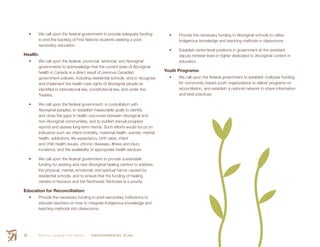
•	 We call upon the federal government to provide adequate funding
to end the backlog of First Nations students seeking a post-
secondary education
Health:
•	 We call upon the federal, provincial, territorial, and Aboriginal
governments to acknowledge that the current state of Aboriginal
health in Canada is a direct result of previous Canadian
government policies, including residential schools, and to recognize
and implement the health-care rights of Aboriginal people as
identified in international law, constitutional law, and under the
Treaties.
•	 We call upon the federal government, in consultation with
Aboriginal peoples, to establish measurable goals to identify
and close the gaps in health outcomes between Aboriginal and
non-Aboriginal communities, and to publish annual progress
reports and assess long-term trends. Such efforts would focus on
indicators such as: infant mortality, maternal health, suicide, mental
health, addictions, life expectancy, birth rates, infant
and child health issues, chronic diseases, illness and injury
incidence, and the availability of appropriate health services
•	 We call upon the federal government to provide sustainable
funding for existing and new Aboriginal healing centers to address
the physical, mental, emotional, and spiritual harms caused by
residential schools, and to ensure that the funding of healing
centers in Nunavut and the Northwest Territories is a priority.
Education for Reconciliation:
•	 Provide the necessary funding to post-secondary institutions to
educate teachers on how to integrate Indigenous knowledge and
teaching methods into classrooms.
•	 Provide the necessary funding to Aboriginal schools to utilize
Indigenous knowledge and teaching methods in classrooms.
•	 Establish senior-level positions in government at the assistant
deputy minister level or higher dedicated to Aboriginal content in
education
Youth Programs:
•	 We call upon the federal government to establish multiyear funding
for community-based youth organizations to deliver programs on
reconciliation, and establish a national network to share information
and best practices.
ENVIRONMENTAL SCAN Smith’s Landing First Nation 31
1
C O M P O N E N T 1 :
B A N D D E V E L O P M E N T
C O R P O R A T I O N S
Smith’s Landing First Nation ENVIRONMENTAL SCAN32
Introduction
Improving organizational leadership and building strong leadership capacity
are strategic priorities of the majority of Bands our research team identified,
as well as the SLFN Band Council. The implementation of a functional Band
Development Corporation (BDC) will greatly assist SLFN in achieving goals
set out within the 2010-2013 Strategic Plan12
.
A BDC is the “for-profit” organization within a First Nation’s band. The BDC
is designed to help develop a sustainable economy that works with the
people, community, and their beliefs. In many places within Canada well-
managed BDC organizations have seen their communities thrive through
conscious economic choices and development of local business portfolios.
Our research has shown that strong and effective leadership, through both
a BDC and Band Council, positively impacts organizational performance,
corporate culture, and economic development opportunities.
Key Findings
Through research of successful BDC organizations within Canada, our
research has determined a specific set of best practices typically required to
establish a functional BDC. These include: clearly identified groups, roles,
and skill-sets required.
The BDC is owned by the community13
, and therefore the community must
both manage and support the BDC to ensure that the choices made are
in the best interest of the Band, community, and the strategic priorities
outlined in the Band’s Strategic Plan. The organization that oversees the
BDC is the committee. The day-to day operators of the BDC are provided
by the employees. The governance framework of the BDC’s our team
12
 The Imagination Group. (2010). Strategic Plan Report Smith’s Landing First Nations
(2010-2013). Internal Document.
13
  NWT Education, Culture and Employment. (2015). Government Departments: About
Department of Education, Culture, and Employment. Retrieved from https://www.ece.gov.
nt.ca/about-epartment-education-culture-and-employment
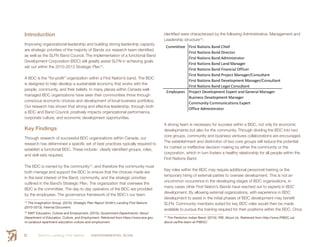
identified were characterized by the following Administrative, Management and
Leadership structure14
:
A strong team is necessary for success within a BDC, not only for economic
developments but also for the community. Through dividing the BDC into two
core groups, community and business ventures collaborations are encouraged.
The establishment and distinction of two core groups will reduce the potential
for rushed or ineffective decision making by either the community or the
corporation, which in turn fosters a healthy relationship for all people within the
First Nations Band.
Key roles within the BDC may require additional personnel training or the
temporary hiring of external parties to oversee development. This is not an
uncommon occurrence in the developing stages of BDC organizations, in
many cases other First Nation’s Bands have reached out to experts in BDC
development. By allowing external organizations, with experience in BDC
development to assist in the initial phases of BDC development may benefit
SLFN. Community members suited for key BDC roles would then be made
available to pursue the training required for their positions within the BDC. Once
14
 The Penticton Indian Band. (2015). PIB: About Us. Retrieved from http://www.PIBDC.ca/
about-us/the-team-at-PIBDC/
Project Development Expert and General Manager
Business Development Manager
Community Communications Expert
Employees
Office Administrator
First Nations Band Director
First Nations Band Administrator
First Nations Band Land Manager
First Nations Band Financial Officer
First Nations Band Project Manager/Consultant
First Nations Band Development Manager/Consultant
First Nations Band Legal Consultant
Committee First Nations Band Chief
ENVIRONMENTAL SCAN Smith’s Landing First Nation 33
the training of personnel is complete, and the BDC has been professionally
developed to allow for easy implementation of these key community
members, the foundations for successful economic and business have
been established.
Observations
For a First Nation’s Band, the formation of a BDC is a necessary step in
generating an economically successful and environmentally conscious
community. For many First Nation’s Bands within Canada a well-developed
BDC has allowed their community to meet and exceed their goals as stated
in their Strategic Plans. Through continued development and collaboration
between the community, Band Council and BDC, many First Nation’s Bands
have seen increased job development, employment opportunities, tourism
and expanding development and business prospects materialize. Through
a focused approach to the development of a BDC for SLFN, the Band and
SLFN community could be positioned to realize these potential benefits
within their community and as part of their economic development.
To mitigate any chances of BDC failure there must be strong and capable
groups in place. These groups, the committee and employees, need to be
able to collaborate to ensure the community and SLFN economy are able to
grow and prosper.
C A S E S T U D Y
The Penticton BDC15
“Penticton Indian Band Development
15
 The Penticton Indian Band. (2015). PIB: About Us. Retrieved from http://www.PIBDC.ca/
about-us/the-team-at-PIBDC/
Corporation (PIBDC) exists to ensure
the certainty of the Penticton Indian
Band’s traditional values and provide a
sustainable economic return. The
Penticton Indian Band Development
Corporation (PIBDC) will honor the
community by creating the opportunity
for responsible sustainable business
decisions through its investments
and economic development strategy,
while maintaining commitment to
community stewardship, ownership,
values and engagement”
Issue: The Penticton Indian Band wanted to establish a Band
Development Corporation (BDC), however attempts to form a BDC in
the past resulted in internal conflicts and poor organization.
Solution: The Penticton Indian BDC (PIBDC) utilized outside help
to develop a cohesive BDC. Outside assistance was found in a
consultant and former Chief Operations Officer of the Osoyoos Indian
Band Development Corp, who has over 15 years of experience in
First Nations development. With his expertise in BDC operations and
management the PIBDC was able to better purse their vision.
Smith’s Landing First Nation ENVIRONMENTAL SCAN34
Outcome: The formation of the PIBDC continues to foster the
development of a sustainable economy. All “for profit” business and
investments are overseen by the PIBDC. The PIBDC focuses on
profits and business sustainability that results in job creation, training
opportunities and wealth generation. Ultimately the PIBC is responsible
for the overall management of the band’s business portfolio.
C A S E S T U D Y
The Osoyoos Band Development Corporation
(BDC)16
“The Okanagan First Nation people
have lived in this region from time
immemorial. The Osoyoos Indian Band
people honor the hard working, self-
supporting lifestyle of our ancestors by
developing our own economy through
our business initiatives.”
Issue: The Osoyoos Indian Band (OIB) is located in one of Canada’s
premier agricultural and tourism regions. With 32,000 acres of land
opportunities in agriculture, eco-tourism, commercial, industrial, and
16
 Osoyoos Indian Band. (2015). OIB: Mission. Retrieved from http://oiBDC.ca/mission.html
residential developments have high potential. The formation of a
business savvy Band Development Corporation was required in order
for OIB to maintain and establish the many business opportunities
available to them.
Solution: The oib established a BDC, comprised of highly educated,
motivated, business people with background in infrastructure
development, joint ventures, and tourism.
Outcome: Through leases and joint ventures the oib have built
meaningful business relationships and created social and employment
opportunities for both aboriginals and non-aboriginals within the
South Okanagan area. With a focus on economic development
and management, the Osoyoos Indian Band (OIB) has developed a
very successful BDC that now oversees over 10 businesses. These
businesses include: community infrastructure, business development
and tourism.
Implications/Areas to Consider
The BDC is expected to over-see all “for-profit” business. Any economic
development must be agreed upon through the BDC and the Band Council.
Local entrepreneurship should be a priority of the BDC, as small companies
and businesses account for a large portion of employment opportunities
in a community, as well as foster community development by providing
support to personal development. The BDC should encourage continuous
training of and for the local community, as a skilled and educated public will
allow for quick development of the SLFN’s strategic priorities.
SLFN has a BDC in title, however the formation of a functional BDC that
works with the Band Council to forward economic developments and
enhance the community does not seem to have been developed to its full
potential and could be beneficial going forward for SLFN.
ENVIRONMENTAL SCAN Smith’s Landing First Nation 35
Areas that SLFN may wish to consider to promote economic and
community development within its community SLFN include:
•	 Establishing an operational BDC to work with the current SLFN
Band Council
•	The BDC will oversee all “for profit” business
•	A functional BDC is often a pre-requisite and/or requirement for
funding applications and opportunities
•	 Utilize BDC development approaches from successful BDC’s
•	Hire external parties to oversee development, success, training
of staff, etc.
•	 Revise SLFN Strategic Plan to include areas of focus and
collaboration for the BDC and Band Council
•	 Revise SLFN Housing Policy to include areas of focus and
collaboration for the BDC and Band Council
•	 Provide necessary training and skills development to current and
future SLFN Band Council Members and BDC Committee and
Employees
•	 Work with the Band Council to develop and build a Community
Wellness Center
Smith’s Landing First Nation ENVIRONMENTAL SCAN36
2
C O M P O N E N T 2 :
N A T U R A L
R E S O U R C E S
ENVIRONMENTAL SCAN Smith’s Landing First Nation 37
Introduction
With a territory covering an approximate 11 000 hectares within both the
province of Alberta and the Northwest Territories, the Smith’s Landing
First Nation includes 10 reserves within and surrounding the Wood Buffalo
National Park17
. The SLFN territorial land covers 21 500 acres in northern
Alberta within the boundaries of Wood Buffalo National Park, a 25 km
stretch of the Slave River and 800 square km in Northern Alberta and the
southern portion of the bordering Northwest Territories. The vast expanse
of territorial land belonging to and in the care and stewardship of the SLFN
people, contains many natural resources. These natural resources have
the potential to provide immediate and future economic development and
tourism opportunities.
Key Findings
The key findings of the Natural Resources Component are focused on 4
areas:
1.	 Excess 5 to 9 Mega Watt generation produced from the Taltson
Hydro Plant
2.	 Renewable energy technology potential
3.	 Forest Management
4.	 Gravel Resource
Each of the 4 areas discussed within this component will be further broken
down into types of technologies, operations, or sub categories.
Excess MW Generation- Taltson Hydro Facility
The 18 mw Taltson Hydro Facility is operated by the Northwest Territories
Power Corporation (NTPC) and owned by the Government of the Northwest
Territories (GNWT)18
. Electricity produced by hydroelectric facilities, such
17
 Fasken Martineau prepared for B.B Hydro power and authority. (2013). Site C
Clean Energy Project. Retrieved from https://www.ceaa-acee.gc.ca/050/documents_
staticpost/639 19/85328/ Vol5_Appendix-Smith_Landing.pdf
18
 Northwest Territories Power Corporation. (2015). How We Supply Power: Taltson Hydro.
as Taltson Hydro, are distributed by two utilities: Northlands Utilities (NWT)
and Northland Utilities (Yellowknife)19
. The Taltson grid is powered by Taltson
Hydro located on the Great Slave River. This grid services communities
south of the Great Slave Lake including: Fort Smith, Hay River, Hay River
Reserve, Fort Resolution and Enterprise20
.
Existing Electrical Infrastructure NWT21
Retrieved from https://www.ntpc.com/smart-energy/how-we-supply-power/hydro
19
 Northwest Territories Power Corporation. (2013). A Vision for the NWT Power System
Plan. Retrieved from http://www.iti.gov.nt.ca/sites/default/files/NWT_ power_systems_
plan_ december2013.pdf
20
 Northwest Territories Power Corporation. (2015). How We Supply Power:Taltson Hydro.
Retrieved from https://www.ntpc.com/smart-energy how-we-supply-power/hydro
21
 “Existing Electrical Infrastructure NWT”, image retrieved from: Northwest Territories
Power Corporation. (2013). A vision for the NWT power system plan. Retrieved from http://
Smith’s Landing First Nation ENVIRONMENTAL SCAN38
Information received through the Listening Campaign and site visits to
SLFN informed ALIF Partners that an estimated 5 to 9 mw of Hydro power
generation is not being utilized. Further investigation into the excess power
generation revealed that the Taltson Grid system includes the Taltson Hydro
facility and the Taltson Diesel generation facility22
. The combined installed
power generation of the Hydro and Diesel facilities is 24.7 mw. With a peak
system load of 12.8 mw, the potential excess generation of the Taltson Grid
system is 11.8 mw23
. Due to the location of the Taltson Service Grid within
SLFN Reserve, the excess power generation could be utilized to provide
power to new developments.
Generation and Load of the South Slave Region24
www.iti.gov.nt.ca/sites/default/files/NWT_power_systems_plan_december2013.pdf
22
 Northwest Territories Power Corporation. (2015). How We Supply Power: Taltson Hydro.
Retrieved from https://www.ntpc.com/smart-energy/how-we-supply-power/hydro
23
 Northwest Territories Power Corporation. (2013). A Vision for the NWT Power System
Plan. Retrieved from http://www.iti.gov.nt.ca/sites/default/files/NWT_ power_systems_
plan_ december2013.pdf
24
 “Generation and Load of the South Slave Region”, image retrieved from: Northwest
Territories Power Corporation. (2013). A vision for the NWT power system plan. Retrieved
from http://www.iti.gov.nt.ca/sites/default/files/NWT_power_systems_plan_december2013.
pdf
For reference: energy and power are not interchangeable. Power
is what is generated by a diesel generator or hydroelectric facility.
Power is measured in Watts. Energy is the use of the power
generated over time. Energy is measured in Watt-hours.
Example: light bulbs are available in a range of wattages (60
W, 100 W, etc.). Depending on how long a bulb or other device
is operating will determine the amount of electricity used. The
standard measurement of electricity includes both the amount
and duration of power used. This standard is the kilowatt hour
(kWh), the amount of energy consumed by a load of 1,000 watts
operating for one hour (10 one-hundred watt light bulbs operating
for one hour = 1 kWh)
The average home in the Province of Alberta will require an estimated
8000 kWh of energy per year25
. The excess power generated by the
Taltson Hydro Facility, between 5 to 11 mw depending on the combined
diesel generation capacity, has the potential to provide power to an
estimated minimum of 5000 houses per year. This estimate is conservative,
assuming only 5 mw of excess power generation and does not account for
transmission losses or power consumption of large industrial or commercial
buildings. The excess power generation from the Taltson Hydro Facility has
potential use within future housing development and upgrades in SLFN.
This would reduce the need for expensive fuel sources (diesel, gas, and
propane) required to power generators. The decreased generator usage
would also reduce environmentally harmful emissions associated with
hydrocarbon combustion.
25
 Energy Alberta. (2015). Alberta Estimated Average Energy Usage. Retrieved from http://
www.energy.alberta.ca/Electricity/684.asp
ENVIRONMENTAL SCAN Smith’s Landing First Nation 39
Consumer Type Estimated Average Usage
Average Alberta Residence 670 kWh/month
A City Block (20 houses) 14 000 kWh/month
A Convenience Store 3000 kWh/month
Hospital 2 000 000 kWh/month
Elementary School 25 000 kWh/month
A Green House 40 000 000 kWh/month
Alberta Estimated Average Energy Usage26
1.1 Sustainable Agriculture- Green Houses and Aquaponics
Food security is an issue of major concern for Northern and remote
communities across Canada27
. Climate change, transportation costs, limited
outdoor growing seasons, and the decreasing value of the Canadian dollar
affects retail food prices which in turn affects communities and access to
healthy and nutritious food. The ability for a remote northern community to
produce vegetables and fruits year-round will increase access to healthy
food options, with the additional benefit of: job production and economic
opportunities28
.
A variety of year-round producing greenhouses designed for Northern
growing are available within Canada29
. These structures require minimal
build time, but require on-going maintenance and monitoring in order
to continuously produce a harvest. Greenhouses can grow a diverse
26
 “Table: Alberta Estimated Average Energy Usage”, image retrieved from http://www.
energy.alberta.ca/Electricity/684.asp
27
 Food Secure Canada. (2015). Local Sustainable Food Systems Network. Retrieved from
http://foodsecurecanada.org/community-networks/local-sustainable-food-systems
28
 Canadian Northern Economic Development Agency. (2015). Northern Greenhouse
Initiative. Retrieved from http://www.cannor.gc.ca/eng/1409326765947/1409326828119
29
 The Globe and Mail. (2015). Greenhouses: Ideas Grow in the Far North. Retrieved from
http://www.theglobeandmail.com/news/national/greenhouse-idea-grows-in-far-north/
article4421650/
assortment of crops: berries, fruits, vegetables, legumes, herbs and
nutraceuticals (any plant/fungi or food item containing health related
properties that has a medical benefit; ginseng, Echinacea, milk-thistle, etc.),
which can be sold to local markets.
Aquaponics systems, like greenhouses, are able to produce crops year-
round30
. Nutrient rich waste water, produced by freshwater farmed fish or
shrimp, is circulated to the root systems of various plant species. The plants
absorb the nutrients and purify the water, which is then returned to the fish
tank. This system produces both a plant based crop and an animal product.
Aquaponics systems require more maintenance and monitoring, but result
in a much higher product yield.
The excess power produced from the Taltson Hydro facility could be used
to power greenhouse or aquaponics facilities. These facilities operate year-
round and provide healthy, locally produced food options. Government
programs such as the Northern Greenhouse Initiative31
, provide support
to northern communities and businesses to advance productivity and
commercialization of food-producing greenhouse projects in the North.
C A S E S T U D Y :
Alaska Hydroponic Farm in a Box32
30
 Nutraponics Canadian Corporation. (2015). The Nutraponics System. Retrieved from
http://www.nutraponics.ca/
31
 Canadian Northern Economic Development Agency. (2015). Northern Greenhouse
Initiative. Retrieved from http://www.cannor.gc.ca/eng/1409326765947/1409326828119
32
 Alaska Dispatch News. (2015). Hydroponic Farm in a Box Offers Portable, Year-Round
CropGrowing. Retrieved from http://www.adn.com/article/20160103/hydroponic-farm-box-
offers-portable-year-round-crop-growing
Smith’s Landing First Nation ENVIRONMENTAL SCAN40
Issue: Once used to bringing fresh produce to Anchorage Alaska,
used refrigeration container vans were discarded and left to rust. These
discarded vans became an eyesore to the community.
Solution: An Anchorage startup company has found a new use for the
refrigerated container vans, repurposing them to create transportable
hydroponic gardens that can produce leafy greens year-round in
northern communities.
Outcome: The self-contained units, outfitted with heating systems,
shelves and electricity to support LED growing lights, [that] can
produce 1,800 plants at a time in mineral-rich water, without soil --
the definition of hydroponics. The units can be heated in a variety
of ways, including with propane, natural gas, wood chips or solar
power.  The farm-in-a-box concept seems particularly useful in off-road
villages where store items arrive by plane or barge, boosting prices and
making fresh food a rarity. 
2. Renewable Energy Technology Installation
Renewable energy technologies enable human kind to produce sustainable
and clean energy including: electricity, heat, and fuel from renewable
sources33
. These types of installations have minimal impact on the earth and
reduce harmful carbon dioxide and greenhouse gas emissions.
There are 2 distinct types of energy generation systems: dispatchable and
intermittent34
. Dispatchable refers to power generating sources that can
be dispatched upon the request of the grid system or are continuously
available. Dispatchable systems include: hydroelectricity facilities, coal
33
  NWT: Environment and Natural Resources. (2013). Northwest Territories Energy Action
Plan: AThree Year Action Plan and Long Tern Vision. Retrieved from http://www.iti.gov.
nt.ca/sites/default/files/NWT_energy_action_plan_december2013.pdf
34
 Energy Alberta. (2015). Alberta Estimated Average Energy Usage. Retrieved from http://
www.energy.alberta.ca/Electricity/684.asp
power and natural gas power plants, and nuclear. Intermittent refers to
power generation sources that are not continuously available but are
somewhat predictable. Intermittent systems include: solar PV, wind, and
tidal. The sun will shine for a portion of each day, wind has higher speeds
in fall and winter seasons, the tides come and go daily; these describe both
predictability and intermittency.
Combining dispatchable and intermittent systems will provide the best
power generation results35
. For example, a hydroelectric facility can produce
steady power all day. However, power consumption fluctuates throughout
the day and night. An average household will consume large amounts of
electricity in the morning and evening and very little throughout the night. If
power consumption levels spike at certain times throughout the day, there
may not be enough generation capacity from a dispatchable system to
provide the required power. Solar PV will produce electricity when the sun
shines, this additional intermittent production can be used to augment the
continuous production of power from a hydro facility during peak loads.
Renewable energy technology installations are increasing in numbers
throughout the Northwest Territories. Due to limited infrastructure in remote
areas and the ever increasing price of fuel, many remote communities are
investing in renewable energy36
. The Federal and Territorial governments
have created incentive programs to reduce the initial cost of system
installation, with additional government programs and funding to be
announced in early 201637
.
35
 Pembina Institute. (2009). Off Grid Communities Initiative (ecoEnergy for Aboriginal and
Northern Communities). Retrieved from https://www.pembina.org/reports/wind-diesel-1-
daniel-van-vliet.pdf
36
 Assembly of First Nations. (2011). Mitigating Climate Change: Community Success in
Developing Energy Efficiency and Renewable Energy Projects. Retrieved from http://www.
afn.ca/uploads/files/env/07-03-31_health_canada_climate_change_report-_final.pdf
37
 Pembina Institute. (2009). Off Grid Communities Initiative (ecoEnergy for Aboriginal and
Northern Communities). Retrieved from https://www.pembina.org/reports/wind-diesel-1-
daniel-van-vliet.pdf
ENVIRONMENTAL SCAN Smith’s Landing First Nation 41
2.1 Solar PV
Solar PV arrays have been installed in many northern communities. The
ability to produce renewable power from the sun provides communities
with energy independence, removing their reliance on diesel or gasoline
generators38
. Solar PV installations can be grid tied, where the power
produced from a solar PV array is both used by the community where
the power is produced and distributed to a main electrical grid. The main
grid may also transport power produced from a variety of other sources
including: coal, diesel, or hydro. Excess power generation from a solar PV
installation can be sold back to the main grid. Off grid solar PV systems are
another option, where the power produced from a solar PV array can be
stored in an energy storage system (battery backup system) for later use.
Depending on energy requirements and specific location of the installation
it is difficult to determine what type and size of system is most beneficial
without a site assessment.
Through initial research, our research team has determined that SLFN has
excellent solar potential. However, further information, a site assessment,
and consultation with council members would be recommended prior to
moving forward.
C A S E S T U D Y :
Solar Panels Empower Indigenous Peoples in
Canada's North39
38
  NWT: Environment and Natural Resources. (2013). Northwest Territories Energy Action
Plan: A Three Year Action Plan and Long Tern Vision. Retrieved from http://www.iti.gov.
nt.ca/sites/default/files/NWT_energy_action_plan_december2013.pdf
39
 Aresenault. C. Reuters. (2015). Solar Panels Empower Indigenous Peoples in Canadas
North.Retrieved from http://news.yahoo.com/solar-panels-empower-indigenous-people-
Issue: Remote northern communities frequently rely on expensive fuel
based generator systems to provide heating and electricity. These noisy
systems produce large amounts of greenhouse gas emissions and
regularly require repair.
Solution: Renewable energy technology, specifically solar PV
installations, are providing remote communities with electricity from the
sun and creating green jobs.
Outcome: Energy independence, fewer emissions from generators,
and community monetary savings due to the decreased need to
purchase expensive fuel are all outcomes of solar PV installations in
remote northern communities. The Northwest Territories has seen
a surge in the use of solar power over the last five years. Recent
installations include: the Colville Lake Solar Project and the Fort
Simpson Solar Energy Project. The regional government has spent $50
million to boost renewable energy production and improve efficiency
within the region, with further spending on renewables to occur in
2016-2017.
2.2 Small Wind
Generating electricity from small wind energy sources typically involves
smaller wind turbines found at homes, farms, businesses and public
facilities, which off-set all or a portion of on-site consumption. Small wind
turbines are very different than large wind turbines. Large turbines, often
grouped in wind farms, are widely used by utilities across Canada to
supply power to electricity grids40
. Although small wind turbines may look
like miniature versions of large turbines, there are important differences in:
technology, cost and return on investment (ROI), application requirements,
and value of generated electricity41
.
canadas-north-060814941.html
40
 CANWEA. (2015). Small wind energy. Retrieved from http://canwea.ca/wind-facts/small-
wind-energy/
41
 A Northern Vision: Building A Better North. (2015). Renewable Energy Inventory: Wind.
Smith’s Landing First Nation ENVIRONMENTAL SCAN42
A small wind system can be integrated on-grid or off-grid, similar to solar
PV:
•	 On-grid: small wind can supplement grid electricity and reduce
dependency on the local electrical utility
•	 Off-grid: small wind provides electricity to remote locations for both
seasonal and year-round use
•	 For isolated grids (not connected to the national electrical grid),
small wind can help reduce the use of diesel generators, thereby
saving fuel costs and reducing pollution
Through initial research, ALIF Partners has found that SLFN, near Fort
Smith, has a low average annual wind speed (3.71 m/s)42
, this low wind
speed is not conducive for a small wind installation. However further
investigation and site assessments may result in better wind speeds.
2.3 Biomass- Pellet Mills
Biomass is considered to be any type of organic matter that is used as a
fuel source to produce heat or electricity43
. The biomass industry within
the NWT is expanding as government incentive programs continue to fund
and support efforts to utilize waste from logging and saw mill operations as
well as harvest dead fall and other forest materials that assist in forest fire
prevention44
. These materials are brought to a peletization facility where they
are mulched, pelletized (formed into dense pellets), dried and packaged.
Through GNWT support of bio-mass operations (Energy Efficiency Initiative
Retrieved from http://www.anorthernvision.ca/inventory/wind.html
42
 Wind Atlas. (2015). Wind resource: Smith’s Landing First Nation. Retrieved from http://
www.windatlas.ca/en/nav.php?no=43&field=E1&height=50&season=ANU
43
 Arctic Energy Alliance. (2015). Energy Efficiency Incentive Program - Home Heating:
Guide to Residential Home Heating. Retrieved from http://aea.nt.ca/programs/energy-
efficiency-incentive-program
44
  NWT Energy Efficiency Incentive Program. (2015). Application Guideline. Retrieved from
http://www.enr.gov.nt.ca/sites/default/files/eeip-application-guidelines.pdf
Program (EEIP)—NWT Application Guidelines, 2015), specifically pellet
stove implementation and peletization facilities, many northern communities
are investing in the renewable energy development of bio-mass production
and consumption. Burning pellets in the specialized pellet stoves is an
extremely efficient heating method than can be employed in both home
and business settings. It is a sustainable and more affordable alternative to
expensive gas heaters. However, commercialization of the pellet product
requires access to markets and a transportation network. For a pellet mill to
be commercially viable, access to a large customer base is necessary.
The remote location of SLFN and lack of transportation routes and
infrastructure prevents immediate successful commercialization of a bio-
mass facility. However, Aurora Wood Pellets45
, is building a bio-mass and
pellet production facility near Hay River and is currently seeking partners
for secure timber supplies. Aurora Wood Pellets is actively working with
surrounding First Nations groups to gain access to traditional and reserve
lands, to obtain a reliable feedstock for its operations, and to expand
operations. A partnership between SLFN and Aurora Wood Pellets may
wish to be considered.
C A S E S T U D Y :
Wood Pellet Association of Canada: North
West Territories at the Leading Edge46
.
Issue: The Government of the Northwest Territories first began to look
45
 Biomass Magazine. (2015). Aurora Wood Pellets Making Headway on Proposed Plant in
Canada. Retrieved from http://biomassmagazine.com/articles/12146/aurora-wood-pellets-
making-headway-on-proposed-plant-in-Canada
46
 Wood Pellet Association of Canada. (2015). NWT at the Leading Edge. Retrieved from
http://www.pellet.org/wpac-news/NWT-at-the-leading-edge
ENVIRONMENTAL SCAN Smith’s Landing First Nation 43
seriously at biomass in 2007, when the growing need to manage costs
and carbon emissions started to become too difficult to ignore. Rather
than keep moving forward with gradual investments in clean energy, the
government decided to come up with a territorial biomass strategy that
would set out objectives for the future.
Solution: Government investment into biomass production, use, and
facilities combined with home and business incentive programs have
created a growing biomass industry in the Northwest Territories.
Outcome: Installers and suppliers in almost every community credit
the GNWT with helping to make the advent of wood pellets viable in
the North, despite a lack of local manufacturing. Over 20 government-
owned facilities, including schools, health centers, correctional facilities
and the like, now run on biomass in the territory. And as retrofits and
new buildings work their way into capital spending plans, biomass
is increasingly looked to as an ideal source of energy for Northern
communities. Now, the Northwest Territories is at the leading edge of
the biomass industry in Canada, and with further investments from
government, growing private sector demand and an increased base
of homeowners looking to cut heating costs that lead is only bound to
grow.
3. Forest Management Services
Forest Management is an integrated and multifaceted sector that creates
diverse opportunities for First Nations communities across the Northwest
Territories47
. Sub-sectors of Forest Management include: timber harvesting,
timber leveraging, sawmill and lumber operations, forest maintenance and
sustainability, fuel wood and pellet mills, and forest fire prevention.
The Forest Management Division of the Northwest Territories Department
47
  GNWT: Environment and Natural resources. (2005). Commercial Timber Harvest Planning
and Operations- Standard Operating Procedures Manual. Retrieved from http://www.enr.
gov.nt.ca/sites/default/files/reports/commercial_timber_procedures_manual.pdf
of Resources, Wildlife and Economic Development is responsible for:
managing, developing and maintaining the forests of the NWT. The Division
works with First Nation organizations, communities and other groups
within the NWT, as well as with the Canadian Forest Service and other
government agencies to fulfill its mandate48
.
The NWT Forest Management Division policy is based on 9 themes:
1.	 Ensuring a sustainable harvest
2.	 Minimizing environmental impact and impact on traditional resource
uses
3.	 Completing forest inventories
4.	 Preparation of integrated resource management plans with full
community participation
5.	 Ensure forest renewal/remediation in harvest areas
6.	 Local involvement through the development of community forests
and co-management agreements
7.	 Increase opportunities for NWT residents within the forest sector
8.	 Provide education and training programs
9.	 Increase and provide opportunities for northern lumber and value-
added production
Forest management services require the adherence to the Commercial
Timber Harvest Planning and Operations Standard Operating Procedures
Manual49
, territorial legislation, and policy. These documents outline
best practice procedures and standards to ensure sustainable forest
management for forest planning, domestic use of timber, and industrial
uses.
48
 NRCAN, Canadian Forest Service, and the GNWT. (1997). Forests of the Northwest
Territories. Retrieved from http://cfs.nrcan.gc.ca/bookstore_pdfs/20057.pdf
49
  GNWT: Environment and Natural resources. (2005). Commercial Timber Harvest Planning
and Operations- Standard Operating Procedures Manual. Retrieved from http://www.enr.
gov.nt.ca/sites/default/files/reports/commercial_timber_procedures_manual.pdf
Smith’s Landing First Nation ENVIRONMENTAL SCAN44
3.1 Fire Crew Training and Community Wildfire Protection
Plans
Fire is a natural occurrence within a healthy forest ecosystem. Forest
productivity, diversity, and rejuvenation are often associated with fires.
Although necessary to maintain a healthy ecosystem, fires are hazardous
to human settlements. The protection of people, properties, businesses
and surrounding forest from fires presents a complex challenge. Climate
change and associated weather extremes have added complications to the
severity, duration, and number of wildfires. Most communities in the NWT
are located within or near forests which elevates the need to mitigate the
risk from wildfires.
Wildfire and forest fire abatement and prevention plans and strategies are
necessary for remote and forest surrounded communities. A key aspect of
all fire prevention strategies are trained fire crews. Fire crews are trained to:
determine wildfire ignition potential, understand and predict behavior and
potential, evaluate and assess risks, conduct vegetation management, and
assist in emergency planning and implementation.
NWT Department of Environment and Natural Resources provides a week
long type 3 wildland fire crew training through the Fort Smith Airport50
. The
course is offered to volunteers that pass a medical screening and physical
fitness test. This is an unpaid position, however the skills and training
obtained through the program is beneficial to applicants applying for other
types of firefighting positions. The Government of Alberta provides several
types of paid wildland firefighting positions51
: Unit Crew (UNIT), Helitack
(HAC), Rappel (RAP), and Firetack (FTAC). Applications for these positions
are available on the wildfire.alberta.ca website.
50
 CBC News. (2014). NWT Residents Offer to Learn How to Fight Wildfires. Retrieved from
http://www.cbc.ca/news/canada/north/n-w-t-residents-offer-to-learn-how-to-fight-
wildfires-1.2731099
51
 Alberta Agriculture and Forestry. (2015). Wildfire Crews. Retrieved from http://wildfire.
alberta.ca/seasonal-employment/wildfire-crews.aspx
Community Wildfire Protection Plans (CWPP) are designed to assess
the potential hazards and risks of wildland and urban interfaces.
Recommendations based on these assessments help to lessen the threat
of a wildfire.
Recommendations to reduce wildfire threats can be found through the NWT
FireSmart website52
. FireSmart development plans and Community Wildfire
Protection Plans include:
CWPP development plans include:
•	 Vegetation management
•	 Development
•	 Public education and communications
•	 Legislation
•	 Inter-agency cooperation
•	 Cross-training
•	 Emergency planning
Completed CWPPS help communities to:
•	 Make sound decisions on which areas are most critical to address
•	 Develop funding applications to assist in the implementation of
recommendations
•	 Work with private landowners/homeowners to take responsibility
and address their own exposure to risk
52
  NWT: Environment and Natural Resources. (2015). Fire Smart Program. Retrieved from
http://www.NWTfire.com/pages/firesmart-program
ENVIRONMENTAL SCAN Smith’s Landing First Nation 45
The town of Fort Smith has developed a Community FireSmart Protection
Plan53
. This plan includes a variety of mitigation strategies that cover both
the wildland and urban areas within Fort Smith.
C A S E S T U D Y :
Pic River First Nation Mkwa Timber Forestry
Company54
Issue: Mill owners found that many timber forestry companies would
come and go, there was not a reliable, lasting company to purchase
timber from.
Solution: A new timber company on the Biigtigong Nishnaabeg
First Nation (formerly Pic River First Nation), about 350 kilometres
northeast of Thunder Bay on the north shore of Lake Superior, has
begun harvesting wood for transport to parts of northwestern Ontario.
Mkwa Timber, wholly owned by the Biigtigong Nishnaabeg first nation,
announced it will deliver timber to the mill in the township of Terrace
Bay. The company is also negotiating with mill owners in White River
about a similar agreement, the company president told CBC News.
Outcome: Owner of Mkwa Timber, Byron LeClair said the community
has a long history in forestry, and that its new operation will provide a
stable supply of wood to local mills. In preparation for the Mkwa Timber
company, several pieces of equipment were purchased in 2015. Initially
53
 Walkinshaw, S. (2010). Town of Fort Smith Community Firesmart Protection Plan.
Retrieved from http://www.NWTfire.com/sites/default/files/FtSmith%20CFPP%20
FINAL%20Feb19_10.pdf
54
 CBC News. (2016). Pic River First Nations Launches Mkwa Timber Forestry Company.
Retrieved from http://www.cbc.ca/news/canada/thunder-bay/pic-river-first-nation-
launches-mkwa-timber-forestry-company-1.3438266
Mkwa timber will employ 8 people from the community to harvest
wood but seeks to expand its forestry capabilities in areas including:
sawmill operations, wood pellet production, and commercially available
firewood, which will in turn increase employee numbers to 40 or 50.
4. Gravel Resource
Through the listening campaign and talking circle the possible development
of a nearby gravel resource was brought the attention of ALIF Partners.
From conversations with council and band members, the gravel resource
was determined to be in proximity to Myers Lake, Alberta.
It was explained to ALIF Partners that the gravel deposit near Myers
Lake had been investigated by a developer in the past. The deposit was
described as a rare type of gravel or grout, however the documentation
pertaining to this investigation could not be located.
Myers Lake Image55
Through research into the Myers Lake area, ALIF Partners found that Myers
Lake is located on an alluvial aquifer. Alberta Water Portal56
describes
alluvial aquifers as shallow sand and gravel deposits, laid down by a river
or flood plain, created slowly over hundreds of years. “Alluvial” refers to
55
 Google Maps. (2015). Myers Lake Image. Retrieved from https://www.google.ca/
maps/place/Myers+Lake,+Wood+Buffalo,+AB+T0P/@59.6924235,111.5302278,10z/
data=!3m1!4b1!4m2!3m1!1s0x53ca06a09082f63d:0x4b183529a1ed1837
56
 Alberta Water Portal. (2015). Learn: What is an Aquifer? Retrieved from http://
albertawater.com/what-is-an-aquifer
Smith’s Landing First Nation ENVIRONMENTAL SCAN46
loose materials that include: silt, clay, sand, and gravel. No other information
regarding the value or potential of alluvial aquifer deposits in this specific
area could be found.
ALIF Partners research team contacted a Postdoctoral Fellow and Research
Associate within the University of Alberta’s Earth and Atmospheric Sciences
Faculty, Dr. J. Banks, regarding the Myers Lake gravel deposit. Dr. Banks
informed the ALIF research team that alluvial aquifers deposits are very
common within the Wood Buffalo region. The specific types of gravel, sand,
clay, and silt within the deposit can only be determined by a geological
survey and study. If a geological survey and study has been conducted
in thepast, information from that study is not required to be made public.
Often, land development companies will with-hold information found
through geological studies and surveys to protect that potential land area
and resource from being claimed by another company or corporation.
The Northwest Territories and northern region of the province of Alberta
are known to have exceptional mineral, rock, and hydro carbon deposits57
.
Extraction, feasibility, and environmental studies have discovered a rare
earth element deposit near Thor Lake NWT58
. Rare earth elements are of
incredible importance to the technology industries as they are used in a
variety of devices including: cell phones, computers, rechargeable batteries,
magnets, and catalytic converters59
. The Avalon Nechalacho Rare Earth
Element Project60
is an advanced heavy rare earth element development
project, the largest in the world outside of China. Pending environmental
studies and permitting, this 1.5 billion dollar project is expected to begin
initial development operation in early 2016.
57
 The Conference Board of Canada. (2014). Territorial Outlook: Economic Forecast.
Retrieved from http://www.conferenceboard.ca/e-library/abstract.aspx?did=6697
58
 Avalon Rare Metals. (2015). Rare Earth Mineral Project Thor Lake NWT. Retrieved from
http://avalonraremetals.com/_resources/project_sheet.pdf
59
 Geology.com. (2015). REE- Rare Earth Elements and Their Uses. Retrieved from http://
geology.com/articles/rare-earth-elements/
60
 Avalon Rare Metals. (2015). Rare Earth Mineral Project Thor Lake NWT. Retrieved from
http://avalonraremetals.com/_resources/project_sheet.pdf
(“Avalon Nechalacho Rare Earth Elements Project”, image retrieved from
http://avalonraremetals.com/_resources/project_sheet.pdf)
C A S E S T U D Y :
De Beers NWT Snap Lake Diamond Mine61
Issue: De Beers opened their first diamond mine outside of Africa in
Snap Lake, NWT in 2008. The operation was estimated to produce
over 2.5 carats. However, the Snap Lake mine faced numerous
operational problems including: market conditions, ground water
interference, downturn in the diamond market, and increased facility
maintenance costs.
61
 CBC News. (2015). NWT’s Snap Lake Diamond Mine Halts Operation, De Beers Says.
Retrieved from http://www.cbc.ca/news/canada/north/n-w-t-s-snap-lake-diamond-mine-
to-cease-operations-immediately-1.3350770
ENVIRONMENTAL SCAN Smith’s Landing First Nation 47
Solution: The Snap Lake mine is being put on “care and maintenance”,
effectively shutting down production.
Outcome: Of the over 700 mine employees, over 400 will be made
redundant, with approximately 100 being retained for another year to
provide mine maintenance. 200 employees are to be transferred to
other De Beers mines across Canada62
.
Observations
Smith’s Landing First Nation lands cover a vast and diverse area, and has
multiple diverse resources. Many resources will take time to develop while
others could begin development within the next 12 to 18 months. The
potential for economic development of natural resources is strong, however
it will require narrowing down of development projects, establishing a
dedicated strategic plan and skilled workforce, and further investigation.
Implications/Areas to Consider
The abundance of natural resource opportunities available to SLFN may
result in a difficult decision making process. It is important for SLFN to use
a decision making criteria matrix to determine which opportunities align with
the Strategic Plan and will result in ‘best case’ economic developments.
Areas to consider for determining the potential of a natural resource
development include:
•	 The remote location of SLFN, may affect which resources can be
successfully developed.
•	 Limited infrastructure and transportation corridors will restrict the
development of some resources, such as forestry and mining.
•	 Land boundary issues, development potential and policies
62
 CBC News. (2015). NWT Braces for Economic Sting of Snap Lake Mine Shutdown.
Retrieved from http://www.cbc.ca/news/canada/north/snap-lake-shutdown-
layoffs-1.3353295
regarding Wood Buffalo National Park may inhibit resource
development.
•	 Remaining current on Federal, Territorial, and Provincial politics,
mandates, and funding opportunities are important to ensure that
SLFN can leverage government initiatives to promote and benefit
resource development.
•	 The downfall of global oil prices and the reducing value of the
Canadian dollar must be considered when investigating costs for
resource development.
•	 Future viability of natural resources must be considered (what is the
estimated lifetime of this resource?)
Smith’s Landing First Nation ENVIRONMENTAL SCAN48
3
C O M P O N E N T 3 :
T O U R I S M
O P P O R T U N I T I E S
ENVIRONMENTAL SCAN Smith’s Landing First Nation 49
Introduction
Tourism in the NWT and Northern Alberta is an emerging industry. With
benefits from tourism being seen in economic development, cultural
tourism, learning experiences, and environmental preservation and
sustainability. Tourism attracts people from around the world who will spend
and spread wealth in a variety of areas. Done correctly, environmental
tourism can enhance the preservation of natural areas, while local
businesses prosper from increased tourism spending. Cultural tourism
is a growing opportunity, which connects visitors with the values and
traditional ways of life of northern indigenous people. In turn, cultural
tourism encourages community youth to learn about and practice traditional
values from elders, establishing strong community and cultural ties that will
continue to be passed onto future generations. In order to promote tourism
within SLFN access to the tourism destinations are key. A business plan
focusing on people, the community, and business growth and development,
will enhance tourism opportunities in SLFN.
SLFN’s method to establishing economic development through tourism
opportunities would benefit from the approach outlined within The Vision
of the NWT Tourism 2015: New Directions for a Spectacular Future63
. This
document focuses on: environmental sustainability, business development,
and community and cultural involvement as related to the economic
development of tourism in the north.
The vision of the NWT Tourism 2015: New Directions for a Spectacular
Future includes 5 main themes:
63
  NWT Industry, Tourism, and Investment. (2011). NWT Tourism 2015: New Directions
for a Spectacular Future. Retrieved from http://www.iti.gov.nt.ca/sites/default/files/
tourismplanbrochure2015_20110223.pdf
NWT Tourism 2015: A New Direction64
“To develop a dynamic partnership
of industry and government to
market the NWT as a premier
travel destination and to develop
an environmentally sustainable
tourism industry that supports
the aspirations and goals of
the people, communities, and
business.”
64
  NWT Industry, Tourism, and Investment. (2011). NWT Tourism 2015: New Directions
for a Spectacular Future. Retrieved from http://www.iti.gov.nt.ca/sites/default/files/
tourismplanbrochure2015_20110223.pdf
Smith’s Landing First Nation ENVIRONMENTAL SCAN50
Key Findings
The key findings of the Tourism Opportunities Component are focused on 4
areas:
1.	 Cultural/Aboriginal tourism
2.	 Hunting and Fishing
3.	 Nature Photography and Bird Watching
4.	 Enhancement of Campgrounds and Facilities
Each of the 4 areas of focus will be investigated and areas of potential
economic development opportunity SLFN may wish to consider will be
addressed.
1. Cultural/Aboriginal Tourism
Northern Alberta and the Northwest Territories has a deeply rooted, vibrant,
and rich cultural heritage. Traditional ways of life; hunting, trapping, fishing,
cuisine, arts, and storytelling; continue to be practiced by indigenous
people and are taught to new generations. Because of this, aboriginal
cultural experiences are sought out by tourists from Europe, Japan, and
across North America65
.
An authentic experience with the ability to participate and learn is what
drives tourists to travel great distances to the North. Aboriginal cultural
tourism not only provides an opportunity for economic development, but
also strengthen and encourages language and culture by engaging the
community and youth66
. Embracing the traditions and heritage of one’s
culture builds pride in the community and strengthen bonds with nature.
65
  NWT Industry, Tourism, and Investment. (2015). NWT Tourism Numbers and Parks
Season. Retrieved from http://www.iti.gov.nt.ca/news/NWT-tourism-numbers-and-parks-
season
66
  NWT Industry, Tourism, and Investment. (2011). NWT Tourism 2015: New Directions
for a Spectacular Future. Retrieved from http://www.iti.gov.nt.ca/sites/default/files/
tourismplanbrochure2015_20110223.pdf
Forming partnerships with other Bands, Governments, aboriginal and non-
aboriginal businesses and operators, and Federal, Territorial, and Provincial
economic development agencies will enhance the success of cultural
tourism opportunities.
Challenges that may affect the development of cultural tourism include:
creating a market ready product that does not infringe on values and beliefs
is a challenge and the possibility that cultural tourism is sometimes seen
as cultural appropriation, and can divide a community. Through engaging
the community in cultural tourism opportunities and developments, and
listening to concerns and opinions, these challenges can be overcome.
SLFN has a deep rooted history, with a variety of cultural practices and
traditions that could be accessed through cultural tourism. As an economic
development opportunity, Cultural Tourism has many collaborative
potentials. Working with Wood Buffalo Nation Park, the Town of Fort Smith,
and other First Nations groups would enhance the diversity of cultural
tourism opportunities.
C A S E S T U D Y
Up North Tours—Tundra North Tours67
“It’s the place people go to escape, a
place made of cabins, pine trees and
lakes. But no matter how far you drive,
67
 Up North Tours. (2015). Authentic Cultural Tours of the NWT and Yukon. Retrieved from
http://www.upnorthtours.ca/
ENVIRONMENTAL SCAN Smith’s Landing First Nation 51
there’s no sign to say “you’ve arrived.”
So, just follow your heart til you find,
your special place that brings peace
of mind. As you breathe in the air and
unwind, your cares are all left behind.
It’s no mystery where the “north
woods” start when you’re “Up North”
you’ll know in your heart.”
–Suzanne Kindler
Issue: Authentic aboriginal cultural tourism of the NWT and the Yukon
requires expertise of the region.
Solution: Cultural tours of the NWT and Yukon are provided by local
aboriginal guides through Tundra North Tours formerly Up North
Tours). Experiencing the north in spring, summer, fall or winter, by
boat, air, foot, or dog sled can be provided through the unique tourism
opportunities provided by Tundra North Tours.
Outcome: Tundra North Tours (formerly Up North Tours) is an Inuvialuit
owned and operated company based in Inuvik, Northwest Territories,
Canada. Tundra North Tours mission is to provide visitors from all over
the world with an authentic experience of the unique atmosphere and
culture of Canada’s North. Tundra North Tours provides: tours of Inuvik,
boat or flight tours to Tuktoyaktuk, and driving tours down the famous
Dempster Highway to the Arctic Circle.
C A S E S T U D Y :
B. Dene Adventures: Aboriginal Cultural
Tours68
“The NWT and the community of
Yellowknife is a meeting point of
different cultures and ways of life. We
also welcome visitors from different
parts of the world. As a result of
this diversity, there is a strong need
for cultural education and tourism
activities which teaches the Dene
way of life, through our history, our
language and our unique connection
to the land.”
Issue: Cultural tourism helps promote tradition and ties to the history
and way of life of the Dene people. It is important to educate those who
are not a member of the Dene on the traditional way of life and to value
and protect earth.
68
 B. Dene Adventures. (2015). Aboriginal Cultural Tours. Retrieved from http://www.bdene.
com/
Smith’s Landing First Nation ENVIRONMENTAL SCAN52
Solution: B. Dene Adventures focuses on teaching the traditional Dene
way of life to students, social groups, industry, and visitors to the NWT.
Strong community relationships, knowledge of the land, and providing
a relaxing and comfortable environment for learning and sharing are
important to B. Dene Adventures and are reflected in their tours.
Outcome: B. Dene Adventures continues to operate and expand
its tours. People from all over the world have come to enjoy and
experience Dene culture. B. Dene Adventures offeres a variety of tours
throughout the year, including:
•	 The Dene and our land- a Dene cultural experience
•	 Under Dene skies- Aurora viewing
•	 Dene cultural tours
•	 Winter cultural camp tour
•	 Summer boat tours
2. Hunting and Fishing
The NWT is home to a variety of fish species, and many small and large
game types. With vast and remote expanses of untouched wilderness, free-
roaming game outnumber human population69
. Hunting and fishing tourism
opportunities were frequently discussed within the talking circle and the
Listening Campaign. An estimated 4000 people visited the NWT specifically
for hunting and fishing excursions in 2014-201570
. That number is expected
to grow in 2016-2017, increasing the demand for hunting and fishing
tourism opportunities and outfitters.
SLFN’s reserves are located near and within the boundaries of Wood
69
 Visit Yellowknife. (2015). Hunting: World Famous Hunts. Retrieved from http://
visityellowknife.com/things-to-do/hunting-0
70
  NWT Industry, Tourism, and Investment. (2015). NWT Tourism Numbers and Parks
Season. Retrieved from http://www.iti.gov.nt.ca/news/NWT-tourism-numbers-and-parks-
season
Buffalo National Park. Hunting and fishing are prohibited within National
Park boundaries71
. Designated hunting areas and updated hunting and
fishing regulations are outlined within the 2016-2017 NWT Hunting Guide.
Guided tours to designated hunting areas are available through hunting
outfitters.
Hunting Outfitters are required for non-resident and non-resident aliens to
hunt big game72
. Hunting Outfitters are trained, licenced companies that
have deep knowledge of local terrain, survival techniques, first-aid, hunting
and fishing regulations. They also provide licenced guides, tours, and
packages for groups or individual tourists.
Developing a hunting and fishing outfitter requires: appropriate training
(provided through Provincial, Territorial, and Federal Governments),
maintaining valid certification and licensing, obtaining access to remote
hunting and fishing locations (may require air plane, boat, and on or off
road vehicle transportations), establishing a business, and ensuring that all
outfitter operators and clientele adhere to the rules and regulations outlined
within the hunting and fishing regulations.
Fort Smith provides hunting and fishing excursions through their connection
to the Andrew Lake Lodge, Camp and Outfitters73
. A collaboration with Fort
Smith and/or Andrew Lake Outfitters would provide hunting and fishing
outfitter mentorship opportunities to SLFN.
3. Nature Photography and Bird Watching
With abundant wilderness, the majestic Slave River, and proximity to Wood
71
 Environment and Natural Resources NWT. (2015). NWT Hunting Guide. Retrieved from
http://www.enr.gov.nt.ca/node/3005
72
 Northwest Territories Natural Resources and Environment. (2015). Northwest Territories
Summary of Hunting Regulations: July 1 2015 to June 30 2016. http://www.enr.gov.nt.ca/
sites/default/files/128-hunting_reg_2015-16-web.pdf
73
 Andrew Lake Lodge and Camp. (2015). Fishing and Hunting Adventures in Canada’s
Northern Wilderness: About Us. Retrieved from http://www.andrewlakelodge.com/about-us
ENVIRONMENTAL SCAN Smith’s Landing First Nation 53
Buffalo National Park, SLFN is an ideal location for bird watching and nature
photography. Bird species including: whooping cranes, white pelicans,
sandhill cranes, hawks, eagles, and owls; and animals such as wood
buffalo, red garter snake, bears, wolves, moose, wolverines, and foxes
all call Wood Buffalo National Park and the surrounding lands home. The
dense forests and glorious northern lights also offer stunning imagery for
photographers and nature enthusiast alike.
Wood Buffalo National Park74
and surrounding area is home to some
remarkable occurrences including:
•	 The only known nesting site of the endangered whooping crane
•	 The location of the northern most colony of red sided garter
snakes. Where, every spring hundreds of snakes appear above
ground and form mating balls
•	 A breeding ground for the white pelican
•	 A protected area for the world’s largest roaming herd of wood
buffalo
•	 Karst sinkholes
•	 The world’s largest dark-sky preserve
•	 Wood Buffalo National Park is also Canada’s largest national park.
With local expertise and knowledge of the land, SLFN could develop this
tourism opportunity and provide guided tours to bird watchers and nature
photographers and enthusiasts.
74
 Wood Buffalo National Park. (2015). About Wood Buffalo. Retrieved from http://www.
pc.gc.ca/eng/pn-np/nt/woodbuffalo/index.aspx
C A S E S T U D Y
Eagle-Eye Tours: High Arctic and Northwest
Territories Tour75
Issue: Large number, varieties, and species of birds call the high
arctic and the Northwest Territories home. Some of these birds live in
the region year round, while others are seasonal nesters. Birding (bird
watching) is an activity that is growing in popularity throughout North
America, Europe, and the world. Many rare and elusive bird species
live in remote locations, which require specialized tours and guides to
reach.
Solution: Eagle-Eye Tours has developed specialized tours to take
guests to three different areas within the Northwest Territories and
Alberta to explore three very different landscapes and to hopefully catch
a glimpse of a rare bird.
The unique Eagle-Eye birding tour takes in three different areas; the
exquisite high Arctic tundra above the Arctic Circle and far north of
the tree line, the boreal forest and lakes around Yellowknife, NWT, and
the aspen parkland and potholes of Central Alberta. Eagle-Eye Tours
provides encounter opportunities to view a diverse array of birds and
other wildlife, from King Eiders to northern owls, Pacific to Yellow-billed
Loons, Long-tailed Jaegers to Sabine’s Gulls, Musk Oxen to Arctic
Foxes, and much more. The area is also steeped in history and culture,
from explorers searching for the Northwest Passage to the Inuit of the
western Arctic.
Outcome: People from across the globe have enjoyed the tours
provided by Eagle-Eye Tours, and many are return customers.
75
 Eagle-Eye Tours. (2015). High Arctic and Northwest Territories Tour. Retrieved from
http://www.eagle-eye.com/High-Arctic-NWT-Birding-Tour
Smith’s Landing First Nation ENVIRONMENTAL SCAN54
4. Enhancement of Campgrounds and Facilities
Parks and campgrounds allow for visitors to immerse themselves in the
natural beauty of the area. These parks and campgrounds can be seasonal
or year-round operations, depending on the facility. Through establishing
well maintained parks, campgrounds, and facilities (electrical hook ups,
dumping stations, shower facilities, full service washrooms, accessibility
for persons with limited mobility, laundromat, etc.) SLFN will promote
longer stays from visiting tourists. This will also enhance the possibility
that the visitors will spend more time and money at other attractions and
businesses.
The Federal Government announced that all Canadian National Parks
will be free of charge for the entire year of 2017 to celebrate the 150th
anniversary of Canada becoming a common wealth nation76
. Leading
up to 2017, the Federal Government has pledged to increase funding
to parks, campgrounds, and related infrastructure. To enhance services
and campgrounds, SLFN would benefit from the additional funding
opportunities.
Additional services added to the nearby campsite could include electrical
hook ups with power to site provided by the excess power generation
from the Taltson Hydro Facility. Enhanced camp sites and facilities would
draw more tourists to SLFN, especially in 2017 when fees to Wood Buffalo
National Park will be waived. Further investigation and feasibility studies will
be required to determine how to establish/extend grid access to the camp
site.
76
 CBC News. (2016). Parks Canada to Waive Entrance Fees in 2017 to Celebrate
Canada’s 150th
. Retrieved from http://www.cbc.ca/news/canada/calgary/park-passes-free-
canada-150-1.3389451
Observations
Northern and remote tourism opportunities have increased greatly over the
past decade. The pristine beauty of nature and national parks combined
with cultural tourism, provide a magical, memorable, and educational
experience for visitors. Tourism opportunities also attract private sector
investors, which can improve the growth of existing businesses and
improve overall tourism profitability. There are many government funding
opportunities for NWT tourism development, as well as personnel training
campaigns and additional grant funding options. A highly trained workforce
in travel, tourism, and hospitality will produce the best results for the
development of tourism opportunities. Establishing SLFN as a tourism
destination will require upgraded infrastructure, housing (hotel, cabin, etc.)
developments, enhancement of campground facilities, and the construction
of an information/interpretive center.
C A S E S T U D Y
Taiga tours: Fort Smith77
Issue: Fort Smith is located near the Slave River in the Northwest
Territories, and is surrounded by a beautiful natural environment. To
ensure that travelers, tourists, and visitors to the area were able to
appreciate and enjoy the many activities, sights, and areas in and
around Fort Smith, a tour company needed to be established.
Solution: Taiga Tours, an operation developed and run by locals
delivers year round world-class and leisure experiences, while
preserving, protecting, and sharing the pristine natural environment.
77
 Taiga tours: Fort Smith. (2015). Available Tours. Retrieved from http://www.taigatour.com/
NWT-tours/
ENVIRONMENTAL SCAN Smith’s Landing First Nation 55
Taiga Tours offers a wide range of tour packages for adventure
enthusiasts and to experience Canada’s beautiful Northwest Territories.
Tours offered:
•	 Northern Aurora Adventure
•	 Naturally Taiga- bird watching
•	 Taiga Way Eco-Fishing: Catch and Release
•	 Great Taiga Outdoor Adventure (fly in camping)
•	 Taiga Canoe Adventure/Boat adventure
•	 Taiga Dog team adventure
•	 Taiga snowmobile Tour
Outcome: Visitors from around the world have used Taiga Tours to
discover Fort Smith and its surrounding area. The Taiga Tours webpage
has been updated to include English, French, German, and Japanese
translations.
Implications/Areas to Consider
Due to the low Canadian dollar tourism across Canada is expanding.
Canadians are taking vacations within Canada and foreigners are taking
advantage of the exchange rate and travelling great distances to appreciate
the diversity and beauty of Canada. This is an excellent opportunity to
expand tourism within SLFN.
Areas to consider within tourism opportunities:
•	 Education and Training are necessary to implement successful
tourism developments
•	Identify tourism and tourism related training and educational
requirements.
•	Aurora College is developing a diploma/certification program
and related courses in tourism and hospitality78
•	 Other tourism related educational opportunities are available
through NWT—Tourism Funding 79
•	Youth Mentorship for Tourism Program
•	Tourism Training Fund Program
•	Tourism Product Diversification and Marketing Program
Industry, Government, and strategic partnerships with the Town of Fort
Smith and neighboring First Nations Communities will promote and
enhance tourism opportunities. Partnerships to consider include:
•	 Fort Smith Paddle Fest
•	 Other First Nation Groups within or in close proximity to the region
•	 Canadian Tourism Commission
•	 Indian and Northern Affairs Canada (INAC)
•	 CanNor
•	 GNWT—Industry, Tourism and Investment (ITI)
•	 Parks Canada
•	 Aboriginal Business Canada
•	 Canadian Heritage
•	 Department of Municipal and Community Affairs
78
 Aurora College: Thebacha Campus. (2015). Programs and Courses. Retrieved from
http://www.auroracollege.nt.ca/_live/pages/wpPages/ProgramsAndCourses.aspx
79
  NWT Industry, Tourism, and Investment. (2015). Available Funding. Retrieved from http://
www.iti.gov.nt.ca/available-funding/68
Smith’s Landing First Nation ENVIRONMENTAL SCAN56
Mentorship and opportunities to learn from other communities would benefit
SLFN in developing a tourism industry.
Tourism infrastructure development
•	 NWT Industry, Tourism and Investment- Community Tourism
Infrastructure Contribution Program80
•	The Community Tourism Infrastructure Contribution Program
(CTIC) provides funding to community governments and
non-government organizations to support new and innovative
tourism infrastructure projects in and around their communities
Parks and Campgrounds
•	 Parks and campgrounds allow for visitors to immerse themselves in
the natural beauty of the area. These parks and campgrounds can
be seasonal or year-round operations, depending on the facility.
Through establishing well maintained parks, campgrounds, and
facilities within, the SLFN will promote longer stays from visiting
tourists. This will also enhance the possibility that the visitors will
spend more time and money at other attractions and businesses.
Tourism Marketing and Communication
•	 A marketing campaign will promote all the tourism opportunities
available to visitors of SLFN. Up to date information on weather
conditions, upcoming community events, best locations to view the
aurora borealis, etc.
•	Social Media: Facebook, Twitter
•	Website
•	 GPS and Satellite Internet Connections
•	Potential for GPS guided tours
•	Accessibility of maps for adventure tourism
•	Access to social media and websites from remote locations
80
  NWT Industry, Tourism and Investment. (2015). Community Tourism Infrastructure
Contribution Program. Retrieved from (http://www.iti.gov.nt.ca/publications/68)
Whooping Crane Tours81
•	 Wood Buffalo National Park began offering tours to visit the
nesting ground of the endangered whooping crane within the park
boundaries
•	 The tours were later cancelled due to complaints from aboriginal
groups citing a lack of consultation as well as concerns over low
flying planes disturbing wildlife (specifically the nest sites)82
•	 Wood Buffalo National Park has not stated whether Whooping
Crane tours will be available in the future
C A S E S T U D Y
Finland: The Sami Indigenous People83
Issue: The Lapland region of Finland is home to the only indigenous
people of Europe, the Sami. Their land, traditions, and language have
been untouched by western culture. However, the Sami youth began
leaving their homelands in search of employment opportunities. The
traditional way of life, skills, and language became jeopardized as more
Sami left their lands for work in Europe.
Solution: To enhance the economy and provide opportunities for
the Sami, the development of a tourism industry in Lapland was
established. The preservation of the Sami traditions and language
81
 Wood Buffalo Park. (2015). Whooping Crane Tours. Retrieved from http://
spectacularNWT.com/whooping-cranes
82
 CBC News. (2015). Whooping Cranes Tours Cancelled in Wood Buffalo National Park.
Retrieved from http://www.cbc.ca/news/canada/north/parks-canada-cancels-whooping-
crane-tours-in-wood-buffalo-national-park-1.3085386
83
 Visit Finland. (2015). Tourism Finland: The Sami Indigenous People. Retrieved from http://
www.visitfinland.com/article/chill-out-with-the-sami-people/
ENVIRONMENTAL SCAN Smith’s Landing First Nation 57
was a major focus in the development of the tourism industry. Today,
tourism is the largest industry in Lapland, and the Sami are benefiting
from the economic boost of tourism.
Outcome: The Sami Indigenous People of Finland have an established
year round tourism industry, which has become a destination tourists in
the European Union. From adventure tourism; including skiing, reindeer
racing, kayaking, off highway vehicle (OHV) excursions; to cultural
tourism; including: arts, crafts, music, festivals, local cuisine, traditional
ceremonies; to appreciating the wonders of the natural landscape;
including: the aurora borealis, igloo “cabins”, reindeer herding and
migration, fishing and ice fishing, the Sami people have a deep rooted
connection to their lands that they are able to share with visitors.
C A S E S T U D Y :
Yukon, Canada84
“Active outdoor adventure or a relaxed
leisurely vacation, tourism Yukon has it
all. The long summer days are perfect
for exploring Yukon’s vast wilderness
on horseback of from the seat of your
canoe. Discover the natural wonders
84
 Travel Yukon Canada. (2015). Yukon Adventure. Retrieved from http://www.travelyukon.
com/
of this place on a scenic driving tour
or on the back of a dog sled. Or, plan
your vacation around events like the
Dawson City Music Festival or Yukon
Quest International Sled Dog Race.”
Issue: The Yukon is a vast area of Northern Canada with an abundance
of wildlife, cultures, and history. Due to the variety of outdoor activities
and natural beauty, the Yukon needed to market its tourism industry.
Solution: The Yukon has created a variety of tourism and adventure
endeavors. Within the many Tourism Yukon webpages a variety
of activities can be researched, planned, and paid for. The Yukon
Government has spent a significant amount of time and investment on
promoting the Yukon as a year round tourism destination.
Outcome: Tourism in the Yukon has increased, with a significant
amount of visitors, travelers, and tourists coming from overseas and
other countries to enjoy the natural beauty of the Yukon.
The Yukon’s tourism industry attractions include:
•	 The northern lights
•	 The midnight sun
•	 Klondike gold-rush
•	 Aboriginal Heritage and culture
•	 Wilderness and wildlife
•	 Iconic landscapes and drives
Smith’s Landing First Nation ENVIRONMENTAL SCAN58
A N N U A L T O U R I S M C A L E N D A R
**(Dependant on type of game. Each specific game has a different season, best information is provided by an outfitter. Hunting regulations and season dates change regularly, see "The NWT Summary of Hunting Regulations
July 1, 2015 to June 30, 2016, New Wildlife Act Regulations" http://www.enr.gov.nt.ca/sites/default/files/128-hunting_reg_2015-16-web.pdf )
*Annual Events From Fort Smith Web Page: http://www.fortsmith.ca/tourism/explore/annual-events
	 Best Time of Year
	 Possible, but not ideal
	 Not Recommended
*Town of Fort
Smith Events
NWT Cree Calendar
January
Kisepisim Ochehtow Kisikaw
(January 1st
February
Aurora College
Community Carnival
Mikisewipisim Sakihakan Kisikaw
(February 14th)
Louis Riel Kisikaw (February 15th)
March
Buffalo Frolics Spring
Carnival
Niskipisim
Iskonikan Piwapan Petapan (March
13th) Niyanan Kisikaw Miyo (April
25th) Apisisinok Isikaw (April 27th)
Apisisinow Kisikaw (April 28th)
April
Ayikipisim
Kiyaskiw Kisikaw (April 1st)]
May
Apiniyawew-pisim
Omamawaw Kisikaw (May 8th)
Kechi Okimaskew Kisikaw (May 23rd
June
National Aboriginal
Day/ Aurora Open
Golf Tournament
Opaskahopisim
Opapamaw Kisikaw (June 19th)
Nehiyawewin Kisikaw (June 21st)
July
National Aboriginal
Day/ Aurora Open
Golf Tournament
Opaskowipi-siom
Canada Kisikaw (July 1st)
August
The Merchant Classic
Golf Tournament/
Dark Sky Festival/
Summer Splash
Ohpahopisim
Ayiwepiw Kisikaw Civic (August 1st)
September
Pelican Rapids
Baseball Tournament
Onocihitowip- isim
Otatos'kewak Okesik Amiwaw
(September 5th
October
Kaskatinowip-isim
Nanaskom Kisikaw (October 10th)
Cipay Kisikaw (October 31st)
November
Remember-ance Day
Service
Iyikopiwipisim
Iskonikan Piwapan Ekosi (November
6th) Kikisi Yak Ayiseniwak (November
11th)
Nanaskom Kisikaw (November 24th)
December
Christmas, New
Years Eve and Aurora
Celebrations
Pawacakinpisim
Manito Nihtawikiwin Kisikaw
(December 25th)
Ochehtow Kisikaw (December 31st)
ENVIRONMENTAL SCAN Smith’s Landing First Nation 59
C A S E S T U D Y :
North Vancouver, B.C.—Takaya Tours85
Issue: The area of North Vancouver, B.C. is rich in history and tradition.
To provide tourists, travelers, and visitors a unique cultural tourism
opportunity gaining access to the land, distinct customs and history of
the Tsleil-Waututh Nation would be necessary.
Solution: Takaya Tours was created by the Tsleil-Waututh Nation.
A people of the Inlet, with deep roots, the Coast Salish people are a
growing community of 500 with large territorial lands. From the Fraser
river to the south point of Mamquam Lake (east of Whistler Mountian)
these lands and waterways hold the tradition and history of thousands
of years and many generations. Takaya Tours wished to share their
lands and knowledge with visitors who appreciate the wild, nature, and
authentic indigenous culture.
Outcome: Takaya Tours is a First Nation-owned eco-tourism venture
offering a range of activities that mix outdoor adventure with an
authentic interpretation of Coast Salish culture, including ancestral
walking tours as well as canoe and kayak tours.
Tours Include:
•	 Interpretive canoe & kayak tours
•	 Traditional flora and fauna tours
•	 Cultural Boat excursions up Indian Arm & and more
85
 Takaya Tours. (2015). Fist Nation, Canoe and Kayak Adventures. Retrieved from http://
takayatours.com/
Smith’s Landing First Nation ENVIRONMENTAL SCAN60
4
C O M P O N E N T 4 :
F U N D I N G
ENVIRONMENTAL SCAN Smith’s Landing First Nation 61
Introduction
There are a significant number of programs and funding streams available to
encourage aboriginal economic development. These programs and funding
streams are broken down into four categories86
:
•	 Government funding, which includes Federal, Provincial, and
Territorial funding streams.
•	 Private investment, which includes corporations or large
businesses investing in the community. This type of funding is
commonly associated with resource and land development.
•	 Community funding, which is provided by a municipality.
•	 Aboriginal funding, which is provided through aboriginal economic
development groups and focuses primarily on research and
development, pre-commercialization support, infrastructure,
forestry, and land management.
Clean technology or “Green” funds are available within each of the above
categories. There are overlapping or potential funding combinations that
can be considered within the four categories.
Funding, generally, is used to: increase community employment,
development of valuable resources, enhancement of community and
infrastructure, generate increased revenue from economic developments,
access to education and training opportunities, generate community
business, and tourism development opportunities87
.
86
 Aboriginal Affairs and Northern Development Canada (AANDC). (2015). Lands and
Economic Development Sector 2015-2016 Business Plan: Enabling Aboriginal People and
Communities to Fully Participate in Canada’s Economy. Retrieved from https://www.aadnc-
aandc.gc.ca/eng/1389718323634/1389718386428
87
 Canada: Indigenous and Northern Affairs. (2015). Funding. Retrieved from https://www.
aadnc-aandc.gc.ca/eng/1100100014444/1100100014445
Funding applications generally require additional documents to be
submitted with the application. These documents include, but are not
limited to: a recent business plan, financial statements and 5 to 10 year
outlooks, and information regarding previous funds obtained88
. SLFN
has many economic opportunities available for consideration. A funding
committee should be established to oversee the funding application
process as well as to determine which funding streams are most likely
to result in allocated funds. To seize upon current and future economic
opportunities, the ability to obtain funding for projects is of great benefit.
Key Findings
The key findings of the Funding Component are focused on 5 areas:
1.	 Develop a funding committee within the SLFN Band Council and
BDC
2.	 Funding for Skills, Education and Development Training
3.	 Funding for Tourism Opportunities
4.	 Funding for Housing Development
5.	 Funding for Infrastructure Development and Enhancement
Each of the 5 areas of focus will be investigated and areas of opportunity
will be addressed.
1. Develop a funding committee within the SLFN Band
Council and Band Development Corporation
Access to information regarding funding, the application process, time lines,
and requirements, is a full time position. The different categories of funding
release funding applications at different times throughout the year. Some
88
 Canadian Northern Economic Development Agency (CNEDA). (n.d). Northwest Territories
Economic Opportunities Strategy: Connecting Businesses and Communities to Economic
Opportunities. Retrieved from http://www.iti.gov.nt.ca/sites/default/files/0004-704_econ_
opp_strat_-_low-res.pdf
Smith’s Landing First Nation ENVIRONMENTAL SCAN62
applications are short and will only require a few hours to apply and submit,
however there are other streams, mainly government, which require 40
plus hours of time to read through and correctly apply with all required and
requested documentation. Because of this, a dedicated funding committee,
which works with the Band Council and BDC, would be necessary.
Ideally a funding committee would be made up of three to five individuals
with high competency in computer technology skills (Microsoft Word, Excel,
and PowerPoint). The funding committee would need access to required
documents, such as business plans, development proposals, financial
statements and outlooks, etc. Working closely with the Band, Council, and
BDC, the funding committee would have intimate knowledge of economic
development pursuits. With this knowledge they could immediately begin to
seek out, research, and begin the application process.
Applying early is often key to obtaining funding, and will provide the
committee with potential ‘rework’ time if the funding application/proposal
needs adjustment. Often funding allocation takes 2 to 8 months to be
determined, and will require the funding committee to provide milestones
reached as well as other information regarding the use of the funding and
how the project being funded is progressing.
The Government of Canada provides Band Support Funding89
, which
assists with costs associated with local governments and services
administered through Indigenous and Northern Affairs Canada (INAC). The
funding is allocated to support effective delivery of services and community
governance. This funding is dependent on a funding formula and seven
point criteria:
1.	 Population according to place of residence (on-reserve and off-
reserve population) as of December 31 of each year
2.	 Total number of cases per month in the income security program
89
 Canada: Indigenous and Norther Affairs. (2015). Band Support Funding. Retrieved from
https://www.aadnc-aandc.gc.ca/eng/1100100013825/1100100013826
3.	 Number and value of federal, provincial and territorial agreements
4.	 Value of major capital projects
5.	 Number of specialists required to deliver the services funded
by INAC
6.	 Type and value of the basic services funded by INAC (such as
education, income support, economic development, infrastructure,
band management)
7.	 Geographic index (location based on remoteness and
environmental conditions)
The Band Support Funding would be a beneficial funding stream for SLFN
to investigate. This fund provides a monetary contribution that could be
allocated training and skills development programs for the Band and
Council, and to train and establish a funding committee.
2. Funding for Skills, Education and Development Training
Capacity development is listed as a core strategic priority within the SLFN
Strategic Plan90
. Ensuring that the population is prepared for and able to
participate within current and future economic developments will require
skills, education, and development training. There are a number of funding
opportunities available in this area, however it will be important for SLFN to
determine what types of education, skills, and development training would
most benefit the community.
SLFN conducted a Labour Pool Analysis91
that revealed multiple barriers
faced by community members seeking sustainable employment. Of these
barriers, a lack of education was the most profound. While the 2007 Labour
Pool Analysis is a beneficial document, SLFN should consider conducting
90
 The Imagination Group. (2010). Strategic Plan Report Smith’s Landing First Nations
(2010-2013). Internal Document.
91
 Tupper. B. (2007). Smith’s Landing First Nation Labour Pool Analysis. Internal document.
ENVIRONMENTAL SCAN Smith’s Landing First Nation 63
a labour pool and skills set analysis in 2016, to provide current data. This
information can then be used to determine what skill sets are benefiting the
employed population and educational requirements that would benefit from
funding.
Continued training and skills development for all members of SLFN is
important. With its proximity to The Aurora College - Thebacha Campus,
SLFN could potentially leverage funding to develop continuing education
classes to be held in Smith’s Landing and facilitated by Aurora College.
This would provide opportunities for SLFN members to receive necessary
training, education, and skills for them to pursue employment opportunities.
Skills, education, and development Funding Opportunities:
Government of Canada: First Nations Education Programs92
•	 Recently the GOC has announced that the 2% cap on funding for
First Nations Programs will be removed, and significant investments
will be made into First Nations education. Information regarding
investments and funding increases to First Nations education
spending will be released in early 2016.
NWT Education, Culture and Employment93
.
•	 ECE provides a variety of career, employment and labour programs
and services to citizens in the Northern economy. 
•	 The Department also funds, supports and evaluates training
programs, including apprenticeship training that is responsive to
the needs of individuals, industry and communities. We work with
92
 CBC News: Politics. (2015). Trudeau Lays Out Plan for New Relationship with Indigenous
People. Retrieved from http://www.cbc.ca/news/politics/justin-trudeau-afn-indigenous-
aboriginal-people-1.3354747
93
  NWT Education, Culture and Employment. (2015). ECE Education and Employment.
Retrieved from https://www.ece.gov.nt.ca/
employers and industry groups to ensure a coordinated approach
to labour force development. We establish occupational standards
and provide certification for designated occupations in the NWT.
•	 Funding opportunities for individuals seeking education/training
The Aurora Research Institute - Thebacha Campus94
•	 Focused on development and support of Northern Communities,
the Aurora Research Institute provides education, training and
research that is culturally sensitive.
3. Funding for Tourism Opportunities
Northern Tourism is a growing industry and to keep up with the demand the
GNWT Industry Tourism and Investment department has developed a 4 part
funding structure that focuses on Northern Tourism Opportunities95
. This
funding structure includes:
•	 Youth Mentorship for Tourism Program
•	The Youth Mentorship for Tourism Program provides applicants
with an opportunity and financial support to learn skills from an
experienced mentor.
•	 Tourism Training Fund Program
•	The Tourism Training program supports skill development for
individuals working in the Tourism sector.
•	 Tourism Product Diversification and Marketing Program
•	The Tourism Product Diversification and Marketing Program
assists entrepreneurs and inventors to: re-invent, improve or
expand a tourism product and operation to meet future market
94
 The Aurora Research Institute-. (2015). Thebacha Campus- About Us. Retrieved from
http://www.auroracollege.nt.ca/_live/pages/wpPages/home.aspx
95
  NWT: Industry Tourism and Investment. (2015). Available Funding. Retrieved from http://
www.iti.gov.nt.ca/available-funding/68
Smith’s Landing First Nation ENVIRONMENTAL SCAN64
demands by providing funding for business planning, product
development and packaging as well as marketing.
•	 Community Tourism Infrastructure Contribution Program96
•	The Community Tourism Infrastructure Contribution Program
(CTIC) provides funding to community governments and
non-government organizations to support new and innovative
tourism infrastructure projects in and around their communities.
Tourism opportunities within SLFN and surrounding area are plentiful.
Through the GNWT four part tourism opportunity funding structure, SLFN
can purse a variety of tourism related economic development opportunities
and train community members to work within the growing tourism industry.
4. Funding for Housing Development
“Housing is the foundation for
strong and healthy communities”
A lack of adequate housing and housing developments is of concern to
SLFN. The 2001 SLFN Housing Policy outlined a framework identified
specific housing programs, short and long term housing development
plans, and potential funding sources. The vision for the 2001 Housing Policy
was to provide adequate and affordable housing for reserve dwelling SLFN
members97
. Funding provided through the department of Indigenous and
Northern Affairs Canada (INAC), was mentioned within the 2001 Housing
Policy the main source of funding for the proposed housing development.
INAC funding is determined yearly through an eligibility criteria. Once
96
  NWT Industry, Tourism and Investment. (2015). Community Tourism Infrastructure
Contribution Program. Retrieved from (http://www.iti.gov.nt.ca/publications/68)
97
 Smith’s landing First Nation: Housing Policy. (July 25, 2001). Internal document.
allocated the funds can be used to build and renovate homes, and
contribute to maintenance, insurance and planning/management of housing
portfolios98
. It is important to note that INAC funding will not cover the full
cost of a housing project. The funding stipulates that: First Nations groups
are expected to secure additional funding from other sources for their
housing projects.
Another potential source for funding is through the Canadian Mortgage
and Housing Corporation (CMHC). The CMHC works in partnership with
First Nation communities, through its housing programs and capacity
development initiatives, to help them attain their housing goals and
improve their overall living conditions99
. Funding support from the CMHC
enables First Nations communities to actively participate in their housing
developments, through new construction and renovations of existing
homes, and to further develop capacity to manage and maintain all aspects
of their housing portfolio.
C A S E S T U D Y
Seabird Island First Nation Sustainable
Community Demonstration Project100
98
 Government of Canada-Indigenous and Northern Affairs Canada. (2015). Quarterly
Financial Report for the Quarter Ended June 30, 2015. Retrieved from http://www.aadnc-
aandc.gc.ca/eng/1439560584085/1439560642040
99
 Canada Mortgage and Housing Corporation (CMHC). (2015). About First Nations
Housing. Retrieved from http://www.cmhc-schl.gc.ca/en/ab/abfinaho/index.cfm
100
 CMHC, Indian and Northern Affairs Canada, and Seabird Island First Nation. (n.d.).
Building  Sustainable Future. Retrieved from http://www.broadwayarchitects.com/
downloads/Building-A-Sustainable-Future.pdf
ENVIRONMENTAL SCAN Smith’s Landing First Nation 65
“The Seabird Island Project is part
of the Seabird Island First Nation’s
Sustainable Community Plan. The
idea behind sustainable community
planning is to use land and design
neighborhoods in a way that reduces
costs and minimizes environmental
impacts, while creating a livable
community – to create housing that
serves our needs now, in the future
and in our children’s future.”
Issue: Housing on reserves is often limited and in need of major repair.
With an increasing number of first nations people living longer and
returning to reserves, there is a demand for affordable, high quality,
sustainable homes to be developed.
Solution: Seabird Island First Nation, in collaboration with the Canadian
Mortgage and Housing Cooperation and Indian and Northern Affairs
Canada, began the Sustainable Community Demonstration Project.
A first of its kind on reserve and in the world, this project combines
renewable technologies, healthy housing design concepts, and
sustainable community planning to provide housing accommodations
that will serve the needs of the Seabird Island First Nation group in the
present and into the future.
Outcome: Seven homes were built through the course of the project
on the Seabird Island First Nations (SIFN) reserve, near Agassiz, B.C.
The homes were designed under the direction of Seabird Island First
Nation and CMHC, by Broadway Architects in Vancouver, BC.
The challenge of the build was to:
•	 Demonstrate an integrated approach to designing sustainable
housing
•	 Develop housing models that address key housing issues facing
Aboriginal people living on reserve across Canada – including
those in remote areas
•	 Incorporate traditional design elements reflecting the community’s
culture and heritage
This project was designed in a way that it could be duplicated by others
and taken into consideration was the need for high density single family
accommodations, efficient use of land, and sustainability.
Six of the seven homes were funded through the CMHC’s Non-Profit
On-Reserve Housing Program. The seventh demonstration home, was
funded through the support of CMHC and INAC, and the generous
contributions of more than twenty sponsors. The demonstration home
will stay open for tours and public education for two years, after which
time it will be gifted to the Seabird Island First Nation.
C A S E S T U D Y
CMHC First Nations Success Stories - Indian
Brook First Nation: Improving Older Homes101
101
 CMHC: First Nations Success Stories. (2015). Indian Brook First Nation: Improving Older
Homes. Retrieved from http://www.cmhc-schl.gc.ca/en/ab/finasust/upload/67772_w_ACC.
pdf
Smith’s Landing First Nation ENVIRONMENTAL SCAN66
Issue: Indian Brook First Nation had a housing crisis. Homes on the
reserve were old and required significant improvements, new housing
was required to meet the needs of a growing population.
Solution: The Indian Brook First Nation approached the Canadian
Mortgage and Housing Corporation to apply for funding.
Outcome: Funding from Canada’s Economic Action Plan (CEAP) in
association with the Canadian Mortgage and Housing Corporation
(CMHC) helped Indian Brook First Nation retrofit 29 housing units. Much
of the work was completed by members of the First Nation, creating
jobs in the community. CEAP funding also helped to build two new
homes, which were designed to accommodate large families.
5. Funding for Infrastructure Development and Enhancement
Limited and degrading infrastructure strongly inhibits economic
development in SLFN, which is why development and enhancement of
infrastructure must be pursued. A variety of funding opportunities exist to
facilitate infrastructure development, including:
•	 Alberta Aboriginal Resources: Aboriginal Business Investment Fund
(ABIF)102
•	The Aboriginal Business Investment Fund (ABIF) was
established to provide funding to capitalize community-
owned business development opportunities. The grants offer
direct investment into eligible Aboriginal community-owned
businesses. ABIF is intended for capital projects that are close
to starting operations or breaking ground for building projects
within the funding year. The projects must demonstrate long-
term impacts as follows:
	 Increase the number of Aboriginal-owned
102
 Alberta Aboriginal Resources. (2015). Aboriginal Business Investment Fund (ABIF).
Retrieved from http://www.aboriginal.alberta.ca/ABIF.cfm
businesses;
	 Increase the number of employment opportunities
for Aboriginal people;
	 Create local revenue streams for the Aboriginal
communities, and
	 Strengthen the economies of Aboriginal
communities.
•	An Aboriginal community can only submit one application
and business plan for consideration in any given funding year.
Funding is allocated on a competitive basis.
•	 The INAC—First Nations Infrastructure Fund (FNIF)103
•	The fnif supports a wide range of on reserve or Crown Land
infrastructure projects including:
	 Planning and skills development
	 Solid waste management
	 Roads and bridges
	 Energy systems
	 Connectivity
	 Disaster mitigation
•	There is no application process for the FNIF, projects are
identified, reviewed and selected by Aboriginal Affairs and
Northern Development Canada (AANDC) regional offices based
on the First Nations Infrastructure Investment Plan (FNIIP)
annual process and priority ranking system.
•	 The INAC-Capital Facilities and Management Program (CFMP)104
•	The CFMP works alongside AANDC and the Government of
Canada to support community infrastructure for First Nations
on reserve.
•	The objective of the CFMP are to make investments that:
103
 Canada: Indigenous and Northern Affairs. (2015). First Nations Infrastructure Fund.
Retrieved from https://www.aadnc-aandc.gc.ca/eng/1100100010656/1100100010657
104
 Canada: Indigenous and Northern Affairs. (2015). Capital Facilities and
Maintenance Program. Retrieved from https://www.aadnc-aandc.gc.ca/
eng/1100100016395/1100100016396
ENVIRONMENTAL SCAN Smith’s Landing First Nation 67
	 Maximize the life cycle of physical assets
	 Mitigate health and safety risks
	 Ensure assets meet applicable codes and
standards
	 Ensure assets are managed in a cost effective and
efficient manner
•	The CFMP has 3 funding streams:
	 Operations and Maintenance (O&M)
	 Minor capital (for projects under $1.5 million)
	 Major Capital (for projects over $1.5 million and
subject to a priority ranking framework)
Increased spending on infrastructure promises have been made by both
the Government of Alberta and the Federal Government. However, the
allocations of infrastructure funds will not be disclosed until the Alberta
Provincial budget and the Federal Budget are released in spring 2016.
SLFN requires increased infrastructure enhancement and funding to fulfill
their Strategic Plan and increase economic development opportunities.
Observations
The economic opportunities discussed within this report could all benefit
from funding assistance. Depending on which economic developments
are to be pursued will reflect the type of funding that is applied for.
Because funding is required to pursue all areas of economic development,
establishing a funding committee will enhance SLFN’s ability to navigate the
multiple funding opportunities available to them.
Implications/Areas to Consider
Due to the multiple potential economic development opportunities available
to SLFN, determining specific projects and initiatives to pursue will be
important. Once the areas of focus have been established, focus can be
provided to funding opportunities. Economic development projects with
the potential for overlapping Federal, Provincial, and/or Territorial funding
streams, should be given priority.
Smith’s Landing First Nation ENVIRONMENTAL SCAN68
C O N C L U S I O N
& M O V I N G
F O R W A R D
ENVIRONMENTAL SCAN Smith’s Landing First Nation 69
Many social and economic development activities and potential economic
development opportunities have been outlined and discussed throughout
this report. The purpose of this report is not to suggest the types of
economic development opportunities SLFN should pursue, rather it has
been to identify the types of activities other Bands have decided to select
that SLFN may consider.
In subsequent phases of supporting SLFN, our research team will work with
the SLFN Band Council to identify, select and prioritize which opportunities
are viable for SLFN to further investigate and/or develop.
Band Development
Band Development is an integral component of the SLFN Environmental
Scan. Within the report specific areas for SLFN to consider and focus on
were discussed. First, the establishment of a functional BDC is necessary
to oversee all “for profit” economic development opportunities, and to
work alongside the Band Council to provide a united future vision for
the SLFN members and community. SLFN would gain access to many
more economic development opportunities through the establishment
of functional BDC. Second, revisiting and reviewing internal documents,
specifically the 2010 Strategic Plan105
and 2001 Housing Policy106
, would
provide the SLFN Band and Council with valuable information and help
them to adapt their vision for the future into 2016 and beyond. Finally, the
development and construction of a Community Wellness center would
provide the area for a variety of programs and seminars, and be a location
in which all SLFN community members can feel at home. This building
could be the heart and foundation of the community, a space that facilitates
the necessary implementations to achieve SLFN’s goals.
105
 The Imagination Group. (2010). Strategic Plan Report Smith’s Landing First Nations
(2010-2013).Internal Document.
106
 Smith’s landing First Nation: Housing Policy. (July 25, 2001). Internal document.
Natural Resources
Natural Resources development potential within and around SLFN is
significant. Within the focus of the Natural Resources component, four
areas of priority were discussed. Excess power generation from the Taltson
Hydro Facility has multiple potentials including: using the estimated 5 MW
to power greenhouses or aquaponics facilities year round, provide power
for new housing developments, provide power to a proposed peletization
facility, and to update the services and facilities within a local camp ground.
All of these potential uses for the excess power generation have potential,
however it will be left to the Band to determine if any of these options will
be investigated further. The second area of consideration was the potential
for integrating renewable energy technologies within SLFN. The potential for
solar PV, small wind turbines, and biomass installations were discussed. It
was found that solar PV has the highest potential as a successful economic
development, but an in-depth feasibility study would be necessary. Forest
management as an economic development opportunity has the potential
to work in congruence with the proposed biomass peletization facility.
Other areas discussed within forest management include: timber harvesting
and leveraging, and fire crew training. These areas all have potential to
be developed, but proper training and investigation into the possibility
of harvesting timber within a National Park must be addressed. Gravel
extraction from the Myers Lake area must be investigated further, and the
original documentation regarding the value of this resource must be located
in order to determine future potential.
Tourism Opportunities
Northern Tourism is a fast growing industry. SLFN could take immediate
action to prepare for the potential increase in tourists arriving from afar, due
to the low Canadian dollar. Free access to National Parks in 2017 will also
increase the potential for tourism in and around Wood Buffalo National
Smith’s Landing First Nation ENVIRONMENTAL SCAN70
Park107
. Cultural and aboriginal tourism is very popular, SLFN with its deep
rooted culture and traditions, has potential in developing this industry
and providing tourists with experiences in hunting, fishing, and trapping
methods, arts and crafts, performing arts, storytelling, and traditional
cuisine. Nature photography, bird watching, hiking, aurora borealis
watching, and the many other outdoors experiences available in SLFN
would provide excellent tourism opportunities. SLFN is located in a unique
area, with access to a vast, untouched wilderness. As stewards of the land,
the people of SLFN should take care to preserve their cultural heritage, and
use their knowledge of the land to teach and educate others on how to
retain it.
Funding
Multiple funding opportunities are available to SLFN. These opportunities,
however, are dependent on the types of economic developments being
pursued. In order to keep up with the hundreds of potential funds available,
it is recommended that SLFN establish a funding committee to work
with the Band Council and the BDC. The funding committee will require
appropriate training and access to internal documents in order to meet
funding application requirements.
Once the SLFN Band decides to move forward within an individual
economic development opportunity; further in depth research, and
feasibility studies will be required. ALIF Partners, working with the SLFN
Band, Council, and community, will assist in the development of a decision
making criteria, Phase two will be used to establish what types of economic
development are best suited for Smith’s Landing Fist Nation.
The submission of the SLFN Environmental Scan concludes the first of
the four phase project as outlined by ALIF Partners in the original Project
Outline.
107
 CBC News. (2016). Parks Canada to Waive Entrance Fees in 2017 to Celebrate
Canada’s 150th
. Retrieved from http://www.cbc.ca/news/canada/calgary/park-passes-free-
canada-150-1.3389451
Areas of Consideration
The SLFN Environmental Scan summarizes a diverse range of economic
development opportunities. However, there are many other potential
economic development areas to consider. Many of these areas to
consider were referred to by members of SLFN through the talking circle
and through the Listening Campaign. ALIF Partners investigated and
researched a number of these economic development opportunities
to provide better insight into their potential. Due to the large number of
suggested opportunities, ALIF Partners was unable to fully research each
one. All of the suggestions and opinions provided by the SLFN community
are important. To gain a better understanding of the feasibility and potential
for each of the areas of consideration, the SLFN Council, with guidance
from ALIF Partners, will develop a decision making criteria checklist. This
checklist will assist in determining which areas of consideration (economic
development opportunities) have the best potential for success.
Band Development
•	 Form a functioning BDC
•	 Revisit and revise the Strategic Plan
•	 Revisit and Revise the Housing Policy
•	 Develop a Community Wellness Center
•	 Enhance communications
o	 Website, social media presence
•	 Marketing and branding of SLFN
•	 Education, skills training, and Development
o	 Trades training
o	 General Education development certificate (GE) and post-
secondary
o	 Computer and technology skills training
ENVIRONMENTAL SCAN Smith’s Landing First Nation 71
•	 Building a school within the SLFN reserve with programming to
include:
o	 Child care facility (early childhood development)
o	 Nutrition and cooking classes
Natural Resources
•	 Potential uses for the excess mw generation from the Taltson Hydro
Facility
•	 Renewable energy technology development and installations
•	 Solar PV, wind turbines, biomass/pellet mills
•	 Forest management
•	 Timber harvesting, timber leveraging, sawmill and lumber
operations, forest maintenance and sustainability, fuel wood and
pellet mills, and forest fire prevention
•	 The Myers Lake Gravel deposit
•	 Production and sale of bottled water
•	 Run of river micro-hydro development on the Slave River
•	 Remediation of vegetation on disturbed sites
•	 Food production
o	 Cereal crops, livestock, traditional foods, teas
•	 Community composting
•	 Watershed remediation
Tourism Opportunities
•	 Cultural/Aboriginal tourism
•	 Hunting and Fishing
•	 Nature Photography and Bird Watching
•	 Enhancement of Campgrounds and Facilities
•	 Dog Sledding
•	 Trans Canada Trail
•	 Traditional cuisine (restaurant potential)
•	 Gift ship featuring traditional crafts, clothing, and art
•	 Survival camps
•	 Conference Center
o	 Business gathering, retreats, etc.
Miscellaneous Opportunities
•	 Establish partnerships with the Town of Fort Smith
o	 Become more involved with Paddle fest
•	 Drivers education and training
•	 Paving the road from the SLFN Band Office to Fort Smith
•	 Transportation enhancement
o	 Taxis, public transit, airport shuttles, ride shares
•	 Airline acquisitions – Business collaboration with the Fort Smith
regional airport
o	 Pilot training
•	 Highway infrastructure
o	 Ditch mowing, powerline slashing, grading, ditch
maintenance, drainage, snow ploughing
•	 Trucking and heavy equipment services
o	 Sand and gravel hauling
o	 Water delivery
o	 Septic services (pump outs)
o	 Snow removal
o	 Excavation
•	 Waste management facility
o	 Solid waste removal, recycling, composting
Smith’s Landing First Nation ENVIRONMENTAL SCAN72
Throughout the research conducted as part of the Environmental Scan, as
well as the preliminary findings from the listening campaign, our research
team has highlighted below the range of potential opportunities SLFN may
consider pursuing. These potential opportunities have been divided by
the relevant key components contained within this report and contain an
overview of the potential cost of the opportunity, the anticipated timeframe
to develop and realize the opportunity, as well as the types of activities that
are needed to develop the opportunity.
The subsequent phases of ALIF Partners providing support to SLFN will
focus on identifying two or three of these opportunities to then develop a
more detailed plan for each of the economic development opportunities.
This will occur at a later stage and ALIF Partners will work closely with
the Band Council to select the right opportunities based on a number
of key decision making criteria that the Band can apply when evaluating
the viability and feasibility of any current or future economic development
opportunity. This decision-making criteria is included as an appendix to this
report.
A P P E N D I C E S
ENVIRONMENTAL SCAN Smith’s Landing First Nation 73
Potential Opportunities
Potential
Opportunity
Estimated Initial
Cost
of Opportunity
(a more detailed financial
analysis is advised
prior to commencing
the development of
any of these potential
opportunities)
Areas of Consideration
(these areas of consideration will be developed further as
part of the 2 or 3 economic development opportunities plans
selected by SLFN for further development)
Estimated
Time to
Maturation &
Functionality
Estimated
Operational
Lifetime
Band Development
Development &
Staffing of a functional
Band Development
Corporation
$500,000.00
1.	 Identification of relevant skills & talent needed
2.	 Recruitment Plan
3.	 Onboarding & Training
4.	 Legal Structure & Documentation
5.	 Organizational Structure
6.	 BDC Terms of Reference
7.	 BDC Scope of Actvities
1 to 3 years
unlimited if
maintained
Revisit and revise SLFN
Strategic Plan
$100,000.00
1.	 Consider an external third party organization to
review and revise strategic plan
3-6 months 1-3 years
Revisit and revise SLFN
Housing Policy
$50,000.00
1.	 Consider an external third party organization to
review and revise housing policy
2.	 Determine how many homes in 2016 need
renovation, new builds based on population growth,
feasibilty (access to sewage, water, heating,
electricity)
3-6 months 1-3 years
Smith’s Landing First Nation ENVIRONMENTAL SCAN74
Develop a Community
Wellness Center
$1,000,000.00
1.	 Identification and selection of suitable land space
2.	 Determine area for new build
3.	 Process to procure Land
4.	 Obtaining necessary building/electrical/structural
permits
5.	 Required Infrastructure connectivity to water/
sewage/electricity, high efficicency build for remote
climate, zoning? (commercial building)
1-3 years 30 + years
Programming within Community Wellness Center to include:
Develop child care
facility
$75,000.00
1.	 Identification and selection of suitable space
2.	 Facility Development
3.	 Determine Operating & Business Model
4.	 Recruitment Plan
5.	 Financial Estimations
6.	 Facility Operational Plan
6-12 months
unlimited if
maintained
Nutrition and cooking
classes
$20,000.00
7.	 Equipment
1.	 Materials
2.	 Rent for a dedicated area
3.	 Insurance
4.	 Recruitment Plan
6-12 months
unlimited if
maintained
Youth recreation and
programming
$30,000.00
1.	 Identification and selection of suitable space
2.	 Facility Development
3.	 Determine Operating & Business Model
4.	 Recruitment Plan
5.	 Financial Estimations
6.	 Operational Plan
1 year
unlimited if
maintained
ENVIRONMENTAL SCAN Smith’s Landing First Nation 75
Substance abuse
support programs
$20,000.00
1. Identification and selection of suitable space
2. Program Development
3. Determine Operating & Business Model
4. Recruitment Plan
5. Financial Estimations
6. Operational Plan
7. Marketing Plan
8. Materials Development
1 year
unlimited if
maintained
Enhance Communications:
Website, social media
presence
$30,000.00
1. Consider an external third party organization to review
and revise curent website
2. Ongoing Maintenance Costs
1 year
unlimited if
maintained
Marketing and
branding
$100,000.00
1. Consider an external third party organization to review
and revise curent website
2. Ongoing Maintenance Costs
3. Materials Development
1 year
unlimited if
maintained
Educational, skills training and development:
Trades training (per
person)
$50,000.00
1. Funding Sources
2. Necessary Equipment Costs
3. Training Delivery Costs
4. Accommodation Costs
3-5 years N/A
General Education
Development certificate
(GED) (per person)
$10,000.00
1. Funding Sources
2. Necessary Equipment Costs
3. Training Delivery Costs
4. Accommodation Costs
1-4 years N/A
Smith’s Landing First Nation ENVIRONMENTAL SCAN76
Post secondary (per
person)
$70,000.00
1. Funding Sources
2. Necessary Equipment Costs
3. Training Delivery Costs
4. Accommodation Costs
4-6 years N/A
Computer and
technology skills
training (per person)
$8,000.00
1. Funding Sources
2. Necessary Equipment Costs
3. Training Delivery Costs
4. Accommodation Costs”
1 year N/A
Build a school within
sLFN reserve
$2,000,000.00
1. Identification and selection of suitable space
2. School Design & Build
3. Determine Operating & Business Model
4. Recruitment Plan
5. Financial Estimations
6. Facility Operational Plan & Costs
7. Maintenance Plan & Costs
3-8 years 30+ years
Natural Resources
Potential uses for excess MW generation from Taltson Hydro Facility:
Greenhouses $80,000.00
1. Identification and selection of suitable space
2. Construction Costs
3. Business & Materials Costs
4. Infrastructure Costs
5. Determine Operating & Business Model
6. Recruitment Plan
1-2 years 20+ years
ENVIRONMENTAL SCAN Smith’s Landing First Nation 77
Aquaponics $100,000.00
1. Identification and selection of suitable space
2. Construction Costs
3. Business & Materials Costs
4. Infrastructure Costs
5. Determine Operating & Business Model
6. Recruitment Plan
1-2 years 20+ years
Pellet Mill $75,000.00
1. Identification and selection of suitable space
2. Construction Costs
3. Business & Materials Costs
4. Infrastructure Costs
5. Determine Operating & Business Model
6. Recruitment Plan
7. Production Costs
8. Marketing Costs
9. Distribution Costs
10. Maintenance Plan & Costs
1-2 years 20+ years
Electricity to Campsite $1,000,000.00
1. Preparation, Setup & Installation Costs (extending
transmission from source to campsite-estimated $25000
per pole)
2. Maintenance Costs
2-3 years 30+ years
Electricity for housing
development
$1,000,000.00
1. Preparation, Setup & Installation Costs (extending
transmission from source to campsite-estimated $25000
per pole)
2. Maintenance Costs
2-8 years 30+ years
Smith’s Landing First Nation ENVIRONMENTAL SCAN78
Renewable energy technology development and installations:
Solar PV $500,000.00
1. Preparation, Setup & Installation Costs
2. Transportation Costs
3. Maintenance Costs
1-2 years 30+ years
Small wind turbine $250,000.00
1. Feasability Study Costs (6-12 months)
2. Materials Costs
3. Preparation, Setup & Installation Costs
4. Transporation Costs
5. Staff Costs
6. Maintenance Costs
1-2 years 20+ years
Biomass/pelletization $500,000.00
1. Feasability Study Costs (6-12 months)
2. Materials & Product Development Costs
3. Preparation, Setup & Installation Costs
4. Transporation Costs
5. Staff Costs
6. Maintenance Costs
7. Marketing Costs
1-2 years
unlimited if
maintained
Forest management:
Timber harvesting/
leverage
$500,000.00
1. Materials Costs
2. Preparation & Setup Costs
3. Transporation Costs
4. Staff Costs
5. Maintenance Costs
6. Marketing Costs
1-2 years
dependant on
harvest
ENVIRONMENTAL SCAN Smith’s Landing First Nation 79
Sawmill and lumber
operations
$1,000,000.00
1. Identification and selection of suitable space
2. Facility Development
3. Determine Operating & Business Model
4. Recruitment Plan & Staff Costs
5. Financial Estimations
6. Facility Operational Plan
7.Materials & Product Development Costs
8. Transporation Costs
9. Maintenance Costs
10. Marketing Costs
1-2 years 30+ years
Forest maintenance/
sustainability
$250,000.00
1. Materials Costs
2. Preparation & Setup Costs
3. Transporation Costs
4. Staff & Training Costs
5. Maintenance Costs
6. Infrastructure Costs
1-2 years 20+ years
Fuel wood $100,000.00
1. Materials Costs
2. Preparation & Setup Costs
3. Transporation Costs
4. Staff & Training Costs
5. Maintenance Costs
6. Infrastructure Costs
1-2 years
dependant on
harvest
Forest fire prevention $10,000.00
1. Materials Costs
2. Preparation & Setup Costs
3. Transporation Costs
4. Staff & Training Costs
5. Maintenance Costs
6. Infrastructure Costs
1-2 years
unlimited if
maintained
Smith’s Landing First Nation ENVIRONMENTAL SCAN80
Myers Lake gravel
deposit
$3,000,000.00
1. Feasability Study Costs (6-12 months)
2. Environmental Assessment Costs
3. Infrastructure Costs
4 Materials Costs
5. Preparation & Setup Costs
6. Transporation Costs
7. Staff & Training Costs
8. Maintenance Costs
5-10 years 5-15 years
Production and sale of
bottled water
$1,000,000.00
1. Feasability Study Costs (6-12 months)
2. Environmental Assessment Costs
3. Facility Development Costs
4. Infrastructure Costs
5. Materials Costs
6. Preparation & Setup Costs
7. Transporation Costs
8. Staff & Training Costs
9. Maintenance Costs
5-10 years 2-5 years
Run of river micro-
hydro development of
the Slave River
$5,000,000.00
1. Feasability Study Costs (6-12 months)
2. Environmental Assessment Costs
3. Facility Development Costs
4. Infrastructure Costs
5. Materials Costs
6. Preparation & Setup Costs
7. Transporation Costs
8. Staff & Training Costs
9. Maintenance Costs
5-10 years 20+ years
ENVIRONMENTAL SCAN Smith’s Landing First Nation 81
Remediation of
vegetation on disturbed
sites
$1,000,000.00
1. Materials Costs
2. Preparation & Setup Costs
3. Transporation Costs
4. Staff & Training Costs
5. Maintenance Costs
6. Infrastructure Costs
7. Operational Costs
3-10 years
unlimited if
maintained
Food production:
Cereal crops $1,000,000.00
1. Feasability Study Costs (6-12 months)
2. Environmental Assessment Costs
3. Facility Development Costs
4. Infrastructure Costs
5. Materials Costs
6. Preparation & Setup Costs
7. Transporation Costs
8. Staff & Training Costs
9. Maintenance Costs
10. Operational Costs
2-5 years 5-10 years
Livestock $2,000,000.00
1. Feasability Study Costs (6-12 months)
2. Environmental Assessment Costs
3. Facility Development Costs
4. Infrastructure Costs
5. Materials Costs
6. Preparation & Setup Costs
7. Transporation Costs
8. Staff & Training Costs
9. Maintenance Costs
10. Operational Costs
2-10 years
unlimited if
maintained
Smith’s Landing First Nation ENVIRONMENTAL SCAN82
Traditional foods/teas $400,000.00
1. Facility Development Costs
2. Infrastructure Costs
3. Materials Costs
4. Preparation & Setup Costs
5. Marketing Costs
6. Transporation Costs
7. Staff & Training Costs
8. Maintenance Costs
9. Operational Costs
1-2 years
unlimited if
maintained
Community
composting
$100,000.00
1. Facility Development Costs
2. Infrastructure Costs
3. Materials Costs
4. Preparation & Setup Costs
5. Marketing Costs
6. Transporation Costs
7. Staff & Training Costs
8. Maintenance Costs
9. Operational Costs
1-5 years
unlimited if
maintained
Watershed remediation $500,000.00
1. Facility Development Costs
2. Infrastructure Costs
3. Materials Costs
4. Preparation & Setup Costs
5. Marketing Costs
6. Transporation Costs
7. Staff & Training Costs
8. Maintenance Costs
9. Operational & Compliance Costs
5-20 years
unlimited if
maintained
ENVIRONMENTAL SCAN Smith’s Landing First Nation 83
Tourism Opportunities
Cultural and Aboriginal
tourism
$250,000.00
1. Infrastructure Costs
2. Materials Costs
3. Program & Development Costs
4. Marketing Costs
5. Transporation Costs
6. Staff & Training Costs
7. Maintenance Costs
8. Operational & Compliance Costs
3-5 years
unlimited if
maintained
Hunting and fishing $250,000.00
1. Infrastructure Costs
2. Equipment Costs
3. Program & Development Costs
4. Marketing Costs
5. Transporation & Accommodation Costs
6. Staff & Training Costs
7. Maintenance Costs
8. Operational & Compliance Costs
1-3 years
unlimited if
maintained
Nature photography $100,000.00
1. Infrastructure Costs
2. Equipment Costs
3. Program & Development Costs
4. Marketing Costs
5. Transporation & Accommodation Costs
6. Staff & Training Costs
7. Maintenance Costs
8. Operational & Compliance Costs
1-2 years
unlimited if
maintained
Smith’s Landing First Nation ENVIRONMENTAL SCAN84
Bird watching $100,000.00
1. Infrastructure Costs
2. Equipment Costs
3. Program & Development Costs
4. Marketing Costs
5. Transporation & Accommodation Costs
6. Staff & Training Costs
7. Maintenance Costs
8. Operational & Compliance Costs
1-2 years
unlimited if
maintained
Enhancement of
campground and
facilities
$1,000,000.00
1. Infrastructure Costs
2. Equipment Costs
3. Program & Development Costs
4. Marketing Costs
5. Transporation & Accommodation Costs
6. Staff & Training Costs
7. Maintenance Costs
8. Operational & Compliance Costs
9. Feasability Study Costs
2-10 years 40+ years
Dog sledding $100,000.00
1. Infrastructure Costs
2. Equipment Costs
3. Program & Development Costs
4. Marketing Costs
5. Transporation & Accommodation Costs
6. Staff & Training Costs
7. Maintenance Costs
8. Operational & Compliance Costs
1-2 years
unlimited if
maintained
ENVIRONMENTAL SCAN Smith’s Landing First Nation 85
Trans Canada Trail $1,000,000.00
1. Infrastructure Costs
2. Equipment Costs
3. Program & Development Costs
4. Marketing Costs
5. Transporation & Accommodation Costs
6. Staff & Training Costs
7. Maintenance Costs
8. Operational & Compliance Costs
9. Feasability Study Costs
5-10 years 20+ years
Traditional cuisine
(restaurant)
$300,000.00
1. Infrastructure Costs
2. Equipment Costs
3. Marketing Costs
4. Staff & Training Costs
5. Operational Costs
1-3 years
unlimited if
maintained
Gift shop (traditional art
and crafts)
$300,000.00
1. Infrastructure Costs
2. Equipment Costs
3. Marketing Costs
4. Staff & Training Costs
5. Operational Costs
1-5 years
unlimited if
maintained
Survival camps $200,000.00
1. Infrastructure Costs
2. Equipment Costs
3. Marketing Costs
4. Staff & Training Costs
5. Operational Costs
6. Transportation Costs
1-2 years
unlimited if
maintained
Smith’s Landing First Nation ENVIRONMENTAL SCAN86
Conference center
(business gatherings,
retreats)
$3,000,000.00
1. Identification and selection of suitable space
2. Construction Costs
3. Business & Materials Costs
4. Infrastructure Costs
5. Determine Operating & Business Model
6. Recruitment Plan
7. Production Costs
8. Marketing Costs
9. Maintenance Plan & Costs
5-10 years
unlimited if
maintained
Miscellaneous Opportunities
Airline acquisitions /
partnership exploration
$25,000,000.00
1. Determine Operating & Business Model
2. Legal Structure & Documentation
3. Scope of Activities
5-10 years
unlimited if
maintained
Business collaboration
with Fort Smith regional
airport
$1,000,000.00
1. Determine Operating & Business Model
2. Legal Structure & Documentation
3. Scope of Activities
1-5 years
unlimited if
maintained
Pilot training (per
person)
$100,000.00
1. Funding Sources
2. Necessary Equipment Costs
3. Training Delivery Costs
4. Accommodation Costs
2-6 years N/A
ENVIRONMENTAL SCAN Smith’s Landing First Nation 87
Highway infrastructure:
Ditch mowing $200,000.00
1. Infrastructure Costs
2. Equipment Costs
3. Marketing Costs
4. Staff & Training Costs
5. Operational Costs
6. Transportation Costs
1-3 years 10+ years
Power line slashing $200,000.00
1. Infrastructure Costs
2. Equipment Costs
3. Marketing Costs
4. Staff & Training Costs
5. Operational Costs
6. Transportation Costs
1-3 years 10+ years
Grading $200,000.00
1. Infrastructure Costs
2. Equipment Costs
3. Marketing Costs
4. Staff & Training Costs
5. Operational Costs
6. Transportation Costs
1-3 years 10+ years
Ditch maintenance $200,000.00
1. Infrastructure Costs
2. Equipment Costs
3. Marketing Costs
4. Staff & Training Costs
5. Operational Costs
6. Transportation Costs
1-3 years 10+ years
Smith’s Landing First Nation ENVIRONMENTAL SCAN88
Drainage
$500,000.00
1. Infrastructure Costs
2. Equipment Costs
3. Marketing Costs
4. Staff & Training Costs
5. Operational Costs
6. Transportation Costs
1-5 years 10+ years
Snow plowing $500,000.00
1. Infrastructure Costs
2. Equipment Costs
3. Marketing Costs
4. Staff & Training Costs
5. Operational Costs
6. Transportation Costs
1-3 years 10+ years
Trucking and heavy equipment services:
Sand and gravel
hauling
$300,000.00
1. Infrastructure Costs
2. Equipment Costs
3. Marketing Costs
4. Staff & Training Costs
5. Operational Costs
6. Transportation Costs
1-3 years 10+ years
Water delivery $300,000.00
1. Infrastructure Costs
2. Equipment Costs
3. Marketing Costs
4. Staff & Training Costs
5. Operational Costs
6. Transportation Costs
1-3 years 10+ years
ENVIRONMENTAL SCAN Smith’s Landing First Nation 89
Septic services $500,000.00
1. Infrastructure Costs
2. Equipment Costs
3. Marketing Costs
4. Staff & Training Costs
5. Operational Costs
6. Transportation Costs
5-10 years 10+ years
Snow removal $250,000.00
1. Infrastructure Costs
2. Equipment Costs
3. Marketing Costs
4. Staff & Training Costs
5. Operational Costs
6. Transportation Costs
1-3 years 10+ years
Excavation $500,000.00
1. Infrastructure Costs
2. Equipment Costs
3. Marketing Costs
4. Staff & Training Costs
5. Operational Costs
6. Transportation Costs
1-3 years 10+ years
Waste management
facility (solid waste
removal, recycling,
composting)
$3,000,000.00
1. Identification and selection of suitable space
2. Construction Costs
3. Business & Materials Costs
4. Infrastructure Costs
5. Determine Operating & Business Model
6. Recruitment Plan
7. Production Costs
8. Marketing Costs
9. Maintenance Plan & Costs
5-10 years 30+ years
Smith’s Landing First Nation ENVIRONMENTAL SCAN90
Establish a partnership
with the town of Fort
Smith
$3,000,000.00
1. Determine Operating & Business Model
2. Legal Structure & Documentation
3.Scope of Activities
4. Staff & Training Costs
1-5 years
unlimited if
maintained
Drivers education and
training
$1,000,000.00
1. Funding Sources
2. Necessary Equipment Costs
3. Training Delivery Costs
4. Marketing Costs
1-3 years 10+ years
Paving the road from
the SLFN band office
to Fort Smith
$300,000.00
1. Construction Costs
2. Materials Costs
3. Infrastructure Costs
4. Staff Costs
5. Maintenance Plan & Costs
1-3 years 10+ years
Transportation enhancement:
Taxis, ride shares,
public transit, airport
shuttles
$300,000.00
1. Infrastructure Costs
2. Equipment Costs
3. Marketing Costs
4. Staff & Training Costs
5. Operational Costs
6. Maintenance Costs
1-3 years
unlimited if
maintained
ENVIRONMENTAL SCAN Smith’s Landing First Nation 91
Local Business Development:
Develop a Gas Bar $1,000,000.00
1. Identification and selection of suitable space
2. Construction Costs
3. Business & Materials Costs
4. Infrastructure Costs
5. Determine Operating & Business Model
6. Recruitment Plan - Staff & Training Costs
7. Production Costs
8. Marketing Costs
9. Maintenance Plan & Costs
3-5 years 10+ years
Smith’s Landing First Nation ENVIRONMENTAL SCAN92
D E C I S I O N M A K I N G C R I T E R I A
Decision Criteria
Will this opportunity benefit SLFN, it's people, community, and land? /10
To use this decision
criteria matrix use the
statements and rating
systems to evaluate
a potential economic
opportunity. Add the
numbers from each
rating together to
determine a final total
out of 100. The closer
the final total is to 100,
the better the economic
opportunity to SLFN.
Is this opportunity environmentally responsible? /10
Will this opportunity create employment? What number and what
quality of employment? /20
Is there an available work force? /10
Can skills, training and / or education be provided to community
members so they can find jobs within this opportunity? /10
Will this opportunity be viable into the future? (5, 10, 20 years?) /10
Is there appropriate infrastructure currently in place to support this
opportunity? /5
Does this opportunity require specific materials and are those
materials available locally? /10
Are there case studies available to inform SLFN of similar successful
opportunities? /5
Final
Is funding available for this opportunity? /10 /100
ENVIRONMENTAL SCAN Smith’s Landing First Nation 93
References
The references contained within the appendices were obtained through
research conducted by our research team. All relevant references have
been included to enable the SLFN Band, Council, and Community to have
access to the information if required and to aid ongoing discussions.
Aurora College. (2013). 2013-2014 Annual Report. Retrieved from
	http://www.auroracollege.nt.ca/_live/documents/content/Annual
	Report_13-14.pdf
Manitoba Mini Homes. (2015). Manitoba Mini Homes. Retrieved from
http://www.mbminihomes.com/Smith’s landing First Nation:
Housing Policy. (July 25, 2001). Internal document.
Smith’s Landing First Nation. (n.d). Home Page. Retrieved from
http://www.smithslandingfirstnation.com/
The Imagination Group. (2010). Strategic Plan Report Smith’s Landing
	 First Nations (2010-2013). Internal Document. 	
Truth and Reconciliation Commission of Canada. (2012). Truth and
	 reconciliation commission of Canada: Calls to action. Retrieved	
	 from http://www.trc.ca/websites/trcimstitution/index.php?p=890
Westbank First Nation. (2015). Community Service. Retrieved from
http://www.wfn.ca/siya/communityservices.htm
Band Development
Carcross Tagish. (2015). Carcross Tagish Band Development Corporation.
	 Retrieved from http://www.ctfn.ca/departments/capacity
	development
NWT Education, Culture and Employment. (2015). Government
	 Departments: About Department of Education, Culture, and
	Employment. Retrieved from https://www.ece.gov.nt.ca/about-
department-education-culture-and-employment
Osoyoos Indian Band. (2015). OIB: Mission. Retrieved from http://oiBDC.ca
	mission.html
The Penticton Indian Band. (2015). PIB: About Us. Retrieved from
	http://www.PIBDC.ca/about-us/the-team-at-PIBDC/
Natural Resources
A Northern Vision: Building A Better North. (2015). Renewable Energy
	 Inventory: Wind. Retrieved from http://www.anorthernvision.ca	
	inventory/wind.html
Alaska Dispatch News. (2015). Hydroponic Farm in a Box Offers Portable,	
	 Year-Round Crop Growing. Retrieved from http://www.adn.com	
	article/20160103/hydroponic-farm-box-offers-portable-year-round	
	crop-growing
Alberta Agriculture and Forestry. (2015). Wildfire Crews. Retrieved from
http://wildfire.alberta.ca/seasonal-employment/wildfire-crews.aspx
Alberta Water Portal. (2015). Learn: What is an Aquifer? Retrieved from
http://albertawater.com/what-is-an-aquifer
Aresenault. C. Reuters. (2015). Solar Panels Empower Indigenous Peoples
	 in Canadas North. Retrieved from http://news.yahoo.com/solar
	panels-empower-indigenous-people-canadas-north-060814941	
	html
Smith’s Landing First Nation ENVIRONMENTAL SCAN94
Assembly of First Nations. (2011). Mitigating Climate Change: Community	
	 Success in Developing Energy Efficiency and Renewable Energy	
	Projects. Retrieved from http://www.afn.ca/uploads/files/env/07-	
	03-31_health_canada_climate_change_report-_final.pdf
Arctic Energy Alliance. (2015). Energy Efficiency Incentive Program -
	 Home Heating: Guide to Residential Home Heating. Retrieved	
	 from http://aea.nt.ca/programs/energy-efficiency-incentive-program
Avalon Rare Metals. (2015). Rare Earth Mineral Project Thor Lake NWT.
	 Retrieved from http://avalonraremetals.com/_resources/project
	sheet.pdf
Biomass Magazine. (2015). Aurora Wood Pellets Making Headway on
	 Proposed Plant in Canada. Retrieved from http:/
	biomassmagazine.com/articles/12146/aurora-wood-pellets
	making-headway-on-proposed-plant-in-Canada
Canadian Northern Economic Development Agency. (2015). Northern
	 Greenhouse Initiative. Retrieved from http://www.cannor.gc.ca
	eng/1409326765947/1409326828119
CANWEA. (2015). Small wind energy. Retrieved from http://canwea.ca
	wind-facts/small-wind-energy/
CBC News. (2015). De Beers Mine in Northwest Territories Had Water
	 Issues Before Closing. Retrieved from http://www.cbc.ca/news
	canada/north/de-beers-mine-closure-water-1.3352186
CBC News. (2015). NWT Braces for Economic Sting of Snap Lake Mine
	Shutdown. Retrieved from http://www.cbc.ca/news/canada/north
	snap-lake-shutdown-layoffs-1.3353295
CBC News. (2016). Pic River First Nations Launches Mkwa Timber
	 Forestry Company. Retrieved from http://www.cbc.ca/news
	canada/thunder-bay/pic-river-first-nation-launches-mkwa-timber
	forestry-company-1.3438266
CBC News: NWT. (2013). Federal Minister Approves NWT Rare Earth
	Mine. Retrieved from http://www.cbc.ca/news/canada/north
	federal-minister-approves-n-w-t-rare-earth-mine-1.2356245
CBC News. (2014). NWT Residents Offer to Learn How to Fight Wildfires.
	 Retrieved from http://www.cbc.ca/news/canada/north/n-w-t
	residents-offer-to-learn-how-to-fight-wildfires-1.2731099
CBC News. (2015). NWT’s Snap Lake Diamond Mine Halts Operation, De
	 Beers Says. Retrieved from http://www.cbc.ca/news
	canada/north/n-w-t-s-snap-lake-diamond-mine-to-cease
	operations-immediately-1.3350770
Energy Alberta. (2015). Alberta Estimated Average Energy Usage.
	 Retrieved from http://www.energy.alberta.ca/Electricity/684.asp
Fasken Martineau prepared for B.B Hydro power and authority. (2013). Site
	 C Clean Energy Project. Retrieved from https://www.ceaa-acee
	 gc.ca/050/documents_staticpost/639 19/85328/ Vol5_Appendix
	Smith_Landing.pdf
Food Secure Canada. (2015). Local Sustainable Food Systems Network.
	 Retrieved from http://foodsecurecanada.org/community-networks
	local-sustainable-food-systems
Geology.com. (2015). REE- Rare Earth Elements and Their Uses.
	 Retrieved from http://geology.com/articles/rare-earth-elements/
ENVIRONMENTAL SCAN Smith’s Landing First Nation 95
GNWT: Environment and Natural resources. (2005). Commercial Timber
	 Harvest Planning and Operations- Standard Operating
	 Procedures Manual. Retrieved from http://www.enr.gov.nt.ca/sites
	default/files/reports/commercial_timber_procedures_manual.pdf
Google Maps. (2015). Myers Lake Image. Retrieved from
https://www.google.ca/maps/place/
Myers+Lake,+Wood+Buffalo,+AB+T0P/@59.6924235,111.
5302278,10z/
data=!3m1!4b1!4m2!3m1!1s0x53ca06a09082f63d:0x4b
183529a1ed1837
Northern Journal. (2015). Fire Crew Leaders Train for Busy Season in
	 NWT. Retrieved from http://norj.ca/2015/06/fire-crew-leaders-train
	for-busy-season-in-NWT/
Northwest Territories Power Corporation. (2013). A Vision for the NWT
	 Power System Plan. Retrieved from http://www.iti.gov.nt.ca/sites
	default/files/NWT_ power_systems_plan_ december2013.pdf
Northwest Territories Power Corporation. (2014). Colville Lake Solar
	Project. Retrieved from https://www.ntpc.com/smart-energy/how
	to-save-energy/colville-lake-solar-project
Northwest Territories Power Corporation. (2014). Fort Simpson Solar
	 Energy Project. Retrieved from https://www.ntpc.com/smart
	energy/how-to-save-energy/fort-simpson-solar-energy-project
Northwest Territories Power Corporation. (2015). How We Supply Power:
	 Taltson Hydro. Retrieved from https://www.ntpc.com/smart-energy
	how-we-supply-power/hydro
NRCAN, Canadian Forest Service, and the GNWT. (1997). Forests of the
	 Northwest Territories.Retrieved from http://cfs.nrcan.gc.ca
	bookstore_pdfs/20057.pdf
Nutraponics Canadian Corporation. (2015). The Nutraponics System
	 Retrieved from http://www.nutraponics.ca/
NWT Energy Efficiency Incentive Program. (2015). Application Guideline
	 Retrieved from http://www.enr.gov.nt.ca/sites/default/files/eeip
	application-guidelines.pdf
NWT: Environment and Natural Resources. (2011). Solar Energy Strategy
	2012-2017. Retrieved rom http://www.NWTclimatechange.ca/
sites
	default/files/Solar_Energy_Strategy_2012-2017_0.pdf
NWT: Environment and Natural Resources. (2013). Northwest Territories
	 Energy Action Plan: A Three Year Action Plan and Long Tern
	Vision. Retrieved from http://www.iti.gov.nt.ca/sites/default/files
	 NWT_energy_action_plan_december2013.pdf
NWT: Environment and Natural Resources. (2015). Fire Smart Program.
	 Retrieved from http://www.NWTfire.com/pages/firesmart-program
NWT: Territorial Farming Association. (2015). Growing Local Food Security
	 in the NWT. Retrieved from http://www.farmNWT.com/content
	growing-local-food-security-NWT
Pembina Institute. (2009). Off Grid Communities Initiative (ecoEnergy
	 for Aboriginal and Northern Communities). Retrieved from https:/
	www.pembina.org/reports/wind-diesel-1-daniel-van-vliet.pdf
Pembina Institute. (2012). Solar PV Case Study: Colville Lake, Northwest
	Territories. Retrieved from http://www.bullfrogpower.com/wp
Smith’s Landing First Nation ENVIRONMENTAL SCAN96
	content/uploads/2015/09/Colville_Lake-Solar.pdf
Pinard, J.P., Maissan, J.F., and Seccombe-Hett, P. (2008). Aurora
	 Research Institute: Yellowknife Wind Energy Pre-feasibility
	Report.	Retrieved from https://NWTresearch.com/sites/default/files
	yellowknife-wind-energy-pre-feasibility-study.pdf
The Conference Board of Canada. (2014). Territorial Outlook: Economic
	Forecast. Retrieved from http://www.conferenceboard.ca/e-library
	abstract.aspx?did=6697
The Globe and Mail. (2015). Greenhouses: Ideas Grow in the Far
	North. Retrieved from http://www.theglobeandmail.com/news
	national/greenhouse-idea-grows-in-far-north/article4421650/
Walkinshaw, S. (2010). Town of Fort Smith Community Firesmart
	 Protection Plan. Retrieved from http://www.NWTfire.com/sites
	default/files/FtSmith%20CFPP%20FINAL%20Feb19_10.pdf
Wind Atlas. (2015). Wind resource: Smith’s Landing First
	Nation. Retrieved from http://www.windatlas.ca/en/nav
	php?no=43&field=E1&height=50&season=ANU
Wood Pellet Association of Canada. (2015). NWT at the Leading Edge
	 Retrieved from http://www.pellet.org/wpac-news/NWT-at-the
	leading-edge
Tourism Opportunities
Andrew Lake Lodge and Camp. (2015). Fishing and Hunting Adventures
	 in Canada’s Northern Wilderness: About Us. Retrieved from
	http://www.andrewlakelodge.com/about-us/
Aurora College: Thebacha Campus. (2015). Programs and Courses
	 Retrieved from http://www.auroracollege.nt.ca/_live/pages
	wpPages/ProgramsAndCourses.aspx
B. Dene Adventures. (2015). Aboriginal Cultural Tours. Retrieved from
	http://www.bdene.com/
CBC News. (2015). Whooping Cranes Tours Cancelled in Wood Buffalo
	 National Park. Retrieved from http://www.cbc.ca/news/canada
	north/parks-canada-cancels-whooping-crane-tours-in-wood
	buffalo-national-park-1.3085386
CBC News. (2016). Parks Canada to Waive Entrance Fees in 2017 to
	 Celebrate Canada’s 150th
. Retrieved from http://www.cbc.ca
	news/canada/calgary/park-passes-free-canada-150-1.3389451
David Suzuki Foundation. (2016). Majestic Whooping Crane Faces
	 Uncertain Future. Retrieved from http://www.davidsuzuki.org
	issues/wildlife-habitat/science/species-at-risk-act/majestic
	whooping-crane-faces-uncertain-future/
Eagle-Eye Tours. (2015). High Arctic and Northwest Territories Tour
	 Retrieved from http://www.eagle-eye.com/High-Arctic-NWT
	Birding-Tour
Environment and Natural Resources NWT. (2015). NWT Hunting Guide.
	 Retrieved from http://www.enr.gov.nt.ca/node/3005
Northwest Territories Natural Resources and Environment. (2015)
	 Northwest Territories Summary of Hunting Regulations: July 1
	 2015 to June 30 2016. http://www.enr.gov.nt.ca/sites/default
	files/128-hunting_reg_2015-16-web.pdf
ENVIRONMENTAL SCAN Smith’s Landing First Nation 97
NWT Industry, Tourism, and Investment. (2015). Available Funding
	 Retrieved from http://www.iti.gov.nt.ca/available-funding/68
NWT Industry, Tourism, and Investment. (2011). NWT Tourism 2015: New
	 Directions for a Spectacular Future. Retrieved from http://www.iti
	gov.nt.ca/sites/default/files/tourismplanbrochure2015_20110223
	pdf
NWT Industry, Tourism and Investment. (2015). Community Tourism
	 Infrastructure Contribution Program. Retrieved from (http://www
	iti.gov.nt.ca/publications/68)
NWT Industry, Tourism, and Investment. (2015). NWT Tourism Numbers
	 and Parks Season. Retrieved from http://www.iti.gov.nt.ca/news
	 NWT-tourism-numbers-and-parks-season
Taiga tours: Fort Smith. (2015). Available Tours. Retrieved from
	http://www.taigatour.com/NWT-tours/
Takaya Tours. (2015). Fist Nation, Canoe and Kayak Adventures. Retrieved
	 from http://takayatours.com/
Travel Yukon Canada. (2015). Yukon Adventure. Retrieved from
	http:/www.travelyukon.com/
Up North Tours. (2015). Authentic Cultural Tours of the NWT and Yukon.
	 Retrieved from http://www.upnorthtours.ca/
Visit Finland. (2015). Tourism Finland: The Sami Indigenous People.
	 Retrieved from http://www.visitfinland.com/article/chill-out-with-the
	sami-people/
Visit Yellowknife. (2015). Hunting: World Famous Hunts. Retrieved from
http://visityellowknife.com/things-to-do/hunting-0
Wood Buffalo National Park. (2015). About Wood Buffalo. Retrieved from
	http://www.pc.gc.ca/eng/pn-np/nt/woodbuffalo/index.aspx
Wood Buffalo Park. (2015). Whooping Crane Tours. Retrieved from
	http://spectacularNWT.com/whooping-cranes
Funding
Aboriginal Affairs and Northern Development Canada (AANDC). (2015).
	 Lands and Economic Development Sector 2015-2016 Business
	 Plan: Enabling Aboriginal People and Communities to Fully
	 Participate in Canada’s Economy. Retrieved from https://www
	aadnc-aandc.gc.ca/eng/1389718323634/1389718386428
Alberta Aboriginal Resources. (2015). Aboriginal Business Investment
	 Fund (ABIF). Retrieved from http://www.aboriginal.alberta.ca/ABIF
	.cfm
Canada: Indigenous and Norther Affairs. (2015). Band Support
	Funding. Retrieved from https://www.aadnc-aandc.gc.ca
	eng/1100100013825/1100100013826
Canada: Indigenous and Northern Affairs. (2015). Capital Facilities and
	 Maintenance Program.Retrieved from https://www.aadnc-aandc
	gc.ca/eng/1100100016395/1100100016396
Canada: Indigenous and Northern Affairs. (2015). First Nations
	Housing. Retrieved from https://www.aadnc-aandc.gc.ca
	eng/1100100010715/1100100010719
Smith’s Landing First Nation ENVIRONMENTAL SCAN98
Canada: Indigenous and Northern Affairs. (2015). First Nations
	 Infrastructure Fund. Retrieved from https://www.aadnc-aandc
	gc.ca/eng/1100100010656/1100100010657
Canada: Indigenous and Northern Affairs. (2015). Funding. Retrieved from
	https://www.aadnc-aandc.gc.ca
	eng/1100100014444/1100100014445
Canada: Indigenous and Northern Affairs. (2015). Infrastructure and
	Housing. Retrieved from https://www.aadnc-aandc.gc.ca
	eng/1100100010558/1100100010565
Canada Mortgage and Housing Corporation (CMHC). (2015). About First
	 Nations Housing. Retrieved from http://www.cmhc-schl.gc.ca/en
	ab/abfinaho/index.cfm
Canadian Northern Economic Development Agency (CNEDA). (n.d
	 Northwest Territories Economic Opportunities Strategy:
	 Connecting Businesses and Communities to Economic
	Opportunities. Retrieved from http://www.iti.gov.nt.ca/sites/default
	files/0004-704_econ_opp_strat_-_low-res.pdf
CBC News: Politics. (2015). Trudeau Lays Out Plan for New Relationship
	 with Indigenous People. Retrieved from http://www.cbc.ca/news
	politics/justin-trudeau-afn-indigenous-aboriginal-people-1.3354747
CMHC: First Nations Success Stories. (2015). Indian Brook First Nation:
	 Improving Older Homes. Retrieved from http://www.cmhc-schl
	gc.ca/en/ab/finasust/upload/67772_w_ACC.pdf
CMHC, Indian and Northern Affairs Canada, and Seabird Island First
	 Nation. (n.d.). Building  Sustainable Future. Retrieved fromhttp:/
	www.broadwayarchitects.com/downloads/Building-A-Sustainable
	Future.pdf
Federation of Canadian Municipalities. (2015). First Nations Municipal
	 Community Economic Development Initiative Program.
	 Retrieved from http://www.fcm.ca/home/programs/community
	economic-development-initiative/about-the-program.htm
Government of Canada-Indigenous and Northern Affairs Canada. (2015).
	 Quarterly Financial Report for the Quarter Ended
	 June 30, 2015. Retrieved from http://www.aadnc-aandc.gc.ca
	eng/1439560584085/1439560642040
NWT Education, Culture and Employment. (2015). ECE Education and
	Employment. Retrieved from https://www.ece.gov.nt.ca/
NWT: Industry Tourism and Investment. (2015). Available Funding
	 Retrieved from http://www.iti.gov.nt.ca/available-funding/68
The Aurora Research Institute-. (2015). Thebacha Campus- About Us.
	 Retrieved from http://www.auroracollege.nt.ca/_live/pages
	wpPages/home.aspx
The National Aboriginal Economic Development Board (NAEDB). (2015).
	 The Aboriginal Economic Progress Report 2015. Retrieved from
	http://s3.documentcloud.org/documents/2104954/naedb
	progress-report-june-2015.pdf
Tupper. B. (2007). Smith’s Landing First Nation Labour Pool Analysis.
	 Internal document.
ENVIRONMENTAL SCAN Smith’s Landing First Nation 99
Smith’s Landing First Nation ENVIRONMENTAL SCAN100
Smith's Landing First Nation | Community and Economic Development | Environmental Scan | February, 2016
Prepared by ALIF Partners | alifpartners.com

SLFN Environmental Scan

  • 1.
    ENVIRONMENTAL SCAN Smith’sLanding First Nation 1 SMITH’S LANDING FIRST NATION Community and Economic Development Phase One: Environmental Scan
  • 2.
    Smith’s Landing FirstNation ENVIRONMENTAL SCAN2 We would like to acknowledge and thank the following funding partners for this study
  • 3.
    ENVIRONMENTAL SCAN Smith’sLanding First Nation 3 On behalf of ALIF Partners, each one of our team would like to take this opportunity to express our genuine appreciation for all who have made the development of this report possible. This includes the informative discussions held with members of the Smith's Landing First Nation through various community engagement activities, as well as the insightful opportunities our team members have had with Smith's Landing First Nation Chief Andrew Wandering Spirit, Band Council, Management and members of staff. This report contains information collected through dialogue with Smith's Landing First Nation, dialogue with non-band members, as well as perspectives gathered through research into the social and economic activities of other First Nations, Métis and Inuit groups throughout Canada. To those mentioned below, as well as First Nations, Métis and Inuit communities referred to throughout this report, thank you. T H A N K S A N D A C K N O W L E D G E M E N T S Smith’s Landing First Nation Chief & Band Council Chief Andrew Wandering Spirit; Francois Paulette, Elder; Mary Abraham, Elder; Councillor Dianne Benwell; Councillor Anges Cheezie; Councillor Geronimo Paulette; Councillor Thaidene Paulette. Smith’s Landing First Nation Community Bernadette Benwell; Riley Hessdorfer; Harvey Lepine; Cheyanne Paulette; Leslie Paulette; Tony Vermillion, Anthony Vermillion. Smith’s Landing First Nation Management & Staff Lorraine MacDonald & Smith’s Landing First Nation Staff, including: Jeff Dixon; Paula Cadwell-Lepine; Destiny Martin; Cochise Paulette; Christine Seabrook; Sharon Tourangeau. Non-Smith’s Landing First Nation Fort Smith Community Government of Northwest Territories; Tom Colosimo and Michelle Keizer. Thebacha Business Development Services: Linda Martin Uncle Gabe’s Friendship Centre; Tina Chalifoux and Amy Harris. Wood Buffalo National Park, Parks Canada; Mike Keizer and Melissa Zimmer. Special thanks to the insights provided by Francois and Leslie Paulette.
  • 4.
    Smith’s Landing FirstNation ENVIRONMENTAL SCAN4 Preface..........................................................................................5 Executive Summary.....................................................................18 Introduction........................................................................19 Key Findings.......................................................................23 Observations......................................................................28 Implications/Areas to Consider............................................29 Component 1- Band Development Corporations.........................31 Introduction........................................................................32 Key Findings.......................................................................32 Observations......................................................................33 Implications/Areas to Consider............................................34 Component 2- Natural Resources...............................................36 Introduction........................................................................37 Key Findings.......................................................................37 Observations......................................................................47 Implications/Areas to Consider............................................47 Component 3 - Tourism Opportunities.........................................48 Introduction........................................................................49 Key Findings.......................................................................50 Observations......................................................................54 Implications/Areas to Consider............................................55 Component 4- Funding...............................................................60 Introduction........................................................................61 Key Findings.......................................................................61 Observations......................................................................67 Implications/Areas to Consider............................................67 Conclusion & Moving Forward.....................................................68 Areas of Consideration........................................................70 Appendices.................................................................................72 Potential Opportunities........................................................73 Decision Making Criteria ...................................................92 References.........................................................................93 T A B L E O F C O N T E N T S
  • 5.
    ENVIRONMENTAL SCAN Smith’sLanding First Nation 5 P R E F A C E W H A T W E H E A R D F R O M T H E S L F N C O M M U N I T Y
  • 6.
    Smith’s Landing FirstNation ENVIRONMENTAL SCAN6 R E F L E C T I O N S F R O M T H E C O M M U N I T Y We will always have our land beneath our feet, so home will always be here We are grateful for being asked our opinion There are no jobs for SLFN youths Access to mentors & leaders will help our youth Involve Elders in sharing their stories Good education will benefit future generations A feeling that Fort Smith is home We want to get involved & shape our community Not enough is being done to address current social problems
  • 7.
    ENVIRONMENTAL SCAN Smith’sLanding First Nation 7 Generative Economy Local Economy Educ ation & Lifelong Le arning Infrastructure Communi ty Healing & Building H I G H L E V E L T H E M E S F R O M T H E L I S T E N I N G C A M P A I G N Open meetings, all year round listening campaign, communications, newsletters, increased band visibility Health programs, youth engagement activities, community based activities 1. Skills Building & Career Orientated Training 2. Life Based Learning: Pre natal, infants, youth, adult, cultural, parenting, communications Local businesses, housing, business partnerships Employment opportunities, local businesses, business partnerships Local businesses, housing, business partnerships Dialogue
  • 8.
    Smith’s Landing FirstNation ENVIRONMENTAL SCAN8 D E F I N I N G T H E S E T H E M E S *Has been modified to include key components from the Truth & Reconciliation Commission’s Mandate Theme Definition Example Generative Economy Create wealth for their community and attract people who want to invest and spend money to come to the region. They are based on more than a single resource or industry and do not deplete the environment. Silicon valley generates more wealth than it takes in, it draws in investors, tourists, and premium talent. Local Economy Capture and retain wealth for their communities. They minimize the outflow of money and maximize the internal circulation of funds. Money spent in a local shop, goes on to pay not only local staff, but local accountants, graphic designers, and suppliers. Money spent in a big franchise flows out of the community. Infrastructure Basic facilities and physical systems of a community that facilitates different economic activities and makes activity possible. Also includes the basic facilities that are necessary for human development. Access to infrastructure is essential for any community undertaking economic development activities. Transportation, sewage, energy supply systems are examples of economic infrastructures, whilst hospitals, education and housing are common examples of social infrastructure. Education & Lifelong Learning Acquisition of knowledge as part of an individual studying a particular subject to provide an understanding of something. Lifelong learning refers to learning that occurs at various stages of an individual’s life and tends to be self directed and focused on self and continuous improvement. Education includes the systematic process of acquiring knowledge in both informal or formal settings at various stages including pre school, kindergarten, primary, secondary and adult learning. Lifelong learning is characterized by being voluntary and occurring throughout life. Community Healing & Building Building on the Truth & Reconciliation recommendations, which focuses on providing a forum for people to reconcile historical and recent traumas (including residential schooling, to splitting of the Dene band, family and personal traumas). Regular community talking circles to address historical traumas, creating the conditions for people to be full, well and productive. Dialogue* Committed to the principle of fairness and voluntariness with respect to individuals’ participation. To openly provide information and promote knowledge sharing among individuals within the community. To respect all contributions and treat of equal importance. To adopt approaches it considers necessary to achieve its goals as a band. To provide a safe and respectful setting for all members of the community to be heard and be responsive to the needs of the community.
  • 9.
    ENVIRONMENTAL SCAN Smith’sLanding First Nation 9 D E T A I L E D F I N D I N G S B Y T H E M E : D I A L O G U E Theme Supporting Data from Listening Campaign Observations Dialogue* • The need for regular community meetings to keep band members (who reside in or outside Fort Smith) informed of planned and future events • Appoint a band community spokesperson who raises awareness of band activities/interests at the government and business level • Band representation on a number of government & business boards • Band Council & Staff demonstrating positive leadership & mentoring skills within the wider band community • Band Council & Staff need to create a set of focused & regularly monitored programs for the Band Youth • Building on being transparent and accountable, it has been widely appreciated that the Band Council share access to its meeting minutes and that they continue to be accessible to all band members of the community • More formal & informal opportunities to share information between Band Elders and Band Youth • There is a perception amongst community members of closed mindedness and resistance to change • Members of the community would be receptive to regular coffee mornings or ‘open house’ sessions with the Band • Communications between the SLFN council and wider band community can be enhanced by providing regular, timely and clear updates to all band members (including those who reside outside the community) • An ongoing Listening Campaign throughout the year to consistently gather band community feedback, insights & perspectives would enable the Band Council to ensure it understands band community needs • The development of a youth council would be a proactive mechanism to actively engage young people & empower them to play a lead role in community & economic development
  • 10.
    Smith’s Landing FirstNation ENVIRONMENTAL SCAN10 D E T A I L E D F I N D I N G S B Y T H E M E : C O M M U N I T Y H E A L I N G & B U I L D I N G Theme Supporting Data from Listening Campaign Observations Community Healing & Building • Increasing number of social problems within the community that are not being addressed which include: impact of residential schooling effects; high levels of youth disengagement; levels of alcohol & drug use, levels of domestic violence & health impacts on new born babies because of fetal alcohol spectrum disorder • Perceived tension between members of the community who practice traditional aboriginal spiritual beliefs & those who practice Christianity • It was noted that the Band Council is well positioned to promote healthy living, as well as encouraging the band community to focus on self improvement, the development of a positive mindset & to be a proactive member of the community • Band members need to be encouraged to use their own skills to contribute to the further growth & development of the band & community • Access to local support programs for those impacted by alcohol & substance addictions is needed in the community • Lack of available band role models – need for greater development & access to community role models • Band members leave the community if they do not have a strong connection to the community, as well as access to education & employment opportunities • Access to a community wellness center is one platform used by other aboriginal groups to address key social problems being experienced by their communities • The development of formal or informal community mentoring programs could improve levels of community engagement, be led by the Band & would be supported by members of the community • Access to community based programs to approach the community’s social problems could lead to a change in community mindset • An investment into a police presence within Fort Smith may aid the enforcement of policies to control alcohol & substance abuse social challenges
  • 11.
    ENVIRONMENTAL SCAN Smith’sLanding First Nation 11 D E T A I L E D F I N D I N G S B Y T H E M E : E D U C A T I O N & L I F E L O N G L E A R N I N G Theme Supporting Data from Listening Campaign Observations Education & Lifelong Learning • General perception that there is a lack of access to education and effective education services within the community • The community is encouraged that young people are beginning to get involved with land based programs & activities • The Band Council may consider exploring the feasibility of developing a school on reserve land, as many community members raised this as key to community development • Access to career programs towards the end of youth education to provide an overview of potential career options in the region • Availability of (including access to) programs for lifelong learning, including: driver training; parenting education; community team building; volunteer based programs • The Band Council could take a lead role in investing the time, developing the infrastructure, providing the relevant training & providing employment opportunities in a growth orientated industry • There is a perception that providing better education services for the band community will position them to then leave Fort Smith • Future generations may remain in the community & be pursuing careers of their choice if they have access to the relevant education & available employment opportunities • A significant number of interview responses highlighted a sense that education & access to suitable education services is fundamental to future community & economic development • There is a clear appetite for education and lifelong learning programs to be provided by the Band & Wider Community • The Band could choose to invest additional time & resources into better understanding the key industries that will continue to grow over the next 5-10 years
  • 12.
    Smith’s Landing FirstNation ENVIRONMENTAL SCAN12 D E T A I L E D F I N D I N G S B Y T H E M E : I N F R A S T R U C T U R E Theme Supporting Data from Listening Campaign Observations Infrastructure Social Infrastructure • Fort Smith has few social gathering places, social activities to keep the community occupied & limited access to high speed technology or amenities such as a Laundromat, furniture store or removal company • Access to & the volume of child day care facilities is limited within Fort Smith • Children to do not have access to playgrounds or play areas within their community • A shortage of available housing exists, as well as an unclear housing allocation policy • There is no school transportation system that picks up & drops off school children to & from school • There are some clear opportunities for the Band to play a key role in improving current infrastructure within Fort Smith • Parts of the local community have displayed a proactive attitude & have the time to get involved to address a number of the current infrastructure challenges the community is experiencing
  • 13.
    ENVIRONMENTAL SCAN Smith’sLanding First Nation 13 D E T A I L E D F I N D I N G S B Y T H E M E : I N F R A S T R U C T U R E Theme Supporting Data from Listening Campaign Observations Infrastructure Economic Infrastructure • Limited transportation options within and around Fort Smith causes a high level of frustration within the community • Improved maintenance for roads (& their access), tree felling, snow removal & a police presence are considered to be needed in the community • The development of additional hotel & business conference facilities along the river could generate revenue from local business & government & provide local employment opportunities • Lack of adequate drainage & water system, as well irregular access to & availability of water is a concern for Band members • A lack of certainty existed as to whether the Band & Fort Smith had worked collaboratively to explore the feasibility of using wind power through wind turbines • Irregular access to & local availability of general health services, including dentistry is a challenge of living in a remote community • There are some clear opportunities for the Band to play a key role in improving current infrastructure within Fort Smith • Parts of the local community have displayed a proactive attitude & have the time to get involved to address a number of the current infrastructure challenges the community is experiencing
  • 14.
    Smith’s Landing FirstNation ENVIRONMENTAL SCAN14 D E T A I L E D F I N D I N G S B Y T H E M E : L O C A L E C O N O M Y Theme Supporting Data from Listening Campaign Observations Local Economy • The general consensus is that living costs in Fort Smith are high & continue to rise • Very few basic amenities in Fort Smith, including clothing, grocery stores or entertainment which means money is spent outside the local community in neighbouring regions or through online purchasing • Lack of employers means there are limited employment opportunities, including few manual trades • The diamond mining industry has not directly positively impacted Fort Smith or provided employment to many Band members (it is closed now) • The Band does not directly own or operate any aboriginal owned businesses, though it was suggested that a locally aboriginal owned construction business or saw mill may benefit the community by providing services, employment & revenue to the local region • A clear appetite exists for local community members to get more involved with & develop local businesses, though few commercial lots are available for new businesses • There is a clear perception that the community needs more small businesses that are locally owned & operated • As part of developing its local economy, it has been suggested that the Band invest in enhanced infrastructure for snow removal activities • The Band needs to be more proactive at getting the young people engaged in providing opportunities for them to further develop and be part of the local economy • The Band could be well positioned to carry out a research project to assess the feasibility & viability of investing in a variety of aboriginal owned businesses that service the local economy • Investing in providing education in key industries or industry related skills, as well as creating the infrastructure to provide relevant employment or locally owned business development opportunities could reduce the numbers of community members leaving the local economy & ensure they continue to contribute to the local economy • SLFN Band Council may consider conducting a lessons learned review of the reasons for why the diamond mine closed, to enable it to better understand areas to focus on in the future should it decide to pursue partnership or collaboration opportunities with similar industries in the local or nearby region (s) • Fort Smith and SLFN has limited capacity for supporting members of the community to develop new businesses (for instance, with resource support to develop business plans to conducting financial projections for local entrepreneurs)
  • 15.
    ENVIRONMENTAL SCAN Smith’sLanding First Nation 15 D E T A I L E D F I N D I N G S B Y T H E M E : L O C A L E C O N O M Y Theme Supporting Data from Listening Campaign Observations Local Economy • Explore the potential to develop a local partnership between the Band and Myers Lake to position the Band as a distributor of gravel in the local region • As part of developing a partnership with Myers Lake, develop & service a camp for local workers • The development of an additional hotel & conference center for local business & government to use could be promoted in the region as a means of generating revenue for the local economy • The Band could encourage Band community members to volunteer their time to local events, such as the Wood Buffalo Frolics, Summer Music Festival & others which positively impact & generate revenue for the local economy • A water truck delivery scheme operated through a local partnership between the Band & water provider could address access to & availability of regular water services
  • 16.
    Smith’s Landing FirstNation ENVIRONMENTAL SCAN16 D E T A I L E D F I N D I N G S B Y T H E M E : G E N E R A T I V E E C O N O M Y Theme Supporting Data from Listening Campaign Observations Generative Economy • The region provides prime access to local amenities such as Wood Buffalo National Park, the annual Paddlefest, historical landmarks & the northern lights which positions it as a unique environment that can generate long term revenue from eco tourism, cultural tourism & environmental activities • Fort Smith is considered by its community to be geographically isolated from other communities, though this requires a change in mindset to be seen as an advantage rather than setback • A perception exists within the community that those who do not live in Fort Smith consider it to be at the ‘end of the road’ • Some community members consider the Band could play a lead role in the creation of a sustainable industry, through consultation with the community • Developing positive relationships with large scale organizations, such as oil companies was referred to as one way to raise awareness of the Band & its activities outside of Fort Smith & neighbouring regions • Little information outside of the local region is considered to be known about the Band & Fort Smith (in other parts of Canada & the world) • The Band can decide to position itself as continuing to promote land based & cultural initiatives/traditions that reinforce the Band’s traditions on a global scale • People in the community feel strongly about their land & commented that the land could be the central reason why people from outside Fort Smith visit the area • A number of comments suggested that future generations will be interested in becoming future leaders, stewards of the land & pioneers of sustainable economic development if the Band & Fort Smith begin to provide such opportunities • The Band & town of Fort Smith could formalize a partnership to leverage the region’s uniqueness to create a demand for higher numbers of tourists to the region • Should the Band choose to be involved in the development of a hotel & conference center facility for providing local services to government & local business, it may consider marketing such a service on a wider scale as a retreat & professional development type service • The Band (& Fort Smith) could raise awareness of its existence throughout Canada & the world through collaboration with a series of selected business partnerships (& leverage such partnerships for marketing & promotion purposes)
  • 17.
    ENVIRONMENTAL SCAN Smith’sLanding First Nation 17 E X E C U T I V E S U M M A R Y
  • 18.
    Smith’s Landing FirstNation ENVIRONMENTAL SCAN18 1 2 3 4 Band Development Natural Resources Tourism Opportunities Funding The purpose of the Smith’s Landing First Nations (SLFN) Environmental Scan is to support, identify, and establish priorities to guide the SLFN Band, Band Council and the Thebati Dene Sų́tiné community as it seeks to understand the range of economic development opportunities available to it as it moves forward. This Environmental Scan outlines the types of social and economic activities being conducted in and around the region of SLFN, through Canada and other parts of the world as appropriate. In conducting this scan, multiple economic and social activities, economic development options and opportunities were researched. The research team was able to collect data through a talking circle, a 14 week Listening Campaign, as well as an in depth review of key documentation provided by the SLFN Band Council and our research team’s own external research activities. Through these activities, several overarching themes were identified: These four components became the focus of the Environmental Scan. Information gathered through key documentation, provided by the SLFN Band Council and augmented by research, addressed the vision SLFN has for its future. “We, the Thebati Dene Sų́tiné, have been sovereign since time immemorial. Together, we will continue our journey in harmony with the environment to sustain a healthy and self- sufficient lifestyle for future generations. To honour our Creator and ancestors, we will protect and nurture the integrity of our Dene Ch’anie.” – SLFN It is this vision that motivates the people of SLFN. ALIF Partners in collaboration with the SLFN Band Council, Band Staff and Community wishes to see the community grow, thrive, and continually accomplish its vision.
  • 19.
    ENVIRONMENTAL SCAN Smith’sLanding First Nation 19 Introduction The Environmental Scan is a community and research based exploration of the current social and economic activities, resources and future potential for community and economic development opportunities that we have found other First Nations, Métis, and Inuit Groups to be focusing on. This Environmental Scan summarizes the research process, key findings obtained from the Environmental Scan research, observations, and implications/areas to consider for economic development of SLFN as it moves forward with selecting the right opportunities for its First Nation, whilst bearing in mind SLFN’s limited infrastructure and access to resources, remote location, and small and dispersed population. Determining what economic development opportunities will best serve the people, community and future generations will be explored as a subsequent phase of supporting SLFN. This Environmental Scan is one of many steps that will guide and prepare SLFN towards creating long-term livelihoods and wealth for its community. Purpose and Structure Typically an Environmental Scan is a research-based document, focusing on the consolidation and review of existing and anticipated environmental factors that may impact an organization. For the purposes of supporting SLFN as part of this activity, the research team focused on the following four components it considered most valuable to supporting SLFN: Band Development, Resources; both natural and situational, Tourism Opportunities and Funding. Each of the components explored focuses on a variety of short term, medium term, and long term potential economic development opportunities. These opportunities have been identified through the research activities highlighted above and where appropriate, a relevant case study is included within that section to illustrate how other Bands have addressed such an opportunity. It should be noted that the Environmental Scan is phase one of a four phase process to support SLFN in the identification, selection and high level planning of community and economic development opportunities. Key Components These key components are discussed in more detail below: Component 1 - Band Development • This component focuses on organizational, policy, and planning documents provided to by the SLFN Band Council to the research team. This information was supplemented with reference materials from Federal, Provincial, and Territorial Governments, Educational facilities, and case studies of successful Band Development Corporations across Canada. Component 2 - Natural Resources • This component focuses on documentation obtained through external based research. Research materials include: environmental policy documentation, Federal, Provincial, and Territorial Government documentation and supporting websites, online news stories, and case studies. Component 3 - Tourism Opportunities • This component focuses on documentation obtained through external based research. Research materials include: Federal, Provincial and Territorial Government documentation and websites, online news stories, and case studies. Component 4 - Funding • This component focuses on documentation obtained through external based research. The research materials complied within this component focus on potential funding streams for community and economic development opportunities within the above components. These reference materials include: Federal,
  • 20.
    Smith’s Landing FirstNation ENVIRONMENTAL SCAN20 Provincial and Territorial Government documentation and websites, educational facility documents and websites, and online news stories. High Level Findings It should be noted that the findings collected, themed and analyzed as part of this Environmental Scan will be used as part of subsequent phases. Key decision making criteria will also be developed to enable the Band Council to evaluate the potential and viability of the economic development opportunities outlined within each of the four components addressed within this Environmental Scan. With such a decision making criteria, SLFN will be better equipped with strategies and metrics to best determine the potential of and for economic development within its community. Band Development The high level findings obtained from research into the Band Development component reveal the need for SLFN to establish a functional Band Development Corporation (BDC). A functional BDC is a powerful organization that will enhance the ability of Band to pursue economic development opportunities, work alongside the Band Council, and maintain all “for profit” economic endeavours. Along with establishing a functional BDC, it is important for SLFN to revisit and revise both the Strategic Plan (2010-2013)1 and the Housing Policy (2001)2 . These two documents contain valuable information into strategic priorities, housing development plans, and the future vision of SLFN. Community engagement, kinship, unity, and appreciation of and for traditional and cultural values are all of importance to the past, present, and future of SLFN. A Community Wellness Center will be the setting for 1 The Imagination Group. (2010). Strategic Plan Report Smith’s Landing First Nations (2010- 2013). Internal Document. 2 Smith’s Landing First Nation: Housing Policy. (July 25, 2001). Internal document. a variety of community gatherings, skills and education training, wellness seminars, group functions, and a safe place where community members can feel welcomed and appreciated. The development and construction of a Community Wellness Center SLFN will bring the community together and foster many positive outcomes. Natural Resources With the abundant Natural Resources within and around SLFN, there are a variety of economic development opportunities available. The focus of the Natural Resources component includes 4 areas: potential uses for the excess mega Watt (mw) generation from the Taltson Hydro facility, renewable energy technology, forest management, and nearby Myers Lake gravel resource. SLFN has a unique situation, in that it has access to excess power generation from a nearby hydroelectric facility. Currently the Taltson Hydro Electric facility produces an average excess of 5 mw. That excess power production is more than enough to power 5000 average sized Albertan homes. The possibilities of what to do with the excess power are vast. The SLFN Environmental Scan focuses on sustainable agriculture, housing development, and facility enhancement of a local campground. Renewable energy technology provides northern communities with energy independence; little or no reliance on power companies due to energy production occurring locally. SLFN, from initial research, has good solar photovoltaic (PV) and biomass potential. Solar PV is increasingly installed in remote northern areas. The power produced from the solar PV installations can reduce or eliminate the need for expensive diesel, gas, and/or propane generators. Biomass, specifically pellet production for use in biomass (pellet) stoves, is another potential area for economic development. With access to surrounding forests and organic materials, SLFN could feasibly construct a peletization facility. Forest management would work alongside potential biomass operations. Timber harvesting and leveraging, and fire
  • 21.
    ENVIRONMENTAL SCAN Smith’sLanding First Nation 21 crew training all have potential for economic development within SLFN. The frequently discussed Myers Lake gravel deposit is another potential natural resource that SLFN could benefit from. Tourism Opportunities SLFN is surrounded by natural beauty. Due to the low Canadian dollar, foreign and home grown tourism is expected to increase. With other countries taking advantage of the exchange rate and Canadians travelling more within their country, Tourism Canada is expecting a large increase in the amount of visitors to all National and Provincial parks and campgrounds in 2016. Tourism opportunities to be considered by SLFN include: cultural/ aboriginal tourism, hunting, fishing, nature photography, bird watching, and the enhancement of campgrounds and facilities. Due to its location within the boundaries of Wood Buffalo national Park, SLFN has a unique advantage when it comes to nature tourism. Many species of birds and animals call Wood Buffalo National park home, and some of these creatures are incredibly rare. Nature photography, bird watching, and the ability to commune with nature have excellent appeal to tourist and the tourism industry. Fishing and hunting, canoeing and camping, and the allure of adventure in the remoteness of the North will appeal to a different kind of tourist. Indigenous tradition, culture, arts and crafts, storytelling, song, dance and traditional foods appeal to those looking for a more cultural type of tourism. With endless natural beauty and a deep cultural heritage, SLFN has a lot to offer and definite tourism potential. Funding With the many different potential economic development opportunities explored as part of this Environmental Scan SLFN, the ability to appropriately fund these opportunities is a priority for First Nations, Métis, and Inuit Groups. The Funding component focuses on multiple areas including: the development of a funding committee and funding options for: skills, education, and development training; tourism opportunities, housing developments, and infrastructure development and enhancement. There are a variety of funding streams and sources available in Canada. To better understand the complexities of funding, it is advisable for SLFN to establish a full-time staff position (or committee) focused entirely on funding opportunities. Research Approach The information obtained through research and case study analysis of each component is contained within this report. The research conducted into the four components occurred over a two month timeframe, which included over one hundred documents being reviewed. The findings outlined within the Environmental Scan are an overview of the potential current and potential opportunities that could be available to SLFN. Further investigation of these opportunities will occur in later phases. Through consultation with the SLFN band and Wider Community, several concerns and priorities of the Band Council and community were identified. These concerns and priorities have been incorporated within the relevant components of this report. A series of site visits to the town of Fort Smith and to get to know the SLFN community were conducted between November 2015 and December 2015. Prior to commencing the Environmental Scan research, it was essential for the research team to fully understand the community’s long term vision, challenges, expectations and concerns about community and economic development. The following key activities underpin the way in which the research team has approached this Environmental Scan:
  • 22.
    Smith’s Landing FirstNation ENVIRONMENTAL SCAN22 1. Respect Tradition: To commence the project with SLFN, a traditional talking circle with the SLFN community was organized. This enabled the research team to hear the views of those who turned up. Approximately 20 SLFN community and non-SLFN community members provided input as part of the talking circle 2. Listen: The next activity was to organize a 14-week community engagement process termed a ‘Listening Campaign’. Listening Campaigns augment other forms of community engagement because they provide a means by which community members are interviewed on an informal basis by members of their own community. Using this approach, data was collected from 25 community members of various ages and backgrounds 3. Discuss: A series of 1:1 informal sessions were held with the SLFN Chief, Band Council and staff, as well as a group session. This provided the research team with a better understanding of both the strategic and operational opportunities and challenges faced by the SLFN Band. This was integral to planning the structure of how the Environmental Scan would be developed. The Environmental Scan used information obtained from the above three activities to then conduct comprehensive research into understanding the many different community and economic development opportunities being employed throughout Canada that have potential to be successful in SLFN. The visits to Fort Smith allowed the research team to gain a better understanding of the geographic area, lands and current social and business infrastructure. The scope of the Environmental Scan is extensive. For the purposes of developing this report, the scope of the Environmental Scan has been to address the four key components outlined earlier. Research conducted within each of these four components is intended to explore and understand potential community and economic development activities currently being conducted in parts of Canada, as well as highlighting a range of potential opportunities that regions similar to SLFN have pursued. The Environmental Scan will form the basis for subsequent research into the feasibility of opportunities that may be right for SLFN, given its uniqueness. Assumptions In order for SLFN to pursue the range of potential opportunities outlined in the relevant components of this report, the research team have had to make a number of key assumptions. Key assumptions have aided the research team in the development of this report and it is suggested that these initial assumptions (and others) are discussed further with SLFN prior to SLFN commencing the identification of potential economic development opportunities it may seek to explore. Assumptions include: • The continued decline and/or fluctuation of the Canadian Dollar will affect the ability of SLFN to pursue potential opportunities • Climate change awareness and mitigation will be a focus of Federal, Provincial, and Territorial Governments • The 94 Calls to Action outlined by the Truth and Reconciliation Committee will be addressed by Federal, Territorial, and Provincial Governments and may impact SLFN’s choices in deciding which economic development opportunities to pursue • Fuel prices will continue to fluctuate, impacting the ability of service providers to service remote areas such as Fort Smith • Federal Government spending on infrastructure will increase • Information obtained through the Listening Campaign reflects SLFN community members thoughts and perspectives for community and economic development
  • 23.
    ENVIRONMENTAL SCAN Smith’sLanding First Nation 23 • Documentation provided by the SLFN Band Council to ALIF Partners is relevant, recent, and complete • The SLFN Band Council will assume responsibility to continue the implementation of the SLFN Strategic Plan • Education, skills and development training for all members of SLFN will be considered and steps taken to ensure a locally available workforce wherever possible • The contents of this Environmental Scan is the basis for further discussion and development of economic development activities Key Documentation To position the research team to conduct this Environmental Scan, a range of key documentation and supporting materials were provided by the SLFN Band Council, Band Staff and Wider Community (SLFN and non-SLFN). In addition, this information was supplemented with reference materials from the Federal Government of Canada, Provincial and Territorial Governments, the United Nations, and the Truth and Reconciliation Commission. A list of the key documentation reviewed as part of this Environmental Scan is contained within the appendix section of this report though the key findings are outlined below. Through interviews conducted with the SLFN Band, Staff and the wider SLFN community, our research team has a more in depth understanding and appreciation of and for the SLFN vision, its people, policies, land and resources. SLFN concerns surrounding limited education, training, and employment opportunities, and inadequate housing and local infrastructure within the community were a common theme throughout the sessions held with SLFN, as well as through the listening campaign. Within the SLFN’s Strategic Plan Report and Housing Policy Document a variety of measures and solutions to these issues were addressed. Further information, researched from government and advocacy groups, was used to supplement the documentation provided by the SLFN Band Council. Key Findings The key findings of the Key Documentation Component are focused on 4 areas: 1. The 2010-2013 SLFN Strategic Plan 2. The 2001-2006 SLFN Housing Plan 3. Education, Skills, Training and Development 4. Development of a Community Wellness Center Each of the 4 areas of focus will be investigated and areas of opportunity will be addressed. 1. 2010-2013 SLFN Strategic Plan In 2010 the Chief and Band Council established strategic priorities for SLFN, this was revisited and revised in 2013. From the Strategic Plan Report- Smith’s Landing3 , it is clear that the band, Chief and Band Council have a grand vision for their community and their future. Strategic priority action plans covered within the Strategic Plan Report include: Governance, Economic Development, Health and Addictions, Trust Agreement, Capacity Development (Education and Skills Training), History and Culture, a Community Plan, Communications, and Land and Resources. A focus on strategic priorities and a methodology to reach these goals is important to the success of the Strategic Plan, however it is unclear if this multifaceted and meaningful document is being utilized to its full potential. 3  The Imagination Group. (2010). Strategic Plan Report Smith’s Landing First Nations (2010- 2013). Internal Document.
  • 24.
    Smith’s Landing FirstNation ENVIRONMENTAL SCAN24 Highlights from the 2010-2013 SLFN Strategic Plan: Governance “Leadership is key to the development of a community” The SLFN has an established council based on band membership, with a formal organizational chart of the council to be developed. Establishing a functional Band Development Corporation (BDC) is recommended. SLFN has two BDC in name, however these organizations are not being utilized to their full potential. A Band Development Corporation is an organization of members, chosen by the band, to facilitate and operate business ventures to improve economic development. This will be discussed further within Component 2: Band Development. Economic Development “To improve economic well- being and quality of life for the members of SLFN and community, creating employment opportunities and supporting development is of importance” The SLFN band has a vision for the future: where an established economy provides for continued development of the self-sustaining community and business opportunities. This future vision includes a focus on land reclamation and green technology opportunities. Economic development includes areas of: member education/skill training, land and resource development with a focus on Northern Tourism, and the implementation of renewable and sustainable technologies. Strategies to address and implement the above areas will require funding strategies and initiatives. Health and Addictions “Your present circumstances don’t determine where you can go, they merely determine where you start” – Nido Qubien Physical, mental, and spiritual health is of incredible importance for the success of the SLFN’s Strategic Priorities, the growth of the community, and the wellbeing of all people that call SLFN home. The ability for people to access health services, traditional medicines, and health strategies will ensure the success of future development. A healthy population provides the roots to a strong economy. History and Culture Initiatives are required to reinforce the history, language and culture of the SLFN people. With deep rooted history in the land, there are many valuable lessons and learning experiences that will come out of a focused Cultural and Historical Strategic Plan that integrates other aspects of the Strategic Plan, including: health and wellness programs, education, skills
  • 25.
    ENVIRONMENTAL SCAN Smith’sLanding First Nation 25 development and training, and tourism opportunities. This component of the strategic plan will require a community task force to steward the initiative and to document and research the history of the people and land. From these findings a cultural and interpretive center can be developed. An annual “Culture Days” celebration and festival would be an ideal initial project for the Cultural and Historical task force. “Culture Days” would unite the community and educate and celebrate the people and future visitors. The preservation of the history and culture of SLFN will provide a way for community members to take pride in and honor their past, present, and future. Communications Open, honest, and respectful communication is necessary for the development and implementation of the SLFN Strategic Plan. The development of a Communication Plan must address the needs of all community members. A variety of communication types are necessary in order to reach all members of the community and be available to tourists and people new to the community. These communication types must be kept up to date and incorporate relevant materials (history and culture, current and upcoming events, information regarding health services, membership, education and training, land and resource development, etc.). Communication areas to consider include: • Social Media (FaceBook, Twitter, updated website) • Town Meetings; information from town meetings should be made available to the community and as reference material for future meetings. Minutes from meetings, agendas discussed, parking lot issues, etc. could all be incorporated into a data base. • Paper media (community newspapers, flyers, community message boards) The SLFN Strategic Plan contains numerous important priorities and areas of focus for the Band Council, members, and communities. The information contained within this document should be considered as a basis for future strategic planning and economic development. 2. 2001-2006 SLFN Housing Policy The SLFN Housing Policy (2001)4 outlines an interim program to provide members with affordable, highly efficient housing that has been constructed specifically for the SLFN climate. Individual home ownerships, potential for relocation to the SLFN from Fort Smith, possible rent to own houses, and rental units including specific accommodations for seniors and students are areas of focus. Initiatives including self-building subsidies, renovations, maintenance, and affordable insurance are secondary components outlined within the SLFN Housing Policy Program Components. This specific interim Housing Policy was to be implemented over five years, from 2001 to 2006, results pertaining to the successful implementation of this plan have not been verified. (“Housing Construction Plan” image retrieved from the SLFN Housing Policy document, 2001) 4  Smith’s landing First Nation: Housing Policy. (July 25, 2001). Internal document.
  • 26.
    Smith’s Landing FirstNation ENVIRONMENTAL SCAN26 Community Plan Associated with the 2001 SLFN Housing Policy is the development of a Community Land Use Plan. This plan will provide an outline for future and necessary infrastructure and services to the members and community of SLFN. This plan is currently under development, but will focus on: • The creation and review of a Community Plan. • The creation and submission of a 5-year Capital Plan • An outline of projected priorities and opportunities to be funded by the First Nations Development Fund • The creation and implementation of a Land Use Plan • The implementation and monitoring of the Municipal Services Agreement with the town of Fort Smith • Community consultation regarding health services • A Health Services Agreement • Develop and implement a Housing Plan • To include current housing maintenance and future housing development The SLFN Housing Policy and developing Community Plan outline a vision for the future. Housing creates economic development opportunities, engages members of the community, and develops pride within homeowners, renters, and home builders. 3. Education, Skills, Training and Development Education at all levels is a priority of the SLFN Strategic Plan, and is an area of concern to council and community members. With limited access to various levels of education, the skills, training and development of SLFN members to obtain and maintain jobs is difficult. SLFN has a vision: “[Where] all members will be provided with every opportunity for education and preparation to participate fully in building our envisioned future”5 The SLFN Strategic Plan includes a workforce plan, designed to assess development and current capacity. The workforce plan discusses a pilot workforce training initiative to be done in partnership with Aurora College (Fort Smith) and the Government of Alberta. Aurora College6 offers a variety of courses and classes that will enhance employability among SLFN band members. Identification of potential employers and the creation of an employment coordinator position within the SLFN Band Council has been discussed, and will be necessary for the implementation of this program. The end result of the workforce plan is to prepare the people of SLFN to pursue and participate in economic development opportunities. 5  The Imagination Group. (2010). Strategic Plan Report Smith’s Landing First Nations (2010- 2013). Internal Document. 6  Aurora College. (2013). 2013-2014 Annual Report. Retrieved from http://www. auroracollege.nt.ca/_live/documents/content/Annual_Report_13-14.pdf
  • 27.
    ENVIRONMENTAL SCAN Smith’sLanding First Nation 27 4. Development of a Community Wellness Center The SLFN Strategic Plan and Housing Policy have been created to ensure that the community is educated, healthy, and engaged. These areas of focus could be greatly benefited by the creation of a Community Wellness Center. As mentioned in talking circle and the Listening Campaign, a community gathering facility, large enough to host meeting, training seminars, youth engagement (such as recreational sports, arts and performing arts, etc.) does not exist in SLFN. The Community Wellness Center could provide a structure in which a variety of activities could take place. From: substance abuse meetings to skills and training education seminars, the teaching of traditional arts, crafts, and storytelling to hip-hop dance classes and health education seminars; the community center would provide a safe place for every community member to engage in activities and build community development. C A S E S T U D Y Westbank First Nation7 “The Westbank First Nation strives to deliver programs and services that facilitate a healthy, strong, and vibrant community while promoting physical, mental, emotional, and spiritual wellbeing” 7  Westbank First Nation. (2015). Community Service. Retrieved from http://www.wfn.ca/ siya/communityservices.htm Issue: The West Bank First Nation wanted to improve community engagement and programing for its people. Solution: West Bank First Nation built a Community Services facility. Referred to as “the heart” of the Westbank First Nation, the Community Services facility houses a variety of programs and services. These programs and services are offered to community members that live within and outside of the reserve. Outcome: The West Bank First Nation community is more involved and engaged. Programs offered through the Community Services facility provide important skills and education training, as well as bringing together youth, elders, and other community members. Since the facility’s inception, the available programs and services have expanded to include: • Youth programs • Leadership council, homework and tutoring, cooking sessions, youth fitness and sports, movie nights • Health services • Primary care, chronic disease management, immunization, prenatal nutrition • Education services • Post-secondary support, tutoring, training development council • Early year development programs and services • WFN child development center, kids camp (spring and summer), little coyotes (similar to boy scouts), after school care, family circle • Wellness services • Therapeutic counselling services, loss and grief group and counselling, children’s counselling, addictions counselling, women’s circle • Membership services • WFN elders group, personal development, WFN employment coordination, registry services, community Christmas party
  • 28.
    Smith’s Landing FirstNation ENVIRONMENTAL SCAN28 • Sensisyusten School • Monday to Friday 8:25am—2:35 pm (from September to June), junior kindergarten, kindergarten, grades 1 to 6 • Recreation programs • Drop-in basketball and volley ball, yoga, boot camp, climbing wall, fitness facility C A S E S T U D Y : Carcross Tagish First Nation Band Development Corporation (BDC)8 Issue: The Carcross Tagish First Nation (C/TFN) held a priority planning process retreat. The result of this retreat found that the C/TFN’s community vision was not being achieved and that measures needed to be taken. The C/TFN community vision states: “We want to build a stronger, unified community by: • Ensuring that all children are raised with love by parents and other family members who have the abilities and supports they need • Providing a first rate early childhood development program and significantly improving the conditions for success in elementary and secondary school • Increasing the frequency and sustainability of efforts made by adults to heal themselves, take responsibility for their lives, and sustain themselves in paid employment 8  Carcross Tagish. (2015). Carcross Tagish Band Development Corporation. Retrieved from http://www.ctfn.ca/departments/capacity-development • Doing all of this in a way that revives and strengthens our language, traditional knowledge, virtues, and values. Solution: The governing system on the Carcross Tagish First Nation (C/TFN) was restructured to reflect the medicine wheel, with each department representing a specific portion of the medicine wheel. The C/TFN BDC has established the Capacity Development Department (CDD), to oversee education, training, and employment of C/TFN citizens and staff. Outcome: Through much work and effort the C/TFN is well on their way to achieving the community vision.The CDC oversees the following: • A licensed daycare, the Ya Dak Du Hidi Early Childhood Development Center, overseen by the Capacity Department • The Ya Dak Du Hidi has 25 child care spaces and 7 staff • Supports the needs of C/TFN students from Kindergarten to Grade 12, including kids attending Ghuch Tla Elementary School in Carcross, as well as students who move on to high school in Whitehorse. • After highschool, the CDC provides support, financial and otherwise, for post-secondary and training needs of C/TFN citizens • This can include university or college training as well as certification needs for employment, such as First Aid, whmis, chainsaw safety, etc. Observations SLFN has developed and communicated a variety of tasks and strategies required to accomplish the priorities within the Strategic Action Plans. In order to achieve their future vision, many First Nations Groups have gone through the process of addressing, developing, initiating and implementing Strategic Plans. SLFN can learn from how other groups accomplished their
  • 29.
    ENVIRONMENTAL SCAN Smith’sLanding First Nation 29 visions, overcame obstacles, and developed self-sufficient economies. SLFN’s greatest strength is the community desire for change and to provide and create a better future. There are however, multiple challenges that must be overcome to achieve the goals set out. These include: • Enhancement of skills/education (such as leadership training for Band Council members, and skills training for community members) • A structured Band Council, with clearly identified roles and responsibilities • Limited engagement of youth • Limited infrastructure • Health and substance abuse concerns Through addressing and overcoming these challenges and continuing to develop the Strategic Plan and Housing Policy, SLFN will move closer to achieving their goals and vision for the community. Implications/Areas to Consider Community engagement, a lack of services and programs, and inadequate buildings could all be addressed by building a community wellness center. This center has development opportunities that include: • Government funding (Provincial, Territorial, and Federal) • A location to provide necessary programs and services relating to: health, education, employment, child development, etc. • A building that encourages community engagement and provides a safe place for people to learn, teach, connect, and heal The current housing situation in SLFN is not sustainable, the SLFN Housing Policy9 is a basis for development. Other potential housing development opportunities include: • Locally built accommodations for Aurora College students, using local supplies. • Building high efficiency apartments or row housing, that could be used for community members or serve as accommodations for the developing tourism sector. • Developing a partnership with Manitoba Mini Homes10 . Training can be provided by Manitoba Mini Homes on construction, fabrication, and energy efficiency techniques used to build tiny homes. Manitoba Mini Homes works with the Idle No More campaign to provide remote reserves high efficient, quality mini homes The Truth and Reconciliation Commission of Canada11 released the 94 Calls to Action. These calls to action redress the dark legacy of residential schools in Canada and advance the process of reconciliation. While all areas of the 94 Calls to Action are important, specific areas will have a greater impact with regard to the SLFN Strategic Plan: Education: • We call upon the federal government to develop with Aboriginal groups a joint strategy to eliminate educational and employment gaps between Aboriginal and non-Aboriginal Canadians • We call upon the federal government to eliminate the discrepancy in federal education funding for First Nations children being educated on reserves and those First Nations children being educated off reserves 9  Smith’s landing First Nation: Housing Policy. (July 25, 2001). Internal document. 10  Manitoba Mini Homes. (2015). Manitoba Mini Homes. Retrieved from http://www. mbminihomes.com/ 11  Truth and Reconciliation Commission of Canada. (2012). Truth and reconciliation commission of Canada: Calls to action. Retrieved from http://www.trc.ca/websites/ trcimstitution/index.php?p=890
  • 30.
    Smith’s Landing FirstNation ENVIRONMENTAL SCAN30 • We call upon the federal government to provide adequate funding to end the backlog of First Nations students seeking a post- secondary education Health: • We call upon the federal, provincial, territorial, and Aboriginal governments to acknowledge that the current state of Aboriginal health in Canada is a direct result of previous Canadian government policies, including residential schools, and to recognize and implement the health-care rights of Aboriginal people as identified in international law, constitutional law, and under the Treaties. • We call upon the federal government, in consultation with Aboriginal peoples, to establish measurable goals to identify and close the gaps in health outcomes between Aboriginal and non-Aboriginal communities, and to publish annual progress reports and assess long-term trends. Such efforts would focus on indicators such as: infant mortality, maternal health, suicide, mental health, addictions, life expectancy, birth rates, infant and child health issues, chronic diseases, illness and injury incidence, and the availability of appropriate health services • We call upon the federal government to provide sustainable funding for existing and new Aboriginal healing centers to address the physical, mental, emotional, and spiritual harms caused by residential schools, and to ensure that the funding of healing centers in Nunavut and the Northwest Territories is a priority. Education for Reconciliation: • Provide the necessary funding to post-secondary institutions to educate teachers on how to integrate Indigenous knowledge and teaching methods into classrooms. • Provide the necessary funding to Aboriginal schools to utilize Indigenous knowledge and teaching methods in classrooms. • Establish senior-level positions in government at the assistant deputy minister level or higher dedicated to Aboriginal content in education Youth Programs: • We call upon the federal government to establish multiyear funding for community-based youth organizations to deliver programs on reconciliation, and establish a national network to share information and best practices.
  • 31.
    ENVIRONMENTAL SCAN Smith’sLanding First Nation 31 1 C O M P O N E N T 1 : B A N D D E V E L O P M E N T C O R P O R A T I O N S
  • 32.
    Smith’s Landing FirstNation ENVIRONMENTAL SCAN32 Introduction Improving organizational leadership and building strong leadership capacity are strategic priorities of the majority of Bands our research team identified, as well as the SLFN Band Council. The implementation of a functional Band Development Corporation (BDC) will greatly assist SLFN in achieving goals set out within the 2010-2013 Strategic Plan12 . A BDC is the “for-profit” organization within a First Nation’s band. The BDC is designed to help develop a sustainable economy that works with the people, community, and their beliefs. In many places within Canada well- managed BDC organizations have seen their communities thrive through conscious economic choices and development of local business portfolios. Our research has shown that strong and effective leadership, through both a BDC and Band Council, positively impacts organizational performance, corporate culture, and economic development opportunities. Key Findings Through research of successful BDC organizations within Canada, our research has determined a specific set of best practices typically required to establish a functional BDC. These include: clearly identified groups, roles, and skill-sets required. The BDC is owned by the community13 , and therefore the community must both manage and support the BDC to ensure that the choices made are in the best interest of the Band, community, and the strategic priorities outlined in the Band’s Strategic Plan. The organization that oversees the BDC is the committee. The day-to day operators of the BDC are provided by the employees. The governance framework of the BDC’s our team 12  The Imagination Group. (2010). Strategic Plan Report Smith’s Landing First Nations (2010-2013). Internal Document. 13   NWT Education, Culture and Employment. (2015). Government Departments: About Department of Education, Culture, and Employment. Retrieved from https://www.ece.gov. nt.ca/about-epartment-education-culture-and-employment identified were characterized by the following Administrative, Management and Leadership structure14 : A strong team is necessary for success within a BDC, not only for economic developments but also for the community. Through dividing the BDC into two core groups, community and business ventures collaborations are encouraged. The establishment and distinction of two core groups will reduce the potential for rushed or ineffective decision making by either the community or the corporation, which in turn fosters a healthy relationship for all people within the First Nations Band. Key roles within the BDC may require additional personnel training or the temporary hiring of external parties to oversee development. This is not an uncommon occurrence in the developing stages of BDC organizations, in many cases other First Nation’s Bands have reached out to experts in BDC development. By allowing external organizations, with experience in BDC development to assist in the initial phases of BDC development may benefit SLFN. Community members suited for key BDC roles would then be made available to pursue the training required for their positions within the BDC. Once 14  The Penticton Indian Band. (2015). PIB: About Us. Retrieved from http://www.PIBDC.ca/ about-us/the-team-at-PIBDC/ Project Development Expert and General Manager Business Development Manager Community Communications Expert Employees Office Administrator First Nations Band Director First Nations Band Administrator First Nations Band Land Manager First Nations Band Financial Officer First Nations Band Project Manager/Consultant First Nations Band Development Manager/Consultant First Nations Band Legal Consultant Committee First Nations Band Chief
  • 33.
    ENVIRONMENTAL SCAN Smith’sLanding First Nation 33 the training of personnel is complete, and the BDC has been professionally developed to allow for easy implementation of these key community members, the foundations for successful economic and business have been established. Observations For a First Nation’s Band, the formation of a BDC is a necessary step in generating an economically successful and environmentally conscious community. For many First Nation’s Bands within Canada a well-developed BDC has allowed their community to meet and exceed their goals as stated in their Strategic Plans. Through continued development and collaboration between the community, Band Council and BDC, many First Nation’s Bands have seen increased job development, employment opportunities, tourism and expanding development and business prospects materialize. Through a focused approach to the development of a BDC for SLFN, the Band and SLFN community could be positioned to realize these potential benefits within their community and as part of their economic development. To mitigate any chances of BDC failure there must be strong and capable groups in place. These groups, the committee and employees, need to be able to collaborate to ensure the community and SLFN economy are able to grow and prosper. C A S E S T U D Y The Penticton BDC15 “Penticton Indian Band Development 15  The Penticton Indian Band. (2015). PIB: About Us. Retrieved from http://www.PIBDC.ca/ about-us/the-team-at-PIBDC/ Corporation (PIBDC) exists to ensure the certainty of the Penticton Indian Band’s traditional values and provide a sustainable economic return. The Penticton Indian Band Development Corporation (PIBDC) will honor the community by creating the opportunity for responsible sustainable business decisions through its investments and economic development strategy, while maintaining commitment to community stewardship, ownership, values and engagement” Issue: The Penticton Indian Band wanted to establish a Band Development Corporation (BDC), however attempts to form a BDC in the past resulted in internal conflicts and poor organization. Solution: The Penticton Indian BDC (PIBDC) utilized outside help to develop a cohesive BDC. Outside assistance was found in a consultant and former Chief Operations Officer of the Osoyoos Indian Band Development Corp, who has over 15 years of experience in First Nations development. With his expertise in BDC operations and management the PIBDC was able to better purse their vision.
  • 34.
    Smith’s Landing FirstNation ENVIRONMENTAL SCAN34 Outcome: The formation of the PIBDC continues to foster the development of a sustainable economy. All “for profit” business and investments are overseen by the PIBDC. The PIBDC focuses on profits and business sustainability that results in job creation, training opportunities and wealth generation. Ultimately the PIBC is responsible for the overall management of the band’s business portfolio. C A S E S T U D Y The Osoyoos Band Development Corporation (BDC)16 “The Okanagan First Nation people have lived in this region from time immemorial. The Osoyoos Indian Band people honor the hard working, self- supporting lifestyle of our ancestors by developing our own economy through our business initiatives.” Issue: The Osoyoos Indian Band (OIB) is located in one of Canada’s premier agricultural and tourism regions. With 32,000 acres of land opportunities in agriculture, eco-tourism, commercial, industrial, and 16  Osoyoos Indian Band. (2015). OIB: Mission. Retrieved from http://oiBDC.ca/mission.html residential developments have high potential. The formation of a business savvy Band Development Corporation was required in order for OIB to maintain and establish the many business opportunities available to them. Solution: The oib established a BDC, comprised of highly educated, motivated, business people with background in infrastructure development, joint ventures, and tourism. Outcome: Through leases and joint ventures the oib have built meaningful business relationships and created social and employment opportunities for both aboriginals and non-aboriginals within the South Okanagan area. With a focus on economic development and management, the Osoyoos Indian Band (OIB) has developed a very successful BDC that now oversees over 10 businesses. These businesses include: community infrastructure, business development and tourism. Implications/Areas to Consider The BDC is expected to over-see all “for-profit” business. Any economic development must be agreed upon through the BDC and the Band Council. Local entrepreneurship should be a priority of the BDC, as small companies and businesses account for a large portion of employment opportunities in a community, as well as foster community development by providing support to personal development. The BDC should encourage continuous training of and for the local community, as a skilled and educated public will allow for quick development of the SLFN’s strategic priorities. SLFN has a BDC in title, however the formation of a functional BDC that works with the Band Council to forward economic developments and enhance the community does not seem to have been developed to its full potential and could be beneficial going forward for SLFN.
  • 35.
    ENVIRONMENTAL SCAN Smith’sLanding First Nation 35 Areas that SLFN may wish to consider to promote economic and community development within its community SLFN include: • Establishing an operational BDC to work with the current SLFN Band Council • The BDC will oversee all “for profit” business • A functional BDC is often a pre-requisite and/or requirement for funding applications and opportunities • Utilize BDC development approaches from successful BDC’s • Hire external parties to oversee development, success, training of staff, etc. • Revise SLFN Strategic Plan to include areas of focus and collaboration for the BDC and Band Council • Revise SLFN Housing Policy to include areas of focus and collaboration for the BDC and Band Council • Provide necessary training and skills development to current and future SLFN Band Council Members and BDC Committee and Employees • Work with the Band Council to develop and build a Community Wellness Center
  • 36.
    Smith’s Landing FirstNation ENVIRONMENTAL SCAN36 2 C O M P O N E N T 2 : N A T U R A L R E S O U R C E S
  • 37.
    ENVIRONMENTAL SCAN Smith’sLanding First Nation 37 Introduction With a territory covering an approximate 11 000 hectares within both the province of Alberta and the Northwest Territories, the Smith’s Landing First Nation includes 10 reserves within and surrounding the Wood Buffalo National Park17 . The SLFN territorial land covers 21 500 acres in northern Alberta within the boundaries of Wood Buffalo National Park, a 25 km stretch of the Slave River and 800 square km in Northern Alberta and the southern portion of the bordering Northwest Territories. The vast expanse of territorial land belonging to and in the care and stewardship of the SLFN people, contains many natural resources. These natural resources have the potential to provide immediate and future economic development and tourism opportunities. Key Findings The key findings of the Natural Resources Component are focused on 4 areas: 1. Excess 5 to 9 Mega Watt generation produced from the Taltson Hydro Plant 2. Renewable energy technology potential 3. Forest Management 4. Gravel Resource Each of the 4 areas discussed within this component will be further broken down into types of technologies, operations, or sub categories. Excess MW Generation- Taltson Hydro Facility The 18 mw Taltson Hydro Facility is operated by the Northwest Territories Power Corporation (NTPC) and owned by the Government of the Northwest Territories (GNWT)18 . Electricity produced by hydroelectric facilities, such 17  Fasken Martineau prepared for B.B Hydro power and authority. (2013). Site C Clean Energy Project. Retrieved from https://www.ceaa-acee.gc.ca/050/documents_ staticpost/639 19/85328/ Vol5_Appendix-Smith_Landing.pdf 18  Northwest Territories Power Corporation. (2015). How We Supply Power: Taltson Hydro. as Taltson Hydro, are distributed by two utilities: Northlands Utilities (NWT) and Northland Utilities (Yellowknife)19 . The Taltson grid is powered by Taltson Hydro located on the Great Slave River. This grid services communities south of the Great Slave Lake including: Fort Smith, Hay River, Hay River Reserve, Fort Resolution and Enterprise20 . Existing Electrical Infrastructure NWT21 Retrieved from https://www.ntpc.com/smart-energy/how-we-supply-power/hydro 19  Northwest Territories Power Corporation. (2013). A Vision for the NWT Power System Plan. Retrieved from http://www.iti.gov.nt.ca/sites/default/files/NWT_ power_systems_ plan_ december2013.pdf 20  Northwest Territories Power Corporation. (2015). How We Supply Power:Taltson Hydro. Retrieved from https://www.ntpc.com/smart-energy how-we-supply-power/hydro 21  “Existing Electrical Infrastructure NWT”, image retrieved from: Northwest Territories Power Corporation. (2013). A vision for the NWT power system plan. Retrieved from http://
  • 38.
    Smith’s Landing FirstNation ENVIRONMENTAL SCAN38 Information received through the Listening Campaign and site visits to SLFN informed ALIF Partners that an estimated 5 to 9 mw of Hydro power generation is not being utilized. Further investigation into the excess power generation revealed that the Taltson Grid system includes the Taltson Hydro facility and the Taltson Diesel generation facility22 . The combined installed power generation of the Hydro and Diesel facilities is 24.7 mw. With a peak system load of 12.8 mw, the potential excess generation of the Taltson Grid system is 11.8 mw23 . Due to the location of the Taltson Service Grid within SLFN Reserve, the excess power generation could be utilized to provide power to new developments. Generation and Load of the South Slave Region24 www.iti.gov.nt.ca/sites/default/files/NWT_power_systems_plan_december2013.pdf 22  Northwest Territories Power Corporation. (2015). How We Supply Power: Taltson Hydro. Retrieved from https://www.ntpc.com/smart-energy/how-we-supply-power/hydro 23  Northwest Territories Power Corporation. (2013). A Vision for the NWT Power System Plan. Retrieved from http://www.iti.gov.nt.ca/sites/default/files/NWT_ power_systems_ plan_ december2013.pdf 24  “Generation and Load of the South Slave Region”, image retrieved from: Northwest Territories Power Corporation. (2013). A vision for the NWT power system plan. Retrieved from http://www.iti.gov.nt.ca/sites/default/files/NWT_power_systems_plan_december2013. pdf For reference: energy and power are not interchangeable. Power is what is generated by a diesel generator or hydroelectric facility. Power is measured in Watts. Energy is the use of the power generated over time. Energy is measured in Watt-hours. Example: light bulbs are available in a range of wattages (60 W, 100 W, etc.). Depending on how long a bulb or other device is operating will determine the amount of electricity used. The standard measurement of electricity includes both the amount and duration of power used. This standard is the kilowatt hour (kWh), the amount of energy consumed by a load of 1,000 watts operating for one hour (10 one-hundred watt light bulbs operating for one hour = 1 kWh) The average home in the Province of Alberta will require an estimated 8000 kWh of energy per year25 . The excess power generated by the Taltson Hydro Facility, between 5 to 11 mw depending on the combined diesel generation capacity, has the potential to provide power to an estimated minimum of 5000 houses per year. This estimate is conservative, assuming only 5 mw of excess power generation and does not account for transmission losses or power consumption of large industrial or commercial buildings. The excess power generation from the Taltson Hydro Facility has potential use within future housing development and upgrades in SLFN. This would reduce the need for expensive fuel sources (diesel, gas, and propane) required to power generators. The decreased generator usage would also reduce environmentally harmful emissions associated with hydrocarbon combustion. 25  Energy Alberta. (2015). Alberta Estimated Average Energy Usage. Retrieved from http:// www.energy.alberta.ca/Electricity/684.asp
  • 39.
    ENVIRONMENTAL SCAN Smith’sLanding First Nation 39 Consumer Type Estimated Average Usage Average Alberta Residence 670 kWh/month A City Block (20 houses) 14 000 kWh/month A Convenience Store 3000 kWh/month Hospital 2 000 000 kWh/month Elementary School 25 000 kWh/month A Green House 40 000 000 kWh/month Alberta Estimated Average Energy Usage26 1.1 Sustainable Agriculture- Green Houses and Aquaponics Food security is an issue of major concern for Northern and remote communities across Canada27 . Climate change, transportation costs, limited outdoor growing seasons, and the decreasing value of the Canadian dollar affects retail food prices which in turn affects communities and access to healthy and nutritious food. The ability for a remote northern community to produce vegetables and fruits year-round will increase access to healthy food options, with the additional benefit of: job production and economic opportunities28 . A variety of year-round producing greenhouses designed for Northern growing are available within Canada29 . These structures require minimal build time, but require on-going maintenance and monitoring in order to continuously produce a harvest. Greenhouses can grow a diverse 26  “Table: Alberta Estimated Average Energy Usage”, image retrieved from http://www. energy.alberta.ca/Electricity/684.asp 27  Food Secure Canada. (2015). Local Sustainable Food Systems Network. Retrieved from http://foodsecurecanada.org/community-networks/local-sustainable-food-systems 28  Canadian Northern Economic Development Agency. (2015). Northern Greenhouse Initiative. Retrieved from http://www.cannor.gc.ca/eng/1409326765947/1409326828119 29  The Globe and Mail. (2015). Greenhouses: Ideas Grow in the Far North. Retrieved from http://www.theglobeandmail.com/news/national/greenhouse-idea-grows-in-far-north/ article4421650/ assortment of crops: berries, fruits, vegetables, legumes, herbs and nutraceuticals (any plant/fungi or food item containing health related properties that has a medical benefit; ginseng, Echinacea, milk-thistle, etc.), which can be sold to local markets. Aquaponics systems, like greenhouses, are able to produce crops year- round30 . Nutrient rich waste water, produced by freshwater farmed fish or shrimp, is circulated to the root systems of various plant species. The plants absorb the nutrients and purify the water, which is then returned to the fish tank. This system produces both a plant based crop and an animal product. Aquaponics systems require more maintenance and monitoring, but result in a much higher product yield. The excess power produced from the Taltson Hydro facility could be used to power greenhouse or aquaponics facilities. These facilities operate year- round and provide healthy, locally produced food options. Government programs such as the Northern Greenhouse Initiative31 , provide support to northern communities and businesses to advance productivity and commercialization of food-producing greenhouse projects in the North. C A S E S T U D Y : Alaska Hydroponic Farm in a Box32 30  Nutraponics Canadian Corporation. (2015). The Nutraponics System. Retrieved from http://www.nutraponics.ca/ 31  Canadian Northern Economic Development Agency. (2015). Northern Greenhouse Initiative. Retrieved from http://www.cannor.gc.ca/eng/1409326765947/1409326828119 32  Alaska Dispatch News. (2015). Hydroponic Farm in a Box Offers Portable, Year-Round CropGrowing. Retrieved from http://www.adn.com/article/20160103/hydroponic-farm-box- offers-portable-year-round-crop-growing
  • 40.
    Smith’s Landing FirstNation ENVIRONMENTAL SCAN40 Issue: Once used to bringing fresh produce to Anchorage Alaska, used refrigeration container vans were discarded and left to rust. These discarded vans became an eyesore to the community. Solution: An Anchorage startup company has found a new use for the refrigerated container vans, repurposing them to create transportable hydroponic gardens that can produce leafy greens year-round in northern communities. Outcome: The self-contained units, outfitted with heating systems, shelves and electricity to support LED growing lights, [that] can produce 1,800 plants at a time in mineral-rich water, without soil -- the definition of hydroponics. The units can be heated in a variety of ways, including with propane, natural gas, wood chips or solar power.  The farm-in-a-box concept seems particularly useful in off-road villages where store items arrive by plane or barge, boosting prices and making fresh food a rarity.  2. Renewable Energy Technology Installation Renewable energy technologies enable human kind to produce sustainable and clean energy including: electricity, heat, and fuel from renewable sources33 . These types of installations have minimal impact on the earth and reduce harmful carbon dioxide and greenhouse gas emissions. There are 2 distinct types of energy generation systems: dispatchable and intermittent34 . Dispatchable refers to power generating sources that can be dispatched upon the request of the grid system or are continuously available. Dispatchable systems include: hydroelectricity facilities, coal 33   NWT: Environment and Natural Resources. (2013). Northwest Territories Energy Action Plan: AThree Year Action Plan and Long Tern Vision. Retrieved from http://www.iti.gov. nt.ca/sites/default/files/NWT_energy_action_plan_december2013.pdf 34  Energy Alberta. (2015). Alberta Estimated Average Energy Usage. Retrieved from http:// www.energy.alberta.ca/Electricity/684.asp power and natural gas power plants, and nuclear. Intermittent refers to power generation sources that are not continuously available but are somewhat predictable. Intermittent systems include: solar PV, wind, and tidal. The sun will shine for a portion of each day, wind has higher speeds in fall and winter seasons, the tides come and go daily; these describe both predictability and intermittency. Combining dispatchable and intermittent systems will provide the best power generation results35 . For example, a hydroelectric facility can produce steady power all day. However, power consumption fluctuates throughout the day and night. An average household will consume large amounts of electricity in the morning and evening and very little throughout the night. If power consumption levels spike at certain times throughout the day, there may not be enough generation capacity from a dispatchable system to provide the required power. Solar PV will produce electricity when the sun shines, this additional intermittent production can be used to augment the continuous production of power from a hydro facility during peak loads. Renewable energy technology installations are increasing in numbers throughout the Northwest Territories. Due to limited infrastructure in remote areas and the ever increasing price of fuel, many remote communities are investing in renewable energy36 . The Federal and Territorial governments have created incentive programs to reduce the initial cost of system installation, with additional government programs and funding to be announced in early 201637 . 35  Pembina Institute. (2009). Off Grid Communities Initiative (ecoEnergy for Aboriginal and Northern Communities). Retrieved from https://www.pembina.org/reports/wind-diesel-1- daniel-van-vliet.pdf 36  Assembly of First Nations. (2011). Mitigating Climate Change: Community Success in Developing Energy Efficiency and Renewable Energy Projects. Retrieved from http://www. afn.ca/uploads/files/env/07-03-31_health_canada_climate_change_report-_final.pdf 37  Pembina Institute. (2009). Off Grid Communities Initiative (ecoEnergy for Aboriginal and Northern Communities). Retrieved from https://www.pembina.org/reports/wind-diesel-1- daniel-van-vliet.pdf
  • 41.
    ENVIRONMENTAL SCAN Smith’sLanding First Nation 41 2.1 Solar PV Solar PV arrays have been installed in many northern communities. The ability to produce renewable power from the sun provides communities with energy independence, removing their reliance on diesel or gasoline generators38 . Solar PV installations can be grid tied, where the power produced from a solar PV array is both used by the community where the power is produced and distributed to a main electrical grid. The main grid may also transport power produced from a variety of other sources including: coal, diesel, or hydro. Excess power generation from a solar PV installation can be sold back to the main grid. Off grid solar PV systems are another option, where the power produced from a solar PV array can be stored in an energy storage system (battery backup system) for later use. Depending on energy requirements and specific location of the installation it is difficult to determine what type and size of system is most beneficial without a site assessment. Through initial research, our research team has determined that SLFN has excellent solar potential. However, further information, a site assessment, and consultation with council members would be recommended prior to moving forward. C A S E S T U D Y : Solar Panels Empower Indigenous Peoples in Canada's North39 38   NWT: Environment and Natural Resources. (2013). Northwest Territories Energy Action Plan: A Three Year Action Plan and Long Tern Vision. Retrieved from http://www.iti.gov. nt.ca/sites/default/files/NWT_energy_action_plan_december2013.pdf 39  Aresenault. C. Reuters. (2015). Solar Panels Empower Indigenous Peoples in Canadas North.Retrieved from http://news.yahoo.com/solar-panels-empower-indigenous-people- Issue: Remote northern communities frequently rely on expensive fuel based generator systems to provide heating and electricity. These noisy systems produce large amounts of greenhouse gas emissions and regularly require repair. Solution: Renewable energy technology, specifically solar PV installations, are providing remote communities with electricity from the sun and creating green jobs. Outcome: Energy independence, fewer emissions from generators, and community monetary savings due to the decreased need to purchase expensive fuel are all outcomes of solar PV installations in remote northern communities. The Northwest Territories has seen a surge in the use of solar power over the last five years. Recent installations include: the Colville Lake Solar Project and the Fort Simpson Solar Energy Project. The regional government has spent $50 million to boost renewable energy production and improve efficiency within the region, with further spending on renewables to occur in 2016-2017. 2.2 Small Wind Generating electricity from small wind energy sources typically involves smaller wind turbines found at homes, farms, businesses and public facilities, which off-set all or a portion of on-site consumption. Small wind turbines are very different than large wind turbines. Large turbines, often grouped in wind farms, are widely used by utilities across Canada to supply power to electricity grids40 . Although small wind turbines may look like miniature versions of large turbines, there are important differences in: technology, cost and return on investment (ROI), application requirements, and value of generated electricity41 . canadas-north-060814941.html 40  CANWEA. (2015). Small wind energy. Retrieved from http://canwea.ca/wind-facts/small- wind-energy/ 41  A Northern Vision: Building A Better North. (2015). Renewable Energy Inventory: Wind.
  • 42.
    Smith’s Landing FirstNation ENVIRONMENTAL SCAN42 A small wind system can be integrated on-grid or off-grid, similar to solar PV: • On-grid: small wind can supplement grid electricity and reduce dependency on the local electrical utility • Off-grid: small wind provides electricity to remote locations for both seasonal and year-round use • For isolated grids (not connected to the national electrical grid), small wind can help reduce the use of diesel generators, thereby saving fuel costs and reducing pollution Through initial research, ALIF Partners has found that SLFN, near Fort Smith, has a low average annual wind speed (3.71 m/s)42 , this low wind speed is not conducive for a small wind installation. However further investigation and site assessments may result in better wind speeds. 2.3 Biomass- Pellet Mills Biomass is considered to be any type of organic matter that is used as a fuel source to produce heat or electricity43 . The biomass industry within the NWT is expanding as government incentive programs continue to fund and support efforts to utilize waste from logging and saw mill operations as well as harvest dead fall and other forest materials that assist in forest fire prevention44 . These materials are brought to a peletization facility where they are mulched, pelletized (formed into dense pellets), dried and packaged. Through GNWT support of bio-mass operations (Energy Efficiency Initiative Retrieved from http://www.anorthernvision.ca/inventory/wind.html 42  Wind Atlas. (2015). Wind resource: Smith’s Landing First Nation. Retrieved from http:// www.windatlas.ca/en/nav.php?no=43&field=E1&height=50&season=ANU 43  Arctic Energy Alliance. (2015). Energy Efficiency Incentive Program - Home Heating: Guide to Residential Home Heating. Retrieved from http://aea.nt.ca/programs/energy- efficiency-incentive-program 44   NWT Energy Efficiency Incentive Program. (2015). Application Guideline. Retrieved from http://www.enr.gov.nt.ca/sites/default/files/eeip-application-guidelines.pdf Program (EEIP)—NWT Application Guidelines, 2015), specifically pellet stove implementation and peletization facilities, many northern communities are investing in the renewable energy development of bio-mass production and consumption. Burning pellets in the specialized pellet stoves is an extremely efficient heating method than can be employed in both home and business settings. It is a sustainable and more affordable alternative to expensive gas heaters. However, commercialization of the pellet product requires access to markets and a transportation network. For a pellet mill to be commercially viable, access to a large customer base is necessary. The remote location of SLFN and lack of transportation routes and infrastructure prevents immediate successful commercialization of a bio- mass facility. However, Aurora Wood Pellets45 , is building a bio-mass and pellet production facility near Hay River and is currently seeking partners for secure timber supplies. Aurora Wood Pellets is actively working with surrounding First Nations groups to gain access to traditional and reserve lands, to obtain a reliable feedstock for its operations, and to expand operations. A partnership between SLFN and Aurora Wood Pellets may wish to be considered. C A S E S T U D Y : Wood Pellet Association of Canada: North West Territories at the Leading Edge46 . Issue: The Government of the Northwest Territories first began to look 45  Biomass Magazine. (2015). Aurora Wood Pellets Making Headway on Proposed Plant in Canada. Retrieved from http://biomassmagazine.com/articles/12146/aurora-wood-pellets- making-headway-on-proposed-plant-in-Canada 46  Wood Pellet Association of Canada. (2015). NWT at the Leading Edge. Retrieved from http://www.pellet.org/wpac-news/NWT-at-the-leading-edge
  • 43.
    ENVIRONMENTAL SCAN Smith’sLanding First Nation 43 seriously at biomass in 2007, when the growing need to manage costs and carbon emissions started to become too difficult to ignore. Rather than keep moving forward with gradual investments in clean energy, the government decided to come up with a territorial biomass strategy that would set out objectives for the future. Solution: Government investment into biomass production, use, and facilities combined with home and business incentive programs have created a growing biomass industry in the Northwest Territories. Outcome: Installers and suppliers in almost every community credit the GNWT with helping to make the advent of wood pellets viable in the North, despite a lack of local manufacturing. Over 20 government- owned facilities, including schools, health centers, correctional facilities and the like, now run on biomass in the territory. And as retrofits and new buildings work their way into capital spending plans, biomass is increasingly looked to as an ideal source of energy for Northern communities. Now, the Northwest Territories is at the leading edge of the biomass industry in Canada, and with further investments from government, growing private sector demand and an increased base of homeowners looking to cut heating costs that lead is only bound to grow. 3. Forest Management Services Forest Management is an integrated and multifaceted sector that creates diverse opportunities for First Nations communities across the Northwest Territories47 . Sub-sectors of Forest Management include: timber harvesting, timber leveraging, sawmill and lumber operations, forest maintenance and sustainability, fuel wood and pellet mills, and forest fire prevention. The Forest Management Division of the Northwest Territories Department 47   GNWT: Environment and Natural resources. (2005). Commercial Timber Harvest Planning and Operations- Standard Operating Procedures Manual. Retrieved from http://www.enr. gov.nt.ca/sites/default/files/reports/commercial_timber_procedures_manual.pdf of Resources, Wildlife and Economic Development is responsible for: managing, developing and maintaining the forests of the NWT. The Division works with First Nation organizations, communities and other groups within the NWT, as well as with the Canadian Forest Service and other government agencies to fulfill its mandate48 . The NWT Forest Management Division policy is based on 9 themes: 1. Ensuring a sustainable harvest 2. Minimizing environmental impact and impact on traditional resource uses 3. Completing forest inventories 4. Preparation of integrated resource management plans with full community participation 5. Ensure forest renewal/remediation in harvest areas 6. Local involvement through the development of community forests and co-management agreements 7. Increase opportunities for NWT residents within the forest sector 8. Provide education and training programs 9. Increase and provide opportunities for northern lumber and value- added production Forest management services require the adherence to the Commercial Timber Harvest Planning and Operations Standard Operating Procedures Manual49 , territorial legislation, and policy. These documents outline best practice procedures and standards to ensure sustainable forest management for forest planning, domestic use of timber, and industrial uses. 48  NRCAN, Canadian Forest Service, and the GNWT. (1997). Forests of the Northwest Territories. Retrieved from http://cfs.nrcan.gc.ca/bookstore_pdfs/20057.pdf 49   GNWT: Environment and Natural resources. (2005). Commercial Timber Harvest Planning and Operations- Standard Operating Procedures Manual. Retrieved from http://www.enr. gov.nt.ca/sites/default/files/reports/commercial_timber_procedures_manual.pdf
  • 44.
    Smith’s Landing FirstNation ENVIRONMENTAL SCAN44 3.1 Fire Crew Training and Community Wildfire Protection Plans Fire is a natural occurrence within a healthy forest ecosystem. Forest productivity, diversity, and rejuvenation are often associated with fires. Although necessary to maintain a healthy ecosystem, fires are hazardous to human settlements. The protection of people, properties, businesses and surrounding forest from fires presents a complex challenge. Climate change and associated weather extremes have added complications to the severity, duration, and number of wildfires. Most communities in the NWT are located within or near forests which elevates the need to mitigate the risk from wildfires. Wildfire and forest fire abatement and prevention plans and strategies are necessary for remote and forest surrounded communities. A key aspect of all fire prevention strategies are trained fire crews. Fire crews are trained to: determine wildfire ignition potential, understand and predict behavior and potential, evaluate and assess risks, conduct vegetation management, and assist in emergency planning and implementation. NWT Department of Environment and Natural Resources provides a week long type 3 wildland fire crew training through the Fort Smith Airport50 . The course is offered to volunteers that pass a medical screening and physical fitness test. This is an unpaid position, however the skills and training obtained through the program is beneficial to applicants applying for other types of firefighting positions. The Government of Alberta provides several types of paid wildland firefighting positions51 : Unit Crew (UNIT), Helitack (HAC), Rappel (RAP), and Firetack (FTAC). Applications for these positions are available on the wildfire.alberta.ca website. 50  CBC News. (2014). NWT Residents Offer to Learn How to Fight Wildfires. Retrieved from http://www.cbc.ca/news/canada/north/n-w-t-residents-offer-to-learn-how-to-fight- wildfires-1.2731099 51  Alberta Agriculture and Forestry. (2015). Wildfire Crews. Retrieved from http://wildfire. alberta.ca/seasonal-employment/wildfire-crews.aspx Community Wildfire Protection Plans (CWPP) are designed to assess the potential hazards and risks of wildland and urban interfaces. Recommendations based on these assessments help to lessen the threat of a wildfire. Recommendations to reduce wildfire threats can be found through the NWT FireSmart website52 . FireSmart development plans and Community Wildfire Protection Plans include: CWPP development plans include: • Vegetation management • Development • Public education and communications • Legislation • Inter-agency cooperation • Cross-training • Emergency planning Completed CWPPS help communities to: • Make sound decisions on which areas are most critical to address • Develop funding applications to assist in the implementation of recommendations • Work with private landowners/homeowners to take responsibility and address their own exposure to risk 52   NWT: Environment and Natural Resources. (2015). Fire Smart Program. Retrieved from http://www.NWTfire.com/pages/firesmart-program
  • 45.
    ENVIRONMENTAL SCAN Smith’sLanding First Nation 45 The town of Fort Smith has developed a Community FireSmart Protection Plan53 . This plan includes a variety of mitigation strategies that cover both the wildland and urban areas within Fort Smith. C A S E S T U D Y : Pic River First Nation Mkwa Timber Forestry Company54 Issue: Mill owners found that many timber forestry companies would come and go, there was not a reliable, lasting company to purchase timber from. Solution: A new timber company on the Biigtigong Nishnaabeg First Nation (formerly Pic River First Nation), about 350 kilometres northeast of Thunder Bay on the north shore of Lake Superior, has begun harvesting wood for transport to parts of northwestern Ontario. Mkwa Timber, wholly owned by the Biigtigong Nishnaabeg first nation, announced it will deliver timber to the mill in the township of Terrace Bay. The company is also negotiating with mill owners in White River about a similar agreement, the company president told CBC News. Outcome: Owner of Mkwa Timber, Byron LeClair said the community has a long history in forestry, and that its new operation will provide a stable supply of wood to local mills. In preparation for the Mkwa Timber company, several pieces of equipment were purchased in 2015. Initially 53  Walkinshaw, S. (2010). Town of Fort Smith Community Firesmart Protection Plan. Retrieved from http://www.NWTfire.com/sites/default/files/FtSmith%20CFPP%20 FINAL%20Feb19_10.pdf 54  CBC News. (2016). Pic River First Nations Launches Mkwa Timber Forestry Company. Retrieved from http://www.cbc.ca/news/canada/thunder-bay/pic-river-first-nation- launches-mkwa-timber-forestry-company-1.3438266 Mkwa timber will employ 8 people from the community to harvest wood but seeks to expand its forestry capabilities in areas including: sawmill operations, wood pellet production, and commercially available firewood, which will in turn increase employee numbers to 40 or 50. 4. Gravel Resource Through the listening campaign and talking circle the possible development of a nearby gravel resource was brought the attention of ALIF Partners. From conversations with council and band members, the gravel resource was determined to be in proximity to Myers Lake, Alberta. It was explained to ALIF Partners that the gravel deposit near Myers Lake had been investigated by a developer in the past. The deposit was described as a rare type of gravel or grout, however the documentation pertaining to this investigation could not be located. Myers Lake Image55 Through research into the Myers Lake area, ALIF Partners found that Myers Lake is located on an alluvial aquifer. Alberta Water Portal56 describes alluvial aquifers as shallow sand and gravel deposits, laid down by a river or flood plain, created slowly over hundreds of years. “Alluvial” refers to 55  Google Maps. (2015). Myers Lake Image. Retrieved from https://www.google.ca/ maps/place/Myers+Lake,+Wood+Buffalo,+AB+T0P/@59.6924235,111.5302278,10z/ data=!3m1!4b1!4m2!3m1!1s0x53ca06a09082f63d:0x4b183529a1ed1837 56  Alberta Water Portal. (2015). Learn: What is an Aquifer? Retrieved from http:// albertawater.com/what-is-an-aquifer
  • 46.
    Smith’s Landing FirstNation ENVIRONMENTAL SCAN46 loose materials that include: silt, clay, sand, and gravel. No other information regarding the value or potential of alluvial aquifer deposits in this specific area could be found. ALIF Partners research team contacted a Postdoctoral Fellow and Research Associate within the University of Alberta’s Earth and Atmospheric Sciences Faculty, Dr. J. Banks, regarding the Myers Lake gravel deposit. Dr. Banks informed the ALIF research team that alluvial aquifers deposits are very common within the Wood Buffalo region. The specific types of gravel, sand, clay, and silt within the deposit can only be determined by a geological survey and study. If a geological survey and study has been conducted in thepast, information from that study is not required to be made public. Often, land development companies will with-hold information found through geological studies and surveys to protect that potential land area and resource from being claimed by another company or corporation. The Northwest Territories and northern region of the province of Alberta are known to have exceptional mineral, rock, and hydro carbon deposits57 . Extraction, feasibility, and environmental studies have discovered a rare earth element deposit near Thor Lake NWT58 . Rare earth elements are of incredible importance to the technology industries as they are used in a variety of devices including: cell phones, computers, rechargeable batteries, magnets, and catalytic converters59 . The Avalon Nechalacho Rare Earth Element Project60 is an advanced heavy rare earth element development project, the largest in the world outside of China. Pending environmental studies and permitting, this 1.5 billion dollar project is expected to begin initial development operation in early 2016. 57  The Conference Board of Canada. (2014). Territorial Outlook: Economic Forecast. Retrieved from http://www.conferenceboard.ca/e-library/abstract.aspx?did=6697 58  Avalon Rare Metals. (2015). Rare Earth Mineral Project Thor Lake NWT. Retrieved from http://avalonraremetals.com/_resources/project_sheet.pdf 59  Geology.com. (2015). REE- Rare Earth Elements and Their Uses. Retrieved from http:// geology.com/articles/rare-earth-elements/ 60  Avalon Rare Metals. (2015). Rare Earth Mineral Project Thor Lake NWT. Retrieved from http://avalonraremetals.com/_resources/project_sheet.pdf (“Avalon Nechalacho Rare Earth Elements Project”, image retrieved from http://avalonraremetals.com/_resources/project_sheet.pdf) C A S E S T U D Y : De Beers NWT Snap Lake Diamond Mine61 Issue: De Beers opened their first diamond mine outside of Africa in Snap Lake, NWT in 2008. The operation was estimated to produce over 2.5 carats. However, the Snap Lake mine faced numerous operational problems including: market conditions, ground water interference, downturn in the diamond market, and increased facility maintenance costs. 61  CBC News. (2015). NWT’s Snap Lake Diamond Mine Halts Operation, De Beers Says. Retrieved from http://www.cbc.ca/news/canada/north/n-w-t-s-snap-lake-diamond-mine- to-cease-operations-immediately-1.3350770
  • 47.
    ENVIRONMENTAL SCAN Smith’sLanding First Nation 47 Solution: The Snap Lake mine is being put on “care and maintenance”, effectively shutting down production. Outcome: Of the over 700 mine employees, over 400 will be made redundant, with approximately 100 being retained for another year to provide mine maintenance. 200 employees are to be transferred to other De Beers mines across Canada62 . Observations Smith’s Landing First Nation lands cover a vast and diverse area, and has multiple diverse resources. Many resources will take time to develop while others could begin development within the next 12 to 18 months. The potential for economic development of natural resources is strong, however it will require narrowing down of development projects, establishing a dedicated strategic plan and skilled workforce, and further investigation. Implications/Areas to Consider The abundance of natural resource opportunities available to SLFN may result in a difficult decision making process. It is important for SLFN to use a decision making criteria matrix to determine which opportunities align with the Strategic Plan and will result in ‘best case’ economic developments. Areas to consider for determining the potential of a natural resource development include: • The remote location of SLFN, may affect which resources can be successfully developed. • Limited infrastructure and transportation corridors will restrict the development of some resources, such as forestry and mining. • Land boundary issues, development potential and policies 62  CBC News. (2015). NWT Braces for Economic Sting of Snap Lake Mine Shutdown. Retrieved from http://www.cbc.ca/news/canada/north/snap-lake-shutdown- layoffs-1.3353295 regarding Wood Buffalo National Park may inhibit resource development. • Remaining current on Federal, Territorial, and Provincial politics, mandates, and funding opportunities are important to ensure that SLFN can leverage government initiatives to promote and benefit resource development. • The downfall of global oil prices and the reducing value of the Canadian dollar must be considered when investigating costs for resource development. • Future viability of natural resources must be considered (what is the estimated lifetime of this resource?)
  • 48.
    Smith’s Landing FirstNation ENVIRONMENTAL SCAN48 3 C O M P O N E N T 3 : T O U R I S M O P P O R T U N I T I E S
  • 49.
    ENVIRONMENTAL SCAN Smith’sLanding First Nation 49 Introduction Tourism in the NWT and Northern Alberta is an emerging industry. With benefits from tourism being seen in economic development, cultural tourism, learning experiences, and environmental preservation and sustainability. Tourism attracts people from around the world who will spend and spread wealth in a variety of areas. Done correctly, environmental tourism can enhance the preservation of natural areas, while local businesses prosper from increased tourism spending. Cultural tourism is a growing opportunity, which connects visitors with the values and traditional ways of life of northern indigenous people. In turn, cultural tourism encourages community youth to learn about and practice traditional values from elders, establishing strong community and cultural ties that will continue to be passed onto future generations. In order to promote tourism within SLFN access to the tourism destinations are key. A business plan focusing on people, the community, and business growth and development, will enhance tourism opportunities in SLFN. SLFN’s method to establishing economic development through tourism opportunities would benefit from the approach outlined within The Vision of the NWT Tourism 2015: New Directions for a Spectacular Future63 . This document focuses on: environmental sustainability, business development, and community and cultural involvement as related to the economic development of tourism in the north. The vision of the NWT Tourism 2015: New Directions for a Spectacular Future includes 5 main themes: 63   NWT Industry, Tourism, and Investment. (2011). NWT Tourism 2015: New Directions for a Spectacular Future. Retrieved from http://www.iti.gov.nt.ca/sites/default/files/ tourismplanbrochure2015_20110223.pdf NWT Tourism 2015: A New Direction64 “To develop a dynamic partnership of industry and government to market the NWT as a premier travel destination and to develop an environmentally sustainable tourism industry that supports the aspirations and goals of the people, communities, and business.” 64   NWT Industry, Tourism, and Investment. (2011). NWT Tourism 2015: New Directions for a Spectacular Future. Retrieved from http://www.iti.gov.nt.ca/sites/default/files/ tourismplanbrochure2015_20110223.pdf
  • 50.
    Smith’s Landing FirstNation ENVIRONMENTAL SCAN50 Key Findings The key findings of the Tourism Opportunities Component are focused on 4 areas: 1. Cultural/Aboriginal tourism 2. Hunting and Fishing 3. Nature Photography and Bird Watching 4. Enhancement of Campgrounds and Facilities Each of the 4 areas of focus will be investigated and areas of potential economic development opportunity SLFN may wish to consider will be addressed. 1. Cultural/Aboriginal Tourism Northern Alberta and the Northwest Territories has a deeply rooted, vibrant, and rich cultural heritage. Traditional ways of life; hunting, trapping, fishing, cuisine, arts, and storytelling; continue to be practiced by indigenous people and are taught to new generations. Because of this, aboriginal cultural experiences are sought out by tourists from Europe, Japan, and across North America65 . An authentic experience with the ability to participate and learn is what drives tourists to travel great distances to the North. Aboriginal cultural tourism not only provides an opportunity for economic development, but also strengthen and encourages language and culture by engaging the community and youth66 . Embracing the traditions and heritage of one’s culture builds pride in the community and strengthen bonds with nature. 65   NWT Industry, Tourism, and Investment. (2015). NWT Tourism Numbers and Parks Season. Retrieved from http://www.iti.gov.nt.ca/news/NWT-tourism-numbers-and-parks- season 66   NWT Industry, Tourism, and Investment. (2011). NWT Tourism 2015: New Directions for a Spectacular Future. Retrieved from http://www.iti.gov.nt.ca/sites/default/files/ tourismplanbrochure2015_20110223.pdf Forming partnerships with other Bands, Governments, aboriginal and non- aboriginal businesses and operators, and Federal, Territorial, and Provincial economic development agencies will enhance the success of cultural tourism opportunities. Challenges that may affect the development of cultural tourism include: creating a market ready product that does not infringe on values and beliefs is a challenge and the possibility that cultural tourism is sometimes seen as cultural appropriation, and can divide a community. Through engaging the community in cultural tourism opportunities and developments, and listening to concerns and opinions, these challenges can be overcome. SLFN has a deep rooted history, with a variety of cultural practices and traditions that could be accessed through cultural tourism. As an economic development opportunity, Cultural Tourism has many collaborative potentials. Working with Wood Buffalo Nation Park, the Town of Fort Smith, and other First Nations groups would enhance the diversity of cultural tourism opportunities. C A S E S T U D Y Up North Tours—Tundra North Tours67 “It’s the place people go to escape, a place made of cabins, pine trees and lakes. But no matter how far you drive, 67  Up North Tours. (2015). Authentic Cultural Tours of the NWT and Yukon. Retrieved from http://www.upnorthtours.ca/
  • 51.
    ENVIRONMENTAL SCAN Smith’sLanding First Nation 51 there’s no sign to say “you’ve arrived.” So, just follow your heart til you find, your special place that brings peace of mind. As you breathe in the air and unwind, your cares are all left behind. It’s no mystery where the “north woods” start when you’re “Up North” you’ll know in your heart.” –Suzanne Kindler Issue: Authentic aboriginal cultural tourism of the NWT and the Yukon requires expertise of the region. Solution: Cultural tours of the NWT and Yukon are provided by local aboriginal guides through Tundra North Tours formerly Up North Tours). Experiencing the north in spring, summer, fall or winter, by boat, air, foot, or dog sled can be provided through the unique tourism opportunities provided by Tundra North Tours. Outcome: Tundra North Tours (formerly Up North Tours) is an Inuvialuit owned and operated company based in Inuvik, Northwest Territories, Canada. Tundra North Tours mission is to provide visitors from all over the world with an authentic experience of the unique atmosphere and culture of Canada’s North. Tundra North Tours provides: tours of Inuvik, boat or flight tours to Tuktoyaktuk, and driving tours down the famous Dempster Highway to the Arctic Circle. C A S E S T U D Y : B. Dene Adventures: Aboriginal Cultural Tours68 “The NWT and the community of Yellowknife is a meeting point of different cultures and ways of life. We also welcome visitors from different parts of the world. As a result of this diversity, there is a strong need for cultural education and tourism activities which teaches the Dene way of life, through our history, our language and our unique connection to the land.” Issue: Cultural tourism helps promote tradition and ties to the history and way of life of the Dene people. It is important to educate those who are not a member of the Dene on the traditional way of life and to value and protect earth. 68  B. Dene Adventures. (2015). Aboriginal Cultural Tours. Retrieved from http://www.bdene. com/
  • 52.
    Smith’s Landing FirstNation ENVIRONMENTAL SCAN52 Solution: B. Dene Adventures focuses on teaching the traditional Dene way of life to students, social groups, industry, and visitors to the NWT. Strong community relationships, knowledge of the land, and providing a relaxing and comfortable environment for learning and sharing are important to B. Dene Adventures and are reflected in their tours. Outcome: B. Dene Adventures continues to operate and expand its tours. People from all over the world have come to enjoy and experience Dene culture. B. Dene Adventures offeres a variety of tours throughout the year, including: • The Dene and our land- a Dene cultural experience • Under Dene skies- Aurora viewing • Dene cultural tours • Winter cultural camp tour • Summer boat tours 2. Hunting and Fishing The NWT is home to a variety of fish species, and many small and large game types. With vast and remote expanses of untouched wilderness, free- roaming game outnumber human population69 . Hunting and fishing tourism opportunities were frequently discussed within the talking circle and the Listening Campaign. An estimated 4000 people visited the NWT specifically for hunting and fishing excursions in 2014-201570 . That number is expected to grow in 2016-2017, increasing the demand for hunting and fishing tourism opportunities and outfitters. SLFN’s reserves are located near and within the boundaries of Wood 69  Visit Yellowknife. (2015). Hunting: World Famous Hunts. Retrieved from http:// visityellowknife.com/things-to-do/hunting-0 70   NWT Industry, Tourism, and Investment. (2015). NWT Tourism Numbers and Parks Season. Retrieved from http://www.iti.gov.nt.ca/news/NWT-tourism-numbers-and-parks- season Buffalo National Park. Hunting and fishing are prohibited within National Park boundaries71 . Designated hunting areas and updated hunting and fishing regulations are outlined within the 2016-2017 NWT Hunting Guide. Guided tours to designated hunting areas are available through hunting outfitters. Hunting Outfitters are required for non-resident and non-resident aliens to hunt big game72 . Hunting Outfitters are trained, licenced companies that have deep knowledge of local terrain, survival techniques, first-aid, hunting and fishing regulations. They also provide licenced guides, tours, and packages for groups or individual tourists. Developing a hunting and fishing outfitter requires: appropriate training (provided through Provincial, Territorial, and Federal Governments), maintaining valid certification and licensing, obtaining access to remote hunting and fishing locations (may require air plane, boat, and on or off road vehicle transportations), establishing a business, and ensuring that all outfitter operators and clientele adhere to the rules and regulations outlined within the hunting and fishing regulations. Fort Smith provides hunting and fishing excursions through their connection to the Andrew Lake Lodge, Camp and Outfitters73 . A collaboration with Fort Smith and/or Andrew Lake Outfitters would provide hunting and fishing outfitter mentorship opportunities to SLFN. 3. Nature Photography and Bird Watching With abundant wilderness, the majestic Slave River, and proximity to Wood 71  Environment and Natural Resources NWT. (2015). NWT Hunting Guide. Retrieved from http://www.enr.gov.nt.ca/node/3005 72  Northwest Territories Natural Resources and Environment. (2015). Northwest Territories Summary of Hunting Regulations: July 1 2015 to June 30 2016. http://www.enr.gov.nt.ca/ sites/default/files/128-hunting_reg_2015-16-web.pdf 73  Andrew Lake Lodge and Camp. (2015). Fishing and Hunting Adventures in Canada’s Northern Wilderness: About Us. Retrieved from http://www.andrewlakelodge.com/about-us
  • 53.
    ENVIRONMENTAL SCAN Smith’sLanding First Nation 53 Buffalo National Park, SLFN is an ideal location for bird watching and nature photography. Bird species including: whooping cranes, white pelicans, sandhill cranes, hawks, eagles, and owls; and animals such as wood buffalo, red garter snake, bears, wolves, moose, wolverines, and foxes all call Wood Buffalo National Park and the surrounding lands home. The dense forests and glorious northern lights also offer stunning imagery for photographers and nature enthusiast alike. Wood Buffalo National Park74 and surrounding area is home to some remarkable occurrences including: • The only known nesting site of the endangered whooping crane • The location of the northern most colony of red sided garter snakes. Where, every spring hundreds of snakes appear above ground and form mating balls • A breeding ground for the white pelican • A protected area for the world’s largest roaming herd of wood buffalo • Karst sinkholes • The world’s largest dark-sky preserve • Wood Buffalo National Park is also Canada’s largest national park. With local expertise and knowledge of the land, SLFN could develop this tourism opportunity and provide guided tours to bird watchers and nature photographers and enthusiasts. 74  Wood Buffalo National Park. (2015). About Wood Buffalo. Retrieved from http://www. pc.gc.ca/eng/pn-np/nt/woodbuffalo/index.aspx C A S E S T U D Y Eagle-Eye Tours: High Arctic and Northwest Territories Tour75 Issue: Large number, varieties, and species of birds call the high arctic and the Northwest Territories home. Some of these birds live in the region year round, while others are seasonal nesters. Birding (bird watching) is an activity that is growing in popularity throughout North America, Europe, and the world. Many rare and elusive bird species live in remote locations, which require specialized tours and guides to reach. Solution: Eagle-Eye Tours has developed specialized tours to take guests to three different areas within the Northwest Territories and Alberta to explore three very different landscapes and to hopefully catch a glimpse of a rare bird. The unique Eagle-Eye birding tour takes in three different areas; the exquisite high Arctic tundra above the Arctic Circle and far north of the tree line, the boreal forest and lakes around Yellowknife, NWT, and the aspen parkland and potholes of Central Alberta. Eagle-Eye Tours provides encounter opportunities to view a diverse array of birds and other wildlife, from King Eiders to northern owls, Pacific to Yellow-billed Loons, Long-tailed Jaegers to Sabine’s Gulls, Musk Oxen to Arctic Foxes, and much more. The area is also steeped in history and culture, from explorers searching for the Northwest Passage to the Inuit of the western Arctic. Outcome: People from across the globe have enjoyed the tours provided by Eagle-Eye Tours, and many are return customers. 75  Eagle-Eye Tours. (2015). High Arctic and Northwest Territories Tour. Retrieved from http://www.eagle-eye.com/High-Arctic-NWT-Birding-Tour
  • 54.
    Smith’s Landing FirstNation ENVIRONMENTAL SCAN54 4. Enhancement of Campgrounds and Facilities Parks and campgrounds allow for visitors to immerse themselves in the natural beauty of the area. These parks and campgrounds can be seasonal or year-round operations, depending on the facility. Through establishing well maintained parks, campgrounds, and facilities (electrical hook ups, dumping stations, shower facilities, full service washrooms, accessibility for persons with limited mobility, laundromat, etc.) SLFN will promote longer stays from visiting tourists. This will also enhance the possibility that the visitors will spend more time and money at other attractions and businesses. The Federal Government announced that all Canadian National Parks will be free of charge for the entire year of 2017 to celebrate the 150th anniversary of Canada becoming a common wealth nation76 . Leading up to 2017, the Federal Government has pledged to increase funding to parks, campgrounds, and related infrastructure. To enhance services and campgrounds, SLFN would benefit from the additional funding opportunities. Additional services added to the nearby campsite could include electrical hook ups with power to site provided by the excess power generation from the Taltson Hydro Facility. Enhanced camp sites and facilities would draw more tourists to SLFN, especially in 2017 when fees to Wood Buffalo National Park will be waived. Further investigation and feasibility studies will be required to determine how to establish/extend grid access to the camp site. 76  CBC News. (2016). Parks Canada to Waive Entrance Fees in 2017 to Celebrate Canada’s 150th . Retrieved from http://www.cbc.ca/news/canada/calgary/park-passes-free- canada-150-1.3389451 Observations Northern and remote tourism opportunities have increased greatly over the past decade. The pristine beauty of nature and national parks combined with cultural tourism, provide a magical, memorable, and educational experience for visitors. Tourism opportunities also attract private sector investors, which can improve the growth of existing businesses and improve overall tourism profitability. There are many government funding opportunities for NWT tourism development, as well as personnel training campaigns and additional grant funding options. A highly trained workforce in travel, tourism, and hospitality will produce the best results for the development of tourism opportunities. Establishing SLFN as a tourism destination will require upgraded infrastructure, housing (hotel, cabin, etc.) developments, enhancement of campground facilities, and the construction of an information/interpretive center. C A S E S T U D Y Taiga tours: Fort Smith77 Issue: Fort Smith is located near the Slave River in the Northwest Territories, and is surrounded by a beautiful natural environment. To ensure that travelers, tourists, and visitors to the area were able to appreciate and enjoy the many activities, sights, and areas in and around Fort Smith, a tour company needed to be established. Solution: Taiga Tours, an operation developed and run by locals delivers year round world-class and leisure experiences, while preserving, protecting, and sharing the pristine natural environment. 77  Taiga tours: Fort Smith. (2015). Available Tours. Retrieved from http://www.taigatour.com/ NWT-tours/
  • 55.
    ENVIRONMENTAL SCAN Smith’sLanding First Nation 55 Taiga Tours offers a wide range of tour packages for adventure enthusiasts and to experience Canada’s beautiful Northwest Territories. Tours offered: • Northern Aurora Adventure • Naturally Taiga- bird watching • Taiga Way Eco-Fishing: Catch and Release • Great Taiga Outdoor Adventure (fly in camping) • Taiga Canoe Adventure/Boat adventure • Taiga Dog team adventure • Taiga snowmobile Tour Outcome: Visitors from around the world have used Taiga Tours to discover Fort Smith and its surrounding area. The Taiga Tours webpage has been updated to include English, French, German, and Japanese translations. Implications/Areas to Consider Due to the low Canadian dollar tourism across Canada is expanding. Canadians are taking vacations within Canada and foreigners are taking advantage of the exchange rate and travelling great distances to appreciate the diversity and beauty of Canada. This is an excellent opportunity to expand tourism within SLFN. Areas to consider within tourism opportunities: • Education and Training are necessary to implement successful tourism developments • Identify tourism and tourism related training and educational requirements. • Aurora College is developing a diploma/certification program and related courses in tourism and hospitality78 • Other tourism related educational opportunities are available through NWT—Tourism Funding 79 • Youth Mentorship for Tourism Program • Tourism Training Fund Program • Tourism Product Diversification and Marketing Program Industry, Government, and strategic partnerships with the Town of Fort Smith and neighboring First Nations Communities will promote and enhance tourism opportunities. Partnerships to consider include: • Fort Smith Paddle Fest • Other First Nation Groups within or in close proximity to the region • Canadian Tourism Commission • Indian and Northern Affairs Canada (INAC) • CanNor • GNWT—Industry, Tourism and Investment (ITI) • Parks Canada • Aboriginal Business Canada • Canadian Heritage • Department of Municipal and Community Affairs 78  Aurora College: Thebacha Campus. (2015). Programs and Courses. Retrieved from http://www.auroracollege.nt.ca/_live/pages/wpPages/ProgramsAndCourses.aspx 79   NWT Industry, Tourism, and Investment. (2015). Available Funding. Retrieved from http:// www.iti.gov.nt.ca/available-funding/68
  • 56.
    Smith’s Landing FirstNation ENVIRONMENTAL SCAN56 Mentorship and opportunities to learn from other communities would benefit SLFN in developing a tourism industry. Tourism infrastructure development • NWT Industry, Tourism and Investment- Community Tourism Infrastructure Contribution Program80 • The Community Tourism Infrastructure Contribution Program (CTIC) provides funding to community governments and non-government organizations to support new and innovative tourism infrastructure projects in and around their communities Parks and Campgrounds • Parks and campgrounds allow for visitors to immerse themselves in the natural beauty of the area. These parks and campgrounds can be seasonal or year-round operations, depending on the facility. Through establishing well maintained parks, campgrounds, and facilities within, the SLFN will promote longer stays from visiting tourists. This will also enhance the possibility that the visitors will spend more time and money at other attractions and businesses. Tourism Marketing and Communication • A marketing campaign will promote all the tourism opportunities available to visitors of SLFN. Up to date information on weather conditions, upcoming community events, best locations to view the aurora borealis, etc. • Social Media: Facebook, Twitter • Website • GPS and Satellite Internet Connections • Potential for GPS guided tours • Accessibility of maps for adventure tourism • Access to social media and websites from remote locations 80   NWT Industry, Tourism and Investment. (2015). Community Tourism Infrastructure Contribution Program. Retrieved from (http://www.iti.gov.nt.ca/publications/68) Whooping Crane Tours81 • Wood Buffalo National Park began offering tours to visit the nesting ground of the endangered whooping crane within the park boundaries • The tours were later cancelled due to complaints from aboriginal groups citing a lack of consultation as well as concerns over low flying planes disturbing wildlife (specifically the nest sites)82 • Wood Buffalo National Park has not stated whether Whooping Crane tours will be available in the future C A S E S T U D Y Finland: The Sami Indigenous People83 Issue: The Lapland region of Finland is home to the only indigenous people of Europe, the Sami. Their land, traditions, and language have been untouched by western culture. However, the Sami youth began leaving their homelands in search of employment opportunities. The traditional way of life, skills, and language became jeopardized as more Sami left their lands for work in Europe. Solution: To enhance the economy and provide opportunities for the Sami, the development of a tourism industry in Lapland was established. The preservation of the Sami traditions and language 81  Wood Buffalo Park. (2015). Whooping Crane Tours. Retrieved from http:// spectacularNWT.com/whooping-cranes 82  CBC News. (2015). Whooping Cranes Tours Cancelled in Wood Buffalo National Park. Retrieved from http://www.cbc.ca/news/canada/north/parks-canada-cancels-whooping- crane-tours-in-wood-buffalo-national-park-1.3085386 83  Visit Finland. (2015). Tourism Finland: The Sami Indigenous People. Retrieved from http:// www.visitfinland.com/article/chill-out-with-the-sami-people/
  • 57.
    ENVIRONMENTAL SCAN Smith’sLanding First Nation 57 was a major focus in the development of the tourism industry. Today, tourism is the largest industry in Lapland, and the Sami are benefiting from the economic boost of tourism. Outcome: The Sami Indigenous People of Finland have an established year round tourism industry, which has become a destination tourists in the European Union. From adventure tourism; including skiing, reindeer racing, kayaking, off highway vehicle (OHV) excursions; to cultural tourism; including: arts, crafts, music, festivals, local cuisine, traditional ceremonies; to appreciating the wonders of the natural landscape; including: the aurora borealis, igloo “cabins”, reindeer herding and migration, fishing and ice fishing, the Sami people have a deep rooted connection to their lands that they are able to share with visitors. C A S E S T U D Y : Yukon, Canada84 “Active outdoor adventure or a relaxed leisurely vacation, tourism Yukon has it all. The long summer days are perfect for exploring Yukon’s vast wilderness on horseback of from the seat of your canoe. Discover the natural wonders 84  Travel Yukon Canada. (2015). Yukon Adventure. Retrieved from http://www.travelyukon. com/ of this place on a scenic driving tour or on the back of a dog sled. Or, plan your vacation around events like the Dawson City Music Festival or Yukon Quest International Sled Dog Race.” Issue: The Yukon is a vast area of Northern Canada with an abundance of wildlife, cultures, and history. Due to the variety of outdoor activities and natural beauty, the Yukon needed to market its tourism industry. Solution: The Yukon has created a variety of tourism and adventure endeavors. Within the many Tourism Yukon webpages a variety of activities can be researched, planned, and paid for. The Yukon Government has spent a significant amount of time and investment on promoting the Yukon as a year round tourism destination. Outcome: Tourism in the Yukon has increased, with a significant amount of visitors, travelers, and tourists coming from overseas and other countries to enjoy the natural beauty of the Yukon. The Yukon’s tourism industry attractions include: • The northern lights • The midnight sun • Klondike gold-rush • Aboriginal Heritage and culture • Wilderness and wildlife • Iconic landscapes and drives
  • 58.
    Smith’s Landing FirstNation ENVIRONMENTAL SCAN58 A N N U A L T O U R I S M C A L E N D A R **(Dependant on type of game. Each specific game has a different season, best information is provided by an outfitter. Hunting regulations and season dates change regularly, see "The NWT Summary of Hunting Regulations July 1, 2015 to June 30, 2016, New Wildlife Act Regulations" http://www.enr.gov.nt.ca/sites/default/files/128-hunting_reg_2015-16-web.pdf ) *Annual Events From Fort Smith Web Page: http://www.fortsmith.ca/tourism/explore/annual-events Best Time of Year Possible, but not ideal Not Recommended *Town of Fort Smith Events NWT Cree Calendar January Kisepisim Ochehtow Kisikaw (January 1st February Aurora College Community Carnival Mikisewipisim Sakihakan Kisikaw (February 14th) Louis Riel Kisikaw (February 15th) March Buffalo Frolics Spring Carnival Niskipisim Iskonikan Piwapan Petapan (March 13th) Niyanan Kisikaw Miyo (April 25th) Apisisinok Isikaw (April 27th) Apisisinow Kisikaw (April 28th) April Ayikipisim Kiyaskiw Kisikaw (April 1st)] May Apiniyawew-pisim Omamawaw Kisikaw (May 8th) Kechi Okimaskew Kisikaw (May 23rd June National Aboriginal Day/ Aurora Open Golf Tournament Opaskahopisim Opapamaw Kisikaw (June 19th) Nehiyawewin Kisikaw (June 21st) July National Aboriginal Day/ Aurora Open Golf Tournament Opaskowipi-siom Canada Kisikaw (July 1st) August The Merchant Classic Golf Tournament/ Dark Sky Festival/ Summer Splash Ohpahopisim Ayiwepiw Kisikaw Civic (August 1st) September Pelican Rapids Baseball Tournament Onocihitowip- isim Otatos'kewak Okesik Amiwaw (September 5th October Kaskatinowip-isim Nanaskom Kisikaw (October 10th) Cipay Kisikaw (October 31st) November Remember-ance Day Service Iyikopiwipisim Iskonikan Piwapan Ekosi (November 6th) Kikisi Yak Ayiseniwak (November 11th) Nanaskom Kisikaw (November 24th) December Christmas, New Years Eve and Aurora Celebrations Pawacakinpisim Manito Nihtawikiwin Kisikaw (December 25th) Ochehtow Kisikaw (December 31st)
  • 59.
    ENVIRONMENTAL SCAN Smith’sLanding First Nation 59 C A S E S T U D Y : North Vancouver, B.C.—Takaya Tours85 Issue: The area of North Vancouver, B.C. is rich in history and tradition. To provide tourists, travelers, and visitors a unique cultural tourism opportunity gaining access to the land, distinct customs and history of the Tsleil-Waututh Nation would be necessary. Solution: Takaya Tours was created by the Tsleil-Waututh Nation. A people of the Inlet, with deep roots, the Coast Salish people are a growing community of 500 with large territorial lands. From the Fraser river to the south point of Mamquam Lake (east of Whistler Mountian) these lands and waterways hold the tradition and history of thousands of years and many generations. Takaya Tours wished to share their lands and knowledge with visitors who appreciate the wild, nature, and authentic indigenous culture. Outcome: Takaya Tours is a First Nation-owned eco-tourism venture offering a range of activities that mix outdoor adventure with an authentic interpretation of Coast Salish culture, including ancestral walking tours as well as canoe and kayak tours. Tours Include: • Interpretive canoe & kayak tours • Traditional flora and fauna tours • Cultural Boat excursions up Indian Arm & and more 85  Takaya Tours. (2015). Fist Nation, Canoe and Kayak Adventures. Retrieved from http:// takayatours.com/
  • 60.
    Smith’s Landing FirstNation ENVIRONMENTAL SCAN60 4 C O M P O N E N T 4 : F U N D I N G
  • 61.
    ENVIRONMENTAL SCAN Smith’sLanding First Nation 61 Introduction There are a significant number of programs and funding streams available to encourage aboriginal economic development. These programs and funding streams are broken down into four categories86 : • Government funding, which includes Federal, Provincial, and Territorial funding streams. • Private investment, which includes corporations or large businesses investing in the community. This type of funding is commonly associated with resource and land development. • Community funding, which is provided by a municipality. • Aboriginal funding, which is provided through aboriginal economic development groups and focuses primarily on research and development, pre-commercialization support, infrastructure, forestry, and land management. Clean technology or “Green” funds are available within each of the above categories. There are overlapping or potential funding combinations that can be considered within the four categories. Funding, generally, is used to: increase community employment, development of valuable resources, enhancement of community and infrastructure, generate increased revenue from economic developments, access to education and training opportunities, generate community business, and tourism development opportunities87 . 86  Aboriginal Affairs and Northern Development Canada (AANDC). (2015). Lands and Economic Development Sector 2015-2016 Business Plan: Enabling Aboriginal People and Communities to Fully Participate in Canada’s Economy. Retrieved from https://www.aadnc- aandc.gc.ca/eng/1389718323634/1389718386428 87  Canada: Indigenous and Northern Affairs. (2015). Funding. Retrieved from https://www. aadnc-aandc.gc.ca/eng/1100100014444/1100100014445 Funding applications generally require additional documents to be submitted with the application. These documents include, but are not limited to: a recent business plan, financial statements and 5 to 10 year outlooks, and information regarding previous funds obtained88 . SLFN has many economic opportunities available for consideration. A funding committee should be established to oversee the funding application process as well as to determine which funding streams are most likely to result in allocated funds. To seize upon current and future economic opportunities, the ability to obtain funding for projects is of great benefit. Key Findings The key findings of the Funding Component are focused on 5 areas: 1. Develop a funding committee within the SLFN Band Council and BDC 2. Funding for Skills, Education and Development Training 3. Funding for Tourism Opportunities 4. Funding for Housing Development 5. Funding for Infrastructure Development and Enhancement Each of the 5 areas of focus will be investigated and areas of opportunity will be addressed. 1. Develop a funding committee within the SLFN Band Council and Band Development Corporation Access to information regarding funding, the application process, time lines, and requirements, is a full time position. The different categories of funding release funding applications at different times throughout the year. Some 88  Canadian Northern Economic Development Agency (CNEDA). (n.d). Northwest Territories Economic Opportunities Strategy: Connecting Businesses and Communities to Economic Opportunities. Retrieved from http://www.iti.gov.nt.ca/sites/default/files/0004-704_econ_ opp_strat_-_low-res.pdf
  • 62.
    Smith’s Landing FirstNation ENVIRONMENTAL SCAN62 applications are short and will only require a few hours to apply and submit, however there are other streams, mainly government, which require 40 plus hours of time to read through and correctly apply with all required and requested documentation. Because of this, a dedicated funding committee, which works with the Band Council and BDC, would be necessary. Ideally a funding committee would be made up of three to five individuals with high competency in computer technology skills (Microsoft Word, Excel, and PowerPoint). The funding committee would need access to required documents, such as business plans, development proposals, financial statements and outlooks, etc. Working closely with the Band, Council, and BDC, the funding committee would have intimate knowledge of economic development pursuits. With this knowledge they could immediately begin to seek out, research, and begin the application process. Applying early is often key to obtaining funding, and will provide the committee with potential ‘rework’ time if the funding application/proposal needs adjustment. Often funding allocation takes 2 to 8 months to be determined, and will require the funding committee to provide milestones reached as well as other information regarding the use of the funding and how the project being funded is progressing. The Government of Canada provides Band Support Funding89 , which assists with costs associated with local governments and services administered through Indigenous and Northern Affairs Canada (INAC). The funding is allocated to support effective delivery of services and community governance. This funding is dependent on a funding formula and seven point criteria: 1. Population according to place of residence (on-reserve and off- reserve population) as of December 31 of each year 2. Total number of cases per month in the income security program 89  Canada: Indigenous and Norther Affairs. (2015). Band Support Funding. Retrieved from https://www.aadnc-aandc.gc.ca/eng/1100100013825/1100100013826 3. Number and value of federal, provincial and territorial agreements 4. Value of major capital projects 5. Number of specialists required to deliver the services funded by INAC 6. Type and value of the basic services funded by INAC (such as education, income support, economic development, infrastructure, band management) 7. Geographic index (location based on remoteness and environmental conditions) The Band Support Funding would be a beneficial funding stream for SLFN to investigate. This fund provides a monetary contribution that could be allocated training and skills development programs for the Band and Council, and to train and establish a funding committee. 2. Funding for Skills, Education and Development Training Capacity development is listed as a core strategic priority within the SLFN Strategic Plan90 . Ensuring that the population is prepared for and able to participate within current and future economic developments will require skills, education, and development training. There are a number of funding opportunities available in this area, however it will be important for SLFN to determine what types of education, skills, and development training would most benefit the community. SLFN conducted a Labour Pool Analysis91 that revealed multiple barriers faced by community members seeking sustainable employment. Of these barriers, a lack of education was the most profound. While the 2007 Labour Pool Analysis is a beneficial document, SLFN should consider conducting 90  The Imagination Group. (2010). Strategic Plan Report Smith’s Landing First Nations (2010-2013). Internal Document. 91  Tupper. B. (2007). Smith’s Landing First Nation Labour Pool Analysis. Internal document.
  • 63.
    ENVIRONMENTAL SCAN Smith’sLanding First Nation 63 a labour pool and skills set analysis in 2016, to provide current data. This information can then be used to determine what skill sets are benefiting the employed population and educational requirements that would benefit from funding. Continued training and skills development for all members of SLFN is important. With its proximity to The Aurora College - Thebacha Campus, SLFN could potentially leverage funding to develop continuing education classes to be held in Smith’s Landing and facilitated by Aurora College. This would provide opportunities for SLFN members to receive necessary training, education, and skills for them to pursue employment opportunities. Skills, education, and development Funding Opportunities: Government of Canada: First Nations Education Programs92 • Recently the GOC has announced that the 2% cap on funding for First Nations Programs will be removed, and significant investments will be made into First Nations education. Information regarding investments and funding increases to First Nations education spending will be released in early 2016. NWT Education, Culture and Employment93 . • ECE provides a variety of career, employment and labour programs and services to citizens in the Northern economy.  • The Department also funds, supports and evaluates training programs, including apprenticeship training that is responsive to the needs of individuals, industry and communities. We work with 92  CBC News: Politics. (2015). Trudeau Lays Out Plan for New Relationship with Indigenous People. Retrieved from http://www.cbc.ca/news/politics/justin-trudeau-afn-indigenous- aboriginal-people-1.3354747 93   NWT Education, Culture and Employment. (2015). ECE Education and Employment. Retrieved from https://www.ece.gov.nt.ca/ employers and industry groups to ensure a coordinated approach to labour force development. We establish occupational standards and provide certification for designated occupations in the NWT. • Funding opportunities for individuals seeking education/training The Aurora Research Institute - Thebacha Campus94 • Focused on development and support of Northern Communities, the Aurora Research Institute provides education, training and research that is culturally sensitive. 3. Funding for Tourism Opportunities Northern Tourism is a growing industry and to keep up with the demand the GNWT Industry Tourism and Investment department has developed a 4 part funding structure that focuses on Northern Tourism Opportunities95 . This funding structure includes: • Youth Mentorship for Tourism Program • The Youth Mentorship for Tourism Program provides applicants with an opportunity and financial support to learn skills from an experienced mentor. • Tourism Training Fund Program • The Tourism Training program supports skill development for individuals working in the Tourism sector. • Tourism Product Diversification and Marketing Program • The Tourism Product Diversification and Marketing Program assists entrepreneurs and inventors to: re-invent, improve or expand a tourism product and operation to meet future market 94  The Aurora Research Institute-. (2015). Thebacha Campus- About Us. Retrieved from http://www.auroracollege.nt.ca/_live/pages/wpPages/home.aspx 95   NWT: Industry Tourism and Investment. (2015). Available Funding. Retrieved from http:// www.iti.gov.nt.ca/available-funding/68
  • 64.
    Smith’s Landing FirstNation ENVIRONMENTAL SCAN64 demands by providing funding for business planning, product development and packaging as well as marketing. • Community Tourism Infrastructure Contribution Program96 • The Community Tourism Infrastructure Contribution Program (CTIC) provides funding to community governments and non-government organizations to support new and innovative tourism infrastructure projects in and around their communities. Tourism opportunities within SLFN and surrounding area are plentiful. Through the GNWT four part tourism opportunity funding structure, SLFN can purse a variety of tourism related economic development opportunities and train community members to work within the growing tourism industry. 4. Funding for Housing Development “Housing is the foundation for strong and healthy communities” A lack of adequate housing and housing developments is of concern to SLFN. The 2001 SLFN Housing Policy outlined a framework identified specific housing programs, short and long term housing development plans, and potential funding sources. The vision for the 2001 Housing Policy was to provide adequate and affordable housing for reserve dwelling SLFN members97 . Funding provided through the department of Indigenous and Northern Affairs Canada (INAC), was mentioned within the 2001 Housing Policy the main source of funding for the proposed housing development. INAC funding is determined yearly through an eligibility criteria. Once 96   NWT Industry, Tourism and Investment. (2015). Community Tourism Infrastructure Contribution Program. Retrieved from (http://www.iti.gov.nt.ca/publications/68) 97  Smith’s landing First Nation: Housing Policy. (July 25, 2001). Internal document. allocated the funds can be used to build and renovate homes, and contribute to maintenance, insurance and planning/management of housing portfolios98 . It is important to note that INAC funding will not cover the full cost of a housing project. The funding stipulates that: First Nations groups are expected to secure additional funding from other sources for their housing projects. Another potential source for funding is through the Canadian Mortgage and Housing Corporation (CMHC). The CMHC works in partnership with First Nation communities, through its housing programs and capacity development initiatives, to help them attain their housing goals and improve their overall living conditions99 . Funding support from the CMHC enables First Nations communities to actively participate in their housing developments, through new construction and renovations of existing homes, and to further develop capacity to manage and maintain all aspects of their housing portfolio. C A S E S T U D Y Seabird Island First Nation Sustainable Community Demonstration Project100 98  Government of Canada-Indigenous and Northern Affairs Canada. (2015). Quarterly Financial Report for the Quarter Ended June 30, 2015. Retrieved from http://www.aadnc- aandc.gc.ca/eng/1439560584085/1439560642040 99  Canada Mortgage and Housing Corporation (CMHC). (2015). About First Nations Housing. Retrieved from http://www.cmhc-schl.gc.ca/en/ab/abfinaho/index.cfm 100  CMHC, Indian and Northern Affairs Canada, and Seabird Island First Nation. (n.d.). Building Sustainable Future. Retrieved from http://www.broadwayarchitects.com/ downloads/Building-A-Sustainable-Future.pdf
  • 65.
    ENVIRONMENTAL SCAN Smith’sLanding First Nation 65 “The Seabird Island Project is part of the Seabird Island First Nation’s Sustainable Community Plan. The idea behind sustainable community planning is to use land and design neighborhoods in a way that reduces costs and minimizes environmental impacts, while creating a livable community – to create housing that serves our needs now, in the future and in our children’s future.” Issue: Housing on reserves is often limited and in need of major repair. With an increasing number of first nations people living longer and returning to reserves, there is a demand for affordable, high quality, sustainable homes to be developed. Solution: Seabird Island First Nation, in collaboration with the Canadian Mortgage and Housing Cooperation and Indian and Northern Affairs Canada, began the Sustainable Community Demonstration Project. A first of its kind on reserve and in the world, this project combines renewable technologies, healthy housing design concepts, and sustainable community planning to provide housing accommodations that will serve the needs of the Seabird Island First Nation group in the present and into the future. Outcome: Seven homes were built through the course of the project on the Seabird Island First Nations (SIFN) reserve, near Agassiz, B.C. The homes were designed under the direction of Seabird Island First Nation and CMHC, by Broadway Architects in Vancouver, BC. The challenge of the build was to: • Demonstrate an integrated approach to designing sustainable housing • Develop housing models that address key housing issues facing Aboriginal people living on reserve across Canada – including those in remote areas • Incorporate traditional design elements reflecting the community’s culture and heritage This project was designed in a way that it could be duplicated by others and taken into consideration was the need for high density single family accommodations, efficient use of land, and sustainability. Six of the seven homes were funded through the CMHC’s Non-Profit On-Reserve Housing Program. The seventh demonstration home, was funded through the support of CMHC and INAC, and the generous contributions of more than twenty sponsors. The demonstration home will stay open for tours and public education for two years, after which time it will be gifted to the Seabird Island First Nation. C A S E S T U D Y CMHC First Nations Success Stories - Indian Brook First Nation: Improving Older Homes101 101  CMHC: First Nations Success Stories. (2015). Indian Brook First Nation: Improving Older Homes. Retrieved from http://www.cmhc-schl.gc.ca/en/ab/finasust/upload/67772_w_ACC. pdf
  • 66.
    Smith’s Landing FirstNation ENVIRONMENTAL SCAN66 Issue: Indian Brook First Nation had a housing crisis. Homes on the reserve were old and required significant improvements, new housing was required to meet the needs of a growing population. Solution: The Indian Brook First Nation approached the Canadian Mortgage and Housing Corporation to apply for funding. Outcome: Funding from Canada’s Economic Action Plan (CEAP) in association with the Canadian Mortgage and Housing Corporation (CMHC) helped Indian Brook First Nation retrofit 29 housing units. Much of the work was completed by members of the First Nation, creating jobs in the community. CEAP funding also helped to build two new homes, which were designed to accommodate large families. 5. Funding for Infrastructure Development and Enhancement Limited and degrading infrastructure strongly inhibits economic development in SLFN, which is why development and enhancement of infrastructure must be pursued. A variety of funding opportunities exist to facilitate infrastructure development, including: • Alberta Aboriginal Resources: Aboriginal Business Investment Fund (ABIF)102 • The Aboriginal Business Investment Fund (ABIF) was established to provide funding to capitalize community- owned business development opportunities. The grants offer direct investment into eligible Aboriginal community-owned businesses. ABIF is intended for capital projects that are close to starting operations or breaking ground for building projects within the funding year. The projects must demonstrate long- term impacts as follows:  Increase the number of Aboriginal-owned 102  Alberta Aboriginal Resources. (2015). Aboriginal Business Investment Fund (ABIF). Retrieved from http://www.aboriginal.alberta.ca/ABIF.cfm businesses;  Increase the number of employment opportunities for Aboriginal people;  Create local revenue streams for the Aboriginal communities, and  Strengthen the economies of Aboriginal communities. • An Aboriginal community can only submit one application and business plan for consideration in any given funding year. Funding is allocated on a competitive basis. • The INAC—First Nations Infrastructure Fund (FNIF)103 • The fnif supports a wide range of on reserve or Crown Land infrastructure projects including:  Planning and skills development  Solid waste management  Roads and bridges  Energy systems  Connectivity  Disaster mitigation • There is no application process for the FNIF, projects are identified, reviewed and selected by Aboriginal Affairs and Northern Development Canada (AANDC) regional offices based on the First Nations Infrastructure Investment Plan (FNIIP) annual process and priority ranking system. • The INAC-Capital Facilities and Management Program (CFMP)104 • The CFMP works alongside AANDC and the Government of Canada to support community infrastructure for First Nations on reserve. • The objective of the CFMP are to make investments that: 103  Canada: Indigenous and Northern Affairs. (2015). First Nations Infrastructure Fund. Retrieved from https://www.aadnc-aandc.gc.ca/eng/1100100010656/1100100010657 104  Canada: Indigenous and Northern Affairs. (2015). Capital Facilities and Maintenance Program. Retrieved from https://www.aadnc-aandc.gc.ca/ eng/1100100016395/1100100016396
  • 67.
    ENVIRONMENTAL SCAN Smith’sLanding First Nation 67  Maximize the life cycle of physical assets  Mitigate health and safety risks  Ensure assets meet applicable codes and standards  Ensure assets are managed in a cost effective and efficient manner • The CFMP has 3 funding streams:  Operations and Maintenance (O&M)  Minor capital (for projects under $1.5 million)  Major Capital (for projects over $1.5 million and subject to a priority ranking framework) Increased spending on infrastructure promises have been made by both the Government of Alberta and the Federal Government. However, the allocations of infrastructure funds will not be disclosed until the Alberta Provincial budget and the Federal Budget are released in spring 2016. SLFN requires increased infrastructure enhancement and funding to fulfill their Strategic Plan and increase economic development opportunities. Observations The economic opportunities discussed within this report could all benefit from funding assistance. Depending on which economic developments are to be pursued will reflect the type of funding that is applied for. Because funding is required to pursue all areas of economic development, establishing a funding committee will enhance SLFN’s ability to navigate the multiple funding opportunities available to them. Implications/Areas to Consider Due to the multiple potential economic development opportunities available to SLFN, determining specific projects and initiatives to pursue will be important. Once the areas of focus have been established, focus can be provided to funding opportunities. Economic development projects with the potential for overlapping Federal, Provincial, and/or Territorial funding streams, should be given priority.
  • 68.
    Smith’s Landing FirstNation ENVIRONMENTAL SCAN68 C O N C L U S I O N & M O V I N G F O R W A R D
  • 69.
    ENVIRONMENTAL SCAN Smith’sLanding First Nation 69 Many social and economic development activities and potential economic development opportunities have been outlined and discussed throughout this report. The purpose of this report is not to suggest the types of economic development opportunities SLFN should pursue, rather it has been to identify the types of activities other Bands have decided to select that SLFN may consider. In subsequent phases of supporting SLFN, our research team will work with the SLFN Band Council to identify, select and prioritize which opportunities are viable for SLFN to further investigate and/or develop. Band Development Band Development is an integral component of the SLFN Environmental Scan. Within the report specific areas for SLFN to consider and focus on were discussed. First, the establishment of a functional BDC is necessary to oversee all “for profit” economic development opportunities, and to work alongside the Band Council to provide a united future vision for the SLFN members and community. SLFN would gain access to many more economic development opportunities through the establishment of functional BDC. Second, revisiting and reviewing internal documents, specifically the 2010 Strategic Plan105 and 2001 Housing Policy106 , would provide the SLFN Band and Council with valuable information and help them to adapt their vision for the future into 2016 and beyond. Finally, the development and construction of a Community Wellness center would provide the area for a variety of programs and seminars, and be a location in which all SLFN community members can feel at home. This building could be the heart and foundation of the community, a space that facilitates the necessary implementations to achieve SLFN’s goals. 105  The Imagination Group. (2010). Strategic Plan Report Smith’s Landing First Nations (2010-2013).Internal Document. 106  Smith’s landing First Nation: Housing Policy. (July 25, 2001). Internal document. Natural Resources Natural Resources development potential within and around SLFN is significant. Within the focus of the Natural Resources component, four areas of priority were discussed. Excess power generation from the Taltson Hydro Facility has multiple potentials including: using the estimated 5 MW to power greenhouses or aquaponics facilities year round, provide power for new housing developments, provide power to a proposed peletization facility, and to update the services and facilities within a local camp ground. All of these potential uses for the excess power generation have potential, however it will be left to the Band to determine if any of these options will be investigated further. The second area of consideration was the potential for integrating renewable energy technologies within SLFN. The potential for solar PV, small wind turbines, and biomass installations were discussed. It was found that solar PV has the highest potential as a successful economic development, but an in-depth feasibility study would be necessary. Forest management as an economic development opportunity has the potential to work in congruence with the proposed biomass peletization facility. Other areas discussed within forest management include: timber harvesting and leveraging, and fire crew training. These areas all have potential to be developed, but proper training and investigation into the possibility of harvesting timber within a National Park must be addressed. Gravel extraction from the Myers Lake area must be investigated further, and the original documentation regarding the value of this resource must be located in order to determine future potential. Tourism Opportunities Northern Tourism is a fast growing industry. SLFN could take immediate action to prepare for the potential increase in tourists arriving from afar, due to the low Canadian dollar. Free access to National Parks in 2017 will also increase the potential for tourism in and around Wood Buffalo National
  • 70.
    Smith’s Landing FirstNation ENVIRONMENTAL SCAN70 Park107 . Cultural and aboriginal tourism is very popular, SLFN with its deep rooted culture and traditions, has potential in developing this industry and providing tourists with experiences in hunting, fishing, and trapping methods, arts and crafts, performing arts, storytelling, and traditional cuisine. Nature photography, bird watching, hiking, aurora borealis watching, and the many other outdoors experiences available in SLFN would provide excellent tourism opportunities. SLFN is located in a unique area, with access to a vast, untouched wilderness. As stewards of the land, the people of SLFN should take care to preserve their cultural heritage, and use their knowledge of the land to teach and educate others on how to retain it. Funding Multiple funding opportunities are available to SLFN. These opportunities, however, are dependent on the types of economic developments being pursued. In order to keep up with the hundreds of potential funds available, it is recommended that SLFN establish a funding committee to work with the Band Council and the BDC. The funding committee will require appropriate training and access to internal documents in order to meet funding application requirements. Once the SLFN Band decides to move forward within an individual economic development opportunity; further in depth research, and feasibility studies will be required. ALIF Partners, working with the SLFN Band, Council, and community, will assist in the development of a decision making criteria, Phase two will be used to establish what types of economic development are best suited for Smith’s Landing Fist Nation. The submission of the SLFN Environmental Scan concludes the first of the four phase project as outlined by ALIF Partners in the original Project Outline. 107  CBC News. (2016). Parks Canada to Waive Entrance Fees in 2017 to Celebrate Canada’s 150th . Retrieved from http://www.cbc.ca/news/canada/calgary/park-passes-free- canada-150-1.3389451 Areas of Consideration The SLFN Environmental Scan summarizes a diverse range of economic development opportunities. However, there are many other potential economic development areas to consider. Many of these areas to consider were referred to by members of SLFN through the talking circle and through the Listening Campaign. ALIF Partners investigated and researched a number of these economic development opportunities to provide better insight into their potential. Due to the large number of suggested opportunities, ALIF Partners was unable to fully research each one. All of the suggestions and opinions provided by the SLFN community are important. To gain a better understanding of the feasibility and potential for each of the areas of consideration, the SLFN Council, with guidance from ALIF Partners, will develop a decision making criteria checklist. This checklist will assist in determining which areas of consideration (economic development opportunities) have the best potential for success. Band Development • Form a functioning BDC • Revisit and revise the Strategic Plan • Revisit and Revise the Housing Policy • Develop a Community Wellness Center • Enhance communications o Website, social media presence • Marketing and branding of SLFN • Education, skills training, and Development o Trades training o General Education development certificate (GE) and post- secondary o Computer and technology skills training
  • 71.
    ENVIRONMENTAL SCAN Smith’sLanding First Nation 71 • Building a school within the SLFN reserve with programming to include: o Child care facility (early childhood development) o Nutrition and cooking classes Natural Resources • Potential uses for the excess mw generation from the Taltson Hydro Facility • Renewable energy technology development and installations • Solar PV, wind turbines, biomass/pellet mills • Forest management • Timber harvesting, timber leveraging, sawmill and lumber operations, forest maintenance and sustainability, fuel wood and pellet mills, and forest fire prevention • The Myers Lake Gravel deposit • Production and sale of bottled water • Run of river micro-hydro development on the Slave River • Remediation of vegetation on disturbed sites • Food production o Cereal crops, livestock, traditional foods, teas • Community composting • Watershed remediation Tourism Opportunities • Cultural/Aboriginal tourism • Hunting and Fishing • Nature Photography and Bird Watching • Enhancement of Campgrounds and Facilities • Dog Sledding • Trans Canada Trail • Traditional cuisine (restaurant potential) • Gift ship featuring traditional crafts, clothing, and art • Survival camps • Conference Center o Business gathering, retreats, etc. Miscellaneous Opportunities • Establish partnerships with the Town of Fort Smith o Become more involved with Paddle fest • Drivers education and training • Paving the road from the SLFN Band Office to Fort Smith • Transportation enhancement o Taxis, public transit, airport shuttles, ride shares • Airline acquisitions – Business collaboration with the Fort Smith regional airport o Pilot training • Highway infrastructure o Ditch mowing, powerline slashing, grading, ditch maintenance, drainage, snow ploughing • Trucking and heavy equipment services o Sand and gravel hauling o Water delivery o Septic services (pump outs) o Snow removal o Excavation • Waste management facility o Solid waste removal, recycling, composting
  • 72.
    Smith’s Landing FirstNation ENVIRONMENTAL SCAN72 Throughout the research conducted as part of the Environmental Scan, as well as the preliminary findings from the listening campaign, our research team has highlighted below the range of potential opportunities SLFN may consider pursuing. These potential opportunities have been divided by the relevant key components contained within this report and contain an overview of the potential cost of the opportunity, the anticipated timeframe to develop and realize the opportunity, as well as the types of activities that are needed to develop the opportunity. The subsequent phases of ALIF Partners providing support to SLFN will focus on identifying two or three of these opportunities to then develop a more detailed plan for each of the economic development opportunities. This will occur at a later stage and ALIF Partners will work closely with the Band Council to select the right opportunities based on a number of key decision making criteria that the Band can apply when evaluating the viability and feasibility of any current or future economic development opportunity. This decision-making criteria is included as an appendix to this report. A P P E N D I C E S
  • 73.
    ENVIRONMENTAL SCAN Smith’sLanding First Nation 73 Potential Opportunities Potential Opportunity Estimated Initial Cost of Opportunity (a more detailed financial analysis is advised prior to commencing the development of any of these potential opportunities) Areas of Consideration (these areas of consideration will be developed further as part of the 2 or 3 economic development opportunities plans selected by SLFN for further development) Estimated Time to Maturation & Functionality Estimated Operational Lifetime Band Development Development & Staffing of a functional Band Development Corporation $500,000.00 1. Identification of relevant skills & talent needed 2. Recruitment Plan 3. Onboarding & Training 4. Legal Structure & Documentation 5. Organizational Structure 6. BDC Terms of Reference 7. BDC Scope of Actvities 1 to 3 years unlimited if maintained Revisit and revise SLFN Strategic Plan $100,000.00 1. Consider an external third party organization to review and revise strategic plan 3-6 months 1-3 years Revisit and revise SLFN Housing Policy $50,000.00 1. Consider an external third party organization to review and revise housing policy 2. Determine how many homes in 2016 need renovation, new builds based on population growth, feasibilty (access to sewage, water, heating, electricity) 3-6 months 1-3 years
  • 74.
    Smith’s Landing FirstNation ENVIRONMENTAL SCAN74 Develop a Community Wellness Center $1,000,000.00 1. Identification and selection of suitable land space 2. Determine area for new build 3. Process to procure Land 4. Obtaining necessary building/electrical/structural permits 5. Required Infrastructure connectivity to water/ sewage/electricity, high efficicency build for remote climate, zoning? (commercial building) 1-3 years 30 + years Programming within Community Wellness Center to include: Develop child care facility $75,000.00 1. Identification and selection of suitable space 2. Facility Development 3. Determine Operating & Business Model 4. Recruitment Plan 5. Financial Estimations 6. Facility Operational Plan 6-12 months unlimited if maintained Nutrition and cooking classes $20,000.00 7. Equipment 1. Materials 2. Rent for a dedicated area 3. Insurance 4. Recruitment Plan 6-12 months unlimited if maintained Youth recreation and programming $30,000.00 1. Identification and selection of suitable space 2. Facility Development 3. Determine Operating & Business Model 4. Recruitment Plan 5. Financial Estimations 6. Operational Plan 1 year unlimited if maintained
  • 75.
    ENVIRONMENTAL SCAN Smith’sLanding First Nation 75 Substance abuse support programs $20,000.00 1. Identification and selection of suitable space 2. Program Development 3. Determine Operating & Business Model 4. Recruitment Plan 5. Financial Estimations 6. Operational Plan 7. Marketing Plan 8. Materials Development 1 year unlimited if maintained Enhance Communications: Website, social media presence $30,000.00 1. Consider an external third party organization to review and revise curent website 2. Ongoing Maintenance Costs 1 year unlimited if maintained Marketing and branding $100,000.00 1. Consider an external third party organization to review and revise curent website 2. Ongoing Maintenance Costs 3. Materials Development 1 year unlimited if maintained Educational, skills training and development: Trades training (per person) $50,000.00 1. Funding Sources 2. Necessary Equipment Costs 3. Training Delivery Costs 4. Accommodation Costs 3-5 years N/A General Education Development certificate (GED) (per person) $10,000.00 1. Funding Sources 2. Necessary Equipment Costs 3. Training Delivery Costs 4. Accommodation Costs 1-4 years N/A
  • 76.
    Smith’s Landing FirstNation ENVIRONMENTAL SCAN76 Post secondary (per person) $70,000.00 1. Funding Sources 2. Necessary Equipment Costs 3. Training Delivery Costs 4. Accommodation Costs 4-6 years N/A Computer and technology skills training (per person) $8,000.00 1. Funding Sources 2. Necessary Equipment Costs 3. Training Delivery Costs 4. Accommodation Costs” 1 year N/A Build a school within sLFN reserve $2,000,000.00 1. Identification and selection of suitable space 2. School Design & Build 3. Determine Operating & Business Model 4. Recruitment Plan 5. Financial Estimations 6. Facility Operational Plan & Costs 7. Maintenance Plan & Costs 3-8 years 30+ years Natural Resources Potential uses for excess MW generation from Taltson Hydro Facility: Greenhouses $80,000.00 1. Identification and selection of suitable space 2. Construction Costs 3. Business & Materials Costs 4. Infrastructure Costs 5. Determine Operating & Business Model 6. Recruitment Plan 1-2 years 20+ years
  • 77.
    ENVIRONMENTAL SCAN Smith’sLanding First Nation 77 Aquaponics $100,000.00 1. Identification and selection of suitable space 2. Construction Costs 3. Business & Materials Costs 4. Infrastructure Costs 5. Determine Operating & Business Model 6. Recruitment Plan 1-2 years 20+ years Pellet Mill $75,000.00 1. Identification and selection of suitable space 2. Construction Costs 3. Business & Materials Costs 4. Infrastructure Costs 5. Determine Operating & Business Model 6. Recruitment Plan 7. Production Costs 8. Marketing Costs 9. Distribution Costs 10. Maintenance Plan & Costs 1-2 years 20+ years Electricity to Campsite $1,000,000.00 1. Preparation, Setup & Installation Costs (extending transmission from source to campsite-estimated $25000 per pole) 2. Maintenance Costs 2-3 years 30+ years Electricity for housing development $1,000,000.00 1. Preparation, Setup & Installation Costs (extending transmission from source to campsite-estimated $25000 per pole) 2. Maintenance Costs 2-8 years 30+ years
  • 78.
    Smith’s Landing FirstNation ENVIRONMENTAL SCAN78 Renewable energy technology development and installations: Solar PV $500,000.00 1. Preparation, Setup & Installation Costs 2. Transportation Costs 3. Maintenance Costs 1-2 years 30+ years Small wind turbine $250,000.00 1. Feasability Study Costs (6-12 months) 2. Materials Costs 3. Preparation, Setup & Installation Costs 4. Transporation Costs 5. Staff Costs 6. Maintenance Costs 1-2 years 20+ years Biomass/pelletization $500,000.00 1. Feasability Study Costs (6-12 months) 2. Materials & Product Development Costs 3. Preparation, Setup & Installation Costs 4. Transporation Costs 5. Staff Costs 6. Maintenance Costs 7. Marketing Costs 1-2 years unlimited if maintained Forest management: Timber harvesting/ leverage $500,000.00 1. Materials Costs 2. Preparation & Setup Costs 3. Transporation Costs 4. Staff Costs 5. Maintenance Costs 6. Marketing Costs 1-2 years dependant on harvest
  • 79.
    ENVIRONMENTAL SCAN Smith’sLanding First Nation 79 Sawmill and lumber operations $1,000,000.00 1. Identification and selection of suitable space 2. Facility Development 3. Determine Operating & Business Model 4. Recruitment Plan & Staff Costs 5. Financial Estimations 6. Facility Operational Plan 7.Materials & Product Development Costs 8. Transporation Costs 9. Maintenance Costs 10. Marketing Costs 1-2 years 30+ years Forest maintenance/ sustainability $250,000.00 1. Materials Costs 2. Preparation & Setup Costs 3. Transporation Costs 4. Staff & Training Costs 5. Maintenance Costs 6. Infrastructure Costs 1-2 years 20+ years Fuel wood $100,000.00 1. Materials Costs 2. Preparation & Setup Costs 3. Transporation Costs 4. Staff & Training Costs 5. Maintenance Costs 6. Infrastructure Costs 1-2 years dependant on harvest Forest fire prevention $10,000.00 1. Materials Costs 2. Preparation & Setup Costs 3. Transporation Costs 4. Staff & Training Costs 5. Maintenance Costs 6. Infrastructure Costs 1-2 years unlimited if maintained
  • 80.
    Smith’s Landing FirstNation ENVIRONMENTAL SCAN80 Myers Lake gravel deposit $3,000,000.00 1. Feasability Study Costs (6-12 months) 2. Environmental Assessment Costs 3. Infrastructure Costs 4 Materials Costs 5. Preparation & Setup Costs 6. Transporation Costs 7. Staff & Training Costs 8. Maintenance Costs 5-10 years 5-15 years Production and sale of bottled water $1,000,000.00 1. Feasability Study Costs (6-12 months) 2. Environmental Assessment Costs 3. Facility Development Costs 4. Infrastructure Costs 5. Materials Costs 6. Preparation & Setup Costs 7. Transporation Costs 8. Staff & Training Costs 9. Maintenance Costs 5-10 years 2-5 years Run of river micro- hydro development of the Slave River $5,000,000.00 1. Feasability Study Costs (6-12 months) 2. Environmental Assessment Costs 3. Facility Development Costs 4. Infrastructure Costs 5. Materials Costs 6. Preparation & Setup Costs 7. Transporation Costs 8. Staff & Training Costs 9. Maintenance Costs 5-10 years 20+ years
  • 81.
    ENVIRONMENTAL SCAN Smith’sLanding First Nation 81 Remediation of vegetation on disturbed sites $1,000,000.00 1. Materials Costs 2. Preparation & Setup Costs 3. Transporation Costs 4. Staff & Training Costs 5. Maintenance Costs 6. Infrastructure Costs 7. Operational Costs 3-10 years unlimited if maintained Food production: Cereal crops $1,000,000.00 1. Feasability Study Costs (6-12 months) 2. Environmental Assessment Costs 3. Facility Development Costs 4. Infrastructure Costs 5. Materials Costs 6. Preparation & Setup Costs 7. Transporation Costs 8. Staff & Training Costs 9. Maintenance Costs 10. Operational Costs 2-5 years 5-10 years Livestock $2,000,000.00 1. Feasability Study Costs (6-12 months) 2. Environmental Assessment Costs 3. Facility Development Costs 4. Infrastructure Costs 5. Materials Costs 6. Preparation & Setup Costs 7. Transporation Costs 8. Staff & Training Costs 9. Maintenance Costs 10. Operational Costs 2-10 years unlimited if maintained
  • 82.
    Smith’s Landing FirstNation ENVIRONMENTAL SCAN82 Traditional foods/teas $400,000.00 1. Facility Development Costs 2. Infrastructure Costs 3. Materials Costs 4. Preparation & Setup Costs 5. Marketing Costs 6. Transporation Costs 7. Staff & Training Costs 8. Maintenance Costs 9. Operational Costs 1-2 years unlimited if maintained Community composting $100,000.00 1. Facility Development Costs 2. Infrastructure Costs 3. Materials Costs 4. Preparation & Setup Costs 5. Marketing Costs 6. Transporation Costs 7. Staff & Training Costs 8. Maintenance Costs 9. Operational Costs 1-5 years unlimited if maintained Watershed remediation $500,000.00 1. Facility Development Costs 2. Infrastructure Costs 3. Materials Costs 4. Preparation & Setup Costs 5. Marketing Costs 6. Transporation Costs 7. Staff & Training Costs 8. Maintenance Costs 9. Operational & Compliance Costs 5-20 years unlimited if maintained
  • 83.
    ENVIRONMENTAL SCAN Smith’sLanding First Nation 83 Tourism Opportunities Cultural and Aboriginal tourism $250,000.00 1. Infrastructure Costs 2. Materials Costs 3. Program & Development Costs 4. Marketing Costs 5. Transporation Costs 6. Staff & Training Costs 7. Maintenance Costs 8. Operational & Compliance Costs 3-5 years unlimited if maintained Hunting and fishing $250,000.00 1. Infrastructure Costs 2. Equipment Costs 3. Program & Development Costs 4. Marketing Costs 5. Transporation & Accommodation Costs 6. Staff & Training Costs 7. Maintenance Costs 8. Operational & Compliance Costs 1-3 years unlimited if maintained Nature photography $100,000.00 1. Infrastructure Costs 2. Equipment Costs 3. Program & Development Costs 4. Marketing Costs 5. Transporation & Accommodation Costs 6. Staff & Training Costs 7. Maintenance Costs 8. Operational & Compliance Costs 1-2 years unlimited if maintained
  • 84.
    Smith’s Landing FirstNation ENVIRONMENTAL SCAN84 Bird watching $100,000.00 1. Infrastructure Costs 2. Equipment Costs 3. Program & Development Costs 4. Marketing Costs 5. Transporation & Accommodation Costs 6. Staff & Training Costs 7. Maintenance Costs 8. Operational & Compliance Costs 1-2 years unlimited if maintained Enhancement of campground and facilities $1,000,000.00 1. Infrastructure Costs 2. Equipment Costs 3. Program & Development Costs 4. Marketing Costs 5. Transporation & Accommodation Costs 6. Staff & Training Costs 7. Maintenance Costs 8. Operational & Compliance Costs 9. Feasability Study Costs 2-10 years 40+ years Dog sledding $100,000.00 1. Infrastructure Costs 2. Equipment Costs 3. Program & Development Costs 4. Marketing Costs 5. Transporation & Accommodation Costs 6. Staff & Training Costs 7. Maintenance Costs 8. Operational & Compliance Costs 1-2 years unlimited if maintained
  • 85.
    ENVIRONMENTAL SCAN Smith’sLanding First Nation 85 Trans Canada Trail $1,000,000.00 1. Infrastructure Costs 2. Equipment Costs 3. Program & Development Costs 4. Marketing Costs 5. Transporation & Accommodation Costs 6. Staff & Training Costs 7. Maintenance Costs 8. Operational & Compliance Costs 9. Feasability Study Costs 5-10 years 20+ years Traditional cuisine (restaurant) $300,000.00 1. Infrastructure Costs 2. Equipment Costs 3. Marketing Costs 4. Staff & Training Costs 5. Operational Costs 1-3 years unlimited if maintained Gift shop (traditional art and crafts) $300,000.00 1. Infrastructure Costs 2. Equipment Costs 3. Marketing Costs 4. Staff & Training Costs 5. Operational Costs 1-5 years unlimited if maintained Survival camps $200,000.00 1. Infrastructure Costs 2. Equipment Costs 3. Marketing Costs 4. Staff & Training Costs 5. Operational Costs 6. Transportation Costs 1-2 years unlimited if maintained
  • 86.
    Smith’s Landing FirstNation ENVIRONMENTAL SCAN86 Conference center (business gatherings, retreats) $3,000,000.00 1. Identification and selection of suitable space 2. Construction Costs 3. Business & Materials Costs 4. Infrastructure Costs 5. Determine Operating & Business Model 6. Recruitment Plan 7. Production Costs 8. Marketing Costs 9. Maintenance Plan & Costs 5-10 years unlimited if maintained Miscellaneous Opportunities Airline acquisitions / partnership exploration $25,000,000.00 1. Determine Operating & Business Model 2. Legal Structure & Documentation 3. Scope of Activities 5-10 years unlimited if maintained Business collaboration with Fort Smith regional airport $1,000,000.00 1. Determine Operating & Business Model 2. Legal Structure & Documentation 3. Scope of Activities 1-5 years unlimited if maintained Pilot training (per person) $100,000.00 1. Funding Sources 2. Necessary Equipment Costs 3. Training Delivery Costs 4. Accommodation Costs 2-6 years N/A
  • 87.
    ENVIRONMENTAL SCAN Smith’sLanding First Nation 87 Highway infrastructure: Ditch mowing $200,000.00 1. Infrastructure Costs 2. Equipment Costs 3. Marketing Costs 4. Staff & Training Costs 5. Operational Costs 6. Transportation Costs 1-3 years 10+ years Power line slashing $200,000.00 1. Infrastructure Costs 2. Equipment Costs 3. Marketing Costs 4. Staff & Training Costs 5. Operational Costs 6. Transportation Costs 1-3 years 10+ years Grading $200,000.00 1. Infrastructure Costs 2. Equipment Costs 3. Marketing Costs 4. Staff & Training Costs 5. Operational Costs 6. Transportation Costs 1-3 years 10+ years Ditch maintenance $200,000.00 1. Infrastructure Costs 2. Equipment Costs 3. Marketing Costs 4. Staff & Training Costs 5. Operational Costs 6. Transportation Costs 1-3 years 10+ years
  • 88.
    Smith’s Landing FirstNation ENVIRONMENTAL SCAN88 Drainage $500,000.00 1. Infrastructure Costs 2. Equipment Costs 3. Marketing Costs 4. Staff & Training Costs 5. Operational Costs 6. Transportation Costs 1-5 years 10+ years Snow plowing $500,000.00 1. Infrastructure Costs 2. Equipment Costs 3. Marketing Costs 4. Staff & Training Costs 5. Operational Costs 6. Transportation Costs 1-3 years 10+ years Trucking and heavy equipment services: Sand and gravel hauling $300,000.00 1. Infrastructure Costs 2. Equipment Costs 3. Marketing Costs 4. Staff & Training Costs 5. Operational Costs 6. Transportation Costs 1-3 years 10+ years Water delivery $300,000.00 1. Infrastructure Costs 2. Equipment Costs 3. Marketing Costs 4. Staff & Training Costs 5. Operational Costs 6. Transportation Costs 1-3 years 10+ years
  • 89.
    ENVIRONMENTAL SCAN Smith’sLanding First Nation 89 Septic services $500,000.00 1. Infrastructure Costs 2. Equipment Costs 3. Marketing Costs 4. Staff & Training Costs 5. Operational Costs 6. Transportation Costs 5-10 years 10+ years Snow removal $250,000.00 1. Infrastructure Costs 2. Equipment Costs 3. Marketing Costs 4. Staff & Training Costs 5. Operational Costs 6. Transportation Costs 1-3 years 10+ years Excavation $500,000.00 1. Infrastructure Costs 2. Equipment Costs 3. Marketing Costs 4. Staff & Training Costs 5. Operational Costs 6. Transportation Costs 1-3 years 10+ years Waste management facility (solid waste removal, recycling, composting) $3,000,000.00 1. Identification and selection of suitable space 2. Construction Costs 3. Business & Materials Costs 4. Infrastructure Costs 5. Determine Operating & Business Model 6. Recruitment Plan 7. Production Costs 8. Marketing Costs 9. Maintenance Plan & Costs 5-10 years 30+ years
  • 90.
    Smith’s Landing FirstNation ENVIRONMENTAL SCAN90 Establish a partnership with the town of Fort Smith $3,000,000.00 1. Determine Operating & Business Model 2. Legal Structure & Documentation 3.Scope of Activities 4. Staff & Training Costs 1-5 years unlimited if maintained Drivers education and training $1,000,000.00 1. Funding Sources 2. Necessary Equipment Costs 3. Training Delivery Costs 4. Marketing Costs 1-3 years 10+ years Paving the road from the SLFN band office to Fort Smith $300,000.00 1. Construction Costs 2. Materials Costs 3. Infrastructure Costs 4. Staff Costs 5. Maintenance Plan & Costs 1-3 years 10+ years Transportation enhancement: Taxis, ride shares, public transit, airport shuttles $300,000.00 1. Infrastructure Costs 2. Equipment Costs 3. Marketing Costs 4. Staff & Training Costs 5. Operational Costs 6. Maintenance Costs 1-3 years unlimited if maintained
  • 91.
    ENVIRONMENTAL SCAN Smith’sLanding First Nation 91 Local Business Development: Develop a Gas Bar $1,000,000.00 1. Identification and selection of suitable space 2. Construction Costs 3. Business & Materials Costs 4. Infrastructure Costs 5. Determine Operating & Business Model 6. Recruitment Plan - Staff & Training Costs 7. Production Costs 8. Marketing Costs 9. Maintenance Plan & Costs 3-5 years 10+ years
  • 92.
    Smith’s Landing FirstNation ENVIRONMENTAL SCAN92 D E C I S I O N M A K I N G C R I T E R I A Decision Criteria Will this opportunity benefit SLFN, it's people, community, and land? /10 To use this decision criteria matrix use the statements and rating systems to evaluate a potential economic opportunity. Add the numbers from each rating together to determine a final total out of 100. The closer the final total is to 100, the better the economic opportunity to SLFN. Is this opportunity environmentally responsible? /10 Will this opportunity create employment? What number and what quality of employment? /20 Is there an available work force? /10 Can skills, training and / or education be provided to community members so they can find jobs within this opportunity? /10 Will this opportunity be viable into the future? (5, 10, 20 years?) /10 Is there appropriate infrastructure currently in place to support this opportunity? /5 Does this opportunity require specific materials and are those materials available locally? /10 Are there case studies available to inform SLFN of similar successful opportunities? /5 Final Is funding available for this opportunity? /10 /100
  • 93.
    ENVIRONMENTAL SCAN Smith’sLanding First Nation 93 References The references contained within the appendices were obtained through research conducted by our research team. All relevant references have been included to enable the SLFN Band, Council, and Community to have access to the information if required and to aid ongoing discussions. Aurora College. (2013). 2013-2014 Annual Report. Retrieved from http://www.auroracollege.nt.ca/_live/documents/content/Annual Report_13-14.pdf Manitoba Mini Homes. (2015). Manitoba Mini Homes. Retrieved from http://www.mbminihomes.com/Smith’s landing First Nation: Housing Policy. (July 25, 2001). Internal document. Smith’s Landing First Nation. (n.d). Home Page. Retrieved from http://www.smithslandingfirstnation.com/ The Imagination Group. (2010). Strategic Plan Report Smith’s Landing First Nations (2010-2013). Internal Document. Truth and Reconciliation Commission of Canada. (2012). Truth and reconciliation commission of Canada: Calls to action. Retrieved from http://www.trc.ca/websites/trcimstitution/index.php?p=890 Westbank First Nation. (2015). Community Service. Retrieved from http://www.wfn.ca/siya/communityservices.htm Band Development Carcross Tagish. (2015). Carcross Tagish Band Development Corporation. Retrieved from http://www.ctfn.ca/departments/capacity development NWT Education, Culture and Employment. (2015). Government Departments: About Department of Education, Culture, and Employment. Retrieved from https://www.ece.gov.nt.ca/about- department-education-culture-and-employment Osoyoos Indian Band. (2015). OIB: Mission. Retrieved from http://oiBDC.ca mission.html The Penticton Indian Band. (2015). PIB: About Us. Retrieved from http://www.PIBDC.ca/about-us/the-team-at-PIBDC/ Natural Resources A Northern Vision: Building A Better North. (2015). Renewable Energy Inventory: Wind. Retrieved from http://www.anorthernvision.ca inventory/wind.html Alaska Dispatch News. (2015). Hydroponic Farm in a Box Offers Portable, Year-Round Crop Growing. Retrieved from http://www.adn.com article/20160103/hydroponic-farm-box-offers-portable-year-round crop-growing Alberta Agriculture and Forestry. (2015). Wildfire Crews. Retrieved from http://wildfire.alberta.ca/seasonal-employment/wildfire-crews.aspx Alberta Water Portal. (2015). Learn: What is an Aquifer? Retrieved from http://albertawater.com/what-is-an-aquifer Aresenault. C. Reuters. (2015). Solar Panels Empower Indigenous Peoples in Canadas North. Retrieved from http://news.yahoo.com/solar panels-empower-indigenous-people-canadas-north-060814941 html
  • 94.
    Smith’s Landing FirstNation ENVIRONMENTAL SCAN94 Assembly of First Nations. (2011). Mitigating Climate Change: Community Success in Developing Energy Efficiency and Renewable Energy Projects. Retrieved from http://www.afn.ca/uploads/files/env/07- 03-31_health_canada_climate_change_report-_final.pdf Arctic Energy Alliance. (2015). Energy Efficiency Incentive Program - Home Heating: Guide to Residential Home Heating. Retrieved from http://aea.nt.ca/programs/energy-efficiency-incentive-program Avalon Rare Metals. (2015). Rare Earth Mineral Project Thor Lake NWT. Retrieved from http://avalonraremetals.com/_resources/project sheet.pdf Biomass Magazine. (2015). Aurora Wood Pellets Making Headway on Proposed Plant in Canada. Retrieved from http:/ biomassmagazine.com/articles/12146/aurora-wood-pellets making-headway-on-proposed-plant-in-Canada Canadian Northern Economic Development Agency. (2015). Northern Greenhouse Initiative. Retrieved from http://www.cannor.gc.ca eng/1409326765947/1409326828119 CANWEA. (2015). Small wind energy. Retrieved from http://canwea.ca wind-facts/small-wind-energy/ CBC News. (2015). De Beers Mine in Northwest Territories Had Water Issues Before Closing. Retrieved from http://www.cbc.ca/news canada/north/de-beers-mine-closure-water-1.3352186 CBC News. (2015). NWT Braces for Economic Sting of Snap Lake Mine Shutdown. Retrieved from http://www.cbc.ca/news/canada/north snap-lake-shutdown-layoffs-1.3353295 CBC News. (2016). Pic River First Nations Launches Mkwa Timber Forestry Company. Retrieved from http://www.cbc.ca/news canada/thunder-bay/pic-river-first-nation-launches-mkwa-timber forestry-company-1.3438266 CBC News: NWT. (2013). Federal Minister Approves NWT Rare Earth Mine. Retrieved from http://www.cbc.ca/news/canada/north federal-minister-approves-n-w-t-rare-earth-mine-1.2356245 CBC News. (2014). NWT Residents Offer to Learn How to Fight Wildfires. Retrieved from http://www.cbc.ca/news/canada/north/n-w-t residents-offer-to-learn-how-to-fight-wildfires-1.2731099 CBC News. (2015). NWT’s Snap Lake Diamond Mine Halts Operation, De Beers Says. Retrieved from http://www.cbc.ca/news canada/north/n-w-t-s-snap-lake-diamond-mine-to-cease operations-immediately-1.3350770 Energy Alberta. (2015). Alberta Estimated Average Energy Usage. Retrieved from http://www.energy.alberta.ca/Electricity/684.asp Fasken Martineau prepared for B.B Hydro power and authority. (2013). Site C Clean Energy Project. Retrieved from https://www.ceaa-acee gc.ca/050/documents_staticpost/639 19/85328/ Vol5_Appendix Smith_Landing.pdf Food Secure Canada. (2015). Local Sustainable Food Systems Network. Retrieved from http://foodsecurecanada.org/community-networks local-sustainable-food-systems Geology.com. (2015). REE- Rare Earth Elements and Their Uses. Retrieved from http://geology.com/articles/rare-earth-elements/
  • 95.
    ENVIRONMENTAL SCAN Smith’sLanding First Nation 95 GNWT: Environment and Natural resources. (2005). Commercial Timber Harvest Planning and Operations- Standard Operating Procedures Manual. Retrieved from http://www.enr.gov.nt.ca/sites default/files/reports/commercial_timber_procedures_manual.pdf Google Maps. (2015). Myers Lake Image. Retrieved from https://www.google.ca/maps/place/ Myers+Lake,+Wood+Buffalo,+AB+T0P/@59.6924235,111. 5302278,10z/ data=!3m1!4b1!4m2!3m1!1s0x53ca06a09082f63d:0x4b 183529a1ed1837 Northern Journal. (2015). Fire Crew Leaders Train for Busy Season in NWT. Retrieved from http://norj.ca/2015/06/fire-crew-leaders-train for-busy-season-in-NWT/ Northwest Territories Power Corporation. (2013). A Vision for the NWT Power System Plan. Retrieved from http://www.iti.gov.nt.ca/sites default/files/NWT_ power_systems_plan_ december2013.pdf Northwest Territories Power Corporation. (2014). Colville Lake Solar Project. Retrieved from https://www.ntpc.com/smart-energy/how to-save-energy/colville-lake-solar-project Northwest Territories Power Corporation. (2014). Fort Simpson Solar Energy Project. Retrieved from https://www.ntpc.com/smart energy/how-to-save-energy/fort-simpson-solar-energy-project Northwest Territories Power Corporation. (2015). How We Supply Power: Taltson Hydro. Retrieved from https://www.ntpc.com/smart-energy how-we-supply-power/hydro NRCAN, Canadian Forest Service, and the GNWT. (1997). Forests of the Northwest Territories.Retrieved from http://cfs.nrcan.gc.ca bookstore_pdfs/20057.pdf Nutraponics Canadian Corporation. (2015). The Nutraponics System Retrieved from http://www.nutraponics.ca/ NWT Energy Efficiency Incentive Program. (2015). Application Guideline Retrieved from http://www.enr.gov.nt.ca/sites/default/files/eeip application-guidelines.pdf NWT: Environment and Natural Resources. (2011). Solar Energy Strategy 2012-2017. Retrieved rom http://www.NWTclimatechange.ca/ sites default/files/Solar_Energy_Strategy_2012-2017_0.pdf NWT: Environment and Natural Resources. (2013). Northwest Territories Energy Action Plan: A Three Year Action Plan and Long Tern Vision. Retrieved from http://www.iti.gov.nt.ca/sites/default/files NWT_energy_action_plan_december2013.pdf NWT: Environment and Natural Resources. (2015). Fire Smart Program. Retrieved from http://www.NWTfire.com/pages/firesmart-program NWT: Territorial Farming Association. (2015). Growing Local Food Security in the NWT. Retrieved from http://www.farmNWT.com/content growing-local-food-security-NWT Pembina Institute. (2009). Off Grid Communities Initiative (ecoEnergy for Aboriginal and Northern Communities). Retrieved from https:/ www.pembina.org/reports/wind-diesel-1-daniel-van-vliet.pdf Pembina Institute. (2012). Solar PV Case Study: Colville Lake, Northwest Territories. Retrieved from http://www.bullfrogpower.com/wp
  • 96.
    Smith’s Landing FirstNation ENVIRONMENTAL SCAN96 content/uploads/2015/09/Colville_Lake-Solar.pdf Pinard, J.P., Maissan, J.F., and Seccombe-Hett, P. (2008). Aurora Research Institute: Yellowknife Wind Energy Pre-feasibility Report. Retrieved from https://NWTresearch.com/sites/default/files yellowknife-wind-energy-pre-feasibility-study.pdf The Conference Board of Canada. (2014). Territorial Outlook: Economic Forecast. Retrieved from http://www.conferenceboard.ca/e-library abstract.aspx?did=6697 The Globe and Mail. (2015). Greenhouses: Ideas Grow in the Far North. Retrieved from http://www.theglobeandmail.com/news national/greenhouse-idea-grows-in-far-north/article4421650/ Walkinshaw, S. (2010). Town of Fort Smith Community Firesmart Protection Plan. Retrieved from http://www.NWTfire.com/sites default/files/FtSmith%20CFPP%20FINAL%20Feb19_10.pdf Wind Atlas. (2015). Wind resource: Smith’s Landing First Nation. Retrieved from http://www.windatlas.ca/en/nav php?no=43&field=E1&height=50&season=ANU Wood Pellet Association of Canada. (2015). NWT at the Leading Edge Retrieved from http://www.pellet.org/wpac-news/NWT-at-the leading-edge Tourism Opportunities Andrew Lake Lodge and Camp. (2015). Fishing and Hunting Adventures in Canada’s Northern Wilderness: About Us. Retrieved from http://www.andrewlakelodge.com/about-us/ Aurora College: Thebacha Campus. (2015). Programs and Courses Retrieved from http://www.auroracollege.nt.ca/_live/pages wpPages/ProgramsAndCourses.aspx B. Dene Adventures. (2015). Aboriginal Cultural Tours. Retrieved from http://www.bdene.com/ CBC News. (2015). Whooping Cranes Tours Cancelled in Wood Buffalo National Park. Retrieved from http://www.cbc.ca/news/canada north/parks-canada-cancels-whooping-crane-tours-in-wood buffalo-national-park-1.3085386 CBC News. (2016). Parks Canada to Waive Entrance Fees in 2017 to Celebrate Canada’s 150th . Retrieved from http://www.cbc.ca news/canada/calgary/park-passes-free-canada-150-1.3389451 David Suzuki Foundation. (2016). Majestic Whooping Crane Faces Uncertain Future. Retrieved from http://www.davidsuzuki.org issues/wildlife-habitat/science/species-at-risk-act/majestic whooping-crane-faces-uncertain-future/ Eagle-Eye Tours. (2015). High Arctic and Northwest Territories Tour Retrieved from http://www.eagle-eye.com/High-Arctic-NWT Birding-Tour Environment and Natural Resources NWT. (2015). NWT Hunting Guide. Retrieved from http://www.enr.gov.nt.ca/node/3005 Northwest Territories Natural Resources and Environment. (2015) Northwest Territories Summary of Hunting Regulations: July 1 2015 to June 30 2016. http://www.enr.gov.nt.ca/sites/default files/128-hunting_reg_2015-16-web.pdf
  • 97.
    ENVIRONMENTAL SCAN Smith’sLanding First Nation 97 NWT Industry, Tourism, and Investment. (2015). Available Funding Retrieved from http://www.iti.gov.nt.ca/available-funding/68 NWT Industry, Tourism, and Investment. (2011). NWT Tourism 2015: New Directions for a Spectacular Future. Retrieved from http://www.iti gov.nt.ca/sites/default/files/tourismplanbrochure2015_20110223 pdf NWT Industry, Tourism and Investment. (2015). Community Tourism Infrastructure Contribution Program. Retrieved from (http://www iti.gov.nt.ca/publications/68) NWT Industry, Tourism, and Investment. (2015). NWT Tourism Numbers and Parks Season. Retrieved from http://www.iti.gov.nt.ca/news NWT-tourism-numbers-and-parks-season Taiga tours: Fort Smith. (2015). Available Tours. Retrieved from http://www.taigatour.com/NWT-tours/ Takaya Tours. (2015). Fist Nation, Canoe and Kayak Adventures. Retrieved from http://takayatours.com/ Travel Yukon Canada. (2015). Yukon Adventure. Retrieved from http:/www.travelyukon.com/ Up North Tours. (2015). Authentic Cultural Tours of the NWT and Yukon. Retrieved from http://www.upnorthtours.ca/ Visit Finland. (2015). Tourism Finland: The Sami Indigenous People. Retrieved from http://www.visitfinland.com/article/chill-out-with-the sami-people/ Visit Yellowknife. (2015). Hunting: World Famous Hunts. Retrieved from http://visityellowknife.com/things-to-do/hunting-0 Wood Buffalo National Park. (2015). About Wood Buffalo. Retrieved from http://www.pc.gc.ca/eng/pn-np/nt/woodbuffalo/index.aspx Wood Buffalo Park. (2015). Whooping Crane Tours. Retrieved from http://spectacularNWT.com/whooping-cranes Funding Aboriginal Affairs and Northern Development Canada (AANDC). (2015). Lands and Economic Development Sector 2015-2016 Business Plan: Enabling Aboriginal People and Communities to Fully Participate in Canada’s Economy. Retrieved from https://www aadnc-aandc.gc.ca/eng/1389718323634/1389718386428 Alberta Aboriginal Resources. (2015). Aboriginal Business Investment Fund (ABIF). Retrieved from http://www.aboriginal.alberta.ca/ABIF .cfm Canada: Indigenous and Norther Affairs. (2015). Band Support Funding. Retrieved from https://www.aadnc-aandc.gc.ca eng/1100100013825/1100100013826 Canada: Indigenous and Northern Affairs. (2015). Capital Facilities and Maintenance Program.Retrieved from https://www.aadnc-aandc gc.ca/eng/1100100016395/1100100016396 Canada: Indigenous and Northern Affairs. (2015). First Nations Housing. Retrieved from https://www.aadnc-aandc.gc.ca eng/1100100010715/1100100010719
  • 98.
    Smith’s Landing FirstNation ENVIRONMENTAL SCAN98 Canada: Indigenous and Northern Affairs. (2015). First Nations Infrastructure Fund. Retrieved from https://www.aadnc-aandc gc.ca/eng/1100100010656/1100100010657 Canada: Indigenous and Northern Affairs. (2015). Funding. Retrieved from https://www.aadnc-aandc.gc.ca eng/1100100014444/1100100014445 Canada: Indigenous and Northern Affairs. (2015). Infrastructure and Housing. Retrieved from https://www.aadnc-aandc.gc.ca eng/1100100010558/1100100010565 Canada Mortgage and Housing Corporation (CMHC). (2015). About First Nations Housing. Retrieved from http://www.cmhc-schl.gc.ca/en ab/abfinaho/index.cfm Canadian Northern Economic Development Agency (CNEDA). (n.d Northwest Territories Economic Opportunities Strategy: Connecting Businesses and Communities to Economic Opportunities. Retrieved from http://www.iti.gov.nt.ca/sites/default files/0004-704_econ_opp_strat_-_low-res.pdf CBC News: Politics. (2015). Trudeau Lays Out Plan for New Relationship with Indigenous People. Retrieved from http://www.cbc.ca/news politics/justin-trudeau-afn-indigenous-aboriginal-people-1.3354747 CMHC: First Nations Success Stories. (2015). Indian Brook First Nation: Improving Older Homes. Retrieved from http://www.cmhc-schl gc.ca/en/ab/finasust/upload/67772_w_ACC.pdf CMHC, Indian and Northern Affairs Canada, and Seabird Island First Nation. (n.d.). Building Sustainable Future. Retrieved fromhttp:/ www.broadwayarchitects.com/downloads/Building-A-Sustainable Future.pdf Federation of Canadian Municipalities. (2015). First Nations Municipal Community Economic Development Initiative Program. Retrieved from http://www.fcm.ca/home/programs/community economic-development-initiative/about-the-program.htm Government of Canada-Indigenous and Northern Affairs Canada. (2015). Quarterly Financial Report for the Quarter Ended June 30, 2015. Retrieved from http://www.aadnc-aandc.gc.ca eng/1439560584085/1439560642040 NWT Education, Culture and Employment. (2015). ECE Education and Employment. Retrieved from https://www.ece.gov.nt.ca/ NWT: Industry Tourism and Investment. (2015). Available Funding Retrieved from http://www.iti.gov.nt.ca/available-funding/68 The Aurora Research Institute-. (2015). Thebacha Campus- About Us. Retrieved from http://www.auroracollege.nt.ca/_live/pages wpPages/home.aspx The National Aboriginal Economic Development Board (NAEDB). (2015). The Aboriginal Economic Progress Report 2015. Retrieved from http://s3.documentcloud.org/documents/2104954/naedb progress-report-june-2015.pdf Tupper. B. (2007). Smith’s Landing First Nation Labour Pool Analysis. Internal document.
  • 99.
    ENVIRONMENTAL SCAN Smith’sLanding First Nation 99
  • 100.
    Smith’s Landing FirstNation ENVIRONMENTAL SCAN100 Smith's Landing First Nation | Community and Economic Development | Environmental Scan | February, 2016 Prepared by ALIF Partners | alifpartners.com