Using eAssessment to  Support the  Objectives of  Curriculum for Excellence Martyn Ware Head of eAssessment  and Learning Scottish Learning Festival, Wednesday 23 September 2010
Overview What is e-assessment?  Rationale for its use Assessment under CfE – the Eight Key Ideas Examples of e-assessment that support these ideas Where next?
About SQA National awarding body  750 staff, £60m turnover Offices in Glasgow and Dalkeith Qualifications for schools, colleges and training providers Offer products and services across Scotland, the UK and internationally
What is e-assessment? ‘… .the use of electronic media within the assessment process.’ focus in particular on those aspects experienced by learners e.g. on-screen assessments and e-portfolios
Why e-assessment? Improving the assessment experience for teachers, learners and SQA Engagement and motivation Flexibility Consistency with experience of learning Automatic marking and immediate, rich  feedback Enhanced quality assurance Assessing new things
Purposes of assessment include….. Supporting learning Helping to plan next steps Informing learners and parents of their progress Summarising achievements (including in qualifications) Monitoring the education system and influencing future developments From ‘a summary of building the curriculum 5 a framework for assessment’
Assessment under CfE - The Eight Key Ideas Learner engagement Variety in approaches Focus on breadth, challenge and application Evidence from across the four contexts  Professional dialogue Reliability, validity and proportionality Reporting underpinned by CfE principles Importance of quality assurance From ‘a summary of building the curriculum 5 a framework  for assessment’
Key Idea 1 ‘ Learner engagement in assessment is crucial’ Solar Open Assess http://www.sqasolar.org.uk/openassess
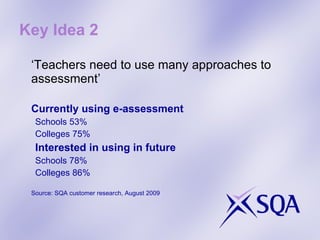
Key Idea 2 ‘ Teachers need to use many approaches to assessment’ Currently using e-assessment Schools 53% Colleges 75% Interested in using in future Schools 78% Colleges 86% Source: SQA customer research, August 2009
Key Idea 3 ‘ Assessment should focus on breadth, challenge and application’ Webquest  ‘ an inquiry-oriented activity in which some or all of the information that students interact with comes from resources on the internet.’ http://webquest.sdsu.edu/about_webquests.html , accessed 20 Sept 2010 www.internet4classrooms.com/why_webquest.htm , accessed 20 Sept 2010
Key Idea 4 ‘ Evidence of learners’ progress can be gathered across the four contexts for learning’ Deskspace e-portfolio for Skills for Work www.sqadeskspace.org
Key Idea 5 ‘ Professional dialogue is central to agreeing standards’ The Understanding Standards Website www.understandingstandards.org.uk SQA Academy www.sqaacademy.org.uk
Key Idea 6 ‘ Assessments should be reliable, valid and proportionate’ Use of social software for assessment http://www.sqa.org.uk/sqa/38247.2258.html Games based assessment http://www.sqa.org.uk/sqa/36537.2262.html
Key Idea 7 ‘ Curriculum for Excellence principles should underpin reporting’ Deskspace e-portfolio   www.sqadeskspace.org.uk
Key Idea 8 ‘ Assessment needs to be quality assured’ Fit for purpose Valid and reliable Takes account of national standards Focuses on breadth, challenge and application Promotes active learner engagement
Where next…….? Further potential of games based approaches Mobile technologies Sharing assessment materials through NAR Using these approaches to challenge existing assessment thinking and practice  Contribution of Glow Futures
Thank you for your attention [email_address]
 

Slf sqa - using e-assessment to support cf e - 100914

  • 1.
  • 2.
    Using eAssessment to Support the Objectives of Curriculum for Excellence Martyn Ware Head of eAssessment and Learning Scottish Learning Festival, Wednesday 23 September 2010
  • 3.
    Overview What ise-assessment? Rationale for its use Assessment under CfE – the Eight Key Ideas Examples of e-assessment that support these ideas Where next?
  • 4.
    About SQA Nationalawarding body 750 staff, £60m turnover Offices in Glasgow and Dalkeith Qualifications for schools, colleges and training providers Offer products and services across Scotland, the UK and internationally
  • 5.
    What is e-assessment?‘… .the use of electronic media within the assessment process.’ focus in particular on those aspects experienced by learners e.g. on-screen assessments and e-portfolios
  • 6.
    Why e-assessment? Improvingthe assessment experience for teachers, learners and SQA Engagement and motivation Flexibility Consistency with experience of learning Automatic marking and immediate, rich feedback Enhanced quality assurance Assessing new things
  • 7.
    Purposes of assessmentinclude….. Supporting learning Helping to plan next steps Informing learners and parents of their progress Summarising achievements (including in qualifications) Monitoring the education system and influencing future developments From ‘a summary of building the curriculum 5 a framework for assessment’
  • 8.
    Assessment under CfE- The Eight Key Ideas Learner engagement Variety in approaches Focus on breadth, challenge and application Evidence from across the four contexts Professional dialogue Reliability, validity and proportionality Reporting underpinned by CfE principles Importance of quality assurance From ‘a summary of building the curriculum 5 a framework for assessment’
  • 9.
    Key Idea 1‘ Learner engagement in assessment is crucial’ Solar Open Assess http://www.sqasolar.org.uk/openassess
  • 10.
    Key Idea 2‘ Teachers need to use many approaches to assessment’ Currently using e-assessment Schools 53% Colleges 75% Interested in using in future Schools 78% Colleges 86% Source: SQA customer research, August 2009
  • 11.
    Key Idea 3‘ Assessment should focus on breadth, challenge and application’ Webquest ‘ an inquiry-oriented activity in which some or all of the information that students interact with comes from resources on the internet.’ http://webquest.sdsu.edu/about_webquests.html , accessed 20 Sept 2010 www.internet4classrooms.com/why_webquest.htm , accessed 20 Sept 2010
  • 12.
    Key Idea 4‘ Evidence of learners’ progress can be gathered across the four contexts for learning’ Deskspace e-portfolio for Skills for Work www.sqadeskspace.org
  • 13.
    Key Idea 5‘ Professional dialogue is central to agreeing standards’ The Understanding Standards Website www.understandingstandards.org.uk SQA Academy www.sqaacademy.org.uk
  • 14.
    Key Idea 6‘ Assessments should be reliable, valid and proportionate’ Use of social software for assessment http://www.sqa.org.uk/sqa/38247.2258.html Games based assessment http://www.sqa.org.uk/sqa/36537.2262.html
  • 15.
    Key Idea 7‘ Curriculum for Excellence principles should underpin reporting’ Deskspace e-portfolio www.sqadeskspace.org.uk
  • 16.
    Key Idea 8‘ Assessment needs to be quality assured’ Fit for purpose Valid and reliable Takes account of national standards Focuses on breadth, challenge and application Promotes active learner engagement
  • 17.
    Where next…….? Furtherpotential of games based approaches Mobile technologies Sharing assessment materials through NAR Using these approaches to challenge existing assessment thinking and practice Contribution of Glow Futures
  • 18.
    Thank you foryour attention [email_address]
  • 19.

Editor's Notes

  • #9 Priorities in BtC 5 grouped under eight key ideas None entirely new but all given additional prominence Should be used to shape assessment processes that will meet the needs of CfE
  • #10 Active engagement of learner a key feature of CfE Key elements are: Teachers sharing learning intentions Indicating what is a good measure of success Learners need early and accurate feedback and chance to discuss this with teachers Further than this learners should be involved in choosing assessment approaches and selecting the evidence To do this learners need to be able to evaluate their own work effectively
  • #11 Learners need to demo knowledge, understanding and skill This requires a range of evidence drawn from a range of assessment approaches Teachers should chose assessment approaches in discussion with learners that are best suited to learners’ circumstances and the requirements of a specific assessment.
  • #12 As far as possible, all assessments should: Evaluate success across a range of experiences and outcomes Demonstrate the ability to: respond to the level of challenge presented apply the knowledge in circumstances other than those in which it was acquired Breadth – connections across outcomes Challenge – depth: more than the acquisition of knowledge Application – the ability to turn knowledge to practical effect
  • #13 CfE identifies the four contexts as: Learning within curriculum areas Interdisciplinary learning Ethos and life of the school as a community Broader opportunities for achievement in the outside world ‘ Schools expected to recognise and celebrate all aspects of achievement and help young people to present a comprehensive view of their accomplishments.’
  • #14 Essential that common, in-depth understanding of standards in Es and Os and qualifications should be shared by teachers and all with an interest in the education system. Professional dialogue is central to the creation of this understanding
  • #15 Need to be able to assess understanding, skills and personal qualities as well as knowledge. ‘ In many cases this means using innovative approaches that give greater validity while preserving the standards of reliability of more traditional forms of assessment’.
  • #16 ‘ Comment should be made on those aspects of learning that are important, not merely on those that are easy to measure.’ ‘ Reporting should be regular and is particularly important at points of transition…’ ‘ It is also important that reporting activity should be proportionate and not unnecessarily burdensome.’
  • #17 Emphasis on the importance of QA at an establishment level to ensure that assessment is: Fit for purpose Valid and reliable Takes account of national standards Focuses on breadth, challenge and application Promotes active learner engagement