Sleep better, naturally
Marianna Shimelfarb, M.D.
Integrative Family Medicine
Montclair Family Practice at SMG
September 25th , 2017
“What are we going to talk about tonight?”
• Why you need to sleep
• Why can’t you get good sleep
• Why is it important to do something about it?
And, most importantly,
• What you can do tonight to make it
better, naturally!
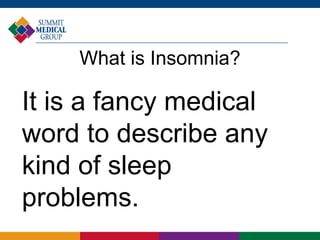
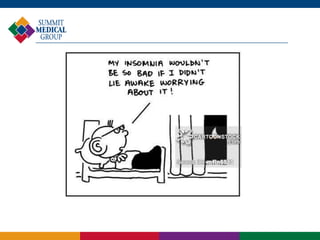
What is Insomnia?
It is a fancy medical
word to describe any
kind of sleep
problems.
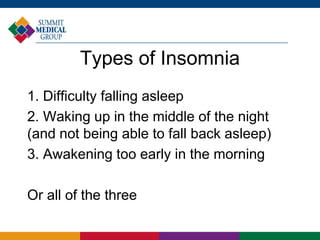
Types of Insomnia
1. Difficulty falling asleep
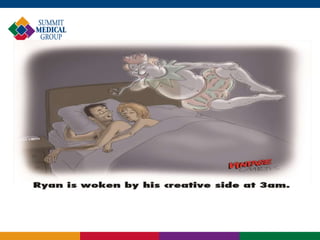
2. Waking up in the middle of the night
(and not being able to fall back asleep)
3. Awakening too early in the morning
Or all of the three
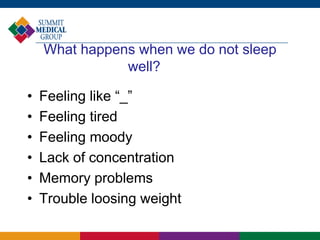
What happens when we do not sleep
well?
• Feeling like “_”
• Feeling tired
• Feeling moody
• Lack of concentration
• Memory problems
• Trouble loosing weight
What causes trouble sleeping?
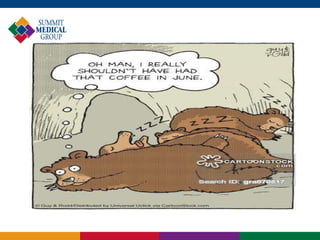
• Alcohol, caffeine, nicotine
• Over-the-counter medications
• Reflux disease (chronic heartburn), sleep apnea
• STRESS
• Diet
• Anxiety, Depression
• Prescription medicine
• Lack of physical activity or excess of physical activity
• Age
“If there is a secret to good
night sleep, it is the good time
waking”
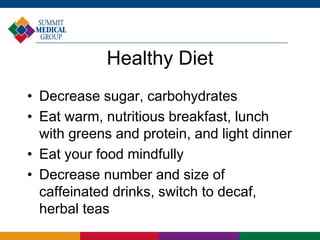
Healthy Diet
• Decrease sugar, carbohydrates
• Eat warm, nutritious breakfast, lunch
with greens and protein, and light dinner
• Eat your food mindfully
• Decrease number and size of
caffeinated drinks, switch to decaf,
herbal teas
But I am French
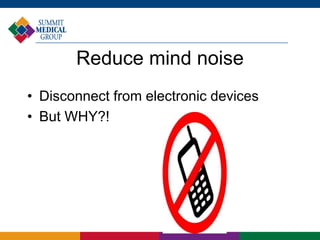
Reduce mind noise
• Disconnect from electronic devices
• But WHY?!
“But I cannot relax…”
• “Tired and Wired”
• Let’s talk about a
“ GYM FOR YOUR MIND”
More ways to relax
• Engage in regular exercise
• Pursue relaxing hobby
• Journaling
• Practice yoga, tai chi, or qigong
• Reflexology, acupressure
• Hypnotherapy, guided imagery
Pranayama Breath
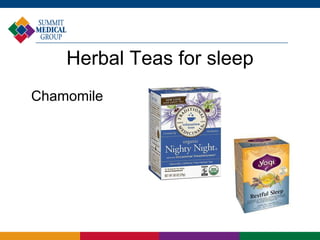
Herbal Teas for sleep
Chamomile
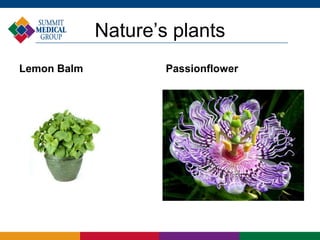
Nature’s plants
Lemon Balm Passionflower
Minerals
• A “relaxation” mineral
• Magnesium Glycinate or Magnesium
Citrate: 200-300 mg before bedtime
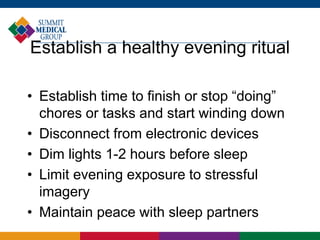
Establish a healthy evening ritual
• Establish time to finish or stop “doing”
chores or tasks and start winding down
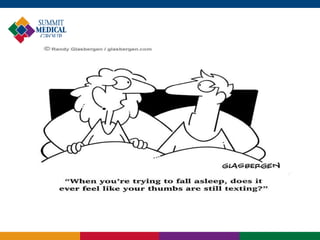
• Disconnect from electronic devices
• Dim lights 1-2 hours before sleep
• Limit evening exposure to stressful
imagery
• Maintain peace with sleep partners
Finally,
• “It can be incredibly freeing simply to
accept that our sleep cycles vary and
that there will be nights when we don’t
sleep well.”
• Dr.Tierona Low Dog
References:
• Mary Bove, N.D., Lemon Balm (Melissa officinalis), An Overview of its Versatility,
Effectiveness, and Indications
• Tieraona Low Dog, M.D., Life is your best medicine, 2014
• Rubin Naiman, PhD. ,Chapter 8: Insomnia, Integrative Medicine, Third Edition, David Rakel,
M.D.
• Michael Reed Gach, Ph.D ., Acupressure.com
• Dr.Michael Traub, Passionflower (Passiflora), An Overview of the research and clinical
indications
• Cartoonstock.com
• Glasbergen.com

Sleep Better, Naturally

  • 1.
    Sleep better, naturally MariannaShimelfarb, M.D. Integrative Family Medicine Montclair Family Practice at SMG September 25th , 2017
  • 3.
    “What are wegoing to talk about tonight?” • Why you need to sleep • Why can’t you get good sleep • Why is it important to do something about it?
  • 4.
    And, most importantly, •What you can do tonight to make it better, naturally!
  • 7.
    What is Insomnia? Itis a fancy medical word to describe any kind of sleep problems.
  • 8.
    Types of Insomnia 1.Difficulty falling asleep 2. Waking up in the middle of the night (and not being able to fall back asleep) 3. Awakening too early in the morning Or all of the three
  • 10.
    What happens whenwe do not sleep well? • Feeling like “_” • Feeling tired • Feeling moody • Lack of concentration • Memory problems • Trouble loosing weight
  • 12.
    What causes troublesleeping? • Alcohol, caffeine, nicotine • Over-the-counter medications • Reflux disease (chronic heartburn), sleep apnea • STRESS • Diet • Anxiety, Depression • Prescription medicine • Lack of physical activity or excess of physical activity • Age
  • 14.
    “If there isa secret to good night sleep, it is the good time waking”
  • 16.
    Healthy Diet • Decreasesugar, carbohydrates • Eat warm, nutritious breakfast, lunch with greens and protein, and light dinner • Eat your food mindfully • Decrease number and size of caffeinated drinks, switch to decaf, herbal teas
  • 17.
    But I amFrench
  • 18.
    Reduce mind noise •Disconnect from electronic devices • But WHY?!
  • 20.
    “But I cannotrelax…” • “Tired and Wired” • Let’s talk about a “ GYM FOR YOUR MIND”
  • 21.
    More ways torelax • Engage in regular exercise • Pursue relaxing hobby • Journaling • Practice yoga, tai chi, or qigong • Reflexology, acupressure • Hypnotherapy, guided imagery
  • 23.
  • 24.
    Herbal Teas forsleep Chamomile
  • 25.
  • 26.
    Minerals • A “relaxation”mineral • Magnesium Glycinate or Magnesium Citrate: 200-300 mg before bedtime
  • 27.
    Establish a healthyevening ritual • Establish time to finish or stop “doing” chores or tasks and start winding down • Disconnect from electronic devices • Dim lights 1-2 hours before sleep • Limit evening exposure to stressful imagery • Maintain peace with sleep partners
  • 29.
    Finally, • “It canbe incredibly freeing simply to accept that our sleep cycles vary and that there will be nights when we don’t sleep well.” • Dr.Tierona Low Dog
  • 31.
    References: • Mary Bove,N.D., Lemon Balm (Melissa officinalis), An Overview of its Versatility, Effectiveness, and Indications • Tieraona Low Dog, M.D., Life is your best medicine, 2014 • Rubin Naiman, PhD. ,Chapter 8: Insomnia, Integrative Medicine, Third Edition, David Rakel, M.D. • Michael Reed Gach, Ph.D ., Acupressure.com • Dr.Michael Traub, Passionflower (Passiflora), An Overview of the research and clinical indications • Cartoonstock.com • Glasbergen.com

Editor's Notes

  • #2 Having trouble falling or staying asleep at night? Join us to learn about natural ways to promote healthy, sound, restorative sleep. https://soundcloud.com/bbbsounds-434606022/turn-off-your-cell-phone
  • #4 Reading self-help articles, beautiful magazine articles about how to battle sleep, 10 habits to help you get restorative sleep. You read it, and … nothing changes. Because it is not personal.
  • #5 (This is when you will really put away your phones and start paying attention!)
  • #8 In 2012, 49 million prescriptions for sleep aids were prescribed. This is a 50% increase from 2007. -60 million adults in the U.S. struggle with insomnia every year -10-30% of adults suffer from it and prevalence increases with age and female gender, as well as with concurrent health issues
  • #9 Talk about pre-historic cultures and reference to periods of wakefullness
  • #11 Most patients with insomnia are at increased risk for comorbid medical disorders, including chronic pain, CV disease, cancer, neurologic and GI disorders, obesity and diabetes. Sleep loss – ass’d w/disruptions in immune function. Persistent insomnia significantly increases the risk of clinical depression, anxiety, and substance abuse.
  • #13 Meds for colds and allergies, asthma, high BP, thyroid dz, birth control, pain, and antidepressants. Fairly common condition that causes pauses in breathing or shallow breath is sleep apnea. Restless leg syndrome. Pain. Hormonal fluctuations of menopause.
  • #15 Let’s talk about “ABCs” of health: diet, exercise, and stress management. Isn’t that what makes up our body and mind’s waking time? Beside what we need to do – work, take care of our families, study, etc.
  • #16 30 minutes
  • #17 Integrative approach to treatment: RESTORATION OF SLEEP HEALTH, AS OPPOSED TO SUPPRESSION OF SYMPTOMS. Alcohol, over-the-counter medications, even “natural” supplements can all impact your sleep. Review your prescription medications with your doctor.
  • #18 It can interrupt your  circadian rhythm. While you may fall asleep quickly after drinking, it's also common to wake up in the middle of the night. One explanation is that alcohol may affect the normal production of chemicals in the body that trigger sleepiness when you’ve been awake for a long time, and subside once you’ve had enough sleep. After drinking, production of adenosine (a sleep-inducing chemical in the brain) is increased, allowing for a fast onset of sleep. But it subsides as quickly as it came, making you more likely to wake up before you’re truly rested. It blocks REM sleep. Another reason people get lower-quality sleep following alcohol is that it blocks REM sleep , which is often considered the most restorative type of sleep. With less REM sleep, you’re likely to wake up feeling groggy and unfocused.
  • #19 HABITS. How many of you are using your phone right now? What drives you to do it? Excessive stimulation from electronics, social media, email, news, and other during the day greatly contributes to the wakefulness in the evening. “My mind cannot stop”, or “racing mind”. “blue” vs “red” light frequency, Melatonin production
  • #21 A lot of us find it hard to relax or wind down at the end of the day and that’s why electronic devices and social media take place of unhealthy winding down. Practice 4-7-8 breath
  • #22 Knitting, Adult coloring books. I often ask my patients, “what is it that you like to do for yourself” or “what do you do for self-care”? And when I hear a pause or a mmm, I think to myself …
  • #26 Melissa officinalis, commonly called Lemon Balm, is a member of the mint family. Melissa is Greek for honeybee. It is used to garnish salads and drinks, while the dried leaves have been frequently used for teas. Memory-enhancing, mild sedative, mood elevating, sleep aid, digestive aid. Passionflower: beautiful exotic flowers and delicious fruit that grow worldwide, preferring subtropical climates. Spanish conquistadors learned from the Aztecs that PF was has a sedative for nervousness and insomnia. It was introduced and cultivated in Europe. It is currently officialin the British, French, German, and Egyptian pharmacopoeia. In Germany, Passionflower is used as a component in sedatives combined with lemon balm and valerian root.
  • #27 Supports onset and duration through the night. Think of magnesium as the relaxation mineral. Anything that is tight, irritable, crampy, and stiff — whether it is a body part or an even a mood — is a sign of magnesium deficiency. This critical mineral is actually responsible for over 300 enzyme reactions and is found in all of your tissues — but mainly in your bones, muscles, and brain. You must have it for your cells to make energy, for many different chemical pumps to work, to stabilize membranes, and to help muscles relax.
  • #28 How do you end your day now? Do you try to get as much as possible done and then drop it all and crash? Do you pretend to have “my own grown up time” by surfing FB or mindlessly watching TV while your kids are asleep? How would it feel if you had an hour to yourself to take care of your body and mind? Actually, have time set aside to unwind, cleanse your thoughts, emotions, relax your muscles, joints?