Macroeconomics & Business Environment
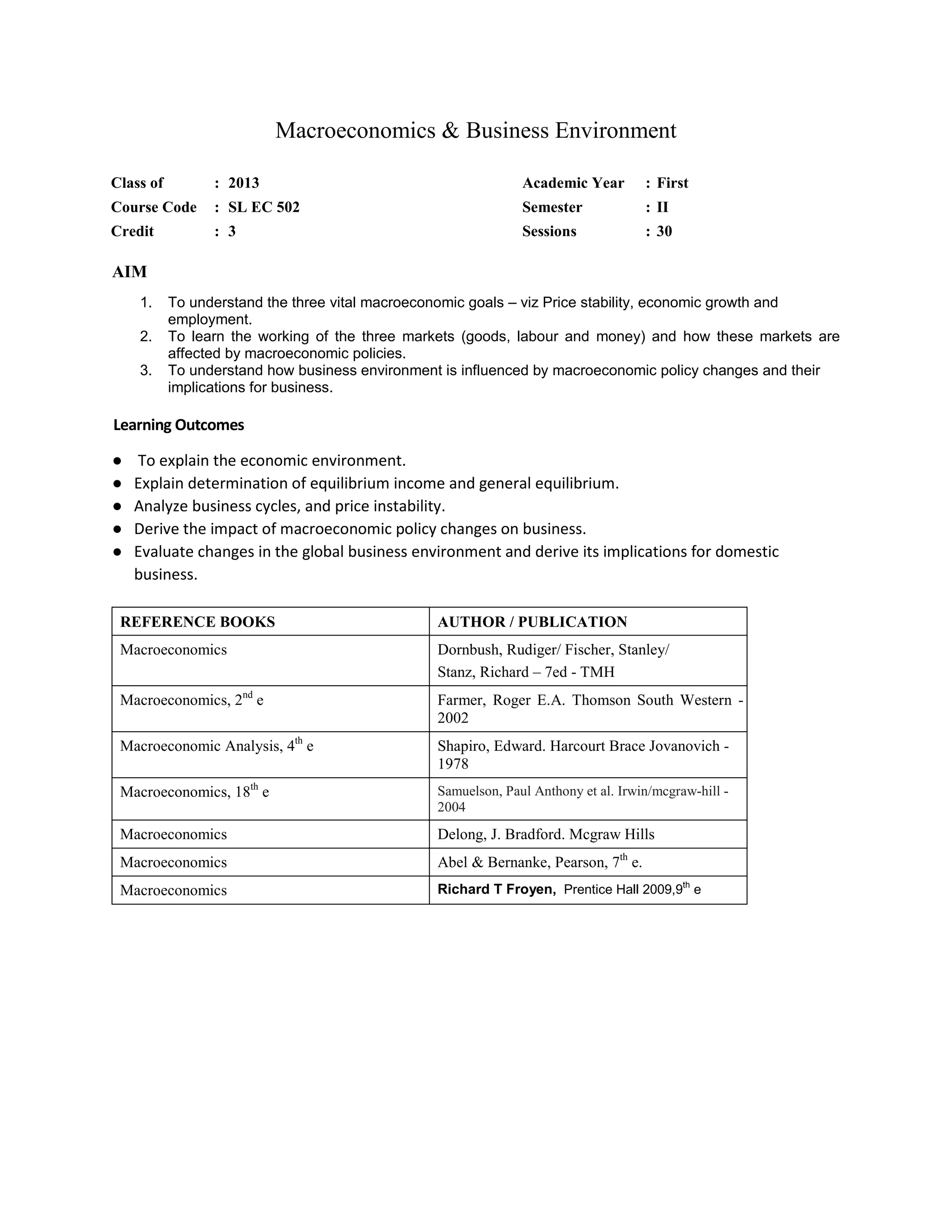
Class of

: 2013

Academic Year

: First

Course Code

: SL EC 502

Semester

: II

Credit

: 3

Sessions

: 30

AIM
1.
2.
3.

To understand the three vital macroeconomic goals – viz Price stability, economic growth and
employment.
To learn the working of the three markets (goods, labour and money) and how these markets are
affected by macroeconomic policies.
To understand how business environment is influenced by macroeconomic policy changes and their
implications for business.

Learning Outcomes
●
●
●
●
●

To explain the economic environment.
Explain determination of equilibrium income and general equilibrium.
Analyze business cycles, and price instability.
Derive the impact of macroeconomic policy changes on business.
Evaluate changes in the global business environment and derive its implications for domestic
business.

REFERENCE BOOKS

AUTHOR / PUBLICATION

Macroeconomics

Dornbush, Rudiger/ Fischer, Stanley/
Stanz, Richard – 7ed - TMH

Macroeconomics, 2nd e

Farmer, Roger E.A. Thomson South Western 2002

Macroeconomic Analysis, 4th e

Shapiro, Edward. Harcourt Brace Jovanovich 1978

Macroeconomics, 18th e

Samuelson, Paul Anthony et al. Irwin/mcgraw-hill 2004

Macroeconomics

Delong, J. Bradford. Mcgraw Hills

Macroeconomics

Abel & Bernanke, Pearson, 7th e.

Macroeconomics

Richard T Froyen, Prentice Hall 2009,9th e
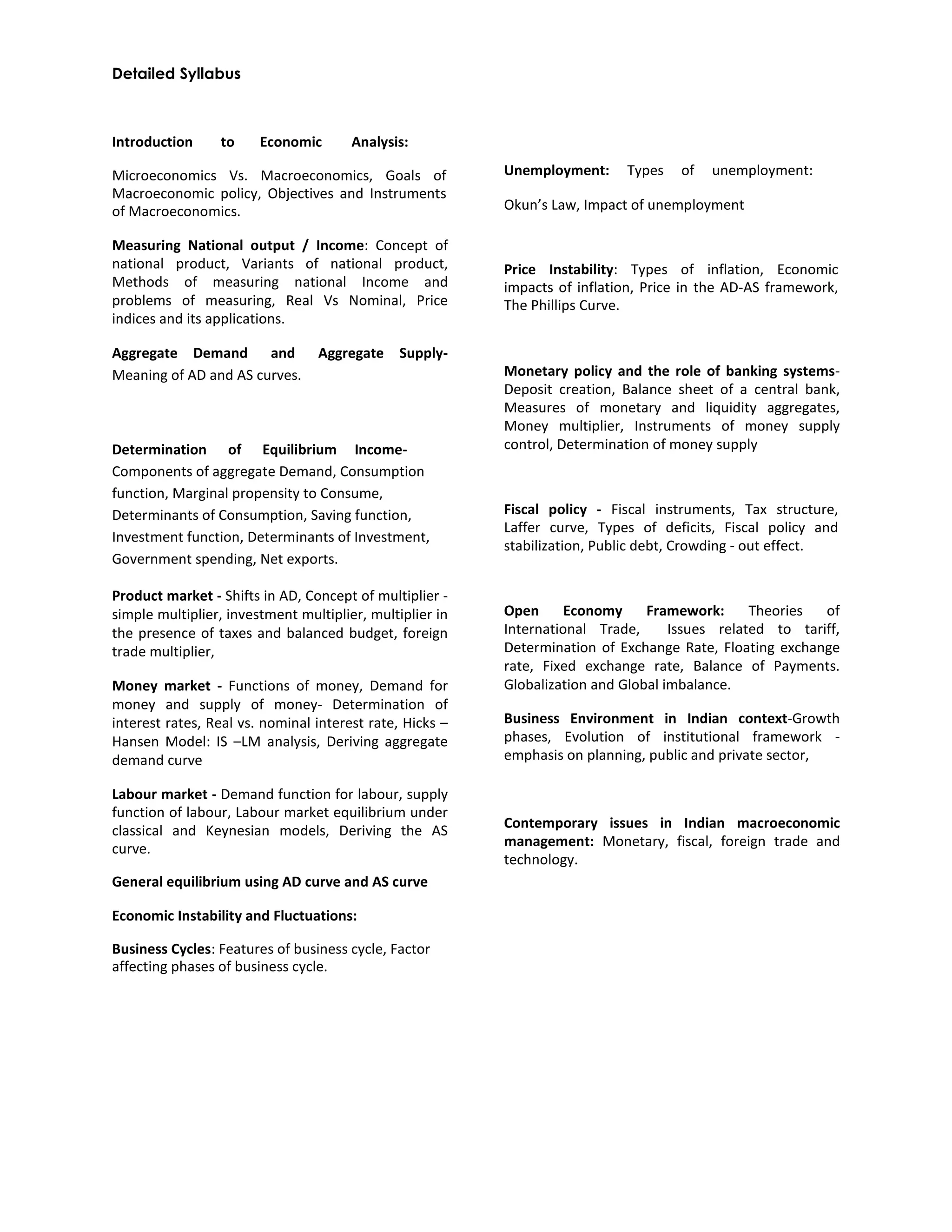
Detailed Syllabus

Introduction

to

Economic

Analysis:

Microeconomics Vs. Macroeconomics, Goals of
Macroeconomic policy, Objectives and Instruments
of Macroeconomics.
Measuring National output / Income: Concept of
national product, Variants of national product,
Methods of measuring national Income and
problems of measuring, Real Vs Nominal, Price
indices and its applications.
Aggregate Demand and
Meaning of AD and AS curves.

Aggregate

Unemployment:

Types

of

unemployment:

Okun’s Law, Impact of unemployment

Price Instability: Types of inflation, Economic
impacts of inflation, Price in the AD-AS framework,
The Phillips Curve.

Supply-

Determination of Equilibrium IncomeComponents of aggregate Demand, Consumption
function, Marginal propensity to Consume,
Determinants of Consumption, Saving function,
Investment function, Determinants of Investment,
Government spending, Net exports.
Product market - Shifts in AD, Concept of multiplier simple multiplier, investment multiplier, multiplier in
the presence of taxes and balanced budget, foreign
trade multiplier,
Money market - Functions of money, Demand for
money and supply of money- Determination of
interest rates, Real vs. nominal interest rate, Hicks –
Hansen Model: IS –LM analysis, Deriving aggregate
demand curve
Labour market - Demand function for labour, supply
function of labour, Labour market equilibrium under
classical and Keynesian models, Deriving the AS
curve.
General equilibrium using AD curve and AS curve
Economic Instability and Fluctuations:
Business Cycles: Features of business cycle, Factor
affecting phases of business cycle.

Monetary policy and the role of banking systemsDeposit creation, Balance sheet of a central bank,
Measures of monetary and liquidity aggregates,
Money multiplier, Instruments of money supply
control, Determination of money supply

Fiscal policy - Fiscal instruments, Tax structure,
Laffer curve, Types of deficits, Fiscal policy and
stabilization, Public debt, Crowding - out effect.

Open
Economy
Framework:
Theories
of
International Trade,
Issues related to tariff,
Determination of Exchange Rate, Floating exchange
rate, Fixed exchange rate, Balance of Payments.
Globalization and Global imbalance.
Business Environment in Indian context-Growth
phases, Evolution of institutional framework emphasis on planning, public and private sector,

Contemporary issues in Indian macroeconomic
management: Monetary, fiscal, foreign trade and
technology.
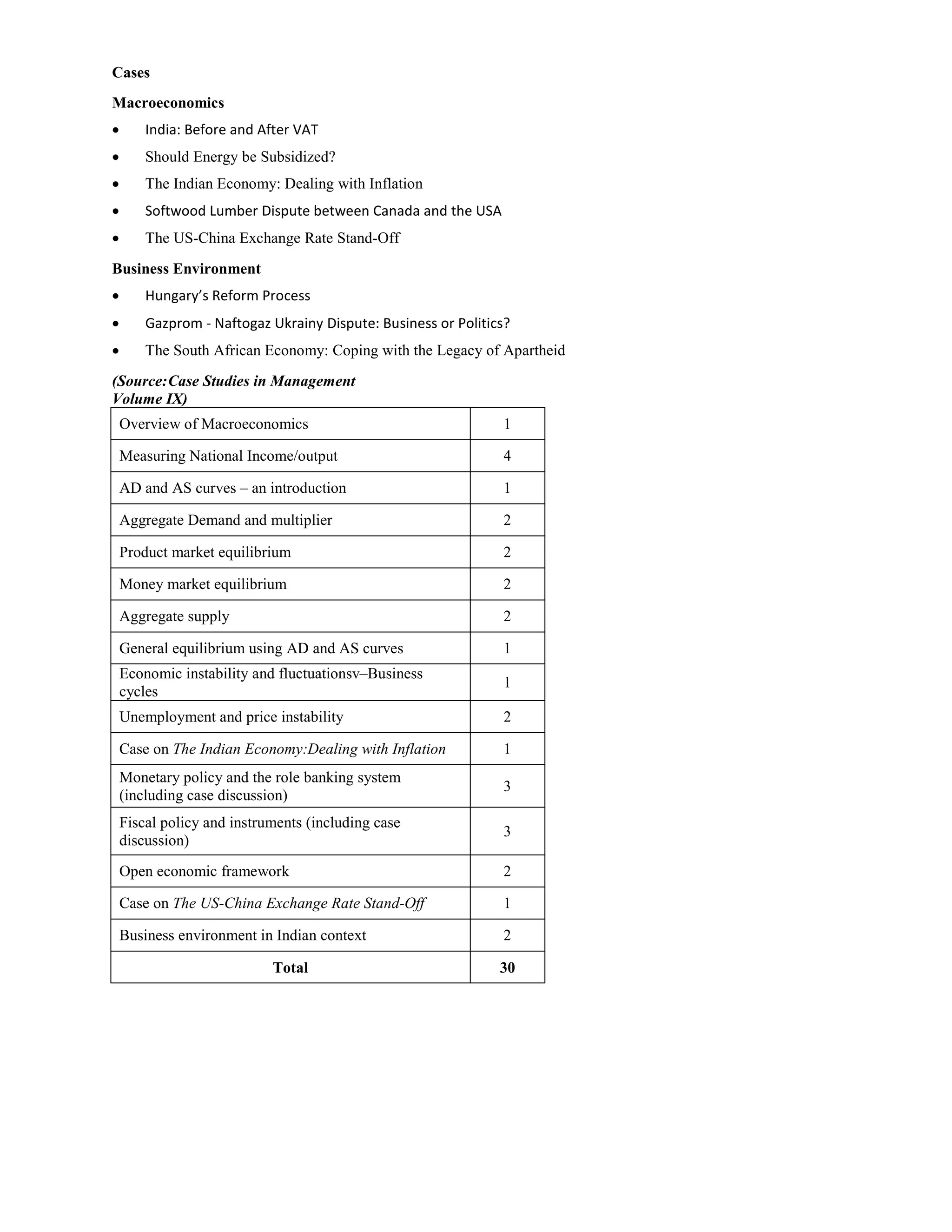
Cases
Macroeconomics
•

India: Before and After VAT

•

Should Energy be Subsidized?

•

The Indian Economy: Dealing with Inflation

•

Softwood Lumber Dispute between Canada and the USA

•

The US-China Exchange Rate Stand-Off

Business Environment
•

Hungary’s Reform Process

•

Gazprom - Naftogaz Ukrainy Dispute: Business or Politics?

•

The South African Economy: Coping with the Legacy of Apartheid

(Source: Case Studies in Management
Volume IX)
Overview of Macroeconomics

1

Measuring National Income/output

4

AD and AS curves – an introduction

1

Aggregate Demand and multiplier

2

Product market equilibrium

2

Money market equilibrium

2

Aggregate supply

2

General equilibrium using AD and AS curves

1

Economic instability and fluctuationsv–Business
cycles

1

Unemployment and price instability

2

Case on The Indian Economy:Dealing with Inflation

1

Monetary policy and the role banking system
(including case discussion)

3

Fiscal policy and instruments (including case
discussion)

3

Open economic framework

2

Case on The US-China Exchange Rate Stand-Off

1

Business environment in Indian context

2

Total

30

Slec502 me

  • 1.
    Macroeconomics & BusinessEnvironment Class of : 2013 Academic Year : First Course Code : SL EC 502 Semester : II Credit : 3 Sessions : 30 AIM 1. 2. 3. To understand the three vital macroeconomic goals – viz Price stability, economic growth and employment. To learn the working of the three markets (goods, labour and money) and how these markets are affected by macroeconomic policies. To understand how business environment is influenced by macroeconomic policy changes and their implications for business. Learning Outcomes ● ● ● ● ● To explain the economic environment. Explain determination of equilibrium income and general equilibrium. Analyze business cycles, and price instability. Derive the impact of macroeconomic policy changes on business. Evaluate changes in the global business environment and derive its implications for domestic business. REFERENCE BOOKS AUTHOR / PUBLICATION Macroeconomics Dornbush, Rudiger/ Fischer, Stanley/ Stanz, Richard – 7ed - TMH Macroeconomics, 2nd e Farmer, Roger E.A. Thomson South Western 2002 Macroeconomic Analysis, 4th e Shapiro, Edward. Harcourt Brace Jovanovich 1978 Macroeconomics, 18th e Samuelson, Paul Anthony et al. Irwin/mcgraw-hill 2004 Macroeconomics Delong, J. Bradford. Mcgraw Hills Macroeconomics Abel & Bernanke, Pearson, 7th e. Macroeconomics Richard T Froyen, Prentice Hall 2009,9th e
  • 2.
    Detailed Syllabus Introduction to Economic Analysis: Microeconomics Vs.Macroeconomics, Goals of Macroeconomic policy, Objectives and Instruments of Macroeconomics. Measuring National output / Income: Concept of national product, Variants of national product, Methods of measuring national Income and problems of measuring, Real Vs Nominal, Price indices and its applications. Aggregate Demand and Meaning of AD and AS curves. Aggregate Unemployment: Types of unemployment: Okun’s Law, Impact of unemployment Price Instability: Types of inflation, Economic impacts of inflation, Price in the AD-AS framework, The Phillips Curve. Supply- Determination of Equilibrium IncomeComponents of aggregate Demand, Consumption function, Marginal propensity to Consume, Determinants of Consumption, Saving function, Investment function, Determinants of Investment, Government spending, Net exports. Product market - Shifts in AD, Concept of multiplier simple multiplier, investment multiplier, multiplier in the presence of taxes and balanced budget, foreign trade multiplier, Money market - Functions of money, Demand for money and supply of money- Determination of interest rates, Real vs. nominal interest rate, Hicks – Hansen Model: IS –LM analysis, Deriving aggregate demand curve Labour market - Demand function for labour, supply function of labour, Labour market equilibrium under classical and Keynesian models, Deriving the AS curve. General equilibrium using AD curve and AS curve Economic Instability and Fluctuations: Business Cycles: Features of business cycle, Factor affecting phases of business cycle. Monetary policy and the role of banking systemsDeposit creation, Balance sheet of a central bank, Measures of monetary and liquidity aggregates, Money multiplier, Instruments of money supply control, Determination of money supply Fiscal policy - Fiscal instruments, Tax structure, Laffer curve, Types of deficits, Fiscal policy and stabilization, Public debt, Crowding - out effect. Open Economy Framework: Theories of International Trade, Issues related to tariff, Determination of Exchange Rate, Floating exchange rate, Fixed exchange rate, Balance of Payments. Globalization and Global imbalance. Business Environment in Indian context-Growth phases, Evolution of institutional framework emphasis on planning, public and private sector, Contemporary issues in Indian macroeconomic management: Monetary, fiscal, foreign trade and technology.
  • 3.
    Cases Macroeconomics • India: Before andAfter VAT • Should Energy be Subsidized? • The Indian Economy: Dealing with Inflation • Softwood Lumber Dispute between Canada and the USA • The US-China Exchange Rate Stand-Off Business Environment • Hungary’s Reform Process • Gazprom - Naftogaz Ukrainy Dispute: Business or Politics? • The South African Economy: Coping with the Legacy of Apartheid (Source: Case Studies in Management Volume IX) Overview of Macroeconomics 1 Measuring National Income/output 4 AD and AS curves – an introduction 1 Aggregate Demand and multiplier 2 Product market equilibrium 2 Money market equilibrium 2 Aggregate supply 2 General equilibrium using AD and AS curves 1 Economic instability and fluctuationsv–Business cycles 1 Unemployment and price instability 2 Case on The Indian Economy:Dealing with Inflation 1 Monetary policy and the role banking system (including case discussion) 3 Fiscal policy and instruments (including case discussion) 3 Open economic framework 2 Case on The US-China Exchange Rate Stand-Off 1 Business environment in Indian context 2 Total 30