SHREWSBURY PUBLIC SCHOOLS OVERVIEW OF SPECIFIC LEARNING DISABILITY (SLD)  ELIGIBILITY PROCESS Slides based on DESE PPT that can be accessed on main page of Shrewsbury Public Schools website
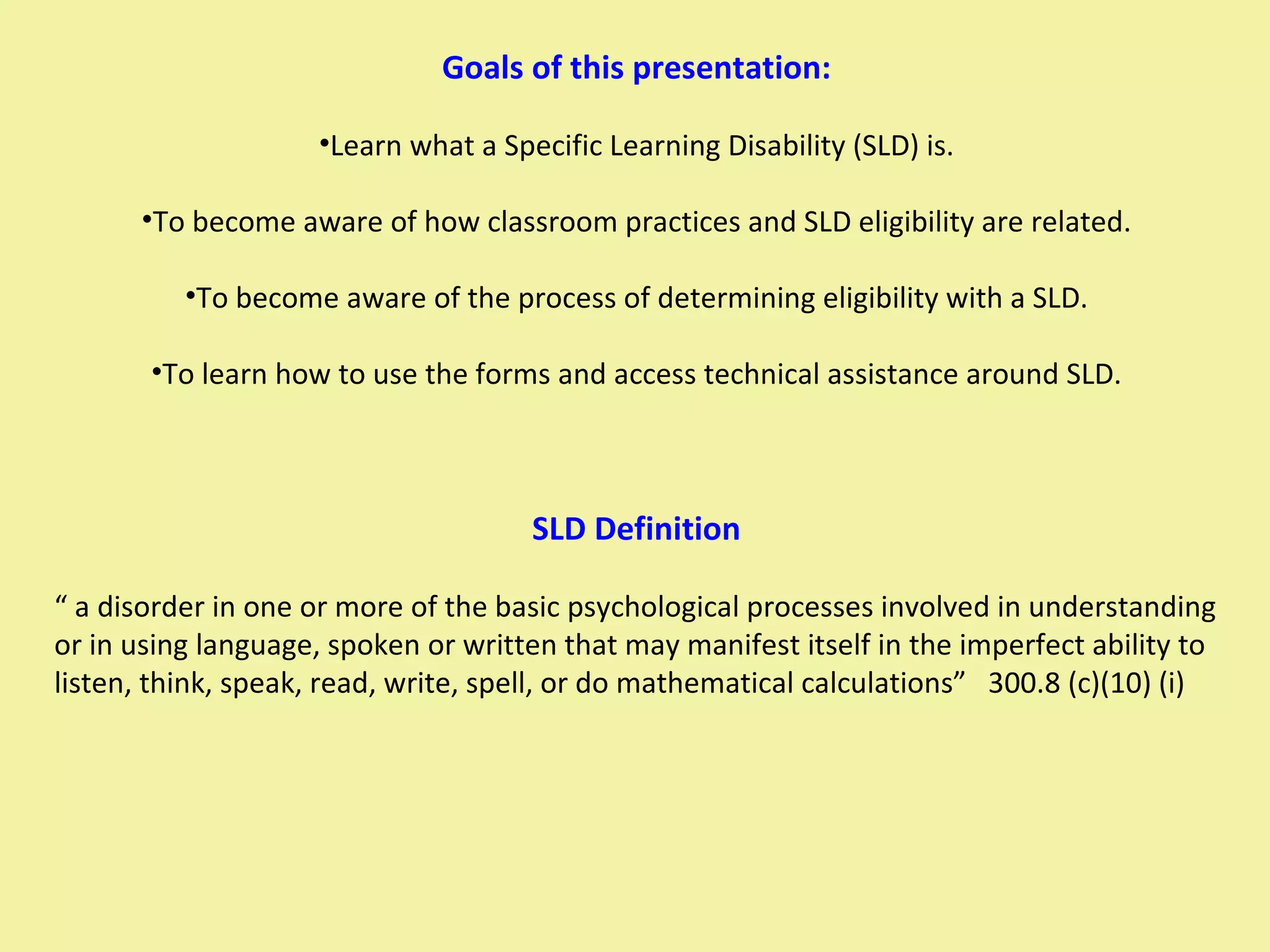
Goals of this presentation: Learn what a Specific Learning Disability (SLD) is. To become aware of how classroom practices and SLD eligibility are related. To become aware of the process of determining eligibility with a SLD. To learn how to use the forms and access technical assistance around SLD. SLD Definition “  a disorder in one or more of the basic psychological processes involved in understanding or in using language, spoken or written that may manifest itself in the imperfect ability to  listen, think, speak, read, write, spell, or do mathematical calculations”  300.8 (c)(10) (i)
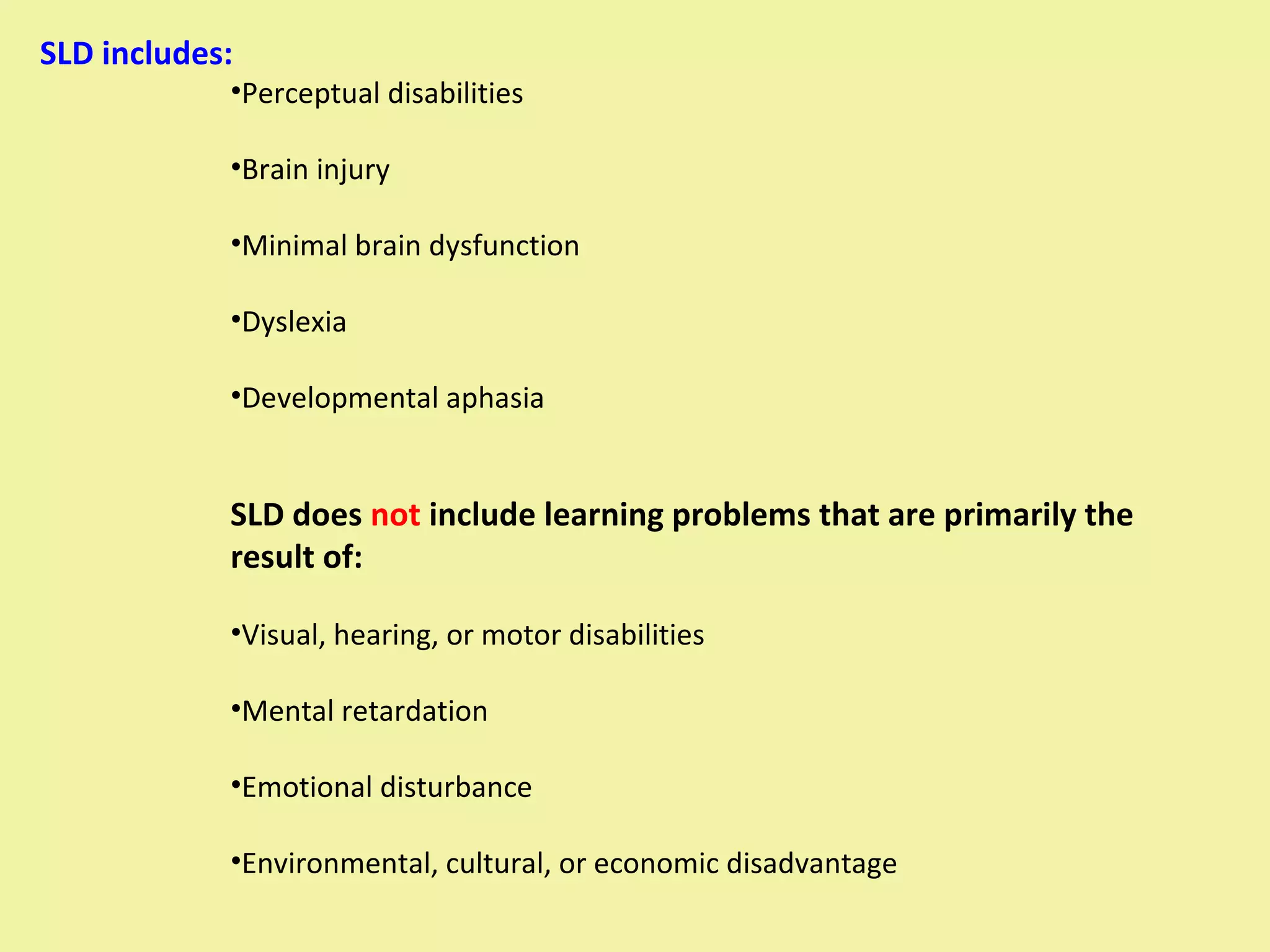
SLD includes:  Perceptual disabilities Brain injury Minimal brain dysfunction Dyslexia Developmental aphasia SLD does  not  include learning problems that are primarily the result of: Visual, hearing, or motor disabilities Mental retardation Emotional disturbance Environmental, cultural, or economic disadvantage
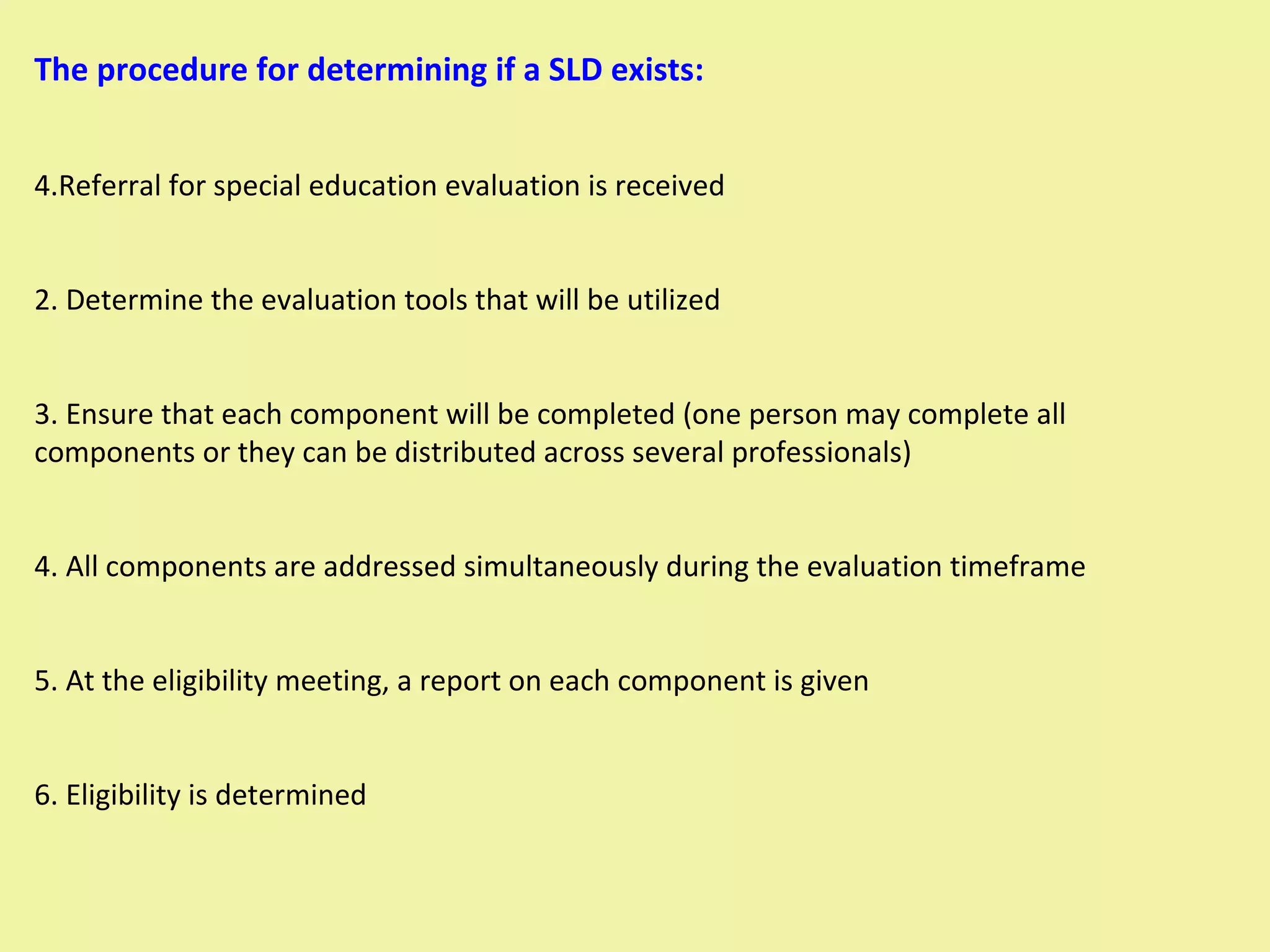
The procedure for determining if a SLD exists: Referral for special education evaluation is received 2. Determine the evaluation tools that will be utilized 3. Ensure that each component will be completed (one person may complete all components or they can be distributed across several professionals) 4. All components are addressed simultaneously during the evaluation timeframe 5. At the eligibility meeting, a report on each component is given 6. Eligibility is determined
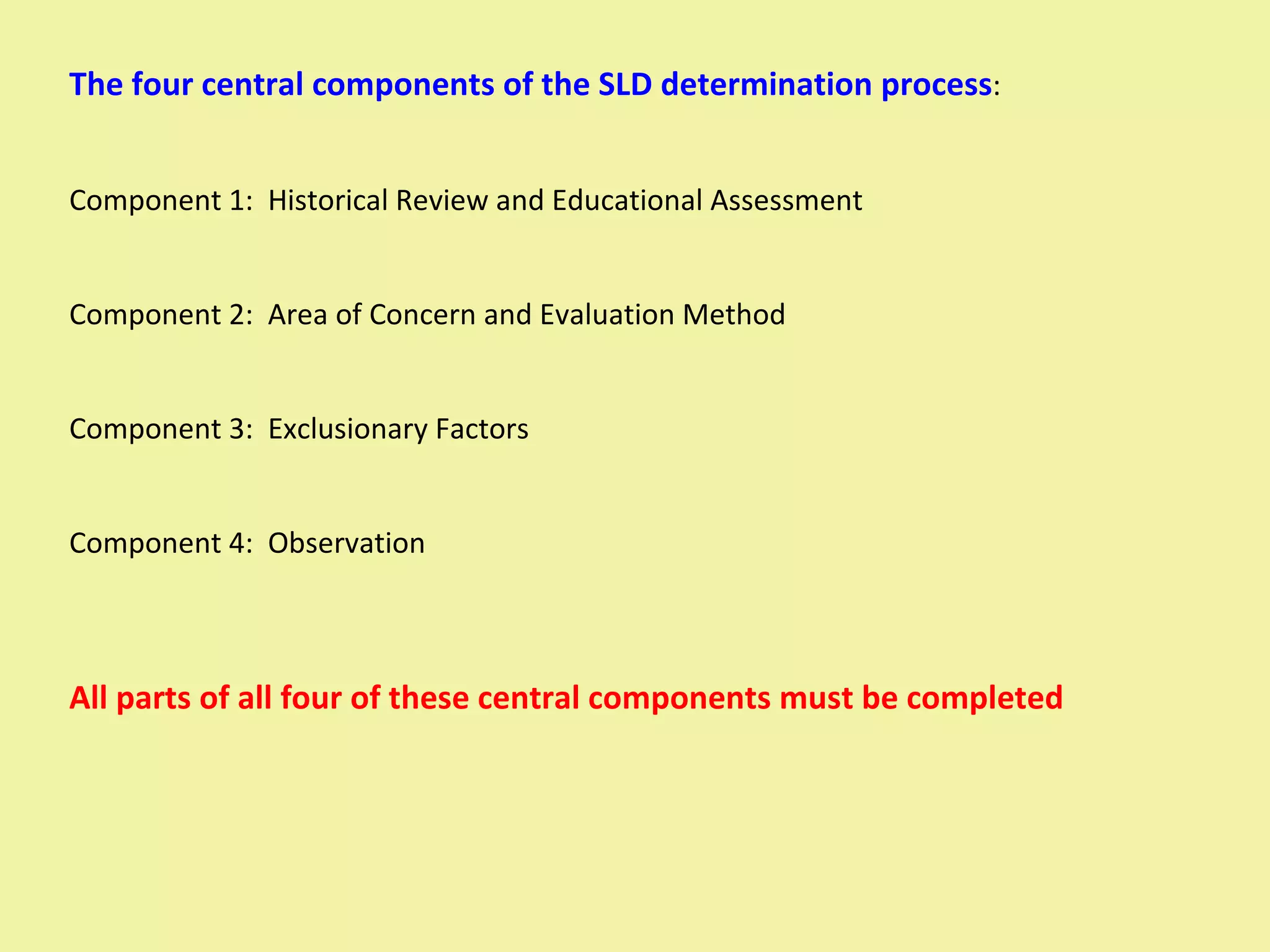
The four central components of the SLD determination process : Component 1:  Historical Review and Educational Assessment Component 2:  Area of Concern and Evaluation Method Component 3:  Exclusionary Factors Component 4:  Observation All parts of all four of these central components must be completed
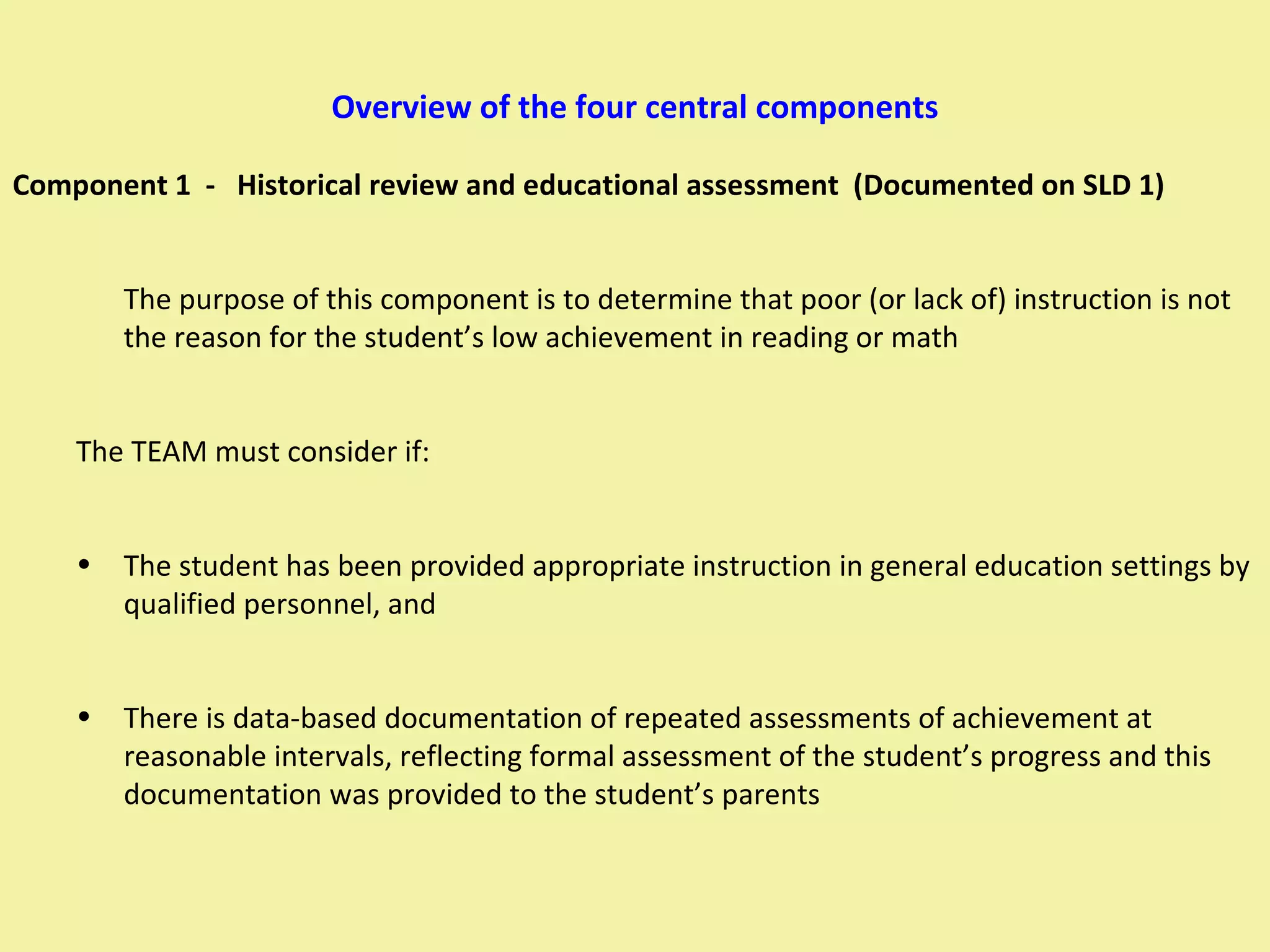
Overview of the four central components Component 1  -  Historical review and educational assessment  (Documented on SLD 1) The purpose of this component is to determine that poor (or lack of) instruction is not the reason for the student’s low achievement in reading or math The TEAM must consider if:  The student has been provided appropriate instruction in general education settings by qualified personnel, and There is data-based documentation of repeated assessments of achievement at reasonable intervals, reflecting formal assessment of the student’s progress and this documentation was provided to the student’s parents
Overview of the four central components Component 1  -  Historical review and educational assessment (Continued) The educational assessment looks at the student’s attention skills, participation behaviors, communication skills, memory, and social relations with groups, peers, and adults.  This assessment also includes performance history evidence that will show how the student has historically performed in comparison to his/her same-age peers. Finally, the educational assessment takes into account any educationally relevant medical findings. Historical Review and Educational Assessment Participation Skills Historical Review Performance History Medical Information = +
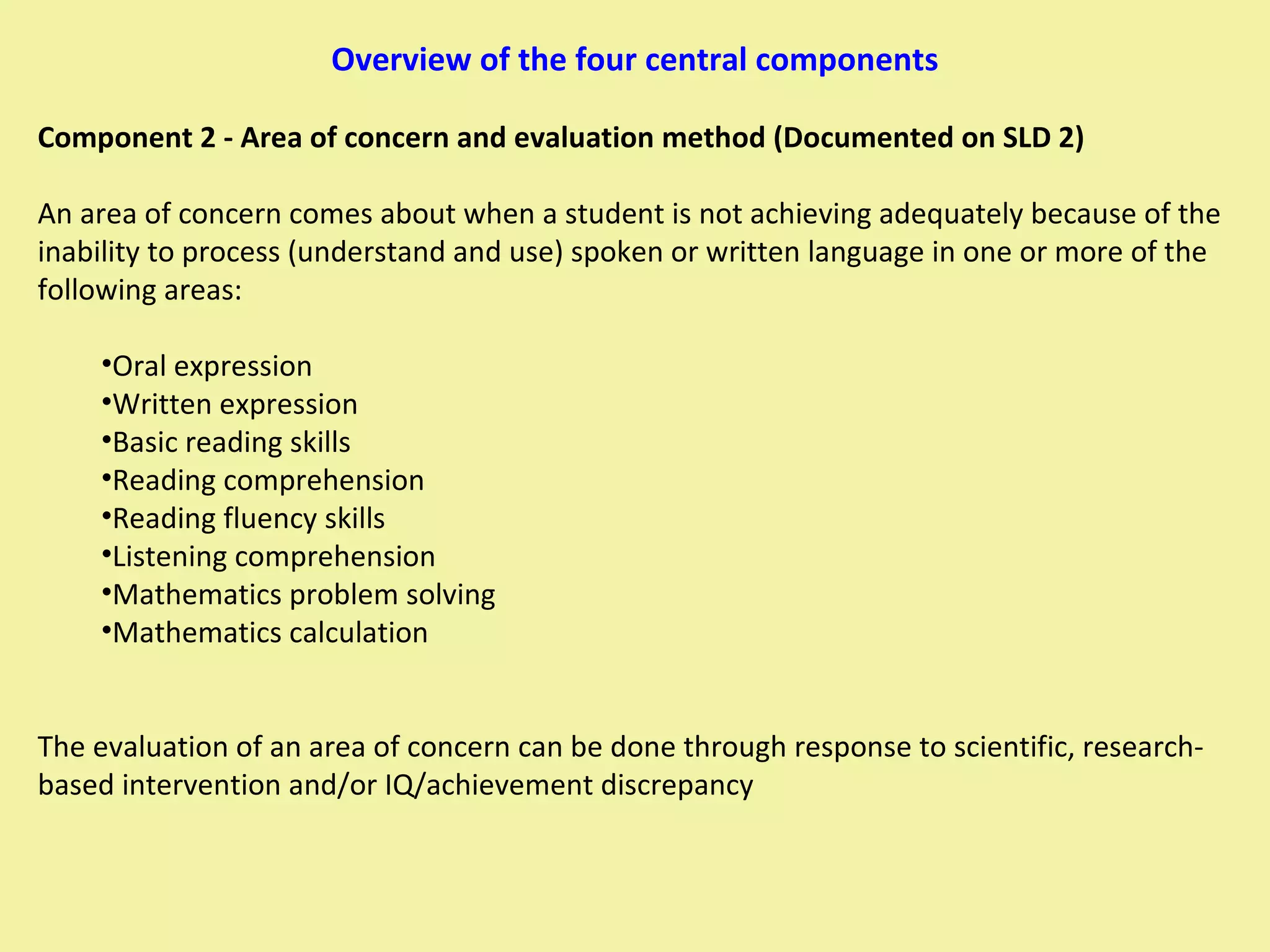
Overview of the four central components Component 2 - Area of concern and evaluation method (Documented on SLD 2) An area of concern comes about when a student is not achieving adequately because of the inability to process (understand and use) spoken or written language in one or more of the following areas: Oral expression Written expression Basic reading skills Reading comprehension Reading fluency skills Listening comprehension Mathematics problem solving Mathematics calculation The evaluation of an area of concern can be done through response to scientific, research-based intervention and/or IQ/achievement discrepancy
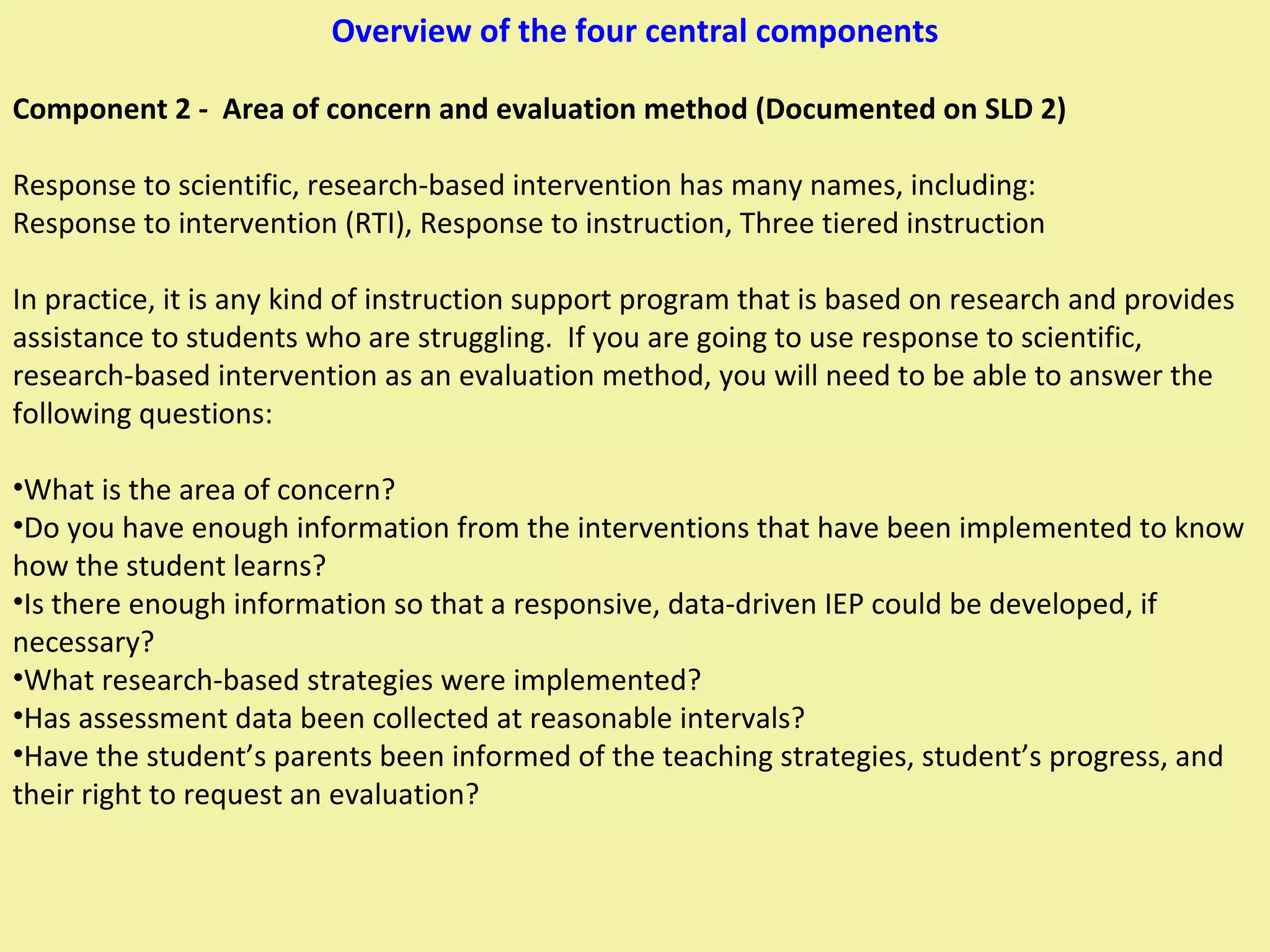
Overview of the four central components Component 2 -  Area of concern and evaluation method (Documented on SLD 2) Response to scientific, research-based intervention has many names, including: Response to intervention (RTI), Response to instruction, Three tiered instruction In practice, it is any kind of instruction support program that is based on research and provides assistance to students who are struggling.  If you are going to use response to scientific, research-based intervention as an evaluation method, you will need to be able to answer the following questions: What is the area of concern? Do you have enough information from the interventions that have been implemented to know how the student learns? Is there enough information so that a responsive, data-driven IEP could be developed, if necessary? What research-based strategies were implemented? Has assessment data been collected at reasonable intervals? Have the student’s parents been informed of the teaching strategies, student’s progress, and their right to request an evaluation?
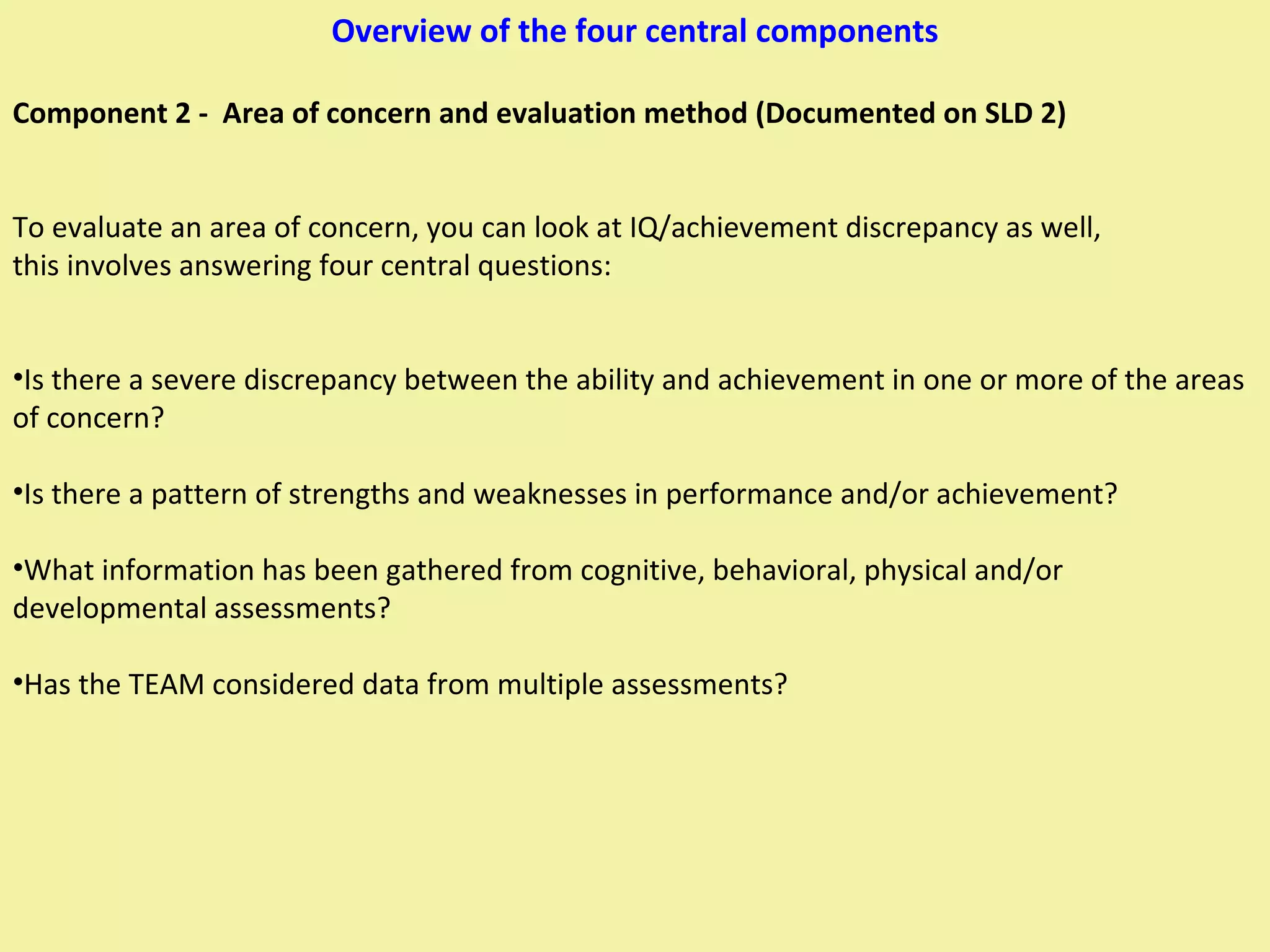
Overview of the four central components Component 2 -  Area of concern and evaluation method (Documented on SLD 2) To evaluate an area of concern, you can look at IQ/achievement discrepancy as well, this involves answering four central questions: Is there a severe discrepancy between the ability and achievement in one or more of the areas of concern? Is there a pattern of strengths and weaknesses in performance and/or achievement? What information has been gathered from cognitive, behavioral, physical and/or developmental assessments? Has the TEAM considered data from multiple assessments?
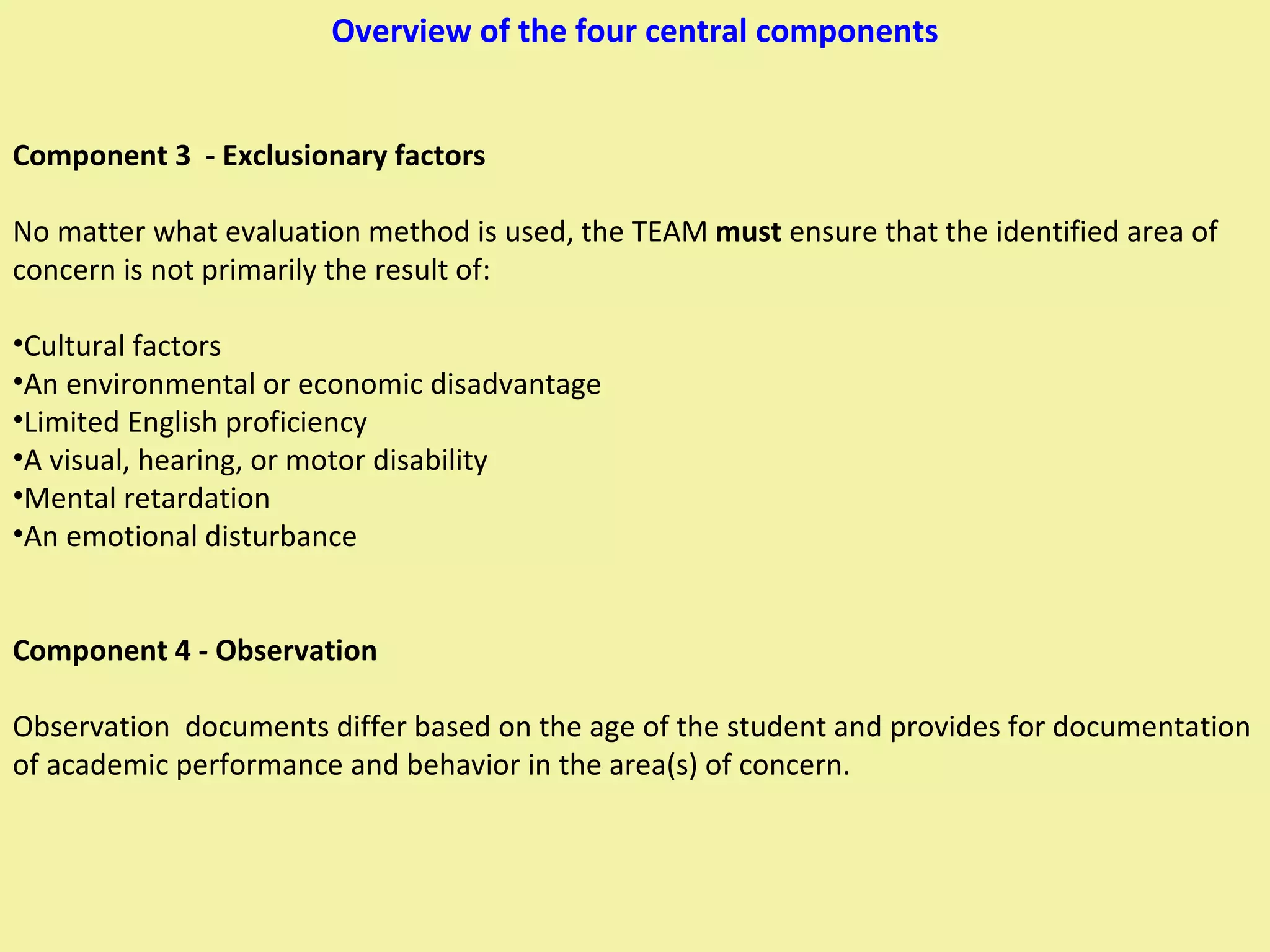
Overview of the four central components Component 3  - Exclusionary factors No matter what evaluation method is used, the TEAM  must  ensure that the identified area of concern is not primarily the result of:  Cultural factors An environmental or economic disadvantage Limited English proficiency A visual, hearing, or motor disability Mental retardation An emotional disturbance Component 4 - Observation Observation  documents differ based on the age of the student and provides for documentation of academic performance and behavior in the area(s) of concern.
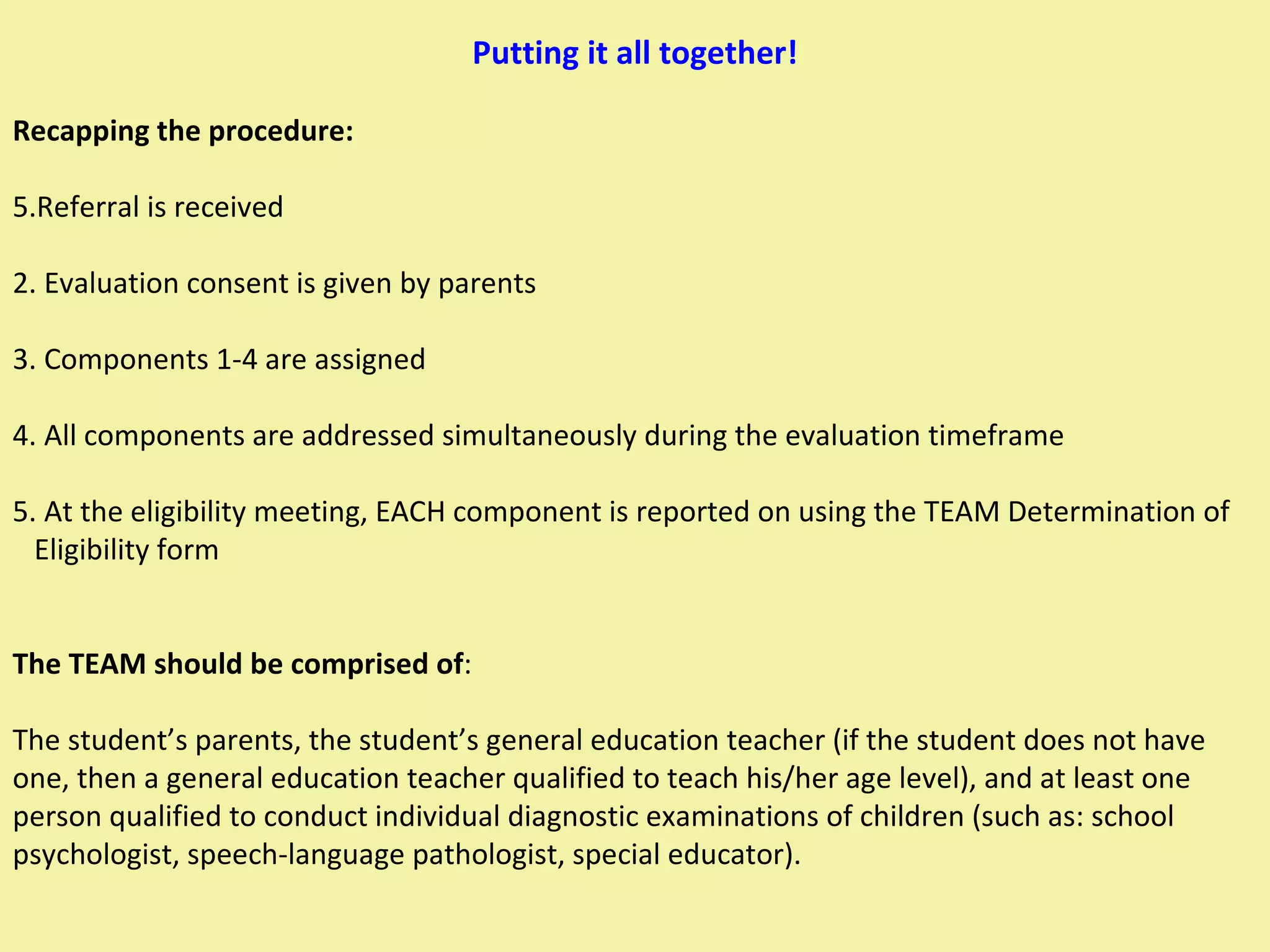
Putting it all together! Recapping the procedure: Referral is received 2. Evaluation consent is given by parents 3. Components 1-4 are assigned  4. All components are addressed simultaneously during the evaluation timeframe 5. At the eligibility meeting, EACH component is reported on using the TEAM Determination of  Eligibility form The TEAM should be comprised of :  The student’s parents, the student’s general education teacher (if the student does not have one, then a general education teacher qualified to teach his/her age level), and at least one person qualified to conduct individual diagnostic examinations of children (such as: school psychologist, speech-language pathologist, special educator).
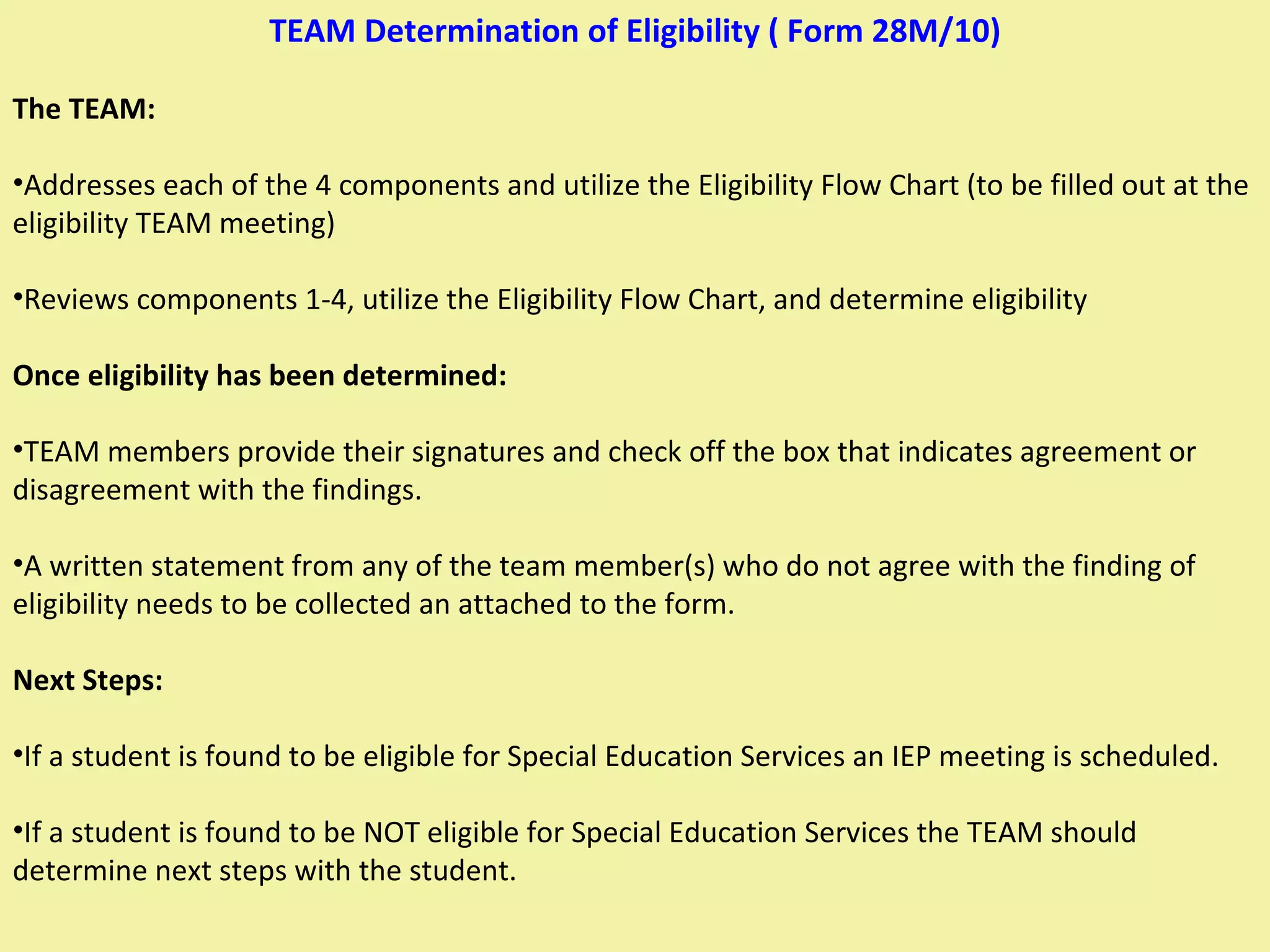
TEAM Determination of Eligibility ( Form 28M/10) The TEAM: Addresses each of the 4 components and utilize the Eligibility Flow Chart (to be filled out at the eligibility TEAM meeting) Reviews components 1-4, utilize the Eligibility Flow Chart, and determine eligibility Once eligibility has been determined: TEAM members provide their signatures and check off the box that indicates agreement or disagreement with the findings. A written statement from any of the team member(s) who do not agree with the finding of eligibility needs to be collected an attached to the form. Next Steps: If a student is found to be eligible for Special Education Services an IEP meeting is scheduled. If a student is found to be NOT eligible for Special Education Services the TEAM should determine next steps with the student.
Thank you  for taking your valuable time to learn about specific learning disabilities and the process for diagnosis.  Additional information about specific learning disabilities, information on the four components, and access to the forms utilized in the process can be found within the full SLD PowerPoint at  http://schools.shrewsbury-ma.gov/ Information related to specific learning disabilities provided by the DESE can be accessed at:  http://www.doe.mass.edu/sped/links/learndisability.html Additional information can also be provided by building principals and team chairs.

Sld Overview

  • 1.
    SHREWSBURY PUBLIC SCHOOLSOVERVIEW OF SPECIFIC LEARNING DISABILITY (SLD) ELIGIBILITY PROCESS Slides based on DESE PPT that can be accessed on main page of Shrewsbury Public Schools website
  • 2.
    Goals of thispresentation: Learn what a Specific Learning Disability (SLD) is. To become aware of how classroom practices and SLD eligibility are related. To become aware of the process of determining eligibility with a SLD. To learn how to use the forms and access technical assistance around SLD. SLD Definition “ a disorder in one or more of the basic psychological processes involved in understanding or in using language, spoken or written that may manifest itself in the imperfect ability to listen, think, speak, read, write, spell, or do mathematical calculations” 300.8 (c)(10) (i)
  • 3.
    SLD includes: Perceptual disabilities Brain injury Minimal brain dysfunction Dyslexia Developmental aphasia SLD does not include learning problems that are primarily the result of: Visual, hearing, or motor disabilities Mental retardation Emotional disturbance Environmental, cultural, or economic disadvantage
  • 4.
    The procedure fordetermining if a SLD exists: Referral for special education evaluation is received 2. Determine the evaluation tools that will be utilized 3. Ensure that each component will be completed (one person may complete all components or they can be distributed across several professionals) 4. All components are addressed simultaneously during the evaluation timeframe 5. At the eligibility meeting, a report on each component is given 6. Eligibility is determined
  • 5.
    The four centralcomponents of the SLD determination process : Component 1: Historical Review and Educational Assessment Component 2: Area of Concern and Evaluation Method Component 3: Exclusionary Factors Component 4: Observation All parts of all four of these central components must be completed
  • 6.
    Overview of thefour central components Component 1 - Historical review and educational assessment (Documented on SLD 1) The purpose of this component is to determine that poor (or lack of) instruction is not the reason for the student’s low achievement in reading or math The TEAM must consider if: The student has been provided appropriate instruction in general education settings by qualified personnel, and There is data-based documentation of repeated assessments of achievement at reasonable intervals, reflecting formal assessment of the student’s progress and this documentation was provided to the student’s parents
  • 7.
    Overview of thefour central components Component 1 - Historical review and educational assessment (Continued) The educational assessment looks at the student’s attention skills, participation behaviors, communication skills, memory, and social relations with groups, peers, and adults. This assessment also includes performance history evidence that will show how the student has historically performed in comparison to his/her same-age peers. Finally, the educational assessment takes into account any educationally relevant medical findings. Historical Review and Educational Assessment Participation Skills Historical Review Performance History Medical Information = +
  • 8.
    Overview of thefour central components Component 2 - Area of concern and evaluation method (Documented on SLD 2) An area of concern comes about when a student is not achieving adequately because of the inability to process (understand and use) spoken or written language in one or more of the following areas: Oral expression Written expression Basic reading skills Reading comprehension Reading fluency skills Listening comprehension Mathematics problem solving Mathematics calculation The evaluation of an area of concern can be done through response to scientific, research-based intervention and/or IQ/achievement discrepancy
  • 9.
    Overview of thefour central components Component 2 - Area of concern and evaluation method (Documented on SLD 2) Response to scientific, research-based intervention has many names, including: Response to intervention (RTI), Response to instruction, Three tiered instruction In practice, it is any kind of instruction support program that is based on research and provides assistance to students who are struggling. If you are going to use response to scientific, research-based intervention as an evaluation method, you will need to be able to answer the following questions: What is the area of concern? Do you have enough information from the interventions that have been implemented to know how the student learns? Is there enough information so that a responsive, data-driven IEP could be developed, if necessary? What research-based strategies were implemented? Has assessment data been collected at reasonable intervals? Have the student’s parents been informed of the teaching strategies, student’s progress, and their right to request an evaluation?
  • 10.
    Overview of thefour central components Component 2 - Area of concern and evaluation method (Documented on SLD 2) To evaluate an area of concern, you can look at IQ/achievement discrepancy as well, this involves answering four central questions: Is there a severe discrepancy between the ability and achievement in one or more of the areas of concern? Is there a pattern of strengths and weaknesses in performance and/or achievement? What information has been gathered from cognitive, behavioral, physical and/or developmental assessments? Has the TEAM considered data from multiple assessments?
  • 11.
    Overview of thefour central components Component 3 - Exclusionary factors No matter what evaluation method is used, the TEAM must ensure that the identified area of concern is not primarily the result of: Cultural factors An environmental or economic disadvantage Limited English proficiency A visual, hearing, or motor disability Mental retardation An emotional disturbance Component 4 - Observation Observation documents differ based on the age of the student and provides for documentation of academic performance and behavior in the area(s) of concern.
  • 12.
    Putting it alltogether! Recapping the procedure: Referral is received 2. Evaluation consent is given by parents 3. Components 1-4 are assigned 4. All components are addressed simultaneously during the evaluation timeframe 5. At the eligibility meeting, EACH component is reported on using the TEAM Determination of Eligibility form The TEAM should be comprised of : The student’s parents, the student’s general education teacher (if the student does not have one, then a general education teacher qualified to teach his/her age level), and at least one person qualified to conduct individual diagnostic examinations of children (such as: school psychologist, speech-language pathologist, special educator).
  • 13.
    TEAM Determination ofEligibility ( Form 28M/10) The TEAM: Addresses each of the 4 components and utilize the Eligibility Flow Chart (to be filled out at the eligibility TEAM meeting) Reviews components 1-4, utilize the Eligibility Flow Chart, and determine eligibility Once eligibility has been determined: TEAM members provide their signatures and check off the box that indicates agreement or disagreement with the findings. A written statement from any of the team member(s) who do not agree with the finding of eligibility needs to be collected an attached to the form. Next Steps: If a student is found to be eligible for Special Education Services an IEP meeting is scheduled. If a student is found to be NOT eligible for Special Education Services the TEAM should determine next steps with the student.
  • 14.
    Thank you for taking your valuable time to learn about specific learning disabilities and the process for diagnosis. Additional information about specific learning disabilities, information on the four components, and access to the forms utilized in the process can be found within the full SLD PowerPoint at http://schools.shrewsbury-ma.gov/ Information related to specific learning disabilities provided by the DESE can be accessed at: http://www.doe.mass.edu/sped/links/learndisability.html Additional information can also be provided by building principals and team chairs.