ROI 2.0George Scotti, Director Channel Marketing
BackgroundSpringer’s interest in ROI came about from our Corporate and Government Library Advisory Board; they told us…“We have difficulty providing ROI on content to management & information tools are intangible and value is hard to measure.”
So we decided to dig a little deeper…Conducted a research study with corporate customers with Outsell in 2009.Held a workshop at our May 2009 corporate and government library advisory boards.Reviewed published research.Developed a 5 Step Plan to Developing an ROI Dashboard.
What they had to say…Perspectives on Value of Library, and Measuring Return on Investment from Information Manager Survey, Springer & Outsell, May 2009
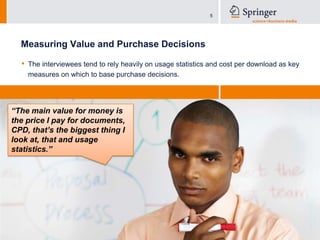
Measuring Value and Purchase DecisionsThe interviewees tend to rely heavily on usage statistics and cost per download as key measures on which to base purchase decisions.“The main value for money is the price I pay for documents, CPD, that’s the biggest thing I look at, that and usage statistics.”
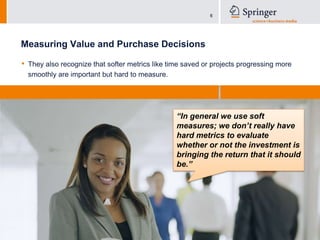
Measuring Value and Purchase DecisionsThey also recognize that softer metrics like time saved or projects progressing more smoothly are important but hard to measure.“In general we use soft measures; we don’t really have hard metrics to evaluate whether or not the investment is bringing the return that it should be.”
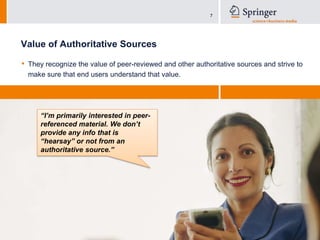
Value of Authoritative SourcesThey recognize the value of peer-reviewed and other authoritative sources and strive to make sure that end users understand that value. “I’m primarily interested in peer-referenced material. We don’t provide any info that is “hearsay” or not from an authoritative source.”
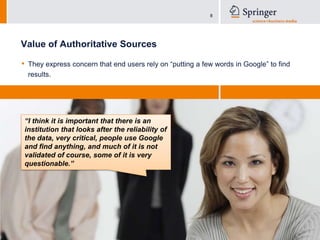
Value of Authoritative SourcesThey express concern that end users rely on “putting a few words in Google” to find results.“I think it is important that there is an institution that looks after the reliability of the data, very critical, people use Google and find anything, and much of it is not validated of course, some of it is very questionable.”
The Library Within the OrganizationAll recognize that it is important for the library to be recognized for its value within the organization.“Helping people understand that the resources are valuable, and how and where to use those resources.”
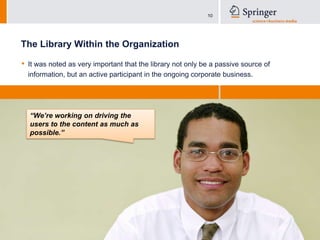
The Library Within the OrganizationIt was noted as very important that the library not only be a passive source of information, but an active participant in the ongoing corporate business.“We’re working on driving the users to the content as much as possible.”
Here’s what they had to say…Springer Corporate and Government Library Advisory Board, May 2009
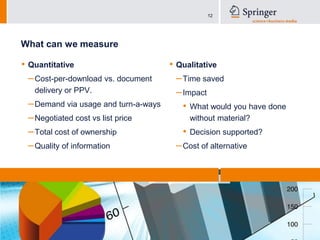
What can we measureQuantitativeCost-per-download vs. document delivery or PPV.Demand via usage and turn-a-ways Negotiated cost vs list priceTotal cost of ownershipQuality of informationQualitative Time saved Impact What would you have done without material? Decision supported?Cost of alternative
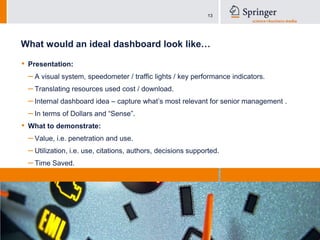
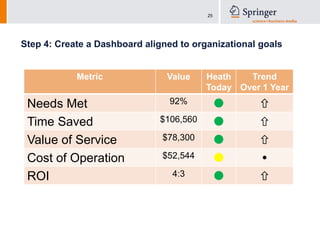
What would an ideal dashboard look like…Presentation:A visual system, speedometer / traffic lights / key performance indicators.Translating resources used cost / download.Internal dashboard idea – capture what’s most relevant for senior management .In terms of Dollars and “Sense”.What to demonstrate:Value, i.e. penetration and use.Utilization, i.e. use, citations, authors, decisions supported.Time Saved.
Published Research
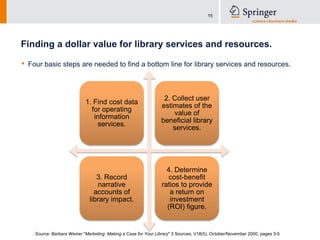
Finding a dollar value for library services and resources.Four basic steps are needed to find a bottom line for library services and resources.. Source: Barbara Weiner "Marketing: Making a Case for Your Library" 3 Sources, V18(5), October/November 2000, pages 3-5
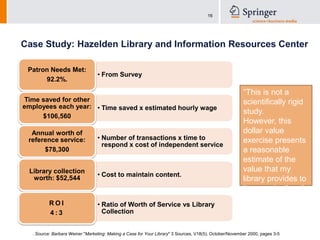
Case Study: Hazelden Library and Information Resources Center “This is not a scientifically rigid study. However, this dollar value exercise presents a reasonable estimate of the value that my library provides to its organization. “. Source: Barbara Weiner "Marketing: Making a Case for Your Library" 3 Sources, V18(5), October/November 2000, pages 3-5
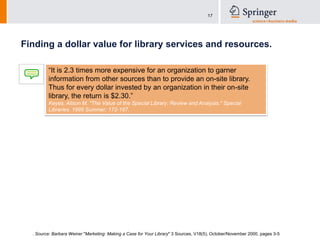
Finding a dollar value for library services and resources.“It is 2.3 times more expensive for an organization to garner information from other sources than to provide an on-site library. Thus for every dollar invested by an organization in their on-site library, the return is $2.30.” Keyes, Alison M. "The Value of the Special Library: Review and Analysis." Special Libraries. 1995 Summer; 172-187. . Source: Barbara Weiner "Marketing: Making a Case for Your Library" 3 Sources, V18(5), October/November 2000, pages 3-5
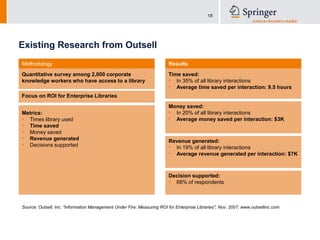
Existing Research from OutsellMethodologyResultsQuantitative survey among 2,000 corporate knowledge workers who have access to a libraryTime saved:In 35% of all library interactions
Average time saved per interaction: 9.5 hoursFocus on ROI for Enterprise LibrariesMoney saved:In 20% of all library interactions
Average money saved per interaction: $3KMetrics:Times library used
Time saved
Money saved
Revenue generated
Decisions supportedRevenue generated:In 19% of all library interactions
Average revenue generated per interaction: $7KDecision supported:68% of respondentsSource: Outsell, Inc. "Information Management Under Fire: Measuring ROI for Enterprise Libraries", Nov. 2007; www.outsellinc.com
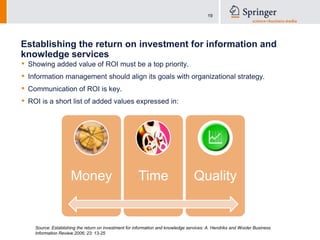
Establishing the return on investment for information and knowledge servicesShowing added value of ROI must be a top priority.Information management should align its goals with organizational strategy.Communication of ROI is key.ROI is a short list of added values expressed in:Source: Establishing the return on investment for information and knowledge services: A. Hendriks and Wooler Business Information Review.2006; 23: 13-25
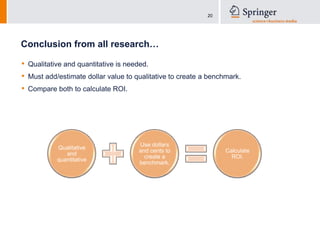
Conclusion from all research…Qualitative and quantitative is needed.Must add/estimate dollar value to qualitative to create a benchmark.Compare both to calculate ROI.
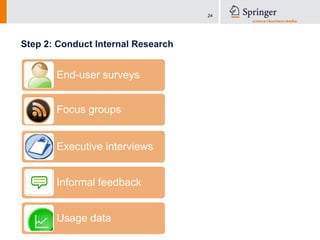
5 Steps to Creating a ROI DashboardA Practical Approach

SLA Hot Topic: ROI 2.0 Corporate Libraries

  • 1.
    ROI 2.0George Scotti,Director Channel Marketing
  • 2.
    BackgroundSpringer’s interest inROI came about from our Corporate and Government Library Advisory Board; they told us…“We have difficulty providing ROI on content to management & information tools are intangible and value is hard to measure.”
  • 3.
    So we decidedto dig a little deeper…Conducted a research study with corporate customers with Outsell in 2009.Held a workshop at our May 2009 corporate and government library advisory boards.Reviewed published research.Developed a 5 Step Plan to Developing an ROI Dashboard.
  • 4.
    What they hadto say…Perspectives on Value of Library, and Measuring Return on Investment from Information Manager Survey, Springer & Outsell, May 2009
  • 5.
    Measuring Value andPurchase DecisionsThe interviewees tend to rely heavily on usage statistics and cost per download as key measures on which to base purchase decisions.“The main value for money is the price I pay for documents, CPD, that’s the biggest thing I look at, that and usage statistics.”
  • 6.
    Measuring Value andPurchase DecisionsThey also recognize that softer metrics like time saved or projects progressing more smoothly are important but hard to measure.“In general we use soft measures; we don’t really have hard metrics to evaluate whether or not the investment is bringing the return that it should be.”
  • 7.
    Value of AuthoritativeSourcesThey recognize the value of peer-reviewed and other authoritative sources and strive to make sure that end users understand that value. “I’m primarily interested in peer-referenced material. We don’t provide any info that is “hearsay” or not from an authoritative source.”
  • 8.
    Value of AuthoritativeSourcesThey express concern that end users rely on “putting a few words in Google” to find results.“I think it is important that there is an institution that looks after the reliability of the data, very critical, people use Google and find anything, and much of it is not validated of course, some of it is very questionable.”
  • 9.
    The Library Withinthe OrganizationAll recognize that it is important for the library to be recognized for its value within the organization.“Helping people understand that the resources are valuable, and how and where to use those resources.”
  • 10.
    The Library Withinthe OrganizationIt was noted as very important that the library not only be a passive source of information, but an active participant in the ongoing corporate business.“We’re working on driving the users to the content as much as possible.”
  • 11.
    Here’s what theyhad to say…Springer Corporate and Government Library Advisory Board, May 2009
  • 12.
    What can wemeasureQuantitativeCost-per-download vs. document delivery or PPV.Demand via usage and turn-a-ways Negotiated cost vs list priceTotal cost of ownershipQuality of informationQualitative Time saved Impact What would you have done without material? Decision supported?Cost of alternative
  • 13.
    What would anideal dashboard look like…Presentation:A visual system, speedometer / traffic lights / key performance indicators.Translating resources used cost / download.Internal dashboard idea – capture what’s most relevant for senior management .In terms of Dollars and “Sense”.What to demonstrate:Value, i.e. penetration and use.Utilization, i.e. use, citations, authors, decisions supported.Time Saved.
  • 14.
  • 15.
    Finding a dollarvalue for library services and resources.Four basic steps are needed to find a bottom line for library services and resources.. Source: Barbara Weiner "Marketing: Making a Case for Your Library" 3 Sources, V18(5), October/November 2000, pages 3-5
  • 16.
    Case Study: HazeldenLibrary and Information Resources Center “This is not a scientifically rigid study. However, this dollar value exercise presents a reasonable estimate of the value that my library provides to its organization. “. Source: Barbara Weiner "Marketing: Making a Case for Your Library" 3 Sources, V18(5), October/November 2000, pages 3-5
  • 17.
    Finding a dollarvalue for library services and resources.“It is 2.3 times more expensive for an organization to garner information from other sources than to provide an on-site library. Thus for every dollar invested by an organization in their on-site library, the return is $2.30.” Keyes, Alison M. "The Value of the Special Library: Review and Analysis." Special Libraries. 1995 Summer; 172-187. . Source: Barbara Weiner "Marketing: Making a Case for Your Library" 3 Sources, V18(5), October/November 2000, pages 3-5
  • 18.
    Existing Research fromOutsellMethodologyResultsQuantitative survey among 2,000 corporate knowledge workers who have access to a libraryTime saved:In 35% of all library interactions
  • 19.
    Average time savedper interaction: 9.5 hoursFocus on ROI for Enterprise LibrariesMoney saved:In 20% of all library interactions
  • 20.
    Average money savedper interaction: $3KMetrics:Times library used
  • 21.
  • 22.
  • 23.
  • 24.
    Decisions supportedRevenue generated:In19% of all library interactions
  • 25.
    Average revenue generatedper interaction: $7KDecision supported:68% of respondentsSource: Outsell, Inc. "Information Management Under Fire: Measuring ROI for Enterprise Libraries", Nov. 2007; www.outsellinc.com
  • 26.
    Establishing the returnon investment for information and knowledge servicesShowing added value of ROI must be a top priority.Information management should align its goals with organizational strategy.Communication of ROI is key.ROI is a short list of added values expressed in:Source: Establishing the return on investment for information and knowledge services: A. Hendriks and Wooler Business Information Review.2006; 23: 13-25
  • 27.
    Conclusion from allresearch…Qualitative and quantitative is needed.Must add/estimate dollar value to qualitative to create a benchmark.Compare both to calculate ROI.
  • 28.
    5 Steps toCreating a ROI DashboardA Practical Approach